ISSN(Online) : 2319 - 8753
ISSN (Print) : 2347 - 6710
International Journal of Innovative Research in Science,
Engineering and Technology
(An ISO 3297: 2007 Certified Organization)
Vol. 4, Issue 1, January 2015
Spectrum Utilization in an Efficient Manner
Using Overlay and Underlay of Cognitive
Radio
S.Kumaravel 1, M.Appadurai2, A.Bakiya3
Assistant Professor, Department of Electronics and Communication Engineering, SKP Engineering College
Tiruvannamalai, Tamilnadu, India1, 2, 3
ABSTRACT: Spectrum utilization is improved significantly by allowing a secondary user to utilize a licensed band when the primary user (PU) is absent. Cognitive radio (CR), as an agile radio technology, has been proposed to promote the efficient use of the spectrum. Interest in Cognitive Radio (CR) remains strong as the communications community strives to solve the spectrum congestion problem. This paper proposed a method of using the overlay waveforms that exploit unused (white) spectrum holes and underlay waveforms that leads to a modest increase of the noise floor for these primary users.
KEYWORDS: Cognitive Radio, Spectrum Sensing, Energy Detection, Primary user, Secondary user, Spectrum Overlay, Spectrum Underlay
I. INTRODUCTION
As wireless technologies continue to grow, more and more spectrum resources will be needed. Within the current spectrum regulatory framework, however, all of the frequency bands are exclusively allocated to specific services, and no violation from unlicensed users is allowed. A recent survey of spectrum utilization made by the Federal Communications Commission (FCC) has indicated that the actual licensed spectrum is largely underutilized in vast temporal and geographic dimensions [2]. By sensing and adapting to the environment, a CR is able to fill in spectrum holes and serve its users without causing harmful interference to the licensed user. To do so, the CR must continuously sense the spectrum it is using in order to detect the reappearance of the PU. Once the PU is detected, the CR should withdraw from the spectrum so as to minimize the interference it may possibly cause. Another great challenge of implementing spectrum sensing is the hidden terminal problem, which occurs when the CR is shadowed, in severe multipath fading or inside buildings with a high penetration loss while a PU is operating in the vicinity.
FCC: “A cognitive radio (CR) is a radio that can change its transmitter parameters based on interaction with the environment in which it operates. The majority of cognitive radios will probably be SDRs (Software Defined Radios), but neither having software nor being field programmable are requirements of a cognitive radio.”Recent studies suggest that spectrum congestion is primarily due to inefficient spectrum usage rather than spectrum availability. Dynamic spectrum access (DSA) and cognitive radio (CR) are two techniques being considered to improve spectrum efficiency and utilization. The advent of CR has created a paradigm shift in wireless communications and instigated a change in FCC policy towards spectrum regulations. Within the hierarchical DSA model, spectrum overlay is employed to enable primary and secondary users to coexist while improving overall spectrum efficiency. As employed here, spectrum overlay exploits unused (white) spectral regions. Spectrally modulated, spectrally encoded (SMSE) signals, to include orthogonal frequency domain multiplexing (OFDM) and multi-carrier code division multiple access (MC-CDMA), are candidate CR waveforms. The SMSE structure supports and is well suited for CR-based software defined radio (SDR) applications.
ISSN(Online) : 2319 - 8753
ISSN (Print) : 2347 - 6710
International Journal of Innovative Research in Science,
Engineering and Technology
(An ISO 3297: 2007 Certified Organization)
Vol. 4, Issue 1, January 2015
Several studies have revealed that spectrum congestion is primarily due to the inefficient use of spectrum versus unavailability. Cognitive radio (CR) and ultra wide band (UWB) technologies have been proposed as candidates to address this problem. Currently, a CR determines unused frequency bands and transmits overlay waveforms in these bands, while UWB transmits underlay waveforms that span the entire frequency band while coexisting with primary users. This suggests that most of the spectrum occupied by primary users is underused. This work proposes a general soft decision cognitive radio (SDCR) framework, based on a previous developed spectrally modulated, spectrally modulated (SMSE) framework, to combine benefits of overlay/underlay techniques while maximizing channel capacity. We also show that current CR and UWB implementations represent two extreme SDCR cases and that current overlay/underlay waveforms are two special cases of the general waveform platform.
Compounding the confusion is the use of the broad term cognitive radio as a synonym for dynamic spectrum access. As an initial attempt at unifying the terminology, the taxonomy of dynamic spectrum access is provided. In this article, an overview of challenges and recent developments in both technological and regulatory aspects of opportunistic spectrum access (OSA). The three basic components of OSA are discussed. Spectrum opportunity identification is crucial to OSA in order to achieve nonintrusive communication. The basic functions of the opportunity identification module are identified.
II. COGNITIVE CYCLE
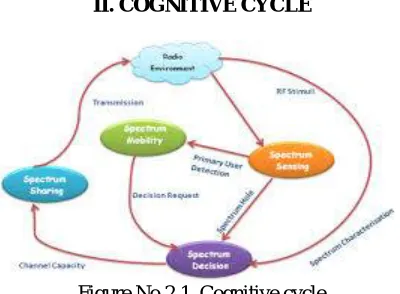
Figure No 2.1. Cognitive cycle
There are four main steps in Cognitive cycle:
1. Spectrum Sensing: It refers to detect the unused spectrum and sharing it without harmful interference with other users. It is an important requirement of the Cognitive Radio network to sense spectrum holes, detecting primary users is the most efficient way to detect spectrum holes.
2. Spectrum Management: It is the task of capturing the best available spectrum to meet user communication requirements.
ISSN(Online) : 2319 - 8753
ISSN (Print) : 2347 - 6710
International Journal of Innovative Research in Science,
Engineering and Technology
(An ISO 3297: 2007 Certified Organization)
Vol. 4, Issue 1, January 2015
III. CLASSIFICATION OF SPECTRUM SENSING TECHNIQUES
Figure No 3.1 Classification of SpectrumSensing Techniques
The classification of Spectrum sensing techniques are:
Matched filter detection
Energy detection
Feature detection
Cooperative detection
Interference-based detection
In this project we used energy detection technique.
Energy Detection:
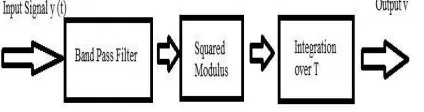
If the secondary user cannot gather sufficient information about the PU signal, the optimal detector is an energy detector, also called as a radiometer. It is common method for detection of unknown signals. The
block diagram of the energy detector is shown in Figure.
Figure No 3.2. Energy detection
First, the input signal y(t)is filtered with a band pass filter (BPF) in order to limit the noise and to select the bandwidth of interest. The noise in the output of the filter has a band-limited, flat spectral density. Next, in the figure there is the energy detector consisting of a squaring device and a finite time integrator. The output signal V from the integrator is
= / − dr
Finally, this output signal V is compared to the threshold n in order to decide whether a signal is present or not. The threshold is set according to statistical properties of the output V when only noise is present. The probability of detection Pd and false alarm Pf are given as follows.
= { >ƛ\ } = { >ƛ\ }
ISSN(Online) : 2319 - 8753
ISSN (Print) : 2347 - 6710
International Journal of Innovative Research in Science,
Engineering and Technology
(An ISO 3297: 2007 Certified Organization)
Vol. 4, Issue 1, January 2015
Figure No 3.3.Trade-off between missed detection and false alarm
IV. SPECTRUM OVERLAY
A spectrum overlay technique is a spectrum management principle whereby a secondary user uses a channel from a primary user only when it is not occupied. Spectrum overlay techniques are based on detect and avoid mechanism such as DFS. The secondary user senses the frequency spectrum, if a primary user is active the channel will not be used.
The defining assumption for these models is that the secondary transmitter has a priori (non-causal) knowledge of the primary user’s transmissions. Consider the communication scenario shown figure, where the primary transmitter (PT) and secondary transmitter (ST) wish to communicate over the same frequency band with the primary receiver (PR) and the secondary receiver (SR), respectively. All the channel gains are known to both the transmitters and both the receivers. The defining assumption in the overlay models is that the secondary transmitter has a priori knowledge of the primary user’s transmissions, i.e., the primary message W1 is non-causally known to the secondary transmitter. In such a scenario, there are two interesting strategies the secondary transmitter can pursue.
This is a greedy approach wherein the secondary transmitter uses all the available power to send its own message to the secondary receiver. The secondary transmitter uses the knowledge of the primary message to effectively null the interference at the secondary receiver by using a dirty paper coding technique. The secondary receiver is therefore oblivious to the presence of the primary user, as shown by the equivalent channel model in Figure 1b. While the selfish approach violates the cognitive radio principle of protecting the primary users, it provides a theoretical upper bound on the maximum throughput achievable by the secondary users.
In this approach, the secondary transmitter allocates a part of its power to relay the primary user’s message to the primary receiver. The remaining power is used to transmit the secondary user’s message. The power distribution is calculated so that the SNR at the primary receiver remains the same with or without the secondary user .The primary receiver is therefore virtually unaware of the existence of the secondary user. Since accurate knowledge of the primary user’s message is available, the secondary transmitter applies dirty paper coding on its own message to eliminate interference at the secondary receiver. The capacity of the secondary user in the low interference gain case (jH21j > jH22j) is characterized.
V. SPECTRUM UNDERLAY
Spectrum underlay technique is a spectrum management principle by which signals with a very low spectral power density can coexist, as a secondary user, with the primary users of the frequency band(s). The primary users deploy systems with a much higher power density level. The underlay leads to a modest increase of the noise floor for these primary users. Ultra Wide Band and other spread spectrum technologies can use a spectrum underlay.
VI. SYSTEM MODEL
ISSN(Online) : 2319 - 8753
ISSN (Print) : 2347 - 6710
International Journal of Innovative Research in Science,
Engineering and Technology
(An ISO 3297: 2007 Certified Organization)
Vol. 4, Issue 1, January 2015
Spectrum overcrowding continues to present a fundamental challenge for both military and commercial communications as earlier concerns over spectrum congestion and inefficient usage are manifest with 4G system emergence. A number of Dynamic Spectrum Access (DSA) models have been proposed to enhance the spectrum efficiency. Under the hierarchical DSA model, interactions between primary and secondary users are considered to achieve spectrum efficiency. Thus, the hierarchical DSA model is synonymous with Cognitive Radio (CR) technology. In current CR research, the secondary user uses an overlay waveform to harness unused spectrum holes (white areas) and avoid interference to the primary users.
As demonstrated for a non-faded AWGN channel, the proposed waveform effectively exploits both unused spectrum holes and underused spectrum bands to improve overall channel capacity and Bit Error Rate (BER) performance of the secondary user, without impacting the primary user’s transmission. Specifically, the work in extended the original Spectrally Modulated Spectrally Encoded (SMSE) framework in to create a soft decision SMSE (SD-SMSE) frame work that supports a group of multi-carrier based signals to generate hybrid overlay/underlay waveforms in support of soft decision CR applications. The BER of overlay, underlay and hybrid overlay/underlay CR waveforms was the primary evaluation metric.
The original SMSE framework provides a unified expression for generating and implementing a host of multicarrier waveforms (e.g., OFDM, MC-CDMA CI/MC-CDMA , TDCS, etc) and satisfies current CR goals of exploiting unused spectral bands. However, the original work did not explicitly exploit underused spectrum. In Part I we extended the original SMSE framework into a soft decision SMSE (SDSMSE) framework by relaxing conditions on the binary (hard decision) spectrum availability .
VII. MODULES Analysis of Overlay Channels
When the secondary user employs an overlay waveform for transmission, only the spectrum holes are used. Here it is assumed that one secondary user is transmitting over all available spectrum holes. The corresponding received signal for a secondary user employing NC-OFDM can be written as
( ) = ( ) ( )
WhereEbs is the secondary user’s average bit energy, (s) is the secondary user’s ith symbol value, fhi is the ith sub
carrier frequency that corresponds to the ith spectrum hole, and Mh is the total number of subcarriers/spectrum holes.
Similarly, the received signal for a secondary user employing NC-MC-CDMA can be written as
( ) = ( ) ( )
whereβiis the ith component of the spreading code for the secondary user. Since the secondary and primary user’s
transmissions are assumed to be synchronized in time, and the secondary user only transmits within spectrum holes, there is no interference from the secondary user to primary users and vice versa. In this case, the BER performance of the secondary and primary users is simply given by
( ) =1 2 1−
̅⁄2 1 + ̅⁄2
where γ is the average signal-to-noise ratio (SNR) defined as
̅= [ ]
with [.] being the expected value operator.
Performance analysis in multipath fading channels
ISSN(Online) : 2319 - 8753
ISSN (Print) : 2347 - 6710
International Journal of Innovative Research in Science,
Engineering and Technology
(An ISO 3297: 2007 Certified Organization)
Vol. 4, Issue 1, January 2015
( ) = ( ) + ( ) + ( )
whereas before is the total number of primary users, is the total number of secondary users, represents the received signal of the primary user,is the received signal of the h secondary user, and represents AWGN having a two-sided power spectrum density of N0/2.Without loss of generality, it is assumed that each primary user experiences different, independent channel fading. Hence, the primary user’s signal goes through a frequency selective fading channel with impulse response and is given by,
( ) = ℎ ( ) ∗ ( )
where represents convolution and represents the primary user’s transmitted signal. Note that if the primary user’s signal is not transmitted through a fading channel, the channel response in simply after transmission through a multipath fading channel with impulse response, the received secondary user signals are given by
( ) =ℎ( ) ∗ ( )
Assuming that the primary user transmits an OFDM signal with BPSK modulation over subcarriers, the transmitted signal in (27) for the primary user corresponds to:
( ) = { ( ) ( )
where, is the user’s average bit energy, is the user’s symbol value, is the subcarrier frequency of the user, is a rectangular waveform of unity height which time-limits the code to one symbol duration, and the subcarrier bandwidth.
Performance Analysis of Overlay Waveforms
When the secondary user employs an overlay waveform for transmission, only spectrum holes are used. Here, it is assumed that one secondary user is transmitting over all the available spectrum holes. The received signal corresponding to the secondary user waveform employing NC-OFDM can be written as:
( ) = { ( ) ( ) ( )
where is the channel fading gain on the subcarrier, is the phase offset introduced by the fading channel on the subcarrier is the secondary user’s average bit energy, is the secondary user’s symbol value, is the subcarrier frequency that corresponds to the spectrum hole, and is the total number of subcarriers. Similarly, the received signal of a secondary user employing NC-MC-CDMA can be written as
( ) = ( ) ( ) ( )
where, j is the component of the spreading code for the secondary user.
Given that primary and secondary user transmissions are assumed to be synchronized in time, and the secondary user only transmits within spectrum holes, there is no interference from the secondary user to primary users and vice versa .Without frequency diversity, the NC-OFDM BER performance of secondary and primary users is the same as what occurs for a flat fading channel and is given .However, the signal is recombined across all NC-MC-CDMA subcarriers to exploit frequency diversity. After frequency combining, the final decision variable corresponds to:
( ) = ( )
where, the first term is the desired signal, the second term is MAI and the third term is the noise contribution. It is relatively straight forward to show that the corresponding instantaneousSINR is:
= +
ISSN(Online) : 2319 - 8753
ISSN (Print) : 2347 - 6710
International Journal of Innovative Research in Science,
Engineering and Technology
(An ISO 3297: 2007 Certified Organization)
Vol. 4, Issue 1, January 2015
( ) = √ ( ) ( )
where, (SINR)is the probability density function of SINR.
VIII. RESULTS AND DISCUSSION
This section deals with the discussion of various result analyses on cognitive spectrum sharing.In this analysis of spectrum performance, that is, how to share the spectrum by primary and secondary user, for the flat fading overlay waveform.
Figure 8.1 Overlay Waveform
From the Figure 8.1, it is clear that spectrum which is not used by the primary user is used by the secondary user.
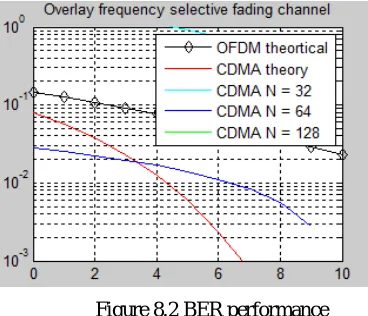
Figure 8.2 BER performance
ISSN(Online) : 2319 - 8753
ISSN (Print) : 2347 - 6710
International Journal of Innovative Research in Science,
Engineering and Technology
(An ISO 3297: 2007 Certified Organization)
Vol. 4, Issue 1, January 2015
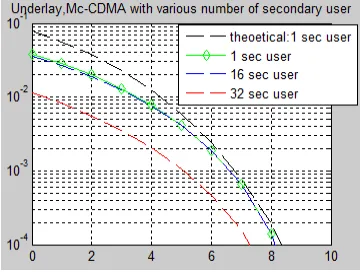
Figure 8.3 BER performance
Figure 8.4BER performance
From the Figure 8.3, it is clear that, performance of underlay network is best than theoretical for the number of secondary user is equal to 1. And also, it is clear that, practically, when the number of secondary users increases, bit error decreased, thus the performance increased.
From the Figure 8.4, it is clear that, performance of underlay network is worst than theoretical for the number of subcarrier is equal to 512. And also, it is clear that, practically, when the
IX. CONCLUSION AND FUTURE WORKS
Thus, when the number of subcarrier increases, the performance of overlay network increases, whereas for underlay network, it decreases. Hence, in a cognitive radio network the subcarrier module should be high in order to maintain a good balance between power spectral density and bit error rate.
ISSN(Online) : 2319 - 8753
ISSN (Print) : 2347 - 6710
International Journal of Innovative Research in Science,
Engineering and Technology
(An ISO 3297: 2007 Certified Organization)
Vol. 4, Issue 1, January 2015
REFERENCES
[1] “FCC - Notice of proposed rulemaking and order, facilitating opportunitiesfor flexible, efficient and reliable spectrum use employing cognitiveradio technologies,” FCC Document ET Docket No. 03-108, Dec. 2003.
[2] Q. Zhao and B. M. Sadler, “A survey of dynamic spectrum access,”IEEE Signal Process. Mag., vol. 24, pp. 79–89, May 2007.
[3] Q. Zhao and A. Swami, “A survey of dyanmic spectrum access: signalprocessing and networking perspectives,” in Proc. Int’l Conf. Acoustics,Speach, Signal Process. (ICASSP), Oct. 2007, vol. 4, pp. 1349–1352.
[4] V. Chakravarthy, Z. Wu, M. Temple, F. Garber, R. Kannan, andA. Vasilakos, “Novel overlay/underlay cognitive radio waveforms usingSD-SMSE framework to enhance spectrum efficiency–part I: theoretical
framework and analysis in AWGN channel,” IEEE Trans. Commun.,vol. 57, Dec. 2009.
[5] M. Roberts, M. A. Temple, M. E. Oxley, R. F. Mills, and R. A.Raines, “Communication waveform design using an adaptive spectrallymodulated, spectrally encoded (SMSE) framework,” IEEE J. Sel. Topics
Signal Process., vol. 1, no. 1, pp. 203–213.
[6] M. Roberts, M. A. Temple, M. E. Oxley, R. F. Mills, and R. A. Raines,“A general analytic framework for spectrally modulated, spectrallyencoded signals,” in Proc. IEEE Waveform Diversity Conf., Jan. 2006.
[7] M. Roberts, M. A. Temple, M. E. Oxley, R. F. Mills, and R. A. Raines,“A spectrally modulated, spectrally encoded analytic framework forcarrier interferometry signals,” in Proc. International Wireless Commun.
Mobile Computing Conf. (IWCMC), July 2006.
[8] V. Chakravarthy, Z. Wu, A. Shaw, M. Temple, R. Kannan, and F. Garber,“A general overlay/underlay analytic expression representing cognitiveradio waveform,” in Proc. IEEE Int’l Conf. Waveform Diversity Design,June 2007.
[9] C.-W. Wang and L.-C.Wang, “Modeling and Analysis for Reactive-Decision Spectrum Handoff in Cognitive Radio Networks,”Proc. IEEE Global Telecomm.Conf. (GlobeCom), 2010.