STUDY OF SEISMIC STRUCTURE-SOIL-STRUCTURE INTERACTION
BETWEEN TWO HEAVY STRUCTURES
Christine Roy1, Aaron J. Roffel2, Said Bolourchi3, Luben Todorovski4, and Mahmoud Khoncarly5
1Senior Staff I – Structures, Simpson Gumpertz & Heger Inc., Waltham, MA ([email protected]) 2
Staff II – Structures, Simpson Gumpertz & Heger Inc., Waltham, MA ([email protected])
3Senior Principal, Simpson Gumpertz & Heger Inc., Waltham, MA ([email protected]) 4URS Corporation, Princeton, NJ ([email protected])
5URS Corporation, Cleveland, OH ([email protected])
ABSTRACT
Seismic structure-soil-structure interaction (SSSI) may have a significant effect on the structural seismic design and in-structure response spectra (ISRS) used for design of equipment and components. Prior studies have shown that heavy structures typically have significant impact on seismic responses of closely spaced light structures. There are limited studies addressing the impact of SSSI for closely spaced heavy structures. This paper presents a case study evaluating the significance of SSSI effects on seismic response of closely or moderately spaced heavy structures based on the results of SSSI analyses performed on finite element models of heavy ultimate heat sink (UHS) structures for different soil conditions and at different spacing when subjected to low frequency ground motion.
The significance of SSSI effects is evaluated by comparing the maximum nodal accelerations and ISRS obtained from soil-structure interaction (SSI) analyses of a stand-alone UHS to responses obtained from SSSI analyses of closely and moderately spaced UHS structures. The horizontal responses in direction of the adjacent structure are considered as representative SSSI behavior for heavy structures. The results of the study indicate that the SSSI effect has to be considered for closely and moderately spaced structures with a low frequency content input, as their responses can be significantly impacted depending on the soil conditions and depth of embedment.
INTRODUCTION
The seismic analysis and design of heavy nuclear facilities are typically based on responses obtained from SSI analyses of stand-alone buildings interacting with the free-field environment without consideration of the effects of SSSI with adjacent structures. Analytical and experimental studies have shown that adjacent structures can significantly affect dynamic responses but the conditions under which structure-soil-structure interaction (SSSI) effects must be considered have not been identified. Chen et al. (1997) and Roy et al. (2011) showed that relatively smaller structures have little SSSI effect on larger structures, but a larger and heavier structure could significantly impact the response of the lighter structure. Imamura et al. (1992) showed that SSSI of a reactor building, control building, and turbine building with soil modeled between them can increase the responses of the buildings at higher elevations, although the responses of the structures below grade are not significantly impacted by the SSSI effects. The Imamura study modeled the structure using two-dimensional finite element (FE) models and accounted for three-dimensional (3D) interaction effects using a lumped-mass 3D boundary element model.
structural and system SSI frequency of the structures. This paper presents a case study evaluating the significance of SSSI effects on seismic response of a heavy structure when it is closely or moderately spaced with another heavy structure.
STRUCTURE AND MODELS DESCRIPTION
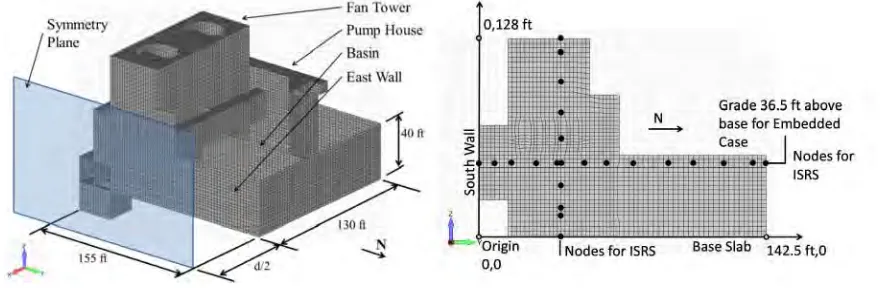
The current study considers the SSSI impact of embedded and surface-mounted ultimate heat sink (UHS) structures that are approximately 130 ft by 155 ft in plan dimensions with 40 ft height of water basin and total structural height of 128 ft. The base slab is embedded approximately 36.5 ft below grade. The basin walls are 4 or 5 ft thick, the superstructure walls are 1 to 5 ft thick, the basin slab is 5 ft thick, and the Pump House basin base slab, which is 12 ft below the basin slab, is 5 ft thick. There is a two-barrel tunnel 26 ft 5 in. wide by 18 ft 2 in. tall on the south side of the basin. The deeper tunnel extension is embedded approximately 21 ft below the base slab. These structures are considered heavy since the equivalent uniform gravity loading pressure under the foundation of the UHS with its basins full with water is approximately 4.0 ksf. The UHS structure is selected for this study since there is no slab at top of the basin wall and the embedded structure will exhibit more interaction with the soil.
The FE model of the UHS structure consist of 27,920 plate elements modeling the walls and slabs, 1,606 beam elements modeling girders and columns, vertical nodal masses on the basin base slab nodes to simulate vertical water masses, and horizontal nodal masses on the basin walls to simulate impulsive mass of water in the basin. 3D solid elements are used to model the excavation volume for SASSI2000 program modeling. An anti-symmetric plane at 5 ft or 30 ft east of the east wall of the UHS is used to simulate the d = 10 ft or 60 ft spacing of the structures for SSSI analyses in the east-west direction. The east-west (longitudinal) direction is considered as representative behavior since the response in the other directions (transverse and vertical) are expected to be similar or less significant (Imamura et al., 1992). The FE model of the UHS structure considered in this study is shown in Figure 1.
Figure 1: UHS structure description and model (left) and east wall elevation showing nodes for ISRS comparison (right)
ANALYSIS CASES
with soil of Vs 1000 ft/s at top 36.5 ft on stiff soil of Vs 5000 ft/s below basin foundation is considered. The unit weight of soil is 145 pcf, Poisson’s ratio is 0.35, and the damping ratio is 0.01 for all soil conditions. Soil extends two times the largest structure base dimension below the base slab. SSI and SSSI analyses of embedded structures are performed using the modified subtraction method, defining all nodes on the exterior of the excavation block including the top nodes as interaction nodes. Analyses of the surface structures are performed using the direct method with all nodes on the excavation defined as interaction nodes. The following is a summary of the analysis cases and abbreviations for each SSSI case considered for this study:
For the surface model conditions:
• SS_d: SSSI of surface structures with soft soil and spacing ofdft • ST_d: SSSI of surface structures with stiff soil and spacing ofdft For the embedded model conditions:
• ES_d: SSSI of embedded structures with soft soil and spacing ofdft • ET_d: SSSI embedded structures with stiff soil and spacing ofdft
• EST_d: SSSI embedded structures with soft-over-stiff soil and spacing ofdft
where dis distance between two structures, equal to 10 ft or 60 ft. The SSI analyses of the stand-alone UHS cases use the same abbreviations defined above but without the spacing distance d. Therefore, the abbreviation ET is for stand-alone SSI of embedded structure with stiff soil.
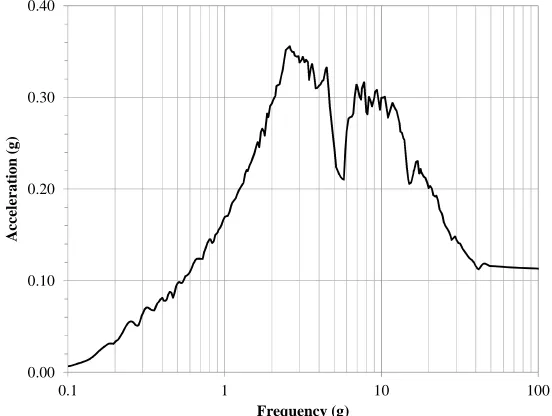
For all analyses, the same input motion with low frequency content is applied at the elevation of the basin slab. For the embedded cases this motion is defined as in-layer input and for the surface cases the same motion is used as surface input for the program SASSI. The 5% damped spectrum of the input motion is shown in Figure 2. Although the input motion used has a valley at about 5.5 Hz corresponding to soft soil column above basin slab, the use of this motion for this comparative study should be acceptable.
Figure 2: 5% damped acceleration response spectrum of input motion
IMPACT OF SSSI ON NODAL MAXIMUM ACCELERATION
The nodal maximum accelerations, also referred as zero period acceleration (ZPA), are calculated for SSSI analyses and stand-alone SSI analyses. The comparison of results shows SSSI impacts the nodal
0.00 0.10 0.20 0.30 0.40
0.1 1 10 100
A
cc
el
er
a
ti
o
n
(g
)
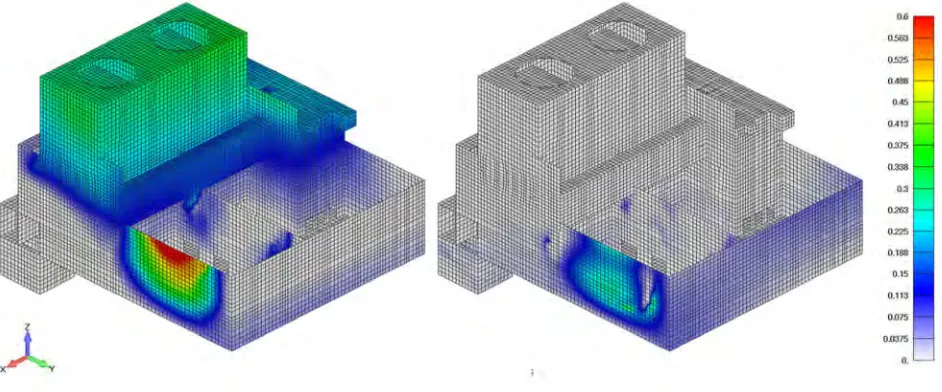
ZPA values. The SSSI nodal ZPAs most significantly increase locally for the soft soil condition, followed by moderate increases for stiff soil condition, and the least impact for the soft backfill on stiff soil condition. To present the impact of SSSI on ZPA, the nodal SSI ZPA is subtracted from the nodal SSSI ZPA and assumed to be zero if the difference is zero or negative. Positive difference shows the increase in ZPA in (g) units of gravity due to SSSI impact. Figure 3 shows the SSSI impact on nodal ZPA for the embedded UHS in uniform soft soil when the adjacent structures are spaced at either 10 ft or 60 ft. This figure shows that the responses above grade and at the basin east wall (wall closest to the adjacent structure) are affected most when structure spacing is 10 ft. When the adjacent UHS is spaced at 60 ft, the SSSI effect on ZPA is reduced, and is concentrated at the basin walls. These results are similar to those reported by Imamura et al. (1992) at the south section of the UHS, but not for the UHS cantilever basin walls below grade. This difference could be due to the simplified modeling and methods used by Imamura as opposed to the detailed 3D modeling used in this study. It could also be due to the difference in structural flexibility. The UHS basin walls act as cantilevers below grade. The reactor building studied by Imamura has walls supported at the top and bottom, similar to the south section of the UHS.
Figure 3: Increase in ZPA (
g
) for embedded UHS with uniform soft soil (SS) due to SSSI effect for spacing of 10 ft (left) and 60 ft (right)IMPACT OF SSSI ON IN-STRUCTURE RESPONSE SPECTRA (ISRS)
The ISRS for the SSSI analyses are calculated and compared to the corresponding responses for the SSI analyses. Based on review of the nodal ZPA comparison it was shown above that the east wall of UHS is most impacted by SSSI behavior. The ISRS are developed at nodes along a vertical line and horizontal line on the east wall of UHS as shown in Figure 1 (right). The ISRS are presented and compared up to 15 Hz in this paper due to the low frequency content of the input and also to assure the transfer functions to be very smooth using the modified subtraction method, although responses beyond 15 Hz are similarly impacted by SSSI.
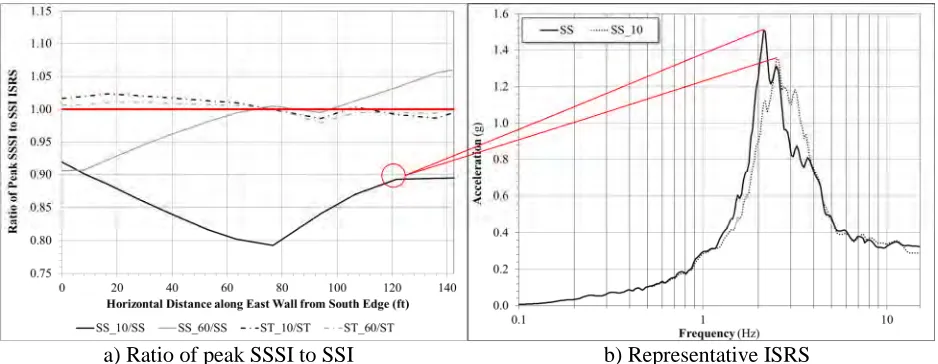
east wall. A ratio greater than unity indicates SSSI amplifies the peak of the ISRS; a ratio less than unity indicate that SSSI reduces the peak of the ISRS. The main peaks ratio does not give the entire SSSI impact on ISRS, since there are cases that the ratio could be less than unity but there may be other peaks for SSSI spectrum that could exceed the SSI spectrum. However, this measure provides a representative indication of the significance of SSSI effect on ISRS.
Surface Conditions
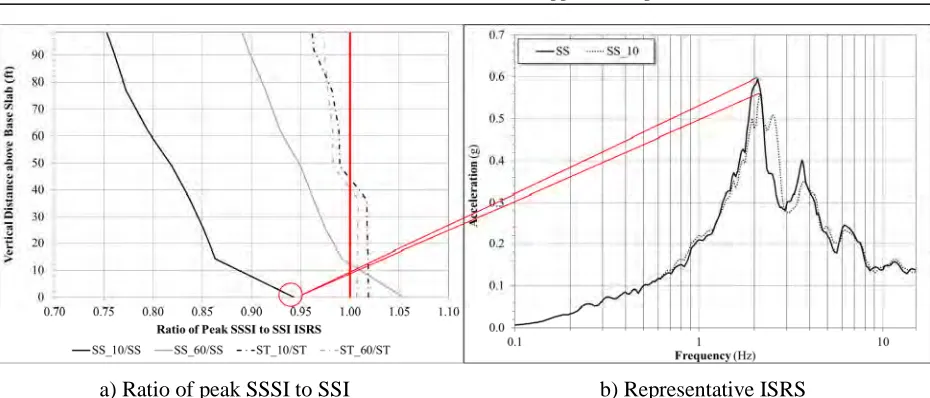
The comparison of the ratios of the peak spectra shown in Figures 4a and 5a generally show reduced SSSI spectra peaks compared to SSI spectra peaks for soft soil conditions. The distance between structures has nominal impact on the SSSI responses for the stiff soil, and more impact for soft soil case. There is a greater reduction in the peak of the spectra for 10 ft spacing for the soft soil case. Typical spectra along horizontal and vertical nodes for 10 ft spacing in soft soil are also shown in Figures 4b and 5b. These demonstrate a reduction in the primary spectral peaks due to the SSSI effect; however, there are frequency ranges where the SSSI spectra exceed the SSI spectra that are not captured in the ratio measure.
a) Ratio of peak SSSI to SSI b) Representative ISRS
a) Ratio of peak SSSI to SSI b) Representative ISRS
Figure 5. Ratio of ISRS peaks and typical ISRS on east wall along vertical distance for surface structure
Embedded Conditions
The comparisons of ratios of the peak of spectra for all embedded conditions are shown in Figures 6 and 7. These figures show that SSSI behavior can significantly increase the peak of spectra as compared to SSI response. The impact of SSSI behavior is most pronounced for the embedded stiff soil condition with 10 ft spacing between UHS structures. The spectra comparison for the embedded stiff soil condition with 10 ft spacing at locations of maximum increase in the peak are shown in Figures 6 and 7. The SSSI spectra envelope the SSI spectra for most of the frequency range considered in this study. The embedded structure in soft soil is moderately impacted by SSSI behavior and the soft-over-stiff soil condition is least impacted. In general, the main peaks of the SSSI ISRS are more amplified when the structures are 10 ft apart, as compared to 60 ft.
a) Ratio of peak SSSI to SSI b) Representative ISRS
a) Ratio of peak SSSI to SSI b) Representative ISRS
Figure 7. Ratio of ISRS peaks and typical ISRS on east wall along vertical distance for embedded structure
CONCLUSIONS
Representative heavy UHS structures with thick basin walls and no slab at top of the walls were used to study the impact of heavy structures located at 10 ft or 60 ft apart. The study was performed for surface and embedded structures with uniform soft or stiff soil profiles, and an additional soft-over-stiff soil condition for embedded structures. The responses in terms of nodal maximum accelerations and in-structure response spectra with SSSI behavior were compared to corresponding responses from SSI behavior of the stand-alone structure.
A heavy structure could impact the responses of an adjacent heavy structure.
The area of the structure closer to the adjacent structure is generally more impacted by SSSI behavior.
SSSI behavior impacts both nodal maximum accelerations and in-structure response spectra.
The SSSI behavior has more impact on responses when the structures are closer.
SSSI responses of the embedded UHS are more impacted compared with that of surface structures.
SSSI analysis compared with SSI analysis generally shows amplified peak response on an embedded heavy structure adjacent to another embedded heavy structure, but in cases such as surface structures the SSSI peak response is reduced.
REFERENCES
Chen, J. C., Maslenikov, O. R. and Johnson, J. J. (1997). “Seismic Reponses of a Nuclear Power Generation Complex Including Structure-to-Structure Interaction Effects,” 1997 ASME Pressure Vessels and Piping Conference, ASME, Orlando, FL.
Imamura, A., Ishizaki, M., Watanabe, T. and Motosaka, M. (1992). “Seismic Response Characteristics of Embedded Structures Considering Cross Interaction,” Earthquake Engineering, Tenth World Conference, Balkema, Rotterdam.
Roy, C. H., Eggers, D. W. and Bolourchi S. (2011). “A Cascade Analysis to Account for Structure-Soil-Structure Interaction Effects,”Transactions SMiRT-21, New Delhi, India.