CHANDRA, DHRUBA. Speech Recognition Co-processor. (Under the direction of Professor Paul D. Franzon.)
With computing trend moving towards ubiquitous computing propelled by the
advances in embedded mobile processors and battery technoloqy, speech recognition
is becoming an essential part of embedded processor I/O device. Speech recognition is
also used in command and control and automated customer service. Real time speech
recognition application is both computation and memory intensive and it overwhelms
even a high end multi-gigahertz processor to achieve real time performance. An
embedded mobile device cannot support real time large vocabulary speech recognition
application as the processors are less aggressive because of tighter power budget.
Hardware solution to speech recognition, in the past, have mainly concentrated on
building specialized hardware or ASIC accelerators to run software speech application
faster but have largely ignored design for large vocabulary and power reduction.
In this work, we propose a hardware-software co-design for real time large
vocabu-lary speech recognition. Our design has custom ASIC blocks and RAM memories and
a low power processor. The processor maintains a high level control over the blocks
and processes parts of speech recognition application which is not computation and
memory intensive. The custom ASIC computes the Gaussian probability and
per-forms word search in the dictionary. The RAMs are used for storing the intermediate
values and states. The design can handle large vocabulary speech recognition in real
time on a mobile embedded device. Our word search uses innovative dictionary word
layout in memory which reduces bandwidth by a factor of 11 compared to software
implementation and by a factor of 4 compared to other ASIC implementation. One
unit of our proposed design can perform 4x and 20x better than other proposed
de-sign of specialized hardware dede-sign for software speech application in computing the
by
Dhruba Chandra
A dissertation submitted to the Graduate Faculty of North Carolina State University
in partial fulfillment of the requirements for the Degree of
Doctor of Philosophy
Computer Engineering
Raleigh, North Carolina
2007
Approved By:
Dr. E. Rotenberg Dr. Robert Rodman
Dedication
Biography
Dhruba Chandra was born and raised in Durgapur, West Bengal, India. He received
a Bachelors and a Masters in Mathematics from Indian Institute of Technology (IIT),
Kharagpur. Dhruba joined graduate program in Applied Mathematics at North
Car-olina State University in fall of 1999. He received a Masters in Applied Mathematics
in fall of 2001 and a Masters in Computer Engineering in spring of 2002. Since spring
of 2003 he has been enrolled in computer engineering doctoral program at North
Acknowledgements
First and foremost, I would like to thank my advisor, Dr. Paul Franzon. His has
unique way of advising students. He encourages free thinking and his valuable
feed-back keeps his students on track and always motivated. He has always impressed
me and all other ECE graduate and undergradute students with his teaching. I am
thankful to all my committee members. I would like to thank Dr. Rhett Davis for
his valuable suggestions and for asking the critical questions. I thank Dr. Rotenberg
for teaching computer architecture courses and letting me use the modified
simplas-calar simulator. I thank Dr. John Wilson and Dr. Steve Lipa for always helping the
research group. I would like to thank my previous research group - Dr Solihin, Dr
Seong beom Kim, Dr Mazen Kharbutli and Fei Guo.
I thank my parents for their love, support and constant encouragement. My sister
has always been source of my inspiration. I would like to thank all my friends from my
undergraduate days - Bibhudatta Sahoo, Chandrasekhar Puthilathe, Debasis Mishra,
Mukul Khandelia, Ranadeb Chaudhuri, Shailendra Jha, Sunil Saini, Vinit Srivastava
Vivek Gulati, Saurav Prasad, Sumon Chattopadhye, Rohith S., Shubhadip Niyogi,
Pratik Chaudhury and Chandramauli Sastry. Thanks to Vikram Pendharkar, Paul
Palathingal, Jaishankar, Sajid, Tanvir, Milind, Shamsheer, Udayan, and Shashank
for friendship and tolerating me as their roommate. Thanks to the Volleyball gang
and Kausar Hassan.
of gallon of Java sipped, camaraderie I developed with the fellow coffee drinkers
and hundreds of hours invested - discussing world politics, NFL, college basketball
and research. Thanks to Cup-A-Joe for being that coffee shop. Thanks to Ajit
Rajagopal, Meeta Yadav, Nikola Vouk, Radha Venkatagiri, Salil Pant, Sarat
Kocher-lakota, Saurabh Sharma, Sibin Mohan, Surendra Jain for being the comrades. Time
spent with these folks in - Lab / Coffee Shop/ Glenwood South- is priceless. Thanks
to Nagendra Kumar and Milind Nemlekar for starting the evening coffee tradition.
I would like to thank my friend Ravi Jenkal for his help in my research. Thanks to
Ambarish Sule and Vimal Reddy for helping me in my research work with various
tools and simulator. Thanks to Meeta again for helping me in getting post defense
formalities done.
To all friends and folks in Raleigh, thank you for making my stay enjoyable over
Contents
List of Figures ix
List of Tables xii
1 Introduction 1
1.1 Speech Recognition: Demand and Challenges. . . 1
1.1.1 Recognition Basics . . . 6
1.1.2 Identifying Performance Bottlenecks . . . 8
1.2 Proposed Solution and Key Contributions . . . 10
1.3 Dissertation Outline . . . 12
2 Hidden Markov Model and Speech Recognition Theory 13 2.1 Markov Process . . . 13
2.2 Hidden Markov Model . . . 16
2.3 Speech Recognition Theory . . . 18
2.4 Language Model. . . 23
2.4.1 Stochastic Language Models . . . 24
3.1.1 Frontend . . . 29
3.1.2 Observation Probability Computation . . . 29
3.1.3 Word Search. . . 34
3.2 Building a Case for our Design. . . 37
4 Related Work 39 4.1 Software Solutions . . . 40
4.1.1 Problems with Software Solution . . . 42
4.2 Hardware Solutions . . . 43
5 System Architecture 46 5.1 Frontend . . . 48
5.2 Senone Evaluation Stage and Word Decode Stage . . . 50
5.3 Basic Blocks . . . 53
5.3.1 Observation Probability Unit . . . 53
5.3.2 Senone Score Memory . . . 54
5.3.3 Acoustic-Model RAM. . . 56
5.3.4 Senone Prioritizer . . . 56
5.3.5 Viterbi Decoder . . . 58
5.3.6 Dictionary Storage . . . 59
5.4 Word Search Mechanism . . . 64
5.4.1 Word Sequences, Language Model and Word Path Search . . . 67
6 Results 70 6.1 Performance and Power Evaluation . . . 71
6.1.1 Senone Evaluation Stage . . . 72
6.1.2 Word Decode Stage . . . 72
7 Summary 79
List of Figures
1.1 Sphinx-III Performance [27] . . . 3
1.2 Battery Life-Words/min vs.Processor [24] . . . 4
1.3 Dictionary Word, Basic Sounds and Statistical Models . . . 6
1.4 Speech Recognition (Functional Blocks) . . . 7
1.5 Comparison Computation Performance . . . 9
1.6 Word search block Computation Performance . . . 9
2.1 Hidden Markov Model Experiment . . . 17
2.2 Composite HMM representing the word this ( th-ih-s ) . . . 19
2.3 Tied mixtures or Senones . . . 20
2.4 Dictionary Arrangements . . . 20
3.1 Frontend L1 Cache Miss Rate . . . 29
3.2 Frontend L2 Cache Miss Rate . . . 30
3.3 L1 Cache Miss Rate for Observation Probability Calculation . . . 30
3.5 L2 Miss Rate for Observation Probability Computation (2000 Senones) 32
3.6 L2 Miss Rate for Observation Probability Computation (4000 Senones) 32
3.7 L2 Miss Rate for Observation Probability Computation (6000 Senones) 33
3.8 Performance of Observation Probability on 1GHz Processor . . . 33
3.9 Triphone Evaluation Example . . . 34
3.10 Miss Rate for All Fresh nodes, and All Repeat Nodes . . . 36
3.11 Performance of Word Search Stage - Triphones per Frame . . . 37
3.12 Processing of Input Speech Pipelined across three Functional Blocks . 38 5.1 Speech Recognition System . . . 46
5.2 Speech Recognition Frontend . . . 49
5.3 Senone Evaluation and Word Decode Stage for first couple of frames 51 5.4 Observation Probability (OP) Unit . . . 54
5.5 Senone Score Memory . . . 55
5.6 Senone State Memory and Prioritizer . . . 57
5.7 Viterbi Decoder (δ = Delta) . . . 59
5.8 Triphone Representation using Senone ID . . . 60
5.9 Word and Lexical Tree information packed in a triphone packet . . . 61
5.10 Unfurled Flat Dictionary in RAM . . . 62
5.11 Triphone data block in Dictionary RAM . . . 63
5.12 Word Search Mechanism . . . 65
6.1 Bandwidth Comparison Senone Evaluation . . . 76
List of Tables
1.1 Cache size Miss-rate and Bandwidth . . . 5
6.1 Phoneme arcs and Active arcs in 12306 word Lexical Tree Dictionary 71
6.2 Power and Area of the Observation Probability Unit (0.18µ Tech) . . 73
6.3 Power and Area of the Word Decode Stage (0.18µTech) . . . 73
6.4 Performance per Senone and Senones Evaluated Per Frame . . . 76
6.5 Performance per Triphone and Triphones Evaluated Per Frame . . . . 77
6.6 Comparison of Power Consumption - Senone evaluation . . . 78
Introduction
1.1
Speech Recognition: Demand and Challenges
The advances in computing ability of processors, low power embedded processors
and artificial intelligence are making Human-Computer Interaction (HCI) and
ubiq-uitous computing a reality. Automatic speech recognition is an essential part of HCI
and ubiquitous computing and has some attractive advantages when used as an I/O
device for a system. Usually, a person can speak faster than he/she can type and it
keeps his/her other senses free to do other tasks.
Automatic speech recognition is also useful in applications like automated
cus-tomer service, interactive video games, and for controlling unmanned vehicle. With
the advent of battery operated mobile devices like cell-phone, PDA, speech
medical transcription etc. as the I/O (alphabet keyboard) of these battery operated
mobile devices are not user friendly. Automatic speech recognition coupled with an
automatic language translator can be used as language-to-language translation for
tourism, business or military purposes.
Speech recognition can done with template matching [6] but has limitations on its
usability. Any word spoken outside the pre-recorded templates are not recognizable.
Also, recognition may be speaker’s accent dependent. We now look at desirable/ideal
characteristic of a speech recognition system. A speech recognition system should
be as accurate as possible. Speech is different from the other I/O devices, such as
a computer key board, since in most cases it needs to be speaker independent. For
example, an automated customer service application may have callers with different
accents. Speaker independent speech recognition cannot be done using template
matching and is best handled using Hidden Markov Model (HMM), explained later
in the text.
When used as an I/O (speech to text) for emails, making documents or for
med-ical transcription the vocabulary needs to be fairly large since an ideal recognizer
should identify all words spoken, which may span the entire language dictionary. The
recognition should be done real-time/finite-time as otherwise the recognized speech
may lose its significance. Therefore, an ideal speech recognition system should be
a high accuracy real-time speaker independent Large Vocabulary Automatic Speech
different dialects.
Research in academia and industry have long pursued and developed high
accu-racy LVASR. The popular commercial systems available in market today are Dragon
naturally speaking [38], IBM’s Via Voice [4], Phillips-Freespeech98 [5] etc and systems
developed by academia are CMU-Sphinx [1], Cambrige-HTK [2] etc. These systems
are all software solutions, available as software packages and are run on desktop/server
platforms.
Speech recognition involves complex mathematical calculations involving floating
point numbers and has large memory requirement. Software solutions for speech
overwhelm a powerful desktop/server system because of their computational needs,
large memory and high memory bandwidth requirement.
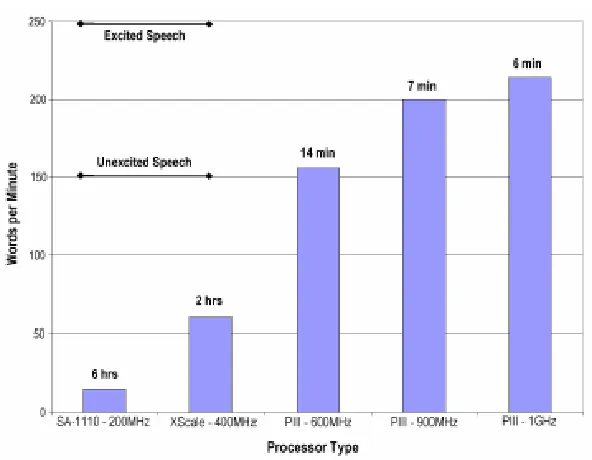
Figure 1.2: Battery Life-Words/min vs.Processor [24]
Sphinx-III developed by CMU runs 1.8x slower than real-time on a 1.7 GHz AMD
Athelon [27]. The Figure 1.1 shows the processor speed and the recognition
perfor-mance for 29.3 sec of speech. In theory 1
, 2.4GHz is required to achieve real-time
performance. These recognition systems are memory intensive, have large memory
footprint, high L2 miss-rate and memory bandwidth requirement. The miss-rate of
L2 cache and bandwidth requirement are shown in Table 1.1. The recognition
sys-tem uses key resources of a syssys-tem (execution units, caches, bus bandwidth) because
of its high computational needs and high miss-rates of speech recognition and other
applications running on the desktop/server system may freeze because of resource
starvation. Moreover speech recognition is not scalable with processor frequency and
1
architectural changes are required. Figure 1.1 shows the battery life of two ’AA’
batteries if they power different processors running speech application.
Table 1.1: Cache size Miss-rate and Bandwidth
L2 Cache Size 2MB 4MB 8MB Miss Rate (%) 34.39 29.42 17.9 Bandwidth (MB/s) 1502 1261 773
It implies that the speech recognition application cannot be ported to battery
operated mobile devices as embedded processors (SA-1110 or X-scale) do not have
the required processing power and it is impractical to have a a Pentium / Athlon like
processor on a mobile device as it cannot be powered by a battery.
To make real time speech recognition work on embedded mobile enviroment, we
propose a system with a general purpose microprocessor, dedicated ASICs and RAMs.
We identify the computationally heavy and memory intensive parts of the speech
recognition and provide a solution with dedicated ASIC and RAM structures,
respec-tively. The microprocessor maintains a high-level control over the ASIC blocks and
performs computationally non-intensive tasks of the speech recognition.
We now take a look at speech recognition in somewhat more details 2
to quickly
identify the critical parts that cuases performance bottleneck (computationally heavy
and memory intensive parts) and solution proposed (key contributions).
2
1.1.1
Recognition Basics
Any words spoken in a language is composed of a sequence of basic sounds. Sound
features of these basic sounds are captured and are represented as a collection of
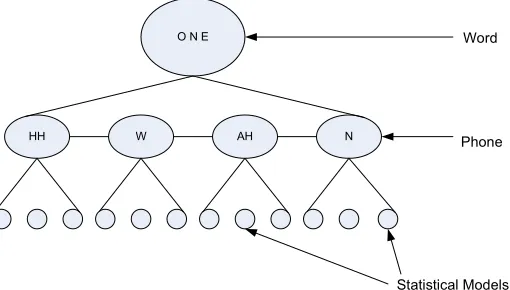
multi-dimensional statistical models. The following figure 1.3 shows the word ”ONE” as
sequence of basic sounds ”HH-W-AH-N”. These basic sounds are also called phones. All words in a language dictionary are sequence of basic sounds.
Figure 1.3: Dictionary Word, Basic Sounds and Statistical Models
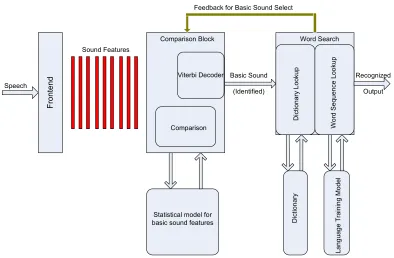
The following Figure 1.4 shows how a speech recognition system works. It is
divided in three broad functional blocks. Spoken words goes through Digital Signal
Processing (DSP) Frontend and sound features of the speech are extracted. To have a real-time recognition features are extracted every 10ms. These features are then
probabilistically compared with the huge database of all possible known basic sound
features to identify the most likely spoken sequence of sounds. (This database is
a collection of statistical models of basic sound features and is created by speech
of the dictionary words are mapped as sequence of sounds, the first part of the word
search block identifies the word(s) from dictionary.
! " # $% &
Figure 1.4: Speech Recognition (Functional Blocks)
There are many close sounding words and many different words may sound
sim-ilar because of speaker’s accent. It often happens that sequence of sound produced
matches closely with more than one word in the dictionary for one word spoken at the
frontend. All the close matching words are considered as poteintial candidate for the
actual word spoken. So a sentence with several words spoken at the frontend results
in a trellis of words identified as poteintial candidate for words spoken. The second
part (word sequence search) in word search block picks the most likely sequence of
words spoken from the trellis. This is done by baising certain sequences of words over
language training model.
1.1.2
Identifying Performance Bottlenecks
We now look at the performance bottlenecks in each block (as shown in Figure1.4)
of a speech recognition application run on a general purpose microprocessor. Our
speech recognition application is Sphinx-III [1]. We use Simplescalar [3]3
simulator for
the underlying processor architecture, is similar to present day application processor
on a mobile device. It is a 233MHz, 2-way out-of-order with 32KB L1 instruction
cache, 32KB L1 instruction cache, 256KB unified L2 cache (instruction and data).
Since the features are extracted every 10ms, we look at how the following parts
perform in processing the features extracted in 10ms. If each block takes 10ms or less
(i.e. 2.33 million cycles or less) in processing, a simple pipelined architecture with 3
stages would suffice.
The Frontend is a lightweight process and the software implementation for
ex-tracting features from speech signal take less than 1% [27,24] of the execution time
of speech recognition application on a general purpose microprocessor.
In the comparison block, there may be as many as 6000 (or more) different
sta-tistical models representing basic sound features. The number of comparisons can be
reduced with a feedback mechanism from the word search block. Figure 1.5 shows
the performance of the comparison part of the comparison block. Even one thousand
comparison takes around 16 million processor cycles. Usually, with feedback, the
3
Performance (Comparison block)
0 20 40 60 80 100
1K 2K 3K 4K 5K 6K # of c om pa ris on s Million Cycles
Figure 1.5: Comparison Computation Performance
number of comparisons reduced to around two thousand. All comparisons must be
done without feedback. Therefore, the comparisons are a bottleneck for a real time
speech recognition.
Performance - Word Search Block
0.00E+00 5.00E+05 1.00E+06 1.50E+06 2.00E+06 2.50E+06 3.00E+06
1f 25f 50f 75f 100f 125f 150f
Frame
C
yc
le
s
Figure 1.6: Word search block Computation Performance
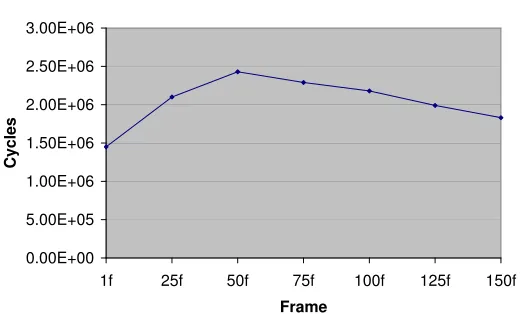
We now look at the performance of word search functional block (Figure 1.6).
The performance of this functional block is dependent on size of the vocabulary. We
number of cycles needed for real time recognition for many frames. A dictionary for
large vocabulary is usually consists of hundred-thousand words. With those many
words in the dictionary, the number of frames not processed within 10ms is much more
than the number shown in the figure. Therefore, this gives us another bottleneck that
needs to be considered.
The performance of speech application clearly shows that real time recognition
is not possible on a present day embedded processor. In this work, we propose a
software-hardware co-design of the speech recognition system such that real time
recognition can be handled on a mobile device.
1.2
Proposed Solution and Key Contributions
• We propose a new design to traverse through lexical tree dictionary in hardware
and suggest an ASIC for word search, which uses this hardware tree traversal
to look through the words in the dictionary. It recognizes individual words and
provide information for determining the possible word sequences in the input
speech. One unit of this design performs about 20 times better than other
implementation of specialized hardware design to run speech application.
• Large vocabulary may have more than hundred thousand dictionary words. The
dictionary is stored in a DRAM memory. We propose a new way to store the
dictionary words in the DRAM which facilitates lexical tree traversal and
application and by a factor of 4 when compared to other hardware
implemen-tation of speech recognition.
• In the previous section, we saw that the comparison of a feature vector with
the database is a performance bottleneck. The comparison involves complicated
floating point calculations. We propose a dedicated ASIC for these
computa-tions. The ASIC can perform the required number of comparison within 10ms
(i.e. meets real time goal) and can operate in much lower frequency than the
processor, therefore saves power. This solution also enables the system to do
more exhaustive search and computation than a software speech recognition
ap-plication tailored for embedded enviroment. The design is flexible to algorithmic
changes in speech recognition theory which reduces processing requirement and
bandwidth, thus gives opportunity to reduce frequency and hence reduce power.
One ASIC unit performs 4 times better than one unit of specialized hardware
(processing element) for running speech application. The ASIC power
consump-tion is lower by a factor of eight.
• The feedback from the word search enables the comparison block to make
smaller number of relevant comparison in the database than comparing the
entire database. We design a mechanism which implements the feedback using
three small embedded SRAMs (1KB each). This design also priortizes some
1.3
Dissertation Outline
The remainder of the dissertation is organized as follows:
• Chapter 2 introduces the HMM based speech recognition theory in detail. The
Markov process is explained with a simple example of weather forcasting. The
hidden Markov model is introduced with the coin tossing example. Basic
defi-nitions and and an understanding of speech recognition system is presented.
• In chapter 3, we take look at the characteristics of speech recognition
applica-tions. Various performance bottlenecks are analyzed in greater detail, which
leads to our software - hardware co-design of the speech recognition system.
• Chapter 4 touches upons the related work in academia and industry. The
CMU-Sphinx system (opensource) is explained in detail as we use CMU-Sphinx system for
speech recognition Frontend and SphinxTrain for creating Acoustic and Lan-guage Models. Known speech recognition implementations in hardware is then
discussed.
• Chapter 5, presents our design, its various components and an understanding
of how the system works.
• Chapter 6 presents the performance and power results of our system and
com-pares it with the other related work.
Chapter 2
Hidden Markov Model and Speech
Recognition Theory
As mentioned earlier, speech recognition is usually efficient and accurate using
Hidden Markov Model (HMM). We start by understanding Markov process (chain)
and a hidden Model model and its application to speech recognition.
2.1
Markov Process
A Markov process is a stochastic process with Markov property. The Markov
property states that conditional probability of appearance of future state of a process,
given the present and all the past states only depends on the present state and not
on any of the past states. In other words, the future state is independent of the
path of the process (past states of the process). If X1, X2, X3, ..., XN are the random
variables which represents the occurrence of states s1, s2, s3, ...., sM then
P(Xi/Xi−1
where Xi−1
= Xi−1, ...., X3, X2, X1, i < N and the random variable Xi and Xi−1
represent the occurrence of state sp and sq, where p, q[1, M] respectively. The
prob-ability P(Xi = sp/Xi−1 =sq) is called the transition probability between the states
p and q and is represented by apq. The other properties associated with Markov
proccess are
M X
j=1
aij = 1; (2.2)
M X
j=1
P(X1 =sj) = 1; (2.3)
Both the equations represent basic principles of probablity theory that the sum of the
transition probabilities from one state to all of its possible next state is one and the
sum of the probabilities of the initial state being in any one of the M states is also
one. The Markov process above is called an observable Markov model. The output
of the process is a set of states, the occurence of each of which corresponds to an
event represented by the random variables. There is a one-to-one mapping between
observable event sequence X and Markov chain state sequence S.
The following example gives a good understanding of the Markov process and its
applicability. The summer weather in Raleigh, NC can be considered to have the
following three states.
• Really hot and dry (s1)
• Really hot and little humid (s2)
Let P(si) represent the probability of a certain day (initial day) being in state si.
Since the summer days are categorized into the above three states, any particular day
will be either dry or little humid or very humid. Therefore, probability that the intial
day is either dry, little humid or very humid (equaton 2.3) follows:
P(s1) +P(s2) +P(s3) = 1; (2.4)
Assume,P(s1) = 0.4,P(s2) = 0.4 andP(s3) = 0.3. Now, if the transition probability
from dry, little or very humid weather on a particular day to dry(d), little humid(l.h)
or very humid(v.h) next day is given by the following matrix:
aij =
d l.h v.h
d l.h v.h
0.2 0.6 0.2
0.3 0.3 0.4
0.1 0.3 0.6
The above matrix is called transition probability matrix for this system. The
sum-ming transition probabilities to all possible weather states for next days we get one
(equation 2.2). In above probability transition matrix this corresponds to the sum
of the row elements. With above information we can forecast the probability of a
particular weather pattern using Markov process. Probability of a weather pattern
−l.h−> d−> l.h−> v.h−> l.h−> d−> v.h−> v.h− is evaluated as follows:
P(O|M) = P(s2, s1, s2, s3, s2, s1, s3, s3)
= (0.4)(0.3)(0.6)(0.4)(0.3)(0.3)(0.1)(0.6)
= 0.00015552
2.2
Hidden Markov Model
The above Markov model is observable, i.e states are observed when an event oc-curs. This observable Markov model is too restrictive and cannot be applied to many
problems. Alternately, Markov model can be extended such that the observations are
probabilistic functions of the state. In other words, it is a double-embedded stochastic
process with an underlying stochastic process not directly observable (hidden). This
underlying stochastic process can only be probabilistically associated with another
observable stochastic process producing the sequence of features we can observe. The
hidden Markov model concept is well understood through the well known coin toss
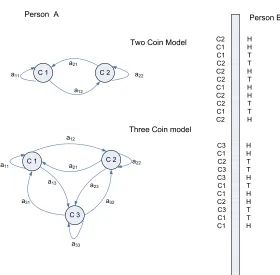
example [34]. Assume that there is a coin tossing experiment where a person (say
person A) is performing coin tosses from two different sets of coins: one set has two
coins in it and the other one has three coins in it. Person A can select any coin from
just one set for the toss. Now another person (say person B) can’t see howA chooses
a coin but just observes the outcome of sequence of head and tail.
The observation O is sequence of head or tail tossed by person A and seen by
person B. Each set can produce an observation and each individual coin can be
Figure 2.1: Hidden Markov Model Experiment
will be tossed is the transition probabilityaij (thejth coin will be tossed immediately
after the ith). The person B can now probabilistically determine whether the two
coin model or the three coin model was most likely used for tossing.
HMM based speech recognition uses the same concept. Any utterence (speech)
is composed of sequence of basic sounds. Any word in dictionary is composed of
se-quence of basic sounds. Each of these basic sound have statistical models. Therefore,
a word can be expressed as sequence of statistical models. Speech (to be recognized)
is sampled by the the speech recognition system to form a sequence of speech feature
vectors (numerical parameters). This sequence of speech feature vector is the
most likely would produced the speech vector. Identifying the model sequence results
in identifying the word spoken.
2.3
Speech Recognition Theory
A spoken word or phrase is represented as a sequence of basic sounds called phone or phoneme [39, 18, 20, 15]. For example, there are approximately 51 phonemes in the English language. A Permutation of these phones leads to a word or a phrase.
The sentence ”This is speech” is phonetically broken down to ’th ih s ih z s p iy sh’.
Phones are an excellent means for encoding word pronunciation but they are not
ideal for recognition of speech. The contextual affects cause variation in the way the
basic sounds are produced. Each of the phones along with it neighboring phones (left
and right) is called a triphone. Therefore, in above example sound of ’ih’ is effected by neighboring ’th’ (left phone) and ’s’ (right phone). Recognizing triphone units in
context tends to be more accurate than recognizing individual phones. The triphones
are represented with a ’-/+’ sign so ’th-ih+s’ represent a triphone where ’th’ and ’s’
are the left and right phones respectively. The first phone in any utterance has ’sil’
(representing silence) as the left phone. The total number of possible triphones in
English is around 65000. The phones without any influencing neighbouring phones
are called context-independent phones. In this text, phones and triphones are used interchangeably. Context-indenpendent phone refers to original phone without any
Y Z P
X Q Y R U U
Th ih s
Figure 2.2: Composite HMM representing the word this ( th-ih-s )
In HMM based speech recognition theory, for each phone and triphone, there is
a corresponding statistical model called hidden Markov model. These HMMs are
sequence of states called Markov states, connected by probabilistic transitions. Each
of these states have one or more entry and exit states. Exit state of one triphone
merged to entry state of another forms composite HMM, which allows to represent a word and then the words joined together to form a phrase or utterance.
Figure2.2is an example1
of a three state HMM representing the word ”this”. The
states in triphones are best represented by multi-variate mixture Gaussian
distribu-tion. The parameters for the statistical models which represents the states (Gaussian
mixtures and transition probabilities) are obtained from the training data and is
collectively called the Acoustic Model.
In absence of sufficient training data or to avoid redundancy of data the states
of different triphones can be sometimes represented by same distribution [21, 40],
and these are called senones or tied mixtures. Therefore, a combination of senones 1
Figure 2.3: Tied mixtures or Senones
forms triphones, which, in turn, combine to form words and words, themselves, come
together to form a sentence or an utterance. Number of senones in English language
is around 6000.
The collection of all words is called the dictionary. The dictionary words are phonetically broken down and are stored in eitherflatform orlexical treeform [14,36]. Figure 2.4 shows two form of dictionary arrangement representing words - Start,
Starting, Started and Startup.
S S S S T T T T AA AA AA AA AA R TD DX DX DX IX IX PD DD NG T
R AX
R T PD DD NG AX IX IX DX DX R R TD
R T
S
FLAT LEXICAL TREE
In a speech recognition, speech or the utterance (to be recognized) is a sequence of
words. It goes through theFrontend, where spectral analysis is done to extract the fea-ture vectors(input acoustic vectors). These feature vectors are sampled at fixed inter-vals (10 ms). The sequence of vectors thus obtained is called theobservation sequence . If the observation sequence is O=O1, O2, O3, ..., OT, where Oi represents a feature
vector sampled at fixed interval, the speech recognition decoder (the decoder is the
part which does the actual recognition) finds the sequence of words (i.e. sequence
phones or triphones) which is most likely to produce the observation O. If the
se-quence of n words is represented by W =W1, W2, W3...., Wn, the decoder maximizes
P(W|O), whereP represents the probability. We want to maximize P(W|O),
apply-ing Bayes’ theorem
P(W) =argWmaxP(W|O) =argWmaxP(W).P(O|W)
P(O) (2.5)
Where P(W) represents the probability of a word sequence and is available from
language model. P(O) is the probability of the observation sequence. P(O|W) is the
probability of observation sequence O, given the word sequence W. It is computed
using a composite hidden Markov model forW, constructed from simple HMM phone
or triphone models joined in sequence (according to word pronunciations stored in a
dictionary).
In speech recognition, HMM generates speech feature vector sequences. It is a
finite state machine which changes state every time unit and each time t that a
called the observation probability. As mentioned earlier, each of the transition is probabilistic. The probability of transition from statei to statej is given by discrete
probability, called the transition probability and is represented by aij.
The joint probability of observation of vector sequence O and state sequence
X = xo, x1, x2...xT−1, given some model M is calculated as product of the
transi-tion probabilities and the output probabilities.
P(O, X|M) = b0(O0)ΠT−1
t=1 bxt(Ot)axt−1xt (2.6)
assuming the HMM is in state 0 at timet= 0. In practice, only observation sequence
O is known and underlying state sequence is hidden. The probability P(O|M) is
determined by the probability associated with the state sequence which maximizes
P(O, X|M). This is calculated usingViterbi decoder. We defineδt(j) as the maximum probability that the HMM is in state j at time t. The value δt(j) is computed, as
follows
δt(j) =max0≤i≤N−1[δt−1(i)aij].bj(Ot) (2.7)
where i is the previous state (at time t− 1). The observation probability bj(Ot),
where Ot represents the probability that state j emits observation feature vector
Ot for observation sequence number t. The observation probability [40] is mixture
multivariate Gaussian distribution is given by
bj(Ot) =
M X
m=1
where cjm is the weight of the mixture component, m in statej and N(Ot;µjm, σjm)
is the multivariate Gaussian with meanµ and covariance σ
N(Ot;µj, σj) = (√L1 2π)
1
p
Πσji.e
−12P(Oji−µji)2 2σ2
ji (2.9)
Lis the dimension of the feature vector considered (summation and multiplication
is done from 1 through L). Calculation of observation probability is computationally
very intensive and is usually calculated in logarithm domain to reduce the complexity.
Moreover, it is calculated against large number of senones per frame.
2.4
Language Model
The language model is used by large vocabulary speech recognition system to
increase recognition accuracy [8, 9, 31]. It helps in identifying the most probable
sequence of words uttered from a large pool of words recognized as candidate for
ac-tual words spoken. The Language model selects a sequence of words attaching more
weight to certain word sequence out of pool of alternative word sequences produced
by the acoustic model for possible match. Weight are priori probability of sequence of
words. Inclusion of language model also helps in increasing efficiency of speech
recog-nition system by eliminating (pruning) the unlikely path for word sequence search.
All the present day speech recognition systems have some sort of language model.
The language model also enables the recognition system to have correct syntax and
semantics of the language. It helps in forming meaningful and grammatically well
theory [29] 2
or by using probabilistic language model (Stochastic language model).
Most of the recognition system uses Stochastic Language Model (SLM) [23].
2.4.1
Stochastic Language Models
Stochastic language modeling is a probabilistic approach to language modeling.
The most commonly used SLM is the N-gram model. It provides adequate
proba-bilistic information so that likely word sequence has the maximum probability among
all other possible word sequence.
N-gram Models
Revisiting equation 2.5, P(W) is the probability of word sequence. P(W) is
mathematically expressed in the following form.
P(W) = P(w1, w2, w3, ..., wn)
= P(w1)P(w2|w1)P(w3|w1, w2)...P(wn|w1, w2, w3, ...wn−1)
= Πn
i=1P(wi|w1, w2, ...wi−1) (2.10)
where P(wi) is the probability of wordwi appear following the occurence of word
sequence w1, w2, w3,...,wi−1. The probability evaluation is managable with small
vocabulary size since the complexity of the language model increases exponentially
with the vocabulary size. If the vocabulary size is V, the word wi will have Vi−1
histories and it is practically impossible to evaluate all the values even for a moderate
2
value of i. To reduce the complexity of the P(W) a variant of above probability
formulation is considered. Instead of P(wi|w1, w2, w3...., wi−1) an equivalance class
P(wi|wi−N+1, wi−N+2, wi−N+3...., wi−1) is considered. This is called the N-gram
lan-guage model [17, 33]. When N = 1 we have P(W) = ΠP(wi) - unigram language model, the probability ofith word does not depend upon any previously spoken words
but depends on probability of a word appearing in training data. When N = 2 we
have P(W) = ΠP(wi|wi−1) - bigram language model. Therefore, bigram language
model suggests that probability of appearence of a word in an utterence depends on
the previous word uttered. When N = 3 we have P(W) = ΠP(wi|wi−1, wi−2) -
tri-gramlanguage model - probability of word appearing in an utterence depends on two previous words uttered. The three language models listed above are most commonly
used in speech recognition systems. In some of the systems N = 5 is also used. The
probabilities of all these stochastic language models are predefined for speech
recog-nition process, and the values are obtained from training the language model using
training data. The probabilities for N-gram(N = 3) model are usually calculated
using the following formula.
P(wi|wi−1, wi−2) =
F(wi−2, wi−1, wi)
F(wi−2, wi−1)
(2.11)
F(wi−2, wi−1, wi) refers to the frequency of occurrence of the trigram (wi−2, wi−1, wi)
in the training text and F(wi−2, wi−1) refers to the frequency of occurrence of the
bi-gram (wi−2, wi−1). The training data however may not cover entire vocabulary or have
system using N-gram model may bias against a sequence of words which has
max-imum likelyhood according to acoustic model of the system. In such cases M-gram
(M < N) probabilities are used in the place of N-gram probabilities after reducing
the probability by a back-off weight which accounts for the fact that the next higher
N-gram has not been seen and therefore has a lower chance of occurring [12].
Alter-natively, smoothing technique is used to get the N-gram probabilitiies. In N-gram
smoothing, the low probabilities are raised and the high probabilities are lowered.
The idea is to keep the language model with extreme values (N-gram probability of 0
or 1)totally overriding the the selection of word sequence even though acoustic model
may suggest otherwise. A simple smoothing technique is to assume any trigram
(se-quence of three words) appears one more than actually observed in the training data
as shown below.
P(wi|wi−1, wi−2) =
1 +F(wi−2, wi−1, wi)
P
wi(1 +F(wi−2, wi−1, wi))
(2.12)
With above equation2.12, the probability of any unseen trigram in the training data
Chapter 3
Evaluation and Analysis of Speech
Recognition Application
In this chapter, we look at how speech recognition application performs on a
gen-eral purpose microprocessor. Our goal is to achieve real time large vocabulary speech
recognition on a battery operated mobile device. We first evaluate the performance
of speech recognition software application in processing one frame of speech on a
gen-eral purpose microprocessor. One frame of speech is speech input in 10ms (sampling
interval). In order to have a real time recognition one frame of speech input must be
processed within 10ms or less.
We use Sphinx-III [1] for our evaluation and analysis. This is because, Sphinx is
open source, free and achieves good recognition (fast and low error rate). In chapter
1, we mention that the speech recognition has three major independent functional
parts - the Frontend, the Comparison Block (probability computation) and the Word
Search. We evaluate and analyze each of these parts separately. The performance
chap-ter 1, figure1.1and figure1.2, respectively. Our analysis based on different functional
parts, helps us understand various performance bottlenecks of the application when
run on a general purpose microprocessor. It also helps us decide, hardware software
partition in for a hardware-software system design for speech recognition.
Any speech recognition system implemented in software or hardware needs large
memory for the acoustic model, dictionary and language model storage. The acoustic
model is looked up numerous times every frame as senones are evaluated in each and
every frame in the recognition process. The dictionary is also looked up every frame
for the matching triphones. The language model is looked up less frequently than
the acoustic model and dictionary. For a software speech recognition application
on a general purpose microprocessor these memory lookups are converted to loads
and stores (generated because of storing various scores computed in the process of
recognition). In case of hardware (hardware accelerator) implementations the lookups
and stores are memory reads and writes.
3.1
Performance Analysis of the Functional Blocks
We saw a brief performance evaluation in chapter 1. We now present detailed
performance analysis of the functional blocks. Since speech recognition is very
mem-ory intensive, we present the complete analysis of the application’s memmem-ory behavior
3.1.1
Frontend
The Frontend converts the speech input to acoustic vectors. The speech signals
undergo digital signal processing and acoustic vectors [25, 26] are obtained. The
Frontend only counts for 1-2% of the processing time of speech recognition application
[24,27]. Though, Frontend is a light weight process (low processing time), we still look
at its memory characteristic since its memory behavior may effect the performance of
other jobs running simultaneously. The following figures 3.1 and 3.2 shows the miss
rates of the Frontend in L1 and L2 cache.
0 0.01 0.02 0.03 0.04 0.05
16K 32K 64K
Cache Size
M
is
s
R
at
e
Figure 3.1: Frontend L1 Cache Miss Rate
3.1.2
Observation Probability Computation
In chapter 1, we have seen the time taken to evaluate senone scores for different
number of senones. The amount of time taken to score a group of senones is linearly
0 0.05 0.1 0.15 0.2 0.25 0.3
64K 128K 256K 512K 1024K 2048K
Cache Size M is s R at e
Figure 3.2: Frontend L2 Cache Miss Rate
expected and is observed in Figure1.5. The reason for this linear trend is the fact that
the senone score (observation probability) is evaluated using equation 2.8 and each
senone has different acoustic parameters (mean, variance and constant cofficients).
The acoustic parameter for each senone is around 2.5KB. Once a senone score is
computed its 2.5KB of data is never reused. So N senones would require 2.5*N KB
of data. 0 0.005 0.01 0.015 0.02
8K 16K 32K 64K
L1 Cache Size
M is s R at e
2000 Senones 4000 Senones 6000 Senones
Figure 3.3, shows the L1 cache miss rates of the observation probability
calucula-tion of 2000, 4000 and 6000 senones on different cache sizes. Figure 3.4 shows ratio
of number of hits per way in L1 cache. The high hit rate in most recently used cache
line imply of a good spatial locality. The observation probability calculation is
ex-pected to show high spatial locality since each of the parameters in acoustic model is
4 byte (32 bits) wide and are packed together in cache blocks and each of the senone
is evaluated one by one.
0 0.1 0.2 0.3 0.4 0.5 0.6 0.7 0.8 0.9
MRU LRU MISS
L1 Ways R at io -L 1 A cc es se s)
2000 Senones 4000 Senones 6000 Senones
Figure 3.4: Access pattern in L1 Cache
The miss rate in L2 cache is shown in Figure3.5, 3.6and 3.7. The high miss rates
in L2 and the pattern of hits in the L1 ways indicate that lack of temporal locality
in data used to evaluate the observation probability of senones. The high number of
accesses to L2 cache with high miss rate results in cache pollution and effects other
application threads or different threads of the same application. It tends to increase
the number of misses in L2 access for other threads possibly slowing them down [10].
L2 Miss Rate (2000 Senone)
0.8 0.85 0.9 0.95 1
64K 128K 256K 512K 1024K 2048K
Cache Size
L1=16K L1=32K
Figure 3.5: L2 Miss Rate for Observation Probability Computation (2000 Senones)
L2 Miss Rate (4000 Senones)
0.8 0.85 0.9 0.95 1
64K 128K 256K 512K 1024K 2048K
Cache Size
L1=16K L1=32K
Figure 3.6: L2 Miss Rate for Observation Probability Computation (4000 Senones)
imply that observation probability of senone can be computed with one hierarchy of
small cache size.
We now focus on the computational part of the senone score evaluation. This is
done by assuming one cycle latency in all loads and stores,i.e., every memory request (including the cold misses) is assumed to be a hit in L1 cache. Figure 3.8 shows the
performance on senone computation in two different architecture platform for 2000
L2 Miss Rate (6000 Senones) 0.8 0.85 0.9 0.95 1
64K 128K 256K 512K 1024K 2048K
Cache Size
L1=16K L1=32K
Figure 3.7: L2 Miss Rate for Observation Probability Computation (6000 Senones)
processor.
Performance of Observation Probability Calculation
0 1 2 3 4 5 6 7 8 9 10
1K 2K 3K 4K 5K 6K
# of Senones
Fr am e in te rv al (1 0m s)
L1-L2-Memory No Memory Latency
Figure 3.8: Performance of Observation Probability on 1GHz Processor
Ideally, all senones in an acoustic model used in recognition system should be
scored within one frame. Therefore, for large vocabulary speech in English, having
1000 or more senones, real time recognition is not possible since it takes about 8.6
times more time to compute.
time requirement. Therefore, either architectural changes are needed for running the
speech application or ASIC accelerator is needed to to speed up the computation.
3.1.3
Word Search
The words in a speech recognition system are represented by sequence of triphones.
Each triphone is represented by three senone sequence in 3-state HMM (or five senone
sequence in 5-state HMM) and the transition matrix. If the senone scores are
avail-able, the triphone score can be computed using a Viterbi decoder [13, 16, 19, 22]. In
each frame, the word search computes its triphone scores. A triphone (in a word)
may be computed in consecutive frames, also one frame may compute more than one
triphone. (shown in figure 3.9).
Figure 3.9: Triphone Evaluation Example
A word is idtentified by the speech recognition system as spoken word when it
detects the last triphone of the word and the over all word score (sum of score of each
is above preassigned threshold. We refer triphones in a word as nodes or triphone nodes.
For real time speech recognition, every frame needs to evaluate certain number of
nodes. These nodes are called the active nodes. The number actives nodes changes dynamically based on algorithm implemented in the speech recognition system.
Dic-tionary used in the speech recognition application is a lexical tree dicDic-tionary where
the different words share the common nodes. Sharing reduces memory space for
stor-ing dictionary words and reduces redundant score computation. The computation of
each node with available input data takes same amount of time.
With the dictionary arranged in lexical tree format the two factors effecting the
performance of this stage are number of active nodes and memory latency of input
data. Unlike senone evaluation stage, the cache hierarchy plays an important role
in determining the performance of this stage. The reason for this is the fact that a
particular node may be active in two or more consecutive frames, therefore, a high
possibility of the node data structure being found in the cache. In presence of a node
data structure in cache hierarchy results in quicker score evaluation because of smaller
latency for data.
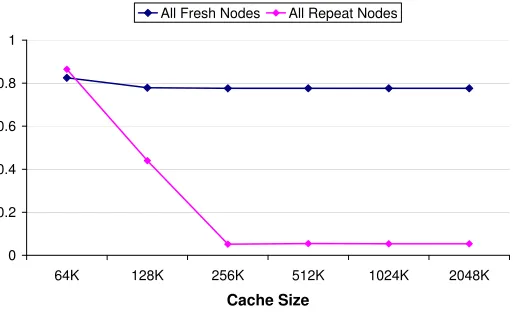
There are three possible categories in which we can classify the performance of the
word search stage. They are 1) None or very few active nodes present in the cache
hierarchy (High miss mate 2) Almost all or majority of the active nodes present in
nor the misses (nodes not preset in the cache) on active nodes are ignorable. The
following figure (Fig. 3.10) shows first two categories. It shows the miss rates of the
L2 cache accesses by the word search in frame duration. All fresh nodes signifies
that score of each node is computed for the first time in this frame, therefore causing
L2 cache misses. Score of a node computed in the preceding frame is a repeat node
and likely to result in cache hits. The miss rates for the third category is bounded
within maximum and minimum miss rates values available for these curves. It is
L2 Miss Rate (Word Search)
0 0.2 0.4 0.6 0.8 1
64K 128K 256K 512K 1024K 2048K
Cache Size
All Fresh Nodes All Repeat Nodes
Figure 3.10: Miss Rate for All Fresh nodes, and All Repeat Nodes
difficult to estimate the performance of the word search part of speech recognition
application and guarantee real time performance since the number of active triphone
nodes and the repeat characteristic of the active triphones in consecutive frames are
input (speech) dependent. We, therefore, bound the performance of word search
between time taken to compute one triphone node score under cache hit and time
taken to compute one triphone node score under cache miss. The figure (Fig. 3.11)
10 ms). (These values are not linear with processor speed. The processor speed is
only used for calculation of processor memory latency in cycles)
0 1000 2000 3000 4000 5000 6000
233 MHz 400 MHz 1000 MHz
Processor Speed N um be r o f T rip ho ne s
All Fresh All Repeat (L1 Hits)
Figure 3.11: Performance of Word Search Stage - Triphones per Frame
3.2
Building a Case for our Design
We now find a solution for real time speech recognition. For real time speech
recognition, input speech is sampled every 10ms and must be processed within 10ms.
This involves processing by the Frontend, computing the observation probability and
processing by the Word Search block.
We have seen in the previous section that a very aggressive processor (1 GHZ,
2-way, 32KB L1D, 32KB L1I, 256KB L2) cannot process the computation of observation
probability even for 1000 senones within 10ms. Moreover, it can poteintially slow
down other applications or other parts of speech recognition application because of
its high miss rate in L2. Since the calculation of probability is same for all senones,
Figure 3.12: Processing of Input Speech Pipelined across three Functional Blocks
The performance of word search cannot be gauranteed since it depends on
avail-ability of cache hierarchy, size of the vocabulary (dictionary size) and input speech.
We suggest an ASIC for computation and a RAM for the dictionary to gaurantee
performance of based on number of triphones that can be processed.
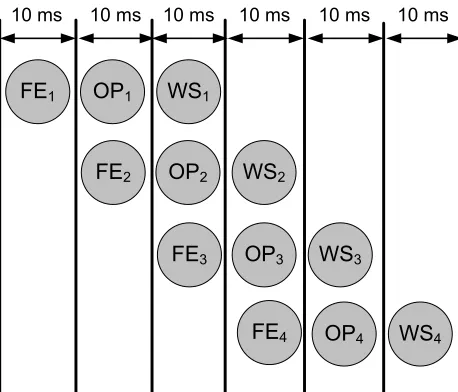
We separate out the three functional blocks and compute each of these in parallel
as shown in the figure (Fig. 3.12). This give more time to each block to process.
ASIC blocks can operate on much lower clock frequency and perform much better
Chapter 4
Related Work
Speech recognition applications have been developed in industry for commercial
purpose as well as in university for academic interests. Most of the speech
recogni-tion systems are based on HMM. The software solurecogni-tions for speech recognirecogni-tion are
available as software packages. These packages have two parts - the decoder, which
does the actual recognition of the utterance and the acoustic and language models,
which are used by the decoder. The software solutions are efficient implementation
of speech recognition algorithms in high level language, therefore need a general
pur-pose microprocessor. The decoder is computationally very demanding and dedicated
hardware units and platforms have been built in academia and the industry. These
hardware approaches usually use the acoustic and language models of the software
packages. We now look at few software solutions as well as hardware approaches for
4.1
Software Solutions
The AT&T Watson speech recognition engine [35] is a software implementation
of AT&T voice processing technology. This system is HMM based and the uses
gender based triphone models. In 94 NAB 1
evaluation, the system has around 22000
context dependent phones. The language model is 5-gram. The recognition is in two
passes, the first pass does the phone recognition, word recognition and build the word
lattice and the second pass rescores the word graph. The system works on Pentium
with Win/NT operating system. This system also implemented for shared memory
multiprocessor architecture [32].
The IBM speech recognition is known as Via-Voice. It is different from other speech recognition system. It uses rank-based approach 2
for the computation of
ob-servation probabilities. The search technique is a combination of A* search 3
heuristic
and time synchronous Viterbi decoding. A version of Via-Voice designed for
embed-ded processors and works on PDA’s and automobile GPS system and mobile devices
for command and control. A detail on this version is not available in literature.
SRI international’s Speech Technology And Research (STAR) groups has speech
recognition system called DECIPHER. The system is HMM based and does
multi-pass time synchronous Viterbi decoding. The system uses tied-mixture states.
Sphinx-II speech recognition system was developed by CMU (later versions are
1
Benchmark 2
Not discussed in this report 3
III and IV). This system is based on hidden Markov models.
Sphinx-II uses normalized feature representation, multiple-codebook semi continuous hidden
Markov models [20]. It has multi-pass search architecture and unified acoustic and
language models. For the HMM states it uses senones based approach tying mixtures
of similar Gaussian distribution. It uses scaled-integer for computation of observation
probability. The multi-pass search architecture is mainly used when the vocabulary is
large. Viterbi algorithm is efficient but less optimal compared to A* search algorithm.
In first pass, Viterbi decoding is done to reduce the search space for A* algorithm. In
second pass the A* search combines the result of Viterbi decoding and the language
model to effectively do the recognition. Sphinx uses a unified stochastic engine which
combines acoustic model and the language model and jointly optimizes both the
models. The newer versions of Sphinx are built on the older version. The Sphinx-III
and Sphinx-IV uses lexical trees rather than flat dictionary. The searches in the higher
version are efficient using beam searchs and various pruning strategies. The acoustic
models consist of 3-state or 5-state HMMs. Sphinx is only good for academic interest
as it requires extraordinary memory and high-end workstation for speech recognition.
Microsoft Whisper is built on the basics of CMU-Sphinx system is more
appli-cable in real world. It works on common desktop machines. Whisper uses speaker
adaptation and noise cancellation. Whisper is memory efficient as the acoustic model
is compressed and has no decompression overhead effect on speech recognition and
Binu et.al. [27] worked on Sphinx-III and made it more efficient. They targeted
on reducing the bandwidth requirement for calculating observation probability. Since
observation probability for a single senone requires lot of data corresponding to the
mean, variance and the weight mixtures and the calculations are done every frame,
their scheme calculated probability of a senone for ten consecutive frames before
moving on to the next senone. This reduces the bandwidth requirement by ten times,
if all the senones are to be evaluated every frame. Moreover, calculating senone score
for ten consecutine frames leads to more cache hits therefore has better performances.
4.1.1
Problems with Software Solution
Before going into hardware solutions for speech recognition, we re-visit the
prob-lems software implementation has with HMM based speech recognition.
• The calculation is slow because of complicated mathematical operation even on high performance platform. (Floating point multiplication, logarithm
calcu-lation or exponent calcucalcu-lation)
• To have simplicity, fixed point or scaled-integer arithmetic is used instead of floating point, therefore it induces inaccuracy.
• To speed up recognition, number of computation is reduced by introducing
threshold values. This also induces inaccuracy.
• The computational need of speech recognition algorithm freezes most of the
• Speech Recognition requires large amount of memory (Table 1.1) for storing
the parameters of statistical model (example Mean, Variance, Weights etc),
language model and dictionary.
– It has large working set which causes problem when some other application runs on the same platform. They share the same cache hierarchy resulting
in contention and therefore affecting each others performance.
– The memory bandwidth requirement is a bottleneck.
• Software solution ispower hungry.
4.2
Hardware Solutions
Software solution fails to achieve the real time speech recognition, which is
accu-rate and has tight power budget needed for mobile devices. Hardware-software
ap-proaches have been tried by many researchers. Mainly hardware accelerators [27, 28]
for calculating the observation probability were implemented in academia. There are
several IC’s for speech recognition but it is not clear whether they do anything other
than the frontend DSP and the probability calculation.
Low power accelerator [27] implements the computation of observation
proba-bility. The design acts as accelerator for Sphinx-III speech recognition system. The
implementation has floating-point arithmetic. The floating point arithmetic, however,
is not same as the IEEE-754 standards, instead has only 12-bit mantissa. Smaller
buffers the feature vectors from ten consecutive frames and then evaluates the
acous-tic score (probability) with respect to each senone. This enhances the performance
with more cache hits (if there is a cache type fast memory buffer in the embedded
en-vironment) and reduced bandwidth requirement. This design (0.25µ process) shows
29-fold improvement in power consumption over the software implementations used
by Sphinx-III on Pentium-4 (0.13µ process). Though, this design optimizes
Sphinx-III for embedded environment, it evaluates senone score for ten consecutive frames
together, therefore restricting any algorithmic optimization using the Viterbi decoder
feedback. Other than computation of probability, the Viterbi algorithm for optimal
path and the search of optimal path in word lattice is computationally demanding and
therefore accelerator is not a complete solution for enhancing real-time performance.
Hardware implementation speech recognition system, with FPGA acting as a
co-processor [28] for speech recognition is an alternative to ASIC implementation of
real-time recognition. This implementation however, is not designed for power efficiency.
Low power device for speech recognitions implemented by Sergiu et.al. [30] does
real-time speech recognition. Unlike other hardware recognition systems which are
usually accelerators for certain function in the software, this design is a complete
recognition system. It has its own language and acoustic model. This
implementa-tion does not use the n-gram language model, instead uses regular grammar based
language model to ease the search space. It exploits parallelism existing in speech
helps in reducing clock frequency resulting in reduced power usage. The acoustic and
language models are kept in FLASH memory and SRAM is used for dynamic memory
required for intermidiate stages of recognition. The design however is good for a very
Chapter 5
System Architecture
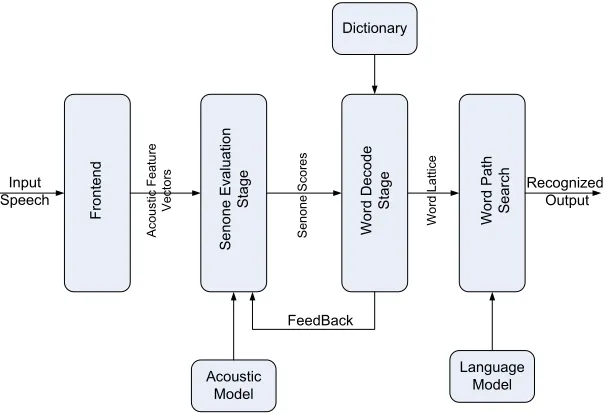
The speech recognition system that we design has components shown in Figure5.1.
The input speech goes through the Frontend, where spectral analysis is done to extract
acoustic feature vectors.
!
"
"
Figure 5.1: Speech Recognition System
These acoustic feature vectors then go through thesenone evaluation stage, where the observation probability of each senone is calculated. This probability is also called
easily (triphones are collection of senones) and is done by theword decode stage. This stage calculates the triphones scores of the dictionary words. Also, the word score is
calculated, summing all the triphone scores of the component triphones. The probable
spoken word is identified based on word scores. Over time, it generates a word lattice
over time. The word lattice is then evaluated by the Word Path Searchfor the most likely spoken word sequence in the input speech.
The word decode stage also provides the senone evaluation stage with information
about the relevant senones whose score must be evaluated in the next frame. This is
shown by ’Feedback’ in the figure.
As shown in the previous chapters, an acoustic vector is easily processed within
10ms and the native execution takes only 1% of the computation time. We, in our
system, have the Frontend in software which is run on the general purpose
micropro-cessor. Our design proposes ASIC and RAM structures for the senone evaluation and
word decode stages since the real time processing (of these two stages) is not possible
using a general purpose microprocessor.
We now give detail of the Frontend, then a brief understanding of how the senone
evaluation and the word decode works using ASIC blocks we design along with RAM
5.1
Frontend
The system audio device converts the spoken words into the speech signals. The
speech signals are sampled over an interval of few milliseconds. The spectral
charac-teristic of speech is assumed to be constant within the interval. Frontend takes the
sampled speech signals as input and generates the speech feature vectors as output.
It performs a spectral analysis of speech signals. It is assumed that the speech signals
correspond only and only to the spoken words on the audio device. i.e, all background
words/noise does not contribute to the speech signal. Linear Predictive Coding (LPC)
is used for the spectral analysis. We go through the brief detail of each of the steps
involved. Figure 5.2 shows the block diagram of a speech recognition frontend. The
overall block action is a frame ofN samples is processed and a speech feature vector
Ot is computed.
The intervals are typically spaced 10 msecs. Blocks are overlapped to give a
longer analysis window, typically 25 msecs. The raw signal is then pre-emphasized
by applying high frequency amplification to compensate for the radiation from the
lips.
Spectral estimates can be computed via linear prediction or discrete Fourier
anal-ysis or cepstrum analanal-ysis, and the coefficients, i.e., the final acoustic vectors can be obtained via a number of transformations. The most typical method of modern LVR
systems is to use the mel-frequency cepstral coefficients (MFCCs). The processing
Figure 5.2: Speech Recognition Frontend
The Fourier spectrum of each speech block is smoothed by a mel-scale filter-bank
that consists of 24 band-pass filters that simulate the human cochlea processing. The
mel-scale is linear up to 1000 Hz and logarithmic thereafter, creating a so-called
perceptual weighting to the signal.
From the output of the filter-bank a squared logarithm is computed, which
dis-charges the unnecessary phase information and performs a dynamic compression
mak-ing the feature extraction less sensitive to dynamic variations. This also makes the
estimated speech power spectrum approximately Gaussian. Finally, the inverse DFT
is applied to the log filter-bank coefficients, which actually is reduced to a discrete
cosine transformation (DCT). DCT compresses the spectral information into
![Figure 1.1: Sphinx-III Performance [27]](https://thumb-us.123doks.com/thumbv2/123dok_us/1716504.1218463/16.612.177.474.437.675/figure-sphinx-iii-performance.webp)