Jurnal Teknologi, 49(E) Dis. 2008: 93–107 © Universiti Teknologi Malaysia
THE USE OF INTERACTIVE GEOMETRY SOFTWARE (IGS) TO DEVELOP GEOMETRIC THINKING
ABDUL HALIM ABDULLAH1 & MOHINI MOHAMED2
Abstract: The purpose of this research is to measure the level of students’ geometrical thinking after using a newly developed module based on Form Two topic on Circles using an Interactive Geometry software (IGS). The research comprises of two phases which are the development phase and the implementation phase. In the development phase, a learning module using KDE Interactive Geometry (KIG) software was developed. The questions in the module were developed based on the levels as proposed in the Van Hiele Model which are visualization, analysis and informal deduction. In the implementation phase, the developed module was then used as a treatment on three Form Two students involving one-group of pre-test post-test research design. The students were chosen randomly and they were given a pre and post test before and after the learning sessions of circles using IGS. While using the module, the students’ conversations with the researcher were recorded. The transcript was then analysed to determine the types of critical and creative thinking utilised by the students. The critical and creative thinking indicators as suggested by the Curriculum Development Centre were referred. The students’ work completed in the module, together with their work saved in hard disk were analysed for the purpose of identifying the students’ geometrical thinking levels. The results showed that the students were able to utilise various types of critical and creative thinking while solving the questions in the module. In addition, the students were also able to achieve the third level of geometrical thinking as proposed in van Hiele Model. The post test results indicated that the students’ geometrical thinking showed clear improvement after using the module.
Keywords: Geometrical thinking; critical and creative thinking; interactive geometry software
Abstrak: Kajian ini bertujuan untuk mengukur tahap pemikiran geometri pelajar selepas menggunakan modul pembelajaran bulatan tingkatan dua menggunakan sebuah perisian geometri interaktif. Kajian ini melibatkan dua fasa, iaitu fasa pembangunan dan fasa perlaksanaan. Dalam fasa pembangunan, sebuah modul pembelajaran topik bulatan tingkatan dua menggunakan perisian KDE Interactive Geometry (KIG) dibangunkan. Soalan-soalan di dalam modul dibina berdasarkan kepada tiga tahap pemikiran geometri sebagaimana yang dicadangkan dalam Model Van Hiele, iaitu visualisasi, analisis dan deduksi tidak formal. Dalam fasa perlaksanaan, modul tersebut kemudiannya dijadikan rawatan dan digunakan oleh tiga orang pelajar tingkatan dua yang terlibat dalam kajian eksperimen berbentuk praujian-pasca ujian satu kumpulan ini. Pelajar yang terlibat dalam kajian ini dipilih secara rawak dan mereka diberikan ujian pra dan ujian pos sebelum dan selepas rawatan diberikan. Semasa menggunakan modul tersebut, perbualan pengkaji dengan pelajar dirakamkan dan kemudian ditranskripsikan untuk mengenal pasti jenis-jenis kemahiran berfikir kritis dan kreatif (KBKK) yang telah digunakan. Petunjuk KBKK yang dicadangkan oleh
1&2Department of Science and Mathematics Education, Faculty of Education, Universiti Teknologi
Pusat Perkembangan Kurikulum dirujuk bagi tujuan pengenal pastian KBKK. Hasil kerja pelajar di dalam modul dan di dalam cakera keras juga telah dianalisis bagi mengenal pasti tahap pemikiran geometri mereka. Hasil dapatan menunjukkan pelbagai KBKK telah digunakan pelajar semasa mereka menyelesaikan soalan yang terdapat di dalam modul. Di samping itu, pelajar juga dapat mencapai tahap tiga pemikiran geometri dalam Model Van Hiele. Keputusan ujian pos turut menunjukkan peningkatan tahap pemikiran geometri pelajar setelah mereka menggunakan modul yang telah dibangunkan.
Kata kunci : Pemikiran geometri; kemahiran berfikir kritis dan kreatif; perisian geometri interaktif
1.0 INTRODUCTION
Geometry is one of the most important components of the school mathematics curriculum. In Malaysia, the syllabus for Mathematics under the Kurikulum Bersepadu Sekolah Menengah (KBSM) highlights and includes geometry. One of the main reason is to provide the platform for students to expand their visualisation skills and to enhance their knowledge and understanding in the area. This will enable them to utilise geometrical structures and theorems ( Jones, 2002). According to Curriculum Development Centre (2000), shapes and space are vital components in secondary level Mathematics. The knowledge and skill in this field and its connection to other topics are useful in our daily lives. By increasing the level of understanding of students in this field, students can solve geometric problems effectively. Besides that, students can also increase their visual thinking and appreciate the aesthetic values of shapes and space. Principles and Standards for School Mathematics documented by National Council of Teachers of Mathematics (NCTM) accentuated that through the study of geometry, students will learn about geometric shapes and structures and analyze their characteristics and relationships. Furthermore Sherard (1981) stated seven reasons on why geometry is supposed to be taught in school and the reasons are (1) geometry is an important aid for communication, (2) geometry has important applications to real life problems, (3) geometry has important applications to topics in basic mathematics such as arithmetical, algebraic and statistical concepts, (4) geometry gives valuable preparation for courses in higher mathematics and the sciences and for a variety of careers requiring mathematical skills, (5) geometry provides opportunities for developing spatial perception, (6) geometry can serve as a vehicle for stimulating and exercising general thinking skills and problem solving abilities, and (7) there are cultural and aesthetic values to be derived from the study of geometry. Hence, the techniques in learning geometry concepts should be implemented in an effective way. Instead of using the traditional approach which is concentrating more on memorization of geometrical concepts, students’ geometrical learning experience should be changed in a more meaningful way.
with some similar capabilities to those of GSP (Zaleha, 2007). KIG is an open source geometrical software and runs on LINUX operating system. Computer-based learning environment especially the use of dynamic geometry software has been shown to have some benefits for learning geometry (Knerr, 1982; NCTM, 2000; Norhayati, 2005). There are a few attributes of dynamic geometrical software that can make students’ geometrical learning more meaningful. One attribute is the ability to specify the geometrical relationships between objects created on the computer screen, such as points, lines and circles. A second attribute is the ability to explore graphically the implications of the geometrical relationships established in constructing a figure. Within the computer environment the geometrical objects created on the screen can be manipulated, moved and reshaped interactively with the use of the mouse (Christou, 2005). In addition, the tools, definitions, exploration techniques and visual representations associated with dynamic geometry contribute to a learning environment fundamentally removed from its straightedge-and-compass counterpart (Laborde, 1998).
2.0 PROBLEM BACKGROUND
Geometry is not only an important field in the mathematics curriculum in schools, it is also an important element in Mathematics itself (Atiyah, 2001). Nonetheless, many parties are of the opinion that the learning of geometry in a classroom environment today is a traditional approach and not student centric (Noraini, 2005; Olkun, 2005). Based on the evaluation conducted by National Assessment of Educational Progress
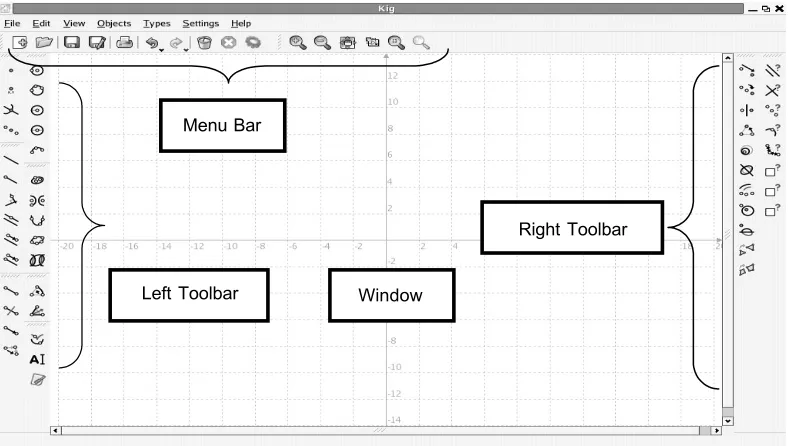
Right Toolbar
Window Menu Bar
Left Toolbar
(NAEP), students fail to grasp the basic concepts of geometry and fail to master the skill of geometry problem solving (Kouba et al. 1990). The factors that lead to this weak achievement is the students’ habit and practice that only focus on identifying and naming geometric shapes and learning symbols for basic geometry concepts (Carpenter et al. 1980 & Flanders, 1987). This is also agreed by Battista (2002) who stated that the traditional method in learning mathematical topics related to geometry only gives focus in memorising the definition of various shapes and its characteristics. Students should be learning geometry by understanding shapes, movements and its relations with the surrounding space (Clements & Battista, 1986). The early experience of students in learning geometry should be focused on informal learning of shapes and its physical characteristics. This knowledge is then made the first objective to expand their knowledge in the surrounding space. The next experience should involve students analysing and collating concepts and relations of shapes in geometry. Due to the fact that the geometry curriculum in secondary schools only focus on identification of shapes and usage of geometric themes (Kouba et al. 2000), the opportunity to solve geometric problems are limited. This will impact the students’ chance in expanding their spatial thinking, and this is a basic skill required in geometry. Students also have limited opportunity to analyse and conceptualise the ideas of geometry. In addition to that, according to National Advisory Committee of Mathematical Education (NACOME, 1995), the contents of geometry in text books are insufficient and the task of teachers are to transfer what is already available in these text books (Noor Azlan Ahmad Zanzali, 1987). Hence, after learning geometry in secondary schools, a study revealed that some university students do not have solid background in geometry to take up further courses in geometry (Hoffer, 1991). They also face difficulties in learning other mathematical ideas related to geometry like vectors, transformation, coordinates and trigonometry (Fey et al. 1994). Besides that, the current syllabus for geometry does not focus on the relation in geometry understanding. Too much emphasis is given in naming and identifying geometric symbols formally. Exploring of space, analysis, synthesis and solving geometry problems were not emphasised.
The proposal states that mathematics teachers should provide the opportunity for students to actively participate in the learning of geometry besides giving focus on experimental activities, exploration and communication on geometric problem solving in a conducive environment (NCTM, 1980). This proposal is inclined with the belief that learning geometry should be student oriented, encourages the constructive process whereby students build and modify their knowledge and are responsible in referring, filtering and expanding their knowledge in this field (Hatfield, 1999). As an alternative to replace the traditional method in delivering and presenting topics of geometry, students themselves need to build their own concepts and meaningful evaluating skills to enable them to analyse and solve related problems (Battista, 2001). However, topics in geometry are always neglected in secondary schools due to several factors (Olkun, 2005). These include the lack of concrete resources, computer softwares and lack of expertise in the skills of computer handling. Hence, mathematics teacher should think and practice the best way on how to enhance students geometrical learning.
3.0 VAN HIELE MODEL
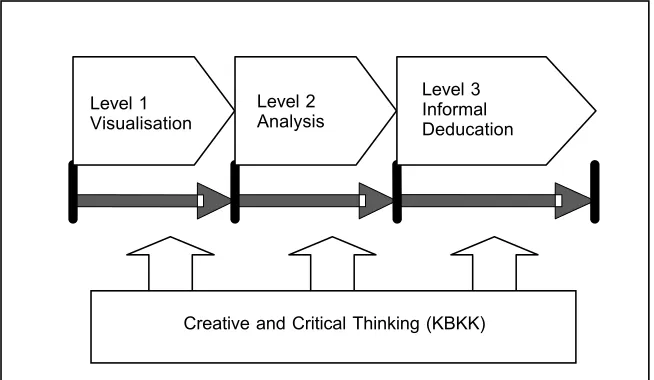
Van Hiele Model is a model concerning the learning of geometry. It is in hierarchical sequence of five levels of thinking which are visualization, analysis, informal deduction, formal deduction and rigor. At level 1 which is visualisation, geometric figures are recognized by their shape as a whole. For example, students can identify both squares and rectangle but they think that squares are not rectangles. At level 2 which is analysis, students can discern some characteristics of figures. At level 3 which is informal deduction, students can see interrelationships between figures and derive relationship among figures. At level 4 which is formal deduction, students understand the significance of deduction and the role of postulates, theorems and proof. They can write proofs with understanding. At level 5 which is rigor, students understand the formal aspects of deduction, such as establishing and comparing mathematical systems. They also can understand the use of indirect proof and proof by contra positive, and can understand non-Euclidean systems. Although there are five levels of thoughts in the van Hiele model, this research will focus on the first three levels which are visualisation, analysis and informal deduction. This is based on the study by Knight, K.C. (2006) which stated that the National Council of Teachers of Mathematics (NCTM) expected that students who completed Grade 8 (Form 2) are able to attain the third level in the van Hiele model.
4.0 PURPOSE OF THE STUDY This study has two main objectives:
(2) To identify the types of critical and creative thinking the van Hiele level of understanding of geometry among students who have used the developed module
5.0 THEORETICAL FRAMEWORK
Cognitive approach looks at students as active knowledge explorers and focus on the cognitive processes. Learning styles such as discovery learning, inquiry and so on have been recommended to be implemented in the classroom because these learning styles can encourage the use of students’ minds (Battista, 2002). In geometry, students’ thinking in two-dimensional geometry could be best explained using the Van Hiele theory. Crowley (1987) stated that there are a few characteristics of Van Hiele theory. One of them is the development of geometric ideas progresses through a hierarchy of levels. Students first learn to recognize whole, shapes and then to analyze the relevant properties of shape. Later they can see relationships between shapes and make simple deductions. Teachers should provide their students with appropriate experiences and the opportunities to discuss them. Besides that, teachers can assess their students’ levels of thought and provide instruction at those levels. The teacher should provide experiences organized according to the phases of learning to develop each successive level of understanding. Research done by Suguna (2005) proved that the use of various types of critical and creative thinking while learning geometry with interactive geometry software can help students achieve the third level in the Van Hiele theory.
Figure 2 Theoretical framework Creative and Critical Thinking (KBKK)
Level 3 Informal Deducation Level 1
Visualisation
6.0 THE DEVELOPMENT OF THE MODULE AND THE CIRCLE TEST
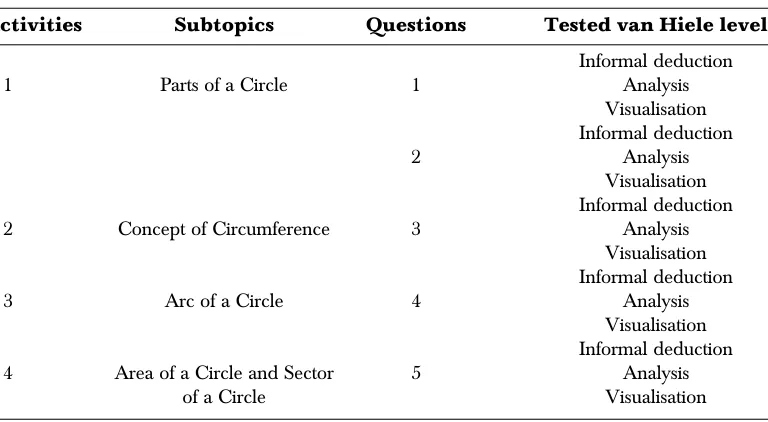
A module on learning circles with IGS was developed by the researcher. The content in the module was based on a topic of circles in form two mathematics syllabus. There are four activities in the module representing each subtopic of circles. Practice questions were developed for each activity and the questions were developed based on first three levels in Van Hiele Model. The levels are visualisation, analysis and informal deduction. Table 1 shows the content summary of the developed module.
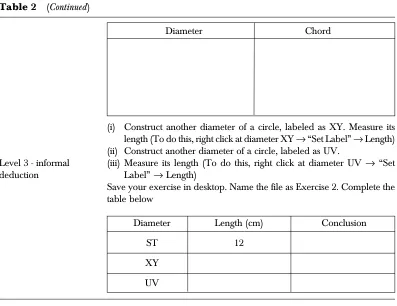
Table 2 displays the sample activity and practice questions that cover the three Van Hiele levels.
Table 1 Summary of the module
Activities Subtopics Questions Tested van Hiele level
Informal deduction
1 Parts of a Circle 1 Analysis
Visualisation Informal deduction
2 Analysis
Visualisation Informal deduction
2 Concept of Circumference 3 Analysis
Visualisation Informal deduction
3 Arc of a Circle 4 Analysis
Visualisation Informal deduction
4 Area of a Circle and Sector 5 Analysis
of a Circle Visualisation
Table 2 Sample activity in the module
Level Question
In this module, draw a circle with
Level 1 - visualisation (i) a minor sector, OKLM (ii) a major sector, OKJM (iii) a chord, MN
By using KIG, construct a circle with a diameter 12 cm, labeled as ST and a chord, labeled as TU.
Diameter Chord
(i) Construct another diameter of a circle, labeled as XY. Measure its length (To do this, right click at diameter XY → “Set Label” → Length) (ii) Construct another diameter of a circle, labeled as UV.
Level 3 - informal (iii) Measure its length (To do this, right click at diameter UV → “Set
deduction Label” → Length)
Save your exercise in desktop. Name the file as Exercise 2. Complete the table below
Diameter Length (cm) Conclusion
ST 12
XY
UV
A set of test items on form two circles topic based on Van Hiele was developed. The test consists of six questions where two questions represent the first three levels in Van Hiele Model which are visualisation, analysis and informal deduction. The test was then used as a pre and post test in this study. Both module and the test were given to three mathematics teacher for the purpose of validity.
7.0 METHODOLOGY
One group pre-test-posttest research design was adopted in this study. The experimental research was designed to determine the effect of independent variable towards dependent variable which is students’ geometrical thinking levels. Pre and post-test were given to the students before and after the treatment. Basically, the research design can be illustrated as follow:
Table 3 Research design
Pre-test Treatment Post-test
C1 O C2
Three form two students named as A, B and C were chosen randomly to participate in the study. They were given a pre-test which was the test designed based on Van Hiele before they learnt the form two circles topic using the developed module. While using the module, the samples’ conversations with the researcher were recorded. The transcript was then analysed to determine the types of creative and critical thinking that could be picked up from their conversations. The critical and creative thinking indicators as suggested by the Curriculum Development Centre were referred. Then the researcher analysed the students’ work completed in the module, together with their work saved in hard disk for the purpose of identifying the students’ geometrical thinking levels. Finally the students were given a post-test to determine the effectiveness of the module to increase students’ geometrical thinking levels.
8.0 DATA ANALYSIS
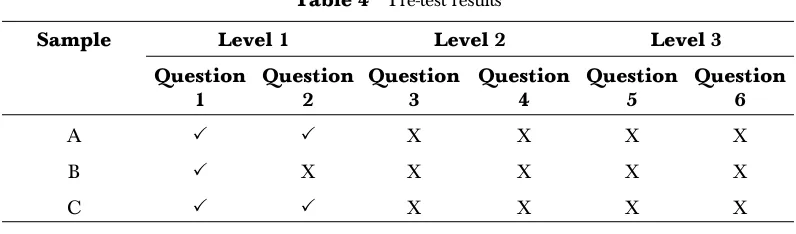
The performances of the three students in the pre-test are displayed in Table 4.
Table 4 Pre-test results
Sample Level 1 Level 2 Level 3
Question Question Question Question Question Question
1 2 3 4 5 6
A 3 3 X X X X
B 3 X X X X X
C 3 3 X X X X
3 “ = achieved X = did not achieve
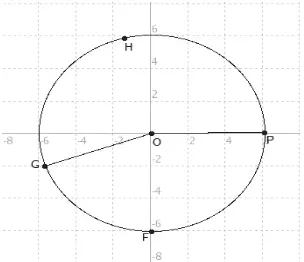
After the pre-test was given, the students used the module in learning the topic of Circles using the KIG. Question 1 asked the students to construct a circle with center O and radius OP with length 6cm. Then on the same circle, the students were asked to construct a minor sector OPFG and a major sector, OPHG. Finally they had to make conclusion about the lengths of radius in a circle. After the transcript of students’ conversations with the researcher were analysed, the following types of critical and creative thinking were identified. Some parts of dialogue are given below where R represents the researcher and A, B and C represent students.
R : how to draw minor sector? A : it is small right?
R : yes
R : yes. okay, now label it as? A : OPFG
R : where to put H to construct a major sector? A : it is big, right?
From the above transcript, the researcher indicated that student A can distinguish a major and minor sector before she can construct them by using KIG (refer Figure 2). Refering to the critical and creative thinking indicators as suggested by the Curriculum Development Centre, the students had the ability to utilize the “compare and differentiate” type of critical and creative thinking if they can find, state, list and arrange the similarity and difference of geometrical object. Then, by using KIG, the students made conclusion about the lengths of radius in a circle. Referring to the indicators of KBKK from the Curriculum Development Centre, students have the ability to utilise “making inference” type of creative and critical thinking if they can make a conclusion based on a set of information. Figure 3 shows the conclusion made by student B as taken from her written work in the module. She used KIG to find several length in one circle before she can make a conclusion about the length of radius in a circle. Student B concluded that “In a circle, all the radius have the same length.”
After all discussion sessions with the researcher for Activity and Question 1 were analysed, the researcher found that the students were able to utilise various types of
Figure 3 Minor and major sector constructed with KIG
Figure 4 Conclusion made by sample B
Radius Length (cm) Conclusion
OP 6
OQ 6
OR 6
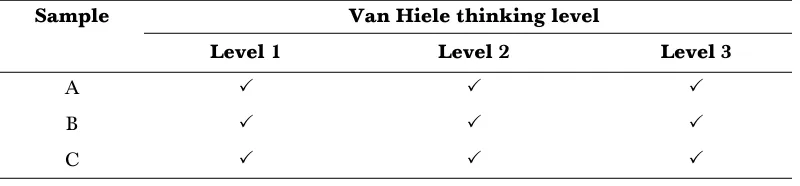
critical and creative thinking while solving the questions in the module. The thinking that are involved are classifying, comparing and differentiating, analysing, inference making and mental illustrating. Furthermore, the students’ completed work for Question 1 in the module, together with their work saved in hard disk were analysed to identify the students’ geometrical thinking levels based on Van Hiele Model. The Table 5 shows the result for Question1.
Table 5 Van Hiele thinking level for question 1
Sample Van Hiele thinking level
Level 1 Level 2 Level 3
A 3 3 3
B 3 3 3
C 3 3 3
3 = achieved X = did not achieve
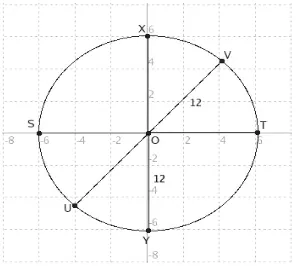
Question 2 asked the students to make a conclusion about the length of diameters in a circle. The question also asked the samples to find the difference between a diameter and a chord in a circle. All the activities were done by using KIG. After the transcript of students’ conversations with the researcher were analysed, the following types of critical and creative thinking were identified.
C : diameter 12cm? R : how to draw it… C : 6,6 (refer to radius)
From the above transcript, student C knew that a diameter is twice of radius. Cochrane, C. (1996) explained that if the students can link facts, ideas and notions and generate new data from information collected, they had the ability to utilize critical thinking skills.
C : chord R : label as.. C : TU
R : where to put TU? C : here..
R : from point T to…
Figure 5 The differences between a diameter and a chord in a circle made by sample C
Figure 6 Length of diameters of a circle constructed by sample A
Diameter Chord
Have to cross the centre Don’t have to cross the centre
Radius X2 . Diameter Depends
From the above transcript, student C knows that a chord does not pass through a center of a circle. Newman, D. R. (1996) stated that the most important points to determine students had utilized any critical thinking if they can find new problem-related information, new ideas for discussion, new solutions to problem and welcoming new ideas.
R : add another diameter C : label as…
R : UV
C : from here to there
R : yes. As long as it passes through.. C : center of a circle
From the above transcript, student C knew that a diameter passes through a center of a circle.
So from the three transcripts above, it is apparent that student C had utilized classifying and analysing types of creative and critical thinking.
After all students’ conversations with the researcher for activity and question 2 were analysed, the researcher found that the students were able to utilise various types of critical and creative thinking such as classify, mentally illustrate, rearrange, synthesis and integrate while solving the questions in the module. Furthermore, the students’ completed work for question 2 in the module, together with their work saved in hard disk were analysed to identify the samples’ geometrical thinking levels. The Table 6 shows the results for question 2.
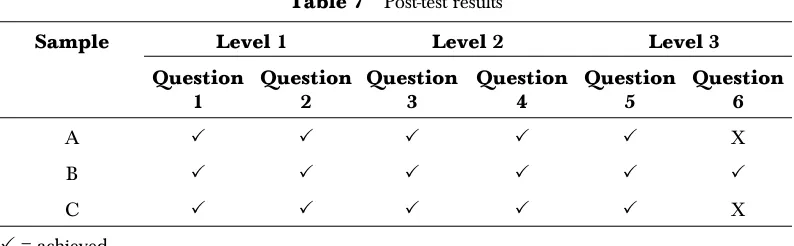
In this study, the students had gone through five questions in three days before the post-test was given to them. The post-test results shown in Table 7.
Table 6 Van Hiele thinking level for question 2
Sample Van Hiele thinking level
Level 1 Level 2 Level 3
A 3 3 3
B 3 3 3
C 3 3 3
3 = achieved X = did not achieve
Table 7 Post-test results
Sample Level 1 Level 2 Level 3
Question Question Question Question Question Question
1 2 3 4 5 6
A 3 3 3 3 3 X
B 3 3 3 3 3 3
C 3 3 3 3 3 X
3 = achieved X = did not achieve
9.0 DISCUSSION AND CONCLUSION
only achieved the lowest level in the Van Hiele model which is visualisation. After using the module for learning circles with IGS, they attained the third level of the model which is informal deduction. This result is similar with studies done by Corley (1990), Yusof (1990), Fitzsimmons (1995), Mac Clendon (1990) and Olkun (2005) who developed learning modules for geometry with IGS that involves active participation of students. The activities with IGS modules developed by the researchers are used as treatment in group experiments. In the end, students participated in the research achieved the third level in the Van Hiele model. When activities based on the Van Hiele with IGS is given in this research, the usage of various creative and critical thinking skills by students have enabled them to move from one lower level to the next higher level in the Van Hiele model. Activities for all levels are required because learning geometry must be supported by suitable activities for each level in the model (Noraini, 2007). For visualisation questions, most students use their thinking skill to obtain a mental image. For example, to build a circle with centre at O and radius OP, students must move the cursor to functions in the menu bar to draw the right diagram. This is similar to the study by Suguna (2005) that determined that students use their thinking skills to obtain a mental picture in order to direct the turtle to draw the polygon. For analytical questions, students compare and differentiate, analyse, arrange sequence and make relations. Students analyse the parts of a circle, compare and differentiate the parts before attaining the next level in the Van Hiele model. A sample question in this module where students are required to analyse the area of sectors for ½ circle, ¼ circle and 1/8 circle. They compare and differentiate the areas and sector angles to determine the formula for area of circle and area of sectors. This is similar to the study by Suguna (2005) that determined that student use their analytical skill to modify information while drawing polygons to a smaller size in order to understand the concept. The pair of student draw the circle by analising the turtle movement from a bigger angle to a smaller angle and longer sides to shorter sides.
For questions under informal deduction, the students have employed the creative and critical skills such as inventing, sequencing and making inference. This is in line with the study by Noraini (2007) whereby learning geometry is challenging and require the involvement of higher level thinking skills. An example of question of this nature required students to determine the relation between the length of diameter and circumference. To attain this level, students must make a few circles with varying diameters. By using the KIG software, they then analyse the diameter and circumference of the respective circles. Based on the information obtained, they finally make an inference on the relation between the length of diameter and circumference.
REFERENCES
Battista, M. T. 2002. Learning Geometry in a Dynamic Computer Environment. Teaching Children Mathematics.
8: 333-339.
Carpenter, T. P. et al. 1980. National Assessment. In Mathematics Education Research: Implications for the 80s, edited by Elizabeth Fennema. Alexandria, Va.: Association for Supervision and Curriculum Development. Clements, D. H. and M. T. Battista. 1992. Geometry and Spatial Sense. Journal for Research in Mathematics
Education. (7): 420-464.
Christou et al. 2005. Problem Solving and Problem Posing in a Dynamic Geometry. The Montana Mathematics Enthusiast. ISSN 1551-3440. 2(2): 125-143.
Cochrane, C. 1996. A Content Analysis Method to Measure Critical Thinking in Face-to-face and Computer Supported Group Learning. Retrieved April 25, 2005, from http://www.qub.ac.uk/agt/papers/methods/contpap.html Fey, J. Y. 1994. Concepts in Algebra: A Technological Approach. Providence, RI, Janson Publications, Inc. Flanders. 1987. How Much of the Content in Mathematics Textbooks is New? Arithmetic Teacher 35 (September
1987): 18-23.
Hoffer, A. 1991. Geometry is more than proof. Math. Teach. 74: 11-18.
Knight, K. C. 2006. An Investigation into the Change in the Van Hiele Levels of Understanding Geometry of Pre-Service Elementary and Secondary Mathematics Teachers. The University of Maine. Thesis.
Kouba et al. 1990. Results of the Fourth NAEP Assessment of Mathematics: Measurement, Geometry, Data Interpretation, Attitudes, and Other Topics. Arithmetic Teacher. 33: 10-16.
Newman, D. R., B. Webb & C. Cochrane. 1996. A Content Analysis Method to Measure Critical Thinking in Face-to-face and Computer Supported Group Learning. Retrieved April 25, 2005, from http://www.qub.ac.uk/ agt/papers/methods/contpap.html
Noor Azlan Ahmad Zanzali. 1987. The Malaysian Mathematics Program: A Case Study of the Difference Between Design Intention and Classroom Implementation. An unpublished doctoral dissertation at the University of Wisconsin-Madison.
Noraini Idris. 2005. Pedagogi Dalam Pendidikan Matematik. Kuala Lumpur: Utusan Publications & Distributors Sdn Bhd.
NCTM. 2000. Principals and Standards for School Mathematics. National Council of Teachers of Mathematics, Reston: VA.
Olkun et al. 2005. Geometric Explorations with Dynamic Geometry Applications based on Van Hiele Levels.
International Journal for Mathematics Teaching and Learning.
Pusat Perkembangan Kurikulum. 2001. Kemahiran Berfikir dalam Pengajaran dan Pembelajaran. Pusat Perkembangan Kurikulum, Kementerian Pendidikan Malaysia.
Sherard, W. 1981. Math Anxiety In the Classroom. The Clearing House. 55: 106-110.
Suguna Appalanayudu. 2005. Pembelajaran Geometri di Kalangan Pelajar dalam Persekitaran Pengaturcaraan LOGO. Universiti Teknologi Malaysia: Thesis.