An Efficient Delay-Constrained Minimum Spanning Tree
Heuristic
H.F. Salama
D.S. Reeves
Y. Viniotis
Center for Advanced Computing and Communication
ECE Department and CSC Department
Box 7911, North Carolina State University, Raleigh, NC 27695-7911, USA
Phone: (919) 515-5348
Fax: (919) 515-2285.
Email:
fhfsalama,reeves,candice
g@eos.ncsu.edu
Abstract
Many distributed real-time applications require broadcasting information to all participants. This information must be received within some delay bound, and at the lowest possible cost. We formulate the problem of constructing broadcast trees for real-time traffic with delay constraints in networks with asymmetric link loads as a delay-constrained minimum spanning tree (DCMST) problem in directed networks. Then we prove that this problem is NP-complete, and we propose an efficient heuristic to solve the problem based on Prim’s algorithm for the unconstrained minimum spanning tree problem. This is the first heuristic designed specifically for solving the DCMST problem. Simulation results under realistic networking conditions show that our heuristic’s performance is close to optimal when the link loads are symmetric as well as when asymmetric link loads are used. Delay-constrained minimum Steiner tree heuristics can also be used to solve the DCMST problem. Simulation results indicate that the fastest delay-constrained minimum Steiner tree heuristic, DMCT [1], is not as efficient as the heuristic we propose, while the most efficient delay-constrained minimum Steiner tree heuristic, BSMA [2], is much slower than our proposed heuristic and does not construct cheaper delay-constrained broadcast trees.
1
Introduction
Most distributed real-time applications involve more than two users and hence the need for efficient multicast routing. Several multicast routing protocols have been proposed. These protocols con-struct multicast trees that can be classified into two categories: source-specific trees (MOSPF [3],
DVMRP [4], and PIM [5, 6]) and shared trees (CBT [7] and PIM1[5]). In this paper we consider only source-specific trees. All these protocols are based on simple multicast routing algorithms: shortest path algorithms [8, 9] and reverse path multicasting [10, 11], and none of them applies cost metrics that are functions of the utilization of the network resources.
Real-time applications, e.g., multimedia and distributed real-time control applications, will be popular applications of high-speed networks in the near future. Real-time traffic is usually bandwidth-intensive and requires quality of service (QoS) guarantees from the underlying network. Hence the need for efficient multicast routing algorithms which define cost as a function of the utilized link bandwidth, and are capable of constructing low-cost multicast trees that satisfy the constraints imposed by the QoS requirements. The delay constraint, i.e., the upper bound on end-to-end delay, is an important QoS requirement, because most real-time applications (the interactive ones in particular) are delay-sensitive. A number of delay-constrained multicast routing algorithms have been proposed during the past few years. A delay-constrained shortest path heuristic was proposed in [12], and several cost-efficient, but quite complex, delay-constrained minimum Steiner tree heuristics were proposed in [13, 1, 14, 2]. A thorough evaluation of different multicast routing algorithms, unconstrained and delay-constrained, can be found in [15]. The destination set of the minimum Steiner tree problem may be any subset of the network nodes. In the special case when the destination set includes all nodes in the network, multicasting reduces to broadcasting, and the minimum Steiner tree problem reduces to the, usually less complex, minimum spanning tree (MST) problem. The delay-constrained minimum Steiner tree problem is NP-complete [13], and it remains NP-complete even after the delay constraint is removed [16]. We prove in this paper that the delay-constrained MST (DCMST) problem is also NP-complete. However, several polynomial time algorithms exist for the unconstrained MST problem [17, 18].
In the future, many real-time applications will involve all nodes in a given network. Some distributed real-time control applications and the broadcasting of critical network state information are just a few examples. For such applications, DCMSTs are needed to broadcast the real-time traffic from the source node to all other nodes in the network. The existing delay-constrained minimum Steiner tree heuristics, can be used to construct delay-constrained broadcast trees, but most of them are too complicated [15]. The comparison given in [15] shows that BSMA [2] is the most efficient delay-constrained minimum Steiner tree heuristic. The distributed delay-constrained minimum Steiner tree heuristic, DMCT, proposed in [1], is the only fast heuristic capable of generating DCMSTs. DMCT was designed for networks with symmetric link loads (undirected networks). In this paper, we propose an efficient DCMST heuristic for the general case of networks with asymmetric link loads (directed networks). Both our heuristic and DMCT are based on Prim’s unconstrained MST algorithm [17]. We will show that the proposed heuristic outperforms DMCT, not only in the case of directed networks, but also in the special case of undirected networks. We also compare our heuristic to BSMA.
This paper is organized as follows. In section 2, we formulate the DCMST problem in directed networks and prove that it is NP-complete. In section 3, we present our heuristic for solving the problem. Then in section 4, we evaluate the average performance of the heuristic and compare it to optimum, DMCT, and BSMA using simulation. Section 5 concludes the paper.
1PIM has two modes: a dense mode that uses specific trees, and a sparse mode that allows both
2
Problem Formulation
A communication network is represented as a directed network
G
= (V;E
), whereV
is a set ofnodes and
E
is a set of directed links. Any linke
2E
has a costc
(e
)and a delayd
(e
)associatedwith it.
c
(e
)andd
(e
)may take any positive real values.A spanning tree
T
(s
)E
is rooted at a source nodes
2V
and contains exactly one path froms
to any nodev
2(V
?fs
g). The total cost of a treeT
(s
)is simply:Cost
(T
(s
))= Xt2T(s)
c
(t
) (1)A path
P
(T
(s
);v
)T
(s
)is the set of tree links connectings
tov
2V
. The cost of the pathP
(T
(s
);v
)is:Cost
(P
(T
(s
);v
))= Xt2P(T(s);v)
c
(t
) (2)and the end-to-end delay along that path is:
Delay
(P
(T
(s
);v
))= Xt2P(T(s);v)
d
(t
) (3)Thus the maximum end-to-end delay of a spanning tree is:
Max Delay
(T
(s
))=maxv2V ?
Delay
(P
(T
(s
);v
))(4)
The DCMST problem in directed networks constructs the spanning tree
T
(s
)rooted ats
thathas minimum total cost among all possible spanning trees rooted at
s
which have a maximum end-to-end delay less than or equal to a given delay constraint∆. The same problem can be expressed as a decision problem as follows.Delay-Constrained Minimum Spanning Tree (DCMST) Problem: Given a directed network
G
=(V;E
), a positive costc
(e
)for eache
2E
, a positive delayd
(e
)for eache
2E
, a sourcenode
s
2V
, a positive delay constraint ∆, and a positive valueB
, find a spanning treeT
(s
)thatsatisfies:
Cost
(T
(s
))B;
(5)Max Delay
(T
(s
))∆:
(6)Theorem 1 DCMST is NP-complete unless all link costs are equal.
Proof. The DCMST problem in undirected networks (DCMST-undirected) is a restricted version of DCMST. We prove in appendix A that DCMST-undirected is NP-complete and therefore DCMST
is also NP-complete. 2
3
The BDB Heuristic
The BDB algorithm consists of two phases; phase 1 is executed once, followed by phase 2, which is also executed once. The input to phase 1 is the network and all link costs and link delays. The result of phase 1 processing is a moderate-cost spanning tree which satisfies the delay constraint, if such a tree exists. Phase 2 produces a lower-cost spanning tree, still satisfying the delay constraint. It does this by replacing expensive links with cheaper links, without introducing loops or violating the delay bound.
Before describing the phases of the algorithm, we define the term “delay relaxation.” Suppose that two alternate paths called
P
1andP
2connect the sources
to some noden
2V
, andDelay
(P
2)<
Delay
(P
1). IfP
1is the currently-used path froms
ton
, then the delay froms
ton
can be reducedby using the path
P
2 instead ofP
1. The delay relaxation atn
is the difference betweenDelay
(P
2)and
Delay
(P
1).Phase 1 of BDB is based on Prim’s MST algorithm. Starting with a subtree containing only the source node
s
, one node at a time is added to the subtree without violating the delay constraint. This continues until the subtree spans all nodes in the network. If at some point no node can be added without violating the delay constraint, the algorithm resorts to delay relaxation at some noden
. Noden
is chosen such that the delay relaxation is maximized. If no further delay relaxation can be achieved and there are still nodes not connected to the subtree, the algorithm fails. It is guaranteed, however, that the first phase of BDB will find a delay-constrained tree spanning all nodes if one exists. In the worst case, continued application of delay relaxation results in the construction of the shortest path tree that minimizes the end-to-end delay (i.e., the least-delay tree). If the least-delay tree cannot span all nodes in the network without violating the delay constraint, no other tree can. Phase 1 of BDB is sketched below:1. Given
G
=(V;E
), a source nodes
, all link costs, andall link delays. The initial subtree contains the source
s
only. 2. Repeat f3. Find the cheapest link that connects an unconnected node to the already constructed subtree, without violating the delay constraint. Add that link to the subtree.
4. If step 3 can not find such a link, then find a link
e
=(u;v
) such that:
e
is not already in the subtree, butu
andv
are in the subtree. And,Let link
l
= (w;v
) be the subtree link connectingv
towardss
. Replacingl
withe
results in a positive delay relaxation at nodev
. And,If such a link is found, replace
l
withe
in the subtree.5. If neither step 3 nor step 4 finds a new link to add to the subtree, the algorithm fails and exits.
6. g until the tree spans all nodes.
In phase 2, expensive tree links are removed and replaced with cheaper links. The algorithm scans all links not already in the tree. It chooses the cheapest link
e
=(p;q
), such thatc
(e
)< c
(l
),and
l
= (w;q
) is the link already used to connect nodev
upstream towards the sources
. Thereplacement of
l
bye
may not result in violation of the delay constraint. This process is repeated until no more cost reduction can be achieved. Below is a description of phase 2.1. Given
G
=(V;E
), a source nodes
, all link costs, all link delays, and a delay-constrained tree spanning all nodes inV
.2. Repeat f
3. Find the cheapest link
e
=(p;q
),q
6=s
, such that
e
is not already in the tree, and
c
(e
)< c
(l
), wherel
=(w;q
) is the tree link currently used to connectq
upstream towardss
, andreplacing
l
withe
does not violate the delay constraint, andIf such a link
e
can be found, but replacingl
withe
creates a loop, the loop breaking algorithm, LBA, is called. If LBA fails, linke
can not be used to replacel
, else memorize the values ofl
remove andl
add returned by LBA2.4. If such a link can be found, and adding
e
to the tree does not create a loop, then replacel
withe
in the tree.5. Else, if such a link can be found, but adding
e
does create a loop, replacel
withe
in the tree, and also replacel
remove withl
add to break the resulting tree.6. Else, if no such link can be found, the algorithm cannot achieve further cost reduction.
7. g until no further cost reduction can be achieved.
2The created loop can be broken by removing
The link replacement operation of phase 2 may result in the formation of loops. The loop breaking algorithm LBA is used to prevent this if possible. LBA is sketched below:
1. Given
G
=(V;E
), a treeT
(s
)E
, a potential loop path consisting of the set of nodesX
=fx
0;:::;x
kgV
, and the set of linksL
= fl
1 = (x
0;x
1);:::;l
k = (x
k?1
;x
k)g
T
(s
), a linke
=(x
k;x
0) which will close the loop if added, and a linkl
= (w;x
0) linking the potential loop path upstream towards the source.c
(e
)< c
(l
).2. For
i
=1:::k
, find a linkl
0i to replace a link
l
i in connectingx
i upstream towards the source such thatThe result after replacing
l
bye
andl
i byl
0i is a spanning tree without loops, and not violating the delay constraint, and
The cost reduction due to substituting
l
i byl
0i is positive, i.e.,
c
(e
)+c
(l
0
i)?
c
(l
)?c
(l
i)>
0, andThe cost reduction due to substituting
l
i byl
0i is the largest among all possible substitutions.
3. If such a link exists, return success and the following values:
l
remove =l
i andl
add =l
0
i. 4. Otherwise, return failure.
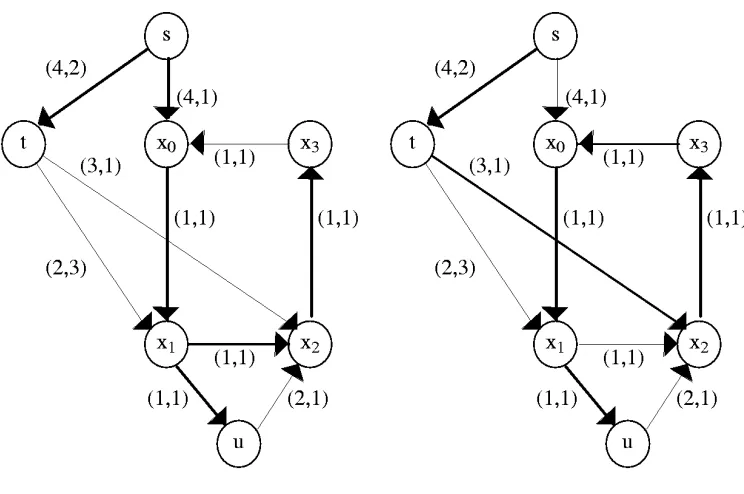
An example illustrating how LBA works is now given.
Example: Figure 1 shows an example illustrating the loop breaking operation. Figure 1(a) shows a broadcast tree constructed by the first phase of BDB. Its cost is 12. In phase 2, BDB attempts to remove the linkl0 =(s;x0)and to replace it with the linkl
0
0 =(x3;x0)in order to reduce the tree cost. However,
this results in a loopfl1=(x0;x1);l2=(x1;x2);l3=(x2;x3);l 0
0=(x3;x0)g. LBA is called to determine
how to break that loop. For this case, LBA has only three alternatives. The first alternative is to remove the link l1 and replace it with the link (t;x1). This breaks the loop and results in a tree cost of 11, and
improvement. However, the resulting tree would have a maximum end-to-end delay of 8 > ∆, so it is
rejected. The second alternative is to remove the linkl2 and replace it with the link(u;x2). This breaks
the current loop, but creates another one consisting off(x0;x1);(x1;u);(u;x2);(x2;x3);(x3;x0)g. This is
also unacceptable. The only remaining alternative for the given example is to removel2and replace it with
(t;x2). This results in an acceptable tree with a total cost of 12 and a maximum end-to-end delay of 7=∆,
as shown in figure 1(b).
(a) Cost(T(s)) = 12, Max Delay(T(s)) = 4. (b) Cost(T(s)) = 11, Max Delay(T(s)) = 7.
Figure 1: Total cost of a MC tree relative to optimal, unconstrained algorithms, 20 nodes, average degree 4.
In the next section we compare the performance of BDB to the performances of DMCT, BSMA, and the optimal delay-constrained minimum spanning tree algorithm, OPT. We implemented OPT as a branch and bound algorithm.
4
Experimental Results
We used simulation for our experimental investigations to avoid the limiting assumptions of analyt-ical modeling. Full duplex directed networks of different sizes with homogeneous link capacities of 155 Mbps (OC3) were used in the experiments. The positions of the nodes were fixed in a rectangle of size 30002400 Km
2, roughly the area of the USA. A random generator (based on Waxman’s
generator [19] with some modifications) was used to create links interconnecting the nodes. The output of this random generator is always a connected network in which each node’s degree is2.
The probability of a link to exist between any two nodes is a function of the distance between these two nodes [19]. We adjusted the parameters of the random generator to yield networks with an average node degree of 4. Figure 2 shows an example of a randomly generated 20-node network.
Figure 2: A randomly generated network, 20 nodes, average degree 4.
We used variable bit rate (VBR) video for the broadcast sources [20]. These are realistic bursty traffic sources used in real-time applications with delay constraints. A broadcast tree that includes a link
e
, reserves a fraction ofe
’s bandwidth equal to the effective bandwidth3 [21] of the trafficgenerated by the corresponding broadcast source. The link cost,
c
(e
), is equal to the reservedbandwidth on that link,i.e., equal to the sum of the effective bandwidths of the traffic streams traversing that link.
Our experiment compares the different algorithms when creating a broadcast tree. The source node of the tree generates VBR traffic with an effective bandwidth of 0
:
5 Mbps, and network loading conditions are varied. For each run of the experiment, we generated a random set of links to interconnect the fixed nodes, we selected a random source node, and we generated random background traffic for each link. The effective bandwidth of each link’s background traffic was a random variable uniformly distributed betweenB
min andB
max. This represents the initial cost of each link. For networks with symmetric link loads, the initial cost of a linke
=(u;v
)and theinitial cost of the reverse link
e
0=(
v;u
)were set to the same random value. For networks withasymmetric link loads, however, the initial cost of
e
= (u;v
)ande
0= (
v;u
)were independentrandom variables. In that case, the asymmetry of the link loads increased as the range of the link loads, i.e., the difference between
B
max andB
min, increased.The experiment was repeated with different link loading conditions, different delay constraints, and different network sizes. For each setting of these parameters, we measured the total cost of the broadcast tree. We ran the algorithms repeatedly until confidence intervals of less than5%, using
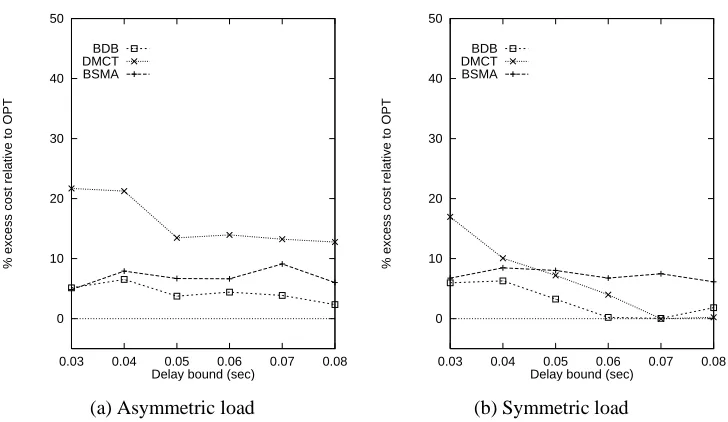
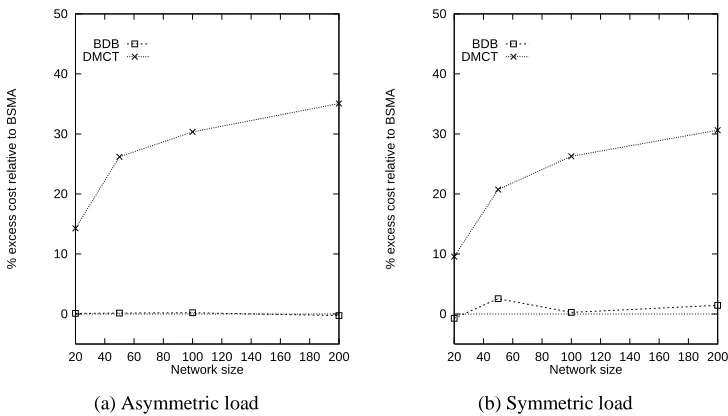
95% confidence level, were achieved. On the average, 300 different networks were simulated in each experiment, in order to reach such confidence levels. At least 250 networks were simulated in each case. We simulated the following algorithms: BDB, DMCT, BSMA, and OPT. We could not apply OPT to networks with more than 20 nodes due to its excessive execution time. The other algorithms were applied to networks with up to 200 nodes. Therefore, we show the percentage excess cost of each algorithm relative to OPT in case of 20-node networks only. When discussing results for networks with more than 20-nodes, we show the percentage excess cost of each algorithm relative to BSMA which was previously shown in [15] to be the best performing minimum Steiner tree heuristic.
3
0 10 20 30 40 50
0 20 40 60 80 100 120
% excess cost relative to OPT
Range of link loads (Mbps) BDB
DMCT BSMA
(a) Asymmetric load
0 10 20 30 40 50
0 20 40 60 80 100 120
% excess cost relative to OPT
Range of link loads (Mbps) BDB
DMCT BSMA
(b) Symmetric load
Figure 3: Percentage increase in the cost of a broadcast tree relative to optimal, variable range of link loads, 20 nodes, delay constraint∆=0
:
03 seconds.0 10 20 30 40 50
0.03 0.04 0.05 0.06 0.07 0.08
% excess cost relative to OPT
Delay bound (sec) BDB
DMCT BSMA
(a) Asymmetric load
0 10 20 30 40 50
0.03 0.04 0.05 0.06 0.07 0.08
% excess cost relative to OPT
Delay bound (sec) BDB
DMCT BSMA
(b) Symmetric load
0 10 20 30 40 50
20 40 60 80 100 120 140 160 180 200
% excess cost relative to BSMA
Network size BDB
DMCT
(a) Asymmetric load
0 10 20 30 40 50
20 40 60 80 100 120 140 160 180 200
% excess cost relative to BSMA
Network size BDB
DMCT
(b) Symmetric load
Figure 5: Percentage increase in the cost of a broadcast tree relative to BSMA’s tree cost, variable network size, delay constraint∆=0
:
03 seconds,B
min = 5 Mbps,B
max = 125 Mbps.Figure 3 shows the cost of a broadcast tree versus the range of link loads,
B
max ?B
min, for20-node networks and a tight delay constraint of 0
:
03 seconds. We increased the range of link loads,B
max?B
min, from 0 to 120 Mbps while keeping the average link load,(B
max +B
min)=
2,fixed at 65 Mbps at all times. All algorithms perform equally well in case of zero range of link loads, because all link costs are equal and there is nothing to be minimized in that case. DMCT’s costs deviate further from optimal as the range of link loads increases. It is up to 23% worse than OPT when the link loads are asymmetric, but it performs slightly better in case of symmetric link loads and yield tree cost that are within 15% from OPT. BDB and BSMA remain close to optimal even when the range of link loads is large. The tree costs of BDB and BSMA are equal throughout the entire range of link loads simulated in this experiment. BDB’s tree costs are within 7
:
5% from OPT when asymmetric link loads are used and only 5% off optimal in case of using symmetric link loads. We found that DMCT’s tree costs are comparable to the costs of the intermediate trees resulting from phase 1 of BDB. Thus the phase 2 of BDB is capable of reducing the cost of its initial tree by up to 15% in some cases.0.01 0.1 1 10 100 1000
20 40 60 80 100 120 140 160 180 200
Execution time (sec)
Network size BDB
DMCT BSMA
(a) Asymmetric load
0.01 0.1 1 10 100 1000
20 40 60 80 100 120 140 160 180 200
Execution time (sec)
Network size BDB
DMCT BSMA
(b) Symmetric load
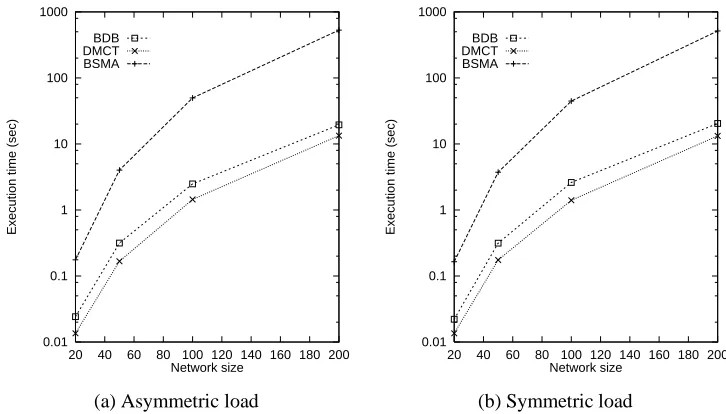
Figure 6: Average Execution time, variable network size, delay constraint ∆=0
:
03 seconds,B
min= 5 Mbps,
B
max = 125 Mbps.loads are asymmetric and when they are symmetric.
Figure 5 shows the percentage excess costs of BDB and DMCT relative to BSMA when the network size varies from 20 nodes to 200 nodes while keeping the delay constraint and the range of link loads fixed. BDB performs as well as BSMA does throughout the entire range of network sizes, while DMCT’s performance relative to BSMA deteriorates as the network size increases. For 200-node networks, DMCT’s trees are 30% and 35% more expensive than BSMA and BDB depending on whether the link loads are symmetric and asymmetric respectively.
Finally, in figure 6, we present the average execution times of BDB, DMCT, and BSMA versus the network size. Note, however, that our code for these algorithms was not optimized for speed. This figure shows that the average execution times of both heuristics grow at the same rate, and are always within the same order of magnitude, with BDB being constantly slower than DMCT by approximately 60%. BSMA is at least one order of magnitude slower than BDB and DMCT and its execution time grows at a faster rate.
In summary, our experimental results indicate that BDB constructs broadcast trees that are close to optimal in cost. It does so in much less time than the best-performing delay-constrained Steiner tree heuristic.
5
Conclusions
is NP-complete. We proposed a bounded delay broadcast (BDB) heuristic to solve the DCMST problem. The heuristic consists of two phases. The first phase is based on Prim’s algorithm [17] and constructs a moderate-cost delay-constrained spanning tree. The second phase reduces the cost of that tree by replacing tree link with cheaper links not in the tree without violating the imposed delay constraint. Simulation results show that BDB’s performance is close to optimal in case of networks with asymmetric link loads as well as in the special case of networks with symmetric link loads. Delay-constrained minimum Steiner tree heuristics can be used to solve the DCMST problem. We compared BDB to the best delay-constrained Steiner heuristic with respect to tree cost, BSMA, and the fastest delay-constrained Steiner heuristic, DMCT. BDB is as efficient as BSMA in constructing cheap broadcast trees. DMCT is not as efficient as BDB. As the network size increases the difference between BDB and DMCT increases. DMCT’s trees are up to 35% more expensive than BDB’s trees when the network size is 200 nodes. DMCT was designed for networks with symmetric link loads, but even in that case BDB performs better. The average execution times of both BDB and DMCT grow at the same rate with DMCT being faster than BDB. BSMA’s execution times are larger than BDB’s execution times, and grow at a faster rate. In summary, our experimental results indicate that BDB is a fast and efficient DCMST heuristic.
Appendix A
NP-Completeness of DCMST-undirected
Delay-Constrained Minimum Spanning Tree in Undirected Networks (DCMST-undirected) Problem: Given an undirected network
G
= (V;E
), a positive costc
(e
) for eache
2E
, apositive delay
d
(e
) for eache
2E
, a source nodes
2V
, a positive delay constraint ∆, and apositive value
B
, find a spanning treeT
(s
)that satisfies:Cost
(T
(s
))= Xt2T(s)
c
(t
)B;
(7)Max Delay
(T
(s
))=maxv2V
Delay
(P
(T
(s
);v
))∆:
(8)Theorem 2 DCMST-undirected is NP-complete unless all link costs are equal.
Proof. When all link costs are equal, the solution to the polynomial time least-delay tree problem (the shortest path tree in which link delays are used as a cost function) can be used to answer the DCMST-undirected decision problem. The DCMST-undirected problem is in NP, since a nondeterministic algorithm can guess a set of links to form the tree, then it is possible to verify in polynomial time that these links do form a tree, that this tree spans all nodes in the network, that the total cost of the tree is less than
B
, and that the maximum end-to-end delay from the source nodes
to any nodev
2V
is no more than∆.Exact Cover by 3-Sets (X3C) Problem: Given a finite set
X
= fx
1;:::;x
3pg and a collectionY
=fy
1;::::;y
qg,q
p
, of 3-element subsets ofX
, find a subcollectionY
0
Y
such that everyelement of
X
occurs in exactly one member ofY
0, i.e., the members of
Y
0are pairwise disjoint,
andS
y2Y
0
y
=X
.Given an arbitrary instance of X3C, we construct the network
G
=(V;E
)for the correspondinginstance of DCMST-undirected as follows:
Every element of
X
is represented by a node in the network, and also every member ofY
isrepresented by a node. Two additional nodes are introduced: a source node
s
and another nodet
. Therefore:V
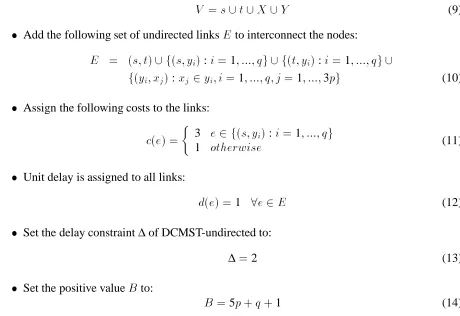
=s
[t
[X
[Y
(9)Add the following set of undirected links
E
to interconnect the nodes:E
= (s;t
)[f(s;y
i):i
=1;:::;q
g[f(t;y
i):i
=1;:::;q
g[f(
y
i;x
j):x
j 2y
i;i
=1;:::;q;j
=1;:::;
3p
g (10)Assign the following costs to the links:
c
(e
)= (3
e
2f(s;y
i):i
=1;:::;q
g1
otherwise
(11)Unit delay is assigned to all links:
d
(e
)=1 8e
2E
(12)Set the delay constraint∆of DCMST-undirected to:
∆=2 (13)
Set the positive value
B
to:B
=5p
+q
+1 (14)Figure 7 illustrates this transformation. It is clear that it can be done in polynomial time. The final step is to show that a feasible spanning tree exists for the above instance of DCMST-undirected if and only if the 3-set collection
Y
has an exact coverY
0. If for a given instance of X3C, any element
x
2X
is not in any membery
of the collectionY
then that instance does not have an exactcover. The above transformation, when applied to such an instance, will result in an unconnected network, thus no spanning tree can be constructed.
If, however, for a given instance of X3C, each element
x
2X
appears in at least one membery
ofY
, the resulting network will be connected. Since all link delays are set to 1 and the delay constraint∆is set to 2, the number of hops along any path starting ats
in any feasible solutionT
(s
)can not exceed 2. As a result all nodes
x
i,i
=1;:::;
3p
, must be leaf nodes in any feasible solution.Each node
x
i will be attached to some nodey
j 2Y
via a unit cost link. They
js used to reach theFigure 7: Equivalent instances of X3C and DCMST-undirected. Link costs are shown. All link delays are set to 1 (not shown).
paths, via the node
t
, can be used froms
to they
js which are not used to reach thex
is. Let there bem
nonleafy
j nodes (y
js that are used to reach thex
is) andn
leafy
j nodes, whereq
=m
+n
.Thus the total cost of any spanning tree,
T
(s
)sat ∆, that satisfies the delay constraint∆is:Cost
(T
(s
)sat ∆) =xis z }| {
3
p
1+nonleafyjs z }| {
m
3 +leafyjs z}|{
n
1+t
z}|{
11
= 3
p
+3m
+(q
?m
)+1=3p
+2m
+q
+1 (15)Each component in equation 15 represents the cost of the links used to attach a set of nodes, indicated as the label of that component, upstream towards
s
. From equations 7, 14 and 15 it follows that the conditionm
p
(16)must be satisfied for the total cost of the tree to be less than
B
. On the other hand, each of them
nonleafy
js can be used to reach at most 3x
is. Thereforem
p
(17)nonleaf
y
j nodes are needed to reach the 3p x
is. Combining conditions 16 and 17, we getm
=p
(18)to reach exactly 3 different
x
is, or in terms of the X3C problem: the members of the collectionY
corresponding to thep
nonleafy
j nodes must be pairwise disjoint.p
pairwise disjoint 3-sets cover 3p
elements, and thus form an exact cover of the setX
. This means that the existence of a feasible solution of an instance of DCMST-undirected implies the existence of a feasible solution for the corresponding instance of X3C.Conversely, if an instance of X3C has an exact cover of
X
, that exact coverY
0Y
must haveexactlyj
Y
0j=
p
members to cover the 3p
elements ofX
. The corresponding instance ofDCMST-undirected will have a feasible solution with j
Y
0j nonleaf
y
js, a maximum end-to-end delay of2=∆, and a total cost of 3
p
+jY
0j3+j
Y
?Y
0j1+1 =3
p
+3p
+q
?p
+1 =5p
+q
+1=B
.This completes the proof. 2
References
[1] V. Kompella, J. Pasquale, and G. Polyzos, “Two Distributed Algorithms for the Constrained Steiner Tree Problem,” in Proceedings of the Second International Conference on Computer
Communications and Networking, pp. 343–349, 1993.
[2] Q. Zhu, M. Parsa, and J. Garcia-Luna-Aceves, “A Source-Based Algorithm for Delay-Constrained Minimum-Cost Multicasting,” in Proceedings of IEEE INFOCOM ’95, pp. 377– 385, 1995.
[3] J. Moy, “MOSPF, Analysis and Experience.” Internet RFC 1585, May 1994.
[4] D. Waitzman, C. Partridge, and S. Deering, “Distance Vector Multicast Routing Protocol.” Internet RFC 1175, November 1988.
[5] S. Deering et al., “Protocol Independent Multicast-Sparse Mode (PIM-SM): Protocol Speci-fication.” Internet Draft, September 1995. Available at ftp://ftp.ietf.cnri.reston.va.us/internet-drafts/draft-ietf-idmr-pim-spec-02.txt.
[6] S. Deering et al., “Protocol Independent Multicast-Dense Mode (PIM-DM): Protocol Spec-ification.” Internet Draft, January 1996. Available at ftp://ftp.ietf.cnri.reston.va.us/internet-drafts/draft-ietf-idmr-pim-dm-spec-01.txt.
[7] A. Ballardie, “Core Based Tree (CBT) Multicast: Protocol Specification.” Internet Draft, February 1996. Available at ftp://ftp.ietf.cnri.reston.va.us/internet-drafts/draft-ietf-idmr-cbt-spec-04.txt.
[8] R. Bellman, Dynamic Programming. Princeton University Press, 1957.
[9] E. Dijkstra, “Two Problems in Connectionwith Graphs,” Numerische Mathematik, vol. 1, pp. 269–271, 1959.
[10] Y. Dalal and R. Metcalfe, “Reverse Path Forwarding of Broadcast Packets,” Communications
[11] S. Deering and D. Cheriton, “Multicast Routing in Datagram Internetworks and Extended LANs,” ACM Transactions on Computer Systems, vol. 8, no. 2, pp. 85–110, May 1990.
[12] Q. Sun and H. Langendoerfer, “Efficient Multicast Routing for Delay-Sensitive Applications,” in Proceedings of the Second Workshop on Protocols for Multimedia Systems (PROMS), (Salzburg, Austria), October 1995.
[13] V. Kompella, J. Pasquale, , and G. Polyzos, “Multicasting for Multimedia Applications,” in
Proceedings of IEEE INFOCOM ’92, pp. 2078–2085, 1992.
[14] R. Widyono, “The Design and Evaluation of Routing Algorithms for Real-Time Channels,” Tech. Rep. ICSI TR-94-024, University of California at Berkeley, International Computer Science Institute, June 1994.
[15] H. Salama, D. Reeves, Y. Viniotis, and T.-L. Sheu, “Evaluation of Multicast Routing Algo-rithms for Real-Time Communication on High-Speed Networks,” in Proceedings of the Sixth
IFIP Conference on High Performance Networking (HPN ’95), pp. 27–42, Chapman and
Hall, September 1995.
[16] R. Karp, “Reducibility among Combinatorial Problems,” in Complexity of Computer
Compu-tations (R. Miller and J. Thatcher, eds.), pp. 85–103, Plenum Press, 1972.
[17] R. Prim, “Shortest Connection Networks and Some Generalizations,” The Bell Systems
Tech-nical Journal, pp. 1389–1401, November 1957.
[18] H. Gabow, Z. Galil, T. Spencer, and R. Tarjan, “Efficient Algorithms for Finding Minimum Spanning Trees in Undirected and Directed Graphs,” Combinatorica, vol. 6, no. 2, pp. 109– 122, 1986.
[19] B. Waxman, “Routing of Multipoint Connections,” IEEE Journal on Selected Areas in
Com-munications, vol. 6, no. 9, pp. 1617–1622, December 1988.
[20] M. Izquiredo, and D. Reeves, “Statistical Characterization of MPEG VBR-Encoded Video at the Slice Layer”, in Proceedings of the SPIE Conference on Multimedia Computing and
Networking, San Jose CA, March 1995.
[21] A. Elwalid, and D. Mitra, “Effective Bandwidth of General Markovian Traffic Sources and Admission Control of High Speed Networks,” IEEE/ACM Transactions on Networking, vol. 1, no. 3, pp. 329-343, June 1993.
[22] M. Garey and D. Johnson, Computers and Intractability: A Guide to the Theory of
![Figure 2: A randomly generated network, 20 nodes, average degree 4.BmaxB’s bandwidth equal to the effective bandwidth(v;Bmine=(u;Bv)maxec(e)0=3 [21] of the traffic, is equal to the reserved(v:;u)e=(u;v)generated by the corresponding broadcast source](https://thumb-us.123doks.com/thumbv2/123dok_us/1213924.1152524/8.612.144.484.13.209/randomly-generated-bandwidth-effective-bandwidth-generated-corresponding-broadcast.webp)