ABSTRACT
DAY, TRICIA MARIE. Assessing the Environmental Orientation: A Course-based Process. (Under the direction of Candace Goode Vick.)
The purpose of this study was to develop a course-based learning
environment assessment process to assist higher education faculty in the design
or redesign of courses to provide a quality learning experience. Kolb’s (1984)
Experiential Learning Theory and Fry’s (1978) Environmental Orientation
Considerations provided the framework for this model. As a course development
model, Kolb’s (1984) Experiential Learning Theory has utility in ensuring that all
learning modes are adequately and appropriately addressed by the
considerations within a unit of analysis, in this case, course content objectives.
As a result of this study, a Learning Environment Orientation (LEO)
Assessment Process was established that could be employed by instructors to
improve the learning environment of their course. The process was established
as follows:
1. Identify an existing course to be revised using Kolb’s (1984)
Experiential Learning Cycle.
2. Identify the content objectives for the selected course.
3. Gather all written materials for the course experiences including
lecture notes, discussion questions and assignments.
4. Map all documented experiences to the appropriate course content
5. Apply the Learning Environment Orientation (LEO) assessment
instrument to each course experience.
6. Create an experience profile for each course experience. Then
develop a Learning Environment Profile by compiling the results
from all the individual experiences by content objective to identify
the environmental orientation of the content objective, using the
purpose of the activity as the indicator for each objective.
7. Based on the results from the assessment, recommend
adjustments to course experiences to reflect all learning modes
included in Kolb’s (1984) Experiential Learning Cycle.
A major component of this study dealt with the creation and refinement of
a reliable instrument to measure the environmental orientation of class
experiences. The Learning Environment Orientation (LEO) Assessment
Instrument was successfully created. To effectively assess a course’s
environmental orientation, the instrument must be applied as part of the Learning
ASSESSING THE ENVIRONMENTAL ORIENTATION: A COURSE-BASED PROCESS
by:
Tricia Marie Day
A dissertation submitted to
the Graduate Faculty of North Carolina State University in partial fulfillment of the requirements for
the degree of Doctor of Philosophy
PARKS, RECREATION AND TOURISM MANAGEMENT
Raleigh
2005
Approved by:
_______________________________ _______________________________ Chair of Advisory Committee
BIOGRAPHY
Tricia Marie Day was born on August 10, 1972 to Dan and Connie Day.
She grew up in Columbus, Indiana and attended public school at Richards
Elementary School, Central Middle School and Columbus East High School. For
college, she moved to Tennessee and began her academic endeavors at
Tennessee Technological University in Cookeville, Tennessee, continued her
pursuit at Motlow State Community College in Tullahoma, Tennessee and finally
ended up at Middle Tennessee State University in Murfreesboro, Tennessee
where she graduated in 1995 with a Bachelor of Science in Recreation and
Leisure Studies. While in school, she completed two internships; she spent the
summer of 1994 in Bahrain with Navy MWR and the summer of 1995 with Peoria
Community Services in Peoria, Arizona.
She began her professional career with Cummins Employee Recreation
Association at CERAland Park in Columbus, Indiana as the Program and Special
Event Coordinator. From there, she moved to the Social Center Manager with
Munster Parks and Recreation in Munster, Indiana. She sought and found a
director’s position with Greenfield Parks and Recreation in Greenfield,
Tennessee. To continue her academic pursuits, she accepted a position as a
Recreation Programmer with McMinnville Parks and Recreation in McMinnville,
Tennessee and began working on her Master’s of Science back at Middle
Tennessee State University in Murfreesboro, Tennessee. She accepted a
graduate assistantship to finish the last semester of her graduate work and
Physical Education and Recreation with an emphasis in Recreation and Leisure
in 2000 from Middle Tennessee State University in Murfreesboro, Tennessee.
She moved to Raleigh, North Carolina to begin her doctoral work at North
Carolina State University. She began as a graduate assistant with Recreation
Resources Service but quickly found her niche teaching and has been teaching
PRT 150, Orientation to Parks, Recreation and Tourism Management and PRT
152, Introduction to Parks, Recreation and Tourism Management during her
tenure in graduate school. In the fall semester of 2005, she joined the faculty at
Lindsey Wilson College in Columbia, Kentucky to establish an academic
ACKNOWLEDGEMENTS
This dissertation recognizes the end of a long struggle. It is one of the few
times I wanted something enough to work and struggle this hard to achieve it. I
am forever in debt to my advisor and chair, Dr. Candace Goode. She has spent
hours mentoring me through the process of becoming a good teacher. She was
patient as I worked through many topics and ideas for my dissertation and has
challenged me to be explicit in my explanations and descriptions of this process.
Additionally, I would like to thank Dr. Deb Luckadoo who inspired me to connect
academic and student affairs issues in ways that make sense. Thanks for your
patience through the process. To my other committee members, Dr. Doug
Wellman and Dr. Janice Odom, thank you for your commitment to undergraduate
education and undergraduate teaching. I appreciate the expertise and value you
brought to this project. I would like to extend a special thanks to Dr. Marilee
Bresciani who encouraged me to continue even (or especially) when I did not
want to or did not think I could. Dr. Beth Wilson, what can I say? Thanks for
letting me sit in your office and cry once a semester. You listened to me ramble
on about all the reasons it did not make sense to continue and were patient as I
thought of all the other things I could be doing that would be much easier and
more financially profitable. I always left knowing I was going to make it, not
always knowing how but knowing I would be ok. Thanks for making sure all my
forms were filled out correctly and turned in, sending all the emails to make sure I
knew what I should be doing and a special thanks for hosting our end of the
I am most grateful to Janice Alexander, Cnm. who finally prescribed a
medicine to reduce my headaches. There was no way I could have made
progress on this dissertation if I kept having such severe migraines.
Graduate School is a communal process. I am grateful to the people I met
and friends I have made while I have been here. Holly Bosley, you became a
friend in such an amazing way. You challenged me to become a better student
and scholar. We started out as office mates and now we are friends. I am
appreciative for the opportunity I have had to get to know you! You are an
inspiration. Sam Trogdon, thanks for helping me keep life fun and in perspective.
Barb Sulik, I am sure my sense of fashion has been forever affected by you and
you never know I may just be a trend-setter one day. It is doubtful but it could
happen! Mark Ivy, you came before me and paved the way. I could not have
made it through my first year without your support and encouragement; it was a
rough transition for me. A special thanks to my friend and colleague, David
Carter, who opened his classroom up for me to examine and was truly interested
in improving student learning. Both personally and professionally, your insight
and counsel has proved to be invaluable.
Thanks to the faculty and staff with the PRTM Department and RRS. You
have all made this an experience I will never forget. Special thanks to Felicia
Mangum. You have brought an energy and enthusiasm to the fourth floor of
Biltmore that it so desperately needed. Thanks for bringing yummy snacks and
thanks for agreeing to participate and providing valuable feedback about the
process.
Thanks to my friends and family at Raleigh Vineyard; you have kept me
centered and loved me. Special thanks to the Raleigh Vineyard kids, your
laughter and enthusiasm kept me going on more than one occasion. Thanks to
my friend Keri Jackowski; you have taught me what it means to be a good friend.
I hope to carry that with me forever. Thank you for the countless hours you have
spent talking to me and praying for me. Thanks to my friend Karen Orthner; you
have taught me what it means to love other people. This has been a true gift.
And finally to my students, you have had to endure me learning how to
teach. I know I am not finished learning yet. Thank you for your feedback and
TABLE OF CONTENTS
LIST OF FIGURES ...ix
LIST OF TABLES ...x
CHAPTER 1 – INTRODUCTION... 1
Introduction ... 1
Purpose Statement ... 5
Limitations... 5
CHAPTER 2 – REVIEW OF THE LITERATURE ... 7
History of Higher Education ... 7
Learning Theory as a Framework ... 8
Kolb’s Experiential Learning Cycle ... 8
Learning Cycle Dimensions ... 9
Classroom Activities... 11
Environmental Orientation ... 12
The Structure of the Brain Supports the Learning Cycle ... 12
Development of Assessment Criteria... 15
Traditional Application ... 19
Advocates of Using Learning Styles ... 19
Link between Learning Theory and Learning Preferences ... 20
Learning Preferences... 21
Strengths and Weaknesses of Learning Preferences ... 22
Kolb’s Learning Style Inventory ... 23
Learning Styles Studies... 24
Learning Styles Studies in Parks and Recreation... 25
CHAPTER 3 – METHODOLOGY ... 27
The Purpose of the Study ... 27
Content Analysis... 27
Historical Uses of Content Analysis ... 28
Contemporary Examples... 29
Narrative Content Analysis... 30
Research Method ... 30
Course Description... 31
Defining the Units of Analysis ... 32
Establishing the Assessment Criteria... 33
Developing the Analysis Plan... .35
Selecting the Raters ... 35
Training the Raters... 36
Learning Environment Orientation (LEO) Development ... 36
Pilot Assessment... 39
Inter-rater Reliability ... 39
Application of the Assessment Criteria... 41
Compiling the Results for Each Experience ... 45
Constructing a Learning Environment Profile (LEP) ... 45
CHAPTER 4 – RESULTS... 46
Purpose of the Study ... 46
Process... 46
Instrument Development... 47
Environmental Orientation Profile ... 48
Profile for Each Content Objective... 66
CHAPTER 5 – CONCLUSIONS AND IMPLICATIONS ... 70
The Process... 70
Limitations... 72
The Instrument... 72
Observations of Kolb’s Experiential Learning Cycle ... 75
Variety of Experiences ... 77
Learning Style Connection... 78
Future Utility of this Model and Theory ... 79
Use for Future Teaching ... 80
REFERENCES ... 84
APPENDICES ... 88
Appendix A. Course Experiences Mapped to Specific Content Objectives... 88
Appendix B. Rater Training... 106
Appendix C. Revision #1 LEO ... 113
Appendix D. LEO Instruction Sheet ... 114
Appendix E. Pilot Rating Assessment Packet ... 115
LIST OF FIGURES
FIGURE 1
Kolb’s Experiential Learning Cycle ... 9 FIGURE 2
Classroom Activities ... 11 FIGURE 3
Location of Brain Functions in Learning... 13 FIGURE 4
Relationship of Brain Function Locations with the
Experiential Learning Cycle ... 14 FIGURE 5
Typology of Environments ... 16 FIGURE 6
Description of Learning Environments ... 18 FIGURE 7
Learning Preferences based on Kolb’s Experiential Learning Cycle... 21 FIGURE 8
Strengths and Weaknesses of Learning Preferences... 23 FIGURE 9
PRT 454 Course Objectives ... 32 FIGURE 10
Learning Environment Orientation Indicators... 34 FIGURE 11
Fry’s (1978) Learning Environment Description as Questions ... 38 FIGURE 12
Learning Environment Orientation (LEO) Assessment Instrument ... 41 FIGURE 13
LEO Assessment Instrument for PRT 454 Raters ... 44 FIGURE 14
LEO Experience Profile ... 45 FIGURE 15
Environmental Orientation of Course based on
Purpose of the Activity ... 69 FIGURE 16
Environmental Orientation of Experiences based on the
Purpose of the Activity ... 76 FIGURE 17
LIST OF TABLES
Table 1
Experiences 5, 9, 11, 13, 16, 18, 20, 22, 24, 25 and 27 ... 50 Table 2
Experiences 10 and 12 ... 51 Table 3
Experiences 21, 23 and 26 ... 52 Table 4
Experience 3... 53 Table 5
Experience 4... 54 Table 6
Experience 8... 55 Table 7
Experience 14... 56 Table 8
Experience 15... 56 Table 9
Experience 17 ... 57 Table 10
Experiences 1 ... 58 Table 11
Experience 2... 59 Table 12
Experience 7... 60 Table 13
Experience 19... 61 Table 14
Experience 28... 62 Table 15
Experience 29... 63 Table 16
Experience 30... 64 Table 17
Experience 31... 65 Table 18
Experience 32... 66 Table 19
Chapter 1
Introduction
Introduction
For most students, the first day of school is an event that brings up many
emotions: happiness to see old friends again, excitement for what a new year
brings, fear of starting something new and sadness that summer has ended. For
first-time teachers, the emotions run the same gamut: shock that someone would
bestow such responsibility on them, excitement for a new year of school, fear of
not knowing all the answers, horror at the thought of walking into class on the
first day as the person in charge, and sadness that summer has ended.
As a first time teacher, my initial question was, what will I teach? That
answer came rather quickly for I did not struggle with the content of my courses.
For the first few years of teaching, I knew what I wanted to teach but struggled
with how to convey that information to students. Teaching multiple sections of
the same class offered me an opportunity to observe the mystery of classes,
identical in content and evaluation, but reacting differently to the same material
and experiences. This mystery can be explained at least in part by
understanding the process of learning. So, how in the world do you teach
someone something?
This dissertation is a culmination of my own experiences and frustrations
trying to learn to teach and knowing there was help out there, somewhere. It is
the pursuit of comprehending the learning process and becoming a better
and awards and more to do with the transformations within an individual student
produced by the learning process.
Faculty in higher education have had a renewed focus on student learning
(Astin, 1993). Much of that interest has been generated by accrediting bodies,
such as Southern Association of Colleges and Schools (SACS) and legislative
bodies requiring institutions of higher education to assess student learning.
Faculty have been challenged to articulate what they want their students to be
able to know and do upon graduation and how to help students achieve success.
When assessment data indicate students have not met faculty
expectations, many faculty members are overwhelmed by what and how to
change. As academic professionals, most receive training in a specific field of
study and not in how to teach. As a result of this new focus on undergraduate
education, faculty are required to shift to the process of learning. The use of
learning theory is a key to informing the teaching and learning process. Learning
theory merits attention because it can provide profound insight into the learning
process and can assist instructors in designing productive learning environments
for students.
Many factors contribute to the overall learning environment, which
incorporates “the conditions and context for learning” (Smith, Neilsworth, &
Greer, 1978, p. 10). The primary dimensions of the learning environment are as
follows: physical environment, instructional arrangements, social situation,
evaluative instruments and practices, and supportive services (Smith et al.).
student’s experience in a higher education setting. Specifically examining
instructional arrangement includes the consideration of several perspectives: the
curriculum, the instructional materials, and the method of instruction (Smith et
al.). Experiential learning theory deals directly with this dimension of a learning
environment. Course design becomes a critical factor when experiential learning
theory is used as the framework with which to view the learning environment
(Kolb, 1984).
Experiential learning theory includes two basic dimensions of
conceptualizing learning: what is being taught and how it is being taught. In
typical learning situations, the content is explicit in terms of discipline-specific
outcomes, but attention to how the content is presented is often neglected (Kolb,
1984). Examining learning as a multidimensional process allows for
consideration of factors other than those specific to content.
Faculty need to specifically consider their design of learning experiences
(Spence, 2001). “If educators relied upon models of how individuals learn, they
would be better able to enhance their students’ ability to learn” (Sims & Sims,
1995, p. 1). The instructor is responsible for planning the formal educational
experience. “A teacher has the primary responsibility and authority for
appropriately orchestrating the instructional environment” (Smith et al., 1978, p.
51). Effective instructional strategies go beyond the curriculum and instructional
material to incorporate learning strategies that explicitly provide for the variability
In the same learning situations, students are affected differently (Joyce &
Weil, 2000). The variability and the individuality of learning experience can be
explained by understanding how learners take in and process information. This
variability is a major consideration for adopting and utilizing a variety of methods
in course development.
The effectiveness of traditional instructional methods comes into question
when issues of accountability and quality are raised. Traditional instructional
methods are ideal only for a limited number of students, leaving the majority of
students at a disadvantage (Kolb, 1984). Appropriate variations to traditional
methods (e.g., lectures) must be integrated (Barr & Tagg, 1995).
Experiential learning is one variation on the traditional instructional
methods. One well known and widely utilized model of experiential learning
comes from David Kolb (1984). Unlike other theories, Kolb’s work is grounded in
solid theory and epistemological tradition (Holman, Pavlica, & Thorpe, 1997).
Kolb designed an experiential learning cycle comprised of four learning modes
concrete experience, reflective observation, abstract conceptualization and
abstract experimentation in two dimensions: a grasping dimension and a
processing dimension. The grasping dimension describes how a student takes in
information, either as a concrete experience or as an abstract concept. The
processing dimension describes how information is processed once it has been
taken in, either by actively experimenting with the information or reflectively
observing. These four learning modes are represented in these two dimensions.
student’s preferences, it is the sequential combination of all four learning modes
that produces the most effective learning environment (Kolb, 1984). Effective
learning indicates a quality educational experience. Kolb’s model allows learning
environments to be more effective and is, therefore, worth considering.
Purpose Statement
The purpose of this study was to develop a course-based learning
environment assessment process to assist higher education faculty in the design
or redesign of courses to provide a quality learning experience. Kolb’s (1984)
Experiential Learning Theory and Fry’s (1978) Environmental Orientation
Considerations provided the framework for this model. The primary objective of
this study was:
To develop a learning environment orientation assessment process based
on accommodating Kolb’s (1984) four learning modes that faculty could
use to design or assess a course. Park and Recreation Finance and
Administration, PRT 454, was used to illustrate the process. The course
profile and recommendations were specific to the course and used for
illustrative purposes.
Limitations
This study only evaluated the written documents provided by the instructor
from PRT 454. Significant documentation from lesson plans and assignments
was needed to complete the assessment. The assessment process did not take
into consideration the instructor/student interactions. Some of the learning
therefore are not accounted for in the analysis and profile. Because this process
focused on how students are taught and not what students are taught, it does not
evaluate course content, just delivery. The process provided no mechanism for
evaluating if course objectives were being met.
The assessment process relied on the results from independent raters
applying the Learning Environment Orientation (LEO) Assessment Instrument to
the course material. While the instrument was deemed reliable, this study
Chapter 2
Review of the Literature
History of Higher Education
Pedagogical practices at modern universities have expanded to meet the
demands of student diversity and the economy. In his pivotal work, Scholarship
Reconsidered: Priorities of the Professoriate, Earnest Boyer (1990) reviewed the
history of higher education. Following World War II, the GI Bill had a major
impact on access to higher education. The movement of higher education from
an elite privilege to a mass entitlement was an important shift in access to
educational opportunities. As access to higher education expanded, the system
needed to adapt to meet the needs of the diverse student populations. This
adaptation expanded the mission of universities and higher education. The
complex proposition of managing the quantity of students as well as the ensuing
change in the quality of students followed the shift in access.
To keep pace with the expanding mission of higher education, the
academy expanded to incorporate the community college system. Community
colleges offered more immediate access to higher education and encouraged the
expansion of access beyond social and economic classes to include
non-traditional students such as part-time and older students. Addressing students’
learning needs, given the diversity in the quality and the quantity of students, has
demanded that higher education take into account the individual needs of
students as well as the practical concerns for delivering instruction in mass
Learning Theory as a Framework
Learning theory extends to more than just describing an environment;
learning theory can be used as a framework to ensure a balanced approach to
learning. “The learning process is not identical for all human beings” (Kolb, 1984,
p. 62). For learning environments to be sensitive and responsive to all types of
learning, the factors that influence the educational process must be identified and
managed. One such factor is the design of a course. Course design can be
improved by understanding how students learn (Russell & Rothschadl, 1992).
Understanding how students learn goes beyond knowing what content students
need to learn and focuses on the process of how students learn. “Instructors
need to design courses to enable students to increase their ability to learn”
(Russell & Rothschadl, p. 43).
Kolb’s Experiential Learning Cycle
The roots of experiential learning go back to the early twentieth century to
Dewey, Piaget and Lewin (Kolb, 1984; Smith, 2001). Building specifically on
Lewin’s work, Kolb designed an experiential learning cycle comprised of two
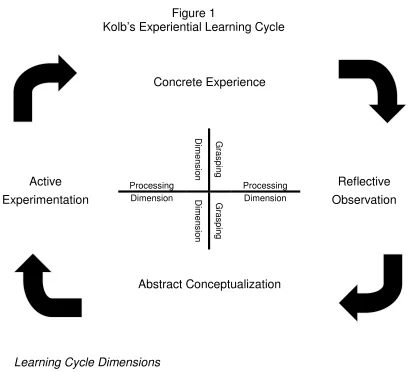
Figure 1
Kolb’s Experiential Learning Cycle
Concrete Experience
Active Processing
D
im
e
n
s
io
n
G
ra
s
p
in
g
Processing Reflective
Experimentation Dimension D
im
e
n
s
io
n
G
ra
s
p
in
g
Dimension Observation
Abstract Conceptualization
Learning Cycle Dimensions
The grasping dimension describes how a student takes in information,
either as a concrete experience or as an abstract concept. The processing
dimension describes how information is processed once it has been taken in,
either by actively experimenting with the information or reflectively observing.
The sequential engagement of all abilities creates a self-perpetuating spiral of
learning. This spiral is the sequence that creates deep learning. “Deep learning,
learning for real comprehension comes through a sequence of experience,
reflection, abstraction, and active testing” (Zull, 2002, p. 13).
For the grasping dimension, any specific event is a concrete experience.
impact an experience generates. Feelings, values and opinions are
acknowledged as part of the process” (Rainey & Kolb, 1995, p. 134). Relating an
experience to previous knowledge and generating new ideas is abstract
conceptualization. In this stage, the learner is looking to find the right or best
answer (Sims & Sims, 1995). Learners are expected to memorize and recall
information. The recollection of this information is then judged against rigid
criteria for a single right answer (Rainey & Kolb).
For the processing dimension, reflective observation is where learners
make meaning of an experience. Profound insight is often gained through this
reflection. The learner’s main goal is to “understand something: to be able to
identify relationships between concepts, to be able to define problems for
investigation, to be able to collect relevant information, to be able to research a
question, and the like” (Rainey & Kolb, 1995, p. 134). In this learning
environment, experiences are considered from multiple perspectives, personal
experience, expert opinions and the literature as well as multiple methods of
experience such as listening, observing, writing, discussing, and acting (Rainey &
Kolb). The process is emphasized more than the result of finding a single
solution. The value of the process comes from considering multiple perspectives
and solutions. Learners are left to define success for themselves. There are no
objective criteria against which to evaluate success (Sims, 1995). The focus is
on how a learner interprets and makes meaning of a situation or experience.
The final phase of the experiential learning cycle is active experimentation. As
have learned to solve “real-world” problems (Sims). In this stage, the focus is on
doing. It is essential to the learning process to complete the task (Sims). Tasks
are typically interrelated and require comprehensive understanding of concepts.
Success is situational and based on specific task criteria.
Kolb and Fry (1975) further conceptualized the learning environment by
identifying the area of complexity associated with each stage of learning. They
recognized that a concrete experience is affectively complex by taking into
account the emotional impact an experience generates. Abstract
conceptualization is primarily a cognitive process. Reflective observation is
perceptually complex, thinking about an experience from multiple perspectives.
Active experimentation is behaviorally complex, involving trying out new ideas.
Classroom Activities
As Kolb (1984) suggests, each stage in the cycle has appropriate
classroom activities (Figure 2).
Figure 2 Classroom Activities
Classroom application
Concrete Experience laboratory observations, primary text reading, simulations and games, fieldwork, trigger films, readings, problem sets and examples
Reflective Observation logs, journals, discussions, brainstorming, thought questions and rhetorical questions
Abstract Conceptualization lectures, papers, model building, projects and analogies Active Experimentation simulations, case studies, laboratory, fieldwork, projects
Environmental Orientation
“When experiential learning theory is used to view the learner and
instructional environment… useful relationships begin to emerge concerning the
design of learning situations” (Kolb, 1984, p. 200). The environmental orientation
of a learning experience can be identified by determining if the following five
considerations established and controlled by the instructor are in alignment with
a specific orientation: the purpose of the major activities, the primary source or
use of information, the rules guiding learning behavior, the teacher’s role, and the
provision for feedback. “Any educational program, course design or classroom
session can be viewed as having degrees of orientation towards each of the four
learning modes” (Kolb, 1984, p. 197).
The Structure of the Brain Supports the Learning Cycle
A fellow faculty member of Kolb found his work to be particularly
interesting and wanted to explore Kolb’s ideas in his discipline of Biology. After
exploring the biology of learning, Zull (2002) discovered the biological link
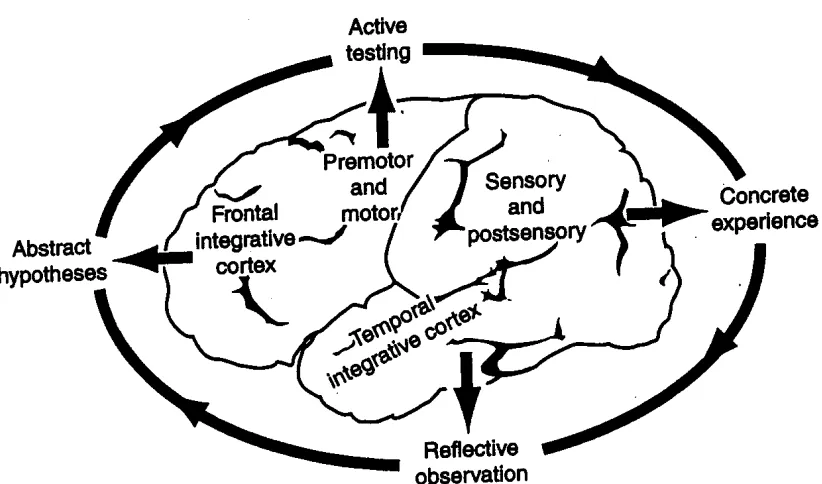
between brain functioning and the learning cycle (Figure 3). There is a “natural
relationship between brain structure and learning” (Zull, 2002, p. 13). The natural
organization of the brain generates the learning cycle. It is the way people learn
about the world. Each person is always having some type of concrete
experience and relating that experience to what is already known, thinking of how
to interpret and make use of the information and as it becomes part of a person’s
of the learning cycle mirror the physical location of where learning is processed in
the brain (Figure 4).
Concrete experience comes through the sensory cortex, reflective observation involves the integrative cortex at the back, creating new abstract concepts occurs in the frontal integrative cortex, and active testing involves the motor brain. In other words, the learning cycle arises naturally from the structure of the brain (Zull, 2002, pp. 18-19).
Figure 3
Figure 4
Relationship of Brain Function Locations with the Experiential Learning Cycle
Important Functions of Each Part of Cortex
Match with Each Stage of the Learning Cycle The sensory cortex receives first input
from the outside world in form of vision, hearing, touch, position, smell and taste.
This matches with the common
definition of concrete experience, with its reliance on direct physical
information from the world. The back integrative cortex is
engaged in memory formation and reassembly, language comprehension, developing spatial relationship, and identifying objects, faces, and motion. In short, it integrates sensory
information to create images and meaning
These functions match well with what happens during reflection, for example, remembering relevant information, daydreaming, and free associations, mentally rerunning experiences, and analyzing experiences.
The frontal integrative cortex is responsible for short-term memory, problem solving, making decisions, assembling plans of action, assembling language, making judgments and evaluations, directing the action of the rest of the brain (including memory recall), and organizing actions and activities of the entire body.
This matches well with the generation of abstractions, which requires
manipulation of images and language to create new (mental) arrangements, developing plans for future action, comparing and choosing options, directing recall of past experience, creating symbolic representations and replacing and manipulating items held in short-term memory.
The motor cortex directly triggers all coordinated and voluntary muscle contractions by the body, producing movement. It carries out the plans and ideas originating from the frontal
integrative cortex, including the actual production of language through speech and writing.
This matches with the necessity of action in completion of the learning cycle. Active testing of abstractions requires conversion of ideas into physical action, or movements of parts of the body. This includes intellectual activities such as writing, deriving relationships, doing experiments and talking in debate or conversation.
Zull, 2002, pp. 21-22
From this relationship, a question surfaces in relationship to facilitating
learning. Can we use this information to help people learn? Perhaps a better
question is, why would we not use this information to help people learn? With a
environmental structure of a learning experience is more than background for a
learner. The structure of an experience becomes an agent of change for the
learner. Learning is transformation for the learner. Kolb (1984) defined learning
as “the process whereby knowledge is created through the transformation of
experience” (p. 38). Experience and information are the raw materials for
learning, but with reflection and experimentation, information and experience are
converted to knowledge (Zull, 2002). This conversion to knowledge is called
deep learning. Most instructors desire deep learning for their students.
Development of the Assessment Criteria
The utility of Kolb’s (1984) Experiential Learning Cycle is not fully
actualized by a theoretical discussion of what learning should be. It is the
operationalization of the four learning modes that has a direct impact on
curriculum design and development. Kolb and Fry (1975) initially developed the
Typology of Environments (Figure 5). It included indicators that specifically
represented Kolb’s four learning modes. The Typology of Environments included
four indicators for concrete experience, three indicators for reflective observation,
four indicators for abstract conceptualization and three indicators for active
Figure 5
Typology of Environments
1. Concrete Experiences are characterized by: a. Focus on here and now experiences
b. Legitimization of expression of feelings and emotions c. Situations structured to allow ambiguity
d. High degree of personalization
2. Reflective observations are characterized by:
a. Opportunities to view subject matter from different perspectives b. Time to reflect and roles (e.g., listener, observer) which allow for
reflection
c. Complexity and multiplicity of observational frameworks 3. Abstract conceptualizations are conceptualized by:
a. Emphasis on recall of concepts
b. Thinking or acting governed by rules of logic and inference c. Situations structured to maximize certainty
d. Authorities respected as caretakers of knowledge 4. Active experimentations are conceptualized by:
a. Responsibility for setting own learning goals b. Opportunities for real risk taking
c. Environmental responses contingent upon self-initiated action Kolb and Fry (1975)
Fry (1978) subsequently expanded the Typology of Environments to
identify five specific considerations to assess an environmental orientation.
These five considerations are established and controlled by the instructor: the
purpose of the major activities, the primary source or use of information, the rules
guiding learning behavior, the teacher’s role, and the provision of feedback.
“Learning environments vary along dimensions that are primarily predetermined
and independent of learner interaction in the setting” (Fry, p. 3). “These [five
considerations] are useful cues, because to a great extent they are controlled by
the instructor, faculty or administration, independent of the learner. Most
decisions affecting these aspects of learning environments are made before
Within a learning environment, Fry (1978) described each of the
environmental orientation indicators. The purpose outlines the major goals of an
experience or assignment. The information source identifies the various uses
and origins of the data utilized in an experience or for an assignment. The nature
of the feedback describes how reactions from both the instructor and peers will
be addressed. The rules of behavior recognize the learner’s role in an
experience or actions for an assignment. Finally, the role of the teacher
discriminates among the various functions an instructor can serve in the
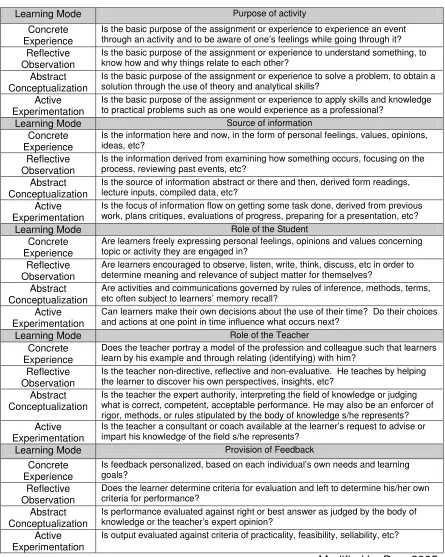
classroom. Fry (1978) went on to describe each of the four learning modes
based on the five considerations established and controlled by the instructor
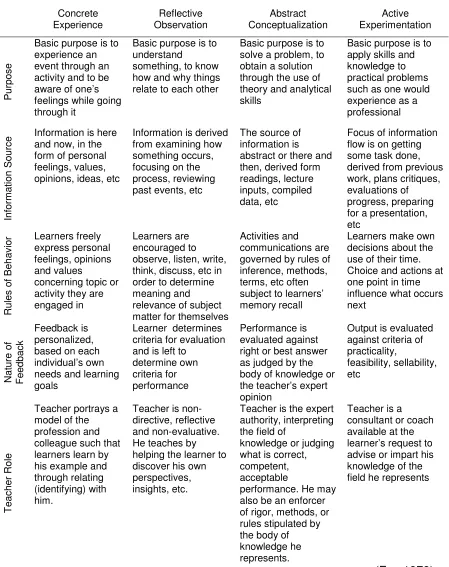
Figure 6
Description of Learning Environments
Concrete Experience Reflective Observation Abstract Conceptualization Active Experimentation P u rp o s e
Basic purpose is to experience an event through an activity and to be aware of one’s feelings while going through it
Basic purpose is to understand
something, to know how and why things relate to each other
Basic purpose is to solve a problem, to obtain a solution through the use of theory and analytical skills
Basic purpose is to apply skills and knowledge to practical problems such as one would experience as a professional In fo rm a ti o n S o u rc
e Information is here
and now, in the form of personal feelings, values, opinions, ideas, etc
Information is derived from examining how something occurs, focusing on the process, reviewing past events, etc
The source of information is abstract or there and then, derived form readings, lecture inputs, compiled data, etc
Focus of information flow is on getting some task done, derived from previous work, plans critiques, evaluations of progress, preparing for a presentation, etc R u le s o f B e h a v io
r Learners freely
express personal feelings, opinions and values
concerning topic or activity they are engaged in
Learners are encouraged to observe, listen, write, think, discuss, etc in order to determine meaning and relevance of subject matter for themselves
Activities and communications are governed by rules of inference, methods, terms, etc often subject to learners’ memory recall
Learners make own decisions about the use of their time. Choice and actions at one point in time influence what occurs next N a tu re o f F e e d b a c k Feedback is personalized, based on each individual’s own needs and learning goals
Learner determines criteria for evaluation and is left to
determine own criteria for performance
Performance is evaluated against right or best answer as judged by the body of knowledge or the teacher’s expert opinion
Output is evaluated against criteria of practicality, feasibility, sellability, etc T e a c h e r R o le
Teacher portrays a model of the profession and colleague such that learners learn by his example and through relating (identifying) with him.
Teacher is non-directive, reflective and non-evaluative. He teaches by helping the learner to discover his own perspectives, insights, etc.
Teacher is the expert authority, interpreting the field of
knowledge or judging what is correct, competent, acceptable
performance. He may also be an enforcer of rigor, methods, or rules stipulated by the body of knowledge he represents.
Teacher is a consultant or coach available at the learner’s request to advise or impart his knowledge of the field he represents
Traditional Application
A discussion of Kolb’s Experiential Learning Theory would be incomplete
without mentioning the traditional applications of his ideas. The predominant use
of this information in higher education has been in assessing the individual
learning preferences of students using Kolb’s Learning Style Inventory (LSI) and
using that information to define clusters of students, typically within a particular
major.
Advocates of Using Learning Styles
The insight to use learning theory to enhance the learning process is not a
new concept. In 1975, Kolb and Fry recognized that an understanding of the
content does not necessarily translate into effective delivery. They documented
learning theory’s utility in creating environments for learning. Kolb and Fry
(1975) forecasted that “our efforts to understand and further develop learning
theory will be fruitful if the results eventually affect the deliberate use of models
[based on learning theory] to design and implement more effective learning
situations” (p. 51). Recent studies are in agreement with Kolb and Fry’s
perspective.
Moore, Riggins, and Sylvester (1986) encouraged examining classroom
effectiveness beyond looking at the instructor as the presenter of knowledge to
looking at how the student receives the information. The authors encouraged
designing courses to meet the learning styles of all students, understanding that
in any one course a variety of learning styles are present. Russell and
students, they urged faculty to “be aware of the differences and create options for
learning the same material in various ways” (p. 43).
Keri (2002) is also in favor of a variety of approaches to classroom
instruction because of the variety of ways students learn. Keri discussed the
need for diverse instructional styles to effectively direct learning experiences.
Perry (1994) advocated for an understanding of learning styles as a tool for
curriculum planning and design. “Knowledge of individual learning styles can
form a productive basis for curriculum planning, implementation and evaluation”
(Perry, 1994, p. 6).
Link Between Learning Theory and Learning Preferences
Kolb (1981) defined learning preference as a habitual way of responding
to a learning environment. It is the combination of the two structural dimensions
of Kolb’s model that offers the four basic preferences for learning: converging,
diverging, assimilating, and accommodating (Figure 7). This combination of a
person’s habitual way of responding to a learning environment on each
dimension indicates his/her learning preference. Kolb’s learning preferences are
Figure 7
Learning Preferences Based on Kolb’s Experiential Learning Cycle
Accomodator
Concrete Experience
Diverger
Active Reflective
Experimentation Observation
Converger
Abstract Conceptualization
Assimilator
Learning Preferences
Seemingly random variation in learning preferences is often quite
systematic and methodical. These learning preferences are comprised of one
preference from the grasping dimension and one preference from the processing
dimension. For example, a convergent learning preference represents abstract
conceptualization from the grasping dimension and active experimentation from
the processing dimension. A divergent preference is the opposite of the
convergent in that it represents concrete experience from the grasping dimension
and reflective observation from the processing dimension. The other two
combines concrete experience and active experimentation. An assimilation
preference combines abstract conceptualization and reflective observation.
A learning preference is a habitual response among opposing
preferences. People can respond to learning environments in ways other than
their preferred response. It would be like a right-handed person writing with their
left hand. It is possible, just not always most comfortable or efficient. This lack
of comfort and efficiency for a particular preference warrants learning
environments being designed to accommodate all learning preferences. In fact, it
is the combination of all types of learning that produce the most effective
learning. “The combination of all four of the elementary learning forms produces
the highest level of learning, emphasizing and developing all four modes of the
learning process” (Kolb, 1984, p. 66).
Strengths and Weaknesses of Learning Preferences
Considering learning preferences can be an asset for course design.
Preference information should “…provide some guidance for restructuring the
curriculum and methodology…” (Matthews, 1991-2, p. 29). In 1984, Kolb
identified both the strengths and the weaknesses of each learning preference
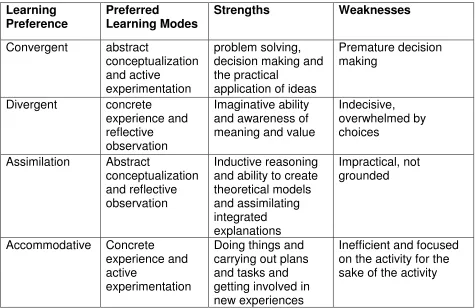
Figure 8
Strengths and Weaknesses of Learning Preferences
Learning Preference
Preferred
Learning Modes
Strengths Weaknesses
Convergent abstract
conceptualization and active
experimentation
problem solving, decision making and the practical
application of ideas
Premature decision making
Divergent concrete
experience and reflective
observation
Imaginative ability and awareness of meaning and value
Indecisive, overwhelmed by choices
Assimilation Abstract
conceptualization and reflective observation
Inductive reasoning and ability to create theoretical models and assimilating integrated explanations Impractical, not grounded
Accommodative Concrete experience and active
experimentation
Doing things and carrying out plans and tasks and getting involved in new experiences
Inefficient and focused on the activity for the sake of the activity
Kolb’s Learning Style Inventory
The original learning style inventory was comprised of nine sets of words
to be ranked four to one, where four best depicts the participant’s learning style
and one least depicts the participant’s learning style (Kolb, 1976). The column
totals are then translated into numbers translated onto a graph which visually
depicts a person’s learning style preference (Kolb, 1976). The LSI version 2 was
developed by Kolb in 1981 and is conceptually similar to the original inventory,
but the second inventory consisted of twelve partial sentences and four
alternative endings for each sentence (Kolb, 1999). The participant must again
style and one least describes the participant’s learning style (Smith & Kolb, 1985;
Smith, 2001). The latest version, LSI version 3, was developed in 1999 (Kolb,
1999). Again, respondents are asked to complete twelve items but the items are
now randomized. The participants are still given twelve partial sentences and
four alternative endings for each sentence. The participant must again rank the
endings from four to one, where four best describes the participant’s learning
style and one least describes the participant’s learning style (Kolb, 1999).
The LSI version 3 has pros and cons. It is practical because it is brief and
straightforward. It looks to predict behavior that is consistent with learning
theory. Since a person can choose how to operate in a learning situation, the
instrument is self-reported. The inventory seeks to describe the typical
responses from an individual. It seeks to represent the “stable and enduring
patterns of human individuality [that] arise from consistent patterns of transaction
between the individual and his or her environment” (Kolb, 1984, p. 63). It often
requires “one to resolve the opposing tensions between abstract-concrete and
active-reflective orientations” (Kolb, 1984, p. 67). This forced choice is often
disliked by respondents.
Learning Styles Studies
Assessing the learning styles of students in particular majors has value to
explain the anecdotal observations of instructors. “There seem to be learning
styles that are best suited for particular task demands” (Kolb & Fry, 1975, p. 52).
Kanske, Brewster, and Fanjoy (2003) looked at learning styles of aviation
Loo (2002) compiled a meta-analysis of studies of business majors that utilized
Kolb’s Learning Styles Inventory. Loo found a significantly higher proportion of
assimilators and a significantly lower proportion of accommodators among
business majors.
Raschick, Maypole, and Day (1998) looked at education majors. The
predominant learning style was accommodators. Perry (1994) also looked at
students in a teacher education program. He discovered teacher education
students had differing learning styles but had a slight preference for abstract
experimentation. Zakrajsek, Johnson, and Walker (1984) compared learning
styles of physical education and dance majors. Their results indicated no
significant difference between majors or genders.
Learning Style Studies in Parks and Recreation
Moore et al. (1986) conducted the original work in parks and recreation
using Kolb’s learning style inventory. They found park and recreation majors to
be predominantly accommodators (50%, n=15). The other categories of
divergers (n=6), convergers (n=5) and assimilators (n=5) were fairly equal.
The second study in parks and recreation using Kolb’s learning style
inventory was conducted by Russell and Rothschadl (1992). Again, this study
found the majority of park and recreation students were accommodators. While
this study did ask students their area of concentration, the total number (N=50)
was too small to examine for significant differences between concentrations.
With the information known regarding experiential learning theory, the
encourage movement through Kolb’s (1984) Experiential Learning Cycle? Thus
Chapter 3
METHODOLOGY
Purpose of the Study
The purpose of this study was to develop a course-based learning
environment assessment process to assist higher education faculty in the design
or redesign of courses to provide a quality learning experience. Kolb’s (1984)
Experiential Learning Theory and Fry’s (1978) Environmental Orientation
Considerations provided the framework for this model. The primary objective of
this study was:
To develop a learning environment orientation assessment process based
on accommodating Kolb’s (1984) four learning modes that faculty could
use to assess or design a course. Park and Recreation Finance and
Administration, PRT 454, was used to illustrate the process. The course
profile and recommendations were specific to the course used for
illustrative purposes.
Content Analysis
Different types of research questions demand different approaches to
studying and answering them. Content analysis is a systematic technique for
evaluating and interpreting content. Content analysis is not a method for data
collection but rather a tool for data analysis (Henderson, 1991). It is a “research
technique for making replicable and valid inferences from texts (or other
meaningful matter) to the contexts of their use” and, “as a technique, content
method applies a measurement tool to pre-determined units of analysis (Manning
& Cullum-Swan, 1994). Content analysis looks for the presence of words or
concepts within text. The nature of content analysis involves the rearticulating of
text and is often referred to as interpretive (Krippendorff, 2004).
Content analysis begins with a theory or rationale that “indicates this
particular message content is important to study” (Neuendorf, 2002, p. 50).
Learning theory merits attention because it can provide insight into the learning
process and can assist instructors in creating productive learning environments
for students. The way a learning environment is conceptualized identifies the
many factors that impact the learning environment such as culture, intelligence,
learning disabilities, life stage, cognitive development, attitude, motivation,
satisfaction, institution, peer group influence, familial situation, student
involvement, and self-esteem. While most of those impacts deal directly with the
student’s perspective and what a student brings to the classroom, a portion of
this puzzle deals with the faculty member. It matters how the faculty member
designs and conceptualizes a course, particularly with respect to student learning
outcomes.
Historical Uses of Content Analysis
The earliest examination of text dates back to the late 1600’s in
theological studies. The church was often concerned about the content of
non-religious publications, particularly newspapers. The methods of analyzing the
newspaper content, however, were extremely primitive and often less than
text in the church and theological studies, examination efforts were focused
almost exclusively on newspaper content (Krippendorff, 2004).
In early to mid-twentieth century America, interest in newspaper content
had a significant impact on politics. “Major political challenges to democracy were
linked to the new mass media” (Krippendorff, 2004, p. 6). The interest in
newspaper content was particularly important following the stock market crash of
1929 and the period surrounding World War II. Following the War, psychologists
became interested in measuring attitudes and images. This shift marked the
transition from quantitative analysis of newspapers to content analysis. As social
scientists asked different kinds of questions and sought an understanding of
more elaborate phenomena than they had in the past, they began to seek more
sophisticated techniques to analyze ideas and concepts within texts. Thus, the
methods and uses of content analysis expanded and blended in with other
inquiry traditions and became part of other research methods.
Contemporary Examples
As society evolves and social issues change, so do the ways scientists
investigate and describe social phenomena. Content analysis is one such way of
investigating and describing such events. The utility of the computer has made
more contemporary uses of content analysis practical. The availability of text in a
digital format has reduced the time and cost of analyzing large quantities of data
and increased the accuracy and complexity of analysis (Krippendorff, 2004). The
prevalence of television in modern society offered researchers a new medium to
examined. In recent years, the content of television has been examined
particularly for messages of violence much like the newspaper content was
examined for political messages in early twentieth century America (Neuendorf,
2002).
Narrative Content Analysis
Narrative analysis, a specific form of content analysis, can be interpreted
from the “top-down” or “bottom-up.” Top-down approaches are deductive and
start with specific criteria and compare the units to criteria, while bottom-up
approaches are inductive and use the units to create the structure and criteria
(Neuendorf, 2002). The deductive framework (i.e., top-down approach) lends
itself to a more quantitative orientation, and the inductive framework (i.e.,
bottom-up approach) lends itself to a more qualitative orientation.
For content analysis, it is important to understand the perspective from
which content will be examined. There are two basic perspectives: latent and
manifest. The latent use of language is deeper and useful for identifying the
ideas or concepts represented by the words. Latent use and interpretation is
more appropriate for bottom-up approaches. In contrast, the manifest use of
language is more superficial and lends itself to words or symbols that have
apparent significance by their mere presence or absence. Manifest use and
interpretation is more appropriate for top-down approaches (Neuendorf, 2002).
Research Method
Top down, narrative content analysis of PRT 454 was used to develop the
primary reasons. First, content analysis provided an unobtrusive method of
examining the five considerations of learning environments established and
controlled by the instructor. Second, the data used in the analysis were not
created or contrived for this study. The data were naturally occurring in the form
of the course materials used to teach PRT 454 from the Fall of 2004. Lastly, the
assessment criteria necessary for top-down analysis existed and were developed
by combining Kolb’s (1984) four learning modes with Fry’s (1978) five
considerations for assessing a learning environment and applied to each of the
seven course content objectives. The following steps were used to conduct the
top-down, narrative analysis of PRT 454:
1. Obtaining a course description
2. Defining the unit of analysis
3. Establishing the assessment criteria
4. Developing the analysis plan (Crowley & Delfico, 1996).
The Course Description
For this study, a senior-level park and recreation class was selected,
Parks and Recreation Finance and Administration, PRT 454. The study was
limited to one course due to the extensive nature of the investigation of the
course content. In the Parks, Recreation and Tourism curriculum (PRT) at North
Carolina State University, there are several courses all students take regardless
of their concentration. These classes comprise the core curriculum in PRT. The
course selected was one of the core PRT courses. It met on a weekly basis and
because of the instructor’s seasoned status as an adjunct faculty member, his
willingness to participate, his openness to suggestions regarding his teaching
techniques, and the detailed historical course data provided for the study. The
data detailed the content and experiences from the Fall 2004 semester.
Participation on behalf of the instructor was voluntary.
Defining the Units of Analysis
The course content objectives for PRT 454 provided the organizational
structure for compiling the learning units of analysis for this study. Course
assignments, discussions, lectures and in-class activities help students achieve
the course objectives. Seven course objectives were obtained from the Fall
2004, PRT 454 syllabus (Figure 9).
Figure 9
PRT 454 Course Objectives
Students will be able to:
1. Develop personal budgets and identify both revenue opportunities and cash flow leaks.
2. Explain the historical perspective to financing in the parks, recreation and tourism management field and relate it to contemporary times.
3. Apply various techniques of fiscal management as related to this field. 4. Design and evaluate “real life” budgetary and financial situations that will be
practiced in both the classroom and through homework assignments. 5. Interpret and explain the process of developing and administering budgets,
principles of accounting, auditing and cost analysis.
6. Identify and distinguish the values and utilization of various sources of revenue applicable to the parks, recreation and tourism management field. 7. Formulate and apply solutions to management problems and issues relating
to financing parks, recreation and tourism services
To define the content objectives by learning experiences, all the course
materials were obtained from the instructor. Because much of the course
transcribed by the researcher. Once transcribed, the material was divided into
specific experiences and each experience was labeled as lecture, discussion or
assignment. To facilitate efficient assessment, the researcher condensed the
lectures during transcription to include only major topical headings and outlined
examples and illustrations used in this course. Including the detailed course
content would not have enhanced the rater’s evaluation of the learning
environment. The experiences were numbered 1 through 32, but there was no
number 6 because there was no documentation of that experience from the
instructor, so there were a total of 31 experiences.
After transcription and labeling, each experience was then mapped to a
specific content objective. After organizing the material according to the content
objectives, the instructor was invited to review the accuracy of mapping of course
experiences to content objectives and to suggest modifications. No modifications
were indicated.
Often with content analysis, the volume of material to be examined is large
and unmanageable and researchers opt to sample the content for efficiency
(Krippendorf, 2004). For this study, all the course material was available and the
volume was manageable; therefore, it was not necessary to sample the content.
A detailed listing of the course experiences associated with each content
objective was assembled (see Appendix A).
Establishing the Assessment Criteria
Fry’s (1978) considerations and Kolb’s (1984) learning modes provided
outlined that were established and controlled by the instructor are: purpose of the
activity, source of information, role of the student, role of the teacher and
provision of feedback (Fry, 1978; Kolb & Fry, 1975). Kolb’s (1984) Experiential
Learning Cycle consisted of four learning modes: concrete experience, reflective
observation, abstract conceptualization and active experimentation. The
assessment criteria were developed from additional research (Rainey & Kolb,
1995, p. 136) that provided a description of each of Fry’s considerations within
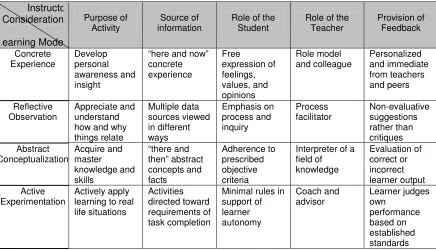
each of Kolb’s four learning modes. These assessment criteria are summarized
in Figure 10.
Figure 10
Learning Environment Orientation Indicators (Fry, 1978; Kolb, 1984)
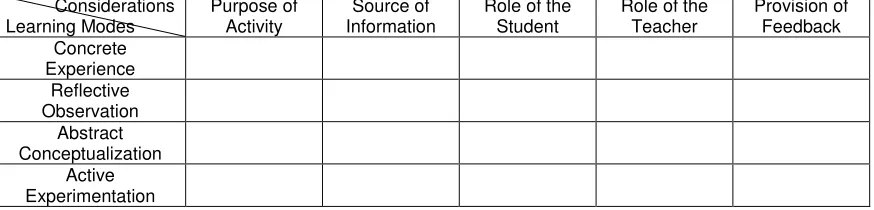
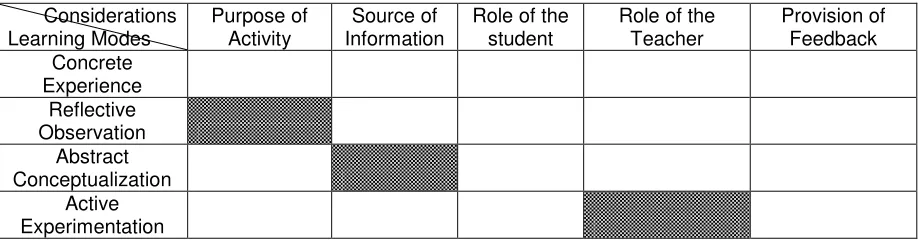
Instructor Considerations Learning Mode Purpose of Activity Source of information
Role of the Student
Role of the Teacher Provision of Feedback Concrete Experience Develop personal awareness and insight
“here and now” concrete experience Free expression of feelings, values, and opinions Role model and colleague Personalized and immediate from teachers and peers Reflective Observation Appreciate and understand how and why things relate Multiple data sources viewed in different ways Emphasis on process and inquiry Process facilitator Non-evaluative suggestions rather than critiques Abstract Conceptualization Acquire and master knowledge and skills “there and then” abstract concepts and facts Adherence to prescribed objective criteria
Interpreter of a field of knowledge Evaluation of correct or incorrect learner output Active Experimentation Actively apply learning to real life situations
Activities directed toward requirements of task completion
Developing the Analysis Plan
Once the units of analysis were identified and the evaluation criteria were
developed, the next step was to develop the analysis plan. The analysis plan
consisted of the following steps:
1. The researcher selected and trained the raters.
2. The researcher piloted the Learning Environment Orientation (LEO)
Assessment Instrument using the trained raters.
3. The raters applied the assessment criteria operationalized in the LEO
Assessment Instrument to the PRT 454 course material.
4. The researcher compiled the results from the LEO using a scoring rubric
for each experience.
5. The researcher constructed a course profile by assembling the scoring
rubrics for all experiences mapped to each course objective.
Selecting the Raters
To develop a reliable instrument, it was desirable for multiple raters to
apply the evaluation criteria and get consistent results among raters (Neuendorf,
2002). For this study, four raters were asked to participate. The raters consisted
of two Park, Recreation and Tourism Management (PRTM) faculty members and
two PRTM Ph.D. students. Participation was voluntary.
The researcher selected the raters based on the following criteria:
1. Teaching experience
2. Interest in improving student learning
Substantial teaching and course development experience was sought from the
two faculty members. The faculty raters were selected because of their veteran
teaching status. Both faculty members have taught for over 15 years and
designed or redesigned numerous courses and course experiences. The Ph.D.
students were selected because they had independently taught courses and had
some experience in course development, although neither had experience
designing an entire course. All raters were selected because of their interest in
improving student learning and their ability to participate in the study.
Training the Raters
In an effort to train the raters on Kolb’s Experiential Learning Theory and
the application of the LEO assessment instrument, extensive training was
provided (see Appendix B). The initial training was planned for two hours and
conducted with the raters prior to the distribution of the pilot assessment packet.
The training consisted of an overview of the project, a comprehensive and
detailed explanation of Kolb’s Experiential Learning Cycle, and instructions on
how to complete the LEO. Raters were then given an opportunity to ask
questions about the instrument and theory.
Learning Environment Orientation (LEO) Development
Once the raters were selected and trained on Kolb’s Experiential Learning
Cycle, they were asked to assist in further developing the criteria included in the
LEO Assessment Instrument. The evolution of the LEO began with the
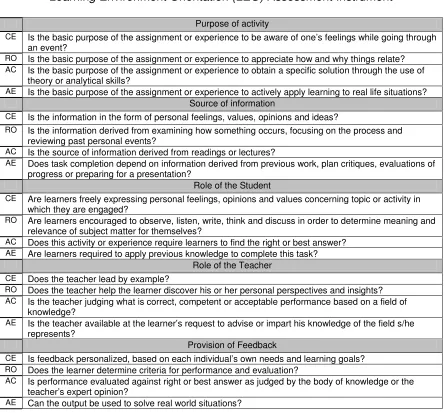
researcher taking Fry’s (1978) original criteria and forming each indicator into a
were created to allow the raters to indicate the presence or absence of an
environmental orientation indicator. When presented with Fry’s original criteria
modified into question form (Figure 11), the raters had substantial suggestions
for enhancements of the specific indicators. Much of the training time was spent
discussing the indicators and allowing for clarification in the wording of the
questions. The changes to Fry’s original criteria consisted of eliminating
ambiguous language, gender bias and multiple questions within a single criterion.
The raters agreed that the resulting LEO criteria eliminated gender bias, and
were more direct and explicit for a single criterion (see Appendix C). The raters
also suggested including a brief explanation of the basic information on Kolb’s
Experiential Learning Theory and written instructions on how to complete the