68:2 (2014) 57–63 | www.jurnalteknologi.utm.my | eISSN 2180–3722 |
Full paper
Jurnal
Teknologi
Analysis of Contradictions in Online Collaborative Learning using Activity
Theory as Analytical Framework
Mohd Nihra Haruzuan Mohamad Saida*, Mike Forretb, Chris Eamesb
aDepartment of Educational Sciences, Mathematics and Creative Multimedia Universiti Teknologi Malaysia, Johor Bahru, Malaysia bTechnology, Environmental, Mathematics and Science Education Research Centre (TEMS) University of Waikato, Hamilton, New Zealand
*Corresponding author: [email protected]
Article history
Received :1 December 2013 Received in revised form : 10 January 2014
Accepted :31 January 2014
Graphical abstract
Abstract
While previous studies have cited the benefits of incorporating online collaborative learning (OCL) in teaching and learning, there are also shortcomings of OCL that should not be ignored. This study aimed to investigate the constraints of incorporating OCL in a Malaysian tertiary classroom using Activity Theory as analytical framework. Activity Theory proved to be useful, particularly for OCL, because it provided a structure for identifying internal contradictions, also referred as tensions or constraints as result of interaction by the components of the OCL. Hence, the objectives of this paper are twofold: to identify constraints of OCL as perceived by students; and to investigate their suggestions or recommendations for improvement of OCL. The findings indicated two keys constraints: technology-related contradictions, which are technology-related to desire for synchronous feedback in forum discussions, cut and paste and plagiarism of ideas, and other technological distractions; and group discussion contradictions. These refer to repetitive and mixed-up postings, clashes on topics of discussion, and discussions being too formal. Suggestions for improvement are reported by students regarding aspects of personalizing an online collaborative learning template; and providing additional support for collaborating online.
Keywords: E-learning; online collaborative learning; activity theory-based analytic framework
Abstrak
Walaupun kajian sebelum ini melaporkan kebaikan pembelajaran kolaboratif atas talian (OCL) dalam pengajaran dan pembelajaran, terdapat juga kelemahan OCL yang tidak boleh diabaikan. Kajian ini bertujuan untuk menyiasat kekangan penggunaan OCL di dalam kelas tertiari di Malaysia menggunakan Teori Aktiviti sebagai rangka analisis. Teori Aktiviti terbukti berguna, terutamanya bagi OCL, kerana ia menyediakan struktur untuk mengenal pasti percanggahan dalaman, juga dirujuk sebagai ketegangan atau kekangan akibat interaksi oleh komponen OCL. Oleh itu, objektif kajian ini adalah dua: untuk menyiasat kekangan OCL seperti yang dilihat oleh pelajar dan untuk mengenal pasti cadangan mereka untuk penambahbaikan OCL. Dapatan kajian menunjukkan dua kunci utama kekangan: percanggahan berkaitan teknologi, yang berkaitan dengan keinginan untuk mendapatkan maklum balas segera dalam perbincangan forum, potong dan tampal bagi plagiarisme idea, dan gangguan teknologi yang lain, manakala bagi percanggahan perbincangan kumpulan pula merujuk kepada paparan forum yang berulang dan bercampur, percanggahan mengenai topik-topik perbincangan, dan perbincangan yang terlalu formal. Cadangan-cadangan penambahbaikan yang dilaporkan oleh pelajar-pelajar pula adalah berkaitan dengan aspek templat pembelajaran kolaboratif dalam talian yang lebih personal dan penyediaan sokongan tambahan bagi kerjasama atas talian.
Kata kunci: E-pembelajaran; pembelajaran kolaboratif atas talian; kerangka analisa berasaskan teori aktiviti
© 2014 Penerbit UTM Press. All rights reserved.
1.0 INTRODUCTION
While, previous studies have reported that online learning can be used as a tool to enhance and improve students’ learning, but its effectiveness depends on how the tool is utilized (Aris et al.,
2006, Mason and Rennie, 2008). Other studies have asserted that
have cited the benefits of incorporating collaborative learning in face-to-face environments (Dirkx and Smith, 2003, Johnson and Johnson, 1996) there is little research on the analysis of constraints of incorporating online collaborative learning using Activity Theory analytical framework, especially in a teacher education context in Malaysian Higher Education Institutions, although there are research on online collaborative learning in the Malaysian context.
One of the advantages of online collaborative learning that has been the focus of much of this research is the potential to be an alternative solution to the shortcomings of individualized instructions. Johnson and Johnson (1996) state that learning collaboratively in a group can result in higher achievements and knowledge retention than in competitive and individualistic learning. Furthermore, students involved in individualistic learning tend to depress achievement due to competitive and individualistic natures that isolate individuals from each other (Johnson and Johnson, 1996). Johnson and Johnson (1996) summarized some of the shortcomings of individualized instruction: (1) isolating students – working alone for long periods may lower personal motivation by increasing boredom, frustration, anxiety, and the perception that learning is impersonal; (2) limiting the resources and technology available to students, and the support and encouragement of peers; and (3) no cognitive benefits associated with explaining to peers and developing shared mental models (p. 786).
2.0 ACTIVITY THEORY
Despite the confusion associated with the term, Activity Theory refers to the Soviet cultural-historical research that represents neither activity nor theory in general. The core concept or basic unit of Activity Theory is still called activity in which it carries a minimal meaningful context for individual actions (Kuutti, 1996). It is through activities that humans develop skills, personalities and consciousness, transform social conditions, resolve contradictions, generate new cultural artefacts, and create new forms of life and the self (Sannino, Daniels andGutierrez, 2009). Some researchers also believe that through such activities humans transform learning and embrace the possibility of expansive learning (Engeström, 2001). Rogoff (2003) asserts human development is a cultural process, and has a great influence on the content and course of development and learning. Activity Theory views learning as inseparable from activity; activity is not carried out by the human alone but mediated by tools within a cultural-historical context. Engeström (1999) argues against behavioural and social science researchers that separate the study of the human activity and his or her cultural artefacts from the study of individual behaviour and human agency. He believes that human activity is never isolated and separated from cultural artefacts and made it clear in his writing that “the individual could no longer be understood without his or her cultural means; and the society could no longer be understood without the agency of individuals who use and produce artefacts” (Engeström, 2001, p. 134). He points out the key to understanding the human mind is through the object-orientedness of action between human and object through mediating tools.
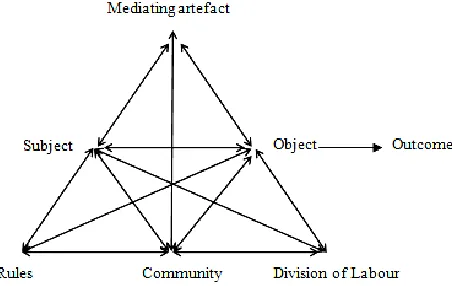
Activity Theory has evolved through different generations. The first generation of Activity Theory traces its history from the early works of Vygotsky, Leont’ev and Luria (Engeström, 2001). Vygotsky and others developed the concept of mediation which serves as the core of the first generation of Activity Theory. The mediation model advocated by Vygotsky encompasses two basic components called stimulus (S) representing subject, and response (R) representing object. The relationship between the stimulus or subject and response or object is mediated by an intermediate term called a mediating artefact which carries with
it the history of the relationship (Kuutti, 1996). When the object is transformed the outcome is produced as depicted in Figure 1.
Figure 1 First generation of activity theory
However, the process of transformation as depicted in Figure 1 is limited because the main unit of analysis only occurs at the individual level, which is missing the component of collective activity (Engeström, 2001). Inspired by Leont’ev’s famous example of primeval collective hunt, Engeström presents a much more integrated model of a collective human activity system that borrows Leont’ev’s explication of the crucial differences between an individual action and a collective activity. Engeström defends his action by claiming that Leont’ev never explicitly expanded Vygotsky’s model into a triangular model of a collective activity system as depicted in Figure 2.
Figure 2 Second generation of activity theory
and conventions that constrain actions and interactions within the activity system’’ and “division of labour” means “both the horizontal division of tasks between the members of the community and the vertical division of power and status” (Engeström, 1993, p. 67).
3.0 THE PURPOSE OF THE STUDY
The purpose of the study was to identify potential constraints of online collaborative learning when it was used for teaching and learning through the university’s Course Management System (Moodle) using Activity Theory as analytical framework. In addition, this study also aimed to propose some suggestions to address the particular constraints and issues. Hence, this paper intended to answer the following research questions:
What are the perceived constraints of online collaborative learning? and
What are students’ suggestions or recommendations for improvement of online collaborative learning in tertiary ICT education?
4.0 METHODS
The research in this study employed qualitative methods, namely semi-structured group interviews with students and analyzed using constant comparative method at two levels: within-case analysis and cross-case analysis, in order to generate meaningful qualitative themes (Huberman and Miles, 2002, Merriam, 2009). The overall analysis of data was framed and guided by Activity Theory framework which is explained in Section 7.0.
5.0 PARTICIPANTS
The students participating in the research were Malaysian undergraduate pre-service teachers from three different programmes of Science and Mathematics, with specialization in Computer Education, namely, Science and Computer with
Education (Chemistry) (SPK), Science and Computer with Education (Physics) (SPP), and Science and Computer with Education (Mathematics) (SPT). The students in each programme were in the second year of their study and were enrolled in a Computer Education course known as Authoring Language, which was conducted under the Department of Educational Multimedia, Faculty of Education at the Universiti Teknologi Malaysia (see Table 1).
Table 1 Background of participants
Characteristics N
Programme of study SPK-Chemistry SPK-Physics SPK-Mathematics
9 10 27
Gender Female
Male
34 12
Ethnicity Malay
Chinese Indian Other
38 4 2 2
Age 19-23 years
24-30 years
33 13
Education level Undergraduate-Year 2 46
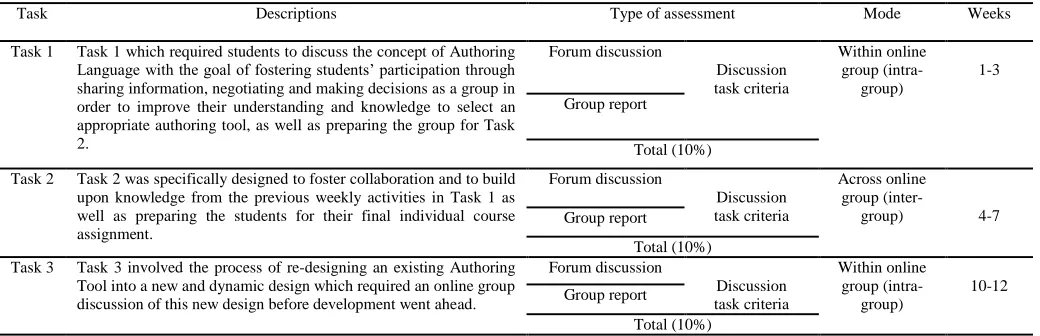
The teaching and learning in the Authoring Language course consisted of conventional face-to-face teaching lectures together with online participation through the university’s virtual Learning Management System (Moodle). The course ran for 15 weeks, comprised of 13 weeks of lectures, and one week each of mid-semester break and study week. During the course, students in each programme were formed into groups of 4-6 with a total of nine groups involved. The collaborative group task(s) were designed to enable groups in each programme to participate online and be involved in the creation of a solution to a problem case study. The designed collaborative group task(s) are explained as in Table 2.
Table 2 Collaborative group tasks
Task Descriptions Type of assessment Mode Weeks
Task 1 Task 1 which required students to discuss the concept of Authoring Language with the goal of fostering students’ participation through sharing information, negotiating and making decisions as a group in order to improve their understanding and knowledge to select an appropriate authoring tool, as well as preparing the group for Task 2.
Forum discussion
Discussion task criteria
Within online group
(intra-group)
1-3
Group report
Total (10%)
Task 2 Task 2 was specifically designed to foster collaboration and to build upon knowledge from the previous weekly activities in Task 1 as well as preparing the students for their final individual course assignment.
Forum discussion
Discussion task criteria
Across online group
(inter-group) 4-7
Group report
Total (10%) Task 3 Task 3 involved the process of re-designing an existing Authoring
Tool into a new and dynamic design which required an online group discussion of this new design before development went ahead.
Forum discussion
Discussion task criteria
Within online group
(intra-group)
10-12 Group report
6.0 ANALYTICAL FRAMEWORK
The analytical framework for analyzing constraints and suggestions for online collaborative learning was provided by Activity Theory (Engeström, 1999). Activity Theory is progressively being used within the area of research such as humanities and computer interaction (Kuutti, 1996, Mwanza and Engeström, 2002), in research into distributed learning (Russell, 2002), for conceptualizing online community in educational setting (Barab, Schatz and Scheckler, 2004) and for designing constructivist e-learning environment (Jonassen and Murphy, 1999, Said et al., 2013). Within an activity system illustrated in Figure 2, students are portrayed as subjects interacting with objects to attain desired outcomes. The object of activity system is the goal (or motive) and the interaction is mediated through the use of tools (or technology affordances for students in the activity). Similarly, the relationship between subject and community is mediated through rules. Rules are described as any formal or informal regulations (or pedagogical rules) which have an effect on activity are designed. The affiliation between community and object is mediated through division of labor, which refers to how the tasks are socially distributed between the students. Previous researchers indicate that an online learning environment can be represented as an activity system that involves the aspects of technology, pedagogy and social (Barab, Schatz and Scheckler, 2004; Said, 2011).
Activity system is also embedded with internal contradictions (Engeström, 1999). These contradictions are referred as tensions or conflicts as result of interaction by the components of the activity system. For example, Barab et al.,
(2002) described that contradictions as outcome of “exchange value of what is learned” and as outcome of “use value of learning because of its importance in addressing real-world problems” (p. 80). Tensions are crucial in developing the understanding of what motivates particular actions of activity system and its evolution. Although, tensions can also be associated of as system dualities through the interplay of its components but can help support the continued innovation of the system (Barab et al., 2002). Wenger (1998) described that the interplay of system dualities within activity system can be used to leverage they dynamics aspects of the system without treating them as incompatible components where one part or the other can be purged or removed. The changes to activity system are driven by tensions of the systems as well as to develop (Barab et al., 2002).
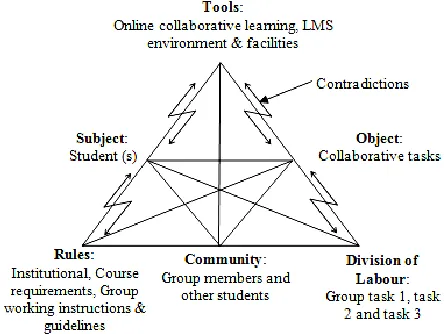
Activity theorists see contradictions as sources of development (Barab, Schatz and Scheckler, 2004; Engeström, 1999; Jonassen and Murphy, 1999). Engeström (1999) characterizes a contradiction as "a social, societally essential dilemma which cannot be resolved through separate individual actions alone – but in which joint cooperative actions can push a historically new form of activity into emergence" (p. 16). The resolution of contradictions, according to Engeström (2001), takes place in the process of "living movement leading away from the old" (p. 16), when a goal or object of the system transformed into an outcome. For instance, the everyday decision making situation in which a person in conflicting with his/her decision may be influenced by immediate circumstances that influence his/her final decision-making. This is consistent with the notion of knowledge construction within a learning community where knowledge is constructed as results of interaction and negotiation of conflicting and different understanding (Said et al., 2013). Figure 3 depicts contradictions in an activity system model.
Figure 3 Contradictions in an activity system
Based on the contradictions model of an activity system in Figure 3, the analytical framework for identifying constraints of incorporation of online collaborative learning is developed as in Table 3.
Table 3 Key of research components Theoretical components:
Activity system Research components
Subject-Tools-Object (Tools)
Technology Tools affordances and
constraints
Subject-Rules-Object (Rules)
Pedagogy Pedagogical rules
Subject-Division of Labor-Object (Division of Labor)
Social Shared roles and
responsibilities
7.0 DATA ANALYSIS
Qualitative analysis was conducted on the data collected from interviews. The verified interview transcripts by participants were analyzed using the constant comparative method at two levels: within-case analysis and cross-case analysis, in order to generate meaningful qualitative themes (Huberman and Miles, 2002; Maykut and Morehouse, 1994; Merriam, 2009). In this method, each individual group transcript was studied and emerging themes from the data were coded and compiled for each group. The emerging themes were then compared across groups and subsequently categorized into similar units of meaning. The categories were continually refined, changed, merged or removed and grouped accordingly. Cross-case analysis within and between groups was undertaken to explore relationships and patterns that emerged from the interactions within each individual group case.
environment, constraining and enabling factors, online group work, and roles and responsibilities, can be later viewed and reviewed in a single window, making it convenient and efficient for the researcher to conduct qualitative analysis on a large amount of data.
8.0 FINDINGS
The research findings are presented below, grouped according to the research questions.
RQ 1: What are the perceived constraints of online collaborative learning?
Two keys constraints and tensions of activities in the course were addressed and shared by students in the interviews. They are summarized and grouped into (1) technology-related contradictions, which are related to Subject-Tools-Object (Tools) and Subject-Rules-Object (Rules) as desire for synchronous feedback in forum discussions, cut and paste and plagiarism of ideas, and other technological distractions, followed by (2) group discussion contradictions which are related to Subject-Division of Labor-Object (Division of Labor). These refer to repetitive and mixed-up postings, clashes on topics of discussion, and discussions being too formal.
Technology-related contradictions
Desire for synchronous responses in forum discussions
Some students felt that the delay feature of forum discussions did not fulfill their desire for immediate synchronous responses. This tension is revealed through Adam from Group 3, who said:
The best way for discussion is through chatting where we can get immediate response. Sometimes, when we ask a question in a forum discussion, there is no one person who wants to reply to the post. Even if we wait for a long time there is still no response to our question. The best example of chatting for forum discussion is through Yahoo Messenger [synchronous]. (Adam, Group 3, Int.)
Susan from Group 1 added that a consequence of not having an immediate response is that students tended to forget the message and this contradicts the reflective nature of a forum discussion:
The discussion is best when someone responds to your question immediately, or else they will forget what they want to tell you. (Susan, Group 1, Int.)
Based on this tension, several students from all nine groups expressed their preference for face-to-face discussion over forum discussion to compensate for its constraint. Wendy from Group 4 reported:
For me, we can get an immediate response during a face-to-face discussion, but if we discuss it in the eLearning, we only can get the response from our course mates when they log-in. We have to wait for some time and wait for other peoples’ responses. (Wendy, Group 4, Int.)
Cut and paste and plagiarism of ideas
Another technology-related issue stressed by students was the direct cut and paste feature. This was reported by John from
Group 1 as irritating as the structure of the posting was difficult to follow and understand. He said:
In my opinion, not all of us can present their ideas through words and writing. Sometimes we present better in words, but for discussion in eLearning, people who give out their ideas might copy their post from the Internet. In this situation, the idea is that their contribution is not originally from them and sometimes we do not understand the content. (John, Group 1, Int.)
Because of the ease of cutting and pasting messages in a forum discussion, some students felt that this could lead to plagiarism of ideas. Dennis from Group 7 pointed out:
There are possibilities of the ideas that have been pointed out by other people. Ideas that have been mentioned in discussion should not be pointed out again. People might say we copy someone’s idea. (Dennis, Group 7, Int.)
Other technological distractions
The multi-tasking feature of a computer operating system that allows the user to run multiple applications is another tension that students addressed. Hamesh from Group 9 stressed:
There’s always a problem during online that we do not focus only at one web page. Even if we log in to eLearning, while waiting for eLearning website page to be loaded, we are prone to visit other website pages like Facebook, YouTube and similar. (Hamesh, Group 9, Int.)
Some students viewed this tension as hindering their participation in the eLearning forum, as Aaron from Group 4 reported:
Like my own experience participating in the forum, while waiting to be logged-in which took some time, I like to open [visit] other websites which actually ended up by spending my time on that website instead of eLearning forum [laughed]. (Aaron, Group 3, Int.)
Group discussion contradictions Repetitive and mixed-up postings
Because of the task goals of inter-group discussion to foster online inter-group collaboration across different programmes of studies (Chemistry, Physics and Mathematics Education), some students felt it was frustrating when some groups repetitively mixed-up their postings when completing the task. William from Group 1 said:
For example, discussions with SPT [Mathematics] group, where ideas that have been discussed were mixed-up. The worst part is where they kept discussing the same things over and over. (William, Group 1, Int.)
Lincoln from Group 8 added her frustration when some students posted repetitive, unrelated mixed-posts which contradict task goals:
Clashes on topic of discussion
Some Physics students felt some tensions and constraints in finding a suitable shared discussion topic that could accommodate different interests of programmes of studies, especially with Mathematics students, which contradicts task goals. Sandy from Physics Group 4 reported:
SPT [Mathematics] students discuss software that relates with Mathematics that can be used in their teaching, while we discuss software that relates with Physics and it depends on the suitability of the software to accommodate the Maths and Physics subject. (Sandy, Group 4, Int.)
Meanwhile, Elizabeth from Chemistry Group 1 found this tension occurred when Physics and Mathematics students focused on their related areas and expertise, but not inter-related areas and expertise, which contradicts task goals. Elizabeth from Chemistry Group 1 reported:
Like I said just now, SPP [Physics] come out with different ideas that suit their subjects, while SPT [Mathematics] come with their subjects, which are not related to SPP [Physics]. (Elizabeth, Group 1, Int.)
Discussion being too formal
Because discussions were evaluated as a part of the course assessment requirement, some students felt that it was in their interest to discuss it formally which is in line with the academic assessment requirement. However, some students faced dilemmas and tensions to accommodate the interplay between their non-academic identities and tertiary identities. Maggie from Mathematics Group 9 stressed:
We would not be able to point out what we want to say actually because we feel forced to do so. When we talk about fact, we feel that way rather than if we discuss it in the idle talk, where we feel free to talk about our feelings. We know that we will be evaluated based upon our opinions and thoughts that we share in a serious discussion. If it is a general topic, I will discuss it normally without feeling forced to do it, and sometimes if I feel I am being forced I tend to pretend to be another person while discussing. Even in writing, I will write it formally, the same as I did while discussing, if that is a fact thing and is going to be evaluated. (Maggie, Group 9, Int.)
RQ 2: What are students’ suggestions or recommendations for improvement of online collaborative learning in tertiary ICT education?
Suggestions and insights for further improvements were shared by nine participating groups through interviews and they are: personalizing an online collaborative learning template, and additional support for collaborating online.
Personalizing online collaborative learning template
Five groups from the interviews raised the importance of having personalized and attractive educational layout and communication as supplementary to the course. Adam from Physics Group 3 reported:
Attractive layout that students feel familiar with, like general forum with chat style in which students can
directly communicate, like Peer-to-Peer (P2P) application which integrated in the forum with different layout style that students find attractive and familiar to them. (Adam, Group 3, Int.)
Two students from Group 5 and 8 suggested the use of structured postings and concept linkers so that it can help students to locate information if discussion postings were overloaded. The first point is exemplified by Marry from Mathematics Group 5 and the second point by Peter:
The discussion will be held according to the date that has been assigned by the group member. For example, I have to access on the second day so I need to know the ideas that the previous person has contributed. (Marry, Group 5, Int.)
If there are links to these concepts, it will help us to find the information and we can direct our information-seeking in the right direction. (Peter, Group 8, Int.)
Additional supports for collaborating online
All groups raised the importance of establishing additional support for collaborating online. This includes clear guidelines and ways of communicating online. Mike from Mathematics Group 8 stressed:
I think the students are not very familiar learning through the eLearning, though they have learnt the eLearning skills during their first year and also because of the attitude of the students towards the eLearning. I think we need to practice the eLearning culture by being active in using eLearning and support others to change bit by bit. (Mike, Group 8, Int.)
9.0 CONCLUSION
The study has shown that the online collaborative learning activities were helpful in facilitating students’ learning but also have undesirable identified constraints such as technology-related contradictions (such as a desire for synchronous feedback in forum discussions, cutting and pasting and plagiarism of ideas, and other technological distractions) and group discussion contradictions (such as repetitive and mixed-up posts, clashes on topics of discussion, and discussions being too formal). However, constraints being inextricable aspects of online collaborative learning activities are consequently used as points of reference for further teaching and learning improvement.
Some suggestions and insights for further improvements of online collaborative learning were also shared by all participating groups of students. Although the feedback was very limited to students’ background knowledge of online learning as some of them were new online learners, few suggestions as: personalizing an online collaborative learning template, and additional support for collaborating online were deemed appropriated to be considered especially when designing an online course where flexible approach become handy in order to compensate for those constraints.
Acknowledgement
their support in making this project possible. This work was supported by the Fundamental Research Grant Scheme (Vote No.4F171) initiated by UTM and MoE.
References
[1] An, H., Kim, S., and Kim, B. 2008. Teacher Perspectives on Online
Collaborative Learning: Factors Perceived as Facilitating and Impeding
Successful Online Group Work. Contemporary Issues in Technology
and Teacher Education. 8(1): 65–83.
[2] Aris, B., Ali, M. B., Harun, J., Tasir, Z., Atan, N. A., and Noor, N. M.
2006. E-Learning Research and Development Experiences Related to Learning Computer Science, Information Technology and Multimedia
Subjects. Paper presented at 3rd International Conference on
University Learning and Teaching (InCULT 2006). Shah Alam,
Malaysia
[3] Barab, Schatz, S., and Scheckler, R. 2004. Using Activity Theory to
Conceptualize Online Community and Using Online Community to
Conceptualize Activity Theory. Mind, Culture, and Activity. 11(1): 25–
47.
[4] Barab, S. A., Barnett, M., Yamagata-Lynch, L., Squire, K., and Keating, T. 2002. Using activity theory to understand the systemic tensions characterizing a technology-rich introductory astronomy course. Mind, Culture, and Activity. 9(2): 76–107.
[5] Dillenbourg, P. 1999. What do you mean by collaborative leraning? In
P. Dillenbourg (Ed.), Collaborative-learning: Cognitive and
Computational Approaches. Oxford: Elsevier. 1–19.
[6] Dirkx, J. M., and Smith, R. O. 2003. Thinking Out of Bowl of
Spaghetti: Learning to Learn in Online Collaborative Groups. In T. S.
Robert (Ed.). Online collaborative learning: Theory and practice
USA: Idea Group. 132–159.
[7] Embi, M. A. 2011. E-learning in Malaysian Higher Education
Institutions: Status, Trends, and Challenges. Putrajaya, Malaysia:
Department of Higher Education Ministry of Higher Education.
[8] Engeström, Y. 1999. Activity Theory and Individual and Social
Transformation. In Y. Engeström, R. Miettinen and R.-L. Punamäki
(Eds.), Perspectives on Activity Theory Cambridge: Cambridge
University Press. 19–38.
[9] Engeström, Y. 2001. Expansive Learning at Work: Toward an Activity
Theoretical Reconceptulization. Education and Work. doi:
10.1007/978-1-4419-1428-6_857. 14(1): 133–156.
[10] Garrison, D. R., and Anderson, T. 2003. E-learning in the 21st
Century: A Framework for Research and Practice. London: Routledge
Falmer.
[11] Graham, C. R., and Misanchuk, M. 2004. Computer-Mediated
Learning Groups: Benefits and Challenges to Using Groupwork in
Online Learning Environments. In T. S. Roberts (Eds.). Online
collaborative learning: Theory and practice. USA: Information
Science Publishing.
[12] Harasim, L. 2012. Learning Theory and Online Technologies. First ed.
New York: Taylor and Francis Group.
[13] Huberman, A. M., and Miles, M. B. 2002. The Qualitative
Researcher's Companion. California: Sage Publications, Inc.
[14] Jonassen, D. H., and Murphy, R. L. 1999. Activity Theory as a
Framework for Designing Constructivist Learning Environments.
EtrandD-Educational Technology Research and Development. 47(1):
61–79, doi: 10.1007/BF02299477.
[15] Johnson, D. W., and Johnson, R. T. 1996. Cooperation and the Use of
Technology. In H.Jonassen (Ed.). Handbook of Research for
Educational Communications and Technology New York: Simon and
Schuster Macmillan. 785–811.
[16] Kuutti, K. 1996. Activity Theory as a Potential Framework for
Human-Computer Interaction Research. In B. Nardi (Ed.). Context and
Consciousness: Activity Theory and Human Computer Interaction
Cambridge: MIT Press. 17–44.
[17] Maykut, P., and Morehouse, R. 1994. Beginning Qualitative Research:
A Philosophic and Practical Guide. London: Falmer Press
[18] Mason, and Rennie, F. 2008. E-Learning and Social Networking
Handbook: Resources for Higher Education. New York, USA:
Routledge.
[19] Merriam, S. 2009. Qualitative Research: A Guide to Design and
Implementation. San Francisco: Jossey-Bass.
[20] Mwanza, D. 2002. Towards an Activity-Oriented Design Method for
HCI Research and Practice. The Open University, United Kingdom.
[21] Mwanza, D., and Engeström, Y. 2003. Pedagogical Adaptness in the
Design of E-Learning Environments: Experiences From Lab@Future
Project. Paper presented at International Conference on E-Learning in
Corporate, Goverment, Healthcare, and Higher Education, Phoenix, Arizona.
[22] Nardi, B. 1996. Studying Context: A Comparison of Activity Theory,
Situated Action Models, and Distributed Cognition. In B. Nardi (Ed.),
Context and Consciousness: Activity Theory and Human-Computer
Interaction Hong Kong and USA: Massachussets Institute of
Technology. 69–102.
[23] Rogoff, B. 2003. The Cultural Nature of Human Development. Oxford,
NY: Oxford University Press.
[24] Russell, D. R. 2002. Looking Beyond the Interface: Activity Theory
and Distributed Learning. In R. M. Lea and K. Nicoll (Eds.).
Distributed Learning: Social and Cultural Approaches to Practice.
London: Routledge Falmer.
[25] Said, M. N. H. M., Hassan, J., Idris, A. R., Zahiri, M. A., Forret, M.,
Eames, C. 2013. Technology-Enhanced Classroom Learning Community for Promoting Tertiary ICT Education Learning in Malaysia. In K. M. Yusof, M. Arsat, M. T. Borhan, E. de Graff, A.
Kolmos, F. A. Phang (Eds.). PBL Across Cultures Aalborg University
Press. 326–334.
[26] Said, M. N. H M. 2011. The Design and Implementation of an Online
Collaborative Learning in Malaysian Tertiary Classroom. Proceedings of International Conference on Education and New Learning Technologies. Barcelona, Spain. 5487–5492.
[27] Sannino, A., Daniels, H., and Gutierrez, K. D. 2009. Activity Theory
between Historical Engagement and Future-Making Practice. In H.
Daniels and K. D. Gutierrez (Eds.). Learning and Expanding with
Activity Theory New York: Cambridge University Press. 1–15.
[28] Wenger, E. 1998. Communities of Practice: Learning, Meaning, and