Jurnal Teknologi, 43(A) Dis. 2005: 113–124 © Universiti Teknologi Malaysia
MICROSTRUCTURAL CHARACTERISATION OF AS-CAST BINARY NEAR GAMMA TITANIUM ALUMINIDES
ESAH HAMZAH1*, MAIIYEAALAGAN KANNIAH2 & MOHD. HARUN3
Abstract. Intermetallics based on Ti-Al compounds exhibits promising properties for high temperature applications. However, only two phase near gamma alloys are able to some extent fulfill the crucial high temperature applications. Therefore during the past decade, a number of research efforts were directed to optimise the application of this recently emerging class of alloy. Since the high temperature property which mainly concerns creep is strongly microstructure dependent, a comprehensive understanding on the microstructure is needed. In this paper, the current knowledge on the microstructures of as-cast binary near gamma titanium aluminides will be addressed.
Keyword: Near gamma titanium aluminides, microstructure, lamellae, nearly lamellae, duplex Abstrak. Sebatian antara logam berasaskan sebatian Ti-Al mempamerkan sifat yang menyakinkan untuk aplikasi suhu tinggi. Walau bagaimanapun, hanya aloi dua fasa hampir gamma mampu sedikit sebanyak memenuhi aplikasi suhu tinggi yang penting. Oleh itu, pada dekad yang lepas, banyak kajian telah ditumpukan kepada mengoptimumkan aplikasi aloi baru ini. Oleh kerana sifat suhu tinggi terutama berkaitan dengan rayapan yang sangat bergantung kepada mikrostruktur, kefahaman menyeluruh mengenai mikrostruktur ini diperlukan. Dalam kertas kerja ini, pengetahuan semasa mengenai mikrostruktur aloi tuangan binari hampir gamma titanium aluminaid akan dibincangkan.
Kata kunci: Hampir gamma titanium aluminaid, mikrostruktur, saiz bijian, pecahan isipadu, morphologi sempadan bijian
1.0 INTRODUCTION
Intermetallic compounds based on titanium and aluminium are light (low density), relatively stiff (high modulus) and have attractive high temperature mechanical properties (tensile and creep properties) [1].
Examination of the Ti-Al phase diagram shows that there are three compounds in this system; Ti3Al (super alpha, α2), TiAl (gamma, γ) and TiAl3. Among these, only Ti3Al and TiAl have been extensively investigated. Ti3Al has a tetragonal DO19 structure and TiAl has the hexagonal LI0 structure. In both cases, the compounds
1&2Department of Materials Engineering, Faculty of Mechanical Engineering, Universiti Teknologi
Malaysia, 81310 Skudai, Johor. Tel: 07-5535463, Fax: 07-5566159.
3 Malaysian Institute for Nuclear Technology Research (MINT)
exhibit limited ductility at room temperature, particularly in binary state [1]. However, there is another phase; near gamma (α2 + γ) which are more reliable for structural applications than super alpha and gamma titanium aluminides.
γ-TiAl alloys have no significant engineering applications because of their poor ductility and fracture toughness, although they exhibit better performance in hostile environment [2]. The low ductility of single phase TiAl (more than 52%at Al) is not even improved by alloying addition of, e.g. V, Nb, Cr, W or Mn [3]. Super alpha, α2-Ti3Al are not preferred due to their high density, high susceptibility to stress
corrosion cracking, reduced tensile ductility, creep failure at high temperature, low oxidation limit temperature and low specific strength and modulus [4].
Near gamma titanium aluminides are classified into single and two phase alloys. Near gamma alloys which were mentioned earlier for structural applications are referred to the two phase alloys; Ti-(46-52)at% Al [5]. The single phase near gamma alloys have no significant engineering properties. Figure 1 shows the composition range for two phase near gamma alloys [5].
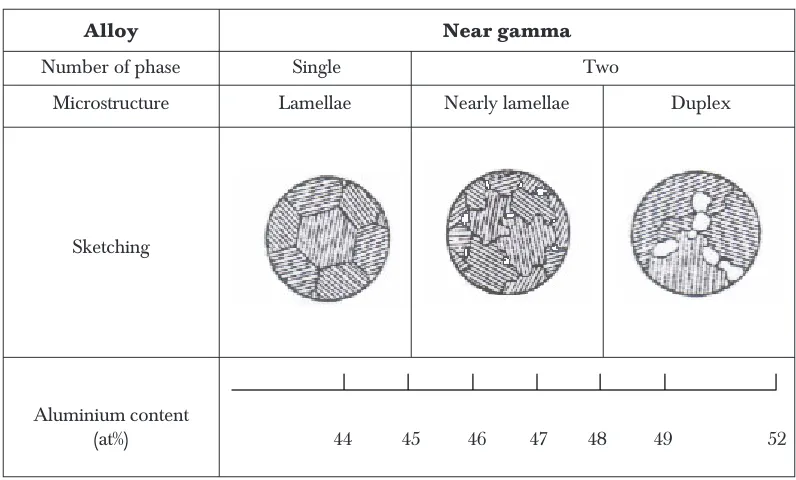
The single phase near gamma alloys exhibit a lamellae microstructure. On the other hand, the significant two phase near gamma alloy exhibits two different structure as to the aluminum content which is nearly lamellae, Ti-(46-48)at% Al and duplex,
Figure 1 Central portion of binary Ti-Al phase diagram showing the composition range for two
phase near gamma alloys [1]
T
emperature (°C)
1600
1400
1200
1000
800
Ti 30 40 50 60
at% Al β
L
α2
Te γ
α2+γ
α Tα
α+γ
Ti-(49-52)at% Al. Researchers had defined both microstructures to distinguish them. Nearly lamellae are defined as coarse lamellae grains with minor amounts of fine γ -grains [3] or when gamma -grains can be seen in the lamellae grain boundaries [6]. Whereas for duplex microstructure, it is a combination of equiaxed gamma grains and lamellae grains [3, 6].
The lamellae structure consists of alternating plates of the γ-TiAl and α2-Ti3Al phases. Such a lamellae structure results from the solid state phase transformation of the primary disordered α dendrites. The γ regions surrounding the lamellae grains result from the transformation of the aluminium rich interdendritic melt [7].
Even if the microstructures are well defined and distinguished, there is still confusion regarding this because there is no any complete comprehensive paper which describes this individually. Therefore, beginners have to go through a lot of literature to understand well about the microstructure, which is the basis for the studies. In this paper, all the three microstructures of near gamma alloys will be characterized and discussed
2.0 MATERIALS AND METHOD
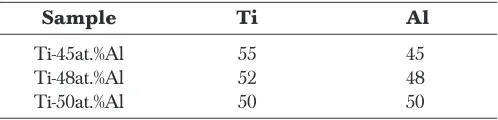
Ti-45at.%Al, Ti-48at.%Al and Ti-50at.%Al were produced by IRC, University of Birmingham, UK by plasma melting casting technique to produce buttons weighing 2 kg each. The chemical composition of the as-cast samples is shown in Table 1. The samples will be referred in atomic percentage (at.%) throughout the manuscript.
Table 1 Chemical composition of the as-cast samples in at.%
Sample Ti Al
Ti-45at.%Al 55 45
Ti-48at.%Al 52 48
Ti-50at.%Al 50 50
The samples for metallography analysis were cut into cubic shapes by using Electro Discharge Wire Cut Machine with dimensions of 10 × 10 × 10 mm. The samples were then grounded and polished in accordance to the standard procedures. The polished surface was etched by using Kroll's reagent (94 ml H2O + 4 ml HNO3 + 2 ml HF).
3.0 RESULTS AND DISCUSSION
3.1 Microstructures
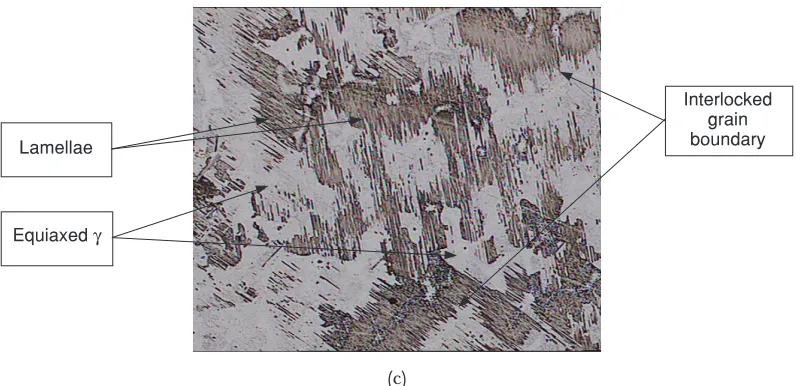
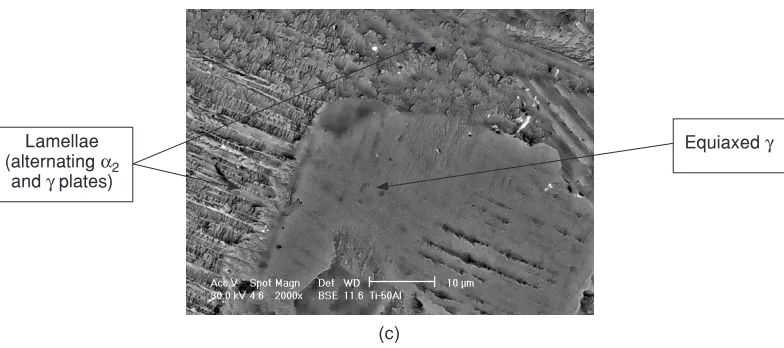
Figures 2(a), 2(b) and 2(c) show the microstructures of as-cast Ti-45Al, Ti-48Al and Ti-50Al which was observed under optical microscope at magnification of 50x whereas Figures 3(a), 3(b) and 3(c) show the microstructures of as-cast Ti-45Al, Ti-48Al and Ti-50Al which was observed under scanning electron microscope with magnification of 2000x. Ti-45Al, Ti-48Al and Ti-50Al exhibited lamellae, nearly lamellae and duplex microstructure respectively. The as-cast sample Ti-48Al and Ti-50Al exhibited a microstructure with strong microseggregations, being composed of primary α dendrites, which transformed into lamellae α2 + γ during solid state cooling and
(a)
(b)
Lamellae
Planar grain boundary
Namellae
Fine γ
Figure 2 Optical micrograph showing microstructure of (a)Ti-45Al, (b)Ti-48Al and (c) Ti-50Al at magnification of 50x
(c)
Interlocked grain boundary
(a)
(b)
Lamellae
Equiaxedγ
Fine γ Lamellae
(alternatingα2
andγ plates)
Lamellae (alternating α2
interdendritic γ phase. The solidification of these two phase alloys, based on the phase diagram, occurs through two peritectic reactions, L + β→ α and L + α → γ, which is normally incomplete due to limited diffusion caused by the formation of a solid envelope of the peritectic phase, avoiding the physical contact between the reactants. For both peritectic reactions, high cooling rate or melt under cooling inhibit the formation of the pro-peritectic solid phase; the incompleteness of the peritectic reactions will cause the remaining liquid to progressively enrich in aluminum and solidify, at lower temperatures, as interdendritic γ phase [8].
3.2 Phases and Crystal Structures
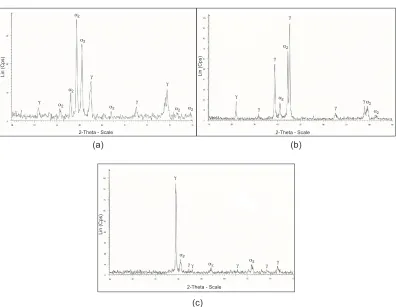
Figures 4(a), 4(b) and 4(c) show the XRD test results of the samples. All samples showed hexagonal and tetragonal crystal structures which represent Ti3Al and TiAl respectively.
3.3 Microstructural Features
3.3.1 Grain Size
Determination of the grain size of near gamma titanium aluminide is most probably the second most important metallography measurement after the lamellae spacing. The grain size is measured using the intercept method. The detail description of this method is described elsewhere [9]. Table 2 shows the grain size of lamellae grain size.
(c)
Figure 3 Scanning electron (back scattered electron mode) micrograph showing microstructures
of (a) Ti-45Al, (b) Ti-48Al and (c) Ti-50Al at magnification of 2000x
Lamellae (alternatingα2
and γ plates)
Figure 4 X-ray diffraction results of (a) Ti-45Al, (b) Ti-48Al and (c) Ti-50Al
(c)
(b) (a)
Lin (Cps)
Lin (Cps)
γ
γ
γ γ
γ
γ γ
γ γ
γ
α2 α2
α2 α2 α2 α2
α2 α2 α2
α2
α2
2-Theta - Scale 2-Theta - Scale
γ
α2
2-Theta - Scale
Lin (Cps)
γ γ α2 γ α2 γ γ
Table 2 Lamellae grain size measured using intercept method
Samples Grain size (µµµµµm)
Ti-45Al 500 – 800 Ti-48Al 300 – 700 Ti-50Al 100 – 500
3.3.2 Volume fraction
3.3.3 Grain Boundary Morphology
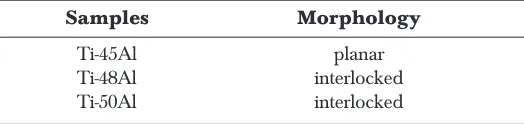
Grain boundary of near gamma titanium aluminides is usually in a condition of planar or interlocked. The grain boundary morphology of the samples is characterized using the microstructure micrographs with higher magnification. Table 4 shows the grain boundary morphology of the samples.
Table 3 Volume fraction of single gamma phase measured using point count method
Samples Volume fraction (%)
Ti-45Al 0
Ti-48Al 2 – 5
Ti-50Al 30 – 50
It is observed that sample Ti-45Al, Ti-48Al and Ti-50Al exhibit lamellae, nearly lamellae and duplex structures respectively. XRD results showed that the crystal structure in all three samples was hexagonal and tetragonal which indicated that Ti3Al and TiAl phases present. The gamma phase does not exist as single phase in the lamellae structure but it exists as alternating gamma plates (lamellae phase). The gamma exists as fine grain at the grain boundaries and as alternating plates in nearly lamellae structure. As for the duplex structure, the lamellae and gamma phase can easily be identified even at the lower magnification. It exists as equiaxed grains and alternating plates. The duplex structure is also known as the bi-modal structure [1]. Basically, the microstructure of near gamma alloy is distinguished by analysing the size of single gamma phase. When there is no presence of single gamma phase, the structure is called lamellae. If the amount of the gamma phase is small and located mainly at grain boundaries, it is referred as nearly lamellae and if it is almost similar size with lamellae colonies, it is called duplex structure. These microstructural characteristics are greatly influenced by the aluminum content.
Grain size [10, 11], volume fraction [10] and grain boundary morphologies [12] are important microstructural parameters which influence the mechanical properties of near gamma titanium aluminides. It is proposed that fine lamellae grain exhibits better mechanical properties compared with coarse lamellae grain. However, very small grain (<100 µm) is usually associated with low creep strength [10]. As for the
Table 4 Grain boundary morphology exhibited by the samples
Samples Morphology
Ti-45Al planar
volume fraction of the constituent phases, it is insensitive to creep strength [10]. On the other hand, grain boundary morphology plays a major role in influencing the mechanical properties. Near gamma alloy usually has a planar or interlocked grain boundary. The interlocked grain boundary is reported to be very effective for improving creep resistance in heat resistance austenitic steels and cobalt base superalloys. A number of factors such as restriction of grain boundary sliding, slow crack growth due to crack deflection and a greater crack path can possibly explain the improvement of creep resistance due to the interlocked grain boundaries [12].
The lamellae structure has coarse lamellae grain of about 500 to 800 µm and with planar grain boundaries. So, it is clear that this single phase alloy have no significant engineering properties. Therefore, these alloys were never studied or extensively developed for engineering applications.
The nearly lamellae structure exhibits almost similar grain size (300-700 µm) with the lamellae structure. Besides that, this structure has also an interlocked grain boundaries. This recently emerging class of alloy Ti-(46-48)at % Al is reported to exhibit the highest tensile ductility, as high as 2% at room temperature [12, 13] and has better fracture toughness [14] and creep properties [12] compared to other class of near gamma alloys in the as-cast condition. Thus, extensive studies have been done to improve further this reliable alloy by altering the microstructures. Currently, most efforts have been focused on these alloys which are slightly lean in aluminum and microalloyed with several third elements. These have led to very complex alloys with the general compositions (in at.%) as follows:
Ti – (45–49)Al + (0.3–10)X
with X designating alloying elements, such as Cr, Nb, V, Ta, Si, B and C [15]. The duplex structure has more fine lamellae grain (100-500 µm) compared to the nearly lamellae structure. However, the gamma grains have almost equal size to lamellae grains (100-300 µm). It is reported that gamma grains reduce the tensile ductility, which is an important criteria for structural applications. The single phase gamma alloy (more than 52% at Al), which has equiaxed gamma grains exhibits poor ductility. As stated earlier, the low ductility of this single phase gamma alloy is not even improved by alloying additions [3]. This indicates that gamma grains have significant effect on the ductility of the alloys. Figure 5 shows the equiaxed microstructure of as-cast gamma alloy as reference [13].
There is a well known microstructure which exhibits very good creep strength. It is called the fully lamellae microstructure. Typical heat treatment to produce it is homogenization in the disordered α phase field at 1400°C for 2 hours in vacuum and slowly cooled to 1000°C for an aging treatment of 4 hours [16]. Figure 6 shows the fully lamellae microstructure.
Figure 6 Optical micrograph shows the fully lamellae microstructure [17]
Figure 5 Optical micrograph shows the equiaxed microstructure of as-cast single phase gamma
alloys [13]
(Ti-45Al). Both lamellae and fully lamellae structures have 100% lamellae phase but there is a significant difference between them. The fully lamellae structure has finer lamellae grains compared to the lamellae structure. Another significant difference is that fully lamellae has an interlocked grain boundaries, whereas the lamellae structure has planar grain boundaries.
of the lamellae structured alloys which has no significant engineering properties. Therefore, researchers instead moved to the single phase gamma alloys (equiaxed microstructure). At this point, researchers found that if the Al content is reduced below 52at% to form Ti3Al as a second phase besides the TiAl, the resulting two phase alloys show ductilities of a few percent, which are acceptable for applications [3]. Besides that, two phase alloy also has better creep strength. Thus, researchers had classified this new emerging alloys as two phase gamma alloys and it has been widely accepted. However, there were some researchers who classified the two phase alloys as near gamma alloys [7]. Both classifications have been accepted and are used world-wide. As far as this paper is concerned, the two phase alloys will be classified as near gamma alloys. Table 5 shows the classification of near gamma alloys. The sketched microstructure is only for comparison purpose and does not represent any quantitative measurements.
Table 5 Classification of near gamma titanium aluminides
Alloy Near gamma
Number of phase Single Two
Microstructure Lamellae Nearly lamellae Duplex
Sketching
Aluminium content
(at%) 44 45 46 47 48 49 52
4.0 CONCLUSIONS
(1) Ti-45Al, Ti-48Al and Ti-50Al exhibits lamellae, nearly lamellae and duplex microstructure respectively.
(4) Ti-45Al showed planar grain boundary whereas Ti-48Al and Ti-50Al showed interlocked grain boundaries.
ACKNOWLEDGEMENTS
The authors would like to thank the Malaysian Ministry of Science, Technology and Environment for the research fund under the IRPA program (Project No. 09-02-06-0002 EA-002).
REFERENCES
[1] Lutjering, G., and J. C. Williams. 2003. Titanium. Berlin: Springer.
[2] Kim, Y. W., and D. M. Dimiduk. 1991. Progress in Understanding of Gamma Titanium Aluminides.
Journal of the Minerals, Metal and Materials Society. 43(8): 40-47. [3] Sauthoff, G. 1995. Intermetallics. Germany: VCH Verlagsgesellschaft.
[4] Patel. P. J., G. A. Gilde. P. G. Dehmer, and J. W. McCauley. 2000. Titanium Aluminides Intermetallics. The AMPTIAC Newsletter. 4: 7-9.
[5] Appel, F., and R. Wagner. 1998. Microstructure and Deformation of Two-Phase γ-Titanium Aluminides.
Materials Science and Engineering. 22: 187-268.
[6] Recina, V., D. Lundstrom, and B. Karlsson. 2002. Tensile, Creep and Low-Cycle Fatigue Behavior of a Cast (Gamma)-TiAl-Based Alloy for Gas Turbine Applications. Metallurgical and Materials Transactions: A: Physical Metallurgy and Materials Science. September 2002. Warrendale: The Minerals, Metals and Materials Society. 33A (9): 2869-2880.
[7] Es-Souni, M., A. Bartels, and R. Wagner. 1993. Creep Deformation and Creep Microstructures of a Near
γ-TiAl Alloy Ti-48Al-2Cr. Materials Science and Engineering. A171: 127-141.
[8] Duarte, A., F. Viana, and H. Santos. 1999. As-Cast Titanium Aluminides Microstructure Modification.
MaterialsResearch. 2 (3).
[9] Voort, V. 1984. Metallography Principles and Practice. USA: Mc Graw Hill.
[10] Maruyama, K., R. Yamamoto, H. Nakakuki, and N. Fujitsuna. 1997. Effects of Lamellar Spacing, Volume Fraction and Grain Size on Creep Strength of Fully Lamellar TiAl Alloys. Materials Science and Engineering Part A. A239-240: 419-428.
[11] Morris, M. A., and M. Leboeuf. 1997. Grain-Size Refinement of γ-TiAl Alloys: Effect on Mechanical Properties. Materials Science and Engineering Part A. A224: 1-11.
[12] Mitao, S., S. Tsuyama, and K. Minakawa. 1991. Effect of Aluminum Content on Creep Deformation Behavior of γ-Titanium Aluminides. Microstructure/Property Relationship in Titanium Aluminides and Alloys. 1991. Warrendale: The Minerals, Metals and Materials Society. 297-311.
[13] Huang, S. C., and J. C. Chesnutt. 1994. Gamma TiAl and its Alloys. In J. H. Westbrook and R. L. Fleischer. (eds.) Intermetallic Compounds: Volume 2. Practice. United Kingdom: John Wiley and Sons Ltd. 73-89.
[14] Mitao, S., S. Tsuyama, and K. Minakawa. 1991. Effects of Microstructure on the Mechanical Properties and Fracture of γ-Base Titanium Aluminides. Materials Science and Engineering Part A. A143: 51-62. [15] Appel, F., U. Christoph, and M. Oehring. 2002. Creep Deformation in Two-Phase Titanium Aluminide
Alloys. Materials Science and Engineering Part A. 329-331: 780-787.
[16] Es-Souni, M., A. Bartels, and R. Wagner. 1995. Creep Behaviour of a Fully Transformed Near γ-TiAl Alloy Ti-48Al-2Cr. Acta Metallurgica Materilia. 43: 153-161.
![Figure 1Central portion of binary Ti-Al phase diagram showing the composition range for twophase near gamma alloys [1]](https://thumb-us.123doks.com/thumbv2/123dok_us/1255997.1158215/2.595.165.441.409.671/figure-central-portion-binary-diagram-showing-composition-twophase.webp)
![Figure 5Optical micrograph shows the equiaxed microstructure of as-cast single phase gammaalloys [13]](https://thumb-us.123doks.com/thumbv2/123dok_us/1255997.1158215/10.595.196.402.325.485/figure-optical-micrograph-shows-equiaxed-microstructure-single-gammaalloys.webp)