THE INTEGRATION OF CLOSE RANGE PHOTOGRAMMETRY AND DATABASE MANAGEMENT FOR TRAFFIC ACCIDENT MAPPING
NURKHALIESA BALQIS BINTI HAMZAH
A thesis submitted in fulfilment of the requirements for the award of the degree of
Master of Science (Geomatic Engineering)
Faculty of Geoinformation and Real Estate Universiti Teknologi Malaysia
To my dearest husband, Saiful Adilin Ab Aziz
my lovely mama, Jamaliah Desa
my late dad, Hamzah Md. Jidin
my siblings, Faris Syahin,
Muhammad Qayyum and
ACKNOWLEDGEMENT
First of all, I thank Almighty, my husband, my parents, brothers, sisters, family in laws and friends for their constant encouragement without which this thesis would not be possible.
I take this opportunity to express my profound gratitude and deep regards to my guide Prof. Dr. Halim Setan and Dr. Zulkepli Majid for their exemplary guidance, monitoring and constant encouragement throughout the course of this thesis. The blessing, help and guidance given by them time to time shall carry out me a long way in the journey of life on which I am about to embark.
THE INTEGRATION OF CLOSE RANGE PHOTOGRAMMETRY AND DATABASE MANAGEMENT FOR TRAFFIC ACCIDENT MAPPING
NURKHALIESA BALQIS BINTI HAMZAH
CHAPTER TITLE PAGE
DECLARATION ii
DEDICATION iii
ACKNOWLEDGEMENT iv
ABSTRACT v
ABSTRAK vi
TABLE OF CONTENTS vii
LIST OF TABLES x
LIST OF FIGURES xi
LIST OF ABBREVIATIONS xv
LIST OF APPENDICES xvi
1 INTRODUCTION 1
1.1 Background of Study 1
1.2 Problem Statement 3
1.3 Objectives of Study 4
1.4 Scope of Study 5
1.5 Significance of Study 7
1.6 Thesis Chapters Layout 8
2 LITERATURE REVIEW 10
2.1 Information on Traffic Accidents 10 2.2 Methods Used in Traffic Accident Data Collection 13
2.2.1 Conventional Method 14
2.5 General Requirement to Develop Road Accident 32 System
2.6 Type of Database Management System (DBMS) 36 2.6.1 Relational DBMS (RDBMS) 37
2.6.2 Hierarchical 38
2.6.3 Object-oriented (O-O) 39
2.7 Chapter Summary 41
3 RESEARCH METHODOLOGY 44
3.1 Flowchart of Research Methodology 44
3.2 Traffic Accident Mapping 46
3.2.1 Data Collection 46
3.2.2 Data Processing 48
3.2.2.1 Image Processing in iWitness and 48 CrashZone
3.2.2.2 Image Processing in Photomodeler 56 3.3 Traffic Accident Data Management System 61
3.3.1 Overall Workflow 62
3.3.2 Database Design 63
3.3.3 Database System Development 67
3.3.4 System Evaluation 68
3.4 Chapter Summary 69
4 RESULT AND ANALYSIS 70
4.1 Introduction 70
4.2 Camera Calibration 70
4.6 3D Model of Accident Reconstruction 83 4.6.1 3D Model of Accident Reconstruction 84
in iWitness and CrashZone
4.6.2 3D Model of Accident Reconstruction 86 in Photomodeler
4.7 Design and Development of Road Accident 89 Database
4.7.1 Database Query 89
4.7.2 User Interface 90
4.7.2.1 Starting Window 91
4.7.2.2Complainant Report 91 4.7.2.3 Investigation Result 93 4.7.2.4 Staff Registration 94 4.7.3 Road Accident Report Generator 95
4.8 Chapter Summary 99
5 CONCLUSION AND RECOMMENDATION 104
5.1 Conclusion 104
5.2 Recommendation 106
REFERENCES 108
APPENDICES
LIST OF TABLES
TABLE NO. TITLE PAGE
1.1 Thesis Chapters Layout 9
2.1 Existing Traffic Accident Mapping and Data Management 41
3.1 Sample of Physical Evidences 53
4.1 Camera Calibration Result in iWitness for Three Cameras 71 4.2 Camera Calibration Result in Photomodeler for Three Cameras 73 4.3 Root Mean Square for iWitness and Photomodeler Project (in Pixel) 78 4.4 Dimensions of Physical Evidences Using Measurement Tape and 81
iWitness Based on 3 Cameras (Simulation 1)
4.5 Dimensions of Physical Evidences Using Measurement Tape and 82 Photomodeler Based on 3 Cameras (Simulation 1)
4.6 Comparison between This Research and Current Implementation 99 by PDRM and UTM Security Unit
LIST OF FIGURES
FIGURE NO. TITLE PAGE
1.1 Research Area 5
1.2 i) Compact Camera, SONY DSC HX5V 6
ii) SLR Camera, NIKON D300S iii) Video Recorder, MI DVJ350
2.1 Results of Traffic Accidents 11
2.2 Total Road Accidents and Motor Vehicles Involved 2001 to 2010 12
2.3 Types of Manual Measurement 14
2.4 Sketch of a Traffic Accident in POL27 Form 16 2.5 Police Investigators Using Camera to Collect Data 17 2.6 Sketches from James Dean Accident Scene 19 2.7 Crashteam (2008) converted an image that shows skid marks to 20
scale top down view of the scene. The right image was central to the scene reconstruction and development of an accurate accident scene for speed calculation and 3D animation.
2.8 Concept of Close Range Photogrammetry 20
2.9 Data Collection using Total Station and Laser Scanning 22 2.10 A reconstructionist and forensic mapping trainer, 23
2.11 Data visualization on seat belt usage in Vectormap. 25 2.12 Components of Abu Dhabi’s Traffic Information Management 27
2.13 Road Traffic Information Centre 27
2.14 Intelligent Road Accident System (IRAS) 28 2.15 Statistic of Road Deaths per 100000 Populations 30
2.16 Road Safety Strategy 31
2.17 Vehicle and Operator Services Agency (VOSA) Accident Database 33 2.18 PDRM Requirement for Measuring Crash Data 36
2.19 Example of Relational Data Model 38
2.20 Formal Relational Term versus Informal Equivalents Term 38
2.21 Hierarchical Database Model 39
2.22 Object Oriented Database Model 40
3.1 Flowchart of Research Methodology 45
3.2 Process of Data Collection 47
3.3 Process of Data Processing in iWitness and CrashZone 49 3.4 The Arrangement of Colour Coded Target for iWitness Camera 49 3.5 Referencing a Corresponding Feature Point in an Initial Image Pair 50
3.6 Process of Editing 52
3.7 Placing a Car Symbol from Symbol Manager Toolbox onto the 55 Drawing Window
3.8 Marking Process in Photomodeler 58
3.9 Setting Up Project Unit and Scale 58
3.15 (a): ER Diagram (Conceptual Model) 64
(b): ER Diagram (Logical Model) 65
(c): ER Diagram (Physical Model) 66
4.1 Camera Calibration Result (iWitness) 71
4.2 Camera Calibration Result (Photomodeler) 73 4.3 Location of a Simulation of Road Accident 75
4.4 A Scene of Road Accident 76
4.5 3D Point Table for iWitness 77
4.6 3D Point Table for Photomodeler 78
4.7 Sample of Measuring a Feature of Interest in iWitness 80 4.8 Sample of Measuring a Feature of Interest in Photomodeler 80
4.9 2D Diagram of Accident Scene 84
4.10 (a) Images from Camera 85
(b) 3D Reconstructed Model 85
4.11 Wireframe of Digitized Points 87
4.12 Model has been Added Surfaces 87
4.13 Model in Fast Textures 87
4.14 Model in Quality Textures 88
4.15 Model in Quality Textures without Points and Lines 88
4.16 User Form to Make Query 90
4.17 Starting Window 91
4.18 Complainant Form 92
4.19 Investigation Result of an Accident Case 93
4.20 Details of Staff Registration 94
4.21: Total Three Data in Database 95
4.22: Search by Specific Accident Report Number 96
LIST OF ABBREVIATIONS
CAD - Computer Aided Design
CRP - Close Range Photogrammetry
DXF - Drawing Exchange Format
RMP - Royal Malaysia Police
RMS - Root Mean Square
SLR - Single Lens Reflex
TLS - Terrestrial Laser Scanning
2D - 2 Dimension
3D - 3 Dimension
LIST OF APPENDICES
APPENDICES TITLE PAGE
A Image of Camera Calibration in iWitness for SONY DSCHX5V 122 B Image of Camera Calibration in iWitness for NIKON D300S 123 C Image of Camera Calibration in iWitness for MI DVJ350 124 D AutoCal Button to Run Camera Calibration Automatically 125
E Process of Assigning a Scale 125
F XYZ Coordinate Axes in iWitness 126
G Button to View Crash Area in 3D Model 126
H Camera Calibration in Photomodeler 127
I Image activated as the Source in Referencing Mode 127 J Icon of Camera Indicating Position of the Camera Has Been 128
Oriented
K Positions of Camera 128
L Setting Up for Rotation Axes in Photomodeler Project 129
M Measurement of Point of Interest 129
N URA: Interview Session with PDRM-Inspector Haidir 130 O URA: Interview Session with UTM Security Unit-Mr. Norazam 133 P URA: Interview Session with MIROS-Mr. Hizal Hanis 135
Q Road Accident Sketch-by Computer 138
S Road Accident Report by PDRM 140 T Road Accident Report in hardcopy form by UTM Security Unit 141 U Road Accident Report in HRFin by UTM Security Unit (1) 142 V Road Accident Report in HRFin by UTM Security Unit (2) 143 W1 Difference Value of Camera Parameters in iWitness 144
W2 Images for Processing (Simulation 1) 145
W3 Images for Processing (Simulation 2) 146
W4 Images for Processing (Simulation 3) 147
W5 Images for Processing (Simulation 4) 148
W6 Images for Processing (Simulation 5) 149
W7 Dimensions of Physical Evidences Using Measurement Tape and 150 iWitness Based on 3 Cameras (Simulation 2)
W8 Dimensions of Physical Evidences Using Measurement Tape and 151 Photomodeler Based on 3 Cameras (Simulation 2)
W9 Dimensions of Physical Evidences Using Measurement Tape and 152 iWitness Based on 3 Cameras (Simulation 3)
W10 Dimensions of Physical Evidences Using Measurement Tape and 153 Photomodeler Based on 3 Cameras (Simulation 3)
W11 Dimensions of Physical Evidences Using Measurement Tape and 154 iWitness Based on 3 Cameras (Simulation 4)
W12 Dimensions of Physical Evidences Using Measurement Tape and 155 Photomodeler Based on 3 Cameras (Simulation 4)
W13 Dimensions of Physical Evidences Using Measurement Tape and 156 iWitness Based on 3 Cameras (Simulation 5)
W15 3D Constructed Model of Accident Scene for Simulation 2 158 (iWitness)
W16 3D Constructed Model of Accident Scene for Simulation 3 159 (iWitness)
W17 3D Constructed Model of Accident Scene for Simulation 4 160 (iWitness)
W18 3D Constructed Model of Accident Scene for Simulation 5 161 (iWitness)
W19 3D Constructed Model of Accident Scene for Simulation 2 162 (Photomodeler)
CHAPTER 1
INTRODUCTION
1.1 Background of Study
As time goes by, traffic accident has been a concern of the world community since the number of accidents occurs has increased drastically. According to Sahar and Jehan (2010), this phenomenon is increasingly being recognized as a growing public issue. There are many factors that cause road collision including the behaviour of driver, weather conditions, environment of the street, conditions of vehicles and so forth. Malaysia as a developing country is experiencing growing numbers of vehicles every year which is also contributing to the numbers of accidents (Road Safety Department Malaysia, 2010).
data can be obtained by using close range photogrammetry (CRP) method. Coyle (2008) stated that CRP can be implemented in motor vehicle accident reconstruction while Richard and Stephen (2000) declared that videogrammetry can be used by forensic engineers to assist them in the same field.
There are numerous effects of a road accident to the individual involved, their family, and towards the country (Qirjako et al., 2008). Hence, many efforts have been made by different organizations in improving safety each year. The utilization of computers makes this effort more comprehensive and productive. One of the approaches is by using Geographic Information System (GIS) technology which has been a vital tool for visualization of accident data and analysis of hotspots on the road. Mino and Asada (2003) explained that they have demonstrated the spatial information technology such as GIS which can assist their case study.
The key of this study is to investigate five simulation cases of traffic accidents by using 3 types of camera which are SONY DSCHX5V for compact camera, NIKON D300S for Single Lens Reflex (SLR) camera and MI DVJ350 for video recorder. The accident scene is recorded and imported into two different processing softwares which are iWitness that is employed with CrashZone and Photomodeler to perform non-contact measurement on physical evidences. The generation of 3D model of crash scene is made afterwards. The outcomes from these three types of sensors are the measurement of evidences and 3D model of road accident that are analyzed in data analysis section.
1.2 Problem Statement
One of the major concerns for police investigators and forensic scientists in Malaysia is the challenges in documenting traffic accident scenes to obtain accurate measurements. The approach for collecting the measurement of evidences is conventional method which is using a tape measure (Yew, 2009). It is almost impractical to map the scene due to many issues such as traffic jam, the environment of the road, unstable flooring, and line of sight issues consequently this is often inaccurate for 3D data.
In spite of this matter, other techniques that can be implemented for most cases are close range photogrammetry. Currently, law enforcement in Malaysia depends on images captured on site of the accident scene which is only for visualization purpose (Haidir, 2012). The utilization of camera for them is just for pointed out the evidence which is difficult when it comes to retrieve the data.
analysis is done to evaluate the effectiveness of using three types of camera based on different data accuracy.
In the aspect of data processing, the usage of two different softwares which are iWitness and PhotoModeler yield different quality of evidences measurement and the reconstruction of accident scene. To check the reliability of accident simulation, 5 different cases were carried out by using the same three types of camera together with the two kinds of CRP data processing softwares. In brief, various types of camera and processing softwares are used in this research to produce different type of data. The result is different according to accident cases, sensor’s accuracy, measurement of evidences, and crash scene mapping.
In addition, accident recording and analysis system must be developed to support crash data that are obtained by using proposed sensors. Therefore, an appropriate database is necessary to help the police investigators and forensic scientists to assist and manage the road collision data.
1.3 Objectives of Study
The objectives are specified as follows:
i) To reconstruct 3D model of simulation of five accident scenes by using PhotoModeler and iWitness software according to different types of camera.
Four scopes of research are listed as below:
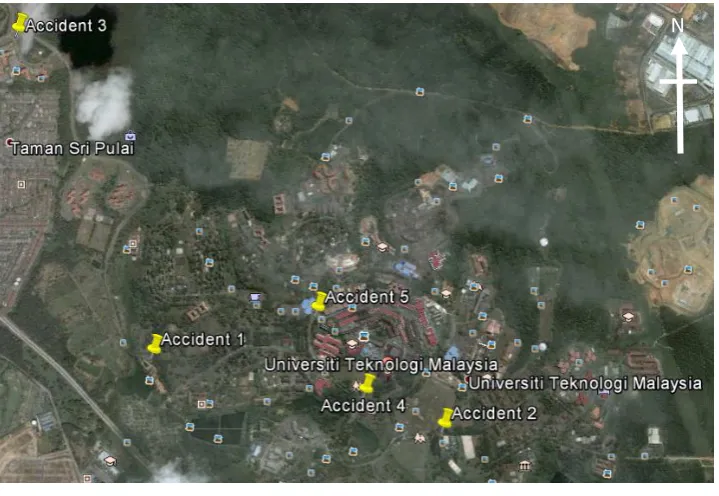
i) Area of study is conducted in Universiti Teknologi Malaysia (UTM) as shown in Figure 1.1. It is located at Johor Bahru, the southern city in Iskandar Malaysia with 1177 hectares of land. The simulations of road accidents are located at 5 different places (yellow pinpoint) which are identified as ‘hotspots’ in UTM area.
Figure 1.1: Research Area Scale 1:25000
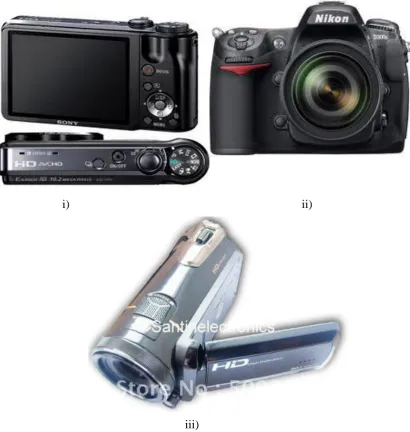
ii) 5 data of road accidents is obtained from 5 accident simulations. Crash scenes are captured by using 3 types of sensors which are SONY DSCHX5V (10.2 Megapixels), NIKON D300S (12 Megapixels) and MI DVJ350 (20.1 Megapixels) as illustrated in Figure 1.2. SONY DSCHX5V is used to capture images of road accidents to represent compact camera. NIKON D300S is characterized as SLR camera also
are used along with other tools such as scale bar, broken glasses as for the impact of accident, 6 traffic cones to control the crash area, and black aerosol spray for creating the scratch tyre. Several images are taken in different angles to cover the whole area of the crash scene.
i) ii)
iii)
Figure 1.2: i) Compact Camera, SONY DSC HX5V (10.4 x 5.8 x 2.8cm) ii) SLR Camera, NIKON D300S (14.7 x 11.4 x 7.4cm) iii) Video Recorder, MI DVJ350
perform the camera calibration. CrashZone support iWitness in order to display the 3D view of the collision scene.
b) Photomodeler: A photogrammetric-based processing software that measures and model real world objects and scenes through the use of images. This software brings the powerful capabilities of photogrammetry in a simple, user friendly Windows environment (Eos, 2010).
iv) The database of road accident data is stored in SQL Server Management Studio while the system is developed in Microsoft Visual Studio 2010.
1.5 Significance of Study
Various actions and treatments have been taken to reduce the rate of traffic accident in the whole world. According to U.S Department of Interior (2003), “an accident investigation is the methodical collection of evidence (facts), and the analysis and interpretation of the evidence. The fundamental purpose is to identify the cause, why the accident happened, and to recommend corrective actions to prevent or minimize the chance of a reoccurrence.” Thus, accident data is significant for government and road agencies as it is served as evidence in jurisdictions and as countermeasure for road safety.
This research is expected to give benefits and contribution to the Malaysia’s traffic management system due to the application of CRP. The final result can be as evidence in court litigation because in most jurisdictions, accidents involving fatalities must be surveyed and mapped. In brief, this research contributes to current practice of data collection with reducing the time and provides higher accuracy of positional crash data.
Variety of study and advice as well as mass media reports regarding the cause of the accident give useful messages to other road users. Despite, this tragedy on the roads continues to be a burden to the society. Thus, this study is essential for traffic accident management by utilization of database system. Since the rate of road deaths increases, a database system is extremely significant tool for traffic safety.
This tool has been employed more commonly by many traffic agencies for accident analysis due to the variety of function such as storing, sharing and managing a great quantity of data. Thus the need to attempt to avoid road accidents by whatever means that are effective will become increasingly important.
1.6 Thesis Chapters Layout
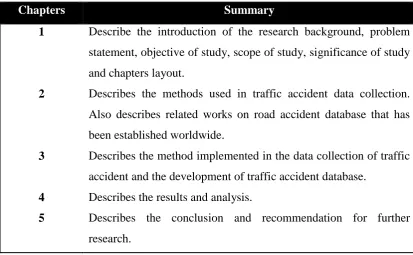
2
3
4 5
statement, objective of study, scope of study, significance of study and chapters layout.
Describes the methods used in traffic accident data collection. Also describes related works on road accident database that has been established worldwide.
Describes the method implemented in the data collection of traffic accident and the development of traffic accident database.
Describes the results and analysis.
Ahmad R.M.and Ehsan, Z. (2008). Intelligent GIS-Based Road Accident Analysis and Real-Time Monitoring Automated System using WiMAX/GPRS. Faculty of Engineering, University Putra Malaysia.
Alfredo, C.F. (2011). Mobile GIS in Police Vehicles for Henrico County, Virginia. Geographic Information Systems Coordinator. County of Henrico, Virginia.
Alley, A.A.(2010). SONY DSCHX5V.
(http://www.articlealley.com/article_1453082_10.html). Retrieved on 15 December 2010.
Ambros, J. (2008). Building the Czech Road Safety Observatory. 21st ICICT Workshop. Session VI: Road Safety Assessment. Transport Research Centre.
Anna, K. (2010). User Interface Design. PowerPoint Presentation. NextLab Mobile Innovation for Global Challenges.
Arnold, E.D. (2007). Use of Photogrammetry as a Tool for Accident Investigation and Reconstruction: A Review of the Literature and State of the Practice.
Research Report. Virginia Transportation Research Council, 530 Edgemont Road, Charlottesville.
Baguley, C. (2001). The Importance of a Road Accident Data System and its Utilisation. International Symposium on Traffic Safety Strengthening and Accident Prevention. 28-30 November. Nanjing, China
Berita Harian (2011). 27 Januari 2011. Page 1
Berry, T. B. (2008). Pre-Incident Planning must go to the Head of Class for Nation’s Schools.(http://www.respondersafetyonline.com/Classes/Articles/ArticleDra w_P.asp) Retrieved on 15 December 2010.
Burroughs, G.(1986). Relational Database Management Systems, Database Design, and GIS. Presented by Tim Haithcoat. Slideshow. University of Missouri, Columbia.
Burtenshaw, G. (2011). Vehicle and Operator Services Agency Database System.
Retrieved on 30 June 2011.
https://www.trlsoftware.co.uk/Content.aspx?ID=27
Campbell, A.T. and Friedrich R.L. (1993). Adapting Three-Dimensional Animation Software for Photogrammetry Calculations. ALFA Engineering, Inc.
Chant, L.D (2008). Multi-image Convergent Triangulation and Single-image Planar-Rectification for Law Enforcement Mapping. [Consultation]. DeChant Consulting Services – DCS Inc.
Cherry, E., Floyd, R., Graves, T., Martin, S., and Ward, D. (2006). Crash Data Collection and Analysis System. [Report]. Arizona Department of Transportation.
CIS (2013). Introduction to Database Management.
Cohen, K. (2007). Digital Still Camera Forensics. Small Scale Digital Device Forensics Journal. Volume 1 (1).
Coyle, F. (2008). Digital Close Range Photogrammetry in Motor Vehicle Accident Reconstruction. Ph.D Theses. Dublin Institute of Technology.
Crashteam (2008). Accident Reconstruction. (http://crashteams.com/index.htm) Retrieved on 14 July 2011.
Cusick, J. (2010). Sony DSC-HX5V Embedded GPS and Compass.[PowerPoint Presenattion].National Park Service.
DeChant, L. (2006). How a Photogrammetry Expert Can Help You Win Your Case. [Brochure]. Bellevue: Dechant Consulting Services. DCS Inc.
Demirel, A. and Akgungor, A.P. (2002). The Importance of Report in the Accident Analyses, Problems in Application and Recommendations for Solution. International Traffic and Road Safety Congress. Ankara, Turkey.
Duesing, B. (2006). PhotoModeler Takes Accident Documentation Off Road. Cygnus Interactive. Volume: 33 Nbr. 6.
Eos System Inc. (2010). Photomodeler Software. Canada. Version 6.
ESRI (2004). ArcPad: Mobile GIS. [Brochure]. United States of America: ESRI White Paper.
Fraser, C.S., Hanley, H.H. and Cronk, S.C. (2008). Close-Range Photogrammetry in Traffic Incident Management. University of Melbourne, Australia: Department of Geomatics.
Galvin, B. (2004). Focus on photography. Evidence Technology Magazine. The Gulick Corporation. SW Watson, Beaverton. Volume 2, Number 5.
Galvin, B. (2005). Photogrammetry Mapping for Crime Scene Mapping. [Brochure]. Oregon, Portland.
Galvin, B. (2007). Mapping Choices Abound as Traffic and Crashes Mount. Law Enforcement Technology Magazine.
http://www.lasertech.com/content/pdfs/Law-Enforcement-Technology-Mapping-Article.pdf Retrieved on 19 December 2013.
Galvin, B. (2010). For Las Vegas Fatal Crash Unit, A Gamble on GPS System to Speed Scene Mapping Pays Off. Article, ARC Network.
Geospatial Expert (2010). GPS-Photo Pro 2709.
(http://www.geospatialexperts.com/gpsphoto-2709-p-115.html). Retrieved on 14 July 2011.
Ghaly, A. (2010). Abu Dhabi’s Traffic Information and Management System: Traffic
Counting and Operational Analysis (COPAS). Retrieved on 30 June 2011.
Google Earth (2011). Google Earth. (http://www.google.com/earth/index.html) Retrieved on 15 August 2011.
Haidir, S. (2012). Personal Communication. Royal Malaysian Police, Traffic Unit, Taman Ungku Tun Aminah, Johor Bharu.
Healey R.G. (1991). Database Management System in Geographic Information
System. Volume I. Study Material.
http://agris.faoswalim.org/resources/NEW%20Docs/Books%20and%20paper s/Geographic%20Information%20Systems,%20First%20Edition,%201991-Longley%20et%20al/BB1v1_ch18.pdf
Hill, J and Cuerden, R. (2005). Development and Implementation of the UK on The Spot Accident Data Collection Study – Phase I. [Report]. Department for Transport, London.
Hirasawa, M. and Asano, M. (2003). Development of Traffic Accident Analysis System Using GIS. Proceedings of the Eastern Asia Society for Transportation Studies. Traffic Engineering Division Civil Engineering Research Institute of Hokkaido, Japan. Volume. 4, pp. 1193–1199.
Hizal, H. and Sharifah Allyana S.M.R. (2009). The Construction of Road Accident Analysis and Database System in Malaysia. International Traffic Safety Data and Analysis Group IRTAD Conference. 16-17 September 2009. Seoul, Korea.
Hoekwater, J. (2008). On Scene Traffic Accident Investigation Level I. [Report]. Georgia Police Academy.
iWitness Manual (2008). Photometrix Pty Ltd Australia. Version 1.107
Japan Digital Road Map Association (2003). Uses of Digital Road Map. (http://www.drm.jp/english/drm/database/use.html.) Retrieved on 5 October 2010.
Java4all (2012). Relational Database Model (RDBMS). .http://www.java4all.in/oracle/oracle-intro.php Retrieved on 19 December 2013
Joeldgreat (2011). Introduction to Accident Investigation Process in a Manufacturing Industry. Retrieved on 1 July 2011.
http://expertscolumn.com/content/introduction-accident-investigation-process-manufacturing-industry
Jun, G. and Peter, T. (2004). Guidelines for Handheld Mobile Device Interface Design. Proceedings of DSI 2004 Annual Meeting. College of Computer and Information Science, Northeastern University, United States of America. Page: 3751-3756.
Katims, L.N. (2011). Kansas City Police Use Forensic Mappping to Unvestigate Accidents. Retrieved on 5 November 2011. http://www.govtech.com/public-safety/Kansas-City-Police-Use-Forensic-Mapping-to-Investigate-Accidents.html
Leonardo, C.G. (2011). The Requirement of Camera in Accident Data Collection. Personal Communication. SKYMAX DG, Italy.
Liang, L.Y., Mo’some, D.M. and Hua, L.T. (2005). Traffic Accident Application Using Geographic Information System. Journal of the Eastern Asia Society for Transportation Studies. Department of Civil Engineering Faculty of Engineering University Putra Malaysia. Volume 6.
Lim, S. (2011). Advanced Road Management System using IT Technology. International Journal of Engineering and Industries Korea Institute of Construction Technology.
Lin, H. (2011). Combining VGI with Viewshed for Geotagging Suggestion. Master of Science in Geoinformation Science and eath Observation. Thesis. University of Twente, Netherlands.
Longstreet, B. (2009). Laser Scanning for Accident Investigation. Sparview. Spar Point Research LLC. September 2. Volume 7, No. 16.
Luhmann, T.L. (2010). Close Range Photogrammetry For Industrial Application. Institute for Applied Photogrammetry and Geoinformatics, Jade University of Applied Sciences Oldenberg, Oldenburg, Germany. ISPRS Journal of Photogrammetry and Remote Sensing. Volume 65 Page 6.
Manase, D., Heesom, D., Oloke, D., Proverbs, D., Young, C., and Luckhurst, D. (2011). A GIS Analytical Approach for Exploiting Construction Health and Safety Information.
Marc, G. (2009). Photographs versus Reality.
(http://www.visualexpert.com/Resources/photoevidence.html). Retrieved on 14 July 2011.
Meisnerr, A., Wang, Z., Putz, W. and Grimmer, J.(2006). MIKoBOS - A Mobile Information and Communication System for Emergency Response. Proceedings of the 3rd International ISCRAM Conference (B. Van de Walle and M. Turoff, eds.), Newark, NJ. May 2006. United States of America.
Mercury (2013). Police Vehicle Involved in Three-Car Crash.
http://www.themercury.com.au/news/tasmania/police-vehicle-involved-in-three-car-crash/story-fnj4f7k1-1226727126512 Retrieved on 19 December
2013.
Mikulik, J. (2007). Road Accident Investigation Guidelines for Road Engineers. Transport Research Centre, Czech Republic.
Ministry of Transport Malaysia (2010). Transport Statistics Malaysia 2010. Statistic. Ministry of Transport Malaysia.
Transport for Elderly and Disabled Persons. 18-22 June. Montreal, Canada.
Murat, H.Y., Yakar, M. and Yildiz, F. (2008). Digital Photogrammetry in Obtaining of 3D Model Data of Irregular Small Objects. Department of Geodesy and Photogrammetry, Konya, Turkey. ISPRS Symposium. 3-11 July. Beijing, China.
NHTSA (2010). Crash Outcome Data Evaluation System (CODES) and Applications to Improve Traffic Safety Decision-Making. United States Department of Transportation.
Noronha, V. and Church, R.L. (2002). Linear Referencing and Alternate Expressions of Location for Transportation. Santa Barbara, California: [Report]. Vehicle Intelligence and Transportation Analysis Laboratory, National Center for Geographic Information and Analysis.
Nurkhaliesa, B.H. (2010). Reconstruction of Traffic Accident Using iWitness and Crash Zone Software. Bachelor of Geomatic Engineering. Thesis. Universiti Teknologi Malaysia, Skudai.
Nur Fazzillah, M.N. (2010). Centralized System for Road Accident, Safety and Hazard Studies (CRASH). Malaysian Institute of Road Safety Research (MIROS), Malaysia.
Ong, T.K. (2009). Ceremony of Dealers and Sellers in Motorcycle as Ambassador Road Safety. Speech. Malaysia International Exhibition & Convention Centre, Mines Resort City, Malaysia.
Exhibition Session: Accident Reconstruction (Part 1 of 4). March 2004: Detroit, Michigan, USA.
O’Shields, L.L. (2007). Photogrammetry in Traffic Accident Reconstruction. Doctor of Philosophy Degree. University of Tennessee, Knoxville.
Pagounis, V., Tsakiri, M., Palaskas, S., Biza, B. and Zaloumi, E. (2006). 3D Laser Scanning for Road Safety and Accident Reconstruction. TS 38 – Engineering Surveys for Construction Works I. Shaping the Change. Proceedings of the XXIII International FIG. 8–13 October, Munich, Germany.
PCauthority, (2010). SONY DSCHX5V.
(http://www.pcauthority.com.au/News/166170,get-lost-with-the-sonys-cyber-shot-dschx5v-thanks-to-built-in-compass-and-gps.aspx). Retrieved on 15 December 2010.
PDRM (2010). Statistic of Road Deaths per 100000 Populations. (http://www.rmp.gov.my). [Statistic]. Retrieved on 5 October 2010. PDRM (2010). POL27 Form. [Form]. Polis DiRaja Malaysia.
Pigman, J.G. and Agent, K.R. (2007). State DOT CrashReconstruction Practices: A Synthesis of Highway Practice. NCHRP Synthesis 369. Transportation Research Board.
Qirjako, G., Burazeri, G., Hysa, B., and Roshi, E. (2008). Factors Associated with Fatal Traffic Accidents in Tirana, Albania: Cross-Sectional Study. Croatian Medical Journal. Volume 49 (6), Page: 734-740.
Rainer, M. (2008). An Introduction to Relational Database. Slideshow. http://www.iai.unibonn.de/III/lehre/vorlesungen/IntelligentIS/WS13/Relation
International. Warrendale, Pennsylvania.
Reddy G.C. (2011). Overview on Databases. Retrieved on 19 December 2013. Hyderabad, India. http://www.gcreddy.com/2013/03/overview-on-databases.html
Richard, M.Z. and Stephen, J.F. (2000). Two & Three Dimensional Photogrammetric Accident Analysis. Journal of the National Academy of Forensic Engineers. 17 No. 1.
Road Safety Department Malaysia (JKJR) (2010). Road Accident Statistics for the Year 2000-2009. (http://www.jkjr.gov.my/statistik.html). [Statistic]. Retrieved on 5 October 2010.
Robert, G. (2011). Burden of Proof.
http://www.pobonline.com/articles/95129-burden-of-proof. Retrieved on 19 December 2013.
Sahar, M.S. and Jehan, M.I. (2010). Driving Behavior, Driver Style and Road Traffic Accidents Among Young Medical Groups. 10th World Safety Conference. 21-24 September. London , United Kingdom, Volume 16 (1).
Saffet, E., Ibrahim, Y., Tamer, B. and Mevlut, G. (2008). Geographical Information System Aided Traffic Accident Analysis System Case Study: City of Afyonkarahisar. Afyon Kocatepe University, Faculty of Engineering, Department of Geodesy and Photogrammetry, Afyonkarahisar, Turkey. Accident Analysis Prevention. Volume 40 (1), Page: 174-181.
2013.http://www.ddegjust.ac.in/studymaterial/mca-3/ms-11.pdf
Tao, Z.M. and Pei, Y.L. (2009). Analysis of Deformation Characteristics of Collision Vehicles Using Close-Range Photogrammetry ICCTP 2009. Critical Issues in Transportation System Planning, Development, and Management Proceedings of the Ninth International Conference of Chinese Transportation Professionals. 5-9 August. Volume 358. China, Pages:177-184.
Templeton, D.A (2008). Close-Range Photogrammetry as a Routine Crash Reconstruction Tool within the Florida Highway Patrol. Florida Department of Transportation, Florida. Collision Publishing LLC. Collision. The International Compendium for Crash Research. Volume 3 (20). Page:16-20.
Tim, H. (1999). Relational Database Management Systems, Database Design, and GIS. Slideshow. University of Missouri, Columbia
Traffic Accident Study Guide (2010). Tools of an Accident Investigator. [Report]. International Association of Chief of Police.
U.S Department of Interior (2003). Serious Accident Investigation Chief Investigator’s Manual. Draft BLM Manual 1112-3. Bureau of Land Management.
Walton, J.R., Barrett, M.L., and Agent, K.R. (2005). Evaluation of Methods to Limit the Time Taken to Investigate Crash Sites. [Report]. Kentucky Transportation Centre.
Wikimedia (2001). Object Oriented Model. U.S. Department of Transportation. http://commons.wikimedia.org/wiki/File:ObjectOriented_Model.svg
Xin, G.D. (2008). Geometry features measurement of traffic accident for reconstruction based on close-range photogrammetry. School of Mechanical Engineering, Shanghai Jiaotong University, Computer Aided Design Institute, Department of Mechanical Engineering. Proceedings of Advances in Engineering Software. Volume 40 (7), Page: 497-505.
Yannis, G., Evgenikos, P., and Chaziris, A. (2009). CADaS - A common road accident data framework in Europe. 4th IRTAD Conference. 16-17 September, 2009, Seoul, Korea National Technical University of Athens, Athens, Greece.