SMITH, DANIEL M. Asymmetric Task Scheduling on Simultaneous Multithreading Pro-cessors. (Under the direction of Professor Vincent W. Freeh).
The performance of a simultaneous multithreaded CPU is greatly impacted by the behavioral characteristics of the threads competing for resources during concurrent execution. Most of the research aimed at improving SMT performance, or characterizing beneficial workload mixes, has targeted a multi-process parallel computation environment. Even in cases where the thread mix was heterogeneous, the CPU contexts were still viewed as two semi-independent resources, both of which were unbiased in their task selection.
We investigate an alternative method for operating system designers to utilize an SMT CPU. By confining user processes to a single context of the CPU and allowing kernel tasks to utilize the other context when necessary, we are able to, in many cases, provide better application performance than either an equivalent uniprocessor system, or an SMT system that is being treated as an SMP. In addition to operating in this special mode, an operating system may also choose to alternate between it and a conventional multiprocessing configuration, depending on which provides better performance.
by
Daniel M. Smith
A thesis submitted to the Graduate Faculty of North Carolina State University
in partial satisfaction of the requirements for the Degree of
Master of Science
Department of Computer Science
Raleigh 2005
Approved By:
Dr. Vincent W. Freeh Chair of Advisory Committee
Biography
Daniel M. Smith was born on August 17th, 1981 in Chapel Hill, North Carolina, USA. He received a B.S. in Computer Science from Appalachian State University in Boone, North Carolina in May 2003.
Acknowledgements
I would like to thank my parents, Philip and Constance Smith, for supporting me throughout my academic career. Without their support (both moral and financial), my success would not have been possible.
Contents
List of Figures vii
List of Tables viii
1 Introduction 1
1.1 Motivation . . . 1
1.2 Contributions of this Thesis . . . 2
1.3 Organization of this Thesis . . . 3
2 Background 4 2.1 Symbiotic Jobscheduling . . . 6
2.2 Other Asymmetric Systems . . . 6
2.3 Linux . . . 7
2.4 Current OS Design Techniques for SMT processors . . . 9
2.4.1 Busy Waiting . . . 9
2.4.2 Idle Loops . . . 10
2.4.3 Intelligent Scheduling . . . 11
2.5 Experimental System Details . . . 11
3 Solution 13 3.1 Asymmetric Task Scheduling . . . 13
3.2 Implementation . . . 17
3.2.1 Linux Scheduler Modifications . . . 17
3.2.2 Changes to the Linux SoftIRQ System . . . 18
3.2.3 Control Module . . . 19
4 Results 20 4.1 Basic Test Methodology . . . 20
4.2 Homogeneous Workload Tests . . . 21
4.3 Hybrid Tests . . . 25
5 Conclusions 29
5.1 Future Work . . . 30
5.1.1 Hybrid SMP-SMT and Wider SMT CPUs . . . 30
5.1.2 Fine-Grain Mode Adjustments . . . 30
5.1.3 The MP scheduler . . . 31
5.1.4 Dynamic Adjustments . . . 31
A Data 32
List of Figures
2.1 Vertical and horizontal waste diagram . . . 5
3.1 Modified scheduling algorithm for DK mode . . . 14
3.2 Pipeline Modes . . . 15
3.3 Actual scheduler modifications . . . 18
4.1 Multi-Thread execution algorithm . . . 22
4.2 Improvement of SMT and DK modes over UP for 4 threads (with network activity) . . . 23
4.3 All projected hybrid run times . . . 27
A.1 Art Data . . . 33
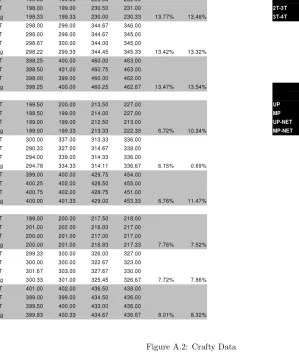
A.2 Crafty Data . . . 34
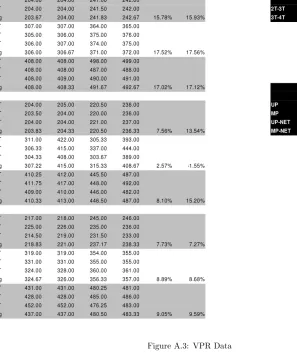
A.3 VPR Data . . . 35
A.4 Vortex Data . . . 36
A.5 Equake Data . . . 37
List of Tables
4.1 Categorization of benchmarks . . . 22
4.2 Summary of data on Art . . . 24
4.3 Summary of data on Mesa . . . 24
4.4 Equake and Crafty hybrid data (4T) . . . 26
Chapter 1
Introduction
1.1
Motivation
Simultaneous multithreading (SMT) is a technique used to increase utilization of modern wide-issue superscalar processors [23, 24]. The focus of previous research into increasing SMT performance has been to treat the processor as a special case of a symmetric multiprocessing (SMP) system [13, 14, 16]. This is a natural starting point because a single SMT CPU is presented to the operating system as multiple independent processors (arranged in an SMP configuration). Thus, the current strategy for operating system design is to make an SMP-capable operating system aware of the special characteristics of the SMT, in an attempt to make more informed scheduling decisions [18]. Additional ways to improve performance exist that allow the operating system to intelligently schedule tasks in such a way that concurrent processes impact each other only slightly, or even possibly improve their collective performance [21, 20].
When symmetric multiprocessing machines became available, software designers had to adjust their methods to take full advantage of the new hardware, as well as rethink previous performance-improving strategies that no longer applied to multiprocessors. As McDowell, et al. suggest [16], simultaneous multithreading represents a similar change, moving the target into a gray area, positioned somewhere between a uniprocessor and a multiprocessor. Exploration of possible fundamental software changes is necessary to achieve the maximum benefit from this new architecture, and therefore motivates our work. A change to the design of a traditional multitasking operating system is provided here, which can offer additional ways for the system to utilize the unique characteristics of an SMT processor. By restricting asynchronous kernel activity to one set of machine contexts and user tasks to another, we can maximize performance for applications that efficiently utilize resources. Since kernel tasks are small and infrequently scheduled, the user application enjoys use of all resources for most of its execution time.
A major portion of our work is focused on a particular scenario. This is the case where a system utilizing an SMT processor runs in an environment where excessive network activity is possible, if not desired. Traditional Denial of Service (DoS) attacks are designed in a way that the target system is overwhelmed with requests, which are serviced (or at least attempted) by the operating system at the expense of all running application tasks. If the primary role of the system is to support a user application, then an excessive amount of network activity may cause starvation and a failure to meet a deadline. However, if the operating system had the ability, as we described above, to limit which types of activity can be processed by a certain CPU context, then starvation could not occur. The SMT processor provides a unique opportunity to divide a physical CPU in such a way that a certain Quality of Service (QoS) is achieved. This can neither be provided by a uniprocessor, nor a multiprocessor.
1.2
Contributions of this Thesis
The main contributions of this work are as follows. It:
• Describes a model for restricting tasks to a given context,
• Provides a modified Linux 2.6 kernel that implements our described model for a more
• Provides a control module allowing runtime adjustments to the scheduler from userspace,
• Illustrates the advantages of our system through the presentation of performance
metrics of known benchmark programs,
• Describes a possible system that automatically detects and transitions to an optimal
operating mode, and
• Describes future research that could result from our work.
1.3
Organization of this Thesis
Chapter 2
Background
Applications rarely fully utilize modern processors. This is often due to the la-tency of other devices within a system, upon which the executing application depends. For in-order pipelined architectures, multithreading provides increased processor utilization by multiplexing the available resources among multiple instruction streams. The result is not a faster execution time for a single application, but rather an increased total through-put for multiple applications. Early multithreaded architectures, such as the MIT Alewife machine [4] and the Tera computer [6] provided fast hardware context switching, which allowed the pipeline to be loaded with an instruction from a different stream every cycle without penalty. Interactions between the running threads were minimal because only one instruction occupied a given pipeline stage at a time.
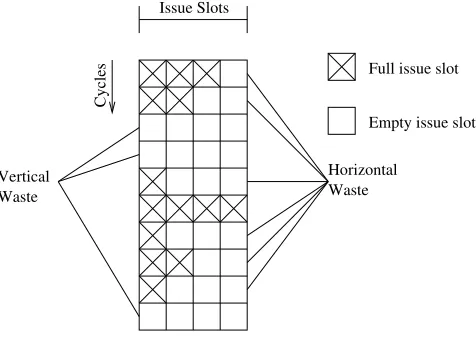
The introduction of superscalar architectures brought concurrent execution of mul-tiple instructions from a single stream. Sufficient instruction-level parallelism (ILP) iden-tified at runtime by the CPU increases throughput by processing multiple instructions per cycle in a single stage. Such an architecture is limited by the finite amount of ILP avail-able in any instruction stream. Tullsen et al. describe this problem in terms of vertical and horizontal waste [23]. They diagram the execution stage of a wide superscalar pipeline vertically, as shown in Figure 2.1.
Vertical Waste
Horizontal Waste
Empty issue slot Full issue slot Issue Slots
Cycles
Figure 2.1: Vertical and horizontal waste diagram
from multiple streams (the number of streams equaling the total number of contexts in the processor). This allows the CPU to fill wasted issue slots with instructions from the other streams.
Vertical waste occurs when the CPU issues no instructions for a given cycle. Hor-izontal waste occurs when the CPU is unable to fill all available issue slots in a cycle, which is a result of low thread ILP. Simultaneous Multithreading focuses specifically on reducing horizontal waste by giving the CPU additional instruction streams from which it can fill the remaining issue slots. This can, however, simultaneously combat vertical and horizontal waste: a given cycle may be filled with instructions from any one of the current threads, or it may be filled with a combination of instructions from more than one thread.
2.1
Symbiotic Jobscheduling
A simultaneous multithreaded processor introduces many complexities and unique characteristics over a similarly-equipped single-threaded processor. Most conventional mul-tiprocessor systems replicate entire CPUs to achieve parallelism. Such a system requires an operating system to intelligently schedule processes to optimize cache performance and re-duce false sharing. Typically, an operating system would ignore things such as the functional unit usage profile of concurrently executing applications, as the independent processors do not share these resources. These factors are exactly reversed in the case of an SMT pro-cessor, and provide the justification for specific operating system support for SMT CPUs. When co-scheduling two tasks on the virtual CPUs of an SMT, false sharing can actually increase performance (since the contexts share a cache) and processes need not be resched-uled on the same CPU, as the shared cache is warm no matter which context executes the process. Similarly, functional units are shared, and thus the operating system could increase performance by intelligently scheduling processes that would minimize interference.
Snavely et al. use the term symbiosis to describe the effectiveness with which multiple jobs achieve speedup when co-scheduled on a simultaneous multithreaded processor [19]. They describe a system, called SOS, that dynamically determines the most beneficial schedule for a set of tasks, based on their measured performances. This is referred to assymbiotic jobscheduling[21], and is a crucial step in improving performance on an SMT system. They take their idea further [20] by introducing weights into their system, providing the (very important) ability to support QoS within the system. This is a key concept, as it is similar to what we plan to do with our work, although it assumes that the operating system is always scheduled with the highest priority. Also, the SOS system spends execution time measuring the performance of many combinations of running tasks before determining the best schedule. Another solution, however, could be to classify applications statically, thereby eliminating the need for run-time sampling and preventing short-lived processes from hurting the performance of the system.
2.2
Other Asymmetric Systems
computers used this technique to allow I/O parallelism[8]. One or two central processors were used to perform high-speed arithmetic operations and general program execution, much like the CPUs of today’s microcomputers. Additionally, small peripheral processors (PP) provided I/O service between external devices and central memory (CM). The PPs each had small private memories and access to all locations of the CM. By loading a small program into a PP’s private memory, a complex I/O operation could be carried out while allowing the central processor to continue execution of other tasks. Thus, the CDC 6000 machine had multiple processors dedicated to different tasks executing different code. Much of the CDC operating system was implemented in PP code,1
resulting in a system where most of the OS was executed on dedicated processors, minimizing interference with user tasks.
A more modern example of an asymmetric architecture is the IBM BlueGene/L machine (BGL)[22]. The BGL system packages two PowerPC 440 CPUs per processing ele-ment (PE). Unlike the CDC 6000 system (in which the CPUs were not similarly-equipped), a BGL PE has two equally-powerful processors in a pseudo-SMP configuration.2
Although the system is capable of symmetric task assignment to both processors on a PE, normal operation utilizes one CPU for computation and the other for messaging. The BGL machine is an example of an SMP system where tasks are not symmetrically assigned. Effectively, the second physical processor becomes a service or co-processor, similar to the intent of our work with respect to an additional context of an SMT processor.
2.3
Linux
Linux is a modern multitasking operating system capable of operating on unipro-cessor and multiprounipro-cessor systems. Time is divided coarsely intoepochs, within which each task is given a finite amount of time to execute, called its timeslice. An epoch ends when all runnable tasks have exhausted their timeslice, thus ensuring that all tasks are given a chance to run. Tasks can be assigned priorities, which increase or decrease the timeslice that will be allotted to them each epoch. Each physical processor in the system is given two dedicated runqueue data structures, one of which holds tasks with time remaining this
1
The PPs used a different ISA from the central processor, and, therefore, required code to be specially written.
2
epoch (runnable tasks), the other holds tasks who have exhausted their time (expired tasks). At the end of an epoch, the concrete runqueues switch roles; the expired runqueue holds all tasks, and, therefore, becomes the runnable queue for the next epoch.
The kernel enforces this strict timing strategy through the use of preemptive scheduling. The system timer is set by the kernel at boot to call a special routine ev-ery millisecond. Thus, during the execution of a task, the kernel regains control of the CPU periodically, where it can update timing measurements and choose to switch to another task if appropriate. Additionally, applications invoking I/O routines make calls directly into the kernel, and, thus, provide another entry point to the scheduler.
The main purpose of the task scheduler is to handle the execution of application tasks; these form the actual workload that the user of the machine intends to complete. The kernel also has work that it must perform, independent of any specific user task. Examples are flushing recent buffer cache changes to disk and balancing the task load on a multiprocessor system. The kernel wraps the routines to accomplish these duties in special kernel tasks, and inserts them into the runqueues as it would for a standard user task. Thus, these kernel tasks are given the same benefits as user tasks, such as guaranteed runtime and periodic scheduling.
Hardware interrupt handlers are divided into two pieces called the top and bottom halves. Although their names imply symmetry, in practice, the top half is much smaller than the bottom half [15]. The idea is that hardware interrupts should preempt the currently running task briefly, perform only necessary work, and then allow the preempted task to continue executing. This typically involves an acknowledgment to the hardware, and possibly the initiation of a data transfer to or from a buffer. The bottom half is typically executed later and performs the bulk of the real work necessary to handle the interrupt, such as copying data into userspace, or responding to another machine over the network. This is accomplished by marking a kernel task (ksoftirqd) as runnable, which will be scheduled in the normal fashion and will call the appropriate interrupt handler. There are two exceptions to this rule: first, an idle system will execute the bottom half immediately. Second, a heavily-loaded system may choose to force the execution of a bottom half if it is necessary to prevent buffer overflows.
addi-tional consideration for shared data structures as routines can be executed concurrently. When booting, only processor 0 is executing code, as instructed by the BIOS of the ma-chine. This processor begins executing the early portions of the kernel and then prepares additional processors for execution. At some point, processor 0 sends an Inter-Processor Interrupt (IPI) to another processor (>0) that causes that CPU to begin executing code at a predefined point. At this time, multiple CPUs are executing the same kernel routines, but are choosing different tasks from their dedicated runqueue. Synchronization is maintained through extensive use of fine-grained locks to prevent concurrent modification of shared data structures. The considerations made by Linux for execution on SMT processors will be discussed in subsequent sections.
2.4
Current OS Design Techniques for SMT processors
The existing operating system we chose to modify already contains several improve-ments and considerations for execution on an SMT processor. These techniques, however, all assume the system will be used in a symmetric fashion, scheduling user and kernel tasks on either context. This behavior is a natural first choice for adding SMT processor support to an existing SMP-capable operating system. By treating the SMT CPU as a special case of an SMP, very few changes are required to utilize the additional context. This approach, however popular, can lead to lower performance for certain workloads. The most com-mon operating system considerations for an SMT architecture are detailed in the following sections.
2.4.1 Busy Waiting
before incurring the overhead of a context switch. If, however, the remaining timeslice is small (or the system is able to determine that the lock will be held for a significant amount of time), the context switch overhead can be justified in favor of allowing other tasks to use the CPU.
However, when the same scenario is applied to an SMT processor, the code making the decision must weigh other factors. Most importantly, busy looping in the waiting process will consume resources that the running process must use in order to complete its task and, in turn, release the lock. Therefore, busy looping can reduce performance instead of lowering latency as is the case in the multiprocessor. In the SMT scenario, the operating system may decide to use a waiting technique that does not impact the running process as heavily as would busy looping. The Intel architecture provides several methods for doing this, depending on the desired delay time.
2.4.2 Idle Loops
A multiprocessor-capable operating system is responsible for scheduling multiple processes on the available multiple processors. If the number of processors is greater than the number of runnable processes, then an idle loop is executed. Typically, this involves a loop that repeatedly checks for runnable tasks followed by an optional delay. On an SMP system, this provides the best performance by reducing the latency between a new process becoming runnable and the idling processor selecting it for execution. When all processor resources are independent, there is no reason not to have a waiting processor spin in a tight loop looking for newly-runnable processes.
2.4.3 Intelligent Scheduling
Typical multiprocessor operating systems are careful to reschedule tasks on the same CPU that they were previously running on. This increases performance in cases where the cache is still warm. If there is a chance that some data that the process will access is still in a processor’s cache, then it is most advantageous to run it there, eliminating compulsory misses after each context switch. An operating system that uses this technique may actually decide to not execute a runnable task on an available CPU because the cold-cache penalty will be greater than the wait for the warm-cache CPU. On a single physical SMT CPU, this technique is not necessary and may decrease performance.
Modern Linux 2.6 kernels are aware of this fact and ensure that logical CPUs that compose the same physical CPU are not biased against each other, therefore allowing a task to be rescheduled on either of the contexts of the warm-cache CPU. This is accomplished by assigning the contexts of a single physical CPU to the same runqueue. Thus, both contexts attempt to fetch new runnable tasks from the same location, eliminating bias between the two logical CPUs.
2.5
Experimental System Details
As of this writing, only two commercially-available processors incorporate simulta-neous multithreading into their architectures: the Intel Pentium 4, and the IBM POWER5. Due to availability, popularity, and price, we use the Intel system as our experimental machine.
Some versions of the Pentium 4 include “HyperThreading Technology” (HT) sup-port, which is the trademark name for Intel’s SMT support. The processor implements a 20-stage pipeline capable of issuing and retiring 3 instructions per cycle [17]. The CPU stores two architectural contexts allowing it to fetch from two independent instructions streams [9] each cycle.
The SMT implementation in the Intel Pentium 4 is considerably limited, compared to the designs used in most previous research. In other research, a Compaq Alpha processor3 was modeled [12], which was capable of fetching 8 instructions from 4 contexts per cycle. Such a system is capable of providing much larger performance gains as well as many more
3
Chapter 3
Solution
In this chapter, we describe our proposed modifications to a conventional operating system scheduler. We used the Linux 2.6 kernel as the base for our actual modifications. Thus, we also describe the design of the related kernel structures and algorithms. Our changes to Linux are made primarily in the actual kernel source code. Other additions are mostly support-related (for example, the control interface) and are encapsulated within a loadable kernel module.
3.1
Asymmetric Task Scheduling
schedule_next_task() { BEGIN:
/* Existing performance tweak */
if(next->allowed_cpus does not match this_cpu) { next = get_next_task();
goto BEGIN }
/* New assignment code */
if(task->type matches this_cpu_duty) { goto RUN_TASK;
} else {
next->allowed_cpus -= this_cpu; next = get_next_task();
goto BEGIN }
RUN_TASK: }
Figure 3.1: Modified scheduling algorithm for DK mode
Note that this is the basic algorithm present in Linux, with small modifications.
The first conditional block is an existing mechanism for providing CPU affinity in an SMP system. The allowed cpusfield of the task structure is a bit-mask; a set nth
bit indicates that processorn can execute the task. The second conditional block is novel and unique to our design. It checks if the next task selected for execution is one that is allowed to execute on the current context.
In practice, the new code is only executed a small number of times while the system adjusts the task list appropriately. As tasks transition from a blocked to runnable state in DK Mode, they are marked for execution only on the correct context. Thus, after every process in the system has been examined, each is marked to run on the correct context. Since both contexts fetch from the same runqueue, tasks not allowed to execute on the context looking for a new task are quickly identified at the top of the routine without re-executing the logic detailed in Figure 3.1.
Kernel Instructions Thread 1 Instructions Thread 2 Instructions Unused Slot 3 Issue Slots
Time
UP SMT DK
!!! !!! !!! "" "" "" ## ## ## $$ $$ $$ %% %% %% && && && ''' ''' ''' (( (( (( ))) ))) ))) ** ** ** +++ +++ +++ ,, ,, ,, ---.. .. .. /// /// /// 00 00 00 111 111 111 22 22 22 333 333 333 44 44 44 555 555 555 66 66 66 777 777 777 88 88 88 99 99 99 :: :: :: ;; ;; ;; << << << == == == >> >> >> ?? ?? ?? @@ @@ @@ AA AA AA BB BB BB CC CC CC DD DD DD EE EE EE EE FF FF FF FF GGG GGG GGG HH HH HH III III III JJ JJ JJ KKK KKK KKK LL LL LL
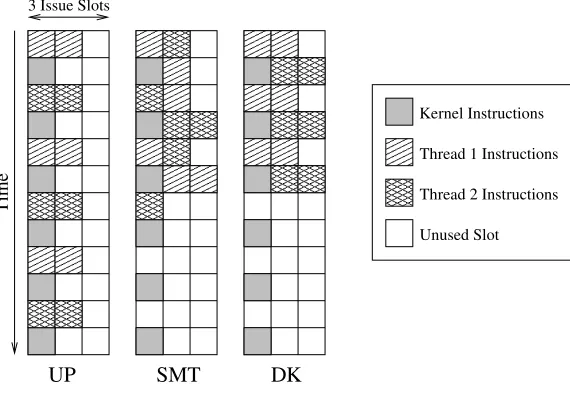
Figure 3.2: Pipeline Modes
is simple to selectively enable or disable this code at runtime allowing the operating system (or user) to select the mode that provides the best performance. A complete solution would encompass another block of code to reset the processor mask for each task, returning the system to its original state. This could easily be accomplished by saving the original allowed cpusmask when DK mode is enabled, so that it can be restored when DK mode is disabled.
In Linux, when there are fewer runnable processes than available processors, a special kernel task, called the idle task, is scheduled on unused CPUs. The idle task is always available for running and is chosen only if there are no real tasks available. When running on an SMT, the idle task explicitly issues a halt instruction, which delays execution until the next hardware interrupt. On the Intel architecture, a halt issued to one context of an SMT CPU relinquishes all shared resources (i.e., unpartitions) to the other running context. Therefore, when only one task is runnable, the Linux idle task collapses the unused context, which generally increases the performance of the running context. The goal of our proposed change is to prevent one context from running user tasks. By preventing it from “seeing” any available user tasks it is collapsed when there are no runnable kernel tasks.
vertically with time and is replicated for each mode. The pipeline is 3-wide, and has only two floating-point (FP) units, just like our Pentium-4 test machine. This means that at most two FP instructions can be processed per cycle. Additionally, the instructions must be processed in the same order in all three examples, as we assume dependencies have been resolved. This example is a simplified representation of what actually happens at runtime, as it ignores things like context-switching overhead; it is, however, sufficient to convey the idea.
In the UP case, two FP instructions from each alternating thread are executed per cycle while handling the kernel work in between. The multiprogrammed operating system scheduler strictly alternates between the user threads. In the SMT case, the scheduler has activated the second context of the machine and is attempting to issue instructions from each stream simultaneously. Thus, two floating point instructions are executed per cycle, one from each stream. Since the kernel activity takes the place of one of the contexts at time 2 and thread 1 has only one more FP instruction that can be executed (according to dependency rules), only one FP instruction is executed that cycle. The DK example does not attempt to fetch instructions from multiple user streams, and, thus, executes much like the UP case. The difference, however, is that the user tasks need not pause for the kernel activity and can be processed simultaneously, because they use different functional units. The result is that both tasks finish one cycle ahead of their SMT counterparts and five cycles ahead of UP.
This example demonstrates a situation where a scheduling policy based on our model can help increase instruction throughput. We used a floating-point example because it introduces additional constraints that are useful for illustrating possible bottlenecks. In practice, some integer-based applications also benefit from executing in DK mode. Similarly, not all floating-point applications exhibit the behavior described above.
A possible variation of our model could be used in the case where DK mode is almost always favorable for the intended workload. In this case, separating the runqueues into kernel-only and application-only queues, and properly assigning them to contexts could help reduce the overhead incurred by the scheduler when the next task on top of the shared runqueue is avoided. However, when operating temporarily in normal SMT mode, such a kernel might suffer from a less effective cache strategy, as was previously mentioned in reference to typical SMP configurations.
integer application. Previous studies have shown that the operating system executes so in-frequently that branch predictions and cache performance suffer [18, 11, 5]. This behavior results in favorable conditions for user applications co-scheduled in the adjacent context. First, the operating system is interleaved with application execution. Hence, poor per-formance in kernel routines will not delay the execution of the application. Second, the dynamic nature of resource binding in the Intel CPU causes the poorly-performing kernel code to utilize few resources, thus minimizing the impact of the concurrently executing user task.
We propose that the interrupt-handling mechanism in Linux be altered slightly as well, in a way similar to the scheduler. When running in DK mode, bottom halves are only ever executed on the context assigned to kernel tasks. This allows the system to execute the interrupt bottom halves concurrently with a running user task without ever interrupting it. In practice, this may occur naturally, but in a situation where interrupt flooding is present (for example, a DoS attack), it may be desirable to guarantee that starvation does not occur for the user task.
3.2
Implementation
In order to evaluate our proposed operating system changes, we chose to modify the Linux 2.6.8.1 kernel. Before our modifications, this kernel contained scheduler optimizations for a single runqueue per physical processor as well as an optimized idle loop for SMT processors.
3.2.1 Linux Scheduler Modifications
The changes we made to the Linux scheduler are almost identical to those proposed in Figure 3.1. At the last moment before the scheduler prepares the next task for execution, the code segment depicted in Figure 3.3 is run.
if(DK_ISON && DK_THISCPU) { if(next->mm != NULL) {
cpu_clear(cpu, next->cpus_allowed); next = rq->idle;
goto switch_tasks; }
}
Figure 3.3: Actual scheduler modifications
on this CPU. The last two lines select the idle task for execution and jump directly to the context switching code. This is a standard way to select an alternate task as the idle code immediately checks for runnable processes before idling. This ensures that the selection code (before our code shown in Figure 3.3) for another runnable task is properly re-run.
3.2.2 Changes to the Linux SoftIRQ System
As previously mentioned, the top half interrupt processing system is left un-changed. This simplifies the modifications we need to make to the system as the existing device drivers and other hardware-related code depend on this system behaving in a certain way. Due to the dual-phase nature of the interrupt system, this is of little consequence to our performance measurements as the top halves of interrupts are designed to run for a very short amount of time, minimizing their impact on the preempted task. Also, the latency of many parts of the system may depend on the speed at which the top halves execute. Thus, we are able to keep latency low by allowing the responses to the hardware to execute as they do in a normal system. We did, however, modify the behavior of the bottom half interrupt processing system.
processors in the system. We still allow this to happen in our modified kernel but alter the resulting behavior by changing the logic in thesoftirq processing routine ( do softirq()). Both processors routinely execute the do softirq() routine. Invocation can occur from many different locations scattered in the code; instead of identifying every call, we simply modified the routine itself to exhibit the behavior we desire. As such, when DK mode is enabled, the context dedicated to user tasks only runs softirqs that match a mask set dynamically at runtime. This is needed because some kernel tasks must be run by both contexts in order to keep the system running. However, the majority of the softirqs are masked out of the user context. The kernel context always processes all pendingsoftirqs. Additionally, it collects softirqs that were previously scheduled for execution on the user context. In order to handle this safely, locking was added to the code for raising and clearing softirqs.
Linux also provides another mechanism for sequential queuing and execution of lower-priority bottom halves: tasklets. The tasklet mechanism simply chains scheduled work together and processes it sequentially, instead of the priority-based softirq system. In fact, tasklet processing is invoked from the lowest-priority softirq. Similar modifications were made to the tasklet system to ensure that all were processed by the dedicated kernel context.
3.2.3 Control Module
Chapter 4
Results
4.1
Basic Test Methodology
We evaluated our operating system changes by measuring the performances of SPEC2000 benchmarks[2, 1] using our mode of operation compared to conventional modes. Our modification has little to offer without additional kernel tasks to process in the adjacent context. Thus, we need a method for introducing an increased amount of kernel activity to the system. We chose to generate load on the interrupt system and did so by designing a simple application pair that creates client-server network traffic. The machine under test ran a benchmark program while also acting the server role to a standalone client on another machine.
Our client-server application implements a protocol similar to many common ones, where large blocks of data are continually being requested by the client and supplied by the server. This activity resembles the I/O-bound load that a simple web server or custom data feedback application would generate. A small amount of occasional client-to-server traffic combined with a large amount of server-to-client traffic resembles a real-life situation.
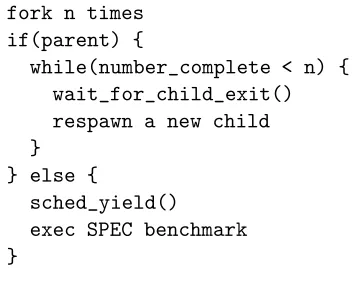
run with the same resource contention for the duration of the measured iteration. The structure of this algorithm lets us run a certain number of threads of the same application, automatically restarting a thread if it finishes so that the remaining threads continue to run at the same speed. The explicit sched yield() call ensures that the new task forfeits its right to run immediately allowing all threads a chance to be forked before the first one begins its task. The timing data for the restarted threads is not used in calculations, only to ensure deterministic test results. This technique is crucial for consistent results; if three of the four threads finish early, the remainder of the last thread must be executed with the same resource contention. Otherwise, the performance could be different than that of the other threads.
We chose to eliminate the case of executing a single application thread for obvious reasons. As previously described, Linux will collapse a context of the SMT when there is no runnable task to execute. Therefore, a typical SMT implementation with only a single thread to execute will naturally behave much like our enhanced kernel because there is already an available context waiting to handle any additional kernel activity.
The value used to compare the performances of two scenarios is time-to-completion (TTC). This metric is the time from when the threads are forked to the time that the slowest thread finishes its first iteration. Average iteration times were also measured but did not differ significantly (except in a specific case, which will be discussed later). We chose to report the TTC value, as it gives a more realistic picture of the performance that could be expected from a multi-threaded application where a single iteration can only be considered complete after all threads finish their work. Additionally, we found circumstances where the complex nature of the interactions between threads can vary the individual iteration times, but the TTC value remains relatively constant.
4.2
Homogeneous Workload Tests
fork n times if(parent) {
while(number_complete < n) { wait_for_child_exit() respawn a new child }
} else {
sched_yield()
exec SPEC benchmark }
Figure 4.1: Multi-Thread execution algorithm
Category Member Benchmarks
pro-SMT Vortex, Mesa, Equake pro-DK Vpr, Crafty, Art
Table 4.1: Categorization of benchmarks
quarter of our available memory without the need for paging.
Analysis of the data yielded by our tests confirms some hypotheses and raises new unanswered questions. First, DK mode does, in fact, behave almost identically to UP mode in the absence of network activity. Second, DK mode always outperforms UP mode in the presence of network activity. These facts, now confirmed, make it easy to classify the test benchmarks into two categories, which we will call pro-SMT and pro-DK. The naming of the latter is justified because DK always performs as well or better than UP, while exhibiting many of the same characteristics. The assignment to categories is shown in Table 4.1. This is interesting because, ignoring network activity, the pro-DK category is also the pro-UP category. Thus, applications that perform better on a uniprocessor than on an SMT also perform better even when network activity is present, in DK mode. Thus, adding the DK functionality to the operating system provides the ability to utilize the additional resources and capabilities provided by the SMT processor without running in a normal SMT mode when such a mode is detrimental to performance of a specific application.
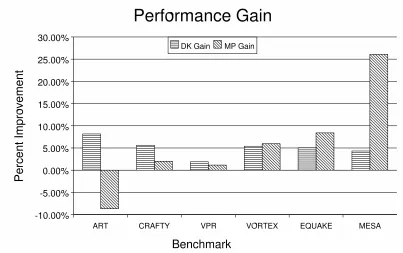
Figure 4.2: Improvement of SMT and DK modes over UP for 4 threads (with network activity)
see a larger benefit when running in DK mode compared to SMT mode. The last three applications, however, benefit from SMT mode. This leads us to believe that applications in the pro-SMT category always benefit from being co-scheduled in a normal multiprocessing manner. Additionally, applications that perform the same or worse on a traditional SMT system than on a uniprocessor, see a benefit by moving to DK mode.
The data for Art and Mesa in all modes and all thread configurations is shown in Tables 4.2 and 4.3. These applications represent our best and worse cases, respectively. The three-thread SMT performance of both applications is anomalous, and is discussed in Section 4.4.
Art’s runtime is longer when running in SMT mode than in UP mode, which immediately shows that it is best run on a conventional uniprocessor. Given this fact, it is not surprising that, in the presence of network load, that it performs better in DK mode than UP. This is because the CPU is able to handle the network load using the additional context of the CPU instead of competing for time, as in the UP case.
Without Net With net Mode Config TTC %-Change TTC %-Change
UP
2T 84.67 0.00% 95.67 0.00%
3T 129.33 0.00% 146.33 0.00%
4T 170.00 0.00% 192.00 0.00%
SMT
2T 86.00 1.55% 103.33 7.41%
3T 159.00 18.66% 179.00 18.25%
4T 173.33 1.92% 207.67 7.55%
DK
2T 85.00 0.39% 88.00 -8.72%
3T 125.33 -3.19% 135.33 -8.13%
4T 170.33 0.19% 176.33 -8.89%
Table 4.2: Summary of data on Art
Without Net With Net
Mode Config TTC %-Change TTC %-Change
UP
2T 327.67 0.00% 378.00 0.00%
3T 491.67 0.00% 576.67 0.00%
4T 659.00 0.00% 777.33 0.00%
SMT
2T 438.67 25.30% 286.67 -24.16% 3T 426.33 -15.33% 492.67 -14.57% 4T 520.33 -26.65% 574.67 -26.07%
DK
2T 340.67 3.82% 367.67 -2.81%
3T 518.33 5.14% 549.67 -4.91%
4T 702.33 6.17% 743.67 -4.52%
Table 4.3: Summary of data on Mesa
4.3
Hybrid Tests
Our modifications to the operating system were made in such a way that transi-tioning between DK and normal SMT mode is easily accomplished. Knowing that DK mode will not always offer a performance benefit in every scenario and with every application, it is desirable to be able to select the mode that will provide the best performance. To test the performance benefit of running a hybrid SMT+DK kernel, we designed a dynamic testing scenario. By running two of our homogeneous tests back-to-back with a mode change in between, we were able to measure the performance of a heterogeneous code mix on all kernel modes and determine which is most efficient.
We planned to test this simple hybrid strategy by choosing two applications, one of which benefited more from SMT mode, another benefiting more from DK mode. Clearly, a fixed SMT or DK policy cannot offer better performance than hybrid mode, where each application is executed in its most favorable mode.
Because our DK-modified kernel is actually an SMT kernel, disabling DK mode causes it to perform exactly like an SMT. Thus, we can predict the performance of a hybrid run by simply combining the appropriate results from previous runs. We verified this fact, and thus provide examples of how to calculate the hybrid run times from our homogeneous test data. Since the test timings include overhead, such as that incurred by
fork()and exec(), only the time needed to switch modes is left out of a simple addition. The work performed to switch modes is extremely light and can safely be left out of the prediction. Using the above assumptions, we can predict that a hybrid equake-crafty test can be determined by the following equation:
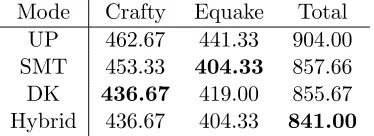
436.67 + 404.33 = 841.00
The hybrid mode allows one to select the fastest run of each application in the computation of the overall sum. By referencing the data for the independent runs of equake and crafty, as shown in Table 4.4, we observe that the overall runtime in hybrid mode is shorter than either of the other modes alone.
Mode Crafty Equake Total UP 462.67 441.33 904.00 SMT 453.33 404.33 857.66 DK 436.67 419.00 855.67 Hybrid 436.67 404.33 841.00
Table 4.4: Equake and Crafty hybrid data (4T)
Mode Art Mesa Total
UP 192.00 777.33 965.33 SMT 208.67 574.67 783.34 DK 176.33 743.67 920.00 Hybrid 176.33 574.67 751.00
Table 4.5: Art and Mesa hybrid data (4T)
that of Art’s benefit with DK mode, which would be an indicator that a static SMT mode would be better than a static DK mode choice. A hybrid system eliminates the need to compromise. SMT mode alone offers a large 18.9% improvement over UP mode, but hybrid execution increases this gain to 22.2%.
A comparison of all projected hybrid run times is given in Figure 4.3. In some cases the difference between a hybrid and static mode is so small that the benefit may not justify the complication. In others, a significant improvement can be made. The figure shows that hybrid mode is always better than any other mode when running two applications that each favor a conflicting mode.
We have shown that when faced with execution of two applications that favor different modes, a hybrid approach can yield the best performance, compared with simply choosing the mode that will provide a performance increase for the one that is larger than the decrease incurred by the other application. The hybrid mode provides the performance increases for each application.
Figure 4.3: All projected hybrid run times
4.4
Odd Thread Count Behavior
an uneven load In such a case all processes should be scheduled round-robin on the available processors to ensure a fair time distribution. Clearly, the current scheduler is in need of further examination and, hopefully, an adjustment.
Chapter 5
Conclusions
In this thesis, we explored an alternative way to approach utilization of the addi-tional resources provided by an SMT processor. We moved away from tradiaddi-tional symmetric scheduling techniques and suggested an operating system modification that would illumi-nate a new path in light of the diminishing returns resulting from conventional thinking. We achieved this goal and did so while maintaining compatibility with existing algorithms as well as the added benefit of being able to utilize both existing and new paradigms in the same system at runtime.
Our research produced:
• Experiments showing that some applications perform better when scheduled alone as
opposed to being co-scheduled on an SMT processor,
• A categorization of the tested benchmarks into those which do and do not perform
well on an SMT,
• The realization that poor SMT performers can achieve a performance gain through
the use of our operating system modification,
• A technique for combining our modifications with traditional scheduling algorithms
at runtime can that achieve a best-of-both-worlds scenario, and
• Shortcomings of the current Linux scheduling algorithm in the case of a non-multiple
5.1
Future Work
In the process of modifying the Linux kernel and examining the results of our tests, many new ideas were formed about ways to further improve performance. Additionally, we recognized situations where our system could not be directly applied to existing workloads and implementations. We attempt to provide possible solutions to increase the usability of the system in real-world situations. These ideas are presented here as the basis for future work.
5.1.1 Hybrid SMP-SMT and Wider SMT CPUs
The concept of a system with multiple SMT processors offers some interesting ways to apply our ideas. Certainly, our model could be adapted to allow independent control of the operating mode for each physical processor. This could provide additional gains for mixed workloads, especially if it is desirable to concurrently execute multiple applications with differing mode preferences. By maintaining a DK scheduling policy on one processor and a conventional SMT policy on another, three differing applications could simultaneously realize an increase in performance.
Similarly, an SMT processor with a larger number of contexts and a wider pipeline, such as the Alpha 21464 described in previous research, could offer more mode options [12]. We have shown that some applications benefit from being co-scheduled on an SMT compared to a uniprocessor. Perhaps this characteristic is specific to our machine, and would not apply to the same application on a wider SMT superscalar. In this case, the operating system may provide more control, such as collapsing two out of four contexts to allow the remaining two contexts to access more resources. The end result may be a software-controlled partitioning scheme where the operating system can choose to treat the CPU as a single-context wide superscalar, a two-context SMT, or a four-context narrow SMT.
5.1.2 Fine-Grain Mode Adjustments
a timeslice. An epoch ends when all processes have consumed their timeslice. In order to accommodate mode changes on a fine-grained level, this algorithm could be modified slightly. First, each epoch would be executed in either DK or SMT mode alternating each time. Tasks that are marked as preferred-DK or preferred-SMT would be given twice the timeslice for the epochs that run in their preferred mode. For the other epochs, they would be allotted no timeslice. Thus, each task would be executed in the appropriate mode. In a design such as this, latency would be increased; in the case of compute-bound tasks however, this would be of no consequence.
5.1.3 The MP scheduler
The idea of a mode-oriented operating system scheduler for SMT CPUs, called the MP scheduler, was originally presented by Freeh [10]. This idea aimed at improving SMT performance of applications that run best in a uniprocessor environment. The DK mode achieves part of these objectives. We have shown that some applications do (even in the absence of network activity) perform better when not co-scheduled in a typical SMT fashion. Work on the MP scheduler has not yet begun, but our work clearly demonstrates that there are cases where improvement is available. This idea, combined with either fine-grained mode adjustments or a true multiprocessor, could add significant value to a real system.
5.1.4 Dynamic Adjustments
Appendix A
Bibliography
[1] Cfp2000 benchmark descriptions, 2000.
[2] Cint2000 benchmark descriptions, 2000.
[3] 12th International Conference on Parallel Architectures and Compilation Techniques. The Impact of Resource Partitioning on SMT Processors, 2003.
[4] A. Agarwal, R. Bianchini, D. Chaiken, K. Johnson, D. Kranz, J. Kubiatowicz, B-H. Lim, K. Mackenzie, and D. Yeung. The MIT alewife machine: Architecture and perfor-mance. InProc. of the 22nd Annual Int’l Symp. on Computer Architecture (ISCA’95), pages 2–13, 1995.
[5] Anant Agarwal, John Hennessy, and Mark Horowitz. Cache performance of operating system and multiprogramming workloads. ACM Trans. Comput. Syst., 6(4):393–431, 1988.
[6] Robert Alverson, David Callahan, Daniel Cummings, Brian Koblenz, Allan Porterfield, and Burton Smith. The Tera computer system. InProceedings of the1990 International Conference on Supercomputing, pages 1–6, 1990.
[7] Daniel P. Bovet and Marco Cesati. Understanding the Linux Kernel. O’Reilly & Associates, 1st edition, 2001.
[8] Control Data Corporation. 6400/6500/6600 Computer Systems Reference Manual, h edition, 1969.
T. Marr, Frank Binns. Hyper-threading technology architecture and microarchitecture. Intel Technology Journal, 6(1), February 2002.
[10] Vincent W. Freeh. Mp scheduler. Private conversation.
[11] Nicolas Gloy, Cliff Young, J. Bradley Chen, and Michael D. Smith. An analysis of dynamic branch prediction schemes on system workloads. InProc. 23rd Annual Intl. Symp. on Computer Architecture, pages 12–21, 1996.
[12] ISSCC. Design of an 8-wide superscalar RISC microprocessor with simultaneous mul-tithreading, volume 1, February 2002.
[13] Jack L. Lo, Luiz Andre Barroso, Susan J. Eggers, Kourosh Gharachorloo, Henry M. Levy, and Sujay S. Parekh. An analysis of database workload performance on simul-taneous multithreaded processors. InISCA, pages 39–50, 1998.
[14] Jack L. Lo, Susan J. Eggers, Henry M. Levy, Sujay S. Parekh, and Dean M. Tullsen. Tuning compiler optimizations for simultaneous multithreading. InInternational Sym-posium on Microarchitecture, pages 114–124, 1997.
[15] Robert Love. Linux Kernel Development. Sam’s Publishing, 2004.
[16] Luke K. McDowell, Susan J. Eggers, and Steven D. Gribble. Improving server software support for simultaneous multithreaded processors.
[17] Dean M. Tullsen Nathan Tuck. Initial observations of the simultaneous multithread-ing pentium 4 processor. In Proc. of the 12th International Conference on Parallel Architechtures and Compilation Techniques, 2003.
[18] Joshua Redstone, Susan J. Eggers, and Henry M. Levy. An analysis of operating system behavior on a simultaneous multithreaded architecture. In Architectural Support for Programming Languages and Operating Systems, pages 245–256, 2000.
[19] A. Snavely. Explorations in symbiosis on two multithreaded architectures, 1999.
[21] Allan Snavely and Dean M. Tullsen. Symbiotic jobscheduling for a simultaneous mul-tithreading processor. InArchitectural Support for Programming Languages and Oper-ating Systems, pages 234–244, 2000.
[22] The BlueGene/L Team. An overview of the bluegene/l supercomputer. Technical report, IBM and Lawerence Livermore National Laboratory, 2002.
[23] Dean M. Tullsen, Susan Eggers, and Henry M. Levy. Simultaneous multithreading: Maximizing on-chip parallelism. InProceedings of the 22th Annual International Sym-posium on Computer Architecture, pages ??–??, 1995.