Guest Speaker
Prof. Dr. Ahmad Zaki Abu Bakar
( Fakulti Sains Komputer & Sistem Maklumat,
Universiti Teknologi Malaysia )
Topic : Customer Accessibility Through a Multiple
Customer Accessibility
Through A Multiple Perspective Framework
Prof. Dr. Ahmad Zaki Abu Bakar
Faculty of Computer Science & Information Systems Universiti Teknologi Malaysia
81310 UTM Skudai, Johor MALAYSIA
Abstract
Customer care has become one of the major issues for many businesses, prompting many organisations around the world to define it as being made up of Courtesy, Accessibility, Responsiveness and Effectiveness. Customer accessibility is defined as the condition, opportunity, rights and the means of a customer in approaching or entering a facility or electronic system. Customer access to products, services and information can be both physical as well as virtual and there are many considerations for its implementation. As such it’s design must be given great care and thought because it relates to facilitating customers to get or do what they want. A happy customer will give repeat business and stay loyal to the organisation. The Multiple Perspectives Framework can be adopted to assist in the planning of the multifaceted customer accessibility. The various issues can be classified and grouped into three perspectives under the Multiple Perspective Framework, namely Organisational (O), Personal (P) and Technical (T). To avoid focusing on only specific issues, the Multiple Perspective Framework provides a more balanced outlook so that organisational, personal and technical issues are equally addressed to provide a more comprehensive solution.
Introduction
With tremendous progress in technology and communication becoming more pervasive, organisations around the world are under increasing pressure to deliver effective solutions at appealing prices that will produce results and benefits over shorter time frames but using fewer resources and with zero defects. It is currently still considered as a buyer’s market. Customers expect and deserve quality services. With fierce global competition, customers should not have to worry about bureaucracy and long queues for service. As customers, they deserve easy, prompt, seamless access to services, products and information. The customer moment of value is when the customer wants it, where the customer wants it, how the customer wants it, and guaranteed delivery to the customer. In short, the slogan of the time is; any way, any how, any time and any form. If the service provider is not able or interested to provide such value, customers are fast to find and change to other vendors who are able to fulfil their needs.
world alike want convenient, efficient, multi-channel access to seamless services, integrated across programmes, departments and jurisdictions. At the same time, they want their service providers to be more transparent, accountable, courteous, and effective as well as able to respond immediately to whatever problems related to the service. As such, customer care has become one of the major issues for many businesses, prompting many organisations around the world to define it as being made up of Courtesy, Accessibility, Responsiveness and Effectiveness.
Customer Accessibility
Customer accessibility is defined as the condition, opportunity, rights and the means of a customer in approaching or entering a facility or electronic system. Customer access to products, services and information can be both physical as well as virtual and there are many considerations for its implementation. As such its design must be given great care and thought because it relates to facilitating customers to get or do what they want. A happy customer will give repeat business and stay loyal to the organisation. When planning to provide such facilities, provisions for people with disability, gender, different age groups and different culture bias must be given due consideration.
2.1 Physical Accessibility
However, having customers at the premise also place many responsibilities such as the safety and security of the customers on the establishment. In case of fire, flash flood, biohazards, threats or any other emergency, customers must have clear access to exits and fire escapes. The procedures to evacuate must also be clear and effective.
Improved access to buildings for customers with disability will certainly improve access for everyone. Glare-free lighting, easy-to-read and logical signage, hand rails, ramps that provide easy access for service trolleys, baby prams and strollers, non-slip floors and stairs, service lifts, and hazard free work spaces and public access areas will be appreciated by both customers and staff alike who use the premises.
While most physical access barriers are faced by customers with mobility difficulties, the needs of customers with a range of other disabilities should also be considered. Customers with vision, hearing and cognitive impairments also experience access barriers to the physical environment.
2.2 Security Accessibility
In restricted areas, smart cards and biometric devices such as thumb and retina recognition are used to limit access to only authorised persons.
2.3 Culture Accessibility
In many countries including Malaysia where cultural diversity is the norm and various religious practices are tolerated, many products have to be segregated physically to Halal and non-Halal to appease Muslim customers who are very particular about the ingredients and placements of products based on their religious beliefs. Access to Halal and non-Halal products must be clearly marked with proper signage to avoid unnecessary wrong purchases and complaints.
In certain countries such as in the Middle East, different gender is still segregated physically to allow better service provision based on gender rather than a unisex approach as practiced in many Western countries. A time-sharing access to a common sport facility or work area for example, is one of the solutions to solve this issue.
2.4 Age Accessibility
broad general audience and is suitable for viewers of all ages.
This means the programme contains little or no violence, no strong language and little or no sexual dialogue or situation. 18 is the classification code for viewers of age 18 and above. The programme is intended for adult viewing and may contain one or more of the following which is considered integral to the development of the plot, character or themes: intense violence and depictions of violence, graphic horror images, graphic language, mature themes, intense sexual situations and suggestive dialogue. Malaysia still does not allow the publication, distribution and broadcasting of pornographic content which are allowed in many other countries but classified as X and XXX.
2.5 Electronic Accessibility
Many governments around the world choose to provide portals as a gateway to a one-stop service centre as its implementation of an e-government. Portals are to fundamentally improve the way citizens interact with government and their communities. It is also a place to search and retrieve local and national information.
Rather than relying on employees to respond to enquiries or process requests for information, through the use of e-government, the public can "serve themselves" to a wide variety of information and services. Through e-government, citizens are able to get "online" rather than "in line" of queues and thereby increasing the efficiency with which citizens are served. A click on a web page is supposed to deliver services to the user versus the user having to find and contact each government office that processes the specific requests. The issue of opening time and physical location are no more limiting factors since citizens can access the government at any time, at any place and also by many means.
Even if there is no security breach, what is stopping the company or its employees from disseminating customer personal information to third parties for profit or other personal gain. In such cases, there is certainly a serious concern on the intrusion of privacy for customers divulging personal information to electronic systems.
Another challenge when offering electronic access would be elimination of face-to-face contact. Traditionally, people needing information either write, telephone, fax or physically go to an office to request that information. Speaking directly with a knowledgeable employee can help focus the enquiry and provide answers to any questions that arise. Direct electronic access to information eliminates this human touch, potentially resulting in a confusing and frustrating experience for the requester especially if the portal’s content structure and navigation controls were poorly designed and not customer friendly.
Another challenge would be the cost for providing the electronic services. Who should bear the cost; the service provider or the customer? If the customer is to be charged for the electronic services rendered, how are the fees set so that it is affordable, reasonable and attractive for the customer?
transfers and file transfer speeds. These should be monitored to ensure customer service levels are met. Additionally, there must be the ability to expand and allow new applications and online services on to the portal. If processing speed, storage, and bandwidth become overloaded, the results will include incomplete transfers of information for searches, poor data access in browsers, and extremely slow response times. The causes of this poor functionality are not visible directly to the user but will be frustrating for them. The integrity and accuracy of the information provided are thus also questionable.
1. Customer Access Based On Multiple Perspective Framework
An open mind and forward planning should be able to minimise access problems and remove barriers for all customers. However, from the above elaboration, customer accessibility is not a single but multiple issues. The challenges may be due to the organisation or the customer but the solution can come from within the organisation, from customers or solved by third parties. The solutions too can be based on human factors or technology.
and technical disciplines, various organisations, and diverse individuals. Alinda & Hasliza (2004) uses the Multiple Perspectives Framework to review and classifies Knowledge Management literature. We believe the same Multiple Perspectives Framework can be adopted to assist in the planning of the multifaceted customer accessibility.
The various customer accessibility issues can be classified and grouped into three perspectives under the Multiple Perspective Framework, namely Organisational (O), Personal (P) and Technical (T). The O perspective mainly looks at areas of the organisations capability in managing their resource to provide customer accessibility. These issues include standards, policy, procedures, and guidelines. Barnes (2002) for example, identifies three dimensions of focus for capabilities of organisations in managing their knowledge resources, which affects customer accessibility. Enhancing performance will reduce problem-solving time, faster result, and faster delivery-cycle time. Increase collaboration will improve communication and increase staff and supplier participation. Improving customer service will provide better service and more customer focus.
The P perspective focuses on the personal issues relating to customers including their needs, requirements, demands, buying habits, income, education, hobbies, interests, culture, geographic, race, religion, age, psychographic and physical features. The main concern is on human aspects that relate to attitude and behaviour that are influenced by environment and experience as well as the manager’s role in facilitating the process (Nonaka, 1991).
implementation of systems and infrastructure provision. System design issues also include techniques, architecture, models and framework for developing customer relationship management systems.
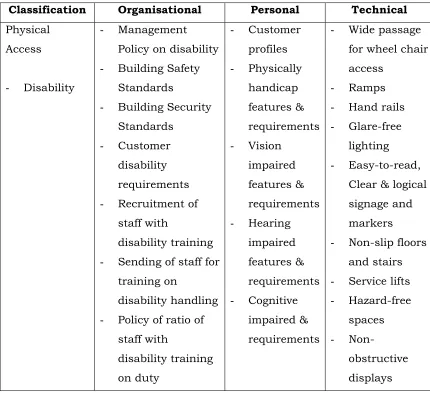
Based on the framework, a table that maps the classification of a certain customer accessibility issue in question can be developed. As an example, a multiple perspective classification for disability access is shown in Table 1.
Table 1: Example of Multiple Perspectives Classification of Customer Accessibility for Disability Physical Access
Classification Organisational Personal Technical
Physical Access
- Disability
- Management
Policy on disability
- Building Safety Standards
- Building Security Standards
- Customer disability requirements
- Recruitment of staff with
disability training
- Sending of staff for training on
disability handling
- Policy of ratio of staff with disability training on duty - Customer profiles - Physically handicap features & requirements - Vision impaired features & requirements - Hearing impaired features & requirements - Cognitive impaired & requirements
- Wide passage for wheel chair access
- Ramps
- Hand rails
- Glare-free lighting
- Easy-to-read, Clear & logical signage and markers
- Non-slip floors and stairs
- Service lifts
- Hazard-free spaces
-
- Annual budget for maintenance of facilities for the handicap
- Disability awareness programme
- Data collection of disability related incidents
- Braille signage
- Voice
response lifts
- Toilets with disability features
- Public
announcemen ts
2. Conclusion
References
Alinda & Hasliza (2004). A Multiple Perspectives Review Of Knowledge Management, Literature Journal of Advancing Information and Management Studies, 1(1), 17-32.
Barnes, S. (2002). Knowledge Management Systems: Theory and Practice (Ed). Thomson Learning, London, UK.
McKenna, Regis, (1999) Real Time: Preparing For The Age of The Never Satisfied Customer, Havard Business School Press.
Mitroff, I.I & Linstone, H. A, (1993). The Unbounded Mind: Breaking the Chains of Traditional Business Thinking. Oxford University Press.
Biodata
Prof. Dr. Ahmad Zaki bin Abu Bakar, a senior professor of Multilingual Knowledge Management Systems at the Department of Information Systems, Faculty of Computer Science and Information Systems, Universiti Teknologi Malaysia (UTM), has been an academic since 1977. He held many portfolios and was the Director of the university’s scholarly publishing house since 2007. Prior to that he was the Dean of International Affairs and before that he was the Dean of the Faculty of Computer Science and Information Systems in 2001 to 2004. He is the Chairman of National E- Commerce Standards Committee, SIRIM and Malaysian Cyber Novelist.