THE CONCEPTUAL DESIGN OF MALAYSIA GEOPOSTCODE AND ITS IMPLEMENTATION
NURZAHIDAH MOHD ZAKI
A report submitted in partial fulfilment of the requirements for the award of the degree of
Master of Science (Geoinformatics)
Faculty of Geoinformation and Real Estate Universiti Teknologi Malaysia
ACKNOWLEDGEMENT
In preparing this thesis, I was in contact with many people, researchers, academicians, and practitioners. They have contributed towards my understanding and thoughts. In particular, I wish to express my sincere appreciation to my main thesis supervisor, Dr Shahabuddin Amerudin, for encouragement, guidance, critics and friendship. Without his continued support and interest, this thesis would not have been the same as presented here.
I am also indebted to Ministry of Education Malaysia for funding my Master study. Directors in JUPEM, officers in Pos Malaysia and the officers in Department of Statistics Malaysia also deserve special acknowledgement for their assistance in supplying the data.
ABSTRACT
ABSTRAK
TABLE OF CONTENTS
CHAPTER TITLE PAGE
DECLARATION i
DEDICATION v
ACKNOWLEDGEMENT vi
ABSTRACT vii
ABSTRAK viii
TABLE OF CONTENTS ix
LIST OF TABLES xiii
LIST OF FIGURES xv
LIST OF ABBREVIATION xix
1 INTRODUCTION 1
1.1 Background of Study 1
1.2 Background of the Problem 4
1.3 Statement of the Problem 9
1.4 Aim of the Study 10
1.5 Objectives of the Study 10
1.6 Research Questions 11
1.7 Scope of the Study 12
1.7.1 Study Area 13
1.7.2 Data 15
2 LITERATURE REVIEW 18
2.1 Introduction 18
2.2 Definition of Postcode 18
2.3 Postcode in India 20
2.4 Postcode in Canada 26
2.5 Postcode in America 29
2.6 Postcode in Republic of Ireland 32
2.7 Postcode in United Kingdom 35
2.8 Postcode in Singapore 39
2.9 Postcode in Malaysia 42
2.3.1 Research on Malaysia Geopostcode 45
2.11 Conclusion of Postcode Design 50
3 RESEARCH METHODOLOGY 53
3.1 Introduction 53
3.2 Research Workflow 53
3.2.1 Preliminary Study 55
3.2.2 Literature Review 56
3.2.3 Implementation 56
3.2.4 Geopostcode Design 57
3.2.5 Research Findings and Conclusions 61
4 RESULT AND ANALYSIS 72
4.1 Introduction 72
4.2 Result of Malaysia Geopostcode Structure 72 4.3 Results by Assigning the Code for Study Area 73 4.3.1 First characters of Malaysia Geopostcode V3 74 4.3.2 Second and Third characters of Malaysia Geopostcode V3
75
4.3.2 Fourth and fifth character of Malaysia Geopostcode V3
4.4 Result for Interview 93
4.4.1 Respondents’ Background 93
4.4.2 Content Analysis 98
5 CONCLUSION AND RECOMMENDATION
5.1 Introduction 117
5.2 Reviewing Research Process 117
5.3 Limitation of Study 118
5.4 Conclusion 119
5.5 Recommendation 123
LIST OF TABLES
TABLE NO. TITLE PAGE
1.1 Previous research study area 3
1.2 Research questions table 8
2.1 First digit of PIN code 17
2.2 First 2 digits in PIN code 18
2.3 First three digits PIN code 19
2.4 The first letter of postcode 22
2.5 The first letter of postcode 25
2.6 Sectors in Singapore 33
2.7 Federal territories assigned codes 36
2.8 States assigned codes 37
2.9 Mail type assigned to the last third codes 37
2.11 Alphabet assigned for the states 39
2.12 Alphabet assigned for the districts 39
2.13 Numbers assigned for every sub-district 40 2.14 Number assigned for administrative boundary 40 2.15 Comparison of the countries structures 43
4.1 Sub-districts of Selangor 70
4.2 Sub-districts of Kuala Lumpur 77
4.3 Sub-districts of Wilayah Persekutuan Labuan 78 4.4 Sub-districts of Wilayah Persekutuan Putrajaya 79 4.5 Sections in sub-district Pekan Kapar, district Klang 79 4.6 Sections in sub-district Bandar Petaling Jaya, district 79
Kuala Lumpur
4.7 Sections in sub-district Bandar Baru Sungai Besi, 79 district Kuala Lumpur
4.8 Sections in sub-district Bandar Putrajaya, district 81 Putrajaya
4.9 Respondents Background 83
LIST OF FIGURES
FIGURE NO. FIGURE PAGE
1.1 Comparison of the proposed Geopostcode frameworks 5
1.2 Malaysia as the study area 10
2.1 Postcode structure in India 16
2.2 First digit of PIN code 17
2.3 Postcode structure in Canada 21
2.4 First digit of postcode in Canada 22
2.5 ZIP Code Structure 25
2.6 ZIP Code Structure 25
2.7 Eircode structure 27
2.8 The structure of alphanumeric postcode in United 30 Kingdom
2.9 The first two characters for UK 31
2.11 First 2-digit of Malaysia postcode 36
2.12 Proposed Malaysia Geopostcode framework 38
2.13 The Enhanced Malaysia Geopostcode 41
2.14 Enhanced Malaysia Geopostcode Framework 41 2.15 Comparisons of previous geopostcode framework and 42
Geopostcode V2
2.16 Comparison the two code structure 44
2.17 Postcode structure around the world 44
3.1 Research workflow 47
3.2 Flowchart for phase 1 48
3.3 Flowchart for phase 2 49
3.5 The process of the interview 50
3.6 Process of human coding 53
3.7 Flowchart for phase 4 55
3.8 JUPEM base map data structure 56
3.9 Structure of Geopostcode V3 57
4.1 The first three charaters of Geopostcode V3 for 63 Peninsular Malaysia
4.2 The first three charaters of Geopostcode V3 for Sabah 67 and Sarawak
4.3 The sub-district of Selangor 68
4.4 The three characters of Geopostcode V3 for Selangor 69 4.5 The fourth and fifth characters of Geopostcode V3 80
4.6 The area coverage by Othman (2015) 80
4.7 The area coverage by Napiah (2015) 80
5.1 The biggest issues in Malaysia Geopostcode 108 Implementation
LIST OF ABBREVIATION
A - Alphabet
BP - Blok Perancangan
BPK - Blok Perancangan Kecil
BO - Branch Office
D - Digit
GIS - Geographic Information System GPO - General Post Office
GPS - Global Positioning System
HO - Head Office
JPBD - Jabatan Perancangan Bandar dan Desa JPJ - Jabatan Pengangkutan Jalan
JUPEM - Jabatan Ukur dan Pemetaan Malaysia KLCC - Kuala Lumpur City Centre
KM - Kilometre
LBS - Local Based System
LDU - Local Delivery Unit
m - metre
MacGDI - Malaysia Centre for Geospatial Data Infrastructure MBJB - Majlis Bandaraya Johor Bahru
MPS - Majlis Perbandaran Selayang MPSJ - Majlis Perbandaran Subang Jaya
MPJBT - Majlis Perbandaran Johor Bahru Tengah MPKu - Majlis Perbandaran Kulai
MPPG - Majlis Perbandaran Pasir Gudang NGV - Natural Gas Vehicle
PIN - Postal Index Number
PON - Position Oriented Navigation SPR - Suruhanjaya Pilihanraya
SO - Sub Office
UK - United Kingdom
UKM - Universiti Kebangsaan Malaysia UPI - Unique Parcel Identifier
UPU - Universal Postal Union
US - United States
V - Version
CHAPTER 1
INTRODUCTION
1.1 Background of Study
The main purpose of postcode is for the mail sorting. Different country used different term of postcode. For example, United Kingdom and most of Asia country includes Malaysia, the term used is postcode. But for India, they used PIN code. United States and Philipines used the term ZIP code.
The coverage area of Malaysia postcode is up to hectars (Othman et al.
User will also easy to remember the codes compared to addresses. Masrek and Razak (2010) stated that, the main reason of the undelivered mail in Pos Malaysia is because the addresses written by the user were nonconforming to the SIRIM address standard. The users usually ignored the standard of the address structure. Thus, by using Malaysia Geopostcode, users will not need to understand the address structure, as the address has been converted to eight alphanumeric structure (Othman et al. 2015). This is more conveniently can be used and easy to be understood by people all over the world as compared to different languages in the address that will end up confusion to the user.
Other than that, it also will assist government and private agencies in using spatial data for policy planning and operations. Every government and private agencies normally will named, numbered and coded their area of operation based on their requirement. It involved high cost and time consumed to create the database. By using Malaysia Geopostcode, these can be centralized. The agencies can used the same boundary line with the same codes of the specific area. These able to provide efficient integration between the agencies, hence, efficient operation can be achieved.
Malaysia Geopostcode will allow integration with global positioning and navigation system, Global Positioning System (GPS). Pos Malaysia will not need to take so many years to train the posman to get familiar with the specific area. Posman can use GPS to assist them in delivering the mails. Malaysia Geopostcode also will lead to faster and more efficient postal delivery.
The previous researches for Malaysia Geopostcode have been done by Wan Mohamad Nazmeen (2013) and Nur Baizura (2015) which proposed and introduced Malaysia Geopostcode framework. Their findings show that the Malaysia Geopostcode able to assist people to navigate to their destination more precise compared to the conventional postcode. The precision is plus minus 10 parcel lots for every one geopostcode. This is because the geographic area assigned to the geopostcode has smaller coverage area compared to the conventional Malaysia postcode area. Users can simply key in the 8 alphanumerical geopostcode characters to search location and arrive to it rather than inserting long addresses.
Geopostcode involved many advantages and disadvantages, especially in the phase of starting the implementation. In Ireland, the user struggle using Eircode (Lucey, 2015). Government also have to pay millions for the implementation and maintenance (McManus, 2010). The structure of the geopostcode must be easy to remember and flexible (Othman et al. 2015) in order to provide the efficient Malaysia Geopostcode implementation.
1.2 Background of the Problem
The biggest issues in geopostcode implementation is the cost and time constraint. A developed country such as Ireland, they have implemented the geopostcode. However, some issues in the implementation have occurred. In Ireland, the implementation caused high cost and time constraint to the government and private agencies especially in updating the old system and databases. For example, the hospital patients details and banks customers details (McManus, 2010). The users in Ireland also will need to pay for geopostcode database updating and will consumed memory space in the devices as well. They claimed, the geopostcode structure is hard to memorize and it has poor design (Lucey, 2015).
On the other hand, in United States, the GIS analyst and researchers claimed, the United States ZIP code is lack of standardization and dynamic. Hence, the spatial analysis is challenging to be done by the researcher. Other than that, the ZIP codes can be split, discontinued and expanded between months or years. This case will confuse the unfamiliar analyst and researchers who not familiar to this field and the modification of the ZIP code can cause spatio temporal discontinuity (Grubesic and Matisziw, 2006). Vashistha and Thies (2013) stated that, in India, postcode has an uncertainty regarding accuracy, robustness, usability and granularity of location data. She also stated that, postcode is not suitable to be used for those applications that require accurate location.
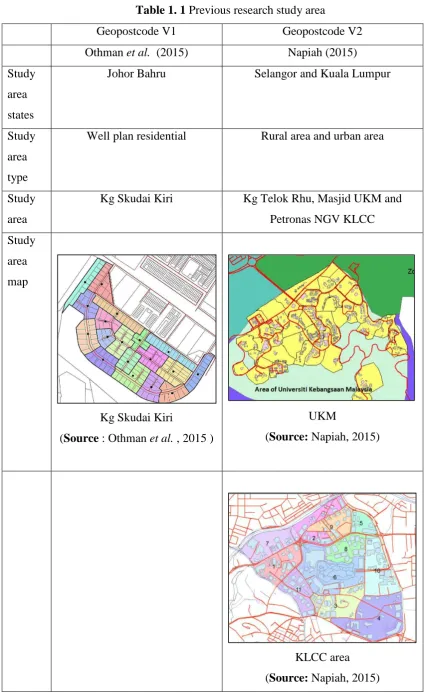
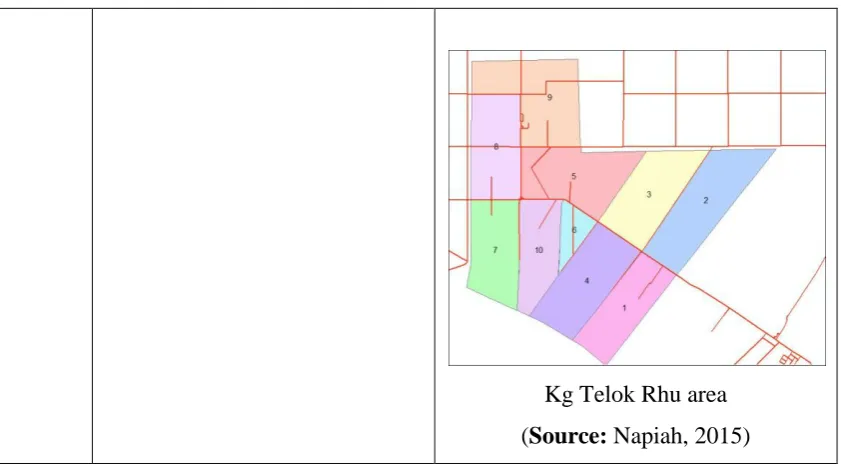
Table 1. 1 Previous research study area
Geopostcode V1 Geopostcode V2
Othman et al. (2015) Napiah (2015) Study
area states
Johor Bahru Selangor and Kuala Lumpur
Study area type
Well plan residential Rural area and urban area
Study area
Kg Skudai Kiri Kg Telok Rhu, Masjid UKM and Petronas NGV KLCC Study
area map
Kg Skudai Kiri
(Source : Othman et al. , 2015 )
UKM
(Source: Napiah, 2015)
Kg Telok Rhu area (Source: Napiah, 2015)
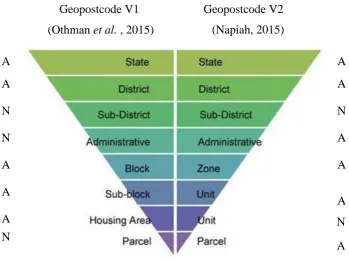
Figure 1. 1: Comparison of the proposed Geopostcode frameworks (Napiah, 2015)
Where;
A = Alphabets N = Numbers
In Malaysia, the government agencies defined their own geospatial data boundary lines for inner operations. Pos Malaysia, Department of Statistics Malaysia and Election Commision Malaysia (SPR) defined their owned boundary line according to their needs. The boundary lines also not fixed due to operation changes. For Department of Statistics Malaysia, the block boundary lines changed every 10 years. It would be more effective if all these agencies use the same boundary lines, which is by using Malaysia Geopostcode for the operations. It is centralized and can be intergrated among the agencies. The study on their needs is to make sure the Malaysia Geopostcode structure suits every agencies needs.
A A A A N A N A A A N N A A A N Geopostcode V2 (Napiah, 2015) Geopostcode V1
The conventional postcode in Malaysia needs to be improved for more efficient mailing and other field services. Current postcode in Malaysia is not spatially related and the postcode boundary covers very large area until up to hectares levels. Postcode only been used by the Pos Malaysia purposes and not for precise navigation (Othman et al. , 2015). Most of the developed countries have applied the modern, digital alphanumeric postcode and can be intergrated with the precise navigation system and technology.
In addition, address system in Malaysia have redundant names and variation in spelling and labeling. Many places in Malaysia have similar names and lack of consistency for reference (Othman et al. , 2015). User struggled to use the existing address system. This also leads to an undelivered mail due to incomplete or incorrect postal addresses. Masrek and Razak (2010) stated that, it was found that 58% of the addresses were nonconforming to the SIRIM address standard while 31% of the postcodes were wrongly stated. The findings also unveiled that 23% of the investigated addresses had dual addresses and 16% had wrong postcodes.
1. 3 Statement of the Problem
The previous research by Othman et al. ( 2015) and Napiah (2015) only study on the specific state in Malaysia but not the nation. Close study need to be done for every state administration boundaries in order to produce an efficient geopostcode structure. The administrative boundary for the states in Malaysia is not the same. In Sabah, there is no district and sub-district. Kuala Lumpur and Selangor have sections in the sub-district which other states do not. This research investigates the administrative boundaries for all states in Malaysia.
Other than that, the alphanumeric characters proposed for the structures in these studies needed to be revised because some of the states have a lot of sub-district compared to others such as Kelantan, Melaka, Negeri Sembilan and so on. They have more than 26 sub-districts in the states which not suitable to used only one character for the structure.
1. 4 Aim of the Study
To analyze the Malaysia Geopostcode implementation issues and the perceptions of the stakeholders towards the Malaysia Geopostcode structure and conceptually designed the Malaysia Geopostcode structure for all states.
1. 5 Objectives of the Study
To accomplish this main aim, four vital objectives have been structured out which are:
i. To review the existing issues in the implementation of Malaysia Geopostcode, the structures and other country postcodes.
ii. To investigate and the issues in Malaysia Geopostcode implementation and the stakeholders perceptions for Malaysia Geopostcode structure.
iii. To analyze the Malaysia Geopostcode implementation issues and stakeholders perception for Malaysia Geopostcode structure.
1. 6 Research Questions
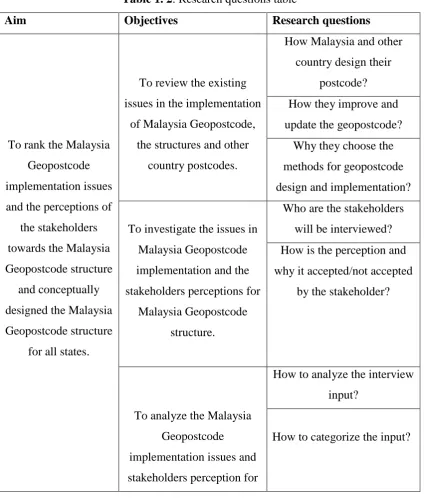
The research questions have been derived from the aim and objectives of the study. The research questions were described in the Table 1. 2.
Table 1. 2: Research questions table
Aim Objectives Research questions
To rank the Malaysia Geopostcode implementation issues and the perceptions of
the stakeholders towards the Malaysia Geopostcode structure
and conceptually designed the Malaysia Geopostcode structure
for all states.
To review the existing issues in the implementation
of Malaysia Geopostcode, the structures and other
country postcodes.
How Malaysia and other country design their
postcode? How they improve and update the geopostcode?
Why they choose the methods for geopostcode design and implementation?
To investigate the issues in Malaysia Geopostcode implementation and the stakeholders perceptions for
Malaysia Geopostcode structure.
Who are the stakeholders will be interviewed? How is the perception and why it accepted/not accepted
by the stakeholder?
To analyze the Malaysia Geopostcode implementation issues and stakeholders perception for
How to analyze the interview input?
Malaysia Geopostcode structure.
How to present the analysis result?
To design and develop the new conceptual design of Malaysia geopostcode for all states until level zone
from the Malaysia Geospatial framework.
How to apply the design technique from other country
geopostcode to Malaysia?
How to apply input from the perception for geopostcode
enhancement?
How to improve the existing method to design the
geopostcode?
1. 7 Scope of the Study
In order to answer the research questions and achieve the targeted research objectives, the scope has been set up to two elements:
1. 7. 1 Study Area
1. 7. 2 Data
1. 7. 2. 1 Vector Data
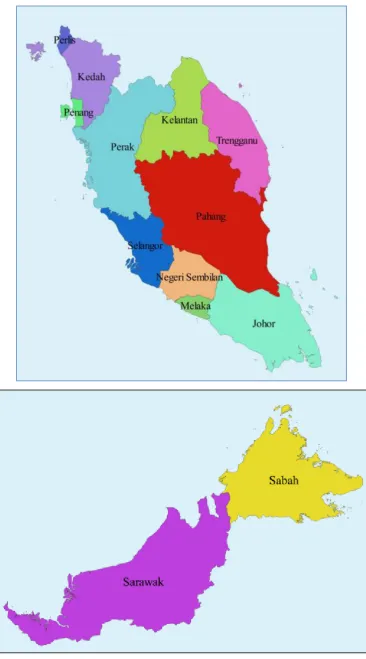
The list of the states, districts, sub-district, sections and precinct was downloaded from the online MaCGDI application, Unique Parcel Identifier, UPI application. This online application is to identify parcel locations based on unique code that consists of states, districts, sub-districts, sections and lots number. The data consist for 13 states and 1,920 mukims in Malaysia. The data structure is the same data structure been used by JUPEM, Department of Statistic Malaysia and Pos Malaysia. The data structure been used as a reference to design the Malaysia Geopostcode structure.
However, the spatial data used in this study in only cover the area of Selangor. This is because the administrative boundaries for other states are restricted data in JUPEM. The available Selangor administrative boundary data is for state, districts and sub-districts boundaries only.
1. 7. 2. 2 Interview Data
Malaysia Geopostcode is to assist mail sorting. According to McManus (2010), demographic is one of the implementation user for the new postcode, hence Department of Statistics has been chosen to be interviewed. The data for interviews was received from the face to face interview, phone calls and emails.
1. 8 Chapters Outline
Chapter 1: Introduction
This chapter shall discuss in brief on the introduction, problem statement, research questions, research objectives and the limitation of research. Chapter 1 is essential in order to clarify on the problem identified: choosing on the best methodology and other elements related shall assist researcher to understand in depth on the research carry out.
Chapter 2: Literature Review
Chapter 3: Research Methodology
This chapter shall discuss on the best selected method on employ in the research. Additionally, approach applied, sampling method, data collection, techniques or method use to analyze data and structure design.
Chapter 4: Result and Analysis
Chapter 4 comprises of all data obtained. Every data will be analyze and interpret using approach and method applied in the research. Results from the interpretation of data will help to construct the conclusion of research. Additionally, the result will also interpret on new findings from the research.
Chapter 5: Conclusion and Recommendation
REFERENCES
Acevedo-Garcia, D. (2001). Zip code-level risk factors for tuberculosis: neighborhood environment and residential segregation in New Jersey, 1985-1992. American Journal of Public Health, 91, 734.
Archive. India. Gov. In (2012). PIN Codes in India. December 9, 2012 ed. 3rd Floor, National Informatics Centre
Bates, A. (2008). The development of a'Postcode Best Fit'methodology for producing Population Estimates for different geographies. Population Trends, 28.
Berger, A. , Keenan, P. & Miscione, G. (2015). A Postcode not for Post.
Bogdan, R. & Biklen, S. (2003). Research for education. Boston: Allyn & Bacon,
1, 56.
Carcary, M. (2009). The research audit trial–enhancing trustworthiness in qualitative inquiry. The electronic journal of business research methods, 7, 11-24.
Cass, A. , Cunningham, J. , Wang, Z. & Hoy, W. (2001). Regional variation in the incidence of end-stage renal disease in Indigenous Australians. Medical Journal of Australia, 175, 24-28.
Clark, N. A. , Demers, P. A. , Karr, C. J. , Koehoorn, M. , Lencar, C. , Tamburic, L. & Brauer, M. (2010). Effect of early life exposure to air pollution on development of childhood asthma. Environmental health perspectives, 118, 284.
Clinch, C. (1981). British postal engineering. Physical Science, Measurement and Instrumentation, Management and Education-Reviews, IEE Proceedings A,
128, 107-116.
Corr, C. (2006). Financial Exclusion in Ireland: An exploratory study and policy
review, Combat Poverty Agency.
Counterflix (2016). Zip Codes & Post Codes from Around the World. 2016 ed. : http://www. counterflix. com/
De Vries, S. , Verheij, R. A. , Groenewegen, P. P. & Spreeuwenberg, P. 2003. Natural environments—healthy environments? An exploratory analysis of the relationship between greenspace and health. Environment and planning A,
35, 1717-1731.
Deonandan, R. , Campbell, K. , Ostbye, T. , Tummon, I. & Robertson, J. (2000). A comparison of methods for measuring socio-economic status by occupation or postal area. Chronic Diseases and Injuries in Canada, 21, 114.
Dhl. (2005). Country Code and Postcode Formats [Online]. Singapore: dhl. com.
Available: http://www. dhl. com.
tw/content/dam/downloads/tw/express/forms/postcode_formats. pdf [Accessed].
Drewnowski, A. , Rehm, C. D. & Solet, D. (2007). Disparities in obesity rates: analysis by ZIP code area. Social science & medicine, 65, 2458-2463. Dugandzic, R. , Dodds, L. , Stieb, D. & Smith-Doiron, M. 2006. Environmental
Health: A Global Access Science Source. Environmental Health: A Global Access Science Source, 5, 3.
Dunne, M. 2014. (2014) Annual Report of the Comptroller and Auditor General and Appropriation Accounts. The Development of Eircode, the National
Postcode System. Ireland: Communications, Energy and Natural Resources.
Eircode (2014). What Is Eircode. Retrieved November 11, 2014 from http://eircode. ie/what-is-eircode
Eisner, M. D. , Balmes, J. , Katz, P. P. , Trupin, L. , Yelin, E. H. & Blanc, P. D. (2005). Environmental Health: A Global Access Science Source.
Environmental health: a global access science source, 4, 7.
Ewell, D. (2004). Canadian Postal Codes. Mon Apr 12 09:40:29 2004 ed. Fullerton, California: http://users. adelphia. net/~dewell/.
Grubesic, T. H. & Matisziw, T. C. (2006). On the use of ZIP codes and ZIP code tabulation areas (ZCTAs) for the spatial analysis of epidemiological data.
International journal of health geographics, 5, 1.
Hanchette, C. L. (1999). GIS and decision making for public health agencies: childhood lead poisoning and welfare reform. Journal of Public Health
Management and Practice, 5, 41-46.
Hoffmann, A. O. , Post, T. & Pennings, J. M. (2013). Individual investor perceptions and behavior during the financial crisis. Journal of Banking & Finance, 37, 60-74.
Horby, P. , O'brien, S. , Adak, G. , Graham, C. , Hawker, J. , Hunter, P. , Lane, C. , Lawson, A. , Mitchell, R. & Reacher, M. 2003. A national outbreak of multi-resistant Salmonella enterica serovar Typhimurium definitive phage type (DT) 104 associated with consumption of lettuce. Epidemiology and infection, 130, 169-178.
Hsieh, H. -F. & Shannon, S. E. (2005). Three approaches to qualitative content analysis. Qualitative health research, 15, 1277-1288.
Hume, D. & Womersley, J. (1985). Analysis of death rates in the population aged 60 years and over of Greater Glasgow by postcode sector of residence.
Journal of epidemiology and community health, 39, 357-363.
Humpel, N. , Owen, N. , Iverson, D. , Leslie, E. & Bauman, A. (2004). Perceived environment attributes, residential location, and walking for particular purposes. American journal of preventive medicine, 26, 119-125.
Humpel, N. , Owen, N. & Leslie, E. (2002). Environmental factors associated with adults‘ participation in physical activity: a review. American journal of preventive medicine, 22, 188-199.
Jacob, F. (2015). The Postcode Map of United Kingdom [Online]. Big Think Available: http://bigthink.
com/strange-maps/113-the-postcode-map-of-the-united-kingdom [Accessed].
Jenner, B. , Flick, U. , Von Kardoff, E. & Steinke, I. (2004). A companion to qualitative research, Sage.
Jones, K. & Simmons, J. W. (1990). Location, location, location, Nelson Canada.
Jones, K. & Simmons, J. W. (1990). Location, location, location, Nelson Canada. Kamilaris, A. , Pitsillides, A. & Fidas, C. (2016). Social Electricity: a case study on
users perceptions in using green ICT social applications. International
Journal of Environment and Sustainable Development, 15, 67-88.
Kamilaris, A. , Pitsillides, A. , Fidas, C. & Kondepudi, S. (2015). Social Electricity: The evolution of a Large-Scale, Green ICT Social Application through two Case Studies in Cyprus and Singapore.
Kimura, F. & Shridhar, M. (1992). Segmentation-recognition algorithm for zip code field recognition. Machine Vision and Applications, 5, 199-210.
Lallie, H. S. (2013). External Validity and Referential Ambiguity in Geospatial Patterns.
Lam, L. & Suen, C. Y. (1988). Structural classification and relaxation matching of totally unconstrained handwritten zip-code numbers. Pattern Recognition,
21, 19-31.
Lazarus, L. , Chettiar, J. , Deering, K. , Nabess, R. & Shannon, K. (2011). Risky health environments: women sex workers‘ struggles to find safe, secure and non-exploitative housing in Canada‘s poorest postal code. Social Science & Medicine, 73, 1600-1607.
Lee, C. K. & Leedham, G. Year. Empirical design of a holistic verifier for automatic sorting of handwritten Singapore postal addresses. In: Document Analysis and Recognition, (1999). ICDAR'99. Proceedings of the Fifth International Conference on, 1999. IEEE, 733-736.
Limited, S. P. (2016). Postal Code Finder [Online]. Singapore. Available: http://www. singpost. com/quick-guide-a-others/postal-code-finder. html [Accessed 2016 2016].
Localplaces (2014). Local Places. Retrieved November 10, 2014 from http://www. localplaces. com/
Lucey, B. M. May (2015). What‘s wrong with Eircode? [Accessed April 14 2014]. Lu, Y. & Tan, C. L. (2002). Combination of multiple classifiers using probabilistic dictionary and its application to postcode recognition. Pattern Recognition,
35, 2823-2832.
Masrek, M. N. & Razak, Z. A. Year. Malaysian Address Semantic: The Process of Standardization. In: Computer Research and Development, (2010) Second International Conference on, 2010. IEEE, 77-80.
Matheson, F. I. , Moineddin, R. , Dunn, J. R. , Creatore, M. I. , Gozdyra, P. & Glazier, R. H. (2006). Urban neighborhoods, chronic stress, gender and depression. Social science & medicine, 63, 2604-2616.
Mcmanus, L. (2010). The Postcode Report. In: Report, S. (ed. ) The Postcode
Report. Ireland: Communications, Energy and Natural Resources.
Miller, D. L. (1997). One Strategy for Assessing the Trustworthiness of Qualitative Research: Operationalizing the External Audit.
Moriarty, J. (2011). Qualitative methods overview.
Morse, S. P. (2008). Decoding Canadian Postal Codes in One Step 2008 ed. San Francisco
Napiah, N. B. B. M. 2015. The Conceptual Design of Malaysia Geopostcode : Re-
Evaluation and Redevelopment. Universiti Teknologi Malaysia.
Nunn, A. , Bickerstaffe, T. , Hogarth, T. , Bosworth, D. , Green, A. & Owen, D. (2010). Postcode Selection?: Employers’ Use of Area and Address-based Information Shortcuts in Recruitment Decisions, Department for Work and Pensions.
Othman, W. M. N. W. , Yusof, Z. M. & Amerudin, S. (2015). Conceptual Design of Malaysia Geopostcode System. Jurnal Teknologi, 73.
Pal, U. , Roy, R. K. , Roy, K. & Kimura, F. Year. Indian multi-script full pin-code string recognition for postal automation. In: Document Analysis and Recognition, 2009. ICDAR'09. 10th International Conference on, (2009). IEEE, 456-460.
Pfeffer, K. , Deurloo, M. C. & Veldhuizen, E. M. 2012. Visualising postcode data for urban analysis and planning: the Amsterdam City Monitor. Area, 44, 326-335.
Postal India (2013). India Postal Guide. Retrieved on April 9, 2014, from, http://www. indiapost. gov. in/Pincode. aspx
Raknes, G. & Hunskaar, S. (2014). Method paper–distance and travel time to casualty clinics in Norway based on crowdsourced postcode coordinates: A comparison with other methods. PloS one, 9, e89287.
Smartystreets. 2016. ZIP Codes 101 [Online]. 2335 S State St Ste 300
Shenton, A. K. (2004). Strategies for ensuring trustworthiness in qualitative research projects. Education for information, 22, 63-75.
Simons, H. (2009). Case study research in practice, SAGE publications.
Tay, Y. H. , Khalid, M. , Tan, K. K. & Yusof, R. Year. Hand-Written Postcode Recognition by Fuzzy ARTMAP Neural Network. In: COSTAM National Science Congress, (1997). Citeseer.
Toledano, M. B. , Nieuwenhuijsen, M. J. , Best, N. , Whitaker, H. , Hambly, P. , De Hoogh, C. , Fawell, J. , Jarup, L. & Elliott, P. (2005). Relation of trihalomethane concentrations in public water supplies to stillbirth and birth weight in three water regions in England. Environmental health perspectives, 225-232.
Turner Iii, D. W. (2010). Qualitative interview design: A practical guide for novice investigators. The qualitative report, 15, 754.
Ulvr, J. & Kho, A. T. (1997). Mail piece bar code having a data content identifier. Google Patents.
Vashistha, A. , Cutrell, E. & Thies, W. (2013). Mapping Interactive Voice Response Call Data in Developing Regions. In: Workshop on Geographic Human Computer Interaction, CHI, 2013.
Vashistha, A. & Thies, W. (2013). How should users convey their location to an interactive voice response system? In: Proceedings of the 4th Annual Symposium on Computing for Development, 2013. ACM, 26.
Wikipedia (2012a). Postal Codes in Canada. Retrieved November 9, 2014, from http://en. wikipedia. org/wiki/Postal_codes_in_Canada
Wirz-Dittus, S. , Belloy, L. , Hüssy, D. , Waldvogel, A. S. & Doherr, M. G. (2010). Seroprevalence survey for Salmonella Abortusovis infection in Swiss sheep flocks. Preventive veterinary medicine, 97, 126-130.
Www. Mapsofindia. Com. (2014). Pin Code. C-62, Community Center, Janakpuri, New Delhi-58 (India): Compare Infobase Limited.