MCCASKILL, KENNETH NEIL. Adapting a Programming Model for Cooperative
Extension Service Programs Delivered Via Distance Education: A National Delphi
Study. (Under the direction of JOHN M. PETTITT and EDGAR JOHN BOONE.)
The purpose of this study was to adapt a model for planning, designing and
implementing, and evaluating and accounting for nonformal distance education programs
in the Cooperative Extension Service. Zetterburg’s five steps were use as a guide in
framing this research. The conceptual programming model was adapted through a review
of the literature, experts’ opinions and advice, and the researcher’s experience with
nonformal distance education in the Cooperative Extension Service.
Data were collected from a panel of experts during two rounds of questionnaires
using a modified Delphi technique. Round one was conducted as a web based instrument
and the follow up round was conducted by electronic mail. Forty-eight panelists were
selected representing the four national Extension regions, rural, urbanizing, and urban
states, and the Extension Agriculture, 4-H, Family and Consumer Sciences, and
Community Resource Development program areas. Twenty-seven participated in the
initial round, a fifty-six percent return rate, and twenty-three participated in round two.
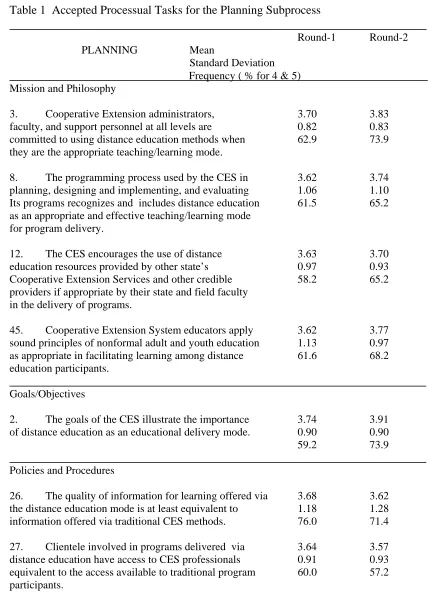
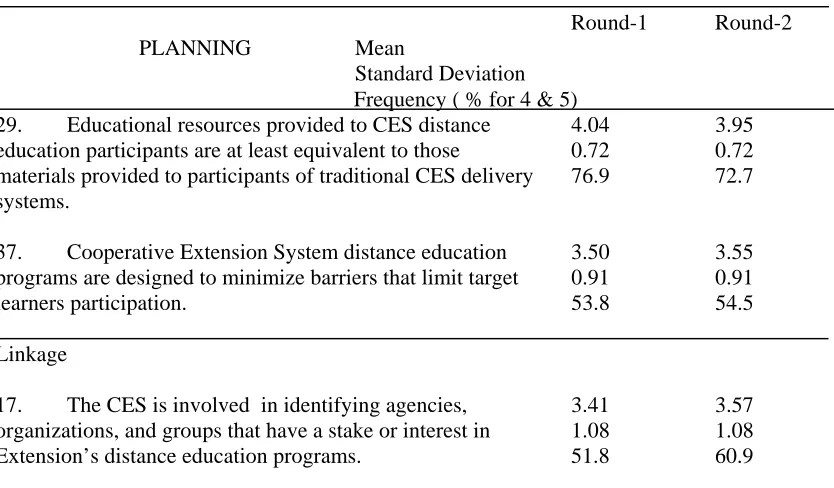
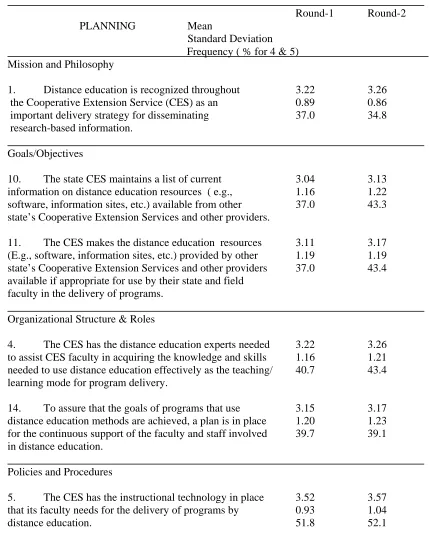
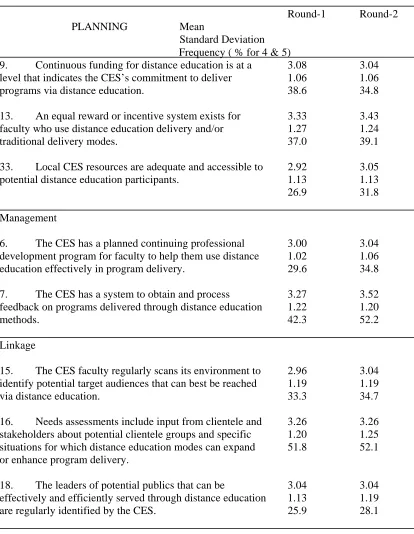
The questionnaire contained forty-six processual tasks which were placed on a
five point Likert-type scale. A processual task was considered accepted when it met both
critical and consensual criteria in the second round. Those processual tasks that had a
mean score of 3.5 or higher as rated by the panel of experts were considered critical for
programming in Extension nonformal distance education programs. Those processual
the experts rated four and five were considered for inclusion in the adapted model. The
final panel of experts accepted twenty-one of the forty-six processual tasks and rejected
twenty-five.
The major findings of this study led to these conclusions: (1) The conceptual
programming model provides a framework that guides the programming efforts of the
Cooperative Extension Services administration, faculty, and field personnel; (2) The
mission and goals of the organization need to be reexamined to determine whether they
need to be revised in order to accent the use of distance education as a delivery mode for
planned programs; (3) Extension needs to have a dynamic training program that focuses
on helping keep state and field faculty abreast of the emerging delivery technologies and
the use of the conceptual programming model; (4) Distance education delivery requires
the involvement of audiences and other relevant stakeholders that may not have been
involved with Extension programs in the past; (5) Cooperative Extension must commit
and make available the resources for support of programs delivered via the distance
SERVICE PROGRAMS DELIVERED VIA DISTANCE EDUCATION: A NATIONAL DELPHI STUDY
BY
KENNETH NEIL MCCASKILL
A dissertation submitted to the Graduate Faculty of North Carolina State University
in partial fulfillment of the requirements for the Degree of
Doctor of Education
DEPARTMENT OF ADULT AND COMMUNITY COLLEGE EDUCATION
Raleigh
2004
APPROVED BY:
Co-Chairman of the Advisory Co-Chairman of the Advisory
BIOGRAPHY
Kenneth Neil McCaskill was born in Pinehurst, North Carolina on December 26, 1955,
son of John Henry and Sarah Catherine McCaskill. He is a graduate of Pinecrest High
School and received his B.S. in Agronomy from North Carolina State University in 1978.
Selected to received a Philip Morris Fellowship he returned to North Carolina State
University where he received his Master of Crop Science degree in 1988.
His career with the Cooperative Extension Service began in 1978 when he was
appointed Assistant Agriculture Extension Agent in Macon County North Carolina.
Kenneth moved to Jackson County in 1982 as Associate Extension Agent, Agriculture
where he was promoted to County Director in 1988. He transferred to Macon County as
County Extension Director in 1993 and assumed Administrative duties in Clay County in
1998. Currently he is serving as County Director in these two counties and Area Burley
ACKNOWLEDGMENTS
I would like to express my most sincere appreciation to those people who have
encouraged and inspired me for their efforts contributing to this study in a variety of
ways. Specifically I would like to thank Drs. E. J. Boone and John M. Pettitt,
Co-Chairmen of the Advisory Committee, for their continual advice and encouragement.
Their continuous guidance, understanding, and patience are greatly appreciated.
Appreciation is also extended to the other members of the Advisory Committee,
Drs. Richard T. Liles, R. David Mustian and Bernadette Watts for their advice and
continual support throughout the study and to Dr. Michael Carter who represented the
Graduate School. My sincere thanks to the administration of Cooperative Extension in
North Carolina for the study leave and support of this study.
Lastly, a very special thank you to my family who stood by me during the ups and
downs during the completion of this study. A specials thanks to my wife, Susan, who
served as the encourager, and brought patience, stability, and calm into my life during the
turbulent times and also my son Brett for his understanding. To my mother, who instilled
TABLE OF CONTENTS
Page
LIST OF TABLES...vi
LIST OF FIGURES...vii
CHAPTER 1...1
Introduction...1
Background of the Problem and need for Resolution...1
Purpose of this Study...3
The Statement of the Problem...3
Limitations of the Study...4
Definition of Terms...5
CHAPTER 2...9
Conceptual Framework And Review of Literature Related to The Model Adaptation and Building Process...9
Concepts...9
Model-building...9
Problem Solving...11
Programming...15
Program...22
Distance Education...23
Systems Theory...27
Summary of Concepts...30
Conceptual Framework of the Study...31
Review of Related Literature...36
Distance Learning...37
Distance Learning in Extension...42
Programming...46
Summary of the Chapter...53
CHAPTER 3...56
Methodology...56
The Research Design...56
Panel of Experts and Data Collection...65
Analysis of Data...65
CHAPTER 4...67
Findings...67
Results of the Delphi Technique...68
Planning...68
Design and Implementation...80
Evaluation and Accountability...85
Cronbach’s alpha Coefficients...87
Summary of Survey Results...88
Summary...89
CHAPTER 5 ...93
Conclusions, Implications, and Recommendations...93
Introduction...93
Conclusions and Implications...94
Recommendations...97
LIST OF REFERENCES...98
APPENDICES...108
Appendix A. Tentative Model...108
Appendix B. Preliminary Panel of Experts...118
Appendix C. Round-1 Questionnaire...121
Appendix D. Final Panel Of Experts...131
Appendix E. Round-2 Questionnaire...138
LIST OF TABLES
Table Page
Table 1. Accepted Processual tasks for the Planning Subprocess...75
Table 2. Rejected Processual tasks for the Planning Subprocess...77
Table 3. Accepted Processual tasks for the Design and Implementation Subprocess...83
Table 4. Rejected Processual tasks for the Design and Implementation Subprocess...84
Table 5. Accepted Processual tasks for the Evaluation and Accountability Subprocess...86
Table 6. Rejected Processual tasks for the Evaluation and Accountability Subprocess...86
LIST OF FIGURES
Figure Page
Introduction
Background of the Problem and Need for Resolution
Hayes (1990) discusses the growing need for education to meet the demands of a
rapidly changing workplace and broader societal changes. This critical need is resulting in
greater emphasis on providing education to people in their homes and workplaces.
Distance education has become more important as a delivery mode for providing learning
opportunities in our modern society. Saba and Twitchell (1988) describe the purpose of
distance education as follows: to eliminate time and distance constraints in the delivery
and utilization of educational services, to provide access to educational services to those
unable to participate in conventional learning, and to provide continuing education to
adults who wish to acquire new skills and knowledge. The society in which we live has
become an audio, visual, and computer world where new options for teaching are evolving
and new light is being shed on the learning process by research. Wolcott (1993) points out
that planning instruction for non-traditional settings and non-traditional learners are
uncharted territory. She further indicates that there is little information about how teachers
design instruction for learning situations that represent a significant change from the
traditional instructional settings to which they are accustomed. Donaldson (1990)
indicates that educators’ selection of delivery methodologies should not be limited to past
patterns or to traditional delivery systems.
With the rapid development of interactive television networks and computer
increased interest in the expansion of distance education. This increasing interest in this
rapidly expanding approach to education has led to the need to adapt a programming
model for nonformal education that will accent the use of distance education delivery of
planned programs. This model could be extremely useful in helping educators discover
how to incorporate distance education in planning, designing and implementing, and
evaluating and accounting for planned programs.
A review of the literature shows that scholars and practitioners of distance
education are at odds over the standards and strategies for planning, designing and
implementing, and evaluating programs that use distance education methodologies in
delivering planned programs. A number of studies have indicated that distance education
delivery requires a more rigorous and systematic approach to development (Willis,1993).
Others indicated a more limited role for instructors in designing distance delivered
instruction than in the design of instruction to be delivered using traditional delivery
methods. Downing (1984) noted potential problems in removing the instructor from the
design and development process such as loss of ownership for the program.
Planned programs delivered via the distance education mode, where the learners
participate voluntarily and are not seeking credentials or degrees, may increase the
number of participating learners. Further review of the literature indicates that there are
few studies on the development of new programming models or the adaptation and
validation of current programming models that accent the use of distance education
Purpose of Study
This research focuses on adapting a conceptual programming model that includes
planning, designing and implementing, and evaluating and accounting for adult education
programs that incorporate the use of distance education as a delivery mode. In order to
accomplish this purpose, Boone’s conceptual programming model became the object of
the inquiry that guided this dissertation. The conceptual programming model is widely
used in the Cooperative Extension Service. Developed and validated during the period of
1960-85, the conceptual programming model references distance education, but does not
highlight the distance education mode as a major delivery strategy for planned programs.
Statement of Problem
The Cooperative Extension Service is one of the major providers of education for
adults in the United States that focuses on the nonformal context. Extension was
established in the early1900's, and its primary mission was, and continues to be that of
disseminating practical research based information generated in Land Grant Universities,
to the people residing in each of the 50 states to enable them to improve the quality of
their lives. Extension has used distance education as a delivery mode from its outset,
beginning with flat media (newsletters, pamphlets and written correspondence materials)
and then moving into audio, video, and computer based delivery systems as these
technologies became available. Although these programs, delivered via the distance mode,
have benefitted millions of learners they have evolved through trial and error and the
programming experiences of Extension educators using traditional delivery methods. At
models for use by Extension educators that emphasize distance education as an important
part of the total programming process.
Because of the increasing central role that instructional technology is playing in
the packaging and delivery of planned programs to the total community, there is a critical
need to assess and modify programming processes used by organizations such as the
Cooperative Extension Service. The conceptual programming model that is the most
widely used programming process by the 50 state Cooperative Extension Services needs
to be adapted to include the philosophy and concepts of distance education as integral to
its planning, design and implementation, and evaluation and accountability subprocesses.
The adapted model could become the motivating and guiding focus for increasing
Extensionists’ understanding and use of distance education technologies to make their
programs and expertise accessible to larger numbers of people.
Limitations of the Study
The limitations of this study are:
1. The conceptual programming model was adapted through a consensus of opinions of a
selected panel of experts in nonformal distance education within the Land Grant
University System. Since experts from all fields of nonformal distance education were not
involved in adapting the conceptual programming model, its applicability may be limited.
2. A self administered mailed survey instrument was used to develop a consensus of
opinion among the panel of experts. Common problems associated with a mailed
(a) Respondent Bias - Inaccurate responses may be given due to the respondent's
attitudes, expectations, and feelings toward a given topic.
(b) Misinterpretation of survey questions may occur due to ambiguity in their
construction. Although a similar instrument has been used in prior research of formal
distance education and the instrument had been pretested through the use of a preliminary
panel of experts, there is always the possibility that misinterpretation of some questions
may occur.
3. Because the final panel of experts was drawn from selected state Cooperative Extension
Services personnel responsible for programming in their respective state, they may not
have been representative of the 50 state Cooperative Extension Services.
4. It is conceivable that the final panel selected, because of their position and
responsibilities for programming in their respective states, may not have possessed the
presumed level of knowledge about the conceptual programming model and distance
education necessary to provide reliable and valid responses.
5. The Delphi technique focuses on consensus. The process has no respondent/respondent
interaction and therefore differences of opinion among the respondents may have been
unintentionally subdued. This lack of personal interaction may have resulted in responses
that were not well thought out.
Definition of Terms
Conventional Education: The learner and the instructor are present in the same place and
time, usually in a classroom or laboratory setting. This form of education is also
referred to as traditional education.
Distance Education: All kinds of education where the learner and the instructor are
separated in place, or time, or both. Methods of communication to carry out the
educational transaction include print, broadcasting, telecommunication media,
correspondence instruction through the mail, audio recordings, video recordings,
computer, and various combinations or variations of these methods (Moore, 1989;
Barker, Frisbe, and Patrick, 1989).
Evaluation: The systematic application of social research procedures for assessing the
conceptualization and design, implementation, and utility of social intervention
programs (Rossi & Freeman, 1993).
Adult Education: Education of adults as defined in Brookfield (1986, p.5) “as courses and
other educational activities, organized by a teacher or sponsoring agency, and
taken by persons beyond compulsory school age”. This encompasses the vast
majority of adult learning that takes place in the community. Learning may be
deliberate or fortuitous, but is always personally meaningful to the adult learner.
The learner has complete control over what he or she will learn and how and
where the learning will occur (Galbraith, 1990, p.9). Opportunities outside of a
traditional educational setting through which individuals can acquire norms,
values, information, knowledge, expectations, skills, and can learn roles. (Charner
Linkage: The “blending of two or more systems to achieve a common purpose” (Boone,
1985, p.15).
Model: “A symbolic representation of the various aspects of a complex event or situation,
and their interrelationships” (Lippitt, 1973, p.2). In educational programming a
model is “A representation of a particular situation, for use in structuring an attack
on new questions and old questions that still need satisfactory answers or
solutions”( Boone, 1985, p.49).
Model-Building: “The process of putting together symbols according to certain rules to
form a structure which corresponds to a real-world system under study” (Lippitt,
1973, p.30). Getzels (1968) lists the following criteria for developing a conceptual
model; (a) the model must provide a set of integrated concepts and relations
capable not only of answering questions already asked, but posing questions that
still need to be asked, (b) the concepts and relations must be operational in that
they give direction to understanding and simultaneously provide blueprints for
investigation, and (c) the model must be capable of handling as many of the
commonplace or familiar issues as possible, within a single set of concepts and
relations.
Nonformal Adult Education: Educational settings in which learners participate
voluntarily and are not specifically seeking credentials or degrees. The adult
learner maintains some degree of control over their learning needs as well as when,
Panel of Experts: A group of selected professionals that because of position or
responsibility are presumed to be knowledgeable about nonformal distance
education and programming in the Cooperative Extension Service. Reeves and
Jaunch (1978) defined "expert" as anyone who could contribute relevant inputs.
Program: A plan of activity that is carefully planned and carried out to achieve specific
goals and objectives.
Programming: The individual and collaborative efforts of the adult education
organization, educators, and learners in planning, designing, implementing,
evaluating, and accounting for educational programs (Boone, 1985).
Program Evaluation: Judgements made about planned programs based on established
criteria and known, observable evidence (Boone, 1985).
Stakeholders: “Individuals or organizations directly or indirectly affected by the
implementation and results of social programs” (Rossi & Freeman, 1993, p.2).
System: “An entity, conceptual or physical, that consists of interrelated parts” (Boone,
1985, p.16).
Validation: When an item in the model meets the critical and consensual criteria
CHAPTER 2
Conceptual Framework and Review of Literature Related to the Model Adaptation and
Building Process in Nonformal Distance Education
To adapt an existing programming model in adult education that will accent and
include a focus on distance education, several concepts were used to provide a rationale
and framework for this inquiry. These concepts included; (a) model-building, (b) problem
solving, (c) programming, (d) program, (e) distance education, and (f) systems theory. The
first part of this chapter defines each of these concepts. The second part of this chapter
presents the conceptual frame formulated to guide the study. The third section is a review
of related literature. The final section includes the research questions that are the object of
the dissertation research.
Concepts
Model-building
The concept of model building is important to understanding what constitutes a
model. O’Sullivan and Rassel (1989, p.2) defined a model as a “representation of reality
that delineates certain aspects of the real world as being relevant to the problem under
investigation and makes explicit the relationships among these aspects.” Webster (1970,
p.913) defines a model as; “a preliminary representation of something, serving as the plan
from which the final, usually larger, object is to be constructed.”
Lippitt (1973, p.2) described a model as “a representation of the aspects of a
should be contained within a change model; (a) it should clearly define the target of the
change and the goal, (b) it should be simple and easily understood and facilitate
communication between the parties involved in the change situation, and (c) it should be
useful as a guide for those in real life situations to devise a course of action. An
educational model, such as the conceptual programming model, should be intellectually
constructed to represent the relevant properties of a chosen aspect of reality and also allow
one to understand the relevant aspects of a complex situation without having to deal with
all of the minute details of the situation.
Stogdill (1970) indicated that we cannot adequately claim to understand a set of
events until we have acquired a theory or model that adequately accounts for the
operational and structural characteristics of the system being observed. He goes on to
outline skills that a student of model building needs in order to become proficient at
describing these characteristics. He states that the student must be able to observe and
analyze a system of real events in order to isolate and determine the variables operating
within the system. He must be able to define in the proper terms each variable or
dimension so that others can identify the exact variable or dimension described, and the
model builder must have skills at perceiving or determining the relationships between the
various dimensions. Stogdill (1970) indicates that not only the structural components of
the system need to be identified, but operational characteristics must also be identified as
well. This set of defined concepts as well as statements delineating the relationship
between the concepts become the model builder’s conceptualization of the model of the
The best way to learn the model building process is by actually building models
according to Lave and March (1975). They suggest that the model builder use the
following procedures:
(a) observe facts, (b) look at the facts as though they were the end result of some
unknown process or model, then speculate about processes that might have
produced such a result, (c) deduce other results (implications / consequences /
predictions) from the model, (d) ask yourself whether these other implications are
true and produce new models if necessary (Lave & March 1975, pp.19-20).
Lave and March (1975) go on to purport that in order to evaluate a model it must
be testable. They indicate that models should make assertions that can be either true or
false and that good models should be simple, produce a number of predictions per
assumption, and also produce some interesting implications that are surprising and are not
immediately obvious from those assumptions.
Problem Solving
In order to be successful in constructing a model, utilizing the procedures
described by Lave and March(1975), a structure helping to organize and guide the inquiry
is required. Zetterburg (1962) provides five steps of problem solving which are useful in
the process of adapting a current model and model building and can serve as a guide for
the process. These steps include; (a) making an exploratory inquiry, (b) achieving a
scholarly understanding, (c) scholarly confrontation, (d) calculation of solutions and, (e)
receiving practical advice. Each of these steps in the adapted process is discussed in the
Making an exploratory inquiry
The first step in this process is making an exploratory inquiry. The researcher must
discover the details relating to the process or problem under investigation by a thorough
study of relevant literature, talking with persons who are actively engaged in the program
or process, and actually observing the program or process in operation. Exploratory
inquiry also may include a research project which aims to identify the structural
components of the program, operational characteristics of the program, the participants in
the program, as well as the relationships among and between these identifiable elements.
This step was used in order to identify those elements that related to the problem and to
observe facts as suggested by Lave and March (1975). During this step the researcher
collects as much information as possible concerning the program or process.
Achieving a scholarly understanding
Lave and March (1975) suggested that these facts be examined as though they
were the end result of some unknown process or model, and then speculate about the
processes that might have produced such a result. Zetterburg’s second step, achieving a
scholarly understanding, is well suited to guide this phase of the model adaptation and
building process. In order to achieve scholarly understanding the researcher must translate
the problem or process into scientific terms and then formulate corresponding theoretical
problems. All of the information that has been gathered during the exploratory inquiry
conducted earlier needs to be analyzed to help the researcher understand the complexity of
the problem or process. During this analytical phase, the process of gathering information
stakeholders involved with the process or problem under investigation continues. The
researcher should continually seek clarification of any aspects or information relating to
the process or problem that is not clear from knowledgeable individuals. During this stage
of the investigation, the researcher should be able to grasp the general concept of the
problem or process for which the model is to be developed/adapted and also should be
able to identify key variables.
Scholarly confrontation
Scholarly confrontation, which is related in general terms to scientific discipline,
allows the researcher to clarify his understanding of the problem or process. The
processual tasks that are critical to the model can be drawn from the first two steps,
making an exploratory inquiry and achieving a scholarly understanding, of the process
where information is collected, analyzed, and organized utilizing theories. After this has
been done, these processual tasks are tested by examining them in a new and different
way. One method that can accomplish this is to present those processual tasks identified
for the adapted model to a panel of selected experts in order to obtain their input and
opinions. This panel of experts can question, argue, reject, or make any necessary changes
or adjustments to the processual tasks or to the adapted model.
Calculation of solutions
During this phase the adapted model is refined based on the feedback and
suggestions received from the panel of experts during scholarly confrontation. This step
involves restatement of the elements/processual tasks, addition, deletion, or combination
This step in the model adaptation/building process also helps to deduce other results,
implications, consequences, and predictions as suggested by Lave and March (1975) as
the third procedure useful to the model builder. Once these modifications and adjustments
are made to the proposed solution, the next step is to present the solution or the tentative
model in this case to the final panel of experts or relevant parties for practical advice.
Receiving practical advice
The fifth and final step of the model adaptation/building process is receiving
practical advice. The researcher receives advice from the final panel of experts on how to
proceed and on what complications or consequences might occur. During this phase the
researcher makes changes, additions, deletions, and corrections to the model. This fifth
and final step accomplishes the last procedure suggested by Lave and March (1975), that
of examining the implications and producing new models when necessary.
In summary, a model is a simplified representation of some more complex
phenomena. The model, such as the conceptual programming model, consists of the
critical processual tasks and ideas gained from review of literature, observation of the
process or phenomena under investigation, the researchers experience, and dialogue with
scholars and professionals in the field of study. The elements/processual tasks in the
model are arranged in a concise and logical order which allows one to understand some
complex phenomena with little difficulty. Validation of a model can be achieved by
several methods such as applying the model to a real-life situation or acceptance by
experts in the field of study. These experts can confirm that the model actually contains
can be applied in real-life situations to achieve the desired goals. These experts can also
confirm that the model is useful under a wide range of situations.
This model building process as described by Lave and March (1975) and the steps
proposed by Zetterburg (1962) are critical to adapting the conceptual programming model
to accent and include distance education as a part of its three subprocesses; planning,
design and implementation, and evaluation and accountability. The adapted model
resulting from this inquiry will serve as a guide accenting the use of distance education
concepts and methodology in the planning and implementation of planned programs that
target learner systems.
Programming
The second concept related to this inquiry is programming. According to Boone
(1985) programming includes the individual and collaborative efforts of the adult
education organization, the adult educators, and the learners in planning, designing and
implementing, and evaluating and accounting for planned educational programs. He goes
on to state that programming is a proactive process that is futuristic. It constitutes a system
that links the adult education organization, and the learner groups and systems in a
collaborative process to identify learning needs of the learner groups and systems, analyze
and assess identified needs, design, market, and implement educational programs which
address those needs, and to determine the extent to which the program has met those
identified needs through the collection and reporting of evidence of program impacts.
Burnham (1988) and Albrecht and Bardsley (1993) report planning patterns that
involvement and collaboration among planners, learners, and instructors. Steps in
programming include; identifying needs or problems, originating program ideas and
establishing objectives, designing programs, ensuring participation, securing resources,
and evaluating and revising programs. Albrecht and Bardsley (1993) also indicate that
programming provides a process and framework for systematically planning, developing,
and adapting instruction based on identifiable learner needs and content requirements.
This process is essential in distance education where the instructor and learners may share
limited common background and typically have minimal face to face contact. Content may
also have to be considered more closely as some content areas lend themselves to distance
delivery more readily, such as those which require little or no laboratory or hands on
motor skill type activity, while others that do require hands on or laboratory activity may
require more extensive adaptation.
Boyle (1981) describes program development as a deliberate series of actions and
decisions which involve; the development of an organizational structure for analyzing,
interpreting, and making decisions about problems or needs that should be changed or
improved, the study and analysis of the community and its people, establishment of
priorities relating to the identified problems or needs, identified outcomes to be attained
by the program with people and communities, developing a program design which
includes appropriate learning experiences, implementation of a plan of action that
provides those learning experiences, development of appropriate accountability
Willis (1993) in his description of the instructional development process for
distance education, emphasizes this same general process but, includes an additional stage
which he calls revision. He used the earlier evaluation stage, consisting of both formative
evaluation and summative evaluation as a spring board for this stage. Formative
evaluation can be used according to Eastmond (1994) to revise the program as the course
is being developed and implemented, while the summative evaluation provides a data base
for program revision and future planning.
From the writings of these authors a few of the common essential features of the
programming process can be deduced. These features included; (a) programming directed
toward specific changes in behavior of a learner, learner group, or system based on
identified needs or problems, (b) programming is a sequential set of deliberate and
systematic steps designed by educators or specialists to achieve the specified changes in
behavior, and (c) evaluation and demonstrating accountability to the various stakeholders
are an integral part of the programming process
Boone’s (1985) conceptualization of the programming process includes three
interrelated and connected subprocesses; (a) planning, (b) design and implementation, and
(c) evaluation and accountability. To understand how to adapt these subprocesses to
accent distance education it is important examine the subprocesses.
Planning
Planning is defined by Boone (1985, p.82) as “a rational, continuing sequence of
precise educational activities carried out by adult educators, operating from an
with learners and their leaders in collaborative identification, assessment, and analysis of
their educational needs.” He identifies two distinct dimensions of this stage of the
programming process that are encompassed within this subprocess. These are the
organization and its renewal process and linking the organization to its publics.
Boone (1985) asserts that organizational renewal requires that the organization be
continually involved in reexamining the needs of its publics and its own function,
structure, and processes as related to its mission, philosophy, and objectives. The adult
education organization and its target publics must be viewed as dynamic and changing.
Reexaminations and adjustments must continually be made in order to keep its functions,
structure, and programs relevant to its publics. To accomplish this end, the educator must
understand and be committed to the mission, or the parameters within which the
organization is to function, and the philosophy, or belief that people adjust to change more
easily in a democratic environment in which expression, direction, and
self-improvement is supported and encouraged. Guided by its mission and goals the adult
education organization engages in a continuing scan of its external environment to stay
abreast of social, economic, political, and technological forces that are operative in the
environment and to identify and maintain linkages with its publics. The goal is to involve
its publics in collaborative needs identification and analysis.
Design and implementation
The second subprocess of the conceptual programming process is design and
implementation. It is at this stage that the adult educator translates the information gained
publics, into meaningful and functional designs and devises effective instructional
strategies for their implementation. Boone (1985, p.130) describes three interrelated
dimensions; “(a) the planned program, (b) plans of action, and (c) action strategies for
implementing plans of action and the planned program.” Boone (1985, pp.130-131)
describes these dimensions as follows:
The planned program is a master prospectus or plan for change toward
which adult educators focus their efforts. The planned program consists of; (a) a
statement of macro needs, (b) a statement of macro objectives that are keyed to the
macro needs, (c) specification of general educational strategies for achieving the
macro objectives, and (d) specification of macro outcomes of the planned program.
Plans of action, which are short-range in nature and are logically
sequenced, include specific teaching-learning strategies designed to guide the adult
educator in fulfilling learners’ needs and attaining the objectives contained in the
long range planned program.
Implementation of a specific plan of action entails action strategies in
which the adult educator engages to assure that the plan is carried through to
successful completion. These action strategies are; (a) marketing, (b) procuring,
developing, and using the necessary, available resources, both human and material,
(c) monitoring ongoing teaching-learning transactions, (d) reinforcing learners and
teachers, and (e) using feedback to evaluate and, if needed, to revise teaching
strategies or learner experiences, or both, to attain maximum behavioral change in
Boone (1985) indicates that the adult educator at this stage must be creative.
Decisions are made about learning strategies to be used in delivering programs. Areas of
particular concern in using distance education to deliver programs would be specifying
constraints (i.e., limitations), exploring alternative solutions, selecting and implementing
the “best” solution, and designing, developing, and implementing this instruction.
Decisions about the use of distance education methodologies in delivering instruction as a
part of the planned program and subsequent plans of action are very critical at this stage of
programming.
Evaluation and accountability
The final stage and subprocess in the programming process identified is evaluation
and accountability. In order to function effectively and to remain relevant to the target
publics, the deliverers of nonformal programs delivered via the distance mode, such as
Cooperative Extension, must continuously engage in an active evaluation and
accountability process. Through active evaluation, both formative and summative, the
adult educator can make revisions in delivery strategies in order to increase effectiveness
of current programs, determine the effectiveness of completed programs, and assessing the
outcomes achieved in relation to the defined goals of the planned program. This stage can
also be used to determine if available resources are being used efficiently, and to provide
data on which to base revisions in future program offerings. The information gained and
the data collected on efficiency, effectiveness, and the extent to which the program has
achieved the desired outcomes can also be utilized in accounting to the target publics, the
According to Boone (1985, p.172), evaluation should answer questions such as
“how program inputs, context, and processes relate to program outputs; how efficient a
program is; how suitable it is; and its overall importance.” In order to be useful evaluation
must be carried on throughout the implementation of the total programming process.
These evaluation and accountability findings can then be used to make program revisions
during the current program as well as in future programs. Also, the findings may be
utilized in the organization renewal process and for communicating the value and worth of
the program to various stakeholders. This final stage, evaluation, was utilized by the
investigator to organize and structure processual tasks identified and included in the final
section of the inquiry.
In summary, the nonformal distance education programming process is made up of
three essential interrelated subprocesses which include; planning, design and
implementation, and evaluation and accountability. Adult educators engaged in distance
education need to review the organizational context from within which they function,
establish linkages with various stakeholders and learner groups, and systematically
identify and analyze the target group’s needs. These analyzed needs should be translated
into hierarchical needs and objectives, sequenced into incremental plans of action, and
then formulated into educational strategies for implementation. Evaluation and
accountability activities should be carried on throughout the programming process. Data
collected can be used to revise current and future programming, for organizational
renewal purposes, as well as to account to the various stakeholder groups, parent
Program
The most basic definition of program is a plan or procedure for dealing with some
matter. This definition leads to the conclusion that the matter has been identified and it is
to be purposefully dealt with, a procedure or orderly response has been devised, and when
followed through, a resolution or end will be reached. Verner (1964) discussed
educational programs in terms of a series of learning experiences designed to achieve, in a
predetermined period of time, certain educational objectives. Brookfield (1986), in his
review of the concept of program, indicated that educational programs have these same
three main features; purpose, order, and finiteness. First, a program has purpose in that it
is designed in such a manner as to bring about a specific change in learner behavior.
Second, a program has order in that the planned learner activities are sequenced so that
they are directional leading toward the behavioral change or program objectives. Third, a
program has finiteness in that it is coordinated and organized by educators in such a way
that it has a clearly identifiable beginning and ending point.
According to Boyle (1981) a program is made up of all of the programming
activities implemented by the learner and the educator. Boyle and Jahns (1970) had earlier
indicated that some of these activities were specifically instructional while others were
directed primarily toward maintaining the viability of the providing agency.
Many agencies and organizations offer a wide variety of programs that are fully or
partially delivered via the distance mode. Some of these are certificate, diploma, or degree
programs while others are short courses that meet the need of specific target audiences
which deliver learning activities that are primarily designed to provide learning activities
that carry no academic credit.
Although many programs delivered via the distance mode are described in the
literature in terms of the technology or a communication channel utilized to bring about
the teaching learning transaction, the concept of program is much broader. Brookfield
(1986) described the educational program in terms of all of the programming activities
that took place in achieving a particular educational objective. This included such diverse
activities as survey research, needs identification, conceptual analysis, committee
management, prioritizing tasks, instructional design, classroom management, counseling,
budgeting, administration, evaluation, public relations, and staff training. The technology
is seen as simply the channel for providing the instructor-learner, content-learner, and
learner-learner interaction within the program.
The primary purpose of programs delivered via the distance mode are to provide
learning activities and deliver educational programs, which are based on identified learner
needs, in such a manner as to overcome barriers such as time and place. These programs
may use a combination of delivery technologies such as printed materials, interactive
television, computer communication, radio, and others as communication channels for the
program delivery. Preparation and instructor training in the use of these media channels to
effectively deliver the program should be provided for in the programming process.
Distance Education
Organizations that deliver nonformal distance education do so in order to
institution. The institutional objectives of these organizations include; (a) to provide
nonformal education which is relevant and easily accessible, (b) to meet the educational
needs of the individual and the community within the institution’s service area, (c) to
bring about change in a target learner’s knowledge, attitudes, skills, and aspirations, (d) to
provide nonformal education to learners at convenient times and locations, and (e) to
extend the educational reach of the institution. The distance delivery mode is especially
suited to accomplishment of these goals.
Since by definition the teacher and learner involved in programs delivered via the
distance mode are separated in time and space or both, the teaching-learning transaction
must be carried out utilizing various media and communication technology. Collaboration
between the instructors, who know the subject matter, instructional designers, and media
and technology specialists are essential for production of quality programs delivered via
the distance mode. The content of the program may be delivered through surface or
electronic mailings, interactive television, communication networks, computers, or several
of these media in combination. This change in delivery system merits considerable
consideration in the planning of nonformal programs delivered via the distance mode.
Moore (1989) suggests that distance education is no longer an independent, isolated form
of learning but, instead, begins to approach the interactive ideal of an educational
experience and is well suited to the achievement of the goals and objectives of the
deliverers of nonformal education.
Garrison (1990) has shown that interaction increases the learner’s motivation and
that the distance educator must consider. These types of interaction are described by
Moore (1989) as; learner-content, learner-instructor, and learner-learner interaction.
Some learning activities are solely learner-content interactive. These are one way
communications that are intended to help distance learners in their study of the subject.
Experts in subject matter areas, sometimes with the assistance of an instructional designer,
prepare materials that can be used in a self-directed learning activity and no other
professional teaching expertise is provided.
Another type of interaction that Moore (1989) discusses is between the learner and
instructor. This learner-instructor interaction is considered essential by many educators
and desirable by many learners. This type of interaction minimizes the ambiguities,
misconceptions, and frustrations encountered by many learners in understanding certain
materials and concepts presented during instruction by allowing learners to communicate
with instructors for help. Moore goes on to point out that interaction with content alone,
no matter how well done, leaves that learner vulnerable at the point of application.
According to Moore (1989, p.4) the learner may not know “enough about the subject to be
sure that they are; (a) applying it correctly, (b) applying it intensively or extensively as
possible or desirable, or (c) aware of all the potential areas of application.”
The third form of interaction, learner-learner interaction, will be the challenge to
distance educators in their planning and practice according to Moore (1989). This is
inter-learner interaction that takes place between one inter-learner and other inter-learners, whether alone
or in group settings, with or without the presence of a real-time instructor. This interaction
program in which this interaction might be essential could be, for example, when teaching
skills in group process or teamwork.
In order to provide for these three types of learner interactions, the deliverer of
nonformal education must plan for the use of appropriate media and communication
technology to deliver learning activities. This could encompass, with some programs,
written materials and instructor feedback through surface mail. In other situations, and
with varied subject matter, it could occur through the use of more sophisticated
technology such as interactive television, computer conferencing, electronic mail, or a
combination of several of these communication technologies.
Moore (1989a) indicates that the main weakness of many programs delivered via
the distance mode are their commitment to utilize only one type of communication
medium. Whether this is print, radio, interactive television, or another medium, it is
probable that only one type of interaction is permitted or done well. Distance educators
should become familiar with the types of media and, through collaborative planning
efforts with media specialists, select the appropriate combinations of media to enhance the
teaching-learning process.
Most of the participants in nonformal distance learning programs are adults. It is
important for the deliverers of these programs as educators to know the characteristics of
these adult learners, their learning styles, and their reasons for participating in the
nonformal programs delivered via the distance mode. By throughly understanding the
targeted audience, the educator can plan and deliver programs that are relevant, more
the learning styles of the participants. Although it is difficult to address the learning styles
of all participants, especially when groups may be large, a combination of teaching
strategies may be included that address most of the participant’s learning styles. This
knowledge and awareness will also allow distance educators to plan and vary their
presentations according to learner feedback during the educational transaction.
In summary, the provider of nonformal distance education must plan within the
scope of the mission and philosophy of their organization. Adult educators, who use
distance education in planning and delivering planned programs, in order to remain
effective and relevant, must plan for meaningful interaction between learners and subject
content, instructors and learners, and learners and learners. They should consider the
characteristics of the learners and plan and revise teaching-learning strategies in order to
create and maintain learner interest and subject relevance. This will require that the
educator utilize a combination of teaching-learning strategies as well as a combination of
communication media and delivery technologies in order to deliver quality programs via
the distance mode.
Systems Theory
Parson (1977) explains the concept of systems and stresses the importance of
interdependency with the environment. Earlier, Griffiths (1964, p.116) describes “an open
system is related to and exchanges matter with its environment, while a closed system is
not related to nor does it exchange matter with its environment.” In this inquiry the ability
to view the system as a whole allowed the investigator to view distance education as a
In this study the Cooperative Extension System, as the provider organization, is
viewed as a system. The programming process that it uses to achieve its mission and
facilitate change is also a system. These two systems are complex and consist of
interrelated subsystems such as; the target learners, the instructors, the administration, the
delivery technology, and the organization. In order to apply systems theory to nonformal
education each of these subsystems was treated as an independent entity, while the
concept of nonformal distance education was considered as a whole.
Application of systems analysis to distance education could assist educators in
accomplishing the following things according to Saba and Twitchell (1988, p.12);
- understand the comprehensive structure of distance education.
- identify critical functions of distance education.
- predict and control the intertwined relationships among the functions of a
distance education system.
- determine the optimal performance of a distance system for serving its clients
(learners, parents, etc.).
- determine the impact of environmental changes on a distance education system
and the impact of the system’s performance on its environment.
- design more effective and efficient distance education systems.
Lippitt (1982, p. 32) defines a human or social system as a “stable pattern of
interaction between interdependent social units.” Nonformal distance education and the
parent or delivering organizations are, according to this definition, social systems.
the organization’s educational objectives are met. According to Boone (1985, pp.93-94)
“new learning or behavior that is facilitated by an organization’s educational endeavors
can best be reinforced by the social system of which the individual is a part.” This
reinforcement is applicable not only to the learner and the social system to which that
individual belongs, but to the stakeholders, the instructors, the administrators, and to those
social systems to which they belong as a subsystem of the distance education system.
Lippitt (1982) suggests that the systems approach allows for the multi-disciplinary
problem solving approach to solving real world problems. This approach allows the adult
educator to have a better perspective of the situation and to offer solutions that are more
likely to lead to a positive resolution of the problem or issue. It is important then that
nonformal distance education remain an open system as described by Griffiths (1964) in
order to accommodate the rapidly changing technologies available for communication and
delivery and in order to deal with continuous changes in the economic, political and
cultural factors within the environment in which the programs delivered via traditional
education modes or the distance education mode exist.
Adult educators who use the social systems approach are able to design a program
that better addresses the needs of the target publics. They are clear on the relationships of
the various systems with which they interact. For example, if adult educators know, during
the planning stage, the current level of the target publics knowledge, they can design
learning activities that are sequential and build on that knowledge. If the available level of
technology for delivery is known then strategies can be developed that are appropriate for
Summary of Concepts
A model is a representation of some more complex phenomena which is utilized
by educators to help explain that phenomena. The model is composed of the processual
tasks that have been identified, by experience and observation, incorporating ideas and
inputs from professional and experts in the field, reviewing relevant literature and research
related to the field and by testing the model in actual field situations. When validated, a
model is considered useful if it proves to be applicable to many situations.
Programming consists of three distinct interrelated subprocesses which are
planning, design and implementation, and evaluation and accountability. Programming
consists of all of the deliberate activities engaged in by the adult education provider, from
the initial examination of the philosophy and mission of the educational organization all
the way through to the summative evaluation and revision of the program. This process is
aimed at bringing about positive changes in individuals and society and is designed to
meet the needs of the identified target public.
The planned program which is an integral part of the programming process is
composed of all of the programming activities engaged in by the learner and the educator.
The primary components of a program are; purpose, order, and finiteness. It has a reason
or set of objectives, a set of sequenced activities leading to achievement of those
objectives and specified outcomes.
Distance education is a descriptive concept that encompasses a spectrum of learner
focused activities in which the learner and instructor are separated in time or place, or
communication tool to deliver educational information and study materials between the
instructor and the learner and to provide for learner-content, learner-instructor, and
learner-learner interaction.
Systems theory provides a mechanism by which the educator can view distance
education as a whole or as a part of the conceptual programming process rather than as
individual, disconnected parts. The analysis of the programming process as a system with
distance education being viewed as an integral part allows the educator to determine the
level of interaction between the systems and to broaden his/her perspective of the
situation. This broadened perspective and increased knowledge about the programming
process and distance education allows the educator to arrive at better solutions that help to
achieve the goals and objectives of the planned program.
Conceptual Framework of the Study
This research was undertaken in an effort to adapt the conceptual programming
model to accent and include distance education methodologies as an integral part of the
model. The model serves as a guide for planning, designing and implementing, and
evaluating and accounting for new programs, as well as, for evaluating existing programs.
The conceptual programming model was developed by Boone (1985). It was
selected for three reasons. First, it is generic in nature and can be easily applied in a
variety of educational settings and second it is aimed at understanding and effecting
change in individuals and society. This was relevant to the study since the outcomes
sought through using the programming process is to facilitate and effect changes in
Next the programming model views system as an important concept. The conceptual
programming model (i.e. process) and its three interrelated subprocesses are displayed in
A CONCEPTUAL PROGRAMMING MODEL
Planning Design and Implementation
The organization Linking the Designing the Implementing the & its organization planned planned renewal process to its publics program program
Evaluation and Accountability
Measuring inputs and outputs Reporting to relevant publics
Program revision
Boone’s conceptual programming model as referred to earlier and displayed in
Figure 1 is the focus of this research. It is composed of three interrelated subprocesses;
(a) planning, (b) design and implementation, and (c) evaluation and accountability. These
subprocesses include a number of dimensions and related processual tasks.
As displayed in Figure 1 the planning subprocess includes two dimensions namely,
the organization and its renewal process and linking the organization to its publics.
Educators should be committed to the mission, philosophy, and objectives of the
organization and understand the roles and relationships established by the organizational
structure. To accent distance education as a critical means for delivering much of its
planned programs strong references must be made to the importance of distance education
as both a concept and delivery mode in the adult education organization statement of
mission, philosophy, goals, organizational structure, its management system, and its
programming process.
In order to effectively link the adult education organization to its publics, the
educator must understand the economic, social, cultural, political, and technological
environment in which it operates and the interaction of these forces on the organization’s
publics and their educational needs through continuous environmental scans. The adult
education organization identifies and maps its target publics, identifies their formal and
informal leaders, and engages these leaders in collaborative identification, assessment and
analysis of the educational needs of the target publics they represent. Failure to carry out
the planning subprocess, and to jump right into the design and implementation subprocess
The next subprocess in the conceptual programming model is design and
implementation. Three dimensions of this subprocess are; “(a) the planned program, (b)
plans of action, and (c) action strategies” (Boone, 1985, p.68). The planned program
focuses on the macro level needs identified and assessed in the planning subprocess,
macro objectives to be achieved, change strategies and macro outcomes sought in terms of
the targeted learner system. The planned program is the blueprint/prospectus that drives
the change effort of the adult education organization. It is in this blueprint for change that
recognition must be given to the use of distance education instructional design strategies.
The implementation of the planned program requires that the educator design incremental
plans of action that are connected to the attainment of the needs and objectives of the
targeted learner system defined in the planned program. It is very important that the use of
distance education methodologies be included in the plans of action.
The last subprocess of the conceptual programming model is evaluation and
accountability. Evaluation begins during the planning subprocess and continues
throughout the entire programming process. Formative evaluation is carried out as the
program is being developed in order to make changes that will assure that the program
remains focused on needs of the learners and the desired outcomes. This helps the
adult/distance educator to refocus efforts and rectify errors that are made in such areas as
mapping the target publics, or identifying needs prior to program implementation.
Summative evaluation is used to determine if program objectives have been achieved, to
revise the program for future delivery, and also for reporting outcomes to relevant
Accountability refers to the process of reporting efficiency of planned program
operation, primarily to the learners and leaders of the target public, the organization, the
funding sources, the profession, and, where appropriate, the governance body.
Communication is essential to accountability. Reporting the achievement of outcomes to
participants, funders, and the organization is imperative to the growth and renewal of the
organization. In order to increase educational efficiency, in this world of finite resources,
it is important to report to the profession those delivery modes and methods that work as
well as those that don’t.
In summary, the conceptual programming model constituted the conceptual
framework for this study. The three subprocesses and the processual tasks encompassed
within each of these subprocesses are the objects of the study in that their assessment and
possible alteration are critical to the integration of distance education into the
programming process.
This study was initiated because of the seemingly lack of emphasis on distance
education as a delivery mode in the conceptual programming model that is used by state
Cooperative Extension Services across the nation. The goal of this study was to adapt the
conceptual programming model to accent its inclusion of the distance education delivery
mode.
Review of Related Literature
In order to understand the need to modify and adapt the conceptual programming
model to accommodate distance education and its evolving instructional technologies, a
developed. This review serves to illuminate and help explain the conceptual programming
model displayed in Figure 1.
Distance Learning
Distance education is a dynamic and constantly changing delivery mode for
educational programs. According to Moore (1989a) the earliest form of distance teaching
was in medieval times utilizing the didactic text, in the early nineteenth century this was
advanced with the development of home study guides that accompanied the text. These
early programs in the form of correspondence courses and educational publications served
millions of distance learners. Hall (1990) described distance learning as a fast growing
instructional pattern worldwide. Saba and Twitchell (1988) delineated the purpose of
distance education as follows; to eliminate time and distance constraints in the delivery
and utilization of educational services, to provide educational services to those unable to
participate in conventional learning, and to provide continuing education to adults who
wish to acquire new skills and knowledge. Lauzon and Moore (1989) found that distance
education is no longer a marginal activity but is now seen as an essential means for
individuals to adapt to a changing world. They indicate that recent developments in
educational technology are facilitating the development of a fourth generation distance
education system knocking down the barriers of time and place.
Lauzon (1992) indicated that distance education design had been focused more on
the education design rather than the process of learning. His findings agree with those of
Garrison (1990) who found that little attention has been paid to the teaching learning
that education is a transactional process which is characterized by the exchange of ideas,
thoughts, and feelings between and among people, resulting in new ways of viewing or
relating to the world or in new ways of acting. Perhaps because of distance education’s
early origins in correspondence study, which has limited means of conducting dialogue
effectively and efficiently, more emphasis has been placed on structure rather than
creating an opportunity for interaction.
According to Gibson, Boelter, Boyce, and LeFebvre (1992) many barriers keep
people from participating in classes which include lack of time and money, inconvenient
scheduling or location of classes, and even lack of confidence. Cross and Jones (1977)
discovered similar barriers with the addition of accumulation of credits. Sullins, Hoerner,
and Whisnat (1989) found that rural citizens did not participate because of isolation,
cultural homogeneity, tradition, and lack of economies of size and scale. Sullins et. al.
(1989) were able to categorize the barriers that inhibit participation in distance learning.
These barriers fall into four categories which are described as; “situational” which
is associated with an individual’s family status, occupation, or social group, “institutional”
organizational policies that preclude participation, “dispositional” personal considerations
such as lack of confidence in ability, tired of being in school, or not enjoying studying,
and “policy” which is lack of legislative support and lack of public empathy. It was
pointed out that many of these barriers could be over come by changes in policies,
procedures, programs, or services. Distance education was reported as one method of
overcoming several of these barriers to participation in educational programs (Gibson et.
Self study educational programs aren't new, but what is new, according to Israel
and Ingram (1991), is using video tapes and workbooks to deliver educational programs.
They point out that there are barriers to participation in programs delivered via the
distance mode as in traditional delivery methods. These would include the amount of
travel to obtain workbooks and materials to participate, the availability of the necessary
hardware to participate, the educational level of the target audience, and competition for
time due to employment or other activities.
Ezell (1989) points out that with the convergence of communications technology,
which is to say one network capable of bringing voice, data, and video into the home,
office, and workplace, will be more powerful in spreading ideas and concepts around the