• 192 •
Jordan W. Smith is a visiting assistant professor in the Department of Forestry and Natural Resources at Purdue University.
Dorothy H. Anderson is a professor and the department head of the Department of Parks, Recreation and Tourism Management at North Carolina State University.
Mae A. Davenport is an associate professor in the Department of Forest Resources at the University of Minnesota.
Jessica E. Leahy is an associate professor in the School of Forest Resources at the University of Maine. Acknowledgment: This research was supported by funding from the U.S. Army Corps of Engineers and the USDI National Park Service through cooperative agreements with the Great Lakes Northern For-est CESU.
Please send correspondence to Jordan W. Smith, Department of Forestry and Natural Resources, Purdue University, West Lafayette, IN, [email protected]
Community Benefits From Managed Resource Areas
An Analysis of Construct Validity
Jordan W. Smith Purdue University
Dorothy H. Anderson North Carolina State University
Mae A. Davenport University of Minnesota
Jessica E. Leahy University of Maine
Abstract
This research develops a theoretically informed measurement instrument for assessing local community members’ perceptions of benefits that managed re-source areas provide to their communities. We suggest five distinct types of com-munity benefits dominate individuals’ perceptions. These comcom-munity benefits are ecological, economic, quality of life, physical and aesthetic, and social solidarity. We empirically tested the community benefits measurement instrument for con-struct validity with data collected from five samples of residents living adjacent to four managed resource areas.
The policies and management frameworks guiding the conservation of feder-ally managed natural resource areas are intended to ensure the continued produc-tion of desired benefits to individuals who value them. This philosophy is often explicit in policy and management objectives. For example, in 2003 the Bureau of Land Management issued a “statement of commitment to the American public” that specified a “plan for delivering benefits to the American people and their communities” (p. 1). Other federal land managing agencies, such as the National Park Service and the USDA Forest Service, have similar objectives requiring the explicit consideration of desired benefits in decision making (U.S. Department of Agriculture, 2010; U.S. Department of the Interior, 2011). By identifying and managing for desired benefits, resource managers ideally can build trust and sat-isfaction within local communities while simultaneously meeting other resource management needs such as species conservation or watershed protection (Ander-son, Davenport, Leahy, & Stein, 2008). Unfortunately, however, identifying and managing benefits effectively is a difficult task for resource managers, often re-quiring trade-offs and difficult value-laden decisions (Wyman & Stein, 2010). To compound issues, natural resource social science scholarship has not sufficiently developed a standardized evaluation tool through which resource managers can systematically identify the benefits resource users and local community members desire. A more formalized method of assessing desired benefits is warranted. The purpose of this paper was to present and test a psychometric measurement instru-ment intended to gauge individuals’ perceptions of the benefits communities de-sire located in close proximity to federally managed resource areas.
Theoretical Origins of the Community Benefits Measurement Instrument Natural resource social scientists have realized for some time that managed natural resource areas produce a host of benefits to individuals and local com-munities (Driver, 2008; Driver, Brown, & Peterson, 1991). The large majority of resource management scholarship, however, has focused almost exclusively on the benefits that individuals can obtain from managed resource areas. As a result, the presence of systematic research addressing the perceived benefits attained by local
communities is highly underrepresented as both a social scientific line of inquiry
and as a means of informing resource management decisions1 (Smith, Davenport, Anderson, & Leahy, 2011; Smith & Moore, 2011; Wyman & Stein, 2010).
The focus on benefits produced solely through on-site resource use is attribut-able to the historical development and interdependence of federal resource man-agement frameworks and resource manman-agement scholarship. The benefits-based management (BBM) framework, originally developed for leisure and recreation management, has heavily influenced the way academics and resource managers have conceptualized and identified desired benefits over the past 40 years (Driver, 2008). Under the BBM framework, a benefit is defined as a desired condition, an
1Of course, natural resource and recreation economists have a long history of estimating the
improved condition, or the prevention of an unwanted condition (Driver, 1996). Resource planners and managers first identify the benefits that resource users de-sire and subsequently take management actions that enable those benefits to be provided for.
The underlying purpose of the BBM framework is to ensure that resource man-agers define how their actions will impact those individuals dependent upon the resource (Driver, 1996, 2008). Given this, the process of identifying and managing for benefits can easily be extended to investigate the benefits accrued not only to individuals but also to local communities (Smith et al., 2011; Smith & Moore, 2011; Wyman & Stein, 2010). Community benefits therefore can best be defined as “benefits resulting from public land management that accrue to local residents living in communities nearby or adjacent to public lands” (Anderson et al., 2008, p. 312).
Quantifying perceived benefits that managed resource areas provide must begin with an operationally tractable definition of community given the various ways that scholars and analysts in different fields define the term (Brint, 2001; Harrington, Curtis, & Black, 2008; Luloff, Krannich, Theodori, Trentelman, & Wil-liams, 2004; Stedman, Amsden, & Kruger, 2006). We adopt Wilkinson’s (1999) interactional approach, which defines community according to three essential elements: a locality, a local society, and a process of locally oriented collective ac-tions. This definition is most appropriate for natural resource managers for many reasons. First, by confining community to a specific geographic space, resource managers can more readily define the individuals most likely to be directly impact-ed by their actions. This is a fundamental decision that must be made in resource planning processes such as social assessments and social impact assessments. Sec-ond, confining community to a specific location enables resource managers to more readily identify variable community attributes such as demographic pro-files; social class structure; and social, political, and economic institutions likely to influence the social acceptability of their decisions (Brunson, 1996). Finally, confining community to locally oriented collective action is desirable for resource managers because they have a vested and often integral role to play in determin-ing how communities collaborate and solve collective problems (Theodori, 2005). Recreation opportunities and other amenities often set the stage for the develop-ment of community (Kruger, 2006). The ability to solve these problems, however, is dependent upon local individuals and resource managers sharing a clear under-standing of what benefits the resource area provides to local communities (Armit-age, 2005; Wondolleck & Yaffee, 2000).
the desired outcomes that local community members would like to see managed resource areas provide.
Theoretical Implications of the Community Benefits
Measurement Instrument
Currently, much of the natural resource social science literature is concerned with individuals’ values, attitudes, and behaviors. Theoretically, individuals’ be-haviors and intentions are influenced by their attitudes, social norms, and their values. Causal theories such as the cognitive hierarchy model (Fulton, 1996; Ful-ton, Manfredo, & Lipscomb, 1996 Vaske & Donnelly, 1999) or value-belief-norm theory (Stern, Dietz, Abel, Guagnano, & Kalof, 1999) have informed a significant amount of the understanding regarding individuals’ perceptions of and preferenc-es for managed rpreferenc-esource areas. Often unacknowledged, however, is that individu-als’ perceptions and preferences are socially defined. More explicitly, individuindividu-als’ perceptions of and preferences for managed resource areas are not solely informed by how management actions will influence them individually; they are also in-formed by how those individuals believe potential management actions will affect the communities in which they live (Anderson et al., 2008; Gibson & Koontz, 1998; Smith et al., 2011). For example, in a study of residents living near three federally managed resource areas Leahy and Anderson (2010) found local residents conceptualized and understood their individual role within a broad connected network of social actors. Local individuals’ perceptions of and preferences for spe-cific management actions can also be influenced by the impact of those actions on extra-local actors (e.g., nonprofit or regional organizations) who are still believed to be integral members of a community (Leahy & Anderson, 2010). For many community members involved in resource management and planning, achieving community goals has become a motivating factor guiding their behavior and their relationship with agency personnel.
aspect of study. The measurement instrument developed here can assist leisure re-searchers in acknowledging the central role that community identity, and individ-uals’ perceptions about the factors that shape their community’s identity, can play in developing preferences for recreation services. The measurement instrument provides a useful analytical tool through which leisure researchers and scholarship can better engage community as a complex, dynamic, and contested concept, as opposed to a normative collective or romanticized ideal (Glover & Stewart, 2006; Stewart, 2006).
Developing a more holistic understanding of the complex nature of indi-viduals and the communities in which they live cannot be accomplished solely through the development of the community benefits measurement instrument. However, when coupled with other existing theories, the instrument can lead to a more accurate empirical understanding of how the desired benefits that man-aged resource areas produce influence individuals’ perceptions, preferences, and behaviors.
In short, the development of a community benefits instrument has applied and theoretical utility. Natural resource planners and managers could employ such an instrument to initially gauge what community benefits local residents desire from the management of adjacent resource areas. Theoretically, the measurement instrument, when coupled with other theories and concepts, provides a more complete understanding of the role desired community benefits play in influenc-ing individuals’ behaviors or their perceptions of management actions.
Development of Distinct Perceived Community Benefits
through the open coding of each interview; dimensions were refined into specific measurement items through more detailed coding (Crang, 1997).
Based on the existing research addressing desired community benefits as well as the analysis of the qualitative interview data, a set of five community benefit dimensions were developed: ecological, economic, quality of life, physical and aesthetic, and social solidarity. Each of the desired community benefits is briefly outlined below before discussing the tests for measurement reliability and validity. Ecological Benefits
The conservation of natural landscapes in managed resource areas can provide a host of ecological benefits (habitat conservation, watershed protection, carbon sequestration, etc.). Whether individuals perceive ecological benefits to be a pri-mary concern for management agencies is likely a product of their own values and beliefs (Stern, 2000; Stern et al., 1999), the social roles they occupy (McClanahan, Cinner, Kamakuru, Abunge, & Ndagala, 2009), as well as their sociodemographic characteristics (Smith & Moore, 2011).
Recent survey research suggests the ecological benefits that managed resource areas produce are among the most important benefits management agencies can produce (Wallace, Theobald, Ernst, & King, 2008). Over 80% of a sample of resi-dents near Itasca State Park in Minnesota believed the park provided a “major” benefit to the community by “preserving and conserving unique and natural ecosystems” (Stein, Anderson, & Thompson, 1999). In a similar study, Stein and Anderson (2002) assessed the ecological benefits that local community members believed Minnesota’s Leech Lake Watershed produced. The authors found that respondents considered a diverse natural landscape as one of the most important qualities of the area. Local residents surveyed believed the ecological services the management of the watershed produced were more important than the role the watershed played in sustaining police and fire services, the public road system, and the region’s overall economy.
Recent survey research also illustrates how individuals’ perceptions of eco-logical benefits can vary widely across local user groups, indicating that particular management actions will impact different groups in different ways. Specifically, in a study of individuals’ perceptions of invasive species management approaches, García-Llorente, Martín-López, González, Alcorlo, and Montes (2008) found dif-ferent types of stakeholders had significantly difdif-ferent beliefs about the ecological impacts/benefits of invasive species and various types of management regimes. The authors argue understanding these varied perceptions can aid management in crafting specific actions that have minimal impact on local resource users.
Economic Benefits
areas impact their communities; these perceptions guide individual behavior (Ful-ton et al., 1996; Vaske & Donnelly, 1999; Whittaker, Vaske, & Manfredo, 2006).
The results of several studies indicate that residents living adjacent to state and federally managed resource areas consistently believe these areas provide econom-ic benefits for their community. For example, Stein, Anderson, and Kelly (1999) found that 83% of the previously mentioned Itasca State Park sample believed “the chance to attract tourism dollars to the community” was a major benefit the park provided. Similarly, 64% of a sample of residents adjacent to Tettegouche State Park in Minnesota perceived their community benefited economically from the park. Community members’ perspectives of economic benefits have also been expressed in qualitative data collected from residents living near federally managed resource areas. Davenport and Anderson (2005) conducted 25 interviews with residents living along the Niobrara National Scenic River and found economic benefits, or “sustenance” (p. 632), were one of four primary meanings individuals attached to the river. The authors note that many of the individuals interviewed believed recreation and tourism-based development would ensure the economic stability of the community. Furthermore, individuals do not always see the production of economic benefits as socially just. Local landowners, particularly ranchers and farmers, believed the river’s national significance increased proximate property values and led to an inequitable distribution of economic benefits. These findings suggest local community members perceive economic benefits as a key outcome that managed resource areas produce. Economic benefits are ubiquitous in com-munity planning and development efforts as well as in resource management. Quality of Life Benefits
Early work on community benefits revolved around the study of quality of life issues. Recreational opportunities provided through managed resource areas can strongly contribute to residents’ overall feelings of satisfaction with their com-munity and can be a better predictor of comcom-munity satisfaction than other social services such as health and safety services or educational services (Allen & Beat-tie, 1984). When individuals’ needs and values are met through the provision of managed resource areas, they are more likely to be satisfied with their community and to believe the resource area produces a higher quality of life for local residents (Marans, 2003).
Physical and Aesthetic Benefits
Managed resource areas often play a role in the formation of distinct com-munity identities. These identities are in part determined by the physical and aes-thetic characteristics of the community itself. Over time, communities adjacent to managed resource areas can develop distinct architectures and aesthetic traits. The physical characteristics of local communities can develop from conscious ef-forts on the part of local developers and city officials to increase tourist flows and, subsequently, local tax revenues. This process of shaping the physical space of local communities occurs frequently in resource-associated communities. Howe, McMahon, and Propst (1997) use numerous case studies from across the United States to illustrate how local community architecture, public services, and physical infrastructure are shaped by and impact the seasonal visitation patterns of tour-ists drawn to local communities. Physical features of a resource area also can help maintain a community’s natural assets and rural landscape character, as well as support its members’ sense of space. Research has shown that community mem-bers are attuned to the threats that encroaching residential or tourism develop-ment pose to resource areas and what they perceive to be “their” community’s landscape (Davenport & Anderson, 2005).
It is important to note that our community benefits measurement instrument distinguishes between the physical attributes of local communities, which can benefit from management of nearby public lands, and the social, cognitive, and
emotional benefits that accrue to local communities as a result of management of
nearby public lands. The former benefits are primarily concerned with physical space (Smale, 2006), and the latter are primarily concerned with social and psy-chological attachments to those spaces (Stedman, Beckley, Wallace, & Ambard, 2004; Williams & Stewart, 1998).
Social Solidarity Benefits
Currently, an extensive body of literature points to the need to foster and de-velop social capital within local communities, as well as between local community members and management agencies, to achieve more effective and efficient re-source management. Communities benefit from managed rere-source areas through the presence of a common physical setting where social solidarity can be formed. Family and friendship groups, civic and religious groups, and professional orga-nizations use local amenities for social functions and gatherings. Recent research suggests the presence of common resource areas can facilitate the development of within-group social ties (Mann & Leahy, 2010). Specifically, the associational bonds of individuals, or the formal and informal organizations and activities to which an individual belongs, are often dependent upon the maintenance of the resource and the recreational opportunities it provides (Matarrita-Casante, Sted-man, & Luloff, 2010). Moreover, the maintenance of interpersonal relationships and broad social networks can be heavily dependent upon the leisure-time activi-ties provided in managed landscapes (e.g., Devine & Parr, 2008).
recreationists believed participation in the activity helped them sustain close ties with family and friends and become more civically engaged in their communities through efforts made to advocate for ATV access. In sum, managed resource areas provide the physical setting around which many social bonds are formed and maintained. These bonds can develop within close-knit social groups, such as fam-ily and friendship networks, and across the community as a whole.
Methods
Data Collection
This research focused on residents living in communities adjacent to four re-source areas in the Midwestern United States: Voyageurs National Park in Min-nesota (VNP), managed by the National Park Service, and the Kaskaskia River Wa-tershed in Illinois (KRW), managed in part by the U.S. Army Corp of Engineers (Corps). The KRW resource areas of interest in this study consisted of three Corps projects: Lake Shelbyville, Carlyle Lake, and the Navigation Project.
The two distinct sites were chosen in an attempt to maximize variation in environmental contexts, management regimes, and study populations. VNP is lo-cated in northern Minnesota and is a water-based national park managed primar-ily for recreation. The park consists of upland and aquatic waterways surrounded by southern boreal and northern hardwood forest; these environments support the park’s main activities of canoeing, kayaking, and fishing. In comparison, the KRW is located in central and southern Illinois and covers 10% of the land area within the state (3.7 million acres). The Corps manages projects within the water-shed for multiple uses including flood damage reduction services, water quality control, water supply, recreation, fish and wildlife conservation, and navigation (U.S. Army Corps of Engineers, 1996). Within the KRW, about 80% of the land is used for agricultural production and just 2% is used for recreation (Illinois De-partment of Natural Resources, 2001). Qualitatively, VNP and KRW offer different environmental contexts and management regimes that, in turn, could influence individuals’ perceptions of how they benefit local communities.
Data were collected from two samples of residents living adjacent to VNP. The first sample was drawn from residents living in International Falls, Minnesota, and the second sample was drawn from residents living in other communities within 15 miles of the park. Representative samples of 575 residents (1,150 total) were generated from tax records and addresses included in local phone number listings. Potential respondents were sent a mail-back questionnaire containing the community benefits measurement instrument. The mail questionnaire protocol followed Dillman’s Tailored Design Method (Dillman, 2007), which involved three rounds of questionnaires administered during the summer of 2005. A total of 996 questionnaires were deliverable, out of which 610 were completed (International Falls sample = 313, Other communities sample = 297) and returned for a response rate of 61%. Because a response rate of 60% or greater was achieved, a nonresponse bias check was not conducted (Dillman, 2007).
Repre-sentative populations included all households within 15 miles2 of the three Corps projects. These projects are primary recreation destinations for many residents liv-ing within the watershed. From these populations, three samples of 533 house-holds were drawn and these househouse-holds were sent a mail-back questionnaire, again following Dillman’s Tailored Design Method. At the end of the response period, 213 (Lake Shelbyville), 233 (Carlyle Lake), and 201 (Navigation Project) question-naires had been returned. After the undeliverable questionquestion-naires were subtracted (65 for Lake Shelbyville, 41 for Lake Carlyle, and 25 for the Navigation Project), the response rates were 46%, 45%, and 40%, respectively. Nonresponse bias was checked using the extrapolation method of successive survey waves (Armstrong & Overton, 1977). Comparisons of the first and last waves of respondents on gender, education, income, and age showed no differences in the Lake Shelbyville and Navigation Project samples. In the Carlyle Lake sample, first wave respondents dif-fered from third wave respondents on the amount of education obtained. Community Benefit Measurement Items
A total of 18 measurement items were generated from the literature and the previously mentioned interviews (Table 1). The measurement instrument was pref-aced with a statement that read “We would like to know how important it is to you that your community benefits from being near (name of resource area). Please indi-cate how important each of the following benefits of being near (name of resource
area) is to your community.” Responses were assessed on a 5-point Likert scale,
which ranged from 1 = very unimportant to 5 = very important. Data Analysis
The community benefits measurement instrument administered to the KRW and VNP samples were identical. As a result, the data as well as the psychometric properties of the community benefits measurement instrument can be directly compared between samples. The data will support the reliability and construct va-lidity of the measurement instrument if similar results are found for each sample (Byrne, Shavelson, & Muthén, 1989).
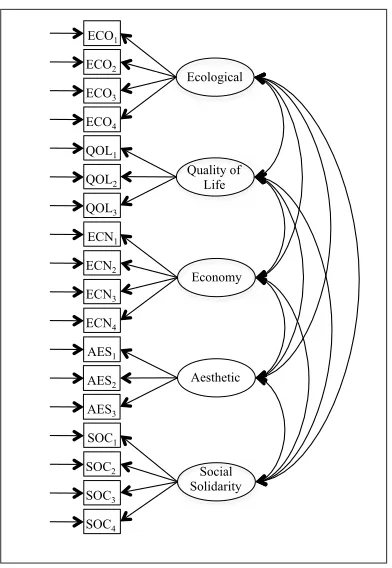
Our analysis of the hypothesized five-factor first-order model (Figure 1) pro-ceeded through four distinct phases: exploratory factor analysis, reliability analy-sis, convergent validity analyanaly-sis, and discriminant validity analysis. Exploratory factor analysis, recommended by Cortina (1993) and Floyd and Widaman (1995), allowed us to explore the hypothesis that the measurement instrument is gauging distinct and similar latent factors across samples. A reliable measurement instru-ment should produce similar factor structures across discrete samples (Byrne et al., 1989; Clark & Watson, 1995). Individual measurement items should load highly on similar freely estimated factors between both sets of data.
The last three phases of analysis involved testing for construct validity within the measurement instrument. Construct validity is the extent to which a set of operationalized variables effectively measures the constructs they are supposed to measure; it is primarily composed of reliability, convergent validity, and
dis-2The 15-mile limit was based on the U.S. Army Corps of Engineers’ knowledge and experience
criminant validity (Kline, 2011). The reliability of measurement items was assessed through the internal consistency statistic (Cronbach’s alpha) and reliability coef-ficients, which are the square of the multiple correlation coefficient for a mea-surement item. Alpha values should be above 0.70 (Nunnally & Bernstein, 1994), and reliability coefficients, which range from 0 to 1, should be high (the existing literature does not suggest a cutoff value).
We assessed the convergent validity of the measurement instrument through four tests: adequate factor loadings, acceptable model fit, measurement invariance, and structural invariance. For a measurement item to be considered a valid metric for gauging a latent construct, the latent construct, when measured through a set of measurement items, should explain at least 36% of the observed variance in each observed item. In short, all factor loadings should be above 0.60 (0.602 = 0.36; Hair, Black, Babin, & Anderson, 2010). For the second test of convergent validity, we used the following criteria to judge model fit: a relative chi-square (χ2/
df) value less than 5.0 (Schumacker & Lomax, 2004), a root mean square error of
approximation (RMSEA) near 0.06 with an upper confidence interval not above Figure 1. Illustration of Five-Factor
First-Order Model
ECO1
ECO2
ECO3
ECO4
QOL1
QOL2
QOL3
ECN1
ECN2
ECN4
AES1
AES2
AES3
ECN3
SOC1
SOC2
SOC3
SOC4
Ecological
Social Solidarity Quality of Life
Economy
0.10 (Hu & Bentler, 1999), the Akaike Information Criteria (AIC; lower values rep-resent better model fit), and a comparative fit index (CFI) and Tucker-Lewis Index (TLI) above 0.90 (Hu & Bentler, 1999). The final tests for convergent validity in-volved discerning if the measurement instrument was measuring the same latent constructs across the five distinct samples (measurement invariance) and whether the correlations between latent constructs were identical across the samples as well (structural invariance). Invariance testing is normally employed to test if latent variable scores and hypothesized relationships (correlation coefficients) are simi-lar across groups (Jöreskog, 1971). Most commonly, structural invariance tests are applied to two nominal groups within the same data set (e.g., men and women, residents and tourists, children and adolescents, etc.). We tested for invariance through a multigroup estimation process, where each sample is a distinct group, to generate a baseline or configural model against which subsequent restricted models could be judged (Kline, 2011). Measurement invariance is supported if the model fit indices do not deteriorate substantially (i.e., ∆CFI < 0.01) when factor loadings are constrained to be equal across all of the groups (Cheung & Rensvold, 2002). Similarly, structural invariance is supported if the model fit indices do not deteriorate substantially (i.e., ∆CFI < 0.01) when the correlations between latent constructs are not freely estimated between groups. Testing for both measurement invariance and structural invariance increases support for the convergent validity of the community benefit measurement instrument.
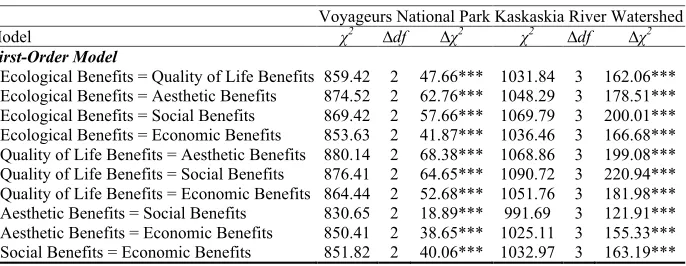
Our final test of the community benefits measurement instrument involved testing for discriminant validity; this was accomplished by constraining each cor-relation parameter between latent constructs to 1.00 and then checking for a sub-stantial deterioration in model fit (Kline, 2011). By constraining the correlations between latent constructs, we are determining that each pair is empirically dis-tinct, as gauged by its set of measurement items. The test involves a chi-square difference test between a freely estimated model and the constrained model. A sig-nificantly higher chi-square value for the constrained model indicates non-perfect correlation between the latent variables being constrained and provides support for the discriminant validity of the measurement instrument (Kline, 2011). Each correlation parameter between pairs of latent constructs is tested one at a time.
Results
Respondent Characteristics
Of the 610 individuals sampled near VNP, 77% were male and the mean age was 58 years old (sd ± 14 years). Nearly the entire sample (96%) had a high school degree, and 34% had a 4-year college degree. The modal income category was between $50,000 and $75,000 with 26% of respondents indicating an income in that range. Another 34% reported an income below $35,000, and 11% indicated an income over $100,000. Seven percent of the respondents living near VNP were employed in a position dependent upon the park.
had obtained a 4-year college degree. Within the sample, 34% of respondents re-ported an annual income between $50,000 and $75,000. At the same time, 25% of respondents reported an annual income below $35,000 and 12% reported incomes over $100,000. When asked whether they or anyone in their household had ever been employed in a job dependent upon the Kaskaskia River, seven percent indi-cated they had.
Exploratory Factor Analysis
All 18 measurement items are listed along with mean response values and standard deviations in Table 1. Initial analysis of the items suggested, as hypothe-sized, that latent constructs were present in the data (Kaiser-Meyer-Olkin measure of sampling adequacy = 0.962 [pooled samples]). Subsequent exploratory factor analysis using maximum likelihood estimation and Varimax rotation yielded a three-factor solution that explained 72.0% of the variation across the 18 mea-surement items. All statement items intended to measure distinct perceived com-munity benefits held together within the three freely estimated factors (Table 1). Explicitly, ecological benefits and quality of life benefits loaded highly (i.e., all loadings > 0.60; Hair et al., 2010) on the first extracted factor. Aesthetic benefits and social benefits loaded highly on the second extracted factor. Finally, economic benefit measurement items loaded highly on the third extracted factor.
Reliability
We first tested the reliability of each set of measurement items used to gauge perceived community benefits. The internal consistencies (Cronbach’s alpha) of each of the hypothesized community benefits are shown in Table 1 (both resource areas are reported individually). Overall, the alpha coefficients were highly satis-factory, ranging from 0.77 to 0.93. Initial support for the reliability of measure-ment items was also seen through the calculation of squared multiple correlations. The squared multiple correlations tended toward their upper bound of 1 (range = 0.43 to 0.92), illustrating the presence of internal consistency and homogeneity within sets of measurement items. The results from the internal consistency and reliability tests suggest each latent perceived community benefit is being measured through a reliable set of statement items.
Convergent Validity
COMMUNITY BENEFITS
• 205
Table 1
Descriptive Statistics, Reliabilities, and Exploratory Principal Factor Loadings
Voyageurs National Park
(n = 610) Kaskaskia River Watershed (n = 637)
Statementa M SD l
1 l2 l3 α mc2 M SD l1 l2 l3 α mc2
Ecological / Environmental 0.95 0.93
Ecological Benefits 0.93 0.92
Improved soil, water, and air quality 4.14 1.07 0.671 0.303 0.473 0.79 4.25 0.88 0.702 0.329 0.199 0.69 A sense of security that the natural environment will not be lost 4.06 1.08 0.811 0.257 0.329 0.76 4.23 0.87 0.792 0.276 0.210 0.64 A place to conserve various natural and unique ecosystems 3.92 1.08 0.817 0.245 0.236 0.66 4.10 0.90 0.813 0.211 0.159 0.58 Knowing conserved natural resources exist for future generations 4.10 1.07 0.827 0.192 0.331 0.76 4.31 0.85 0.844 0.281 0.220 0.79
Quality of Life Benefits 0.88 0.84
A greater concern for the natural environment among residents 3.95 1.05 0.657 0.435 0.244 0.62 4.11 0.81 0.675 0.289 0.334 0.59 Living in a healthy environment 4.31 1.03 0.625 0.384 0.444 0.71 4.41 0.82 0.588 0.439 0.335 0.63 A higher quality of life 4.05 1.08 0.676 0.299 0.460 0.74 4.29 0.81 0.631 0.436 0.263 0.65
Aesthetic and Social 0.94 0.91
Aesthetic Benefits 0.84 0.77
An ability to preserve small-town feeling of your community 3.63 1.20 0.210 0.735 0.310 0.68 3.97 0.91 0.321 0.253 0.631 0.54 Better maintenance of community infrastructure 3.71 1.14 0.307 0.661 0.338 0.67 3.90 0.92 0.310 0.407 0.595 0.63 Greater retention of community’s distinctive architecture 3.38 1.12 0.395 0.600 0.253 0.57 3.58 0.97 0.332 0.282 0.479 0.43
Social Benefits 0.91 0.88
A stronger sense of community togetherness or cohesion 3.66 1.15 0.271 0.792 0.328 0.71 3.77 0.90 0.198 0.264 0.780 0.58 A stronger sense of family bonds within the community 3.55 1.19 0.200 0.802 0.286 0.63 3.77 0.91 0.166 0.314 0.759 0.57 A natural setting in which your community takes great pride 3.96 1.14 0.464 0.619 0.314 0.69 4.13 0.85 0.347 0.376 0.624 0.67 A feeling of community pride 3.81 1.13 0.465 0.635 0.344 0.75 3.99 0.87 0.346 0.435 0.602 0.70
Economic 0.94 0.93
Economic Benefits 0.94 0.93
Having a more stable economy within my community 4.16 1.10 0.372 0.380 0.776 0.92 4.24 0.88 0.398 0.736 0.362 0.87 Increased job opportunities within my community 4.16 1.13 0.342 0.354 0.758 0.84 4.31 0.89 0.302 0.815 0.284 0.82 Attracting tourism dollars to my community 4.14 1.11 0.430 0.277 0.626 0.59 4.24 0.92 0.247 0.716 0.247 0.57 Having a more stable economy for the surrounding region 4.18 1.05 0.420 0.343 0.742 0.81 4.25 0.87 0.336 0.784 0.295 0.80 Note. Factors extracted using Varimax rotation.
a Respondents were asked to indicate the importance of the statement item relative to their community’s relationship with the resource along a scale where 1 = Very Unimportant through 5 = Very Important.
The last two tests for convergent validity determine if the hypothesized five-factor model effectively measures the same latent constructs (perceived commu-nity benefits) across samples by comparing a baseline model against a model with parameters constrained between samples and subsequently checks for a substan-tial deterioration in model fit. The baseline or configural model (Table 2) yielded summed chi-square statistics and reestimated fit indices. We constrained factor loadings to be equal across all five samples, reestimated the model, and checked for deterioration in fit to test for measurement invariance. The results of this test (Table 2) reveal a ∆CFI less than 0.01, supporting the hypothesis the measure-ment items are assessing the same constructs across samples. Next, we tested for structural invariance between samples by adding the constraint of equal correla-tions between latent factors across all five samples. The results of this test (Table 2) again reveal a ∆CFI less than 0.01, supporting the hypothesis that the relation-ship between perceived community benefits is equal across each of the samples. Collectively, the overall goodness of fit of the hypothesized model’s correlation/ covariance matrix to observed data and the presence of measurement and struc-tural invariance provide multiple points of support for the convergent validity of the measurement instrument.
Discriminant Validity
The final test of construct validity involved discerning whether the measure-ment instrumeasure-ment could empirically differentiate distinct perceived community benefits—more explicitly, whether individual measurement items diverge in their assessment of related latent constructs (Kline, 2011). We tested for discriminant validity by constraining each correlation parameter between latent constructs to 1.00, reestimating the model and checking for a significant deterioration in model fit with the chi-square difference test. Results from these tests, which are conduct-ed on each correlation parameter connecting pairs of latent constructs, are shown in Table 3. The chi-square difference test was significant for all 10 constrained models, providing support for the measurement items empirically differentiating between distinct perceived community benefits.
COMMUNITY BENEFITS 35
Table 2
Goodness-of-Fit Indices for Confirmatory Factor Analyses and Multigroup Invariance Tests
Model χ2 df χ2/df RMSEA [90%C.I] AIC CFI TLI
Confirmatory Factor Analysis
Voyageurs National Park
Multigroup first-order model 811.76 206 3.94 0.07 [0.07, 0.08] 1011.76 0.94 0.92
Kaskaskia River Watershed
Multigroup first-order model 869.78 309 2.81 0.05 [0.05, 0.06] 1169.78 0.94 0.92
Multigroup Invariance Tests
Multigroup Configural Model 1681.56 515 3.27 0.04 [0.04, 0.05] 2181.56 0.94 0.92
Multigroup Test of Measurement Invariance 1740.47 563 3.09 0.04 [0.04, 0.04] 2144.47 0.94 0.93
Multigroup Test of Structural Covariance Invariance 1931.78 623 3.10 0.04 [0.04, 0.04] 2215.78 0.93 0.93
Table 2
Discussion and Conclusions
The community benefits measurement instrument provides a mechanism through which resource managers can gauge desired outcomes of people living in communities adjacent to managed natural resource areas. As noted earlier, past research points to a need for land managers to better understand local communi-ties to effectively build collaborative partnerships with stakeholders that result in management actions promoting desired community benefits (Davenport, An-derson, Leahy, & Jakes, 2007; Davenport, Leahy, AnAn-derson, & Jakes, 2007; Won-dolleck & Yaffee, 2000). The community benefits measurement instrument can provide public land managers with data, which in the past was unavailable, re-lated to specific outcomes that local residents desire (Anderson et al., 2008). The instrument provides not only a barometer through which distinct desired dimen-sions can be measured but also a mechanism to analyze, in a comparative and standardized fashion, variations in desired benefits. Variations of interest to social scientists and resource managers may be between distinct segments of the popula-tion (e.g., retirees relative to the populapopula-tion in the workforce or recreapopula-tionists vs. non-recreationists). The instrument can be used to tailor resource management plans to provide desired benefits for distinct regions of managed landscapes. For example, local residents may desire more ecological benefits from forested areas, while simultaneously desiring more economic benefits from areas of the landscape that are more heavily used for timber production. In sum, the community benefits instrument not only is valid and reliable but also has practical value to community stakeholders and resource area managers.
The community benefits instrument might also foster future research that is more integrated with the realities of managing public lands. Recreation manag-ers no longer simply manage just recreation usmanag-ers and recreation settings. Rather, resource managers today manage users, settings, and a diverse array of stakeholders
from local communities. The community benefits instrument provides a new metric
responsive to the realities resource managers currently face. It provides a standard mechanism through which variations in desired community benefits can be
as-COMMUNITY BENEFITS 36
Table 3
Goodness-of-Fit Indices for Discriminant Validity Tests (Constrained Covariances)
Voyageurs National Park Kaskaskia River Watershed
Model χ2 ∆df ∆χ2 χ2 ∆df ∆χ2
First-Order Model
Ecological Benefits = Quality of Life Benefits 859.42 2 47.66*** 1031.84 3 162.06*** Ecological Benefits = Aesthetic Benefits 874.52 2 62.76*** 1048.29 3 178.51***
Ecological Benefits = Social Benefits 869.42 2 57.66*** 1069.79 3 200.01***
Ecological Benefits = Economic Benefits 853.63 2 41.87*** 1036.46 3 166.68*** Quality of Life Benefits = Aesthetic Benefits 880.14 2 68.38*** 1068.86 3 199.08*** Quality of Life Benefits = Social Benefits 876.41 2 64.65*** 1090.72 3 220.94*** Quality of Life Benefits = Economic Benefits 864.44 2 52.68*** 1051.76 3 181.98***
Aesthetic Benefits = Social Benefits 830.65 2 18.89*** 991.69 3 121.91***
Aesthetic Benefits = Economic Benefits 850.41 2 38.65*** 1025.11 3 155.33***
Social Benefits = Economic Benefits 851.82 2 40.06*** 1032.97 3 163.19***
Table 3
sessed. These variations can be assessed not only within local populations but also across management units.
Ipso facto, the community benefits instrument also opens up new avenues for theoretical and empirical study of resource management. The measurement in-strument acknowledges that individual behaviors and needs are not solely driven by the desired experiences individuals wish to obtain from recreation settings as past research has shown. Rather, it acknowledges individuals’ behaviors and needs are also shaped by their perceptions and beliefs about how managed landscapes affect the places in which they work and play.
The community benefits instrument also gives resource managers and sci-entists the ability to discern heterogeneous preferences for community benefits across individuals. This can prove useful in determining if certain individuals pre-fer similar sets of benefits over others. For example, our exploratory factor analysis of the data collected in both the communities around VNP and within the KRW revealed the tendency of individuals to rate ecological community benefits simi-larly to quality of life benefits (as evidenced by all the statement items loading highly on the same factor). This finding supports the growing body of literature that suggests the perceived ecological integrity of an area is a significant deter-minant of individuals’ appraisals of their general well-being (Marans, 2003; Ma-rans & Mohai, 1991). Consequently, resource planners and managers could infer that any management action that could potentially reduce the area’s ecological health (e.g., establishing new roads or advocating for more intensive recreational development) would have concomitant detrimental effects on local community members’ perceived quality of life. As a result, those management actions would most likely be met with disapproval from local community members. Although the high degree of correlation between perceived ecological and quality of life benefits should not be construed as normative, finding the relationship for both communities near VNP and within the KRW highlights how the community ben-efits scale can be used to gauge the relative importance of and similarities between various benefits that managed resource areas provide.
References
Allen, L. R., & Beattie, R. J. (1984). The role of leisure as an indicator of overall satisfaction with community life. Journal of Leisure Research, 16(2), 99–109. Anderson, D. H., Davenport, M. A., Leahy, J. E., & Stein, T. V. (2008). OFM and
community benefits. In B. L. Driver (Ed.), Managing to optimize the beneficial
outcomes of recreation (pp. 311–334). State College, PA: Venture.
Armitage, D. (2005). Adaptive capacity and community-based natural resource management. environmental Management, 35(6), 703–715. doi:10.1007/ s00267-004-0076-z
Armstrong, J. S., & Overton, T. S. (1977). Estimating nonresponse bias in mail sur-veys. Journal of Marketing Research, 14(3), 396–402.
Arai, S., & Pedlar, A. (2003). Moving beyond individualism in leisure theory: A critical analysis of concepts of community and social engagement. Leisure
studies, 22(3), 185–202.
Bollen, K. A. (1989). structural equations with latent variables. New York, NY: Wiley. Brint, S. (2001). Gemeinschaft revisited: A critique and reconstruction of the
com-munity concept. sociological Theory, 19(1), 1–23.
Bruns, D., Driver, B. L., Lee, M. E., Anderson, D. H., & Brown, P. J. (1994, June).
Pilot test for implementing benefits-based management. Paper presented at The
Fifth International Symposium on Society and Resource Management, Fort Collins, CO.
Brunson, M. (1996). A definition of “social acceptability” in ecosystem manage-ment. In M. Brunson, L. E. Kruger, C. B. Tyler, & S. A. Schroeder (Eds.), defining
social acceptability in ecosystem management: workshop proceedings (Gen. Tech.
Rep. PNW-GTR-369). Portland, OR: USDA Forest Service, Pacific Northwest Research Station.
Bureau of Land Management. (2003). The BLM’s priorities for recreation and visitor
services. Washington, DC: Author. Retrieved April 7, 2010, from http://www.
blm.gov/pgdata/etc/medialib/blm/id/publications.Par.99986.File.dat/recvisit. pdf
Byrne, B. M., Shavelson, R. J., & Muthén, B. (1989). Testing for equivalence of fac-tor covariance and mean structures: The issue of partial measurement invari-ance. Psychological Bulletin, 105, 456–466.
Cheung, G. W., & Rensvold, R. B. (2002). Evaluating goodness-of-fit indexes for testing measurement invariance. structural equation Modeling: A
Multidisci-plinary Journal, 9(2), 233–255.
Clark, L. A., & Watson, D. (1995). Constructing validity: Basic issues in objective scale development. Psychological Assessment, 7(3), 309–319.
Cortina, J. M. (1993). What is coefficient alpha? An examination of theory and applications. Journal of Applied Psychology, 78, 98–104.
Crang, M. (1997). Analyzing qualitative methods. In R. Flowerdew & D. Martin (Eds.), Methods in human geography (pp. 183–196). London, England: Long-man.
Davenport, M. A., Anderson, D. H., Leahy, J. E., & Jakes, P. J. (2007). Reflections from USDA Forest Service employees on institutional constraints to engaging and serving their local communities. Journal of Forestry, 105(1), 43–48.
Davenport, M. A., Leahy, J. E., Anderson, D. H., & Jakes, P. J. (2007). Building trust in natural resource management within local communities: A case study of the Midewin National Tallgrass Prairie. environmental Management, 39(3), 353–368.
Devine, M. A., & Parr, M. G. (2008). “Come on in, but not too far:” Social capital in an inclusive leisure setting. Leisure sciences, 30(5), 391–408.
Dillman, D. A. (2007). Mail and Internet surveys: The tailored design method (2nd ed.). New York, NY: Wiley and Sons.
Driver, B. L. (1996). Benefits-driven management of natural areas. Natural Areas
Journal, 16(2), 94–99.
Driver, B. L. (Ed.). (2008). Managing to optimize the beneficial outcomes of recreation. State College, PA: Venture.
Driver, B. L., Brown, P. J., & Peterson, G. L. (1991). Benefits of leisure. State College, PA: Venture.
Floyd, F. J., & Widaman, K. F. (1995). Factor analysis in the development and refine-ment of clinical assessrefine-ment instrurefine-ments. Psychological Assessrefine-ment, 7, 286–299. Freudenburg, W. R. (1988). Perceived risk, real risk: Social science and the art of
probabilistic risk assessment. science, 242(4875), 44–49.
Fulton, D. C., Manfredo, M. J., & Lipscomb, J. (1996). Wildlife value orientations: A conceptual and measurement approach. Human dimensions of wildlife, 1(2), 22–47.
García-Llorente, M., Martín-López, B., González, J. A., Alcorlo, P., & Montes, C. (2008). Social perceptions of the impacts and benefits of invasive alien species: Implications for management. Biological Conservation, 141(12), 2969–2983. Gibson, C. C., & Koontz, T. (1998). When “community” is not enough:
Institu-tions and values in community-based forest management in southern Indi-ana. Human ecology, 26(4), 621–647.
Glover, T. D., & Stewart, W. P. (2006). Rethinking leisure and community research: Critical reflections and future agendas. Leisure/Loisir, 30(2), 315–327.
Hair, J. F., Black, B., Babin, B., & Anderson, R. E. (2010). Multivariate data analysis (7th ed.). Upper Saddle River, NJ: Prentice Hall.
Harrington, C., Curtis, A., & Black, R. (2008). Locating communities in natural resource management. Journal of environmental Policy & Planning, 10(2), 199– 215.
Howe, J., McMahon, E. T., & Propst, L. (1997). Balancing nature and commerce in
gateway communities. Washington, DC: Island Press.
Hu, L.-T., & Bentler, P. M. (1999). Cutoff criteria for fit indexes in covariance struc-ture analysis: Conventional criteria versus new alternatives. structural equation
Modeling, 6(1), 1–55.
Hunnicutt, B. (2000). Our reform heritage: Recovering the vision of community leisure service. Journal of Leisure Research, 32, 58–61.
Illinois Department of Natural Resources. (2001). The Kaskaskia River Basin: An
Jöreskog, K. G. (1971). Simultaneous factor analysis in several populations.
Psycho-metrica, 36(4), 409–426.
Kline, R. B. (2011). Principles and practices of structural equation modeling (3rd ed.). New York, NY: Guilford.
Kruger, L. E. (2006). Recreation as a path for place making and community build-ing. Leisure/Loisir, 30(2), 383–392.
Leahy, J. E., & Anderson, D. H. (2010). “Cooperation gets it done”: Social capital in natural resources management along the Kaskaskia River. society and Natural
Resources, 23(3), 224–239.
Luloff, A. E., Krannich, R. S., Theodori, G. L., Trentelman, C. K., & Williams, T. (2004). The use of community in natural resource management. In M. J. Man-fredo, J. J. Vaske, B. L. Bruyere, D. R. Field, & P. J. Brown (Eds.), society and
natural resources: A summary of knowledge (pp. 249–259). Jefferson, MO:
Mod-ern Litho.
Mann, M., & Leahy, J. (2010). Social capital in an outdoor recreation context.
en-vironmental Management, 45(2), 363–376.
Marans, R. W. (2003). Understanding environmental quality through quality of life studies: The 2001 DAS and its use of subjective and objective indicators.
Landscape and Urban Planning, 65(1/2), 73–83.
Marans, R. W., & Mohai, P. (1991). Leisure resources, recreation activity, and the quality of life. In B. L. Driver, P. Brown, & G. L. Peterson (Eds.), Benefits of
lei-sure. State College, PA: Venture.
Matarrita-Casante, D., Stedman, R., & Luloff, A. E. (2010). Permanent and seasonal residents’ community attachment in natural amenity-rich areas: Exploring the contribution of landscape-related factors. environment and Behavior, 42(2), 197–220.
McClanahan, T. R., Cinner, J., Kamakuru, A. T., Abunge, C., & Ndagala, J. (2009). Management preferences, perceived benefits and conflicts among resource us-ers and managus-ers in the Mafia Island Marine Park, Tanzania. environmental
Conservation, 35(4), 340–350.
Nunnally, J., & Bernstein, I. (1994). Psychometric theory (3rd ed.). New York, NY: McGraw-Hill.
Puddifoot, J. E. (2003). Exploring “personal” and “shared” sense of community identity in Durham City, England. Journal of Community Psychology, 31(1), 87–106.
Reed, P., & Brown, G. (2003). Public land management and quality of life in neigh-boring communities—The Chugach National Forest Planning Experience.
For-est science, 49(4), 479–498.
Schumacker, R. E., & Lomax, R. G. (2004). A beginner’s guide to structural equation
modeling (2nd ed.). London, England: Erlbaum.
Smale, B. (2006). Critical perspectives on place in leisure research. Leisure/Loisir,
30(2), 369–382.
Smith, J. W., Davenport, M. A., Anderson, D. H., & Leahy, J. E. (2011). Place meanings and desired management outcomes. Landscape and Urban Planning,
101(4), 359–370.
Stedman, R. C., Amsden, B. L., & Kruger, L. (2006). Sense of place and community: Points of intersection for leisure research. Leisure/Loisir, 30(2), 393–404. Stedman, R. C., Beckley, T., Wallace, S., & Ambard, M. (2004). A picture and 1000
words: Using resident-employed photography to understand attachment to high amenity places. Journal of Leisure Research, 36(4), 580–606.
Stein, T. V., & Anderson, D. H. (2002). Combining benefits-based management with ecosystem management for landscape planning: Leech Lake watershed, Minnesota. Landscape and Urban Planning, 60(3), 151–161.
Stein, T. V., Anderson, D. H., & Kelly, T. (1999). Using stakeholders’ values to ap-ply ecosystem management in an upper Midwest landscape. environmental
Management, 24(3), 399–413.
Stein, T. V., Anderson, D. H., & Thompson, D. (1999). Identifying and managing for community benefits in Minnesota State Parks. Journal of Park and Recreation
Administration, 17(4), 1–19.
Stern, P. C. (2000). Toward a coherent theory of environmentally significant be-havior. Journal of social Issues, 56(3), 407–424.
Stern, P. C., Dietz, T., Abel, T., Guagnano, G. A., & Kalof, L. (1999). A value-belief-norm theory of support for social movements: The case of environmental concern. Human ecology Review, 6(2), 81–97.
Stewart, W. (2006). Community-based place meanings for park planning. Leisure/
Loisir, 30(2), 405–416.
Sugiyama, T., Thompson, C. W., & Alves, S. (2009). Associations between neigh-borhood open space attributes and quality of life for older people in Britain.
environment and Behavior, 41(1), 3–21.
Theodori, G. L. (2005). Community and community development in resource-based areas: Operational definitions rooted in an interactional perspective.
society and Natural Resources, 18, 661–669.
Tversky, A., & Kahneman, D. (1974). Judgment under uncertainty: Heuristics and biases. science, 185(4157), 1124–1131.
U.S. Army Corps of Engineers. (1996). Carlyle Lake, Illinois map. Carlyle, IL: Carlyle Lake U.S. Army Corps of Engineers Office.
U.S. Department of Agriculture. (2010). strategic plan Fy 2010–2015. Washington, DC: Author.
U.S. Department of the Interior. (2011). strategic plan for fiscal years 2011–2015. Washington, DC: Author.
Vaske, J. J., & Donnelly, M. P. (1999). A value-attitude-behavior model predicting wildland preservation voting intentions. society and Natural Resources, 12(6), 523–537.
Wallace, G. N., Theobald, D. M., Ernst, T., & King, K. (2008). Assessing the ecologi-cal and social benefits of private land conservation in Colorado. Conservation
Biology, 22(2), 284–296.
Whittaker, D., Vaske, J. J., & Manfredo, M. J. (2006). Specificity and the cognitive hierarchy: Value orientations and the acceptability of urban wildlife manage-ment actions. society & Natural Resources, 19(6), 515–530.
Williams, D. R., McDonald, C. D., Riden, C. M., & Uysal, M. (1995). Community attachment, regional identity and resident attitudes towards tourism. In
Pro-ceedings of the 26th Annual Travel and Tourism Research Association Conference
Proceedings (pp. 424–428). Wheat Ridge, CO: Travel and Tourism Research
As-sociation.
Williams, D. R., & Stewart, S. I. (1998). Sense of place: An elusive concept that is finding a home in ecosystem management. Journal of Forestry, 95(5), 18–23. Wondolleck, J. M., & Yaffee, S. L. (2000). Making collaboration work: Lessons from
innovation in natural resource management. Washington, DC: Island Press.
Wyman, M., & Stein, T. (2010). Examining the linkages between community ben-efits, placed-based meanings, and conservation program involvement: A study within the Community Baboon Sanctuary, Belize. society and Natural