Int. J. Advance Soft Compu. Appl, Vol. 8, No. 2, July 2016 ISSN 2074-8523
A Hybrid of Ant Colony Optimization and
Flux Variability Analysis to Improve the
Production of L-Phenylalanine and
Biohydrogen
Amira Husna Azhar1, Mohd Saberi Mohamad1, Safaai Deris2, Suhaimi Napis3, and Richard Sinnott4
1Artificial Intelligence and Bioinformatics Research Group, Faculty of
Computing, Universiti Teknologi Malaysia, Skudai 81310, Malaysia e-mail: [email protected], [email protected]
2Department of Creative Technology (Multimedia), Faculty of Technology
Creative and Heritage, Universiti Malaysia Ketantan, 16300, Bachok, Kelantan, Malaysia
3Department of Cell and Molecular Biology, Faculty of Biotechnology and
Biomolecular Sciences, Universiti Putra Malaysia, 43400 UPM, Serdang, Selangor, Malaysia
4Department of Computing and Information System, University of Melbourne,
Victoria, 3010, Australia
Abstract
Amira Husna Azhar et al. 162
dimensional data size that contains competing pathway of non-desirable product. Indeed, the suitable population size and knockout number for this new algorithm have been tested previously. This study proposes an algorithm that is a hybrid of the ant colony optimization algorithm and flux variability analysis (ACOFVA) to predict near-optimal sets of reactions knockout in an effort to improve the growth rates and the production rate of L-phenylalanine and biohydrogen in Saccharomyces cerevisiae and cyanobacteria Synechocystis sp PCC6803 respectively.
Keywords: metabolic engineering; ant colony optimization; flux variability analysis; L-phenylalanine; biohydrogen.
1 Introduction
Metabolic engineering (ME) has shown a big improvement and is getting more popular in these recent years. Metabolic engineering has been used to study and manipulate the biological microbial cell metabolism by many researchers in this field [1]. An example of a strategy that has been introduced by metabolic engineering method is by suggesting any genes or reactions from its complex metabolic network to be deleted [2,3]. This technique has shown many achievements towards genome-scale metabolic network (GSMN) model in addressing high yield of by-product secretion and cell growth rate.
The advancement of metabolic engineering has gained more attention as it is able to improve any desired metabolites strain that can further the process to become valuable products for market industries purposes [4]. With such results, more developments of quantitative models and algorithms using computational approach are growing in these recent years. However, the current production rate is still low than its theoretical maximum value probably due to the lack of effective computational technique developed to modify the metabolic model of microorganisms. Even modification toward biological network of an organism has been proven to be a successful technique, constructing a mutant strain of genome model is a challenging part to overproduce the interest metabolites beyond its wild type limit.
163 A Hybrid of Ant Colony Optimization and
metabolites by microorganisms the presence of interaction among thousands of reactions in the metabolic network caused higher dimensional data size. In addition, the presence of competing pathway of non-desirable product may affect the desired metabolite production.
The reason of using advance computational approach in today’s research is because it is powerful and able to save costs and time in manipulating phenotypes to enhance desired strain model compared to wet lab procedures. The goal of metabolic engineering is to develop effective methods in order to improve the metabolic capabilities producing desired metabolites in microorganism for industrial purpose [5]. In metabolic engineering, there are some recognized methods available that are currently being used widely to assist in simulating process to improve metabolite production genome-scale model, for example, optimization algorithm, modeling simulation algorithm and modeling framework.
Microbial strains are microorganisms that are widely used to produce biochemical products, antibiotics, drug targets, therapeutic proteins, food ingredients, vitamins, fuels, and other useful chemicals that are in demand in many markets and industries. Therefore, this research is concerned about the production of metabolites L-Phenylalanine (L-Phe) in Saccharomyces cerevisiae and biohydrogen (H2) in
cyanobacteria Synechocystis sp PCC6803. There is a growing concern about energy generation by fossil fuels to be continued such as biohydrogen because it is renewable and shows the tendency to be an alternative to fossil fuels for transportation [6]. While L-phenylalanine has been used as a precursor to vanillin production for food additives and also one of good nutritional supplements in pharmaceutical industry [7].
Amira Husna Azhar et al. 164
number of significant flux changes. Same with MOMA, ROOM also aim to find minimize set of fluxes that are close to wild type without too concerning to minimize the growth rate [14].
Other than constraint-based methods, there are some famous and common rational modeling frameworks used by researchers in metabolic engineering area. These frameworks applies bi-level optimization strategy which it targets to solve two conflicts that biologically related which is the cell growth and maximum bioengineering objective. Modeling framework applied two key points in their calculation which is optimization strategy and modeling simulation. For example are OptKnock [15] and ReacKnock [16] which are aimed at identifying reaction (gene) knockout to obtain improved metabolites. OptKnock targets the set of reaction (gene) to be deleted without affecting the internal flux distribution of the genome model so that the flux of the metabolites could be optimized in a nonviable growth rate. OptKnock framework formulates the in silico design problem by using Genetic Algorithm (GA) and use FBA, MOMA or other method to calculate fitness if an individual [17]. While Reacknock applying FVA to predict the possible production rate under knockout strategies. RobustKnock [18] predicts more robust solution than OptKnock by predicting gene to be deleted that lead to the over-production of chemicals of interest. OptGene [19] is an another algorithm that search for reaction candidates that can be activated, inhibited or eliminated by using evolutionary search procedure for solving the resulting combinatorial optimization problem.
In this paper, a hybrid of Ant Colony Optimization and Flux Variability Analysis (ACOFVA) is proposed. This newly hybrid algorithm is developed to predict the reaction knockout strategy. Ant Colony Optimization (ACO) is a swarm intelligence based optimization algorithm which is inspired by the behavior of ants to find food which has been introduced in the year 1991 by [20]. While Flux Variability Analysis (FVA) is a constraint-based modeling approach developed by [21].
2 Methods
165 A Hybrid of Ant Colony Optimization and
2.1
Problem Formulation
The problem is to find the best set of reaction knockout including the associated genes of biological models which can be formulated as follows: A genome-scale model data is present by a stoichiometric matrix which consists of; where m and n
are the representation of number of metabolites and reactions in the network respectively shows in equation 1.
𝑆𝑚×𝑛 (1)
𝑆. 𝑣 = 0 (2) In equation 2, v represents the vector for overall fluxes including the internal, transport and the growth fluxes which are sure to achieve a steady state condition to bring the zero value. A steady state is referred to the total amount of any compound being produced that must equal to the total amount that is being consumed. A constraint-based method applying dynamic mass that can be formulated in equation 3 is as followed, where t is time:
𝑑𝑥𝑑𝑡 = 𝑆𝑣 (3)
There are two additional constraints that are commonly used in this modelling simulation comprising the upper and lower boundaries of internal fluxes denoted by v and exchange fluxes present by vector b as state in equation 4:
lowerbound upperbound
0 < 𝑣 < ∞
−∞ < 𝑏 < ∞ (4)
2.2
A hybrid of ACO and FVA
Amira Husna Azhar et al. 166
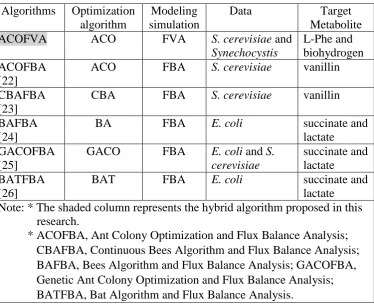
Table 1: Differences between the existing and proposed hybrid algorithm. Algorithms Optimization
algorithm
Modeling simulation
Data Target Metabolite
ACOFVA ACO FVA S. cerevisiae and
Synechocystis
L-Phe and biohydrogen ACOFBA
[22]
ACO FBA S. cerevisiae vanillin
CBAFBA [23]
CBA FBA S. cerevisiae vanillin
BAFBA [24]
BA FBA E. coli succinate and
lactate GACOFBA
[25]
GACO FBA E. coli and S. cerevisiae
succinate and lactate
BATFBA [26]
BAT FBA E. coli succinate and
lactate
Note: * The shaded column represents the hybrid algorithm proposed in this research.
* ACOFBA, Ant Colony Optimization and Flux Balance Analysis; CBAFBA, Continuous Bees Algorithm and Flux Balance Analysis; BAFBA, Bees Algorithm and Flux Balance Analysis; GACOFBA, Genetic Ant Colony Optimization and Flux Balance Analysis; BATFBA, Bat Algorithm and Flux Balance Analysis.
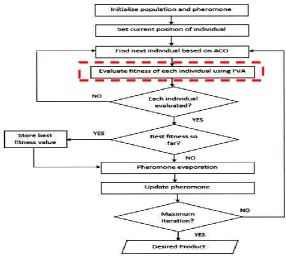
The proposed ACOFVA attempts to improve the traditional approach which can simultaneously combine the optimization technique and modeling method in modifying the metabolic network in order to improve the metabolite production in microorganisms. The main differences between existing algorithm and this newly proposed algorithm is the implementation of FVA for the modeling simulation which has not been used before. Next, the optimal percentage of a solution constructed is set to achieve the highest solution which reflects to the fitness of the objective function. This optimal percentage can only be set with the implementation of FVA. The in silico research about the interest metabolites production focused in this study is still lack. Thus this study gives deeper view on optimizing the production of desired metabolites. Figure 1 shows the flowchart of ACOFVA.
2.2.1 Model pre-processing
167 A Hybrid of Ant Colony Optimization and
may affect the result of this experiment and also the accuracy. In addition, this step also perform a check for consistency of the model after it has undergone the pre-process step.
Fig. 1. Flowchart of ACOFVA.
2.2.2 Ant Representation
Amira Husna Azhar et al. 168
Fig. 2. Basic Ant Colony Optimization Behavior at Different Time Stamps [27]
2.2.3 Initialize population
The algorithm starts by initializing populations of m ants. Each ant is initialized as by assuming a reaction with n genes. A population is initialized by a predefined number of individuals by assigning present and absent status. The matrix creates the status randomly using bit ‘0’ or ‘1’ among them. The suggested reaction to be knocked out is represented by ‘1’ while reaction that is not deleted and maintained is represented by ‘0’. The purpose of assigning those value is to select the best set of reaction to be deleted in order to enhance the production of a metabolite. Figure 3 shows the representation of gene and reaction of metabolic model to give a clearer view of the reaction deletion. ACO is applied at this stage where the number of ants is initialized as mentioned using bit number. This step is important to find the essential or essential reaction to optimize the desired metabolite. The non-desired reaction is selected to be knocked out and needs to make sure that the deletion of the set of reactions not defect the growth of a microorganism based on the biological facts.
Fig. 3. The representation of reaction and gene of metabolic model.
2.2.4 Solution construction
169 A Hybrid of Ant Colony Optimization and
individuals and is continuously repeated until all individuals are evaluated. Moreover, the bases for probabilistically constructing solutions is the implementation and use of heuristic information and in this study, FVA and the optimization rule of pheromone value are combined.
2.3.5 Scoring fitness of an individual
The fitness evaluation was carried out by using FVA. Figure 4 shows the basic flowchart of FVA to obtain the best production rate. FVA calculates the fitness of a mutant individual after undergoing a deletion reaction strategy. The calculation performed is based on steady state approximation of the internal metabolites concentration, which reduces the corresponding mass balances in an effective manner. When a list of reactions that is selected to knock out has been found and removed from current solution, FVA examines the model after the knockout process using linear objective function to determine the flux distribution.
Fig. 4. The flow of FVA to obtain the best production rate.
Amira Husna Azhar et al. 170
best production rate value. This production rate is used as the fitness. The flow of fitness evaluation is showed in Figure 4. The aim is to maximize the objective function of f(x) can be formulated as equation 6.
𝑓(𝑥) = 𝑝𝑟𝑜𝑑𝑢𝑐𝑡𝑖𝑜𝑛 𝑟𝑎𝑡𝑒 mmol g/DW/ h (6)
3
Datasets and Experimental Setup
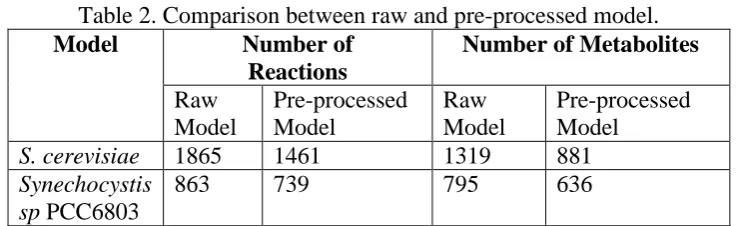
Genome-scale model has been chosen as input data to perform the operation of the algorithm of ACOFVA. The two developed datasets Yeast (Saccharomyces cerevisiae) and Cyanobacteria (Synechocystis sp PCC6803) are selected. These models are well established and have been used by many researchers in metabolic engineering area to study the bacterium’s metabolism and phenotypic behaviour. The S. cerevisiae model used is downloaded from a published literature by [28] derived from http://sourceforge.net/projects/yeast/files/yeast_4.05.zip/download and known as yeast.4.05 which contains 1865 reactions and 1319 metabolites. The other model is Synechocystis sp PCC6803 version iJN678 developed by [29] downloaded from bigg.ucsd.edu/ models/iJN678 that contains 863 reactions and 795 metabolites.
Before all the models are applied to the constructed ACOFVA algorithm, the pre-processed steps are carried out towards the models based on biological assumptions and computational approaches. During this step, some non-informative data inside the model are removed to obtain better results. For example, dead-end reactions are removed from the model to elude it from affecting the accuracy of the result while testing the model with the algorithm. In addition, this step also perform a check for consistency of the model after it has undergone the pre-process step. Table 2 shows the reducing of reactions and metabolites number after those model undergo the pre-processing steps.
Table 2. Comparison between raw and pre-processed model.
Model Number of
Reactions
Number of Metabolites
Raw Model
Pre-processed Model
Raw Model
Pre-processed Model
S. cerevisiae 1865 1461 1319 881
Synechocystis sp PCC6803
863 739 795 636
171 A Hybrid of Ant Colony Optimization and
the next section. The experiment was conducted using quad core of 3.60 GHz Intel Core i7 processor with 16 GB RAM workstation.
Parameter Setting for ACOFVA
The performance of any algorithm is largely depend on the setting of its algorithm dependent parameter [30]. The optimal setting should allow the algorithm to achieve the best performance for solving a range of optimization problems.
The glucose uptake rate is used as the sole carbon source for both models in this study. This research is emphasized to improve the metabolites production in heterotrophic condition. The glucose uptake rate is set at 10 mmol g DW-1 h-1 as it is the common glucose value that is suitable with Yeast organism. In addition, the amount is also the highest value of glucose uptake rate for Yeast S. cerevisiae [31]. According to [32], 0.85 mmol g DW-1 h-1 is the maximum bounds of glucose uptake rate for the heterotrophic growth condition for Cyanobacteria Synechocystis
sp. PCC6803 model. Therefore, by setting high glucose uptake rate as sole carbon for the model to grow, the desirable production can be enhanced. The set amount has been used widely by computational and also wet lab experiment.
In addition, the population size and number of knockout for this new proposed algorithm are 100 and 5 respectively. These values have been tested and showed good results. Thus, it is selected as the most suitable parameter to have a better growth and production rates. All the results showed are from 30 number of runtime and iteration for each runtime is 100. The performance of any algorithm is largely depend on the setting of its algorithm dependent parameter [30]. The optimal setting should allow the algorithm to achieve the best performance for solving a range of optimization problems.
4
Results and Discussion
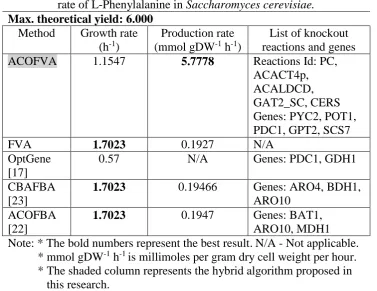
In this paper, a hybrid of ACOFVA is proposed to improve the result of some previous existing methods in elucidating phenotype behavior after modification towards metabolic network is carried out while improving the interest metabolite production. For the benchmarking function, mean and standard deviation (STD) of growth rate and production rate are calculated. Table 3 shows the result of mean and STD. Both datasets show low STD when tested with ACOFVA indicate that the result of each run is very close to the mean. It is apparent that the stability of the proposed algorithm is high as the difference between the results of each runtime is small. In addition, due to the set of reactions and genes knockouts performed, it could be hypothesized that each set of reactions might cause a specific and varying range of interactions that can affect the final cascading pathway for L-Phe and H2
Amira Husna Azhar et al. 172
Table 3. Mean and standard deviation for the growth rate of each metabolite.
Data Mean Standard Deviation
L-phenylalanine (S. cerevisiae)
1.1547 0.5054
Biohydrogen (Synechocystis)
0.0374 0.0024
Production of L-Phenylalanine in S. cerevisiae
Table 4 shows reactions and genes information that are suggested to be knocked out for L-Phenylalanine in S. cerevisiae. The list of reaction knocked out that can be used in real laboratory experiment to test its potential to improve L-Phe production is also provided. Some justifications towards the suggested reaction to be deleted are explained according to biological information.
Table 4. Reactions and genes information suggested to be knocked out for L-Phenylalanine in Saccharomyces cerevisiae.
Reaction Id Reaction Description
Genes Pathway
PC Pyruvate
carboxylase
PYC2 atp + hco3 + pyr --> adp + h + oaa + pi
ACACT4p Acetyl CoA C-acetyltransferase
POT1 3odcoa + coa --> accoa + occoa
ACALDCD Acetaldehyde condensation
PDC1 acald --> actn-R
GAT2_SC Glycerol-3-phospate
GPT2 dcacoa + ddcacoa + dhap + hdcoa + ocdycacoa + odecoa + pmtcoa + stcoa + tdcoa --> 1agly3p_SC + coa CERS Fatty acid SCS7 cer1_24 + h + nadph + o2
--> cer2'_24 + h2o + nadp
173 A Hybrid of Ant Colony Optimization and
the production rate of the modified model is far higher than the WT. This is because the modification towards the biological network is set to optimize the production of interest metabolite while maintaining the good growth. From the results, the growth rate of S. cerevisiae at 1.1547 h-1 it able to produce 5.7778 mmol gDW-1 h-1 of L-Phe.
Table 5. Comparison between different methods for growth rate and production rate of L-Phenylalanine in Saccharomyces cerevisiae.
Max. theoretical yield: 6.000 Method Growth rate
(h-1)
Production rate (mmol gDW-1 h-1)
List of knockout reactions and genes
ACOFVA 1.1547 5.7778 Reactions Id: PC,
ACACT4p, ACALDCD, GAT2_SC, CERS Genes: PYC2, POT1, PDC1, GPT2, SCS7
FVA 1.7023 0.1927 N/A
OptGene [17]
0.57 N/A Genes: PDC1, GDH1
CBAFBA [23]
1.7023 0.19466 Genes: ARO4, BDH1,
ARO10 ACOFBA
[22]
1.7023 0.1947 Genes: BAT1,
ARO10, MDH1 Note: * The bold numbers represent the best result.N/A - Not applicable. * mmol gDW-1 h-1 is millimoles per gram dry cell weight per hour. * The shaded column represents the hybrid algorithm proposed in this research.
Amira Husna Azhar et al. 174
algorithm can converge faster which takes nearly at iterations 30 although the algorithm is allowed to run until 100 iterations. These results are used as the benchmark function of the algorithm.
Fig. 5. ACOFVA convergence graph for production of L-Phenylalanine.
Production of biohydrogen in Synechocystis sp PCC6803
Table 5 shows reactions and genes information that are suggested to be knocked out for biohydrogen in Synechocystis.
Table 5. Reactions and genes information suggested to be knocked out for biohydrogen in Synechocystis sp PCC6803.
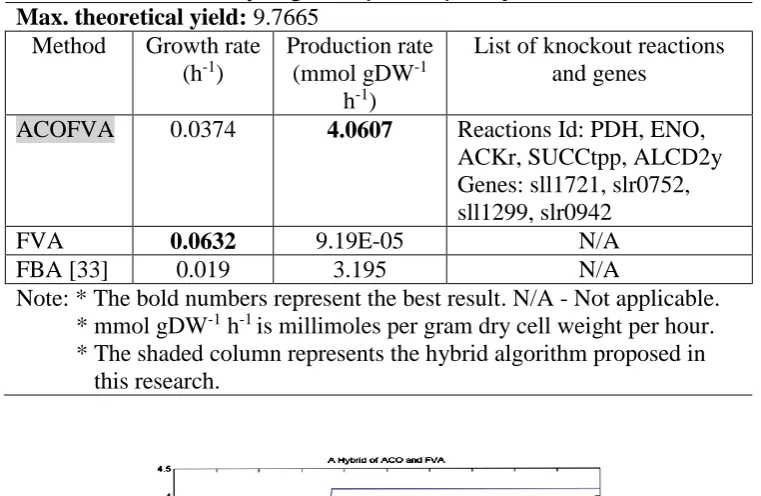
Comparison of the results obtained for H2 production using ACOFVA and other methods are showed in Table 6. The results return by FVA is by the wild type (WT)
Reaction Id
Reaction description
Genes Pathway
PDH Pyruvate dehydrogenase
sll1721 nad + coa + pyr -> nadh + co2 + accoa
ENO Enolase slr0752 2pg <=> h2o + pep ACKr Acetate kinase sll1299 acetyl-CoA => acetate SUCCtpp Succinate transport
via diffusion (periplasm to cytosol)
N/A h + succ <=> h + succ
ALCD2y Alcohol dehydrogenase
175 A Hybrid of Ant Colony Optimization and
model. From the table, it can be clearly seen that the value of growth date is a bit lower than the WT. However, the production rate of the modified model is far higher than the WT. For the Synechocystis model, at growth 0.0374 h-1 this model can produce 4.0607 mmol gDW-1 h-1 of biohydrogen. This is because the modified model has removed some competitive reactions that could affect the acquisition of high production of interest metabolite. Figure 6 shows the convergence graph for biohydrogen production. The graph shows that this algorithm can converge faster which takes nearly iterations 40 although the algorithm is allowed to run until 100 iterations.
Table 6. Comparison between different methods for growth rate and production rate of biohydrogen in Synechocystis sp PCC6803.
Max. theoretical yield: 9.7665 Method Growth rate
(h-1)
Production rate (mmol gDW-1
h-1)
List of knockout reactions and genes
ACOFVA 0.0374 4.0607 Reactions Id: PDH, ENO, ACKr, SUCCtpp, ALCD2y Genes: sll1721, slr0752, sll1299, slr0942
FVA 0.0632 9.19E-05 N/A
FBA [33] 0.019 3.195 N/A
Note: * The bold numbers represent the best result. N/A - Not applicable. * mmol gDW-1 h-1 is millimoles per gram dry cell weight per hour. * The shaded column represents the hybrid algorithm proposed in this research.
Fig. 6. ACOFVA convergence graph for production of biohydrogen.
Amira Husna Azhar et al. 176
produce ATP. Thus by removing this reaction, conversion of pyruvate to acetyl-CoA cannot be carried out as reflected in the production of other competitive metabolites that are present in that pathway. Removing ACKr also causes the reaction to carry acetyl-CoA as unable. Thus, pyruvate can only focus on the production of H2. slr0752 is a protein-coding gene which is involved in glycolysis.
This gene helps in converting glycerate to phosphoenolpyruvate. By deleting the enolase reaction and its gene, phosphoenolpyruvate cannot be used to catalyse the pyruvate production which then lactates or ethanol is not able to be produced. SUCCtpp is a reaction for subsystem of transportation of succinate via diffusion from periplasm to cytosol. This reaction is removed because it is not an important path to overproduce the interest metabolites. However, this reaction does not contain any gene because it is a transport reaction as mentioned. Reaction alcohol dehydrogenase with gene slr0942 is other reaction (gene) suggested to be knocked out. All of this information is according to KEGG.
Conclusion and Future Works
The advancement of computational biology use in metabolic engineering area to predict study about genome-scale metabolic model has become more popular by the days. Metabolic flux analysis shows many successful results in studying genome data. However, the accuracy and efficiency of existing methods are still not viable, thus setting a challenge that calls for an action for improvement. These two points are the crucial keys in developing any computational methods to obtain better results in predicting and observing the phenotype of interest in the biotechnology field. Consequently, it fulfills the industrial market needed such as for biofuel, food and the pharmaceutical sectors. In this paper, a hybrid of modeling simulation of constraint-based method and optimization algorithm which is ACOFVA has been proposed to overcome the issues mentioned. This algorithm has successfully predicted several reactions and genes that can be knocked out in order to improve and optimize the production of desired metabolites in a viable growth rate. This particular research only focuses on the production rate of L-Phe and H2 with some
information of reaction and genes suggested to knockout. The list of reaction and genes knockout need to be further validated through wet lab experiment. ACOFVA has successfully improved the performance of other existing methods such as FBA, FVA, CBAFBA and also ACOFBA. This is because the newly developed algorithm has implemented some suitable parameters in the algorithm that was tested earlier. It directly improves the accuracy while searching for the best value of an objective function. Based on the experiment, the results showed that the L-Phe and H2
177 A Hybrid of Ant Colony Optimization and
of phenotype for other metabolites, too.
ACKNOWLEDGEMENT
We would like to express gratitude to the editors and reviewers for helpful suggestions and Universiti Teknologi Malaysia for sponsoring this research by the GUP Research Grant (Grant Number: Q.J130000.2528.12H12) and FRGS Research Grant (Grant Number: R.J130000.7828.4F720).
References
[1] Chartrain, M., Salmon, P. M., Robinson, D. K., & Buckland, B. C. (2000). Metabolic engineering and directed evolution for the production of pharmaceuticals. Current Opinion In Biotechnology.11(2), 209-214.
[2] Mahalik, S., Sharma, A. K., & Mukherjee, K. J. (2014). Genome engineering for improved recombinant protein expression in Escherichia coli. Microbial Cell Factories, 13(1), 1.
[3] Kumar, R.R., & Prasad, S. (2011). Metabolic Engineering of Bacteria. Indian
Journal of Microbiology, 51(3), 403-409.
[4] Atsumi, S., & Liao, J. C. (2008). Metabolic engineering for advanced biofuels production from Escherichia coli. Current Opinion In Biotechnology.19(5), 414-419.
[5] Wiechert, W. (2002). Modeling and simulation: tools for metabolic engineering. Journal of Biotechnology, 94(1), 37-63.
[6] Veziroglu, A., & Macario, R. (2011). Fuel cell vehicles: State of the art with economic and environmental concerns. International Journal of Hydrogen Energy.36(1), 25-43.
[7] Liu, S., Xiao, M., Zhang, L., Xu, J., Ding, Z., Gu, Z., & Shi, G. (2013). Production of l-phenylalanine from glucose by metabolic engineering of wild type Escherichia coli W3110. Process Biochemistry. 48(3), 413-419.
[8] Price, N. D., Papin, J. A., Schilling, C. H., & Palsson, B.O. (2003). Genome-Scale Microbial In Silico Models: The Constraints-Based Approach. Trends in biotechnology. 21(4), 162-169.
[9] Lee, J. M., Gianchandani, E. P., & Papin, J. A. (2006). Flux Balance Analysis in the Era of Metabolomics. Briefings in Bioinformatics, 7(2), 140-150. [10]Martins Conde, P. D. R., Sauter, T., & Pfau, T. (2016). Constraint Based
Amira Husna Azhar et al. 178
[11]Mahadevan, R., & Schilling, C. (2003). The effects of alternate optimal solutions in constraint-based genome-scale metabolic models. Metabolic Engineering, 5(4), 264-276.
[12]Gudmundsson, S., & Thiele, I. (2010). Computationally Efficient Flux Variability Analysis. BMC bioinformatics, 11(1), 489.
[13]Segre, D., Vitkup, D., & Church, G. (2002). Analysis of Optimality in Natural and Perturbed Metabolic Networks. Proceedings of the National Academy of Sciences (Vol. 99(23), pp. 15112-15117).
[14]Shlomi, T., Berkman, O., & Ruppin, E. (2005). Regulatory on/off Minimization of Metabolic Flux Changes After Genetic Pertubations.
Proceedings Of The National Academy Of Sciences (Vol. 102(21), pp.
7695-7700).
[15]Burgard, A. P., Pharkya, P., & Maranas, C. D. (2003). Optknock: A bilevel programming framework for identifying gene knockout strategies for microbial strain optimization. Biotechnology and Bioengineering,84(6), 647-657. [16]Xu, Z., Zheng, P., Sun, J., & Ma, Y. (2013). ReacKnock: Identifying Reaction
Deletion Strategies for Microbial Strain Optimization Based on Genome-Scale Metabolic Network. Plos ONE, 8(12), e72150.
[17]Patil, K., Rocha, I., Förster, J., & Nielsen, J. (2005). Evolutionary Programming as a Platform for In Silico Metabolic Engineering. BMC bioinformatics, 6(1), 1.
[18]Tepper, N., & Shlomi, T. (2009). Predicting metabolic engineering knockout strategies for chemical production: accounting for competing pathways. Bioinformatics, 26(4), 536-543.
[19]Pharkya, P., & Maranas, C. D. (2006). An optimization framework for identifying reaction activation/inhibition or elimination candidates for overproduction in microbial systems. Metabolic Engineering, 8(1), 1-13. [20]Colorni, A., Dorigo, M., & Maniezzo, V. (1991). Distributed optimization by
ant colonies. In Proceedings of the first European conference on artificial life
(Vol. 142, pp. 134-142).
[21]Xue, X. D., Cheng, X. D., Xu, B., Wang, H.L., & Jiang, C.P. (2010). The basic principle and application of Ant Colony Optimization algorithm. In Artificial
Intelligence and Education (ICAIE) International Conference (pp. 358-360).
IEEE.
179 A Hybrid of Ant Colony Optimization and
[23]Yin, L. H., Choon, Y. W. , Mohamad, M. S. , Chai, L. E. , Chong, C. K., Abdullah, A., Deris, S., & Illias, R. M. (2013). Prediction of Vanillin and Glutamate Productions in Yeast Using a Hybrid of Continuous Bees Algorithm and Flux Balance Analysis (CBAFBA). Current Bioinformatics. 9(3), 284-294.
[24]Choon, Y. W., Mohamad, M. S., Deris, S., & Illias, R. M. (2014). A hybrid of bees algorithm and flux balance analysis (BAFBA) for the optimisation of microbial strains. International Journal of Data Mining and Bioinformatics.
10(2), 225.
[25]Salleh, A. H. M., Mohamad, M. S., Deris S., Omatu, S., Fdez-Riverola, F., & Corchado, J. M. (2015). Gene knockout identification for metabolite production improvement using a hybrid of genetic ant colony optimization and flux balance analysis. Biotechnology and Bioprocess Engineering.20(4), 685-693.
[26]Chua, P. S., Salleh, A. H. M., Mohamad, M. S., Deris, S., Omatu, S., & Yoshioka, M. (2015). Identifying a gene knockout strategy using a hybrid of the bat algorithm and flux balance analysis to enhance the production of succinate and lactate in Escherichia coli. Biotechnology And Bioprocess Engineering. 20(2), 349-357.
[27]Tavares, Neto, R., & Godinho Filho, M. (2011). An Ant Colony Optimization approach to a permutational flowshop Scheduling Problem with outsourcing allowed. Computers and Operations Research. 38(9), 1286-1293.
[28]Dobson, P. D., Smallbone, K., Jameson, D., Simeonidis, E., Lanthaler, K., Pir, P., Lu, C., Swainston, N., Dunn, W. B., Fisher, P., Hull, D., Brown, M., Oshota, O., Stanford, N. J., Kell, D. B., King, R. D., Oliver, S. G., Stevens, R. D., & Mendes, P. (2010). Further developments towards a genome-scale metabolic model of yeast. BMC Systems Biology.4(1), 145.
[29]Nogales, J., Gudmundsson, S., Knight, E. M., Palsson, B. O., & Thiele, I. (2012). Detailing the optimality of photosynthesis in cyanobacteria through systems biology analysis. Proceedings Of The National Academy Of Sciences
(Vol. 109(7), pp. 2678-2683).
[30]Yang, X. S., Deb, S., Loomes, M., & Karamanoglu, M. (2013). A framework for self-tuning optimization algorithm. Neural Computing & Applications.23(7-8), 2051-2057.
high-Amira Husna Azhar et al. 180
level production of 3-hydroxypropionic acid in Saccharomyces cerevisiae via β-alanine. Metabolic Engineering. 27, 57-64.
[32]Mao, L. & Verwoerd, W.S. (2013). Genome-Scale Stoichiometry Analysis to Elucidate the Innate Capability of the Cyanobacterium Synechocystis for Electricity Generation. Journal of industrial microbiology & biotechnology.
40(10), 1161-1180.
![Fig. 2. Basic Ant Colony Optimization Behavior at Different Time Stamps [27]](https://thumb-us.123doks.com/thumbv2/123dok_us/1283771.1160871/8.595.138.476.493.579/fig-basic-colony-optimization-behavior-different-time-stamps.webp)