74129
DEVELOPMENT OF KNOWLEDGE MANAGEMENT FOR
ADAPTIVE HYPERMEDIA LEARNING SYSTEM
SHAHLIZA ABD HALIM
NOR BAHIAH HJ AHMAD
PM DR NAOMIE HJ SALIM
PM DR SITI MARYAM HJ SAMSUDIN
FAKULTI SAINS KOMPUTER DAN SISTEM MAKLUMAT
UNIVERSITI TEKNOLOGI MALAYSIA
Abstract
Adaptive hypermedia learning systems (AHLS) aims in adaptively accommodating learning materials based on individual differences in user. This kind of system faces problems in cognitive overload where too many information are given to students resulting to some of them become lost in hyperspace. In order to reduce the overload, user or leaner should be given materials well suited with their learning ability and also in their style of learning. Our project concentrates in individualizing the learning material and navigational paths to adapt with different users learning styles and knowledge acquisition. Learning ability is associated by their knowledge acquisition in using the system captured via user model. Knowledge acquisition per se is not enough as research on learning shows students learns effectively when they were thought with methods that suits their learning style. Pedagogical framework for this project comprise of Myers Briggs Type Indicator (MBTI) personality factor as learning strategy and Howard Gardner and Honey & Mumford theory for learning technique and method. Our contribution is on the learning materials which are structured based on the pedagogical framework. Another contribution is mainly on the theoretical and practical mechanism for the integration of computational intelligence techniques mainly to personalize the user both at the presentation and navigation level. Theoritical and practical aspects of this project are discussed; e.g., instructional material suitable for learning style chosen, experiments on Kohonen neural network and rough sets for classification of knowledge acqusitions, fuzzy logic architecture for the adaptation in learning style, architecture of the prototype developed and also its evaluation. The contribution of this project is based on these seven papers describe herewith:
Paper I discusses the problems in personalizing instructional material that matches the differences of students according to student’s fuzzy membership to certain learning styles.
Paper II focuses on the use of computational intelligence techniques such as Kohonen self-organizing maps in the classification of student models and Fuzzy logic in the adaptation of learning material and navigation path.
Paper III discusses the structure of the learning material which are; 1) theory, 2) example, 3) exercise and 4) activities.
In paper IV, a generation of rough set rules is implemented in identifying the status of students’ knowledge acquisition in hypermedia learning.
Paper V describes the use of back propagation neural network in classifying the student.
Paper VI presents the architecture and design for the development of an adaptive hypermedia learning system for teaching and learning Data Structure.
Abstrak
Sistem Pembelajaran Hipermedia Adaptif (AHLS) mempunyai matlamat untuk menyesuaikan material pembelajaran secara adaptif berdasarkan keunikan yang terdapat pada setiap individu. Sistem seumpama ini menghadapi masalah bebanan kognitif lebihan dimana terlalu banyak maklumat diberikan kepada pelajar menyebabkan sesetengah daripada pelajar “sesat dalam ruang hiper”. Untuk mengurangkan bebanan tersebut, pengguna atau pelajar perlu diberikan bahan yang bersesuaian dengan kemampuan pembelajarannya dan juga gaya pembelajarannya. Projek ini menumpukan kepada persembahan bahan pembelajaran dan laluan penyusuran yang unik bagi setiap indivdu bagi membolehkan adaptasi dilakukan terhadap gaya pembelajaran dan perolehan pengetahuan yang berbeza dikalangan pengguna atau pelajar. Kemampuan pembelajaran individu dilihat berdasarkan perolehan pengetahuan semasa menggunakan sistem dimana ianya disimpan di dalam model pengguna. Perolehan pengetahuan semata-mata tidak mencukupi dimana penyelidikan dalam bidang pembelajaran menunjukkan pelajar dapat mempelajari dengan lebih efektif apabila mereka diajar dengan kaedah yang bersesuaian dengan gaya pembelajaran mereka. Rangkakerja pedagogi bagi projek ini adalah terdiri daripada faktor personaliti Myers Briggs Type Indicator (MBTI) sebagai strategi pembelajaran dan teori Howard Gardner serta Honey&Mumford sebagai kaedah dan teknik pembelajaran. Sumbangan projek ini adalah dari sudut material pembelajaran yang telah distrukturkan berdasarkan kepada rangkakerja pedagogi. Sumbangan utama adalah mekanisme secara teori dan praktikal bagi integrasi teknik kepintaran komputan bagi memberikan material yang khusus kepada pengguna pada aras persembahan dan navigasi. Aspek teori dan praktikal bagi projek ini telah dibincangkan contohnya material pembelajaran yang bersesuaian dengan gaya pembelajaran yang dipilih, eksperimen terhadap rangkaian neural kohonen dan juga set kasar bagi pengklasifikasian perolehan pengetahuan, senibina bagi logik kabur untuk pengadaptasian gaya pembelajaran, senibina bagi prototaip yang telah dibina dan juga penilaian terhadap prototaip. Sumbangan projek ini adalah berdasarkan kepada tujuh kertas kerja yang diterangkan di bawah:-
Kertas I membincangkan masalah-masalah yang wujud dalam adaptasi bahan pengajaran bagi persembahan bahan pembelajaran yang sepadan dengan keunikan pelajar berpandukan hubungan kabur pelajar dengan gaya pembelajaran pelajar terbabit.
Kertas II memfokuskan kepada aplikasi teknik-teknik pengkomputeran pintar seperti pemetaan sendiri Kohonen dalam pengelasan model pelajar dan logik kabur dalam adaptasi bahan pembelajaran dan laluan penyusuran.
Kertas III pula membincangkan bahan-bahan pembelajaran yang terdiri daripada ; 1) teori, 2) contoh, 3) latihan dan 4) aktiviti.
Dalam Kertas IV penjanaan peraturan bagi set kasar telah diimplimentasikan dalam mengenalpasti status perolehan pengetahuan pelajar dalam pembelajaran hipermedia.
Kertas V menerangkan aplikasi rangkaian neural rambatan balik dalam mengelaskan pelajar. Kertas VI membentangkan senibina dan reka bentuk pembangunan sistem pembelajaran adaptif hipermedia bagi pengajaran dan pembelajaran Struktur Data.
TABLE OF CONTENT
ABSTRACT………...
i
ABSTRACT………...
ii
TABLE OF CONTENT………
iii
INTRODUCTION……….
1
PAPER I
: Fuzzy Logic Approach to Evaluate Student’s Preferable Learning Material
Based on Student Personality Factor
………..
7
PAPER II
: Individualizing the Learning Material and Navigation Path in an Adaptive
Hypermedia Learning System
……….
18
PAPER III
: Individualizing Learning Material Of Adaptive Hypermedia Learning
System Based On Personality Factor (MBTI) Using Fuzzy Logic Techniques
………
35
PAPER IV:
Rough Set Generation for Identifying Status of Student’s Knowledge
Acquisition
………..
47
Learning System: Preliminary Work
………..
60
PAPER VI
: Development of an Adaptive Hypermedia Learning System
………
73
PAPER VII
: Evaluation of Intelligent Tutoring System (SPATH)
………...………
87
DISCUSSION AND CONCLUSION………...………...
103
INTRODUCTION
Introduction to Knowledge Management and Knowledge Discovery
Knowledge management is a process which refers to a range of practices used by organizations to identify, create, represent and distribute knowledge for reuse, awareness and learning across the organization. This process deals with methods, models and strategies to capture, reuse and maintain knowledge. Knowledge discovery on the other hand is the process of identifying valid, novel, potentially useful and ultimately understandable patterns in data. It involves a new generation of techniques and tools to intelligently and automatically assist humans in analyzing the mountains of data for useful knowledge. In Adaptive Hypermedia Learning System (AHLS), knowledge management is crucial as it will organize knowledge base to store the learning sources and store user profile and at the same time restrict the amount of knowledge represented to the user. Knowledge discovery on the other hand can be use to discover knowledge about student behavior during their learning time.
Introduction to Adaptive Hypermedia Learning System (AHLS)
deal with exponential increases in the amount of available knowledge and increasingly complex processes.
Managing knowledge represents the primary opportunity for achieving substantial savings, significant improvements in human performance, and competitive advantage. Repositories promote the preservation, sharing, retrieval and reuse of data. A knowledge repository organizes and stores data, information, knowledge, expertise, and experience for one domain.
Literature Review on Kohonen Network
Kohonen network has been widely used for classification task and the results are considered succeeded Cho (1997). Basic Kohonen network like vector quantization or k-means can be used for simple classification Sarle (1994).
The development of the self-organizing map (SOM) was introduced by Kohonen (1995). Such maps are the end result of analysis by what are known as Kohonen networks. The self-organizing Kohonen network is a type of neural network and is popular in areas that require visualization and dimension reduction of large, high dimensional data sets. Kohonen network are a vector quantization method, which can preserve the topological relationships between input vectors when projected to a lower dimensional display space. The idea was to create a neural network to represent the input space using the topological structure of a grid to store neighborhood relations. In contrast to most neural network methods that use the desired result to compute the weights of the network, Kohonen network need no reference output (unsupervised learning).
The network is trained by finding the weight vector, which is most similar to an input vector. This weight vector, and its neighbors are then updated to make them more similar to the input vector. The output of training phase is a weight vectors. After training, the new testing data set is feeded into the SOM. During testing, the weights gained during training are used to classify the data set into a number of groups based on the similarity they shared.
evaluating which group represents which kind of data become difficult. Many researchers developed self-organizing techniques to automatically grouping a set of data to groups and using different techniques to interpret and labeling those groups (Kaski et al.,1998; Rauber, 1999; Drobics et al., 2000).
Literature Review on Fuzzy Logic
Fuzzy logic method, proposed by Zadeh [10], has proved to be very effective in handling the vagueness and uncertainty intrinsically existing in the knowledge possessed by people. It is also computationally undemanding and is most suitable for processing imprecise input data, as it supports natural description of knowledge and reasoning in the form of imprecise concepts, operators and rules [Negnevitsky 2002].
In ITS, fuzzy logic techniques have been used due to their ability to handle imprecise information, such as student’s actions, and to provide human descriptions of knowledge and of student’s cognitive abilities [Stathacopoulou et al. 1999]. The fuzzy logic system consists of three main stages: Fuzzification, Rule Evaluation and Defuzzification. Fuzzy rules based in fuzzy logic provide a qualitative description of the input-output relationship of a system using fuzzy linguistic term.
Research Problem
We define three major problems that lead us to the proposed solution in this project:
i. Management of large and complex knowledge in AHLS
Even though there has been many research conducted recently, researchers still face a problem to manage a large and complex knowledge in hypermedia learning system. This is because of too many information are given to the students that makes some of them become lost in hyperspace (Brusilovsky, 1996). The system had
ii. Identifying method for managing student model intelligently and method
for individualizing the learning material
With SPAtH, we apply computational intelligence approach to help managing the learning material and students’ data. We do this by using fuzzy logic to evaluate student’s preferable learning material based on student personality factor and individualizing it to suit the individual preferences. Some of the techniques implemented in this project to solve the above questions are neural network such as back propagation and Kohonen’s self-organizing maps, fuzzy logic and rough set.
iii. Integrating the learning style and knowledge acquisition for adaptivity in
hypermedia learning system
It is an important part of the research which is to integrate the learning style and knowledge acquisition to make it possible for the adaptivity in SPAtH. Our research has developed the design of adaptation based on the learning style information and level of knowledge acquisition. To determine the level of knowledge acquisition, we have selected the attributes of adaptation based on the work done by Papanikolaou et al.(2003) and Paridah et. al. (2001). The attributes selected are the learning time, number of backtracking, number of getting help function and the score earned while doing the exercise. Meanwhile, the pedagogical and learning style refer to student’s personality factor based on (MBTI) as explained in Norreen & Naomie (2005). We also have identified the structure of the learning material that the system should offer to learners with different styles and characteristics.
Research Objective
To provide the solution to the above problem statement, we define three objectives:
ii. To test and enhance the methods for personalizing the learning style using Fuzzy Logic and classification of user model based on knowledge acquisition using Kohonen neural network and Rough Sets.
iii. To develop prototype software that integrates the mechanism of adaptivity in learning style and knowledge acquisition for AHLS.
iv. To evaluate the prototype software based on its impact in student learning particularly in its usability.
Reasearch Scope
This research is conducted to achieve the above objectives within the following scope:
i) Study soft computing techniques suitable for adaptation in Hypermedia Learning System such as Rough Sets, Kohonen Network and Fuzzy Logic. ii) Learning style is based on Myers Brigss Type Indicator (MBTI).
iii) The prototype of an AHLS will be used for teaching and learning Data Structure for university students.
Report Overview
Report on the research is explained by the following papers:
i. PAPER I, “Fuzzy Logic Approach to Evaluate Student’s Preferable Learning Material Based on Student Personality Factor”, discusses the problems in personalizing instructional material for representing learning material that matches the differences of students according to student’s fuzzy membership to certain learning styles.
classification of student models and Fuzzy logic in the adaptation of learning material and navigation path.
iii. PAPER III, “Individualizing Learning Material Of Adaptive Hypermedia Learning System Based On Personality Factor (MBTI) Using Fuzzy Logic Techniques”, propose the solution to the inflexible linking provided in conventional hypermedia learning system that can cause teaching and learning to be less effective.
iv. PAPER IV, “Rough Set Generation for Identifying Status of Student’s Knowledge Acquisition”, implementation of a generation of rough set rules in identifying the status of students knowledge acquisition in hypermedia learning.
v. PAPER V, “Student Classification Using Neural Network in Adaptive Hypermedia Learning System: Preliminary Work”, describe the use of back propagation neural network in classifying the student that is needed for the system to provide suitable learning module to each individual student by taking consideration of students’ knowledge level and their performances as they go through the system.
vi. PAPER VI, “Development of an Adaptive Hypermedia Learning System”, presents the architecture and design for the development of an AHLS for teaching and learning Data Structure.
PAPER I:
FUZZY LOGIC APPROACH TO EVALUATE STUDENT’S PREFERABLE
LEARNING MATERIAL BASED ON STUDENT PERSONALITY FACTOR
Norreen Binti Haron Software Engineering Lab Department of Software Engineering
Faculty of Computer Science and Information System Universiti Teknologi Malaysia
Naomie Binti Salim
Faculty of Computer Science and Information System Universiti Teknologi Malaysia
Abstract
represented the student’s preferable learning material; (theory, example, exercise and activities). Based on fuzzy set and fuzzy rule theory, the vagueness and uncertainty intrinsically existing in the knowledge possessed by expert is computed whilst providing qualitative description of the input-output relationship using fuzzy linguistic terms. Triangle fuzzy set, Mamdani inference and center of gravity (COG) defuzzification techniques are used in the system. Comparison of the defuzzified values of the fuzzy rule base system and the value from conventional system shows that the fuzzy rule base system has better performance in structuring the learning material.
Keywords
Fuzzy logic, Fuzzy sets, Fuzzy ruled base, Learning style, AHLS.
1. Introduction
Research on learning has shown that student learns differently, they process and represent knowledge in different ways and they learn more effectively when taught with preferred methods. Information about learning style can help system become more sensitive to the differences students using the system.
Although learning style theory is widely accepted amongst educational theorists in the context of e-learning environments [1,2,3,4,5], there is still no research on the adaptation to individualize student’s learning material based on fact that students have more than one learning style in a certain degree. In particular the possibility of fluctuations in a learning style with changing tasks or content has not yet been addressed [6].
In designing the fuzzy logic system, it is important to identify the main control variables and determine the term set which is at the right level of granularity for describing the values of each linguistic variable [9]. In this problem, the fuzzy system is represented by four input linguistic variables (or the antecedents), and four output linguistic variables (or the consequents). Also, each input and output may be represented by either a three-term-set or a five-term-set of linguistic values. After defining the fuzzy variables and its term sets, fuzzy rule base is then being constructed. The number of fuzzy rules being formed is directly related to the number of fuzzy term sets defined at the antecedents. At the end of the process, the crisps output shows the structure of the learning material, which is learning material that the student most preferable and which learning material that the student choose less attention.
2. Approach and Method
Fuzzy logic method, proposed by Zadeh [10], has proved to be very effective in handling the vagueness and uncertainty intrinsically existing in the knowledge possessed by people. Fuzzy rules based in fuzzy logic provide a qualitative description of the input-output relationship of a system using fuzzy linguistic term. Moreover, fuzzy linguistic rule appear close to human reasoning and in many real-world applications, and it is more adequate and flexible for knowledge representation than conventional crisp IF THEN rules. Thus, it is reasonable to use fuzzy logic system to classify students and determine the most suitable learning material for them.
Fuzzy logic techniques in this research are used to personalize the learning material where it denotes to structures of learning material. It calculates precisely the structures of learning material (theory, example, exercise and activities) that suit student’s personality.
In this study, the fuzzy sets and fuzzy rules are constructed based on the standard of mastery or the criterion-referenced acquired from the human instructors’ experience and knowledge about student’s learning style.
combine all the fuzzy output derived from fuzzy rules, and last step, the defuzzification stage produces the output in crisp value. In this problem, the defuzzified value is derived based on the centre of gravity method. Figure 1 shows the flow of the fuzzy logic system.
Figure 1: Flow of Fuzzy Logic System
In this paper, there are four inputs and four outputs of linguistic variables are being considered. The input linguistic variables are representing the student personality’s scores; extrovert scores, introvert scores, sensor scores and intuitive scores.
The input expressed by:
(xa, xb, xc and xd). (1)
Whilst, the outputs are expressed by:
Structure of learning material (Theory, example, exercise, activities)
Crisp Output
Fuzzification
Fuzzy Processing
Rule base
Defuzzification Sensor
Extrovert
Introvert
Fuzzy Input
Fuzzy Output
Membership Function (Input)
Membership Function (Output)
Rule
Intuitive
(ya, yb, yc and yd) (2)
that represents the student’s acceptance level of learning material; theory, example, exercise and activities.
To identify student personality’s scores as fuzzy numerical data in ranges (0.0, 1.0), all the score retrieve from pre-course questionnaire are gathered according to each personality and are calculated by dividing the total score of particular personality, si, with the total number of pre-course questionnaire answered for that
particular personality, P, as follows:
(3)
We also determine the membership function of fuzzy set in fuzzification stages. The membership functions of fuzzy set in this paper are based on Zimmerman [11] which is allows the element in set to have multiple degree of membership. For example:-
à = {(x, à (x)) | x e R}) (4) where x={100, 90, 80, 70, 60, …, n}
then à ={(100, 1), (90, 0.9), (80, 0.8), (70,0.7), (60, 0.6),…, (n, à (x))}
-R is student,
-x is student personality’s value,
-Ã (x) is membership function x in Ã,
-(Ã) is a fuzzy set for personality’s value x with student’s acceptance level of theory
learning material.
The membership value 1, appoint to the student personalities x=100, where the
student’s acceptance level of theory learning material at the highest level. The student’s acceptance level will decrease when number in personality x become lower.
In the second stages, rule evaluation, the inference rule of fuzzy reasoning consists of multiple antecedents and multiple consequents are expressed as below: Ri :
Xa= si P
i = 1
P
IF Xa is N1 and Xb is N2 and Xb is N3 and Xd is N3 THEN
Y1 is M1 and Y2 is M2 and Y3 is M3 and Y4 is M4
where Ri, (i = 1, 2, … n) is the rule number, Ni, (i =1, 2 and 3) are the membership functions of the antecedent part, Mi, (i =1, 2, 3, 4 and 5) are the membership functions of the consequent part. The example of fuzzy rules applied in this problem as show in Table 1.
Input:-
{E-extrovert, I-introvert, S-sensor, N-intuitive} Output:-
{1-theory, 2-example, 3-excersice, 4-activity}.
Table 1: Example of Fuzzy Rules
Input-
(student personality) Output - learning Material
E I S N 1 2 3 4
Low High Low High VHigh High Low VLow Low High Med Med High Med Low Vlow Low High High Low Med VHigh VLow Low
: : : : : : : : High Low High Low VLow Low High VHigh
the same time significantly simplifies the process of computation. The fuzzy set is expressed by three parameters {a, b, c} as shown in figure 2.
Figure 2- Triangular fuzzy set
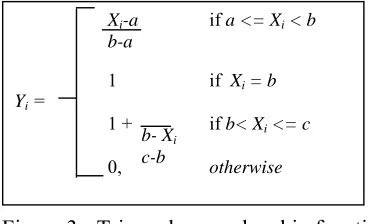
The membership value is derived by the following formula as shown in Figure 3.
Figure 3 - Triangular membership function
where a, b, and c are parameters that control the intervals of the triangle (as shown in figure 2), Xi is the input (i =1, 2, 3, 4), and Yi is the output of fuzzification input i.
Overall process in second stages is expressed as following definition:-
Ĺi(z):=((Rαi = [Ai(xa1) Bi(xb1)] ) Li(z)) for i= 1,2,3…n (5)
Ĺi(z) is fuzzy output retrieved from selected rule (Rα) based on the rule evaluation , input data, antecedent (xa,xb,xc and xd) and output data, consequent, Li(z).
The maxima method in aggregation stage is based on the definition shown in equation (6):-
Xi-a if a <= Xi < b
b-a
1 if Xi = b
1 + if b< Xi <= c
0, otherwise
b- Xi
c-b Yi =
Yi
1.0
a b c
0.0 X
Ļ (z) = Ĺ1 (z) Ĺ2 (z)
= (Rα1 L1 (z)) (Rα2 L2 (z)) (6)
Ļ(z) are fuzzy set expressed from combination of all consequent values retrieved from selected rule, Ĺi(z), (i= 1,2,3…n), where Rαi is selected rule and Li(z), (i= 1,2,3…n), is fuzzy consequent value.
The defuzzified value of the fuzzy reasoning, are derived based on the Mamdani-style inference (centre of gravity-COG) as shown in equation (7) below:
COG = (7)
3. Experiment and Result
Table 2: The Comparison between Fuzzy rule base system and Conventional System
Data Input
(student
personality)
%
Fuzzy rule base system Conventional System
E I S N Theory Example Exercise Activity Theory Example Exercise Activity 30 70 60 40 0.554 0.683 0.317 0.446 0.000 1.000 0.000 0.000 46 54 40 50 0.526 0.470 0.500 0.428 1.000 0.000 0.000 0.000 50 30 80 20 0.187 0.569 0.25 0.750 0.000 0.000 0.000 1.000
Comparison of the defuzzified values of the fuzzy rule base system and the value from conventional system shows that the fuzzy rule base system present better performance in structuring the learning material. As shows in table 2, the
c
∑ Zb (x) x x=a c
conventional system can’t structure the learning material and shows only one learning material to the user even though the user have mixed traits of different styles. Differ from fuzzy rule base system; the students can have different learning material according to their mixed traits of different styles, with a certain percentage of membership rather solely having one particular learning material to learn. Moreover, the result also shows that the learning material could be structure according to the defuzzified result.
4. Conclusion and Further Work
This paper has proposed a way to personalize the learning material for AHLS, which aims to provide learners with a customized learning environment. It emphasizes the combination of learning style theories and artificial intelligent techniques. Fuzzy logic techniques used to impart the learning content based on student’s fuzzy personality data and instructional rules in order to support customisation that will allow learners to learn faster and understand the learning material much easier. Conversely, the challenge is to identify what those learning content (structure of learning material) for a given learner in online system based on student personality and which result is more precise to the learner’s personality whether the traditional approach or using the fuzzy logic techniques.
For further work, the author suggested to test the evaluation and performance of this theory, the author will conduct two assessments; testing the performance of effectiveness and testing the accuracy of the system. In the first evaluation, the author divide the student into two groups where as both group have same knowledge level. The first group will use the system that proposes in this theory while other group will use a system without including this theory. Both groups will take a test before and after using both systems. The result from the test would show which of both group perform good result. This is base on the result from student’s test after using the systems.
This questionnaire is use to identify the learning style of the student. In using the prototype system, student will be show several button that link to each of the teaching method. Based on the student questionnaire and student preferable of teaching method, the system will recognize the relationship between student learning style and the teaching style. The result will be use to compare with the result in fuzzy logic techniques. This comparison is use to find the precision of fuzzy logic techniques with student preferences.
5. References
[1] N. Stach, A. Cristea and P. De Bra. “Authoring of Learning Styles in Adaptive Hypermedia.” in Procceding. of WWW Conference. 2004.
[2] J.E. Gilbert and C.Y. Han. “Adapting Instruction In Search Of a Significant Difference”. Journal of Network and Computer applications. 1999. 22. 3.
[3] M. Kwok and C. Jones. “Catering For Different Learning Styles, Association for Learning Technology”. -Association for Learning Technology Journal-(ALT-J). 1985. 3(1). 5-11.
[4] M. Grigoriadou, K. Papanikolaou, H. Kornilakis and G. Magoulas. “ INSPIRE: An Intelligent System For Personalized Instruction In A Remote Environment”. In Proceedings of 3rd Workshop on Adaptive Hypertext and Hypermedia . 2001. pp. 13-24.
[5] P. Paredes and P. Rodriguez. “Considering Learning Styles in Adaptive Web-based Education”. The 6thWorld Multi Conference on Systemics, Cybernetics and Informatics. 2002. vol. II. pp. 481-485.
[6] C. Wolf. “iWeaver: Towards 'Learning Style'-based e-Learning in Computer Science Education. ACE2003”. Conferences in Research and Practice in Information Technology. 2003.
[7] S. Carolyn. et. al. “Myers Briggs Type Preferences in Distance Learning Education”. In International Journal of Educational Technology. 2001. 2(2). [8] C. C. Bishop. et. al. “The Myers-Briggs Personality Type and Its Relationship to
[9] H. R. Berenji. “Fuzzy Logic Controllers In Yager R.R. & Zadeh L. A., An Introduction to Fuzzy Logic Applications in Intelligent System”. Kluwer Academic Publisher, 1992.
[10] L. A Zadeh. “Fuzzy Logic for Management of Uncertainty”. John Wiley & Sons, New York.1992.
[11] H.J. Zimmerman, “Fuzzy Sets Theory - and Its Applications”. Kluwer Publishing Company. 1985.
PAPER II:
INDIVIDUALIZING THE LEARNING MATERIAL AND NAVIGATION
PATH IN AN ADAPTIVE HYPERMEDIA LEARNING SYSTEM
Bariah Yusob1, Norreen Haron2, Nor Bahiah Hj Ahmad3, Shahliza Abd Halim4 1 [email protected] , 2 [email protected] , 3 [email protected] & 4
Department of Software Engineering
Faculty of Computer Science and Information System
Abstract
This research aims to develop a prototype of an AHLS for teaching and learning Data Structure for university students. Our system integrates pedagogy of education and intelligence technique in the presentation of the learning material and the suggested navigation path. The system comprises of three main components, user profile model, domain model and adaptive engine. User profile model stores the learning activities, learning performances and interaction history of each student in the database. Adaptive navigation path will provide the annotated link based on the performance and the interaction history of each student. To reduce disorientation, each student will get different paths based on their level of knowledge acquisitions and learning style. Adaptive engine will determine the appropriate learning material and the navigation path based on the student’s status that was retrieved from the user profile model.
performance. By adapting the user both at presentation and navigation level, we hope that this study can solve disorientation and lost in hyperspace problem that usually occur in conventional hypermedia learning system.
Keywords: Adaptive hypermedia learning system, personalization, user profile,
self-organizing map, learning style.
1.0 Introduction
The Adaptive Hypermedia Learning Systems HLS (AHLS) is a computer based learning system in which interactive and dynamic learning module is customized to each student. Research on learning has shown that each individual student learns differently and processes and represents knowledge in different ways. Therefore, it is important to diagnose the learning style because some students learn more effectively when taught with preferred methods. Information about the learning style can help system become more sensitive to the differences students using the system. Several systems adapting the learning style have been developed to date; however, it is not clear which aspects of learning characteristics are worth modelling, how the modelling can take place and what can be done differently for users with different learning style [Brusilovsky 2001]. There are serious consequences when student learning styles and teaching styles do not match. One of it, the students face on difficulties to understand what is being taught, this lead to decrease of student interest to continue study in the subject and the student need a long term to finish one lesson session [Hashim and Yaakub 2003].
Adaptive engine will determine the appropriate learning material and the navigation path based on the student’s status that was retrieved from the user profile model.
Domain model stores all the teaching materials including the learning objectives, lecture notes, examples, exercises and the answer for each question. To adapt to the user category, the flow of the learning material for each category of the student will be different. To assist the user in terms of navigation, an individualized navigation path is constructed for each student, suggesting the path or link that the student has already learned, forbidden (the prerequisite is not fulfill), ready to be learned and need revision. Each link for each node will be annotated in different colors suggesting the depth of knowledge that the user already acquired. This way, the user can choose which node has greater priority to be learned and thus enabling him to optimize the path he plan to explore while studying. By adapting the user both at presentation and navigation level, we hope that this study can solve disorientation and lost in hyperspace problem that usually occur in hypermedia learning system.
In this paper, a framework for learning path personalization in adaptive learning system is introduced. It aims to utilize the learning characteristics and to provide a personalized learning environment, that exploit pedagogical model and fuzzy logic techniques. The pedagogical model and learning style are referring to the student’s personality factor; Myers-Briggs Type Indicator (MBTI) [Carolyn et al. 2001; Bishop et al. 1994]. Based on the MBTI theory, the fuzzy logic techniques are then use to classify learning material (structure of learning material, type of learning material and additional link).
2.0 Approaches And Methods To Implement Adaptivity
In the construction of an AHLS, the first issue that needs to be considered is how to identify the user features and to develop the content that reflects the personality’s principles. The proposed architecture in this paper is based on this question. The architecture involved three main phases, as can be seen in Figure 1.
Based on Figure 1, the user profile model stores the information about learners in the learning system. The profiles were extracted from both explicit and implicit user profile. The explicit information is the information that the learner gave willingly or directly and he/she is aware that the information is kept in the database. The implicit information is the information the system collects without the learner acknowledgement. It records the learner’s activity and behavior as he/she navigates through the system.
In this work, we test the learner’s knowledge by giving them some exercises to be completed after finishing a concept. We keep the score that represent the explicit data because learner has to finish the exercises to gain scores. The implicit data used are the learning time, number of backtracking and number of getting help. From these data, we use Kohonen network to classify the learners’ into three categories as shown in Figure 1.The process of identifying the learner’s learning features is difficult [Brusilovsky 2001]. Moreover, it is not clearly defined which aspect in learning features that really useful for learner’s modelling. Besides, the process of developing and identifying the learner’s attributes in the learner’s model will take a very long time. Therefore, we use a simulated data that represent the actual learner’s data.
in focusing attention while the sensing and intuition type, illustrating the student preferable way in taking information.
The extrovert students prefer and focus on the outer activity and are energize by interaction with others. They prefer to talk, participate and interaction with people. While the introvert students prefer and focus on the inner activity. They prefer reading, listening to others and writing. Sensing student prefer concrete information, facts and procedures. They are good in memorization and like to go systematically, they also learn best with instruction that allow them to use their sense. Intuition student prefer discovering possibilities and relationship. They also like courses that involve a lot of experimentation and experiences.
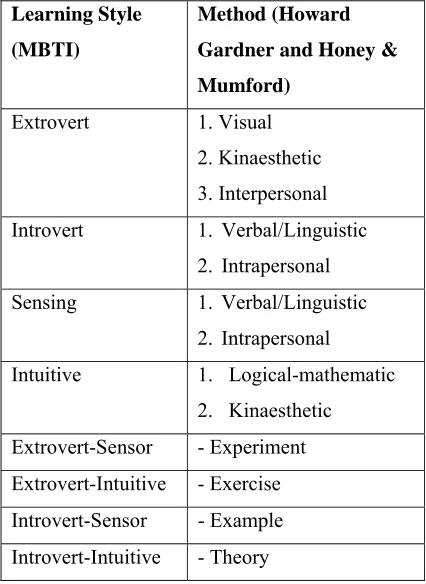
The pedagogical framework comprise the steps on how content is develop to reflect those personality principles. Table 1 shows the relationship between learning strategy and learning method.
Table 1: The Relationship between Learning Style and Method.
Learning Style
(MBTI)
Method (Howard
Gardner and Honey &
Mumford)
Extrovert 1. Visual
2. Kinaesthetic 3. Interpersonal Introvert 1. Verbal/Linguistic
2. Intrapersonal Sensing 1. Verbal/Linguistic
2. Intrapersonal Intuitive 1. Logical-mathematic
3.0 User Classification Based On Kohonen Network
Kohonen network has been widely used for the classification purposes and it produced an excellent results [Cho 1997; Vendlinski and Stevens 2000]. Basic Kohonen algorithm such as Vector Quantization or k-means clustering can be used as a simple classifier [Sarle 1994].
The Kohonen’s self-organizing map (SOM) was introduced by Professor Teuvo Kohonen at the University of Helsinki in 1982. The idea was to create a neural network to represent the input space using the topological structure of a grid to store neighborhood relations. In contrast to most neural network methods that use the desired result to compute the weights of the network, SOMs need no reference output themselves (unsupervised learning).
A SOM defines a mapping of an n-dimensional input space R to an
m-dimensional output space C (we use m=2). The output space consists of Nc neurons.
They are embedded in the topological structure of C, which may be an m-dimensional
grid or any other graph structure. To each neuron of the output space, a parametric weight vector in the input space [ 1, 2,..., ]T
s
w R
s s sn
µ µ µ
= ∈ is associated.
Eq. 6 define the mapping ∅ from the input space R to the topological structure C:
:
w R→C
∅ ,
( )
w
x→∅ x , (1)
where, ( )
wx
∅ is defined as,
{ }
( ) arg min ||i ||
w x = x−wi
∅ . (2)
Figure 1: The Architectures of the AHLS. Data Preparation
IMPLICIT USER PROFILE EXPLICIT USER PROFILE
0000111100011011110011…….
CLASSIFICATION PROCESS DATABASE
DATA PRE-PROCESSING
LEARNER’S STATUS
BEGINNER INTERMEDIATE ADVANCE
Fuzzification Rule
Evaluation Defuzzification Fuzzy Logic System
Decision Making Student’s learning strategy
The goal of Kohonen learning process is to reduce the distortion error:
1 ( ) || ||
| |
ci i
x I i C
d x x
I
h w
∈ ∈
=∑∑ − , (3)
where,
I denotes the set of input samples, ci
h denotes the neighbourhood relation in C between neuron i and the best
matching one c.
3.1 Experiment with Self-Organising Maps (Kohonen)
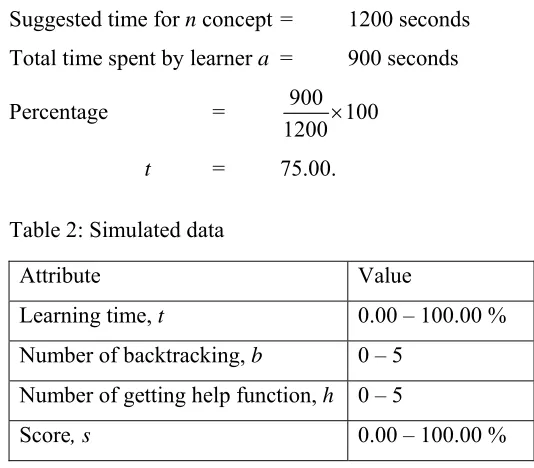
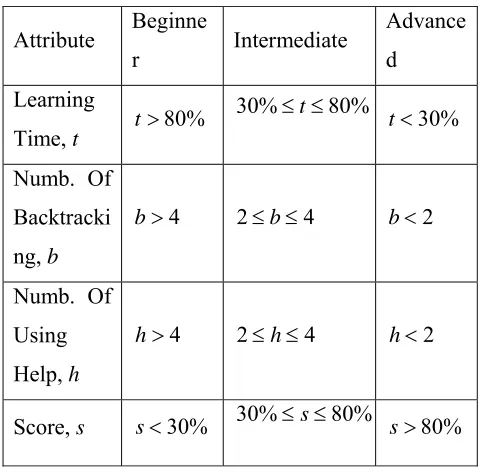
Table 2 shows the attributes and the values defined as simulated data. To develop a simulated data, we use the criteria shown in Table 3. When the learner log into the learning system, the system will count the time he/she spent on learning a concept. The system suggests the time to be spent on each concept. Learning time is calculated based on the percentage the learner takes to finish learning from the suggested time. The learner’s learning time is calculated as follows:
Suggested time for n concept = 1200 seconds
Total time spent by learner a = 900 seconds
Percentage = 900 100 1200×
t = 75.00.
Table 2: Simulated data
Attribute Value Learning time, t 0.00 – 100.00 %
Number of backtracking, b 0 – 5
Number of getting help function, h 0 – 5
Table 3: Criteria for learner’s classification Attribute Beginne
r Intermediate
Advance d Learning
Time, t t>80%
30%≤ ≤t 80% 30%
t<
Numb. Of Backtracki ng, b
4
b> 2≤ ≤b 4 b<2
Numb. Of Using Help, h
4
h> 2≤ ≤h 4 h<2
Score, s s<30% 30%≤ ≤s 80% s>80%
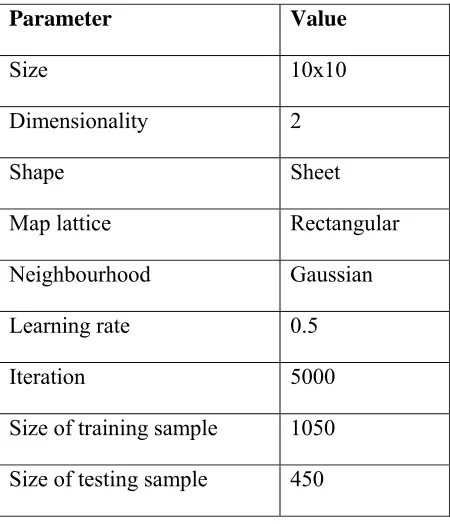
The number of backtracking shows that the learner is not fully mastering the concept, lose direction or change his/her learning goal. The number of backtracking is defined by counting how many times the learner reopen any pages in particular concept. In this research, help function is a list of definition and explanation on terms used in the notes given. This attribute shows that the more help the learner gets, the more he/she is having a difficulty in understanding a concept. The number of getting help is defined by counting how many time the learner click on the help button in particular concept. To test the learner’s level of mastering, the system provides an exercise at the end of the learning period. The score is calculated by the percentage of correct answers given. The SOM structure is defined as shown in Table 4.
All the data must be transformed into a standard format to get a valid and accurate classification. The transformation of the data is included in the pre-processing phase using a normalization method. We used a normalization method that was defined by [Rao 1995] as follows:
n
x
=2
1
( )
x
nx
n×
∑
where,
x
n is the input data for n.Table 4: Parameter settings for the SOM training
Parameter Value
Size 10x10
Dimensionality 2
Shape Sheet
Map lattice Rectangular
Neighbourhood Gaussian Learning rate 0.5
Iteration 5000 Size of training sample 1050
Size of testing sample 450
In the training phase, input data is given to the Kohonen network. The weights are captured after completing the training phase. The size of training sample is 1050. In the testing phase, there is no target data is provided. We used 450 dataset to the network. The network classifies the data based on the weights and outputs are obtained. When the testing results were obtained, the percentage of the classification accuracy was calculated.
3.2 Result of the Experiment
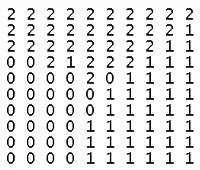
Figure 2: Result Map From Network Training
Table 5 shows the accuracy percentage of network classification in testing process. From 450 data presented, the networks are able to classify 445 data correctly. From the result shown, we conclude that Kohonen network is capable of classifying the learners’ data into categories. It gives more than 90% accuracy in both training and testing phase. The Kohonen’s SOM is definitely a good tool to classify data into a number of groups without supervision. It will be very useful in this study because it can deal with more complex and bigger sample of data when it is applied to the real learners’ data in the learning system’s database.
Table 5: Result from network testing Numb. Of Correct
Classification
Numb. Of testing data
Accuracy
445 450 98.89 %
4.0 Fuzzy Approach
are in terms of the techniques in personalizing the student learning material. The traditional techniques totally use the result from the questionnaires to personalize the learning material. The highest result from the student’s questionnaires will be considered as the student’s personality and the learning method is referring to the personality. Meanwhile, the fuzzy system will calculate the student’s personality and propose the suitable learning method to the student. The problem that occurs in traditional techniques is producing the suitable learning method once the students have equal result in their personality.
Fuzzy logic is computationally undemanding and is most suitable for processing imprecise input data, as it supports natural description of knowledge and reasoning in the form of imprecise concepts, operators and rules [Negnevitsky 2002]. In ITS, fuzzy logic techniques have been used due to their ability to handle imprecise information, such as student’s actions, and to provide human descriptions of knowledge and of student’s cognitive abilities [Stathacopoulou et al. 1999]. The fuzzy logic system consists of three main stages: Fuzzification, Rule Evaluation and Defuzzification. The fuzzification stage transforms crisp student’s personality data, captured in the student database, into suitable linguistic values.
Figure 3. Architecture of fuzzy system
Defuzzification
Membership Function (Output)
Rule
Fuzzy Output
Rule base
Fuzzy Input
Fuzzification Membership
Function (Input) Fuzzy Processing
Crisp Output
Structure of learning material (theory, example, exercise, experiment)
Type of learning material (linguistic, visual)
Preferable Link (E-mail, Forum) Crisp Input
Extrovert
Introvert
Sensor
In this paper, the linguistic variables are based on the MBTI where it provides 4 linguistic variables; (Extrovert, introvert, sensor and linguistic). Whilst the fuzzy set that use for this paper is triangular fuzzy set where it hold 3 parameter {a, b, c} and can be seen in table 3. The rule evaluation stage takes the fuzzified inputs, and applies them to the antecedents of the fuzzy rules. The defuzzification stage produces the output in crisp value. In this problem, the defuzzified value is derived based on the maxima and sum method in Mamdani-style inference. The suitable defuzzified will be choose appropriately based on the result.
The triangular membership function can be specified by three parameters {a, b, c} as shown in figure 4: In figure 5, a, b, and c are parameters that control the
intervals of the triangle, xi is the input, and yi is the output of fuzzification input i.
Figure 4. Triangular membership function
Figure 5. Triangular fuzzy set
The next process is the process to generate the fuzzy rule-base. This process classified the student learning material according to the student personality. The fuzzy rule based system is consisting of IF/THEN statement and combine with AND/OR operation as the example in figure 6.
xi-a if a <= xi <= b
b-a
1, if xi =b
1 + if b < xi <= c
0, otherwise
b-xi
c-b yi =
yi
1
First Rules: IF (a is A1 AND (b is B3) AND (c is C1) AND (d is D3) THEN (e is E2), (f is F5), (g is G4), (h is H2), (i is I1), (j is J1) and (k is K3)
Figure 6: Fuzzy Rules Evaluation
In this figure a, b, c and d each of it represent the Student’s Personality (extrovert, introvert, sensor and intuitive. Whereas (A1,A2,A3), (B1,B2,B3), (C1,C2,C3), (E1,E2,E3), (J1,J2,J3) and (K1,K2,K3) represent the input /output {High, Medium, Low}, and (F1,F2,F3,F4,F5), (G1,G2,G3,G4,G5), (H1,H2, H3, H4,H5) and (I1,I2,I3,I4,I5) represent the output. Table 6 illustrates more examples of the rules.
Table 6: Example of fuzzy rules
Input Output
E x t r o v e r t I n t r o v e r t S e n s o r I n t u i t i v e I n t e r Personal
T h e o r y E x a m p l e E x e r c i s e E x p e r i m e n t V i s u a l L i n g u i s t i c
Low High Low High Low VHigh High Low VLow Low High
Low High Med Med Low High Med Low Vlow Med High
Low High High Low Low Med VHigh VLow Low Med High
: : : : : : : : : : ;
High Low High Low High VLow Low High VHigh High Low
The defuzzification process used in this paper is Mamdani inference-style where it involves difference operation of defuzzification. The best defuzzification operation will be selected. The criterion of selecting the best defuzzification is base to the most similar result that fulfils the expert expectation. Based on the result, the defuzzifications Centre of Area/Gravity (COG) have the most similarity. For example, see table 7 below.
5.0 Conclusion And Further Work
This paper has proposed a way to personalize the course content for AHLS, Which aims to provide learners with a customized learning environment. It
emphasizes the combination of pedagogical theories and artificial intelligent techniques. It is important to note that for a given dataset and defined SOM
Table 7: Comparison of Mamdani defuzzification operation with aggregation – max (input introvert =0.7, extrovert =0.3, sensor = 0.6, intuitive = 0.4 )
Exercise Example Theory Experiment Inter Personal Mamdani
Defuzzification (aggregation max)
COA/G 0.317 0.683 0.446 0.554 0.354
Bisector 0.29 0.71 0.39 0.6 0.29
MOM 0.245 0.75 0.245 0.75 0.13 LOM 0.33 0.84 0.33 0.84 0.26 SOM 0.16 0.66 0.16 0.66 0
Further research is required to identify the most suitable parameter setting for real learners’ data. Our future work will seek to apply different types of network structure such as mapping topology and lattice, and restructure the neighbourhood radius formulation to improve the Kohonen network.
In particular, for adapting the MBTI theories in AHLS, a specific pedagogical model must be prescribe. In this paper, we outline the pedagogical framework containing the approach, method and techniques that suit for AHLS. This first stage are use to describe how content is reflect to the MBTI personality in online system. Fuzzy logic techniques are then used to impart the learning content based on student’s fuzzy personality data and instructional rules in order to support customisation that will allow learners to learn faster and understand the learning material much easier. Conversely, the challenge is to identify what those learning content (structure and type of learning material) for a given learner in online system based on student personality and which result is more precise to the learner’s personality whether the traditional approach or using the fuzzy logic techniques. Fuzzy logic model provides an efficient way to reason the student’s learning method based on the student’s personality. For further research, the fuzzy logic model may need to hybrid with genetic algorithm for tuning the membership function and the scaling function for fuzzy input and output that result to better fuzzy logic techniques.
Acknowledgement
6.0 References
BISHOP-CLARK, C. ET AL, 1994. The Myers-Briggs Personality Type and Its Relationship to Computer Programming. Journal of Research on Computing in Education 26, 3, 358-371.
BRUSILOVSKY, P. 2001. Adaptive Hypermedia. User Modeling and User-Adapted Instruction, In 2001 Kluwer academic Publishers, 11, 1 – 2, 87-110.
CAROLYN, S. ET AL, 2001. Myers Briggs Type Preferences in Distance Learning Education. In International Journal of Educational Technology 2, 2.
CHO, S.B. 1997. Self-organizing Map with Dynamical Node-splitting: Application to Handwitten Digit Recognition. In Neural Computation, 9, 1345-1355.
DARA-ABRAMS, B. P. 2002. Applying Multi-Intelligent Adaptive Hypermedia to Online Learning. In Proceedings of E-Learn2002, Montreal, Canada.
GARDNER, B.S. AND KORTH, S. J., 2001. Using Psychologist Type Theory to Maximize Student Learning. 26th International Conference Learner-Centered Universities for the New Millennium. Rand Afrikaas University, Johannesburg, South
Africa.
HASHIM. S AND YAAKUB. R. 2003. Terbitan Pertama Psikologi Pembelajaran dan Personaliti. PTS Publications & Distributors Sdn. Bhd (Pelita).
NEGNEVITSKY, M. 2002. Artificial Intelligence. A Guide to Intelligent Systems,
First Edition, Pearson Education.
RAO, V.B. 1995. C++ Neural Networks and Fuzzy Logic. MTBooks, IDG Books
SARLE, W.S. 1994. Neural Networks and Statistical Models. In Proceedings of the Nineteenth Annual SAS Users Group Internationanl Conference. Cary, NC: SAS
Institute, 1538-1550.
SCHROEDER, C.C. 1993. New-Students-New Learning Style. 25(5): 21-26.
STATHACOPOULOU R., MOGOULAS G. D, GRIGORIADOU M. 1999, Neural Network-based fuzzy Modeling for the student in Intelligent Tutoring Systems,
Proceedings of the International Joint Conference on Neural Network, IJCNN’99,
3517-3521.
VENDLINSKI, T. AND STEVENS, R. 2000. The Use of Artificial Neural Nets (ANN) to Help Evaluate Student Problem Solving Strategies In: B. Fishman & S. O’Connor-Divelbiss (Eds.): Fourth International Conference of the Learning Science.
108-114.
ZADEH, L. A., 1992. Fuzzy Logic for Management of Uncertainty. John Wiley &
PAPER III:
INDIVIDUALIZING LEARNING MATERIAL OF ADAPTIVE
HYPERMEDIA LEARNING SYSTEM BASED ON PERSONALITY FACTOR
(MBTI) USING FUZZY LOGIC TECHNIQUES
Norreen Binti Haron
Faculty of Computer Science and Information System Universiti Teknologi Malaysia
Naomie Binti Salim
Faculty of Computer Science and Information System Universiti Teknologi Malaysia
Abstract
learning material consists of 4 structures; 1) theory, 2) example, 3) exercise and 4) activities. The pedagogical model and learning characteristics are based on the student’s personality factor (Myers-Briggs Type Indicator (MBTI)), whilst the fuzzy logic techniques are used to classify the structure of learning material which is based on student’s personality factors. This paper focuses on the use of fuzzy logic techniques for adaptation of the content to the user, allowing a learning system to dynamically adapt the choice of possible learning structure through the learning material based on the user’s personality factor, with the hope to provide an adaptive hypermedia learning system that is user-customized to support faster and more effective learning.
Keywords
Adaptive Hypermedia system, Pedagogical Framework, Personality Factors (MBTI), Learning Styles, Fuzzy Logic.
1.0 Introduction
The adaptive hypermedia learning system (AHLS) is a computer based learning system in which interactive and dynamic learning module is customized to each student. Research on learning has shown that student learn differently and process knowledge in different ways. Information about learning style can help system become more sensitive to the differences of students that use the system. Several systems adapting different learning styles have been developed to date. However, it is not clear which aspects of learning characteristics are worth modeling, how the modeling can take place and what can be done differently for users with different learning style [1]. These problems may lead to students facing difficulties to understand what is being taught, decrease of students’ interest to continue their study in the subject time taken to finish a particular lesson session [2].
This paper tends to model the fuzziness in student’s learning style and the appropriate learning material method suitable for student’s fuzzy learning styles membership.
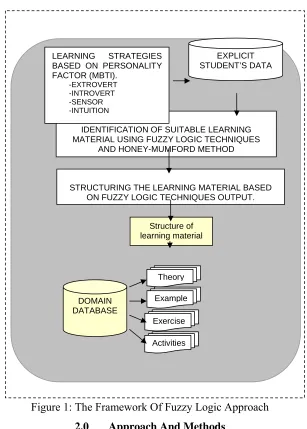
A framework for learning path personalization in adaptive learning system is introduced. It aims to utilize the learning characteristics and provide a personalized learning environment, that exploit pedagogical model and fuzzy logic techniques as shown in Figure 1 below. The pedagogical model and learning style refer to student’s personality factor based on the Myers-Briggs Type Indicator (MBTI) [3, 4]. Based on the MBTI theory, fuzzy logic techniques are then used to classify learning material (structure of learning material).
Fuzzy set theory, proposed by Zadeh [5], has proved to be very effective in handling the vagueness and uncertainty intrinsically existing in the knowledge possessed by people or implied in numerical data. Rules based on fuzzy logic provide a qualitative description of the input-output relationship of a system using fuzzy linguistic terms. Fuzzy linguistic rule is closer to human reasoning and in many real-world applications, and thus it is more adequate and flexible for knowledge representation than the conventional crisp IF THEN rules which is the major reason for its adaptation in this research.
As shown in Figure 1, the architecture for the learning strategy is based on the MBTI personality factor whilst the learning method and techniques is based on the Honey & Mumford theory. The four MBTI personality types used in this research are; Extrovert (E); Introvert (I); Sensing (S) and Intuition (N). Extrovert and introvert represent the student’s preferable condition in focusing attention. Sensing and intuition, illustrate the student’s preferable way in taking information.
Figure 1: The Framework Of Fuzzy Logic Approach
2.0 Approach And Methods
The pedagogical framework consists of steps on how content is develop to reflect those personality principles. Table 1 below, shows the relationship between learning style and learning method.
Table 1: The Relationship Between Learning Style And Method.
Learning Style (MBTI) Method (Honey & Mumford)
Extrovert-Sensor Activity Extrovert-Intuitive Exercise Introvert-Sensor Example Introvert-Intuitive Theory
IDENTIFICATION OF SUITABLE LEARNING MATERIAL USING FUZZY LOGIC TECHNIQUES
AND HONEY-MUMFORD METHOD EXPLICIT STUDENT’S DATA
STRUCTURING THE LEARNING MATERIAL BASED ON FUZZY LOGIC TECHNIQUES OUTPUT.
DOMAIN DATABASE
Theory
Example Structure of learning material
Exercise
Activities LEARNING STRATEGIES BASED ON PERSONALITY FACTOR (MBTI).
Fuzzy techniques are used to personalize the learning path where it has 4 outputs. The outputs indicate the structures of learning material (theory, example, exercise and activity) that suits student’s personality, taking into account the most preferred learning material and the least preferred learning material.
Fuzzy logic is computationally undemanding and is most suitable for processing imprecise input data, as it supports natural description of knowledge and reasoning in the form of imprecise concepts, operators and rules [8]. In AHLS, fuzzy logic techniques have been used due to their ability to handle imprecise information, such as student’s knowledge and their cognitive abilities [9]. Table 2 shows several examples of AHLS adapting intelligent techniques.
Table 2: Examples Of Previous Ahls Adapting Intelligent Techniques In User Modelling.
System Intelligent Techniques Predict User Modeling
KBS-Hyperbook [10] Bayesian Network User Knowledge Level ALICE [11] Fuzzy Logic Techniques User Knowledge Level iWeaver [12] Bayesian Network User Media Presentation INSPIRE [13] Neuro Fuzzy Techniques User Knowledge Level
3.0 The Fuzzy Model
In this study, the fuzzy sets and fuzzy rules are constructed based on the standard of mastery or the criterion-referenced acquired from the human instructors’ experience and knowledge about their students. In this problem, there are four input and four output linguistic variables being considered. The input linguistic variables represent the student’s personality’s scores: extrovert scores, introvert scores, sensor scores and intuitive scores. The fuzzy inputs are expressed by:
x1, x2, x3 and x4
Whilst, the outputs represents the student’s acceptance level of learning material; theory, example, exercise and activities are expressed by:
ya, yb, yc and yd
Figure 2: Flow Of Fuzzy System
In this paper, the fuzzy set is expressed by a triangular function as triangular function. This is chosen based on expert advises, interview session and survey session for the
Crisp Input
Crisp Output Fuzzification
Fuzzy Processing
Rule base
Defuzzification
Sensor Extrovert
Introvert
Fuzzy Input
Fuzzy Output
Structure of learning material o theory,
o example, o exercise, o activities
Membership Function (Input)
Membership Function (Output)
case at hand and at the same time significantly simplifies the process of computation. The fuzzy set is expressed by three parameters {a, b, c} as shown in figure 3 and figure 4 below:
Figure 3: Triangular Membership Function
where a, b, and c are parameters that control the intervals of the triangle (as shown in
figure 3 and figure 4), xi is the input, and yi is the output of fuzzification input i.
Figure 4: Triangular Fuzzy Set
Table 3 below show the fuzzification process that include the linguistic value, notation, numerical ranges and fuzzy set for the input and output of this study.
Table 3: Fuzzification Process
Linguist
ic Value
Input
/
Outp
ut
Notati
on
Numerical Ranges
(normalized)
*Based on expert
advise
Membership Function
*Based on expert advise
Extrover t
Input Low Med High
[0, 0, 0.5] [0.25 0.5 0.75] [0.5 1 1]
xi-a if a <= xi <= b
b-a
1, if xi =b
1 + if b < xi <= c
0, otherwise
b-xi
c-b yi =
yi
1
Introvert Input Low Med High
[0, 0, 0.5] [0.25 0.5 0.75] [0.5 1 1] Sensor Input Low
Med High
[[0, 0, 0.5] [0.25 0.5 0.75] [0.5 1 1] Intuitive Input Low
Med High
[0, 0, 0.5] [0.25 0.5 0.75] [0.5 1 1] Visual Outpu
t
Low Med High
[0 0 0.45] [0.1 0.5 0.9] [0.55 1 1] Linguisti c Outpu t Low Med High
[0 0 0.45] [0.1 0.5 0.9] [0.55 1 1] Theory Outpu t VLow Low Med High VHigh
[0.0, 0.0, 0.25] [0.2, 0.32, 0.45] [0.4, 0.5, 0.6] [0.55, 0.7, 0.85] [0.8, 1.0, 1.0] Excercis e Outpu t VLow Low Med High VHigh
[0.0, 0.0, 0.25] [0.2, 0.32, 0.45] [0.4, 0.5, 0.6] [0.55, 0.7, 0.85] [0.8, 1.0, 1.0] Example Outpu t VLow Low Med High VHigh
Activitie s Outpu t VLow Low Med High VHigh
[0.0, 0.0, 0.25] [0.2, 0.32, 0.45] [0.4, 0.5, 0.6] [0.55, 0.7, 0.85] [0.8, 1.0, 1.0]
The next stage is the process to generate the fuzzy rule-base. This process classifies the student’s learning material according to the student’s personality. The fuzzy rule based system consists of IF/THEN statement, multiple antecedents, multiple consequents and combined with AND/OR operation as expressed below:
Ri :
IF Xa is N1 AND Xb is N2 AND Xc is N3 AND Xd is N3
THEN
Ya is M1 AND Yb is M2 AND Yc is M3 AND Yd is M4
where Ri, (i = 1, 2, … n) is the rule number, Ni, (i =1, 2 and 3) are the membership functions of the antecedent part, Mi, (i =1, 2, 3, 4 and 5) are the membership functions
of the consequent part. The example of fuzzy rules applied in this problem as show in table 4.
Table 4: Example Of Fuzzy Rules
Input Output
Extrov ert Introv ert Sens or Intuit ive Theo ry Examp le Exerci se Activit ies Visu al Linguist ic
Low High Low High VHig h
High Low VLow Low High
Low High Med Med High Med Low Vlow Med High Low High High Low Med VHigh VLow Low Med High
: : : : : : : : : ;
High Low High Low VLo w
The defuzzification process used in this paper is Mamdani inference-style where it involves different operations of defuzzification. The best defuzzification operation will be selected. The criterion of selecting the best defuzzification is based on the most similar result that fulfils the expert expectation. Based on the result, the defuzzifications Centre of Area/Gravity (COG) have the most similarity.
4.0 Conclusion And Further Work
This paper has proposed a way to personalize the course content for adaptive hypermedia learning system, which aims to provide learners with a customized learning environment. It emphasizes on the combination of pedagogical theories and artificial intelligent techniques. In particular, for adapting the MBTI theories in adaptive hypermedia learning system, a specific pedagogical model must be prescribed. In this paper, we outlined the pedagogical framework containing the method and techniques suitable for adaptive hypermedia learning system. Fuzzy logic techniques are used to impart the learning content based on student’s fuzzy personality data and instructional rules in order to support customization that will allow learners to learn faster and understand the learning material easier. The learning content (structure and type of learning material) for a given learner in online system based on student personality is identified. Fuzzy logic model provides an efficient way to reason the student’s learning method based on the student’s personality. We are in process of testing the fuzzy logic model by the students compared to crisp conventional method, based on two assessments; performance effectiveness and the accuracy of the system.
Acknowledgement
This research is conducted under IRPA grant, project vote 74129: The Development of Knowledge Management for Adaptive Hypermedia Learning System.
References
1. Brusilovsky, P. (2001). Adaptive Hypermedia. User Modeling and User- Adapted Instruction. Kluwer academic Publishers, Vol 11, No. 1 – 2, pp