Abstract
MEYER, DAVID CHARLES. Climate for Computer-Mediated Communication Technology Implementation and Implementation Success.
Electronic mail and the world-wide web may be particularly helpful to university faculty members as they implement these technologies into their teaching. However, effective implementation depends on a host of social, technical, and historical factors. This study creates and tests a "climate for computer-mediated communication technology implementation" survey. This quantitative climate measure correlates specific department-level policies and practices with implementation success.
The implementation climate at a large state university based on 420 faculty members representing 58 different academic departments suggests that a climate for computer-mediated communication (CMC) technology implementation does exist at the department level within the university. In addition, the climate for CMC technology implementation accounts for variance in implementation success over and above more traditional
implementation correlates measured in prior MIS research (i.e., individual expectations, task urgency, technical expertise). The research results demonstrate the applicability of MIS research findings to educational settings and quantitatively confirm the existence of a
ii BIOGRAPHY
David Meyer studied history, English, and education at the University of Minnesota and received his bachelor’s degree (cum laude) in Secondary Education. His career path has included teaching secondary school, facilitating teamwork within management teams, organizing community service programs for at-risk youth, and coaching collegiate alpine ski racing.
I am grateful for the financial support that I received from the Division of
Undergraduate Affairs at North Carolina State University. This work also received partial support from the National Science Foundation’s Science and Technology Center (STC) under Agreement Number CHE-9876674. Any opinions, findings, conclusions, or recommendations expressed in this material are those of the author and do not necessarily reflect the views of the National Science Foundation.
I owe my friends and faculty advisors at North Carolina State University, Duke University, and Boise State University many thanks for their guidance and support. I’m also grateful for all the good advice Dr. Denis Gray, my committee chair, has given me over the years. Research involves choices—it is good to have wise counsel.
iv
LIST OF TABLES...V LIST OF FIGURES AND APPENDICES...VI
“MOKITA” AND INFORMATION TECHNOLOGY...1
OVERVIEW...3
LITERATURE REVIEW...7
DEFINING COMPUTER-MEDIATED COMMUNICATION TECHNOLOGY...7
DEFINITION OF IMPLEMENTATION...9
DEFINING IMPLEMENTATION SUCCESS: USE OF CORE FEATURES BY TARGETED MEMBERS...15
THE SEARCH FOR INDEPENDENT VARIABLES: CORRELATES OF “IMPLEMENTATION SUCCESS” AND CLIMATE...18
SUMMARY OF THE WEB-BASED INSTRUCTIONAL TECHNOLOGY LITERATURE...19
PRIOR MIS RESEARCH: ORGANIZATIONAL, TECHNICAL, AND IMPLEMENTATION VARIABLE DOMAINS...29
DIFFICULTY OF APPLYING EXISTING RESEARCH...44
CLIMATE FOR IMPLEMENTATION: CONTRIBUTIONS TO THE LITERATURE...45
SUMMARY OF PRIOR RESEARCH...49
“TECHNOLOGICAL FRAMES” AS CLIMATE—EXTENDING AN EXISTING MODEL...50
OVERVIEW OF SECTION...50
PEOPLE AND TECHNOLOGY: A CLIMATE PRIMER...62
CLIMATE FOR CMC TECHNOLOGY IMPLEMENTATION...64
DEFINING CLIMATE...65
DEFINING A CLIMATE FOR SOMETHING...65
THEORETICAL APPROACHES TO CLIMATE RESEARCH...66
REVIEW OF ANALYTIC APPROACHES TO CLIMATE...74
METHOD...83
DESCRIPTION OF CMC TECHNOLOGY STUDIED...83
PARTICIPANTS...85
DATA COLLECTION...85
SCALE DEVELOPMENT...86
SCALE DEVELOPMENT PROCEDURE...87
DEPENDENT MEASURES...92
PREDICTOR VARIABLES...97
TECHNICAL AND INDIVIDUAL-LEVEL MEASURES...100
INDIVIDUAL-LEVEL PREDICTORS: INDIVIDUAL EXPECTATIONS...100
CLIMATE MEASURE...102
RESULTS...111
SAMPLE DEMOGRAPHICS...111
TEST RESULTS...112
OPEN-ENDED COMMENTS...123
POST HOC ANALYSIS...125
UNIVERSAL USE AS MODERATOR VARIABLE...131
DISCUSSION...134
ACADEMIC CONTRIBUTIONS...134
DISCUSSION OF NON-SIGNIFICANT RESULTS: OUTCOME MEASUREMENT...140
PRACTICAL IMPLICATIONS...141
RECOMMENDATIONS...142
REFERENCES...146
TABLE 1 DEFINITIONS AND EXAMPLES OF CMC AND WEB-BASED INSTRUCTIONAL TECHNOLOGY...8
TABLE 2 SUMMARY OF MIS IMPLEMENTATION FIELD RESEARCH BY LEVEL OF ANALYSIS AND VARIABLE DOMAIN...31
TABLE 3 TYPES OF COMPUTER-MEDIATED COMMUNICATION TECHNOLOGIES...35
TABLE 4 IMPLEMENTATION CLIMATE 40 SUMMARY OF CMC TECHNOLOGY IMPLEMENTATION FIELD RESEARCH USING NATURAL GROUPS...40
TABLE 5 KEY STRUCTURAL, TECHNICAL AND IMPLEMENTATION DIMENSIONS AT INDIVIDUAL- AND GROUP-LEVEL OF ANALYSIS...43
TABLE 6 CLIMATE FOR CMC IMPLEMENTATION MEASURE...57
TABLE 7 ANALYTIC APPROACHES TO CLIMATE...76
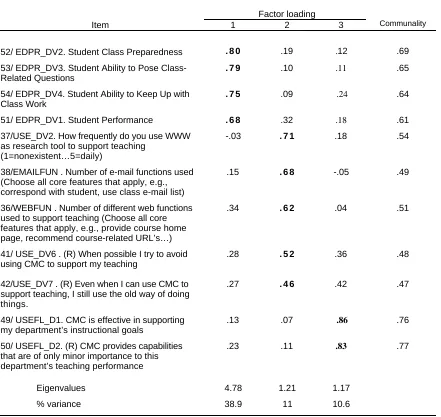
TABLE 8 SUMMARY OF ITEMS AND FACTOR LOADINGS FOR VARIMAX ORTHOGONAL THREE-FACTOR SOLUTION FOR THE DEPENDENT VARIABLES...93
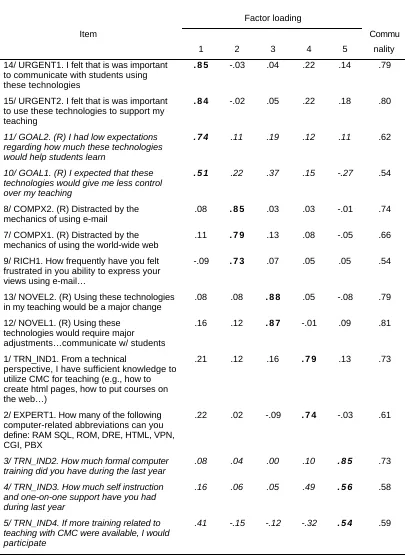
TABLE 9 SUMMARY OF ITEMS AND FACTOR LOADINGS FOR VARIMAX ORTHOGONAL FIVE-FACTOR SOLUTION FOR THE INDIVIDUAL-LEVEL PREDICTOR VARIABLES...98
TABLE 10 EIGENVALUES, PERCENTAGES OF VARIANCE AND CUMULATIVE PERCENTAGES FOR FIVE FACTOR PREDICTOR VARIABLES...99
TABLE 11 SUMMARY OF ITEMS AND FACTOR LOADINGS FOR VARIMAX ORTHOGONAL FOUR-FACTOR SOLUTION FOR THE CLIMATE VARIABLES...104
TABLE 12 CLIMATE ITEMS MEASURING TASK IMPORTANCE/PEER PRESSURE CLIMATE...107
TABLE 13 ITEMS MEASURING IMPLEMENTATION MANAGEMENT CLIMATE (TRAINING AND LEADERSHIP)...108
TABLE 14 CLIMATE ITEMS MEASURING DEPARTMENTAL-LEVEL EXPECTATIONS...109
TABLE 15 SUMMARY OF MEASURES...110
TABLE 16 INTERCORRELATIONS OF PREDICTOR AND OUTCOME VARIABLES...114
TABLE 17 CORRELATIONS OF DEPARTMENTAL-LEVEL CLIMATE AND DEPENDENT VARIABLES...118
TABLE 18 REGRESSION ANALYSIS INDIVIDUAL AND CLIMATE VARIABLES RELATIONSHIP WITH USE OF TECHNOLOGY...120
TABLE 19 REGRESSION ANALYSIS OF CONTEXTUAL, INDIVIDUAL AND CLIMATE VARIABLES RELATIONSHIP WITH SATISFACTION WITH TECHNOLOGY...121
TABLE 20 REGRESSION ANALYSIS OF CONTEXTUAL, INDIVIDUAL AND CLIMATE VARIABLES RELATIONSHIP WITH PERCEIVED IMPACT ON EDUCATIONAL PROCESSES...122
TABLE 21 MAJOR THEMES IDENTIFIED IN OPEN-ENDED RESPONSES...124
TABLE 22 REGRESSION ANALYSIS OF CONTEXTUAL, INDIVIDUAL, AND CLIMATE VARIABLES RELATIONSHIP WITH MODIFIED USE MEASURE...126
TABLE 23 LOGISTIC REGRESSION ANALYSIS: PREDICTING SOPHISTICATION OF USE WITH INDIVIDUAL-LEVEL AND CLIMATE PREDICTORS...128
TABLE 24 REGRESSION ANALYSIS INCLUDING EXPECTATION CLIMATE AS INDIVIDUAL-LEVEL VARIABLE: PREDICTION OF SATISFACTION WITH TECHNOLOGY...130
TABLE 25 CORRELATIONS BETWEEN LEADERSHIP SUPPORT AT THREE LEVELS AND IMPLEMENTATION OUTCOMES...131
vi
List of Figures and Appendices
FIGURE 1 PROPOSED CLIMATE MODEL AND OUTCOME VARIABLES...61
FIGURE 2 LEAVITT’S OPEN SYSTEMS MODEL...63
FIGURE 3 THREE THEORETICAL APPROACHES TO STUDYING CLIMATE...68
FIGURE 4 DATA CLEANING AND SUMMED SCALE DEVELOPMENT ANALYSIS PLAN...88
FIGURE 5 WEB-BASED INSTRUCTIONAL TECHNOLOGY IMPLEMENTATION: MODEL TESTED...91
APPENDICES APPENDIX A NON-RESPONDENT POSTCARD...169
APPENDIX B NON-RESPONDENT REMINDER LETTER #1...170
APPENDIX C NON-RESPONDENT REMINDER LETTER #2...171
APPENDIX D LETTER OF SURVEY INTRODUCTION...172
APPENDIX E PROVOST LETTER OF SUPPORT...173
APPENDIX F SURVEY...174
APPENDIX G SUMMARY OF ITEMS AND FACTOR LOADS FOR VARIMAX ORTHOGONAL FIVE-FACTOR SOLUTION FOR THE DEPENDENT VARIABLES...178
APPENDIX H INTERCORRELATIONS BETWEEN DEPENDENT VARIABLES AND ALL ELIMINATED ITEMS...180
The word “mokita” comes from a tribe in Papua, New Guinea and roughly translates to “the truth that we all know but agree not to talk about.” Within some organizations, the mokita surrounding computer technology reveals itself in resentment toward office automation, failure to use new computer technology as intended, and difficulty justifying ever-increasing information technology (IT) budgets. Indeed, financial records over the last twenty years reveal the paradoxical nature of information technology investments: despite huge expenditures for computer technology during this period, traditional productivity measures remain at about the same level (Brynjolfsson, 1993; Turnage, 1990). While various explanations of this “productivity paradox” exist (Brynjolfsson, 1993; Jurison, 1997; Pinsonneault & Rivard, 1998), few practitioners or researchers recommend computerization as a panacea for organizational problems. Instead, most IT researchers point out the difficulty of successful implementation (Bikson, 1987; Frederiksen, Riley, & Myers, 1985; Hiltz, 1988; Mirvis, Sales, & Hackett, 1992 are just a few examples). Despite the unprecedented growth in computers in organizations, (e.g., use of electronic mail, the Internet, and groupware applications), the unspoken truth about information technology is that computers do not necessarily improve organizational performance.
These “unspoken truths” raise fundamental questions about information technology in organizations: how are people responding to the profound changes in the nature of work caused by the new information technologies? More specifically, why do some people within the same organization using the same technology benefit from new technologies while other people waste resources on unwanted or under-utilized tools? When does e-mail really help employees and when does it simply waste time? The proposed research
Implementation Climate 2
While many studies within the management information systems (MIS) literature recognize some relationship between the social environment within an organization and how successfully new CMC technologies are used, none of the current research provides a composite measure of the social climate for CMC technology implementation. Supported by over 50 years of theory and research on climate, this study applies the concept of climate to MIS research.
Climate, defined here as employees’ perceptions of the events, behaviors, practices, and procedures active in the organization, is extended to a specific type of CMC technology used in university settings: web-based instructional technology. The quantitative measure of climate developed in this research correlates specific department-level policies and practices with implementation success. Within the context of the research setting, the climate for computer-mediated communication technology implementation is comprised of
group-level perceptions of the events, behaviors, practices, and procedures active in the organization that affect the use of web-based instructional technology and the kinds of technology-enabled behaviors that are rewarded, supported, and expected.
Two key hypotheses are tested: (1) a climate for CMC technology implementation is hypothesized to exist at the department level within the university and; (2) the climate for CMC technology implementation is hypothesized to account for variance in implementation success over and above more traditional implementation correlates measured in MIS
research (e.g., training, individual expectations, task urgency). These direct measures of implementation success will provide a benchmark for future change efforts.
measured and entered first into a regression equation. After adding the climate for CMC technology implementation scores, any incremental increase in variance explained is used to evaluate the impact of the department’s climate on implementation outcomes.
Overview
This study focuses on the implementation of a computer-mediated communication (CMC) technology in organizations. CMC technology is two or more electronically
connected computers that distribute some combination of text files, database files, audio, or video messages between people. Common computer-mediated communication technologies include electronic mail, shared database systems, organization-wide intranets, and
computerized decision support systems. These systems are increasingly common in both business and educational settings because of dramatically decreased computer prices and increased computing power.
One type of computer-mediated communication technology, web-based instructional technology, is increasingly used to support instruction in educational settings (Green, 1998). Typical applications of web-based instructional technology include electronic mail to support instructor-student correspondence, text-only electronic discussion groups, and hypertext web pages used to support instruction. Ideally, CMC technologies like web-based instructional technology help create a collaborative communication system in which computer users interact with each other in a shared electronic environment.
Despite the popularity of CMC technology, not all organizations successfully implement these technologies into employees’ daily work routines. Implementation,
Implementation Climate 4
implementation activities within an organization are critical to the ultimate success of a new technology (Tornatzky & Fleischer, 1990). While upper-level mangers and technical experts typically make technology selection and adoption decisions, the implementation activities—appropriate and committed use of an innovation— are end-user behaviors. When end-users do not use CMC technologies or the technologies are implemented differently than the original adopters intended, the expected performance benefits to the
individual, group, or organization are often not realized. Indeed, typical end-users are not often empowered to choose the CMC technology adopted, yet they are responsible for using it their work routines. Based on this incongruity between choice and responsibility, implementation problems often occur at the end-user level of the organization. Hence, the proposed research focuses on these end-users of CMC technology.
In order to identify the individual- and group-level variables that may account for implementation success, individual perceptions and group characteristics are quantified into a single climate for implementation score and associated with three different implementation outcomes. Groups that report high climate for implementation scores are predicted to utilize the new technology as intended and experience a greater frequency of positive outcomes. In contrast, groups that have a low climate for implementation are predicted to report a greater frequency of unintended consequences and negative outcomes. As reviewed later in this proposal, the definition of implementation success includes: technology-related outcomes (use of technology and degree of universal use), perceived impact on educational practices (an outcome relevant to the specific CMC technology studied here: web-based instructional technology), and satisfaction with technology (satisfaction with performance capabilities provided by new technology and satisfaction with technology’s ease of use).
and (3) climate theory and research is used to help build the theoretical foundation for the proposed climate measure.
The fist section of this literature defines the technology studied (computer-mediated communication technology/web-based instructional technology) and the outcome variable (implementation success). This section also reviews some key issues involved in
measuring implementation success. The second section includes a review of the education literature related to the use of CMC technology for instructional purposes in schools and universities. While much of this literature uses relatively weak research methodologies, some of these studies suggests that the number of class and educational institutions using web-based instructional technology is rapidly increasing. This section of the literature review then summarizes the prior correlates of implementation success found in the MIS literature, identifies some of the weaknesses of prior CMC implementation research that correlates a few implementation factors to various “implementation success” outcomes, and argues that a broad climate measure provides a way to address some of these deficiencies. Finally, this section summarizes Orlikowski’s (1992) “technological frames” model and suggests that this theory may provide the basis for a quantitative climate measure. The applied portion of the literature review ends with an integration of prior MIS research and Orlikowski’s frames model into a single climate for CMC technology implementation model.
The third section of the literature review covers the theoretical literature supporting climate. This section begins with an overview of the relationship between the social environment active in an organization and how new technologies are used. Next, a more specific review of the climate literature lays the foundation for the proposed CMC
Implementation Climate 6
This research makes two key contributions to the existing literature. First, the development of a climate measure for computer-mediated communication technology implementation integrates prior MIS research findings with an enduring social science concept. Informed by the vigorous academic debates within the climate literature, this study suggests that a quantitative climate for implementation measure may be used to represent group-level climate perceptions. The concept of implementation climate as well as the climate measure developed in this research may both apply to wide variety of organizational settings.
The second contribution that this research makes to the existing literature is the inclusion of both the individual- and group-level implementation correlates in a single study. Significant individual-level findings may help generalize prior research findings to a new setting. More importantly, significant group-level results—controlling for various accounted for by individual-level factors—provides new insight into how group-level expectations, training, implementation involvement, and interpersonal relationships may be managed to increase implementation success.
More important than these academic contributions may be the applied benefits gained by the cooperating university. This research focuses on the implementation of a rapidly growing application of computer-mediated communication technology used in educational settings: web-based instructional technology. The quantitative approach used, the extensive review of the MIS, educational, and climate literatures, and the survey instruments
developed for this research all help delineate key individual- and group-level factors that are associated with implementation success. The research results help evaluate prior
Literature Review
Defining Computer-Mediated Communication Technology
The definition of computer-mediated communication (CMC) technology is two or more electronically connected computers that distribute some combination of text files, database files, audio, or video messages between people. The specific CMC technology identified in the climate survey is frequently used in educational settings: web-based instructional technology. Typical applications of web-based instructional technology include electronic mail to support instructor-student correspondence, text-only electronic discussion groups, and hypertext web pages used to support instruction.
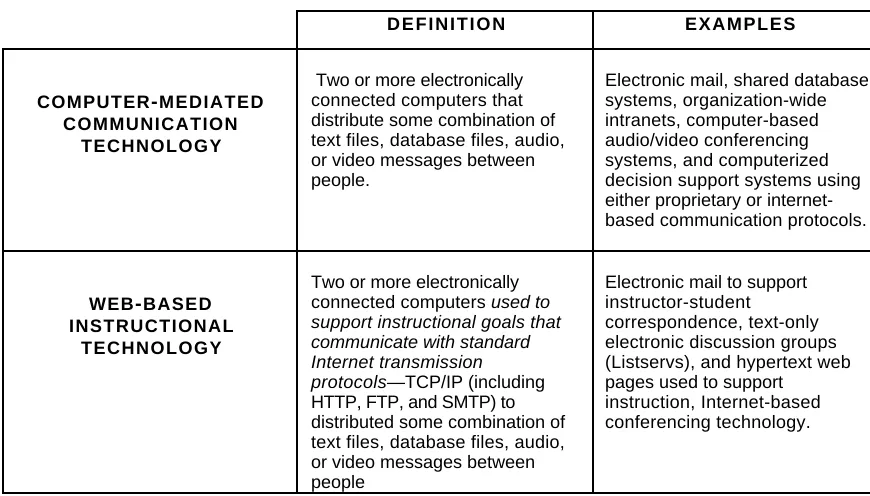
As summarized on Table 1, the key difference between CMC technology and web-based instructional technology is that the latter uses computer technology to support
instructional goals. Another difference—one that is rapidly disappearing—is that
computer-mediated communication technology can also include “stand-alone” systems that use proprietary standards and transmission protocols. Older versions of computer-mediated communication systems such as Lotus Notes or Valacich, Dennis and Nunamaker’s GroupSystems (1991) have used communication protocols and/or network systems that were independent of the Internet1. However, computer-mediated communication
technologies are increasingly using Internet protocols and infrastructures to reduce
development and administration costs as well as increase the number of potential users. In effect, computer-mediated communication technology is increasingly web-based.
1 The word "internet" literally means "network of networks" and is comprised of thousands of smaller
Implementation Climate 8
The term “computer-mediated communication technology” may be modified to make it nearly synonymous with web-based instructional technology by adding the educational intent of web-based instructional technology. Hence, “computer-mediated communication technology used for instructional purposes” is the same as web-based instructional
technology—excluding the few CMC applications that use communication protocols or network systems independent of the Internet.
Table 1
Definitions and Examples of CMC and Web-Based Instructional Technology
D E F I N I T I O N EXAMPLES
COMPUTER-MEDIATED COMMUNICATION
TECHNOLOGY
Two or more electronically connected computers that distribute some combination of text files, database files, audio, or video messages between people.
Electronic mail, shared database systems, organization-wide intranets, computer-based audio/video conferencing systems, and computerized decision support systems using either proprietary or internet-based communication protocols.
WEB-BASED INSTRUCTIONAL
TECHNOLOGY
Two or more electronically connected computers used to support instructional goals that communicate with standard Internet transmission protocols—TCP/IP (including HTTP, FTP, and SMTP) to distributed some combination of text files, database files, audio, or video messages between people
Electronic mail to support instructor-student
correspondence, text-only electronic discussion groups (Listservs), and hypertext web pages used to support instruction, Internet-based conferencing technology.
all of the other mail list subscribers. Hypertext web pages are blocks of text (or images) linked with multiple electronic paths. Selecting one of these electronic links provides the viewer with the content associated with that link, regardless of the physical location of either the computer on which the information is stored or the viewer.
Most of this literature review uses the term “computer-mediated communication technology” because it is derived from establish definitions within MIS research (Hiltz & Turoff, 1978). This more general term also helps link well-established MIS research findings to the educational literature on teaching and learning with technology. An
additional reason for using a categorization scheme from the MIS literature is that a broader base focus may keep the research from being quickly outdated: the rapid pace of
technological change can reduce the "shelf life" of highly focused research findings. For example, research focused on specific characteristics of a web-based instructional technology used five years ago (e.g., Gopher web servers and clients in university settings) would suffer from very time-limited research conclusions.
While the term “web-based instructional technology” is used in the survey to focus on education-specific uses of computer-mediated communication technology, most of this proposal uses “computer-mediated communication technology” to refer to the broader genre’ of technology studied in the proposed research model and survey.
Definition of Implementation
Implementation Climate 10
technologies coupled with the profound impact that they can have on organizations lead Lucas and Baroudi (1994) to suggest that the “design of information technology and the design of organizations are largely becoming the same task” (p. 9). With high financial investments and high expectations of CMC technology, what does “successful
implementation” actually mean?
Perhaps “implementation success” is best defined by understanding the antonym: “unsuccessful implementation.” Poor implementation of new CMC technology may yield four negative outcomes within organizations: (1) failure of technology to deliver expected benefits (e.g., ability to contact co-workers, ability to share information, rapid access to time-sensitive data) because employees use the technology less frequently or less
effectively than the adopters intended; (2) wasted financial and personnel resources used in adoption and implementation activities; (3) variable use of the CMC technology across sub-groups within an organization may create or reinforce intra-group rivalries and
miscommunication; and (4) failure of technology to deliver expected benefits may reduce employees expectations and motivation to use future innovations. Unsuccessful
implementation hurts organizations: not only do poor implementation efforts cost time and money, they may also damage employee relationships and expectations of other new technologies or practices.
This research defines “implementation success” as the active use of the CMC
technology by targeted individuals and groups within an organization in an organizationally
relevant way. The next sections review the literature supporting this definition.
Implementation Research Primer
identified need; (3) adoption decision, the decisions surrounding the acquisition and early use of a technology; (4) implementation, the decisions and behaviors surrounding the active use of a new technology; and (5) routinization, the integration of the new technology into daily work routines (Rogers, 1983; Tornatzky et al., 1983; Tornatzky & Fleischer, 1990; Yin, 1979). These activities take place within the context of the organization’s history, industrial area, and the technical parameters of the innovation itself.
Within this five-stage model, implementation merits special attention because it is the point at which the real transition between technology developers and technology users occurs: implementation is the point at which an innovation is actively used in a new setting. Adoption decisions within organizations are typically made by MIS personnel or upper-level managers—not by the end-users of a technology. A technology may be “officially” adopted—the technology may be purchased and provided to users —but never be actively used. The later stage, routinization, occurs when the technology is actively used
(implemented) in the organization and, by definition, occurs after implementation. Implementation is the critical stage during which a technology is actively transferred and used in a new setting—or is adopted by upper-level managers and forgotten by users.
For purposes of understanding the “big picture” of how implementation fits into the larger innovation process, an additional caveat should be noted: technology is not “handed off” from developers to users. The chronology of technology development and
Implementation Climate 12
Measuring Implementation Outcomes
Several researchers note the difficulty of defining and measuring implementation outcomes for complex technical and social innovations (Bikson, 1987; Eveland, 1981; Fleischer, Liker, & Arnsdorf, 1988; Grudin, 1988; Hiltz & Johnson, 1989; Ives & Olson, 1984; Tornatzky & Fleischer, 1990). In contrast to earlier implementation research which assumed that adoption decisions were the critical predictors of successful implementation (Fliegel & Kivlin, 1966, for example), most recent implementation researchers frame implementation as a process and have not defined a specific end point of adoption or implementation. Given this indistinct nature of “implementation success,” the operational definition depends on the purposes of the research. If the research is concerned only with whether or not a product has been purchased, “adoption” may be defined with this
act—with the unsubstantiated assumption that adoption will lead to implementation. If the research is aimed at understanding the organizational, group, and individual behaviors necessary for a technology to be actively used, implementation researchers must create a specific, measurable definition what “implementation success” actually means.
These multiple definitions of “implementation success” are symptomatic of a larger debate among implementation researchers. All implementation studies must define and measure what an “organizationally relevant ” use really means for the technology of interest. For example, does routine use of computers as telephone answering machines or photocopiers indicate high implementation rates? Indeed, users may adopt a new
technology to meet the local demands of the organization and create uses for the technology not envisioned by the technology developer. Which implementation behaviors represent appropriate use of the new technology (and corresponding measures of “successful implementation”) and which behaviors are abhorrent applications of the technology is the topic of the adaptation/fidelity debate. This debate provides key guidelines for how “implementation success” is defined and measured in the proposed research.
The Adaptation/Fidelity Debate.
Generally, implementation research recognizes that knowledge, values, and purposes of the human user influence the function of a given technology. Even if a single “best” way to use a technology exists, there are almost always alternative ways to employ it (Tornatzky & Fleischer, 1990). For example, a ratchet wrench may have an optimal hand position, technique of changing sockets, and biomechanical position for maximum torque. However, the variability of social context—the way that the wrench is used by different mechanics at different repair shops—has a powerful impact on the end product: a successfully repaired car. Rather than conceptualizing technology as simply a material object, most research on the implementation of technology considers both material and social characteristics.
Implementation Climate 14
In contrast, the fidelity perspective assumes that there is an identifiable configuration of the best technical and social practices for using a technology (Boruch & Gomez, 1979). This group of researchers suggests that the original invention went through rigorous evaluation prior to dissemination and variations on the original configuration may make the technology less effective.
Other researchers do not advocate an a priori supremacy of either the fidelity or adaptation perspective (Gutek, Bikson, & Mankin, 1984; Hall & Loucks, 1978; Rice & Rogers, 1980; Rogers, 1986). Practical considerations—the type of technology
investigated and the goals of the researcher—better direct which perspective is used. A well-defined innovation with a proven effectiveness may produce better results if a fidelity model is followed. For example, Blakely et al. (1983) found seven out of eight criminal justice and educational innovations were implemented with “acceptable” fidelity according to clear, developer-defined parameters. In addition, Blakely et al. found a correlation
between fidelity and effectiveness measures that existed before the innovation was implemented (i.e., reading test scores, school attendance, recidivism rates, and crime
rates).
In contrast, a less well defined technology with a host of contingencies may achieve better results with an adaptation orientation. Berman and McLaughlin’s (1978) results suggest that adaptation rather than complete fidelity to the original model characterizes “successful” educational innovations. Berman and McLaughlin’s implementation outcome measure was teachers’ reports on the extent to which the innovation met the teachers’ own goals. Similarly, Fleischer, Liker, and Arnsdorf’s (1988) study of computer-aided design
Munson’s (1980) suggestion that user-initiated variations of a technology may not be regarded as “effective” according to the developers’ criteria yet may yield highly desirable results in terms of the users’ criteria. The present study emphasizes user-centered
definitions of implementation success.
Despite a difference in research perspective, both “pro-fidelity” (Blakely et al., 1983; Fairweather & Tornatzky, 1977) and “pro-adaptation” (Berman & McLaughlin, 1978; Bikson et al., 1987; Frederiksen et al., 1985) researchers have used a core feature
methodology to identify the use (or rejection) of a given technology at implementing sites. Tornatzky (1990) describes the core feature approach as a three-step process: (1) Identify the core aspects that define an innovation based upon an a priori, data-based judgment. These core attributes are the generic technical characteristics and social behaviors necessary to use the technology and are often defined by the innovation developers. (2) Determine whether these core attributes are implemented in the field via in-depth field assessments at implementing sites. (3) Distinguish empirically between those modifications that represent desirable adaptation and those that represent a negative distortion of the technology. The core feature approach is based on some identifiable, generic definition of the specific innovation, independent of the implementing organization. This core features approach provides a methodologically consistent way to identify the use of an innovation for across implementing organizations.
Implementation Climate 16
the CMC technology. Several researchers suggest that the more people within a community that actively use a given CMC technology, the more useful the system becomes for all users (Kraut, Rice, Cool, & Fish, 1994; Markus, 1990; Rice, Grant, Schmitz, & Torobin, 1990; Steinfield, 1986).
There are two key implications of universal access to a communication technology (Markus, 1990). First, only when all people in an organization or interest community use an interactive communication technology does each member have the ability to realize full benefits from using it; increases in communication efficiency and effectiveness occur only when all group members actively use the communication technology. Secondly, only when a new interactive medium has achieved universal access can organizations reduce the use of older universal access technologies. Without a universal communication medium, Markus warms that:
[c]ommunities risk disintegrating into non-interacting subgroups.
While a newer interactive medium may be more efficient than an older
one, an older one that is universally accessible may be indispensable
until almost everyone uses the new one. For example, in a certain
organization, members of a central processing unit do not have
telephones, communicating with people throughout the organization
via electronic mail (Markus, 1988). Clearly, this firm is able to
dispense with telephones for the central processors only because all the
people who need to reach them also have access to electronic mail
(p. 3).
Not only do technology-enabled benefits correlate with the proportion of people in the organization using the technology, but appropriate and committed use of a CMC
technology by only a few individuals or sub-groups may be detrimental to the organization by reinforcing intergroup rivalry or miscommunication. If successful implementation is limited to a few individuals or sub-group—and these sub-groups replace older
communication may suffer. Interactive CMC technologies such as electronic mail, organization-wide intranets, video-conferencing, and shared databases require that a substantial portion of the organization (or at least key groups) actually use the technology; faithful use by a few technophiles does not constitute implementation success.
In the case of web-based instructional technology, large differences in usage rates between departments or faculty members may exacerbate inter-departmental conflicts and create conflicting demands of the university administration. Studies within the educational literature suggest that use of these teaching technologies creates a host of changes,
including: different teaching norms and expectations (Driscoll, 1998), new demands for teacher training (Claeys, Lowyck, & Van der Perr, 1997), centralized IT planning and funding (Graves, 1999) with consummate evaluation procedures (McClure & Lopata, 1996; Mojkowski, 1999, April), and courses redesigned to reflect the demands of a less traditional population of students (Duderstadt, 1999).
In summary, the implementation process provides a key leverage point for managers to impact the success —or failure— of a new technology in an organization. The proposed research defines “implementation success” as the active use of the CMC technology by targeted individuals and groups within an organization in an organizationally relevant way.
As developed in the methods section, a “core features” approach is used to define “active use” and a substantive judgment based on the cooperating organization defines
“organizational relevance.” Finally, this definition of implementation success assumes that technology-enabled benefits occur only when substantial portions of employees use these new communication tools.
Implementation Climate 18
independent variables with the active use of a CMC technology. The limitations identified in this section will drive the climate measure developed in the proposed research.
The Search for Independent Variables: Correlates of “Implementation Success” and Climate
Overview of Section
The proposed research measures the climate for CMC technology implementation. The hypotheses tested assert that (1) a group-level climate for CMC implementation exists and (2) the climate for CMC technology implementation is hypothesized to account for variance in implementation success over and above more traditional implementation correlates measured in MIS research. In contrast with much of the prior research on CMC implementation, the proposed research tests the group-level correlates of implementation success. These group-level climate perceptions are held by individuals as the result of employees’ shared experiences, observations, and discussions regarding the organization’s implementation norm, policies, and practices and the kinds of technology-enabled
behaviors that are rewarded, supported, and expected in a setting.
The rationale for developing this climate measure is based on a review of prior implementation research within the education and management of information science (MIS) literatures. The following section will identify some of the key findings from these two literatures and suggests that current research fails to address group-level correlates of CMC implementation success. In addition, this review suggests that neither literature identifies any single factor that is necessary or sufficient to ensure successful
social environments—as measured by the proposed climate research—may help explain additional variance in implementation success.
The broader “CMC technology implementation climate” survey is proposed as a way to address some of these limitations. The CMC technology implementation climate provides a way to measure group-level CMC-related events, practices, and procedures that impact successful implementation. Ultimately, this measure may help assess implementation efforts across settings and depict the diverse nature of individual- and group-level interpretations of CMC applications. Even with non-significant findings, the proposed research may provide useful results: ruling out these individual- and group-level factors may help identify organizational barriers to successful implementation.
The cooperating organization in this research is a large state university using web-based instructional technology. Given this organizational environment, key insights into implementation success may be contained in research involving the “instructional” intend of CMC technology used to support teaching/learning activities. The next section of this literature review summarizes the recent research within the education literature on web-based instructional technology.
Given the limitations of the education literature identified (i.e., poorly defined constructs and limited quantitative research), the second section of this literature review summarizes the research from the management of information science (MIS) literature. The MIS literature supports the definitions and model tested in this research because this larger and older body of literature provides more sophisticated models, a greater number of research results, and, in most cases, a higher quality of research methods than the educational literature.
Summary of the Web-Based Instructional Technology Literature
Implementation Climate 20
world-wide web yielded several sites dedicated to teaching and learning with CMC technology. Finally, citation indexes of key published and web-based articles were consulted to find more current research related to the proposed implementation research. Because the participating research site is a large university, this search was focused on (but not limited to) research in post-secondary settings.
While literature review yielded articles ranging from theoretical position papers to second hand reports from the field, few studies provided methodologically sound empirical research results. Most of this literature did not provide the methodological rigor necessary to clearly define the technology of interest, identify the key correlates of effective use, or provide established measures of implementation outcomes. While the educational literature reviewed here does address important problems and promises to yield results in the future, the current state of this literature does not provide the same mature theoretical and applied research as the found in management of science literature.
Definitions Of Web-Based Instructional Technology
For purposes of the proposed research, web-based instructional technology means the use of hypertext world-wide web pages to support teaching activities and electronic mail correspondence with students. While this definition parallels a variety of terms and
instructional technology,” the focus of most of these articles is the use of e-mail and the hypertext-based world-wide web pages to achieve instructional goals.
The lack of specification is epitomized in Khan’s (1998) definition of web-based instruction as “a hypermedia-based instructional program which utilizes the attributes and resources of the world-wide web to create a meaningful learning environment where learning is fostered and supported” (p. 63). Kahn's identification of "hypermedia-based" suggests a definition of web-based instruction that focuses on hyperlinked web pages. However, Kahn's proposed “framework for the delivery of Web-based instruction” and the ensuing discussion of this framework demonstrates that Kahn is using a much broader definition of "hypermedia"—a definition that includes other computer-mediated
communication technologies such as e-mail, Listservs, newsgroups, databases, and web-based conferencing technology. While Kahn's model is quite valuable and his broader definition of “hypermedia” is certainly valid, the potential confusion caused by this broader definition underscores a continuing challenge in defining various web-based instructional technologies for many researchers working in this academic area.
Implementation Climate 22
Major Themes in Educational Literature Related to Teaching With CMC
Two broad categories may be identified within the educational literature on CMC technology used to support instruction: pedagogical-related research and implementation-related research. The pedagogical research on web-based instructional technology is primarily devoted to identifying the most effective teaching methods to use in conjunction with this technology. Research results typically identify key instructor behaviors that impact student learning or student use of CMC technology. The implementation-related research focuses on key organizational attributes or broader management behaviors (e.g., dean or university administrative activities) that impact the use of web-based instructional technology in a department or institution.
Pedagogical-Related Research
Key topics from the pedagogical-related research include the changing roles of instructors in web-supported classrooms (Claeys et al., 1997; McGrath, 1998) recommendations for how to effectively use the computer-mediated communication technology to support instruction (Bonk & Cummings, 1998; Corrent-Agostinho et al., 1998; Gillani, 1998; Partee, 1996; Wiens & Gunter, 1998), and categorization schemas for understanding how web-based instructional technology are used in educational settings (Bannan-Ritland et al., 1998; Driscoll, 1997; Khan, 1998).
Recommendations from this literature include: instructors should have a clear
understanding of what instructional mechanism the web can provide (Bannan-Ritland et al., 1998); instructors should have a unified plan for integrating web-based instructional
technology with content, instructional objectives, student practices, and evaluation (Berge, 1998); and instructors should link established principles of effective teaching practices with new web-based instructional technology (Chickering & Ehrmann, 1996; Ehrmann, 1997a).
technology to support instruction. For example, Gillani (1998) recommends carefully defending the web-supported task, integrating an awareness of different students’ learning styles into web-supported courses, and revising the web site based on formative
evaluations. Unfortunately, Gillani’s approach does not have any research model besides a narrative of his two year experience in designing and teaching a graduate course in learning theories and multimedia design. Gillani does not provide any review of the literature or methods for how to systematically understand web-based instructional technology. In addition, Gillani's outcome measure was the students’ class evaluations (which he reports with: “the students really enjoyed the class…there are comments such as ‘extra-ordinary’, ‘fantastic’ class. Apparently, both groups of students considered the course and its design to be effective, innovative and original”, p. 200). Finally, Gillani does not acknowledge likelihood of bias results due to the sample: graduate students interested in multi-media design are likely to have very different behaviors and learning outcomes using CMC technology relative to the general student population. While Gillani's recommendation makes sense, the weak research design does not provide conclusive evidence on what, if any, impact web-support had on educational outcomes.
Similarly, Partee (Partee, 1996) describes how he uses web-based instructional technology to improve his students’ learning experience. Partee tells how e-mail creates a more “dynamic dialogue from a wider range of students” and suggests that custom
newsgroups may emerge as a new mass communications medium as well as a mechanism to store previous semester’s notes for a class. Partee also suggests that web-based
Implementation Climate 24
Finally, Berge (1998) typifies many of the subjective “reports from the field” with his list of guiding principles in web-based instructional design. Berge first states that the single most important element of successful “on-line education” is interaction among participants because group work “allows students to practice problem-solving and higher level thinking skills” (p. 72). However, Berg does not provide information on how these higher-level thinking skills may be measured or linked to web-based instructional technology. Berge continues with several guiding principles for designing effective web-supported
instructional strategies. Berge’s list of principles may well help create highly effective web-supported instructions, but Berge does not support these principles with any primary data—and scant support from secondary sources.
In an attempt to address the subjective nature of much of this research, Russell’s (1999) annotated bibliography of 355 research reports on technology for distance
education. His analysis suggests that there are no significant differences between different educational delivery systems. Unfortunately, it is not clear how many of the studies reviewed in the book were specifically designed to answer Russell’s research question. As reviewed by Neal (1998) many of the studies appear to have inappropriate research
designs, weak or absent statistical analysis, and limited sample sizes. Given these research limitations, judgements regarding the effectiveness of computer-mediated communication technology for education are, currently, inconclusive.
integrate web-based instructional technology in the learning process. As recommended by Claeys et al.: “the investments in profession development of teachers should equal the investment in new technology.” This integration would consist of both technical skills (e.g., how to put a page on the WWW) as well as how to use the CMC technology in a pedagogically sound way. Indeed, instructors using web-based instructional
technology—like any new user of a technology—need to understand the possibilities and limitations of the new tool within the context in which it is used. Claeys et al. advocate that these “pedagogically sound” teaching techniques could be founded on teacher training, principal support, and a teacher network of “best practices.” The factors identified by Claeys et al.—training, leadership support, and a supportive network (in the form of group-level climate)—are all part of the proposed research model.
In summary, most of these pedagogical-related studies depend on informal case studies and subjective "recommendations" from the field. If an outcome measure is made, it typically consists of attitudinal outcomes (e.g., how the students felt about the experience) rather than a methodologically sound measure of learning outcomes. While these
recommendations make intuitive sense and may certainly be critical to the longer term success or failure of web-based instructional technology in education, the lack of methodologically sound support for these recommendations makes quantitative research based on these suggestions more speculative than necessary. While this review of the pedagogical literature may provide interesting insights and research leads for further inquiry, the MIS research reviewed in later in this proposal provides the more rigorous definitions, models, and research results used to drive the implementation model tested in this study.
Implementation-Related Research in the Education Literature
Implementation Climate 26
impact the use of web-based instructional technology. While this branch of literature suffers from some of the same methodological limitations as the pedagogue-related literature reviewed above, some key recommendations correspond to recommendations made in the broader MIS literature. These factors include: administrative leadership, prior instructor experience teaching with CMC tools, general computer-related experience, availability of network computers to faculty and staff, and an organizational culture that rewards technical innovation/quality in teaching using web-based instructional technology. Additional MIS research with stronger research support for these factors is reviewed later in this paper and these factors are integrated into the research model.
Like the pedagogical research, the implementation-related research on web-based instructional technology uses narrative explanations (Dardig, 1997; Ehrmann, 1997b), and informal case studies designed to highlight a set of "best practices" (Collis & de Boer, 1998; Hexel, Marcellus, & Bernoulli, 1998; Riedl & Carroll, 1997). Exemplifying one of the better case study approaches, the Teaching, Learning, and Technology (TLT) Group of the American Association for Higher Education (information available on the AAHE’s web site) provides a mechanism for sharing local experiences and serves as a cleaning house to share experiences with educational institutions with the common goal of improving
education through more effective use of technology. The fee-based questionnaires and focus groups offered by the TLT Group’s “Flashlight Project” focuses on faculty and student perceptions of the usefulness of web-based instructional technology. Although the “Flashlight Project” is still in its infancy, development of these projects across many universities may lead to a smaller set of “best implementation practices” appropriate for a variety of higher education settings.
University of Twente with two other cohorts: a group of other first year students at a satellite campus, and a group of mature students attending classes from their homes and workplaces. This case study describes their experiences and provides several useful recommendations for supporting web-based instructional technology in new settings including: administrative leadership, prior instructor experience teaching with CMC tools, general computer-related experience, availability of network computers to faculty and staff, and an organizational culture that rewards technical innovation/quality in teaching using web-based instructional technology. Notably, these recommendations are gleaned only from the faculty’s experience in designing this new distance education program. Collis and de Boer do not provide operational definitions or measures of these factors that would facilitate generalization to a new setting or research effort. In addition, no formal outcome measures have been made (although the authors intend to use student evaluation).
Nevertheless, many of these recommendations are supported in the broader MIS literature reviewed later and are integrated into the research model.
Similar to the case studies reviewed above, the narrative approaches provide
interesting insights that may yield more substantive results in the future. Included in these reports are Ehrmann’s (1997b) “letters” from an imaginary dean as she tries to understand the myriad of issue involved in implementing new information technology and Dardig’s (1997) description of the design and implementation of a web site used to disseminate ideas originated by faculty and staff across the campus of a small liberal arts college. While these narratives have little methodological rigor, they do illustrate the complex weave of issues active in the implementation process.
Implementation Climate 28
Computing Survey, the largest continuing study of the role of information technology in US higher education. Over the last nine years, the Campus Computing Project has collected data from chief information officers (CIOs) or chief technology officers (CTOs) at over 600 two- and four-year colleges and universities across the United States. The 1998 survey (Green, 1998, N=571) reports that an increasing number of college courses are using CMC technology: the percentage of classes using e-mail jumped to 44 percent (compared to 8 percent in 1994); 33 percent of all classes are tapping into Internet resources as part of the syllabus (up from 15 percent in 1996); and almost one-fourth (22.5 percent) of all college courses are using “WWW pages for class materials and resources” (compared to 4 percent in 1994).
The 1998 Campus Computing Survey also suggests that an increasing number of faculty and students have access to web-based CMC technology. Respondents estimate that about half of the students and faculty use the Internet at least once a day (45 percent of the undergraduates and 51 percent of the faculty). Both student and faculty use is highest at research universities (over 50 percent for both groups) while at community colleges less than a third (29 percent) of the students and two-fifths (40 percent) of the faculty have daily contact with the Internet. Although this survey uses secondary sources to measure the web-based instructional technology implementation (CIOs and CTOs) the trend over the last nine years suggests that CMC technology is increasingly available and used to support
instructional tasks. The current study may help explain which factors explain this large increase in implementation rates.
definitions, research models, and research results for studying the implementation of CMC technology used for instructional purposes.
Prior MIS Research: Organizational, Technical, And Implementation Variable Domains Literature searches of PsychLit and CARL databases provided lists of published MIS research articles over the last 20 years. From this list, the articles related to CMC
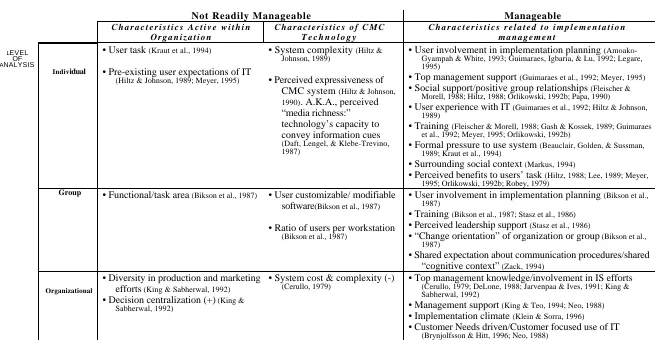
implementation were reviewed. Next, citation indexes of key articles were consulted to find more current research related to the proposed research. This strategy yielded a database of over 500 articles related to the implementation of computer-mediated communication technology. While a full review of all of these articles is beyond the scope of this paper, key articles representative of this literature are summarized on Table 2 along two features: level of analysis1 and variable domain.
1 Level of analysis refers to the entities about which the research poses concepts and relationships:
individuals, groups, organizations, or society. The level of analysis that researchers use is driven by the research question. For example, if individual’s age is hypothesized to correlate with use of a new
Implementation Climate 30 Table 2
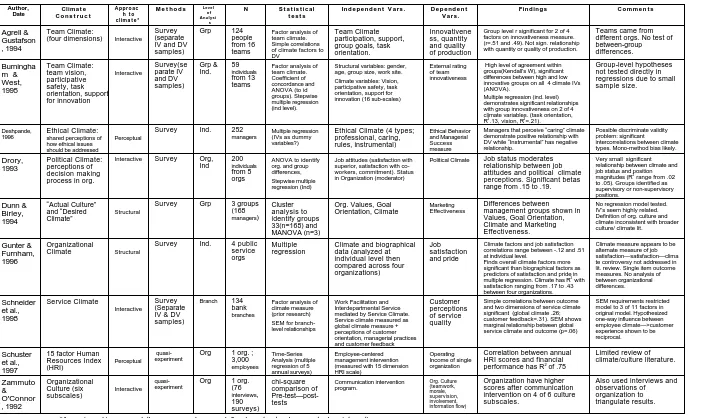
Summary of MIS Implementation Field Research by Level of Analysis and Variable Domain
_________________________________________________________________________________________________________
Not Readily Manageable Manageable
C h a r a c t e r i s t i c s A c t i v e w i t h i n O r g a n i z a t i o n
C h a r a c t e r i s t i c s o f C M C T e c h n o l o g y
C h a r a c t e r i s t i c s r e l a t e d t o i m p l e m e n t a t i o n m a n a g e m e n t
LEVEL OF ANALYSIS
Individual
• User task (Kraut et al., 1994)
• Pre-existing user expectations of IT
(Hiltz & Johnson, 1989; Meyer, 1995)
• System complexity (Hiltz & Johnson, 1989)
• Perceived expressiveness of CMC system (Hiltz & Johnson, 1990). A.K.A., perceived “media richness:” technology’s capacity to convey information cues
(Daft, Lengel, & Klebe-Trevino, 1987)
• User involvement in implementation planning (Amoako-Gyampah & White, 1993; Guimaraes, Igbaria, & Lu, 1992; Legare, 1995)
• Top management support (Guimaraes et al., 1992; Meyer, 1995)
• Social support/positive group relationships (Fleischer & Morell, 1988; Hiltz, 1988; Orlikowski, 1992b; Papa, 1990)
• User experience with IT (Guimaraes et al., 1992; Hiltz & Johnson, 1989)
• Training (Fleischer & Morell, 1988; Gash & Kossek, 1989; Guimaraes et al., 1992; Meyer, 1995; Orlikowski, 1992b)
• Formal pressure to use system (Beauclair, Golden, & Sussman, 1989; Kraut et al., 1994)
• Surrounding social context (Markus, 1994)
• Perceived benefits to users’ task (Hiltz, 1988; Lee, 1989; Meyer, 1995; Orlikowski, 1992b; Robey, 1979)
Group • Functional/task area (Bikson et al., 1987) • User customizable/ modifiable software(Bikson et al., 1987)
• Ratio of users per workstation
(Bikson et al., 1987)
• User involvement in implementation planning (Bikson et al., 1987)
• Training (Bikson et al., 1987; Stasz et al., 1986)
• Perceived leadership support (Stasz et al., 1986)
• “Change orientation” of organization or group (Bikson et al., 1987)
• Shared expectation about communication procedures/shared “cognitive context” (Zack, 1994)
Organizational
• Diversity in production and marketing efforts (King & Sabherwal, 1992)
• Decision centralization (+) (King & Sabherwal, 1992)
• System cost & complexity (-)
(Cerullo, 1979) • Top management knowledge/involvement in IS efforts(Cerullo, 1979; DeLone, 1988; Jarvenpaa & Ives, 1991; King & Sabherwal, 1992)
• Management support (King & Teo, 1994; Neo, 1988)
• Implementation climate (Klein & Sorra, 1996)
• Customer Needs driven/Customer focused use of IT
(Brynjolfsson & Hitt, 1996; Neo, 1988)
Table 2 delineates between individual-, group-, and organizational-levels of analysis. The research reviewed here was assigned a given level of analysis depending on the level of analysis used by the authors. When the level of analysis was not overtly specified in the research article, the specific sampling technique and statistical approach used was used to assign the level of analysis used.
Two key levels of analysis issues are particularly relevant to the current research. First, a careful review of the variables on Table 2 suggests that many of the variables could be active at one or more levels of analysis. For example, “end user involvement in
implementation activities” may occur at the individual level, group level, or organizational level. Similarly, perceptions of “top management support” of the new information
technology may be collected and assigned to individuals, groups, or entire organizations. While these levels of analysis issues are found in all organizational research projects (Rousseau, 1985 provides a seminal review of the subject), few of CMC implementation studies reviewed for the proposed research addressed these levels of analysis issues.
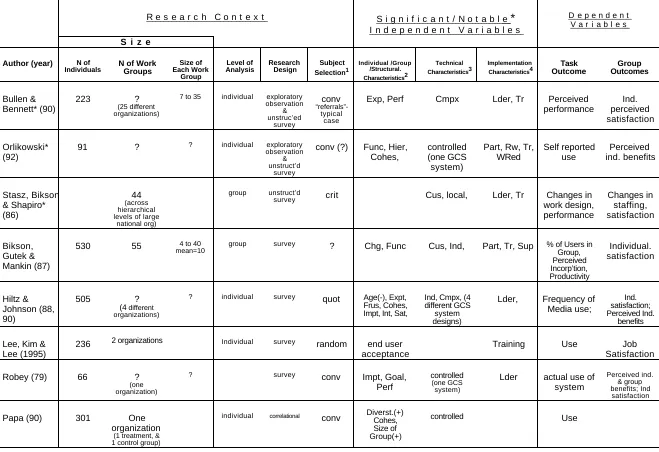
The second—and related—level of analysis issue evident on Table 2 is the dearth of CMC implementation research focused on the group-level of analysis. Only two studies, both sponsored by the Rand Corporation (Bikson et al., 1987; and Stasz et al., 1986), have used the group level of analysis to identify group-level correlates of CMC implementation success. Assuming that various CMC technologies are positioned to become what Markus (1990) describes as “universal communication media” (e.g., e-mail or the Internet), further attention to group-level correlates of implementation success appears to be an essential research avenue; the current research helps address this need.
Implementation Climate 32
relatively stable, enduring characteristics of the organization or the CMC technology1.
These correlates include functional areas within the organization, pre-existing expectations employees have about information technology, or the organization’s diversity in production and marketing activities.
In contrast, correlates judged to be relatively easy to control, changed, or modified by people in the adopting organization are identified as “manageable.” For example,
involvement in implementation planning, top management support, and training are all activities that people in organizations can manage as they adopt and use new CMC technology. This simple categorization scheme clearly identified correlates that may be managed by adopters, implementers, and end users and contrasts them with correlates that are difficult or impossible for technology users to change. In order to provide the most meaningful research results to typical CMC implementing organizations, the “manageable” correlates of implementation success are the primary focus of the climate measure
developed for this research.
Organizational/Structural Attributes
The less manageable correlates may be further divided into organizational characteristics that influence implementation success and characteristics of the CMC technology itself. Prior CMC researchers have correlated several organizational/structural attributes with implementation success. These findings include: user task (Kraut et al., 1994) pre-existing user expectations of information technology (e.g., IT seen as helpful and easy to use versus unhelpful and complex), users’ job tasks (Bikson et al., 1987), diversity in production and marking efforts (King & Sabherwal, 1992) and decision centralization (King & Sabherwal, 1992).
1 Some of these correlates could be changed via a larger organizational development intervention. For
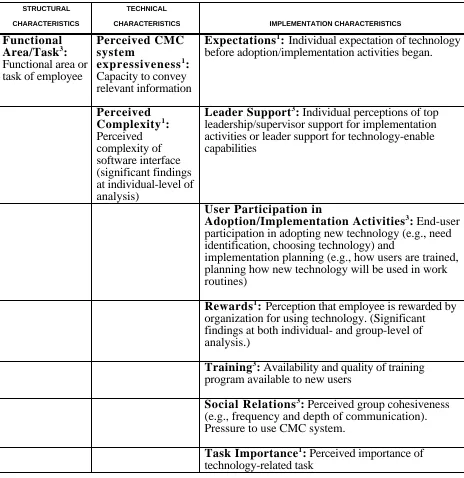
The individual’s functional area (department) is the only structural characteristic from the literature reviewed that is included in the model tested. The other structural
characteristics summarized on Table 2 are integrated into the individual expectation or climate measures discussed later in a following section. As discussed in last half of this study, the present research hypothesizes that group-level interpretations of CMC
technology exist. In order to test this hypothesis, functional area—defined as the individual job task and function within the organization—is included in the model tested.
Technical Characteristics
Categorized under the “Not Readily Manageable” heading of Table 3 are several findings that correlate the technical characteristics of a CMC system with implementation success. Unfortunately, this set of factors is difficult to compare across studies. A computer-mediated communication technology is two or more electronically connected computers that distribute some combination of text files, database files, audio, or video messages between people. Beyond this generic description, however, there are few technical characteristics (i.e., specific hardware or software configurations) that apply across all examples of CMC technology. Instead of identifying hardware and software packages, researchers typically categorize CMC technology along four key functions: Group Information Support Systems, Group External Support Systems, Group
Communication Support Systems, and Group Decision Support Systems. (See DeSanctis & Gallupe, 1987; McGrath & Hollingshead, 1994; Pinsonneault & Kraemer, 1990 for further discussion of computer mediated communication technology types.)
A comparison of the function and technical characteristic columns of Table 3 underscores the category-spanning nature of CMC technologies: the specific mix of
Implementation Climate 34
(Group Communication Support System) while another company may use e-mail to link customers with a specific account representatives (Group External Support System). A third company may use archived records of electronic mail exchanges to help new
Table 3
Types of Computer-Mediated Communication Technologies
________________________________________________________________________
TECHNOLOGY TYPE F U N C T I O N
T E C H N I C A L C H A R A C T E R I S T I C S G I S S
(Group Information Support System)
Information storage and
retrieval—GISS aids in increasing the range and depth of information available to group.
Networked computers with shared database, on-line libraries, electronic mail archives of individual’s or group’s prior activities.
G X S S
(Group External Support System)
Communication system supporting information transmission and reception with outside individuals, groups or agencies
Wide area networks (WANs) that support inter- and intra-organizational bulletin boards, discussion groups, electronic mail, or world wide web sites.
G C S S
(Group Communication Support System)
Electronic communication transmission and receptions—GCSS aids in
exchange of interpersonal and intra-group communication
Goal of GCSS technology is to reduce communication barriers within groups and organizations.
Networked computers supporting audio or video teleconferencing, intranets, or electronic mail systems.
G D S S
(Group Decision Support System)
Structures to group’s information exchange and consensus activities. Electronic structure provides medium for minority opinions to be heard and more systematic assessment of decision alternatives. Goal of technology is to reduce uncertainty and process losses.
Computer automated Nominal and Delphi techniques, networked planning tools (PERT, Gantt), computerized decision tree and risk assessment models.
The impact of non-technical, social factors is evident even in the few research findings that do measure technical characteristics. Most of these studies operationalize technical characteristics with individual user perceptions of these features rather than enduring technical attributes. As illustrated on Table 3, the perceived complexity of the system and perceived expressiveness of system (Hiltz & Johnson, 1989, 1990) depend on user perceived technical characteristics. Even the customizability of software (Bikson et al.,
Implementation Climate 36
generic technical attributes: the ratio of users per workstation (Bikson et al., 1987) and, at the organizational level of analysis, system cost and complexity (Cerullo, 1979).
Despite the subjectivity of these “technical characteristics,” perceived system expressiveness and perceived interface complexity are included in the model tested. The “customizability of software” variable was integrated into other measures. Given the current ubiquity of desktop computers in typical organizations, the “ratio users per workstation” correlate was not included in the model.
Rather than conceptualizing CMC technologies as providing generic functions, most researchers focus on the surrounding organizational and social characteristics that impact if and how CMC capabilities are used. As illustrated in the next section, prior research has suggested that the variability of social context—the way interconnected computers are used by different individuals and organizations— provides many more correlates of
implementation success.
Manageable Correlates: Characteristics Related to Implementation Management Implementation variables refer to the organizational events, practices and procedures involved in implementing a new technology (recall the five-stage adoption/implementation model discussed earlier). Simply purchasing a leading edge technology or automating a “strategic” business function does not guarantee successful integration of the new
technology into an organization. Instead, the implementation activities designed to support a new tool may be as important as the tool itself. As suggested by Eveland (1981) “[t]he manner in which a complex innovation is implemented may account for more of the variance in the net benefits realized than do its main technical features per se” (p.2).
Table 2 illustrates the key implementation activities that have correlated with
implementation-related activities including: individual user involvement in implementation planning (Amoako-Gyampah & White, 1993; Guimaraes et al., 1992; Legare, 1995), individual perceptions of top management support (Guimaraes et al., 1992; Meyer, 1995), individual perceptions of social support/positive group relationships (Fleischer & Morell, 1988; Hiltz, 1988; Orlikowski, 1992b; Papa, 1990), user experience with IT (Guimaraes et al., 1992; Hiltz & Johnson, 1989), training (Fleischer & Morell, 1988; Gash & Kossek, 1989; Guimaraes et al., 1992; Meyer, 1995; Orlikowski, 1992b), individual perceptions of pressure to use system (Beauclair et al., 1989), and perceived benefits to users’ task (Hiltz, 1988; Lee, 1989; Meyer, 1995; Orlikowski, 1992b; Robey, 1979).
At the group-level of analysis, prior MIS research has correlated implementation success with: user involvement in implementation planning (Bikson et al., 1987), training (Bikson et al., 1987; Stasz et al., 1986), group-level perceptions of leadership support (Stasz et al., 1986) and the “change orientation” of organization or group (Bikson et al., 1987).
Finally, at the organizational level of analysis, top management