CLASSIFICATION TECHNIQUE FOR HUMAN EMOTION IN VIRTUAL REALITY USING GAME-BASED BRAIN COMPUTER INTERFACE
FARIS AMIN MUFLIH ABUHASHISH
A thesis submitted in fulfilment of the requirements for the award of the degree of
Doctor of Philosophy (Computer Science)
Faculty of Computing Universiti Teknologi Malaysia
iii
iv
ACKNOWLEDGEMENT
v
ABSTRACT
vi
ABSTRAK
vii
TABLE OF CONTENTS
CHAPTER TITLE PAGE
DECLARATION ii
DEDICATION iii
ACKNOWLEDGEMENT iv
ABSTRACT v
ABSTRAK vi
TABLE OF CONTENTS vii
LIST OF TABLES xiii
LIST OF FIGURES xv
LIST OF ABBREVIATIONS xix
LIST OF SYMBOLS xx
LIST OF APPENDICES xxi
1 INTRODUCTION 1
1.1 Introduction 1
1.2 Problem Background 4
1.3 Problem Statement 12
1.4 Research Aim 14
1.5 Research Objectives 14
1.6 Research Scope 14
1.7 Research Significance 15
viii
2 LITERATURE REVIEW 19
2.1 Introduction 19
2.2 Virtual Reality Game 21
2.3 3D Virtual Human Model (Visualization and Rendering) 23 2.3.1 Areas of applications 28
2.3.2 Virtual Human Visualization 29
2.3.3 Emotion Modelling 29
2.3.4 Social Emotions and Rapport 30
2.3.5 Virtual Human Interaction and Anthropomorphism30 2.3.6 Virtual Human Emotional Walking 31
2.4 Human Computer Interaction (HCI) 31
2.4.1 Interactivity 35
2.4.2 Brain Computer Interface (BCI) Hardware 36
2.4.3 Brain Computer Interface Application 38
2.5 Human Emotion 52
2.5.1 Human Emotion Expression Categories 52
2.5.2 Dimensional and Discrete Models of Emotion 57
2.5.3 Measurement and Evaluation of Human Emotion 59 2.6 Electroencephalogram (EEG) 60
2.6.1 EEG Brain Rhythms and Emotions 60
2.6.2 EEG Using BCI 64
2.7 EEG in EPOC Emotiv BCI 66
2.8 Pre-processing Techniques of EEG signal 68
2.8.1 Temporal Filtering 68
2.8.2 IIR Filter 69
2.8.3 FIR Filter 69
2.8.4 Wiener Filtering 70
2.8.5 Independent Component Analysis (ICA) 70
2.9 Feature Extraction Methods 72
2.10 Classification Methods 73
2.10.1 Back-Propagate Neural Network (BPNN) 75
2.10.2 K-Nearest Neighbour 76
2.10.3 Support Vector Machines 76
ix
2.10.5 Emotion Dimension Classifier 78
2.10.6 Emotion Self-assessment Classifier 78
2.10.7 Brain Hemisphere Activity Classifier 79
2.11 Dataset 80
2.12 Discussion 81
3 RESEARCH METHODOLOGY 82
3.1 Introduction 82
3.2 Research Framework 83
3.3 Phase 1: Investigations and problem formulation 86
3.3.1 Human Emotion 86
3.3.2 Interactivity 87
3.3.3 3D Virtual Human Model 88
3.4 Phase 2: Emotion Feature Extraction 89
3.4.1 Higuchi Fractal Dimension-based Algorithm 90
3.4.2 The Statistical Feature Mean 92
3.4.3 The Raw Signals of Standard Deviation 92
3.4.4 The Statistical Feature Linear Regression 93
3.4.5 The Statistical Feature Mode 94
3.5 Emotion Classification 96
3.6 Emotion Mapping 99
3.7 Phase 3: Synthesis of Emotional Walking 101
3.7.1 Design of the Pre-defined 3D Virtual Human model 102
3.7.2 Creating a 3D Virtual Human Emotional Walking Style 103
3.7.3 3D Virtual Model 104
3.7.4 Emotion Walking Mapping 104
3.8 Integration of System 105
3.9 Phase 4: System Testing and Validation 106
3.10 Resources of Data and Required Equipment 108
3.10.1 Materials and Setup 108
3.10.2 Experiment protocol 109
x
3.10.4 Emotional Data 110
3.10.5 The Nature of EEG Data 111
3.10.6 Data Collection 112
3.10.7 EPOC Emotiv Input Device 113
3.10.8 Pre-processing 115
3.11 Required Environments 118
3.12 Summary 118
4 EMOTION FEATURE EXTRACTION, CLASSIFICATION AND MAPPING 120
4.1 Introduction 120
4.2 Feature Extraction 121
4.2.1 Calculating Higuchi Fractal Dimension 121
4.2.2 Calculating Mean 123
4.2.3 Calculating Standard Deviation (STD) 123
4.2.4 Calculating Linear Regression 124
4.2.5 Calculating the Proposed Method 125
4.3 Emotion Classification 127
4.3.1 Emotional Dimension Model 128
4.3.2 Self-Assessment 133
4.3.3 Variance of Brain Hemisphere Activity 136
4.3.4 Correlation of Self-Assessment, Emotional Model and Hemisphere Activity 138
4.4 Emotion Mapping 139
4.5 Summary 143
5 SYNTHESIS AND INTEGRATION OF EMOTIONAL WALKING 144
5.1 Introduction 144
5.2 3D Virtual Human Modelling Design 147
5.3 3D Virtual Human Design 149
xi Animation Design 154 5.3.3 Mesh Deformation and Animation design 156 5.4 3D Human Emotional Walking Model Simulation 158 5.5 Controlling the 3D Human Emotional Walking
Synthesis Model 162
5.6 Emotional Walking Integration Framework 162 5.6.1 Integrated System Design 163 5.6.2 Requirement Analysis 165 5.6.3 Software/Hardware Requirements 166 5.6.4 EPOC Emotiv Mind Controller Experiment
Setup 168
5.6.5 System Integration 169
5.7 Summary 173
6 TESTING AND EVALUATION 174
6.1 Introduction 174
6.2 Emotional Feature Extraction 175
6.3 Emotion Classification 178
6.3.1 Self-Assessment 179
6.3.2 Emotional Dimension Model 186 6.3.3 Variance of Brain Hemisphere Activity 188 6.3.4 Correlates of Self-Assessment, Emotional Model
and Hemisphere Activity 192
6.4 Objective Evaluation 195
6.5 Subjective Evaluation 196
6.6 Summary 200
7 CONCLUSION 202
7.1 Introduction 202
7.2 Novel Contributions 204
7.3 Future Works 206
xii
xiii
LIST OF TABLES
TABLE NO. TITLE PAGE
1.1 Outline of previous studies on facial expressions and 3D
Virtual Human 8
2.1 VHT Research Issues 25
2.2 BCI Games overview 51
2.3 Outline of previous studies on emotion expressions of
3D virtual Human 56
2.4 Emotion Classification Techniques 74
3.1 EEG Feature Extraction and Classification Methods 90 3.2 Emotion Mapping Results based on the Circumplex Model 100
3.3 Channel Pairs Location. 115
3.4 Software and hardware specification. 118
4.1 Emotion Classifying Result based on Circumplex
Emotional Model 129
4.2 Happy and Sad Emotion Intervals. 141
5.1 The Skeleton Joint Angles (P: pivot, F: flexion, T: twisting) 151 6.1 Mode [Mo] result of Higuchi FD values for Arousal
/Valence level. 176 6.2 Mean result of Higuchi FD values for Arousal/Valence level. 177 6.3 Value of the fractal dimension with the computed mean for the
self-assessment for picture (IAPS) stimuli. 180 6.4 Value of the fractal dimension with the computed mean for the
self-assessment for music (IADS) stimuli. 182 6.5 Value of the fractal dimension with the computed mod for the
xiv arousal(1-9) and valence (1-9)for both happy and sad condition. 187
6.7 Computed Value of T7 channel. 189
6.8 Computed Value of T8 channel. 190
6.9 Computed maximum mean value of T7 &T8 channel. 191 6.10 Computed Pearson correlation value of T7&T8 hemisphere
activity with self-assessment. 193
xv
LIST OF FIGURES
FIGURE NO. TITLE PAGE
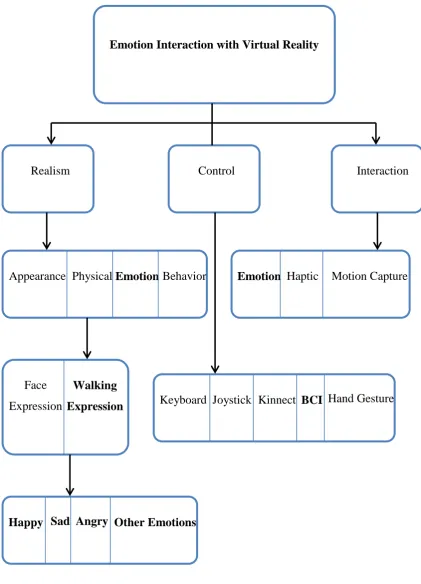
1.1 Visualized research domain. 13
2.1 Chapter organization diagram 20
2.2 Game to Serious Game 22
2.3 Serious Game Coverage 23
2.4 HCI Evolution Timeline 33
2.5 EPOC Emotiv hardware 37
2.6 NIA Hardware 38
2.7 Brain Activity 39
2.8 BCI Architecture with OpenViBE. 41
2.9 The Handball Virtual Reality Application. 42
2.10 BCI2000 Interface. 44
2.11 Simple BCI games. 46
2.12 Brainball Game. 47
2.13 Shooter game 48
2.14 Boboboy BCI game. 50
2.15 Emotional Facial Expressions. 53
2.16 Emotional Facial and Body Expressions. 54
2.17 Emotion walking style expressions. 55
2.18 Russell’s Circumplex Emotion Model 57
2.19 Discrete and Dimensional Emotion Model. 58
2.20 EEG Brain Rhythms 61
2.21 Delta waves 61
2.22 Theta waves. 62
xvi
2.24 Beta waves 63
2.25 Gamma Waves 63
2.26 The 10-20 electrode placement system 65
2.27 14 Channels Location in the EPOC Emotiv 67
2.28 Emotional EEG Signals 68
2.29 Brain Hemisphere Activity 79
3.1 Research Methodology. 85
3.2 Emotional model. 87
3.3 3D Virtual Human Emotional Walking Style. 88
3.4 Emotional Model with Intervals 94
3.5 Hybrid Emotion Classification Method 98
3.6 Defined emotion interval mapped to the emotional model. 99
3.7 Synthesizing Emotional Walking Architecture 102
3.8 Emotional Walking Styles. 103
3.9 System Architecture 107
3.10 Emotion stimulation 112
3.11 EPOC Emotiv Mind controller appliance 113
3.12 The 10-20 system of electrode placement with EMOTIV. 114
3.13 Sample EEG Data Signal. 116
3.14 Pre-process Procedure. 116
3.15 EEG Emotion Signals. 117
4.1 Arousal-Valence Intervals based on Emotional Model. 126
4.2 Hybrid emotion classification technique. 128
4.3 Emotional Model (Circumplex model of affect-emotion). 128
4.4 Geneva Emotion Wheel (GEW). 131
4.5 Happy and Sad Emotion based on Arousal Valence Model. 132
4.6 Locations of Happy and Sad Emotions in the Quadrant of Emotional Model. 132
4.7 Self-Assessment Application. 134
4.8 Selected Stimuli. 135
4.9 Active Hemisphere (left and right). 136
4.10 T7 and T8 Located in Both Hemispheres. 137
xvii 4.12 Emotion Mapping and Rendering Flowchart. 142
5.1 3D virtual human design steps. 145
5.2 3D virtual human design process flow. 146
5.3 Prototype 3D model using Visual Studio IDE. 147 5.4 Happy and Sad Walking Design Model Using Unity3D IDE. 148
5.5 Joints angles of a basic skeleton. 150
5.6 Loading the 3D skeleton model. 153
5.7 Rendering the 3D skeleton model. 153
5.8 Wireframe of 3D Virtual Human Model. 155
5.9 Wireframe 3D Virtual Human Model Rendering. 156
5.10 3D Virtual Human Legs Movement. 157
5.11 Behavior Animation Steps in Term of Emotion 159 5.12 Keyframe 3D Model Emotional Behavior Design. 161
5.13 Integrated System Design. 164
5.14 EPOC Emotiv Mind Controller Device. 167
5.15 User Interaction using EPOC Emotiv BCI . 168
5.16 Emo-Walking Architecture. 169
5.17 Integration Process Sequence. 170
5.18 Rendering Emotional Walking Expression. 171
5.19 Emotion Interaction with VR. 172
6.1 Chart of computed Mode [Mo] result for Higuchi FD values
of emotional experiments. 176
6.2 Happy and sad emotions in emotion model. 177 6.3 Chart for the value of the fractal dimension with the computed
mean for the self-assessment for picture (IAPS) stimuli. 181 6.4 Chart for the value of the fractal dimension with the computed
mean for the self-assessment for music (IADS) stimuli 183 6.5 Chart of the value of the fractal dimension with the computed
mod for the real human EEG brain signals that
represent emotion. 185 6.6 Defined emotion interval mapped to emotional model. 187 6.7 Pearson Correlation between hemisphere activity and
xviii 6.8 Relationship between 3D virtual human emotional walking synthesis
and response. 196
6.9 E-FACT synthesis and response with user interaction with
3D virtual human model using NIA mind controller 198 6.10 Emo-Walking Synthesis and Response with User Interaction with 3D
xix
LIST OF ABBREVIATIONS
VE - Virtual Environment
VH - Virtual Human
VR - Virtual Reality
VRG - Virtual Reality Game
HFD - Highuchi Fractal Dimension
EEG - Electroencephalogram
3D - 3-Dimension
BCI - Brain Computer Interface
xx
LIST OF SYMBOLS
var(X) - Variance
std(X) - Standard Deviation
ρX,Y - Correlation
xxi
LIST OF APPENDICES
APPENDIX TITLE PAGE
A Questionnaire Answer Sheets 226
B Import Data To Matlab 228
1
CHAPTER 1
INTRODUCTION
1.1 Introduction
Many studies focused on 3D virtual human animation as one of the computer graphics fields. These studies cover a wide range of topics which include computer games, cartoons, computer simulation and motion picture special effects. According to Zhuang et al. (2008), investigators in this sphere are prone to slotting computer animation practices into the same category as computer graphics.
Free from the shackles of conventional methods, computer graphics developed briskly and innovatively in the animation domain and subsequently extended its influence to other areas of research. Many investigations in the past have delved into visualization and animation in a virtual situation (Rauterberg et al., 2006; Basori et al., 20011a). Several of these investigations focused on ways to facilitate interaction amongst 3D virtual humans via remote computers to realize human computer relations (Abásolo, 2007; Adamo-Villani, 2007; Greitzer, 2007; Marks et al., 2007).
2 way towards good interaction. The depiction of a human being as a virtual human in a virtual circumstance is regarded as an interface that can formulate an amicable association between humans and computers (Wang et al., 2005).
Currently, the methods employed for the management of 3D virtual human animation are inadequate and wanting in realism (Basori et al., 2011a). Although an array of accepted mechanisms have been harnessed as 3D virtual human controllers, they fall short in the area of human interaction. These mechanisms include the joystick, game pad, mouse and keyboard. The controls for the present day gaming generation are dependent on sensors that include Kinect, XBOX, Gestures and Wii. Currently, the flexible management of interactive applications related to 3D virtual human animation is severely restricted (Oshita, 2011). The game player finds himself/herself restrained by the negligible degree of freedom on offer. The current control mechanisms available do not allow for the free movement of 3D virtual humans to be in tandem with the emotions of a player. At the very least, these mechanisms ought to permit the performance of a series of feats in accordance with the distinctive approach of a gamer (Oshita, 2011).
Emotion-based 3D virtual human animation is held in high esteem for its potential in the realm of animation Magnenat-Thalmann et al. (2006); Takamura et al. (2006) and Bailenson et al. (2007) as there is presently a dearth of interaction between gamers and games with regard to emotions (Oshita, 2011; Tanaka et al., 2012). In response to this situation, Basori et al. (2011a) forwarded an innovative structure for emotional interaction in virtual reality by generating facial expressions founded on facial muscles, acoustics and haptics. Unfortunately, this approach still fell short in terms of immersive emotion interaction and consequently, the element of realism. Liu and Sourina (2013), however, confined their investigations on facial expression to brain activity. Taking off from the efforts of Basori, (2013) and Sourina (2013), they endeavoured to achieve complete feedback interaction regarding emotion with the emphasis on brain activity.
3 of emotion which will enhance the realism of a 3D virtual human in the virtual reality sphere. Subsequently, the interaction between gamers and games will take on a more realistic feel due to the enhanced human-like conduct of the animated 3D virtual human.
For the purpose of attaining immersive emotion, an emotion facet extraction is calculated based on the recommended reconstructed arithmetical element. This process is conducted based on actual human emotions drawn from the game player. Real human emotion is identified through the elicitation and analysis of brain signals. Then, Higuchi Fractal Dimension (HFD) is employed for an illustration on basic emotion data. And lastly, the Mode Statistical Feature is applied on the concluding outcome of the HFD as a recommended feature extraction procedure in order to calculate the emotion within the predetermined emotion interval.
The execution of a hybrid classification procedure with the Pearson correlation coefficient on the outcome of the feature extraction is suggested as an alternative procedure. The generation of emotions was achieved through an inclusive classified value of emotions in relation to their intervals. This hybrid procedure comprises self-assessment, the emotion dimension model and variance of brain hemisphere activity. The purpose of self-assessment is to establish the emotion of the subject that corresponds to the emotion model (arousal and valence) according to the International Affective Picture System (IAPS) and the International Affective Digitized Sounds (IADS). As for the emotion dimension model, each emotion is assigned into multidimensional, emotion valence or emotion arousal scales. These scales denote positive and negative emotions in relation to calmness and excitement and the emotions are categorized according to their scale. Variance of brain hemisphere activity is defined as the computation of the variation between the activities of the two hemispheres to establish the one with a superior level of activity. Subsequent to emotion mapping with a comprehensible and precise emotion, the mapping equation is utilized to match the emotion with the game player and the 3D virtual human model.
4 relation to emotion which is influenced by brain activity. Accordingly, immersive emotional interaction is also realized. The straightforward kinematics procedure is utilized for generating the 3D virtual human model and to maintain the inherent robust traits of the investigational model with regard to emotion.
The ensuing integration process moves on to fashion a walking style that is swayed by the real time emotion of a player. The real human emotion which is concurrently altered subsequent to coordination of the 3D virtual human model is then incorporated. In order to establish the emotion of the player and to coordinate this emotion with the 3D virtual human model in real time, the EPOC Emotive mind controller was employed. The EPOC Emotive mind controller has the capacity to interpret the brain activity signals ascertaining the player’s emotion type.
This study made some progress in efforts to enhance the procedures related to the extraction of emotional features as well as the categorization and mapping of emotions. This paved the way for the incorporation of the player’s emotion with the 3D virtual human model to realize immersion interaction between player and game through the utilization of a brain computer interface (BCI). Thus, other than enhancing the immersion of emotional expression, the realism of emotional interaction in a virtual reality circumstance is also elevated (see Figure 1.1).
1.2 Problem Background
5 human animation in relation to behaviour based on the emotions of gamers/users (Bogdanovych, 2007; Yahaya, 2007; Hutchison, 2007).
A substantial number of procedures have been recommended for the inclusion of emotions in 3D virtual human animation (Bailenson et al., 2007; Oshita, 2011; Oshita et al., 2012). Acosta (2011) opines that in all likelihood, the fundamental elements that heighten the level of realism in 3D virtual human animation are walking real, feeling real, acting real, gaze moving real and talking real. In that sense, the artificial world or the ‘like-real world’ ought to be made up of an intricate fusion of animation and visualization (for instance user interface, navigation and convoluted model). The notion of ‘walking real’ denotes the simulation of the walking movements of a typical human being by a 3D virtual human. While the ‘feeling real’ notion relates to the virtual surroundings, the ‘acting real’ notion is in reference to the human-like behaviour of 3D virtual humans.
In an innovative endeavour, Traum (2008); Liu et al. (2011); Sourina et al. (2012); Basori (2013); Liu and Sourina (2013) attempted the portrayal of emotions by a 3D virtual human through the utilization of sound effects, facial expressions and the sense of feel. Zagalo et al. (2008) crafted and generated a 3D virtual human which had the capability of displaying specific emotions based on feel while sustaining the environmental alteration (saturation and brightness). Traum (2008) endeavoured to raise the human-like conduct of 3D virtual humans by enhancing their readiness to realize an elevated interactive communication avenue.
6 these areas will enable users to not only feel, but also visualize the digital effects all through the period of the game (Nunes et al., 2008; Basori 2013). Nunes et al. (2008) are of the opinion that passiveness and activeness are other facets that require more investigations.
During efforts to enhance the human-like behaviour of 3D virtual humans, researchers have recommended a range of techniques to include emotion in the equation. Oshita and Ishikawa (2012) conducted an investigation on interface of action selection in the computer graphics and multimedia realm. With the emphasis on usability and precision, they conducted a comparison study on the mechanisms employed as an interface for interaction among players/users and the 3D virtual human model in a virtual situation. They settled on an interactive medium for interaction with VR which came with a degree of freedom and proved to be accurate.
In many interactivity models such as dancing motion, fight games, 3D virtual human walking and real-time interactivity, the utilization of 3D virtual human animation remains, for the most part, restricted (Oshita, 2011; Tanakaet et al., 2012). The exclusion of real emotions hampers the ability of the gamer to direct the 3D virtual human to execute human-like walking, interactive dance animation and fighting moves (Oshita, 2011; Tanakaet et al., 2012).
García Rojas et al. (2006) and Feng A. (2012) are of the opinion that the available 3D virtual human models are in need of more enhancement in terms of realism and interaction procedures owing to their deficiency credibility. García Rojas et al. (2006) recommended providing the 3D virtual human with a sexual category and emotional feelings. In order for the interaction and movements of the 3D virtual human to be more realistic, they have to stem from an actual human situation (Lamare, 2005; Oshita and Masaoka, 2011; Oshita and Ishikawa, 2012; Oshita et al., 2012).
7 recommended interface is unorthodox and innovative, it fails to accurately mirror the actual sentiments of a player when compared to the Brain Computer Interface (BCI) (Basori et al., 2011a). As the player directs the movements of the 3D virtual human with his fingers, the interaction method is wholly reliant on his/her fingers. The focus of the majority of investigators is on managing the behaviour of 3D virtual human movements in relation to sentiments (Oshita et al., 2012). The mechanisms employed for the management of 3D virtual human emotions are the joystick, control gloves, camera tracker, keyboard, mouse or brain-computer interface (BCI) (Basori 2013; Jatupaiboon et al., 2013; Sourina et al., 2012).
Investigations on the BCI have been gaining momentum over the last several years (Liu et al., 2011; Sourina et al., 2012). It is sought after for a variety of real time applications that include virtual medical schemes and video games (Liu et al., 2011; Basori et al., 2011a Sourina et al., 2012). The adaption of the BCI throws up the opportunity to exploit new technology for the transference of the user emotional status into 3D virtual human movements. The BCI has the capacity to access brain activities and impart relevant information on the emotional status of the user (Sourina et al., 2012; Jatupaiboon et al., 2013). Currently, the available procedures are dependent on pre-developed datasets procured from the motion capture data or key farming methods to establish the sentiment of a virtual human (Sourina et al., 2012; Jatupaiboon et al., 2013).
Brain controllers are equipped with a substantial number of sensors that are affixed to the gamer’s head. These sensors have the capacity to retrieve the brain activity data of gamers during the period of interactivity (Liu et al., 2011; Sourina et al., 2012; Jatupaiboon et al., 2013; Basori, 2013). The mind controller examines and discerns brain activity prior to yielding data signals denoting the inner human emotion in preparation for a pre-process. Subsequently, it categorizes the emotion according to the supposition of the emotional model (Russel, 1980; Basori, 2013; Sourina et al., 2012; Jatupaiboon et al., 2013).
8 accommodation of both fit and disabled individuals in the VR game domain (BEE et al., 2009; Velasco-Álvarez and Ron-Angevin, 2010; Sourina et al., 2012; Basori, 2013). The BCI has also made its presence felt in the medical sphere for prosthesis management and as biofeedback therapy for treating neurological ailments (Nijholt and Tan, 2007). In the video game domain, the BCI does away with conventional controllers such as the keyboard, mouse and joystick, and utilizes brain signals instead. Currently, total body interaction with 3D virtual human utilizing full immersion toward BCI is developing into the latest fad (Lotte, 2011).
Relevant information gathered from previous investigations Basori (2013); Faris et al. (2012); Jatupaiboon et al. (2013) and Sourina et al. (2012) point to the fact that the BCI has the potential to be an appropriate interfacing implement in a VR situation for the management of 3D virtual human walking motion in relation to emotion.
The natural interaction management of 3D virtual human motion is generated by the game system through inner human emotions by the utilization of a mind controller. Among the most economical game-based mind controllers available is the emotive mind controller (Liu et al., 2011; Sourina et al., 2012; Basori, 2013). According to previous studies, the mind controller, otherwise known as the brain-computer interface, controls nearly all the emotions that are founded on applications (Liu et al., 2011; Sourina et al., 2012; Basori, 2013). This study opted for the BCI as it has the capacity to interpret the brain activity that corresponds to the emotions of the user (Basori, 2013; Jatupaiboon et al., 2013). The game-based BCI mechanism interprets and identifies the bandwidth of signals related to human emotions that require further classification (Sourina et al., 2012; Basori, 2013; Jatupaiboon et al., 2013).
9 Nevertheless, Liu et al. (2011); Sourina et al. (2012) and Basori (2013) utilized the emotions acquired for facial expressions as a feedback. The researchers stated that the existing emotion feedback lack of realism in two portions; first is the feedback technique and the second is the classification methods that are being used. Few researchers succeeded in establishing and modelling the acquired inner human emotions onto the facial features (but not on the moving body) of the 3D virtual human model to generate emotional interaction, but still lack of realism (Basori, 2013). As for future efforts, Basori (2013) proposed the coordination of human emotion with the 3D virtual human motion to portray the interaction feedback through the 3D virtual human model walking style in relation to human emotion. Although a substantial number of methods have been proposed for emotion classification utilizing EEG signals, their performance in this area still inefficient classification result with previous methods so still lack of realism (Koelstra et al., 2012; Sourina et al., 2012; Basori, 2013; Jatupaiboon et al., 2013).
Horlings et al. (2008); Koelstra et al. (2012); Basori 2013 and Liu and Sourina (2013) recommended and utilized three varying emotion classification methods: the emotional dimension model, emotional self-assessment as well as brain activity with hemisphere variance. The results from these investigations revealed that these methods are reliant on a single factor (single class) for emotion classification that makes it poor. Furthermore, Chanel G. (2009); Mauss et al. (2009); Koelstra et al. (2012) and Liu and Sourina (2013) observed that the outcomes attained through these methods were imperfect and that a limited classification reference label denoting a particular sentiment was non-existent. As such, they are of the opinion that more studies are needed to boost the performance of these methods.
10 The recognition of emotion utilizing EEG signals together with an emotional dimensional model was achieved by (Liu and Pan, 2005; Lichtenstein et al., 2008; Cabredo et al., 2012). They realized the classification of the emotions happy, fear, sad, frustration, excitement. However, in spite of their achievement, they opined that classification through these methods is still limited, no benchmark and there was still much room for improvement.
The highest classification rate attained by the emotion self-assessment classifier was 97.4% (Bos, 2006). The investigator observed a high level of correlation between the self-assessment classifier and the EEG brain signal denoting real emotion. He disclosed that this outcome will encourage more in-depth studies on emotion classification procedures and pave the way for improvements.
As for the brain activity with hemisphere variance classifier, Shiffer et al. (2007); Horlings et al. (2008) and Kaffenberger et al. (2010) attained the classification of four emotions: happiness, sadness, fear and anger. They also confirmed that each induced emotion correlated with each brain hemisphere. They opined that this accomplishment will open the door for improvements to this classifier through further investigations.
The performance of currently available emotion classifiers leave much to be desired as they achieve classification through a single class method and a single parameter. Also, in terms of emotion interaction, there have not been any moves to investigate the management of 3D virtual human emotion with full body interaction based on human emotion (Oshita and Ishikawa, 2012; Oshita et al., 2012; Tanaka et al., 2012; Basori, 2013). For the most part, the focus of studies in this domain has been on the management of facial expressions, and this is not wholly dependent on emotional brain activity it uses other devices i.e. hand gestures or the sole utilization of BCI (Basori, 2013; Liu et al., 2011).
self-11 assessment classifier only achieved the classification of four emotions (Sourina et al., 2012). Sourina et al. (2012) disclosed that the performance of the self-assessment classifier is restricted and that it could not generate a generalized outcome. As such, this classifier failed to attract the attention of other investigators in this sphere. The brain activity and hemisphere variance procedure fared poorly as it struggled to classify just six emotions (Shiffer et al., 2007; Horlings et al., 2008; Kaffenberger et al., 2010).
The outcomes attained by the three methods were deemed acceptable although (a) the classification is limited to a single approach and (b) the methods failed to generalize the outcomes (c) couldn’t provide a benchmark. Among others, the investigators achieved the classification of the fundamental emotions of happiness, sadness, fear and disgust. These emotions were utilized in VE with a degree of freedom. These studies reveal the potential for human emotion classification. There is still a long way to go and further in-depth investigation are in the offing for the enhancement of these methods in anticipation of more vibrant and wide-ranging outcomes (Basori et al., 2011a; Koelstra et al., 2012; Basori, 2013; Liu and Sourina, 2013).
According to relevant literature, the recognition of emotion is crucial to emotion establishment. A substantial number of investigators in this domain are focused on enhancing the performance of classification algorithms in the context of emotions. This investigation recommends a merging of three procedures for the enhancement of emotion classification. Called the hybrid emotion classification technique, it covers the second phase of the study framework and the second goal of this investigation.
12 1.3 Problem Statement
Numerous techniques and devices have been forwarded for the utilizing EEG brain activity in virtual environment in term of emotion i.e. game-based brain computer interface (Basori, 2013). Furthermore, the analysing of EEG brain signals for the classification of emotions utilizing non-invasive techniques can prove to be demanding (Yuen et al., 2013; Liu and Sourina, 2013; Basori, 2013). Thus, emotion classification and mapping methods need more enhancement (Chanel G., 2009; Mauss et al., 2009; Liu and Sourina, 2013; Basori, 2013).
13
Figure 1.1 : Visualized Research Domain. Emotion Interaction with Virtual Reality
Realism Control Interaction
Appearance Physical Emotion Behavior
Face Expression
Walking Expression
Happy Sad Angry Other Emotions
14 1.4 Research Aim
The aim of this study is to introduce a classification technique founded on real-life human emotions toward low cost and game-based BCI to attain realistic interaction between user and VE in term of emotion.
1.5 Research Objectives
The objectives of this research are as follows:
1 To redefine an innovative statistical method for the extraction of emotional features that denotes emotion data from EEG brain signals
2 To propose a hybrid emotion classification technique for the classification of human emotions
3 To map and coordinate human emotions with a designed 3D virtual human model for enhancing the interaction with the VR situation through the application of the recommended classification procedure
4 To evaluate the performance of the proposed technique toward enhancement the realism of VE
1.6 Research Scope
15 controlling the walking movements of the 3D virtual human model. The emotive controller is also used for simulating the walking style of the avatars.
Each game player will be provided with a user interface for the inclusion of realism in the context of emotions. The user interface controls and synchronizes the real life human emotions as well as the animated walking movements of the 3D virtual human. Happy and sad are the two fundamental emotions exploited by this study. Happiness portrays a positive emotional trait, while sadness portrays a negative emotional trait. Other emotions which include anger, fear and disgust are excluded from this investigation as well as from the model.
1.7 Research Significance
The mode statistical feature algorithm was the first contribution to this investigation. It was employed for the extraction of human emotional features and was applied on the EEG data that denote the emotion of players. This algorithm comes with the capacity to elevate the quality of the emotion derived from the player.
The second contribution to this study is the hybrid classification algorithm. It comprises three components: self-assessment, the emotion dimension model and brain activity variance. This algorithm executes the classification of the real human emotion to the two accentuated fundamental emotions of happiness and sadness. Subsequent to the classification of emotion, a contemporary numerical formula for the mapping of emotion was employed to map the classified emotions and the outcomes will be mapped to the emotions happy and sad. The accuracy and clarity in relation to the classification and mapping of emotion are ensured by the utilization of the classification and mapping algorithms.
16 walking style. The emotion of the player is revealed through the walking style of the 3D virtual human. Its walking style takes on a happy gait when the player is in a good frame of mind and a sad gait when the player is feeling down. The 3D virtual human was fashioned to facilitate the course of interaction. The emotion interaction portrayed by the walking style of the 3D virtual human was achieved through the employment of the BCI.
Our recommended procedure involves real life human emotions expressed through the walking motion of a 3D virtual human. This is significant for the enhancement of realism in reality games of the future. Additionally, this study performs stimulation utilizing aural-visual effects to reinforce the emotional features of the 3D virtual human and elevate the level of communication between user and model.
1.8 Thesis Organization
This doctoral thesis has been divided into seven chapters, as follows: Chapter 1 explains the introduction and thesis statement, Chapter 2 states the literature review, Chapter 3 describes methodology and research design, Chapter 4 describes a new method for feature extraction, emotion classifier and emotion mapping as well, Chapter 5 describes the 3D virtual human model regarding emotional walking synthesis, Chapter 6 describes that covers stimulation external and input recognition, testing and evaluation. Finally Chapter 7 concludes and expects for future studies. The content of the chapters are briefly illustrated as the followings:
17 Chapter 2 aims at bringing up an in-depth literature review divided from previous studies. of all the three major areas; the use of brain computer interface device in the computer graphics and multimedia domain, human emotion theories and computer walking motion. Emphasis is laid on the various contributions and limitations of the proposed algorithms and techniques in all three relevant areas.
Chapter 3 is devoted to the description of the research design and methodology which is used to solve the problems outlined in chapter 1. This chapter also gives the flowing details of how the problem will be solved using certain procedures. Then testing and evaluating of the results are concluded.
Chapter 4 aims at dedicating a portray for a procedure on solving the first and second objectives of this thesis i.e. using a new statistical feature extraction that becomes the first contribution on the thesis. And for the second contribution, this chapter will discuss how to use a new hybrid method as emotion classifier with implementing a new statistical feature which will be used as an emotion classifier to be further used for mapping to 3D virtual human motion walking model based on emotional expression. Also this chapter will discuss deeply how to propose and produce a new equation for mapping process as a basis to convert emotion into a value usable for 3D virtual human model emotional walking expression. The result of this chapter will also become a key for synchronization with emotional walking expression model. In addition, chapter 4 also explains how to create particular emotional expressions. The chapter also contains evaluation process in order to test whether the proposed methods have produced the correct result or not.
18 Chapter 6 is a detailed of evaluation phase which is conducted in this chapter is based on an empirical study and usability testing to users. The evaluation method is divided into two parts i.e. objective and subjective evaluation. The specific tasks of user that is used in benchmarking with similar system are described in detail in this Chapter.
208
REFERENCES
Abásolo, M. J., and Della, J. M. (2007). Magallanes: 3D navigation for everybody. In Proceedings of the 5th international conference on Computer graphics and interactive techniques in Australia and Southeast Asia (pp.135-142). ACM. Acosta, E. J. (2011). Haptic virtual environment (Doctoral dissertation, Texas Tech
University).
Adamo-Villani, N. (2007). A virtual learning environment for deaf children: design and evaluation. International Journal of Human and Social Sciences,2 (2), 123-128.
Allison, B. Z., and Pineda, J. A. (2006). Effects of SOA and flash pattern manipulations on ERPs, performance, and preference: implications for a BCI system. International journal of psychophysiology, 59(2), 127-140.
Aloise, F., Schettini, F., Aricò, P., Bianchi, L., Riccio, A., Mecella, M., and Cincotti, F. (2010). Advanced brain computer interface for communication and control. In Proceedings of the International Conference on Advanced Visual Interfaces (pp. 399-400). ACM.
Andreassi, J. L. (2007). Psychophysiology: Human behavior and physiological response, (5th Ed.). New Jersey: Lawrence Erlbaum Associates, Publishers. Badler, N. I., and Smoliar, S. W. (1979). Digital representations of human
movement. ACM Computing Surveys (CSUR), 11(1), 19-38.
Bae, J. H., & Kim, A. H. (2014). Design and Development of Unity3D Game
Engine-Based Smart SNG (Social Network Game). International Journal of
Multimedia and Ubiquitous Engineering, 9(8), 261-266.
209 Bailenson, J. N., Yee, N., Brave, S., Merget, D., and Koslow, D. (2007). Virtual interpersonal touch: expressing and recognizing emotions through haptic devices. Human–Computer Interaction, 22(3), 325-353.
Balci, K., Not, E., Zancanaro, M., and Pianesi, F. (2007). Xface open source project and smil-agent scripting language for creating and animating embodied conversational agents. In Proceedings of the 15th international conference on Multimedia (pp.1013-1016). ACM.
Barrett, L. F. (1998). Discrete emotions or dimensions? The role of valence focus and arousal focus. Cognition and Emotion, 12(4), 579-599.
Basori, A. H. (2011). An integration framework for haptic feedback to improve facial expression (Doctoral dissertation, Universiti Teknologi Malaysia, Faculty of Computer Science and Information System).
Basori, A. H. (2013). Emotion walking for humanoid avatars using brain signals.Int J Adv Robotic Sy, 10(29).
Basori, A. H., Bade, A., Sunar, M. S., Daman, D. and Saari, N. (2011a). Natural Interaction for Realistic Emotional Facial Expression of Avatar using Brain Computer Interface and Hand Gestures. Journal of Computer and Information Technology. Academy Publisher, 1.
Basori, A. H., Bade, A., Sunar, M. S., Daman, D., and Saari, N. (2010). E-Facetic: the integration of multimodal emotion expression for avatar through facial expression, acoustic and haptic. In Proceedings of the 9th ACM SIGGRAPH Conference on Virtual-Reality Continuum and its Applications in Industry (pp.147-150). ACM.
Basori, A. H., Daman, D., Bade, A., Sunar, M. S., and Saari, N. (2008a). The feasibility of human haptic emotion as a feature to enhance interactivity and immersiveness on virtual reality game. In Proceedings of The 7th ACM SIGGRAPH International Conference on Virtual-Reality Continuum and Its Applications in Industry (p. 37). ACM.
210 Basori, A. H., Tenriawaru, A., and Mansur, A. B. F. (2011). Intelligent avatar on
E-learning using facial expression and haptic. TELKOMNIKA (Telecommunication Computing Electronics and Control), 9(1), 115-124. Baumgartner, T., Esslen, M., and Jäncke, L. (2006). From emotion perception to
emotion experience: emotions evoked by pictures and classical music.International Journal of Psychophysiology, 60(1), 34-43.
Baumgartner, T., Willi, M., and Jäncke, L. (2007). Modulation of corticospinal activity by strong emotions evoked by pictures and classical music: a transcranial magnetic stimulation study. Neuroreport, 18(3), 261-265.
Bee, N., Falk, B., and André, E. (2009). Simplified facial animation control utilizing novel input devices: A comparative study. In Proceedings of the 14th international conference on Intelligent user interfaces (pp.197-206). ACM. Benbadis, S. R., and Rielo, D. (2014).Waveform Description. Retrieved 2014, from
Medscape: http://emedicine.medscape.com/article/
Boostani, R., Graimann, B., Moradi, M. H., and Pfurtscheller, G. (2007). A comparison approach toward finding the best feature and classifier in cue-based BCI. Medical and biological engineering and computing, 45(4), 403-412.
Bork.A. (1991).“Learning in Twenty -first century :Interactive multimedia technology”, irvine, CA.:University of California.
Bos, D. O. (2006). EEG-based emotion recognition. The Influence of Visual and Auditory Stimuli, (pp.1-17).
Bos, D. P. O., Reuderink, B., van de Laar, B., Gürkök, H., Mühl, C., Poel, M., and Heylen, D. (2010). Brain-computer interfacing and games. In Brain-Computer Interfaces (pp.149-178). Springer London.
Bosse, T., Pontier, M., and Treur, J. (2007). A Dynamical System Modelling Approach to Gross Model of Emotion Regulation. In Proceedings of the 8th international conference on cognitive modeling, ICCM (Vol. 7, pp. 187-192). Bradley, M. M., and Lang, P. J. (1994). Measuring emotion: the self-assessment
manikin and the semantic differential. Journal of behavior therapy and experimental psychiatry, 25(1), 49-59.
211 Cabredo, R., Legaspi, R. S., Inventado, P. S., and Numao, M. (2012). An Emotion
Model for Music Using Brain Waves. In ISMIR (pp. 265-270).
Cani, M. P. (1998). Layered deformable models with implicit surfaces. InGraphics Interface.
Capilla, R. and Martínez, M. (2004) Software Architectures for Designing Virtual Reality Applications Springer Berlin / Heidelberg.
Chadwick, J. E., Haumann, D. R., and Parent, R. E. (1989). Layered construction for deformable animated characters. In ACM Siggraph Computer Graphics (Vol. 23, No. 3, pp. 243-252). ACM.
Chandrakar, B., Yadav, O. P., and Chandra, V. K. (2013). A Survey Of Noise Removal Techniques For ECG Signals. International Journal of Advanced Research in Computer and Communication Engineering, 2(3), 1354-1357. Chanel, G., Rebetez, C., Bétrancourt, M., and Pun, T. (2011). Emotion assessment
from physiological signals for adaptation of game difficulty.Systems, Man and Cybernetics, Part A: Systems and Humans, IEEE Transactions on, 41(6), 1052-1063.
Correa, A. G., Laciar, E., Patiño, H. D., and Valentinuzzi, M. E. (2007). Artifact removal from EEG signals using adaptive filters in cascade. In Journal of Physics: Conference Series (Vol. 90, No. 1, p. 012081). IOP Publishing. Daly, I., Billinger, M., Laparra-Hernández, J., Aloise, F., García, M. L., Faller, J.,
and Müller-Putz, G. (2013). On the control of brain-computer interfaces by users with cerebral palsy. Clinical Neurophysiology, 124(9), 1787-1797. Davidson, R. J. (1992). Anterior cerebral asymmetry and the nature of
emotion.Brain and cognition, 20(1), 125-151.
Davidson, R. J., Ekman, P., Saron, C. D., Senulis, J. A., and Friesen, W. V. (1990). Approach-withdrawal and cerebral asymmetry: Emotional expression and brain physiology: I. Journal of personality and social psychology, 58(2), 330. Davidson, R. J., Schwartz, G. E., Saron, C., Bennett, J., and Goleman, D. J. (1979).
Frontal versus parietal EEG asymmetry during positive and negative affect. In Psychophysiology (Vol. 16, No. 2, pp. 202-203). 40 west 20th street, new york, ny 10011-4211: cambridge univ press.
212 Deivanayagi, S., Manivannan, M., and Fernandez, P. (2007). Spectral analysis of
EEG signals during hypnosis. Int. J. Syst. Cybernet. Inform, 75-80.
Delingette, H., Watanabe, Y., and Suenaga, Y. (1993). Simplex based animation. In Models and techniques in computer animation (pp. 13-28). Springer Japan. Destenhe, M., Hashimoto, K., and Takanishi, A. (2013). Emotional gait generation
method based on emotion mental model—Preliminary experiment with happiness and sadness. In Ubiquitous Robots and Ambient Intelligence (URAI), 2013 10th International Conference on (pp. 86-89). IEEE.
Donchin, E., Spencer, K. M., and Wijesinghe, R. (2000). The mental prosthesis: assessing the speed of a P300-based brain-computer interface. Rehabilitation Engineering, IEEE Transactions on, 8(2), 174-179.
Dornhege, G., Blankertz, B., Krauledat, M., Losch, F., Curio, G., and Muller, K. R. (2006). Combined optimization of spatial and temporal filters for improving brain-computer interfacing. Biomedical Engineering, IEEE Transactions on,53(11), 2274-2281.
Doyle, P. (2002). Believability through context using knowledge in the world to create intelligent characters. In Proceedings of the first international joint conference on Autonomous agents and multiagent systems: part 1 (pp. 342-349). ACM.
Doyle, T. L., Dugan, E. L., Humphries, B., and Newton, R. U. (2004). Discriminating between elderly and young using a fractal dimension analysis of centre of pressure. International journal of medical sciences, 1(1), 11. Ekman, P. (2003). Emotions revealed: Recognizing faces and feelings to improve
communication and emotional life Henry Holt and Company. Incorporated, New York.
Ekman, P., and Friesen, W. V. (1978). Facial action coding system: A technique for the measurement of facial movement. Palo Alto. CA: Consulting Psychologists Press. Ellsworth, PC, and Smith, CA (1988). From appraisal to emotion: Differences among unpleasant feelings. Motivation and Emotion, 12, 271-302.
Ekman, P., and Friesen, W. V. (1982). Felt, false, and miserable smiles. Journal of nonverbal behavior, 6(4), 238-252.
213 Emotiv.(2014). Emotiv Epoc Software Development Kits. Retrieved 2014, from
Emotiv: http://www.emotiv.com/
Farwell, L. A., and Donchin, E. (1988). Talking off the top of your head: toward a mental prosthesis utilizing event-related brain potentials.Electroencephalography and clinical Neurophysiology, 70(6), 510-523.
Fatourechi, M., Bashashati, A., Ward, R. K., and Birch, G. E. (2007). EMG and EOG artifacts in brain computer interface systems: A survey. Clinical neurophysiology, 118(3), 480-494.
García Rojas, A., Vexo, F., and Thalmann, D. (2006). Individualized reaction movements for virtual humans. In Proceedings of the 4th international conference on Computer graphics and interactive techniques in Australasia and Southeast Asia (pp. 79-85). ACM.
García-Rojas, A., Gutiérrez, M., and Thalmann, D. (2008). Simulation of individual spontaneous reactive behavior. In Proceedings of the 7th international joint conference on Autonomous agents and multiagent systems-Volume 1 (pp. 143-150). International Foundation for Autonomous Agents and Multiagent Systems.
García-Rojas, A., Vexo, F., and Thalmann, D. (2007). Semantic Representation of Individualized Reaction Movements for Virtual Human. International Journal of Virtual Reality, 6(VRLAB-ARTICLE-2007-055), 25-32.
García‐Rojas, A., Vexo, F., Thalmann, D., Raouzaiou, A., Karpouzis, K., Kollias, S., and Magnenat‐Thalmann, N. (2006). Emotional face expression profiles supported by virtual human ontology. Computer Animation and Virtual Worlds, 17(3‐4), 259-269.
Georgii, J., Lagler, D., Dick, C., and Westermann, R. (2010). Interactive Deformations with Multigrid Skeletal Constraints. In VRIPHYS (pp. 39-47). Gourret, J. P., Hariri, A., and Liverneaux, P. (2011). Explicit and implicit animation
with fuzzy constraints of a versatile multi‐body system for virtual hand surgery. Computer Animation and Virtual Worlds, 22(4), 371-392.
214 Hamann, S. (2012). Mapping discrete and dimensional emotions onto the brain:
controversies and consensus. Trends in cognitive sciences, 16(9), 458-466. Hassanpour, R., and Shahbahrami, A. (2009). Human computer interaction using
vision-based hand Gesture recognition. J. Comput. Eng, 1, 21-30.
He, X., Yan, S., Hu, Y., Niyogi, P., and Zhang, H. J. (2005). Face recognition using Laplacianfaces. Pattern Analysis and Machine Intelligence, IEEE Transactions on, 27(3), 328-340.
Higuchi, T. (1988). Approach to an irregular time series on the basis of the fractal theory. Physica D: Nonlinear Phenomena, 31(2), 277-283.
Hjelm, S. I., and Browall, C. (2000). Brainball-using brain activity for cool competition. In Proceedings of NordiCHI (Vol. 7, p. 9).
Horlings, R., Datcu, D., and Rothkrantz, L. J. (2008). Emotion recognition using brain activity. In Proceedings of the 9th international conference on computer systems and technologies and workshop for PhD students in computing (p. 6). ACM.
Hosseini, S. A., and Naghibi-Sistani, M. B. (2011). Classification of Emotional Stress Using Brain Activity. INTECH Open Access Publisher.
Hutchison, A. (2007). Back to the Holodeck: new life for virtual reality?. In Proceedings of the 2nd international conference on Digital interactive media in entertainment and arts (pp. 98-104). ACM.
Imbert, R., and De Antonio, A. (2005). An emotional architecture for virtual characters. In Virtual Storytelling. Using Virtual Reality Technologies for Storytelling (pp. 63-72). Springer Berlin Heidelberg.
Ismail, I., Kolivand, H., Sunar, M. S., and Basori, A. H. (2013). An Overview on Dynamic 3D Character Motion Techniques in Virtual Environments. Life Science Journal, 10(3).
Izzetoglu, M., Devaraj, A., Bunce, S., and Onaral, B. (2005). Motion artifact cancellation in NIR spectroscopy using Wiener filtering. Biomedical Engineering, IEEE Transactions on, 52(5), 934-938.
Jatupaiboon, N., Pan-ngum, S., and Israsena, P. (2013). Real-time EEG-based happiness detection system. The Scientific World Journal, 2013.
215 Kachenoura, A., Albera, L., Senhadji, L., and Comon, P. (2008). ICA: a potential
tool for BCI systems. Signal Processing Magazine, IEEE, 25(1), 57-68. Kaffenberger, T., Brühl, A. B., Baumgartner, T., Jäncke, L., and Herwig, U. (2010).
Negative bias of processing ambiguously cued emotional stimuli.Neuroreport, 21(9), 601-605.
Kehrein, R. (2002). The prosody of authentic emotions. In Speech Prosody 2002, International Conference.
Kennedy, J. (2010). Particle swarm optimization. In Encyclopedia of Machine Learning (pp. 760-766). Springer US.
Khalili, Z., and Moradi, M. H. (2008, December). Emotion detection using brain and peripheral signals. In Biomedical Engineering Conference, 2008. CIBEC 2008. Cairo International (pp. 1-4). IEEE.
Khalilzadeh, M. A., Homam, S. M., Hosseini, S. A., and Niazmand, V. (2010). Qualitative and quantitative evaluation of brain activity in emotional stress.Iranian Journal of Neurology, 8(28), 605-618.
Kim, J., and André, E. (2009). Fusion of multichannel biosignals towards automatic emotion recognition. In Multisensor Fusion and Integration for Intelligent Systems (pp. 55-68). Springer Berlin Heidelberg.
Kim, M. K., Kim, M., Oh, E., and Kim, S. P. (2013). A review on the computational methods for emotional state estimation from the human EEG.Computational and mathematical methods in medicine, 2013.
Koelstra, S., Muhl, C., Soleymani, M., Lee, J. S., Yazdani, A., Ebrahimi, T., and Patras, I. (2012). Deap: A database for emotion analysis; using physiological signals. Affective Computing, IEEE Transactions on, 3(1), 18-31.
Kostyunina, M. B., and Kulikov, M. A. (1996). Frequency characteristics of EEG spectra in the emotions. Neuroscience and Behavioral Physiology, 26(4), 340-343.
Kulish, V., Sourin, A., and Sourina, O. (2005). Human electroencephalograms seen as fractal time series: Mathematical analysis and visualization.Computers in biology and medicine, 36(3), 291-302.
216 Lee, D., Glueck, M., Khan, A., Fiume, E., and Jackson, K. (2010). A survey of modeling and simulation of skeletal muscle. ACM Transactions on Graphics,28(4), 1-13.
Levenson, R. W. (1988). Emotion and the autonomic nervous system: A prospectus for research on autonomic specificity. Social psychophysiology and emotion: Theory and clinical applications, 17-42.
Lichtenstein, A., Oehme, A., Kupschick, S., and Jürgensohn, T. (2008). Comparing two emotion models for deriving affective states from physiological data. In Affect and Emotion in Human-Computer Interaction (pp. 35-50). Springer Berlin Heidelberg.
Liu, Y., and Sourina, O. (2013). EEG databases for emotion recognition. In Cyberworlds (CW), 2013 International Conference on (pp. 302-309). IEEE.
Liu, Y., Sourina, O., and Nguyen, M. K. (2010). Real-time EEG-based human emotion recognition and visualization. In Cyberworlds (CW), 2010 International Conference on (pp. 262-269). IEEE.
Liu, Y., Sourina, O., and Nguyen, M. K. (2011). Real-time EEG-based emotion recognition and its applications. In Transactions on computational science XII(pp. 256-277). Springer Berlin Heidelberg.
Liu, Z., and Pan, Z. G. (2005). An emotion model of 3d virtual characters in intelligent virtual environment. In Affective Computing and Intelligent Interaction(pp. 629-636). Springer Berlin Heidelberg.
Lotte, F. (2011). Brain-computer interfaces for 3D games: hype or hope?. In Proceedings of the 6th International Conference on Foundations of Digital Games (pp. 325-327). ACM.
MadehKhaksar, F., Luo, Z., Pronost, N., and Egges, A. (2014). Modeling and Simulating Virtual Anatomical Humans. In 3D Multiscale Physiological Human(pp. 137-164). Springer London.
Magnenat-Thalmann, N., and Bonanni, U. (2006). Haptics in virtual reality and multimedia. MultiMedia, IEEE, 13(3), 6-11.
217 Magnenat-Thalmann, N., Laperrire, R., and Thalmann, D. (1988). Joint-dependent local deformations for hand animation and object grasping. In In Proceedings on Graphics interface’88.
Marks, S., Windsor, J., and Wünsche, B. (2007). Evaluation of game engines for simulated surgical training. In Proceedings of the 5th international conference on Computer graphics and interactive techniques in Australia and Southeast Asia (pp. 273-280). ACM.
MATLAB.(2010). version 7.10.0 (R2010a). Natick, Massachusetts: The MathWorks Inc.
Mauss, I. B., and Robinson, M. D. (2009). Measures of emotion: A review.Cognition and emotion, 23(2), 209-237.
Mehdi, S. A., & Berns, K. (2014). Behavior-based search of human by an autonomous indoor mobile robot in simulation.Universal Access in the Information Society,13(1), 45-58.
Mellinger, J., Schalk, G., Braun, C., Preissl, H., Rosenstiel, W., Birbaumer, N., and Kübler, A. (2007). An MEG-based brain–computer interface (BCI).Neuroimage, 36(3), 581-593.
Memisoglu, A. (2003). Human motion control using inverse kinematics(Doctoral dissertation, bilkent university).
Michael, D. R., and Chen, S. L. (2005). Serious games: Games that educate, train, and inform. Muska and Lipman/Premier-Trade.
Mikels, J. A., Fredrickson, B. L., Larkin, G. R., Lindberg, C. M., Maglio, S. J., and Reuter-Lorenz, P. A. (2005). Emotional category data on images from the International Affective Picture System. Behavior research methods, 37(4), 626-630.
Miranda, F. R., Kögler, J. E., Hernandez, E. D. M., and Netto, M. L. (2001). An artificial life approach for the animation of cognitive characters. Computers and Graphics, 25(6), 955-964.
Morris, J. D. (1995). Observations: SAM: the Self-Assessment Manikin; an efficient cross-cultural measurement of emotional response. Journal of advertising research, 35(6), 63-68.
218 Mueller, E. J. (2014). U.S. Patent No. 8,683,429. Washington, DC: U.S. Patent and
Trademark Office.
Müller-Gerking, J., Pfurtscheller, G., and Flyvbjerg, H. (1999). Designing optimal spatial filters for single-trial EEG classification in a movement task. Clinical neurophysiology, 110(5), 787-798.
Murat, Z. H., Taib, M. N., Lias, S., Kadir, R. S. S. A., Sulaiman, N., and Mustafa, M. (2010). The conformity between brainwave balancing index (BBI) using EEG and psychoanalysis test. neurophysiology, 3, 6.
Murugappan, M., Nagarajan, R., and Yaacob, S. (2009). Appraising human emotions using Time Frequency Analysis based EEG alpha band features. InInnovative Technologies in Intelligent Systems and Industrial Applications, 2009. CITISIA 2009 (pp. 70-75). IEEE.
Murugappan, M., Ramachandran, N., and Sazali, Y. (2010). Classification of human emotion from EEG using discrete wavelet transform. Journal of Biomedical Science and Engineering, 3(04), 390.
Murugappan, M., Rizon, M., Nagarajan, R., Yaacob, S., Zunaidi, I., and Hazry, D. (2008). Lifting scheme for human emotion recognition using EEG. InInformation Technology, 2008. ITSim 2008. International Symposium on (Vol. 2, pp. 1-7). IEEE.
Nakatsu, R., and Rauterberg, M. (2009). Entertainment computing: inaugural editorial. Entertainment computing, 1(1), 1-7.
Newman, E. L., and Norman, K. A. (2010). Moderate excitation leads to weakening of perceptual representations. Cerebral Cortex, 20(11), 2760-2770.
Niemic,(2002). Studies of emotion: A theoretical and empirical review of psychophysiological studies of emotion. Journal of Undergraduate Research. Nijholt, A., and Tan, D. (2007). Playing with your brain: brain-computer interfaces
and games. In Proceedings of the international conference on Advances in computer entertainment technology (pp. 305-306). ACM.
Nunes, F. L., and Costa, R. M. (2008). The Virtual Reality challenges in the health care area: a panoramic view. In Proceedings of the 2008 ACM symposium on Applied computing (pp. 1312-1316). ACM.
219 Oshita, M., and Ishikawa, H. (2012). Gamepad vs. touchscreen: a comparison of action selection interfaces in computer games. In Proceedings of the Workshop at SIGGRAPH Asia (pp. 27-31). ACM.
Oshita, M., N. (2011)."Multi-touch Interface for Character Motion Control", ACM/Eurographics Symposium on Computer Animation, Poster, 2 pages, Vancouver, Canada, August.
Oshita, M., Yamanaka, R., Iwatsuki, M., Nakatsuka, Y., and Seki, T. (2012). Easy-to-use authoring system for Noh (Japanese traditional) dance animation. In ACM SIGGRAPH 2012 Posters (p. 4). ACM.
Oshita, M., Yamanaka, R., Iwatsuki, M., Nakatsuka, Y., and Seki, T. (2012). Development of easy-to-use authoring system for Noh (Japanese traditional) dance animation. In Cyberworlds (CW), 2012 International Conference on (pp. 45-52). IEEE.
Oshita, M., and Masaoka, N. (2011). Generating avoidance motion using motion graph. In Motion in Games (pp. 120-131). Springer Berlin Heidelberg. P.J. Lang, (1980). Behavioral treatment and bio-behavioral assessment, Ablex
Publishing, Norwood, NJ, in: J.B. Sidowski et al. (Ed.), Technology in mental health care delivery systems, pp. 119–137.
Parra, L. C., Spence, C. D., Gerson, A. D., and Sajda, P. (2005). Recipes for the linear analysis of EEG. Neuroimage, 28(2), 326-341.
Pavlovic, V. I., Sharma, R., and Huang, T. S. (1997). Visual interpretation of hand gestures for human-computer interaction: A review. Pattern Analysis and Machine Intelligence, IEEE Transactions on, 19(7), 677-695.
Petrantonakis, P. C., and Hadjileontiadis, L. J. (2010). Emotion recognition from brain signals using hybrid adaptive filtering and higher order crossings analysis.Affective Computing, IEEE Transactions on, 1(2), 81-97.
Pettinelli, M. (2008). The psychology of emotions, feelings and thoughts. Lulu. com. Pfurtscheller, G., Neuper, C., Flotzinger, D., and Pregenzer, M. (1997). EEG-based discrimination between imagination of right and left hand movement.Electroencephalography and clinical Neurophysiology, 103(6), 642-651.
220 Pineda, J. A., Silverman, D. S., Vankov, A., and Hestenes, J. (2003). Learning to control brain rhythms: making a brain-computer interface possible. Neural Systems and Rehabilitation Engineering, IEEE Transactions on, 11(2), 181-184.
Pizzagalli, D. A. (2007). Electroencephalography and high-density electrophysiological source localization. Handbook of psychophysiology, 3, 56-84.
Pleuss, A. (2014). Generating code skeletons for individual media elements in model-driven development of interactive systems. In Proceedings of the 2014 ACM SIGCHI symposium on Engineering interactive computing systems (pp. 155-160). ACM.
Poil, S.-S., Jansen, R., Hardstone, R., Gomez-Herrero, G., Schiavone, G., Rinsma, T., et al. (2014). How to remove artifacts in EEG signals. Retrieved April 10, 2014,from The Neurophysiological Biomarker Toolbox (NBT).
Ponder, M., Papagiannakis, G., Molet, T., Magnenat-Thalmann, N., and Thalmann, D. (2003). VHD++ development framework: Towards extendible, component based VR/AR simulation engine featuring advanced virtual character technologies. In Computer Graphics International, 2003. Proceedings (pp. 96-104). IEEE.
Qadri (2014). Brain Computer Interface Application For Gaming Control. Universiti Teknologi Malaysia.
Rahnuma, K. S., Wahab, A., Kamaruddin, N., and Majid, H. (2011). EEG analysis for understanding stress based on affective model basis function. InConsumer Electronics (ISCE), 2011 IEEE 15th International Symposium on(pp. 592-597). IEEE.
Rahim, M. S. M., Basori, A. H., Saadi, S. M., Rad, A. E., and Rehman, A. (2015). Emotional Facial Expression and Tears Simulation: An Analysis and Comparison of Current Approaches. 3D Research, 6(2), 1-14.
Ramirez, R., and Vamvakousis, Z. (2012). Detecting emotion from EEG signals using the emotive epoc device. In Brain Informatics (pp. 175-184). Springer Berlin Heidelberg.