Secure Positioning of Mobile Terminals with Simplex
Radio Communication
Mikio Fujii
Toshiba Solutions Corporation,
3-22 Katamachi, Fuchu-shi, Tokyo, 183-8512, JAPAN
Abstract
With the rapid spread of various mobile terminals in our society, the importance of secure position-ing is growposition-ing for wireless networks in adversarial settings. Recently, several authors have proposed a secure positioning mechanism of mobile terminals which is based on the geometric property of wire-less node placement, and on the postulate of mod-ern physics that a propagation speed of information never exceeds the velocity of light. In particular, they utilize the measurements of the round-trip time of radio signal propagation and bidirectional communi-cation for variants of the challenge-and-response. In this paper, we propose a novel means to construct the above mechanism by use of unidirectional com-munication instead of bidirectional comcom-munication. Our proposal is based on the assumption that a mo-bile terminal incorporates a high-precision inner clock in a tamper-resistant protected area. In positioning, the mobile terminal uses its inner clock and the time and location information broadcasted by radio from trusted stations. Our proposal has a major advantage in protecting the location privacy of mobile terminal users, because the mobile terminal need not provide any information to the trusted stations through posi-tioning procedures. Besides, our proposal is free from the positioning error due to claimant’s processing-time fluctuations in the challenge-and-response, and is well-suited for mobile terminals in the open air, or on the move at high speed, in terms of practical us-age. We analyze the security, the functionality, and the feasibility of our proposal in comparison to pre-vious proposals.
1
Introduction
In the past decade, we have witnessed the succes-sive emergence of various mobile terminals includ-ing mobile-phones, PDAs, handheld gaminclud-ing devices, non-contact IC cards, RFID tags, and GPS receivers. They have pervaded and dramatically changed every
aspect of our daily life in such a short time. As the mobile terminals became widespread, manufacturers made great efforts to meet urgent requirements of the market needs, and have made outstanding progress in key hardware technologies such as miniaturization of embedded components, lifetime extension of batter-ies, and sensitivity improvement of receivers.
Today, the most popular wireless positioning sys-tem is perhaps thecivilianGPS service, which is orig-inally designed to provide location information from trusted satellites to exposed receivers in nonadversar-ial settings. Because all positioning procedures are presupposed to be legitimate by honest entities, the civilian GPS service has intrinsic vulnerabilities even to the most common attacks known as the imperson-ation attack, the modificimperson-ation attack, or the replay attack. In contrast, the military GPS service is se-cure against the impersonation attack and the modi-fication attack by the external adversaries, thanks to encryption of GPS signals. But the service is only available to the United States military with their se-cret keys, and moreover, even the military GPS ser-vice is not secure enough to defend against the replay attack when it comes to location authentication.
A present RFID system also has security vulnera-bilities on identification and location authentication especially to the replay attack, though expected to be a powerful tool for the product and commodity man-agement. It is desirable for RFID tags to be equipped with a reliable security function for location authen-tication in the light of application demands to ensure the traceability of RFID tags in logistics and trans-portation systems. It is no exaggeration to say that all current services utilizing location information of wireless nodes, including those above, do not have autonomous mechanisms to exclude illegitimate lo-cation information without direct surveillance of the nodes by trusted parties.
re-lation of distances of a point contained within a trian-gle to triantrian-gle’s vertices (for 2D planar positioning), or the geometric relation of distances of a point con-tained within a tetrahedron to tetrahedron’s vertices (for 3D spatial positioning). The second is the pos-tulate of modern physics that a propagation speed of information never exceeds the velocity of light. In particular, the authors utilize the measurements of the round-trip time of radio signal propagation and bidirectional communication for variants of the challenge-and-response.
The proposal in [1], however, has a vulnerability to the replay attack in the man-in-the-middle scenario, and needs a minor modification to prevent the imme-diate rebinding of the used session in the challenge-and-response to the false round-trip latency. Mean-while, the proposal in [2] realizes wireless secure po-sitioning by incorporating thedistance bounding pro-tocol introduced in [3] into a proposed verification technique calledVerifiable Multilateration.
In this paper, we propose a novel means to con-struct the above mechanism by means of unidirec-tional communication instead of bidirecunidirec-tional com-munication used in the previous proposals. We as-sume that a mobile terminal incorporates a verifi-cation module as a verifier and a high-precision in-ner clock in a tamper-resistant protected area, and that the module and the inner clock are protected even from a mobile terminal user. In our proposal, the mobile terminal uses its inner clock and the time and location information broadcasted by radio from trusted stations for positioning.
A similar authentication mechanism for unidirec-tional communication is found in [4] as Temporal Leashes where both sender and receiver use their tightly synchronized clocks to estimate the traveling distance of radio signals. But the proposal is orig-inally designed to detect the specific attack called the wormhole attack by checking that the traveling distance of the received packet is below the predeter-mined upper limit. On the other hand, our protocol does not need any predetermined limit through pro-cedures, but need to include precise location informa-tion of the senders into radio signals for the receiver to calculate receiver’s own location. Thus, Temporal Leashes [4] has significant differences in its purpose and usage from our protocol.
Our proposal has a major advantage in protecting the location privacy of mobile terminal users, because the mobile terminal need not provide any informa-tion to the surrounding stainforma-tions through posiinforma-tioning procedures, thanks to unidirectional communication. Besides, our proposal is free from the positioning er-ror due to claimant’s processing-time fluctuations in the challenge-and-response. Our proposal does not need complex key management, and is well-suited for mobile terminals in the open air, or on the move at
high speed, in terms of practical usage.
Our proposal depends largely on the advanced hardware technologies such as a high-precision small size clock and a tamper-resistant module. But after examining the present level of clock manufacturing technologies, our hardware requirements are consid-ered feasible and will be materialized in a relatively short period of time, though they are still challenging at this moment.
The organization of this paper is the following. In Section 2, we propose our protocol for wireless secure positioning. In Section 3, we analyze the security of our proposal in comparison to the previous proposals. In Section 4, we discuss functional advantages of our protocol. In Section 5, we discuss the feasibility of our proposal. In Section 6, we review related works. We conclude this paper in Section 7.
2
Protocol Description
We propose our protocol for secure positioning on the two dimensional plane as Fig. 1. A digital sig-nature for authentication in Fig. 1 can be replaced with a message authentication code (MAC), but an additional measure is necessary for secure secret-key distribution between a verification module and sta-tions.
We can easily modify the 2D planar positioning protocol in Fig. 1 for secure 3D positioning in a sim-ilar fashion to [1] [2]. In the modified 3D positioning protocol, we need at least four, not three, valid time and location information broadcasted by radio from trusted stations, where the validity of each broad-casted information is verified with the time of receipt, an appended digital signature, and station’s authen-tic public key. In the final domain verification step, the module verifies that receiver’s location computed by triangulation is contained within a tetrahedron, instead of a triangle, spatially formed by four trusted stations.
3
Security Analysis
3.1
Distance Bounding
We will discuss the security of our protocol in terms of the distance bounding in comparison to the previous proposals in [1] [2].
1. A trusted stationSi(i= 1,2,3, . . .) com-putes a digital signature signsi(tsi,xsi) withSi’s private key for the future broad-casting time tsi and Si’s location xsi at the timetsi.
2. Sibroadcaststsi,xsi, and signsi(tsi,xsi) by radio at the timetsi.
3. A tamper-resistant verification moduleM in a mobile terminal receives broadcasts tsi,xsi,signsi(tsi,xsi) (i= 1,2,3, . . .) all at once, and at the same time, obtains the time of receipt tm from the
tamper-resistant inner clock. If the number of received broadcasts is less than three,M aborts the protocol.
4. M checks that tsi ≤ tm for all i of the received broadcasts. If the result is false, Maborts the protocol.
5. M verifies signsi(tsi,xsi) with Si’s au-thentic public key. If the result is true, M accepts tsi,xsi. Otherwise, M rejects them. If the number of accepted broad-casts is less than three,Maborts the pro-tocol.
6. Withtmand all acceptedtsi,xsi,M com-putesM’s locationxmby applying an
ap-propriate optimization method to trian-gulation, and also estimates xm’s error
range.
7. Mchecks thatxm’s error range is within
the preset limit. If the result is false,M rejectsxm.
8. Mverifies that there exists a set of three acceptedxsi which forms a triangle con-taining xm. If the result is true, M
ac-ceptsxm. Otherwise,Mrejects it.
Fig. 1: 2D planar positioning protocol with simplex radio communication
!" #
$ $ % ')(&)(*(' (&
+ ,
-. /
0 12 - 3 4 566
07 5892
. :;
< = = > ?@ @A
BC D E F
F G
H I J KL
MNOPP KQ
H I J KL
M R
S T
U V WXY
Z
[ \]
^_^ \] d
e
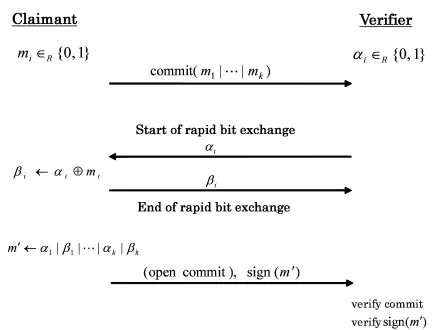
Fig. 2: Distance bounding with bidirectional commu-nication [3]. miis claimant’s nonce andαiis verifier’s
nonce. The verifier estimates the upper bound of a distance to the claimant with the round-trip time of rapid bit exchanges. After the rapid bit exchanges, the claimant signs a concatenation of αi and βi for
alliwith his private key, and sends it to the verifier.
fghif jk lkmn
i o p m
g q rs
t u v w xyz u
u { { { {
{ |
| } } ~
~
~
¡ ¢£¤¥¤¦¤ §
¨© ª«ª
¬
©
Fig. 3: Distance bounding with unidirectional com-munication. The station signs the sending time ts
and station’s location xs with his private key, and
broadcasts them. The mobile terminal estimates the upper bound of a distance to the station withtsand
the time of receipt tm. The mobile terminal then
but cannot make it look closer in principle because no information can propagate faster than light.
Other than the simple forced delay attack, we will consider two major attacks for the security of the dis-tance bounding below. In Fig. 2 and 3, we see the distance bounding protocol with duplex radio munication [3] and the one with simplex radio com-munication in our protocol. Note that a verifier indi-cates a trusted station in the original protocol [3] and the previous proposal [2], whereas in our proposal a verifier indicates a tamper-resistant module with an inner clock incorporated into a mobile terminal.
3.1.1 Impersonation Attack
In this subsection, we analyze the security of distance bounding protocols under the impersonation attack. We define the impersonation attack as a situation where an adversary impersonates another by falsify-ing authentication information to fool a certain legit-imate entity. More specifically, we consider a situa-tion where the adversary falsifies necessary raw data to compute mobile terminal’s time and location, and tries to make the verifier believe the false time and location information as true. The adversary may be a malicious third party, or a malicious user of the mobile terminal.
In the case of [3] [2], if the adversary falsifies mo-bile terminal’s location by the fake challenge-and-response in the man-in-the-middle attack, the veri-fier can detect the attack by verifying the committed random number and the submitted digital signature in the last step. The detection succeeds with over-whelming probability as long as the adopted signa-ture scheme is secure and claimant’s committed ran-dom number is kept secret from the adversary un-til the challenge-and-response between the adversary and the verifier is completed.
In case of our proposal, if the adversary makes up the arbitrary time and location information, the ver-ifier can detect the attack by verifying the appended digital signature. The detection succeeds with over-whelming probability as long as the adopted signa-ture scheme is secure.
3.1.2 Replay Attack
In this subsection, we analyze the security of distance bounding protocols under the replay attack. We de-fine the replay attack as a situation where an adver-sary repeats the past valid information to deceive a certain legitimate entity. More specifically, we con-sider a situation where an adversary eavesdrops on the valid communication between a trusted station and a mobile terminal, and fraudulently reuses the past communication to convince the verifier of the validity of the false time and location information.
The adversary may be a malicious third party, or a malicious user of the mobile terminal.
In [3] [2], if the adversary fraudulently reuses the past valid exchange between a claimant and a ver-ifier, the verifier can detect the attack by verifying the submitted digital signature in the last step. The success probability of the detection is overwhelmingly high as long as verifier’s random number is renewed in each challenge-and-response.
Even if the adversary fraudulently reuses the past valid communication, our proposal still upper bounds the distance of the mobile terminal to the station. Because the time of receipt issued by the tamper-proof inner clock is necessarily later than the past valid time of receipt, the adversary can only lengthen the estimated distance of the mobile terminal to the station, but cannot shorten it.
The proposal in [1] has a vulnerability to the re-play attack in the man-in-the-middle scenario. In the attack, an adversary adjacent to Location Manager eavesdrops on the message from Device to Location Manager containing nonces and encrypted Device’s ID, and also eavesdrops on the exchanged nonces be-tween Device and Location Manager. The adversary then blocks the valid message from Location Manager to Device, and immediately resends to Location Man-ager the first used message from Device to Location Manager. Since this time the adversary knows the valid nonces he will exchange to Location Manager in advance, he can fool Location Manager with the false round-trip latency shorter than the valid one, and he can also fool Device with the signed message from Location Manager containing the false round-trip latency. To prevent this attack, Location Man-ager must check that the encrypted (and randomized) Device’s ID in the first message from Device to Lo-cation Manager is different from all previously used ones.
3.2
Positioning with Distance
Bound-ing
By using the distance bounding in the previous sub-section, we construct a secure positioning mechanism in line with the previous proposals of [1] [2].
adversary from modifying the true location informa-tion inside the triangle. The same geometric prop-erty holds true in the relation between a point and a tetrahedron, instead of a triangle, in 3D space.
In addition to the area test, we check that the error range of the computed location is below the allowable level. With all these filtering tests, we extract only valid positioning results.
But there is a powerful attack to the proposed po-sitioning scheme with the help of plural wireless ter-minals. We will discuss the details below.
3.2.1 Collusion Attack
We define the collusion attack as a situation where plural adversaries share their individual information, or make use of their individual advantages in a co-operative manner, in order to deceive a legitimate entity. In particular, we consider a situation similar to the one discussed in [2] where the adversary col-ludes with plural wireless terminals placed adjacent to the surrounding trusted stations.
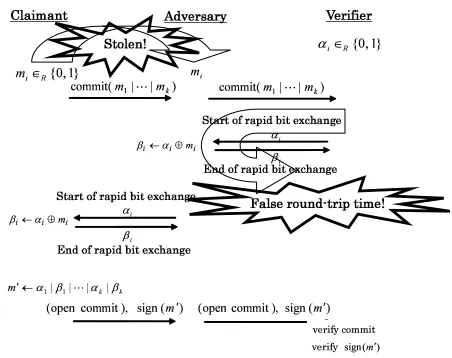
In case of the distance bounding by the challenge-and-response, each colluded wireless node intercepts the radio signal from the nearest station as a veri-fier, keeps it for an appropriate length of time, and returns it to the station to make the verifier be-lieve adversary’s false distance to the station as true. As discussed in [2], the previous proposal is secure as long as the verifier can distinguish adversary’s colluded wireless nodes from the adversary himself, which means that the secret keys for message authen-tication codes (MACs) (or the private keys for digital signatures), and the random nonces for the challenge-and-response must be securely protected from the ad-versary.
A variant of the replay attack [5] is shown in Fig. 4. As pointed out in [5], if the adversary ever obtains the valid nonces beforehand, adversary’s wireless node adjacent to the station uses the stolen nonce for the challenge-and-response with the station (verifier) to make the verifier measure the false round-trip time, reuses verifier’s nonce of the previous challenge-and-response for the next challenge-and-challenge-and-response with the mobile terminal (claimant), and results in success-ful distance falsification by relaying the valid digital signature from the claimant to the verifier. By this means, the colluded wireless nodes can adjust their estimated distances to the nearest station at will in order to look consistent with adversary’s false loca-tion even inside the verificaloca-tion triangle.
To prevent this type of colluded man-in-the-middle attack, a mobile terminal must securely protect a ran-dom number generator for nonces as well as the se-cret keys (or the private keys) for authentication in the tamper-resistant area.
®¯ °±¯²³ ±°´ µ ¶· µ¯¸¹º »°¼½¸ ¾ ¼¶ ²³ ± ° ´ µ ¶· µ ¯¸ ¹º »° ¼½ ¸ ¿ ÀÁ ÂàÀÁ ÄÅ ÆÀÁÇÈÁÉ ®¯ °±¯²³ ±°´ µ ¶· µ¯¸¹º »°¼ ½¸ Ê Ë Ì Í Î Ï Ð Ñ Ò Ó Ô ¾ ¼¶ ²³ ± ° ´ µ ¶·µ ¯¸ ¹º »° ¼½ ¸ Õ Ö Ö ×ØÙ ÙÚ ÛÜ Ý Þ ß ß à Ê Ë Ì Í Î Ï Ð Ò á â â â ã ä åæ ç è é ê ë ì ì í ïñðîñðòðï ðî ó ô õ ö ÷ ø ùú õ û ü ýþþ øÿ ýú ö È Â È ! "# $% & ' ' ()* *+,- . / 0 0 1 2 3 4 4 4 5 6 78 9 ê ë : ; À<
=> ?? @ A È ÇÀÁ;B Å C Á Â D Â À<
Fig. 4: Replay attack using a stolen nonce on the distance bounding with bidirectional communication [5]. The adversary makes up the false round-trip time with the stolen nonce. The adversary successfully deceives the verifier without claimant’s private key for digital signatures.
In case of our proposed protocol, even if adver-sary’s wireless nodes intercept the radio signal on the way to the verification module (verifier) of the mo-bile terminal, all they can do is to lengthen the es-timated distances from the stations but not shorten them, which results in either the computed location of the mobile terminal outside the verification trian-gle, or the computed location of the mobile terminal inside the verification triangle with the prohibitively enlarged error range. Our proposal is therefore secure against this type of attack as long as the mobile ter-minal protects its inner clock in the tamper-resistant area.
4
Functional Advantages
4.1
Location Privacy
In our proposal, a mobile terminal need not provide any information to verify calculated locations because only unidirectional communication is necessary for the verification. This gives mobile terminal users a considerable advantage in protecting their location privacy from the external adversary or the trusted stations.
the central authority through positioning procedures, and the protocol has intrinsic difficulty in protecting the location privacy of the mobile terminal users.
In [2], another protocol designed to protect the lo-cation privacy is also proposed, where the mobile ter-minal (or, a tamper-resistant module embedded in the mobile terminal) as a verifier computes and ver-ifies its location with distance bounding to the sta-tions. But it is technically possible for the surround-ing stations to extract considerably accurate loca-tion informaloca-tion of the mobile terminal from physical properties of the received radio signals, e.g., propa-gation directions, strengths, or temporal variations, through their bidirectional communication.
4.2
Positioning Accuracy
In the previous protocols [1] [2], positioning is based on the measurements of the round-trip latency of the radio signal from the stations to the mobile terminal. The measured time necessarily includes the process-ing time to prepare the valid response by the mobile terminal as a claimant, and the uncertainty of the processing time causes considerable positioning error. Our protocol with one-way communication is free from the positioning error caused by the un-predictable processing-time fluctuations mentioned above, because the measured propagation time does not include any intermediate processing time.
Additionally, in the previous protocols using the challenge-and-response, it is difficult for stations to measure their distances to the mobile terminal on the move. Because the receipt time of stations’ chal-lenges tends to be dispersed when the mobile termi-nal is moving, the location of mobile termitermi-nal at the time of distance estimation is easily blurred, which considerably lowers the positioning accuracy. More-over, if received plural challenges from stations must be processed sequentially to prepare valid responses by the mobile terminal, it is difficult to predict the total processing time of the mobile terminal whose fluctuations also cause positioning errors.
In our protocol, after the mobile terminal success-fully receives plural broadcasts from stations and the precise time of receipt from the inner clock all at once, the mobile terminal does not have to hurry for positioning accuracy in the subsequent procedures. Today, there are various mobile terminals including GPS receivers which can receive plural broadcasts si-multaneously.
4.3
Coverage Area
As for radio communication, the size of the coverage area depends largely on the intensity of the trans-mitted radio wave. In bidirectional radio communi-cation, the size of the coverage area is severely limited
by the poor output power of mobile terminal’s bat-tery. Since it is technically difficult to increase the output power of small size batteries, the size of the coverage area for bidirectional radio communication cannot be enlarged easily. Hence, if we hope to cover a large area or outdoors for secure positioning, we need considerable number of trusted stations.
In contrast, our proposal does not have the above-mentioned upper limit of the communication dis-tance, because we only use unidirectional communi-cation from stations to a mobile terminal. If stations have affluent power supplies to send a strong radio wave, the size of the coverage area becomes much larger, and the number of necessary trusted stations becomes much less than the that of previous propos-als using bidirectional communication.
4.4
Key Management
As for the mainly discussed proposal in [2], the set-ting needs a central authority and a secure backyard network to link between the authority and the sta-tions, where the authority gathers distance informa-tion from the stainforma-tions to compute and verify the mo-bile user’s location. This means the setting needs an additional secure key distribution mechanism to maintain the backyard network, and rather complex key management for it, as shown in [2]. On the con-trary, our proposal does not need either a central au-thority or a secure backyard network for verification of computed locations, because in our setting a veri-fication module in the mobile terminal computes and verifies mobile terminal’s position by itself. Thus, our proposal also has an advantage in simple key manage-ment.
5
Feasibility Analysis
In our proposal, we assume that a verification mod-ule and a small size inner clock with high-precision are embedded in the tamper-resistant area of a mobile terminal, and that they are rigorously protected from outside entities including a mobile terminal user. We suppose that a mobile terminal is lent by an author-ity to a user. An inner clock in the mobile terminal is kept isolated from the authority by the time of expiration when the mobile terminal is returned to the authority. The authority checks that the mobile terminal has no irregularities and updates its inner clock. In the above usage model, the required preci-sion of the inner clock is roughly approximated with the relation
c×(δt×T)∼δl , (1)
of the inner clock, T is the period of validity of the inner clock, and δl is the accumulated positioning error due to δt. Given that T = 30 day with the constantc= 3×10⁸
m/s, if we want the accumulated positioning errorδlin the order of 100
m, the required precision of the inner clockδtshould be in the order of 10−10s/day.
In fact, several clock manufacturers have already developed small size oven-controlled crystal oscilla-tors (OCXOs) which narrowly meet the above preci-sion requirement with low power consumption [6] [7] [8] [9]. Their typical long term stability is 5×10⁻¹⁰
s/day, and the accumulated positioning error is about 5 m according to eq.(1). Those miniaturized OCXOs are small enough to be incorporated into various types of mobile terminals, and are now available on the market. But the OCXOs are rather sensitive to an abnormal environment and external noises, such as mechanical fluctuations and the high/low temper-ature, which might be a restriction on some special usages of mobile terminals.
The chip-scale atomic clock developed by NIST is another promising candidate for the inner clock [10] [11] [12]. The size of the main unit itself is small enough to be integrated with RFID tags, and even the present size of the total system including surrounding electrical control devices is small enough to be embed-ded in most mobile terminals [11]. Although the first reported clock precision (of order 10−8 s/day) [10]
fell short of our requirement above, last year NIST achieved 5×10⁻¹¹ s/day for the long term stability
[12], i.e., about 0.5 m for the accumulated position-ing error by eq.(1), which sufficiently meets our re-quirement. In addition to the above advantage, the chip-scale atomic clock operates with low power con-sumption, and is originally designed for low-cost mass production.
Contrary to cryptographic algorithms and tech-niques, most tamper-resistant hardware techniques have been kept secret among developers exclusively, and there are only limited number of technical liter-atures available to the public [13]. One well-known measure for tamper-proofing is to set up a trap to cer-tainly detect unauthorized operations or intrusions against the protected area. The detection of the at-tack immediately triggers to delete the secret data or break the related hardware functions. The mech-anism may utilize electrical treatments, irreversible chemical reactions, or mechanical destruction. An-other well-known measure for tamper-proofing is to produce the protected area with single-chip integra-tion to cut off the direct contact from outside.
In our proposal, breaking the inner clock itself can-not be a sufficient countermeasure, because the at-tacker can freely replace the broken one with his own high-precision clock. We must either forcibly halt the function of the verification module or delete secret
identification information as a valid verifier embed-ded in the protected area. If we choose the chip-scale atomic clock as an inner clock, single-chip integration might be an effective countermeasure.
6
Related Work
The secure positioning technique with RF mainly cussed in this paper was proposed in [1] [2]. The dis-tance bounding protocols using bidirectional commu-nication to upper bound claimant’s distance was first introduced in [3], and the proposal in [2] is based on the protocols [3]. For easier implementation, a secure positioning technique with a distance bounding pro-tocol using ultrasound and radio communication was proposed in [14], but it has a security vulnerability to the replay attack due to its use of ultrasound. In [15], a distance bounding protocol for RFID is proposed. The protocol uses duplex radio communication, and is designed to lessen the processing load of RFID as far as possible.
The protocol called Temporal Leashes is proposed in [4] for detection of the specific attack called the wormhole attack. The protocol detects the attack by checking the packet transmission time measured by tightly synchronized clocks of a sender and a receiver. On the other hand, there are location verification protocols which substantially make use of the phys-ical properties of broadcasted radio waves [16] [5]. In [16], their proposal depends on the intensity and the directivity of broadcasted radio waves for loca-tion verificaloca-tion. In [5], their proposal with duplex radio communication assumes spatial isotropic prop-agation of radio waves by use of mobile terminal’s omni-directional antenna, and uses its particular ge-ometric relation for location verification. But both proposals have a security vulnerability to malicious modification of the assumed physical properties of ra-dio waves. There are many possible ways, especially for a mobile terminal user, to carry out the physi-cal modification of radio waves, e.g., by fraudulently using a directional antenna for the mobile terminal, or by surrounding the mobile terminal with carefully chosen mediums or materials.
7
Conclusion
and simplifying key management. On the other hand, our proposal depends largely on hardware technolo-gies for a tamper-resistant module and a small size inner clock with high-precision. But we believe those requirements are not serious restriction on our pro-posal, when considering the consecutive advent of various small size clocks with high-precision.
In the previous proposals [1] [2], a random number generator for nonces as well as secret keys for encryp-tion and authenticaencryp-tion must be protected even from a mobile terminal user by a tamper-resistant hard-ware embedded in the mobile terminal. In our pro-posal, correspondingly, a high-precision inner clock must be protected even from a mobile terminal user by a tamper-resistant hardware embedded in the mo-bile terminal.
In the near future, our proposal might be useful for an autonomous RFID tag integrated with a micro processor, a small size battery, and a small size high-precision inner clock, which might play a key role to guarantee the traceability in wireless networks.
Acknowledgements
The author is profoundly grateful to Koji Yura and Ayumu Shimizu for illuminating and constructive discussions on the subject of this paper. The author is also grateful to Koji Okada and Fumihiko Sano for countless instructive helps in extensive background knowledge.
References
[1] B.R. Waters and E.W. Felten, “Secure, private proofs of location,” Princeton Univ., Tech. Rep., [Online]. Available: http://www.cs.princeton.edu/research/techreps/TR-667-03, Jan. 2003.
[2] S. ˇCapkun and J.-P. Hubaux, “Secure position-ing in wireless networks,” IEEE J. Sel. Areas Commun., vol. 24, no. 2, Feb. 2006, pp. 221– 232.
[3] S. Brands and D. Chaum, “Distance-bounding protocols,” inProc. Advances in Cryptology — EUROCRYPT’93, Lecture Notes in Computer Science,vol. 765, Springer-Verlag Berlin Heidel-berg 1994, pp. 344–359.
[4] Y.-C. Hu, A. Perrig, and D.B. Johnson, “Worm-hole attacks in wireless networks,”IEEE J. Sel. Areas Commun., vol. 24, no. 2, Feb. 2006, pp. 370–380.
[5] D. Singelee and B. Preneel, “Location verifica-tion using secure distance bounding protocols,” inProc. MASS05, Nov. 2005, pp. 834–840.
[6] Specification sheet for OCXO 8711/8712, Oscilloquartz S.A. [Online]. Available: http://www.oscilloquartz.com/file/pdf/8712.pdf
[7] Specification sheet for OCXO C4700, Vec-tron International. [Online]. Available: http://www.vectron.com/products/ocxo/c4700.pdf
[8] Specification sheet for VFTDR Series Double Oven Ultra Precision OCXO, Valpey Fisher Corp. [Online]. Available: http://www.mfelectronics.com/PDFs/VFTDXspec.pdf
[9] Specification sheet for CFPO-US SE-RIES: Ultra Stable OCXOS, C-MAC MicroTechnology. [Online]. Available: http://www.cmac.com/pdf/cfpo-us.pdf
[10] S. Knappe, L. Liew, V. Shah, P. Schwindt, J. Moreland, L. Hollberg, and J. Kitching, “A mi-cromachined atomic clock,” Appl. Phys. Lett., vol. 85, Aug. 2004, pp. 1460–1462.
[11] J. Kitching, S. Knappe, L. Liew, J. Moreland, P.D.D. Schwindt, V. Shah, V. Gerginov, and L. Hollberg, “Microfabricated atomic frequency references,”Metrologia,42, 2005, S100–S104.
[12] S. Knappe, V. Gerginov, P.D.D. Schwindt, V. Shah, H.G. Robinson, L. Hollberg, and J. Kitch-ing, “Atomic vapor cells for chip-scale atomic clocks with improved long-term frequency sta-bility,”Optics Letters, vol. 30, no. 18, Sep. 2005, pp. 2351–2353.
[13] R. Anderson and M. Kuhn, “Tamper resistance — A cautionary note,” in Proc. 2nd USENIX Workshop on Electronic Commerce, 1996, pp. 1– 11.
[14] N. Sastry, U. Shankar, and D. Wagner, “Secure verification of location claims,” inProc. WiSe, Sep. 2003, pp. 1–10.
[15] G.P. Hancke and M.G. Kuhn, “An RFID distance bounding protocol,” in Proc. SE-CURECOMM’05, Sep. 2005, pp. 67–73.