The Wrestlers Protocol
A simple, practical, secure, deniable protocol for
key-exchange
Mark Wooding
[email protected]
2 November 2006
1.1 Desirable properties of our protocols . . . 3 1.2 Asymptotic and concrete
security results . . . 4 1.3 Formal models for
key-exchange . . . 4 1.4 Outline of the paper . . . . 5
2 Preliminaries 6
2.1 Miscellaneous notation. . . 6 2.2 Groups . . . 6 2.3 Bit strings and encodings . 6 2.4 Games, adversaries, and
oracles . . . 7 2.5 The random oracle model . 7 2.6 Notation for algorithms . . 8 2.7 Diffie-Hellman problems . 8 2.8 Example groups and
en-codings . . . 11 2.9 Symmetric encryption . . . 12 2.10 Simulations . . . 13
3 A zero-knowledge identification
scheme 17
3.1 Description . . . 17
3.3 An identity-based identifi-cation scheme . . . 25 3.4 Comparison with the
pro-tocol of Stinson and Wu . . 26
4 A simple key-exchange protocol 27
4.1 Overview . . . 27 4.2 Security model and
secu-rity definition . . . 29 4.3 Security . . . 31 4.4 Insecure protocol variants . 33 4.5 Deniability . . . 35 4.6 Practical issues . . . 40
5 Conclusions 42
6 Acknowledgements 43
7 References 43
A Proofs 47
A.1 Proof of theorem 4.3.1 . . . 47 A.2 Proof of theorem 4.5.1 . . . 54 A.3 Sketch proof of single-key
1. Introduction
1 Introduction
This paper proposes protocols foridentificationandauthenticated key-exchange.
An identification protocol allows one party, say Bob, to be sure that he’s really talking to another party, say Alice. It assumes that Bob has some way of recognising Alice; for instance, he might know her public key. Our protocol requires only two messages – a challenge and a response – and has a number of useful properties. It is very similar to, though designed independently of, a recent protocol by Stinson and Wu; we discuss their protocol in section 3.4.
Identification protocols are typically less useful than they sound. As Shoup [Sho99] points out, it provides a ‘secure ping’, by which Bob can know that Alice is ‘there’, but provides no guarantee that any other communication was sent to or reached her. However, there are situations where this an authentic channel between two entities – e.g., a device and a smartcard – where a simple identification protocol can still be useful.
An authenticated key-exchange protocol lets Alice and Bob agree on a shared secret, known to them alone, even if there is an enemy who can read and intercept all of their messages, and substitute messages of her own. Once they have agreed on their shared secret, of course, they can use standard symmetric cryptography techniques to ensure the privacy and authenticity of their messages.
1.1 Desirable properties of our protocols
Our identification protocol has a number of desirable properties.
• It issimpleto understand and implement. In particular, it requires only two messages.
• It is fairlyefficient, requiring two scalar multiplications by each of the prover and verifier.
• It is provably secure (in the random oracle model), assuming the intractability of the computational Diffie-Hellman problem.
Our key-exchange protocol also has a number of desirable properties.
• It is fairlysimpleto understand and implement, though there are a few subtleties. In particular, it is symmetrical. We have implemented a virtual private network system based on this protocol.
• It isefficient, requiring four scalar multiplications by each participant. The communica-tion can be reduced to three messages by breaking the protocol’s symmetry.
• It is provablysecure(again, in the random oracle model), assuming the intractability of the computational Diffie-Hellman problem, and the security of a symmetric encryption scheme.
• It provides perfect forward secrecy. That is, even if a user’s long-term secrets are compromised, past sessions remain secure.
1.2 Asymptotic and concrete security results
Most security definitions for identification (particularly zero-knowledge) and key-exchange in the literature areasymptotic. That is, they consider a family of related protocols, indexed by a security parameter k; they that any polynomially-bounded adversary has only negligible advantage. A polynomially-bounded adversary is one whose running time is a bounded by some polynomialt(k). The security definition requires that, for any such polynomially-bounded adversary, and any polynomialp(k), the adversary’s advantage is less thanp(k)for all sufficiently large values ofk.
Such asymptotic notions are theoretically interesting, and have obvious connections to complexity theory. Unfortunately, such an asymptotic result tells us nothing at all about the security of a particular instance of a protocol, or what parameter sizes one needs to choose for a given level of security against a particular kind of adversary. Koblitz and Menezes [KM06] (among other useful observations) give examples of protocols, proven to meet asymptotic notions of security, whose security proofs guarantee nothing at all for the kinds of parameters typically used in practice.
Since, above all, we’re interested in analysing a practical and implemented protocol, we follow here the ‘practice-oriented provable security’ approach largely inspired by Bellare and Rogaway, and exemplified by [BKR94, BGR95, BR95a, BR96, BCK96, BDJR97]; see also [Bel99]. Rather than attempting to say, formally, whether or not a protocol is ‘secure’, we associate with each protocol an ‘insecurity function’ which gives an upper bound on the advantage of any adversary attacking the protocol within given resource bounds.
1.3 Formal models for key-exchange
Many proposed key-exchange protocols have turned out to have subtle security flaws. The idea of using formal methods to analyse key-exchange protocols begins with the logic of Burrows, Abadi and Needham [BAN89]. Their approach requires a ‘formalising’ step, in which one expresses in the logic the contents of the message flows, and the beliefs of the participants.
Bellare and Rogaway [BR94] describe a model for studying the computational security of authentication and key-exchange protocols in a concurrent setting, i.e., where multiple parties are running several instances of a protocol simultaneously. They define a notion of security in this setting, and show that several simple protocols achieve this notion. Their original paper dealt with pairs of parties using symmetric cryptography; they extended their definitions in [BR95b] to study three-party protocols involving a trusted key-distribution centre.
Blake-Wilson, Johnson and Menezes [BWJM97] applied the model of [BR94] to key-exchange protocols using asymmetric cryptography, and Blake-Wilson and Menezes [BWM98] applied it to protocols based on the Diffie-Hellman protocol.
The security notion of [BR94] is based on agame, in which an adversary nominates achallenge session, and is given either the key agreed by the participants of the challenge session, or a random value independently sampled from an appropriate distribution. The adversary’s advantage – and hence the insecurity of the protocol – is measured by its success probability in guessing whether the value it was given is really the challenge key. This challenge-session notion was also used by the subsequent papers described above.
1. Introduction
AM(for ‘authenticated links model’) andUM(‘unauthenticated links model’). They propose a modular approach to the design of key-exchange protocols, whereby one first designs a protocol and proves its security in theAM, and then applies a authenticating ‘compiler’ to the protocol which they prove yields a protocol secure in the realisticUM. Their security notion is new. They define an ‘ideal model’, in which an adversary is limited to assigning sessions fresh, random and unknown keys, or matching up one session with another, so that both have the same key. They define a protocol to be secure if, for any adversaryAin theAMorUM, there is an ideal adversaryI, such that the outputs ofAandIare computationally indistinguishable.
In [Sho99], Shoup presents a new model for key-exchange, also based on the idea of simulation. He analyses the previous models, particularly [BR94] and [BCK98], and highlights some of their inadequacies.
Canetti and Krawczyk [CK01] describe a new notion of security in the basic model of [BCK98], based on the challenge-session notion of [BR94]. The security notion, called ‘SK-security’, seems weaker in various ways than those of earlier works such as [BR94] or [Sho99]. However, the authors show that their notion suffices for constructing ‘secure channel’ protocols, which they also define.
In [Can01], Canetti describes the ‘universal composition’ framework. Here, security notions are simulation-based: one defines security notions by presenting an ‘ideal functionality’. A protocol securely implements a particular functionality if, for any adversary interacting with parties who use the protocol, there is an adversary which interacts with parties using the ideal functionality such that no ‘environment’ can distinguish the two. The environment is allowed to interact freely with the adversary throughout, differentiating this approach from that of [BCK98] and [Sho99], where the distinguisher was given only transcripts of the adversary’s interaction with the parties. With security defined in this way, it’s possible to prove a ‘universal composition theorem’: one can construct a protocol, based upon various ideal functionalities, and then ‘plug in’ secure implementations of the ideal functionalities and appeal to the theorem to prove the security of the entire protocol. The UC framework gives rise to very strong notions of security, due to the interactive nature of the ‘environment’ distinguisher.
Canetti and Krawczyk [CK02] show that the SK-security notion of [CK01] is equivalent to a ‘relaxed’ notion of key-exchange security in the UC framework, and suffices for the construction of UC secure channels.
The result of [CK02] gives us confidence that SK-security is the ‘right’ notion of security for key-exchange protocols. Accordingly, SK-security is the standard against which we analyse our key-exchange protocol.
1.4 Outline of the paper
The remaining sections of this paper are as follows.
• Section 2 provides the essential groundwork for the rest of the paper. It introduces important notation, and describes security notions and intractability assumptions.
• Section 3 describes our zero-knowledge identification protocol and proves its security.
• Finally, section 5 presents our conclusions.
2 Preliminaries
2.1 Miscellaneous notation
We writeF[D →R]for the set of all functions with domainDand rangeR. We writeN<n=
{i∈Z|06i < n}={0,1, . . . , n−1}for the set of nonnegative integers less thann.
2.2 Groups
Let(G,+)be a cyclic group1of prime orderq, and generated by an elementP. We shall write the identity ofGas0G, or simply as0when no ambiguity is likely to arise. Thus, we have
hPi=GandqP = 0. AnyX∈Gcan be written asX =xP for somex∈N<q.
2.3 Bit strings and encodings
LetΣ ={0,1}be the set of binary digits. ThenΣnis the set ofn-bit strings, andΣ∗the set of all (finite) bit strings. Ifx∈Σn is a bit string, we write its length as|x| =n. For a bit string
x∈Σn, and for0
6i < n, we writex[i]as theith bit ofx. The empty string is denotedλ.
Letxandybe two bit strings. If|x|=|y|=n, we writex⊕yto mean the bitwise exclusive-or ofxandy: ifz = x⊕ythen|z| =n, andz[i] = (x[i] +y[i]) mod 2for0 6i < n. We write
xkyto mean the concatenation ofxandy: ifz =xkythen|z| =|x|+|y|andz[i] = x[i]if
06i <|x|andz[i] =y[i− |x|]if|x|< i6|x|+|y|.
Finally, we let⊥be a value distinct from any bit string.
We shall want to encode group elementsX ∈Gand indicesx∈I =N<|G|as bit strings. To
this end, we shall assume the existence of integers`G, `I >0and functions
eS:S →Σ`S and dS: Σ`S →S∪ {⊥} forS∈ {G, I}.
with the following properties.
• The functions areuniqueandunambiguous, i.e., for anyt∈Σ`S, we have
dS(t) =
(
s if there is somes∈Ssuch thatt=eS(s), or
⊥ if no suchsexists.
• The functions should beefficientto compute. Indeed, we shall be assuming that the time taken for encoding and decoding is essentially trivial.
Note that, as we have defined them, all encodings of group elements are the same length, and similarly for encodings of indices. This is necessary for the security of our protocols.
We shall frequently abuse notation by omitting the encoding and decoding functions where it is obvious that they are required.
1 We find that additive group notation is easier to read. In particular, in multiplicative groups, one ends up with
2. Preliminaries
2.4 Games, adversaries, and oracles
Many of the security definitions and results given here make use of games, played with an adversary. An adversary is a probabilistic algorithm. In some games, the adversary is additionally equipped withoracles, which perform computations with values chosen by the adversary and secrets chosen by the game but not revealed to the adversary. We impose limits on the adversary’s resource usage: in particular, the total time it takes, and the number of queries it makes to its various oracles. Throughout, we include the size of the adversary’s program as part of its ‘time’, in order to model adversaries which contain large precomputed tables.
The games provide models of someone trying to attack a construction or protocol. For security, we will either define a notion of ‘winning’ the game, and require that all adversaries have only a very small probability of winning, or we consider two different games and require that no adversary can distinguish between the two except with very small probability.
Our proofs make frequent use of sequences of games; see [Sho04, BR04]. The presentation owes much to Shoup [Sho04]. We begin with a gameG0based directly on a relevant security
definition, and construct a sequence of gamesG1,G2, . . . , each slightly different from the
last. We define all of the games in a sequence over the same underlying probability space – the random coins tossed by the algorithms involved – though different games may have slightly differently-defined events and random variables. Our goal in doing this is to bound the probability of the adversary winning the initial gameG0by simultaneously (a) relating
the probability of this event to that of corresponding events in subsequent games, and (b) simplifying the game until the probability of the corresponding event can be computed directly.
The following simple lemma from [Sho01] will be frequently useful.
2.4.1 Lemma(Difference Lemma) LetS,T,F be events. SupposePr[S|F] = Pr[T¯ |F¯]. Then|Pr[S]− Pr[T]|6Pr[F].
Proof A simple calculation:
|Pr[S]−Pr[T]|=|(Pr[S|F] Pr[F] + Pr[S|F] Pr[ ¯¯ F])−(Pr[T|F] Pr[F] + Pr[T|F] Pr[ ¯¯ F])|
= Pr[F]· |Pr[S|F]−Pr[T|F]| 6Pr[F]
and we’re done!
2.5 The random oracle model
In particular, most of our results will make use of therandom oraclemodel [BR93], in which all the participants, including the adversary, have access to a number of ‘random oracles’. A random oracle with domainDand rangeRis an oracle which computes a function chosen uniformly at random from the set of all such functions. (In the original paper [BR93], random oracles are considered having domainΣ∗and rangeΣω; we use finite random oracles here, because they’re easier to work with.)
Proofs in the random oracle must be interpreted carefully. For example, Canetti, Goldreich and Halevi [CGH04] show that there are schemes which can be proven secure in the random oracle model but provably have no secure instantiation in the standard model.
The random oracle model is useful for constructing reductions and simulators for two main reasons.
1. One can use the transcript of an adversary’s queries to random oracles in order to extract knowledge from it.
2. One can ‘program’ a random oracle so as to avoid being bound by prior ‘commitments’, or to guide an adversary towards solving a selected instance of some problem.
Our proofs only make use of the first feature. This becomes particularly important when we consider issues of zero-knowledge and deniability in a concurrent setting, because we want to be able to claim that we retain these features when the random oracle is instantiated using a cryptographic hash function, and hash functions definitely aren’t ‘programmable’ in this way! The former property seems rather more defensible – one would indeed hope that the only sensible way of working out (anything about) the hash of a particular string is to actually compute the hash function, and the random oracle model is, we hope, just giving us a ‘hook’ into this process.
(Our protocols can be modified to make use of bilinear pairings so as to provide identity-based identification and key-exchange, using the techniques of [BF03]. Proving the security of the modifications we discuss would involve ‘programming’ random oracles, but this doesn’t affect the zero-knowledge or deniability of the resulting protocols.)
2.6 Notation for algorithms
We shall have occasion to describe algorithms by means of a pseudocode. Our choice of pseudocode is unlikely to be particularly controversial. We letx ← y denote the action of settingxto the valuey; similarly, x ←$ Y denotes the action of sampling xfrom the set Y
uniformly at random.
The expressiona←AO(·,x)(y)means ‘assign toathe value output by algorithmAon inputy, and with oracle access to the algorithm which, given inputz, computesO(z, x)’.
We make use of conditional (if-else) and looping (for-do and while-do) constructions; in order to reduce the amount of space taken up, the bodies of such constructions are shown by indentation only.
We don’t declare the types of our variables explicitly, assuming that these will be obvious by inspection; also, we don’t describe our variables’ scopes explicitly, leaving the reader to determine these from context.
Finally, the notationPr[algorithm:condition]denotes the probability thatconditionis true after running the givenalgorithm.
2.7 Diffie-Hellman problems
2. Preliminaries
ThecomputationalDiffie-Hellman problem (CDH) is as follows: given two group elements
X=xP andY =yP, findZ=xyP.
2.7.1 Definition(The computational Diffie-Hellman problem) Let(G,+)be a cyclic group generated by
P. For any adversaryA, we say thatA’ssuccess probabilityat solving the computational Diffie-Hellman problem inGis
SucccdhG (A) = Pr[x
$
←I;y←$ N<|G|:A(xP, yP) =xyP]
where the probability is taken over the random choices ofxandyand any random decisions made byA. We say that theCDH insecurity functionofGis
InSeccdh(G;t) = max
A Succ cdh G (A)
where the maximum is taken over adversaries which complete in timet.
Certainly, if one can compute discrete logarithms in the groupG(i.e., givenxP, findx), then one can solve the computational Diffie-Hellman problem. The converse is not clear, though. Shoup [Sho97] gives us some confidence in the difficulty of the problem by showing that a generic adversary – i.e., one which makes no use of the specific structure of a group – has success probability no greater thanq2/|G|.
This isn’t quite sufficient for our purposes. Our proofs will be able to come up with (possibly) a large number of guesses for the correct answer, and at most one of them will be correct. Unfortunately, working out which one is right seems, in general, to be difficult. This is the decisionDiffie-Hellman problem (DDH), which [Sho97] shows, in the generic group model, is about as hard as CDH. (See [Bon98] for a survey of the decision Diffie-Hellman problem.)
Our reference problem will be a ‘multiple-guess computational Diffie-Hellman problem’ (MCDH), which is captured by a game as follows. An adversary is given a pair of group elements(xP, yP), and an oracleV(·)which accepts group elements as input. The adversary wins the game if it queriesV(xyP).
2.7.2 Definition(The multiple-guess computational Diffie-Hellman problem) Let(G,+)be a cyclic group generated by P. For some adversary A, we say that A’s success probability at solving the multiple-guess computational Diffie-Hellman problem inGis
SuccmcdhG (A) = Pr[GamemcdhG (A) = 1]
whereGamemcdhG (A)is shown in figure 2.1. We say that theMCDH insecurity function ofGis
InSecmcdh(G;t, qV) = max A Succ
mcdh
G (A)
where the maximum is taken over adversaries which complete in timet and make at most
qV-oracle queries.
Note that our MCDH problem is not quite the ‘gap Diffie-Hellman problem’ (GDH). The gap problem measures the intractibility of solving CDH even with the assistance of an oracle for solving (restricted) decision Diffie-Hellman problems in the group. Specifically, the adversary is given(X, Y) = (xP, yP)and tries to findZ =xyP, as for CDH, but now it has access to an oracleD(R, S)which answers1ifS =xRand0otherwise.
GamemcdhG (A):
w←0;
x←$ N<|G|;y
$ ←N<|G|;
AV(·)(xP, yP); returnw;
FunctionV(Z):
ifZ=xyP then w←1;
return1;
return0;
Figure 2.1: The multiple-guess computational Diffie-Hellman problem:GamemcdhG (A)
2.7.3 Proposition(Comparison of MCDH and CDH security) For any cyclic group(G,+),
InSecmcdh(G;t, qV)6qV InSeccdh(G;t+O(qV)).
Proof Let A be an adversary attacking the multiple-guess computational Diffie-Hellman problem inG, and suppose that it runs in timetand issuesqV queries to its verification oracle.
We use a sequence of games. GameG0is the original MCDH attack game. In each gameGi,
we let the eventSibe the probability that the adversary wins the game.
GameG1 is the same asG0, except that we change the behaviour of the verification oracle.
Specifically, we make the oracle always return 0. We claim that this doesn’t affect the adversary’s probability of winning, i.e.,Pr[S1] = Pr[S0]. To see this, note that if none of the
adversary’sV(·)queries was correct, then there is no change in the game; conversely, if any query was correct, then the adversary will have won regardless of its subsequent behaviour (which may differ arbitrarily between the two games).
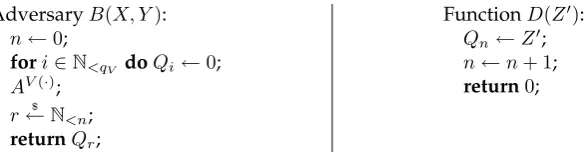
We are now ready to construct fromAan adversaryBattacking the standard computational Diffie-Hellman problem.
AdversaryB(X, Y):
n←0;
fori∈N<qV doQi←0; AV(·);
r←$ N<n;
returnQr;
FunctionD(Z0):
Qn ←Z0;
n←n+ 1;
return0;
Observe thatBprovidesAwith an accurate simulation of gameG1. Moreover, at the end of
the algorithm, we have0< n6qV, the output ofAis stored inQn−1and the valuesQ0,Q1,
. . . ,Qn−1are the values ofA’s oracle queries. Hence, with probabilityP r[S1], at least of one
of theQiis the correct answer to the CDH problem. Letε= Pr[S1] = Pr[S0]; we claim thatB’s
probability of success is at leastε/qV. The proposition follows directly from this claim and that, becauseAwas chosen arbitrarily, we can maximize and count resources.
We now prove the above claim. For06i < qV, letWibe the event thatQi=xyP, i.e., thatQi is the correct response. A simple union bound shows that
X
06i<j
2. Preliminaries
We now perform a calculation:
SucccdhG (B) =
X
06i<qV
Pr[Wi∧r=i]
= X
0<j6qV
Pr[n=j]
X
06i<j
Pr[Wi∧r=i|n=j]
= X
0<j6qV
Pr[n=j]
1
j
X
06i<j
Pr[Wi|n=j]
> X 0<j6qV
Pr[n=j]ε j
>qε
V
X
0<j6qV
Pr[n=j]
= ε qV
.
which completes the proof.
2.8 Example groups and encodings
For nonnegative integers06n <2`, there is a natural binary encodingN`:N<2` →Σ`which
we can define recursively as follows.
N0(0) =λ N`(n) =
(
N`−1(n)k0 if06n <2`−1 N`−1(n−2`−1)k1 if2`−16n <2`.
Given an encodinga=N`(n)we can recovernas
n= X
06i<`
a[i]2i.
Hence, given some limitL62`, we can encode elements ofN<Lusing the functions(e, d):
e(L, `, n) =N`(n) d(L, `, a) =
(
N`(a) ifN`(a)< L
⊥ otherwise
The reader can verify that the functions e(L, `,·) and d(L, `,·) satisfy the requirements of section 2.3.
Given some q < 2`I and I =
N<q, then, we can define an encoding (eI, dI) byeI(n) =
e(q, `I, n)anddI(a) =d(q, `I, a).
Let pand q be primes, with q|(p−1). Then there is an order-q subgroup of(Z/pZ)∗. In practice, an order-qelement can be found easily by taking elementsh∈ (Z/pZ)∗at random and computingg = h(p−1)/2untilg 6= 1; thenG =hgiis a group ofqelements. Assuming
‘representative’ integern such that 0 6 n < p, and given 2`G > p, we can encoden as e(p, `G, n), as above.
Alternatively, letF=Fpf be a finite field, andEbe an elliptic curve defined overFsuch that
the groupE(F) of F-rational points of E has a prime-order cyclic subgroup G. Elements of G can be represented as pairs of elements of F. If f = 1, i.e., F = Z/pZ then field elements can be encoded as above. Ifp= 2, we can represent the field asF2/(p(x))for some
irreducible polynomialp(x)∈F2[x]of degreef. An elementr∈Fcan then be represented by a polynomialr(x)with degree less thanf, and coefficientsci∈ {0,1}, i.e.,
r(x) = X 06i<f
cixi
and hence we can uniquely encoderas anf-bit stringasuch thata[i] =ci.
2.9 Symmetric encryption
Our key-exchange protocol requires a symmetric encryption scheme. Our definition is fairly standard, except that, rather than specifying a key-generation algorithm, we assume that key generation simply involves selecting a string of a given length uniformly at random.
2.9.1 Definition(Symmetric encryption schemes) Asymmetric encryption schemeE = (κ, E, D)consists of:
• an integerκ>0,
• a randomizedencryption algorithmE which, on inputK∈Σκandp∈Σ∗outputs some
c∈Σ∗, writtenc←E
K(p);
• adecryption algorithmDwhich, on inputK∈Σκandc∈Σ∗outputs somep0∈Σ∗∪ {⊥},
writtenp0 ←DK(c).
Furthermore, a symmetric encryption scheme must besound: that is, ifc ←EK(p)for some
K∈Σκandp∈Σ∗, andp0←D
K(c)thenp=p0.
Our security notion for symmetric encryption is the standard notion of left-or-right indistin-guishability of ciphertexts under chosen-ciphertext attack.
2.9.2 Definition(Indistinguishability under chosen-ciphertext attack (IND-CCA)) Let E = (κ, E, D)be a symmetric encryption scheme, andAbe an adversary. Letlrb(x0, x1) =xbforb∈ {0,1}. Let
Pb= Pr[K
$
←Σκ;b←AEK(lrb(·,·)),DK(·)() :b= 1]
An adversary isvalidif
• for any query to its encryption oracleEK(lrb(x0, x1))we have|x0|=|x1|, and
• no query to the decryption oracleDK(·)is equal to any reply from an encryption query.
IfAis valid, then we define itsadvantagein attacking the security ofEas follows
Advind-ccaE =P1−P0.
Further, we define theIND-CCA insecurity function ofEto be
InSecind-cca(E;t, qE, qD) = max
A Adv
ind-cca
2. Preliminaries
where the maximum is taken over all valid adversariesAwhich run in timet, and issue at
mostqEencryption andqDdecryption queries.
2.10 Simulations
In section 3, we shall prove that our identification protocol is zero-knowledge; in section 4.5, we show that our key-exchange protocol is deniable. In both of these proofs, we shall need to demonstratesimulatability.
General framework Consider a game in which an adversaryAinteracts with some ‘world’W, which we shall represent as a probabilistic algorithm. The world may in fact represent a number of honest parties communicating in a concurrent fashion, but we can consider them as a single algorithm for our present purposes.
Initially the world and the adversary are both given the samecommon input c; in addition, the world is given aprivate inputw. Bothcandware computed by aninitialization functionI, which is considered to be part of the definition of the game. Finally, the adversary decides somehow that it has finished interacting, and outputs a valuea. All this we notate as
(w, c)←I();a←AW(w,c)(c).
This game issimulatableif there is an algorithmS – thesimulator– which can compute the same things asA, but all by itself without interacting with the world. That is, we run the simulator on the common inputc, allowing it to interact in some way with the adversaryA, and finally giving us an outputs.
(w, c)←I();s←SA(c).
We shall say that the simulator iseffective if it’s difficult to tell whether a given string was output by the adversary after interacting with the world, or by the simulator running by itself. That is, for any algorithmD– adistinguisher– running in some bounded amount of time, its advantage
Pr[(w, c)←I();a←AW(w,c)(c);b←D(c, a) :b= 1]−
Pr[(w, c)←I();s←SA(c);b←D(c, s) :b= 1]
is small. (Note that we gave the distinguisher the common input as well as the output of the adversary or the simulator.)
It’s usual to studytranscripts of interactions in these kinds of settings. We are considering arbitrary adversarial outputs here, so this certainly includes adversaries which output a transcript of their interactions. Indeed, for any adversary A, we could construct an adversary AT which performs the same computation, and outputs the same result, but also includes a complete transcript ofA’s interaction with the world. Therefore we’re just providing additional generality.
However, this would be a poor model for the real world, since once we instantiate the random oracle with a hash function, we know that everyone would in actually be able to compute the hash function for themselves. Thus a distinguisher in the real world would be able to tell the difference immediately between a real interaction and the simulated transcript, since the ‘random oracle’ queries recorded in the latter would be wrong!
Therefore we decide not to include the random oracles as part of the world, but instead allow all the participants – adversary, simulator and distinguisher – access to them. If we denote byH= (H0, H1, . . . , Hn−1)the collection of random oracles under consideration, the
expression for the distinguisher’s advantage becomes
Pr[(w, c)←I();a←AW(w,c),H(c);b←DH(c, a) :b= 1]−
Pr[(w, c)←I();s←SA,H(c);b←DH(c, s) :b= 1].
Auxiliary inputs If an adversary’s output can be effectively simulated, then we can con-fidently state that the adversary ‘learnt’ very little of substance from its interaction, and certainly very little it canproveto anyone else. However, as we have described the setting so far, we fix an adversary before we choose inputs to the world, so our model says little about what an adversary which has already acquired some knowledge might learn beyond that. For example, an adversary might overhear some other conversation between honest parties and be able to use this to its advantage.
To this end, we give the adversary anauxiliary inputu, computed by an algorithmU. We give
U bothcandw, in order to allow the adversary to gain some (possibly partial) knowledge of the secrets of the other parties. We also allowU access to the random oraclesH, because clearly in the ‘real world’ it would be ridiculous to forbid such an algorithm from computing a publicly-known hash function.
The simulator and distinguisher are also given the auxiliary input. The simulator is meant to represent the adversary’s ability to compute things on its own, without interacting with the world, and since the adversary is given the auxiliary input, the simulator must be too. The distinguisher must be the auxiliary input because otherwise the simulator could just ‘make up’ plausible-looking inputs.
Resource limits We shall not allow our algorithms to perform completely arbitrary compu-tations and interactions. Instead, we impose limits on the amount of time they are allowed to take, the number of random-oracle queries they make, and so on. Specifically, we are interested in
• the timetAtaken by the adversary andtDtaken by the distinguisher,
• the number of oracle queriesQA = (qA,0, qA,1, . . . , qA,n−1)made by the adversary, and QDmade by the distinguisher,
• a number of resource bounds R on the adversary’s interaction with the world (e.g., number of messages of various kinds sent and received), and
• a number of boundsU on the contents of the adversary’s auxiliary inputu.
2. Preliminaries
World syntax It will be worth our while being more precise about what a ‘world’ actually is, syntactically. We define a world to be a single, randomized algorithm taking inputs
(ι, σ, τ, µ) ∈ (Σ∗)4; the algorithm’s output is a pair (σ0, ρ) ∈ (Σ∗)2. We show how the
adversary’s interaction is mapped on to this world algorithm in figure 2.2.
• The ‘input’ιis the result of the initialization functionI. That is, it is the pair(w, c)of the world’s private input and the common input.
• The ‘state’σis empty on the world’s first invocation; on each subsequent call, the value of the world’s outputσ0is passed back. In this way, the world can maintain state.
• The ‘typeτis a token giving the type of invocation this is.
• The ‘message’µis any other information passed in; its form will typically depend on the typeτof the invocation.
• The ‘new state’σ0is the value ofσto pass to the next invocation of the world.
• The ‘replyρis the actual output of the invocation.
There are two special invocation types. The adversary is forbidden from making special invocations.
• The special invocation typeinitis used to allow the world to prepare an initial state. The world is invoked as
WH(ι, λ,init, λ)
and should output an initial stateσ0. The world’s replyρ is ignored. (Recall thatλ
represents the empty string.)
• The special invocation typerandomis used to inform the world that the adversary has issued a random oracle query. The world is invoked as
WH(ι, σ,random,(i, x, h))
to indicate that the adversary has queried its random oracleHi(·)on the inputx, giving outputh. The world may output an updated stateσ0; its replyρis ignored.
The latter special query is a technical device used to allow the ‘fake-world’ simulators we define below to be aware of the adversary’s random oracle queries without being able to ‘program’ the random oracle. Including it here does little harm, and simplifies the overall exposition.
Definitions We are now ready to begin making definitions.
2.10.1 Definition (Simulation security) Consider the game described above, with the initialization functionI, and the worldW: letAbe an adversary, and letUbe an auxiliary-input function; letSbe a simulator, and letDbe a distinguisher. We defineD’sadvantage againstS’s simulation ofA’s interaction withW with auxiliary inputs provided byU to be
AdvsimW,I,S(A, U, D) = Pr[Game real
W,I,S(A, U, D) = 1]−Pr[Game sim
W,I,S(A, U, D) = 1] where the games are as shown in figure 2.3. Furthermore, we define thesimulator’s insecurity functionto be
InSecsim(W, I, S;tD, tA,QD,QA,R,U) = max D,A,UAdv
sim
InteractionAW(w,c),H(c, u):
(σ, ρ)←W((w, c), λ,init, λ);
a←Aworld(·,·),random(·,·)(c, u); returna;
Functionworld(τ, µ):
ifτ ∈ {init,random}then return⊥;
(σ, ρ)←W((w, c), σ, τ, µ);
returnρ;
Functionrandom(i, x):
h←Hi(x);
(σ, ρ)←W((w, c), σ,random,(i, x, h));
returnh;
Figure 2.2: Interacting with a world: InteractionAW,H
GamerealW,I,S(A, U, D):
(w, c)←I();
u←UH(w, c);
a←AW(w,c),H(c, u);
b←DH(c, u, a);
returnb;
GamesimW,I,S(A, U, D):
(w, c)←I();
u←UH(w, c);
s←SA,H(c, u);
b←DH(c, u, s);
returnb;
Figure 2.3: Games for simulation:GamerealW,IandGamesimW,I
where the maximum is taken over all distinguishersDrunning in timetDand making at most
QD random-oracle queries, and all adversaries A running in timetA, making at most QA random-oracle queries, not exceeding the other stated resource boundsRon its interaction withW, and auxiliary-input functions producing output not exceeding the stated boundsU.
2.10.2 Remark The usual definitions of zero-knowledge, for example, require the simulator to work for all choices of inputs (common, private and auxiliary), rather than for random choices. Our definition therefore looks weaker. Our proof of zero-knowledge actually carries through to the traditional stronger-looking definition. Critically, however, the standard universal quantification over inputs fails to capture deniability in the random oracle model, since the inputs can’t therefore depend on the random oracle. Our formulation therefore actually gives
strongerdeniability that the usual one.
Fake-world simulators The simulators we shall be considering in the present paper are of a specific type which we call ‘fake-world simulators’. They work by running the adversary in a fake ‘cardboard cut-out’ world, and attempting to extract enough information from the adversary’s previous interactions and random oracle queries to maintain a convincing illusion.
That is, the behaviour of a fake-world simulatorSis simply to allow the adversary to interact with a ‘fake world’W0, which was not given the world private input. That is, there is some worldW0such that
3. A zero-knowledge identification scheme
Fake-world simulators are convenient because they allow us to remove from consideration the distinguisherDas the following definition shows.
2.10.3 Definition(Fake-world simulation security) LetI,W andUbe as in definition 2.10.1. LetAbe an adversary which outputs a single bit. LetSbe a fake-world simulator. We defineA’sadvantage againstS’s fake-world simulation ofW with auxiliary inputs provided byUto be
AdvfwW,I,S(A, U) = Pr[(w, c)←I();u←U
H(w, c);b←AW(w,c),H(c, u) :b= 1]−
Pr[(w, c)←I();u←UH(w, c);b←SA,H(c, u) :b= 1]
Furthermore, we define thesimulator’s insecurity functionto be
InSecfw(W, I, S;tD, t,Q,R,U) = max A,U Adv
fw
W,I,S(A, U)
where the maximum is taken over all adversariesA running in time t, making at most Q
random-oracle queries, not exceeding the other stated resource boundsRon its interaction withW, and auxiliary-input functions producing output not exceeding the stated boundsU.
It remains for us to demonstrate that this is a valid way of analysing simulators; the following simple proposition shows that this is indeed the case.
2.10.4 Proposition(Fake-world simulation) LetIbe an initialization function and letW be a world. Then, for any fake-world simulatorS,
InSecsim(W, I, S;tD, tA,QD,QA,R,U)6InSecfw(W, I, S;tA+tD,QD+QA,R,U) (where addition of query boundsQis done elementwise).
Proof LetW andIas in the proposition statement be given; also let a distinguisherDrunning in timetD and makingQD random-oracle queries, an adversaryArunning in timetA and makingQArandom-oracle queries and interacting with its world within the stated boundsR, an auxiliary-input functionU satisfying the constraintsU on its output, and a fake-world simulatorSall be given.
We construct an adversaryBoutputting a single bit as follows
AdversaryBW,H(c, u):
a←AW,H(c, u);
b←DH(c, u, a);
returnb;
A glance at definitions 2.10.1 and 2.10.3 and the resources used byBshows that
AdvsimW,I,S(A, U) =Adv fw
W,I,S(B, U)6InSecfw(W, I, S;tD+tA,QD+QA,R,U)
as required.
3 A zero-knowledge identification scheme
3.1 Description
Setup GroupG=hPi;|G|=qis prime.HI(·,·)is a secure hash. Private key x∈$N<q.
Public key X =xP.
Challenge (R, c)wherer∈$N<q,R=rP,c=r⊕HI(R, rX). Response xR=rXifR= (c⊕HI(R, xR))P; otherwise⊥.
Figure 3.1: Summary of the Wrestlers Identification Protocol,W-ident
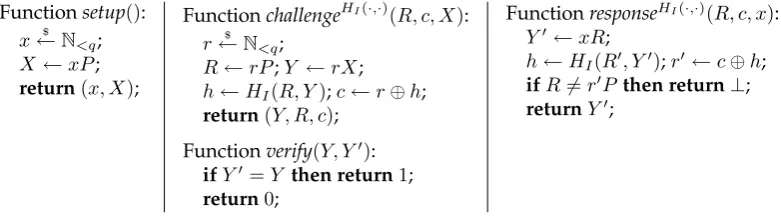
Functionsetup():
x←$ N<q;
X ←xP;
return(x, X);
FunctionchallengeHI(·,·)(R, c, X):
r←$ N<q;
R←rP;Y ←rX;
h←HI(R, Y);c←r⊕h;
return(Y, R, c); Functionverify(Y, Y0):
ifY0=Y then return1;
return0;
FunctionresponseHI(·,·)(R, c, x): Y0←xR;
h←HI(R0, Y0);r0←c⊕h;
ifR6=r0P then return⊥;
returnY0;
Figure 3.2: Functions implementingW-ident in the random oracle model
LetHI:G2→Σ`Ibe a secure hash function. Here’s a simple protocol which lets her prove her identity to Bob.
1. Bob selects a randomr∈$N<|G|, and computesR=rP,Y =rX, andc=r⊕HI(R, Y). He sends the pair(R, c)to Alice as hischallenge.
2. Alice receives(R, c). She computesY0 =xRandr0 = c⊕HI(R0, Y0), and checks that
R=r0P. If so, she sendsY0as herresponse; otherwise she sends⊥.
3. Bob receivesY0 from Alice. He checks thatY0 =Y. If so, he accepts that he’s talking to Alice; otherwise he becomes suspicious.
We name this the Wrestlers Identification Protocol inG,W-identG (we drop the superscript to refer to the protocol in general, or when no ambiguity is likely to result). A summary is shown in figure 3.1.
3.2 Security
In order to evaluate the security of our protocol, we present a formal description of the algorithms involved in figure 3.1. Here, the hash functionHI(·,·)is modelled as a random oracle.
Completeness Suppose that Bob really is talking to Alice. Note thatY0 = xR = x(rP) = r(xP) =rX=Y. Hencer0 =c⊕HI(R0, Y0) =c⊕HI(R, Y) =r, sor0P =rP =R, so Alice returnsY0 = Y to Bob. ThereforeW-identiscomplete: if Bob really is communicating with Alice then he accepts.
3. A zero-knowledge identification scheme
Gameimp-nW-ident(A):
HI
$
← F[G2→Σ`I]; (x, X)←setup(); win←0;
R-map←∅;
c←challenges(n);
(R0, Y0)←AHI(·,·),check(·,·)(X,c); returnwin;
Functionchallenges(n):
fori∈N<ndo
(Y, R, c)←challengeHI(·,·);
R-map←R-map∪ {R7→Y};
c[i]←(R, c);
returnc;
Functioncheck(R0, Y0):
ifR0∈/domR-mapthen return0;
Y ←R-map(R0);
ifverify(Y, Y0)then win←1;
return1;
return0;
Figure 3.3: Soundness ofW-ident:Gameimp-nW-ident(A)
response is very small. However, we prove a stronger result: we show that if the adversary can respond correctly to any of a large collection of challenges then it can solve the MCDH problem.
Consider the gameGameimpW-ident shown in figure 3.3. An adversary’s probability of
success-fully impersonating Alice in our protocol, by correctly responding to any one ofnchallenges, is exactly its probability of winning the game (i.e., causing it to return1).
3.2.1 Theorem(Soundness ofW-ident) LetAbe any adversary running in timetand makingqIqueries to its random oracle, andqV queries to its verification oracle. LetGbe a cyclic group. Then
Pr[Gameimp-nW-identG(A) = 1]6InSec
mcdh(G;t0, q
I+qV) wheret0 =t+O(qI) +O(qV).
3.2.2 Remark Note that the security bound here isindependentof the value ofn.
Proof We prove this by defining a sequence of gamesGi. The first will be the same as the attack gameGameimp-nW-ident(A)and the others will differ from it in minor ways. In each game
Gi, letSibe the event thatAwins the game – i.e., that it successfully impersonates the holder of the private keyx.
Let gameG0 be the attack gameGameimpW-ident(A), and let(R0, Y0)be the output of Ain the
game.
We define a new gameG1which is the same asG0, except that we query the random oracleHI at(R0, Y0)whenever the adversary queriescheck(R0, Y0). (We don’t charge the adversary for this.) This obviously doesn’t affect the adversary’s probability of winning, soPr[S1] = Pr[S0].
GameG2is likeG1, except that we change the way we generate challenges and check their
Functionchallenges2(n):
r∗←$ I;R∗←r∗P;Y∗←r∗X;
fori∈N<ndo
r←$ I;R←rR∗;Y ←rY∗;
h←HI(R, Y);c←r⊕h;
R-map←R-map∪ {R7→r};
c[i]←(R, c);
returnc;
Functioncheck2(R0, Y0):
ifR0∈/domR-mapthen return0;
r←R-map(R0);
ifverify(Y∗, Y0/r)then win←1;
return1;
return0;
Figure 3.4: Soundness ofW-ident: challenges2and check2
Functionchallenges4(n):
r∗←$ I;R∗←r∗P;Y∗←r∗X;
fori∈N<ndo
r←$ I;R←rR∗;
c←$ Σ`I;
R-map←R-map∪ {R7→r};
c[i]←(R, c);
returnc;
Figure 3.5: Soundness ofW-ident: challenges4
While we’re generating and checking challenges in a more complicated way here, we’re not actually changing the distribution of the challenges, or changing the winning condition. HencePr[S2] = Pr[S1].
Now we change the rules again. LetG3be the same asG2except that we change the winning
condition. Instead, we say that the adversary wins if any of the queries to its random oracle
HI(R0, Y0)would be a correct response – i.e.,check2(R0, Y0)would return1. Since we query
the oracle on(R0, Y0)on its behalf at the end of the game, no adversary can do worse in this
game than it does inG2, so we havePr[S3]>Pr[S2]. (It’s not hard to see that this only helps
quite stupid adversaries. We can transform any adversary into one for which equality holds here.)
Finally, letG4be the same asG3except that we change the way we generate challenges again:
rather than computinghand settingc← h⊕r, we just choosecat random. Specifically, we use the new function,challenges4, shown in figure 3.5.
SinceHI(·,·)is a random function, the adversary can only distinguishG4fromG3if it queries
its random oracle at some(R, rY∗). But if it does this, then by the rule introduced inG3it has
already won. Therefore we must havePr[S4] = Pr[S3].
Ourchallenges4 function is interesting, since it doesn’t actually make use ofr∗ orY∗ when generating its challenges. This gives us the clue we need to bound Pr[S4]: we can use
3. A zero-knowledge identification scheme
AdversaryBV(·)(X, R∗):
F ←∅;R-map←∅;
fori∈N<ndo
r←$ I;R←rR∗;c $ ←Σ`I; R-map←R-map∪ {R7→r};
c[i]←(R, c);
(R0, Y0)←AHI(·,·),check(·,·)(X,c); ifY06=⊥thenHI(R0, Y0);
OracleHI(R0, Y0):
if(R0, Y0)∈domF then h←F(x);
else
check(R0, Y0);
h←$ Σ`I;F ←F∪ {(R0, Y0)7→h}; returnh;
Oraclecheck(R0, Y0):
ifR0∈domR-mapthenV(Y0/R-map(R0));
Figure 3.6: Soundness ofW-ident: reduction from MCDH
G4. Specifically, we define the adversaryBas shown in figure 3.6. That is, for each queryA
makes to its random oracle at a new pair(R0, Y0), we see whether this gives us the answer we’re looking for. We havePr[S0] 6 Pr[S4] = SuccmcdhG (B) 6 InSec
gdh(G;t0, q
I +qV)as
required.
Zero-knowledge Finally we must prove that W-ident is (statistical) zero-knowledge – i.e., that, except with very small probability, Bob learns nothing of use to him except that he’s interacting with Alice. To do this, we show that, for any algorithm B which Bob might use to produce his challenge to the real Alice, there exists a simulator S which produces transcripts distributed very similarly to transcripts of real conversations between B and Alice, the difference being thatSdoesn’t know Alice’s key. We shall show that the statistical difference between the two distributions is2−`I.
The intuition here is that Bob ought to know what answer Alice is going to give him when he constructs his challenge. This is certainly true if he’s honest: his challenge isR=rPfor some
rhe knows, so he won’t learn anything useful when Alice responds withxR=rX. However, if Bob sends a challengeRwhen he doesn’t know the correspondingr, he learns something potentially useful. The accompanying check valuec=r⊕HI(R, rX)keeps him honest.
To show this, we present anextractor which, given any challenge(R, c)Bob can construct, and his history of random-oracle queries, either returns a pair(r, Y)such thatR = rP and
Y = rX, or ⊥; moreover, the probability that Alice returns a responseY0 6= ⊥ given the challenge(R, c)is2−`. We can, of course, readily convert this extractor into a simulator to prove the zero-knowledge property of our protocol.
We shall actually consider a slightly more complex setting. We grant Bob access to an oracle which produces random, correctly-formed challenges. We require this to model the legitimate challenges of other parties when we analyse the security of our key exchange protocol. The extractor is permitted to fail given
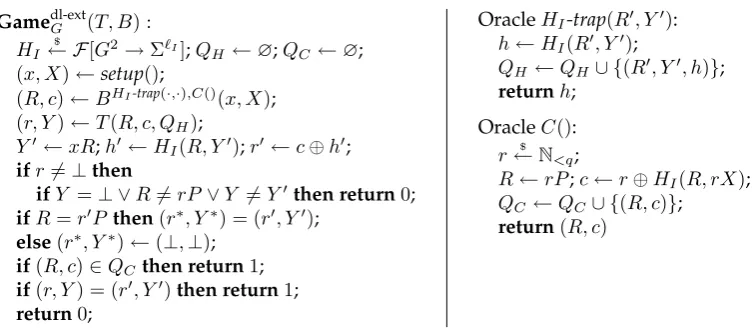
3.2.3 Definition (Discrete-log extractors) Let T, B be randomized algorithms. Define the game
Gamedl-extG (T, B)as shown in figure 3.7. Thesuccess probability ofT as a discrete-log extractor againstBis defined as
Succdl-extG (T, B) = Pr[Game dl-ext
G (T, B) = 1].
Gamedl-extG (T, B) :
HI
$
← F[G2→Σ`I];Q
H←∅;QC←∅;
(x, X)←setup();
(R, c)←BHI-trap(·,·),C()(x, X); (r, Y)←T(R, c, QH);
Y0←xR;h0←HI(R, Y0);r0←c⊕h0;
ifr6=⊥then
ifY =⊥ ∨R6=rP∨Y 6=Y0then return0;
ifR=r0P then(r∗, Y∗) = (r0, Y0);
else(r∗, Y∗)←(⊥,⊥);
if(R, c)∈QCthen return1;
if(r, Y) = (r0, Y0)then return1;
return0;
OracleHI-trap(R0, Y0):
h←HI(R0, Y0);
QH←QH∪ {(R0, Y0, h)};
returnh; OracleC():
r←$ N<q;
R←rP;c←r⊕HI(R, rX);
QC←QC∪ {(R, c)};
return(R, c)
Figure 3.7: Discrete log extraction game:Gamedl-extG (T, B)
Let’s unpack this definition slightly. We make the following demands of our extractor.
• It is given a bare ‘transcript’ ofB’s execution. In particular, it is given only its output and a list ofB’s random-oracle queries in no particular order.
• While the extractor is not given the private keyx, the adversaryB is given the private key.
• We require that, if the extractor produces valuesr, Y 6=⊥thenrandY arecorrect; i.e., thatR=rPandY =xR.
• The extractor is explicitlynotgiven the outputs of the challenge-generation oracleC(), nor of the random-oracle queries issued byC(). However, we allow the extractor to fail (i.e., return⊥) ifBsimply parrots one of itsC-outputs.
• The extractor is allowed – indeedrequired– to fail if the challenge(R, c)isinvalid(i.e., Alice would return⊥given the challenge).
The resulting definition bears a striking similarity to the concept of plaintext awareness in [BDPR98].
Such an extractor indeed exists, as the following lemma states.
3.2.4 Lemma(Effectiveness of extractorTW-ident) There exists auniversal discrete-log extractorTW-ident
which, for any algorithmB,
Succdl-extG (TW-ident, B)>1−
1 2`I.
Moreover, ifBissues at mostqHrandom-oracle queries, then the running time ofTW-identisO(qH).
We prove this result at the end of the section. For now, let us see how to prove thatW-identis zero-knowledge.
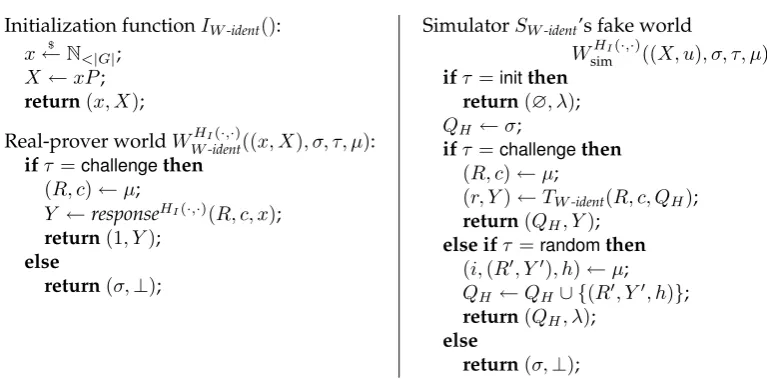
We use the set-up described in section 2.10. Our initialization functionIW-identjust chooses a
3. A zero-knowledge identification scheme
Initialization functionIW-ident():
x←$ N<|G|;
X ←xP;
return(x, X);
Real-prover worldWHI(·,·)
W-ident((x, X), σ, τ, µ):
ifτ=challengethen
(R, c)←µ;
Y ←responseHI(·,·)(R, c, x); return(1, Y);
else
return(σ,⊥);
SimulatorSW-ident’s fake world
WHI(·,·)
sim ((X, u), σ, τ, µ):
ifτ=initthen return(∅, λ);
QH ←σ;
ifτ=challengethen
(R, c)←µ;
(r, Y)←TW-ident(R, c, QH);
return(QH, Y);
else ifτ =randomthen (i,(R0, Y0), h)←µ;
QH ←QH∪ {(R0, Y0, h)};
return(QH, λ);
else
return(σ,⊥);
Figure 3.8: Real-prover and simulator for zero-knowledge ofW-ident
‘real world’, the adversary is allowed to submit a (single) challenge to the prover; it is given the prover’s response, and must then compute its output. This is shown on the left hand side of figure 3.8.
The zero-knowledge property of the scheme is described by the following theorem.
3.2.5 Theorem(Statistical zero-knowledge ofW-ident) LetIW-ident,WW-identandSW-identbe the real-prover
world and simulator shown in figure 3.8. Then, for anyt,qI andqC,
InSecsim(WW-ident, IW-ident, SW-ident;t, qI, qC,0)6
qC
2` I
.
whereqCis the maximum number of challenges allowed by the adversary.
Proof The simulator simply uses the extractor TW-ident to extract the answer from the
adversary’s history of random oracle queries. Observe thatSW-identis a fake-world simulator.
By lemma 3.2.4, the extractor fails with probability only2−`I. The theorem follows by a simple
union bound and proposition 2.10.4.
We now return to proving that our extractor exists and functions as claimed. The following two trivial lemmata will be useful, both now and later.
3.2.6 Lemma(Uniqueness of discrete-logs) LetG=hPibe a cyclic group. For anyX ∈Gthere is a unique integerxwhere06x <|G|andX =xP.
Proof Certainly such anxexists, sinceGis cyclic and finite. SupposeX =xP =x0P: then
0 =xP −x0P = (x−x0)P. Hence(x−x0)is a multiple of|G|.
3.2.7 Lemma(Uniqueness of check values) LetG=hPibe a cyclic group; letHIbe a functionHI: Σ2`G →
Σ`I. Fix somex∈
N<|G|and define the set
Vx=
(R, c)∈G×Σ`I
R= c⊕HI(R, xR)
ExtractorTW-ident(R, c, QH):
for(R0, Y0, h)inQHdo
r←h⊕c;
ifR=R0 =rP∧Y0=rXthen return(r, Y0);
return(⊥,⊥);
Figure 3.9: The discrete-log extractorTW-ident
Then, for anyR,c,c0, if(R, c)∈Vxand(R, c0)∈Vxthenc=c0.
Proof From lemma 3.2.6, we see that there is a uniquer∈N<|G|for whichR =rP. Now, if
(R, c)∈Vx, we must haver=c⊕HI(R, xR). It follows thatc=r⊕HI(R, xR).
Proof of lemma 3.2.4 Our extractorTW-identis shown in figure 3.9.
Let B be any randomized algorithm, and let (R, c, QH) be as given to the extractor by
Gamedl-extG (TW-ident, B). Let the quantitiesHI,QC,r,r0,xandX be as in that game.
Suppose that the extractor returns values(r, Y)6= (⊥,⊥). Leth=r⊕c; then there must be a query(R, Y, h)∈QH, and we haveR=rP andY =rX=r(xP) =x(rP) =xR=Y0, so the extractor’s output must be correct unless it fails.
Furthermore, in the case where the extractor did not fail, we haveh=HI(R, Y) =HI(R, Y0) andc=r⊕h, so the challenge was valid. Therefore, if the challenge was invalid, the extractor will fail.
We now deal with the challenge-generation oracle. Suppose that (R, c0) ∈ QC for some
c0. Now, if c = c0 then (R, c0) is a repeat of some challenge from the challenge-generation oracle, and the extractor is permitted to fail. On the other hand, supposec 6= c0; then, the challenge(R, c)must be invalid by lemma 3.2.7, so the extractor is required to fail, and we have established that indeed it will. From now on, suppose thatR is distinct from all the
R-values returned byC().
LetY =xR. Suppose thatBqueried its random oracle at(R, Y). Leth=HI(Y), sor0=c⊕h. If the challenge is valid thenR=r0P; thereforeY =xR=xr0P =r0X, so we have(R, Y, h)∈
QHwithR=rP andY =rX. Hence the extractor returnsr=r0as required.
It remains to deal with the case where there is no random-oracle query at(R, Y). But then
h=HI(R, Y)is uniformly distributed, and independent of the entire game up to this point. Letrbe the correct discrete log of R; by lemma 3.2.6 there is only one possible value. The extractor always fails under these circumstances, but a correct responder would reply with probability
Pr[h=c⊕r] = 1 2`I.
This concludes the proof.
3.2.8 Remark Note that the fact that the algorithmBwas given the private key is irrelevant to the above argument. However, we shall need this property when we come to prove deniability
3. A zero-knowledge identification scheme
3.2.9 Remark It’s easy to see from the above proof that the extractor works flawlessly on the ‘honest verifier’ algorithmchallengeshown in figure 3.2. This shows thatW-identis perfect zero-knowledge against honest verifiers. We’re much more interested in dishonest verifiers,
though.
3.3 An identity-based identification scheme
Boneh and Franklin [BF03] showed how to construct an identity-based encryption scheme using bilinear pairings. The resulting encryption scheme looks somewhat like a pairing-based version of ElGamal’s encryption scheme [ElG85]. We can easily apply their techniques to our identification protocol, and thereby obtain an identity-based identification scheme. Providing the necessary formalisms to prove theorems analogous to our theorems 3.2.1 and 3.2.5 would take us too far from our objectives; but given appropriate security notions, we can readily adapt our existing proofs to the new setting.
Bilinear pairings Before we describe the necessary modifications to the protocol, we first give a (very brief!) summary of cryptographic pairings. (The Boneh-Franklin paper [BF03] gives more detail; also [Men05] provides a useful introduction to the topic.)
Let(G,+),(G0,+)and(GT,×)be cyclic groups with prime orderq; letP ∈ GandP0 ∈ G0 be elements of orderqinGandG0 respectively. We say that a mappinge:ˆ G×G0 →GT is a non-degenerate bilinear pairingif it satisfies the following properties.
Bilinearity For allR∈GandS0, T0∈G0, we havee(R, Sˆ 0+T0) = ˆe(R, S0) ˆe(R, T0); and for allR, S∈GandT0∈G0we havee(Rˆ +S, T0) = ˆe(R, T0) ˆe(S, T0).
Non-degeneracy e(P, Pˆ 0)6= 1.
For practical use, we also wantˆe(·,·)to be efficient to compute. The reader can verify that
ˆ
e(aP, bP0) = ˆe(P, P0)ab. It is permitted for the two groupsGandG0to be equal.
We require a different intractability assumption, specifically that thebilinearDiffie-Hellman problem (BDH) – given (aP, bP, aP0, cP0) ∈ G2×G02, find ˆe(P, P0)abc ∈ G
T – is difficult. This implies the difficulty of the computational Diffie-Hellman problem in all three ofG,G0
andGT.
The identity-based scheme We need a trusted authority; following [Sch96] we shall call him Trent. Trent’s private key ist∈N<q; his public key isT =tP.
Finally, we need cryptographic hash functionsHI:G×GT →Σ`IandHID: Σ∗→G0; a formal
security analysis would model these as random oracles.
Alice’s public key isA=HID(Alice)∈G0. Her private key isKA=tA∈G0– she needs Trent to give this to her. Bob can interact with Alice in order to verify her identity as follows.
1. Bob computesγA = ˆe(T, A)∈GT. (He can do this once and store the result if he wants, but it’s not that onerous to work it out each time.)
2. Bob choosesr∈$ N<q, and setsR =rP. He also computesψ =γAr,h=HI(R, ψ)and
c=r⊕h. He sends his challenge(R, c)to Alice.
3. Alice receives(R0, c0). She computesψ0 = ˆe(R, K
A),h0 =HI(R0, ψ0), andr0 = c0⊕h0). She checks thatR0=r0P; if so, she sendsψ0back to Bob; otherwise she refuses to talk to
4. Bob receivesψ0. Ifψ=ψ0then he accepts that he’s talking to Alice.
This works becauseψ=γr
A= ˆe(T, A)
r= ˆe(tP, A)r= ˆe(rP, A)t= ˆe(R, tA) =ψ0.
Informal analysis An analogue to lemma 3.2.4 can be proven to show how to extractrfrom a verifier’s random-oracle queries; statistical zero knowledge would then follow easily, as in theorem 3.2.5. Soundness is intuitively clear, since an adversary must computeψ= ˆe(P, P0)art givenA=aP0,R=rPandT =tP, which is an instance of the BDH problem. An analogue of theorem 3.2.1 would have to prove this for an adversary capable of making identity requests as well as obtaining challenges. Finally, our key-exchange protocol can be constructed out of this identity-based identification scheme, yielding an identity-based authenticated key-exchange protocol. We leave it to the reader to work through the details.
3.4 Comparison with the protocol of Stinson and Wu
Our protocol is similar to a recent proposal by Stinson and Wu [SW06]. They restrict their attention to Schnorr groupsG ⊂ F∗p. Letγ be an element of orderq = |G|. The prover’s private key isa∈$N<qand her public key isα=γa. In their protocol, the challenger chooses r∈$N<q, computesρ=γrandψ=αr, and sends a challenge(ρ, H(ρ, ψ)). The prover checks
thatρq 6= 1, computesψ=ρa, checks the hash, and sendsψback by way of response. They prove their protocol’s security in the random-oracle model.
Both the Wrestlers protocol and Stinson-Wu require both prover and verifier to compute two exponentiations (or scalar multiplications) each. The sizes of the messages used by the two protocols are also identical.
(An earlier version of the Stinson-Wu protocol used a cofactor exponentiation: if we setf = (p−1)/q, then we useψ =αrf) =ρaf =γaf r. This is more efficient in typical elliptic curve subgroups, since the cofactor of such subgroups is usually small: indeed, [Cer00] recommends rejecting groups with cofactorf >4. However, in the Schnorr groups used by Stinson and Wu, the cofactor is much larger thanq, and their new variant is more efficient.)
We note that the zero-knowledge property of the Stinson-Wu protocol requires the Diffie-Hellman knowledge of exponent assumption (KEA). Very briefly: supposeAis a randomized algorithm which takes as input X ∈ Gand outputs a pair (rP, rX); intuitively, the KEA assertsAmust have done this by choosingrsomehow and then computing its output from it. Formally, it asserts the existence of an ‘extractor’ algorithm which takes as input the element
Xand the random coins used byAand outputsrwith high probability. This is a very strong assumption, and one which is unnecessary for our protocol, since we can present anexplicit extractor.
The KEA assumption as stated in [SW06] allows the extractor to fail with some negligible probability, over and above the probability that a dishonest verifier managed to guess the correcth= H(ρ, ψ)without making this random-oracle query. Not only does our protocol achieve zero- knowledge without the KEA, our extractor is, in this sense, ‘perfect’.
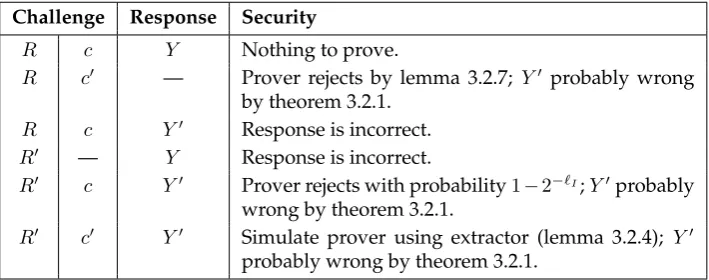
Our protocol is just as strong as Stinson-Wu under attack from active intruders: see table 3.1 for a very brief sketch of the case-analysis which would be the basis of a proof of this.
4. A simple key-exchange protocol
Challenge Response Security
R c Y Nothing to prove.
R c0 — Prover rejects by lemma 3.2.7; Y0 probably wrong by theorem 3.2.1.
R c Y0 Response is incorrect.
R0 — Y Response is incorrect.
R0 c Y0 Prover rejects with probability1−2−`I;Y0probably
wrong by theorem 3.2.1.
R0 c0 Y0 Simulate prover using extractor (lemma 3.2.4); Y0
probably wrong by theorem 3.2.1.
Table 3.1: Security ofW-ident against active intruders (summary)
We suspect that a key-exchange protocol like ours can be constructed using Stinson-Wu rather than the Wrestlers identification scheme. We haven’t, however, gone through all the details, since we believe our protocol is just as efficient and is based on much more conservative assumptions.
4 A simple key-exchange protocol
In this section, we describe a simple key-exchange protocol built out of the identification protocol shown previously.
The key-exchange protocol arises from the following observation. If Bob sends a challenge, presumably to Alice, and gets a correct response, then not only did he really send the challenge to Alice but he knows that she received it correctly.
So, if Alice and Bob authenticate each other, by the end of it, they should each have chosen a random private value, sent the corresponding public value to the other, and been convinced that it arrived safely.
Unfortunately, life isn’t quite this kind, and we have to do some more work to make this scheme secure.
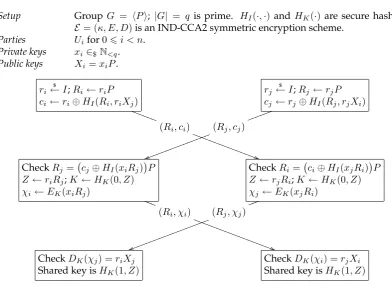
Our key exchange protocol essentially consists of two parallel instances of the identification protocol. If Alice receives a correct response to her challenge, she will know that Bob received her challenge correctly, andvice versa. If we let Alice’s challenge be R0 = r0P and Bob’s
challenge beR1 = r1P then each can compute a shared secretZ = r0R1 = r0r1P = r1R0
unknown to an adversary. There are, unfortunately, a few subtleties involved in turning this intuition into a secure key-exchange protocol, which we now describe.
4.1 Overview
Setup Group G = hPi; |G| = q is prime. HI(·,·)and HK(·)are secure hashes.
E = (κ, E, D)is an IND-CCA2 symmetric encryption scheme. Parties Uifor06i < n.
Private keys xi∈$N<q.
Public keys Xi=xiP.
ri
$
←I;Ri←riP
ci←ri⊕HI(Ri, riXj)
CheckRj= cj⊕HI(xiRj)P
Z ←riRj;K←HK(0, Z)
χi←EK(xiRj)
CheckDK(χj) =riXj Shared key isHK(1, Z)
rj
$
←I;Rj ←rjP
cj ←rj⊕HI(Rj, rjXi)
CheckRi= ci⊕HI(xjRi)P
Z←rjRi;K←HK(0, Z)
χj ←EK(xjRi)
CheckDK(χi) =rjXi Shared key isHK(1, Z)
(Ri, ci) S S S S S S ) ) S S S S S S S S S S S S S S S
(Ri, χi) S S S ) ) S S S S S S S S S S S S S S S S S S
(Rj, cj) kkkkkk
u
u
kkkkkkkkkkkk kkk
(Rj, χj) kkk u u kkkkkkkk kkkkkkkk kk
Figure 4.1: Summary of the Wrestlers Key Exchange protocol,W-kx
Suppose that Alice’s and Bob’s private keys areaandbrespectively, and their public keys are
A=aP andB=bP.
1. Alice chooses a random indexr∈$N<|G|. She computesR=rP andc=r⊕HI(R, rB). She sends the pair(R, c)to Bob.
2. Similarly, Bob chooses a randoms∈$N<|G|. He computesS =sPandd=s⊕HI(S, sA). He sends(S, d)to Alice.
3. Alice receives(S0, d0)from Bob. She computess0 = d0⊕HI(S0, aS0), and verifies that
S0=s0P. If so, she computesKA=HK(0krS0), and sendsR, EKA(aS
0)to Bob.
4. Similarly, Bob receives(R0, c0)from Alice. He verifies thatR0 = c0⊕HI(R0, bR0)P. If so, he computesKB=HK(0ksR0)and sends S,EKB(bR
0)to Alice.
5. Alice receives a ciphertext(S00, χB)from Bob. She checks thatS00=S0, decryptsχB, and checks thatDKA(χB) =rB. If so, she usesHK(1krS
0)as her shared secret.
6. Similarly, Bob receives(R00, χA)from Alice, and checksR00 =R0andDKB(χA) =sA. If
so, he usesHK(1ksR0)as his shared secret.