Hardware Implementation of the
η
TPairing in
Characteristic 3
Robert Ronan1, Colm ´O h ´Eigeartaigh2, Colin Murphy1, Tim Kerins1and Paulo S. L. M. Baretto3
1 Department of Electrical & Electronic Engineering, University College Cork, College Road, Cork, Ireland.
{robertr,cmurphy,timk}@rennes.ucc.ie
2 School of Computing, Dublin City University, Ballymun, Dublin 9, Ireland.
3 Escola Polit´ecnica, Universidade de S˜ao Paulo, Brazil.
Abstract. Recently, there have been many proposals for secure and novel
cryp-tographic protocols that are built on bilinear pairings. TheηTpairing is one such
pairing and is closely related to the Tate pairing. In this paper we consider the efficient hardware implementation of this pairing in characteristic 3. All charac-teristic 3 operations required to compute the pairing are outlined in detail. An efficient, flexible and reconfigurable processor for theηTpairing in characteristic
3 is presented and discussed. The processor can easily be tailored for a low area implementation, for a high throughput implementation, or for a balance between the two. Results are provided for various configurations of the processor when implemented over the fieldF397on an FPGA. As far as we are aware, the
proces-sor returns the first characteristic 3ηT pairing in hardware that includes a final
exponentiation to a unique value.
Keywords−ηT pairing, characteristic 3, elliptic curve, reconfigurable processor,
FPGA
1
Introduction
Since the introduction of the Weil and Tate pairings for constructive cryptographic ap-plications, there has been a flurry of proposals for novel cryptographic protocols based on pairings, including identity-based encryption (IBE) schemes, key exchange schemes and short signature schemes [7].
Bilinear pairings are used to map the Discrete Logarithm Problem (DLP) from the divisor class group of an elliptic or genus 2 hyperelliptic curve, defined overFq, to the
multiplicative subgroupF∗
qkof some extension of the base field. The valuekis known as the embedding degree or security multiplier.
In 2002, significant improvements to this method were independently suggested in [3] and [9]. After this, the Tate pairing implementation was further optimised in [8] for a small class of curves, resulting in the Duursma-Lee algorithm for pairing implemen-tation. In [2] it was clarified how these methods can be used on a more general set of curves. In [2] it was also demonstrated that an even faster bilinear pairing can be returned by using a smaller iterative loop and a slightly more complicated final expo-nentiation. They call this pairing the truncated eta pairing (denotedηT). In this paper
we describe the hardware implementation of this pairing in characteristic 3.
Even with these algorithmic optimisations, pairing calculation remains a compli-cated operation. Pairings are very well suited to hardware implementation for two rea-sons: Much of the arithmetic performed on the extension fieldFqk can be reduced to arithmetic onFq. Many of theseFq arithmetic operations can be performed in parallel
in hardware, providing a large saving over implementations on general purpose serial processors. Furthermore, a pairing calculation consists of an iterative loop followed by a final exponentiation. If care is taken with the scheduling of operations through the loop, a hardware implementation can provide a large level of pipelining, further speeding up pairing computation.
An FPGA implementation of the characteristic 3 pairing methods described in [13] has appeared in [11], where the extension field operations required for pairing com-putation are hardwired. However, this leads to a large design and provides no level of flexibility for different applications (the authors concern themselves with high through-put only). In [10] a pairing processor for the implementation of the pairings described in [8] and [13] is presented. AnF3m ALU is used to perform the operations required for pairing computation. This processor again provides no means for reconfiguration. A study on the scheduling of the Duursma-Lee algorithm in [8] has appeared in [4]. Recently, an implementation of the characteristic 3ηT pairing has appeared in [6]. The
operations necessary for the iterative loop of theηT pairing are hardwired. This results
in a high operational frequency. However, there is no means for exponentiation using the architecture in [6]. This exponentiation is required such that the pairing returns a unique value, which is required for cryptographic applications. Thus, the architecture in [6] must be supplemented with a coprocessor for exponentiation, which, at the time of writing, is a work in progress and details are not included.
This paper is organised as follows: Section 2 presents the necessary mathematical preliminaries along with algorithms for computation of theηT pairing on a
characteris-tic 3 ellipcharacteris-tic curve. Section 3 outlines the implementation of arithmecharacteris-tic onF3,F3mand F36m. Section 4 describes the reconfigurable processor used to perform theηT pairing. Section 5 presents results returned by the processor when generated on the fieldF397
and implemented on an FPGA in various configurations. Finally, Section 6 draws some conclusions from the work.
2
Mathematical Preliminaries
has embedding degreekifrdividesqk−1, but does not divideqi−1for any0< i < k.
A subgroup of orderris known as anr-torsion group, denotedE(Fq)[r].
Following [3] and [9], the Tate pairing of orderris a bilinear map betweenE(Fq)[r]
andE(Fqk)[r]to an element of the multiplicative groupF∗
qk:
er(P, Q) :E(Fq)[r]×E(Fqk)[r]→F∗qk (1)
The second argument can be generated overE(Fq)and then mapped toE(Fqk)using a distortion map (denotedφ) [16]. This leads to a reduction in cost since more operations can be performed on the sub-field. The incorporation of the distortion map yields the modified Tate pairing
ˆ
er(P, Q) =er(P, φ(Q)) (2)
where nowP, Q∈E(Fq)[r]. In [8], it was shown how the distortion map can be
incor-porated into the formulae for this modified pairing computation.
The valueˆer(P, Q)is only defined up tor-th powers. A final exponentiation must be
performed to obtain a unique value for cryptographic purposes. The reduced modified Tate pairing is defined as
ˆ
e(P, Q) = ˆer(P, Q)(q
k−1)/r
(3)
In this paper we compute theηT pairing on a characteristic 3 elliptic curve given by
E:y2=x3−x+b, b∈ −1,1 (4)
over a fieldFq =F3mwithm mod 12≡1,m mod 6≡1. This curve has an embed-ding degree ofk= 6. The Tate pairing is computed with an iterative algorithm incorpo-rating the intermediate tangent, chord and vertical line functions on the curve associated with the elliptic curve additive group operation. TheηT pairing reduces the number of
iterations required to build a bilinear pairing at the expense of a more complicated fi-nal exponentiation when compared to the Tate pairing. In most cases, the reduction in computation time yielded by the smaller number of iterations far outweighs the slightly more costly exponentiation.
In characteristic 3, theηT pairing is related to the Tate pairing with
(ηT(P, Q)M)
3T2
= (ˆeN(P, Q)M)L (5)
where
N = 3m+ 1 +b.3(m+1)/2
M = (36m−1)/N = (33m−1)(3m+ 1)(3m−b.3(m+1)/2+ 1) T =q−N=−1−b.3(m+1)/2
L=−b.3(m+3)/2
The functionηT(P, Q)M is itself bilinear and returns a non-degenerate and unique
value. It is, therefore, suitable as a basis for secure cryptographic protocols. The remain-der of this paper deals with the efficient implementation ofηT(P, Q)Min hardware. We
refer to the exponentiation toM as the final exponentiation. If compatibility with the Tate pairing is required, then the powering to3T2can be performed with a very small number of calculations (that are insignificant when compared to the overall cost of the pairing computation).
2.1 The Characteristic 3ηTPairing
In this section we describe the calculation of theηT pairing on the curveE:x3−x+b
in affine coordinates defined on the fieldF3m in them mod 12≡1, m mod 6≡1,
b =−1case. Note that other cases formandbrequire only slight modifications (but no significant additional operations). Again, consider the pointsP = (xP, yP),Q =
(xQ, yQ)∈E(F3m)[r]withxP, yP, xQ, yQ ∈F3m. A suitable distortion mapφon this curve is
φ(Q) =φ(xQ, yQ) = (ρ−xQ, σyQ) (6)
whereσ∈F32andρ∈F33such thatσ2+ 1 = 0andρ3−ρ+ 1 = 0.
A basis must be chosen for the representation of elements inF36m. The choice of basis is motivated by the desire to simplify the arithmetic operations in this field as much as possible. We choose to represent elements ofF36musing the basis(1, σ, ρ, σρ, ρ2, σρ2). An elementA∈F36mis then represented as
A= (a0, a1, a2, a3, a4, a5)
=a0+a1σ+a2ρ+a3σρ+a4ρ2+a5σρ2 (7)
= ˆa0+ ˆa1ρ+ ˆa2ρ2 (8)
wherea0, a1, a2, a3, a4, a5∈F3mandaˆ0=a0+a1σ, ˆa1=a2+a3σ, ˆa2=a4+a5σ withaˆ0,ˆa1,ˆa2∈F32m.
This is equivalent to a tower field representation [9] ofF36m, i.e.F36m ≡((F3m)2) 3
whereσandρare zeros ofσ2+ 1andρ3−ρ+ 1as defined by the distortion map. The F36m field is generated as
F32m =F3m[y]/g[y] (9)
whereg(y) =y2+ 1is an irreducible polynomial overF3m and
F36m =F32m[z]/h[z] (10)
whereh(z) =z3−z+ 1is an irreducible polynomial overF32m.
The operations required to computeηT(P, Q)M, as described in [2], are shown in
Algorithm 1. Note that using the tower of extensions, all arithmetic operations in Al-gorithm 1 are performed onF3m. The algorithm begins with a precomputation stage in which powers of cubes ofxQandyQare calculated and stored in memory. This means
Algorithm 1 Computation ofηT(P, Q)M onE(F3m) :y2=x3−x−1,m mod 12≡
1,m mod 6≡1case
INPUT: P= (xP, yP), Q= (xQ, yQ),(P, Q)∈E(F3m) OUTPUT: f=ηT(P, Q)∈F∗36m
INITIALISE:
1: f∈F36m 2: f←1
PRECOMPUTE:
3: fori←m−1downto(m+ 1)/2 + 1do
4: xQ←xQ3,yQ←yQ3 –2F3mcubings
5: end for
6: fori←(m+ 1)/2downto0do
7: xQ←xQ3,yQ←yQ3 –2F3mcubings
8: x′
Q[i]←xQ,y′Q[i]←yQ 9: end for
RUN:
10: fori←1to(m+ 1)/2do
11: u←xP+x′Q[i] + 1
12: c0← −u.u –1F3mmul
13: c1← −yP.yQ′ [i] –1F3mmul
14: g←c0+ (c1)σ+ (−u)ρ+ (0)σρ+ (−1)ρ2+ (0)σρ2
15: f←f.g –13F3mmuls
16: ifi <(m+ 1)/2then
17: xP←x3
P,yP←y3
P –2F3mcubings
18: end if
19: g← −yP.(xQ′ [i] +xP+ 1) + (−y′
Q[i])σ+ (yP)ρ –1F3mmul
20: f←f.g –10F3mmuls
21: end for
22: returnf(33m−1)(3m+1)(3m+3(m+1)/2+1) –See Algorithm 2
of cube roots in characteristic 3 has been simplified in [1], the roots are stored in this way to ensure an efficient use of area in the hardware implementation by avoiding the additional area cost that would be incurred by a cube rooting circuit.
The most costly part of the pairing is the loop iteration. Each iteration requires fifteenF3m multiplications, a number ofF3m additions and subtractions and twoF3m cubings. The scheduling of these operations through the hardware processor will be vital to computation speed. The multiplication offbygcan be performed with a regular F36m multiplication (requiring 18F3m multiplications). However, this does not make use of the fact thatghas the special formg= (g0+g1σ+g2ρ+(0)σρ+(−1)ρ2+(0)σρ. If theF36m multiplication is unrolled and examined, it becomes apparent thatf.gcan be performed in only 13 multiplications, providing a saving of five multiplications. The F3m operations required for the multiplication off = (f0, f1, f2, f3, f4, f5)by
g= (g0, g1, g2,0,−1,0), including the required reductions are shown in (11), (12) and (13). Note that all13F3mmultiplications can be performed in parallel.
mul0←f0.g0
mul1←f1.g1
mul2←(f0+f1).(g0+g1)
mul3←f2.g2
mul4←f3.g2
mul5←(f0+f2).(g0+g2)
mul6←(f1+f3).(g1)
mul7←(f0+f1+f2+f3).(g0+g1+g2)
mul8←(f0+f4).(g0+ 2)
mul9←(f1+f5).(g1)
mul10←(f0+f1+f4+f5).(g0+g1+ 2)
mul11←(f2+f4).(g2+ 2)
mul12←(f3+f5).(g2+ 2)
Algorithm 2 Exponentiation ofηT(P, Q)toηT(P, Q)M onE(F3m) :y2=x3−x−1,
m%12≡1,m%6≡1case INPUT: f=ηT(P, Q)∈F∗36m
OUTPUT: f(33m−1)(3m+1)(3m+3(m+1)/2+1)=η
T(P, Q)M ∈F∗36m
1: INITIALISE:
2: n, d, w∈F36m 3: w←f
4: RUN:
5: fori←0to(m+ 1)/2−1do
6: w←w3 –F36mcube
7: end for
8: d←f.w –1F36mmul
9: f←fq –1
F36mpowq 10: n←f
11: f←fq –1F36mpowq
12: d←d.f –1F36mmul
13: f←fq –1F36mpowq
14: t←f2 –1
F36mmul
15: d←d.t –1F36mmul
16: f←fq –1
F36mpowq
17: d←d.f –1F36mmul
18: f←fq –1
F36mpowq
19: n←n.f –1F36mmul
20: f←fq –1
F36mpowq
21: t←f3 –1F36mcube
22: n←n.t –1F36mmul
23: w←wq2 –1
F36mpowq2
24: n←n.w –1F36mmul
25: w←wq –1
F36mpowq
26: n←n.w –1F36mmul
27: w←wq2 –1
F36mpowq2
28: d←d.w –1F36mmul
29: f←n
30: f←f /d –1F36minv,1F36mmul
31: returnf
t00r←mul0−mul1
t11r←mul3
t22r← −f4
t01r←mul5−mul6
t02r←mul8−mul9
t12r←mul11
t00i←mul2−mul0−mul1
t11i←mul4
t22i← −f5
t01i←mul7−mul5−mul6
t02i←mul10−mul8−mul9
t12i←mul12
(12)
c0←t00r−t12r+t11r+t22r c1←t00i−t12i+t11i+t22i c2←t01r−t00r+t11r+t12r+t22r c3←t01i−t00i+t11i+t12i+t22i c4←t02r−t00r+t11r
c5←t02i−t00i+t11i
(13)
The computationηT(P, Q)finishes with an exponentiation toM. This
are detailed in Algorithm 2. The exponentiation requires(m+ 1)/2 + 1F36m cubings, seven powerings toq = 3m, two powerings toq2, elevenF24m multiplications and an F36m inversion. The computation of these operations is performed using the tower of extensions idea and will be detailed later. Note that due to the serial nature of the expo-nentiation, it is vital that these operations are performed efficiently if a low computation time forηT(P, Q)M is to be returned.
3
Characteristic 3 Arithmetic
In this section we consider the hardware implementation ofF3,F3m andF36m arith-metic for the computation ofηT(P, Q)M. We provide results when the arithmetic
oper-ations are implemented over a base fieldF397. This base field was chosen as it affords
us the opportunity to compare our implementation with others in the literature. The ir-reducible polynomial used isx97+x16−1. However, the components described in this section can be reconfigured for any other suitable field size or irreducible polyno-mial. The FPGA on which the arithmetic is implemented is a Xilinx Virtex-II Pro FPGA (xc2vp100-6ff1696) with 45120 slices. All components have been realised using VHDL and synthesised and placed & routed using Xilinx ISE Version 8.1i.
3.1 F3Arithmetic
Unlike the characteristic 2 field on which the additive and multiplicative operations can be performed using only onexor- gate and oneand-gate respectively,F3 arith-metic operations are slightly more complicated to perform in hardware. Each element
{0,1,2} ∈F3must be represented using two hardware bits. We choose the representa-tion0 ={00,01},1 = 10and2 = 11. This representation means that the check if zero operation can be performed by simply checking the high bit of anF3element.
OnF3, the required arithmetic operations are addition, subtraction and multiplica-tion (negamultiplica-tion can be performed with a subtracmultiplica-tion from zero). The underlying logic unit on FPGAs are function generators, which can be configured as 4 : 1Look-Up tables (LUTs). We make explicit use of these LUTs in generating circuitry for the addi-tive and multiplicaaddi-tiveF3operations. The input-output map for each of the arithmetic operations can be placed on two4 : 1look up tables, or one FPGA slice.
3.2 F3mArithmetic
TheF3m operations that are required for the computation ofηT(P, Q)M are addition, subtraction, cubing and multiplication. AnF3m inversion is also required for the final extension field division in Algorithm 2. Note thatF3msquaring is performed using mul-tiplication circuitry. The arithmetic components used to implementF3m are described in Table 1.
Op Description Cycles Area(Slices)
Add/Sub Performed usingmF3addition or subtraction units. Combi-natorial logic only.
1 97
Cube Created as anxor-gate array using methods from [5]. Com-binatorial logic only.
1 120
Inv Performed using the Extended Euclidean Algorithm (EEA). The EEA operations are modified for a characteristic 3 im-plementation [12].
2m 1939
Mult
D≡1 A serial Most Significant Coefficient First (MSC) Multiplier [12] is used. Only one input coefficient operated on at a time.
m 637
D>1 Digit Multipliers of type described in [15] are used.D co-efficients of the inputs are processed in parallel, whereDis known as the Digit Size. The area of the multiplier increases withD. These multipliers offer a direct trade-off between speed and area.
m/D D=4: 1224
D=8: 2049
D=16: 3737
Table 1. Implementation of Arithmetic onF3m
different types of multipliers. The first is a low area cost serial approach utilising a Most Significant Coefficient First (MSC) multiplier. In this case, coefficients of the inputs are operated on one at a time. The MSC multiplier returns a result inmclock cycles. The second approach is to use Digit Multipliers such thatDcoefficients of the inputs are operated on in parallel. These multipliers return results inm/Dclock cycles and provide a speed/area trade-off.
3.3 F36m Arithmetic
As seen in Algorithm 2, various extension field operations must be performed during the final exponentiation. However, using the tower of extensions idea, arithmetic onF36m can be reduced to operations onF3m. This means that the components described in the previous section can be reused to perform the F36m operations. The F36m operations required by Algorithm 2 are shown in Table II.
Note that theF36m cubing, powq and powq2 operations require only F3m cubes and additions/subtractions, which are combinatorial. Extension field multiplication and inversion are, however, more costly to compute.
4
The
η
Tprocessor
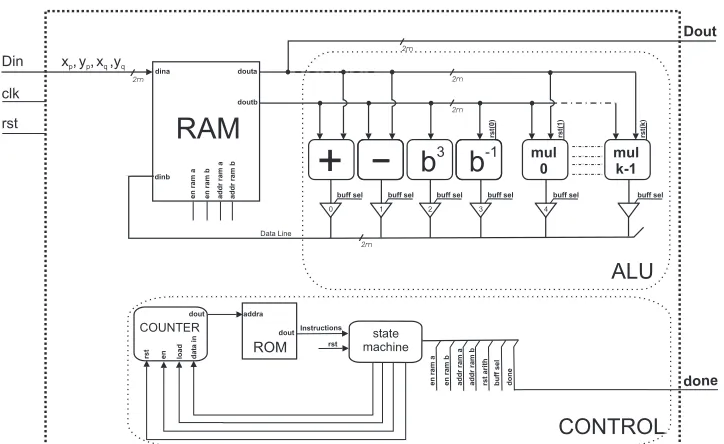
This section describes the reconfigurable processor designed to compute the secure bilinear pairingηT(P, Q)M. The processor was designed with flexibility and versatility
in mind and is shown in Figure 1.
Op Method of Computation Cost onF3m
Cube Let A = ˆa0 + ˆa1ρ+ ˆa2ρ2 where ˆa0 = (a0 + a1σ), ˆa1 = (a2+a3σ), aˆ2= (a4+a5σ) (see (8)) ⇒A3= ˆa30+ ˆa31ρ3+ ˆa23ρ6
Butρ3=ρ−1andρ6=ρ2+ 1. Reduce: (see (6)) ⇒A3= (ˆa3
0−ˆa31+ ˆa32) + ((ˆa13+ ˆa32)ρ+ ˆa33ρ2
Butσ2 =−1,⇒aˆ3
0 = (a03−σa13), ˆa31 = (a23−σa33),ˆa32 = (a43−σa53)
⇒A3= (a
03−a23+a43) + (a33−a13−a53)σ+ (a23+a43)ρ+ (−a33−a53)σρ
+(a43)ρ2+ (−a53)σρ2
6 cubings, 8 sub/adds
PowQ LetA= ˆa0+ ˆa1ρ+ ˆa2ρ2again: ⇒Aq=A3m= ˆa3m
0 + ˆa3 m 1 ρ3
m
+ ˆa23(ρ2) 3m
⇒Aq= ˆa
0+ ˆa1ρ3+ (ˆa1)ρ6
⇒Aq= (a0−a
2+a4)+(a3−a1−a5)σ+(a2+a4)ρ+(−a3−a5)σρ +(a4)ρ2+ (−a5)σρ2
8 sub/adds
P owQ2Reapply powq: ⇒Aq2= (a
0+a2+a4)+(a3+a1+a5)σ+(a2−a4)ρ+(a3−a5)σρ +(a4)ρ2+ (a5)σρ2
6 sub/adds
Mul GivenA = (ˆa0 + ˆa1ρ+ ˆa2ρ2), B = (ˆb0+ ˆb1ρ+ ˆb2ρ2)perform Karatsuba Multiplication ofA.BoverF32m followed by a reduction byρ3 = ρ−1. The Karatsuba Multiplication costs six
F32m multi-plications. EachF32mmultiplication requires three multiplications on F3m. This means that, in total, 18F3mmultiplications are required for F36m multiplication. All multiplications can be performed in parallel if desired. See [11] for more details.
18 muls, 72 add/subs
Inv Use method in [11]. Change representation from{1, σ, ρ, σρ, ρ2, σρ2} to{1, ρ, ρ2, σ, σρ, σρ2, i.e.A= ˆa
0+ ˆa1σwhereaˆ0=a0+a1ρ+a2ρ2 andaˆ1 = a3+a4ρ+a5ρ2. Recalling thatσ2 = −1, the inversion can be carried out efficiently using conjugate methods. Only oneF3m inversion is required.
33 muls, 4 cubings, 67 add/subs, 1 inv
Table 2. Implementation of Arithmetic onF36m
+
-
-
b
3b
-1 mul0mul k-1
0 1 2 3 4
douta
dinb
doutb dina
x , y , x ,yp p q q
addra
en load dat
ain
dout
dout
rst
Instructions state machine
buff sel buff sel buff sel buff sel buff sel buff sel
2m 2m
2m 2m
Dout
RAM
ROM
COUNTER
enrama enramb addrrama addrramb rstarith buffsel
enram
a
enram
b
addrram
a
addrram
b
rst(0) rst(1) rst(k) Din
clk
rst
2m
ALU
rst
Data Line
CONTROL
done done
Fig. 1. The characteristic 3 elliptic curveηTprocessor
Dual port RAM is used to store the intermediate variables required for computa-tion. The required input coordinates are read serially into the RAM before computation begins. During computation, two2m-bit data signals bring variables to the ALU to be operated on. Tri-state buffers at the output of the arithmetic components are used to select which result is written to RAM when theF3m operation has been completed.
A control unit consisting of a ROM, a counter and a simple state machine is used to perform the pairing operation. An instruction set sequencing the operations required for theηT pairing is loaded into the ROM. A counter controls the address of the ROM.
When the processor is reset, the counter begins to iterate through the instruction set. A simple state machine checks bits of the instruction vector and halts the counter for
m/Dclock cycles andmclock cycles when a multiplication and an inversion are being performed respectively so that the correct result will be written to RAM. The counter also contains a load control bit such that the counter can jump to particular addresses in the instruction set when required (for example jumping from the end of the loop to the beginning of the loop in Algorithm 1 when required). The state machine also handles the data load. This control methodology ensures flexibility as it eliminates the requirement for a large fixed state machine. When a new instruction set is required, it can simply be loaded into the ROM.
4.1 Processor Generation
number of multipliers and their digit sizes, the instruction set and, indeed, the size of the memory blocks, can be automatically reconfigured according to the application.
The instruction set that implements the bilinear pairing is also generated inCcode and written to a file that is loaded into the ROM. The instruction set is generated very efficiently inCthrough the use of operator overloading. Arithmetic operators are over-loaded such that an instruction of the type X=Y+Z written inCcode will automatically generate instructions that sendXfrom RAM port a,Y from RAM port b and set the tri-state buffers, the RAM enable signals and the RAM address signals such that the result is written from the addition circuitry toX after a clock cycle. This yields a very rapid generation of an instruction set for a particular application. Additional operations such as elliptic curve point scalar multiplication as required by some pairing-based protocols can also be added to the instruction set with ease.
4.2 Operation Scheduling
It is vital that the scheduling of operations be as efficient as possible to ensure that valuable clock cycles are not wasted. Operations are scheduled such that, if possible, additions, subtractions and cubings are performed and their results written to RAM while multiplication or inversion is in progress. In particular, the scheduling of opera-tions through the loop of Algorithm 1 is vital since the loop is performed(m+ 1)/2
times. To achieve a fast throughput through the loop, hardware pipelining is performed. Before the loop begins to iterate, the values ofc0 =−u1.u1andc1 =−yP.y′Q[i]are
computed and subsequently stored. On the first iteration of the loop, the calculation of
f.gcan then proceed almost immediately as the inputs to the operation will be available. The values ofc0 andc1 that will be required on the following iteration can be calcu-lated in parallel with these multiplications and stored. This means that after finding the initial values ofc0andc1, all15F3m multiplications can be performed in parallel if desired. Note also that the additions required to computef, as per (12) and (13), are also pipelined in a similar manner by calculating thef coefficients of the previous loop while multiplications are being performed during the current iteration. It is worthwhile noting that only a small level of this form of parallel scheduling can be achieved dur-ing the final exponentiation toM as described in Algorithm 2. This means that while the number of operations required for exponentiation is far less than for the loop itera-tions, the time required for exponentiation is not trivial due to its serial nature and effort should be made to minimise the number of operations required as much as possible.
5
Results
The Tate pairing processor described in the previous section was implemented over the sameF397base field and on the same FPGA described at the beginning of the previous
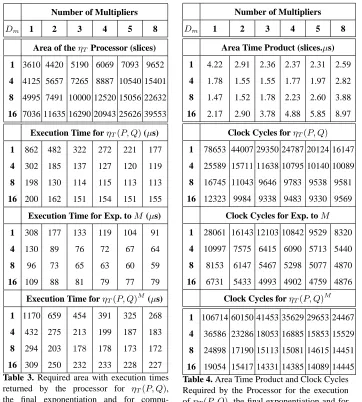
section. Note that the processor is fully reconfigurable for any suitable field size. Results returned by the processor whenηT(P, Q)M is implemented with 1, 2, 3, 4,
Number of Multipliers
Dm 1 2 3 4 5 8
Area of theηTProcessor (slices)
1 3610 4420 5190 6069 7093 9652
4 4125 5657 7265 8887 10540 15401
8 4995 7491 10000 12520 15056 22632
16 7036 11635 16290 20943 25626 39553
Execution Time forηT(P, Q)(µs)
1 862 482 322 272 221 177
4 302 185 137 127 120 119
8 198 130 114 115 113 113
16 200 162 151 154 151 155
Execution Time for Exp. toM(µs)
1 308 177 133 119 104 91
4 130 89 76 72 67 64
8 96 73 65 63 60 59
16 109 88 81 79 77 79
Execution Time forηT(P, Q)M (µs)
1 1170 659 454 391 325 268
4 432 275 213 199 187 183
8 294 203 178 178 173 172
16 309 250 232 233 228 227
Table 3. Required area with execution times
returned by the processor for ηT(P, Q),
the final exponentiation and for compu-tation of the full ηT(P, Q)M pairing, fCLK=91.2,84.8,70.4 and 61.6MHz for
D=1,4,8 and 16 respectively
Number of Multipliers
Dm 1 2 3 4 5 8
Area Time Product (slices.µs)
1 4.22 2.91 2.36 2.37 2.31 2.59
4 1.78 1.55 1.55 1.77 1.97 2.82
8 1.47 1.52 1.78 2.23 2.60 3.88
16 2.17 2.90 3.78 4.88 5.85 8.97
Clock Cycles forηT(P, Q)
1 78653 44007 29350 24787 20124 16147
4 25589 15711 11638 10795 10140 10089
8 16745 11043 9646 9783 9538 9581
16 12323 9984 9338 9483 9330 9569
Clock Cycles for Exp. toM
1 28061 16143 12103 10842 9529 8320
4 10997 7575 6415 6090 5713 5440
8 8153 6147 5467 5298 5077 4870
16 6731 5433 4993 4902 4759 4876
Clock Cycles forηT(P, Q)M
1 106714 60150 41453 35629 29653 24467
4 36586 23286 18053 16885 15853 15529
8 24898 17190 15113 15081 14615 14451
16 19054 15417 14331 14385 14089 14445 Table 4. Area Time Product and Clock Cycles
Required by the Processor for the execution ofηT(P, Q), the final exponentiation and for
computation of the fullηT(P, Q)Mpairing.
the multiplications required within the loop of Algorithm 1 dominate the pairing cal-culation time. The latency of these15multiplications does not improve between 5 and 7 (it remains at3m/Duntil a configuration incorporating 8 multipliers is instantiated). Operations required by theF36m multiplication are also scheduled to make use of the various numbers of multipliers.
0 1 2 3 4 5 6 7 8 9 5000 10000 15000 20000 25000 30000 35000 40000 45000 50000 D=1 D=4 D=8 D=16 A r e a ( S l ice s)
Number of Multipliers
(a) Total area for theηTProcessor in slices
0 1 2 3 4 5 6 7 8 9
10000 20000 30000 40000 50000 60000 70000 80000 90000 100000 110000 D=1 D=4 D=8 D=16 C l o ck C y cl e s
Number of Multipliers
(b) Total number of clock cycles forηT(P, Q)M
0 1 2 3 4 5 6 7 8 9
200 400 600 800 1000 1200 D=1 D=4 D=8 D=16 T o t a l C a l cu l a t i o n T im e ( u s)
Number of Multipliers
(c) Total time for computation ofηT(P, Q)Minµs
0 1 2 3 4 5 6 7 8 9
0 1 2 3 4 5 6 7 8 9 10 11 12 D=1 D=4 D=8 D=16 A r e a T i m e P r o d u ct ( S l i ce s. s)
Number of Multipliers
(d) Area-Time Product for theηTProcessor in slices.s
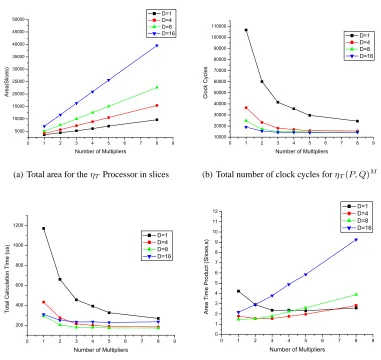
Fig. 2.ηT processor results when implemented with 1, 2, 3, 4, 5 and 8 multipliers with D=1, 4,
8, 16
configured with the MSC multiplier, the maximum attainable post place and route clock frequency of the processor is91.2MHz. The maximum frequencies for the processor when implemented with digit multipliers of D=4, 8 and 16 are84.8MHz,70.4MHz and
61.6MHz respectively. The computation times in Tables III and IV are returned by the processor at these post place & route frequencies.
Figure 2 illustrates trends in the area of the processor (slices), the total number of clock cycles required forηT(P, Q)M, the total computation time (µs) and the
Fig-ure 2(a) it can be seen that the processor can be configFig-ured for a large range of area costs, depending on the required computation time and application (3610–39553 slices).
As seen in Figure 2(b) the total number of clock cycles decreases as both the digit size and number of multipliers increase. An increase in the number of multipliers in the
D = 1case provides for a dramatic reduction in the number of clock cycles required since in this case each multiplicative operation consumes a relatively large number (m) of clock cycles. The effect is less dramatic in theD > 1cases since not only are the multiplicative operations less dominant but there is less time to pipeline intermediate additions while the multiplications are being performed.
Figure 2(c) illustrates trends in the time taken to computeηT(P, Q)and provides
some interesting results. Here, the decrease in clock frequency as the digit size is in-creased has an effect on the computation. In theD = 16case, the reduced frequency yielded by the larger digit size results in longer computation times than theD= 8case and in the {D=4, number of mults>2} cases since the multiplicative operations are taking a relatively small amount of time and are thus not so dominant when compared to the quantity of additive operations. From Table III the fastest pairing is returned in
172µs for the{D=8, number of muls=8}case. However, note from Table III that in-creasing the number of multipliers from 3 to 8 for this digit size returns a very small decrease in computation time. A more efficient option for a fast throughput architecture is the{D=8, number of muls=3}case, which requires only10,000slices (22.6% of the FPGA) and returns a cryptographically secure pairing in 178µs.
Trends in the area-time (AT) product of the processor are illustrated in Figure 2(d) and are, perhaps, the most revealing since a measure of the efficiency of the processor in the various configurations is provided. In theD ≡ 1case, the AT product reduces continuously until the number of multipliers is 5. Increasing the number of multipliers to 8 yields a less efficient utilisation of area as the extra 3 multipliers do not provide a large enough reduction in computation time to warrant their inclusion. The AT product floor is hit when the number of multipliers is3in theD = 4case. For digit sizes of 8 and 16, the most efficient utilisation of resources is returned by a processor with just one multiplier as the latency through the multipliers is reduced and the additions begin to dominate the computation time. Overall, the most efficient use of resources is returned by the {D = 8, number of muls=2}case. This configuration costs only 7491 slices (17% of the FPGA) and returns a fully secure pairing in203µs.
In the future, data trends for various different field sizes will be generated to inves-tigate the best configuration for theηT processor at various security levels.
5.1 Comparisons
algorithms of [13] and [8] are performed in 64887 and 69543 clock cycles respectively with an area of 4481 slices. No post place and route frequency values are provided. Our implementation compares favourably with these results.
6
Conclusions
In this paper we have discussed the efficient implementation of theηT pairing in
charac-teristic 3. AllF3,F3m andF36moperations required to compute a secure cryptographic pairing (including final exponentiation) have been discussed and their hardware im-plementation considered. A reconfigurable hardware processor for theηT pairing has
been presented. As far as we are aware, this is the first processor in the literature that computes e bilinear pairing including final exponentiation using theηTmethods in
char-acteristic 3. The cryptographic processor can be tailored for various applications as it is fully reconfigurable for any suitable field size, for various numbers of multipliers and for different multiplier digit sizes. The efficient scheduling of operations through this processor has been considered and a pipelining methodology outlined. Results returned by the processor when implemented over a field size ofF397 have been presented. At
present, the processor returns the fastest characteristic 3 cryptographic pairing returning a unique value in the literature.
In the future it will be interesting to analyse the results returned by the processor for various different field sizes. It would also be interesting to add an instruction set for the implementation of point scalar multiplication as this operation is required by many pairing based protocols.
References
1. P. S. L. M. Barreto. A note on efficient computation of cube roots in characteristic 3. Cryp-tology ePrint Archive, Report 2004/305, 2004. Available fromhttp://eprint.iacr.
org/2004/305.
2. P. S. L. M. Barreto, S. Galbraith, C. ´O h ´Eigeartaigh, and M. Scott. Pairing computation on supersingular abelian varieties. Cryptology ePrint Archive, Report 2004/375, 2004. Avail-able fromhttp://eprint.iacr.org/2004/375.
3. P. S. L. M. Barreto, H. Y. Kim, B. Lynn, and M. Scott. Efficient algorithms for pairing-based cryptosystems. In Advances in Cryptology – Crypto’2002, volume 2442 of Lecture Notes in
Computer Science, pages 354–368. Springer-Verlag, 2002.
4. G. Bertoni, L. Breveglieri, P. Fragneto, and G. Pelosi. Parallel Hardware Architectures for the Cryptographic Tate Pairing. In Information Technology: New Generations, pages 186–191. IEEE Computer Society, 2006.
5. G. Bertoni, J. Guajardo, S. Kumar, G. Orlando, C. Paar, and T. Wollinger. EfficientGF(pm)
arithmetic architectures for cryptographic applications. In Topics in Cryptology - CT RSA
2003, volume 2612 of Lecture Notes in Computer Science, pages 158–175. Springer-Verlag,
2003.
6. J.L. Beuchat, M. Shirase, T. Takagi, and E. Okamoto. An algorithm for theηT pairing
cal-culation in characteristic three and its hardware implementation. Cryptology ePrint Archive, Report 2006/327, 2006.http://eprint.iacr.org/2006/327.
8. I. Duursma and H.-S. Lee. Tate pairing implementation for hyperelliptic curvesy2 =xp− x+d. In Advances in Cryptology – Asiacrypt’2003, volume 2894 of Lecture Notes in
Computer Science, pages 111–123. Springer-Verlag, 2003.
9. S. Galbraith, K. Harrison, and D. Soldera. Implementing the Tate pairing. In Algorithmic
Number Theory – ANTS V, volume 2369 of Lecture Notes in Computer Science, pages 324–
337. Springer-Verlag, 2002.
10. P. Grabher and D. Page. Hardware acceleration of the tate pairing in characteristic 3. In
Cryptographic Hardware and Embedded Systems (CHES), volume 3659 of Lecture Notes in Computer Science, pages 398–411. Springer-Verlag, 2005.
11. T. Kerins, W.P. Marnane, E.M. Popovici, and P.S.L.M. Barreto. Efficient hardware for the Tate pairing calculation in characteristic 3. In Cryptographic Hardware and Embedded
Sys-tems (CHES), volume 3659 of LNCS, pages 412–426. Springer, 2005.
12. Tim Kerins, Emanuel M. Popovici, and William P. Marnane. Algorithms and architectures for use in FPGA implementations of identity based encryption schemes. In FPL, pages 74–83, 2004.
13. S. Kwon. Efficient Tate pairing computation for elliptic curves over binary fields. In
Aus-tralasian Conference on Information Security and Privacy – ACISP 2005, volume 3574 of Lecture Notes in Computer Science, pages 134–145. Springer-Verlag, 2005.
14. V. S. Miller. Short programs for functions on curves. Unpublished manuscript, 1986.http:
//crypto.stanford.edu/miller/miller.pdf.
15. L. Song and K.K. Parhi. Low-energy digit-serial/parallel finite field multipliers. Journal of
VLSI Signal Processing Systems, 2(22):1–17, 1997.
16. E. Verheul. Evidence that XTR is more secure than supersingular elliptic curve cryptosys-tems. In Advances in Cryptology – Eurocrypt’2001, volume 2045 of Lecture Notes in