Birgit Pfitzmann, Matthias Schunter, Michael Waidner
IBM Zurich Research Laboratory, S¨aumerstrasse 4, CH-8803 R¨uschlikon, Switzerland, e-mail:{bpf,mts,wmi}@zurich.ibm.com
Revision of Sept. 2004 of a journal submission from Dec. 2000.
Abstract Certified mail is the fair exchange of a message for a receipt, i.e., the recipient gets the message if and only if the sender gets a receipt. It is an important primitive for electronic commerce and other atomicity services. Certified-mail protocols are known in the literature, but there was no rigorous definition yet, in particular for optimistic protocols and for many interleaved executions. We provide such a definition via an ideal system and show that a specific real certified-mail protocol is as secure as this ideal system in the sense of reactive simulatability in the standard model of cryptography and under standard assumptions.
As certified mail without any third party is not practical, we consider optimistic proto-cols, which involve a third party only if one party tries to cheat. The real protocol resembles prior protocols, but we had to use a different cryptographic primitive to achieve simulata-bility. The communication model is synchronous.
This proof first demonstrated that a cryptographic multi-step protocol can fulfil a gen-eral definition of reactive simulatability enabling concurrent composition. We also first showed how formal-method style reasoning can be applied over the ideal system in a cryp-tographically sound way. Moreover, the treatment of multiple protocol runs and their mod-ular proof in spite of the use of common cryptographic primitives for all runs can be seen as a first example of what is now known as joint-state composition.
Key Words: Certified Mail, Fair Exchange, Reactive Simulatability, Composability, For-mal Methods
1 Introduction
There are three classes of certified-mail protocols. Protocols with an in-line third party involve a trusted third party in every protocol run [49, 56, 28, 37]. The older cryptographic literature treats two-party protocols that involve only the sender and the recipient, e.g., [18, 49, 53, 31, 19]. These protocols are based on the gradual exchange of secrets. However, their error probabilities only decrease linearly in the number of rounds, and one can show that this is unavoidable.1 Hence they are not used in practice. In order to minimize the involvement of a third party in realistic scenarios, optimistic protocols were introduced [3, 4, 39, 7, 57]. Here a trusted third party is available to ensure fairness, but it is only involved in a protocol run if something goes wrong in this run.
The main value of this paper is not that we propose a new optimistic certified-mail protocol, although we do. More importantly, we provide the first rigorous definition of certified mail, in particular for optimistic protocols and for many concurrent protocol runs. However, the main value in hindsight—the paper was originally written in 2000—is that it was the first example that cryptographic multi-step protocols can fulfil a definition of reactive simulatability that enables concurrent composition. This approach is nowadays better known as “universal composability” [47, 48, 23]. Our ideal certified-mail system is abstract, i.e., the specification for one protocol run is a simple, deterministic state-transition machine. Essentially it gets two inputs, a payload message from a sender and an OK to receive a message from the recipient. If these inputs fit together, it outputs the payload message to the recipient and a success indication to the sender. At any time after a success indication, the sender can input the wish to convince a verifier of the sending, and the verifier will get the output that the sender in fact sent the message to the recipient. While we will add some details below to allow efficient protocols to fulfil the specification, the ideal system remains without probabilism and cryptographic objects. Hence it is easy to encode in state-of-the-art automated proof tools for distributed systems, in order to prove larger electronic-commerce or agreement protocols based on certified mail.
Many later publications adapted other, often smaller, primitives or protocols to the reac-tive simulatability / universal composability setting, following either similar lines of defin-ing abstract ideal systems as here, or workdefin-ing on lower levels of abstraction where there are still cryptographic objects. While it may thus seem normal nowadays that such ideal-izations can be made and real protocols can fulfil them, this was not at all clear in 2000. It was known from zero-knowledge proofs that some interesting systems cannot be composed concurrently in spite of fulfilling normal cryptographic definitions [30], and it was known from multi-party function evaluation that committing primitives are problematic in simu-lation proofs. As reactive simulatability implies concurrent composability, and all known certified-mail protocols contain somewhat committing primitives, we were very suspicious of our potential results. This was also a reason for us to make a very detailed proof. It is typically not hard to define the simulator for a simulatability proof, i.e., a machine that interacts with the ideal system and uses an arbitrary adversary against the real system as a subroutine, and that produces behavior that the honest users cannot distinguish from what would happen in the real system. One may be tempted to stop at this point and say that the simulator obviously simulates correctly. However, comparing two such systems, the ideal system plus simulator with the real interacting machines, is a distributed-system problem of significant size, and humans often misjudge the correctness of distributed systems even for much smaller examples. For instance, even for a very small system like signatures cer-tain ideal systems and proofs had to be repaired several times [24, 8]. Thus the hard part of the proof is to rigorously show that the simulator simulates correctly. We still believe that every simulation proof should contain this part, but certainly the first large proof with respect to a new definition had to.
1
Our certified-mail system is also the first example of a technique that later became known as joint-state composition [25], although the generalization was only sketched in the outlook of the original report [46]. These aspects occur on two layers: First, the certified-mail system is defined as a composition of many submachines, each handling one transac-tion with a specific transactransac-tion identifier. Higher protocols can therefore essentially work with independent certified-mail transactions even though joint state is present underneath. Secondly, the proof is performed modularly for the transaction machines, although they jointly use three cryptographic primitives, signatures with arbitrary memory, a one-way function, and chameleon commitments. For these, we did not use the technique that one would use for higher-level protocols using certified mail, i.e., we did not abstract them as ideal systems with their own transaction identifiers. Instead, we use a similar separation technique directly for the original definitions.
An interesting aspect is that one-way functions and commitments by themselves do not have simple idealizations in the standard model of cryptography [23]. Nevertheless, our overall result is in the standard model. This is due to restrictions in the usage of the primitives: The one-way functions are only used for one-time signatures. The commitments are used in a scenario with a trusted third party—this party already exists in optimistic certified mail to guarantee fairness, but now we also use it to choose the commitment key. Thus in the simulation the simulator can choose the commitment key, and it can later use the chameleon property to open commitments to reveal arbitrary messages, here the payload certified-mail message that the simulator did not know when simulating a commitment on this message. A definition of primitives via ideal systems with usage restrictions was recently made for symmetric encryption in [11]; similar ideas might be applicable here.
Our certified-mail protocol is synchronous, i.e., there is a notion of rounds. In practice, rounds can be realized if suitable bounds on clock deviation and message delay are given. While recent cryptographic advances focus on asynchronous protocols, in particular in the simulatability area following [48, 23], synchronous protocols remain important in practice because one almost always needs timeouts anyway; e.g., recall the example of time-critical buying. Simply combining an asynchronous protocol with a timeout will typically not retain the security. It was later shown in [5] how the synchronous systems and simulatability definitions from [47] can be represented as special cases of the asynchronous versions from [48]. However, this embedding does not make concrete protocol definitions and proofs easier. Further, a synchronous proof implies the absence of timing vulnerabilities, e.g., covert channels, on the round level, while an asynchronous proof cannot do this.
Finally, our certified-mail protocol is labeled. This means that the recipient initially agrees to receive a mail under a specific subject, called label, and this label becomes part of the receipt. Labels are important for fixing a protocol context.
1.1 Further Related Literature
The underlying security definition of reactive simulatability and its composition properties were introduced in [47] and extended to asynchronous systems in [48, 23]. It extends the security notions of multi-party (one-step) function evaluation [54, 34, 32, 40, 15, 22] and the observational equivalence of [38]. The idea of simulatability was already used earlier for specific reactive problems, to our knowledge first in [29], and when constructing generic solutions for large classes of reactive problems [34, 35], usually yielding inefficient solu-tions and assuming that all parties take part in all subprotocols. None of these prior reactive papers proposed a general definition or a composition theorem.
multi-round subprotocols, multiple sub-protocols per transaction identifier (here sending a mail and showing the receipt), and committing primitives.
Separation of protocol runs by transaction or session identifiers is a well-known tech-nique in practical distributed computing, although rarely treated systematically. In security, it is known from robust protocol design [1], where protocol designers are advised to add transaction, message, and participant identifiers to authenticated messages unless there is a good reason not to, although this advice is not as explicit as it could be. Not all protocols need transaction identifiers, though. For instance, authentication protocols typically choose nonces internally in the protocol; see, e.g., [16] (whose oracles correspond to transactions). A comparison of labeled certified mail with protocols where the recipient simply agrees to receive a message, or where he need not agree at all, is given in [52] via reductions and round- and message-optimality results for all classes.
2 State-Machine Notation
We use state-transition machines as the primary system model, in other words probabilistic I/O automata similar to [51]. A Turing-machine realization is defined for the class of au-tomata used in [47]. This allows us to define ideal systems suitable for treatment by formal proof tools when designing higher-level protocols over them, while at the same time the real systems have well-defined complexities. Further, it enables rigorous definitions of our systems. While pure Turing machines also allow this in principle, in reality one typically resorts to informal activity diagrams or state-transition machines there, too.
Each machine may have different connections, e.g., to a user and a network. These are attached at so-called input and output ports. Following CSP notation we denote input ports with?and output ports with!. Ports of different machines that only differ in this “direction” are connected.
We often define state-transition functions graphically in the following standard nota-tion: A circle is a state. An arrow labeledin[c]/out is a transition resulting from an input in, dependent on conditionc(which can refer to the input and the internal state) and result-ing in an actionout, typically an output. Inputs that are not explicitly shown in a state are ignored. No condition meanstrue. The notationx.ymeans thatyis input or output at port
x. We then omit the direction of portx(the?or!) because it is clear from the context. A dash means no in- or output. A state transition without input means that the machine always makes this transition in the next round. An input¬x.ymeans that the machine makes the transition if the inputyis not received at portxin the next round.
We further define that every input parameter is assigned to a variable of the same name in the machine if no assignment to such a variable occurred before in the given run of the machine; otherwise the input is only accepted if the values of the parameter and the variable are equal. Finally,T (time) globally denotes the current round number, although not all machines need to know it. The starting state is designated by an incoming arrow without source. The label of this arrow denotes initial variables in this machine.
3 Ideal System for One Labeled Certified-Mail Transaction
Actually, in this section we only define an ideal system for one transaction. Exten-sions to multiple transactions are discussed in Section 8; they are relatively standard for distributed systems.
3.1 Motivation of the Definition
As discussed in the introduction, a highly ideal systemTHnaivefor certified mail might look as follows. This simple description already allows any number of transactions.
– Whenever THnaive obtains two matching inputs (send, r, l, m) at port ins? and
(receive, s, l) at inr? in a round i, it outputs (received,(s, r, i), m) at outr! and
(sent,(s, r, i))atouts!in the next round.
– For every non-matched such input, it outputs(failed,(s, r, i))to the party concerned. – On input(show,(s, r, i))atins?, it outputs(received,(s, r, i), l, m)atoutv!if it
previ-ously got an input(send, r, l, m)atins?and answered with(sent,(s, r, i)).
HereTHnaivestands for “naive trusted host”,sandrare identities of a sender and recipient, ins?andinr?are input ports for these two parties, andouts!andoutr!are the output ports where these parties get results. We modeled only one verifier with output portoutv!for simplicity because verifiers are stateless in our protocols and would thus all act identically. The inputssendandreceivestart the sending protocol, whileshowstarts the showing of a receipt. The valueslare the labels; note that the recipient inputs the label he agrees to initially; further, both parties designate the desired partner in their inputs. For simplicity, we treat the combination(s, r, i)of the partner identities and round number as transaction identifier, allowing only one protocol per such combination. The following proofs would work equally well with more such possible protocols; an additional transaction identifier is then needed in many places where now the triple(s, r, i)is used.
Unfortunately, normal certified-mail protocols do not satisfy this simple, very ideal specification.
First,THnaivehides all interactions between honest parties from the adversary. In real
life, it would be very expensive to hide who communicates with whom at what time. As the secure-channel example in [44] shows how to allow just this minimal information, we decided here to model the usual unencrypted protocols from the fair-exchange literature. Thus for each transaction, our final trusted host initially forwards all non-secret parts of the user inputs to the adversary at a portout a!, and later forwards(msg, m)when a payload message is sent in clear.
Secondly,THnaiveguarantees availability, i.e., it always delivers certified mails between agreeing honest users. However, in usual real systems the adversary can prevent commu-nication. Therefore our final trusted host accepts inputssuppressfrom the adversary that describe which protocol runs are disrupted. However, we need reliable channels to trusted third parties.
Thirdly,THnaiveproduces outputs in one round, while every real optimistic protocol requires at least four rounds already in the optimistic case [52]. Hence we use a number
∆ of rounds as a free parameter in the specification. For brevity, we use only one such parameter for all honest parties and all cases. Showing a receipt will work in one round.
Finally, the trusted host with the additions discussed so far would make outputs to the adversary after the same time∆as to honest parties. However, a real adversary can usually learn results faster. For simplicity, our final ideal system allows the adversary slightly more than a real adversary can achieve in any specific protocol: He can disrupt at any time, or decide that he will not disrupt and immediately learn the results.
3.2 Ideal Machines for One Transaction
! " ! "
! " ! "
! " ! "
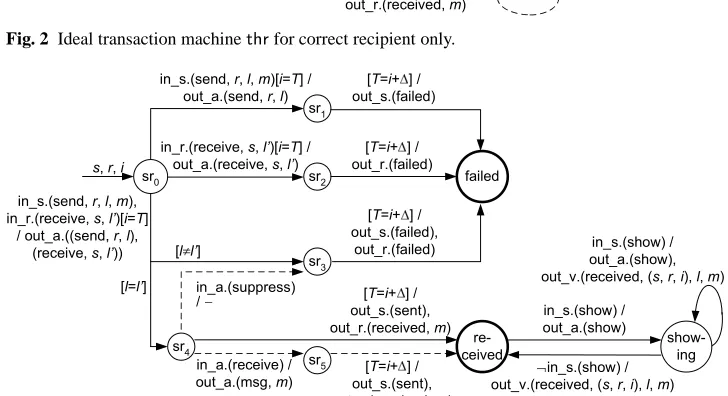
Fig. 1 Ideal transaction machinethsfor correct sender only. Dashed arrows arise from adversary inputs.
Fig. 2 Ideal transaction machinethrfor correct recipient only.
! " ! "
! " ! "
! "
# $
! "
Fig. 3 Ideal transaction machinethsrfor correct sender and recipient.
transaction machines. We distinguish whether only the sender (ths), only the recipient (thr), or both parties (thsr) in the transaction are honest. The trusted third party is not visible in the ideal system; it only has an auxiliary role in real systems. Thus the ideal system is not specific to optimistic protocols. The following is the rigorous definition using the state-machine notation introduced in Section 2.
Definition 1 (Ideal Machines for One Certified-Mail Transaction) We define machine typesths,thr, andthsrwith ports for each party concerned with this transactions:in s?
andout s!forthsandthsr,in r?andout r!forthrandthsr, and alwaysout v!,in a?and
out a!. Their state-transition functions are defined in Figures 1 to 3.
These state-transition functions correspond to the naive ideal systems with the addi-tions motivated above: Each transaction machine is started by inputs (send, . . .) and/or
sr2, andsr3occur if there are not two matching inputs. The adversary immediately obtains the parameters of the run at the portout a!. Then for∆rounds he can either disrupt the run with(suppress)or decide that it should end successfully by inputting(send, m)if he is the sender, or else(receive). In the latter case, he immediately obtains the payload message of the honest sender. The outputs for the honest users only occur after∆rounds. Only then can receipts be shown. Showing by an adversary works within the same round, by an honest user it has one round delay. In most user outputs we now omitted(s, r, i)because it only served as a transaction identifier in the naive ideal system, and for a one-transaction system this is clear by the machine identity.
Parameterizing the Ideal System. The ideal system from Definition 1 accepts inputs of ar-bitrary length. (We tacitly assume that all inputs are coded as strings over a fixed alphabet.) Further, it is willing to show receipts for one transaction arbitrarily often. One consequence is that it is not polynomial-time in the usual sense for interactive Turing machines, i.e., time measured in a security parameter alone. We call this strictly polynomial-time. It is, however, weakly polynomial-time, i.e., polynomial-time in the overall length of inputs it receives. The system model and the simulatability definition do not require ideal systems to be polynomial-time at all; however, proofs (e.g., of higher protocols using this trusted host and other cryptographic primitives) are often simpler if all machines are strictly polynomial-time, because this is a composable notion, in contrast to weak polynomial-time. For this purpose, we also define a parameterized version of the ideal system. It has a message space, a label space, and a bound on the number of rounds, which may depend on a security parameterk. Thus they are sequences(Msgk)k∈N,(Lk)k∈N, and(Bk)k∈N.
The message and label spaces must be polynomial-time decidable subsets of strings over the given alphabet, and the boundsBk ∈ Npolynomially bounded and polynomial-time computable. Then we modify the machinesths,thr, andthsr as follows: They only run forBkrounds. Inputs namedmandlare typed, i.e., the machines verify thatm∈Msgk andl ∈Lk before accepting such an input. Finally, they have length bounds determining how many symbols of any input they read. Polynomial bounds sufficient for all correct in-puts can easily be derived from the message formats. While this was well-defined on the Turing-machine level in the original report [46], the corresponding input-bounding func-tions for our state-transition machine model were only generally defined in [12], called length functions.
Independent of their use for polynomial time, restricted message and label sets may be useful in specific applications of certified mail.
4 Real Certified-Mail Protocol for One Transaction
Like the ideal system, the real system for labeled certified mail, i.e., the actual protocol, is built from machines for individual transactions, and we first define these transaction machines.
4.1 Overview
We first sketch our protocol as activity diagrams, before defining it rigorously via state-transition machines. The subprotocol for sending a mail has three potential participants, the sender’s machinecm s, the recipient’s machinecm r, and the third party’s machine
cm t. The protocol for showing a receipt is similarly executed by a sender and a verifier. The inputs starting these subprotocols and the possible outputs to the users are the same as in the ideal system.
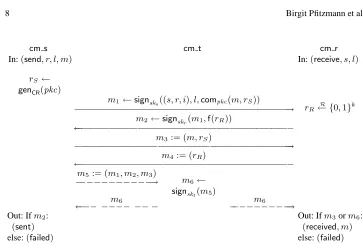
The subprotocol for sending is shown in Figure 4. Messagesm1andm2are promises
cm s cm t cm r
In:(send, r, l, m) In:(receive, s, l)
rS←
genCR(pkc)
−−−−−−−
m1←signsks((s, r, i), l,compkc(m, rS))
−−−−−−−−−−−−−−−−−−−−−−−−−−−−−−−−−−−−→ rR
R
← {0,1}k
←
−−−−−−−−−−−−
m2←signskr(m1,f(rR))
−−−−−−−−−−−−−−−−−−−−−−−−−−−−−−
−−−−−−−−−−−−−−−−m
3 := (m, rS)
−−−−−−−−−−−−−−−−−−−−−−−−−−→
←
−−−−−−−−−−−−−−−−−m
4:= (rR)
−−−−−−−−−−−−−−−−−−−−−−−−−
−m
5:= (m1, m2, m3)
−−−−−−−−−−−→ m6← signskt(m5)
←
−−− −−−− −− −m6 −−−−−−−−−−m6 → Out: Ifm2:
(sent)
else:(failed)
Out: Ifm3orm6: (received, m)
else:(failed)
Fig. 4 Run of the sub-protocol “send”. Dashed flows are only needed in the non-optimistic recovery, i.e., ifm4is missing.
cm s cm v
In:(show,(s, r, i))
−m
7:= (m1, m2, m3, m4) or m6
−−−−−−−−−−−−−−−−−−−−−−−−→−Ifm7orm6:
Out:(received,(s, r, i), l, m)
Fig. 5 Showing a receipt
valueiis the number of the starting round andka security parameter. The message part
compkc(m, rS)is a commitment tom, using a suitable random value generated with an algorithmgenCR(pkc). The message partf(rR)is a one-way function applied to a random value; this is used as the public key for a one-time signature. If both parties are honest, the sender reveals the payload messageminm3, and the recipient sends the one-time
sig-naturerR as a receipt inm4. If a dishonest recipient does not sendm4, the sender uses
the recipient’s promisem2inm5to convince the third party that the recipient wanted to
receive a message under this label. Thus the third party can safely issue an affidavit,m6.
If a dishonest sender does not reveal the payload message inm3, the recipient waits until
Roundi+6. Ifm6arrives, the recipient extractsm3and thusmfrom it. Otherwise it knows
that the message will never arrive and can safely decide that the transaction failed. For the latter, the third party must honorm5only if it arrives in Roundi+ 5.
If the sender wants to show the receipt to a verifier, it sends(m1, m2, m3, m4)orm6,
respectively, see Figure 5. The verifier can easily verify both potential receipts, provided it knows the public keys.
4.2 Cryptographic Primitives Used and Probabilistic Notation
In the following,NEGLdenotes the set of all negligible functions, i.e.,g:N → R≥0 ∈
NEGLiff for all positive polynomialsQ,∃k0∀k ≥ k0: g(k) ≤ 1/Q(k). The notation
For all algorithms of the following cryptographic primitives, we assume that efficiently computable upper bounds on the output length, given the input lengths, are known, as well as for the number of random bits needed in a probabilistic algorithm.
A signature scheme is a triple of algorithms(genS,sign,test). We assume w.l.o.g. that the message space isΣ+for an alphabetΣ with{0,1} ⊆ Σand
false 6∈ Σ+[27]. We
write(sk,pk)←genS(1k,1s∗)for the generation of a signing key and a test key based on a security parameterkand the desired maximum number of signatures,s∗∈N. Bysig←
signsk(m), we denote the (probabilistic) signing of a messagem, whereskmay be updated
in the process. This is a simple way to represent schemes with memory. We assume thatsig is of the form(m,sig0). The deterministic verificationtestpk(sig)returnsmorfalse; in the
first case we say that the signature is valid. The firsts∗correctly generated signatures must
be valid. Security of a signature scheme means that existential forgery is infeasible even in adaptive chosen-message attacks [33]:
Definition 2 (Signature Security) Given a signature scheme and a functions∗overN, a
signer machineSigs∗ is defined as follows: It has one input and one output port, variables
sk,pk, and the following transition rules:
1. First generate a key pair,(sk,pk)←genS(1k,1s∗
), and outputpk. 2. On input(sign, mj), returnsigj ←signsk(mj).
The signature scheme is called existentially unforgeable under adaptive chosen-message attack if for every efficiently computable, polynomially boundeds∗and every probabilistic
polynomial-time machineAsigthat interacts withSigs∗ and outputs a valuesig, the
proba-bility thatm:=testpk(sig)6=falseandmwas not signed bySigs∗ during the interaction
is negligible (ink).
Definition 3 (Security of a One-way Function) A functionf:{0,1}∗→ {0,1}∗is called
one-way if for all probabilistic polynomial-time algorithmsAowf,
P(r∗ =r::r R
← {0,1}k;r∗←
Aowf(1k,f(r)))∈ NEGL
(as a function ofk).
A non-interactive chameleon commitment scheme [21] is a tuple of algorithms
(genC,genCR,com,trans) wherecom is deterministic, and a message space MsgC. We write(skc,pkc)←genC(1k)for the generation of a key pair based on a security parameter
k, andr←genCR(pkc)for the generation of a suitable random valuerfor commitments given the public keypkc. We writec:=compkc(m, r)for the commitment on a message
m∈MsgCusing the public keypkcand the random valuer. By(c, r)←comrpkc(m), we abbreviate the compositionr←genCR(pkc);c:=compkc(m, r).
A commitment c is opened by sending (m, r). The recipient verifies that
compkc(m, r) = c. Byr∗ ← transskc(c, m, r, m∗)we denote the transformation that
al-lows the owner of the secret keyskc to take a commitment c, values m, rthat open it, and another message m∗ ∈
MsgC and to derive a valuer∗ such thatc can be opened
tom∗ usingr∗. For all correctly generated keys and c = compkc(m, r), this must give
c=compkc(m∗, r∗).
Definition 4 (Security of a Chameleon Commitment Scheme) A non-interactive chameleon commitment scheme is called secure if it has the following three properties.
a) Computationally binding: For every probabilistic polynomial-time algorithmA:
P(compkc(m, r) =compkc(m∗, r∗)∧m6=m∗ :: (skc,pkc)←genC(1k); (m, r, m∗, r∗)←A(1k,
b) Perfectly hiding: For all(skc,pkc)∈[genC(1k)], all probability distributionsDiston MsgC, allm∈MsgCand all possible commitmentsc,
PDist∗(m|c) =PDist(m)
whereDist∗is the distribution defined bym←Dist; (c, r)←comrpkc(m).2 c) Chameleon: For all (skc,pkc) ∈ [genC(1k)] andm, m∗ ∈ Msg
C: The probability
distribution of the pair(c, r∗)in(c, r) ← comrpkc(m);r∗ ← transskc(c, m, r, m∗)
equals that in(c, r∗)←comrpkc(m∗).
For example, we can use the commitment scheme from [20, 26, 42] with a chameleon exten-sion, combined with a family of collision-resistant hash functions [27]. In the basic scheme, key generationgenC(1k)means to randomly choose ak-bit primeqand anl(k)-bit prime
pwithq|(p−1)for a functionldetermining a suitable second security parameter, a gen-eratorgof the unique subgroupGq of orderqinZ∗p, andx
R
←Z∗q, and to seth:=gx. The keys arepkc := (p, q, g, h)andskc := x. A suitable random value is chosen asr R
←Zq
and a commitment on a messagem ∈ MsgC := Zq as c := compkc(m, r) := gmhr
modp. The transformation isr∗:=transskc(c, m, r, m∗) := (m−m∗)/x+r. The
bind-ing property holds under the discrete-logarithm assumption for this family of groups. We now use a family of collision-resistant hash functions to allow commitments to arbitrarily long inputs. A particular hash functionhashpkh is also (at least in theory) selected by a public keypkhthat becomes part of the public key of the extended commitment scheme. The hash outputs for a security parameterkmust belong toMsgC. Given a messagem, we
now commit tohashpkh(m). One easily sees that this combination retains all the properties of the commitment scheme.
For proving simulatability of the certified-mail scheme, we need that an adversary can-not open a commitment made by someone else even if he has chosen the content. This is Part b) of the following lemma, and Part a) is a simple fact used.
Lemma 1 (Properties of the Commitments)
a) For all(skc,pkc)∈[genC(1k)], allm, m0 ∈Msg
C, and all possible commitmentsc,
P(c0=c:: (c0, r)←comrpkc(m)) =P(c0=c:: (c0, r)←comrpkc(m0)).
b) For all probabilistic polynomial-time algorithmsA1,A2:
P(c=compkc(m∗, r∗)
:: (skc,pkc)←genC(1k); (m,aux)←A1(1k,pkc);
(c, r)←comrpkc(m); (m∗, r∗)←A
2(1k,pkc, m,aux, c))
∈NEGL.
Hereaux denotes auxiliary information thatA1may hand toA2.
Proof If Part a) were not true, then forPDist(m) :=PDist(m0) := 1/2, we would obtain a
contradiction to the hiding property:
PDist∗(m|c) =PDist(m)P(c0 =c:: (c0, r)←comrpkc(m))/PDist∗(c)
= 1/2P(c0=c:: (c0, r)←comrpkc(m))/PDist∗(c)
6= 1/2P(c0=c:: (c0, r)←comrpkc(m0))/PDist∗(c)
=PDist∗(m0|c).
For Part b), assume that A1,A2 contradict the lemma. Then either the probability with
an additional conditionm∗ 6= mor with m∗ = mis still not negligible. The first case
immediately contradicts the binding property.
2
ThusPDist∗(m|c)abbreviatesP(m0=m|c0=c::m0←Dist; (c0, r)←comr
! " #
$ %
$
$
$
&
' '
(
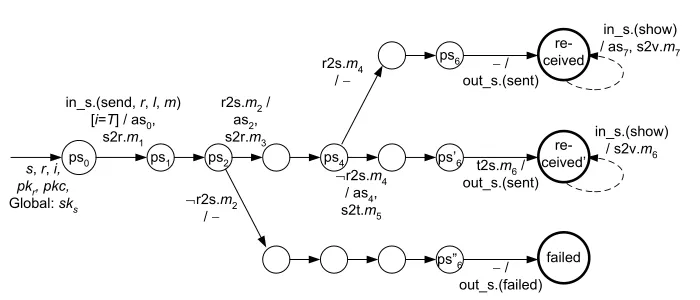
Fig. 6 Sender transaction machinecm s.
In the second case, consider an adversaryA3that carries out(m,aux)←A1(1k,pkc),
then chooses a message m0 6= m inMsg
C (e.g., the first possible one out of two fixed
ones), sets(c, r)←comrpkc(m0)and finally(m∗, r∗)←A
2(1k,pkc, m,aux, c). By Part
a) this does not change the distribution ofccompared with the assumption aboutA1 and
A2. Hence the success probability of A2 is unchanged, and as in the first case we get a
contradiction to the binding property.
4.3 Real Machines for One Transaction
We now define the real machines for one transaction of our certified-mail protocol in detail. Note that the same sender transaction machine once sends and then, possibly many times, shows the resulting receipt. As we allow the machines for different transactions to use a common signature key that may be updated in each signing, we define it as a global variable, indicated by “Global:” on the start arrow. Further, we define subprograms for message tests and computations that do not fit into the state-transition diagrams, called “axj” for partyx’s action in statej.
A comma in messages denotes tuple composition, not concatenation. It must be imple-mented such that decomposition is unambiguous. We slightly augment the message format of Figure 4; in particular we repeat the transaction identifier in places to simplify later dis-patching. Further, we add message type identifiers likem1in signed messages, although in this protocol this is not needed because each type of machine signs only one type of message.
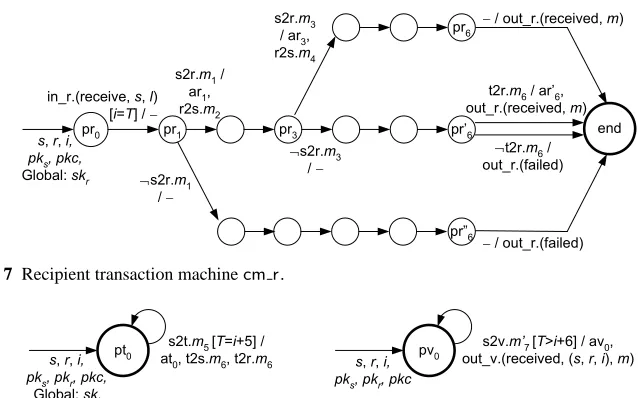
Definition 5 (Real Machines for One Certified-Mail Transaction) We define machine typescmx withx ∈ {s, r, t, v}. Each machine has at most one input and output port for its user,in x?forx ∈ {s, r}andoutx!forx ∈ {s, r, v}. Further, it has so-called network portsx2y!for outputs to a machine of typecmy andy2x?for inputs from that machine. The detailed behavior of these machines is defined in Figures 6 to 8. We now define the subprograms used in the figures; they operate on the variables of the respective machine as defined by our general conventions.
In the sendercm s.
Subprogramas0. Let(c, rS)←comrpkc(m)andm1←signsks((s, r, i),m1, l, c).
Subprogramas2. Verify thattestpkr(m2) = ((s, r, i),m2, m1, pR)for some valuepR.
If yes, setm3:= ((s, r, i), m, rS).
Subprogramas4. Test whetherm4 = ((s, r, i), rR)for some valuepR ∈ {0,1}k with
f(rR) =pR. If not, setm5:= (m1, m2, m3).
Subprogramas7. Setm7:= ((s, r, i),m7, m1, m2, m3, m4).
! "
!
#!
! !
!
Fig. 7 Recipient transaction machinecm r.
! !
Fig. 8 Transactions machinescm tandcm vfor third party and verifier.
Subprogramar1. Verify thattestpks(m1) = ((s, r, i),m1, l, c)for some valuec. If yes,
setrR
R
← {0,1}kandm
2←signskr((s, r, i),m2, m1,f(rR)).
Subprogramar3. Verify thatm3 = ((s, r, i), m, rS)for some valuesmandrS with
compkc(m, rS) =c. If yes, setm4:= ((s, r, i), rR). Subprogramar0
6. Retrieve the signed message((s, r, i),m6, m5)fromm6, decompose
m5into(m1, m2, m3), and decomposem3into((s, r, i), m, rS).
In the third-partycm t, subprogramat0. Test that m5 is a triple (m1, m2, m3) with
testpks(m1) = ((s, r, i),m1, l, c) for some values l and c, and testpkr(m2) = ((s, r, i),m2, m1, pR) for some value pR ∈ {0,1}k. Finally, test that m3 =
((s, r, i), m, rS)for some valuesmandrS withcompkc(m, rS) =c. Then setm6 ←
signskt((s, r, i),m6, m5).
In the verifiercm v, subprogramav0. Verify that m07 is of the form m6 =
(((s, r, i),m6, m5),sig) or m7 = ((s, r, i),m7, m1, m2, m3, m4) for some
val-uesmi andsig. In the first case, test iftestpkt(m6) = ((s, r, i),m6, m5)and verify
and decomposem5 as defined forcm t. In the second case, verify and decompose
m5:= (m1, m2, m3)in the same way and then verifym4as defined forcm s.
Part of the trust model for this protocol is that the channels to and from the third party and the verifier are reliable and authentic, i.e., messages arrive as sent, although the ad-versary may read them. The assumption that other parties can reliably communicate with the third party is essential for optimistic (and in-line) certified mail. For the verifier, it is less essential, but otherwise we would have to allow the adversary to suppress runs of the “show” protocol in the ideal system. The authenticity of these channels could be realized cryptographically, while the reliability has to be assumed.
5 Reactive Simulatability
In order to prove that the real system (for one or many transactions) is as secure as the ideal system, we need a summary of the underlying security definitions from [47]. As said in Section 2, the machine model is essentially normal probabilistic state-transition machines and we do not repeat a formal definition here.3The machines are connected according to the port naming convention, i.e., messages output atp!arrive atp?. A collection of machines is a set of machines compatible with this connection convention, i.e., no port occurs twice. A collection is called closed if all ports are connected.
Runs (executions) are defined for closed collections essentially in the usual way for probabilistic state-transition machines (see [51]), in particular in the synchronous case needed here. Only, to capture security notions like rushing adversaries, we allow differ-ent clocking schemes. A clocking scheme withnsubrounds for a machine collectionMˆ is a functionκ:{1, . . . , n} → P(Mˆ); it assigns each subround the set of machines switching in this subround.
For security purposes, we distinguish certain free ports of a collection of machines as service ports. This is where the honest users of the protocol (human users or a higher-level protocol) are supposed to make in- and outputs. For instance, in both the real and the ideal certified-mail system for one transaction with honest sender and recipient, the service ports are the setS :={in s?,out s!,in r?,out r!,out v!}. When comparing systems (e.g., a real one and an ideal one), we restrict ourselves to systems with the same service ports. We call a pair(Mˆ,S)of a machine collection and distinguished service ports a structure. For instance,(thsr,S)and({cm s,cm r,cm t,cm v},S)are corresponding real and ideal structures for one transaction of certified mail.
A structure becomes a configuration(Mˆ,S,H,A)by adding an adversaryAand honest usersH. Both are normal probabilistic state-transition machines, but typically universally quantified, while the machines of the structure are predefined. The honest users Hmust only link to the machines of the structure by the service ports, while the adversary links to the other free ports, e.g., insecure network connections. Together, a configuration must be a closed collection. We use the clocking scheme(Mˆ,A,H,A). The notation exploits that functions over {1, . . . , n} are equivalent to tuples, and we omitted brackets around one-element sets. Thus not only the adversary, but also the honest users are rushing. The motivation for this clocking scheme and equivalence results can be found in [45]. For con-figurations, we typically consider the case where the initial state of each machine is just the security parameterk. Then the runs are a family of probability distributions (in other words random variables), one for each value ofk.4
Views of machines and traces of the events at certain ports are defined in a natural way as restrictions (projections) of runs. Details of the run representation and these projections are not needed in the following; they can be found in [47].
Often one defines an intended structure for a real system, in other words a protocol and intended connections for a number of parties, plus a trust model that defines how many of these parties might be corrupted and how, and how secure the connections are. We may thus obtain a set of possible real structures. To allow many types of trust models, the general security definitions in [47] are for arbitrary sets of possible structures, called systems. The certified-mail system for one transaction has three possible structures corresponding to a trust model where the sender, the recipient, or none may be corrupted. As said above, channels to and fromcm t andcm v are authentic, the others insecure. The latter means that both machines actually interact with the adversary; this is formally realized by a port
3
The only special aspect is the length functions that may bound the length of the inputs read at each port in each state, as explained above and first defined precisely in [12].
Fig. 9 Example of blackbox simulatability; the two views of the userHare indistinguishable.
renaming convention defined in the derivation of a system from an intended structure and a trust model.
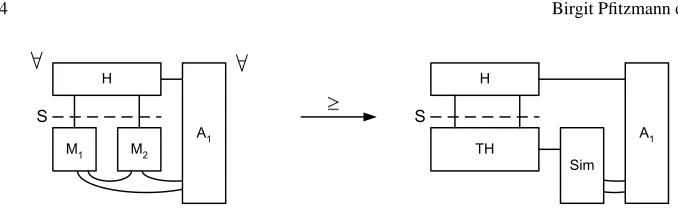
The notion of reactive simulatability essentially means that it makes no difference for the honest users whether they interact with the real system or the ideal system. This is illustrated in Figure 9 (already for the usual stronger case of blackbox simulatability). More precisely, their view is indistinguishable in corresponding structures. Indistinguishability is an important cryptographic concept, first from [55].
Definition 6 (Computational Indistinguishability) Two families (vark)k∈N and
(var0
k)k∈N of random variables (or probability distributions) are computationally
indistinguishable (“≈poly”) iff for every algorithm Dist (the distinguisher) that is probabilistic polynomial-time in its first input,
|P(Dist(1k,vark) = 1)−P(Dist(1k,var0k) = 1)| ∈NEGL.
Intuitively,Dist, given the security parameter and an element chosen according to either
varkorvar0k, tries to guess which distribution the element came from.
We now denote the random variable of the view of a machineMin a configurationconf byviewconf(M). Then reactive simulatability is defined as follows.
Definition 7 (Computational Reactive Simulatability for Structures) We say that a structure(Mˆ1,S)is computationally at least as secure as a structure (Mˆ2,S)and write
(Mˆ1,S)≥polysec (Mˆ2,S)iff for every configurationconf1 = (Mˆ1,S,H,A1), there exists a
configurationconf2= (Mˆ2,S,H,A2)such that
viewconf1(H)≈polyviewconf2(H).
Blackbox simulatability, written ≥poly,bb
sec means that, given(Mˆ1,S)and the setP of
adversary ports,A2is a fixed simulatorSimwithA1as a blackbox submachine.
A typical simulator does not modify the communication betweenA1andH(as already
shown in Figure 9) and thus only depends on the structure(Mˆ1,S). Further, for blackbox
simulatability, one typically shows that the joint view of HandA1 is indistinguishable.
Thus the distinction ofHandA1disappears, while the service ports remain important to
decide howSimconnects to the ideal system.
The reactive simulatability definition is lifted from structures to systems (sets of struc-tures) by comparing “corresponding” structures defined by some mapping. Certified mail belongs to the canonical case where a setSof service ports uniquely characterizes a corre-sponding real and ideal structure, correcorre-sponding to a set of correct participants according to the trust model. We also write “≥poly
sec ” for systems.
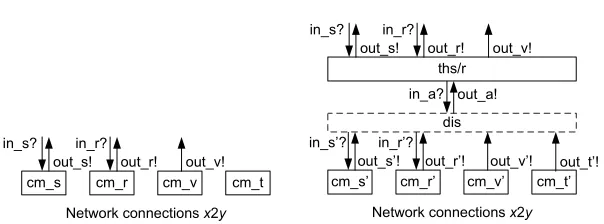
Fig. 10 Machines for one transaction in the real system (left) and the ideal system with simulator (right). Machineths/rstands forths,thr, orthsrdepending on which parties are correct.
6 Simulator for One Transaction
We will prove that the real certified-mail system (for one or many transactions) is as se-cure as the ideal system in the sense of blackbox simulatability. For this, we first define a simulator for one transaction.
The main cryptographic aspect is the simulation of the messagem1of the subprotocol
“send” if the sender is honest: In Roundi, wherem1should be sent, the ideal system does
not reveal the payload messagemthe honest user wants to send. Nevertheless, the simu-lator has to input a correct-looking network message to the adversaryA, which includes a commitment that is supposed to fixm. If the protocol run is successful, the simulator has to open this commitment two rounds later. If it then reveals a messagem06=m, the simulation
is not correct. This is why we need the chameleon property: It allows the simulator (which also simulates the machinecm tand thus knows its secret commitment keyskc) to make the commitment on an arbitrary messagemsimand later open it to the correct messagem.
The main non-cryptographic aspects of the simulation are to verify that the real adver-sary has no possibilities to disrupt the protocol runs in certain states, to show receipts too early, etc., that are not specified in the ideal system.
We structure the simulator for one transaction similar to the real system, i.e., it explicitly simulates machinescm sand/orcm r,cm t, andcm v. Additionally it translates signals that the ideal system outputs at port out a! into user inputs to these machines and vice versa. The machines, instead of making their normal final user outputs, recognize certain intermediate situations and output the decision to suppress or to correctly finish the run as needed for the ideal system. Figure 10 shows the resulting machines in the comparison of the real and ideal system.
For such a behavior, the simulator switches twice per real round, before and after a switching step of the ideal system. Formally, this would not need to be visible in the sim-ulator definition: The simsim-ulator is a synchronous machine and can make one transition in each of its rounds. However, for ease of comparison with the real system, we draw the state-transition diagrams essentially with the global rounds.5
Definition 8 (Simulator for One Transaction) The simulator for one transaction of la-beled certified mail consists of submachinescm s0and/orcm r0 (intuitively depending on
whether only the sender, only the recipient, or both are honest), cm t0, andcm v0, and
a dispatcherdis. The user ports of these machines are namedin x0?forx ∈ {s, r}and
outx0!forx∈ {s, r, t, v}. The network ports are named as in the real system.
5
Formally we use the clocking scheme(TH,Sim,A,H,A,Sim)for an ideal system with separate simulator. With the combination lemma of [47] (Lemma 2) the system whereAandSimare combined into an adversaryA0and clocked as(TH,A0,H,A0), i.e., the prescribed clocking for synchronous
systems, is well-defined, and does not change the views of any (sub-)machines. Similarly, a scheme is defined whereTHandSimare combined into one machineM0and clocked as(M0,A,H,A), and
!
" "
#
"
"
# $
% %
&
'
&
Fig. 11 Simulated sender transaction machinecm s0. Differences tocm sare denoted in bold face.
!
!
Fig. 12 Simulated recipient transaction machinecm r0.
Fig. 13 Simulated transactions machinescm t0andcm v0for third party and verifier.
Input atouta? to port of
(send, r, l) in s0? cm s0
(receive, s, l) in r0? cm r0
(show,(s, r, i)) in s0? cm s0
(msg, m) in s0? cm s0
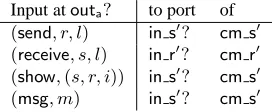
Fig. 14 Dispatching of inputs from the ideal system in the simulator.
The state-transition diagrams of the main machines are defined in Figures 11 to 13. We draw two states of the simulator that envelop one switching step of the ideal system (and thus try to simulate one real switching step) as one circle unless a decision is made in the middle. Inputs at network ports are always expected in the first of these two states; then the machines make outputs at their user ports, anddisdispatches them toina!. Inputs at
outa?are expected in the second state, dispatched to the user inputs of the submachines as defined in Figure 14, and then the machines make outputs at the network ports. The global timeT is now interpreted as an external global variable. Letmsim be an arbitrary fixed
message.
Onlycm s0uses new subprograms:
Subprogramas0
0. Let (c,rsim) ← comrpkc(msim) and m1 ← signsks((s, r, i), m1, l, c). Generate a random string rtrans of sufficient length for a later call of transforcwith another messagem.6
Subprogramas0
2. Transform the commitment with rS ← transskc(c,msim,rsim, m),
usingrtransif random bits are needed in this process. Setm3:= ((s, r, i), m, rS).
This was a simulator for the original, weakly polynomial-time systems. If we make the real system strictly polynomial-time, we do the same for the simulator with the same global parameters, the same length functions for network inputs, and easily computable bounds for the inputs from the ideal system.
7 Correctness of the Simulation for One Transaction (Over Joint State)
We now want to show that the simulator for one transaction, i.e., one run of the subprotocol “send” with potentially many runs of “show” for the resulting receipt, simulates correctly. However, we want to do this in a modular way that later lets multiple transactions use common signature and commitment keys, as well as a common one-way function.
7.1 Methods to Prove Correct Simulation
To prove blackbox simulatability with the given simulator (recall Definition 7 and Fig-ure 9), we show that arbitrary polynomial-time users and real adversaries cannot distin-guish whether they are interacting with the real transaction or the ideal transaction plus simulator. This is essentially what is called observational equivalence in formal methods for distributed systems. The polynomial-time case was first defined in [38] for aπ-calculus system model. Ignoring probabilistic and cryptographic aspects, there are essentially three systematic methods for such proofs when the product state space of each system is too large for ad-hoc treatment, as it is the case with a certified-mail transaction.
– Walkthroughs through both systems with all accepted inputs in each state, showing that they produce identical outputs at the same times. This corresponds to an exploration of the reachable space of corresponding states, typically depth-first. When automated, this approach is called model checking.
– Bisimulation. This means to define a general relation between “corresponding” states of the two systems, and to show that equal inputs in corresponding states lead to equal outputs and to corresponding states again. When automated, this is the typical approach with general-purpose theorem provers.
– Calculi. This means a successive transformation from one system definition into the other by a fixed set of provably secure transformation steps. This is a typical method with process algebras.
For this proof, we chose the walkthrough approach, because our systems for one transac-tion are relatively straight-line and thus a step-by-step argument seemed easiest for human provers and readers. In the outlook, Section 10.1, we discuss how one could partially auto-mate such a proof, but why it would still be a significant challenge far beyond the scope of this paper.
7.2 Assumptions on the Use of Joint Primitives
In the walkthroughs we will encounter situations that depend on the cryptographic prim-itives, and sometimes on the correct overall use of those primitives with joint state. We
6
will later prove that the overall probability of so-called error sets where the observational equivalence is not guaranteed (e.g., due to a forged signature) is negligible even for many transactions. Besides the definitions and lemmas from Section 4.2 we will need one as-sumption about the joint use of signatures.
Definition 9 (Assumption on the Joint Use of Signatures) When considering a certified-mail transaction with the transaction identifier(s, r, i)in the initial states of all machines in the real and simulated variant and using a global variablesk, we make the following assumptions.
a) No other application usessk to sign messages of the form((s, r, i),mx, ...)withx∈ 1,2,6.
b) The keysk has been correctly generated as(sk,pk)←genS(1k,1s∗)and no applica-tion uses it for anything other than signing.
c) Whenever the real transaction and the simulated one actually sign, thenskhas the same value (even if the real transaction and the simulated one are not executed in identical environments) and less thans∗signatures have been made withskoverall so far.
We immediately see from the state-transition functions that each certified mail transac-tion fulfils Assumptransac-tion a) of the others. Hence this assumptransac-tion is automatically fulfilled if the many transactions of a certified-mail system are the only application that uses this key. This assumption generalizes to other types of transaction identifiers than(s, r, i)if each signed message is again a tuple starting with this transaction identifier.
7.3 The Walkthrough Proof
We summarized the machines that handle one transaction in the two systems in Figure 10. We call the real structurestruc and the simulated structurestruc0. Recall that network
channels involving the third party or the verifier are authentic and reliable, while those be-tween senders and recipients are insecure. By the formal derivations of real structures from intended structures sketched in Section 5, this means that inputs supposedly from sender to recipient and vice versa are actually inputs from the adversary, and thus outer inputs for us, while the authentic channels only give additional outer outputs because the adversary can listen there. We want to show that these two structures essentially have the same outer input-output behavior by walkthroughs with all acceptable inputs in all reachable states.
Lemma 2 (Walkthrough Security of One Certified-Mail Transaction) Let the two struc-tures summarized in Figure 10 be given, where all machines are started in Roundiwith the same security parameterkand transaction identifier(s, r, i), the keys in the start states have been chosen correctly and consistently, the signature assumption (Definition 9) holds, and the ideal protocol length parameter is∆ = 6. Then they have the same probabilistic input-output behavior and make the same use of the global signature keys for all input se-quences except for a set of runs called error sets that we define within the proof. This holds both for the original weakly polynomial-time versions and the strictly polynomial-time pa-rameterized versions.
Each run in an error set corresponds in an obvious way to a situation where a crypto-graphic primitive has been broken. It will thus not be hard to show later that the error sets are negligible; however, because of the joint use of primitives, we have to postpone this proof to the consideration of multiple transactions.
Proof In the walkthroughs, corresponding machinescmx andcmx0will essentially be in
the same state. The only exception is that the choice of the commitments is done differently incm s andcm s0. For this, we will define an exact mapping of corresponding random
walkthroughs, we only have to remember the current state of the real machines and of the trusted host in the system with simulator. We distinguish the three cases from our trust model.
For the strictly polynomial-time case, note that the simulated and the real system have the same bounds on the length of accepted messages fromAandH, and that the bounds for messages between the trusted host and the simulator were assumed to be chosen suf-ficiently large for the simple message format used there, so that messages from either of these machines will always be completely read by the other.
Case S: Correct Sender only. In this case, we have Figure 10 withoutcm r andcm r0,
and withths.
1. States reached without inputsend: The only round wherecm sandthsaccept an input
(send, r, l, m)at portin s?is Roundi. If they do not, both remain in their starting state forever and do not make any outputs. Hencecm s0 does not get an input(send, . . .)via
disand also remains in its starting state. Ascm t,cm t0,cm v, andcm v0 only get inputs
on authentic connections fromcm sandcm s0, respectively, they also never get inputs and
make outputs.
2. States reached on inputsend: If (send, r, l, m)is input at in s?ofthsin Round i, it changes to States1and outputs(send, r, l)atout a!, whichdisdispatches tocm s0. Thus cm s and cm s0 send m
1. These messages only differ in the computation of the
com-mitment c. (Here the signature assumption is used; we do not mention this again.) We therefore define a mapping of random values ofcm s0 to corresponding ones ofcm sas
φ(rsim,rtrans) := rS ← transskc(c,msim,rsim, m), wherertrans is used if random bits
are needed in this process; recall thatcm s0 choosesr
trans already in this round. By the
chameleon property, the resulting commitmentscare equal, and thus so are the messages
m1. Furthermore, the chameleon property implies that the resulting distribution of(c, rS) equals that incm s.
Nom2. If the adversary does not respond with a correctm2(the test is equal forcm sand
cm s0 in the given states), thencm soutputs(failed)atout s!in Roundi+ 6, while
cm s0 immediately sends(suppress)viadistoths. Thusthschanges from States1to
s2, and in Roundi+ 6it outputs(failed)atout s!as well. No network outputs are made
in this process, and all three machines finish in Statefailed.
Correctm2. If cm s and cm s0 receive a correct m2, then cm s sends m3 =
((s, r, i), m, rS), whilecm s0 inputs(receive)toths viadis. Thus thschanges from States1 tos3 and reveals the payload message as(msg, m). Thus cm s0 also sends m3still in Roundi+ 2, using the valuerS ←transskc(c,msim,rsim, m), computed
deterministically withrtrans. This is the samerSas used bycm s.
After sendingm3, the behavior ofcm sandcm s0with respect to the network is
identi-cal. If they send a messagem5, it arrives atcm tandcm t0because these connections
are authentic, and it passes the test by definition, so thatcm sandcm s0will obtain a
correctm6. Thus in Roundi+ 6,cm sandcm s0either both enter the statereceivedor
bothreceived0, andthsentersreceivedand remains in this state and inshowing. In this
round, bothcm sandthsalso output(sent)atout s!.
This covers all states reachable and inputs accepted bycm s,cm s0, andthsas long as the
only input atin s?is(send, . . .). Ascm t,cm t0,cm v, andcm v0only accept inputs on
authentic connections fromcm sandcm s0, respectively, the same holds for them.
3. Reactions on inputshow: Now we consider an input(show)in Roundjatin s?. Machine
cm saccepts this input if it is in Statereceivedorreceived0, whilethsconsiders it in State
receivedorshowing. Above we showed that the machines enter these states under the same conditions in Round i+ 6, and that cm s0 is then in the same state as cm s. Nowths
sends the same messagem6orm7tocm v0ascm stocm von authentic connections. By
construction, these messages are accepted. Thuscm v outputs(received,(s, r, i), l, m)in Roundj+ 1, just likethsdoes because it is in Stateshowing. In addition,cm v0 outputs
(show), which is dispatched toths, butthsis in Stateshowingand ignores it.
Case R: Correct Recipient Only. As the walkthrough proofs are tedious and follow the same pattern, we postpone the remaining two to the appendix. Here we only summarize the situations where we put runs into error sets. (We do not omit the walkthroughs entirely because they are the part of the proof that is unique to certified mail, and they show that the following situations are really the only ones where the real and the simulated systems deviate.)
– If no input(receive, s, l) is made to cm r and thr (always in the correct round), or
cm r andcm r0 do not obtain a correct messagem
1, and thus they do not sendm2,
and the adversary nevertheless inputs a correct messagem5tocm tandcm t0later, or
m0
7tocm vandcm v0, this must contain a correct messagem2, i.e.,testpkr(m2) =
((s, r, i),m2, . . .). Then we let the run be in the error set Forgek with the forged
sig-naturesigf :=m2and attacked participant indexu:=r. Recall that by Assumption 9
no other application signs a message starting((s, r, i),m2, . . .)withskr and that tuple
decomposition is unambiguous, i.e., this is indeed a forgery. – Similarly, ifcm t andcm t0do not obtain a correct messagem
5, butcm r andcm r0
orcm v andcm v0 obtain a correctm
6, thensigf := m6 is signature forgery for a
message starting((s, r, i),m6, . . .), and we put the run in the error set Forgek with
attacked participantu:=t. – Ifcm r andcm r0 sentm
2 and the adversary later shows a receipt m07 containing a
differentm00
2, we put the run in the error setForgekwithsigf :=m002 andu:=r.
– Ifcm randcm r0sentm
2but notm4, and the adversary can nevertheless show a receipt
of the formm7, it must contain a one-way preimagerR0 withf(r0R) =pRfor the one-time public keypRfromm2, whilecm randcm r0never used the original preimage
rRexcept in the assignmentpR ←f(rR). This contradicts the one-way property off. We put the run in the error setOwfBreakk.
– Ifcm r andcm r0 obtainedm
3 with a payloadm and the adversary can later show
a receiptm0
7for a different payloadm
0, then the receipt must contain a messagem0 3
where the same commitmentc is opened in a different waycompkc(m0, r0
S) = c =
compkc(m, rS). This contradicts the binding property of the commitments. We put the run in the error setBindBreakk and setbindbreak := (m, rS, m0, r0S).
Case SR: Correct Sender and Recipient. As in Case R, we only summarize the situations where we put runs into error sets here.
– Similar to Case R, we encounter cases where the adversary forges a signaturesigf on a
message with identifierm1withsks, or on a message with identifierm2withskr. We
put those runs in the error setsForgekwithu:=sorr, respectively.
– Ifcm s andcm s0 send m
1, but do not obtain a correctm2 via the adversary, and
the adversary nevertheless inputs an acceptable m3 to cm r and cm r0, then this
contains values that open the commitment c from m1, i.e., values (ma, raS) with
c = compkc(ma, ra
S). However,cm s did not use the valuerS from the assignment
(c, rS)← comrpkc(m)anywhere else. This situation therefore contradicts Lemma 1. We put the run in the error setComOwfBreakk.
– If the adversary forwards correct messagesm1 andm2, but no acceptablem3, and
nevertheless inputs an acceptablem4tocm sandcm s0, then this contains a one-way
preimager0
Rwithf(rR0 ) =pRfor the one-time public keypRfromm2. However,cm r
andcm r0never used the originalr
– If the adversary forwards correct messagesm1andm2, and an acceptable but
incor-rect third message ma
3 = ((s, r, i), ma, raS)withma 6= m for the payloadm used by cm s andcm s0, then compkc(ma, ra
S) = compkc(m, rS) = c for the commit-ment used bycm s. We put the run in the error setBindBreakk and setbindbreak := (m, rS, ma, raS).
8 Multi-Transaction Systems
In a real certified-mail system it must be possible to execute many certified-mail transac-tions. We first present options for constructing the overall system. We then show how our security proof for one transaction carries over to a multi-transaction system in spite of the joint use of primitives by these transactions.
8.1 Multi-tasking Options
There are multiple options for executing multiple transactions of certified mail, reflecting programming styles known from real distributed systems with multiple transactions (also called sessions, tasks, or threads).
Network dispatching. In the real system, multiple transactions of multiple types of proto-cols are running in the same overall machine with a fixed number of physical connec-tions. Hence network inputs must be dispatched to the correct protocol and transaction. Three standard solutions are:
– Explicit dispatcher. The messages arrive on one connection and a specific program, called dispatcher, distributes them to the transactions that expect them by some transaction identifier. The transaction identifier may come from a flat domain, e.g., be chosen randomly or assigned by the dispatcher, or be hierarchic, i.e., starting with a protocol identifier like “certified mail”.
– Dispatcher in the network layer. A dispatcher may already be inherent in the under-lying network stack in the ability to set up multiple network sessions, one for each transaction.
– Token-based communication. The network outputs of a transaction may be given to the caller of the transaction for transport. This can minimize the communication overhead as only top-level transactions communicate.
Another distinction with dispatcher solutions is whether a dispatcher starts a new trans-action if a message with an unregistered transtrans-action identifier arrives, or whether a local caller must generate the transaction first.
User in- and outputs. The different transactions in one machine need inputs from their users and make outputs to these users. Typically the user is another protocol, but some transactions have an interface to people. This is essentially the same question as net-work dispatching, only seen from the other side.
– Explicit dispatcher. The users make the inputs into a fixed “port” (e.g., they call a fixed library) which internally handles multiple transactions.
– Visible multi-tasking. Each user once calls a fixed port to generate a new transaction locally and then interacts directly with this transaction. In practice, the transaction may come from a pool instead of being newly generated.