68
Canadian Family Physician • Le Médecin de famille canadien Vol 55: january • janVier 2009Research
Print short, Web long*
Changing patterns in opioid addiction
Characterizing users of oxycodone and other opioids
Beth Sproule
PharmDBruna Brands
PhDSelina Li
MSWLaura Catz-Biro
MDABSTRACT
OBJECTIVE
To evaluate the clinical observation that the number of individuals seeking opioiddetoxification from oxycodone was increasing at the Centre for Addiction and Mental Health (CAMH) in Toronto, Ont; and to identify the characteristics of individuals seeking opioid detoxification at CAMH.
DESIGN
Retrospective analysis of patient health records.SETTING
Medical Withdrawal Management Service at CAMH.PARTICIPANTS
All patients admitted for opioid detoxification between January 2000 and December 2004.MAIN OUTCOME MEASURES
Number of opioid detoxification admissions each year; type, dose, and source of opioids; comorbid problems and symptoms.RESULTS
There were 571 opioid detoxification admissions during the 5-year study period. The number of admissions increased steadily over the 5 years; in particular, the number of admissions related to controlled-release oxycodone increased substantially (3.8%, 8.3%, 20.8%, 30.6%, and 55.4% of the total opioid admissions in 2000 to 2004, respectively; χ24
= 105.5, P < .001). The rates of admissions involving heroin remained low and stable. Use of controlled-release oxycodone was associated with considerably higher doses than use of other prescription opioids was. Physician prescriptions were the source of the prescription opioids for a large percentage of patients, particularly for older patients. Prescription opioid users reported considerable comorbid substance use problems, pain, and psychiatric symptoms.
CONCLUSION
This study has demonstrated a significant rise in the number of individuals seeking treatment at CAMH for controlled-release oxycodone addiction. The substantial comorbid pain, psychiatric symptoms, and other psychoactivesubstance use problems in these patients, coupled with the finding that prescriptions were an important source of opioids, highlight the clinical complexities encountered in the treatment of these individuals. Further research examining these complexities and the many possible pathways leading to prescription opioid addiction is required in order to develop effective prevention and treatment strategies.
EDITOR’S kEy POINTS
•
This study identifies the characteristics of
individ-uals seeking opioid detoxification at the Centre for
Addiction and Mental Health in Toronto, Ont.
•
From 2000 to 2004, the number of admissions
increased steadily each year, while the number of
admissions related to controlled-release oxycodone
increased substantially. The main source of
prescrip-tion opioids was doctors’ prescripprescrip-tions, followed by
the street and a combination of prescriptions and
the street; the likelihood of obtaining drugs from
the street decreased with age, while the likelihood
of obtaining them from a physician increased with
age.
•
Before their introduction, controlled-release
prepara-tions were expected to have a lower abuse potential
because users would be less likely to experience the
euphoria associated with high concentrations of the
drug rapidly reaching the brain. Many abusers,
how-ever, reported crushing or chewing these
prepara-tions before swallowing, injecting, or snorting them,
thereby destroying the slow-release properties.
*Full text is available in English at
www.cfp.ca.
Recherche
Résumé imprimé, texte sur le web*
*Le texte intégral est accessible en anglais à
www.cfp.ca.
Cet article a fait l’objet d’une révision par des pairs.
Can Fam Physician 2009;55:68-9.e1-5
Évolution de la dépendance aux opiacés
Caractéristiques des utilisateurs d’oxycodone et autres opiacés
Beth Sproule
PharmDBruna Brands
PhDSelina Li
MSWLaura Catz-Biro
MDRéSUMé
OBJECTIF
Vérifier l’observation clinique qui indique que le nombre de personnes venues au Center for Addiction and Mental Health (CAMH) de Toronto, en Ontario, pour sevrage de l’oxycodone a augmenté; et déterminer les caractéristiques des personnes qui se présentent au CAMH pour sevrage des opiacés.TyPE D’éTUDE
Analyse rétrospective à partir des dossiers médicaux des patients.CONTEXTE
Le Medical Withdrawal Management Service du CAMH.PARTICIPANTS
Tous les patients admis pour sevrage des opiacés entre janvier 2000 et décembre 2004.PRINCIPAUX PARAMÈTRES À L’éTUDE
Nombre annuel d’admissions pour sevrage des opiacés; type, dose et source des opiacés; comorbidité associée et symptômes.RéSULTATS
Il y a eu 571 admissions pour sevrage des opiacés au cours des 5 années de l’étude. Le nombre d’admissions a augmenté régulièrement d’une année à l’autre; en particulier, celui desadmissions en lien avec l’oxycodone à libération contrôlée a augmenté de façon substantielle (3,8%, 8,3%, 20,8%, 30,6% et 55,4% de toutes les admissions, respectivement, pour chacune des années entre 2000 et 2004; χ2
4
= 105,5, P < 0,001). Le taux d’admission pour l’héroïne est demeuré stable à un bas niveau. Par rapport aux autres opiacés sur ordonnance, l’’oxycodone à libération contrôlée était associée à des doses beaucoup plus élevées. Pour un fort pourcentage de patients, notamment les plus âgés, les opiacés sur ordonnance provenaient de prescriptions médicales. Les utilisateurs d’opiacés sur ordonnance ont avoué avoir d’importants problèmes associés de toxicomanie, de douleur et de symptômes psychiatriques.
CONCLUSION
Cette étude a montré uneaugmentation significative du nombre de personnes venues au CAMH pour sevrage de l’oxycodone à libération contrôlée . L’importance des douleurs, symptômes psychiatriques et autres problèmes d’abus de psychotropes chez ces patients fait ressortir la nature complexe du traitement clinique de ces patients. D’autres études devront examiner ces difficultés et les multiples voies conduisant à la dépendance aux opiacés sur ordonnance si on veut développer des stratégies de prévention et de traitement efficaces.
POINTS DE REPÈRE DU RéDACTEUR
•
Cette étude détermine les caractéristiques des
per-sonnes venues au Center for Addiction and Mental
Health de Toronto pour sevrage des opiacés.
•
Entre 2000 et 2004, le nombre d’admissions
annuelles a augmenté régulièrement, tandis que
celui des admissions en lien avec l’oxycodone à
libé-ration contrôlée augmentait de façon substantielle.
Les opiacés sur ordonnance avaient comme
princi-pale source les prescriptions médicales, suivies par la
rue et une combinaison de prescriptions et de rue;
la probabilité d’obtenir les drogues dans la rue
dimi-nuait avec l’âge, tandis que celle de les obtenir d’un
médecin augmentait avec l’âge.
•
Avant leur introduction, on croyait que les
69.e1
Canadian Family Physician • Le Médecin de famille canadien Vol 55: january • janVier 2009Research
Changing patterns in opioid addiction
P
rescription opioids are an important therapeu-tic option in clinical practice and bring important improvements to quality of life in the treatment of pain. Most opioids, however, are potentially addictive. In fact, it appears that the abuse of prescription opioids might have become the predominant form of illicit opi-oid use in Canada.1 Very little is known aboutprescrip-tion opioid abuse, particularly the characteristics of this use and of the individual users. The Centre for Addiction and Mental Health (CAMH) in Toronto, Ont, has been treating a large number of prescription opioid–addicted individuals, providing an opportunity to investigate this population. Affiliated with the University of Toronto, CAMH is Canada’s leading addiction and mental health teaching and research hospital. Through one of its founding partners, the Addiction Research Foundation, CAMH has been operating a methadone maintenance treatment program since 1970. An increase in prescrip-tion opioid–addicted treatment seekers was first noticed in the 1990s, with the expansion of the methadone main-tenance treatment program. Traditionally, methadone maintenance programs serviced primarily heroin users requiring opioid substitution treatment. In a review of the 178 patients who were admitted to the program between 1997 and 1999, it was found that 24% had used prescription opioids only, 24% had used prescription opioids initially then heroin, 35% had used heroin first and prescription opioids later, and only 17% had used heroin only.2 Codeine and oxycodone were the primary
prescription opioids used by these individuals. Since a controlled-release oxycodone product became available in 1995, the numbers of individuals seeking treatment for oxycodone addiction in particular appeared to be increasing at CAMH. To evaluate this clinical observa-tion, this study was undertaken to identify the charac-teristics of individuals seeking opioid detoxification at CAMH over a 5-year period.
METhODS
The Medical Withdrawal Management Service is an inpa-tient service at CAMH for patients who require 24-hour nursing and medical care to withdraw from their sub-stances of abuse. Patients are referred to the service from the greater Toronto area and across Ontario. This study was conducted through a retrospective analysis of patients’ medical charts. The study was approved by the CAMH Research Ethics Board and by the Health Canada Research Ethics Board.
The project included all patients admitted to CAMH’s Medical Withdrawal Management Service seeking treat-ment for opioid detoxification between January 2000 and December 2004. There were no exclusion criteria. For any patient who had multiple admissions during this period, only the most recent admission was included
in subsequent analyses. Two research analysts, trained by the investigators, retrieved the following informa-tion from the medical charts using standardized data collection forms: demographics, opioid use (including types and sources), current use of other psychoactive substances reported by the patient to be a problem, and medical and mental health complaints indicated in the chart to be part of the current clinical picture. More detailed reviews were conducted for patients admitted in 2004, including opioid doses, patterns of use, and age at first use. Prescription opioid doses were expressed as oxycodone equivalents based on approximate equianalgesic oral doses.3 Descriptive statistics were
calculated using SPSS version 12.0. Pearson χ2 was used
to compare the proportion of admissions related to con- trolled-release oxycodone with the proportion of admis-sions related to other opioids.
RESULTS
From 2000 to 2004, there were 571 opioid detoxifica-tion admissions. The number of admissions increased steadily over the 5 years. In particular, the number of admissions related to controlled-release oxycodone increased substantially (n = 3 [3.8% of total opioid admis-sions], n = 8 [8.3%], n = 25 [20.8%], n = 34 [30.6%], and n = 92 [55.4%] from 2000 to 2004, respectively; χ2
4
= 105.5, P < .001). The other opioids involved in these admissions included other oxycodone products (acetaminophen-oxycodone combinations); other pharmaceutical opioid products; and heroin (Figure 1). The other pharmaceu-tical opioid products were primarily codeine (n = 201), morphine (n = 116), hydromorphone (n = 43), and meper-idine (n = 13). Rates of admissions involving heroin remained low and stable. Some admissions involved more than 1 problem opioid. Of the 571 admissions, 295 involved 1 opioid, 204 involved 2 opioids, 68 involved 3 opioids, and 4 involved 4 opioids.
psychiatric (eg, 53% reported depressive symptoms, 25% reported anxiety) symptoms associated with these pre-scription opioid users. Many individuals also had self-reported problem use of other substances (eg, 45% also abused alcohol, 43% used benzodiazepines, 30% used cocaine, and 27% used cannabis).
The more detailed chart review of the 2004 admis-sions (n = 166) consisted of 155 patients after removing
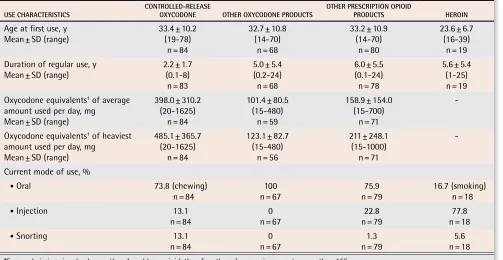
multiple admissions; 84 of these were related to use of controlled-release oxycodone (Table 13). The daily
doses associated with controlled-release oxycodone were higher (mean 398 mg) than for the other pre-scription opioid products (mean 101 to 159 mg oxyco-done equivalents), and the duration of regular use of controlled-release oxycodone was shorter (mean 2.2 years compared with means of 5 to 6 years for other
0 10 20 30 40 50 60 70 80 90 100
2000 2001 2002 2003 2004
Figure 1.
Admissions to the Medical Withdrawal Management Service for opioid detoxification,
2000-2004:
The number of admissions increased over the 5 years (2000, n = 78; 2001, n = 96; 2002,
n = 120; 2003, n = 111; and 2004, n = 166). Of the 571 admissions, 295 involved 1 opioid, 204 involved
2 opioids, 68 involved 3 opioids, and 4 involved 4 opioids.
YEAR
NO
. OF ADMISSIONS
Controlled-release oxycodone Other oxycodone Other prescriptin opioids Heroin
0
10 20 30 40 50 60 70
Figure 2.
Prescription opioid source by age group
AGE GROUPS (Y)
≤ 25 26-35 36-45 46-55 >55
Street Prescription Street and prescription Over-the-counter
PA
69.e3
Canadian Family Physician • Le Médecin de famille canadien Vol 55: january • janVier 2009Research
Changing patterns in opioid addiction
opioids). Controlled-release oxycodone was most likely to be associated with product manipulation, primar-ily chewing the product (73.8%), but also crushing and snorting (13.1%) or crushing and injecting (13.1%). Heroin was most likely to be used by injection (77.8%); however, a substantial proportion of nonoxycodone pre-scription opioid users also injected the drugs (22.8%). The mean age at first use was younger for heroin users than for prescription opioid users.
DISCUSSION
An increasing number of individuals addicted to prescrip-tion opioids have been seeking detoxification assistance at CAMH. The most significant increase has been in the number of controlled-release oxycodone users seeking treatment, whereas the number of heroin users seeking treatment has remained constant and low. Controlled-release oxycodone use was associated with consider-ably higher daily doses than other prescription opioids were. The duration of use of controlled-release oxyco-done was shorter than for other prescription opioids, which might reflect the comparatively recent arrival of this drug on the Canadian market. Physician prescrip-tions were the source of prescription opioids for a large percentage of the patients in this study, with the per-centage increasing in older age groups. It was not pos-sible to further delineate legitimate prescriptions from those obtained through fraudulent means (eg, doctor
scamming). These prescription opioid users reported considerable comorbidity, including other substance use problems, pain, and psychiatric symptoms.
This study adds to the increasing literature on pre-scription opioid abuse. Most studies to date have focused on the prevalence of the problem, primarily in the United States,4-6 with less information available about the
characteristics of the users and their use of these opi-oids, especially in Canada. Previous data from CAMH indicate that codeine and oxycodone have been com-monly abused prescription opioids.2,7,8 The
controlled-release formulation of oxycodone is available in higher doses (10- to 80-mg tablets) than the immediate-release oxycodone formulations (5-mg tablets). Controlled-release preparations were expected to have a lower abuse potential because it was suggested that users would be less likely to experience the euphoria associated with high concentrations of the drug rapidly reaching the brain. However, a substantial proportion of the oxyco-done dose in controlled-release formulations is released immediately, with the rest released more slowly.9
In addi-tion, abusers often report crushing or chewing these preparations before swallowing, snorting, or injecting, thereby destroying the slow-release properties. Results from the US National Household Survey on Drug Abuse (2000-2001) showed that nonmedical controlled-release oxycodone users (n = 553) were more likely to have indi-cations of abuse of or dependence on prescription opioids compared with nonmedical users of other prescription opioids (n = 12 039) (20.1% vs 3.5%, respectively).10
Table 1.
Opioid use characteristics for the 2004 cohort: N = 155.*
USE CHARACTERISTICS COnTROLLED-RELEASE OxyCODOnE OTHER OxyCODOnE PRODUCTS OTHER PRESCRIPTIOn OPIOID PRODUCTS HEROIn
Age at first use, y Mean ± SD (range)
33.4 ± 10.2 (19-78)
n = 84
32.7 ± 10.8 (14-70)
n = 68
33.2 ± 10.9 (14-70)
n = 80
23.6 ± 6.7 (16-39)
n = 19 Duration of regular use, y
Mean ± SD (range) 2.2 ± 1.7 (0.1-8) n = 83
5.0 ± 5.4 (0.2-24) n = 68
6.0 ± 5.5 (0.1-24) n = 78
5.6 ± 5.4 (1-25) n = 19 Oxycodone equivalents† of average
amount used per day, mg Mean ± SD (range)
398.0 ± 310.2 (20-1625)
n = 84
101.4 ± 80.5 (15-480)
n = 59
158.9 ± 154.0 (15-700)
n = 71
-Oxycodone equivalents† of heaviest
amount used per day, mg Mean ± SD (range)
485.1 ± 365.7 (20-1625)
n = 84
123.1 ± 82.7 (15-480)
n = 56
211 ± 248.1 (15-1000)
n = 71
-Current mode of use, %
• Oral 73.8 (chewing)
n = 84 n = 67100 n = 7975.9 16.7 (smoking) n = 18
• Injection 13.1
n = 84 n = 670 n = 7922.8 n = 1877.8
• Snorting 13.1
n = 84 n = 670 n = 791.3 n = 185.6
With the rise in abuse of controlled-release oxyco-done, there have been a few studies specifically aimed at identifying the characteristics of this population. These studies have also demonstrated a pattern of problems with multiple opioids and other substances, substantial pain, and psychiatric comorbidities.11-14 The primary
source of prescription opioids varies in these reports. For example, the source of controlled-release oxyco-done was primarily from the street in a study conducted in Kentucky12,13; yet in a report from the Researched
Abuse, Diversion and Addiction-Related Surveillance System, which used a key informant network across the United States, 70% of the controlled-release oxyco-done abusers listed prescriptions as their main source.14
Very few studies have characterized abusers of other prescription opioids; however, the presence of polysub-stance abuse, pain, and psychiatric comorbidities are consistent findings,15,16 even in studies conducted before
the advent of controlled-release oxycodone.7,8,17
Limitations and areas for further study
The limitations of this study are those of any retrospec-tive chart review. Potential inaccuracies in the reporting and documentation in the clinical record are inherent concerns in this type of research. However, the primary physician for these admissions was one of the authors (L.C.B.), which provided continuity in the clinical docu-mentation. In addition, the large sample size covering all admissions over a 5-year period provides a reasonable picture of the changing patterns of drug use, particularly related to controlled-release oxycodone use, in this pop-ulation. The population of opioid abusers in this study might not necessarily represent other opioid-abusing populations, including those not seeking treatment or those seeking other types of treatment.
The natural history of prescription drug abuse and the relationship of abuse and addiction to the clini-cal management of patients who are prescribed these agents for legitimate medical conditions require further study.18,19 The substantial comorbid pain, psychiatric
conditions, and other psychoactive substance use prob-lems highlight the clinical complexities encountered in the treatment of these individuals. The significant rise in individuals addicted to controlled-release oxycodone seeking treatment has focused these concerns and has helped bring the issue of prescription opioid abuse to the fore. Many clinicians tend to divide patients into 2 categories: individuals with legitimate pain and sub-stance abusers “scamming” to obtain drugs. The clinical reality is much more complex, as pain and substance abuse are not mutually exclusive. This retrospective analysis was not able to fully explore the relationships between prescription opioid use and comorbidities, but this line of research is critical. It underlies the key dif- ference between prescription drug abuse and other sub-stance abuse: some individuals can be and might need
to be exposed to these substances therapeutically. Initial work exploring first exposures to prescription opioids in a population of prescription opioid abusers in a metha-done maintenance treatment program indicated a rela-tionship between previous substance use and continued use of prescription opioids following initial therapeutic exposure.20 The health care system is inextricably linked
to this problem as a source of the drugs, and therefore a potential enabler, but also as a solution.
Conclusion
This study has demonstrated a significant rise in indi-viduals addicted to controlled-release oxycodone seek-ing treatment at CAMH. This has helped bring the issue of prescription opioid abuse to the fore. The significant comorbid pain, psychiatric conditions, and other psy-choactive substance use problems in these patients, coupled with the finding that prescriptions were an important source of opioids, highlights the clinical com-plexities encountered in the treatment of these indi-viduals. Further research, including prospective studies, examining these complexities and the many possible pathways leading to prescription opioid addiction is required in order to develop effective prevention and treatment strategies.
Dr Sproule is an Advanced Practice Pharmacist and Clinician Scientist at the Centre for Addiction and Mental Health (CAMH) in Toronto, Ont, and an Assistant Professor in the Faculty of Pharmacy and Department of Psychiatry at the University of Toronto. Dr Brands was a Research Scientist at CAMH at the time of the study and is now Senior Scientist in the Office of Research and Surveillance at Health Canada and an Assistant Professor in the Department of Pharmacology at the University of Toronto. Ms Li was a research analyst at CAMH at the time of the study. Dr Catz-Biro was a staff physician in Medical Withdrawal Management Services at CAMH at the time of the study and is now a family physician in Toronto.
acknowledgment
This study was supported by the Drug Strategy and Controlled Substances Programme of the Office of Research and Surveillance at Health Canada.
Contributors
Dr Sproule was the principal investigator responsible for the project and she contributed substantially to the conception and design of the study, analysis and interpretation of the data, and preparation of the article. Dr Brands contributed substantially to the conception and design of the study and interpretation of the data and critically appraised the article for intellectual content. Ms Li contrib-uted substantially to the data acquisition and analysis. Dr Catz-Biro contrib-uted substantially to the conception and design of the study and interpretation of the data and critically appraised the article for intellectual content.
Competing interests
None declared
Correspondence
Dr Sproule, Centre for Addiction and Mental Health, 33 Russell St, Toronto, ON M5S 2S1; e-mail [email protected]
reference list
1. Fischer B, Rehm J, Patra J, Cruz MF. Changes in illicit opioid use across Canada. CMAJ 2006;175(11):1385.
2. Brands B, Blake J, Sproule BA, Gourlay D, Busto U. Prescription opioid abuse in patients presenting for methadone maintenance treatment. Drug Alcohol Depend 2004;73(2):199-207.
3. Gutstein HB, Akil H. Opioid analgesics. In: Brunton LL, Lazo JS, Parker KL, editors. Goodman & Gilman’s the pharmacological basis of therapeutics. 11th ed. New York, NY: McGraw-Hill; 2005
4. Ball J, Lehder Roberts D. Oxycodone, hydrocodone, and polydrug use, 2002.
DAWN Rep 2004;Jul:1-4. Available from: http://dawninfo.samhsa.gov/old_ dawn/pubs_94_02/shortreports/files/DAWN_tdr_opiates_polydrugs.pdf. Accessed 2008 Nov 25.
69.e5
Canadian Family Physician • Le Médecin de famille canadien Vol 55: january • janVier 2009Research
Changing patterns in opioid addiction
6. Cicero TJ, Dart RC, Inciardi JA, Woody GE, Schnoll S, Muñoz A. The develop-ment of a comprehensive risk-management program for prescription opioid analgesics: Researched Abuse, Diversions and Addiction-Related Surveillance (RADARS). Pain Med 2007;8(2):157-70.
7. Busto UE, Sproule BA, Knight K, Romach MK, Sellers EM. Severe depen-dence on oral opiates. Can J Clin Pharmacol 1998;5(1):23-8.
8. Sproule BA, Busto UE, Somer G, Romach MK, Sellers EM. Characteristics of dependent and nondependent regular users of codeine. J Clin Psychopharmacol 1999;19(4):367-72.
9. Mandema JW, Kaiko RF, Oshlack B, Reder RF, Stanski DR. Characterization and validation of a pharmacokinetic model for controlled-release oxycodone.
Br J Clin Pharmacol 1996;42(6):747-56.
10. Sees KL, Marino ME, Ruediger NK, Sweeney CT, Shiffman S. Non-medical use of OxyContin tablets in the United States. J Pain Palliat Care Pharmacother 2005;19(2):13-23.
11. Potter JS, Hennessy G, Borrow JA, Greenfield SF, Weiss RD. Substance use histories in patients seeking treatment for controlled-release oxycodone dependence. Drug Alcohol Depend 2004;76(2):213-5.
12. Hays LR, Kirsh KL, Passik SD. Seeking drug treatment for OxyContin abuse: a chart review of consecutive admissions to a substance abuse treatment facility in Kentucky. J Natl Compr Canc Netw 2003;1(3):423-8.
13. Hays LR. A profile of OxyContin addiction. J Addict Dis 2004;23(4):1-7. 14. Cicero TJ, Inciardi JA, Munoz A. Trends in abuse of OxyContin and other
opioid analgesics in the United States: 2002-2004. J Pain 2005;6(10):662-72. 15. Passik SD, Hays L, Eisner N, Kirsh KL. Psychiatric and pain characteristics of prescription drug abusers entering drug rehabilitation. J Pain Palliat Care Pharmacother 2006;20(2):5-13.
16. Fischer B, Rehm J, Brissette S, Brochu S, Bruneau J, El-Guebaly N, et al. Illicit opioid use in Canada: comparing social, health, and drug use char-acteristics of untreated users in five cities (OPICAN study). J Urban Health 2005;82(2):250-66. Epub 2005 May 4.
17. Romach MK, Sproule BA, Sellers EM, Somer G, Busto UE. Long-term codeine use is associated with depressive symptoms. J Clin Psychopharmacol 1999;19(4):373-6.
18. Compton WM, Volkow ND. Major increases in opioid analgesic abuse in the United States: concerns and strategies. Drug Alcohol Depend 2006;81(2):103-7. Epub 2005 Jul 14.
19. Compton WM, Volkow ND. Abuse of prescription drugs and the risk of addiction. Drug Alcohol Depend 2006;83(Suppl 1):S4-7. Epub 2006 Mar 23. 20. Sproule BA, Elkader A. First exposures in prescription opioid abusers.
Poster presented at: College on Problems of Drug Dependence 69th Annual Scientific Meeting 2007; June 2007; Quebec City, QC.