Exchange for Ad-Hoc Groups
Yvo Desmedt1?, Tanja Lange2, and Mike Burmester3 1 Information Security, Department of Computer Science,
University College London, UK
2 Department of Mathematics and Computer Science Eindhoven University of Technology, The Netherlands
3 Department of Computer Science Florida State University, USA
Abstract. Task-specific groups are often formed in an ad-hoc manner within big structures, like companies. Take the following typical scenario: A high rank manager decides that a task force group for some project needs to be built. This order is passed down the hierarchy where it finally reaches a manager who calls some employees to form a group. The members should communicate in a secure way and for efficiency reasons symmetric systems are the common choice. To establish joint secret keys for groups, group key exchange (GKE) protocols were developed. If the users are part of e.g. a Public Key Infrastructure (PKI), which is usually the case within a company or a small network, it is possible to achieve authenticated GKE by modifying the protocol and particularly by including signatures.
In this paper we recall a GKE due to Burmester and Desmedt which needs only O(logn) communication and computation complexity per user, rather thanO(n) as in the more well-known Burmester-Desmedt protocol, and runs in a constant number of rounds. To achieve authenticated GKE one can apply compilers, however, the existing ones would needO(n) computation and communication thereby mitigating the advantages of the faster protocol. Our contribution is to extend an existing compiler so that it preserves the computation and communication complexity of the non-authenticated protocol. This is particularly important for tree based protocols.
Keywords. Key Distribution, Group Key Exchange, Tree based GKE, Ad-Hoc Groups, Forward Security, Authentication, Anonymity.
1 Introduction
Today several banks have branches worldwide. Moreover, stock owners of these banks often are in different countries. In general, globalization implies that decision makers are in different locations. So efficient and secure communication within a group is very important. Clearly symmetric systems offer the higher throughput and so all group members must hold a common secret key. Given the distributed nature of the group new keys can only be established through an insecure channel. Furthermore, the parties need to be assured that this key is shared with the correct group members, so the users must be authenticated. This shows that in financial cryptography group key exchange is an important primitive.
? Part of this research was done while visiting the ITSC Bochum 2004.
Another scenario is the need to set up ad-hoc groups. Organizations, such as financial ones, are usually organized in a hierarchical way. Often outside consultants are needed in virtual group meetings. The president of the organization does not know who these experts are. We find ourselves in a situation where members lower in the hierarchy decide who the outside-consultants are that should join the group. Again secure group communication is needed.
Once this symmetric key is established it can be used for basically all com-munication needs within the group. It not only works as the key in a symmetric system to ensure that data cannot be decrypted but also allows members within the group to communicate anonymously and the key can also be used in MACs to authenticate messages.
A simple solution for authenticated group key exchange is to have one user (the chair) choose the key and exchange it with the next one, who will exchange it with the next, etc., each by using the Diffie-Hellman KE protocol. The cost of this solution is that it requires O(n) rounds and each user has constant communication and computation. We refer to this scenario as thenaive approach.
So far, several group KE protocols have been proposed, most of which are exten-sions of the two-party Diffie-Hellman protocol [7, 8, 15, 17, 9]. Katz and Yung [19] designed a compiler that transforms any secure group KE protocol into an authen-ticated KE protocol. The model used is a refinement of models proposed by Bresson et al. in [6]. The additional requirements are: a PKI for digital signatures, and each message issued should be signed and checked by all participants. 4 To avoid replay attacks and loss of intermediate messages without noticing, each group member needs to maintain a counter for messages send during one KE and a signed string must includeall group participants as well as a random nonce foreach participant. As an example they consider the Burmester-Desmedt scheme [7, 9] which requires a constant number of rounds but has communication complexity5O(n) and computa-tional complexity of O(n). Since, apparently, there is another Burmester-Desmedt group key exchange protocol [8], we refer to the one in [7, 9] as Burmester-Desmedt I (BD-I).
Although BD-I is considered algebraically nice, it is rarely used in real life appli-cation. As has been pointed out by many authors, e.g. [21, p.86] “One shortcoming of BD is the high communication overhead.” It is for this reason that tree based group key exchange protocols are considered superior, as we describe further. Tree based group key exchange protocols have become quite popular due to the work of Wong-Gouda-Lam [23] (see also [24]). They actually considered a generalization of trees, i.e., directed acyclic graphs. One should observe that many schemes can be described as trees. Indeed the Boyd and Nieto [5] scheme corresponds to a star which is a special tree. Certain trees provided better efficiency. We now discuss such a scheme.
4 We like to remark that the PKI could also be replaced by an Identity-based Key Infrastructure (IKI) [10].
The Burmester-Desmedt scheme II (BD-II) [8] is one of the schemes which uses a (binary) tree for group KE. Using the properties of trees, it can achieve logarithmic complexitywhile keeping the same constant number of rounds. (Note that the work in BD-II predates the one by Wong-Gouda-Lam.) Now if one were to use the Katz-Yung compiler [19] it would mitigate the advantage of BD-II as checking of O(n) signatures would be required. In this contribution we give anauthenticated version of the BD-II group KE protocol with an overall communication and computation complexity of O(logn) while running in a constant number of rounds.These ideas extend to other group key exchange protocols, in particular tree based ones with logarithmic complexity. For this reason we modify the Katz-Yung compiler.
After introducing the BD-II schemes and stating the security model we give a security proof for a passive adversary of one of the Burmester-Desmedt II schemes (although the paper contains several security claims, no proofs are given in [8]). We then extend the scheme to an authenticated KE by modifying the Katz-Yung compiler. The main problem with a direct application of the Katz-Yung compiler is that each party needs to verifyO(n) signatures which turns the overall complexity to O(n) even though the underlying protocol allows forO(logn). The main observation which enables us to keep the logarithmic complexity is to notice that the joint key is computed by any userU entirely from information provided by its at most logn ancestors along the tree. Hence, only logarithmically many signatures need to be verified. We present the compiler in the most general setting applicable to any group KE protocol.
composablility. However, [12] demonstrate that dealing with active insiders is far from trivial. They criticize the model in [18] and present a different one which they consider to be more realistic. We do not want to enter into this controversy and exclude malicious insiders. Note that a full contributory variant of BD-II is easy to design, maintaining, order-wise, the same complexity but introducing delays. A detailed description will be given in the full paper.
We recently noticed an independent result on authenticated tree based GKEs [20]. That paper is also based on the Burmester-Desmedt II GKE even though this is not stated in the paper. One shortcoming of that paper is that they require each party to check all signatures on all messages; this implies that they haveO(n) computation costs rather than the desiredO(logn). It is because of that difference that the Katz-Yung compiler [19] needs to be adjusted. Furthermore, their group identifiers have length O(n).
The remainder of this paper is organized as follows. We start by stating the security model and surveying one of the BD-II schemes. We then prove its secu-rity against passive adversaries and provide an authenticated variant based on the DDH assumption. A comparison with other schemes shows the advantages of our proposal.
2 Models
Unless particularly mentioned we follow the same lines as Katz and Yung [19] who used the security model for group KE due to Bresson et al. [6]. We first introduce the notations and then briefly mention the oracles the adversary can query depending on the protocol. For full details we refer to [19].
2.1 Participants and initialization
There is a polynomial-size setP of potential participants in the group key exchange, any subset of P may decide to establish a session key. We assume that during an initialization phase each participant in P runs an algorithm G(1k) to generate a pair of public and private keys (P K, SK). The secret key is stored by the user and (certified) public keys are accessible to all participants.
2.2 Adversarial model
We denote the instance i of user U as ΠUi, each instance may be used only once. Each instance has associated with it the variables stateiU, termiU, acciU, usediU, pidiU and the session key skiU which we now explain. In our model, the partner ID pidiU contains a group identifier gid which identifies all partners involved in the current execution of the GKE. The other definitions are as in [6], so stateiU represents the current (internal) state of instance Πi
The adversary is assumed to have full control over all communication in the network. His interaction is modeled by the following oracles:
– Send(U, i, M) – to send the message M to instance ΠUi and output the reply generated by this instance. This oracle may also be used to initiate a key ex-change among a group{U1, . . . , Un} of users identified by some group identifier gid. The length of gid must correspond to the security parameter. This means that the first round of the KE protocol is executed upon receipt of this message.
– Execute(gid) – to execute the protocol between unused instances of players U1, . . . , Un∈ P determined by the group identifiergid and to output the trans-action of the execution. The adversary has control over the number of players and their identities.
– Reveal(U, i) – to reveal the session keyskiU of player U belonging to instancei.
– Corrupt(U) – to output the long-term secret keySKU of playerU.
– Test(U, i) – to be issued the final test. Once the adversary decides that he has enough data he queries the Test oracle for a challenge. A random bit b is generated; if b = 1 then the adversary is given skiU, otherwise he receives a random session key.
A passive adversary is given access to the Execute, Reveal, Corrupt and Test oracles, while an active adversary is additionally given access to the Send oracle. Both types of adversaries are allowed to make adaptive queries before and after the Test oracle is queried.
Partnering The session IDsidiU equals the concatenation of all messages sent and received by Πi
U during the course of its execution. For the partner ID we deviate from the suggestion in [19] andgeneralize their setting to the situation that not each party communicates with each of the others during an execution of the protocol. Although this may seem as a slight adaptation of [19] (see also [6]), it allows us to dramatically improve on the efficiency of the schemes.
We assume that the group of users can be identified uniquely by a group iden-tifier gid. This assumption holds true in all network protocols and fits well for hierarchical situations we encounter in the financial world. Then pidiU consists of the group identifier and the identities of the players in the group with which ΠUi
interacts during the KE protocol, i.e., to which he sends messages or from which he receives messages. Since the underlying unauthenticated protocol is assumed to provide each user with the same key this implies that the union of all pidiU cov-ers each user involved in the key exchange. Furthermore, the graph displaying the communication must be connected. This is due to the fact that all users obtain the same key. In our compiler this ensures that each signature is checked by a group member which is connected via checked paths.
Correctness We require that for all U, U0
and i, i0
involved in the same key exchange and such that acciU = acciU00 = TRUE, the same valid session key is
Security and freshness An instance ΠUi is fresh unless one of the following is true: (1) at some point, the adversary queried Reveal(U, i) orReveal(U0
, i0
) for any ΠUi00 in the same group (denoted bygid) asΠUi or (2) a queryCorrupt(V) was asked
before a query of the formSend(U, i,∗) orSend(U0 , i0
,∗), whereV is inpidiU. (Note that our definition of pidiU only includes those users that U is directly interacting with, i.e., those providing input to the key computation of U).
The event Succ occurs if the attacker is successful, i.e., if he queries the Test oracle on a fresh instance ΠUi for which acciU = TRUE and guesses the bit b correctly. The advantage of attackerAagainst protocolP is defined asAdvA,P(k)def=
|2·Pr[Succ]−1|.
ProtocolP is a secure group KE protocol if it is secure against a passive adver-sary, i.e., for any PPT passive adversary A the advantage AdvA,P(k) is negligible. Protocol P is a secure authenticated group KE (AKE) if it is secure against an active adversary.
We useAdvKEP (t, qex) to denote the maximum advantage of any passive adversary
attacking P, running in time tand making qex calls to the Execute oracle. For the
authenticated group KE we use AdvAKEP −fs(t, qex, qs), whereqs refers to the number
of Sendqueries.
The security of the example protocols will be based on the decisional Diffie-Hellman problem (DDHP), let AdvddhG (t) be the advantage of a PPT adversary against the DDHP in a group G of order `. The DDHP is the problem of dis-tinguishing the distributions of {(ga, gb, gab) : a, b ∈R ZZ/`ZZ} from {(ga, gb, gc) : a, b, c∈R ZZ/`ZZ} giveng. For a single triple this amounts to deciding whether the triple (g1, g2, g3)∈G3 is a valid Diffie-Hellman triple, i.e., if g3 =g
loggg1
2 .
2.3 Complexity
Group KE protocols are often carried out in dynamic sets of players. One important feature of good protocols is their scalability. To take this into account we always consider the maximal complexity occurring for any user in the system. Furthermore, we consider the number of users n as the important parameter and ignore costs depending on the cryptographic primitive like the size of the underlying grouphgi. The communication complexity is the maximal amount of informationsent and received per user. We assume that broadcasting a message does not depend on the number of receivers, however, receiving l different messages means cost of l, even if this occurs in one round. Katz and Yung [19] mention only sent messages but use it in the same way. We mention the received messages explicitly to take into account the costs for being online, and for receiving and storing messages. At the same time we also allow users to ignore communication not intended for them.
The computation complexity is the maximal amount of computation during one call of the protocol.
3 The Burmester-Desmedt Scheme II
We now describe in detail one scheme with logarithmic complexity. This example serves two purposes: on the one hand it gives a good example of the advantage of our compiler over that of Katz and Yung and on the other hand it closes the gap that [8] was published without security proofs.
The BD-II scheme [8] is a compiler that transforms a two-party KE protocol into a multiparty key exchange protocol. There are two variants. The first is sequential with delays. The second is a multicast version with minimal delay.
To ease exposition we focus on the Diffie-Hellman version of the BD-II scheme [8, p. 127] (one can use other two party KE protocols as primitives) and use a cyclic groupG=hgi of prime order (although the proof remains similar if the last condi-tion is not satisfied). The advantage of BD-II over other group KE protocols is that the communication complexity, the computation complexity and memory reduce fromO(n) per party toO(logn) per party in the multicast version, and to constant in the sequential version which hasO(logn) delay. The number of rounds each party is involved in (per instance) is constant and equal to three for both variants.
In this section we briefly recall the BD-II protocol [8] in the multicast version and give a proof of security of the unauthenticated scheme; a sequential version is given in the Appendix.
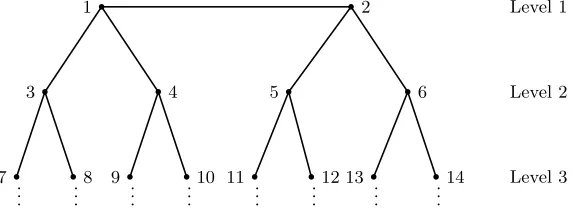
LetU1, . . . , Un be the users who want to make a group KE. We now show how their index automatically determines their place in the (almost) binary tree as in Figure 1. This ordered tree has the property that user Ui is at level blog2(i+ 1)c
1 2 Level 1
3 4 5 6 Level 2
7 8 9 10 11 12 13 14 Level 3
..
. ... ... ... ... ... ... ...
Fig. 1.The binary BD-tree in the BD-II scheme.
(a rooted tree version would need one more multiplication round and is therefore avoided). The set-up can be easily done as the position of userUicorresponds to the binary expansion of i+ 1, i.e.,ifi+ 1 = (il−1il−2. . . i1i0)2 is the binary expansion
withij the leftmost non-zero bit thenUi is on levelj and his parent has expansion parent(i) + 1 = (0. . .0ijij−1i1)2 (one more leading zero). Likewise the children can easily be determined as their expressions are shifted to the right and they have the same initial binary representation with different concatenated tails.
let ancestors(i) be the set of indices of all ancestors of Ui, including i but having removed 1 and 2. Let parent(i),left child(i) and right child(i) be the indices of the parent of Ui and its left child or right child respectively.
Remark 1. One advantage of this scheme is that users only need to know users higher up in the hierarchy. This fits well to common applications of GKE in groups invoked by some manager higher up in the hierarchy who decides the members of the group and their respective function. Once the GKE protocol is started the users have already received some information publicly and their public keys are available in a public database.
While the BD-I scheme requires that each user needs to know the position of
every other user relative to him, our scheme limits this to the knowledge of the positions of at mostO(logn) users.
Note that all this is usually not a problem. The user name in the protocol should contain information about the user’s position (the numbers 1,2, . . . , n can be encoded with logn bits) and this number is enough to determine the relative positions for both BD-I and BD-II.
We only stress this observation since it is a often claimed as a disadvantage of BD-II that the position needs to be known even though this is true even more for BD-I.
Protocol 1 (BD-II group KE)
Let U1, . . . , Un be the set of all users who want to generate a common conference
key. Assume that they are arranged in the binary tree as in Figure 1. The key exchange is performed in a group hgi of order `with generator g.
Step 1 Each Ui, i= 1, . . . , n, selects ki∈RZZ/`ZZ, computes and sends zi =gki to
his parent and children.
Step 2 Each Ui, i= 1, . . . , n, computes and multicasts to its descendants:
Xleft child(i) = (zparent(i)/zleft child(i))ki,
Xright child(i) = (zparent(i)/zright child(i))ki.
Step 3 Each Ui, i= 1, . . . , n, computes the conference key,
Ki=zparent(ki i)
Y
j∈ancestors(i)
Xj.
Remark 2. Honest users compute the same key,
K=gk1k2.
We prove this claim by induction. First observe that K1 = K2 = gk1k2. Next let
Kparent(i) =K. Then since Kparent(i) =zkparent(i) parent(parent(i))
Q
j∈ancestors(parent(i))Xj it is obvious that we have:
Ki =zkiparent(i)∗(zkparent(i)
parent(parent(i)))
−1
Since
Xi = (zparent(parent(i))/zi)kparent(i) (1) and zparent(ki i) =zkparent(i)
i we obtain Ki =K.
Remark 3. Obviously this scheme is vulnerable to denial of service attacks. This is always an issue in group KEs and more severely in non-contributory schemes as users on lower levels or on different branches cannot notice that some members might be excluded. However, as stated before, like Katz-Yung, we only deal with attacks from outsiders.
4 Proof of Security against Passive Attacker for BD-II
We first show that an attacker against Protocol 1 can be used to solve the decisional Diffie-Hellman problem The proof is an adaption of Burmester-Desmedt’s proof for BD-I in [9].
Theorem 1. Protocol P is a secure group KE protocol. Namely
AdvKEP (t, qex)≤AdvddhG (t 0
),
where t0 = t+O(|P|qextexp), qex is the number of Execute queries, and texp is the time required to perform exponentiations in G.
Note that the time for the execution of P is made explicit by the use oftexp.
Proof. Given an algorithm A againstP running in timet we show how to build a distinguisher D against the DDHP. First consider the case that A makes a single Execute query.
LetDbe given a triple (g1, g2, g3)∈ hgi3. NowDcan generate a valid transcript
for A as shown below. Then D runs A on this transcript and outputs 1, i.e., the claim that (g1, g2, g3) is a valid Diffie-Hellman triple, if Aoutputs 1 and outputs 0
otherwise.
Putz01 =g1 and z20 =g2. Randomly choose c3, . . . , cn ∈R ZZ/`ZZ and putzi0 := z0
parent(parent(i))g
−ci fori≥3. So,z0
3 :=g2·g−c3, z05:=g1·g−c5, etc.
ConsistentX0
i’s are obtained asX 0 i := (z
0
parent(i))ci fori≥3 is easy to verify. As
theci (i≥3) are distributed uniformly at random, the distribution ofz0i and Xi0 is identical to that inP.
The transcript consists ofT= (z0
1, . . . , z
0 n, X
0
3, . . . , X
0
n). Upon the Test request,
D issuessk0=g3.
Indeed, if sk0 is the valid group key then g3 = sk0 = z
0loggz20
1 = g
loggg2 1 , i.e.,
(g1, g2, g3) is a valid Diffie-Hellman triple. SoD succeeds with the same advantage
asAand needs (2n−4)texp additional time for the exponentiations to generate the
transcript.
{(g1, g2, g3),(g1r2, gr22, g3r2), . . . ,(g
rqex 1 , g
rqex 2 , g
rqex
3 )} for random exponents rj ∈R ZZ/`ZZ.
Bounding the number nby the total number of participants |P|the claim
fol-lows. ut
Note that the computational complexity of computing the group key under a passive attack for an outsider corresponds to the Computational Diffie-Hellman problem, as is easy to verify (similar as in [9]).
This protocol does not involve any longterm secrets, soCorruptqueries need not be taken into account and the protocol automatically achieves forward security.
5 Authenticated Group Key Exchange
A direct application of the compiler of Katz and Yung [19] would transform Pro-tocol 1 into an authenticated KE proPro-tocol with running time and communication complexity O(n). We now provide our adjusted compiler which allows us to stay in O(logn). To simplify the presentation we assume that the reader is familiar with [19] and will only mention the differences.
To avoid replay attacks, Katz-Yung [19] introduce fresh randomnessri per user Ui for each execution of the protocol, add a message number for each user, and make the signature contain information on the group of players in the AKE. We follow the same road and so we modify the protocol to always sendU|j|m(the user name, the message number and the message) and not onlym orU|m.
We observe that in BD-II user Ui computes the Xchild(i) depending only on
information from its parent and two children. To compute the group key skUi = Ki, user Ui (i 6= 1,2) uses information coming only from the same branch of the binary tree from nodes on levels above Ui whileU1and U2 use information by their
respective parents. In general, in each group KE protocol there is a clearly defined ordered set of messages used by a specific userUi and our compiler requires to check only signatures on these messages. In most tree based systems the set of users any specific user communicates with is much smaller than the total set of users; even to the extent that the number of used messages is logarithmic in the total number of users. In BD-I, however, each user processes input from every user.
We formulate the compiler in a more general setting which contains Katz-Yung’s as a special case, we use the term “multicast” to stress that not all users need to receive the message. To link the messages to the structure in which the users are arranged we let the set relU ={V1, V2, . . . , VtU} be the set of users whose input is processed by user U at some point in the protocol and U itself. E.g. in the BD-I protocol relU is the whole group for any userU while in BD-IIrelU is the set of all ancestors and both children of U; it contains at most O(logn).
1. During the initialization phase, each party U ∈ P generates the verifica-tion/signing keys (P K0
U, SK 0
2. LetU1, . . . , Un be the identities of users wishing to establish a joint group key and letgid be their group identifier6. Each user U
i chooses some random nonce ri ∈ {0,1}k and broadcasts Ui|0|ri. So for each execution of the protocol fresh randomness is used and so replay is not possible.
Let relU = {V1, V2, . . . , VtU} be as above. Each instance ΠUj stores the identi-ties and their per-round randomness together with the group ID indirectjU = (gid|V1|r1|. . .|VtU|rtU) and stores this as part of the state information.
3. The members of the group now execute the protocol P with the following changes:
– Whenever instanceΠi
U is supposed to multicastU|j|mas part of protocolP, the instance computesσ =SignSK0
U(j|m|direct i
U) and multicastsU|j|m|σ.
– Before using message V|j|m|σ the instanceΠUi checks that (1) V ∈ pidiU7, (2)jis the next expected sequence number for messages fromV, and, finally, (3) that VrfyP K0
V(j|m|direct i
V, σ) = 1. If any of these are untrue, ΠUi aborts the protocols and sets acciU = FALSE and skiU = NULL. Otherwise, Πi
U continues as it would in P and uses the messagem.
Remark 4. We like to stress that the authentication does not prevent attacks by malicious insiders. Like Katz and Yung state in [19, Section 2.1] these definitions cannot achieve “agreement” in the sense of [14], e. g. since the attacker could stop all communications by denial of service attacks.
Remark 5. The overhead introduced by the compiler does not change the complex-ity classes for communication and computation. The number of signatures a user makes is equal to the number of messages he sends, the length of the message is extended by adding the message number anddirectiU. The latter has length equal to the number of partnersU directly communicates with and thus is reflected by the computation costs. Reading through the list as part of the signing process does not change the complexity. The number of signature verifications equals the number of processed messages. If userU has to verify that VrfyP K0
V(j|m|direct i
V, σ) = 1 then V must be inrelU and thusU knowsV’s position and thus alsodirectV.
By sticking to the very same security definition as [19] we show that our com-piler works just as well, and in particular allows having a better complexity if the underlying protocol does.
Theorem 2. If P is a secure group KE protocol achieving forward secrecy, then
P0
given by the above compiler is a secure group AKE protocol achieving forward
6 Katz and Yung suggest to usegid =U1|. . .|U
n which automatically forces them to deal with
inputs of lengthO(n). This does not pose a problem for them because BD-I has complexityO(n) anyway. In practical situations, however, the group is formed by e. g. a manager in a bank or a network administrator at the same time as deciding membership and the number of actually used groups is on a much smaller scale than the total number of all possible groups. Quite commonly there there exists a compact description, e.g. the name of the task force.
secrecy. Namely, for qs the number of Send queries and qex the number of Execute queries we obtain
AdvAKEP0 −fs(t, qex, qs)≤
qs
2 ·Adv KE P (t
0
,1) +AdvKEP (t0, qex)
+|P| ·SuccΣ(t0) +q
2
s +qexqs
2k ,
where t0 =t+ (|P|qex+qs)·tP0 and tP0 is the time required for an execution of P0
by any party and SuccΣ is the success probability against the used signature scheme Σ.
The compiler maintains the number of rounds and the complexity class of the protocol P.
Proof. The proof follows the same lines at the corresponding one in [19]. We use an active adversary A0 against P0 to construct an adversary against P. There are three ways in which A0
can succeed, namely by forging a signature if he has not queried the Corrupt oracle before, by repeating the information direct and thus reusing a signature obtained in a previous execution, or by distinguishing the key from random. It is only the latter that leads to an attack against P.
The contribution of the eventForge is as in [19], namely
Pr[Forge]≤ |P| ·SuccΣ(t0).
Due to the different definition ofdirect compared to nonces in [19] we need to reconsider the probability of Repeat. The probability that the nonce used by any user in response to an initialSendquery was previously used by that user (in either another execution of Sendor in an Execute query) is still bounded by
Pr[Repeat]≤ qs(qs+qex)
2k .
8
The remainder of the considerations works as in [19]. LetEx be the event that
A0 queries theTestoracle to an instanceΠUi such thatA0never made a query of the form Send(U, i,∗), i.e., in the simulation A has the full transcript without patches from its own execution of P. Defining Se = Ex and considering the probabilities PrA0,P0[Succ∧Ex] and PrA0,P0[Succ∧Se] separately by constructing appropriate
adversaries A1 andA2 one obtains the stated result. ut
Corollary 1. The authenticated group key exchange protocol obtained from Proto-col 1 by applying this compiler is secure against active attacks and has communi-cation and computation complexity O(logn).
Remark 6. The original paper [8] describes the system in more generality allowing more than two children per vertex. Forkchildren this means that each vertex has to computek values forXi whereas the final computation of the key reduces to logkn computations only. While the overall number of operations is smallest for k = 2; larger k might be an interesting alternative if the storage is restricted and only logknelements can be stored from the multicast to compute K. In the sequential version (see Appendix) a larger k reduces the delay while making each step more expensive. Again the maximal overall efficiency is obtained for k= 2.
In an authenticated version, however, at most k+ logknsignatures need to be verified and k+ 1 messages must be signed. Additionally k + 2 exponentiations are needed. In the ElGamal signature scheme, two exponentiations are needed per signature generation and a multi-exponentiation is used for verification. Accordingly a larger k reduces the computational complexity.
6 Comparison
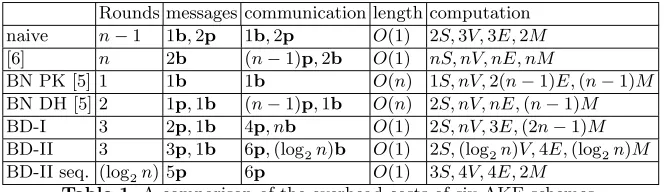
To show the advantages of our group AKE we give an overview of the costs for the naive version (one party transmits the key to the next participant, etc.), the BD-I version considered in [19] and the two authenticated BD-II versions proposed in this paper, in the table below – see Table 6.
We also take into account the scheme by Boyd and Nieto [5] and the scheme by Bresson et al. [6]. In the Boyd-Nieto scheme one user U1 chooses the key and
encrypts this key for all n−1 other group members. This long message is signed and broadcast to all participants who then check the signature and decrypt their part to obtain the joint key. If a public key system is used for the encryption this scheme runs in 1 round. Otherwise a further round is necessary in which each party Ui (includingU1) sends gki. Then the Diffie-Hellman key gk1ki is used to transmit
the group key. This scheme requires the party U1 to perform O(n) computations
and the message has length O(n). We denote the first version by BN PK and the second one by BN DH.
In [6] the authors usegk1k2k3...knas the joint secret key. To make this possible, the
users sequentially add their contributionki to the key which accounts for requiring nrounds and the last user needs to sendg(k1k2k3...kn)/ki to userU
i for eachi, so he has communication and computation O(n).
Except for [5] and [6] group KE schemes are balanced in workload in the sense that all users have about the same amount of work. The table below states the
maximal values per user. Katz and Yung use the same measures because maximal effort per user captures scalability.
To describe the message and communication complexity, we use p to denote point-to-point communication and b to denote broadcast. As the set of users is finite we do not distinguish between multicast and broadcast, otherwise the BD-II protocols use only multicast while BD-I needs broadcast. Furthermore, we list the maximal length of the messages.
encryption; the costs for retrieving the public keys are not mentioned. We neglect the number of inversions as there are at most 2 of them. For the number of rounds we consider the maximal delay of the protocol. Except for the second version of BD-II and [6] this is the maximum number of rounds per user. In the last protocol there are 3 rounds per user.
Rounds messages communication length computation naive n−1 1b,2p 1b,2p O(1) 2S,3V,3E,2M [6] n 2b (n−1)p,2b O(1) nS, nV, nE, nM
BN PK [5] 1 1b 1b O(n) 1S, nV,2(n−1)E,(n−1)M BN DH [5] 2 1p,1b (n−1)p,1b O(n) 2S, nV, nE,(n−1)M BD-I 3 2p,1b 4p, nb O(1) 2S, nV,3E,(2n−1)M BD-II 3 3p,1b 6p,(log2n)b O(1) 2S,(log2n)V,4E,(log2n)M BD-II seq. (log2n) 5p 6p O(1) 3S,4V,4E,2M
Table 1.A comparison of the overhead costs of six AKE schemes.
Accordingly, our authenticated BD-II version achieves an overall complexity of O(logn) while Katz-Yung [19] based on BD I need O(n) in communication and in computation. Additionally, the number of messages to be stored from the broadcast is O(logn), as only the messages of the maximal logn ancestors are needed. The sequential version has a delay of logn but reduces the requirements considerably,
e.g.,, no broadcast is assumed and far fewer operations. This might be interesting in restricted networks which need to minimize the computational and technical requirements trading it off for a longer overall execution of the protocol.
7 Conclusions
We have presented a compiler that adds authenticity to any group KE protocols while preserving computation and communication complexities of the original group KE protocol. In particular we have detailed a secure group AKE protocol based on the BD-II group KE which has a constant number of rounds and requires only O(logn) computation and communication. This is, essentially, an exponential sav-ing compared to previously proposed AKE protocols.
References
1. R. Barua, R. Dutta, and P. Sarkar. Extending Joux’s protocol to multi party key agreement. In Progress in Cryptology - INDOCRYPT 2003 volume 2904 of Lect. Notes Comput. Sci., pages 205–217. Springer 2003.
2. R. Barua, R. Dutta, and P. Sarkar. Provably secure authenticated tree based group key agreement protocol using pairing. InICICS 2004, volume 3269 ofLect. Notes Comput. Sci., pages 92–104. Springer, 2004. see also: ePrint archive, 2004/090, 2004.
3. D. Boneh and M. Franklin. Identity based encryption from the Weil pairing. InAdvances in cryptology – Crypto 2001, volume 2139 ofLect. Notes Comput. Sci., pages 213–229. Springer, 2001.
5. C. Boyd and J.M.G. Nieto. Round-optimal contributory conference key agreement. InPublic Key Cryptography 2003, volume 2567 of Lect. Notes Comput. Sci., pages 161–174. Springer, 2003.
6. E. Bresson, O. Chevassut, D. Pointcheval, and J.-J. Quisquater. Provably authenticated group Diffie-Hellman key exchange. InProc. 8th Annual ACM Conference on Computer and Com-munications Security, pages 255–264, 2001.
7. M. Burmester and Y. Desmedt. A secure and efficient conference key distribution system. InAdvances in Cryptology – Eurocrypt ’94, volume 950 ofLect. Notes Comput. Sci., pages 275–286, Springer, 1995.
8. M. Burmester and Y. Desmedt. Efficient and secure conference key distribution. InSecurity Protocols, volume 1189 ofLect. Notes Comput. Sci., pages 119–130, Springer, 1997.
9. M. Burmester and Y. Desmedt. A secure and scalable group key exchange system.Information Processing Letters, 94(3), pages 137–143, 2005.
10. M. Burmester and Y. Desmedt. Identity-based Key Infrastructures (IKI). In Security and Protection in Information Processing Systems – SEC 2004, pages 167–176, Kluwer, 2004. 11. K.Y. Choi, J.Y. Hwang, and D.H. Lee. Efficient ID-based group key agreement with bilinear
maps. InPublic Key Cryptography - PKC 2004, volume 2947 ofLect. Notes Comput. Sci., pages 130–144, Springer, 2004.
12. Y. Desmedt, J. Pieprzyk, R. Steinfeld, and H. Wang. A Non-Malleable Group Key Exchange Protocol Robust Against Active Insiders. In Information Security Conference – ISC 2006, volume 4176 ofLect. Notes Comput. Sci., pages 459–475, Springer, 2006.
13. X. Du, Y. Wang, J. Ge, and Y. Wang. An improved ID-based authenticated group key agreement scheme. ePrint archive, 2003/260, 2003.
14. M.J. Fischer, N.A. Lynch, and M.S. Patterson. Impossibility of distributed consensus with one faulty process. Journal of the ACM, 32(2), pages 374–382, 1985.
15. I. Ingemarsson, D.T. Tang, and C.W. Wong. A conference key distribution system. IEEE Trans. Inform. Theory, 28, pages 714–720, 1982.
16. A. Joux. A one round protocol for tripartite Diffie-Hellman. InAlgorithmic Number Theory, ANTS-IV, volume 1838 ofLect. Notes Comput. Sci., pages 385–394, Springer, 2000.
17. M. Just and S. Vaudenay. Authenticated multi-party key agreement. InAdvances in Cryptology – Asiacrypt 1996, volume 1163 ofLect. Notes Comput. Sci., pages 36–49, Springer, 1996. 18. J. Katz and J. S. Shin. Modeling Insider Attacks on Group Key-Exchange Protocols. ePrint
archive, 163/2005.
19. J. Katz and M. Yung. Scalable protocols for authenticated group key exchange. InAdvances in Cryptology – Crypto 2003, volume 2729 ofLect. Notes Comput. Sci., pages 110–125. Springer, 2003. full version available athttp://www.cs.umd.edu/∼jkatz/research.html.
20. J. Nam, Y. Lee, and D. Won. Constant Round Group Key Exchange with Logarithmic Com-putational Complexity. ePrint archive, 284/2006.
21. Y. Kim, A. Perrig, and G. Tsudik. Tree-based group key agreement. ACM Trans. Inf. Syst. Secur., 7(1), pages 60–96, 2004.
22. J. Pieprzyk and H. Wang. Malleability attacks on multi-party key agreement protocols. In Coding, Cryptography and Combinatorics, volume 23 of Progress in Computer Science and Applied Logic, pages 277–288. Birkh¨auser, 2004.
23. C. K. Wong, M. G. Gouda, and S. S. Lam. Secure group communications using key graphs. InSIGCOMM, pages 68–79, 1998.
24. C. K. Wong, M. G. Gouda, and S. S. Lam. Secure group communications using key graphs. IEEE/ACM Trans. Netw., 8(1), pages 16–30, 2000.
Appendix – A Peer-to-peer version of BD-II
Protocol 2 (Peer-to-peer version of BD-II group KE)
Let U1, . . . , Un be a (dynamic) subset of all users who want to generate a common
conference key. Assume that they are arranged in the binary tree as in Figure 1. The key exchange is performed in a group of order `with generator g.
Step 1 Each Ui, i= 1, . . . , n, selects ki∈RZZ/`ZZ, computes and sends zi =gki to
his parent and children.
Step 2 Each Ui, i = 1, . . . , n computes Xp,i = zparent(ki i), Xl,i = zleft child(ki i) and Xr,i =zkiright child(i).
Step 3 U1 and U2 have already obtained the joint key Ki = Xp,i and send
Yleft child(i)=Ki·Xl,i andYright child(i)=Ki·Xr,ito their respective children.
Step 4 For j= 2, . . . , mdo:
each user Ui on level j computes upon receipt ofYi the joint key as
Ki =yi/Xp,i.
Then he sends Yleft child(i) = Ki· Xl,i and Yright child(i) = Ki· Xr,i to his
respective children.
Remark 7. For this scheme it is even more obvious why honest users obtain the same key
K=gk1k2.
First note that this holds for K1 and K2. Assume that the parent
of Ui obtained Kparent(i) = K. Then Ui computes Ki = Xp,iYi = Xp,i(Xp,child(parent(i)))−1Kparent(i) = K, where child takes into account the correct