MAP POSITIONS AND SPECIFICITIES O F SUPPRESSOR MUTATIONS IN ESCHERICHIA COLI K-12’9’
GUDMUNDUR EGGERTSSON3 AND EDWARD A. ADELBERG
Department of Microbiology, Yale University, New Haven, Connecticut
Received March 11, 1965
suppressor mutation (“suppressor”) can be defined as a mutation which
A
reverses the phenotypic effects of a second (“primary”) mutation at a differ- ent position in the genome. Suppressors may occur either inside or outside the locus containing the suppressed mutation; these are termed intragenic and ex- ternal suppressors, respectively. Most external suppressors are capable of sup- pressing particular alleles of different loci. Several external suppressors have been shown to alter the primary structure of proteins by causing amino acid substitutions at the mutant site (BRODY and YANOFSKY 1963; NOTANI, ENGEL-HARDT, KONIGSBERG and ZINDER 1965; WEIGERT and GAREN 1965).
The units of the genetic code, presumably base-pair triplets, have been referred to as codons, each codon determining one amino acid in a polypeptide chain. Codons which code for the normal, or wild-type, amino acids are called “sense”; a mutant codon which causes the wrong amino acid to be inserted in the poly- peptide during translation is called “missense”; and a mutant codon for which the translation machinery provides no corresponding amino acid is called “non- sense” (CRICK 1963). Both missense and nonsense mutations are found among primary mutations which are genetically suppressible (
BRODY
and YANOFSKY 1963; BENZER and CHAMPE 1962; GAREN and SIDDIQI 1962). When a missense or a nonsense mutation is suppressed, an amino acid is substituted in the poly- peptide at the position affected by the primary mutation. The substituted amino acid may be the same as that found in the wild-type polypeptide or may be a different one which nevertheless restores function. It is generally believed that suppression takes place during the “translation” of the nucleotide sequence in messenger RNA into the amino acid sequence of the polypeptide, and not during the “transcription” of the nucleotide sequence of DNA into that of RNA. Trans- lation of a missense codon may be ambiguous in a suppressed strain; i.e., the cell makes two forms of the polypeptide, the original mutant form and the form containing the new amino acid at the mutant site (BRODY and YANOFSKY 1963).Assuming that suppression does occur at the level of translation, it is still not clear which component of the translating (protein synthesizing) system is af- fected by such suppressors. YANOFSKY and ST. LAWRENCE (1960) proposed that suppression may be caused by specificity alterations in transfer RNA (T-RNA)
1 Supported by Grant No. G19383 from the National Science Foundation.
2Most of the experimental results reported in this paper are taken from a thesis submitted to Yale Univers:ty h y Gudniundur Eggertsson i n partial fulfillment of the requirements for the degree of Doctor of Philosophy.
Present address: Department of Radiology, Yale University.
320 G. EGGERTSSON A N D E . A. ADELBERG
o r amino acid activating enzymes. More recently a role of the ribosomes in de- termining coding specificity has become evident ( GORINI and KATAJA 1964a,b; DAVIES, GILBERT and GORINI 1964), suggesting the possibility that suppressor mutations may affect the genetic code by causing alterations in ribosome struc- ture. Further possible mechanisms of suppressor action have been considered by BRENNER and STRETTON ( 1964).
AS a step towards elucidating the mechanisms of action of external suppressors in Escherichia coli, it was decided to investigate the genetic behaviour of such suppressors. The main purposes of our study were: (1) To determine the map positions of suppressor loci; (are they distributed randomly over the genetic map or do they tend to occur in clusters?) (2) To determine the number of suppressor loci for given suppressible mutations. (3) To study the allele specificity of sup- pressors.
Mutations of the structural loci governing the biosynthesis of isoleucine and valine, the ilv loci, were employed as “primary” mutations in obtaining external suppressors, i.e., suppressors were obtained as “reversions.” The five ilu loci in
E. coli are known to be located in a single cluster on the chromosome (PITTARD,
LOUTIT and ADELBERG 1963), consisting of three operons, one of which comprises three of the five loci (RAMAKRISHNAN and ADELBERG 1964, 1965a,b). The rela- tionship of the ilu loci to the isoleucine-valine biosynthetic enzymes is summar- ized in Figure 1.
In the following sections we describe the isolation, properties, and genetic mapping of a large number of suppressors obtained in ilu mutants.
MATERIALS A N D METHODS
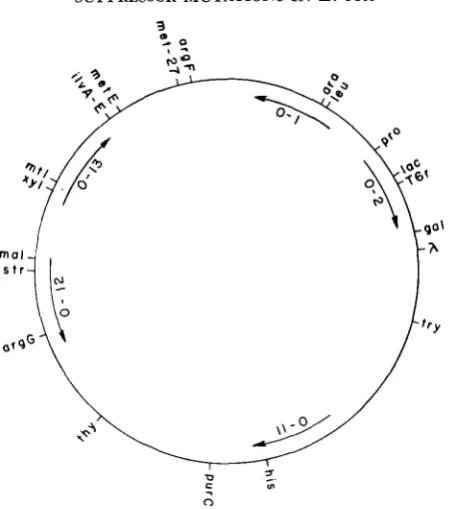
Bacterial strains: A primary list of bacterial strains which were used is provided in Table 1. Th2y are all derivatives of Escherichia coli K-12. Derivatives of these strains are described in Tables 2 and 3. Chromosome markers, and Points of Origin of the Hfr strains, are shown in Figure 2. Throughout this paper, male strains will be classified according to the Points of Origin shown in Figure 2; e.g., a strain exhibiting Point of Origin 0-1 during chromosome transfer will be referred to as an “0-1 male,” etc.
Bacteriophages: The following were used: Plkc, X, T6, and the phage T4 amber mutants
N130 and N135. The T 4 mutants were kindly provided by DR. A. GAREN.
Media and culture methods: Unless otherwise mentioned, those previously described by ADELBERG and BURNS (1960) were used.
Bacterial mating: The conditions described by ADELBERG and BURNS (1960) were employed
GENE SEQUENCE
FIGURE 1 .--Sequence of genes controlling the formation of enzymes in the isoleucine-valine biosynthetic pathway. TD, threonine deaminase; CE, condensing enzyme; RI, reductoisomerase;
z
2 .U U v)-
.U - aU $+J$
s
.;a -w
$
.Uk
h
SUPPRESSOR MUTATIONS I N
E.
coli 321k - - q + + + m + 2 + + + + + + + +
+ + + g g + + z z g z + + + + + +
2% E sa
?.-a w
d + Z $
gg:
',A"@:" I"
p
k9.8
=
-1;;; c
2-3 *.&
as, 2-
g"s ', g
a'&k I I i
- t s m a
.+ ' g U,
. g +
s
$--4zs, 0
&z..;
4-."E$&
6
a
$E.-
e,:z
"k k-g
F m w E w & u G b . - H
e, ..,I.$
3
.* C1S,L'L '3
.c & a; a
p * . s m % m a ' G ' , 2 - 2 m m $ 7.C.cT.g ? A . : h Z E >^,
/ E @
z
. g $ & : a t3
... 2 E g 2 k
&
&,as e:
EB 01.- 8
3 ,B a,:
f5
L . s ' S 2 ac:
-
. S O , q j gm =.e YI E .
b.2 M-E 8 2" v u 0 3 ",$-
S.!;g%~
a'z m
..'
a m.g
2
S2-G:v'I .% Z.g&$
8 c m s r ; m
.;;.;.U
g E Q zi , 2 . c r % "5
gz
2 2 g $ 2 &-& 8 2 F r o -&3
+. z%5 ,>"3,,F. -'s--
5
.c.4"$ g::
2
c - a' E A C 0%.- w E.."Z * * 3
.fq &ar m 0 o s a p C 0 S'? 2.2:- z 2s Fi
a,,"S$u.-
-
.=a=.& osmg
@ . x p a
8 8 G , I g.g-,g-.a2 9 U xe a 1 E
W . 3 A E ' 'E
zz
u' . * o r * o'=" $ E 2 6
3
p
-
;
2.;
3
- 2 . 5 - ::w
g4-
Y) fi s-sg "<$a z;z;cQg
-
-24 ,*.-mmg
g2s
$$pa - < <
&s:
$2 s 2 2 8 0 m c u E Et-o.c--- c - *
* .,-g:p:zz
2.5.3 i
g
6"if1
$
$2
i
- w a'
- b C L3
g - m m
" P U P 2 .
w s c 3 ;m,c_5m L V J f
g
- a , j.
a - 3 * > a
0"
- 4 - m a."
r - u - ? , i c c m
* - S S 4 C a m
322 G. EGGERTSSON A N D E. A. ADELBERG
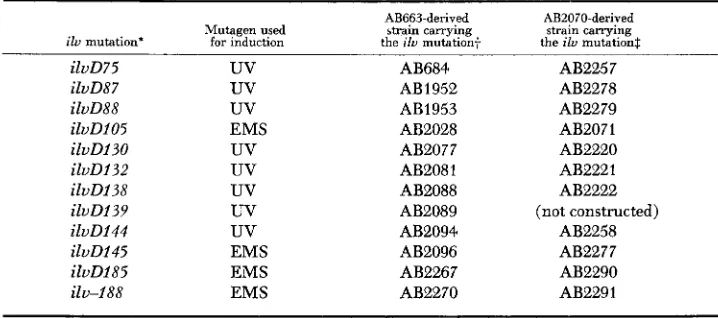
TABLE 2
Suppressible ilv mutations in strains deriued from AB663 (male) and AB2070 (female)
ilu mutation’
iluD75 iluD87 iluD88 iluD105 iluD130 iluD1 32 iluD138 ilvD139 iluD144 iluD145 iluDi85
il U-18 8
Mutagen used for induction
AB663-derived strain carrying the ilu mutation+
uv
uv
uv
EMSuv
uv
uv
uv
uv
EMS EMS EMS AB684 AB1952 AB1953 AB2028 AB2077 AB2081 AB2088 AB2089 AB2094 AB2096 AB2267 AB2270 AB2070-derived strain carrying the ilu mutation$AB2257 AB2278 AB2279 AB2071 AB2220 AB222 1 AB2222 AB2258 AB2277 AB2290 AB2291 (not constructed)
* Locus assignments based on enzyme assays described in RESULTS.
t Strains listed in this column are induced ilu mutants of AB663. they are isogenic with AB663 except for ilu alleles. t Strains obtained by introducing ilu mutations from AB663 mitants into AB2070 by co-transduction with iluE+, as described in MATERIAISAND METHODS. These strains are isogenic with AB2070 except for il; alleles
with the following modifications and exceptions. In all interrupted-mating experiments separa- tion of mating couples (referred to as “blending”) was effected by subjecting samples (1 ml) of the mating mixture to agitation on a Vortex Junior mixer for 1 min. In interrupted mating experiments with 0-11, 0-12, and 0-13 males, the male cells were killed by bacteriophage T6,
to which the female cells were resistant; 0.1 ml of a phage-T6 lysate (containing approximately
1011 T6 particles per ml) was added to each sample of mating mixture immediately prior to blending. In interrupted-mating experiments with 0-1 male strains the mating mixture was, after
5 min of mating, diluted 1 :500 in minimal medium (DEHAAN and GROSS 1962). The diluted cells
TABLE 3
A partial list of strains carrying suppressors of ilv mutations*
GenotvDe
Strain No. Sex ilu sup+ other genetic markers
AB2273 AB2275 AB2285 AB2300 AB2536 AB2542 AB2544. AB2546 AB2547 AB2551 AB2561 AB2562
Hfr 0-12
Hfr 0-12 Hfr 0-12 Hfr 0-12 Hfr 0-1 1
Hfr 0-12
0 Hfr 0-12
Hfr 0-12
Hfr 0-13
Hfr 0-13
Hfr 0-1
145 HI1
188 0 1
88 H i 2 188 LZ 145 H11
188 L2
188 M20
188 N23
132 T I 0
188 N23
188 0 1
188 L Z / t S
same as in AB663
same as in AB663
same as in AB663
same as in AB663
metE+ ; other markers same as in AB2234
( A + ) ; other markers as in AB2300
galf/gal-IOS; other markers as in AB2527
same as in AB663
same as in AB663
metE+; other markers same as in AB2529
metE+ ; other markers same as in AB2529
metE+ ; other markers same as in AB2545
;
Symbols explained in Table 1 and in section on Nomenclature concluding MATERIALS A N D METHODS. - Refers to suppressors of ilu mutations only. Capital letters are locus designations.SUPPRESSOR MUTATIONS IN E. coli 323
0
FIGURE 2.-Genetic map of E. coli K-12 showing the location of pertinent loci. Arrows indi- cate Points of Origin of the Hfr strains employed (0-1, 0-2, 0.11, 0-12 and 0-13, originally present in strains Hfr H, Hfr CAVALLI, AB311. AB312, and AB313, respectively).
were incubated at 37°C without aeration, and samples (1 ml) taken a t intervals for blending; the male cells were in this case killed by plating on selective media containing streptomycin, to which the female cells were resistant.
Transductiox The methods used in experiments with bacteriophage Plkc (referred to as PI
in this paper) were essentially as described by LENNOX (1955). Transduction by bacteriophage
A was carried out using the methods described by ARBER (1958).
Scoring for unselected markers: The colonies to be tested for unselected markers in conjuga- tion or transduction experiments, were transferred to master plates of the selective medium, and after overnight incubation were replica plated to the appropriate media. Data given on unselected marker frequencies in transduction experiments are based on at least 100 transductants scored.
En zy me assays: Assays of enzymes of the isoleucine-valine pathway were performed as describ2d by RAMAKRISHNAN and ADELBERG (1964).
324 G. EGGERTSSON A N D E. A . ADELBERG
the donor by co-transduction with iluE+. These 12 ilu alleles are listed in Table 2, along with the AB663 mutant strains in which they were originally present, and the strains which were obtained by transducing these alleles into AB2070.
Co-transduction of the ilu loci with the metE locus was observed early in the course of this work and was frequently made use of in constructing strains carrying ilu mutations or metE mutations. The following observations are relevant to experiments described in this paper. Using recipients which carry m t E 4 6 and an ilu mutation (strains carrying mutations in iluA, iluD and iluE were used) and ilu+ metE+ donors, the total number of ilu+ transductants obtained was approximately four times that of metE+ transductants; about 16% of the ilu+ transductants carried the unselected donor marker met&+, whereas about 65% of the m t E + transductants carried the unselected donor marker ilu+. In case the recipient was ilu+ and the donor was an ilv mutant, the frequency of the unselected ilu marker of the donor among the metE+ trans- ductants was approximately 50%.
Isolation of strains containing external suppressors: The external suppressors employed in this work were, unless otherwise mentioned, obtained in ilu mutants of strain AB663 as muta- tions causing “reversion” to the isoleucine-valine independent (Isoval + ) phenotype. Isoval+ revertants either were obtained as spontaneous revertants or were induced by the mutagens diethylsulfate (DES) or N-methyl-N’-nitro-N-nitrosoguanidine (NTG) . DES-induced and NTG- induced mutants were obtained by adding 0.025 ml of the mutagen (liquid DES or a 2 mg/ml aqueous solution of NTG) to small filter paper discs placed in the center of plates containing selective media which had been spread with about 2 x 10⁸ cells. The cells to be spread were suspended i n minimal medium supplemented with nutrient broth at a final concentration of 10%. The induced mutants form colonies which appear in a circular zone surrounding the paper disc at a distance determined by the diffusion rate of the mutagen and the concentration required for mutagenesis (IYER and SZYBALSKI 1958).
The following test, referred to as the external suppressor test, was employed in order to test Isoval+ revertants of AB663-derived ilu mutants for the presence of external suppressors. A P I lysate of the revertant was used to transduce the metE+ marker into strain AB1976 which carries ilu+ and metE46. Selection was made for metE+ on a medium supplemented with iso- leucine and valine. A sample (usually 100) of the transductants obtained was scored for the isoleucine-valine dependent (Isoval-) phenotype. In case the reversion to Isovalf is due to an external suppressor not co-transducible with metE+, approximately 50% of the metE+ trans- ductants are expected to be Isoval-, having received the mutant ilu marker of the donor by co-transduction with metE+. If, on the other hand, the reversion to Isoval+ is due to a muta- tional event inside the locus containing the original ilu mutation, not more than a few percent
of the metE+ transductants are expected to be of the Isoval- phenotype. (It should be noted, however, that a failure to recover Isoval- transductants in such tests is also expected if the recip- ient contains a suppressor capable of suppressing the ilu mutation that is introduced by co-trans- duction with metE+).
Transfer of suppressors between strains containing homologous ilu mutations was frequently accomplished by P I transduction; suppressor-carrying transductants were obtained directly by selection for the Isovalf phenotype.
Strains carrying suppressors of ilu mutations are described in Table 3.
SUPPRESSOR MUTATIONS IN E . coli 325
transductants are expected to be Isovalf. I t should be noted that all the ilu mutations employed
in these tests had previously been shown to be jointly transducible with metE+. Tests in which donor and recipient carried homologous mutant ilu alleles served as controls on reversion of the suppressor.
Genetic mapping of suppressors: Mapping of suppressors was carried out by P1 transduction and/or by conjugation. As a first step, a P1 lysate of the suppressor-carrying strain (an iZu mutant of AB663) was used to transduce the suppressor into the AB2070-derived strain carrying the same ilu mutation as the donor. Selection was made for recombinants carrying the mutant sup allele (i.e., having the Isoval+ phenotype). The selective medium was supplemented with adenine and arginine (both required by the donor) together with the growth factors required by the recipient. A sample of the sup transductants (usually 100) was then scored for the following donor markers: argFI, purC1, str+, metE+, pro+, try+, his+, mal+, xyl-4, m t l f , a r a f , lac+,
gal+. In case none of the markers scored for was found to be co-transducible with the suppressor, the suppressor-carrying 0-12 male strain was crossed to the AB2070-derived strain carrying the homologous ilu allele. After 90 min of mating, selection was made for metE+, p r o f , try+, his+ and sup (separately), and the recombinants were scored for unselected markers. Such tests usually allowed a determination of the approximate map position of the suppressor.
In order to ensure (in interrupted-mating experiments) that mapping by time of entry could be carried out for suppressors located at any point of the chromosome, metE mutant male strains with Points of Origin 0-1, 0-11. and 0-13 were constructed (strains AB2545, AB2234 and AB2529. respectively). The appropriate suppressible ilu mutations were introduced into these strains by joint transduction with metE+ ; suppressors of these mutations were subsequently introduced by PI transduction.
Nomenclature: Genotypic symbols are used to designate loci and/or mutational sites. They consist of three italicized letters, usually lower-’case, followed by a hyphen and a serial isolation number. When it is known in which of several loci concerned with the same general phenotypic property (e.g., biosynthesis of methionine) the mutation has occurred, the hyphen is replaced by a capital letter (e.g., m e t E 4 6 ) . The full symbol, including the locus designation letter and the isolation number, defines a mutant allele. The wild-type allele of any locus is indicated by a plus sign in place of an isolation number (e.g., m e t E + ) . Minus signs are not used in genotypic symbols.
Suppressor mutation sites will he designated by the symbol sup, followed by a serial isolation numb-r. When a particular suppressor locus has been defined by mapping experiments, it is indi- cated by a capital letter (e.g., supT) . To he consistent with the general practice stated above, the wild-type (nonsuppressing) allele of any suppressor locus is designated by a f sign (e.g., s u p T + ) ;
mutant (suppressive) alleles are indicated only by the inclusion of a n isolation number (e.g., supT3). (Note: some authors have used the plus sign to mean “suppressive”, and a minus sign to mean “nonsuppressive.” This practice is not recommended, as it confuses symbols for pheno- typic activity with symbols for genetic alleles).
Phenotypic symbols are used to designate strain properties. They are never italicized, and usually consist of abbreviations that cannot be confused with locus or allele designations. Thus, Tswal+ and Isoval- symbolize, respectively, the ability and inability to synthesize isoleucine and valine.
R E S U L T S
326 G . EGGERTSSON A N D E. A. ADELBERG
of 48 UV-induced mutations and 50 of
54
EMS-induced mutations were found to be reverted by DES. Slow growing revertants were obtained in the case of approximately one third of the mutants tested; each mutant giving such revert- ants also gave revertants having growth rates similar to wild type, but slow grow- ing revertants were frequently the more numerous.Slow growing DES-induced revertants of 20 ilu mutants ( 1 1 UV-induced, 9
EMS-induced) were subjected to the external suppressor test described in MA- TERIALS AND METHODS; One to three revertants of each mutant were tested. In
the case of eight of the ilu mutants (3 UV-induced, 5 EMS-induced) all the tests were negative, i.e., none of the metE+ transductants tested was Isoval-. However, the ‘‘Slow growing character” of these mutants was in each case co-transducible with the metE+ marker at a frequency expected for the ilv loci. The Isoval+ phenotype of these mutants is therefore probably due either to intragenic sup- pressors or to mutations at the original mutant sites causing partial restoration of protein function. (These results could, however, also be accounted f o r by the alternative explanation described in MATERIALS AND METHODS).
External-suppressor tests with revertants of the remaining 12 ilu mutants (listed in Table 2) were all positive, i.e., in each case approximately
50%
of themetE+ transductants were phenotypically Isoval-, and the Isoval+ phenotype of these revertants could therefore be attributed to external suppressors.
The suppressors used in this study were obtained in representatives of the 12
strains whose ilu mutations had thus been shown to be suppressible by external suppressors, or in strains into which these mutations had been introduced by transduction. Unless otherwise mentioned, they were induced with DES.
Enzyme deficiencies caused b y suppressible ilv mutations: Assays of the de- hydrase enzyme of the isoleucine-valine pathway were carried out by T. RAMA- KRISHNAN on extracts of the 12 suppressible ilv mutants of AB663 (Table 2 ) . These strains were all found to be deficient in dehydrase. Other enzymes of the isoleucine-valine pathway were not assayed in these strains, which were tenta- tively classified as iluD. Further assays f o r enzymes of the isoleucine-valine pathway have, however, been carried out on extracts of strain AB2291 which contains ilu-188 (Table 2 ) . The results, which are preliminary, suggest that this strain is deficient in both dehydrase and threonine deaminase, but contains nor- mal levels of both transaminase and condensing enzyme; (reducto-isomerase was not assayed). It will be recalled that the structural genes for threonine de- aminase and dehydrase are located next to each other in an operon which also includes the structural gene for transaminase in the operator-distal position (Figure 1 ) . The dual deficiency caused by ilu-188 suggests that it may be a polarity mutation (cf. AMES and HARTMAN 1963), but in that case the produc- tion of wild-type levels of the operator-distal enzyme, transaminase, is unexpect- ed. This is being investigated further.
SUPPRESSOR .MUTATIONS I N E. coli TABLE 4
Results of allele specificity tests with suppressors of ilv mutations
32 7
Mutations tested for suppression'
Suppressor Iocus
sup-?, @+
+ + +
+
- - --
- supTsup-4
+
@+ +
+
. . .-
- S U ~ TI sup-5
+
+
@
+ +
. . .-
- S U ~ Tsup-l - - - @ - - - + + sup0
I1 sup-2 - - -
0
- --
- - -+
+
supLsup-6
+
f+
@
. . . - - supT sup-7+
+
+ +
6
i- . . .-
- SUPTsup-20 - - - @ -
- -
- - -+
+
supMsup-23 - - - @ - -
-
- --
f+
supN111 sup-ll
- - - e + - - -
supHIV sup-9 - - - @
+
- --
- notmappedv
sup-I3 . .sup-l4 . .
. . .
. . .
0
, ,- -
notmapped. .
@
. . . . notmapped* Tests were carried out as described in text. -t =suppression; -=no suppression; dotsxnot tested. +@indicates the ilu mutation of the strain in whirh the suppressor was obtained.
be divided into five specificity groups (Table 4), with the following character- istics:
Group I: Five of the 12 ilv mutations were suppressed. These five were shown by recombination tests to represent at least four different mutational sites. No
Isoval- revertants of strains carrying Group I suppressors were observed.
Group
II:
Only one ilu mutation, ilv-188, was suppressed, but Group I1 sup- pressors also suppress try-3 and his-4 which are present in strain AB2070 and its derivatives. Suppression of the his-4 mutation by sup-1 and sup-20 was heat- sensitive: derivatives of AB2291 carrying either of these suppressors grew with- out histidine supplementation at 30°C or at 37"C, but not at 42°C. Suppression of try-3 and ilv-188 by the same suppressors was, however, effective at all three temperatures. The his-4 mutation was suppressed at 42°C by SUPS and sup-23.Suppressors of Group I1 could be divided into three subgroups or types on the basis of the heat-sensitivity of the his-4 suppression, and of differences between suppressed strains with respect to growth rates on media with or without iso- leucine and valine (Table 5 ) . Among 200 Isoval+ revertants of strain AB2291
induced by DES at 37"C, 126 were inferred to carry suppressors of Type 1, and
328 G. EGGERTSSON A N D E . A. ADELBERG TABLE 5
A classification of suppressors of Group I1
Growth rates of suppressed
Division time strains Suppression uency of
Suppressor of suppressed strains in on isol-Val of his-4
123-
mutants type Suppressor medium containing isol-Val' free media+ at 4Q°C of suppressed strains1 sup-2, sup-23 60 min (AB2300, AB2547)
+
+
yes not observed2 sup-1 80 min (AB2275)
+
+ +
no relatively high$3 sup-20 120 min (AB2546)
+
no low* Strain numbers in parentheses refer to strains whose division times were measured. Cultures were grown with aeration in isol-val supplemented minimal medium at 37°C. Division time of strain AB663 in the same medium was about 60 min; isol-Val =isoleucine valine.
+
Relative colony size on minimal agar plates at 37'C. wild type:+ + + +
.t Overnight broth cultures started from large inocula (1-5 X io' cells/ml) of cells grown on media free of isoleucine and valine, usually contained 1 to 5 % Isoval- colonies.
sors of Type 3 were obtained among 120 slow-growing Isovalf revertants in- duced at 30°C in strain AB2291. Suppressors of Types I and 2 were also obtained at 37°C as a result of spontaneous mutations.
Group
111:
sup-21 suppressed ilvD145 and ilvD88. Strains carrying sup-12revert to the Isoval- phenotype at relatively high frequency.
Group IV: sup-9 suppressed ilvD138 and ilvD139. Isoval- revertants were
obtained at a relatively high frequency in strains carrying sup-9.
Group
V :
sup-13 and sup-14 which suppress ilvD75 and ilvD87, respectively, were not employed in allele specificity tests, but they are known to differ in specificity from Groups I to IV, none of which suppresses ilvD75 or ilvD87. It is not known, however, whether sup-13 and sup-14 have identical allele specific- ities. Strains carrying sup-13 revert to the Isoval- phenotype at a relatively high frequency.P
TaDpinq of suppressors of Group I: Approximate mapping by conjugationindicated that the suppressors of Group I which are listed in Table 4 are trans- ferred later than his by 0-12 males. An ilv mutation which is suppressible by Group I suppressors, ilvD132, was therefore transduced into the 0-13 male strain AB2529. A suppressor mutation, sup-20, was then induced by DES; (this SUP-
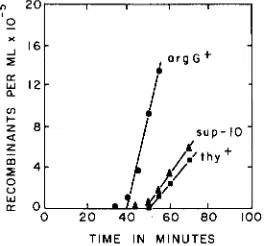
pressor was later, by allele specificity tests, shown to have the specificity charac- teristics of Group I suppressors). The strain thus obtained, AB2551, was used as donor in interrupted mating experiments with the F- strain AB2527, which carried i2vD132 and also argG6 and thy-3. Selection was made for the donor markers argG+, thy+ and sup-20. In order to prevent growth of donor cells that might have survived the treatment with bacteriophage T6, leucine, which is required by the donor, was omitted from the selective media. The results of a
typical experiment are shown in Figure 3; it is seen that sup-10 entered the zygotes approximately 10 min after argG+ and about 1 min before thy+.
SUPPRESSOR MUTATIONS IN E . coli 329
1
;
0
::L
U W
r r o 0
L
20
T I M E IN M I N U T E S
FIGURE 3.-Kinetics of recombinant formation for the a&+, sup-10 and t h y + markers in an interrupted-mating experiment. Donor AB2551 ; recipient AB2527.
of thy+ and sup-IO was demonstrated. The thy+ transductants obtained in ex-
periments of this type were consistently about half as frequent as the sc!p-lO
transductants obtained in the same experiments. This difference was reflected in the frequency of sup-IO and thy+ as unselected markers among thy+ and sup-IO transductants, respectively: 49
%
of 258 thy+ transductants carried the unselect-ed sup-20 marker, while only 27% of 250 sup-IO transductants carried the un-
selected thy+ marker.
The five suppressors of Group I which are included in Table 4 were also tested for co-transduction with thy. Strain AB2527 was used as recipient in transduction experiments with five thy+ donors carrying the sup-3, sup-#, sup-5, sup-6 and
sup-7 alleles respectively. Selection was made for thy+ transductants, of which from 100 to 400 were scored for the presence of the unselected suppressor allele of the donor. The five suppressors were co-transduced with thy+ at frequencies of
40 to 53%, comparable to the frequency previously found for sup-IO. These results suggest that the six Group I suppressors which were employed in these experiments all represent alleles of the same locus, to be designated supT. (The presence of a cluster of suppressor loci closely linked to thy has, however, not been excluded.)
In an attempt to determine whether any other suppressor locus exists for a given mutation that is suppressible by Group I suppressors, 19 additional slow- growing Isoval+ revertants of an iluDI32-carrying strain, AB2081
,
were obtained(five spontaneous, nine induced by NTG, five induced by DES). These revert- ants were tested for the presence of suppressors co-transducible with thy. The tests were carried out as already described for Group I suppressors sup-3-sup-7. All 19 revertants carried suppressors of iluDI32 that are co-transducible with thy
330 G. EGGERTSSON A N D E . A. ADELBERG
Mapping of suppressors of Group
ZI,
T y p e I : The loci governing the synthesis of the enzymes of galactose utilization, the gal loci, are clustered together in one region of the chromosome. sup-2, a Type 1 suppressor, is co-transducible withgal by phage P1. Strain AB2300 which carries the ilu-188, sup-2 and gal+ alleles was used as donor in transduction experiments with recipient strains AB2291
and AB2531 both of which carry the ilu-I88 mutation and mutant gal alleles. Selection was made for suppressed (Isoval+) transductants, a sample of which (about 200 in the case of each recipient) were scored for the unselected gal+
allele of the donor. With both recipients, about 64% of the sup transductants scored were gal+, having received the unselected gal+ allele by co-transduction with sup-2.
The close linkage of sup-2 with gal, demonstrated in the P1 transduction ex- periments, suggested that s u p 2 might be transducible by phage A. In order to test this possibility, strain AB2300 was made lysogenic for h, and the resulting strain,
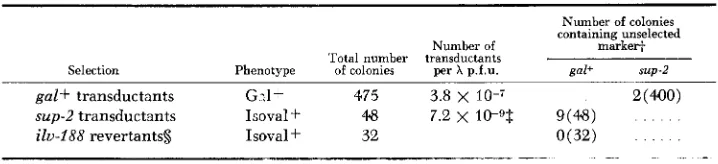
AB2542, was used as donor in h-transduction experiments with AB2531 as re- cipient. Separate selections were made for transductants having the Gal+ and Isovalf phenotypes. The results of such an experiment are shown in Table 6. It
is seen that Gal+ and Isoval+ colonies were obtained in a ratio of approximately
10: 1. However, the number of Isoval+ revertants obtained on control plates indi- cates that the selection for s u p 2 transductants was obscured by a relatively high frequency of Isoval+ revertants. Two out of 440 Gal+ transductants scored had the unselected Isovalf phenotype, indicating that co-transduction by h of gal+
and sup-2 occurs at a low frequency. This conclusion was confirmed by the find-
ing that 9 of the 48 Isoval+ colonies obtained after infection with h in the same experiment carried the unselected gal+ marker, while the 32 Isoval+ colonies obtained on control plates (without h ) all carried the mutant gal allele of the recipient (Table 6). It is not known whether sup-2 can be transduced by h inde- pendently of gal.
In other experiments with the same donor and recipient strains (AB2542, AB2531 )
,
transductants containing both gal+ and SUP-2 were obtained by plating h-infected cells on media jointly selective for both donor markers.TABLE 6
Transduction of sup-2 and gal by A *
Number of colonies containing unselected
Number of marker+
Total number transductants
Selection Phenotype of colonies per A p.f.u. gal+ sup-2
gal+ transductants G d + 475 3.8 x 2(NO)
sup-2 transductants Isoval + 4.8 7.2 x 10⁻⁹t g(4.8)
ilu-188 revertantss Isoval+ 32 ~ 3 2 )
- . _. . .. -
Recipient AB2531 (gal-IO sup+ (A-)); Donor AB2542 (gal+ sup-2 ( A + ) ) . Multi licity of infection ( i.e., X plaque forming units per cell): 4 to 5. In each selection four 0.1 ml aliquots (either of the pkage/cell mixture or of the e ually concentrated recipient culture without X) were hlated on the appropriate media. Gal+ revertants were not obtaine%. All
the data in this table were obtained in the same experiment. t Number of colonies scored is shown in parentheses. f i.e., sup-2 gal+ transductants.
SUPPRESSOR MUTATIONS IN E. coli 331 The 11 Gal+ Isoval+ transductants obtained in the experiment described above (Table 6) were all purified and tested for segregation of Gal- clones by streaking on indicator agar. All of the transductants segregated Gal- clones at a frequency considerably higher than reported for A-gal heterogenotes (MORSE, LEDERBERG, and LEDERBERG 1956). One of the transductants, strain AB2544, was used for further study. Exponential-phase cultures of this strain which had been grown for 5 or 6 generations in nutrient broth (after initial growth in a minimal medi- um with galactose as carbon source and unsupplemented with isoleucine and valine) contained Gal- segregants at a frequency of 20 to 30%. When 200 Gal- colonies from such a culture were scored for sup (i.e., the Isoval phenotype).
97% were sup+ (Isoval-). Among 144 Gal+ colonies from the same culture, only 7% were sup+. All the Gal- and Isoval- segregants were still lysogenic for A. The parallel loss of sup-2 and gal+ in the majority of the segregants scored indicated that the two markers are, in strain AB2544, carried on a single physical structure (i.e., the A prophage). These data also demonstrate that the mutant sup-2 allele is dominant over the wild-type sup+ allele in heterozygotes.
In order to test further the nature of the linkage of the sup-2 and gulf markers in strain AB2544, a high-frequency transducing lysate of this strain was pre- pared by UV-induction of A, and used with strain AB2531 as recipient. The
AB2544 lysate was used to infect AB2531 at low mlutiplicities (0.01) in the presence of high multiplicities ( 3 to 5) of a helper phage prepared on a A-lyso- genic derivative of strain AB2531. Isoval+ transductants were selected with or without joint selection f o r gal. In these experiments, the frequency of transduc- tants that had received both donor markers was approximately lo5 to lo6 times higher than previously obtained with lysates of strain AB2542. Out of 100 sup-2
transductants scored, 76 contained the unselected gal+ marker. These results con- firm the previous conclusion that the two markers, sup-2 and g u l f , are both carried on the same prophage particle. The suppressor locus, which was thus shown to be co-transducible with gal by phages P1 and A, is designated supL. It is not known on which side of gal supL is located.
Seven additional suppressors of Group 11, Type 1, were tested for co-transduc- tion with gal. These were induced in strain AB2291 and introduced by P1 trans- duction into strain AB2270, which carries gal+ and ilu-188. Selection was made for the suppressed (Isoval+) phenotype, and samples of the transductants were scored for the donor gal allele. Co-transduction with gal was found for five of the seven suppressors tested. The observed co-transduction frequencies varied from 4<3 to 66%; it is tentatively assumed that these five suppressors all represent alleles of the supL locus.
Further mapping experiments were conducted with sup-23, one of the two Type 1 suppressors which was not co-transducible with gal. In conjugation ex- periments sup-23 was transferred later than his by an 0-12 male. An 0-13 male,
332 G . EGGERTSSON A N D E. A. ADELBERG
T I M E I N M I N U T E S
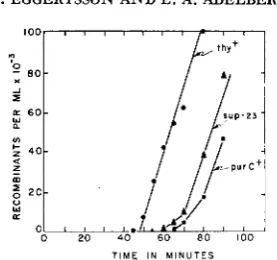
FIGURE 4.-Kinetics of recombinant formation for the t h y + , sup23 and purC+ markers in an interrupted-mating experiment. Donor AB2561 ; recipient AB2533.
T6, leucine, which is required for growth by the donor, was omitted from the selective media. The results of a typical bxperiment are shown in Figure
4.
It is seen that sup-23 entered the zygotes approximately 10 min later than thy+ and approximately 5 min earlier than purC+. The suppressor locus which is repre- sented by sup-23 is designated supN.Mapping of suppressors of Group I I , Type 2: The approximate map position of
sup-l was determined in conjugation experiments using as donor the 0-12 male
strain AB2275, which carries sup-1; the recipient strain was AB2291. Such ex- periments were complicated by the suppression of his-4 and try-3 of the recipient strain by s u p l (Table
4).
The results, however, indicated that sup-l is located near try. AB2562, an 0-1 male strain carrying ilv-188 and sup-1, was used in interrupted-mating experiments with F- strain AB2596; the latter carries ilv-188as well as a try mutation (try-23) which is not suppressible by sup-1. Selection was made for the donor markers try+ and sup-l (Isovalf). The donor strain was killed by streptomycin present in the selective media. In these experiments the times of entry of the two markers were not significantly different, suggesting very close linkage.
Co-transduction by P1 of sup-l with try was therefore tested using AB2275 as donor, and AB2596 as recipient. Isoval+ (sup-2 ) transductants were selected and scored for the unselected try+ marker of the donor. Among 200 Isoval+ transductants scored, 36% were try+.
The suppressor locus which is represented by sup-l is designated sup0. Nine additional suppressors of Group 11, Type 2 were mapped. All were found to be co-transducible with try at frequencies comparable to that found for supOl, and probably all represent the sup0 locus.
Mapping of suppressors of Group 11, Type 3: Two suppressors of Group 11,
SUPPRESSOR MUTATIONS IN E. coli 333 with argF1. Among 200 sup-18 transductants, 45% contained argF1; among the same number of sup-20 transductants, 54% contained argF1.
Further information about the map position of sup-20 was obtained in another
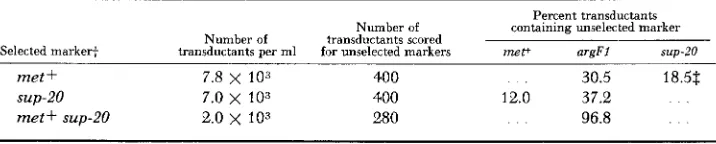
P1 transduction experiment. Strain AB2546 which carries sup-20 and argF1 was used as donor; AB1940 which carries met-27 was used as recipient. met-27 is jointly transducible with argF (J. PITTARD, personal communication). Selection was made for the donor markers met+ and sup-20, both separately and jointly. Strain AB1940 is iZv+, but carries try-3 and his-4, both of which are suppressible by sup-20 (Table 4 ) . Selection for sup-20 was therefore carried out on media unsupplemented with tryptophan and histidine. All selections were carried out on media containing arginine. Transductants of all selections were scored for the unselected marker argF1. In the case of met+ and sup-20 transductants. the un- selected sup-20 and met+ markers, respectively, were also scored. The results (Table 7) show that the three donor markers, met+, argF1 and sup-20, are all co-transducible; it can be concluded that their order on the chromosome is that given above.
It is assumed that the sup-18 and sup-20 mutations have both occurred in the same suppressor locus, which is designated supM.
Mapping of suppressors of Group III: The sup-11 mutation of Group 111.
which is present in strain AB2273, is co-transducible at a low frequency with
his. AB2277, which carries his-4, was used as recipient; both donor and recipient
contain ilvD145. Selection was made for the donor markers his+ and sup-11.
Scorings for the unselected donor markers sup-11 and his+, among the his+ and
sup-1 1 transductants, respectively, gave CO-transduction frequencies of 4 to 6%.
It will be recalled that ilvD88 is suppressed by sup-11 (Table 4 ) . Suppressors of Group 111 would therefore be expected to be obtainable in strains carrying
iluD88. Such a suppressor, sup-12, present in strain AB2285, proved to be CO-
transducible with his at a frequency similar to that of sup-11. sup-11 and sup-12
presumably represent the same locus, which is designated supH.
In order to determine more accurately the map position of sup-11, an 0-11
male strain, AB2536, carrying this suppressor, was used as donor in interrupted- mating experiments with strain AB2277 as recipient. Selection was made for the
TABLE 7
M a p position of sup-20 determined by Pi transduction'
Percent transductants Number of containing unselected marker Number of transductants scored
Selected marker+ transductants per ml for unselected markers met+ argFl sup-20
met + 7.8 x 10³ 400 30.5 18.5$
sup-20 7.0 x 10³ 400 12.0 37.2
met+ sup-20 2.0 x 10³ 280 96.8
* Recipient: AB1940 (met-27, argF+, sup+). Donor: AB2546 (met+ argFl sup-20). The data given in this table are all
334
0
x 2 5 -
G. EGGERTSSON A N D E. A, ADELBERG
I I I I I I
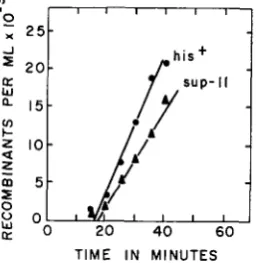
FIGURE 5.-Kinetics of recombinant formation for the his+ and s u p - I 1 markers in an inter- rupted-mating experiment. Donor AB2536; recipient AB2277.
donor markers his+ and sup-21. Arginine, which is required for growth by the donor strain, was omitted from the selective media in order to prevent growth of donor cells which might have survived treatment with bacteriophage T6. In such experiments, sup-22 entered the zygotes approximately 1 minute later than his+
(Figure
5).
Mapping of suppressors of Groups IV and V : Approximate mapping by conju-
gation indicated that both sup-9 (Group
IV)
and sup-23 (Group V) are trans- ferred later than metE, but earlier than pro, by 0-12 males. Both suppressors were introduced into 0-1 male strains; neither suppressor was transferred early by such strains. It is therefore tentatively concluded that both cuppressors are located in the region containing the ilv loci, between the Points of Origin 0-12 and 0-1, and probably closer to the latter. Presumably two loci are represented by the two suppressors.Results of suppressor-mapping experiments: a summary: Positions of suppres-
sor loci which have been mapped in this study are shown in Figure 6 (see also Table
4).
Of the six suppressor loci mapped, four are represented by Group 11, one by Group I, and one by Group 111 suppressors. The existence of two addi- tional suppressor loci, represented by Groups IV and V, is inferred. Five of the suppressor loci have been mapped by co-transduction with known markers.Suppression of a lacZ polarity mutation ( a so-called “0”” mutation) by sup-
pressors of Group ZI: The pleiotropic effect shown by ilu-188 suggested that it is
a polarity mutation comparable to the 0” mutations found in the 2 gene of the
SUPPRESSOR MUTATIONS IN E. coli 3
335
U P
0
C
-
FIGURE 6.-Genetic map of E . coli K-I2 showing positions of suppressor loci.
be capable of suppressing the lacZ13 polarity mutation. This possibility was tested as follows: Strain AB2291 was crossed with the 0-1 male strain AB2572
(lacZ13). Recombinants containing pro+ and gal+ were selected (the recipient
contains pro-2 and gal-2). Streptomycin was added to the selective medium to prevent growth of donor cells. Recombinants were scored for lacZ13. A lac223
recombinant, AB2550, which retains the ilv-188 allele of the recipient strain, was used as recipient in P1 transduction tests with four donor strains carrying ilv-188
and, respectively, the supL2, supM20, supN23, and sup01 alleles, representing each of the four Group I1 suppressor loci. Fifty sup (Isoval+) transductants from each experiment were scored for the ability to grow on lactose as sole carbon source. In each experiment, all the transductants tested were capable of utilizing lactose. It is therefore concluded that lac213 is suppressible by each of the four suppressors tested. These results support the inference that ilu-188 is a polarity mutation.
The ability of supL, supM, supN and sup0 to suppress lacZ13, together with the approximate map positions reported by BECKWITH (1963) for his suppressors, suggests that the same four loci have been identified in both his studies and in ours. If so, then his suA probably corresponds to our supM, his suB to our supL,
his sur to our sup0, and his suD to our supN. Until these correspondences can be verified, however, it seems best to retain the separate designations.
Tests for suppression of amber mutations of phage T4 b y suppressors of Group
336 G. EGGERTSSON A N D E. A. ADELBERG
mutations ( BENZER and CHAMPE 1962; SARABHAI, STRETTON, BRENNER and BoLLE 1964). The growth of an amber mutant is dependent on the presence in the bacterial host of a suppressor capable of suppressing the amber mutation. Suppression of amber mutations is caused by suppressors of certain mutations in the alkaline phosphatase locus in E . coli which are also thought to be nonsense mutations (GAREN and SIDDIQI 1962). Suppressors of nonsense mutations are referred to as nonsense suppressors. Three nonsense-suppressor loci have recently been mapped by GAREN, GAREN and WILHELM (1 965).
In preparation for testing whether suppressors of Groups I to V are capable of suppressing nonsense mutations, tests were carried out in order to determine whether nonsense suppressors were already carried by the primary strains in which the suppressible ilv mutations and their suppressors had been obtained. An amber mutant of phage T4, N130, was plated on many of the strains listed in Table 1. Most of these strains were found to support growth of the amber mutant, and are therefore inferred to contain nonsense suppressors. The non- sense suppressors carried by these strains have not been mapped, and it is not known whether the same suppressor (or suppressors) is present in all of them. All the suppressible ilv mutations used in the present work were induced in strain AB663. Mutations which are suppressible by the nonsense suppressor (or sup- pressors) that is present in strain AB663 could, therefore, not have been obtained. Neither could suppressors specific for such mutations be among the suppressors of Groups I to V. The possibility remained, however, that some of the latter might be nonsense suppressors whose specificity differed from that of the non- sense suppressor(s) present in strain AB663. In order to test this possibility, suppressors representing Groups I to V were introduced into strain AB2584, which does not contain nonsense suppressors. The suppressible mutations iluD132, ilu-188, iluD145, ilvD138 and ilvD75 were introduced into this strain by co-transduction with metE+. Suppressors representing each of the five SUP-
TABLE
a
Suppressors of Groups I to V , present in derivatives of AB2584, tested for suppression of amber mutations of phage T4*
ilu mutation Effect of sup ressor present in on growth otamber Suppressor group Suppressor suppressed strain mutants N130 and NI351
I I1 I1 I1 I1 I11 IV V
supT3 supL2 supMZ0 supN23
sup01
sup-1.2
s u p 9
s u p 1 3
iluD132
ilu-188
ilu-188 ilu-188 ilu-188 iluD145 iluD138 iluD75
* ilu mutations and suppressors were introduced into smain AB2584 as desuibed in the text. Criterion for suppression: t -=no plaques formef (no suppression); +=large plaques formed (suppression); (f) =very small plaques formed plaque formation in soft a ar layers on L-agar.
SUPPRESSOR MUTATIONS I N E. coli 337
pressor groups were subsequently introduced by Pl transduction (selecting for the Isoval+ phenotype) into metE+ transductants carrying the appropriate ilv
mutations. The suppressor-carrying strains thus obtained were tested for ability to suppress amber mutations N130 and N135. The results of these tests are sum- marized in Table 8. It is seen that only the four suppressors of Group I1 (repre- senting each of the four Group I1 suppressor loci) are capable of suppressing these amber mutations. However, two of the four Group I1 suppressors, supL2
and supN23, showed only very weak suppression of the amber phage mutations.
Suppression of amber mutations by certain suppressors of a polarity mutation
(lacZ13) has also been reported by BECKWITH (1963b).
Tests for suopression of ilv-188 by nonsense suppressors: As suppressors of ilv-188 were found to be capable of suppressing amber mutations of phage T4, it was of interest to test whether ilv-188 is suppressible by suppressors represent- ing any of the three nonsense-suppressor loci whose map positions have been determined by GAREN et al. (1965). This was done as follows: Strains AB2597, AB2598 and AB2599, (which were kindly provided by DR. A. GAREN), each carries a nonsense suppressor representing a different locus. An ilv mutation was induced by NTG in each of these strains, and metE46 was subsequently intro- duced by joint transduction with ilv+. Finally, the three strains carrying metE46 thus obtained were used as recipients in transduction experiments with a donor carrying ilv-188 and metE+. Selection was made for metE+ transductants, of which 100 from each experiment were scored for the Isoval phenotype. In case ilv-188 was suppressed by the nonsense suppressor present in the recipient, all the metE+ transductants were expected to be phenotypically Isoval+. If, on the other hand, suppression of ilu-188 by the nonsense suppressor present in the re- cipient did not occur. approximately 50% of the metE+ transductants were expected to be Isoval-. The latter was found with each of the three recipients. It is therefore concluded that the three nonsense suppressors tested are not capable of suppressing ilv-188.
DISCUSSION
In the experiments described above, six suppressor loci were mapped, and the existence of two additional suppressor loci was inferred. Our mapping data show no evidence for clustering of suppressor loci. However, one of the nonsense-sup- pressor loci studied by GAREN et al. (1965) is, like the sup0 locus, co-transducible with try (D. DUGGAN and A. GAREN, personal communication). The inference that two loci are involved is based only on the difference in specificity between the try-linked nonsense suppressors and supOl.
338 G . EGGERTSSON A N D E. A. ADELBERG
may be associated with episomic elements which can be attached to the chromo- some at more than one alternative position.
Our results indicate that the number of suppressor loci for a given suppressible mutation may in certain cases (e.g., ilvD132) be only one, in other cases (ilv-188,
lacZ13) at least four, and in the case of certain amber mutations of phage T 4 as many as seven (assuming that the three nonsense suppressor loci described by GAREN et al. (1965) all are different from our Group I1 loci). These differ- ences in the number of suppressors per mutation may be related to the number of amino acids whose substitution at the mutant site will restore the function of a given protein. It should be noted, however, that since many point mutations are not reverted by external suppressors, not all theoretically possible functional substitutions can be expected to be effected by such suppressors. The number of theoretically possible functional substitutions may be particularly high in the case of nonsense or polarity mutations. The ilv mutations suppressible by sup- pressors of Groups I, 111, IV and V are inferred to be missense mutations, since we did not observe suppression of amber mutations of phage T4 by suppressors of these Groups.
It will be recalled that three types of Group I1 suppressors could be distin- guished phenotypically (Table 5 ) . The difference between suppressors of differ- ent types can be explained on the hypothesis that they cause the substitutions of different amino acids. Thus, the heat sensitivity of the suppression of his-4 by
sup0 and supM may be due to substitution at the his-4 site of amino acids which make the mutant enzyme heat sensitive. Since ilv-188 and try-3 are suppressed by the same suppressors at 42"C, it seems less likely that the suppression mecha- nism itself is heat sensitive.
Ambiguous translation caused by a suppressor is expected to affect not only the mutated codon containing the suppressed mutation, but also other codons of the same type, wherever they occur in the genome. If the codon in question occurs relatively frequently, the mistakes in protein synthesis caused by the suppressor would be expected to have deleterious effects on growth, even on fully supple- mented media. Growth inhibitory effects of suppressors were observed by BECK-
WITH (1963a) and by SCHWARTZ (1964). In our study, mutations of both the
sup0 and the supM loci were found to have such effects (Table 5 ) .
Assuming that a suppressor mutation acts by changing a codon in a structural gene for one of the components of translation (e.g., ribosomes, activating enzymes or t-RNA molecules), it should be dominant in heterozygotes. It is possible, how- ever, that suppressor loci determine enzymes which secondarily modify the com- ponents of translation (e.g., by methylation). In that case, suppression could result from either the loss or the gain of enzyme activity. In the former case the suppressor mutation should be recessive; in the latter, it should be dominant. The only suppressor which was tested for dominance, supL2, was found to be dominant.
SUPPRESSOR MUTATIONS IN
E.
coli 339SUMMARY
Twelve mutations of loci governing the biosynthesis of isoleucine and valine
(ilv loci) were shown to be suppressible by external suppressors. The suppressors
were divided into five groups on the basis of allele specificity tests. Mapping of suppressors was carried out by conjugation and/or by transduction with phage
P1. Twenty-five suppressors of Group I were all co-transduced with thy and probably represent a single locus, supT. On the other hand, suppressors of Group
I1 were mapped at four different loci, supL, supM, and sup0, co-transducible with gal, w g F , and try, respectively; and supN, which is located between pur€
and thy. Suppressors of Group I11 were mapped at a locus, supH, which is CO-
transducible with his. Suppressors of Groups IV and V appear to represent two additional loci.
The supL locus is transducible by phage A. A mutation of this locus, supL2, is dominant in A supL2/supL+ heterogenotes.
The mutation ilv-188, which is suppressed by Group I1 suppressors, causes deficiency of two enzymes whose structures are controlled by ilv loci. Suppressors of Group I1 were found to suppress a known polarity mutation in the lac operon as well as certain amber ("nonsense") mutations of phage T4. ilv-188 was, how- ever, not suppressed by three different suppressors known to suppress nonsense mutations. Suppressors of Groups I, 111, IV, and V did not suppress amber mutations.
LITERATURE CITED
ADELBERG, E. A., and S. BURNS, 1960
ADELBERG, E. A., and J. W. MYERS, 1953
AMES, B., and P. E. HARTMAN, 1963
ARBFX, W., 1958
BECKWITH, J., 1963a
Genetic variation in the sex factor of Escherichia coli. J. Bacteriol. 79 : 321-330.
Modification of the penicillin technique for selection of auxotrophic bacteria. J. Bacteriol. 65: 348-353.
The histidine operon. Cold Spring Harbor Symp. Quant. Biol. 28: 249-356.
Transduction des characthres gal par le bactkriophage lambda. Arch. Sci. (Geneva) 11: 259-338.
Restoration of operon activity by suppressors. Biochim. Biophys. Acta
76: 162-164. - 1963b Restoration of operon activity by suppressors. pp. 119-123.
Struktur und Funktion d e s genetischen Materials. Erwin-Baur Symposium 111. Akademie- Verlag, Berlin. __ 1964 A deletion analysis of the lac operator region in Escherichia coli. J. Mol. Biol. 8 : 427-430.
BENZER, S., and S. CHAMPE, 1962 A change from nonsense to sense in the genetic code. Proc. Natl. Acad. Sci. U.S. 48: 1114-1121.
BRENNER, S , and A. 0. W. STRETTON, 1964 The amber mutation. J. Cell. Comp. Physiol. 64:
Supplement 1 : 4349.
BRODY, S.. and C. YANOFSKY, 1963 Suppressor gene alteration of protein primary structure. Proc. Natl. Acad. Sci. U.S. 50: 9-16.
340 G. EGGERTSSON A N D E. A. ADELBERG
DAVIES, J., W. GILBERT, and L. GORINI, 1964
DE HAAN, P. G., and J. D. GROSS, 1962
GAREN, A., and 0. SIDDIQI, 1962
GAREN, S., A. GAREN, and R. WILHELM, 1965
GORINI, L., and E. KATAJA, 1964a
Streptomycin, suppression and the code. Proc.
Transfer delay and chromosome withdrawal during
Suppression of mutations in the alkaline phosphatase structural
Suppressor genes for nonsense mutations. J. Mol. Biol. (In press.)
Phenotypic repair by streptomycin of defective genotypes in E. coli. Proc. Natl. Acad. Sci. U.S. 51: 487-493. - 1964b. Streptomycin-induced oversuppression in E. coli. Proc. Natl. Acad. Sci. U.S. 51: 995-1001.
IYER, V. N., and W. SZYBALSKI, 1958 Two simple methods for the detection of chemical muta- gens. Appl. Microbiol. 6 : 23-29.
JACOB, F.. and J. MONOD, 1961 Genetic regulatory mechanisms i n the synthesis of proteins. J. Mol. Biol. 3: 318-356.
LEDERBERG, E. M., L. CAVALLI-SFORZA, and J. LEDERBERG, 1964 Interaction of streptomycin and a suppressor for galactose fermentation in E. coli K-12. Proc. Natl. Acad. Sci. US. 51:
678482.
LENNOX, E. S., 1955 Transduction of linked genetic characters of the host by bacteriophage PI.
MORSE, M. L., E. M. LEDERBERG, and J. LEDERBERG, 1956 Transduction in Escherichia coli K-12.
NOTANI, G. W., D. L. ENGELHARDT, W. KONIGSBERG, and N. D. ZINDER, 1965 Suppression of a coat protein mutant of the bacteriophage f2. J. Mol. Biol. (In press.)
PITTARD, J., J. S. LOUTIT, and E. A. ADELBERG, 1963 Gene transfer by F' strains of Escherichia coli K-12. I. Delay in initiation of chromosome transfer. J. Bacteriol. 85: 1394-1401. RAMAKRISHNAN, T., and E. A. ADELBERG, 1964 Regulatory mechanisms in the biosynthesis of
isoleucine and valine. I. Genetic depression of enzyme formation. J. Bacteriol. 87: 566-573.
-
Regulatory mechanisms in the biosynthesis of isoleucine and valine. 11.Identification of two operator genes. J. Bacteriol. 89: 654-660.
-
196513 Regulatory mechanisms in the biosynthesis of isoleucine and valine. 111. Map order of the structural genes and operator genes. J. Bacteriol. 89: 661-664.SARABHAI, A. S., A. 0. W. STRETTON, S. BRENNER, and A. BOLLE, 1964 CO-linearity of the gene with the polypeptide chain. Nature 201: 13-17.
SCHWARTZ, N. M., 1964 Suppression of a lac00 mutation in Escherichia coli. J. Bacteriol. 88:
996-1001. - 1965 Genetic instability in Escherichia coli. J. Bacteriol. 89: 712-717. Response of Escherichia coli auxotrophs to heat after treatment with mutagenic alkyl methane sulfonates. J. Bacteriol. 83 : 241-249.
The genetic map of E . coli K-12. Genetics 50: 659- 677.
Amino acid substitutions resulting from suppression of nonsense mutations. I. Serine insertion by the su-1 suppressor gene. J. Mol. Biol. (In press.) Gene action. Ann. Rev. Microbiol. 14: 311-34.0. Natl. Acad. Sci. U.S. 51 : 883-890.
conjugation in Escherichia coli. Genet. Res. 3: 251-272.
cistron of E . coli. Proc. Natl. Acad. Sci. U.S. 48: 1121-1 127.
Virology 1 : 190-206.
Genetics 41 : 142-156.
1965a
STRAUSS, B. S., 1962
TAYLOR, A. L., and M. S. THOMAN, 1964
WEIGERT, M., and A. GAREN, 1965