Perfect Non-Interactive Zero Knowledge for NP
Jens Groth
∗Rafail Ostrovsky
†U.C.L.A.
Department of Computer Science
{
jg,rafail,sahai
}
@cs.ucla.edu
Amit Sahai
‡August 31, 2005
Abstract
Non-interactive zero-knowledge (NIZK) systems are fundamental cryptographic primitives used in many constructions, including CCA2-secure cryptosystems, digital signatures, and various crypto-graphic protocols. What makes them especially attractive, is that they work equally well in a concur-rent setting, which is notoriously hard for interactive zero-knowledge protocols. However, while for interactive zero-knowledge we know how to construct statistical zero-knowledge argument systems for all NP languages, for non-interactive zero-knowledge, this problem remained open since the inception of NIZK in the late 1980’s. Here we resolve two problems regarding NIZK:
• we construct the first perfect NIZK argument system for any NP language.
• we construct the first UC-secure NIZK protocols for any NP language in the presence of a dy-namic/adaptive adversary.
While it was already known how to construct efficient prover computational NIZK proofs for any NP language, the known techniques yield large common reference strings and large NIZK proofs. As an additional implication of our techniques, we considerably reduce both the size of the common reference string and the size of the proofs.
Keywords: Non-interactive zero-knowledge, universal composability, non-malleability.
1
Introduction
In this paper, we resolve a central open problem concerning Non-Interactive Zero-Knowledge (NIZK) protocols: how to construct statistical NIZK arguments for any NP language. While for interactive zero
∗Supported by NSF grant No. 0456717, and NSF Cybertrust grant.
†Supported in part by a gift from Teradata, Intel equipment grant, NSF Cybertrust grant No. 0430254, OKAWA research
award, B. John Garrick Foundation and Xerox Innovation group Award.
‡Supported by grant No. 0456717 from the NSF ITR and Cybertrust programs, an equipment grant from Intel, and an
knowledge (ZK), it has long been known how to construct statistical zero-knowledge argument systems for all NP languages [BCC88], for NIZK this question has remained open for nearly two decades.
IN CONTEXT WITH PREVIOUS WORK– STATISTICAL ZERO KNOWLEDGE: Blum, Feldman, and Micali
[BFM88] introduced the notion of NIZK in the common random string model and showed how to con-struct computational NIZK proof systems for proving a single statement about any NP language. The first computational NIZK proof system for multiple theorems was constructed by Blum, De Santis, Micali, and Persiano [BDMP91]. Both [BFM88] and [BDMP91] based their NIZK systems on certain number-theoretic assumptions (specifically, the hardness of deciding quadratic residues modulo a composite num-ber). Feige, Lapidot, and Shamir [FLS90] showed how to construct computational NIZK proofs based on any trapdoor permutation.
The above work, and the plethora of research on NIZK that followed, mainly considered NIZK where the zero-knowledge property was only true computationally; that is, a computationally bounded party can-not extract any information beyond the correctness of the theorem being proven. In the case of interactive zero knowledge, it has long been known that all NP statements can in fact be proven using statistical (in fact, perfect) zero knowledge arguments [BC86, BCC88]; that is, even a computationally unbounded party would not learn anything beyond the correctness of the theorem being proven, though we must assume that the prover, only during the execution of the protocol, is computationally bounded to ensure soundness1.
Achieving statistical NIZK has been an elusive goal. The original work of [BFM88] showed how an computationally unbounded prover can prove to a polynomially bounded verifier that a number is a quadratic-residue, where the zero-knowledge property is perfect. Statistical ZK (including statistical NIZK2 ) for any non-trivial language for both proofs and arguments were shown to imply the existence
of a one-way function by Ostrovsky [Ost91]. Statistical NIZK proof systems were further explored by De Santis, Di Crescenzo, Persiano, and Yung [DDPY98] and Goldreich, Sahai, and Vadhan [GSV99], who gave complete problems for the complexity class associated with statistical NIZK proofs. How-ever, these works came far short of working for all NP languages, and in fact NP-complete languages cannot have (even interactive) statistical zero-knowledge proof systems unless the polynomial hierarchy collapses [For87, AH87]3. Unless our computational complexity beliefs are wrong, this leaves open only
the possibility of argument systems.
Do there exist statistical NIZK arguments for all NP languages? Despite nearly two decades of re-search on NIZK, the answer to this question was not known. In this paper, we answer this question in the affirmative, based on a number-theoretic complexity assumption introduced in [BGN05].
OUR RESULTS. Our main results, which we describe in more detail below, are:
- Perfect NIZK arguments for any NP language.
- UC-secure perfect NIZK arguments for any NP language, secure against adaptive/dynamic adver-saries.
As a building block we start by constructing a simple and efficient computational NIZK proof of knowledge for circuit satisfiability, based on the subgroup decision problem introduced in [BGN05]. To
1Such systems where the soundness holds computationally have come to be known as argument systems, as opposed to proof systems where the soundness condition must hold unconditionally.
2We note that the result of [Ost91] is for honest-verifier SZK, and does not require the simulator to produce Verifier’s
random tape, and therefore it includes NIZK, even for the common reference string which is not uniform. See also [PS05] for an alternative proof.
the best of our knowledge, our techniques are completely different from all previous constructions of NIZK proofs. In this NIZK proof system, the size of the common reference string isO(k), wherekis the security parameter; thus it is independent of the size of the NP statements. The NIZK proofs have size
O(k|C|), where|C|is the size of the circuit. We point out that this is a significant result in its own right; the most efficient NIZK proof systems for an NP-complete problem with efficient provers previously known [KP98] required a reference string of size at least O(k3) and the NIZK proofs of size at least
O(|C|k2). For comparison with the most efficient previous work, please see Table 1.
Reference CRS size Proof Size Assumption Kilian-Petrank O(|C|k2) O(|C|k2) Trapdoor Permutations
Kilian-Petrank O(k3) O(|C|k3) Trapdoor Permutations
This paper O(k) O(|C|k) Specific Number-Theoretic [BGN05]
Table 1: Comparison of CRS size and NIZK Proof Size for Efficient-Prover NIZK Proof systems for NP-complete language
The NIZK proofs we construct are built using encryptions of the bits in the circuit. However, by a slight modification to only the reference string, we effectively transform the cryptosystem into a perfectly hiding commitment scheme. With this transformation, we obtain a perfect NIZK argument for NP statements. The result comes in two flavors:
- Perfect NIZK arguments for circuit satisfiability with “ordinary” soundness.
- Perfect NIZK arguments for circuit satisfiability with adaptive soundness, but for circuits of limited size.
By “ordinary” soundness we mean: for any NP statement, it is infeasible to make a valid NIZK argument for that statement given a random common reference string. However, in real life we can of course imagine an adversary that first sees the common reference string, and then chooses the false statement on which he will attempt to cheat. This is normally handled by an adaptive definition of soundness (e.g. [FLS90]). We make two observations regarding adaptive soundness:
First, we note that we can obtain full adaptive soundness if we restrict the size of statements to be proven. Let νSD(k) be the advantage of an adversary trying to decide the subgroup decision problem
of [BGN05]. We can construct NIZK arguments with adaptive soundness by limiting the adversary to picking circuits of size`(k)such that`(k)`(k)νSD(k)is negligible4
Second, we observe that our construction of perfect NIZK arguments (with only “ordinary” soundness) already achieves a weaker, but sufficient, form of adaptive soundness. It turns out, informally speaking, that if an adversary succeeds in producing an NIZK argument for a false statement, it cannot “know” that it has done so. In other words, if the adversary can efficiently recognize when it has succeeded in specifying a false statement, then it cannot produce a valid proof of that statement.
We are able to formalize the second observation and illustrate its utility by constructing perfect NIZK arguments that satisfy Canetti’s UC definition of security. Canetti introduced the universal composability (UC) framework [Can01] as a general method to argue security of protocols in an arbitrary environment. It is a strong security definition; in particular it implies non-malleability and security when arbitrary protocols are executed concurrently. The notion of non-malleability was introduced by Dolev, Dwork and
4For instance, if`(k) =k, then we assume thatν
SD(k) = 2−k
logk
Naor [DDN00] in the interactive setting for Zero-Knowedlge and Commitment protocols. In the non-interactive setting, the first non-malleable commitment protocol was given by Di Crescenzo, Ishai and Ostrovsky [DIO98]. Sahai introduced the first non-malleable NIZK proof system, for a single theorem [Sah99]. De Santis, Di Crescenzo, Ostrovsky, Persiano and Sahai showed how to construct non-malleable NIZK proofs for polynomially-many theorems. As mentioned above, the UC framework guarantees a strong form of non-malleability, and in [CLOS02], it was observed that [DDO+01] achieves UC-security, but only for the setting with static advrsaries.
We define NIZK arguments in the UC framework and construct a NIZK argument (without any re-strictions on the size of the NP statements that we prove) that satisfies the UC security definition. From the theory behind the UC framework, this means that we can plug in our NIZK argument in arbitrary settings and maintain security (including soundness!). At the same time, we can prove that our UC NIZK argument enjoys a perfect zero-knowledge property.
We stress that our result holds even in the setting of dynamic/adaptive adversaries without erasures: where the adversary can corrupt parties adaptively, and upon corruption of a party, it learns the entire history of the internal state of this party. Prior to our result, no NIZK protocol was known to be UC-secure against dynamic/adaptive adversaries.
1.1
Notation
We model adversarial behavior as non-uniform interactive probabilistic polynomial time algorithms. Un-less otherwise specified all other algorithms are uniform probabilistic polynomial time algorithms. A function ν : N → [0; 1] is negligible if for all ∀c > 0∃K∀k > K : ν(k) < 1
kc. For two functions
f1, f2 :N→[0; 1]we writef1(k)≈f2(k)if|f1(k)−f2(k)|is negligible. We writeoutput←A(input)
for the process of selecting randomnessrand settingoutput=A(input;r).
2
Non-interactive Zero-Knowledge
LetR be an efficiently computable binary relation. For pairs(x, w) ∈ R we call xthe statement andw the witness. LetLbe the language consisting of statements inR.
A proof system for a relationRconsists of a key generation algorithmK, a proverP and a verifierV. The key generation algorithm produces a common reference stringσ. The prover takes as input(σ, x, w)
and checks whether (x, w) ∈ R. In that case, it produces a proof or argument π, otherwise it outputs
failure. The verifier takes as input(σ, x, π)and outputs 1 if the proof is acceptable and 0 if rejecting the proof. We call(K, P, V)an argument or a proof system forRif it has the completeness and soundness properties described below.
COMPLETENESS. For all adversariesAwe have
Pr
h
σ ←K(1k); (x, w)← A(σ);π ←P(σ, x, w) :V(σ, x, π) = 1if(x, w)∈R
i
≈1.
SOUNDNESS. For all adversariesAwe have
Prhσ←K(1k); (x, π)← A(σ) :V(σ, x, π) = 0ifx /∈Li≈1.
KNOWLEDGE EXTRACTION. We call(K, P, V)an argument of knowledge or a proof of knowledge for
Rif there exists a knowledge extractorE = (E1, E2)with the properties described below.
For all adversariesAwe have
Prhσ←K(1k) :A(σ) = 1i ≈Prh(σ, τ)←E1(1k) :A(σ) = 1
i
For all adversariesAwe have
Pr
h
(σ, τ)←E1(1k); (x, π)← A(σ);w←E2(σ, τ, x, π) :V(σ, x, π) = 0or(x, w)∈R
i
≈1.
ZERO-KNOWLEDGE. We call(K, P, V)a NIZK argument or NIZK proof forRif there exists a simulator
S = (S1, S2)with the following zero-knowledge property. For all adversariesAwe have
Prhσ ←K(1k) :AP(σ,·,·)(σ) = 1i≈Prh(σ, τ)←S
1(1k) :AS
0(σ,τ,·,·)
(σ) = 1i,
whereS0(σ, τ, x, w) = S2(σ, τ, x)for(x, w)∈Rand outputsfailureif(x, w)∈/ R.
HONEST PROVER STATE RECONSTRUCTION. In modeling adaptive security without erasures, the prover may be corrupted at some time. To handle such cases, we want to extend the zero-knowledge property such that not only can we simulate an honest party making a proof, we also want to be able to simulate how it constructed the proof. In other words, once the party is corrupted the adversary will learn the witness and the randomness used, we want to create convincing randomness so that it looks like the simulated proof was constructed by an honest prover using this randomness.
We say a NIZK argument or proof forRhas honest prover state reconstruction if there exists a simu-latorS= (S1, S2, S3)so for allAwe have
Pr
h
σ←K(1k) :AP R(σ,·,·)(σ) = 1
i
≈Pr
h
(σ, τ)←S1(1k) :ASR(σ,τ,·,·)(σ) = 1
i
,
where P R(σ, x, w) runs r ← {0,1}`P(k);π ← P(σ, x, w;r) and returns π, r, and where SR runs
ρ ← {0,1}`S(k);π ← S
2(σ, τ, x;ρ);r ← S3(σ, τ, x, w, ρ)and returnsπ, r, both of the oracles outputting
failureif(x, w)∈/ R.
PERFECT COMPLETENESS, SOUNDNESS, KNOWLEDGE EXTRACTION AND ZERO-KNOWLEDGE. We speak of perfect completeness, perfect soundness, perfect knowledge extraction, perfect zero-knowledge and perfect honest prover state reconstruction if for sufficiently large security parameters we have equali-ties in the respective definitions.
Remark. In the paper, we will construct protocols with perfect completeness, perfect soundness, perfect zero-knowledge, etc. In doing so we assume the ability to pick elements from certain sets, e.g.,r ←Z∗
n.
If we consider the more strict setting, where the parties only have access to a source of unbiased coin-flips, we can still pick such elements from these sets in expected polynomial time. Alternatively, we can simply truncate the algorithms, in which case we do not get perfect completeness, perfect soundness, etc., but do get statistical completeness, statistical soundness, etc.
3
The Boneh-Goh-Nissim Cryptosystem
BILINEAR GROUPS. We use two cyclic groupsG,G1 of ordern, wheren = pqandp, q are primes. We
make use of a bilinear map e : G×G → G1. I.e., for all u, v ∈ Gand a, b ∈ Z we havee(ua, vb) =
e(u, v)ab. We require thate(g, g)is a generator of
G1 ifg is a generator ofG. We also require that group
operations, group membership, sampling of a random generator forGand the bilinear map be efficiently computable.
[BGN05] suggest the following example. Pick large primesp, q and letn = pq. Find the smallest ` soP = `n−1is prime and equal to 2 modulo 3. Consider the points on the elliptic curve y2 = x3+ 1
overFP. This curve hasP + 1 =`npoints, so it has a subgroupGof ordern. We letG1 be the ordern
subgroup ofF∗P2 ande:G×G→G1 be the modified Weil-pairing.
THE SUBGROUP DECISION PROBLEM. LetGbe an algorithm that takes a security parameter as input and outputs(p, q,G,G1, e)such thatp, q are primes,n =pqandG,G1 are descriptions of groups of ordern
ande:G×G→G1 is a bilinear map.
LetGqbe the subgroup ofGof orderq. The subgroup decision problem is to distinguish elements of Gfrom elements ofGq. LetGgenbe the generators ofGand letAbe an adversary. Define
SD-AdvA(1k) = Pr
h
(p, q,G,G1, e)← G(1k);n =pq;g, h←Ggen :A(n,G,G1, e, g, h) = 1
i
−Pr
h
(p, q,G,G1, e)← G(1k);n =pq;g ←Ggen, h←Gq\ {1}:
A(n,G,G1, e, g, h) = 1
i
.
Definition 1 The subgroup decision assumption holds for generatorGif there exists a negligible function νSD :N→[0; 1]so for any adversaryAwe have SD-AdvA(1k)< νSD(k)for sufficiently largek.
We remark that we have changed the wording of the subgroup decision problem slightly in comparison with [BGN05], but the definitions are equivalent.
THE BGN-CRYPTOSYSTEM. We generate a public key by running (p, q,G,G1, e) ← G(1k), setting
n = pq, selectingg as a random generator of Gand has a random generator of Gq. The public key is
(n,G,G1, e, g, h)while the decryption key isp, q.
To encrypt a message m of length O(logk)using randomness r ← Z∗
n we compute the ciphertext
c=gmhr. To decrypt we computecq =gmqhmq = (gq)mand exhaustively search form.
By the subgroup decision assumption, we could indistinguishably selecthto be a random generator of
Gas well. In this case, we do not have a cryptosystem but rather a perfectly hiding commitment scheme.
4
Non-interactive Zero-Knowledge Proof
4.1
NIZK Proof that
c
Encrypts 0 or 1
We will construct a NIZK proof of knowledge for circuit satisfiability in Section 4.2. As a building block in this NIZK proof, we will encrypt the truth-values of the wires in the circuit. We need to convince the verifier that these ciphertexts have been correctly formed. We therefore start by constructing a NIZK proof that a BGN-ciphertext has either 0 or 1 as plaintext.
We observe that if a ciphertextccontains 0 or 1, then eitherc ∈ Gq orcg−1 ∈ Gq, soe(c, cg−1)has
orderq. Writec=gy, thene(c, cg−1) = e(g, g)y(y−1). Ife(c, cg−1)has orderq, theny(y−1) = 0 modp,
If we know m, w soc = gmhw then m = 0 impliese(c, cg−1) = e(hw, g−1hw) = e(h,(g−1hw)w)
and if m = 1 we havee(c, cg−1) = e(ghw, hw) = e(h,(ghw)w). So in both cases we get e(c, cg−1) =
e(h,(g2m−1hw)w). Revealing the two components will immediately convince the verifier thate(c, cg−1)
has orderq, however may not be zero-knowledge.
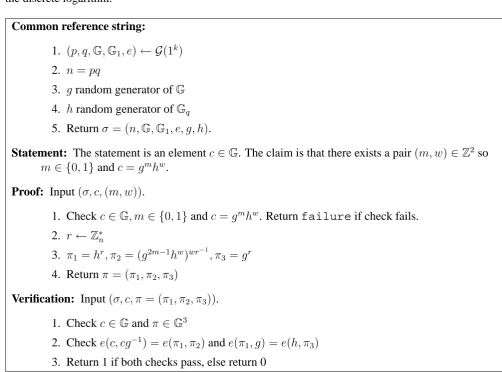
Instead, we make a NIZK proof fore(c, cg−1)having orderqas follows. We choose a random exponent rand compute e(c, cg−1) = e(hr,(g2m−1hw)wr−1
). We reveal these two components, and must convince the verifier that the first element π1 = hr has orderq. For this purpose, we show him the element gr.
Sincee(π1, g) =e(hr, g) =e(h, gr)the verifier can now tell thatπ1has orderq.
To argue zero-knowledge we change the public key. Instead of havinghof orderq, we usehof order n and selectg so we know the discrete logarithm. Now all ciphertexts are perfectly hiding commitments so we can create all of them as encryptions of 0. We can simulate the revelation ofgr because we know the discrete logarithm.
Common reference string:
1. (p, q,G,G1, e)← G(1k)
2. n =pq
3. g random generator ofG
4. hrandom generator ofGq
5. Returnσ= (n,G,G1, e, g, h).
Statement: The statement is an elementc∈G. The claim is that there exists a pair(m, w)∈Z2 so
m∈ {0,1}andc=gmhw.
Proof: Input(σ, c,(m, w)).
1. Checkc∈G, m∈ {0,1}andc=gmhw. Returnfailureif check fails.
2. r ←Z∗
n
3. π1 =hr, π2 = (g2m−1hw)wr
−1
, π3 =gr
4. Returnπ= (π1, π2, π3)
Verification: Input(σ, c, π= (π1, π2, π3)).
1. Checkc∈Gandπ ∈G3
2. Checke(c, cg−1) =e(π
1, π2)ande(π1, g) =e(h, π3)
3. Return 1 if both checks pass, else return 0
Figure 1: NIZK proof of plaintext being zero or one.
Theorem 2 The protocol in Figure 1 is a NIZK proof that c ∈ Ghas plaintextm ∈ {0,1}with honest prover state reconstruction.
Proof. PERFECT COMPLETENESS. Let x be the secret discrete logarithm so h = gx. We
e(g, g)m(m−1)+xw(2m−1+xw) =e(g, g)rx(2m−1+xw)wr−1
=e(hr,(g2m−1hw)wr−1
) = e(π1, π2). Furthermore,
e(π1, g) = e(hr, g) = e(h, gr) =e(h, π3).
PERFECT SOUNDNESS. Let again x be the secret discrete logarithm so h = gx. Consider c, π so e(c, cg−1) = e(π
1, π2)ande(π1, g) = e(h, π3). There exist0≤m < pandw∈Zsoc=gmhw.
We havee(πq1, g) =e(π1, g)q =e(h, π3)q =e(hq, π3) = e(1, π3) = 1. Therefore,π1 must have order
1orq. This means there exists somersoπ1 =hr.
As before we havee(c, cg−1) =e(g, g)m(m−1)+xw((2m−1)+xw). At the same time we havee(c, cg−1) =
e(π1, π2) = e(hr, π2)and thereforee(c, cg−1)q =e(hrq, π2) = e(1, π2) = 1. Som(m−1) +xw((2m−
1) +xw) = 0 modn, andp|xtells usm(m−1) = 0 mod p. Since0≤ m < pthis impliesm ∈ {0,1}. So there does indeed existm∈ {0,1}andwsoc=gmhw.
COMPUTATIONAL ZERO-KNOWLEDGE AND HONEST PROVER STATE RECONSTRUCTION. First, we
de-scribe the simulator S = (S1, S2, S3). S1 runs the algorithm for generating the common reference string
with the following modification. It selects h to be a random generator for G and sets g = hγ, where
γ ←Z∗
n. During the generation of the common reference string the simulator also learnsp, q. S1outputs
(σ, τ) = ((n,G,G1, g, h),(p, q, γ)).
S2 on input (σ, τ, c) simulates a proof as follows. Eitherc, cg−1, or both are generators forG. The
simulator picks r ← Z∗
n. If cis a generator it setsπ1 = cr, π2 = (cg−1)r
−1
and π3 = πγ1. If cis not a
generator for the group, then the simulator setsπ1 = (cg−1)r, π2 =cr
−1
, π3 =π
γ
1.
S3 is given the witness (m, w) so c = gmhw and m ∈ {0,1} and wishes to reconstruct how the
prover could have come up with the proof π. Since it knows γ it can write c = hγm+w. Consider first
the case where cis a generator for G, then we have gcd(n, γm+w) = 1. So we can write the proof as π1 = hr(γm+w), π2 = (g2m−1hw)w(r(γm+w))
−1
, π3 = gr(γm+w). We return r(γm+w) mod n as the
prover’s simulated randomness that would cause it to produceπ. In casecis not a generator, we know that cg−1 is a generator and we write the proof asπ1 = hr(γ(m−1)+w), π2 = (g2m−1hw)w(r(γ(m−1)+w))
−1
, π3 =
gr(γ(m−1)+w)and returnr(γ(m−1) +w) modnas the prover’s simulated randomness.
To argue computational zero-knowledge we consider a hybrid experiment, where we useS1to generate
the common reference stringσ, but implement the simulation oracle using the real proverP. We first show that for all adversariesAwe have
|Prhσ←K(1k) :AP R(σ,·,·)(σ) = 1i−Prh(σ, τ)←S
1(1k) :AP R(σ,·,·)(σ) = 1
i
|< νSD(k),
where P R(σ,(σ, c),(m, w)) runs r ← Z∗
n;π ← P(σ,(σ, c),(m, w);r) and returns π, r, and outputs failureifm /∈ {0,1}orc6=gmhw.
The only difference between the two experiments is the choice of h. In one case, h is a random generator of G in the other case it is a generator of Gq. We do not use the knowledge of p, q or the
discrete logarithm ofgwith respect tohin either experiment. Consider now a subgroup decision problem challenge (n,G,G1, e, g, h). The challenges correspond exactly to common reference strings produced
by respectivelyK andS1. The advantage ofAis therefore bounded byνSD(k).
Next, we go from the hybrid experiment to the simulation. For allAwe have
Prh(σ, τ)←S1(1k) :AP R(σ,·,·)(σ) = 1
i
= Prh(σ, τ)←S1(1k) :ASR(σ,τ,·,·)(σ) = 1
i
,
where SR runs ρ ← Z∗
n;π ← S2(σ, τ,(σ, c);ρ);r ← S3(σ, τ,(σ, c),(m, w), ρ) and returns π, r, or
failureifm /∈ {0,1}orc6=gmhw.
A simulated proof π = (π1, π2, π3) uniquely defines the randomnessr ∈ Z∗n so π1 = hr, and it is
distribution as real proofs in the hybrid experiment. In case cis a generator for G, S2 selects r ← Z∗n
at random and setπ1 = cr, which gives us a random generator ofG. In a real prover’s proofπ1 is also
a random generator of Gwhenhhas order n. Since π1 uniquely definesπ2 andπ3, we see that the two
distributions are identical. Ifcis not a generator forG, thencg−1and since a simulatedπ
1 = (cg−1)rfor
r ←Z∗
nis a random generator ofG, we can use a similar argument to show that also in this case we get a
perfect simulation.
4.2
NIZK Proof of Knowledge for Circuit Satisfiability
Suppose we have a circuitCand want to prove that there existswsoC(w) = 1. Since any circuit can be linearly reduced to a circuit built only from NAND-gates, we will without loss of generality focus on this simpler case.
To prove satisfiability ofC we encrypt the bit value of each wire, when the circuit is evaluated on the input bits inw. Using the NIZK proof in Figure 1 it is straightforward to prove that all ciphertexts contain a plaintext in {0,1}. We form the output ciphertext with randomness 0 so it is straightforward for the verifier to check that the output of the circuit is 1.
The only thing left is to prove that all the encrypted output wires do indeed evaluate the NAND-gates correctly. We make the following observation, leaving the proof to the reader.
Lemma 3 Letb0, b1, b2 ∈ {0,1}.
b0+b1+ 2b2−2∈ {0,1}if and only ifb2 =b0 NANDb1.
Given ciphertexts c0, c1, c2 containing plaintexts b0, b1, b2 we can use the homomorphic properties to
form the ciphertext c0c1c22g
−2. A NIZK proof that c 0c1c22g
−2 contains a plaintext in {0,1} implies
b2 =b0NANDb1, as required. We make such a NIZK proof for each NAND-gate in the circuit.
Theorem 4 The protocol in Figure 2 is a NIZK proof of knowledge of circuit satisfiability with honest
prover state reconstruction.
Proof. PERFECT COMPLETENESS. Knowing a satisfying assignment w for C, we can compute
truth-values for all wires that are consistent with the NAND-gates and make the circuit have 1 as output. Perfect completeness follows from the perfect completeness of the NIZK proofs of plaintexts being either 0 or 1. PERFECT SOUNDNESS. Since we prove for each wire that the encrypted plaintext is either 0 or 1, we have made a perfectly binding commitment to a bit for each wire. By Lemma 3, the NIZK proofs for the gates imply that all encrypted wire-bits respect the NAND-gates. Finally, we know that the output ciphertext is g, so the output bit is 1.
PERFECT KNOWLEDGE EXTRACTION. The extractor sets up the common reference string by running the
key generator for the NIZK proof. In the process it learnsp, q. This allows it to decrypt the ciphertexts containing the input-bits. Since the NIZK proof has perfect soundness, these input bits must correspond to a witnesswsoC(w) = 1.
COMPUTATIONAL ZERO-KNOWLEDGE AND HONEST PROVER STATE RECONSTRUCTION. LetS1be the
simulator of the NIZK proof for a ciphertext having 0 or 1 as plaintext. We use the same algorithm to create the common reference string for simulation of circuit satisfiability NIZK proofs. In other words, bothg, hare random generators ofGand the simulator knowsγ ∈Z∗
Common reference string:
1. (p, q,G,G1, e)← G(1k)
2. n =pq
3. g random generator ofG
4. hrandom generator ofGq
5. Returnσ= (n,G,G1, e, g, h).
Statement: The statement is a circuitCbuilt from NAND-gates. The claim is that there exist input bitswsoC(w) = 1.
Proof: The prover has a witnesswconsisting of input bits soC(w) = 1.
1. Extendwto contain the bits of all wires in the circuit.
2. Encrypt each bitwiasci =gwihri, withri ←Z∗n.
3. For allci make a NIZK proof of existence ofwi, ri sowi ={0,1}andci =gwihri.
4. For the output of the circuit we let the ciphertext becoutput =g, i.e., an easily verifiable
encryption of 1.
5. For all NAND-gates, we do the following. We have input ciphertextsc0, c1 and output
ciphertextsc2. We wish to prove the existence ofw0, w1, w2 ∈ {0,1}andr0, r1, r2so
w2 =w0 NANDw1 andcj =gwjhrj. To do so we make a NIZK proof that there exist
m, rwithm∈ {0,1}soc0c1c22g−2 =gmhr.
6. Returnπconsisting of all the ciphertexts and NIZK proofs.
Verification: The verifier given a circuitCand a proofπ.
1. Check that all wires have a corresponding ciphertext and that the output wire’s ciphertext isg.
2. Check that all ciphertexts have a NIZK proof of the plaintext being 0 or 1.
3. Check that all NAND-gates have a valid NIZK proof of compliance.
4. Return 1 if all checks pass, else return 0.
Figure 2: NIZK proof for circuit satisfiability.
S2 starts by choosing the ciphertexts for the wires: The output wire gets the ciphertextg. For all other
wires, it selects a ciphertextci =hri withri ←Z∗n. Later, whenS3 learns a witnessw, it can compute the
corresponding messagesmi ∈ {0,1}for all these ciphertexts, and open them asci =gmihri−miγ
−1
. For all these ciphertexts S2 simulates a NIZK proof that they contain 0 or 1 as the plaintext. Also
for all NAND-gates with input wires i0, i1 and output wirei2 it simulates a NIZK proof that ci0ci1c
2
i2g
−2
contains a plaintext that is 0 or 1. Later, upon learning the witnessw,S3knows the plaintextswij ∈ {0,1}
and randomizersrij −wijγ
−1 that constitute a satisfactory encryption of the wires of a satisfied circuit.
For each NIZK proof of a plaintext being 0 or 1,S3 can run the honest prover state reconstructor to get
To prove that this is a good simulation, we first consider a hybrid experiment where we use the simu-lator to create the common reference string, but use the real prover to create the NIZK proofs. As in the proof of Theorem 2, we can argue that for all adversariesAwe have
|Pr
h
σ←K(1k) :AP R(σ,·,·)(σ) = 1
i
−Pr
h
(σ, τ)←S1(1k) :AP R(σ,·,·)(σ) = 1
i
|< νSD(k),
whereP R(σ, C, w)runsπ←P(σ, C, w;r)and returnsπ, r.
Next, we modify the way we create proofs. Instead of running the real prover, we create the encryp-tions of the wires ci as the real prover, but simulate the NIZK proofs of 0 or 1 being the plaintext and
simulate the NIZK proofs for the NAND-gates as well. ¿From the proof of Theorem 2 we get that this modification does not increaseA’s probability of outputting 1. We have
Prh(σ, τ)←S1(1k) :AP R(σ,·,·)(σ) = 1
i
= Prh(σ, τ)←S1(1k) :AP SR(σ,τ,·,·)(σ) = 1
i
,
whereP SR(σ, τ, C, w)creates ciphertextsci correctly but simulates NIZK proofs for 0- or 1-plaintexts
and the randomness involved, and outputsfailureifC(w)6= 1. Finally, we go to the full simulation. For allAwe have
Prh(σ, τ)←S1(1k) :AP SR(σ,τ,·,·)(σ) = 1
i
= Prh(σ, τ)←S1(1k) :ASR(σ,τ,·,·)(σ) = 1
i
,
where SR runs π ← S2(σ, τ, C;ρ);r ← S3(σ, τ, C, w, ρ) and returns π, r, and outputs failure if
C(w) 6= 1. The only difference here is in the way we create the ciphertexts, but since they are perfectly hiding, we cannot distinguish the two experiments.
5
Non-interactive Statistical Zero-Knowledge Argument
In this section, we construct a NIZK argument of circuit satisfiability with perfect zero-knowledge. The main idea is a simple modification of the NIZK proof for circuit satisfiability in Figure 2. Instead of choosingh of orderq, we let hbe a random generator of G. This waygmhr is no longer an encryption
ofm, but a perfectly hiding commitment tom. It corresponds to usingS1 restricted to the first half of its
outputs as key generator. Completeness is obvious and the proof of Theorem 4 reveals that the argument is perfect zero-knowledge.
Soundness is trickier though. Sincegmhr is not statistically binding, we cannot prove soundness as
we did in Theorem 4. Suppose we have circuitC /∈Lgenerated independently of the common reference string. We can argue that no adversary can distinguish anhof ordernfrom anhof orderq, and therefore has negligible probability of making an acceptable NIZK argument.
However, if the common reference string is chosen first, then the adversary may choose a circuitC that depends on the common reference string. For instance, we cannot exclude the possibility that it could create an acceptable NIZK argument forh having order smaller than n. This is a false statement, since hhas ordern. However, if we try to argue soundness by switching the reference string to containhwith orderq, then the statement is suddenly true and it might be possible to create such a NIZK argument.
In order to overcome this problem we tighten the subgroup decision assumption. We show that if all adversaries have less than `(k)−`(k)ν(k) chance of distinguishing h generating either G or Gq, then all
Let Sσ be the simulator S1 from the proof of Theorem 4 restricted to its first output. We have the
following theorem
Theorem 5 (Sσ, P, V) is a NIZK argument for circuit satisfiability for circuits of size at most `(k) if
νSD(k)< `(k)−`(k)ν(k)for some negligible functionν.
Proof. As in the proof of Theorem 4, we can show that the protocol has perfect completeness. Perfect zero-knowledge and honest prover state reconstruction follows from the proof of Theorem 4. This leaves us with the question of soundness.
NON-ADAPTIVE COMPUTATIONAL SOUNDNESS. We first demonstrate that the NIZK argument has non-adaptive soundness, i.e., all adversaries have negligible probability of proving a false statement if they choose this statement independently of the common reference string.
Consider any circuitCwith no satisfying witness and a polynomial time adversaryAthat with proba-bility So-AdvA(1k)breaks the soundness property. In other words,Ais given a common reference string
and proceeds to output a valid argumentπ. We will construct an adversaryB that decides the subgroup decision problem with probability SD-AdvB(1k) =So-AdvA(1k).
Bgets a challenge(n,G,G1, e, g, h)and has to decide whetherhhas ordernor not. This corresponds
to a common reference string generated by eitherK orSσ. So we can give it toAand output 1 if and only
ifAforms a valid argument forC being true.
In casehhas order n, the common reference string produced by B is distributed exactly as in a real argument. The adversary therefore has probability So-AdvA(1k)of generating an acceptable argument.
On the other hand, in casehhas orderq the common reference string produced byBis distributed as the reference string in the previously described NIZK proof. Since the NIZK proof has perfect soundness, the probability ofAproducing a valid argument is 0.
COMPUTATIONAL SOUNDNESS. Consider now an adversaryAwith probability So-AdvA(1k)for
break-ing the soundness property. Let C be the unsatisfiable circuit of size at most`(k) that is most likely to be used byA in a valid NIZK argument. As argued in the previous paragraph, the probability ofA se-lecting this circuit when it sees the reference string and making an acceptable NIZK argument is at most SD-Adv(1k). There are at most`(k)`(k)circuits of size`(k). Summing over all possible circuits we have
So-AdvA(1k)≤`(k)`(k)νSD(k)< ν(k).
6
Universally Composable Non-interactive Zero-Knowledge
6.1
Modeling Non-interactive Zero-Knowledge Arguments
The universal composability (UC) framework (see [Can01] for a detailed description) is a strong security model capturing security of a protocol under concurrent execution of arbitrary protocols. We model all other things not directly related to the protocol through a polynomial time environment. The environment can at its own choosing give inputs to the parties running the protocol, and according to the protocol specification the parties can give outputs to the environment. In addition, there is an adversary A that attacks the protocol. A can communicate freely with the environment. It can also corrupt parties, in which case it learns the entire history of that party and gains complete control over the actions of this party.
and tells the parties what they would output if they executed the protocol correctly. In the ideal process, the parties simply pass on inputs from environment toF and whenever receiving a message fromF they output it to the environment. In the ideal process, we have an ideal process adversaryS. S does not learn the content of messages sent fromF to the parties, but is in control of when, if ever, a message fromF
is delivered to the designated party. S can corrupt parties, at the time of corruption it will learn all inputs the party has received and all outputs it has sent to the environment. As the real world adversary, S can freely communicate with the environment.
We now compare these two models and say that it is secure if no environment can distinguish between the two worlds. This means, the protocol is secure, if for anyArunning in the real world, there exists an
S running in the ideal process withF so no environment can distinguish between the two worlds.
The standard zero-knowledge functionality FZK as defined in [Can01] goes as follows: On input
(prove,P, V, sid, x, w) from P the functionality FZK checks that (x, w) ∈ R and in that case sends
(proof,P, V, sid, x) to V. It is thus part of the model that the prover will send the proof to a particular receiver and that this receiver will learn who the prover is. This is a very reasonable model when we talk about interactive NIZK proofs of knowledge. We remark that with only small modifications in the UC NIZK argument that we are about to suggest we could securely realize this functionality.
However, when we talk about NIZK arguments we do not always know who is going to receive the NIZK argument. We simply create a stringπ, which is the NIZK argument. We may create this string in advance and later decide to whom to send it. Furthermore, anybody who intercepts the stringπcan verify the truth of the statement and can use the string to convince others about the truth of the statement. The NIZK argument is not deniable; quite on the contrary it is transferable. For this reason, and because the protocol and the security proof becomes a little simpler, we suggest a different functionality FN IZK to
capture the essence of NIZK arguments.
Parameterized with relationRand running with partiesP1, . . . , Pnand adversaryS.
Proof: On input (prove,sid, ssid, x, w) from partyP ignore if(x, w)∈/ R. Send (prove,x) toS and wait for answer (proof, π). Upon receiving the answer store(x, π)and send
(proof, sid, ssid, π) toP.
Verification: On input (verify, sid, ssid, x, π)fromV check whether(x, π)is stored. If not send (verify,x, π) toS and wait for an answer (witness,w). Upon receiving of the answer, check whether(x, w)∈Rand in that case, store(x, π). If(x, π)has been stored return
(verification,sid, ssid,1) toV, else return (verification,sid, ssid,0).
Figure 3: NIZK functionalityFN IZK.
6.2
Tools
We will need a few cryptographic tools to securely realizeFN IZK.
PERFECTLY HIDING COMMITMENT SCHEME WITH EXTRACTION. A perfectly hiding commitment scheme with extraction (first used in [CKOS01] in the setting of perfectly hiding non-malleable com-mitment) has the following property. We can run a key generation algorithm hk ← Kstat(1k)to get a
commitment scheme. On the other hand,(Kextract, com, dec)constitute a public key cryptosystem with errorless decryption, i.e.,
Prh(hk, xk)←Kextract(1k) :∀(m, r) :decxk(comhk(m;r)) =m i
≈1.
We demand that no adversaryAcan distinguish between the two key generation algorithms. This implies that the cryptosystem is semantically secure against chosen plaintext attack since the perfectly hiding commitment does not reveal what the message is.
We have already seen one example of a perfectly hiding commitment scheme with extraction. We can set up the BGN-cryptosystem with a public key, whereh has full ordern. In this case the cryptosystem is a perfectly hiding commitment scheme. We can also set it up with hhaving order q, in this case the cryptosystem has errorless decryption. The subgroup decisional assumption implies that no adversary can distinguish commitment keys from cryptosystem keys.
PSEUDORANDOM CRYPTOSYSTEM. A cryptosystem(Kpseudo, E, D)has pseudorandom ciphertexts of
length`E(k)if for all adversariesAwe have
Prh(pk, dk)←Kpseudo(1k) :AEpk(·)(pk) = 1 i
≈ Prh(pk, dk)←Kpseudo(1k) :ARpk(·)(pk) :A(c) = 1 i
,
where Rpk(m) runs c ← {0,1}`E(k) and returns c. We require that the cryptosystem have errorless
decryption as defined earlier.
The BGN-cryptosystem serves as an example of a pseudorandom cryptosystem. It is also known that trapdoor permutations imply pseudorandom cryptosystems, we can use the Goldreich-Levin hard-core bit [GL89] of a trapdoor permutation to make a one-time pad.
TAG-BASED SIMULATION-SOUND TRAPDOOR COMMITMENTA tag-based commitment scheme has four algorithms. The key generation algorithmKcomproduces a commitment keyckas well as a trapdoor key tk. There is a commitment algorithm that takes as input the commitment key ck, a message mand any tagtag and outputs a commitmentc= commitck(m, tag;r). To open a commitment cwe revealm, tag
and the randomnessr. Anybody can now verify whether indeedc= commitck(m, tag;r). As usual, the
commitment scheme must be both hiding and binding.
In addition, to these two algorithms there are also a couple of trapdoor algorithmsTcom,Topenthat allow us to create an equivocal commitment and later open this commitment to any value we prefer. We create an equivocal commitment and an equivocation key as (c, ek) ← Tcomck,tk(tag). Later we can
open it to any messagemasr ← Topenck,ek(c, m, tag), such thatc = commitck(m, tag;r). We require
that equivocal commitments and openings are indistinguishable from real openings. For all adversariesA
we have
Prh(ck, tk)←Kcom(1k) :AR(·,·)(ck) = 1i≈Prh(ck, tk)←Kcom(1k) :AO(·,·)(ck) = 1i,
where R(m, tag) returns a randomly selected randomizer and O(m, tag) computes (c, ek) ←
Tcomck,tk(m, tag);r←Topenck,ek(c, m, tag)and returnsrandAdoes not submit the sametagtwice to
the oracle.
we have made equivocations for commitments using different tags. For all adversariesAwe have
Prh(ck, tk)←K(1k); (c, tag, m0, r0, m1, r1)← AO(·)(ck) :
c= commitck(m0, tag;r0) = commitck(m1, tag;r1)andm0 6=m1 andtag /∈Q
i
≈0,
where O(commit, tag) computes (c, ek) ← Tcomck,tk(tag), returns c and stores (c, tag, ek), and
O(open, c, m, tag) returns r ← Topenck,ek(c, m, tag) if (c, tag, ek) has been stored, and where Q is the list of tags for which equivocal commitments have been made byO.
Tag-based simulation-sound trapdoor commitment were first implicitly defined in [DIO98], and ex-plicitly in [CKOS01, MY04]. The notion of simulation soundness for NIZK [Sah99] will be critical to us here, as well (see below). Aside from [DIO98, Sah99, CKOS01, MY04], other constructions of tag-based simulation sound commitments or schemes that can easily be transformed into tag-based simulation-sound commitments have appeared in [DDO+01, CLOS02, GMY03, DG03, Gro04, Gro05].
STRONG ONE-TIME SIGNATURES. We remind the reader that strong one-time signatures allow an ad-versary to ask an oracle for a signature on one arbitrary message. Then it must be infeasible to forge a signature on any different message and also infeasible to come up with a different signature on the same message. One-time signatures can be constructed from one-way functions.
6.3
UC NIZK
The standard technique to prove that a protocol securely realizes a functionality in the UC framework is to show that the ideal model adversary S can simulate everything that happens on top of the ideal functionality. In our case, there are two tricky parts. First, S may learn that a statement C has been proved and has to simulate a UC NIZK argument π without knowing the witness. Furthermore, if this honest prover is corrupted later then we learn the witness but must now simulate the randomness of the prover that would lead it to produce π. The second problem is that whenever S sees an acceptable UC NIZK argument π for a statementC, then an honest verifier V will accept. We must therefore, input a witnesswtoFN IZK so it can instructV to accept.
The main idea in overcoming these hurdles is to commit to the witnessw and make a NIZK proof that indeed we have committed to a witnessw soC(w) = 1. We must show that our NIZK proof has a simulation-soundness property (see above) to ensure that only true statements can be proven. On the other hand, if the NIZK proof has the honest prover state reconstruction property, then we can simulate NIZK proofs and the prover’s random coins when forming this NIZK proof. This leaves us with the commitment scheme. On one hand, when we simulate UC NIZK arguments we want to make equivocal commitments that can be opened to anything since we do not know the witness yet. On the other hand, when we see a UC NIZK argument that we did not construct ourselves we want to be able to extract the witness, since we have to give it toFN IZK.
We will construct such a commitment scheme from the tools specified in the previous section. We use a tag-based simulation-sound trapdoor commitment scheme to commit to each bit ofw. Ifwhas length` this gives us commitmentsc1, . . . , c`. For honest provers we can use the trapdoor keytkto create equivocal
commitments that can be opened to any bit we like. This enables us to simulate the commitments of the honest provers, and when we learn wupon corruption, we can simulate the randomness they could have used to commit to the witnessw.
com-mitments. Now we can extract witnesses, but we have reintroduced the problem of equivocation. In a simulated commitment we may know two different openings of a commitment ci to respectively 0 and
1, however, if we encrypt the opening then we are stuck with one possible opening. This is where the pseudorandomness property of the cryptosystem comes in handy. We can simply make two encryptions, one of an opening to 0 and one of an opening to 1. Since the ciphertexts are pseudorandom, we can open the ciphertext containing the opening we want and claim that the other ciphertext was chosen as a random string. To recap, the idea so far to commit to a bitb is to make a commitmentci to this bit, and create a
ciphertextci,bcontaining an opening ofci tob, while choosingci,1−bas a random string.
The commitment scheme is equivocable, however, again we must be careful that we can extract a message from an adversarial commitment. The problem is that since we equivocate commitments for honest provers it may be the case that the adversary can produce equivocable commitments. This means, the adversary can produce some simulation sound commitment ci and encryptions ci,0, ci,1 of openings
to respectively 0 and 1. To resolve this issue we will select the tags for the commitments in a way so the adversary is forced to use a tag that has not been used to make an equivocable commitment. When an honest prover is making a commitment, we will select keys for a strong one-time signature scheme
(vk, sk) ← Ksign(1k). We will use tag = (vk, C)when making the commitmentc
i. The verification
key vk will be published together with the commitment, and we will sign the commitment (as well as something else) using this key. Since the adversary cannot forge signatures, it must use a different tag, and therefore the commitment is binding and only one of the ciphertexts can contain an opening of ci.
This allows us to establish simulation soundness.
If the adversary corrupts a party that has usedvk earlier, then it may indeed sign messages usingvk and can therefore usevkin the tag for commitments. However, since we also include the statement Cin the tag for the commitment usingvk, the adversary can only create an equivocable commitment in a UC NIZK argument for the same statementC. We will observe that in this particular case we do not need to extract the witnessw, because we can get it during the corruption of the prover.
Finally, in order to make the UC NIZK argument perfect zero-knowledge we wrap all the commitments ciand the ciphertextsci,binside a perfectly hiding commitmentc. In the simulation, however, we generate
the key for this commitment scheme in a way such that it is instead a cryptosystem and we can extract the plaintext. We note that this step is only added to make the UC NIZK argument perfect zero-knowledge, it can be omitted if perfect zero-knowledge is not needed.
The resulting protocol can be seen in Figure 4. We use the notation from Section 6.2.
Theorem 6 The protocol in Figure 6 securely realizesFN IZK in theFCRS-model.
Proof. LetAbe any adversary. We will describe an ideal adversaryS so no environment can distinguish whether it is running in theFCRS-hybrid model with partiesP1, . . . , Pn and adversaryA or in the ideal
process withFN IZK,S and dummy partiesP˜1, . . . ,P˜n.
S starts by invoking a copy of A. It will run a simulated interaction of A, the parties and the envi-ronment. In particular, whenever the simulatedAcommunicates with the environment,Sjust passes this information along. And wheneverAcorrupts a partyPi,S corrupts the corresponding dummy partyP˜i.
SIMULATINGFCRS. S chooses the common reference string in the following way. It selects,(hk, xk)←
Kextract(1k); (ck, tk) ← Kcom(1k); (pk, dk) ← Kpseudo(1k) and (σ, τ) ← S1(1k). This means S
CRS generation:
1. hk ←Kstat(1k)
2. (ck, tk)←Kcom(1k)
3. (pk, dk)←Kpseudo(1k)
4. (σ, τ)←S1(1k)
5. ReturnΣ = (hk, ck, pk, σ)
Statement: A circuitCand a claim that there exists input wireswsoC(w) = 1.
Proof: On input(Σ, C, w).
1. CheckC(w) = 1and returnfailureif not
2. (vk, sk)←Ksign(1k)
3. Fori= 1to`selectriat random and letci = commitck(wi,(vk, C);ri)
4. Fori= 1to`selectRwi at random and setci,wi =Epk(ri;Rwi)and chooseci,1−wi as a
random string.
5. Chooserat random and letc= comhk(c1, c1,0, c1,1, . . . , c`, c`,0, c`,1;r)
6. Create a NIZK proofπfor the statement that there existswsuch thatC(w) = 1and there exists randomness sochas been produced as described in steps 3,4 and 5.
7. s ←signsk(C, vk, c, π)
8. ReturnΠ = (vk, c, π, s)
Verification: On input(Σ, C,Π)
1. ParseΠ = (vk, c, π, s)
2. Verify thatsis a signature on(C, vk, c, π)undervk.
3. Verify the proofπ
4. Return1if all checks work out, else return 0
Figure 4: UC NIZK argument.
Common reference string: On input (start,sid) runΣ←K(1k).
Send (crs,sid,Σ) to all parties and halt.
Figure 5: Protocol for UC NIZK common reference string generation.
LetΣ = (hk, ck, pk, σ). SsimulatesFCRS sending (crs,sid,Σ) to all parties. WheneverAdecides to
deliver such a message to a partyPi,S will simulatePi receiving this string.
SIMULATING UNCORRUPTED PROVERS. Suppose S receives (proof,sid, ssid, C) from FN IZK. This
Proof: PartyP waits until receiving (crs,sid,Σ) fromFCRS.
On input (prove,sid, ssid, C, w) runΠ ←P(Σ, C, w). Output (proof,sid, ssid, π).
Verification: PartyV waits until receiving (crs,sid,Σ) fromFCRS.
On input (verify,sid, ssid, C,Π) runb ←V(Σ, C,Π). Output (verification,sid, ssid, b).
Figure 6: Protocol for UC NIZK argument.
We create(vk, sk) ← Ksign(1k). Lettag = (vk, C)and form equivocal commitments(ci, ek) ←
Tcompk,tk(tag). We simulate openings of the ci’s to both 0 and 1. For all i = 1 to ` and b = 0 to
1 compute ρi,b ← Topenck,ek(ci, b, tag). Select ri,b at random and set ci,b = Epk(ρi,b;ri,b). Compute
c = Ehk(c1, c1,0, c1,1, . . . , c`, c`,0, c`,1;r) for a random r. Choose randomness ρ and simulate the NIZK
proof asπ ←S2(σ, τ,(C, vk, c);ρ). Finally, create a one-time signaturesonC, vk, c, π.
LetΠ = (vk, c, π, s)and return (proof,Π) toFN IZK. FN IZK subsequently sends (proof,sid, ssid,Π)
toP˜and we deliver this message so it gets output to the environment.
SIMULATING UNCORRUPTED VERIFIERS. SupposeS receives (verify,C,Π) fromFN IZK. This means
an honest dummy partyV˜ has received (verify,sid, ssid, C,Π) from the environment.
S checks the UC NIZK argument, b ← V(Σ, C,Π). If invalid, it sends (witness,no witness) to
FN IZK and delivers the consequent message (verification,sid, ssid,0) toV˜ that outputs this rejection to
the environment.
On the other hand, if the UC NIZK argument is valid we must try to extract a witnessw. IfChas ever been proved by an honest prover that was later corrupted, we will know the witness and do not need to run the following extraction procedure. If the witness is not known alreadyS uses the extraction keyxk to extract a plaintextc1, c1,0, c1,1, . . . , c`, c`,0, c`,1fromc. Since it knows the decryption keydk, it can then
decrypt allci,b. This gives us plaintextsρi,b. We check whetherci = Tcomck(b,(vk, C);ρi,b)and in that
casebis a possible candidate for thei-th bit ofw.
If successful in all of this, S lets w be these bits. However, if any of the bits are ambiguous, i.e., wi could be both 0 and 1, or if any of them are inextractable, then it setsw = no witness. It sends
(witness,w) toFN IZK. It delivers the resulting output message toV˜ that outputs it to the environment.
We will later argue that the probability of the UC NIZK argument being valid, yet not being able to supply a good witness to FN IZK is negligible. That means with overwhelming probability we input a
valid witnesswtoFN IZK whenΠis an acceptable UC NIZK argument for satisfiability ofC.
SIMULATING CORRUPTION. Suppose a simulated partyPi is corrupted byA. Then we have to simulate
the transcript ofPi. We start by corruptingP˜i thereby learning all UC NIZK arguments it has verified. It
is straightforward to simulatePi’s internal tapes when running these verification processes.
We also learn all statementsCthat it has proved together with the corresponding witnessesw. Recall, the UC NIZK argumentsΠhave been provided byS. Here is how we can simulate the randomness that would leadPito produce such a UC NIZK argumentΠ. SinceS createdci, ci,0, ci,1such thatci,0contains
a 0-opening of ci and ci,1 contains a 1-opening of ci it can produce good looking randomness to claim
that it committed towi. This also gives us convincing randomness for constructing all these commitments
and for producing the ciphertext c, so we can run the honest prover state reconstruction algorithmS3 to
simulate randomness that would lead the prover to produceπ.
theFN IZK-hybrid model with dummy parties. In order to do so we define several hybrid experiments and
show that the environment cannot distinguish between any of them.
H0: This is theFCRS-hybrid model running with adversaryAand partiesP1, . . . , Pn.
H1: We modify H0 by running(hk, xk)←Kextract(1k)instead ofhk ← Kstat(1k)when generating the common reference stringΣ.
H0 and H1 are indistinguishable, because otherwise we could build a distinguisher that could tell which key generation algorithm createdhk.
H2: We modify H1 in the way an uncorrupted prover P creates commitments c1, . . . , c`. Let tag =
(vk, C) as chosen in the proof. Instead of creating ci by selecting ri at random and setting
ci = commitck(wi, tag;ri), we create an equivocal commitment (ci, ek) ← Tcomck,tk(tag) and
subsequently produce randomness ρi,wi ← Topenck,ek(ci, wi, tag). We continue the proof using
ρi,wi instead ofri.
H1 and H2 are indistinguishable. If they were distinguishable, then we could distinguish real com-mitments and openings from equivocal comcom-mitments and equivocated openings, in violation of the definition of trapdoor commitments.
H3: In H3, we make another modification to the procedure followed by an honest prover. We are
already creating ci as an equivocal commitment and equivocating it with randomness ρi,wi that
would open it to contain wi. We run the equivocation procedure once more to also create
con-vincing randomness that would explain ci as a commitment to 1−wi. This means, we compute
ρi,1−wi ← Topenck,ek(ci,1−wi, tag). Instead of selecting ci,1−wi as a random string, we choose
to encryptρi,1−wi asci,1−wi = Epk(ρi,1−wi;ri,1−wi)for a randomly chosenri,1−wi. We still pretend
thatci,1−wi is a randomly chosen string when we carry out the NIZK proofπor if the prover is ever
corrupted.
H2 and H3 are indistinguishable because of the pseudorandomness property of the cryptosystem. Suppose we could distinguish H2 and H3, then we can distinguish between an encryption oracle and an oracle that supplies randomly chosen strings.
H4: Consider the case where an honest partyV receives (verify,sid, ssid, C,Π). SupposeΠis indeed an acceptable UC NIZK argument and the one-time signature scheme has verification keyvk. If vk was selected by an honest party in making a UC NIZK argument, this party is still uncorrupted, yet C,Πdiffer from the UC NIZK argument this honest party produced, then we outputfailureto the environment.
To argue that H3 and H4 are indistinguishable we need to show that the probability of failure is negligible. This follows from the fact that outputting failure corresponds to a forgery of a strong one-time signature.
H5: Again, we look at the case of an uncorrupted verifier that has an acceptable UC NIZK argumentC,Π
to getρi,b soci,b = commitck(b,(vk, C);ρi,b. We outputfailure if at any point we encounter a
ci = commitpk(0,(vk, C), ρi,0) = commitck(1,(vk, C), ρi,1).
Simulation soundness of the commitment scheme implies that H4 and H5 are indistinguishable. Consider the tag (vk, C). Outputting failure corresponds to breaking the binding property of the commitment scheme, unless we have previously equivocated a commitment with tag(vk, C). In H4, we ruled out the possibility of vkcoming from a UC NIZK argument of a party that is still uncorrupted. This leaves us with the possibility of A corrupting an honest proverP, learning the secret key sk corresponding to vk and making a UC NIZK argument using this. However, this means thatCstems from the same honest prover that has now been corrupted, and in that case we do not try to extractρi,b’s.
H6: We modify the common reference string by selectingσ ←K(1k)instead of(σ, τ)←S
1(1k).
Since we do not use τ for anything at the moment, the zero-knowledge property implies that H5 and H6 are indistinguishable.
H7: As in H5, we try to extract ρi,0, ρi,1’s. We output failure if we cannot decrypt c to get
c1, c1,0, c1,1, . . . , c`, c`,0, c`,1. We also output failure if there is an i so we cannot decrypt
ei-therci,0orci,1to give usρi,bsoci = commitck(b,(vk, C);ρi,b). We ruled out the possibility of both
ρi,0 andρi,1 being an opening ofci in H5, so if everything is OK so far we have a uniquely defined
wso for alliwe haveci = commitck(wi,(vk, C);ρi,wi). We outputfailureifC(w)6= 1.
¿From the soundness property of the NIZK proof and the errorless decryption property of the cryp-tosystems we know that we do succeed in decrypting cto some c1, c1,0, c1,1, . . . , c`, c`,0, c`,1. The
NIZK proof also tells us that for alli = 1to`at least one of the ci,0, ci,1 will have a properρi,b so
ci = commitpk(b,(vk, C);ρi,b). By the soundness property of the NIZK proof we haveC(w) = 1.
The probability of outputting failure is therefore negligible, and H6 is indistinguishable from H7.
H8: Instead of making real NIZK proofs for uncorrupted provers we use the honest prover state
recon-struction simulators. In other words, we run(σ, τ)←S1(1k)when we create the common reference
string. We useπ ← S2(σ, τ,·;ρ)withρrandom to simulate the honest provers NIZK proofs that c
has been correctly generated. Finally, if any such prover is corrupted we user←S3(σ, τ, x, π,·, ρ)
to create convincing randomness that would make the prover output π on the witness forcbeing correctly generated.
The honest prover state reconstruction property of the NIZK proof implies that H7 and H8 are indistinguishable.
SIM: This is the ideal process running withFN IZK andS.
H8 is already very similar to the ideal process. Honest provers in H8 make UC NIZK arguments in the same way asS without using the knowledge of the witnesswfor anything. It therefore makes no difference thatS only learnswupon corruption of a partyP when it has to simulate the random tape of said party.
a similar situation will have corrupted the dummy prover that made the UC NIZK argument, and therefore it will know the witness. If Πis an acceptable UC NIZK argument, it can therefore give this witness toFN IZK that will make the dummy verifier output an acceptance to the environment.
Finally, in the remaining case we have argued in H7 that we manage to extract a witnesswifΠis acceptable and this extraction procedure is carried out exactly as it is done byS. Therefore,S can submit this witness toFN IZK.
In conclusion, H8 is perfectly indistinguishable from the ideal process. Our path from H0 to SIM shows us that H0 and SIM are indistinguishable.
Theorem 7 The UC NIZK argument in Figure 4 is perfect zero-knowledge.
Proof. We start by describing the simulatorSU C = (SU C
1 , S2U C). S1U C runshk ← Kstat(1k); (ck, tk)←
Kcom(1k); (pk, sk)←Kpseudo(1k); (σ, τ)←K(1k). LetΣ = (hk, ck, pk, σ). SU C
1 outputs(Σ, τ).
Consider next S2 that is given a circuit C on which to simulate a UC NIZK argument Π for
satis-fiability. It generates keys for the one-time signature scheme (vk, sk) ← Ksign(1k). Then generates
a statistically hiding commitment c ← comhk(0). It simulates a proof π for the statement x that chas
been correctly formed and contains a witness w soC(w) = 1 as π ← S2(Σ, τ, x). Finally, it creates a
one-time signature on everything,s ← signsk(C, vk, c, π). It outputs the simulated UC NIZK argument
Π = (vk, c, π, s).
Perfect zero-knowledge of the NIZK proof implies that for all adversariesAwe have
PrhΣ←KU C(1k) :AP(Σ,·,·)(Σ) = 1i = Prh(Σ, τ)←KU C(1k) :AP S(Σ,τ,·,·)(Σ) = 1i,
where PS is an oracle that on input(Σ, τ, C, w)outputsfailureifC(w) = 0and otherwise creates a UC NIZK argument Π = (vk, c, π, s)by following the provers algorithm for creatingvk, c, s but simulating the NIZK proofπ.
Next, we argue that for all adversariesAwe have
Prh(Σ, τ)←S1U C(1k) :AP S(Σ,τ,·,·)(Σ) = 1i= Prh(Σ, τ)←KU C(1k) :AS0(Σ,τ,·,·)(Σ) = 1i,
whereS0(Σ, τ, C, w)checks thatC(w) = 1and in that case returnsΠ ←S2(Σ, τ, C).
The only difference in the two oraclesP SandS0 is the message inside the commitmentc. However, since the commitment scheme is perfectly hiding, this does not change the distributions.
Corollary 8 Bilinear groups as described in Section 3 for which the decisional subgroup assumption
holds imply the existence of a non-interactive perfect zero-knowledge protocol that securely realizes
FN IZK.
can sample random element fromGand cannot distinguish a full orderh from a small orderh. Finally, as we saw in Section 4.2 we can construct a NIZK proof with honest prover state reconstruction from the subgroup decision assumption. According to Theorem 6, plugging all these parts into the UC NIZK argument construction in 4 gives us a protocol that securely realizesFN IZK.
As already mentioned the BGN-cryptosystem set up with a full orderhis perfectly hiding. It follows from the proof of Theorem 4 that using the NIZK proof with a simulated common reference stringσgives us a perfect zero-knowledge argument. Theorem 7 then tells us that the UC NIZK argument is perfect zero-knowledge.
References
[AH87] William Aiello and Johan H˚astad. Perfect zero-knowledge languages can be recognized in two rounds. In Proceedings of FOCS ’87, pages 439–448, 1987.
[BC86] Gilles Brassard and Claude Cr`epeau. Non-transitive transfer of confidence: A perfect zero-knowledge interactive protocol for sat and beyond. In Proceedings of FOCS ’86, pages 188– 195, 1986.
[BCC88] Gilles Brassard, David Chaum, and Claude Cr`epeau. Minimum disclosure proofs of knowl-edge. JCSS, 37(2):156–189, 1988.
[BDMP91] Manuel Blum, Alfredo De Santis, Silvio Micali, and Giuseppe Persiano. Noninteractive zero-knowledge. SIAM Jornal of Computation, 20(6):1084–1118, 1991.
[BFM88] Manuel Blum, Paul Feldman, and Silvio Micali. Non-interactive zero-knowledge and its applications. In proceedings of STOC ’88, pages 103–112, 1988.
[BGN05] Dan Boneh, Eu-Jin Goh, and Kobbi Nissim. Evaluating 2-dnf formulas on ciphertexts. In proceedings of TCC ’05, pages 325–341, 2005.
[Can01] Ran Canetti. Universally composable security: A new paradigm for cryptographic pro-tocols. In proceedings of FOCS ’01, pages 136–145, 2001. Full paper available at
http://eprint.iacr.org/2000/067.
[CKOS01] Giovanni Di Crescenzo, Jonathan Katz, Rafail Ostrovsky, and Adam Smith. Efficient and non-interactive non-malleable commitment. In proceedings of EUROCRYPT ’01, pages 40– 59, 2001.
[CLOS02] Ran Canetti, Yehuda Lindell, Rafail Ostrovsky, and Amit Sahai. Universally composable two-party and multi-party secure computation. In proceedings of STOC ’02, pages 494–503, 2002. Full paper available athttp://eprint.iacr.org/2002/140.
[DDN00] Danny Dolev, Cynthia Dwork, and Moni Naor. Non-malleable cryptography. SIAM J. of Computing, 30(2):391–437, 2000. Earlier version at STOC ’91.
[DDPY98] Alfredo De Santis, Giovanni Di Crescenzo, Giuseppe Persiano, and Moti Yung. Image density is complete for non-interactive-szk. In proceedings of ICALP ’98, LNCS series, volume 1443, pages 784–795, 1998.
[DG03] Ivan Damg˚ard and Jens Groth. Non-interactive and reusable non-malleable commitment schemes. In proceedings of STOC ’03, pages 426–437, 2003.
[DIO98] Giovanni Di Crescenzo, Yvail Ishai, and Rafail Ostrovsky. Non-interactive and non-malleable commitment. In proceedings of STOC ’98), pages 141–150, 1998.
[FLS90] Uriel Feige, Dror Lapidot, and Adi Shamir. Multiple non-interactive zero knowledge proofs based on a single random string. In proceedings of FOCS ’90, pages 308–317, 1990.
[For87] Lance Fortnow. The complexity of perfect zero-knowledge. In Proceedings of STOC ’87, pages 204–209, 1987.
[GL89] Oded Goldreich and Leonid A. Levin. A hard-core predicate for all one-way functions. In proceedings of STOC ’89, pages 25–32, 1989.
[GMY03] Juan A. Garay, Philip D. MacKenzie, and Ke Yang. Strengthening zero-knowledge protocols using signatures. In proceedings of EUROCRYPT ’03, LNCS series, volume 2656, pages 177–194, 2003. Full paper available athttp://eprint.iacr.org/2003/037.
[GOP98] Oded Goldreich, Rafail Ostrovsky, and Erez Petrank. Computational complexity and knowl-edge complexity. SIAM J. Comput., 27:1116–1141, 1998.
[Gro04] Jens Groth. Honest verifier zero-knowledge arguments applied. Dissertation Series DS-04-3, BRICS, 2004. PhD thesis. xii+119 pp.
[Gro05] Jens Groth. Cryptography in subgroups of Z∗n. In proceedings of TCC ’05, LNCS series, volume 3378, pages 50–65, 2005.
[GSV99] Oded Goldreich, Amit Sahai, and Salil P. Vadhan. Can statistical zero knowledge be made non-interactive? or on the relationship of szk and niszk. In CRYPTO ’99, LNCS series, volume 1666, pages 467–484, 1999.
[KP98] Joe Kilian and Erez Petrank. An efficient noninteractive zero-knowledge proof system for np with general assumptions. Journal of Cryptology, 11(1):1–27, 1998.
[MY04] Philip D. MacKenzie and Ke Yang. On simulation-sound trapdoor commitments. In pro-ceedings of EUROCRYPT ’04, LNCS series, volume 3027, pages 382–400, 2004. Full paper available athttp://eprint.iacr.org/2003/252.
[Ost91] Rafail Ostrovsky. One-way functions, hard on average problems, and statistical zero-knowledge proofs. In Proceedings of Structure in Complexity Theory Conference, pages 133–138, 1991.