On the Power of Nonlinear Secret-Sharing
∗ (PRELIMINARYVERSION)Amos Beimel Dept. of Computer Science
Ben-Gurion University Beer-Sheva 84105, Israel [email protected]
Yuval Ishai
DIMACS and AT&T Labs – Research 96 Frelinghuysen Road
Piscataway, NJ 08854, USA [email protected]
Abstract
A secret-sharing scheme enables a dealer to distribute a secret amongnparties such that only some predefined authorized sets of parties will be able to reconstruct the secret from their shares. The (monotone) collection of authorized sets is called an access structure, and is freely identified with its characteristic monotone function
f : {0,1}n → {0,1}. A family of secret-sharing schemes is called efficient if the total length of the n shares is polynomial inn. Most previously known secret-sharing schemes belonged to a class of linear schemes, whose complexity coincides with the monotone span program size of their access structure. Prior to this work there was no evidence that nonlinear schemes can be significantly more efficient than linear schemes, and in particular there were no candidates for schemes efficiently realizing access structures which do not lie inNC.
The main contribution of this work is the construction of two efficient nonlinear schemes: (1) A scheme with perfect privacy whose access structure is conjectured not to lie inNC; (2) A scheme with statistical privacy whose access structure is conjectured not to lie in P/poly. Another contribution is the study of a class of nonlinear schemes, termed quasi-linear schemes, obtained by composing linear schemes over different fields. We show that while these schemes are possibly (super-polynomially) more powerful than linear schemes, they cannot efficiently realize access structures outsideNC.
1 Introduction
Secret-sharing schemes enable a dealer, holding a secret piece of information, to distribute this secret among
nparties such that only some predefined authorized subsets of parties can reconstruct the secret from their shares and others learn nothing about it. The (monotone) collection of authorized sets that can reconstruct the secret is called an access structure, and is freely identified with its characteristic monotone functionf :{0,1}n→ {0,1}. The first secret-sharing schemes were introduced by Blakley [14] and Shamir [48]. They constructed threshold schemes, in which the access structure is defined by a threshold function. General secret-sharing schemes, real-izing non-threshold access structures, were introduced by Ito, Saito, and Nishizeki [41], where it was shown that every monotone access structure can be (inefficiently) realized by a secret-sharing scheme. More efficient schemes for specific types of access structures were presented, e.g., in [11, 50, 18, 42]. We refer the reader to [49, 52] for
extensive surveys on secret-sharing literature.1
Originally motivated by the problem of secure information storage, secret-sharing schemes have found numer-ous other applications in cryptography and distributed computing (cf. [46, 10, 23, 25, 28]). However, secret-sharing is independently interesting as a pure complexity question. The default complexity measure of secret-sharing schemes is their share size, i.e., the total length of all shares distributed by the dealer. This is a measure of the amount of communication (or storage) required for sharing a secret.2One of the most interesting open questions in this area is to characterize which access structures can be efficiently realized, i.e., with shares of polynomial size in the number of partiesn. For most access structures, the best known upper bound on the share size is exponential. However, unlike other concrete complexity measures such as circuit complexity, one cannot apply simple counting arguments to show that this must indeed be the case. In fact, given the current knowledge, one cannot even rule out the possibility that all access structures can be efficiently realized.
Several lower bounds on the share size of secret-sharing were obtained [22, 15, 30, 27, 26]. The strongest current bound isΩ(n2/logn)[26]. This bound applies to an explicit access structure. However, as noted above, there is a huge gap between these lower bounds and the best known upper bounds.
1.1 Linear vs. Nonlinear Secret-Sharing
Most previously known secret-sharing schemes were linear. In a linear scheme, the secret is viewed as an element of a finite field F, and the shares are obtained by applying a linear mapping to the secret and several independent random field elements. Linear schemes may be equivalently defined by requiring that each authorized set reconstructs the secret by applying a linear function to its shares [8]. For example, the schemes of [48, 14, 41, 11, 50, 18, 42, 31] are all linear.
The share size in linear schemes overF realizing a monotone functionf is proportional to the monotone span program size of f overF. (Span programs are a linear-algebraic model of computation introduced in [42].) In fact, there is a one-to-one correspondence between linear secret-sharing schemes and monotone span programs. The class of functions that have polynomial size monotone span programs, which coincides with those admitting efficient linear secret-sharing schemes, is fairly well understood: (1) it contains monotoneNC1and even monotone symmetric logspace [11, 12, 42]; (2) it is contained in algebraicNC2(as follows from [13, 17, 45, 21]), implying that it is contained inNC3 whenlog|F|is polynomially bounded; and (3) there are explicit monotone functions that are provably not in this class [9, 2, 35].
As opposed to linear secret-sharing schemes, nearly nothing is known for general (i.e., possibly nonlinear) schemes. Several constructions of nonlinear secret-sharing schemes have been suggested, both for the threshold case [55, 29, 47] and for general access structures [19, 33]. The question of basing verifiable secret-sharing and se-cure multi-party computation on nonlinear secret-sharing has been recently studied in [24]. However, none of these works provides evidence that nonlinear schemes are significantly more powerful than their linear counterparts.
The relation between linear and nonlinear complexity has been studied in other contexts, such as coding and randomness extraction (cf. [54]). While in some of these contexts the margins of possible improvement obtained by relaxing the linearity restriction are provably small, this is not the case for our problem. As discussed above, it is not even known if there exists an access structure that cannot be efficiently realized by a nonlinear scheme. On the other hand, prior to this work there was no evidence that nonlinear schemes are significantly more efficient than linear schemes. In particular, there were no explicit candidates for secret-sharing schemes realizing access structures which do not lie inNC.
1
Similarly to almost all of the vast literature on secret-sharing, this work is concerned with the information-theoretic variant of the problem. A relaxed notion of computationally-secure secret-sharing has been considered in [43, 6].
2
1.2 Our Results
We attempt to remedy the above state of affairs. To this end, we take two different approaches.
Specific candidates. The main contribution of this work is the construction of specific efficient nonlinear schemes, whose access structures are conjectured to be hard. We present two main schemes, whose access structures are related to two variants of the quadratic residuosity problem.3 A third scheme, which is a simplified version of the second, realizes an access structure related to the co-primality problem.4
The first scheme realizes an access structure whose computational complexity is equivalent to that of deciding quadratic residuosity modulo a fixed prime, where the prime modulus may depend only on the number of parties.5 This problem is not known to be inNC. In particular, assuming that it is indeed not inNC, a separation of efficient nonlinear schemes from efficient linear schemes follows.
The second scheme realizes a presumably much harder access structure, whose computational complexity is equivalent to the general quadratic residuosity problem. The latter is widely conjectured to require exponential-size circuits, and its intractability is implied by the so-called Quadratic Residuosity Assumption [37], which is commonly relied on in cryptography. In contrast to the first construction, the second construction only meets a more liberal notion of secret-sharing (with a statistical relaxation of the perfect correctness and privacy require-ments, see Section 2), and its reconstruction procedure is computationally inefficient. Yet, the second scheme demonstrates that the share size in a secret-sharing scheme may be super-polynomially smaller than the circuit size of its access structure.
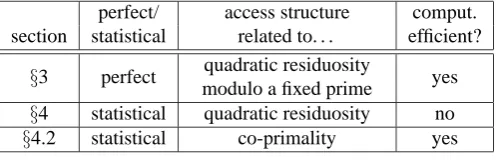
As a variant of the second scheme described above, we obtain a scheme whose access structure is equivalent to the co-primality problem. Similarly to quadratic residuosity modulo a (fixed) prime, the co-primality problem is in
Pbut is not known to be inNC. The third scheme meets only the more liberal notion of security. However, unlike the second scheme it is also computationally efficient. Compared to the first scheme, the co-primality problem is more standard than the problem of deciding quadratic residuosity modulo a fixed prime. The main properties of the three schemes described above are summarized in Table 1.
perfect/ access structure comput. section statistical related to. . . efficient?
§3 perfect quadratic residuosity
modulo a fixed prime yes §4 statistical quadratic residuosity no §4.2 statistical co-primality yes
Table 1. Summary of Our Main Schemes.
Our constructions were inspired by a non-interactive private protocol for the quadratic residuosity problem from [34]. In fact, every protocol in the model of [34, 40] can be transformed into a secret-sharing scheme for a related access structure. In the context of communication complexity lower bounds, the quadratic residuosity problem has been used in [4, 3].
Quasi-linear schemes. In addition to the above specific candidates, we study the class of nonlinear schemes obtained by composing linear schemes over (possibly) different fields, which we term quasi-linear schemes. Com-position of secret-sharing schemes has been used in previous works (cf. [11, 20, 53, 44, 25]). However, to the best
3The quadratic residuosity problem is that of deciding, given a pair of integersw, u, whetherwis a square modulou. 4
The co-primality problem is that of deciding, givenw, u, whethergcd(w, u) = 1. 5
of our knowledge this is the first work to explicitly discuss compositions of linear schemes over different fields. We characterize the complexity of quasi-linear schemes in terms of Boolean formulas over the basis of monotone span programs. While quasi-linear schemes are likely to be strictly more powerful than linear schemes, we prove that they cannot realize any access structure outsideNC. Specifically, we show that the class of structures which they can efficiently realize is contained in NC4. Thus, quasi-linear schemes do not provide the strong (conjec-tured) results implied by the specific candidates described above. On a positive note, we show an application of quasi-linear schemes for the construction of secret-sharing schemes efficiently realizing monotone span programs over a ringZu, whereuis a square-free composite. A naive generalization of the construction for monotone span programs over fields [42] fails to achieve this goal.6
ORGANIZATION. In Section 2 we present some definitions and background. In Sections 3 and 4 we describe our two main constructions of efficient nonlinear schemes, and discuss the complexity of their access structures. In Section 5 we introduce and study the class of quasi-linear schemes. Finally, in Section 6 we mention some open problems.
2 Preliminaries
In this section we define secret-sharing schemes, linear schemes, and span programs, and briefly discuss the connections between these notions. We end this section with some definitions related to the quadratic residuosity problem.
Definition 2.1 (Access Structure) Let {P0, . . . , Pn−1} be a set of parties. A collection A ⊆ 2{P0,...,Pn−1} is
monotone ifB ∈ AandB ⊆ C imply C ∈ A. An access structure is a monotone collectionA of non-empty subsets of{P0, . . . , Pn−1}(that is,A ⊆ 2{P0,...,Pn−1}\ {∅}). The sets inAare called the authorized sets. A set B is called a minimal set ofA ifB ∈ A, and for every C 6⊆ B it holds thatC 6∈ A. The minimal sets of an access structure uniquely define it. Finally, we freely identify an access structure with its monotone characteristic functionfA:{0,1}n→ {0,1}, whose variables are denotedx0, . . . , xn−1.
Definition 2.2 (Secret-Sharing) LetSbe a finite set of secrets, where|S| ≥2. Ann-party secret-sharing scheme
Πwith secret-domainS is a randomized mapping fromS to a set ofn-tuplesS0×S1×. . .×Sn−1, whereSi is called the share-domain ofPi. A dealer distributes a secrets ∈ S according toΠby first sampling a vector of shares(s0, . . . , sn−1)fromΠ(s), and then privately communicating each sharesito the partyPi. We say thatΠ realizes an access structureA ⊆2{P0,...,Pn−1}(or the corresponding monotone functionf
A:{0,1}n→ {0,1}) if
the following two requirements hold:
Correctness. The secretscan be reconstructed by any authorized subset of parties. That is, for any subsetB ∈ A (whereB = {Pi1, . . . , Pi|B|}), there exists a reconstruction functionRecB :Si1 ×. . .×Si|B| → S such that for everys∈S,
Pr[ RecB(Π(s)B) =s] = 1,
whereΠ(s)Bdenotes the restriction of Π(s)to itsB-entries.
Privacy. Every unauthorized subset cannot learn anything about the secret (in the information theoretic sense)
from their shares. Formally, for any subsetC 6∈ A, for every two secretsa, b ∈ S, and for every possible shareshsiiPi∈C:
Pr[ Π(a)C =hsiiPi∈C ] = Pr[ Π(b)C =hsiiPi∈C ].
6
The share complexity of the scheme (or complexity for short) is defined asPn−1
i=0 log|Si|.
The above correctness and privacy requirements capture the strict notion of perfect secret-sharing, which is the one most commonly referred to in the secret-sharing literature. We will also consider a relaxed but natural notion of statistical secret-sharing, in whichΠaccepts an additional argumentk, called the security parameter, and the perfect correctness and privacy requirements are relaxed to statistical correctness and statistical privacy, defined as follows.
Statistical correctness. Any authorized subset of parties can reconstruct the secretsexcept with negligible prob-ability(k). That is, for every authorizedB ∈ Athere exists a reconstruction functionRecBsuch that
Pr[ RecB(Π(s)B) =s]≥1−(k) (1)
for some(k)∈k−ω(1).
Statistical privacy. Any unauthorized subset of parties learns only a negligible amount of information about the
secret. That is, for any unauthorizedC 6∈ Aand two secretsa, b∈S,
SD(Π(a, k)C,Π(b, k)C)≤(k) (2)
for some(k) ∈k−ω(1), where SD(Y0, Y1)denotes the statistical distance between distributionsY0, Y1and
is defined by SD(Y0, Y1) = 12Py|Pr[Y0=y]−Pr[Y1 =y]|.7
We next define the class of linear secret-sharing schemes. There are several equivalent definition for these schemes, see [8].
Definition 2.3 (Linear Secret-Sharing) Let F be a finite field. A secret-sharing scheme Πis said to be linear overF if:
1. The secret-domainSis a subset ofF.
2. There existd0, . . . , dn−1such that each share-domainSiis a subset of the vector spaceFdi.
3. The randomized mappingΠ can be computed as follows. First, the dealer chooses independent random variables, denoted r1, . . . , r`, each uniformly distributed overF. Then, each coordinate of each of then shares is obtained by taking a linear combination ofr1, . . . , r`and the secrets.
We remark that the notions of perfect secret-sharing and statistical secret-sharing coincide in the case of linear schemes: Any linear scheme that satisfies the weaker conditions of statistical correctness and privacy satisfies the stronger requirements of perfect correctness and privacy.
As for any other concrete complexity measure, we will often implicitly use the term “scheme” for referring to an infinite family of schemes{Πn}n∈N, parameterized by the number of partiesn. In the statistical case, we require
the same negligible function(k)to apply in Equations (1) and (2) for allΠnin the family. In the linear case, such a family can have a different underlying field for eachn. A family{Πn}n∈N is efficient if the complexity ofΠnis polynomial inn(or the complexity ofΠn(k)is polynomial innandkin the statistical case). Note that the above definition does not make any requirement on the computational complexity of the scheme. We say that the scheme is computationally efficient if both sharing the secret and reconstructing it can be done in time poly(n,k,log|S|). Finally, the family of access structures {An} realized by a scheme family {Πn} is naturally identified with a monotone Boolean functionf :{0,1}∗ → {0,1}or its characteristic language.
We next define span programs – a linear algebraic model of computation whose monotone version is equivalent to linear secret-sharing.
7
Equivalently, the statistical distance betweenY0andY1may be defined as the maximum, over all functionsA, of the distinguishing
Definition 2.4 (Span Program [42]) A span program over a fieldF is a tripletMc = hM, ρ, ~vi, whereM is an
r×cmatrix overF, the vector~v∈Fcis a non-zero row vector called the target vector, andρis a labeling of the rows ofM by literals from{x0,x0, . . . , x¯ n−1,x¯n−1}(every row is labeled by one literal, and the same literal can
label many rows). A span programMcis said to be monotone if all of its rows are labeled by positive literals.
A span program accepts or rejects an input by the following criterion. For every inputy ∈ {0,1}n let My denote the sub-matrix of M consisting of those rows whose labels are satisfied by the assignmenty. The span programMcacceptsyif and only if~vis in the row-span ofMy (where each row ofMis viewed as a vector inFc).
A span program computes a Boolean functionf :{0,1}n → {0,1}if it accepts exactly those inputsysuch that
f(y) = 1. Note that monotone span programs compute monotone functions. Finally, the size of Mcis the number
of rows inM.
The complexity of realizing a given access structure by a linear secret-sharing scheme overFis proportional to the minimal size of a monotone span program overF computingf. Specifically,
Lemma 2.5 ([42, 8]) An access structure can be realized by a linear secret-sharing scheme overF in which the shares include a total ofdfield elements if and only if it can be computed by a monotone span program overF of sized.
It follows from [13, 17, 45, 21] that all functions that have small span programs are inNC. Specifically,
Lemma 2.6 If a functionf has a span program overF = GF(q) of size`, thenf has an arithmetic circuit of size poly(`) and depthO(log2`) overF, implying that it has a Boolean circuit of size poly(`,logq) and depth
O(log2`log logq).
Quadratic Residues. LetZu be the ring of integers modulou, whose elements are identified with the integers
{0,1, . . . , u−1}. LetZu∗denote the multiplicative group of the elements ofZuthat are relatively prime tou, that is, the elements ofZu∗ are{1≤w < u : gcd(w, u) = 1}. The number of element inZu∗is denoted byϕ(u), and is referred to as the Euler function ofu.
An integer wis said to be a quadratic residue modulouif gcd(w, u) = 1 and there exists an integerb such thatw ≡b2modu. It is said to be a quadratic non-residue modulouifgcd(w, u) = 1and there is no integerb
such thatw ≡b2 modu. We will pay particular attention to the case where the modulus is an odd primep; thus,
wandbmay be viewed as elements of the fieldZp. In this case,w ∈ Zp∗ = Zp\ {0}is said to be a quadratic residue if it is a square of some field element, and a quadratic non-residue otherwise. (The element0is neither a quadratic residue nor a quadratic non-residue.) The number of quadratic residues modulopis equal to the number of quadratic non-residues and is(p−1)/2. The quadratic residues form a subgroup of the multiplicative groupZ∗
p. The quadratic residuosity problem is that of deciding, givenwandu, whetherwis a quadratic residue modulou. Whenuis restricted to be a prime (or given the factorization ofu) this problem can be solved in polynomial time, but is not known to have an efficient parallel algorithm. Whenuis arbitrary, this problem is widely assumed to be intractable. See Section 3.1 for more details.
3 An Efficient Nonlinear Scheme: The Perfect Case
In this section we construct an efficient nonlinear secret-sharing scheme whose access structure is conjectured not to lie in NC. The scheme constructed in this section is perfectly private and correct. A statistical scheme realizing a computationally harder access structure will be given in the next section.
structure are denoted byPib, where0≤i < mandb∈ {0,1}. With eachw∈ {0,1}m(also viewed as anm-bit integer) we naturally associate a setBw of sizemdefined by: Bw
def
={Pwi
i : 0≤i < m}. A setB is a minimal set ofNQRPpif:
• B =
Pi0, Pi1 for some0≤i < m, or:
• B =Bw for somewsuch thatwis not a quadratic residue modulop. (That is, it is either0or a quadratic non-residue.)
We letNQRPdenote a family of access structures such that then-th structure isNQRPpfor somepsuch that blogpc=bn/2c(say, the least suchp).8
We next construct a secret-sharing scheme forNQRP.
Theorem 3.2 For every odd primepthere exists a perfect secret-sharing scheme forNQRPpin which the secret-domain is{0,1}and the share-domain of each party isZp.
Proof: We prove this theorem by describing the secret-sharing scheme.
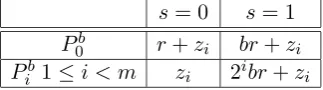
The dealer chooses at randomm−1random elementsz0, z1, . . . , zm−2 ∈ Zpand an additional random element
r ∈ Zp∗. Definezm−1
def
= −Pm−2
i=0 zi, where here and in the following all arithmetic operations involving ring
elements are performed inZp. The shares of the parties are specified in Table 2. We turn to prove that this
secret-s= 0 s= 1 Pb
0 r2+z0 br2+z0 Pib1≤i < m zi 2ibr2+zi
Table 2. A secret-sharing scheme forNQRPp.
sharing scheme satisfies the correctness and privacy properties with respect toNQRPp. Let SUMw denote the sum of themshares held by parties inBw. Both the correctness and the privacy proofs will rely on the following lemma.
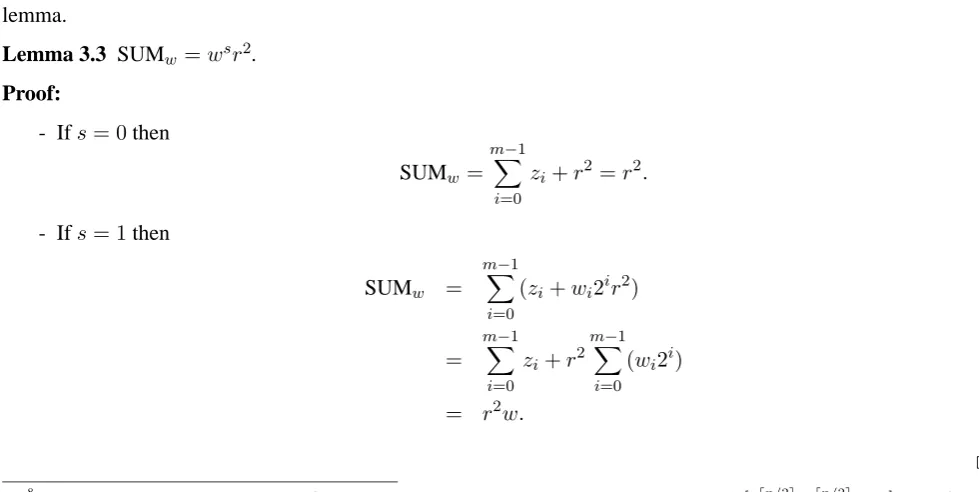
Lemma 3.3 SUMw =wsr2. Proof:
- Ifs= 0then
SUMw = m−1
X
i=0
zi+r2=r2.
- Ifs= 1then
SUMw = m−1
X
i=0
(zi+wi2ir2)
=
m−1
X
i=0
zi+r2 m−1
X
i=0 (wi2i)
= r2w.
2
8
Correctness. We separately consider two types of minimal authorized setsB:
• B =
Pi0, Pi1 for some0≤i < m. In this case,s= 0iff the shares ofPi0 andPi1are equal. This follows from the fact that2ir2 6≡0 modpfor everyi.
• B =Bw for somewsuch thatwis not a quadratic residue. In this case, it follows from Lemma 3.3 that
s= 0iff SUMwis a quadratic residue (since the product of a quadratic residue and a non quadratic residue is a non quadratic residue).
Privacy. We need to prove that every unauthorized subsetC /∈ NQRPp has no information on the secret. It suffices to prove this claim for every maximalCnot in the access structure. There are two cases to consider.
• C =Bw \
n
Pwj
j
o
for somew ∈ {0,1}m and0 ≤j < m. That is,C is a set of sizem−1such that for
exactly onejit contains neitherPj0norPj1. We claim that in this case the share-vector of the parties inCis uniformly distributed inZm−1
p , regardless of the secret. It suffices to show that for every secrets∈ {0,1}, every possible value of the share-vector fromZm−1
p , and every fixedr0 ∈ Zp∗, there exists a unique choice ofz0, . . . , zm−2generating this value withr =r0. This can be verified by inspection of the corresponding
system of linear equations overZp.
• C = Bw for somew ∈ {0,1}msuch thatwis a quadratic residue. In this case we claim that, regardless of the value of the secret, the share-vector of the parties inCis uniformly distributed over them-tuples of field elements whose sum is a quadratic residue. Indeed, by Lemma 3.3, ifs= 0then SUMw =r2, which is a uniformly random quadratic residue. Furthermore, fixing the choice ofr, the choices of zi induce a uniformly random share vector among all those which sum tor2. Similarly, ifs= 1then SUMw =r2w. Sincewis a quadratic residue, SUMwis again a uniformly random quadratic residue determined byr, and the same argument as above applies.
2 A generalization of our construction forNQRPis described in Appendix A.
3.1 DoesNQRPHave an Efficient Linear Secret-Sharing Scheme?
The access structureNQRPwe have realized above is related to the problem of deciding quadratic residuosity modulo a prime. We would like to argue thatNQRPis likely not to be inNC, which would imply in particular thatNQRPcannot be efficiently realized by linear schemes. We start by describing some known facts about the complexity of the quadratic residuosity problem.
Unlike quadratic residuosity modulo a composite, whose intractability is commonly assumed in cryptography (see [37]), quadratic residuosity modulo a prime can be decided in polynomial time. All known algorithms for this problem are sequential. It is not known if efficient parallel algorithms for this problem exist; that is, the situation is similar to the exponentiation function and the gcd function. There are two types of known algorithms. The first uses Euler’s criterion, which states thatwis a quadratic residue modulo an odd primepiffw(p−1)/2 ≡1 modp. Thus, this algorithm requires modular exponentiation. For a survey of algorithms for exponentiation see [38]. The second type of algorithm computes the Jacobi symbol in a way similar to Euclid’s algorithm for computing the gcd. For more details see, e.g., [5, Chapter 5]. “Weak” parallel algorithms for checking quadratic residuosity follow from the algorithms of [32] for computing the Jacobi symbol and the algorithm of [1] for exponentiation. More precisely, there is (1) an algorithm that runs in O(n/log logn) time using O(n1+) processors [32]; (2) an algorithm that runs inO(log2nlog logn)time using2O(n/logn)processors [32]; (3) an algorithm that runs in
The best known polynomial-size circuit for the quadratic residuosity problem has depthO(n/log logn)where
n= logp[32]. Thus, given the current state of knowledge on this problem and the related modular exponentiation problem, it is reasonable to assume that they are not in NC. In fact, this assumption (for the exponentiation problem) has been explicitly relied on in [16].
It is easy to see that deciding quadratic residuosity modulopcan be very efficiently reduced to computing the monotone function defined byNQRPp. However, there is a major difference between the “standard” algorithmic setting for this problem and our setting. Our setting is highly non-uniform, in the sense that with each input length (or number of parties) we associate some fixed primep. Hence, when computing this access structure one may use a non-uniform “advice” depending onp. In algorithmic terms, we allow unlimited preprocessing which depends on the primepbut not on the other inputw. Nevertheless, we do not know how to use this type of preprocessing to obtain an efficient parallel algorithm for the quadratic residuosity problem.9 (It is interesting to note, however,
that deciding quadratic residuosity modulo a composite is no more difficult in our setting than deciding quadratic residuosity modulo a prime, since the factorization of the composite may be used as advice.) To conclude, the assumption thatNQRP6∈NCis stronger than the assumption that the standard quadratic residuosity problem (or modular exponentiation) is not inNC, although still seems very reasonable given the current state of knowledge.
In light of the uncertain situation described above, one could hope for an unconditional super-polynomial lower bound on a size of a monotone span program computing NQRP. This would be sufficient for proving that
NQRPcannot be efficiently realized by linear schemes and, as noted in the introduction, there are explicit mono-tone functions for which such bounds are known. However, as we argue next, such lower bounds are impossible to prove for theNQRPstructure without proving thatNC1 6= P. For a fixed(m+ 1)-bit primep, the quadratic residuosity function (modulop) is defined as:fp(x0, . . . , xm−1) = 1iffPmi=0−1xi2iis a quadratic residue modulo
p. This function is not monotone. To define the monotone access structureNQRPwe replaced each literal by two parties, obtaining an access structure with2mparties. (This is a standard transformation, e.g., when proving that monotone circuit evaluation is P-complete [36].) For technical reasons we also addedm minterms of size two. It follows that the monotone formula size of NQRPp is equal, up to an additiveO(n) difference, to the (non-monotone) formula size of the function fp. Thus, one cannot expect to prove strong lower bounds on the size of a monotone span program (or even a monotone formula) forNQRP, since they will imply, in particular, strong lower bounds on the (non-monotone) formula size of the quadratic residuosity function.10
4 An Efficient Nonlinear Scheme: The Statistical Case
In this section we construct an efficient nonlinear secret-sharing scheme whose access structure is as hard as the general quadratic residuosity function. Unlike the previous construction, the scheme we construct below is only statistically private and correct, and its reconstruction procedure is computationally inefficient. In Section 4.1 we show that perfect correctness (but not perfect privacy) can be achieved under a number-theoretic assumption. We end this section by discussing a generalization of our construction which applies to the so-calledt-residuosity problem. As a special case, we obtain an efficient scheme whose access structure is computationally equivalent to the co-primality problem.
Definition 4.1 (The Access StructureNQRm) Letmbe a positive integer. We define then-party access struc-tureNQRm, wheren= 4mdef , by specifying its collection of minimal sets. It will be convenient in the following to denote the first2m parties byWb
i, whereb ∈ {0,1}and0 ≤ i < m, and the last2mparties byUib. With each pair(w, u), wherew, u∈ {0,1}m, we naturally associate a subset of partiesB
w,uof size2m, defined by:
Bw,u def
={Wwi
i : 0≤i < m} ∪ {U ui
i : 0≤i < m}.
9
Preprocessing can parallelize the algorithms for exponentiation when the field size and the exponentiation base are given in advance (see [38]). However, in our case we know in advance the field size and the exponentiation power.
We will freely identify stringsw, uas above with integers in the interval[0,2m−1]. A setBis a minimal set of
NQRmif: 1. B =
Wi0, Wi1 orB =
Ui0, Ui1 for some0≤i < m, or:
2. B =Bw,ufor somew, usuch thatwis not a quadratic residue modulou. (For technical reasons, we assume here that this condition never holds whenu= 1, and always holds whenu= 0except whenw= 1.) We letNQRdenote the family of access structures in which then-th structure isNQRbn/4c.
We start by observing that the computational complexity of the access structureNQRis essentially the same as that of the general quadratic residuosity problem.
Claim 4.2 The circuit complexity of NQRis the same, up to anO(n)difference, as that of the language{(w, u) :
|w|=|u| ∧ ais w quadratic residue modulou}.
It follows that under the Quadratic Residuosity Assumption [37], computing NQR requires circuits of super-polynomial size. The remainder of this section will be devoted to proving the existence of an efficient nonlinear secret-sharing scheme forNQR. Specifically, we show:
Theorem 4.3 There exists a statistical secret-sharing scheme forNQRmin which: • the secret-domain is{0,1};
• the share size of each party isO(k2+km); • the reconstruction error probability is2−k; • the privacy level is(k) =O(k/2k).
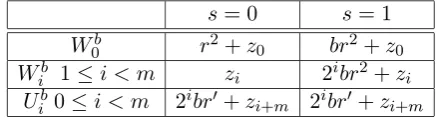
Our secret-sharing scheme forNQRm proceeds as follows. Let D = 2def 4m+3k+1. In the following, all arith-metic operations will be performed inZD. The dealer choosesz0, z1, . . . , z2m−1 ∈ ZD at random subject to the restriction that they sum to0. In addition, it chooses two random integers1≤r ≤2m+kand1 ≤r0 ≤23(m+k). Each party receives a single element ofZD, as specified in Table 3. For amplifying the correctness probability,
s= 0 s= 1
W0b r2+z0 br2+z0 Wib 1≤i < m zi 2ibr2+zi
Uib0≤i < m 2ibr0+zi+m 2ibr0+zi+m
Table 3. A secret-sharing scheme forNQRm.
the above distribution procedure should be independently repeatedktimes, so that each party receiveskelements ofZD. In addition, the minimal authorized sets of size 2 should be taken care of separately, by independently sharingsamong each such authorized pair (that is, for each such pair choose an independent random bitα, and giveα to the first party andα⊕sto the second).11 This only adds a single bit to the size of each share. The following analysis will mostly focus on the core of the scheme, as described in Table 3.
11
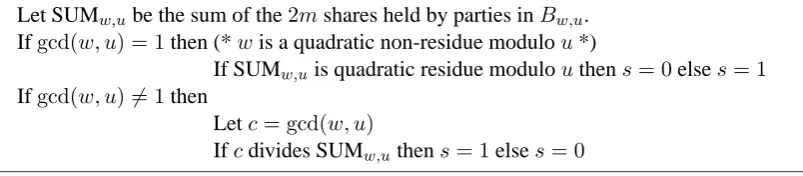
Let SUMw,ube the sum of the2mshares held by parties inBw,u. Ifgcd(w, u) = 1then (*wis a quadratic non-residue modulou*)
If SUMw,uis quadratic residue modulouthens= 0elses= 1 Ifgcd(w, u)6= 1then
Letc= gcd(w, u)
Ifcdivides SUMw,uthens= 1elses= 0
Figure 1. Reconstruction Procedure forBw,uinNQRm.
Statistical correctness. The minimal authorized sets of size 2 were explicitly taken care of in the above con-struction. It thus remains to prove the correctness for a subsetBw,u, wherewis not a quadratic residue modulo
u. Ifrwere chosen such thatgcd(r, u) = 1then the correctness would follow from similar arguments to those of the proof forNQRP(that is, the secret is reconstructed by checking if the sum of shares is a quadratic residue). However, since hereuis not fixed, we cannot guarantee that the above condition always holds. Nevertheless, this already implies that the secret can be correctly reconstructed from the shares in Table 3 with a one-sided error probability of at most1−ϕ(u)/u, which is bounded away from 1. The following tighter analysis shows that the one-sided error probability of reconstruction can be as low as1/2. Hence, withkindependent repetitions the error probability is at most2−k. In Figure 1 we present the reconstruction procedure and then prove its correctness. The following lemma can be verified by inspection of Table 3.
Lemma 4.4 For any0≤w, u <2m and secrets∈ {0,1}, it holds that SUMw,u =r2ws+r0u(where SUMw,u is the sum of the2mshares held by parties inBw,u).
Note that by our choice of parameters, the expressionr2ws+r0u in Lemma 4.4 is always less thanD. We will therefore treat this expression as being evaluated over the integers.
From now on, we assume that u ≥ 2 (the case thatu = 0andw 6= 1can be verified separately). Suppose first thatgcd(w, u) = c > 1. In this case,calways divides r2w+r0u, whereas cdividesr2+r0u if and only ifc dividesr. Thus, with probability at least1−1/c ≥ 1/2 it does not divider2 +r0u. It follows that when
gcd(w, u) > 1the cases = 0can be distinguished from the cases = 1with a one-sided error probability of at most1/2, as described above.
Now suppose thatwis a quadratic non-residue modulou. In this case,r2+r0u≡r2 moduis always a square modulou. This implies that SUMw,uis a quadratic residue whens = 0. The following lemma shows that with probability at least1/2, this is not the case forr2w+r0u, i.e., whens= 1.
Lemma 4.5 Suppose that w is a quadratic non-residue modulo u (in particular, gcd(w, u) = 1). Then, the probability thatr2wis a quadratic residue modulouis at most1/2.
Proof: By the Chinese Remainder Theorem, a number is a quadratic-residue modulou if and only if it is a quadratic-residue modulo each prime power dividingu. Thus, there exists a prime powerpα dividingusuch that
wis a quadratic non-residue modulopα. Now, ifwr2is a square modulou, then it is also a square modulopα, and so there existsdsuch thatd2 ≡wr2 modpα. We argue that it must be the case thatpdividesr. Otherwise,rhas an inverse modulopαandw≡(d/r)2 modpαcontradicting the fact thatwis a quadratic non-residue modulopα. The lemma follows by noting that the probability thatpdividesris at most1/p≤1/2, as required. 2
Statistical privacy. We now prove the privacy of our construction. As before, it suffices to consider maximal unauthorized sets of two types. The first type consists of setsCsuch that|C|<2mandCdoes not contain a pair
Wi0, Wi1or a pairUi0, Ui1. For such a setC, it can be verified that the shares received by its parties are uniformly and independently distributed overZD, regardless of the secrets.
We turn to the more interesting case of a setC =Bw,usuch thatu ≥2andwis a quadratic residue modulo
u. (The cases u = 1 and u = 0, w = 1 can be verified separately.) Whens = 0 the shares are otherwise random numbers whose sum isr2+r0u, and whens= 1the shares are otherwise random integers whose sum is
r2w+r0u. Thus, it suffices to show that in this case SD(r2+r0u, r2w+r0u) = O(2−k). We prove this using the following lemmas. In the lemmas we denote byr, r0the random variables used in the scheme (taking uniform integral values from the intervals[1,2m+k]and[1,23(m+k)], respectively). For the proof we also use an additional random variableruwhich is a uniformly distributed integer in[0, u−1].
Lemma 4.6 If w is a quadratic residue modulo u, then the distribution of(wru2) modu is identical to that of
r2
umodu.
Proof: Since wis a quadratic residue modulou, there existsb such thatgcd(b, u) = 1 andb2 ≡ wmodu. Since wr2u ≡ (bru)2modu, it suffices to show that(bru) modu is identically distributed toru modu = ru. Finally, sincegcd(b, u) = 1, i.e.,bhas an inverse modulou, then for every valueβ it holds thatPr[bru ≡ β] =
Pr[ru≡(β/b)] = 1/u. 2
Lemma 4.7 SD(r2modu , r2
umodu)≤2−k.
Proof: Recall thatr is chosen uniformly from the interval[1,2m+k]. Ifu divides2m+k then the above two distributions are identical. Otherwise, the contribution of eachy ∈ [0, u−1]to this distance is at most1/2m+k, and sinceu <2mthe total contribution is at most2m/2m+k= 2−k. 2
From the previous two lemmas, we may conclude that
SD(wr2modu, r2modu) =O(2−k). (3)
Now, define the multisets
V =nwr2modu : 1≤r≤2m+ko
and
Z =nr2 : 1≤r≤2m+ko.
Let Z0 be a maximal multiset such that Z0 ⊆ Z and Z0 modu =def {zmodu : z ∈ Z0} ⊆ V. It follows from Eq. (3) that|Z0|= (1−O(2−k))|Z|. DefineS =Z0∪(V \(Z0 modu)). Note that|S| =|V|= 2m+k. We will denote the elements ofSbyy1, . . . , y2m+k and the uniform distribution overSbyY. It follows from the
above thatY satisfies: (1) SD(Y, r2) =O(2−k); (2) the distribution ofY moduis identical to that ofar2 modu; and (3)Y ≤22(m+k).
We would like to conclude that SD(wr2+r0u, r2+r0u) =O(2−k). To this end, we use the following lemma.
Lemma 4.8 Let y, z be two integers in some interval [0, M]such that y ≡ zmodu, and let R be uniformly distributed in the interval[1, M K]. Then, SD(y+Ru , z+Ru)≤1/K.
Proof: The statistical distance is bounded by|y−z|/(uM K)≤M/(uM K)<1/K. 2
We are now ready to complete the proof of privacy. From Property (1) ofY it follows that
From property (2) ofY, we may assume thatyr ≡wr2 modu for every1≤ r ≤ 2m+k. LettingM = 23m+2k andK = 2k, bothY andwr2are no larger thanM, andr0 is uniform in[1, M K]. Since
SD(Y +r0u, wr2+r0u)≤Er[SD(yr+r0u, wr2+r0u)]
it follows from Lemma 4.8 that
SD(Y +r0u, wr2+r0u)≤2−k. (5)
Combining Eq. (4) and Eq. (5) we get that SD(wr2+r0u, r2+r0u) =O(2−k), as required.
As explained above, to reduce the error probability in the reconstruction from1/2to2−kwe share the secret independentlyktimes. By standard arguments, this can only increase the statistical distance toO(k/2k), which is still negligible ink.
4.1 A Perfectly Correct Scheme
In this section we show that under the Extended Riemann Hypothesis (abbreviated ERH), one can obtain a variant of the above scheme which is perfectly correct, though still only statistically private. (It is open if there is a scheme with perfect correctness and privacy which efficiently realizesNQR.) The only required modification is the choice ofr: instead of choosing it uniformly from the interval[1,2m+k], it is chosen as a random prime from the interval[2m,2m+k]. Sinceu <2m, this guarantees thatris relatively prime tou, and this in turn is sufficient to guarantee perfect correctness. We next argue that under the ERH, the resulting scheme is statistically private.
We will need the following results on the distribution of primes. For more information on this subject the reader might consult, e.g., [5, Chapter 8]. For an integerxletπ(x)be the number of primes in the interval[1, x], and for integersx, wanduletπ(x, u, w)be the number of primes in the interval[1, x]that are congruent towmodu. It is known thatπ(x)≈x/logx. Ifgcd(w, u)>1then every number that is congruent towmoduis a composite. It turns out that the primes are nearly uniformly distributed among the other residue classes modulou. That is, if
gcd(w, u) = 1thenπ(x, u, w)≈ 1
ϕ(u)x/logx, whereϕ(u)is the Euler function ofu.
We will need good bounds on the error terms in the above approximations. The bounds that can be proved unconditionally are too crude for our purpose, and we will need bounds based on the the Extended Riemann Hypothesis. Proving this famous hypothesis is one of the most important open questions in mathematics. We will not formulate the statement of this hypothesis, and only state the following conclusion from the ERH. The estimations that are used to derive the next theorem are presented in Appendix B.
Theorem 4.9 If the ERH holds andgcd(w, u) = 1then for everyxandx0, whereu≤x0 ≤√x,
π(x, u, w)−π(x0, u, w) π(x)−π(x0) −
1 ϕ(u)
=O log 2x
√
x
!
,
where the constant in the “O” notation is an absolute constant independent ofwandu.
Notice thatπ(x,u,wπ(x))−−ππ((xx00,u,w) )is the probability that a uniformly random prime in the interval[x0, x]is congruent tou modulow. Thus, the above theorem states that this probability is close to the probability that a uniformly random element fromZu∗is equal tow.
Corollary 4.10 Letu <2m,U be a random variable distributed uniformly in Z∗
u, andr be a uniformly chosen prime in the interval[2m,2m+k]. If ERH holds then for everyk, msuch thatk ≤2mit holds that SD(U, rmod
Proof:
SD(U, rmodu)
= 1
2
X
y∈Z∗
u
|Pr[U =y]−Pr[rmodu=y]|
≤ ϕ(u)·O (m+k) 2
√
2m+k
!
= O 2
m(m+k)2
20.5(m+k)
!
= 2−Ω(k).
The last equality holds sincek≥2m. 2
To guarantee that the statistical distance decreases exponentially with the security parameter independently of
m, we execute the scheme withk0 = max(k,2m). Closely following the privacy proof of the previous protocol (and replacing Lemma 4.7 with Corollary 4.10), one can show that the scheme is statistically private with(k) = 2Ω(−k). The next theorem summarizes the properties of this scheme.
Theorem 4.11 If ERH holds, then there exists a statistical secret-sharing scheme forNQRm with perfect cor-rectness in which:
• the secret-domain is{0,1};
• the share size of each party isO(k+m); • the privacy level is(k) = 2−Ω(k).
4.2 Schemes fort-residuosity
The quadratic residuosity problem naturally generalizes to thet-residuosity problem defined as follows. An integer w is a t-residue modulo u if gcd(w, u) = 1 and there exists an integer b such that w ≡ btmodu. The access structure NtRis defined as the access structureNQR, with quadratic residuosity replaced by t-th residuosity.
A scheme forNtRcan be obtained by the following small modification to the scheme forNQR: the ring size
Dis changed to2(t+2)m+(t+1)k+1, the random stringr0 is chosen with uniform distribution from[1,2(t+1)(t+k)], and in the dealer’s distribution procedure we replacer2byrt. The correctness and privacy of the modified scheme are argued similarly to the original scheme. These modification also work in the scheme based on the ERH.
An interesting special case of the general scheme is whent= 1. In the resultant scheme,Bw,ucan reconstruct the secret iff the integerswanduare not co-primes (i.e.,gcd(w, u) >1). Hence, its access structure is computa-tionally equivalent to the co-primality problem. Checking if two integers are co-prime is clearly inP, and it is not known to be inNC. An important feature of this instance of the general construction is that it is computationally efficient: indeed, reconstruction only requires checking ifgcd(w, u)divides SUMw,u.
5 Quasi-Linear Secret-Sharing
In this section we study a natural extension of the class of linear secret-sharing schemes to what we call quasi-linear schemes. Quasi-quasi-linear schemes are obtained by composing a finite number of quasi-linear secret-sharing schemes, possibly over different fields.
Definition 5.1 LetΠbe a secret-sharing scheme with secret-domainSand share-domainsS0, . . . , Sn−1, letT =
{0,1, . . . ,|T| −1}be any finite secret-domain, and let`=dlog|S||T|e. Then, byΠ˜T we denote the randomized mapping from T toS0` × · · · ×Sn`−1 defined as follows. For a secrett ∈ T, let(t1, . . . , t`)denote its base-|S| representation, whereti ∈Sfor alli. The output ofΠ˜T(t)is obtained by independently applyingΠto eachtiand letting thei-th entry of the output be the concatenation of thei-th entries from the`outputs of Π.
As can be easily seen, Π˜T defines a secret-sharing scheme realizing the same access structure asΠ, whose secret-domain isT and whose share-complexity is`=dlog|S||T|etimes that ofΠ. We are now ready to formally define the notion of quasi-linear schemes.
Definition 5.2 Ann-party quasi-linear secret-sharing scheme is recursively defined as follows: 1. Anyn-party linear secret-sharing scheme is ann-party quasi-linear scheme.
2. Suppose that Π is an n0-party linear scheme over a field F with share-domains S0, . . . , Sn0−1, and let
Π0, . . . ,Πn0−1ben-party quasi-linear schemes. Then, define ann-party quasi-linear schemeΠ(Π0, . . . ,Πn0−1)
with secret-domainF as follows. To shares ∈ F, first applyΠ(s)to obtain sharess0, . . . , sn0−1. Then, identifying each share-domainSi with the set{0,1, . . . ,|Si| −1}, independently share eachsi among the
nparties usingΠ˜iS
i.
It is convenient to view ann-party quasi-linear schemeΠas a tree, in which every node contains a linear secret-sharing scheme. Associating each linear scheme with its corresponding monotone span program, we may view this tree as a Boolean formulaϕΠover the basis of all monotone span programs (over all finite fields);12that is,
each gate in the formula computes the Boolean function computed by a monotone span program. For brevity we refer to such a formula as an MSP-formula.
The following proposition establishes the correspondence between a quasi-linear scheme and its associated MSP-formula. Its straightforward proof, generalizing the proof for the AND-OR-Threshold formula construction from [11], is omitted from this abstract.
Proposition 5.3 LetΠbe a quasi-linear secret-sharing scheme andϕΠbe the corresponding MSP-formula. Then,
Πrealizes the access structure computed byϕΠ.
Are quasi-linear schemes strictly stronger than linear schemes, or can every quasi-linear scheme be simulated by a linear scheme with a polynomial complexity overhead? Given the current understanding of monotone span program complexity, no conclusive answer can be obtained. However, under the plausible assumption that the power of monotone span programs over fields of different characteristics is incomparable, quasi-linear schemes are indeed (super-polynomially) stronger. This unsurprising observation can be formally argued by embedding two or more monotone span programs over different fields as restrictions of one efficient MSP-formula. For instance, suppose thatf (respectively,g) can be efficiently computed by a monotone span program over GF(2)
(resp., GF(3)), but hasnω(1) monotone span program size over any field whose characteristic is different from 2
(resp., 3). Then, the functionh = (y∧f)∨(z∧g), where the variablesy, zappear neither inf nor ing, can be efficiently realized by a quasi-linear scheme, but cannot be efficiently realized by any linear scheme.
However, as we show next, quasi-linear schemes cannot be too powerful. More specifically, if there is an efficient quasi-linear scheme for f then f can be computed by a shallow circuit. The idea of the proof is to consider the corresponding MSP-formula ϕ. We use a result of [7] showing that a formula ϕover a general basis can be “balanced” to obtain an equivalent formula whose depth is small and its size is not too big (this is a generalization of the well-known result from [51] for bounded fan-in formulae over the standard basis). An instantiation of this result which is useful for our purposes is quoted in the following lemma.
12An input variable is viewed as a size-1 monotone span program in the variablesx
Lemma 5.4 (Beigel and Fu [7]) Letϕbe a MSP-formula. Then, there exists a MSP-formulaϕˆsuch that: (1)ϕˆ
computes the same function asϕ; (2) the depth ofϕˆisO(log(size(ϕ))); (3) the size ofϕˆissize(ϕ)O(1); and (4)
each node ofϕˆis either labeled by some span program appearing inϕ, or is labeled by an AND, OR, or NOT gate.
Theorem 5.5 Suppose thatf is efficiently realized by quasi-linear schemes. Then,f ∈NC4.
Proof: LetΠ be an efficient quasi-linear scheme realizingf, and let ϕbe the corresponding MSP-formula. We may assume without loss of generality that the span program labeling each internal node ofϕdepends on all of its inputs, and has at least two inputs; otherwise Πcould be simplified into a quasi-linear scheme Π0 whose MSP-formulaϕ0satisfies this property. As the number of leaves in such aϕis a lower bound on the complexity of Π(and the degree of each internal node of ϕis at least 2), ϕmust be of size poly(n). It also follows that each nodevofϕmust be labeled by a polynomial-size monotone span programMv over a field GF(qv)such that
logqv = poly(n).13 By Lemma 2.6, the functionfv computed byMv can be simulated by a Boolean circuit of size poly(n)and depthO(log3n). The theorem follows by applying Lemma 5.4 toϕand replacing each node in
ˆ
ϕby a correspondingNC3circuit. 2
We conclude this section by showing an application of quasi-linear schemes for the construction of secret-sharing schemes efficiently realizing monotone span programs over a ringZu, whereuis a square-free compos-ite.14
Theorem 5.6 LetMbe a monotone span program overZu, whereuis the product ofkdistinct primesp1, . . . , pk. Then, there exists a quasi-linear schemeΠM realizing the access structure defined byM, whose share-complexity issize(M)·Pk
j=1logpj.
Proof: ΠM is defined by the following depth-2 MSP-formulaϕM. The root contains an AND gate with fan-in
k(represented by a size-kmonotone span program over GF(2)). Thej-th leave,1≤j≤k, contains a monotone span programMj over GF(pj), obtained fromM by reducing each of its entries modulopj. By Proposition 5.3, to prove thatΠM indeed realizes the access structure defined byM it suffices to show that ϕM computes the same function as M. Indeed, ifM(x) = 1, then clearlyMj(x) = 1for allj (as witnessed by the same linear combination, modulo pj). The converse follows by applying the Chinese Remainder Theorem to the k linear combination vectors witnessing thatMj(x) = 1,1≤j≤k. 2
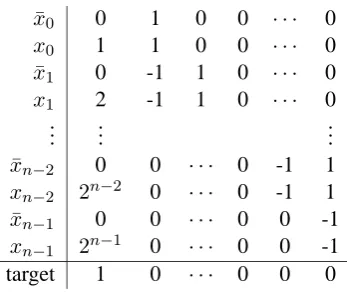
Example 5.7 Figure 2 shows an efficient span program over Zu for testing whether the inputx (viewed as an integer) is co-prime tou. Replacing each negative literal with a new variable, this example gives a very efficient quasi-linear scheme for a monotone access structure derived from the co-primality problem.15
6 Open Problems
The main open problem in this area remains that of characterizing the class of access structures admitting efficient secret-sharing. A more modest problem is to obtain an unconditional separation between the access structures which can be efficiently realized by linear schemes and those efficiently realized by general (nonlinear)
13
The converse does not hold. It is easy to construct a polynomial-size MSP-formula (even a shallow one) which is efficient in this sense, but whose corresponding quasi-linear scheme is inefficient.
14
Span programs over rings are defined in a completely analogous way to span programs over fields. 15
¯
x0 0 1 0 0 · · · 0
x0 1 1 0 0 · · · 0 ¯
x1 0 -1 1 0 · · · 0
x1 2 -1 1 0 · · · 0 ..
. ... ...
¯
xn−2 0 0 · · · 0 -1 1 xn−2 2n−2 0 · · · 0 -1 1 ¯
xn−1 0 0 · · · 0 0 -1 xn−1 2n−1 0 · · · 0 0 -1
target 1 0 · · · 0 0 0
Figure 2. A span program overZu testing whethergcd(x, u) = 1.
schemes. As indicated in Section 5, it suffices to prove strong separations between monotone span program complexity over fields of different characteristics.
We next suggest a candidate for a function that has a small monotone span program over GF(2)and does not have small monotone span program over fields of different characteristic. The candidate is the ODD-FACTOR function considered in [2]: The function hasn=v2variables; the input is a bipartite graph withvvertices in each part represented by a(0,1)-matrix of sizev×v. The graph is accepted if it has an odd factor, i.e., a spanning subgraph such that all vertices have odd degree in the subgraph. Babai, G´al, and Wigderson [2] prove that this function has a small monotone span program over GF(2), but has only exponential monotone formulae and quasi-polynomial monotone circuits. The open problem is whether the ODD-FACTOR function has small monotone span program over fields of a different characteristic.
Acknowledgments. The first author would like to thank Daniel Berend and Yuval Ginosar for helpful discus-sions. The second author would like to thank Eric Allender and Dieter van-Melkebeek for helpful discussions and pointers.
References
[1] L. M. Adleman and K. Kompella. Using smoothness to achieve parallelism. In Proc. of the 20th Annu. ACM Symp. on the Theory of Computing, pages 528–538, 1988.
[2] L. Babai, A. G´al, and A. Wigderson. Superpolynomial lower bounds for monotone span programs. Combinatorica, 19(3):301–319, 1999.
[3] L. Babai, P. G. Kimmel, and S. V. Lokam. Simultaneous messages vs. communication. In 12th Annual Symposium on Theoretical Aspects of Computer Science, volume 900 of Lecture Notes in Computer Science, pages 361–372. Springer, 1995.
[4] L. Babai, N. Nisan, and M. Szegedy. Multiparty protocols and logspace-hard pseudorandom sequences. In Proc. of the 21st Annu. ACM Symp. on the Theory of Computing, pages 1–11, 1989.
[5] E. Bach and J. Shalit. Algorithmic Number Theory, volume 1: Efficient Algorithms. MIT press, 1996.
[6] P. Beguin and A. Cresti. General short computational secret sharing schemes. In L. C. Guillou and J. J. Quisquater, editors, Advances in Cryptology – EUROCRYPT ’95, volume 921 of Lecture Notes in Computer Science, pages 194– 208. Springer, 1995.
[7] R. Beigel and B. Fu. Circuits over PP and PL. J. of Computer and System Sciences, 60:422–441, 2000. Preliminary version in the proceedings of the 12th Annual IEEE Conference on Computational Complexity, pp. 24-35, 1997. [8] A. Beimel. Secure Schemes for Secret Sharing and Key Distribution. PhD thesis, Technion – Israel Institute of
[9] A. Beimel, A. G´al, and M. Paterson. Lower bounds for monotone span programs. Computational Complexity, 6(1):29– 45, 1997. Conference version: FOCS ’95.
[10] M. Ben-Or, S. Goldwasser, and A. Wigderson. Completeness theorems for noncryptographic fault-tolerant distributed computations. In Proc. of the 20th Annu. ACM Symp. on the Theory of Computing, pages 1–10, 1988.
[11] J. Benaloh and J. Leichter. Generalized secret sharing and monotone functions. In S. Goldwasser, editor, Advances in Cryptology – CRYPTO ’88, volume 403 of Lecture Notes in Computer Science, pages 27–35. Springer-Verlag, 1990. [12] J. Benaloh and S. Rudich. Private communication, 1989.
[13] S. J. Berkowitz. On computing the determinant in small parallel time using a small number of processors. Inform. Process. Lett., 18:147–150, 1984.
[14] G. R. Blakley. Safeguarding cryptographic keys. In R. E. Merwin, J. T. Zanca, and M. Smith, editors, Proc. of the 1979 AFIPS National Computer Conference, volume 48 of AFIPS Conference proceedings, pages 313–317. AFIPS Press, 1979.
[15] C. Blundo, A. De Santis, L. Gargano, and U. Vaccaro. On the information rate of secret sharing schemes. Theoretical Computer Science, 154(2):283–306, 1996.
[16] D. Boneh and M. Naor. Timed commitments. In Advances in Cryptology – CRYPTO 2000, volume 1880 of Lecture Notes in Computer Science, pages 236–254. Springer-Verlag, 2000.
[17] A. Borodin, J. v. z. Gathen, and J. Hopcroft. Fast parallel matrix and GCD computations. Information and Control, 52(3):241–256, 1982.
[18] E. F. Brickell. Some ideal secret sharing schemes. Journal of Combin. Math. and Combin. Comput., 6:105–113, 1989. [19] E. F. Brickell and D. M. Davenport. On the classification of ideal secret sharing schemes. J. of Cryptology, 4(73):123–
134, 1991.
[20] E. F. Brickell and D. R. Stinson. Some improved bounds on the information rate of perfect secret sharing schemes. J. of Cryptology, 5(3):153–166, 1992.
[21] G. Buntrock, C. Damm, U. Hertrampf, and C. Meinel. Structure and importance of the logspace-mod class. Math. Systems Theory, 25:223–237, 1992.
[22] R. M. Capocelli, A. De Santis, L. Gargano, and U. Vaccaro. On the size of shares for secret sharing schemes. J. of Cryptology, 6(3):157–168, 1993.
[23] D. Chaum, C. Cr´epeau, and I. Damg˚ard. Multiparty unconditionally secure protocols. In Proc. of the 20th Annu. ACM Symp. on the Theory of Computing, pages 11–19, 1988.
[24] R. Cramer, I. Damg˚ard, and S. Dziembowski. On the complexity of verifiable secret sharing and multiparty computa-tion. In Proc. of the 32th Annu. ACM Symp. on the Theory of Computing, pages 325–334, 2000.
[25] R. Cramer, I. Damg˚ard, and U. Maurer. General secure multi-party computation from any linear secret-sharing scheme. In B. Preneel, editor, Advances in Cryptology – EUROCRYPT 2000, volume 1807 of Lecture Notes in Computer Science, pages 316–334. Springer, 2000.
[26] L. Csirmaz. The dealer’s random bits in perfect secret sharing schemes. Studia Sci. Math. Hungar., 32(3–4):429–437, 1996.
[27] L. Csirmaz. The size of a share must be large. J. of Cryptology, 10(4):223–231, 1997.
[28] Y. Desmedt and Y. Frankel. Shared generation of authenticators and signatures. In J. Feigenbaum, editor, Advances in Cryptology – CRYPTO ’91, volume 576 of Lecture Notes in Computer Science, pages 457–469. Springer-Verlag, 1992. [29] Y. Desmedt and Y. Frankel. Homomorphic zero-knowledge threshold schemes over any finite abelian group. SIAM J.
on Discrete Mathematics, 7(4):667–679, 1994.
[30] M. v. Dijk. On the information rate of perfect secret sharing schemes. Designs, Codes, and Cryptography, 6:143–169, 1995.
[31] M. v. Dijk. A linear construction of secret sharing schemes. Designs, Codes, and Cryptography, 12(2):161–201, 1997. [32] S. M. Eikenberry and J. P. Sorenson. Efficient algorithms for computing the Jacobi symbol. Journal of Symbolic
Computation, 26(4):509–523, 1998.
[33] S. Fehr. Span programs over rings and how to share a secret from a module. Master’s thesis, ETH Zurich, 1998. [34] U. Feige, J. Kilian, and M. Naor. A minimal model for secure computation. In Proc. of the 26th Annu. ACM Symp. on
the Theory of Computing, pages 554–563, 1994.
[35] A. G´al. A characterization of span program size and improved lower bounds for monotone span programs. In Proc. of the 30th Annu. ACM Symp. on the Theory of Computing, pages 429–437, 1998.
[36] L. Goldschlager. The monotone and planar circuit value problem is complete for P. SIGACT News, 9:25–27, 1977. [37] S. Goldwasser and S. Micali. Probabilistic encryption. J. of Computer and System Sciences, 28(21):270–299, 1984. [38] D. M. Gordon. A survey of fast exponentiation methods. Journal of Algorithms, 27(1):129–146, 1998.
[40] Y. Ishai and E. Kushilevitz. Private simultaneous messages protocols with applications. In 5th Israel Symp. on Theory of Computing and Systems, pages 174–183, 1997.
[41] M. Ito, A. Saito, and T. Nishizeki. Secret sharing schemes realizing general access structure. In Proc. of the IEEE Global Telecommunication Conf., Globecom 87, pages 99–102, 1987. Journal version: Multiple Assignment Scheme for Sharing Secret. J. of Cryptology, 6(1):15-20, 1993.
[42] M. Karchmer and A. Wigderson. On span programs. In Proc. of the 8th Annu. IEEE Structure in Complexity Theory, pages 102–111, 1993.
[43] H. Krawczyk. Secret sharing made short. In D. R. Stinson, editor, Advances in Cryptology – CRYPTO ’93, volume 773 of Lecture Notes in Computer Science, pages 136–146. Springer-Verlag, 1994.
[44] K. M. Martin. New secret sharing schemes from old. J. Combin. Math. Combin. Comput., 14:65–77, 1993.
[45] K. Mulmuley. A fast parallel algorithm to compute the rank of a matrix over an arbitrary field. Combinatorica, 7:101–104, 1987.
[46] M. O. Rabin. Randomized Byzantine generals. In Proc. of the 24th Annu. IEEE Symp. on Foundations of Computer Science, pages 403–409, 1983.
[47] A. Renvall and C. Ding. A nonlinear secret sharing scheme. In ACISP: Information Security and Privacy: Australasian Conference, volume 1172 of Lecture Notes in Computer Science, pages 56–66, 1996.
[48] A. Shamir. How to share a secret. Communications of the ACM, 22:612–613, 1979.
[49] G. J. Simmons. An introduction to shared secret and/or shared control and their application. In G. J. Simmons, editor, Contemporary Cryptology, The Science of Information Integrity, pages 441–497. IEEE Press, 1992.
[50] G. J. Simmons, W. Jackson, and K. M. Martin. The geometry of shared secret schemes. Bulletin of the ICA, 1:71–88, 1991.
[51] P. M. Spira. On time hardware tradeoffs for Boolean functions. In Proc. of 4th Hawaii International Symp. on System Sciences, pages 525–527, 1971.
[52] D. R. Stinson. An explication of secret sharing schemes. Designs, Codes, and Cryptography, 2:357–390, 1992. [53] D. R. Stinson. New general lower bounds on the information rate of secret sharing schemes. In E. F. Brickell, editor,
Advances in Cryptology – CRYPTO ’92, volume 740 of Lecture Notes in Computer Science, pages 168–182. Springer-Verlag, 1993.
[54] D. R. Stinson and J. L. Massey. An infinite class of counterexamples to a conjecture concerning non-linear resilient functions. Journal of Cryptology, 8:167–173, 1995.
[55] D. R. Stinson and S. A. Vanstone. A combinatorial approach to threshold schemes. SIAM J. on Discrete Mathematics, 1(2):230–236, 1988.
A A Generalization of the Scheme from Section 3
In this section we show how to generalize the scheme for NQRPto similar access structures. This gener-alization will uncover what algebraic properties we use in our construction, and will supply us with a few more examples.
LetR = hA,+,∗ibe a finite ring andB ⊆ A\ {0} be such thatG = hB,∗iis a group.16 In the sequence all arithmetic operations involving ring elements are performed in the ring. We assume that2∗a 6= 0for every
a∈R\ {0}. We Define the access structureAR,Gin a similar way toNQRP.
Definition A.1 (The access structureAR,G) Letm def
= blog|R|c. We define then-party access structure AR,G, wheren= 2mdef , by specifying its collection of minimal sets. With an integerw∈ {0,1}mwe naturally associate a setBwof sizemdefined by:
Bw def
={Bwi
i : 0≤i < m}. A setBis a minimal set ofAR,Gif:
• B =
Pi0, Pi1 for some0≤i < m, or:
• B =Bwfor somew∈ {0,1}msuch thatw /∈G.
We next show haw to generalize the scheme forNQRPto a scheme forAR,G.
Distribution. The dealer chooses at randomm−1random elements z0, z1, . . . , zm−2 ∈ R and an additional
random elementr ∈G. Definezm−1
def
=−Pm−2
i=0 zi. The shares of the parties are specified in Table 4.
s= 0 s= 1 P0b r+zi br+zi
Pib1≤i < m zi 2ibr+zi
Table 4. A secret-sharing scheme forAR,G.
The reconstruction is similar to the scheme forNQRP, where ifB = Bw for somew /∈ G, thens = 0 iff SUMw∈G. The correctness of this rule follows from the fact that ifw /∈Gandb∈Gthenw∗b /∈G.
For the security, we only consider the case whereC = Bw for somew ∈ G. (The first case is identical to the scheme forNQRP.) In this case we claim that, regardless of the value of the secret, the vector-share of the parties in Cis a random vector such that SUMw ∈ G. This is clearly true whens = 0. Whens = 1, the sum SUMwisrPmi=0−1wi2i =rw, and sincer is a random element ofGandwhas an inverse inG, the product is a random element ofG.
We next show a few examples of access structures.
Example A.2 LetN be a positive integer, R = hZN,+,∗i, and G = hZN∗,∗i. In this case, an efficient linear scheme for AR,G exists (see Footnote 15). A quasi-linear scheme for this access structure is described in Ex-ample 5.7. However, both the linear and the quasi-linear schemes require knowing the factorization ofN. The nonlinear scheme does not require knowledge of the factorization, and all the computations involved are efficient.
Example A.3 Letpbe a prime,R =hZp2,+,∗i,B = n
w∈ Zp2 :wp−1 ≡1 modp2 o
, andG=hB,∗i. In this case we do not know if there is a quasi-linear scheme forAR,G, or even ifAR,Gis inNC.
B Explicit Estimates implied by ERH
The next theorem gives explicit bounds on the error term in the approximation of the distribution of the primes.
Theorem B.1 Letli(x)=defRx
2 logdtt. If the ERH holds then forx≥2657:
x
logx+ 2 < π(x) < x
logx−4 [5, Theorem 8.8.1]
|π(x)−li(x)| ≤ √xlogx/8π [5, Page 249]
If ERH holds andgcd(w, u) = 1then [5, Theorem 8.8.18]
π(x, u, w)− li(x)
ϕ(u)
≤
√