Extracting Parallel Sentences from Comparable Corpora using Document
Level Alignment
Jason R. Smith∗
Center for Lang. and Speech Processing Johns Hopkins University
Baltimore, MD 21218
Chris Quirk and Kristina Toutanova
Microsoft Research One Microsoft Way Redmond, WA 98052
{chrisq,kristout}@microsoft.com
Abstract
The quality of a statistical machine transla-tion (SMT) system is heavily dependent upon the amount of parallel sentences used in train-ing. In recent years, there have been several approaches developed for obtaining parallel sentences from non-parallel, or comparable data, such as news articles published within the same time period (Munteanu and Marcu, 2005), or web pages with a similar structure (Resnik and Smith, 2003). One resource not yet thoroughly explored is Wikipedia, an on-line encyclopedia containing linked articles in many languages. We advance the state of the art in parallel sentence extraction by modeling the document level alignment, mo-tivated by the observation that parallel sen-tence pairs are often found in close proximity. We also include features which make use of the additional annotation given by Wikipedia, and features using an automatically induced lexicon model. Results for both accuracy in sentence extraction and downstream im-provement in an SMT system are presented.
1 Introduction
For any statistical machine translation system, the size of the parallel corpus used for training is a ma-jor factor in its performance. For some language pairs, such as Chinese-English and Arabic-English, large amounts of parallel data are readily available, but for most language pairs this is not the case. The
∗
This research was conducted during the author’s intern-ship at Microsoft Research.
domain of the parallel corpus also strongly influ-ences the quality of translations produced. Many parallel corpora are taken from the news domain, or from parliamentary proceedings. Translation qual-ity suffers when a system is not trained on any data from the domain it is tested on.
While parallel corpora may be scarce, compara-ble, or semi-parallel corpora are readily available in several domains and language pairs. These cor-pora consist of a set of documents in two languages containing similar information. (See Section 2.1 for a more detailed description of the types of non-parallel corpora.) In most previous work on ex-traction of parallel sentences from comparable cor-pora, some coarse document-level similarity is used to determine which document pairs contain paral-lel sentences. For identifying similar web pages, Resnik and Smith (2003) compare the HTML struc-ture. Munteanu and Marcu (2005) use publication date and vector-based similarity (after projecting words through a bilingual dictionary) to identify similar news articles.
Once promising document pairs are identified, the next step is to extract parallel sentences. Usu-ally, some seed parallel data is assumed to be avail-able. This data is used to train a word align-ment model, such as IBM Model 1 (Brown et al., 1993) or HMM-based word alignment (Vogel et al., 1996). Statistics from this word alignment model are used to train a classifier which identifies bilin-gual sentence pairs as parallel or not parallel. This classifier is applied to all sentence pairs in docu-ments which were found to be similar. Typically, some pruning is done to reduce the number of
tence pairs that need to be classified.
While these methods have been applied to news corpora and web pages, very little attention has been given to Wikipedia as a source of parallel sen-tences. This is surprising, given that Wikipedia contains annotated article alignments, and much work has been done on extracting bilingual lexi-cons on this dataset. Adafre and de Rijke (2006) extracted similar sentences from Wikipedia article pairs, but only evaluated precision on a small num-ber of extracted sentences.
In this paper, we more thoroughly investigate Wikipedia’s viability as a comparable corpus, and describe novel methods for parallel sentence ex-traction. Section 2 describes the multilingual re-sources available in Wikipedia. Section 3 gives fur-ther background on previous methods for parallel sentence extraction on comparable corpora, and de-scribes our approach, which finds a global sentence alignment between two documents. In Section 4, we compare our approach with previous meth-ods on datasets derived from Wikipedia for three language pairs (Spanish-English, German-English, and Bulgarian-English), and show improvements in downstream SMT performance by adding the paral-lel data we extracted.
2 Wikipedia as a Comparable Corpus
Wikipedia (Wikipedia, 2004) is an online collabo-rative encyclopedia available in a wide variety of languages. While the English Wikipedia is the largest, with over 3 million articles, there are 24 language editions with at least 100,000 articles.
Articles on the same topic in different languages are also connected via “interwiki” links, which are annotated by users. This is an extremely valuable resource when extracting parallel sentences, as the document alignment is already provided. Table 1 shows how many of these “interwiki” links are present between the English Wikipedia and the 16 largest non-English Wikipedias.
Wikipedia’s markup contains other useful indica-tors for parallel sentence extraction. The many hy-perlinks found in articles have previously been used as a valuable source of information. (Adafre and de Rijke, 2006) use matching hyperlinks to iden-tify similar sentences. Two links match if the
arti-Figure 1: Captions for an image of a foil in English and Spanish
cles they refer to are connected by an “interwiki” link. Also, images in Wikipedia are often stored in a central source across different languages; this allows identification of captions which may be par-allel (see Figure 1). Finally, there are other minor forms of markup which may be useful for finding similar content across languages, such as lists and section headings. In Section 3.3, we will explain how features are derived from this markup.
2.1 Types of Non-Parallel Corpora
Fung and Cheung (2004) give a more fine-grained description of the types of non-parallel corpora, which we will briefly summarize. Anoisy parallel corpushas documents which contain many parallel sentences in roughly the same order. Comparable corporacontain topic aligned documents which are not translations of each other. The corpora Fung and Cheung (2004) examine arequasi-comparable: they contain bilingual documents which are not necessarily on the same topic.
[image:2.612.316.553.59.237.2]French German Polish Italian Dutch Portuguese Spanish Japanese
496K 488K 384K 380K 357K 323K 311K 252K
Russian Swedish Finnish Chinese Norwegian Volap¨uk Catalan Czech
[image:3.612.106.508.60.117.2]232K 197K 146K 142K 141K 106K 103K 87K
Table 1: Number of aligned bilingual articles in Wikipedia by language (paired with English).
write the content themselves. Furthermore, even ar-ticles created through translations may later diverge due to independent edits in either language.
3 Models for Parallel Sentence Extraction
In this section, we will focus on methods for ex-tracting parallel sentences from aligned, compara-ble documents. The related procompara-blem of automatic document alignment in news and web corpora has been explored by a number of researchers, includ-ing Resnik and Smith (2003), Munteanu and Marcu (2005), Tillmann and Xu (2009), and Tillmann (2009). Since our corpus already contains docu-ment aligndocu-ments, we sidestep this problem, and will not discuss further details of this issue. That said, we believe that our methods will be effective in cor-pora without document alignments when combined with one of the aforementioned algorithms.
3.1 Binary Classifiers and Rankers
Much of the previous work involves building a binary classifier for sentence pairs to determine whether or not they are parallel (Munteanu and Marcu, 2005; Tillmann, 2009). The training data usually comes from a standard parallel corpus. There is a substantial class imbalance (O(n) pos-itive examples, andO(n2)negative examples), and various heuristics are used to mitigate this prob-lem. Munteanu and Marcu (2005) filter out neg-ative examples with high length difference or low word overlap (based on a bilingual dictionary).
We propose an alternative approach: we learn a ranking model, which, for each sentence in the
source document, selects either a sentence in the
targetdocument that it is parallel to, or “null”. This formulation of the problem avoids the class imbal-ance issue of the binary classifier.
In both the binary classifier approach and the ranking approach, we use a Maximum Entropy classifier, following Munteanu and Marcu (2005).
3.2 Sequence Models
In Wikipedia article pairs, it is common for par-allel sentences to occur in clusters. A global sen-tence alignment model is able to capture this phe-nomenon. For both parallel and comparable cor-pora, global sentence alignments have been used, though the alignments were monotonic (Gale and Church, 1991; Moore, 2002; Zhao and Vogel, 2002). Our model is a first order linear chain Condi-tional Random Field (CRF) (Lafferty et al., 2001). The set of source and target sentences are observed. For each source sentence, we have a hidden vari-able indicating the corresponding target sentence to which it is aligned (or null). The model is simi-lar to the discriminative CRF-based word alignment model of (Blunsom and Cohn, 2006).
3.3 Features
Our features can be grouped into four categories.
Features derived from word alignments
We use a feature set inspired by (Munteanu and Marcu, 2005), who defined features primarily based on IBM Model 1 alignments (Brown et al., 1993). We also use HMM word alignments (Vogel et al., 1996) in both directions (sourcetotargetandtarget
tosource), and extract the following features based on these four alignments:1
1. Log probability of the alignment
2. Number of aligned/unaligned words
3. Longest aligned/unaligned sequence of words
4. Number of words with fertility 1, 2, and 3+
We also define two more features which are in-dependent of word alignment models. One is a sentence length feature taken from (Moore, 2002),
1These are all derived from the one best alignment, and
which models the length ratio between the source
and target sentences with a Poisson distribution. The other feature is the difference in relative doc-ument position of the two sentences, capturing the idea that the aligned articles have a similar topic progression.
The above features are all defined on sentence pairs, and are included in the binary classifier and ranking model.
Distortion features
In the sequence model, we use additional dis-tortion features, which only look at the difference between the position of the previous and current aligned sentences. One set of features bins these distances; another looks at the absolute difference between the expected position (one after the previ-ous aligned sentence) and the actual position.
Features derived from Wikipedia markup
Three features are derived from Wikipedia’s markup. The first is the number of matching links in the sentence pair. The links are weighted by their inverse frequency in the document, so a link that appears often does not contribute much to this fea-ture’s value. The image feature fires whenever two sentences are captions of the same image, and the list feature fires when two sentences are both items in a list. These last two indicator features fire with a negative value when the feature matches on one sentence and not the other.
None of the above features fire on a null align-ment, in either the ranker or CRF. There is also a bias feature for these two models, which fires on all non-null alignments.
Word-level induced lexicon features
A common problem with approaches for paral-lel sentence classification, which rely heavily on alignment models trained from unrelated corpora, is low recall due to unknown words in the candi-date sentence-pairs. One approach that begins to address this problem is the use of self-training, as in (Munteanu and Marcu, 2005). However, a self-trained sentence pair extraction system is only able to acquire new lexical items that occur in parallel sentences. Within Wikipedia, many linked article pairs do not contain any parallel sentences, yet
con-tain many words and phrases that are good transla-tions of each other.
In this paper we explore an alternative approach to lexicon acquisition for use in parallel sentence extraction. We build a lexicon model using an ap-proach similar to ones developed for unsupervised lexicon induction from monolingual or compara-ble corpora (Rapp, 1999; Koehn and Knight, 2002; Haghighi et al., 2008). We briefly describe the lex-icon model and its use in sentence-extraction.
The lexicon model is based on a probabilistic modelP(wt|ws, T, S)wherewtis a word in the
tar-get language,wsis a word in the source language,
and T and S are linked articles in the target and source languages, respectively.
We train this model similarly to the sentence-extraction ranking model, with the difference that we are aligning word pairs and not sentence pairs. The model is trained from a small set of annotated Wikipedia article pairs, where for some words in the source language we have marked one or more words as corresponding to the source word (in the context of the article pair), or have indicated that the source word does not have a corresponding transla-tion in the target article. The word-level annotated articles are disjoint from the sentence-aligned arti-cles described in Section 4. The following features are used in the lexicon model:
Translation probability. This is the translation probability p(wt|ws) from the HMM word
align-ment model trained on the seed parallel data. We also use the probability in the other direction, as well as the log-probabilities in the two directions.
Position difference. This is the absolute value of the difference in relative position of wordswsand
wtin the articlesSandT.
Orthographic similarity. This is a function of the edit distance between source and target words. The edit distance between words written in different al-phabets is computed by first performing a determin-istic phonetic translation of the words to a common alphabet. The translation is inexact and this is a promising area for improvement. A similar source of information has been used to create seed lexicons in (Koehn and Knight, 2002) and as part of the fea-ture space in (Haghighi et al., 2008).
articleS and next towtin the article T in a local
context window (we used one word to the left and one word to the right), and computes several scor-ing functions measurscor-ing the translation correspon-dence between the contexts (using the IBM Model 1 trained from seed parallel data). This feature is similar to distributional similarity measures used in previous work, with the difference that it is limited to contexts of words within a linked article pair.
Distributional similarity. This feature corre-sponds more closely to context similarity measures used in previous work on lexicon induction. For each source headword ws, we collect a
distribu-tion over context posidistribu-tionso ∈ {−2,−1,+1,+2}
and context wordsvsin those positions based on a
count of times a context word occurred at that off-set from a headword: P(o, vs|ws) ∝ weight(o)·
C(ws, o, vs). Adjacent positions−1and+1have
a weight of 2; other positions have a weight of 1. Likewise we gather a distribution over target words and contexts for each target headwordP(o, vt|wt).
Using an IBM Model 1 word translation table P(vt|vs) estimated on the seed parallel corpus,
we estimate a cross-lingual context distribution as P(o, vt|ws) =PvsP(vt|vs)·P(o, vs|ws). We
de-fine the similarity of a wordswsandwtas one
mi-nus the Jensen-Shannon divergence of the distribu-tions over posidistribu-tions and target words.2
Given this small set of feature functions, we train the weights of a log-linear ranking model for P(wt|ws, T, S), based on the word-level annotated
Wikipedia article pairs. After a model is trained, we generate a new translation tablePlex(t|s)which
is defined as Plex(t|s) ∝ P
t∈T,s∈SP(t|s, T, S).
The summation is over occurrences of the source and target word in linked Wikipedia articles. This new translation table is used to define another HMM word-alignment model (together with dis-tortion probabilities trained from parallel data) for use in the sentence extraction models. Two copies of each feature using the HMM word alignment model are generated: one using the seed data HMM
2
We restrict our attention to words with ten or more occur-rences, since rare words have poorly estimated distributions. Also we discard the contribution from any context position and word pair that relates to more than 1,000 distinct source or tar-get words, since it explodes the computational overhead and has little impact on the final similarity score.
model, and another using this new HMM model. The training data for Bulgarian consisted of two partially annotated Wikipedia article pairs. For German and Spanish we used the feature weights of the model trained on Bulgarian, because we did not have word-level annotated Wikipedia articles.
4 Experiments
4.1 Data
We annotated twenty Wikipedia article pairs for three language pairs: Spanish-English, Bulgarian-English, and German-English. Each sentence in the source language was annotated with pos-sible parallel sentences in the target language (the target language was English in all experi-ments). The pairs were annotated with a quality level: 1 if the sentences contained some parallel fragments, 2 if the sentences were mostly paral-lel with some missing words, and 3 if the sen-tences appeared to be direct translations. In all experiments, sentence pairs with quality 2 or 3
were taken as positive examples. The resulting datasets are available at http://research.microsoft.com/en-us/people/chrisq/wikidownload.aspx.
For our seed parallel data, we used the Europarl corpus (Koehn, 2005) for Spanish and German and the JRC-Aquis corpus for Bulgarian, plus the article titles for parallel Wikipedia documents, and trans-lations available from Wiktionary entries.3
4.2 Intrinsic Evaluation
Using 5-fold cross-validation on the 20 document pairs for each language condition, we compared the binary classifier, ranker, and CRF models for paral-lel sentence extraction. To tune for precision/recall, we used minimum Bayes risk decoding. We define the loss L(τ, µ) of picking target sentenceτ when the correct target sentence is µ as 0 if τ = µ, λ if τ = NULL and µ 6= NULL, and 1 otherwise. By modifying the null loss λ, the precision/recall trade-off can be adjusted. For the CRF model, we used posterior decoding to make the minimum risk decision rule tractable. As a summary measure of the performance of the models at different levels of recall we use average precision as defined in (Ido
3Wiktionary is an online collaborative dictionary, similar to
Language Pair Binary Classifier Ranker CRF
Avg Prec R@90 R@80 Avg Prec R@90 R@80 Avg Prec R@90 R@80
English-Bulgarian 75.7 33.9 56.2 76.3 38.8 57.0 80.6 52.9 59.5
English-Spanish 90.4 81.3 87.6 93.4 81.0 84.5 94.7 87.6 90.2
[image:6.612.67.558.60.131.2]English-German 61.8 9.4 27.5 66.4 25.7 42.4 78.9 52.2 54.7
Table 2: Average precision, recall at 90% precision, and recall at 80% precision for each model in all three language pairs. In these experiments, the Wikipedia features and lexicon features are omitted.
Setting Ranker CRF
Avg Prec R@90 R@80 Avg Prec R@90 R@80
English-Bulgarian
One Direction 76.3 38.8 57.0 80.6 52.9 59.5
Intersected 78.2 47.9 60.3 79.9 38.8 57.0
Intersected +Wiki 80.8 39.7 68.6 82.1 53.7 62.8
Intersected +Wiki +Lex 89.3 64.4 79.3 90.9 72.0 81.8
English-Spanish
One Direction 93.4 81.0 84.5 94.7 87.6 90.2
Intersected 94.3 82.4 89.0 95.4 88.5 91.8
Intersected +Wiki 94.5 82.4 89.0 95.6 89.2 92.7
Intersected +Wiki +Lex 95.8 87.4 91.1 96.4 90.4 93.7
English-German
One Direction 66.4 25.7 42.4 78.9 52.2 54.7
Intersected 71.9 36.2 43.8 80.9 54.0 67.0
Intersected +Wiki 74.0 38.8 45.3 82.4 56.9 71.0
[image:6.612.111.508.179.416.2]Intersected +Wiki +Lex 78.7 46.4 59.1 83.9 58.7 68.8
Table 3: Average precision, recall at 90% precision, and recall at 80% precision for the Ranker and CRF in all three language pairs. “+Wiki” indicates that Wikipedia features were used, and “+Lex” means the lexicon features were used.
et al., 2006). We also report recall at precision of 90 and 80 percent. Table 2 compares the different models in all three language pairs.
In our next set of experiments, we looked at the effects of the Wikipedia specific features. Since the ranker and CRF are asymmetric models, we also experimented with running the models in both di-rections and combining their outputs by intersec-tion. These results are shown in Table 3.
Identifying the agreement between two asym-metric models is a commonly exploited trick else-where in machine translation. It is mostly effec-tive here as well, improving all cases except for the Bulgarian-English CRF where the regression is slight. More successful are the Wikipedia features, which provide an auxiliary signal of potential par-allelism.
The gains from adding the lexicon-based features can be dramatic as in the case of Bulgarian (the CRF model average precision increased by nearly 9 points). The lower gains on Spanish and German may be due in part to the lack of language-specific training data. These results are very promising and motivate further exploration. We also note that this is perhaps the first successful practical application of an automatically induced word translation lexi-con.
4.3 SMT Evaluation
mod-els of source given target and target given source; lexical weighting models in both directions, lan-guage model, word count, phrase count, distortion penalty, and a lexicalized reordering model. Given that the extracted Wikipedia data takes the standard form of parallel sentences, it would be easy to ex-ploit this same data in a number of systems.
For each language pair we explored two training conditions. The “Medium” data condition used eas-ily downloadable corpora: Europarl for German-English and Spanish-German-English, and JRC/Acquis for Bulgarian-English. Additionally we included titles of all linked Wikipedia articles as parallel sentences in the medium data condition. The “Large” data condition includes all the medium data, and also in-cludes using a broad range of available sources such as data scraped from the web (Resnik and Smith, 2003), data from the United Nations, phrase books, software documentation, and more.
In each condition, we explored the impact of in-cluding additional parallel sentences automatically extracted from Wikipedia in the system training data. For German-English and Spanish-English, we extracted data with the null loss adjusted to achieve an estimated precision of 95 percent, and for English-Bulgarian a precision of 90 percent. Ta-ble 4 summarizes the characteristics of these data sets. We were pleasantly surprised at the amount of parallel sentences extracted from such a var-ied comparable corpus. Apparently the average Wikipedia article contains at least a handful of parallel sentences, suggesting this is a very fertile ground for training MT systems.
The extracted Wikipedia data is likely to make the greatest impact on broad domain test sets – in-deed, initial experimentation showed little BLEU gain on in-domain test sets such as Europarl, where out-of-domain training data is unlikely to provide appropriate phrasal translations. Therefore, we ex-perimented with two broad domain test sets.
First, Bing Translator provided a sample of trans-lation requests along with transtrans-lations in German-English and Spanish-German-English, which acted our stan-dard development and test set. Unfortunately no such tagged set was available in Bulgarian-English, so we held out a portion of the large system’s train-ing data to use for development and test. In each language pair, the test set was split into a
devel-opment portion (“Dev A”) used for minimum error rate training (Och, 2003) and a test set (“Test A”) used for final evaluation.
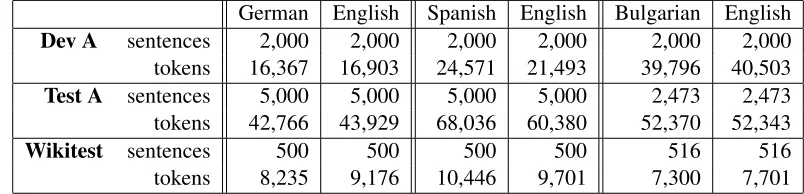
Second, we created new test sets in each of the three language pairs by sampling parallel sen-tences from held out Wikipedia articles. To ensure that this test data was clean, we man-ually filtered the sentence pairs that were not truly parallel and edited them as necessary to improve adequacy. We called this “Wikitest”. This test set is available at http://research.microsoft.com/en-us/people/chrisq/wikidownload.aspx. Characteristics of these test sets are summarized in Table 5.
We evaluated the resulting systems using BLEU-4 (Papineni et al., 2002); the results are pre-sented in Table 6. First we note that the extracted Wikipedia data are very helpful in medium data conditions, significantly improving translation per-formance in all conditions. Furthermore we found that the extracted Wikipedia sentences substantially improved translation quality on held-out Wikipedia articles. In every case, training on medium data plus Wikipedia extracts led to equal or better trans-lation quality than the large system alone. Further-more, adding the Wikipedia data to the large data condition still made substantial improvements.
5 Conclusions
Our first substantial contribution is to demonstrate that Wikipedia is a useful resource for mining par-allel data. The sheer volume of extracted parpar-allel sentences within Wikipedia is a somewhat surpris-ing result in the light of Wikipedia’s construction. We are also releasing several valuable resources to the community to facilitate further research: man-ually aligned document pairs, and an edited test set. Hopefully this will encourage research into Wikipedia as a resource for machine translation.
Secondly, we improve on prior pairwise mod-els by introducing a ranking approach for sentence pair extraction. This ranking approach sidesteps the problematic class imbalance issue, resulting in im-proved average precision while retaining simplicity and clarity in the models.
German English Spanish English Bulgarian English
sentences 924,416 924,416 957,884 957,884 413,514 413,514
Medium types 351,411 320,597 272,139 247,465 115,756 69,002
tokens 11,556,988 11,751,138 18,229,085 17,184,070 10,207,565 10,422,415
sentences 6,693,568 6,693,568 7,727,256 7,727,256 1,459,900 1,459,900
Large types 1,050,832 875,041 1,024,793 952,161 239,076 137,227
tokens 100,456,622 96,035,475 155,626,085 137,559,844 29,741,936 29,889,020
sentences 1,694,595 1,694,595 1,914,978 1,914,978 146,465 146,465
Wiki types 578,371 525,617 569,518 498,765 107,690 74,389
[image:8.612.71.568.62.199.2]tokens 21,991,377 23,290,765 29,859,332 28,270,223 1,455,458 1,516,231
Table 4: Statistics of the training data size in all three language pairs.
German English Spanish English Bulgarian English
Dev A sentences 2,000 2,000 2,000 2,000 2,000 2,000
tokens 16,367 16,903 24,571 21,493 39,796 40,503
Test A sentences 5,000 5,000 5,000 5,000 2,473 2,473
tokens 42,766 43,929 68,036 60,380 52,370 52,343
Wikitest sentences 500 500 500 500 516 516
tokens 8,235 9,176 10,446 9,701 7,300 7,701
Table 5: Statistics of the test data sets.
Language pair Training data Dev A Test A Wikitest
Spanish-English Medium 32.6 30.5 33.0
Medium+Wiki 36.7 (+4.1) 33.8 (+3.3) 39.1 (+6.1)
Large 39.2 37.4 38.9
Large+Wiki 39.5(+0.3) 37.3 (-0.1) 41.1(+2.2)
German-English Medium 28.7 26.6 13.0
Medium+Wiki 31.5 (+2.8) 29.6 (+3.0) 18.2 (+5.2)
Large 35.0 33.7 17.1
Large+Wiki 34.8 (-0.2) 33.9(+0.2) 20.2(+3.1)
Bulgarian-English Medium 36.9 26.0 27.8
Medium+Wiki 37.9 (+1.0) 27.6 (+1.6) 37.9 (+10.1)
Large 51.7 49.6 36.0
[image:8.612.102.504.236.333.2]Large+Wiki 51.7(+0.0) 49.4 (-0.2) 39.5(+3.5)
Table 6: BLEU scores under various training and test conditions. The first column is from minimum error rate training; the next two columns are on held-out test sets. For training data conditions including extracted Wikipedia sentences, parenthesized values indicate absolute BLEU difference against the corresponding system without Wikipedia extracts.
small sample of annotated articles is sufficient to train these global level features, and the learned classifiers appear very portable across languages. It is difficult to say whether such improvement will carry over to other comparable corpora with less document structure and meta-data. We plan to ad-dress this question in future work.
[image:8.612.122.489.366.547.2]References
S. F Adafre and M. de Rijke. 2006. Finding similar sentences across multiple languages in wikipedia. In
Proceedings of EACL, pages 62–69.
Phil Blunsom and Trevor Cohn. 2006. Discriminative word alignment with conditional random fields. In
Proceedings of ACL.
P. F Brown, V. J Della Pietra, S. A Della Pietra, and R. L Mercer. 1993. The mathematics of statistical machine translation: Parameter estimation. Compu-tational linguistics, 19(2):263–311.
P. Fung and P. Cheung. 2004. Multi-level bootstrap-ping for extracting parallel sentences from a quasi-comparable corpus. In Proceedings of the 20th in-ternational conference on Computational Linguistics, page 1051.
W. A Gale and K. W Church. 1991. Identifying word correspondences in parallel texts. In Proceedings of the workshop on Speech and Natural Language, pages 152–157.
Aria Haghighi, Percy Liang, Taylor Berg-Kirkpatrick, and Dan Klein. 2008. Learning bilingual lexicons from monolingual corpora. InProceedings of ACL, pages 771–779.
Roy Bar-Haim Ido, Ido Dagan, Bill Dolan, Lisa Ferro, Danilo Giampiccolo, Bernardo Magnini, and Idan Szpektor. 2006. The second pascal recognising tex-tual entailment challenge.
P. Koehn and K. Knight. 2002. Learning a translation lexicon from monolingual corpora. InProceedings of the ACL Workshop on Unsupervised Lexical Acquisi-tion.
Philipp Koehn, Franz Josef Och, and Daniel Marcu. 2003. Statistical phrase-based translation. In Pro-ceedings of HLT/NAACL, pages 127–133, Edmonton, Canada, May.
P. Koehn. 2005. Europarl: A parallel corpus for statisti-cal machine translation. InMT summit, volume 5. J. Lafferty, A. McCallum, and F. Pereira. 2001.
Con-ditional random fields: Probabilistic models for seg-menting and labeling sequence data. In Proceed-ings of the 18th International Conference on Machine Learning, pages 282–289.
R. C Moore. 2002. Fast and accurate sentence align-ment of bilingual corpora.Lecture Notes in Computer Science, 2499:135–144.
D. S Munteanu and D. Marcu. 2005. Improv-ing machine translation performance by exploitImprov-ing non-parallel corpora. Computational Linguistics, 31(4):477–504.
Franz Josef Och. 2003. Minimum error rate training in statistical machine translation. InProceedings of the
Annual Meeting of the Association for Computational Linguistics, pages 160–167, Sapporo, Japan.
Kishore Papineni, Salim Roukos, Todd Ward, and Wei-Jing Zhu. 2002. BLEU: a method for automatic eval-uation of machine translation. InProceedings of the Annual Meeting of the Association for Computational Linguistics, pages 311–318, Philadelpha, Pennsylva-nia, USA.
R. Rapp. 1999. Automatic identification of word trans-lations from unrelated English and German corpora. InProceedings of ACL.
P. Resnik and N. A Smith. 2003. The web as a parallel corpus.Computational Linguistics, 29(3):349–380. C. Tillmann and J. Xu. 2009. A simple sentence-level
extraction algorithm for comparable data. In Pro-ceedings of HLT/NAACL, pages 93–96.
C. Tillmann. 2009. A Beam-Search extraction algo-rithm for comparable data. InProceedings of ACL, pages 225–228.
S. Vogel, H. Ney, and C. Tillmann. 1996. HMM-based word alignment in statistical translation. In
Proceedings of the 16th conference on Computational linguistics-Volume 2, pages 836–841.
Wikipedia. 2004. Wikipedia, the free encyclopedia. [Online; accessed 20-November-2009].