Modular Data Serialisation
and Mobile Code
Ciarán O’Leary B.Sc.
A dissertation submitted to the University of Dublin in partial
fulfilment of the requirements for the degree of Master of Science
in Computer Science
I declare that the work described in this dissertation is, except where otherwise stated, entirely my own work and has not been submitted as an exercise for a degree at this or any other university.
Signed:
I agree that Trinity College Library may lend or copy this dissertation upon request.
Signed:
Since its creation the World Wide Web has revolutionised how we work. Academics have used it as a media to exchange research information, businesses use it to access markets previously unavailable to them and a growing percentage of society at large has been able to use it to access a global database of information. In short it has forced a rethink of the concepts of boundaries and limits.
The aim of the research outlined in this dissertation is to assess the possibility of stretching the functionality of the web a little further, by developing programming languages which exploit the availability of the web as a massive data store. The objective is to use web documents, traditionally HTML documents but in the future, XML documents, as a store of data values and types for programming languages. Values created by programming languages will be saved in available data space on the web. This will in turn lead to the increased interaction between programs on the web which will be able to exchange information in the form of a XML documents. Serialisation of programming language functions and sections of code as well as values will open the door to the development of mobile programming languages. Processing of code can take place wherever sufficient resources are available on the web, or can be moved to an area where the data required is more easily accessible.
1. Introduction ... 1
1.1 MOTIVATION... 1
1.2 PROPOSED SOLUTION... 1
1.3 OBJECTIVES... 3
1.4 ROADMAP... 4
1.5 SUMMARY... 5
2. Background ... 6
2.1 INTRODUCTION... 6
2.2 VANILLA & PROGRAMMING LANGUAGES... 6
2.2.1 Programming Languages... 7
2.2.1.1 Overview... 7
2.2.1.2 Compiler Design... 7
2.2.2 Vanilla... 10
2.2.2.1 Overview... 10
2.2.2.2 Vanilla Architecture... 11
2.2.2.3 Vanilla Pods... 12
2.2.2.4 Vanilla Types & Values... 13
2.2.2.5 Running Vanilla... 14
2.2.2.6 Summary... 15
2.3 XML... 15
2.3.1 Overview... 15
2.3.2 The Extensible Markup Language... 17
2.3.2.1 Document... 17
2.3.2.2 Markup... 18
2.3.3 Document Type Declarations... 18
2.3.4 XML Schema... 19
2.3.5 XSL... 20
2.3.6 XLink... 20
2.3.10 Summary... 24
2.4 SERIALISATION & COMMUNICATION MECHANISMS... 24
2.4.1 Overview... 24
2.4.2 Java Serialisation... 25
2.4.3 SOAP... 26
2.4.4 Jiki... 28
2.4.5 Summary... 28
2.5 CODE MOBILITY... 28
2.5.1 Overview... 28
2.5.2 Mobile Code Systems... 29
2.5.3 Design of Mobile Code Systems... 31
2.5.3.1 Introduction... 31
2.5.3.2 Remote Evaluation... 32
2.5.3.3 Code on Demand... 32
2.5.3.4 Mobile Agent... 32
2.5.4 Mobile Agent Technologies... 32
2.5.4.1 Java... 33
2.5.4.2 Java Aglets... 33
2.5.4.3 Voyager... 35
2.5.4.4 Agent TCL... 36
2.5.4.5 Obliq... 36
2.5.5 Other Systems... 36
2.5.6 Summary... 37
2.6 SUMMARY... 37
3. Design ...38
3.1 INTRODUCTION... 38
3.2 REQUIREMENTS... 38
3.2.1 Identification of Types and Values... 39
3.2.2 XML Representation... 40
3.2.4.1 Body... 48
3.2.4.2 Environment... 50
3.2.4.3 A Function in XML... 52
3.2.5 Executing Functions... 54
3.2.6 Migrating Function Execution... 56
3.3 REMOTE ACCESS... 57
3.3.1 Local / Network... 58
3.3.2 Remote Read... 58
3.3.3 Remote Write... 58
3.4 OTHER DESIGN ISSUES... 60
3.4.1 XML Parser... 61
3.5 SUMMARY... 61
4. Implementation...63
4.1 INTRODUCTION... 63
4.2 VANILLA COMPONENTS... 63
4.2.1 Serialisation Subsystem... 63
4.2.1.1 XML Approach... 64
4.2.1.2 Component Methods... 65
4.2.2 Code Serialisation... 66
4.2.2.1 ComponentWrite... 66
4.2.2.2 ComponentRead... 67
4.2.3 Environment Serialisation... 67
4.2.3.1 ComponentWrite... 67
4.2.3.2 ComponentRead... 67
4.2.4 Other Subsystems... 68
4.2.4.1 Type Matching... 68
4.2.5 System Overview... 68
4.3 MOBILITY / REMOTE ACCESS... 69
4.3.1 Introduction... 69
4.3.2 Additions to Subsystem... 69
4.4 OTHER IMPLEMENTATION ISSUES... 72
4.4.1 Serialise Pod... 72
4.5 SUMMARY... 72
5. Evaluation...74
5.1 INTRODUCTION... 74
5.2 AIMS... 74
5.3 TYPES & VALUES AS XML... 74
5.4 DISK ACCESS... 75
5.5 SERIALISATION TO WEB... 77
5.6 FUNCTIONS... 78
5.6.1 Issues... 81
5.7 APPLICATIONS... 81
5.8 MOBILITY ANALYSIS... 82
5.8.1 Code Mobility in Vanilla... 82
5.8.2 Strength... 83
5.8.3 Comparison... 83
5.8.4 Mobility Summary... 84
5.9 SUMMARY... 84
6. Conclusion ...85
6.1 INTRODUCTION... 85
6.2 ACHIEVEMENTS... 85
6.3 FURTHER WORK... 85
6.3.1 Current Issues... 86
6.3.1.1 Handling of Multiple Returns... 86
6.3.1.2 Nested Environments... 87
6.3.1.3 Object Serialisation... 87
6.3.2 Remaining Types... 89
6.4.2 Vanilla... 90
Figure 2.1: Standard architecture for a compiler from [3] ...8
Figure 2.2: Architecture of front end of a compiler from [3] ...8
Figure 2.3(a): Example Parse Tree... 9
Figure 2.3(b): Example Abstract Syntax Tree...9
Figure 2.4: Vanilla Architecture from [1] ...13
Figure 2.5: A Simple XML Document...17
Figure 2.6: Common XML markup ...18
Figure 2.7: Sample DTD Entries...19
Figure 2.8: Use of Simple types and constraints in XML Schema ...20
Figure 2.9: Namespace Declaration for TCD ...21
Figure 2.10: Namespace Usage for TCD ...22
Figure 2.11: DOM and SAX ...23
Figure 2.12(a): SOAP Request ...26
Figure 2.12(b): SOAP Response ...27
Figure 2.13: HTTP Header for SOAP Request ...27
Figure 2.14(a): Traditional Distributed System from [15] ...30
Figure 2.14(b): Mobile Code System from [15] ...31
Figure 2.15: Sample Aglet Code ...35
Figure 3.1: Type lattice ...40
Figure 3.2: XML representation of type value pair ...41
Figure 3.3: XML representation of a String...42
Figure 3.4: XML representation of a Record...43
Figure 3.5: Relationship between components ...45
Figure 3.8: Abstract Syntax Tree as XML...50
Figure 3.9: A Function with its Environment ...51
Figure 3.10: An Environment in XML...52
Figure 3.11: A Function in XML ...54
Figure 3.12: Executing XML Function ...55
Figure 3.13: Migrating XML Function ...57
Figure 3.14: The architecture for writing to remote server space ...60
Figure 4.1: Complete view of Vanilla System ...68
Figure 5.1: A Vanilla Integer as XML ...75
Figure 5.2: Example code to write a record locally ...76
Figure 5.3: Output from above code...77
Figure 5.4: Example code to write a record locally ...77
Figure 5.5: Output from code in Figure 5.4...78
Figure 5.6: Write a function...79
Figure 5.7: Read function back in as value...79
Figure 5.8: Output from Figure 5.7 ...79
Figure 5.9: Execute function from XML file ...79
Figure 5.10: Output from Figure 5.9 ...79
Figure 5.11: Running a function with its environment remotely...80
Figure 5.12: Output from Figure 5.11 ...81
Figure 6.1: Function with single return statement ...86
Figure 6.2: Function with many return statements ...86
Figure 6.3: An Object in a Vanilla test language ...88
1. Introduction
1.1 Motivation
Jon Bosak [12], one of the developers of the Extensible Markup Language (XML) argues that the revolution started by the combination of the global Internet and hypertext will be completed by the addition of XML. XML will add to the ability of the web to understand data and perform functions where a greater understanding of web content is required.
David Kotx [17] puts forward the same argument for mobility. He maintains that within five years “nearly all major Internet sites will be capable of hosting and willing to host some form of mobile agent”. Mobile code will be a critical near term part of the Internet. It makes new applications possible, improves significantly on the performance of traditional distributed processing techniques, but most importantly it will provide a single general framework to allow the simple and efficient implementation of distributed, information processing applications. This framework will facilitate the division of programming tasks among the various sites on the Internet which are willing to host processing of some sort.
What is required is a prototypical programming language which exploits the suitability of XML as a means for describing data, and which implements a certain degree of mobility in order to demonstrate the future uses of the web. Such uses will be demonstrated in this dissertation to include the addition of processing power to systems through mobility and the opening of file space to allow for sharing and storage of programming language values.
1.2 Proposed Solution
In doing so extensive use will be made of XML, Vanilla and current theory in the area of mobile code and programming language design. Analysis will be made of the various techniques being employed in the area of mobile code to see how the web could be utilised as a global environment for data processing. Also, if data can be serialised to a local disk then why not allow for its serialisation to any available space on the web. If this data is available elsewhere on the web then other programs will be able to access and understand it. If the same serialisation is implemented for programming language code then the processing burden incurred locally can be distributed among the available resources on the web.
XML adds to the contents of web documents. It replaces the “dumb” HTML that could only format the public view of the data, with a richer more powerful form of markup. XML insists on the specification of domain specific markup tags. It does so by providing a null set of previously defined tags. If a developer has the power to describe his/her data as (s)he chooses then the tags used to describe his/her data will have been enriched by the addition of semantics. Currently XML is being used in an ever-growing number of domains as a structured data description format. These domains range from Medicare (Health Level Seven http://www.hl7.org) to Real Estate (Real Estate Data Interchange Standard http://www.rets-wg.org/) to the News Industry (News Industry Text Format http://www.nitf.org/).
The use of XML for the purposes of this dissertation will be confined to defining the data content of programming language values and types. These values will then be written as web documents to available space on remote web servers. In effect web content will no longer be simply data for display to be read by humans, web documents will represent programming language values. Programming languages will be able to read the contents of an XML document and extract meaning from it, in much the same way as, say Java, can read a serialised Java object from disk and construct an in memory version of it.
programming language builder. It separates the various parts of traditional compiler builders (parser, type checker, interpreter) and implements them independently for the different sections of a programming language (functions, objects, conditionals and so on). Currently, any language built using Vanilla will not have disk access. The aim of this dissertation is to add new components to the existing set of Vanilla components in order to provide serialisation functionality.
Serialisation of programming language values will be the primary focus of the dissertation. However, the additional aim of integrating mobility into Vanilla can be provided by exploiting the fact that Vanilla functions are treated as if they are values. If we can successfully serialise programming language functions to the web then will we have ways of making it run. If so, will it be able to run with the same resources it had on its original host, how will it keep its environment consistent with where it was originally located and how will it communicate with its parent to return values.
1.3 Objectives
For clarity the individual objectives of this dissertation can be specified as follows:
1. The development of some standard mechanism for the representation of Vanilla types and values as well as functions as XML documents. At this stage the aim is simply to be able to take in-memory values and display how they may be represented as an XML document.
2. The extension of the current Vanilla framework to add disk access functionality. Initially all that will be allowed for will be the serialisation of simple text strings to the local disk. Following the implementation of this, however, the basic write(filename, String) will be extended to allow for functions such as write(filename, Value). The data will be serialised to the disk as an XML web document. 3. The remote serialisation of values. This refers to the ability to write the
machine or possibly not even on the network on which the program that generated the value is running. When this has been successfully completed possible applications for this functionality will be looked at. For example Vanilla based programs could interact over the web by exchanging values as XML documents.
4. Ultimately the ability to serialise code and execute it remotely ought to be implemented. This will lead to the area of code mobility. A number of things need to be examined at this stage. For instance the benefits and drawbacks of weak versus strong migration of code between hosts will be analysed to see what is required to add sufficient power to the programming language.
1.4 Roadmap
The next chapter of this dissertation will be present background information on the various areas explored in the project. Subsequent chapters will outline the design, implementation and evaluation of the system. Here is a clearer outline of the remaining chapters.
• 2. Background
o In this chapter the following technologies and research areas will be examined in detail
1. Vanilla and Programming Languages 2. XML
3. Serialisation and Communication Mechanisms 4. Code Mobility
• 3. Design
o The design of the system. What is required, what approach will be taken, what will the architecture appear like from a high level and so on.
o What choices were made on how to implement the system, what issues were encountered when implementing it and how was it implemented?
• 5. Evaluation
o What results did testing of the system produce, what are the possible uses of the system and how do these function at present? What is required to make the system better or more adaptable to other potential uses?
• 6. Conclusion
o What has the research outlined in this dissertation produced? What future research is possible?
• 7. References
o A list of all sources
1.5 Summary
2. Background
2.1 Introduction
In this section the various technologies that will be used in this project will be examined in details as well as what other work is being done in the various research areas relating to these technologies and how these technologies function.
The main sections with be as follows:
• Vanilla
o In this section on overview of programming language theory will be presented before a more detailed discussion of the Vanilla system, the technology that is core to the research in this dissertation. • XML
o The Extensible Markup Language is a subset of the Standard Generalised Markup Language which provides a structure for data so it can be represented in a standard machine understandable manner.
• Serialisation & Communication Mechanisms
o This section will contain a detailed discussion of two technologies, SOAP and Jiki, that may be used as the basis of the communication mechanism in this project.
• Code Mobility
o What is code mobility, what different types of mobility exist and what implementations are available. All these questions will be addressed and answered.
2.2 Vanilla & Programming Languages
program can be seen from processing the source code, rather than machine code. Vanilla is a tool that will build an interpreter for a programming language.
The next section will give a general introduction to compiler design, the lessons from which can just as easily be applied to interpreters. The next section following this will give a complete overview of the Vanilla tool.
2.2.1 Programming Languages
2.2.1.1 Overview
A compiler is a program that translates an program in one language into an executable program in another language. The output produced by the compiler should be better in some way than the original input. For example if some Java code is processed by a Java compiler then the output, Java byte code, will be in a format that is directly understandable by the Java Virtual Machine.
An interpreter is a program that reads an executable program and produces the results of running that program. Typically this will involve executing the source code in some fashion. For example if some Java code is presented to a Java interpreter then the output of running that code will be presented immediately, without the intermediate step of compilation into byte code. Languages such as Perl are usually interpreted rather than compiled into machine code of some sort.
2.2.1.2 Compiler Design
Figure 2.1: Standard architecture for a compiler from [3]
[image:19.595.170.429.77.137.2]The structure of the front end (Figure 2.2) will be similar for both compilers and interpreters. The source code is scanned and parsed to check for syntactic correctness and to construct the intermediate representation that will be used at the back end, throwing any errors encountered along the way.
Figure 2.2: Architecture of front end of a compiler from [3]
The processing that takes place for a small piece of code, such as
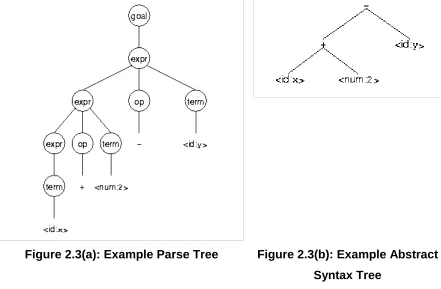
x + 2 – y
can result in a large parse tree, as seen in Figure 2.3(a), so most compilers prefer to use an Abstract Syntax Tree to represent the piece of code.
Figure 2.3(a): Example Parse Tree Figure 2.3(b): Example Abstract
Syntax Tree
The type checker will usually operate as a recursive function of the Abstract Syntax Tree. Its function is to use entries in Symbol Tables to map symbols to bindings. The main aim is to determine type equivalence, to ensure that types, values and objects are only used where it is appropriate to do so. One of the following approaches is taken when checking type equivalence.
• In name equivalence, two types are equivalent if they are named and have the same name.
• In structural equivalence, two types are equivalent if they have the same structure.
• In structural equivalence under naming, two types are equivalent if they have the same structure and the named components of each structure have the same names.
[image:20.595.94.338.72.311.2] [image:20.595.90.531.74.363.2]machine code version of the program is required then the necessary code will be generated for the relevant environment.
The three phases of a compiler can therefore be seen as 1. Parser
• Read in source code and construct Abstract Syntax Tree 2. Type Checker
• Check the types of the nodes in the Abstract Syntax Tree in order to ensure that the left and right hand sides of expressions evaluate to compatible types, and so on.
3. Interpreter
• Produce output, whether this is compiled executable code, or simply the output of running the code.
2.2.2 Vanilla
2.2.2.1 Overview
The Jakarta Tool Suite (JTS) [2] is a set of domain independent tools for creating domain specific languages. A language is constructed using JTS by extending an existing programming language, called a host language. The benefits of using this suite of tools for language creation are three fold.
1. Common programming constructs need not be re-implemented. The functionality of the host language is re-used in the new language. 2. The extensions of the host language need only be transformed to a
point where they can be expressible in the host language 3. The existing infrastructure can be used.
This method of programming encourages the re-use of tried and tested code, and as a result reduces significantly on the time for development of a new language.
components provides all the functionality (parser, type checker, interpreter) for an individual part of a programming language, say loops. Such components are provided for all the basic parts of a language. To alter or extend the language to create a new language only a few components will need to be changed.
This type of programming is a part of the growing area of component based software design. Standard components which provide a certain amount of functionality and that functionality alone can be integrated with other components with confidence that their independent behaviours will not be tied to any other components except for how is specified by the programmer. In this way systems such as JTS and Vanilla can be used to create new languages through the re-use of existing components integrated with a minimal set of newly created components.
2.2.2.2 Vanilla Architecture
Vanilla provides an overall framework (Figure 2.4) into which components for the language can be plugged. It provides a number of components, or subsystems, which mirror the overall architecture of a well-designed interpreter, i.e. parser, type checker, interpreter. Each of these subsystems is implemented as a set of components.
Each individual part of a programming language is implemented as a Vanilla pod. A Vanilla pod will implement a parser, type checker and interpreter for that pod alone. When loaded the different components register themselves with the root component of the subsystem. All pods are loaded at run time. The registry that is constructed for each subsystem is queried each time a parser (or type checker / interpreter / any other subsystem component) is required for an individual piece of code. The registry will then find the appropriate component to perform the operation required.
parser, type checker and interpreter for that feature and include the names of those components in the language definition file. In order to change a subsystem, or to include a new one (for say, serialisation), a set of components must be created and included as a new subsystem in the Vanilla properties file.
Since the language is loaded as well as he program at run time a large set of potential languages can co-exist together, with the language definition file for each language specifying what components are required for each language.
2.2.2.3 Vanilla Pods
A Vanilla pod is a set of components that implement a single language feature and only that feature. Separate pods exist for each of the following:
Core : Ground types, arithmetic, sequence Variables : Put & get from environment
Sequences : Arrays Conditionals : If-then-else
Loops : For (…)
Very Common
Functions : Higher order closures Universals : Like C++ Templates Existentials : Partially abstract types
-recursive types
: Types containing themselves
The basis of functional programming
Objects : Abadi & Cardelli Style Classes :
Figure 2.4: Vanilla Architecture from [1]
2.2.2.4 Vanilla Types & Values
All Vanilla Values have an associated Type. Type and Value components are provided for all the basic types within a programming language i.e.
Boolean, Integer, String, Record, Object. All Type classes extend the root Type class and likewise all Vanilla Values extend the root IValue
class. In order to create new Types or Values these root classes must be extended.
In Vanilla a Function is also treated as a Value. This was a decision that was made when designing the basic functionality that is provided with Vanilla, but could be easily altered thanks to the decoupled component nature of Vanilla. The research outlined in this dissertation takes advantage of the fact that functions are treated as values.
A Value must have an associated Type. Types may also have a Kind
2.2.2.5 Running Vanilla
Vanilla can be downloaded for free from www.vanilla.ie. The current version is Vanilla 1.6 but the version that will be released following the successful completion of this dissertation will be version 1.7 and will include all the serialisation and mobile code capabilities that will be developed as part of this project.
In order to run Vanilla all the compiled classes must be downloaded and installed and the classpath must be set appropriately. Extra components can then be added or amended as required.
There are a number of tests provided which can then be used to test the installation.
1. vc
• The batch-mode shell. Most commonly used
2. avc
• A more intelligent batch-mode shell
3. vint
• The interactive shell
4. vprint
• The AST print utility
5. vp
• The parser component generator 6. vpod
• The pod compiler
7. vic
• The interpreter compiler
In order to run Vanilla using one of these tools on a file such as test.v, run the following command
2.2.2.6 Summary
In brief, Vanilla is a tool that provides a language designer with a means to
“throw together” a language in a short time. It saves the designer from the
burden of having to implement functionality that is common to most languages, allowing him/her to focus solely on the central part of the language, or the part that they wish to implement differently. Vanilla obeys all rules for language design, and in this respect implements languages in the same way as is done by more conventional systems, i.e. it contains parse, type check, interpret phases, it implements Types, Kinds and Values.
What it does differently (i.e. component based, plug in architecture) is what makes it useful for developing prototypical languages. Because it is mainly supposed to be used for this theoretical work its designers concentrated on getting everything to work correctly, rather than optimising it in terms of speed or performance. As would be expected from a system that requires a large number of components to be loaded at run time, its performance can be quite slow in comparison to conventional systems.
2.3 XML
2.3.1 Overview
Documents containing any sort of meaningful information must have some structure if the content is to be understood by a machine. The structured information should contain both content and some indication of what role that content plays. For machines to understand the content they must be presented with a description of the overall structure of information within the document. A markup language is a mechanism to identify structures in a document.
functions as XML, but its complexity does not lend itself nicely to simpler tasks, such as representation of web data. XML, as a restricted form of SGML, can easily accomplish this task and much more.
The magic of XML lies in the freedom that is given to the programmer in describing the overall structure and semantics of his/her data within a single document. Although it is a markup language just like HTML it does not specify any tags. Thus any person, or more typically, any industry can specify a set of tags and an overall XML document structure that should be used to represent the information that is used within the industry.
Originally XML was just seen as a natural successor to the afore-mentioned Hyper Text Markup Language (HTML). Indeed it is probably the case that XML in tandem with its sibling XSL will become the standard method for displaying data on the web, but XML is far too rich to be constrained to that use alone.
There are a number of “extras” that come along with XML to add to its power.
1. XSL – The Extensible Stylesheet Language 2. XLink – The XML Linking Language
3. XPointer – The XML Pointer Language
As well as these, the mass of research taking place in this area has also produced numerous APIs for the processing of XML documents in different ways, as well as a wealth of different environments in which XML can be developed.
2.3.2 The Extensible Markup Language
2.3.2.1 Document
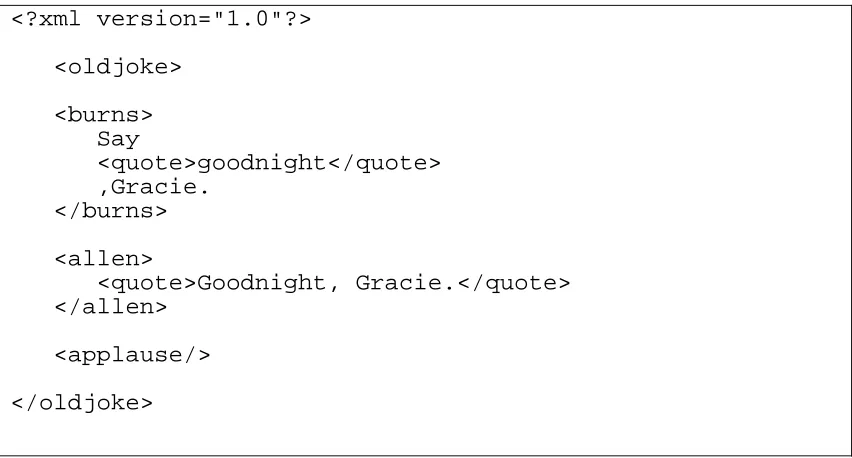
All XML data is contained within an XML document. An example of a simple XML document (that seemingly has become the “Hello World” standard example in XML tutorials) is given below in Figure 2.5. Note that all XML examples presented below are either from the XML tutorial on XML.com [11] or from the myriad of papers written on XML and available off the World Wide Web Consortium web site [4 – 10]
<?xml version="1.0"?>
<oldjoke>
<burns> Say
<quote>goodnight</quote> ,Gracie.
</burns>
<allen>
<quote>Goodnight, Gracie.</quote> </allen>
<applause/>
[image:28.595.85.511.276.505.2]</oldjoke>
Figure 2.5: A Simple XML Document
All XML documents must begin with the code shown in the first line of Figure 2.5 above. This, quite obviously, is an indication of the version of XML being used in the document. Documents must also be well formed, meaning start tags must have corresponding end tags and must not overlap and must be
valid if a structure is given for the document. This will be explained in more
2.3.2.2 Markup
An XML document is comprised of both markup and content. There are six different types of markup in XML. They are Elements, Attributes, Entity References, Comments, Processing Instructions and CDATA sections. Most important for the purposes of this dissertation are Elements and Attributes. These represent the structure of the document and the values that may optionally be associated with them. An example is given below in Figure 2.6.
<elementname attribute1=something> Blah blah blah
</elementname>
Figure 2.6: Common XML markup
2.3.3 Document Type Declarations
As alluded to earlier, one of the great strengths of XML is that it allows the programmer create his/her own tags, thus giving him/her the power to add semantics to their documents by specifying tags that are meaningful to the application in question.
A Document Type Declaration (DTD) describes the Meta data. It gives the structure of the document, saying which tags occur at which point in the document. Documents need not necessarily conform to a DTD but if it does it is said to be valid. If present in a document, the DTD must be the first thing in the document. If not located within the document, there may be a reference to an external DTD or there may be both internal and external DTDs associated with a document.
The DTD’s main function is in communicating Meta information to the parser to give the machine some “understanding” of what is contained within the document.
<!ELEMENT oldjoke (burns+, allen, applause?)> <!ELEMENT burns (#PCDATA | quote)*>
<!ELEMENT allen (#PCDATA | quote)*> <!ELEMENT quote (#PCDATA)*>
<!ELEMENT applause EMPTY>
<!ATTLIST oldjoke name ID label CDATA status ( funny | notfunny ) 'funny'>
Figure 2.7: Sample DTD Entries
2.3.4 XML Schema
Document Type Declarations are typically used to define the structure of an XML document. However DTDs often lack sufficient power. XML Schema attempt to provide an alternative method for describing data that does not lack the power that DTDs do. An advantage of Schema over DTDs is that they are expressed entirely in XML and do no t require a knowledge of a different syntax (Extended Baukus Naur Form for DTDs) to be constructed.
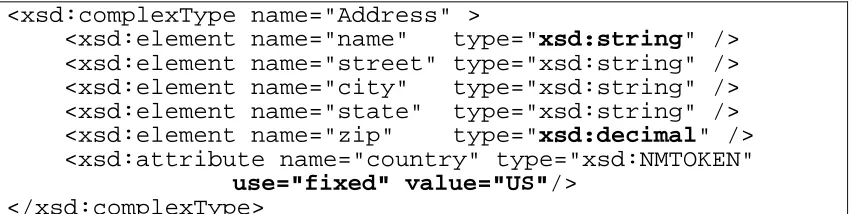
The purpose of XML Schema, according to its specification [8] is to define a class of XML documents. Schemas have many different parts and are probably best understood through the use of an example. Such an example exists in the W3C spec [8], but is far too complex to deal with here. Suffice it to say that XML schemas appear similar to a DTD expressed in XML. Obviously the power to express data definitions using your own tags can add to the power of the definition. There are a number of built in types and constants available to the document writer. The use of a small subset of these should be apparent from the example piece of code in Figure 2.8.
<xsd:complexType name="Address" >
<xsd:element name="name" type="xsd:string" /> <xsd:element name="street" type="xsd:string" /> <xsd:element name="city" type="xsd:string" /> <xsd:element name="state" type="xsd:string" /> <xsd:element name="zip" type="xsd:decimal" /> <xsd:attribute name="country" type="xsd:NMTOKEN" use="fixed" value="US"/>
[image:31.595.87.513.92.199.2]</xsd:complexType>
Figure 2.8: Use of Simple types and constraints in XML Schema
2.3.5 XSL
The Extensible Stylesheet Language [9] specifies the presentation of a class of XML documents as web documents, by describing how a document in the class can be transformed into a document that conforms to the formatting rules for web presentation. For example, some mechanism may be given to specify how the XML content can be formatted in HTML.
2.3.6 XLink
The XML Linking Language [6] allows elements to be inserted into XML documents in order to create and describe links between resources. A link is a relationship between two resources, made explicit by an XLink linking element. XLink allows XML documents to
• Assert linking relationships among two or more resources. • Associate Meta data with a link.
• Create link databases that reside in a location separate from the linked resources.
2.3.7 XPointer
The XML Pointer Language [7] is a language that specifies the means for addressing into the internal structures of an XML document. In particular it provides for specific reference to elements, character strings and other parts of XML documents. In short XPointer provides a means for locating elements and other resources within a document, relative to the root, or any other location within the document. The potential use for this would lie in the ability to navigate through documents pulling information from various sections, where a document contains say, two sets of information, possibly type and value.
2.3.8 XML Namespaces
Namespaces in XML [10] provide a simple method for qualifying element and attribute names used in XML documents by associating them with namespaces associated with URI references. According to its specification [10] an XML namespace is “a collection of names, identified by a URI
reference, which are used in XML documents as element types and attribute names”.
An XML namespace is declared using a family of reserved attributes. Such an attribute’s name must have either xmlns: or xmlns as a prefix. An example namespace declaration which associates the namespace tcd with the namespace name http://www.tcd.ie/ is given in Figure 2.9 below.
<x xmlns:tcd=’http://www.tcd.ie’>
<!—the “tcd” prefix is bound to http://www.tcd.ie/
for the x element and contents -->
</x>
Figure 2.9: Namespace Declaration for TCD
the element. Consider for example the declaration of people as a qualified name for tcd
<x xmlns:tcd=’http://www.tcd.ie’>
<!—the ‘people’ element’s namespace is
http://www.tcd.ie/ -->
<tcd:people type=’Staff’>1000</tcd:people>
</x>
Figure 2.10: Namespace Usage for TCD
When all sorts of XML Schema are declared then there are likely to be conflicts, where size, for instance, means one thing in one industry and something completely different in another industry. The use of namespaces is aimed at preventing the likely confusion, by qualifying the names according to how they are being used and who is using them.
2.3.9 Parsing XML
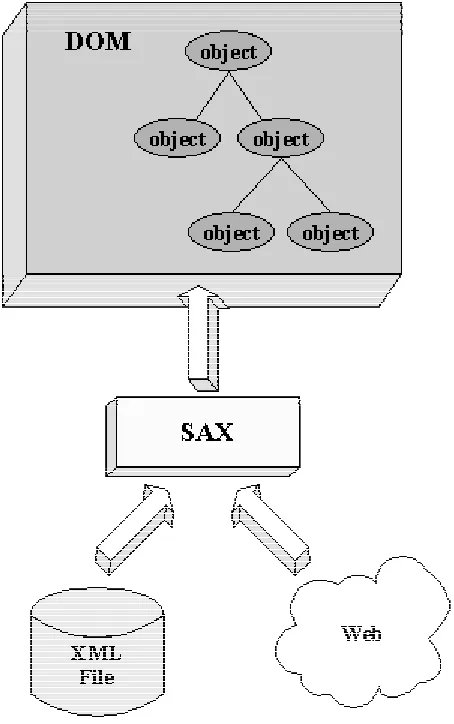
Since one of the primary functions of XML is the exchange of data between computer programs, the necessity for a mechanism to parse and hence, understand, XML is paramount. To do so, Sun provide two APIs for parsing XML documents. These APIs represent different approaches to processing XML, and as such are better suited to different types of applications. They closely related to each other, as will be seen in Figure 2.11.
The "Simple API" for XML (SAX) is the event-driven, serial-access mechanism that does element-by-element processing. The API for this mode reads and writes XML to a data repository or the Web. This mode is best suited to server-side and high-performance applications.
that reason, the SAX API will tend to be preferred for server-side applications and data filters that do not require an in-memory representation of the data. The DOM API builds on the SAX API as shown here in Figure 2.11.
Figure 2.11: DOM and SAX
There are a number of different implementations of the two XML parsers available, including the Apache Xerces parser. This wraps up the Sun implementation with some extra functionality.
2.3.10 Summary
XML has been seen to take its place where it belongs, everywhere. It is destined to become a standard wherever interchange of any sort of structured information is required. This section has presented an outline of how XML documents are constructed, linked, traversed, described and parsed.
2.4 Serialisation & Communication Mechanisms
2.4.1 Overview
The core of this dissertation involves the writing, or serialising of data to disk. This will involve the specification of some mechanism for representing the data, and the development and incorporation of some algorithm that will ensure that the correct data is being collected, to allow for the rebuilding of the data when read from disk.
The Java serialisation mechanism is first looked at to see how Java approaches the issue of serialisation. It is shown why this is insufficient for what is required here.
However, the serialisation in this project takes place in the form of XML documents. In order to look at how data might be represented in XML an examination of the Simple Object Access Protocol (SOAP) is made. This protocol involves the encoding of requests and responses in XML for communication in a distributed programming environment.
2.4.2 Java Serialisation
Sun Microsystems [23] describes the ability to store and retrieve Java objects as being essential to building all but the simplest applications. The key to storing and retrieving objects in a serialised form is representing the state of objects sufficient to reconstruct the object(s). Objects to be saved in the stream may support either the Serializable or the Externalizable
interface. For Java objects, the serialised form must be able to identify and verify the Java class from which the contents of the object were saved and to restore the contents to a new instance. For serialisable objects, the stream includes sufficient information to restore the fields in the stream to a compatible version of the class. For Externalisable objects, the class is solely responsible for the external format of its contents. Objects to be stored and retrieved frequently refer to other objects. Those other objects must be stored and retrieved at the same time to maintain the relationships between the objects. When an object is stored, all of the objects that are reachable from that object are stored as well. The goals for serialising Java objects according to Sun Microsystems [23] given here.
• Have a simple yet extensible mechanism.
• Maintain the Java object type and safety properties in the serialized form.
• Be extensible to support marshaling and unmarshaling as needed for remote objects.
• Be extensible to support simple persistence of Java objects. • Require per class implementation only for customisation. • Allow the object to define its external format.
2.4.3 SOAP
The Simple Object Access Protocol [13] is a minimal set of conventions for invoking code using XML over HTTP. It was submitted to the IETF as an Internet Draft in December 1999, by DevelopMentor, Microsoft and UserLand. It is an evolution of XML-RPC, which was the first result of the concept of calling remote methods over HTTP using XML.
SOAP works by encoding a method name and its associated parameters in an XML document and sending it over HTTP to the required destination. The amount of information used is minute compared to the requirement of encoding complex values in XML, but for primitive data types it is reasonably closely related.
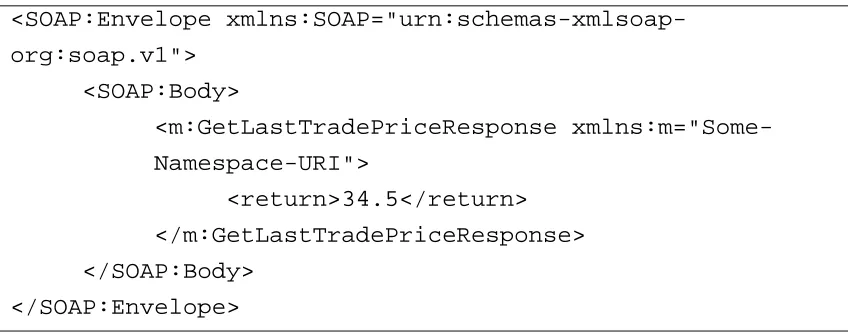
Figure 2.12(a) below shows a SOAP request. Things to note here are the use of namespaces, the envelope notion for storing the information and the way the method name is encoded in XML.
Since SOAP is a request response based approach, a response must follow a request. The response to the request in Figure 2.12(a) is given below in Figure 2.12(b).
<SOAP:Envelope
xmlns:SOAP="urn:schemas-xmlsoap-org:soap.v1">
<SOAP:Body>
<m:GetLastTradePrice
xmlns:m="Some-Namespace-URI">
<symbol>DIS</symbol>
</m:GetLastTradePrice>
</SOAP:Body>
</SOAP:Envelope>
<SOAP:Envelope
xmlns:SOAP="urn:schemas-xmlsoap-org:soap.v1">
<SOAP:Body>
<m:GetLastTradePriceResponse
xmlns:m="Some-Namespace-URI">
<return>34.5</return>
</m:GetLastTradePriceResponse>
</SOAP:Body>
</SOAP:Envelope>
Figure 2.12(b): SOAP Response
SOAP operates entirely over HTTP. The chief advantage of this is that web servers whose firewalls permit communication only on port 80 will not stop SOAP data from being communicated. Other protocols such as the IIOP, which work on other ports, can be stopped by suspicious firewalls.
In HTTP headers SOAP uses the Content-Type of "text/xml". This is used to specify the body of the HTTP request containing a XML encoded method call. To disambiguate the headers it adds to HTTP, SOAP permits use of the HTTP Extension Framework specification. The extension framework allows use of the HTTP verb M-POST. An example HTTP header for the request in Figure 2.12(a) is given below in Figure 2.13.
POST /StockQuote HTTP/1.1
Host: www.stockquoteserver.com
Content-Type: text/xml
Content-Length: nnnn
SOAPMethodName: Some-Namespace-URI#GetLastTradePrice
[image:38.595.85.509.90.257.2]2.4.4 Jiki
Jiki [14] is an open web server architecture that provides access to all documents stored in its file space to any web client. Clients accessing a document stored on a Jiki web server are presented with the opportunity to edit the contents of the page. No security has so far been implemented so anyone who wishes to do so may edit any page on a Jiki web server. This concept of openness is something that could be exploited for the purposes of this dissertation, where a mechanism for writing from one machine to another is required. Although Jiki may not be ideal a lot can be learned from how it is implemented.
1. It is a system written entirely using Java Servlets.
2. It uses simple HTTP POSTs to input all its values, thus avoiding the need for HTTP extensions
3. It keeps everything nice and simple
2.4.5 Summary
Each of Java serialisation, SOAP and Jiki have been introduced to attempt to explain some mechanisms for representing data and sending this data between machines. Java serialisation is a data representation format, SOAP is simply a communications protocol and Jiki is a web server architecture.
2.5 Code Mobility
2.5.1 Overview
alternative to traditional RPC mechanisms by proving to be a better way to perform the same task.
Code mobility refers to the ability to move code around a network exploiting available resources at the various nodes to provide a quicker, more efficient result, or often, just to enable the computation of some meaningful result. There are three main approaches taken in code mobility, which will be elaborated upon. In brief, however, the main methods of making code mobile are as follows [18].
1. The Remote Evaluation Approach 2. The Mobile Agent Approach 3. The Code on Demand Approach
The three approaches differ in the way the code is moved, how the result is achieved and who performs the computation.
When code is moved, or migrated, the level of detail that accompanies it to its destination determines whether the type of migration is weak or strong. Weak migration involves the transfer of the code alone. Strong migration requires that all information about state accompany the code. Intermediate levels of migration strength may also be possible, as discussed by Walsh [15].
The next few sections will outline how code mobility with an examination of how mobility contrasts with traditional distributed computing mechanisms such as CORBA, what are the various approaches taken and what systems currently exist.
2.5.2 Mobile Code Systems
an object broker who knows of who provides what services. All that is required of anyone who requires the services is that they know how to locate the object broker.
Fuggetta [19] gives a clear explanation of the differences between this sort of True Distributed System and what he terms a Mobile Code System. Figure 2.14(b) shows the architecture of a Mobile Code System (MCS). The top layer in the True Distributed System is replaced by a set of Computational Environments located at each node. Therefore the underlying computer network is not hidden from the programmer; rather the programmer is given the power to relocate the processing of an application to any of the nodes. A Computational Environment (CE) is an environment on a machine in a network that can host the execution of a unit of code, or Executing Unit (EU). An executing unit is a sequential flow of execution, for example a single threaded process. An executing unit will have a number of components. Its Code Segment will provide a static description of the execution of the EU. Its Data Space represents the set of resources that can be accessed by it. Its Execution State represents the private data that cannot be shared, as well as control information related to the EU’s state. CEs can also host what are called Resources. Resources represent entities that may be shared among multiple EUs.
• NOS:
o Network Operating System
• OS
o Core Operating System
[image:41.595.82.515.505.646.2]• NOS:
o Network Operating System
• OS
o Core Operating System
Figure 2.14(b): Mobile Code System from [15]
In standard, non-mobile systems an EU is tied to a single CE for its entire lifetime. In Mobile Code Systems, however, an EU can be relocated to a different CE. The portion of the EU that needs to be moved is determined by the strength of the migration that is required.
Strong mobility is the ability of an MCS to allow migration of both the code and
the execution state of the EU to a different CE. Weak mobility is the ability of an MCS to allow code transfer across different CEs, optionally accompanied by some initialisation data, but without any migration of execution state. Mechanisms supporting weak mobility provide the capability to transfer code across CEs and either link it dynamically to a running EU or use it as a code segment for a new EU to be created and initialised.
2.5.3 Design of Mobile Code Systems
2.5.3.1 Introduction
Fuggetta [19], explains that traditional approaches to software design are not sufficient when designing large scale distributed applications that exploit code mobility and dynamic reconfiguration of software components. In these cases, he continues, the concepts of location, distribution of components among locations and migration of components to different locations need to be taken into account at the design stage.
[image:42.595.84.512.74.207.2]1. Remote Evaluation 2. Code on Demand 3. Mobile Agents
2.5.3.2 Remote Evaluation
A and B are two components located respectively at sites SA and SB. A requires some service to be performed, and has the know how to complete it, but does not have the resources to do so. A sends the service know how to B.
B executes the code using the resources available at SB. B then sends the results of the computation back to A.
2.5.3.3 Code on Demand
Once again we have two components A and B are located at sites SA and SB. However in this paradigm A can access the resources it requires since they are located with it at SA. A interacts with B to acquire the know how to perform the service, which is located at SB. B delivers the code to A, and A executes the code at SA using the resources available to it.
2.5.3.4 Mobile Agent
A has the know-how and some of the resources, but lacks some other
resources vital to the correct computation of the piece of code. Therefore it takes the code and some intermediate results that it has computed at SA and travels to SB where it completes the computation.
The first two paradigms deal with the transfer of code. The final one involves the movement of the entire computational component and possible details about its environment and state.
2.5.4 Mobile Agent Technologies
discussion of some of these systems. For a broader analysis and evaluation of some of these systems see Walsh [16] and Kiniry [20].
2.5.4.1 Java
The Java Virtual Machine (JVM) can be viewed as a Computational Environment. The class loader that is provided by Java dynamically links and retrieves classes in a JVM. It is invoked by the Java run time when the code currently in execution contains an unresolved class name. The class loader will retrieve the code from a possibly remote host and load the class into the JVM. For example imagine an applet that is running in a browser. The browser will contain it’s own JVM. When the applet calls a class that it has not got locally the class will be retrieved from the host from which the applet was originally downloaded. In this situation we can view the browser with its in built JVM as the computational environment and the applet as the Executing Unit. We can view this as a simple form of code mobility. It is the weakest form of mobility as the only thing being migrated is stand-alone code that is moving while not running. More complex systems will be dealt with below, but it should be understood that these systems are built using Java and run in a Java Virtual Machine, so they build on the functionality dealt with above.
2.5.4.2 Java Aglets
Aglets [21] are Java classes that can move from one host on the Internet to another. An aglet that executes on one host can suddenly suspend execution, move and then resume execution and another host. Aglets appear to be the most popular of any of the currently available mobility systems, some reasons for which are outlined by Kiniry [20].
1. They are easy to install and use for a Java programmer.
2. The example applications supplied with the installation are flashy and come equipped with attractive APIs (people are easily convinced by aesthetics).
Alongside these reasons comes the fact that the Aglet system has a nice clean design. They take their name from a pun on the two words applet and
agent, and their usage largely reflects the implementation of applets. The
aglet system mirrors a great deal of the applet model, for instance
• dispatch(...) mirrors run(...)
• deactivate(...) mirrors stop(...)
• run(...) mirrors run(...)
• getAgletContext(...) mirrors getAppletContext(...)
Aglets, the Executing Units are threads in a Java Virtual Machine, the Computational Environment. The way in which the Aglet API supports migration is through the primitives dispatch(...) and retract(...).
dispatch performs code shipping of the stand alone code to a new context supplied as a parameter. A context of an aglet is the environment within which it is currently located. Services provided in a context include the facility to list the current set of aglets resident within the context, or add new aglets to the context. The second migration primitive, retract, is the same as dispatch
except for the requirement that the aglet return to where retract was called from upon completion of its task.
With both dispatch and retract the aglet is re-executed from scratch when it is migrated, although the values of its object attributes are retained to provide an initial state for its computation.
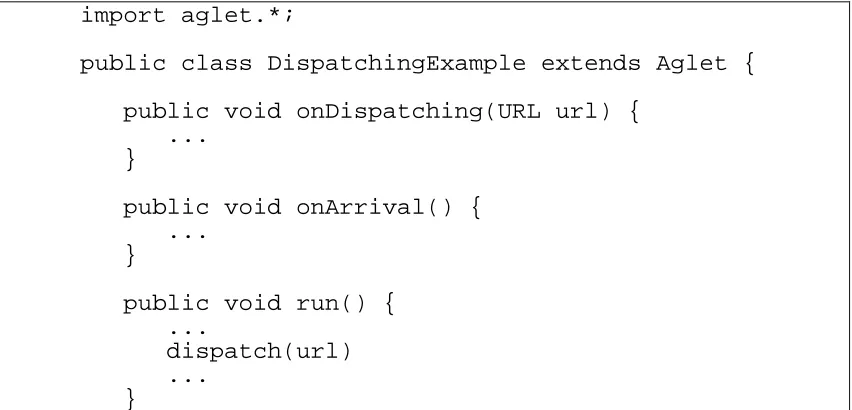
import aglet.*;
public class DispatchingExample extends Aglet {
public void onDispatching(URL url) { ...
}
public void onArrival() { ...
}
public void run() { ...
dispatch(url) ...
[image:46.595.86.512.92.297.2]}
Figure 2.15: Sample Aglet Code
2.5.4.3 Voyager
ObjectSpace developed Voyager [22] in 1997. Voyager is a Java based mobile agent system that “exhibits several unique and innovative features” [20]. The chief innovative feature of Voyager is its Virtual Object. The Virtual Object is Voyager’s key communication framework and tool to support inter-agent communication. Conventional RPC based systems such as Java’s Remote Method Invocation (RMI) mechanism, require the developer to go through a series of steps to describe first the interface and then the implementation of an object. Voyager simplifies this by providing the ”vcc” tool (Virtual Code Compiler). This tool will take any existing Java class and modify it to create the Virtual Object mirror of the source class.
Another advantage of Voyager over other agent systems is that it can migrate into any Java runtime of another Virtual Object. It is not necessary to have an Agent server located on every node that you wish to use as a Computational Environment.
Voyager increases development time by providing a number of mechanisms that make it simple to move from a simple environment space to a distributed, agent based, mobile processing environment.
2.5.4.4 Agent TCL
This is a simple TCL interpreter extended with support for strong mobility. An Executing Unit or Agent is implemented as a Unix process. The Computational Environment abstraction is implemented by the Operating System. EUs can jump to another CE, fork a new EU at a remote CE or submit some code to a remote CE to process.
2.5.4.5 Obliq
Obliq is an untyped, object based, lexically scoped interpreted language. It allows for remote execution of procedures by means of an execution engine, which implement the CE idea. The EU, implemented as a thread can request the execution of a procedure on a remote execution engine. The code is sent to the destination and executed there in a new EU.
2.5.5 Other Systems
Examples of other Mobile Code Systems include the following:
• M0 from the University of Geneva • Mole form the University of Stuttgart • Sumatra from the University of Maryland • Odyssey from General Magic
2.5.6 Summary
Mobile code is code whose execution can take place on a number of nodes, through migration around a network. This chapter has discussed in detail how Mobile Code Systems operate and the different design paradigms to be considered when creating a MCS. It has also presented an overview of some currently available Mobile Code Systems, focussing mainly on IBM’s Aglets and ObjectSpace’s Voyager.
2.6 Summary
The purpose of this Literature Survey has been to outline the main technologies that will be used and referred to for the duration of the dissertation. The following are the topics that were discussed above:
1. Programming Languages & Vanilla 2. XML
3. Design
3.1 Introduction
The last chapter, entitled “Literature Survey” outlined what technologies are available to be used in the course of this dissertation project. Vanilla, the technology that will form the core of the project was discussed in detail, as was XML. Code Mobility was introduced, analysed and assessed for background information on how systems such as the one being developed here are built. In this chapter a detailed design of the system will be presented, making reference back to the technologies discussed above. By then end of the chapter a design of a Data Serialisation and Mobile Code system in Vanilla will have been presented in full.
3.2 Requirements
The requirements of this dissertation can be summarised as follows.
1. Identify the different types/values than should be serialised. 2. Construct an XML representation for each type/value identified. 3. Design a Vanilla subsystem to handle overall serialisation
mechanism and an individual component for each of the types/values to be serialised.
4. Design a mechanism for serialising/deserialising functions.
5. Design a mechanism for executing functions delivered as an XML document.
3.2.1 Identification of Types and Values
The complete set of types implemented in Vanilla is as follows
1. String
2. Integer
3. Boolean
4. Ok
5. Record
6. Function
7. Universals
8. Existentials
9. Autos
10. Mu
11. Top
12. Bottom
The main focus of the serialisation section of this dissertation will be on the types that are central to the functionality of a programming language i.e. the entire set of core types; Strings, Integers, Booleans, Oks. Serialisation components for Records will also be implemented, and Functions, as a special type of type/value will also have serialisation components built.
Figure 3.1: Type lattice
3.2.2 XML Representation
The very first decision that is required before the XML structure for each type-value pair is decided upon is how treat types and type-values should be treated. A number of possibilities existed at this stage.
• Firstly, all information about the Vanilla pods being used for the type/value could have been serialised. This way, when the value was being deserialised the class name of the type could be read in, leaving it up to Vanilla to decide how to handle it.
• Alternatively no information on the type of the serialised value could have been serialised. This could then be decided upon by Vanilla based on the type of the variable to which it was assigned upon deserialisation.
information given would be simply an indication of the name of the types, and any attributes it may have, all reduced down to primitive values. This separation of type and value information means that the serialisation and deserialisation of types and values could be handled separately by different Vanilla components.
The overall structure of the XML document that was decided upon is as follows:
<?xml version="1.0" encoding="UTF-8"?>
<vanilla-serialized-value>
<vanilla-type>
<!-- all type information -->
</vanilla-type>
<vanilla-value>
<!-- all value information -->
</vanilla-value>
</vanilla-serialized-value>
Figure 3.2: XML representation of type value pair
All the core types will be represented in a manner that will be similar to the
<?xml version="1.0" encoding="UTF-8"?>
<vanilla-serialized-value>
<vanilla-type>
<String/>
</vanilla-type>
<vanilla-value>
<string-value>This is a String</string-value>
</vanilla-value>
[image:53.595.82.512.94.290.2]</vanilla-serialized-value>
Figure 3.3: XML representation of a String
Records are more complicated in that they contain a set of values. The example (Figure 3.4) below shows how data describing type and value are kept separate. rather than providing type and value information for each of the fields together. The type and value for field b is given in bold.
<?xml version="1.0" encoding="UTF-8"?>
<vanilla-serialized-value>
<vanilla-type>
<Record>
<record-field field-name="b">
<Boolean/> </record-field>
<record-field field-name="s">
<String/>
</record-field>
</Record>
</vanilla-type>
<vanilla-value>
<record-value>
<record-field field-name="b">
<boolean-value>false</boolean-value> </record-field>
<record-field field-name="s">
<string-value>hello world</string-value>
</record-field>
</record-value>
</vanilla-value>
[image:54.595.84.510.92.565.2]</vanilla-serialized-value>
3.2.3 Vanilla Subsystem
3.2.3.1 Subsystem architecture
A Vanilla language is constructed by “plugging-in” various components to perform the functions of the language. These components may be individual pods to implement aspects of the language such as loops or conditionals, or they may be components that constitute a new subsystem. A subsystem stretches over all pods with an individual component of that subsystem for each pod. An example of a subsystem is a type-checker. A type checker will have to be implemented for each different type within Vanilla, so the type checking subsystem sprawls across all pods implementing the type checker for functions, records, objects etc.
What is required for the purposes of the functionality to be implemented in this project is something similar to this, to implement a serialiser. A root serialiser class will be inherited from to create a serialiser subsystem capable of serialising each of the types and values identified above. An individual serialisation component will be implemented for each type and value and added into the appropriate pod, so that for the, say, Records pod we have each of the following components
• Parser
• Type Checker • Interpreter • Serialiser
Core pod will reply that it is willing to perform this serialisation, and will proceed to do so.
Figure 3.5: Relationship between components
The serialiser subsystem will form the central part of the implementation. The subsystem’s root will need to be implemented and then a component for each of the pods that contains a type/value that will be serialised.
3.2.3.2 Individual Components
Figure 3.6: Functions required of serialiser components
The naming and implementation of the actual methods within the classes will be dealt with in greater detail in the Implementation chapter. Here the intention is only to give a brief overview of what will be performed by each of the methods:
Type Serialisation
• The type will be passed in to the method. The decision is made internally in the method about whether it is possible for this component to perform serialisation of that type. If so then an XML representation of the type will be generated. This will be written to an output stream or an XML document that is also passed as a parameter into the method.
Type Deserialisation
• An input stream or XML document that has been read and parsed by the DOM parser will be passed to the root component’s method. This in turn queries all the components to see who can deserialise the type that is within the document. When a successful candidate is found the type is deserialised and returned back to the interpreter.
Value Serialisation
Value Deserialisation
• To deserialise a value it is necessary to know the type of the value. Therefore prior to deserialisation of a value the type of the value must have been deserialised from the same document or its type must be known. This may be fine for core/primitive types where the type is relatively straightforward, but for more complex types such as Records
and Functions where types contain types and so on, the situation is a great deal trickier. In most cases the type is first deserialised and then passed to the value deserialiser with the XML representation of the value, which can then be deserialised. The decision on which component to use to deserialise a value is made based on the type that is passed in as an argument.
3.2.4 Serialising Functions
Vanilla functions are the same as any Vanilla value in that they implement the
IValue interface. Therefore functions can be serialised and deserialised in the same way as normal types and values such as the Core types and
Records.
However functions differ from more basic types in each of the ways described below
• Body
o A function value contains a piece of code that must be serialised, as it is the central part of the function. This is a great deal more complicated than simply writing a value, as is the case for say, Integers.
• Environment
3.2.4.1 Body
3.2.4.1.1 Abstract Syntax
In the Introduction chapter the basic concepts behind programming language implementations were introduced. In the section on Compiler Design the concept behind the internal representation of code was dealt with. In that section Abstract Syntax was first mentioned as a means for representing code. Vanilla, like most other compilers and interpreters forms an abstract syntax tree naming all expressions as nodes. Vanilla considers all parts of code to be expressions with the overall program being an expression itself. Various Abstract Syntax Nodes represent the expressions in the tree. Figure 3.7 below shows a simple program and its representation as an Abstract Syntax Tree.
Int year = 2001;
if(year > 2000) (
println("Future");
)
else
println("Past");
ASTSequential
ASTIntroduce
ASTIntegerType
ASTIdentifier <year>
ASTIntegerLiteral <2001>
ASTIf
ASTGreaterThan
ASTIdentifier <year>
ASTIntegerLiteral <2000>
ASTSequential
ASTPrint
ASTExpressionList
ASTStringLiteral <Future>
ASTPrint
ASTExpressionList
ASTStringLiteral <Past>
[image:59.595.78.513.361.692.2]
![Figure 2.2: Architecture of front end of a compiler from [3]](https://thumb-us.123doks.com/thumbv2/123dok_us/1411012.676581/19.595.170.429.77.137/figure-architecture-of-front-end-of-compiler-from.webp)
![Figure 2.4: Vanilla Architecture from [1]](https://thumb-us.123doks.com/thumbv2/123dok_us/1411012.676581/24.595.112.490.72.295/figure-vanilla-architecture-from.webp)
![Figure 2.14(a): Traditional Distributed System from [15]](https://thumb-us.123doks.com/thumbv2/123dok_us/1411012.676581/41.595.82.515.505.646/figure-a-traditional-distributed-system-from.webp)
![Figure 2.14(b): Mobile Code System from [15]](https://thumb-us.123doks.com/thumbv2/123dok_us/1411012.676581/42.595.84.512.74.207/figure-b-mobile-code-system-from.webp)