Manuscript Title: Examining the impact of audience response systems on student performance in anatomy education: a randomized controlled trial.
Authors: Stuart J. Fergusson1, Justine Aka2, Catherine M. Hennessy3, Andrew J. Wilson4, Simon H. Parson5, Ewen M. Harrison6, Gabrielle M. Finn*7, Thomas H.
Gillingwater*8
1Royal Alexandra Hospital, Paisley, UK; 2Institute of Molecular and Cellular
Anatomy, University Hospital RWTH Aachen, Germany; 3Department of Anatomy,
Brighton and Sussex Medical School, University of Sussex, Brighton, UK;
4Northern Health and Social Care Trust, Causeway Hospital, 4 Newbridge Road,
Coleraine, County Londonderry.; 5Division of Medical and Dental Education, The
Institute of Medical Sciences, College of Life Sciences and Medicine, University of
Aberdeen, Aberdeen, UK; 6Department of Clinical Surgery, University of
Edinburgh, Edinburgh, UK; 7Centre for Education Development, Hull York
Medical School, University of York, York, UK; 8Edinburgh Medical School:
Biomedical Sciences (Anatomy) & Centre for Integrative Physiology, College of
Medicine and Veterinary Medicine, University of Edinburgh, Edinburgh, UK
*Joint senior authors
Corresponding authors: Professor T Gillingwater, University of Edinburgh, Old Medical School (Anatomy), Teviot Place, Edinburgh, EH8 9AG. Email:
[email protected] / Dr G Finn, University of York, Centre for Education
Development, York, YO10 5DD. Email: [email protected]
Abstract
Background and Aims: Electronic audience response systems (ARSs) offer the
potential to enhance learning and improve performance. However, objective
research investigating the use of ARSs in undergraduate education has so far
produced mixed, inconclusive results. We investigated the impact of ARSs on
short- and long-term test performance, as well as student perceptions of the
educational experience, when integrated into undergraduate anatomy teaching.
Methods and Results: A cohort of 70 undergraduate medical students were
randomly allocated to one of two groups. Both groups received the same
anatomy lecture, but one group experienced the addition of ARSs.
Multiple-choice tests were conducted before, immediately after the lecture and again 10
weeks later. Self-perceived post-lecture subject knowledge, confidence and
enjoyment ratings did not differ between groups. Test performance immediately
following the lecture improved when compared against baseline and was
modestly but significantly superior in the group taught with ARSs (mean test
score of 17.3/20 versus 15.6/20 in the control group, p = 0.01). Tests conducted
10 weeks after the lecture showed no difference between groups (p = 0.61)
although overall a small improvement from the baseline test was maintained (p
= 0.02).
Conclusions: Whilst ARSs offer opportunities to deliver novel education
experiences to students, an initial superiority over standard methods does not
necessarily translate into longer-term gains in student performance when
Introduction
For many years educators have sought to improve the learning experience
offered to their students by adopting new technologies. One such technology is
an audience response system (ARS; sometimes referred to as electronic voting
systems or “clickers”). Whilst many new technologies simply aim to update
delivery methods for existing materials, such as online systems rather than
books, it has been proposed that ARS approaches offer a genuinely novel way of
bridging the gap between the learner and educator, particularly with respect to
large group teaching [1].
Early research suggested that ARSs may increase student and teacher motivation
to participate in a more active learning environment, thereby facilitating
increased engagement, observation and critical reflection amongst students [2].
Current ARSs provide instantaneous and anonymous feedback of student
responses, allowing students to compare their understanding with that of their
colleagues [3,4]. Furthermore, as an accurate method of collecting responses,
ARSs have the capacity to enhance a teacher’s ability to evaluate audience
understanding in real time [5]. Potential advantages of ARSs have been reported
across diverse fields of academia, including microbiology [6], business education
[7], library tutorials [8], and student questionnaire feedback sessions [9].
Several lines of evidence suggest that ARS activities are popular with learners
[10], and their use has been linked to improved student attendance and
performance [11]. ARS approaches have been used as a key component of
distinct pedagogical methods such as peer instruction [12], or as an add-on to
more traditional lectures [13]. However, objective data on the ability of ARSs to
enhance long-term knowledge and understanding remain lacking [14]. A
meta-analysis of immediate and long-term knowledge outcomes suggested that there
was no difference between groups at either time-point in randomized studies,
while non-randomized studies showed significant benefits for ARSs in both
immediate and long-term knowledge scores [15]. As with all technologies, ARSs
are not without drawbacks; they can be costly to purchase initially, require some
staff training, and ARS use within teaching sessions may result in less content
coverage [16].
The need for more research on the impact of ARS use in anatomy education has
been clearly identified [17, 18]. Here, we have used a randomized controlled
trial design to investigate whether the introduction of an ARS into medical
student anatomy teaching resulted in benefits with respect to objective learning
outcomes (short-term and long-term test performance), as well as self-perceived
Methods
We conducted a randomized controlled trial within the Medical School at the
University of Edinburgh, following ethics approval. Written consent was
obtained from all participants. All information was handled in an anonymous and
confidential manner.
All medical students from the first three years of the curriculum, or who were
intercalating (undertaking an extra year of study to obtain a BSc), were invited to
participate (approximately 700 students). We used oral and dental anatomy as
our subject material in the study since this is not covered in the Edinburgh
MBChB curriculum. Anatomy teaching at the University of Edinburgh does not
normally utilize the ARS approach.
All respondents initially undertook an online 20-item multiple-choice test
(referred to subsequently as the “pre-lecture test”). Students were asked to
complete this as a “closed book” test, without reference to any knowledge source.
Students were divided, at the median of pre-lecture test scores, into high and low
score groups. These were used to perform stratified randomization of
participants to a lecture either taught with an ARS or taught without an ARS.
Randomization was performed using random number generation and students
were not aware of their allocation in advance of the lecture.
The lectures took place on consecutive days, approximately one week after the
and covering identical content. They differed only with regard to the inclusion of
ARS questions, which were followed immediately by the lecturer briefly
discussing the answers, with explanations tailored to the spread of answers
received. Ten ARS questions were interspersed throughout the lecture.
Questions were mostly multiple-choice and used the Interwrite Cricket ARS
(Turning Technologies, Youngstown, OH). Individual handset responses were
linked to answers in the pre-lecture/post-lecture tests.
Immediately following the lecture, students completed a paper-based 20-item
multiple-choice test (hereafter the “immediate post-lecture test”). Students also
completed a survey which collected demographic data and assessed student
perceptions of their learning experience using five-item Likert scales. Finally, in
order to test long-term knowledge retention, a further online “closed book”
20-item multiple-choice test was administered ten weeks after the lecture (hereafter
the “final post-lecture test”).
Multiple-choice exam questions in the three test papers were mapped against the
lecture’s learning outcomes to ensure a balanced coverage of topics. Neither
post-lecture test contained questions posed to the ARS group during the lecture.
This ensured that students were not simply recalling the wording of a previously
encountered question.
A power calculation was performed using data from the ‘immediate post-test’
score in a similar trial [19]. Mean score in that study was 7.65 with standard
sample size of 98 would be required to detect a 10% improvement in score with
power 0.9 and alpha 0.05.
Descriptive statistics were produced as appropriate to data type and
distribution. Parametric tests were used only following acceptance assessment of
data approximation to a normal distribution, and sufficient numbers. Analysis of
test results was by comparison of groups, but was additionally explored using
individually paired differences. Unless otherwise stated, correlation was tested
using the Pearson method, which assumes that at least one variable is normally
distributed. For all analyses, a p-value of <0.05 was regarded as significant.
Statistical analysis was performed using Microsoft Office Excel 2003, Service
Pack 3 (Microsoft Corp., Redmond, WA) and R-package software version 3.0.2
Results
Eighty of the approximately 700 invited students completed the pre-lecture test
and were randomly assigned to lecture groups. A total of 70 students attended
the lectures. No reasons for non-attendance were available for analysis.
Thirty-nine students attended the lecture taught with an ARS (“ARS students”), and 31
attended the lecture given without an ARS (“non-ARS students”). Participant
progress through the phases of the trial is shown in Figure 1.
Figure 1: CONSORT flow diagram (uploaded as separate file).
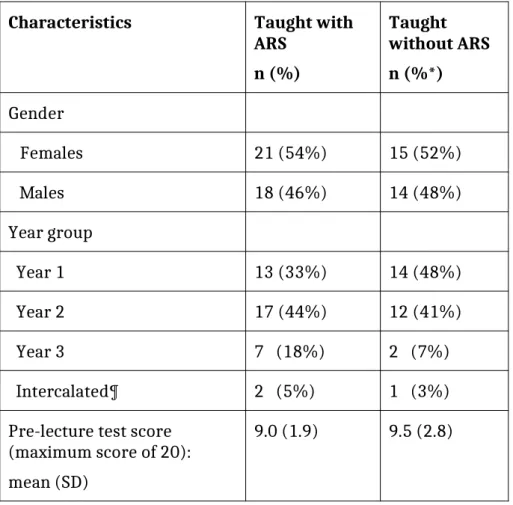
Participant characteristics are shown in Table 1 and did not vary between
groups. All were undertaking medicine as their first undergraduate degree
except for one ARS-student who had a previous undergraduate degree in
dentistry. The control lecture lasted 47 minutes and the intervention lecture
lasted 53 minutes. The multiple-choice tests had acceptable reliability with
Cronbach alpha values of 0.68 for the immediate post-lecture test and 0.60 for
the final post-lecture test.
Post-lecture survey
Post-lecture survey results were based on 68 students for some questions and 67
for others as 3 students failed to correctly complete the survey. There was no
difference in levels of self-perceived knowledge between groups: mean 5-point
score was 2.80 (SD 0.66) in ARS-students, versus 2.69 (SD 0.85) in non-ARS
When asked for their level of agreement with the statement “I now feel confident
with the topic of oral anatomy”, 16/39 (41%) of ARS-students agreed or strongly
agreed, versus 10/28 (36%) of non-ARS students (p = 0.62, χ2 test)
When faced with the statement “I enjoyed this lecture on oral anatomy”, 37/39
(95%) of ARS-students agreed or strongly agreed, versus 24/28 (86%) of
non-ARS students (p = 0.25, Fisher’s exact test).
When the 39 ARS-students were asked how the ARS had affected their learning
experience, 30 stated “positively” and 7 “very positively” (95% in combination).
No student felt it had negatively affected their experience.
Immediate post-lecture test performance
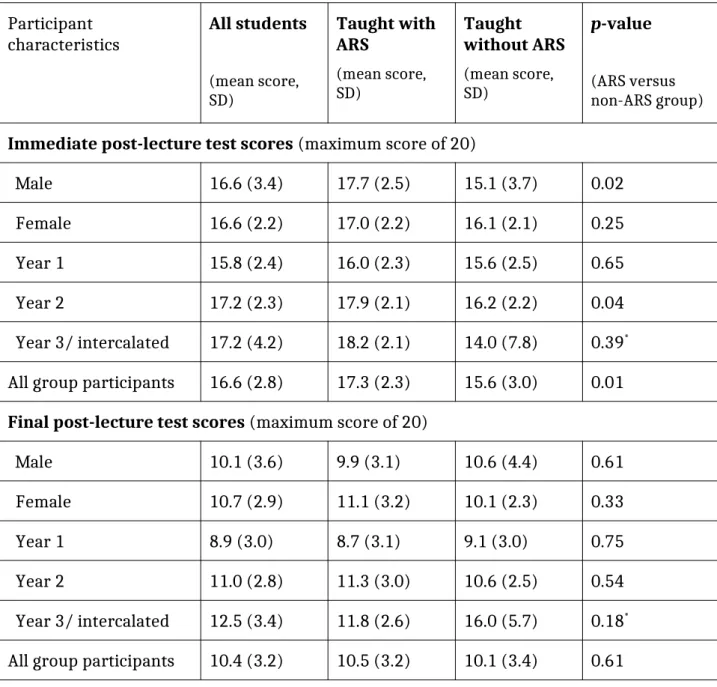
Immediate post-lecture test performance was significantl superior in the ARS
group (score 17.3/20 versus 15.6/20, p = 0.01, Table 2). Test performance was
superior in the ARS group in both genders and across all year groups, although in
sub-group analysis this only reached statistical significance in males and in Year
2 students. These results were unaltered by using a paired differences analysis,
comparing differences in individual scores between the pre-lecture and
immediate post-lecture tests.
Final post-lecture test performance
The final post-lecture test was completed (online, ten weeks following the
When performance was directly compared between groups, there was no
difference, including in sub-group analysis (Table 2). A paired analysis
comparing differences in individual scores between the final post-lecture test
and the pre-lecture test also showed no significant difference between groups
(mean improvement 1.5 in the ARS group, versus 0.7 in the non-ARS group, p =
0.31). Final test score in the study population as a whole (mean 10.4/17) had
significantly improved when compared to the baseline pre-lecture test (9.2/17),
p = 0.02.
In the group taught with the ARS, there was no correlation between in-lecture
ARS question performance and either immediate post-lecture scores (correlation
Discussion
Summary
Our findings suggest that the introduction of ARS into anatomy education had no
impact on students’ self-perceived post-lecture subject knowledge, confidence or
enjoyment, and had no demonstrable impact on long-term student performance.
Several randomized controlled studies have investigated the use of ARS in other
educational settings, and have not consistently demonstrated improvements in
immediate or long-term knowledge tests [15]. Our observation of a modest
improvement in performance immediately post-lecture , with its subsequent
disappearance over an intervening ten-week period is in keeping with a study
from Tregonning and colleagues who found that although ARS improved
immediate knowledge test scores, this effect was not seen 5 weeks later [20]. A
systematic study by Nelson et al concluded that a tendency to produce results
strongly in favour of ARS is associated with non-randomized study designs [15].
Limitations
It should be noted that the present study was based on a single lecture
intervention, allowing for a controlled experimental environment. Students had
little time to incorporate the ARS approach into their expectations and learning
style. It is conceivable that an intervention consisting of more than one lecture
The failure of this study to recruit the numbers suggested by the pre-trial power
calculation is a further limitation. Participation was voluntary and attendance at
an evening lecture unrelated to the core MBChB curriculum may not have been
perceived as valuable by non-participants. There was no identifiable reason for
non-attendance from randomised participants, or for why this varied between
groups (8/39 vs 2/41). The control lecture preceded the ARS-assisted lecture,
and participants were blinded to their assignment. Despite these difficulties, our
study was still able to demonstrate a significant difference in immediate
post-lecture test results. Low numbers may have contributed to the failure to
demonstrate a significant difference at ten weeks, and also rule out any firm
conclusions on sub-group analyses. All conclusions in this study were unaltered
by analysis using non-parametric tests and by using a paired-data approach.
Interpretation
Despite the lack of significant improvement in performance, the vast majority
(95%) of students who received ARS teaching felt that its use positively affected
their learning experience. Again, this is in keeping with previous findings [21]. It
remains unexplained, therefore, why such a positive reported response from
students was not reflected in improved perceptions of confidence or knowledge
after the introduction of ARS. One parsimonious explanation is that ARS
technologies were seen by students as an intervention that promoted
‘intentional engagement’ with their learning [22], marking a major change from
their normal teaching methods and leading to a perception of positive change
Despite the resource implications and training needs created by ARS[23, 24], its
potential advantages remain attractive. ARS provide interactivity within the
teaching setting, which would appear important, considering that in the long
term large group teaching is not particularly effective in delivering student
learning [25]. Knowledge retention following conventional teaching often decays
at an undesirable rate [25, 26]. Post-teaching testing is a valuable way to
improve retention of knowledge as it has been shown to slow decay of
knowledge[27], and ARS may yet be shown to be a useful mechanism for this.
Furthermore, the use of technologies such as ARS within teaching sessions could
create what are known as a “learning landmark” exercises [28]. These are vivid
experiences which are memorable in themselves and which then provide access
to the educational content associated with that memory. Other examples include
the use of virtual reality software in teaching, or body painting within an
anatomy class [28, 29].
Conclusions
In conclusion, our study found that ARS use in a single lecture improved
objective short-term anatomical knowledge, but did not improve long-term
knowledge retention, when integrated into a traditional one-hour lecture format.
Moreover, although students perceived ARS use to improve their learning
experience, it did not improve self-perceived knowledge, nor subjective subject
confidence. However, ARSs have good theoretical potential to improve the
short-term knowledge improvement we recommend further investigation of their use,
including deployment in a more longitudinal fashion.
Acknowledgements
The authors would like to thank academic and technical colleagues at the
University of Edinburgh for helpful discussions regarding study design and data
interpretation, and for assisting with setting up the technology required for the
References
1. Draper SW, Brown MI. Increasing interactivity in lectures using an
electronic voting system. J Comput Assist Learn. 2004;20 :81–94.
2. Doucet M, Vrins A, Harvey D. Effect of using an audience response system
on learning environment, motivation and long-term retention, during
case-discussions in a large group of undergraduate veterinary clinical pharmacology
students. Med Teach. 2009;31: e570–9.
3. Steinert Y, Snell LS. Interactive lecturing: strategies for increasing
participation in large group presentations. Med Teach. 1999;21: 37–42.
4. Nayak L, Erinjeri JP. Audience response systems in medical student
education benefit learners and presenters. Acad Radiol. 2008;15: 383–9.
5. Guse DM, Zobitz PM. Validation of the audience response system. Br J
Educ Technol. 2011 Nov 1;42: 985–91.
6. Chaudhry MA. Assessment of Microbiology Students’ Progress With an
Audience Response System. J Microbiol Biol Educ. 2011;12: 200–1.
7. Heaslip G, Donovan P, Cullen JG. Student response systems and learner
engagement in large classes. Act Learn High Educ. 2014;15: 11–24.
8. Abate LE, Gomes A, Linton A. Engaging students in active learning: Use of
a blog and audience response system. Med Ref Serv Q. 2011;30: 12–8.
9. Turban JW. Students Prefer Audience Response System for Lecture
Evaluation. Int J Emerg Technol Learn IJET [Internet]. 2011;6. Available from:
10. Preszler RW, Dawe A, Shuster CB, Shuster M. Assessment of the Effects of
Student Response Systems on Student Learning and Attitudes over a Broad
Range of Biology Courses. CBE-Life Sci Educ. 2007;6: 29–41.
11. Caldwell JE. Clickers in the Large Classroom: Current Research and
Best-Practice Tips. CBE-Life Sci Educ. 2007;6: 9–20.
12. Crouch CH, Mazur E. Peer Instruction: Ten years of experience and results.
Am J Phys. 2001;69: 970.
13. Miller RG, Ashar BH, Getz KJ. Evaluation of an audience response system
for the continuing education of health professionals. J Contin Educ Health Prof.
2003;23: 109–15.
14. Kirkwood A, Price L. Technology-enhanced learning and teaching in
higher education: what is ‘enhanced’ and how do we know? A critical literature
review. Learn Media Technol. 2014;39: 6–36.
15. Nelson C, Hartling L, Campbell S, Oswald AE. The effects of audience
response systems on learning outcomes in health professions education. A BEME
systematic review: BEME Guide No. 21. Med Teach. 2012;34: e386–405.
16. Mastoridis S, Kladidis S. Coming soon to a lecture theatre near you: the
‘clicker’. Clinical Teacher. 2010;7: 97–101.
17. Alexander CJ, Crescini WM, Juskewitch JE, Lachman N, Pawlina W.
Assessing the integration of audience response system technology in teaching of
anatomical sciences. Anat Sci Educ. 2009;2: 160–6.
18. Border S, Walker F, Smith C. Are zappers a way of improving anatomy
19. Elashvili A, Denehy GE, Dawson DV, Cunningham MA. 2008. Evaluation of
an Audience Response System in a Preclinical Operative Dentistry Course. J Dent
Educ, 72(11), 1296–1303.
20. Tregonning AM, Doherty DA, Hornbuckle J, Dickinson JE. The audience
response system and knowledge gain: A prospective study. Med Teach. 2012;34:
e269–74.
21. Kay RH, LeSage A. Examining the benefits and challenges of using
audience response systems: A review of the literature. Comput Educ. 2009;53:
819–27.
22. Graffam B. Active learning in medical education: Strategies for beginning
implementation. Med Teach. 2007;29: 38–42.
23. Halloran L. A comparison of two methods of teaching. Computer managed
instruction and keypad questions versus traditional classroom lecture. Comput
Nurs. 1995;13: 285–8.
24. Cain J, Robinson E. A primer on audience response systems: current
applications and future considerations. Am J Pharm Educ. 2008;72: 77–77.
25. Bligh DA. 1998. What’s the use of lectures? Exeter, Intellect.
26. Sawdon MA. Improving knowledge retention using KEEpad. Med Educ.
2009;43: 487.
27. Karpicke JD, Roediger HL III. The critical importance of retrieval for
learning. Science. 2008;319: 966–968.
28. Finn GM, McLachlan JC. A qualitative study of students’ perceptions of body
29. Finn GM. Using Body Painting and Other Art-Based Approaches to Teach
Anatomy. Chan LK, Pawlina W, editors. Teaching Anatomy: A Practical Guide.
Tables
Table 1: Overview of participant characteristics
Characteristics Taught with
ARS n (%)
Taught without ARS n (%*) Gender
Females 21 (54%) 15 (52%)
Males 18 (46%) 14 (48%)
Year group
Year 1 13 (33%) 14 (48%)
Year 2 17 (44%) 12 (41%)
Year 3 7 (18%) 2 (7%)
Intercalated¶ 2 (5%) 1 (3%)
Pre-lecture test score (maximum score of 20): mean (SD)
9.0 (1.9) 9.5 (2.8)
Table 2: Immediate and final post-lecture test scores
Participant
characteristics All students (mean score, SD) Taught with ARS (mean score, SD) Taught without ARS (mean score, SD) p-value (ARS versus non-ARS group)
Immediate post-lecture test scores (maximum score of 20)
Male 16.6 (3.4) 17.7 (2.5) 15.1 (3.7) 0.02
Female 16.6 (2.2) 17.0 (2.2) 16.1 (2.1) 0.25
Year 1 15.8 (2.4) 16.0 (2.3) 15.6 (2.5) 0.65
Year 2 17.2 (2.3) 17.9 (2.1) 16.2 (2.2) 0.04
Year 3/ intercalated 17.2 (4.2) 18.2 (2.1) 14.0 (7.8) 0.39*
All group participants 16.6 (2.8) 17.3 (2.3) 15.6 (3.0) 0.01
Final post-lecture test scores (maximum score of 20)
Male 10.1 (3.6) 9.9 (3.1) 10.6 (4.4) 0.61
Female 10.7 (2.9) 11.1 (3.2) 10.1 (2.3) 0.33
Year 1 8.9 (3.0) 8.7 (3.1) 9.1 (3.0) 0.75
Year 2 11.0 (2.8) 11.3 (3.0) 10.6 (2.5) 0.54
Year 3/ intercalated 12.5 (3.4) 11.8 (2.6) 16.0 (5.7) 0.18*
All group participants 10.4 (3.2) 10.5 (3.2) 10.1 (3.4) 0.61