Munich Personal RePEc Archive
Inference for stochastic volatility model
using time change transformations
Kalogeropoulos, Konstantinos and Roberts, Gareth O. and
Dellaportas, Petros
University of Cambridge, Engineering Department - Signal
Processing Lab, University of Warwick, Statistics Department,
Athens University of Economics and Business, Statistics Department
2007
Online at
https://mpra.ub.uni-muenchen.de/5697/
Inference for stochastic volatility models using time
change transformations
Konstantinos Kalogeropoulos
University of Cambridge, Department of Engineering - Signal Processing Lab
Gareth O. Roberts
University of Warwick, Department of Statistics
Petros Dellaportas
Athens University of Economics and Business, Department of Statistics
October 14, 2007
Abstract
We address the problem of parameter estimation for diffusion driven stochastic
volatil-ity models through Markov chain Monte Carlo (MCMC). To avoid degeneracy issues we
introduce an innovative reparametrisation defined through transformations that operate
on the time scale of the diffusion. A novel MCMC scheme which overcomes the inherent
difficulties of time change transformations is also presented. The algorithm is fast to
implement and applies to models with stochastic volatility. The methodology is tested
through simulation based experiments and illustrated on data consisting of US treasury
bill rates.
Keywords: Imputation, Markov chain Monte Carlo, Stochastic volatility
1
Introduction
Diffusion processes provide natural models for continuous time phenomena. They are used
extensively in diverse areas such as finance, biology and physics. A diffusion process is defined
through a stochastic differential equation (SDE)
where W is standard Brownian motion. The drift µ(.) and volatility σ(.) reflect the
instan-taneous mean and standard deviation respectively. In this paper we assume the existence
of a unique weak solution to (1), which translates into some regularity conditions (locally
Lipschitz with a linear growth bound) onµ(.) andσ(.); see chapter 5 of Rogers and Williams
(1994) for more details.
The task of inference for diffusion processes is particularly challenging and has received
remarkable attention in the recent literature; see Sørensen (2004) for an extensive review. The
main difficulty is inherent in the nature of diffusions which are infinite dimensional objects.
However, only a finite number of points may be observed and the marginal likelihood of these
observations is generally unavailable in closed form. This has stimulated the development
of various non-likelihood approaches which use indirect inference (Gouri´eroux et al., 1993),
estimating functions (Bibby and Sorensen, 1995), or the efficient method of moments (Gallant
and Tauchen, 1996); see also Gallant and Long (1997).
Most likelihood based methods approach the likelihood function through the transition
density of (1). Denote the observations by Yk,k= 0, . . . , n, and with tk their corresponding
times. If the dimension of Yk equals that of X (for each k) we can use the Markov property
to write the likelihood, given the initial pointY0, as:
L(Y, θ|Y0) =
n
Y
k=1
pk(Yk|Yk−1;θ,∆), ∆ =tk−tk−1 (2)
The transition densitiespk(.) are not available in closed form but several approximations are
available. They may be analytical, see A¨ıt-Sahalia (2002), A¨ıt-Sahalia (2005), or simulation
based, see Pedersen (1995), Durham and Gallant (2002). They usually approximate the
likelihood in a way so that the discretisation error can become arbitrarily small, although
the methodology developed in Beskos et al. (2006) succeeds exact inference in the sense that
it allows only for Monte Carlo error. A potential downside of these methods may be their
dependence on the Markov property. In many interesting multidimensional diffusion models
the observation regime is different and some of their components are not observed at all.
A famous such example is provided by stochastic volatility models, used extensively to
model financial time series such as equity prices (Heston, 1993; Hull and White, 1987; Stein
and Stein, 1991), or interest rates (Andersen and Lund, 1998; Durham, 2002; Gallant and
Tauchen, 1998). A stochastic volatility model is usually represented by a 2-dimensional
dXt dαt =
µx(Xt, αt, θ)
µα(αt, θ)
dt+
σx(αt, θ) 0
0 σα(αt, θ)
dBt dWt
, (3)
where X denotes the observed equity (stock) log-price or the short term interest rate with
volatilityσx(.), which is a function of a latent diffusionα. For the diffusion in (3), the Markov
property may no longer hold; the distribution of a future stock price depends (besides the
current price) on the current volatility which in turn depends on the entire price history.
Stochastic volatility models are used
An alternative approach to the problem adopts Bayesian inference utilizing Markov chain
Monte Carlo (MCMC) methods. Adhering to the Bayesian framework, a prior p(θ) is first
assigned on the parameter vector θ. Then, given the observations Y, the posterior p(θ|Y)
can be explored through data augmentation (Tanner and Wong, 1987), treating the
unob-served paths of X (paths between observations) as missing data. The resulting algorithm
alternates between updatingθandX. Initial MCMC schemes following this programme were
introduced by Jones (1999); see also Jones (2003), Eraker (2001) and Elerian et al. (2001).
However, as noted in the simulation based experiment of Elerian et al. (2001) and established
theoretically by Roberts and Stramer (2001), any such algorithm’s convergence properties
will degenerate as the number of imputed points increases. The problem may be overcome
with the reparametrisation of Roberts and Stramer (2001), and this scheme may be applied
in all one-dimensional and some multi-dimensional contexts. However this framework does
not cover general multidimensional diffusion models. Chib et al. (2005) and Kalogeropoulos
(2007) offer appropriate reparametrisations but only for a class of stochastic volatility
mod-els. Alternative reparametrisations were introduced in Golightly and Wilkinson (2007); see
also Golightly and Wilkinson (2006) for a sequential approach.
In this paper we introduce a novel reparametrisation that, unlike previous MCMC
ap-proaches, operates on the time scale of the observed diffusion rather than its path. This
facilitates the construction of irreducible and efficient MCMC schemes, designed
appropri-ately to accommodate the time change of the diffusion path. Our approach is general enough
to cover almost every stochastic volatility model used in practice. The paper is organized as
follows: Section 2 elaborates on the need for a transformation of the diffusion to avoid
prob-lematic MCMC algorithms. In Section 3 we introduce time change transformations whereas
Section 4 provides the details for the corresponding non-trivial MCMC implementation. The
in section 5, and on US treasury bill rates in section 6. Finally, section 7 concludes and
provides some relevant discussion.
2
The necessity of reparametrisation
A Bayesian data augmentation scheme bypasses a problematic sampling from the posterior
π(θ|Y) by introducing a latent variableX that simplifies the likelihoodL(Y;X, θ). It usually
involves the following two steps:
1. Simulate X conditional on Y and θ.
2. Simulate θ from the augmented conditional posterior which is proportional to L(Y;X, θ)π(θ).
It is not hard to adapt our problem to this setting. Y represents the observations of the
price processX. The latent variablesX introduced to simplify the likelihood evaluations are
discrete skeletons of diffusion paths between observations or entirely unobserved diffusions.
In other words,X is a fine partition of multidimensional diffusion with driftµX(t, Xt, θ) and
diffusion matrix
ΣX(t, Xt, θ) = σ(t, Xt, θ) × σ(t, Xt, θ)′,
and the augmented dataset is Xiδ, i= 0, . . . , T /δ, whereδ specifies the amount of
augmen-tation. The likelihood can be approximated via the Euler scheme
LE(Y;X, θ) =
T /δ
Y
i=1
p(Xiδ|X(i−1)δ), Xiδ|X(i−1)δ∼ N X(i−1)δ+δµX(.), δΣX(.)
,
which is known to converge to the true likelihood L(Y;X, θ) for small δ (Pedersen, 1995).
Another property of diffusion processes relates ΣX(.) to the quadratic variation process.
Specifically we know that
lim
δ→0
T /δ
X
i=1
Xiδ− X(i−1)δ
Xiδ− X(i−1)δ
T
=
Z T
0
ΣX(s,Xs, θ)ds a.s.
The solution of the equation above determines the diffusion matrix parameters. Hence,
there exists perfect correlation between these parameters and X as δ → 0. This has
dis-astrous implications for the mixing and convergence of the MCMC chain as it translates
into reducibility for δ → 0. This issue was first noted by Roberts and Stramer (2001) for
Nevertheless, it is not an MCMC specific problem. It turns out that the convergence of its
deterministic analogue, EM algorithm, is problematic when the amount of information in
the augmented data X strongly exceeds that of the observations. In our case X contains an
infinite amount of information for δ→0.
The problem may be resolved if we apply a transformation so that the algorithm based
on the transformed diffusion is no longer reducible as δ → 0. Roberts and Stramer (2001)
provide appropriate diffusion transformations for scalar diffusions. In a multivariate context
this requires a transformation to a diffusion with unit volatility matrix; see for instance
Kalogeropoulos et al. (2007). A¨ıt-Sahalia (2005) terms such diffusions as reducible and
proves the non-reducibility of stochastic volatility models that obey (3). The transformations
introduced in this paper follow a slightly different route and target the time scale of the
diffusion. One of the appealing features of such a reparametrisation is the generalisation to
stochastic volatility models.
3
Time change transformations
For ease of illustration we first provide the time change transformation and the relevant
likelihood function for scalar diffusion models with constant volatility. Nevertheless, one
of the main advantages of this technique is the applicability to general stochastic volatility
models.
3.1 Scalar diffusions
Consider a diffusionX defined through the following SDE:
dXt=µ(t, Xt, θ)dt+σdWtX, 0< t <1 σ >0. (4)
Without loss of generality, we assume a pair of observationsX0=y0 andX1 =y1. For more
data, note that the same operations are possible for every pair of successive observations
that are linked together through the Markov property. We introduce the latent ‘missing’
path of X for 0 ≤ t ≤ 1, denoted by Xmis, so that X = (y0, Xmis, y1). In the spirit of
Roberts and Stramer (2001), the goal is to write the likelihood for θ, σ with respect to
a parameter-free dominating measure. Using Girsanov’s theorem we can get the
driftless diffusionM =σdWtX which represents Wiener measure and is denoted byWX. We
can write
dP(X)
dWX =G(t, X, θ, σ) = exp
Z T
0
µ(s, Xs, θ)
σ2 dXs− 1 2
Z T
0
µ(s, Xs, θ)2
σ2 ds
.
By factorizing WX = WXy ×Leb(y1)×f(y1;σ2), where y1 ∼ N(y0, σ2) and Leb(.) denotes
Lebesgue measure, we obtain
dP(Xmis, y0, y1)
d
WX
y ×Leb(y)
=G(t, X, θ, σ)f(y1;σ),
where clearly the dominating measure depends on σ, since it reflects a Brownian bridge with
volatilityσ.
Now consider the time change transformation which first introduces a new time scale
η(t, sigma))
η(t, σ) =
Z t
0
σ2ds=σ2t, (5)
and then defines the new transformed diffusion U as
Ut=
Xη−1(t,σ), 0≤t≤σ2,
Mη−1(t,σ), t > σ2.
The definition for t > σ2 is needed to ensure that tU is well defined for different values of
σ2 >0 which is essential in the context of a MCMC algorithm. Using standard time change
properties, see for example Oksendal (2000), the SDE for U is
dUt=
1
σ2µ(t, Ut, θ)dt+dWtU 0≤t≤σ2,
dWtU, t > σ2,
whereWU is another Brownian motion at the time scale ofU. By using Girsanov’s theorem
again, the law of U, denoted by P, is given through its Radon-Nikodym derivative with
respect to the law WU of the Brownian motionWU at theU−time scale:
dP
dWU = G(t, U, θ, σ) = exp
Z +∞
0
µ(s, Us, θ)
σ2 dUs− 1 2
Z +∞
0
µ(s, Us, θ)2
σ4 ds
= exp
( Z σ2
0
µ(s, Us, θ)
σ2 dUs− 1 2
Z σ2
0
µ(s, Us, θ)2
σ4 ds
)
If we condition the Wiener measure ony at the new time scale, the likelihood can be written
with respect to a Brownian bridge measure WUy as
dP(U, y0, y1) =G(t, U, θ, σ)f(y1;σ)dWUy ×Leb(y) .
However, this Brownian bridge is conditioned on the event Uσ2 =y1 and therefore contains
the parameterσ. For this reason we introduce a second transformation which applies to both
the diffusion’s time scale and its path. Define
Ut0 = (σ2−t)Zt/{σ2(σ2−t)}, 0≤t < σ2, (7)
Ut0 =Ut−(1−
t σ2)y0−
t
σ2y1, 0≤t < σ 2.
Note that this transformation is 1-1. Its inverse is given by
Zt=
1 +σ2t
σ2 U 0
σ4t/(1+σ2t), 0≤t <+∞.
Applying Ito’s formula and using time change properties we can also obtain the SDE of Z
based on another driving Brownian motion WZ operating at the Z−time:
dZt=
µt,1+σtσ22ν(Zt, σ), θ
+ν(Zt)σ2
1 +tσ2 dt+dW
Z
t , 0≤t <+∞, (8)
whereν(Zt, σ) =Ut. This operation essentially transforms to a diffusion that runs from 0 to
+∞ preserving the unit volatility. We can re-attempt to write the likelihood using Girsanov
theorem and condition the dominating measure on y1 to obtain WZy,
dP(Z, y0, y1)
d
WZ
y ×Leb(y)
=G(t, Z, θ, σ)f(y1;σ). (9)
Despite the fact thatG(Z, θ, σ) contains integrals defined in (0, +∞), it is always finite
being an 1−1 transformation of the Radon-Nikodym derivative betweenP(U) andWU given
by (6). Using the following lemma, we prove that WZy is the law of the standard Brownian
motion and hence the likelihood is written with respect to a dominating measure that does
not depend on any parameters.
Lemma 3.1 Let W be a standard Brownian motion in[0, +∞). Consider the process defined
for 0≤t≤T
Bt= (T −t)Wt/{T(T−t)}+ (1−
t T)y0+
t
Then B is a Brownian bridge from y0 at time 0 to y1 at time T.
Proof: See (Rogers and Williams, 1994, IV.40.1) for the casey0 = 0,T = 1. The extension
for general y0 and T is trivial.
Corollary 3.1 The measure WZy is standard Wiener measure.
Proof: Note that WUy reflects a Brownian bridge from y0 at time 0 to y1 at time T and
we obtained WZ
y by using the transformation of Lemma 3.1. Since this transformation is
1−1, U is a Brownian bridge (under the dominating measure) if and only if Z is standard
Brownian motion.
Note that WZy is the probability law of the driftless version of the conditional diffusion Z,
whereas the SDE in (8) corresponds to the unconditional version of Z itself. The conditional
SDE ofZ is generally not available but this does not create a problem. For the path updates
we may use the fact that
dP
dWZ y
(Z|y0, y1) =G(t, Z, θ, σ)
f(y1;σ)
fP(y
1;σ) ∝
G(t, Z, θ, σ), (10)
where Py is the law of the conditional version of Z and fP(.) is the density of y1 under P.
Both Py and fP(.) are generally unknown but G(.) and f(.), which appear in (9) and (10),
are available.
3.2 Stochastic volatility models
Consider the general class of stochastic volatility models with SDE given by (3). Without
loss of generality, we may assume a pair of observations (X0 = y0, X1 = y1) due to the
Markov property of the 2-dimensional diffusion (X, α). The likelihood can then be divided
into two parts: The first contains the marginal likelihood of the diffusionαand the remaining
part corresponds to the diffusion X conditioned on the path ofα
Pθ(X, α) =Pθ(α)Pθ(X|α).
Denote the marginal likelihood forαbyLα(α, θ). To overcome reducibility issues arising from
the paths of α one may use the reparametrisations of Chib et al. (2005) or Kalogeropoulos
(2007). The relevant transformations of the latter are
βt=h(αt, θ),
∂h(αt, θ)
∂αt
γt=βt−β0, βt=η(γt),
and the marginal likelihood for the transformed latent diffusion γ becomes
Lγ(γ, θ) =
dP
dP(γ) =G{η(γ), θ}. (11)
By letting αt=gtγ=h−1(η(γt), θ), the SDE of X conditional on γ becomes:
dXt=µx(Xt, gtγ, θ)dt+σx(gtγ, θ)dBt, 0≤t≤1.
Given the paths of the diffusion α, the volatility function σx(gγt, θ) may be viewed as a
deterministic function of time. The situation is similar to that of the previous section. We
can introduce a new time scale
η(t, γ, θ) =
Z t
0
σx2(gtγ, θ)ds,
T =η(tk, γ, θ),
and define U with the new time scale as before (M is a Brownian motion on the U−time
scale)
Ut=
Xη−1(t), 0≤t≤T,
Mη−1(t), t > T.
(12)
The SDE for U now becomes
dUt=
(
µx Ut, γη−1(t,γ,θ), θ
σ2
x(γη−1(t,γ,θ), θ)
)
dt+dWtU, 0≤t≤T.
We obtain the Radon Nikodym derivative between the distribution ofU with respect to that
of the Brownian motion WU,
dP
dWU = G(U, γ, θ),
and introduce WUy as before. The density of y1 under WU, denoted byf(y, γ, θ), is just
f(y1;γ, θ)≡N(y0, T).
The dominating measure WU
y reflects a Brownian motion conditioned to equal y at a
parameter depended time T = η(tk+1, γ, θ). To remove this dependency we introduce a
Ut0= (T −t)Zt/{T(T−t)}, 0≤t < T, (13)
Ut0=Ut−(1−
t T)y0−
t
Ty1, 0≤t < T.
Therefore, the SDE for Z is now given by
dZt=
T
1 +tT
µ1+TtTν(Zt), γk(t,γ,θ), θ
σ2
x(γk(t,γ,θ), θ)
+ν(Zt)
dt+dWtZ, 0≤t <∞,
where k(t, γ, θ) denotes the initial time scale of X and ν(Zt) =Ut.
Conditional on γ, the likelihood can be written in a similar manner as in (9):
dP
d
WZ
y ×Leb(y)
(Z|y0, y1, γ) =G(Z, γ, θ)f(y1;γ, θ) (14)
It is not hard to see thatWZy reflects a standard Wiener measure and therefore the dominating
measure is independent of parameters. To obtain the full likelihood we need to multiply the
two parts given by (11) and (14).
3.3 Incorporating leverage effect
In the previous section we made the assumption that the increments of X and γ are
inde-pendent, in other words we assumed no leverage effect. This assumption can be relaxed in
the following way: In the presence of a leverage effect ρ, the SDE ofX conditional onγ can
be written as
dXt=µx(Xt, gγt, θ)dt+ρσx(gtγ, θ)dWt+
p
1−ρ2σ
x(gγt, θ)dBt, 0≤t≤tk,
where W is the driving Brownian motion of γ). Note that given γ, W can be regarded as
a function of γ and its parameters θ. Therefore, the term ρσx(gγt, θ)dWt can be viewed as
a deterministic function of time, and it can be treated as part of the drift of Xt. However,
this operation introduces additional problems as the assumptions ensuring a weakly unique
solution to the SDE of X are violated. To avoid this issue we introduce the infinitesimal
transformation
Xt=H(Ht, ρ, γ, θ) =Ht+
Z t
0
which leads us to the following SDE for H:
dHt=µx{H(Xt, ρ, γ, θ), gγt, θ}dt+
p
1−ρ2σ
x(gγt, θ)dBt, 0≤t≤tk.
We can now proceed as before, definingU andZ based on the SDE ofH in a similar manner
as in (12) and (13) respectively.
3.4 State dependent volatility
Consider the family of state dependent stochastic volatility models where conditional on γ,
the SDE ofX may be written as:
dXt=µx(Xt, gtγ, θ)dt+σ1(gtγ, θ)σ2(Xt, θ)dBt, 0≤t≤tk.
This class contains among others, the models of Andersen and Lund (1998), Gallant and
Tauchen (1998), Durham (2002), Eraker (2001). In order to apply the time change
transfor-mations of section 3.2, we should first transform X to ˙Xt, through ˙Xt=h(Xt, θ), so that it
takes the form of (3). Such a transformation, which may be viewed as the first transformation
in Roberts and Stramer (2001), should satisfy the following differential equation
∂h(Xt, θ)
∂Xt
= 1
σ2(Xt, θ)
.
The time change transformations forU andZ may then be defined on the basis of ¨Xthat
will now have volatility σ1(gγt, θ). The transformation h(.) also applies to the observations
( ˙y0, ˙y1) which are now functions of parameters. This would translated in a parameter
dependent likelihood dominating measure, had it not been for the second step in (12) which
in this case acts like the second transformation in Roberts and Stramer (2001). Note that
the parameters of σ2(Xt, θ) enter the reparametrised likelihood in two ways: first through
thef(y;γ, θ) which now should include the relevant Jacobian term, and second through the
drift of Z which is centered at 0 based on the transformed observations.
3.5 Multivariate stochastic volatility models
We may use the techniques of section 3.3 to define time change transformations for
multidi-mensional diffusions. Consider a d−dimensional version of the SDE in (4) whereσ now is a
2×2 matrix ([σ]ij =σij). As noted in Kalogeropoulos et al. (2007), the mapping between
parameters. A way to achieve this, is by allowing σ to be the lower triangular matrix that
produces the Cholesky decomposition ofσσT. Ford= 2, the SDE of such a diffusion is given
by
dXt{1}=µ(Xt{1}, Xt{2}, θ)dt+σ11dBt,
dXt{2}=µ(Xt{1}, Xt{2}, θ)dt+σ21dBt+σ22dWt.
The time change transformations for X{1} will be exactly as in section 3.1. For X{2}
note that given X{1} the term σ21dBt is now a deterministic function of time and may be
treated as part of the drift. Thus, we may proceed following the route of the section 3.3.
Similar transformations can be applied for diffusions that have, or may be transformed
to have, volatility functions independent of their paths. For example we may assume two
correlated price processes with correlation ρx:
[σ]11=σx{1}(gtγ, θ),
[σ]21=ρxσx{2}(gtγ, θ),
[σ]22=
p
1−ρ2
xσx{2}(gγt, θ).
We may proceed in a similar manner for multivariate stochastic volatility models of general
dimension d.
4
MCMC implementation
The construction of an appropriate data augmentation algorithm involves several issues. The
time change transformations introduce three interesting features to the MCMC algorithm
which we address separately: the presence of three time scales; the need to update diffusion
paths that run from 0 to +∞; and the fact that time scales depend on parameters. For
ease of illustration we will assume the simple case of a univariate diffusion with constant
volatility and a pair observations (X0=y0 and X1 =y1). Extensions and generalisations of
the algorithm for stochastic volatility models are noted where appropriate.
4.1 Three time scales
We introduce m intermediate points of X at equidistant times between 0 and 1, to give
large enough for accurate likelihood approximations and any error induced by the time
discretisation is negligible for the purposes of our analysis.
Given a value of the time scale parameter σ, we can get theU−time points by applying
(5) to each one of the existing points X, so that
Uσ2i/(m+1) =Xi/(m+1), i= 0,1, . . . , m+ 1.
Note that it is only the times that change, the values of the diffusion remain intact. In a
stochastic volatility model we would use the quantities
Z mi+1
+1
i m+1
σx2(.)ds
for each pair of consecutive imputed points.
The points ofZ are multiplied by a time factor which corrects the deviations from unit
volatility. The Z−time points may be obtained by
tZi = σ
2i/(m+ 1)
σ2(σ2−σ2i/(m+ 1)), i= 0,1, . . . , m.
Clearly this does not apply to the last point which occurs at time +∞. Therefore, the paths
of X, or U, are more convenient and may be used for likelihood evaluations exploiting the
fact that the relevant transformations are 1-1. However, the component of the relevant Gibbs
sampling scheme is the diffusion Z.
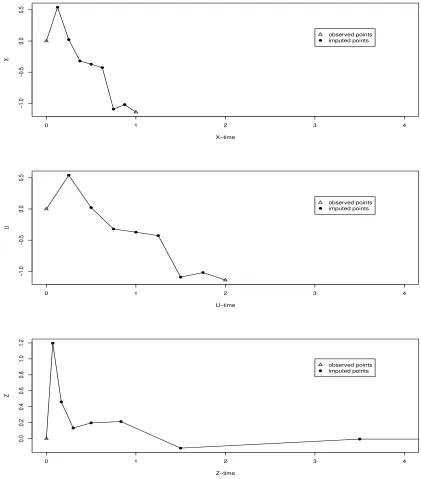
Figure 1 shows a graphical representation of X, U and Z plotted against their
corre-sponding time scales for σ=√2 andm= 7. AlthoughX andU have the same values, their
volatilities are √2 and 1 respectively. The ending point of Z does not appear on the graph
as it occurs at time +∞.
[Figure 1 about here.]
4.2 Updating the paths of Z
The paths of Z may be updated using an independence sampler with the reference measure
as a proposal. Here WZ reflects a Brownian motion at the Z−time which is fixed given
the current values of the time-scale parameter(s). An appropriate algorithm is given by the
following steps.
• Step 2: Transform back to U∗, using (7).
• Step 3: Accept with probability: minn1,GG((UU∗∗,θ,σ,θ,σ))
o
.
4.3 Updating time scale parameters
The updates of parameters that define the time scale, such as σ, are of particular interest.
In almost all cases, their conditional posterior density is not available in closed form, and
Metropolis steps are inevitable. However, the proposed values of these parameters will imply
different Z− time scales. In other words, for each potential proposed value for σ there
exists a different set of Z−points needed for accurate approximations of the likelihood the
Metropolis accept-reject probabilities. In theory, this would pose no issues had we been able
to store an infinitely thin partition ofZ, but of course this is not possible.
We use retrospective sampling ideas; see Papaspiliopoulos and Roberts (2005) and Beskos
and Roberts (2005) for applications in different contexts. Under the assumption of a
suf-ficiently fine partition of Z, all the non-recorded intermediate points contribute nothing to
the likelihood and they are irrelevant in that respect; the set of recorded points is sufficient
for likelihood approximation purposes. Alternatively, we may argue that their distribution is
given by the likelihood reference measure which reflects a Brownian motion. Thus, they can
be drawn after the proposal of the candidate value of the time scale parameter. To ensure
compatibility with the recorded partition of Z, it suffices to condition on their neighboring
points. This is easily done using standard Brownian bridge properties: Suppose that we
want to simulate the value of Z at time tb which fall between the recorded values at times
ta and tc, so thatta ≤ tb ≤ tc. Denote by Zta and Ztc the corresponding Z values. Under
the assumption that Z is distributed according toWZy betweenta and tc we have that
Ztb|Zta, Ztc ∼N
(tb−ta)Ztc+ (tc−tb)Zta
tc−ta
, (tb−ta)(tc−tb) tc−ta
. (15)
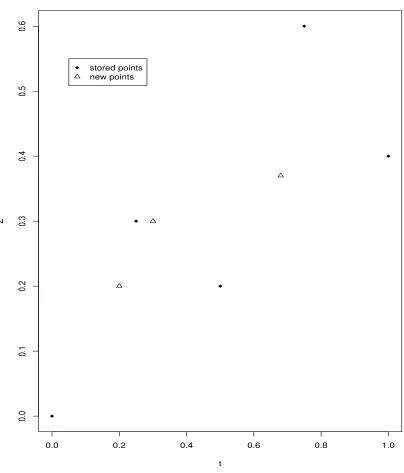
The situation is pictured in Figure 2, where the black bullets represent the stored points and
the triangles the new points required for a proposed value of σ. The latter should be drawn
retrospectively given the former via (15).
[Figure 2 about here.]
A suitable algorithm for the σ−updates may be summarized through the following steps:
• Step 2: Repeat for each pair of successive points:
– Use (5) and (7) to get the new times associated with it.
– Draw the values of Z at the new times using (15).
– Transform back to U∗, using (7).
Form the entire path U∗ by appropriately joining its bits.
• Step 3: Accept with probability: minn1,GG(U(U∗∗,θ,σ,θ,σ∗))ff((yy;;σσ∗))
o
.
Note that in a stochastic volatility model the paths of the transformed diffusion γt are
associated with the time scale of the Z. Therefore a similar algorithm may be used for their
updates.
5
Simulations
As discussed in section 2, appropriate reparametrisations are necessary to avoid issues
re-garding the mixing and convergence of the MCMC algorithm. In fact, the chain becomes
reducible as the level of augmentation increases. This is also verified by the numerical
ex-amples performed in Kalogeropoulos (2007) even in very simple stochastic volatility models.
In this section we perform a simulation based experiment to check the immunity of MCMC
schemes to increasing levels of augmentation, as well as the ability of our estimation
proce-dure to retrieve the correct values of the diffusion parameters despite the fact that the series
is partially observed at only a finite number of points. We simulate data from the following
stochastic volatility model
dXt = κx(µx−Xt)dt+ρexp(αt/2)dWt+
p
1−ρ2exp(α
t/2)dBt,
dαt = κα(µα−αt)dt+σdWt,
where B and W are independent Brownian motions, andρreflects the correlation between the
increments of X and α, also term as leverage effect. A high frequency Euler approximating
scheme with a step of 0.001 was used for the simulation of the diffusion paths. Specifically,
dataset of 501 observations ofX at 0≤t≤500. The parameter values were set toρ=−0.5,
σ = 0.4,κx = 0.2,µx= 0.1, κα= 0.3 and µα=−0.2
The transformations required to construct an irreducible data augmentation scheme are
listed below. First we transform α toγ through
γt=
αt−α0
σ , 0≤t≤500,
αt=ν(γt, σ, α0) =α0+σγt.
Given γ, and for each pair of consecutive observation times tk−1 and tk (k = 1,2, . . . ,500)
on X, we transform as follows: First, we remove the term introduced from the leverage effect
Ht=Xt−
Z t
tk−1
ρexp{ν(γs, σ, α0)/2}dWs, tk−1≤t≤tk,
and consequently we set
η(t) =
Z t
tk−1
(1−ρ)2exp{ν(γs, σ, α0}ds.
Then,U and Z may be defined again from 12 and 13 respectively, but based onHrather on
X. The elements of the MCMC scheme areZ,γ,α0 and the parameters (κx, µx, κα, µα, ρ, σ).
We proceed by assigning flat priors to all the parameters, restricting κx, κα, σ to be
positive andρto be in (−1,1). The number of imputed points was set to 30 and 50, the length
of the overlapping blocks needed for the updates of γ was 2, and the relevant acceptance
rate 75% whereas the acceptance rate for X was 95%. Figure 3 shows autocorrelation plots
for the 2-dimensional diffusion’s (X, α)′ volatility parameters ρ and σ. There is no sign of any increase in the autocorrelation to raise suspicions against the irreducibility of the chain.
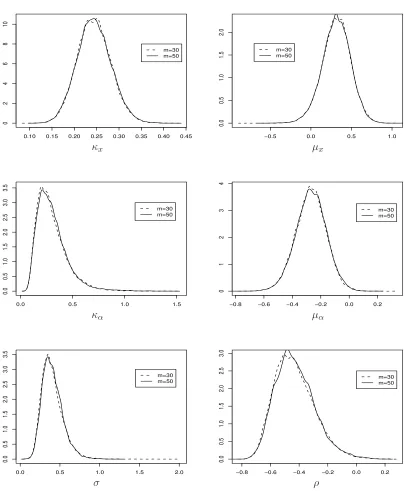
Figure 4 shows density plots for all parameters and both values ofm. These plots indicate a
sufficiently fine discretisation and a good agreement with true values of the parameters. The
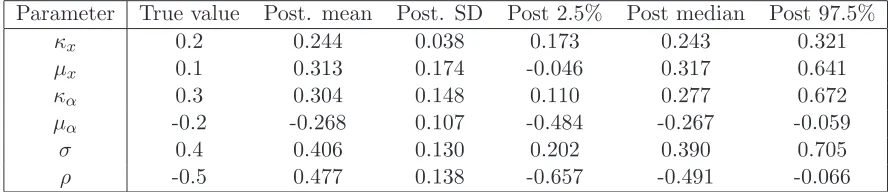
latter is also confirmed by Table 1.
[Figure 3 about here.]
[Figure 4 about here.]
6
Application: US treasury bill rates
To illustrate the time change methodology we fit a stochastic volatility model to US treasury
bill rates. The dataset consists of 1809 weekly observations (Wednesday) of the 3−month
US Treasury bill rate from the 5th of January 1962 up to the 30th of August 1996. The data
are plotted in Figure 5.
[Figure 5 about here.]
Previous analyses of these data include Andersen and Lund (1998), Gallant and Tauchen
(1998), Durham (2002), Durham and Gallant (2002), Eraker (2001), and Golightly and
Wilkinson (2006). Apart from some slight deviations the adopted stochastic volatility models
consisted of the following SDE.
drt = (θ0−θ1rt)dt+rtψexp(αt/2)dBt,
dαt = κ(µ−αt)dt+σdWt, (16)
with independent Brownian motionsB andW. In some cases the following equivalent model
was used:
drt = (θ0−θ1rt)dt+σrrtψexp(αt/2)dBt,
dαt = −καtdt+σdWt. (17)
We proceed with the model in (16), as posterior draws of its parameters exhibit substantially
less autocorrelation. In line with Gallant and Tauchen (1998) and Golightly and Wilkinson
(2006), we also set ψ = 1. Eraker (2001), Durham (2002) and Durham and Gallant (2002)
assume general ‘elasticity of variance’ ψ but their estimates do not indicate a significant
deviation from 1. By settingXt=log(rt), the volatility ofXtbecomes exp(αt/2). Therefore
the U−time for two consecutive observation times tk−1 and tk is defined as
η(t) =
Z t
tk−1
exp(αt)ds,
and U andZ are given by (12) and (13) respectively . We also transformα toγ as before:
γt=
αt−α0
αt=ν(γt, σ, α0) =α0+σγt.
We applied MCMC algorithms based on Z and γ to sample from the posterior of the
parameters θ0,θ1,κ,µandσ. The time was measured in years setting the distance between
successive Wednesdays to 5/252. Non-informative priors were assigned to all the parameters,
restricting κ and σ to be positive to ensure identifiability and eliminate the possibility of
explosion. The algorithm was run for 50,000 iterations and for m equal to 10 and 20. To
optimize the efficiency of the chain we set the length of the overlapping blocks of γ to 10
which produced an acceptance rate of 51.9%. The corresponding acceptance rate for Z was
98.6% .
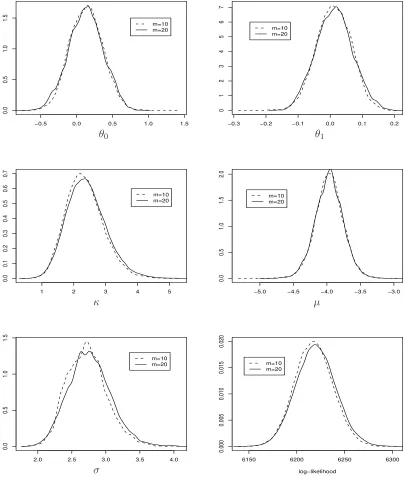
The kernel density plots of the posterior parameters and likelihood (Figure 6) indicate
that a discretisation from an m of 10 or 20 provide reasonable approximations. The
corre-sponding autocorrelation plots of Figure 7 do not show increasing autocorrelation in m, a
feature that would reveal reducibility issues. Finally, summaries of the posterior draws for
all the parameters are provided in Table 2. The parameters κ, µ and σ are different from
0 verifying the existence of stochastic volatility. On the other hand, there is no evidence to
support the existence of mean reversion on the rate, as θ0 and θ1 are not far from 0. The
results are in line with those of Durham (2002), Durham and Gallant (2002) and Golightly
and Wilkinson (2006).
[Figure 6 about here.]
[Figure 7 about here.]
[Table 2 about here.]
7
Discussion
Data augmentation MCMC schemes constitute a very useful tool for likelihood-based
infer-ence on diffusion models. They may not have the appealing properties of complete
elimi-nation of the time discretisation error (Beskos et al., 2006), or the closed form approximate
likelihood expressions of A¨ıt-Sahalia (2002), but nevertheless they give a satisfactory and
very general solution to the problem. However data augmentation schemes require careful
construction to avoid the degeneracy issues described at the beginning of this paper.
Here, we introduce an innovative transformation which operates by altering the time axis
introduce a novel efficient MCMC scheme which mixes rapidly and is not provibitively
com-putationally expensive. Our method is also easy to implement and introduces no additional
approximation error other than that included in methodologies based on a discretisation of
the diffusion path. Moreover it is general enough to include general stochastic volatility
models.
Further work will consider problems with state-dependent volatility and models which
involve jump diffusions, to which the methodology introduced here can be easily applied.
Fundamental to our approach here has been the introduction of a non-centered
parameter-isation to decouple dependence inherent in the model between missing data and volatility
parameters. However non-centered constructions are not unique, as illustrated by the choice
in the diffusion context between the state rescaling approaches of Golightly and Wilkinson
(2007); Roberts and Stramer (2001) and the time-stretching strategy adopted here. Clearly,
further work is required to investigate the relative merits of these approaches in different
situations.
8
Acknowledgements
This work was supported by the EPSRC grant GR/S61577/01 and by the Marie Curie
References
A¨ıt-Sahalia, Y. (2002). Maximum likelihood estimation of discretely sampled diffusions: a
closed form approximation approach. Econometrica, 70:223–262.
A¨ıt-Sahalia, Y. (2005). Closed form likelihood expansions for multivariate diffusions. In
preparation.
Andersen, T. G. and Lund, J. (1998). Estimating continuous-time stochastic volatility models
of the short term interest rate. Journal of Econometrics, 77:343–377.
Beskos, A., Papaspiliopoulos, O., Roberts, G., and Fearnhead, P. (2006). Exact and
compu-tationally efficient likelihood-based estimation for discretely observed diffusion processes
(with discussion). Journal of the Royal Statistical Society: Series B (Statistical
Methodol-ogy), 68(3):333–382.
Beskos, A. and Roberts, G. O. (2005). Exact simulation of diffusions. Ann. Appl. Probab.,
15(4):2422–2444.
Bibby, B. and Sorensen, M. (1995). Martingale estimating functions for discretely observed
diffusion processes. Bernoulli, 1:17–39.
Chib, S., Pitt, M. K., and Shephard, N. (2005). Likelihood based inference for diffusion
models. Submitted.
Durham, G. B. (2002). Likelihod based specification analysis of continuous time models of
the short term interest rate. Journal of Financial Economics. Forthcoming.
Durham, G. B. and Gallant, A. R. (2002). Numerical techniques for maximum likelihood
estimation of continuous-time diffusion processes.J. Bus. Econom. Statist., 20(3):297–316.
With comments and a reply by the authors.
Elerian, O. S., Chib, S., and Shephard, N. (2001). Likelihood inference for discretely observed
non-linear diffusions. Econometrica, 69:959–993.
Eraker, B. (2001). Markov chain Monte Carlo analysis of diffusion models with application
to finance. J. Bus. Econom. Statist., 19(2):177–191.
Gallant, A. R. and Long, J. R. (1997). Estimating stochastic differential equations efficiently
Gallant, A. R. and Tauchen, G. (1996). Which moments to match? Econometric Theory,
12(4):657–681.
Gallant, A. R. and Tauchen, G. (1998). Reprojecting partially observed systems with
applica-tions to interest rate diffusions.Journal of American Statistical Association, 93(441):10–24.
Golightly, A. and Wilkinson, D. (2006). Bayesian sequential inference for nonlinear
multi-variate diffusions. Statistics and Computing, 16:323–338.
Golightly, A. and Wilkinson, D. (2007). Bayesian inference for nonlinear multivariate
diffu-sions observed with error. Computational Statistics and Data Analysis. In press.
Gouri´eroux, C., Monfort, A., and Renault, E. (1993). Indirect inference. Journal of Applied
Econometrics, 8:S85–S118.
Heston, S. (1993). A closed-form solution for options with stochastic volatility. with
appli-cations to bonds and currency options. Review of Financial Studies, 6:327–343.
Hull, J. C. and White, A. D. (1987). The pricing of options on assets with stochastic
volatilities. Journal of Finance, 42(2):281–300.
Jones, C. S. (1999). Bayesian estimation of continuous-time finance models. Unpublished
paper, Simon School of Business, University of Rochester.
Jones, C. S. (2003). Nonlinear mean reversion in the short-term interest rate. The review of
financial studies, 16:793–843.
Kalogeropoulos, K. (2007). Likelihood based inference for a class of multidimensional
diffu-sions with unobserved paths. Journal of Statistical Planning and Inference. To appear.
Kalogeropoulos, K., Dellaportas, P., and Roberts, G. (2007). Bayesian inference for
correl-lated diffusions. In submision.
Oksendal, B. (2000). Stochastic differential equations. Springer, 5th edition.
Papaspiliopoulos, O. and Roberts, G. (2005). Retrospective MCMC for Dirichlet process
hierarchical models. Submitted.
Pedersen, A. R. (1995). A new approach to maximum likelihood estimation for stochastic
Roberts, G. and Stramer, O. (2001). On inference for partial observed nonlinear diffusion
models using the metropolis-hastings algorithm. Biometrika, 88(3):603–621.
Rogers, L. C. G. and Williams, D. (1994). Diffusions, Markov processes and martingales, 2,
Ito calculus. Wiley, Chicester.
Sørensen, H. (2004). Parametric inference for diffusion processes observed at discrete points
in time: a survey. International Statistical Review, 72(3):337–354.
Stein, E. M. and Stein, J. C. (1991). Stock proce distributions with stochastic volatility: an
analytic approach. Review of Financial Studies, 4(4):727–752.
Tanner, M. A. and Wong, W. H. (1987). The calculation of posterior distributions by data
List of Figures
1 Plots of a sample path forX,U and Z against their corresponding times for
σ=√2 andm= 7. Z equals 0 at time +∞. . . 24 2 Updates of time scale parameters: For every proposed value of them, new
points are required and should obtained conditional on the stored points. . . 25 3 Autocorrelation plots for the posterior draws ofρandσ for different numbers
of imputed pointsm= 30,50. Simulation example of Chapter 3. . . 26 4 Kernel densities of the posterior draws of all the parameters for different
num-bers of imputed pointsm= 30,50. Simulation example of Chapter 3. . . 27 5 Weekly 3−month US Treasury bill rate from the 5th of January 1962 up to
the 30th of August 1996. . . 28 6 Kernel densities of the posterior draws of all the parameters and the
log-likelihood for different values of imputed points m = 10,20. Example on Weekly 3−month US Treasury bill rates. . . 29 7 Autocorrelation plots for the posterior draws of the model parameters for
0 1 2 3 4
−1.0
−0.5
0.0
0.5
X−time
X
observed points imputed points
0 1 2 3 4
−1.0
−0.5
0.0
0.5
U−time
U
observed points imputed points
0 1 2 3 4
0.0
0.2
0.4
0.6
0.8
1.0
1.2
Z−time
Z
[image:25.595.87.508.168.647.2]observed points imputed points
Figure 1: Plots of a sample path for X, U and Z against their corresponding times for
0.0 0.2 0.4 0.6 0.8 1.0
0.0
0.1
0.2
0.3
0.4
0.5
0.6
t
Z
[image:26.595.96.500.173.646.2]stored points new points
0 100 200 300 400 500
0.0
0.2
0.4
0.6
0.8
1.0
Autocorrelation
m=30 m=50
0 100 200 300 400 500
0.0
0.2
0.4
0.6
0.8
1.0
Autocorrelation
m=30 m=50
Lag - σ
[image:27.595.94.501.176.636.2]Lag - ρ
0.10 0.15 0.20 0.25 0.30 0.35 0.40 0.45 0 2 4 6 8 10 m=30 m=50
−0.5 0.0 0.5 1.0
0.0 0.5 1.0 1.5 2.0 m=30 m=50
0.0 0.5 1.0 1.5
0.0 0.5 1.0 1.5 2.0 2.5 3.0 3.5 m=30 m=50
−0.8 −0.6 −0.4 −0.2 0.0 0.2
0 1 2 3 4 m=30 m=50
0.0 0.5 1.0 1.5 2.0
0.0 0.5 1.0 1.5 2.0 2.5 3.0 3.5 m=30 m=50
−0.8 −0.6 −0.4 −0.2 0.0 0.2
0.0 0.5 1.0 1.5 2.0 2.5 3.0 m=30 m=50
κx µx
κα µα
[image:28.595.103.508.157.648.2]σ ρ
0 500 1000 1500
0
5
10
15
Time in weeks from 5th January 1962
[image:29.595.93.503.155.636.2]percent
−0.5 0.0 0.5 1.0 1.5 0.0 0.5 1.0 1.5 m=10 m=20
−0.3 −0.2 −0.1 0.0 0.1 0.2
0 1 2 3 4 5 6 7 m=10 m=20
1 2 3 4 5
0.0 0.1 0.2 0.3 0.4 0.5 0.6 0.7 m=10 m=20
−5.0 −4.5 −4.0 −3.5 −3.0
0.0 0.5 1.0 1.5 2.0 m=10 m=20
2.0 2.5 3.0 3.5 4.0
0.0 0.5 1.0 1.5 m=10 m=20
6150 6200 6250 6300
0.000 0.005 0.010 0.015 0.020 log−likelihood m=10 m=20 κ µ
θ0 θ1
[image:30.595.103.511.164.645.2]σ
0 50 100 150 200 250 300 0.0 0.2 0.4 0.6 0.8 1.0 Autocorrelation m=10 m=20
0 20 40 60 80 100
0.0 0.2 0.4 0.6 0.8 1.0 Autocorrelation m=10 m=20
0 50 100 150 200 250 300
0.0 0.2 0.4 0.6 0.8 1.0 Autocorrelation m=10 m=20
0 50 100 150 200
0.0 0.2 0.4 0.6 0.8 1.0 Autocorrelation m=10 m=20
0 50 100 150 200
0.0 0.2 0.4 0.6 0.8 1.0 Autocorrelation m=10 m=20
Lag - σ
Lag - κ Lag - µ
Lag -θ0
[image:31.595.94.510.153.650.2]Lag - θ1
List of Tables
1 Summaries of the posterior draws for the simulation example of Chapter 3 for
m= 50. . . 32 2 Summaries of the posterior draws for the stochastic volatility model of Weekly
Parameter True value Post. mean Post. SD Post 2.5% Post median Post 97.5%
κx 0.2 0.244 0.038 0.173 0.243 0.321
µx 0.1 0.313 0.174 -0.046 0.317 0.641
κα 0.3 0.304 0.148 0.110 0.277 0.672
µα -0.2 -0.268 0.107 -0.484 -0.267 -0.059
σ 0.4 0.406 0.130 0.202 0.390 0.705
[image:33.595.87.531.354.450.2]ρ -0.5 0.477 0.138 -0.657 -0.491 -0.066
Table 1: Summaries of the posterior draws for the simulation example of Chapter 3 for
Parameter Post. mean Post. SD Post 2.5% Post median Post 97.5%
θ0 0.130 0.238 -0.347 0.132 0.589
θ1 0.013 0.057 -0.096 0.013 0.125
κ 2.403 0.620 1.319 2.360 3.745
µ -3.966 0.211 -4.384 -3.964 -3.547
σ 2.764 0.311 2.199 2.750 3.420