•
•
•
L
-
Jt:
/
/-
C
Stati
c
Magnetic Sto
rage
and Delay
Lin
e·
·
...
As WASG ASO WAY DoNG Woo
CI11J1Pl4lallUOO fAllarIJIM)" JJan:.ud U,"r"s1Iy, C"""briJ'f, ,U<UJ(l(I"UtuJ
(Rtcrived July 27, 19-19)
.\Iagnctk cordi with .. ra:tilil/iular hystcr .. sis loop R't u!oal in a storage system whIch rt"(lulr~ "" m .. danical motion and IS il,ermanenl ThelJinary diltil "1" IS ,jorl'd a~ a pMith'C' r~j,lualltul. ano Ihf' ,.inal')' llil[it "0" as. rt'SiJual ilux in the 01'1"l5i1<' dirKlion Wh,m a negali,'" prolJ<nll;: field is Oll'p1if'r1 to 'he rore, • large voltage is mduced In anolhu .... in,lin~ If Ihediltilllnrt\i has l1«n a "I," and "Cr) small V01Hl~"lr it has been a "0" The 'Olluced nlilalle in the f"rme' case is la,ge C'lIOufI;h to magnruu allmher cure <or 1(I .. nti~J
oollslrucljun. Hinnr 'Illills can lhu~ hr lran.Je,red !tum ont core into anhlher .\Iany cure!< Mt' :.rrang~ in undtm II) Form an inFormation dtlay hne. Hinary dirils can he: ad\';&ncl'<:l alonr Iht hnt ~tl'l' II) 5tel) The Ilrrsenl upper limit of the: ~>«d 0' propagation isahout J.".(O) dLgLtI ptr M'1:00J.1L1if1 there: IS no I,,"'et limil
t. INTRODUCTION
O
:-.'E
of the most important research problems ill the field of large-scale digital calculatin~ ma -chines is lhal of information storage. Electronic trigger pair tubes, cathode-ray tubes, acoustic delay lines, rotating drums, or tapes arc used in present machines. Electronic trigger pair storage is, of COUr5('. the most \'ersatilc, but it is extremely expensi\'c and ils reliability poor. ClLlhode-ray tube and acoustic delay line storagt: systems n«<\ constant regeneration 10 p~:.Cr\'c the informati,," stored ... \11 three systems lost' the inf orma-lion if there is interruption of power. ;\!agnetk dTum lIr tape storage prestn'cs information indefinitely, but it involves a mechanical "yslem, and tile opt'rating SIX't.'t1is limited by mC(hanical considerations. Buth in acous-tic delay lines and rotating magnettc drums, Ihe opera· tion is neccss,'uily synchnlllous. The SI"'c,1 depends IIpon the physicalnalure of lhe system aud cannot be
~hanged lit ... ill durill~ npcnllion.
This paper describe,. a storage systf'm .... ·hil h III~ra(es lIke eit-ctrLlnil' trigger p,air~ hUI tI()e~ not U"-C \'.u·uum
tuhes other Lhan a re1atinly small numl..cr fur ("(mtml purposes.
,\ ltinary tligil .... hi~h takes thl' value of "0" or "I" is stored in a ferromagneti\.: core in th~ form IIf positiw or negatiye residu.1l magnetislll, 'dl'l-'cndin~ on the direction of the lasl tnagnt'li.dllg forct' . . h sho ... n in Ii);. 1, II binary digit i" repre5{'nH'(i by the Jluint "U" or "1" un the hysteresis curve (If the {'ore. Tu stf)rt a
•
I• Work d"nt' unLlr. l'onrran \\ IQ 122 ar 14 Ittt ... een Han'ou.1
t'ni"crsII>' an,1 rh\." l"niltll ~tar..s -\11 h'Ht,
•• l'rt5t'nwl al 11K> Camh.ulll:t Mn:ltnlt I)f the \me:rkan I'h ... "al S"dd\' (June. lQ4<'J.
VOLUME 21, JANUARY. IQ~
hinary digil, only the application of a magnetizing pulse of proper polarity is ncces·'ary.
Th(' reading out of tht stored informatioll pres-rnts:t mure difficult problem. For a small negali\'e pulse of ma,ll:lI('tizing ftHce //, applied al JlIlint "0," Ihere re
-!'uhs l('ss change in the Ilux density It than for a similar negative pul~ applied at point "I." Thus the relative amplilude (If the induced \'oitage indicates ... hat 111
-fnrrnalinn has been storeo in the material. lIowever, this is true only for the fi1'5t-Tead-{)ut pulse, sinCe after "1)"' information ha.$ htt'n read nUl, th~ material T(, -turns tf) the point "0," \\l1erea .. aftN "I" information has hetn t(·ad out, !lll' material gocs to a new point "I'" instead of returning 10 "I." Further nl'gativl'
pulses of /I produce \'ery nearly equal changcs of B for starting positions "0" and ""," Thus., lOo'hereas small read-out pulses do nflt actually dt'Stror the posi-II\'e or neA;:lti"t' residual magnetism repr~nling the ~tort'd information, they make reading out hy like pulsc~ impo~,ible after the tirst.
When a lar~e nrg<l t ivc read-out ]Iulse IIf /I is impr~, the information is d('Stroyt"<l. The state of the material
returns to posilil)lI "0" in the /I 1/ I'urve, no mallcr wllal infurmation was previously slure<1. 1I0wev~r, the scnlOtlar), induced vllltage is much larger ... hen H
dlall,l!;e!' from "1" In "0" than .... hen H changes from "0" 1" "0." The rati,) of th('!\C voltages was f{lund 10 he a~ high :t!' ,Kl: I for !'uitahle ma~nClic materials. The !argt· inllu(.('!1 vol!agl' can be made to drive another l'me from !'tale "0" tl) "I." Thu" one C"J.n construct (I) a storage unit in which (Iigits can be Slor('(1 and re:'ld-out "mtinuously, and (2) an infurmallon delay line in which a scfies IIf IHllary digits ran be pTOpagat«l al
' l' .D." ~·'G .~,
"
I'll .. 2 T ... o \."re sturage unit .
•
•
•
:ln~ dt"lphl.' ~pt'i'd UI' 10 ahout Ihin~ InnUSimd Ill. fumMI jorf 1'111,.,(·,; Ilt'r ... on,1.
II. A SINGLE-INFORMATION STORAGE UNIT
:-.in." till" LLf~C 'o('t f!llIbry 1/ldUl ("(I v"lta~I' b '>uni(ient
'" dri\{' .ltlu,lli'r \'lfl' of sil1libr "il.l' to it., saluration,
.1 nwal1'_ I~ ,L\'aibhlc: 10 Ir,tIl .. £cr Iht' Ulfurtll,lliflll,' ~u,h
:t ... IOT;I$:I' 1111111-' .. 11,,\\11 III he: 1. ClOT(' I :anrl Cuw 1: arc
\1"IiII.1 j,f "'Iril" Ilf m.III'ri,,1 Ilith a Iwarly fCit,tllgular
h~~I' rt' .. r ... 1''''1' II' irhufo- Ihal 1h(' ..,Ia\(' .. Ilf r('~idll;ll
nl;l~llI'tl"'llI, 1 ,1I1f1 n, ,In' \11'11 ddirH.'<I.lIld ~1,lbll', .\...sUIllC
"DVINtIPlG
CUIltIlE'"
•
,
• b"
.'
"
"U •. J, Flux lh:II1.1;·
inK path.
lhal the I !>tatC IIf re~idual rnagncti~m cmr('sjloncis II)
tlux in the cort'S in the upward diT{"('tifln, and the (I
slaH' 10 IIII~ in the do .... nward dirl'Ctioll. Then, "hen,
C\'t'T ;~ 1 i!' s!ofed in Core l !hruugh !ht: information input coil, I hl' first current pul!'t' '\ will ehan/l:i.' its Stale
fr')ITI I 10 n, This ~enerates a large induced vohage in
Ihe linLing loil and dri\'es Cort' 2 10 statl' "I." After th,1t III\' ~'I(JIlti Curft'nl pulse I, shifts Ihis slate "I" had: Itl ('ore 1 again. Thus IIIe state "]"' is tran~fl'rn:d
hCllleen Core I and Core 2 wh~'n 11"11' currl'lIt pulse» I, and I:arl' applied alternatel\', 1I0"evcr, If bOlh (I!ft's are originally in the "U" stlt'te, Ihe I, pul~ cannot {hangt! JIlulh of nle Ilux of Cort' 1. The linking current
i~ vNy small, and Ctlre 2 remains in Ihe "0" state. The
alternal(' apl,lic:lti4111 of I, and I" whilh will]x> caliI'd ;'tch'ancing llUl-.es from now on, therefore will nnt pro-duce any [hange of Ihe Slates flf tile-cores. This con-~Iitules:t single information ~tnragf'. in which a binary
digil call hI.' !OtlJred inddinitely and rcad out at any gi\"Cn time by tile "pplklttilill of a pair of advlllwing
1'"15('80.
Physically this is pos..,ihlc due- 10 lhe uislt'nc(' tlf
two limi! ('yd('S uf Ihe hysleresis hlp I,hen IIII' 1\\"0
alternate advancin~ plll!'t'S :lrt' apl,liC"l! As sho\\ n ill Fig. 3, Ihe upper l"op rt!I'rc.-sents Ihe cyt li(" ('hange of mag -netization of llIres when digit "I" i~ !'tnrcd Tht' loI\er
small h,Mlp rcpr(,'oCnls Ihe cyclic rlHllIge flf ma,l;:llt'ti/,,atioll
(If cores \\hen digit "0" i~ stlJrl;'(l. In eitlwr ('aSl:! all
a(h'anrin~ pul!>t· chan~t's Ihe magnf'lil..:nion
ur
one (MC'Chapll'r 1\', l'r"J(r~ H"!~'rI ;,\". 2. ~"\'f'",I", tn, l'I4K tlw l'.,,"tlputali.'n l.al~>ra,,,r.'·. I liH\'iHtl tl1"l'r~il\, un,lrr ("U1lnut \\ 1'1122 a("·14 lOuh rht' l' ~ ,\i, Forn·. .
50
"
al.lIlK the C\ln'e at., bill c \\hile that flf the uth('r~·t)re, through the linlin~ mils, changes from' III d to a,De-peHdin~ on tht! mitial state of milgneti7.3lion of Ihe li"l COH', the hrst('rcsi<; loop f(,lIIIWS either the upper or Ihe lo\\"t'"r I.un·c.
III. PROPAGATION OF INFORMATION ALONG A DELAY LINE
The rt'(llliremcnt for a magnetic del .. I.Y line is thai it shoul{1 he able tn Slore a series of informalion pulsl'~ and tlt'li\'er them hack at a later timt', A numht'r
"r
magncllc eures arc ncccit:d. TheSe should 1)(' 511 nlll'
Sl rucled as to \\ (Hk in I he following manner: When the
fir<>1 illfMmatinn pulse has been stort'd in Ihe tir<>1 magn('lic core, an advancing pulse is applied \0 tlli"
nlre to transfrr !hc information 10 the next core. Thl<; is llece~1ry in order 1<) ma~e the first core rearly 10 ret'cive and Slore Ihe !iCCtlnd informatiun pul!;!', :-;elt,
these two signals are advanced furtilt.'r to make room for Iht' storage of the thirrL This PTlJ("eM I)f advancin~ and !\loring continues to the end of the line, where Ihe
informatinn signal is sent out. If, after Ihe lille is
loaded wilh infurmation, no further advancing pulses
are applied, the information will stay in Ihe corcs in-definitely. When advancing pulses are once again ap-plied, the stllred information is discharge(! I
r
Ihe outputI)f the dt'l.lY line is conlll.'Ctc<1 10 ils inpul, a closed
ring results. Information can he kept circulating around
the ring continuously by Ihe a(h'ancing puL<;($, and can be reptodllcffi at any time. The 5.1nlC is trut' for magnf'lic recordings on a TOtaling slora~e drum, ex\cpt that in the latter case lhe ml.'Chanical rotation of the drum is used to carry the information along, whereas in the present scheme advancing pulst:-o are usc.:'! tn propagate the information,
~illce all the magnetic \.'Or('s in such a delay lint' are l"/)nnC<'Il't1 ill tandem through the linklllg CIII!!:;, 1\11/
j)vssiblc eflects must be prevf"nted befllrc the df'Sirt'fl
information trall~f('r can be made. Fi~t, an ad,'ant ing pulse should advance a digit only in the forward (Iirt~(
lion; any hack ward tlow of infornl1l1 ion is to he a \'\lidClt
Second, an ad\'ancing pulse should advance a digit tu Ihe next core only; any t'flect of the digit on cores h(', yond Ihis would interfere with previolls digils. Of course it is imperati\'c for successful opt'ration thaI Iht.' signal should nnt fade along Ihe line.
IV. A DELAY LINE OF THREE CORES PER BINARY DIGIT
A cirruit has been dcwloJlt'd which is b3<;(>(1 on Ihe
fundamental requirements of a <lela\' line. di!'('u<;'ot~1
ill SCC"tion III. The- cOlIll{,(·tions arc ~lu'\\"1\ ill
Fin "'
Three cores are 1I('1.'e!;SMY for the storage of (,Mh hin;tr:-digit. Three surh rort'~ t"Kl'lh('r \\il1 th~,tcfon: I ... , H'·
ferred to as one storagr unit. TllrlX' suIH, .. ~i\e I'uJ",-' ..
arc requited 10 ad\"3l1u' the informal ion from
"'I\'
Slurnge unit to the nt'.~t The-S(' pulS('!>, re .. pl·lIlwly, adv3nce thesignlll frolil lhe tirst (lIre In I hI.' :;t'UI!\4! f'lr(',
•
•
•
•
1'1(; .. '".Ia, :1ine <tructu.(" uf Ihrt'," cun"" P':' .lil/II
from Iht, sclond ('Ire 10 the thinl tUft', and tJu:n ftlllll
The thmlltlre to Ihe flr'1l core of Ille nul SI'ltaf:c unit.
Th£.' opi.'rallOll fan briefly be summarized as full,,",,:
\11 :lrh-;lIlcing pubes are connecl~1 so as to drive all tht· IUfe:> tn ncgali\'l' s.'liurati!lll. When there is no in· (orm.lIioll in the linc. all the ('orcs have ncgali\c
n:-... idu;.! m.lgnclism and arc thus in lhe "0" Sidle. When
ilifornMlLun is Sll)rct.l, every third (UTC may be
I'0-;i-Il\dy or Ill'g,lIi\'cly magnetized and lhus !Jc ill either
... tate "1" or ··U." Cnnsidcr the case of a "u" hein!<;
stored in Clift" I. All advancing pu]<,e.!> art' SCI 1.:01\
-Iweler' Sf, as It! dri"l' the \:ur{"" tl; nc.,:.tlh·c Mluraliun.
Sin~-c tllc tt ... idu,tI m;lgndi..,m 1111 Cure I i~ alrCillly 1lt'S"·
live ;lnd the lore has t'!lScnudlly a Mluatc h}'~tcre~h
1!~IJ". only a \cry small change Ilf tlu'( re-;ults "hell
AdvanlinK I'ulse:;r I 'is applll~1. Ther{' is 0" dTl'1 1 on lither rort'S, The next ('Ore remains negati\'ely n\itg· 1ll'lil.('(1 One can cunsider that the digit "0" infnrm,l·
IIr)ll has heen Iran~fl'rrl..'(llo Cure 1., On the olher hand,
if ;I "I" is ~IOh'{llIl Core I, il is IJI)'oolli1cly rn:lgn('lut'll.
The applicltitlll of i ... " dri\l's II 10 Ileg:llile s,,\lurali.m,
TIIL<; !J.rge lhange of Ilu'( in Core 1 induces a !arg,·
dcclmmfJlivc force in wib .\'1 and \', of that core,
!";lusing j~1 ::and ;It 10 lin". I'he current in drives Core 2
from neg,lIive magnclizatiun to po~iti\'e saturation.
The ('Urrelll i'1 !<o.tti<iti~ thl' following equ:nion
\ 1(,J4>1 dll+ \ l(dqlf dl);; [R,+ I.(d dl)]!n, (I)
\Ihert' HI represents the IOtal resiSlall(e of lhe link
rircuit in the fClrw;Ird dirt'dinn of 'n and L toe leakagl'
infiutt,ln(e of Ihe linking roil. Inlegrating Eq, {II,
'
·'
~I+.\
:.1¢,. HIJ
il-:dt+ Lolli,.'\lIle Ihal Ilf i~ al"ays a pft.,itlve quantity due to tlil'
prc!;(:llcc uf Iht' reclilic-r. .)'12 vanishes a:s the Ilu){e~ of
('lites I ;Ind 1 Teach a cr)llstant \'alue We gl't
I'he la~t krill in ECj 2 i<; always a positive qualltit\
If Cmt'S 1 ;!nll 1 have tIll' So,\llle dimellsion~, tlit' 1111\
,h.lngt' /if Q, is nnt .-nmplt'te unles. .. \'1 IS gTl'atl'r tllall
':. 'I'll(' optimum r;llm of \ 110 Y: i~ found I .. lit' \I" ... '
VOLUME 11, JANUARY, 1(,150
I" 2 I f The rc'~ult,1I1t d,.ulgt' "f lhu .,f Cure 2
1.;1'"
110l'fTe.. t 1111 Curt' ,I Ix .. ;JU~ tht, lil1king curn'nt i u i~
IJlu(.ked by the retlihcr in Ihe unUI!. Thi~ ~lti~fies tht"
requirl'mellt thal inform.tlloll may 1\1)1 ,uh-ante 1\. (f.res beyond Ihe lIexl nnl', '1 he current ;01 is not
1.11'-""rable lx'(;ause il has the tendelllY to tr,lllsfer infornu
rH,n backward from Cure 1 to Core 0, This cufft'nt
lI1u"l be lMkwceti by Ih(' u9;: of .1. climpen'MlinJ.: .... indillJ.:,
~~ that Ihc net maglwti7.ing fon:c is .Ilway'\ nq~alllt'
in Cilk U to m,linlain its negatl\'c Sitlur,Ltirm whcn in,
formlltion. i:s heing transfl'rrl'd from Curt' 1 II} Core l.
Sinte Ihi~ 1't!J(es.::> of Ir.:tns[cr 3iTl"t IS .lIlly the thrt'("
(or('l'lI, 1, and 2, :uluther digit in Core I C'UI he trans·
ferred al till' Mille tim!' wilhout IIlterf,,'rente ill allY
I~thcr COTt'':' eX(epI~, 4, ,IUd S,
A ~1 ... tlC magllellr o,\!.r,If::1: $ystt'm i~ Illen o!JlJ.im',j ill whith three
cun-.,
;lrt' Il('('ill'il I" ~Iort" cadI l>inM~dlKit. Il\furm,ltiull1..311 1,0(' QIJrl'<l 1/1 Ihe lures indclinileh'
ant.! can be SleplX'i.1 along Ihe linc in I hI;' f'Jrw,ml dirCi..··
tion by the applicatiull !If a.1,II'all' ing pul!oCs. Three
:Hh'anl..ing pulses arc ncc(.'s.::>ary tu ,uivanre lhe informa·
lion I~y a single :»lomgt: unit,
Figure 5 show.:, a hrt:;ldho;lrd mlllW(\1C}1\ of :SUI h a delay Jine fur the <;tora~e of [nur birMry digits, TIll' IIlf .. rm;tti"n ran Ioe a(h',lncC't1 throuKh e.lrh storagc
•
FIG, 6, Fha rs limr ('un," three ('oro per t1i~ll a Informa·
I,un ratr-J ke. Inform.II"" UIII t~ (nf(Jrm.llon r:Ue-.JO 11.('
luformarion 1110,
• Chal'ln \', Pr"Krt.,..~ krlH'rt '\0. 1. ~'rl,ruar) 10, IV"'I, rhr
(',.mllu\,u"", 1.ll1."l\tnr~, Illr\ ltd l'ni\'trsil~', uml~r ConTr'" I
\\1'1111",2" ,,"h the {' " \,r funt.
•
•
•
•
•
"
••
"
iad, lad.
FIG. 7. Dela)' line structure of two COTes per digit.
unit of three cores as fast as thirty thousand digits per
second. OsciUographs showing flux variation of a core
rale of 3((X) and JO,CXXl digits per second are given in Fig. 6.
Sman selenium rectifiers are used in the linking
cir-cuit. The rectifiers can be replace<1 by saturable rc
-actors ... hich offer a high reactance lor current in one
direction and a low reactance for current in the other
direction. But since a reactor is not a highly dissipative element, its use prevents the linking current from dying down fasl. This greatly reduces the maximum possible
rate of advancing.
An analytical investigation of the SOt rage unit in
which rectifiers are used in the link circuits is given In
reference 2.
V. It. DELAY LINE OF TWO CORES PER BINARY DIGIT
As shown in the last section (Fig. 4), the compen
sat-ing winding is necessary to counteract the effect of the
L
current i91 flowing in th;. coil S l of Core O. If this cur
-rent can be eliminated, clearly no compensating winding
is necessary. 1l can be done by the introduction of
another rectifier,Z as shown in Fig. i. In the drawing
the leakage inductance and circuit resistance have been
omined in the Iinkill8 circuit for simplicity. The
shunt-ing of a rectifier across the coils .\"~ is in such a
direction that the current in is unaffected and
pro-duces the useful effect of transferring information from Core 1 to COre 2. But the current iOI is greatly
reduced by the rectifier wbich'short-circuits the electro-motive force generated across .\"1 of Core 1. The in-formation then does not flow backward. Since only
two cores are now involved in transferring the
informa-tion, the next two cores can be used for another digit.
It is then possible to use only two cores per binary digit.
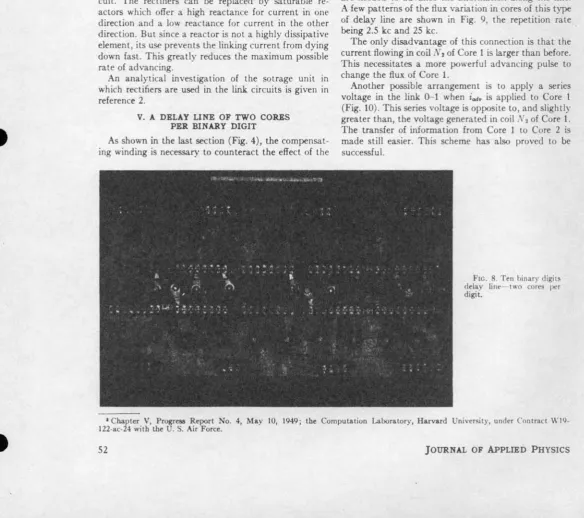
Figure 8 shows an assembly of a delay line of this design to hold ten digits. Only two advancing pulses are needed to ad\-ance the information along the line.
A few palterns of the dux variation in cores of this type of delay line are shown in Fig. 9, the repetition rate being 2.5 kc and 2S kc.
The only disadvantage of this connection is that the
current flowing in coil NI of Core I is larger than before.
This necessitates a more powerful advancing pulse to
change the flux of Core 1.
Another possible arrangement is to apply a series voltage in the link 0-1 when iQd. is applied to Core I (Fig. 10). This series voltage is opposite to, and slightly grealer than, the voltage generated in coil.\'1 of Core 1.
The transfer of information from Core I to Cort: 2 is
madt: still easier. This scheme has also proved to be successful.
FrG. 8. Ten !>ina,y digit!
delay lin.. '1'>'0 w.t'S pet
digit.
• Chapter V, Progreu Report No. 4, May 10, 1949; lbe Computation Laoor&tory, Harvard Un;"fr!Ul)', under ('onln",::1 WI\)_ 122·ac-24 wi,b r.he U. S. Air -Force.
•
•
•
•
•
•
•
,
• -IG. 9. flux
'1
.
lime cur.'e-t'll'O cores per dicit .•. Informationrale- 2.S Itc. Information 1010111010. b. Information rate-25 Itc.
Information 0011101010.
VI. PROPERTIES OF MAGNETIC CORB MATERIAL
As shown in Fig. II, the ideal hysteresisc:haracteristics
of !.he magnetic storage and delay line are a perfectly rectangular hysteresis loop and 11 very low coercive
force.
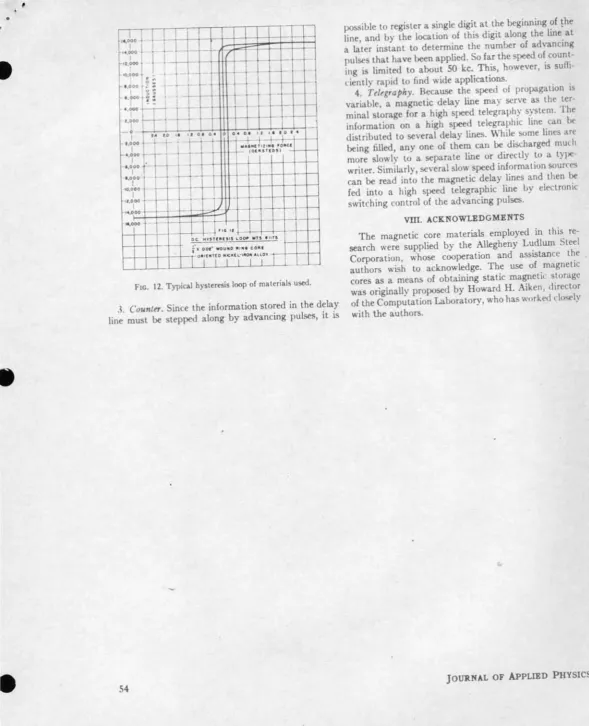
In actual practice, unfortunately. such characteris· tics cannot be realized. Figure 12 shows a typical
hysteresis curve for one of the cores manufactured by
the Allegheny-Ludlum Steel Corporation of wound
strips of Dellamax-. The hysteresis loop is close to the
ideal; nevertheless, the saturated region is not
abso-lutely of lero slope, and the sharply rising portion is nOI quite verticaL In addition, the comers are some~
what rounded. But delay lines using such cores have
been constructed and operate reliably. The criteria of
how good the hysteresis loop is must have been
dis-cussed in reference 2.
As the frequency of operation becomes higher, the hysteresis and eddy current losses become appreciable.
The heat generated is considerable at the highest fre
-quency of operation. Moreover, the eddy current acts like a shorl--circuited secondary around the core. The presence of the eddy current requires a larger advancing
current to drive the core from one polarity to the other. At an operating frequency of 50 kc, e"ery core
aher-nates its tlux between two saturation values in 10
microseconds. As. .. ume that the flux changes linearly.
This is a fairly accurate assumption, as seen from an
oscillograph of tlux variation. The cores used are made of a strip of one-mil thiclrness,
t
i~ch wide, ... ound into a single-tum core of ~-inch diameter. The hysteresis loss is estimated to be of the order of 7 milli ... att 'core, the eddy current loss 25 milli ... all/core, the electrical resistivity of the core being taken as SO microhm cent i-meters. For such a core the equivalent demagnetizing amperetums can be calculated to be about 1.2. It isalso equivalent to an increase of coercive force of 0.37
oersted. Apart from the upper frequency limits imposed
by these losses, the fundamental operation of the stordgc
and delay line is imkpendent of Ihe frequency.
VOLUME 21, JANUARY, 1950
vu.
APPUCAnOlfSIt may be helpful to point out the unique features of this form of storage. No power is needed to maintain
the storage of information. No mechanical movement is
needed in recording and pick-up. The speed of
re-cording, transfer, and read out has no lo ... er limit and
can be varied to an upper limit which is sufficiently
high to be very useful. At the present stage, this maxi
-mum rate is of the order of SO kc. These featur~ repre
-sent improvements' over the characteristics of the storage devices mentioned in the introduction.
Possible applications include the following:
I. In/ormolion sforale. Ifldi\'idual binary digits can
be stored in pairs of cores, as discussed in Section II .
ff a series of digits is to be stored, the infonnation can
be sent into a delay line. After the whole series of digits
is in the line, stopping the flow of advancing pulses
suffices to store the information indcfinitely in the line. It can be read out at any time at the end of the line br
applying the ad\'ancing pulses again. Development
... ork is being done at thc Computation Laboratory of
Harvard University to construct a line holding 40
binary digits in a plug-in component container unit which will be no more than two inches in diameter a.nd six inches in length.
2. Input and output link
lor
high spud compulm.This form of delay line provides an cxcellent malium
for transfer of informa.tion betwccn systems of .different digital rate. Data and commands can be put into the
line manually and then read out to the machine at its
operating spet-d. Again, results from the machine can
be fed at high slx'Cd into the delay line, from which
later a set of slow a<h'ancing pulses can step the results
out at a speed suitable,
sar,
to operatca
t)l)e\\ritcr directly..0
.
,
.
,
FIG. 10. Anolho:r form of delay Im~ of ' .... 0 corrs l)C't digit
FII;:;. It Ideal hrst .. rrsis
10°11·
,
o
- - -
,
.
,
,
•
•
•
•
"
J..I!!lL
T
0+11'
..
_
, ,Tt
-0,r-
f--._
0
I-, :
0'
• 0 ... , ; . • •
·
-.ll
0
f-
-
-:~
'
.
-
T
-•
. -
- r ...
-
.
-f
... ,
..
.,01 O',
O. O . . . .. . 0 • •• .0
1" ~ 1
,.
t
~-+
""'I T'''U .,,_.
,"
l
•
,.
l-
,N ..,n
.
,
•. t" f
0
l-
I-·
.tt'
t
,~t
-!
-
,
.•. y'
I-1
~
-I ...
--
~
.
f-
J
...
..
f--
u -•• ,,, ... ,'."01'
.
..
.
..
tI-
-t
f
....
~
·
t'i·
-
...
'i'''
.
i"~
,
•
•
CO"'t
"FIG. 12. Typical h}'sl~rnis loop or mattri.l~ I,l$otd.
.
t
Count". Since the information stored in the delayline must be stepped along by advancing pulses, it is
54
L-
JC
possible to regisu:r a single digit at the beginning of ~he
line, and by the location of this digit along the line at a later instant to determine the number of advancing
pulst'5lhat have been applied. So far the speed of
count-ing is limitw to about 50 \.;c. This. however, is sulli·
fiently rapid to find wide applications .
4. Td,graphy. Because the speed of propagation is
variable, a magnetic delay line may serve as lh~ l~r
minal storag~ for a high sp~ed tdegraphy system. Th~
information on a high speed t~l~graphic line can hI:'
distributed to se\'~ral d~lay lines. \\11ile somt lines art'
being filled, anyone of them can be discharged mUlh
more slowly to a separate line or direct.1y to a type·
writer. Similarly, several slow
speed
information sourcescan be read into th~ magnetic delay lines and then be
fed into a high speed tel~graphic lin~ by electronic
switching control of the advancing pulses.
VIII. ACKNOWLEDGMENTS
Th~ magnetic core materials employed in this
te-search were supplied by the Allegheny Ludlum Steel
Corporation, .... :hose cooperation and a..-.sislancc the
authors wish to acknowledge. The use of magnetic
cores as a means of obtaining static magnNic storage
was originally proposed by Howard H. Aiken, director
of the Computation Laooratory, who has wurked closely
with the authOr!;.