Volume 2009, Article ID 948961,6pages doi:10.1155/2009/948961
Research Article
A Method for Visualizing Independent
Spatio-Temporal Patterns of Brain Activity
Dean J. Krusienski
School of Engineering, University of North Florida, 1 UNF Drive, Jacksonville, FL 32224, USA
Correspondence should be addressed to Dean J. Krusienski,[email protected]
Received 2 January 2009; Accepted 31 May 2009
Recommended by Don Johnson
Evoked and coordinated brain signals often exhibit distinct, individualized spatial and temporal characteristics, such as amplitude and phase couplings across and within spatial channels. In the study of these brain potentials, it is important to characterize both the spatial and temporal morphologies of the responses for a better understanding of both the physiology and function of the brain. This paper presents a method for visualizing the characteristic spatio-temporal brain activity associated with two distinct conditions. This method, called Independent Spatio-Temporal Patterns (ISTPs), extends Common Spatial Patterns (CSPs) for spatio-temporal pattern visualization by adding temporal features. Independent component analysis (ICA) is then applied to extract independent spatio-temporal patterns corresponding to each condition. The results indicate that the inclusion of temporal features can provide useful insight regarding the spatio-temporal characteristics of sensorimotor rhythms.
Copyright © 2009 Dean J. Krusienski. This is an open access article distributed under the Creative Commons Attribution License, which permits unrestricted use, distribution, and reproduction in any medium, provided the original work is properly cited.
1. Introduction
Evoked and coordinated brain signals often exhibit distinct, individualized spatial and temporal characteristics, such as amplitude and phase couplings across and within spatial channels [2]. In the study of these brain potentials, it is important to characterize both the spatial and temporal mor-phologies of the responses for a better understanding of both the physiology and function of the brain. This knowledge is valuable for characterizing new responses, mapping brain activity, detecting irregularities, and controlling a brain-computer interface (BCI).
Simple ensemble averaging is usually sufficient to char-acterize stimulus evoked potentials because the phase of the response is typically time-locked to the stimulus [2]. How-ever, the averaging of event related (de)synchronizations, such as sensorimotor rhythms (SMRs), is more difficult because the phase of the responses is not time locked to a stimulus. Although the general spatial and spectral character-istics of SMRs are well characterized, there can be differences ranging from subtle to significant in the spatio-temporal SMR patterns across individuals [4]. Obtaining a character-istic temporal waveform from (de)synchronizations on a sin-gle channel can be straightforwardly accomplished via aver-aging using correlations of known responses [4]. However,
this method is not precise for examining multiple channels simultaneously. The proposed method, Independent Spatio-Temporal Patterns (ISTPs), extends common spatial patterns (CSPs), combined with independent component analysis (ICA) in order to accurately extract such characteristic spatio-temporal patterns.
to construct the filtering matrix, enabling a complete visualization of the discriminable spatio-temporal patterns for the two classes. The addition of ICA produces a set of independent spatio-temporal patterns that are informative in terms of substantiating the morphology of the EEG during different mental states.
2. The Method of Common Spatial Patterns
The CSP decomposition of a feature matrix is given as,
Y=WX, (1)
whereXis an N feature×T observance matrix,W is an L
×N matrix (L≤N) whose L rows represent the individual components of the decomposition, andYis an L×T matrix subspace of X. For a two-class classification problem, W
can be determined to decompose the feature matrix such that the resulting projections corresponding to the extreme eigenvalues of the transformed covariance matrices have maximal variance for one class and minimal variance for the other class. First, for the two classes (1 and 2), the class-labeled observations are sorted by the respective class and the class-specific covariance matrices are determined:
Σ1=X(1)X(1)T , Σ2=X(2)X(2)T . (2)
The task is defined as finding the transformationWto create projections that simultaneously maximize the variance for one class and minimize the variance for the other:
WΣ1WT =D, WΣ2WT=I−D, (3)
whereD is a diagonal matrix with elements in [0, 1]. This can be accomplished through simultaneous diagonalization of the two covariance matrices. First, a whitening transfor-mation is performed:
P(Σ1+Σ2)PT =I. (4)
Using spectral theory, the eigenvalue decomposition is then performed for the transformed classes:
PΣ1PT =RDRT, PΣ2PT=R(I−D)RT, (5)
where the columns ofRare the eigenvectors, and the diagonal elements ofD and (D−I) are the eigenvalues of classes 1 and 2, respectively. Note that the maximum eigenvalues for one class correspond to the minimum eigenvalues for the other class. By selecting only the eigenvectors corresponding to the largest and smallest eigenvalues that provide the best discrimination between classes, the subspace projection matrix is defined as.
W=RTP. (6)
For standard CSP analysis of EEG, the features of X
are simply the instantaneous bandpass-filtered voltages at each electrode. For ISTP, the features are the concatenation of time-windowed voltages for each electrode. The actual EEG patterns corresponding to the two mental states can be visualized by inverting the filtering matrixW.
16], trained users are able to effectively modulate 8–12 Hz (αband) and 18–26 Hz (βband) spectral components over the sensorimotor cortex to move a cursor toward a randomly positioned target on a monitor. Four sessions of data from ten able-bodied users (six women and four men ranging in age from 29 to 45) who performed a one-dimensional two-target cursor control task were used for offline evaluation of the ISTPs. All users had exhibited strongμ-band activity during an initial screening and were subsequently trained on a simple two-target, one-dimensional cursor control task. All users were successfully trained on the task (consistently
>80% accuracy) and ranged in experience from 1 to 20 sessions on the task prior to this data set. The study was approved by the New York State Department of Health Insti-tutional Review Board, and each user gave informed consent.
3.1. One-Dimensional Sensorimotor Rhythm Cursor Control Task. The one-dimensional sensorimotor rhythm cursor control task is shown in Figure 1. For the task, the users were presented by a target randomly positioned at the top or bottom right edge of the monitor. The trial began with the cursor at the left center of the monitor. It moved at a constant rate toward the right, reaching the right side of the monitor after 2 seconds. The users’ goal was to move the cursor upward or downward to the height of the target so that it hits the target when it reached the right side of the monitor. The trials continued in 3-minute runs, with a 1-minute break given between runs. Between 18 and 30 trials were completed in a single 3-minute run, and 8 runs constitute a single session. Sessions were conducted one per day over a period of several weeks.
3.2. Data Collection and Feature Extraction. The details of the data collection and analysis are as follows. Using BCI2000 software [17], the EEG activity was collected from 64 channels at standard locations [18] distributed over the scalp. All 64 channels were referenced to the right ear, bandpass filtered (0.1–60 Hz), and digitized at 160 Hz. For each user, a large Laplacian spatial filter [12] (see Figure 2) was applied to the electrode over the right-or-left hand area of the sensorimotor cortex that exhibited maximal correlation betweenμ-band activity and the task based on prior sessions. A 3-Hz bin at the user-specific μ-band frequency from a 16th-order AR model was extracted from the spatial-filtered signal and used as the online control feature. The AR feature was calculated every 50 milliseconds from the past 400 milliseconds of data. The AR model order, bin width, and time windowing were selected based on extensive empirical evaluations. The specific locations and frequencies used for the online experiments are provided inTable 1.
4. Offline Analysis
1 2 3 4 5
Figure1: One-dimensional task trial structure. (1) The target and cursor are present on the screen for 1 second. (2) The cursor moves steadily across the screen for 2 seconds with its vertical movement controlled by the user. (3) If the user hits the target, the target flashes for 1.5 seconds. If the cursor misses the target, the screen is blank for 1.5 seconds. (4) The screen goes blank for a 1-second interval. (5) The next trial begins.
TP7 TP8
T7 T8
F3 F4
FC3 FC4
C3 C4
CP3 CP4
P3 P4
PO3 PO4 CZ
CPZ
Figure2: The large Laplacian spatial filter configuration. For an electrode over the hand area of the sensorimotor cortex (indicated in black), the signals from the four equidistant surrounding electrodes (indicated in gray) are averaged and subtracted from this central (black) electrode to produce the control signal. For the online experiments, a single large Laplacian control signal was used for cursor control. For the offline analysis, the 9 electrodes comprising the two contralateral Laplacian filters covering both hemispheres (depicted as the shaded locations for the C3/C4users and as the unshaded locations for the CP3/CP4users) were used for processing.
each of the 10 users. The first session was used to derive the ISTPs, and the three subsequent sessions were used for validation. As a necessary preprocessing step for CSP-based methods, the channels were bandpass filtered from 7 to 30 Hz [1]. The spatio-temporal features were constructed using the nine raw (i.e., ear-referenced) channels that represent the union of the channels that comprise large Laplacians over the left and right sensorimotor cortex. The observations used to construct the covariance matrices were collected every 6.25 milliseconds using the past 400 milliseconds of data, thus matching the segment length used for the online experiments.
The observations were collected every 6.25 milliseconds to provide an ample number of observations for constructing the covariance matrices, although a lower observation rate
Table1: The predetermined optimal electrode location (Interna-tional 10–20 System [18]) and fundamentalμ-rhythm frequency for each user.
User Location Frequency(Hz)
A C3 12
B C3 12
C CP3 12
D C3 12
E CP3 11
F C3 12
G C4 12
H CP4 13
I C3 12
J C3 10
would likely be adequate. The channel set was limited to nine electrodes in order to provide comparison to the Laplacian spatial filter as well as a manageable feature space for the ISTP method.
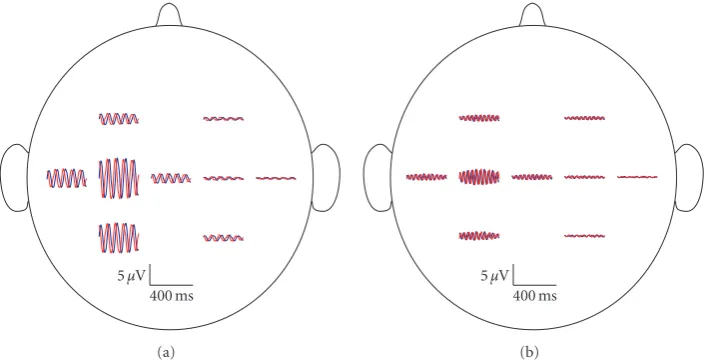
5μV 400 ms
(a)
5μV 400 ms
(b)
Figure3: Representative waveform topographies of the four most prominent patterns for the synchronized condition (high SMR-band amplitude). The waveforms are presented with respect to the electrode locations given inFigure 2. In the left topography, the first and second most prominent patterns are illustrated in red and blue, respectively, and represent theμfrequency band. In the right topography, the third and fourth most prominent patterns are illustrated in red and blue, respectively, and represent theβfrequency band. For this user (User D), theμband from channel C3was used for online control.
the prominent components primarily ranged from apparent random noise to visual α-type activity depending on the user, although other nonvisual rhythmic components were present in some users. Although the method is capable of extracting potential phase shifts between channels for a particular CSTP component, there were no apparent phase offsets between channels for any of the prominent components.
4.2. Independent Spatio-Temporal Patterns. Although the prominent CSTP components are essentially orthogonal Fourier components at the μ and β frequencies, these components are not necessarily independent. In order to gain insight regarding the independent patterns generated for each target condition, independent component analysis (ICA) can be performed on the projected features for each condition. Because the resulting ICA unmixing matrix indi-cates the relative contribution of each projection, and each CSTP component corresponds to a particular projection, the ICA mixing matrix (inverse of the unmixing matrix) can be applied to the CSTP components to produce a representation of the independent patterns. These independent patterns should provide an indication of the preferred response morphologies (i.e., amplitude and phase relationships) for the different conditions. The independent common spatio-temporal patterns (ISTPs) for each target condition i ∈ {1, 2}are attained as follows:
CSTPICAi =W−1iAi, (7) whereAis the resultant mixing matrix of the ICA.
Figure 4shows, for three representative users, the ISTPs of the synchronized condition that result in the highest correlation with target position. The mixing matrices were derived from the 8 most prominent projections (empirically found to be a suitable number of projections for ICA) for
each target condition using FastICA [19] with a tansigmoidal nonlinearity. The classical arch-shape patterns depicted in Figure 4 are consistent for the majority of users, which supports the notion of preferred phase coupling between the
μandβbands [4].
To confirm that the ISTPs are in fact useful and valid results, the two ISTP projections from each class (four features) having the highest correlations with the target position were extracted, and regression weights were determined using the first session from each user. The r2 correlations of the resulting regressed feature were computed using the three subsequent sessions for each user. Theser2 values were compared to values produced by the incumbent online method using two large Laplacian channels, the online control channel, and the contralateral channel over the opposite hemisphere (see Figure 2). For each channel, 3-Hz μ and β band spectral bins were extracted using a 16th-order AR model derived via the maximum entropy method (MEM) [20]. Regression weights were determined for these four features using the first session from each user, and the resulting regressed feature was correlated with three subsequent sessions for each user.
Figure 5 illustrates the r2 for each method averaged across users. These results indicate that the specific spatio-temporal relationships of ISTP provide an improved model compared to the Laplacian and AR combination, which applies fixed spatial weights and does not utilize phase relationships.
5. Discussion
5μV 400 ms
(a)
5μV 400 ms
(b)
5μV 400 ms
(c)
Figure 4: Waveform topographies of the independent common spatio-temporal patterns having the highest correlation for the synchronized condition for three representative users. The wave-forms are presented with respect to the electrode locations given inFigure 2. The users depicted in the top two topographies (User A and D, resp.) used channel C3for online control, while the user depicted in the bottom topography (User G) used channel C4.
0.2 0.3 0.4 0.5 0.6 0.7
r2
AR ISTP
Method
Figure5: An offline evaluation ofr2for the AR and ISTP methods averaged over 10 users. The error bars indicate standard deviation.
distinguishes the actual independent spatio-temporal mor-phologies indicative of the different mental states without prior knowledge of the SMR characteristics. As with any application of ICA where exact number of sources is not known, it is difficult to speculate about the significance of the resulting ISTPs. Nevertheless, it is interesting that the ISTPs having the highest correlation with the target position often exhibit the classical arch-shaped μ-rhythm pattern [20], suggesting that there is a preferred amplitude/phase synchronization between the fundamental SMR frequency and the harmonics.
The resulting ISTP morphologies capture these preferred amplitude and phase relationships across and within chan-nels, which can be visualized, characterized, and applied for classification purposes. The prominent ISTP patterns could potentially be used as spatio-temporal matched filter templates, which would minimize the phase effects and produce better instantaneous tracking estimates than a fixed classifier for continuous SMR cursor control [4]. However, the feature space required for ISTP would likely be overkill compared to methods such CSSSP [21] for discrete classification purposes.
Acknowledgments
This work was initiated and partially completed at the Wadsworth Center, NYSDOH, Albany, NY and supported in part by the National Institutes of Health under Grant NICHD HD30146 and Grant NIBIB/NINDS EB00856 and in part by the James S. McDonnell Foundation. The author would also like to thank Dennis J. McFarland and Jonathan R. Wolpaw for their valuable input to the manuscript.
References
[1] S. Lemm, B. Blankertz, G. Curio, and K.-R. M¨uller, “Spatio-spectral filters for improving the classification of single trial EEG,”IEEE Transactions on Biomedical Engineering, vol. 52, no. 9, pp. 1541–1548, 2005.
[2] E. Niedermeyer and F. L. da Silva, Eds., Electroencephalogra-phy: Basic Principles, Clinical Applications and Related Fields, Williams and Wilkins, Baltimore, Md, USA, 5th edition, 2004. [3] M. Cheng, W. Jia, X. Gao, S. Gao, and F. Yang, “Mu rhythm-based cursor control: an offline analysis,” Clinical Neurophysiology, vol. 115, no. 4, pp. 745–751, 2004.
[4] D. J. Krusienski, G. Schalk, D. J. McFarland, and J. R. Wolpaw, “A μ-rhythm matched filter for continuous control of a brain-computer interface,”IEEE Transactions on Biomedical Engineering, vol. 54, no. 2, pp. 273–280, 2007.
[5] K. Fukunaga,Introduction to Statistical Pattern Recognition, Academic Press, San Diego, Calif, USA, 2nd edition, 1990. [6] Z. J. Koles and A. C. K. Soong, “EEG source localization:
implementing the spatio-temporal decomposition approach,”
Electroencephalography and Clinical Neurophysiology, vol. 107, no. 5, pp. 343–352, 1998.
[7] G. Dornhege, B. Blankertz, G. Curio, and K.-R. M¨uller, “Boosting bit rates in noninvasive EEG single-trial classifica-tions by feature combination and multiclass paradigms,”IEEE Transactions on Biomedical Engineering, vol. 51, no. 6, pp. 993– 1002, 2004.
[8] J. M¨uller-Gerking, G. Pfurtscheller, and H. Flyvbjerg, “Design-ing optimal spatial filters for s“Design-ingle-trial EEG classification in a movement task,”Clinical Neurophysiology, vol. 110, no. 5, pp. 787–798, 1999.
[9] P. Shenoy, M. Krauledat, B. Blankertz, R. P. N. Rao, and K.-R. M¨uller, “Towards adaptive classification for BCI,”Journal of Neural Engineering, vol. 3, no. 1, pp. R13–R23, 2006. [10] G. Townsend, B. Graimann, and G. Pfurtscheller, “A
compar-ison of common spatial patterns with complex band power features in a four-class BCI experiment,”IEEE Transactions on Biomedical Engineering, vol. 53, no. 4, pp. 642–651, 2006. [11] Y. Wang, P. Berg, and M. Scherg, “Common spatial subspace
decomposition applied to analysis of brain responses under multiple task conditions: a simulation study,”Clinical Neuro-physiology, vol. 110, no. 4, pp. 604–614, 1999.
[12] D. J. McFarland, L. M. McCane, S. V. David, and J. R. Wolpaw, “Spatial filter selection for EEG-based communication,” Elec-troencephalography and Clinical Neurophysiology, vol. 103, no. 3, pp. 386–394, 1997.
[13] D. J. McFarland, W. A. Sarnacki, and J. R. Wolpaw, “Brain-computer interface (BCI) operation: optimizing information
nication and control: speed-accuracy relationships,”Applied Psychophysiology Biofeedback, vol. 28, no. 3, pp. 217–231, 2003. [15] J. R. Wolpaw and D. J. McFarland, “Multichannel EEG-based brain-computer communication,”Electroencephalography and Clinical Neurophysiology, vol. 90, no. 6, pp. 444–449, 1994. [16] J. R. Wolpaw and D. J. McFarland, “Control of a
two-dimensional movement signal by a noninvasive brain-computer interface in humans,”Proceedings of the National Academy of Sciences of the United States of America, vol. 101, no. 51, pp. 17849–17854, 2004.
[17] G. Schalk, D. J. McFarland, T. Hinterberger, N. Birbaumer, and J. R. Wolpaw, “BCI2000: a general-purpose brain-computer interface (BCI) system,” IEEE Transactions on Biomedical Engineering, vol. 51, no. 6, pp. 1034–1043, 2004.
[18] F. Sharbrough, C. E. Chatrian, R. P. Lesser, H. Luders, M. Nuwer, and T. W. Picton, “American electroencphalographic society guidelines for standard electrode position nomencla-ture,”Journal of Clinical Neurophysiology, vol. 8, no. 2, pp. 200– 202, 1991.
[19] A. Hyv¨arinen, “Fast and robust fixed-point algorithms for independent component analysis,”IEEE Transactions on Neu-ral Networks, vol. 10, no. 3, pp. 626–634, 1999.
[20] W. N. Kuhlman, “EEG feedback training of epileptic patients: clinical and electroencephalographic analysis,” Electroen-cephalography and Clinical Neurophysiology, vol. 45, no. 6, pp. 699–710, 1978.
[21] G. Dornhege, B. Blankertz, M. Krauledat, F. Losch, G. Curio, and K.-R. M¨uller, “Combined optimization of spatial and temporal filters for improving brain-computer interfacing,”
IEEE Transactions on Biomedical Engineering, vol. 53, no. 11, pp. 2274–2281, 2006.
[22] G. Dornhege, B. Blankertz, and G. Curio, “Speeding up classi-fication of multi-channel brain-computer interfaces: common spatial patterns for slow cortical potentials,” in Proceedings of the 1st International IEEE EMBS Conference on Neural Engineering, pp. 591–594, 2003.
![Table 1: The predetermined optimal electrode location (Interna-tional 10–20 System [18]) and fundamental μ-rhythm frequency foreach user.](https://thumb-us.123doks.com/thumbv2/123dok_us/1161732.1146236/3.600.57.288.201.427/predetermined-optimal-electrode-location-interna-fundamental-frequency-foreach.webp)