
Volume 2007, Article ID 54342,15pages doi:10.1155/2007/54342
Research Article
Scalable Video Coding with Interlayer Signal
Decorrelation Techniques
Wenxian Yang, Gagan Rath, and Christine Guillemot
Institut de Recherche en Informatique et Syst`emes Al´eatoires, Institut National de Recherche en Informatique et en Automatique, 35042 Rennes Cedex, France
Received 12 September 2006; Accepted 20 February 2007
Recommended by Chia-Wen Lin
Scalability is one of the essential requirements in the compression of visual data for present-day multimedia communications and storage. The basic building block for providing the spatial scalability in the scalable video coding (SVC) standard is the well-known Laplacian pyramid (LP). An LP achieves the multiscale representation of the video as a base-layer signal at lower resolution together with several enhancement-layer signals at successive higher resolutions. In this paper, we propose to improve the coding perfor-mance of the enhancement layers through efficient interlayer decorrelation techniques. We first show that, with nonbiorthogonal upsampling and downsampling filters, the base layer and the enhancement layers are correlated. We investigate two structures to reduce this correlation. The first structure updates the base-layer signal by subtracting from it the low-frequency component of the enhancement layer signal. The second structure modifies the prediction in order that the low-frequency component in the new enhancement layer is diminished. The second structure is integrated in the JSVM 4.0 codec with suitable modifications in the prediction modes. Experimental results with some standard test sequences demonstrate coding gains up to 1 dB for I pictures and up to 0.7 dB for both I and P pictures.
Copyright © 2007 Wenxian Yang et al. This is an open access article distributed under the Creative Commons Attribution License, which permits unrestricted use, distribution, and reproduction in any medium, provided the original work is properly cited.
1. INTRODUCTION
Scalable video coding (SVC) is currently being developed as an extension of the ITU-T Recommendation H.264|ISO/IEC International Standard ISO/IEC 14496-10 advanced video [1]. It allows to adapt the bit rate of the transmitted stream to the network bandwidth, and/or the resolution of the trans-mitted stream to the resolution or rendering capability of the receiving device. In the current SVC reference software JSVM, spatial scalability is achieved using layers with diff er-ent spatial resolutions. The higher-resolution signals, com-monly known as enhancement layers, are represented as difference signals where the differencing is performed be-tween the original high-resolution signals and predictions on a macroblock level. These predictions can be spatial (in-traframe), temporal, or interlayer. The lower-base layer sig-nal along with the associated interlayer-predicted enhance-ment layer signal constitutes the well-known Laplacian pyra-mid (LP) representation [2].
The Laplacian pyramid represents an image as an hierar-chy of differential images of increasing resolution such that each level corresponds to a different band of image
frequen-cies. The pyramid is generated from a Gaussian pyramid by taking the differences between its higher-resolution ers and the interpolations of the next lower-resolution lay-ers. The difference layers, called detail signals, have typically much less entropy than the corresponding Gaussian pyramid layers. As a result, an LP requires much less bit rate than the associated Gaussian pyramid when encoded for transmission or storage. At the receiver, the decoder reconstructs the orig-inal signal by successively interpolating the lower-resolution signal and adding the detail layers up to the desired resolu-tion.
layer renders the LP structure to represent either original sig-nals or motion compensated residual sigsig-nals at higher lay-ers. For example, the I frames in upper resolution layers can have interlayer predictions (LP) applied to the original sig-nal; the P and B frames, however, can have interlayer predic-tions (LP) applied to the motion compensated residual sig-nals.
In the context of scalable video coding, the compression of the enhancement layers is an important issue. In the SVC standard, for the enhancement layer blocks coded with inter-layer predictions, the decoder follows the standard LP recon-struction, that is, it interpolates the base layer and adds the enhancement layer to the interpolated signal. Do and Vet-terli [3] have proposed to use a dual-frame-based reconstruc-tion which has a better rate-distorreconstruc-tion (R-D) performance. The dual-frame construction, however, requires biorthogo-nal upsampling and downsampling filters, which limits its application in SVC because of noticeable aliasing in lower-resolution layers. To improve upon this drawback, the au-thors in [4,5] have proposed to add an update step for the base-layer signal at the LP encoder. This structure, however, necessitates not only an open loop LP structure but also the design of a new lowpass filter.
An alternative approach to improve the compression ef-ficiency of enhancement layers is to employ better inter-layer predictions. To that end, several techniques have already been proposed to the JVT [6–8]. In [6], optimal upsamplers are designed which depend on the downsampling filter, the quantization levels of the base layer, and the input video se-quence. Later, a family of downsamplers is constructed to span a range of filter lengths, aliasing, and ringing charac-teristics available to an encoder [7], together with their cor-responding upsamplers. In [8], the direction information of the base layer is used to improve the prediction for the mac-roblocks (MBs) with high-directional characteristics.
In this paper, we propose to improve the coding per-formance of the enhancement layers through efficient inter-layer decorrelation techniques. We first show that, with non-biorthogonal upsampling and downsampling filters, the base layer and the enhancement layers are correlated. We investi-gate two structures to reduce this correlation. The first struc-ture updates the base-layer signal by subtracting from it the low-frequency component of the enhancement layer signal. The second structure modifies the prediction in order that the low-frequency component in the new enhancement layer is diminished. We present these structures both in the open-loop and in the closed-open-loop configurations. We analyze the reconstruction errors with both structures under reasonable assumptions regarding the statistical properties of the differ-ent quantization noises, and show that the second structure in the closed-loop configuration leads to an error that is de-pendent only on the quantization error of the enhancement layer. To improve the coding efficiency of the enhancement layer further, we use a recently proposed orthogonal trans-form in conjunction with the existing 4×4 transform. We incorporate the proposed prediction method in the JSVM software and present the results with respect to a current im-plementation.
The rest of the paper is organized as follows. InSection 2, we present a brief description of the classical Laplacian pyra-mid.Section 3reviews the LP reconstruction structure and some of its recent improvements. Sections4and5describe the proposed decorrelation methods that result in either a reduced coarse signal or a reduced detail signal. InSection 6, we analyze the reconstruction errors that ensue from differ-ent decoding techniques.Section 7touches upon the subject of transform coding of enhancement layers. Sections8and9 present the details of the integration of the proposed method in the JSVM codec with necessary mode selection options and the results obtained with some standard test sequences. Finally, we draw conclusions alongside some future research perspectives inSection 10.
2. LAPLACIAN PYRAMID REPRESENTATION
The LP structure proposed by Burt and Adelson [2] is shown inFigure 1. For convenience of notation, let us consider an LP for 1D signals; the results can be carried over to the higher dimensions in a straightforward manner with separable fil-ters. For an image, for example, the filtering operations can be performed first row-wise and then column-wise, each op-eration using 1D signals. For the sake of explanation, we will here consider an LP with only one level of decomposition. For multiple levels of decompositions, the results can be de-rived by repeating the operations on the lower-resolution layer. Considering an input signalxofNsamples and dyadic downsampling, a coarse signalccan be derived as1
c:=Hx, (1)
whereHdenotes the decimation filter matrix of dimension (N/2)×N.Hhas the following general structure2:
H:=
⎡ ⎢ ⎢ ⎢ ⎢ ⎢ ⎢ ⎢ ⎣
. ..
. . . 0 h(L) h(L−1) . . . h(1) h(0) 0 0 . . . . . . . 0 0 h(L) . . . h(2) h(1) h(0) . . .
. ..
⎤ ⎥ ⎥ ⎥ ⎥ ⎥ ⎥ ⎥ ⎦
.
(2)
The coefficientsh(n),n =0, 1, 2,. . .,L, here denote the downsampling filter coefficients. The matrix structure above is a result of the filtering (i.e., convolution) and downsam-pling the filtered output by factor 2 (the elements of a row are right-shifted by 2 columns from the elements of the pre-vious row). We assume an FIR filter having linear phase (i.e., symmetric). Repeated filtering and downsampling op-erations on the coarsest signal leads to the so-called Gaus-sian pyramid. The first level of LP is obtained by predict-ing the signalxbased on the coarse signalc. The prediction is made by upsampling the coarse signal with alternate zero
1We use the notation “:=” for “is derived as” or “is defined as.”
x + dol
−
pol
h g
c
Qd
Qc
dq
cq
Figure1: Open-loop Laplacian pyramid structure with one decom-position level.
samples and then filtering the upsampled signal. In the SVC framework, the LP coefficients need to be quantized before being encoded. Depending on whether the quantizer for the low-resolution signal is inside or outside the prediction loop, there can be two different structures for the LP. The open-loopprediction structure with the quantizer outside the loop is shown inFigure 1. In this structure, the detail signaldolis given as
dol:=x−Gc=
IN−GH x, (3)
whereIN denotes the identity matrix of orderN andG
de-notes the interpolation filter matrix of dimensionN×(N/2). Ghas the following general structure:
G:=
⎡ ⎢ ⎢ ⎢ ⎢ ⎢ ⎢ ⎢ ⎣
. ..
. . . 0 g(0) g(1) g(2) . . . g(M) 0 0 . . . . . . . 0 0 g(0) g(1) . . . g(M−1) g(M) . . .
. ..
⎤ ⎥ ⎥ ⎥ ⎥ ⎥ ⎥ ⎥ ⎦
t
.
(4)
The coefficientsg(n),n=0, 1, 2,. . .,M, here denote the up-sampling filter coefficients and the superscripttdenotes the matrix transpose operation. Like the decimation filter ma-trix, the interpolation filter matrix structure is a result of the upsampling by factor 2 and filtering. The down-shifting of a column by two rows from the previous column is due to the alternate zero elements in the upsampled signal. The filter is also assumed to be FIR and linear phase. Throughout the pa-per, we assume normalized downsampling and upsampling filters. That is,
n
h(n)=1,
n
g(n)=2. (5)
These normalization conditions guarantee that the coarse signals and the prediction signals have about the same dy-namic range as the original signal.
Theclosed-loopconfiguration with the quantizer within the prediction loop is depicted inFigure 2. Here the quan-tized coarse signal is used to make the prediction for the
x + dcl
−
pcl
h g
c
Qd
Qc
dq
cq
Figure2: Closed-loop Laplacian pyramid structure with one de-composition level.
x +
+ pcl
g dq
cq
Figure3: Standard reconstruction structure for LP.
higher-resolution signal. If cq denotes the quantized
low-resolution signal, the detail signal is obtained as
dcl:=x−Gcq. (6)
Irrespective of the configuration, the coarse and the de-tail signals are encoded with suitable transforms and variable length coding (VLC) schemes before being transmitted to the decoder. In Figures1and2, we use the same symbolscqand
dqto denote the quantized coarse and detail signals. Clearly, given the same quantizers, both structures transmit the same coarse signal; however, the transmitted detail signals are dif-ferent. We use the same symbol notation for the sake of sim-plicity and also because of the fact that their usual recon-struction structures (given in the next section) are identical. In JSVM, the closed-loop prediction structure is adopted be-cause of its superior performance compared to the open-loop structure. Note that the coarse signal and the detail signals here refer, respectively, to the base layer and the interlayer-predicted enhancement layers in the JSVM.
3. LP DECODER STRUCTURES
coarse signal is upsampled and then filtered using the same interpolation filter as used at the encoder. This prediction signal is added to the decoded detail signal to estimate the original higher-resolution signal. Considering an LP with only one level of decomposition, we can reconstruct the original signal as
xs:=Gcq+dq, (7)
wheredqdenotes the quantized or decoded detail signal. Ob-serve that the prediction signal is identical to that for the closed-loop LP encoder (when there are no channel errors).
Because of its overcompleteness, an LP can be repre-sented as a frame expansion as follows. Let K denote the resolution of the coarse signalc. For dyadic downsampling, K=N/2. The coarse and the detail signals can be jointly ex-pressed as
c
dol
:=
H IN−GH
x≡Sx, (8)
where Sdenotes the matrix on the right-hand side having dimension (N+K)×N. Since the LP is reversible for any combinations of the downsampling and upsampling filters
handg,Shas full-column rank. The rows ofSconstitute a frame andScan be called the frame operator or the analysis operator associated with the LP [3,9,10].
The usual reconstruction shown in (7) can be equiva-lently expressed using the reconstruction operator [G IN] as
xs:=G IN cq
dq
. (9)
It is trivial to prove that [G IN]S=IN. In [3], Do and
Vet-terli propose to reconstruct the original signal using the dual frame operator, which is (StS)−1St. It can be shown that if the
decimation and the interpolation filters are orthogonal, that is,GtG=HHt =I
K,G=Ht, the dual frame operator
cor-responding to the frame operator in (8) is [G IN−GH] [3].
If the filters are biorthogonal, that is,HG = IK, the above
reconstruction operator is still an inverse operator (i.e., it is a left-inverse of the analysis operator in (8)) even though it is not the dual-frame operator [3]. Therefore, with either or-thogonal or bioror-thogonal filters, the original signal can be reconstructed as
xf :=
G IN−GH cq dq
=Gcq−Hdq +dq. (10)
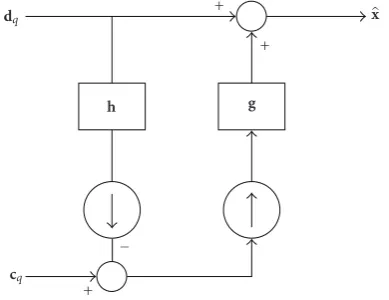
The corresponding reconstruction structure is shown in Figure 4. It is easy to see that the above dual frame based re-construction is identical to the standard rere-construction when the LP coefficients (bothcanddol) are not quantized.
The dual-frame-based reconstruction has the limitation that the decimation and the interpolation filters need to be at least biorthogonal. These filters, however, can lead to dis-cernible and annoying aliasing in the coarse resolution signal. The authors in [11] try to alleviate this problem by proposing an update step at the encoder as shown inFigure 5(a). The
x
+ +
g h
dq
cq
+
−
Figure4: Frame-based reconstruction structure for LP.
detail signaldolundergoes a low-pass filtering and downsam-pling and this update signal is added to the coarse resolution signalcas follows:
cu:=c+Fdol, (11)
whereF denotes the update filter matrix. The update filter matrix has a similar structure as that of the decimation fil-ter matrix except that the filfil-ter coefficientsh(n) are replaced by the update filter coefficients f(n). The corresponding de-coder, shown in Figure 5(b), has the same structure as the frame-based reconstruction inFigure 4except that the dec-imation filterhis replaced by the update filterf. Thus, the reconstructed signal is given as
xu:=Gcuq−Fdq +dq=Gcuq+IN−GF dq, (12)
wherecuqdenotes the quantized updated coarse signal. Obviously, when the decimation and the update filters are identical, this reconstruction structure is the same as the dual frame-based reconstruction. This lifted pyramid is re-versible for any set of filtersh,g, andf. In the special case, when the decimation and the update filters are identical and the decimation and the interpolation filters are biorthogonal, the update signal is equal to zero, and hence this improved pyramid is identical to the framed pyramid. Note that, like the framed pyramid, this improved pyramid is also open-loop. In the following, we propose some structures for LPs with nonbiorthogonal filters that are motivated from com-pression point of view. As we show below, they can be applied both in open-loop and closed-loop configurations.
4. IMPROVED OPEN-LOOP LP STRUCTURES
Consider first the open-loop configuration. When the up-sampling and the downup-sampling filters are biorthogonal, HG = IK [3]. In this case, the detail signal obtained by
the standard prediction does not contain any low-frequency component. This can be easily seen by downsampling the de-tail signal
Hdol=H
x + dol
−
pol
h g f
c
Qd
Qc
dq
cuq
+ + cu
(a) Encoder
x +
+ g f
dq
cuq
+
−
(b) Decoder Figure5: Lifted-pyramid structure with an update step.
Therefore, the correlation between the coarse resolution sig-nalcand the detail signaldolis equal to zero.
Biorthogonality is a constrained relationship between the downsampling and the upsampling filters: if the two fil-ters are concatenated, the resulting filter is a half-band filter which is symmetric about the frequencyπ/2 [5,12]. A sharp roll-offof the decimation filter will require that the upsam-pling filter has an overshoot close to the frequencyπ/2. This has a negative impact on the compression efficiency of en-hancement layers. Therefore, the filters used in the JSVM are usually nonbiorthogonal. Throughout this paper, we assume nonbiorthogonal downsampling and upsampling filters for the LP as used in the JSVM.
Nonbiorthogonality, however, creates correlation be-tween the low-resolution-coarse signal and the detail signal. This can be seen from the following equation:
Hdol=H
IN−GH x=
IK−HG Hx=
IK−HG c.
(14)
SinceHG =IK, the right-hand side, in general, is nonzero.
The above equation can also be rewritten as
Hdol=
IK−HG c=c−Hpol, (15)
wherepoldenotes the open-loop prediction. This shows that the low frequency component in the detail signal is equal to the difference between the coarse signal and the downsam-pled prediction signal. From compression point of view, this correlation is an undesired feature since it leads to higher bit rate.
4.1. Reduced-coarse signal
From (15), it is evident that the detail signal contains some nonzero low-frequency component. This component can be removed from the coarse signal since it can always be ex-tracted from the detail signal at the receiver. Thus, we can update the coarse signal as
cr:=c−Hdol=c−
IK−HG c=HGc=Hpol, (16)
wherecrdenotes the reduced coarse signal. Thus, the reduced coarse signal is equal to the filtered and downsampled pre-diction signal. We term the new signal as reduced-coarse
sig-nal since the operation of upsampling followed by downsam-pling can only lose information. The energy of the new coarse signal relative to the original coarse signal, however, depends on the signal itself, and can be bounded by the squares of the maximum and the minimum singular values of the operator HG.
The updated coarse signal and the detail signal are quan-tized at the desired bit rate and are transmitted. At the re-ceiver, the decoder can estimate the coarse signal and the original signal at higher resolution as
c:=crq+Hdq,
xc:=Gc+dq=Gcrq+IN+GH dq,
(17)
wherecrqdenotes the quantized reduced coarse signal. Ob-serve that, to reconstruct the lower resolution coarse signal
c, the receiver needs to have received the higher resolution detail signald. Therefore, the above algorithm is not suitable for SVC application. The alternative approach would be to design the decimation and interpolation filters such that the updated coarse signal cr, instead of c, has the desired low-resolution quality. This approach does not require the avail-ability of the detail signal to reconstruct the desired coarse signal, which iscr. However, the filters need to be designed differently from those used in the JSVM. Notice that this method is similar to the open-loop LP structure of Flierl and Vandergheynst [4] with the update filter equal to the down-sampling filter and the addition (subtraction) operation at the encoder (decoder) replaced by the subtraction (addi-tion). They propose to follow the second approach through the appropriate design of the three filters so that the equiva-lent downsampling filter has the desired frequency response. Therefore, in their approach, the low-resolution signal can be reconstructed without the higher-resolution detail signal.
4.2. Reduced-detail signal
detail signal as
dr:=dol−GHdol=
IN −GH dol, (18)
wheredrdenotes the reduced detail signal. From the expres-sion on the right-hand side, we observe that the reduced de-tail signal is nothing but the “dede-tail of the dede-tail,” that is, the detail signal for the LP representation of the original detail signal. We term the new detail as the reduced detail signal, since the removal of the coarse component from the origi-nal detail sigorigi-nal tends to reduce its energy. By substituting the value of the low-frequency component from (15) and the detail signal from (3), we get
dr=x−Gc−GIK−HG c=x−
2IN−GH Gc. (19)
Thus, the updated detail signal can be obtained in one step through an improved prediction which is given as
pr:=2IN−GH Gc=
2IN −GH pol. (20)
The coarse signal and the improved detail signal are quantized at the desired bit rate and are transmitted. At the receiver, the decoder first estimates the prediction and then reconstructs the original signal as
pr:=2IN−GH Gcq,
xd:=pr+drq=2IN−GH Gcq+drq,
(21)
wheredrqdenotes the quantized reduced detail signal. Note that the correlation between the newly obtained detail sig-nal and the coarse sigsig-nal is still nonzero because of the non-biorthogonality. However, it can be shown that the new cor-relation is less than the original corcor-relation. Since the detail signal undergoes quantization after transform coding, and the downsampling and upsampling operations increase the complexity, we do not iterate the above operation further.
The above method has the advantage that it suits the SVC application. We do not require the higher-resolution enhancement layer signal to decode the low-resolution base layer signal without redesigning the JSVM filters. However, the above method still suffers from the problem of the open-loop, that is, the error at the higher resolution depends on the quantization error of the coarse layer. In the following, we present the above two methods in the closed-loop mode. As we will see later, only the second method will lead to the reconstruction error which is independent of the quantiza-tion error of the coarse layer.
5. IMPROVED CLOSED-LOOP LP STRUCTURES
The purpose of the closed-loop prediction in the classical LP structure is to avoid the mismatch between the predictions at the encoder and at the decoder. This is achieved by in-terpolating the quantized or decoded coarse resolution sig-nal as the prediction. Since the predictions at the encoder and the decoder are identical, the reconstruction error is solely dependent on the quantization error of the detail sig-nal. Further, this also implies that the reconstruction error is bounded by the quantization step size of the detail layer. In
the following, we use the same notations as with the open-loop configuration in order to avoid introducing further no-tations, but their meanings should be clear from the consid-ered configuration.
5.1. Reduced-coarse signal
In the closed-loop configuration, the encoder updates the coarse signal based on the quantized detail signal. Thus, the reduced detail signal is obtained as
cr:=c−Hdq. (22)
As in the open-loop configuration, the updated coarse sig-nal is quantized at the desired bit rate and is transmitted. At the receiver, the decoder estimates the coarse signal and the original signal at higher resolution using (17). Observe that, because of the quantized detail signal inside the update loop, the update signal at the encoder and the decoder are identi-cal. This update signal can be expressed as
Hdq=Hdol+qd =
IK−HG c+Hqd, (23)
whereqd represents the quantization noise of the detail sig-nal. Here we have assumed an additive quantization noise model. If the quantization noise is assumed to be highpass, the second term on the right-hand side almost vanishes. Therefore the update signal is almost the same as that in the case of the open-loop configuration. As a consequence, there will not be much difference in the reconstruction error com-pared to that with the open-loop structure.
5.2. Reduced-detail signal
In the closed-loop configuration, the new prediction will be based on the quantized- or decoded-coarse signal. Thus, the new detail signal is obtained as
dr:=x−2IN−GH Gcq. (24)
The improved detail signal is quantized at the desired bit rate and is transmitted. At the receiver, the decoder first com-putes the prediction and then reconstructs the original signal using (21). Because the decoder also uses the decoded-coarse signal for prediction, there is no mismatch between the pre-dictions made at the encoder and the decoder.
In the closed-loop prediction, the quality of the predic-tion depends on the quantizapredic-tion parameter of the coarse signal. If the quantization parameter is high, the detail sig-nal can have larger energy, which implies higher bit rate. The same is true for the proposed closed-loop structures.
6. RECONSTRUCTION ERROR ANALYSIS
Here we will assume that there is no channel noise, or equiv-alently all the channel errors have been successfully corrected by forward error correction schemes. Thus, the reconstruc-tion error at the receiver is solely due to the quantizareconstruc-tion noise. In the following, we analyze the error performance of the two methods in both the open-loop and the closed-loop configurations.
6.1. Open-loop LP structures
As before, we will consider an LP with only one level of de-composition. For the sake of simplicity of analysis, we will assume that the coarse and the detail signals are scalar quan-tized. The quantization step sizes are small enough so that the corresponding quantization noise components can be as-sumed to be zero-mean, white, and uncorrelated. Further, since in the open-loop the coarse signal and the detail signal are quantized independently, their quantization noises can be assumed to be uncorrelated.
6.1.1. LP with standard reconstruction
Letqc andqd denote the quantization noises for the coarse signal and the detail signal, respectively. Assuming the quan-tization noise to be additive, we can write
cq=c+qc, dq=dol+qd. (25)
Because of the afore-mentioned white-noise assumptions,
Eqcqtc =σc2IK, E
qdqtd =σ2
dIN, (26)
whereσ2
c andσd2 denote the variances of the coarse and the
detail signal components, respectively, and E denotes the mathematical expectation. Further, because of the assump-tion of zero cross-correlaassump-tion between the coarse signal and the detail signal,
EGqcqt
d =E
qdqt
cGt =0N×N. (27)
Referring to (7) and (3), the reconstruction error can be expressed as
es:=xs−x=Gcq+dq −Gc+dol =Gqc+qd. (28)
Thus, the mean square error with the standard reconstruc-tion is given as:
MSEs:= 1
NEes 2 = 1 NE et ses = 1 NE
Gqc+qd tGqc+qd
= 1
Nσ 2 ctr
GtG +σ2 d,
(29)
where the last expression follows from the assumptions stated above. Here tr(·) denotes the trace of the matrix. We see that the reconstruction error is a function of the quan-tization error of both the coarse signal and the detail signal. Therefore, in a multiple-level LP, the reconstruction error at
any level contributes to the reconstruction error at all higher-resolution levels. Observe that the reconstruction error is also a function of the upsampling filter matrixG. In practice, the quantization noise of the coarse signal is dependent on the coarse signal itself, and therefore, the reconstruction error is also an indirect function of the downsampling filter ma-trixH.
6.1.2. LP with frame reconstruction
Letqcudenote the quantization noise of the updated coarse signal. Therefore, we can writecuq =cu+qcu. Referring to (12) for the frame reconstruction with an update, and using (3) and (11), the reconstruction error can be expressed as
eu:=xu −x=Gqcu+IN−GF qd. (30)
Let us assume thatqcuhas similar statistical properties as that ofqc, that is, its components are white and uncorrelated with
varianceσ2
cu, and they are uncorrelated with the components
ofqd. Using similar steps as for the standard reconstruction, the mean square error expression can be obtained as
MSEu:= 1
NEeu 2 = 1 Nσ 2 cutr
GtG
+ 1 Nσ
2 dtr
IN−GF t
IN−GF
.
(31)
In the special case when f(n)=h(n),F=H, and therefore
MSEu=
1 Nσ
2 cutr
GtG + 1
Nσ 2 dtr
IN−GH t
IN−GH
. (32)
If the upsampling filterg(n) and the update filter f(n) turn out to be biorthogonal, FG = IK. In that case, the mean
square error can be simplified as
MSEu= 1
Nσ 2 cutr
GtG +σ2 d
1−K
N = 1 Nσ 2 cutr
GtG +σd2
2, (∵K=N/2).
(33)
6.1.3. Reduced-coarse signal
We will assume that the quantization noise of the reduced-coarse signal has similar statistical properties as of the orig-inal coarse signal. Even though the update signal depends on the detail signal, for simplicity we will assume that the quantization noise of the reduced coarse and the detail sig-nals are uncorrelated. Letqcr denote the quantization noise of the reduced-coarse signal. Therefore,crq =cr+qcr. Re-ferring to (17), (3), and (16), the reconstruction error can be expressed as
ec:=xc−x=Gqcr+IN+GH qd. (34)
Thus, the mean square error can be derived as
MSEc:= 1
NEec 2 = 1 Nσ 2 crtr
GtG
+ 1 Nσ
2 dtr
IN+GH t
IN+GH
, (35)
whereσ2
6.1.4. Reduced-detail signal
We will assume that the quantization noise of the reduced-detail signal has similar statistical properties as of the original detail signal. Further, the quantization noises of the coarse and the detail signals can be assumed to be uncorrelated. Let
qdrdenote the quantization noise of the reduced detail signal. Therefore,drq = dr +qdr. Referring to (21) and (19), the reconstruction error can be expressed as
ed:=xd−x=2IN−GH Gqc+qdr. (36)
Thus, the mean square error can be derived as
MSEd:=
1 NEed
2
= 1
Nσ 2 ctr
Gt2I
N−GH t
2IN−GH G +σdr2,
(37)
whereσ2
drdenotes the variance of the quantization noiseqdr.
We observe that, for both structures, the reconstruction error at any level of LP is dependent on the reconstruction errors on the lower resolution layers.
6.2. Closed-loop LP structures
Letqc andqd denote the quantization noises for the coarse signal and the detail signal, respectively. Assuming the quan-tization noise to be additive, we can write
cq=c+qc, dq=dcl+qd. (38)
We use the same notations for the errors and mean square errors as in the open-loop configurations in order to avoid introducing further symbols. We will further assume that the quantization noises have similar statistical properties as in the case of open-loop configurations.
6.2.1. LP with standard reconstruction
Referring to (7) for standard reconstruction, and using (6) and (38), the reconstruction error can be expressed as
es:=xs−x=Gcq+dq −Gcq+dcl =qd. (39)
Thus, the mean square error with the standard reconstruc-tion can be computed as follows:
MSEs:=
1 NEes
2
=σd2. (40)
We see that the reconstruction error is equal to the quantiza-tion error of the detail signal. This is true even if we have an LP with multiple layers.
6.2.2. Reduced coarse signal
Referring to (17), (3), and (22), the reconstruction error can be expressed as
ec:=xc−x=Gqcr+qd. (41)
The mean square error thus can be derived as
MSEc:= 1
NEec 2
= 1
Nσ 2 crtr
GtG +σ2
d. (42)
We see that the mean square error has a similar form to that of the standard reconstruction in the open-loop struc-ture. Since the aim of updating is to reduce the energy, the encoding of the updated signal would have better rate-distortion performance. This would imply effectively bet-ter rate-distortion performance for the original signal at the higher resolution. It is evident that, like the open-loop struc-tures, the error is dependent on the quantization noise of the lower-base layer.
6.2.3. Reduced-detail signal
Referring to (21) and (24), the reconstruction error can be expressed as
ed:=xd −x=qdr. (43)
The error thus depends only on the quantization noise of the reduced detail layer. The mean square error can be derived as
MSEd:=
1 NEed
2
=σ2
dr. (44)
The aim of the improved prediction is to reduce the en-ergy of the detail signal. Following the results in information theory [13], this would result in a better rate-distortion per-formance for the encoding of the enhancement layer. This implies that, for a given bit rate, the improved prediction would result in less distortion. Comparing (40) and (44), this would mean thatσdr2 < σd2.
7. TRANSFORM CODING OF ENHANCEMENT LAYER
In practice, the detail signal undergoes an orthogonal form before being quantized and entropy coded. The trans-form aims to remove the spatial correlation in the detail sig-nal coefficients and to compact its energy in fewer number of coefficients. The current SVC standard, for this purpose, uses a 4×4 integer transform, which is an approximation of the discrete cosine transform (DCT) applied over a block size of 4×4. The DCT, however, may not be the optimal trans-form since the detail signal contains more high frequency components. A closer look at (3) reveals that the detail sig-nal has certain inherent structure. Most of its energy is con-centrated along certain directions which are decided by the downsampling and the upsampling filters. These directions can be found out by the singular value decomposition [14] ofIN−GHas follows:
IN−GH≡UΣVt, (45)
Video
Bitstream
Multiplex
2D spatial decimation
Temporal
decomposition Texture
Intraprediction for intrablock
Transform/ entr. coding (SNR scalable) Motion
Motion coding
2D spatial interpolation
Improved spatial prediction
Core encoder
Motion Decodedframes Temporal
decomposition Texture
Intraprediction for intrablock
Transform/ entr. coding (SNR scalable) Motion
Motion coding
2D spatial interpolation Core encoder
Motion Decodedframes Temporal
decomposition Texture
Intraprediction for intrablock
Transform/ entr. coding (SNR scalable) Motion
Motion coding Core encoder
Figure6: Improved scalable encoder using a multiscale pyramid with 3 levels of spatial scalability [1]. The proposed algorithm is embedded in the “improved spatial prediction” module for the spatial intraprediction of the SD layer from the CIF layer for I and P frames.
of the LP. We refer to these matrices as the U-transform and the V-transform, respectively. The 4×4 integer transform applied in the JSVM is referred to as the DCT hereafter.
Under the closed-loop configuration, the above structure is somewhat weakened. The introduction of the quantiza-tion noise in the predicquantiza-tion loop destroys the redundancy structure of the LP. Nevertheless, the above matrices are or-thogonal and can always be applied to the original detail or the newly-obtained detail signal. The decoder can use the transpose of these matrices for the inverse transformation. Experimental results presented in [15] showed that the V-transform had a slightly better R-D performance than the U-transform. Therefore, for the actual implementation with JSVM, we consider only the V-transform.
8. IMPLEMENTATION WITH JSVM
Figure 6 depicts the structure of the improved JSVM en-coder with the proposed spatial prediction module. The
orig-inal JSVM encoder is described in [1]. The encoder sup-ports quality, temporal, and spatial scalabilities. A quality base layer residual provides minimum reconstruction qual-ity at each spatial layer. This qualqual-ity base layer can be en-coded into an AVC compliant stream if no interayer predic-tion is applied. Quality enhancement layers are addipredic-tionally encoded and can be chosen to either provide coarse or fine grain quality (SNR) scalability. To achieve temporal scalabil-ity, hierarchical B pictures are employed. The concept of hi-erarchical B pictures provides a fully predictive structure that is already provided with AVC. Alternatively, motion compen-sated temporal filtering (MCTF) can be used as a nonnorma-tive encoder configuration for temporal scalability.
Table1: Average number of MBs for mode selection over 8 intraframes for CITY SD at different QPs.
QP
Spatial intra d d
QCIF/CIF SD DCT V-trans. DCT V-trans.
18,18
30 21.25 189.875 76.125 739.125 557.625
36 13.625 182.125 18.25 988.75 381.25
42 2.125 179.625 2.75 1289.875 109.625
48 0 176.375 0.625 1370.125 36.875
24,24
30 33.125 465.875 164.75 578.375 341.875
36 16 384.5 67.5 763 353
42 2 383 7.75 1075.375 115.875
48 0 384.375 0.25 1161.75 37.625
of an AVC encoder. The spatial resolution hierarchy is highly redundant. As shown inFigure 6, the redundancy between adjacent spatial layers is exploited by different interlayer pre-diction mechanisms for motion parameters as well as for tex-ture data. For the textex-ture data, the prediction mechanism amounts to computing a difference signal between the orig-inal higher-resolution signal and the interpolated version of the coded and decoded signal at the lower-spatial resolution. In our implementation, we aim to improve the coding performance by exploiting the redundancy of the Laplacian pyramid structure adopted for spatial scalability. To that end, we modify only the interlayer texture prediction module keeping the other modules same as in the original JSVM. Fur-thermore, the original downsampling and upsampling filters are maintained. This means that the improved prediction in (21) is obtained with the existing JSVM filtersHandG. The Fidelity Range Extension (FRExt) of SVC supports the high profiles and adds more coding efficiency without a significant amount of implementation complexity. The new features in FRExt include an adaptive transform block-size and percep-tual quantization scaling matrices. Our proposed method also applies to FRExt, as will be discussed later. Through theoretical analysis, improved interlayer motion and resid-ual prediction can also be achieved, and this remains a future work.
As we have mentioned earlier, in the current JSVM soft-ware, the interlayer prediction is implemented in the closed-loop mode. For each macroblock (MB), the selection of prediction modes (interlayer, spatial-intra, temporal, etc.) is based on a rate-distortion optimization (RDO) procedure. However, the closed-loop structure does not guarantee an improved rate-distortion performance either with the mod-ified prediction or with the V-transform; the performance can vary depending on the local signal statistics. Thus, to apply the proposed method in SVC, we propose three ad-ditional MB modes employing the improved prediction and the V-transform besides the existing interlayer prediction mode. The three proposed MB modes are (i) existing inter-layer prediction followed by V-transform (d+ V-transform), (ii) improved prediction followed by DCT (d + DCT), (iii) improved prediction followed by V-transform (d+ V-transform). We refer to the existing mode, interlayer
predic-tion followed by DCT, as “d+ DCT.” The three proposed modes are applied for encoding the SD layer by prediction from the CIF layer.
The mode selection statistics over several frames are shown in Table 1 for intraframes. These statistics are ob-tained by including all the modes in the original JSVM soft-ware together with the three proposed modes and running over 8 intraframes of the CITY video sequences. The im-proved prediction and the V-transform are applied only to the SD layer while the QCIF and CIF layers are encoded us-ing the existus-ing modes. The table shows the number of mac-roblocks undergoing different modes for different QP values of QCIF, CIF, and SD layers. Note that the size of a mac-roblock is 16×16 and the total number of macroblocks in an SD image (with the resolution of 704×576) is equal to 1584. Thus, inTable 1, the entries (number of macroblocks) in each row add up to 1584.
From Table 1, first we observe that majority of mac-roblocks choose the improved prediction irrespective of the transform method followed, and especially at high QP values of SD. This demonstrates that the proposed interlayer predic-tion successfully reduces the redundancy and energy in the detail signal.
Second, the number of blocks following the V-transform is significant at low QPs of SD. However, the number of blocks selecting the V-transform is always less than that of blocks selecting the DCT. One reason is that the rate-distortion in the current implementation is optimized w.r.t. DCT. The rate-distortion optimization in mode selection plays an important role to the overall coding performance. In general video encoders, the mode that minimizes the cod-ing cost, which is defined as
f ≡R+λD, (46)
will be selected. HereRis the bitrate for coding the MB mode syntax as well as the residual data andDis the corresponding distortion. The optimal Lagrange multiplierλshould be se-lected such that line f is tangent with the R-D curve, and is defined as
Table2: Definition of macroblock modes for I and P frames in JSVM and proposed encoding scheme.
For I frames:
JSVM Spatial-intra Intra 4×4, Intra 8×8
Interlayer texture (d+ DCT) 4×4, (d+ DCT) 8×8
Proposed Interlayer texture
(d+ DCT) 4×4, (d+ DCT) 8×8 (d+ V-trans) 4×4, (d+ V-trans) 8×8 (d+ DCT) 4×4, (d+ DCT) 8×8 (d+ V-trans) 4×4, (d+ V-trans) 8×8
For P frames:
JSVM
Spatial-intra Intra 4×4, Intra 8×8
Temporal Skip, Inter 16×16, Inter 16×8,
Inter 8×16, Inter 8×8
Interlayer texture (d+ DCT) 4×4, (d+ DCT) 8×8 Interlayer MV/resi. IntraBLSkip, Inter 4, Inter 8, Inter 16
Proposed
Temporal Skip, Inter 16×16, Inter 16×8,
Inter 8×16, Inter 8×8
Interlayer texture
(d+ DCT) 4×4, (d+ DCT) 8×8 (d+ V-trans) 4×4, (d+ V-trans) 8×8 (d+ DCT) 4×4, (d+ DCT) 8×8 (d+ V-trans) 4×4, (d+ V-trans) 8×8
Interlayer MV/resi. IntraBLSkip, Inter 4, Inter 8, Inter 16
empirically in the current JSVM implementation. However, thisλis defined according to the DCT of the data to be en-coded, and does not optimize the R-D performance of the V-transform. Still we notice that the number of MBs select-ing the V-transform is significant with lower QPs of the SD layer. The improvement of applying the V-transform in our proposed method remains a future work.
Overall, the proposed modes seem to be the chosen ones, especially for low QP values of CIF and QCIF layers, that is, better base layer qualities. It is also clear that the number of MBs selecting the spatial intra mode is much smaller than the number of MBs selecting the interlayer prediction modes. Thus, we propose to suppress the spatial intra mode and include the other three interlayer prediction modes. More specifically, the MB modes used in original JSVM and the proposed encoding scheme for I and P frames are defined as inTable 2. Note that all the 8×8 modes are valid only when FRExt is enabled.
Note that the V-transform is always applied over mac-roblocks of size 16×16 for the luma component and of size 8×8 for the chroma components. Over a macroblock of size 16×16 (luma) or 8×8 (chroma), the order of complexity is about the same as that of the existing 4×4 transform ex-cept that the operations use floating-point numbers. In the proposed modes adopting the V-transform, that is,d+ V-transform 4×4,d+V-transform 8×8,d+V-transform 4×4,
d+ V-transform 8×8, the suffix (4×4 or 8×8) refers to the block sizes for zigzag scanning of the transform coefficients.
Accordingly, the syntax for coding MB modes is also modified. Two extra flagsBLDetailFlagandBLTransformFlag are needed in the syntax for signaling the additional MB modes.BLDetailFlagdefines whether the original spatial pre-diction or the improved prepre-diction is selected, and BLTrans-formFlag selects between DCT and V-transform. These two flags are encoded using the context adaptive binary arith-metic coding (CABAC). Note that, since the spatial in-tramode, which includes several submodes, is disabled, the number of syntax bits of our proposed encoder remains sim-ilar to that of the original JSVM.
The zigzag scanning, quantization, and entropy coding methods of the transformed coefficients remain unchanged, that is, those techniques as adopted in JSVM are also applied to the transformed coefficients of the MBs selecting the pro-posed modes. However, the quantizer in JSVM is designed to be used in conjunction with the integer DCT transform, and a multiplication factor MF is incorporated in the quantiza-tion. To quantize the coefficients obtained by V-transform directly, this multiplication factor is removed.
9. EXPERIMENTAL RESULTS AND ANALYSIS
29 30 31 32 33 34 35 36 37
PSNR
(dB)
8 9 10 11 12 13 14 15
×103 Bitrate (kbps)
JSVM-18 Proposed-18
City SD, over 64 intraframes, QP=18 for QCIF/CIF, luminance
(a) CITY, QP=18
31 32 33 34 35 36 37 38
PSNR
(dB)
10 10.5 11 11.5 12 12.5 13 13.5 14
×103 Bitrate (kbps)
JSVM-18 Proposed-18
Harbour SD, over 64 intraframes, QP=18 for QCIF/CIF, luminance
(b) HARBOUR, QP=18
27 28 29 30 31 32 33 34 35 36 37
PSNR
(dB)
4 5 6 7 8 9 10 11 12
×103 Bitrate (kbps)
JSVM-24 Proposed-24
City SD, over 64 intraframes, QP=24 for QCIF/CIF, luminance
(c) CITY, QP=24
30 31 32 33 34 35 36 37
PSNR
(dB)
6 6.5 7 7.5 8 8.5 9 9.5 10 10.5 11
×103 Bitrate (kbps)
JSVM-24 Proposed-24
Harbour SD, over 64 intraframes, QP=24 for QCIF/CIF, luminance
(d) HARBOUR, QP=24
27 28 29 30 31 32 33 34 35 36
PSNR
(dB)
2 3 4 5 6 7 8 9 10 11
×103 Bitrate (kbps)
JSVM-30 Proposed-30
City SD, over 64 intraframes, QP=30 for QCIF/CIF, luminance
(e) CITY, QP=30
29 30 31 32 33 34 35 36 37
PSNR
(dB)
3 4 5 6 7 8 9 10
×103 Bitrate (kbps)
JSVM-30 Proposed-30
Harbour SD, over 64 intraframes, QP=30 for QCIF/CIF, luminance
(f) HARBOUR, QP=30
27 28 29 30 31 32 33 34 35 36
PSNR
(dB)
4 4.5 5 5.5 6 6.5
×103 Bitrate (kbps)
JSVM-18 Proposed-18
City SD, over 64 IP frames, QP=18 for QCIF/CIF, luminance
(a) CITY, QP=18
28 29 30 31 32 33 34 35 36 37
PSNR
(dB)
6 7 8 9 10 11 12 13 14 15
×103 Bitrate (kbps)
JSVM-18 Proposed-18
Harbour SD, over 64 IP frames, QP=18 for QCIF/CIF, luminance
(b) HARBOUR, QP=18
27 28 29 30 31 32 33 34 35 36
PSNR
(dB)
1.5 2 2.5 3 3.5 4 4.5
×103 Bitrate (kbps)
JSVM-24 Proposed-24
City SD, over 64 IP frames, QP=24 for QCIF/CIF, luminance
(c) CITY, QP=24
28 29 30 31 32 33 34 35 36
PSNR
(dB)
3 3.5 4 4.5 5 5.5 6 6.5
×103 Bitrate (kbps)
JSVM-24 Proposed-24
Harbour SD, over 64 IP frames, QP=24 for QCIF/CIF, luminance
(d) HARBOUR, QP=24
27 28 29 30 31 32 33 34 35 36
PSNR
(dB)
0.5 1 1.5 2 2.5 3 3.5
×103 Bitrate (kbps)
JSVM-30 Proposed-30
City SD, over 64 IP frames, QP=30 for QCIF/CIF, luminance
(e) CITY, QP=30
28 29 30 31 32 33 34 35 36
PSNR
(dB)
1 1.5 2 2.5 3 3.5 4 4.5 5 5.5 6
×103 Bitrate (kbps)
JSVM-30 Proposed-30
Harbour SD, over 64 IP frames, QP=30 for QCIF/CIF, luminance
(f) HARBOUR, QP=30
results of the SD layer are presented. Since FGS layers are not involved in our experiments, we set both QPs for QCIF/CIF to 18, 24, and 30, which approximately correspond to the base-layer quality with the initial QP 36, 42, and 48 plus three FGS layers. First we test the proposed method using 64 in-traframes. Then we test the proposed method using the GOP structure defined asGOPSize=1andIntraPeriod=8, which means one I frame followed by 7 P frames for every 8 frames. Other parameters in the configuration files are listed as fol-lows: FRExt: offfor QCIF layer, on for CIF/SD layers; Loop Filter: on; Update Step: 0; Adaptive QP: 1; Inter Layer Pred: 0 for QCIF layer, 2 for CIF/SD layers; Number of FGS layers: 0. Results for all Intraframes are shown inFigure 7, and the results with P frames are shown inFigure 8. We observe that the proposed improved prediction works well for small QP values for CIF/QCIF layers. As the QP is increased, the pre-diction becomes less efficient. With QP equal to 18, PSNR gain up to 1 dB can be achieved with all intraframes and a gain up to 0.7 dB gain can be achieved with Intra and inter P frames (with HARBOUR sequence).
We must note here that, for all the simulations, we did not modify the entropy coding that follows the transform (DCT or V-transform). In the current JSVM software, it is implemented as context adaptive variable length coding (CAVLC). The current zigzag scan and the coding scheme are optimized for the DCT; therefore, we expect better re-sults if the scanning and encoding of the V-transformed co-efficients are modified so as to suit the characteristic of the V-transform. This is a subject of research and we will not pursue it in this paper.
10. CONCLUSIONS
In this paper, we have proposed two improved Laplacian pyramid structures for scalable video coding. The proposed structures exploited the inherent redundancy of the underly-ing Laplacian pyramid with nonbiorthogonal filters by ren-dering the enhancement-layer signal less correlated with the base-layer. The first structure updated the base-layer sig-nal by subtracting from it the low-frequency component of the enhancement-layer signal. The second structure modi-fied the prediction with a view to reducing the low-frequency component in the enhancement layer. The corresponding de-coder structures were accordingly modified in order to re-construct the signal at both resolution levels. The simplic-ity of the structures is reflected by the fact that they did not require to modify the current upsampling filter, nor did they require to design additional filters. Moreover, the struc-tures could be implemented both in the open-loop and in the closed-loop configurations.
We studied the distortion performances of both struc-tures in the open-loop and in the closed-loop configurations. Open-loop structures used unquantized continuous-valued update signals whereas the closed-loop signals used the de-coded quantized signals for the purpose. It was demonstrated that only the second structure (with reduced enhancement layer) in the closed-loop configuration leads to a reconstruc-tion error that is dependent on the quantizareconstruc-tion error of the
enhancement layer, but not on the reconstruction error of the lower-resolution layers. Out of the two structures, it was also the only structure that was compatible with the current JSVM architecture.
Along with a recently proposed transform for the en-hancement layer, the proposed structure was integrated with JSVM in the SD layer. Based on the experimental results, the macroblock modes in I and P frames were redesigned. Results with test sequences demonstrated that the proposed scheme achieves better R-D performance compared to the original prediction modes. The performance improvement was significant in the case of low-base layer QP suggesting potential application of the proposed method in high-quality scalable video coding.
For the present JSVM integration, there are still some open issues such as the optimization of the VLC for the V-transform, the choice of theλparameter in rate-distortion optimized mode selection, the optimization of the FGS, and so forth. Further research results along these directions can provide us the complete picture on the true coding performance of the proposed method. Experimental results demonstrate that interlayer prediction is the dominant mode in I frames, and the stationary regions in P and B frames. Thus, the proposed method could have a significant impact on the overall coding performance of still sequences or se-quences having low-motion level.
REFERENCES
[1] JVT, “Joint scalable video model JSVM-4,” in Joint Video Team (JVT) of ISO/IEC MPEG & ITU-T VCEG (ISO/IEC JTC1/SC29/WG11 and ITU-T SG16 Q.6), Nice, France, Octo-ber 2005.
[2] P. J. Burt and E. H. Adelson, “The Lapacian pyramid as a compact image code,”IEEE Transactions on Communications, vol. 31, no. 4, pp. 532–540, 1983.
[3] M. N. Do and M. Vetterli, “Framing pyramids,”IEEE Transac-tions on Signal Processing, vol. 51, no. 9, pp. 2329–2342, 2003. [4] M. Flierl and P. Vandergheynst, “An improved pyramid for
spatially scalable video coding,” inProceedings of IEEE Inter-national Conference on Image Processing (ICIP ’05), vol. 2, pp. 878–881, Genova, Italy, September 2005.
[5] D. Santa-Cruz, J. Reichel, and F. Ziliani, “Opening the Lapla-cian pyramid for video coding,” inProceedings of IEEE Inter-national Conference on Image Processing (ICIP ’05), vol. 3, pp. 672–675, Genova, Italy, September 2005.
[6] A. Segall, “Study of upsampling/down-sampling for spatial scalability,” inJoint Video Team (JVT) of ISO/IEC MPEG & ITU-T VCEG (ISO/IEC JTC1/SC29/WG11 and ITU-T SG16 Q.6), Nice, France, October 2005.
[7] A. Segall, “Upsampling and down-sampling for spatial scala-bility,” inJoint Video Team (JVT) of ISO/IEC MPEG & ITU-T VCEG (ISO/IEC JITU-TC1/SC29/WG11 and IITU-TU-ITU-T SG16 Q.6), Bangkok, Thailand, January 2006.
[9] V. K. Goyal, J. Kovaˇcevi´c, and J. A. Kelner, “Quantized frame expansions with erasures,” Applied and Computational Har-monic Analysis, vol. 10, no. 3, pp. 203–233, 2001.
[10] I. Daubechies,Ten Lectures on Wavelets, SIAM, Philadelphia, Pa, USA, 1992.
[11] M. Flierl and P. Vandergheynst, “Inter-resolution transform for spatially scalable video coding,” inProceedings of Picture Coding Symposium (PCS ’04), pp. 243–247, San Francisco, Calif, USA, December 2004.
[12] P. P. Vaidyanathan, Multirate Systems and Filter Banks, Prentice-Hall, Englewood Cliffs, NJ, USA, 1993.
[13] T. M. Cover and J. A. Thomas,Elements of Information Theory, Wiley-Interscience, New York, NY, USA, 1991.
[14] G. Strang, Linear Algebra and Its Applications, Brooks Cole Publishers, Florence, Ky, USA, 3rd edition, 1988.
[15] G. Rath and C. Guillemot, “Compressing the Laplacian pyra-mid,” in Proceedings of the 8th IEEE Workshop on Multime-dia Signal Processing (MMSP ’06), pp. 75–79, Victoria, BC, Canada, October 2006.
Wenxian Yangreceived the B.Eng. degree from Zhejiang University, Hangzhou, China, in 2001 and the Ph.D. degree in Computer Engineering from Nanyang Technological University, Singapore, in 2006. In 2004, she was with Microsoft Re-search Asia, Beijing, China for internship. From 2005 to 2006, she was a Postdoctoral Researcher in the French National Institute for Research in Computer Science and
Control (INRIA-IRISA), France. She is now a Postdoctoral Fellow in The Chinese University of Hong Kong. Her research interests include video compression, 3D video compression and processing.
Gagan Rathreceived the B.Tech. degree in electronics and electrical communication engineering from the Indian Institute of Technology at Kharagpur in 1990 and the M.E. and Ph.D. degrees in electrical com-munication engineering from the Indian Institute of Science in Bangalore in 1993 and 1999. He is currently a Research Scien-tist at INRIA in France. His research inter-ests include signal processing for
communi-cations, distributed video coding, scalable video coding, and joint source and channel coding.
Christine Guillemotis currently Directeur de Recherche at INRIA, in charge of the TEMICS research group dealing with im-age modelling, processing, video commu-nication, and watermarking. She holds the Ph.D. degree from Ecole Nationale Su-perieure des Telecommunications (ENST) Paris. From 1985 to October 1997, she has been with FRANCE TELECOM/CNET, where she has been involved in various
projects in the domain of coding for TV, HDTV and multi-media applications, and coordinated a few (e.g., the European RACE-HAMLET project). From January 1990 to mid 1991, she has worked at Bellcore, NJ, USA, as a visiting scientist. Her re-search interests are signal and image processing, video coding,
![Figure 6: Improved scalable encoder using a multiscale pyramid with 3 levels of spatial scalability [1]](https://thumb-us.123doks.com/thumbv2/123dok_us/1158021.1145638/9.600.74.521.76.471/figure-improved-scalable-encoder-multiscale-pyramid-spatial-scalability.webp)
