1
When to update systematic reviews and
how to do it: consensus and checklist
Paul Garner*, Sally Hopewell, Jackie Chandler, Harriet MacLehose, Holger J. Schünemann, for the Panel for Updating Guidance for Systematic reviews (PUGs) (Elie A. Akl, Joseph Beyene, Jackie Chandler, Stephanie Chang, Rachel Churchill, Karin Dearness, Paul Garner, Gordon Guyatt, Sally Hopewell, Carol Lefebvre, Beth Liles, Harriet MacLehose, Rachel Marshall, Laura Martínez García, Chris Mavergames, Mona Nasser, Amir Qaseem, Margaret Sampson, Holger J. Schünemann, Karla Soares-Weiser, Yemisi Takwoingi, Lehana Thabane, Marialena Trivella, Peter Tugwell, Emma Welsh, Ed C. Wilson)
*Corresponding author and guarantor: Paul Garner
Address: Cochrane Infectious Diseases Group, Department of Clinical Sciences, Liverpool School of Tropical Medicine, Pembroke Place, L3 5QA
Email address: [email protected] Tel: +441517053201
30 November 2015 Revised 24 May 2016
The Corresponding Author has the right to grant on behalf of all authors and does grant on behalf of all authors, an exclusive licence (or non-exclusive for government employees) on a worldwide basis to the BMJ Publishing Group Ltd to permit this article (if accepted) to be published in BMJ editions and any other BMJPGL products and sublicences such use and exploit all subsidiary rights, as set out in our licence.
Co-authors’ details
Jackie Chandler, Cochrane Editorial Unit, Cochrane Central Executive, London, UK. [email protected]
Sally Hopewell, Centre for Statistics in Medicine, University of Oxford, Oxford, UK; Cochrane Methodology Review Group, Belfast, UK. [email protected]
Harriet MacLehose, Cochrane Editorial Unit, Cochrane Central Executive, London, UK. [email protected]
Holger J. Schünemann, Department of Clinical Epidemiology & Biostatistics, and Department of Medicine, McMaster University, Hamilton, ON, Canada; Cochrane GRADEing Methods Group, Ottawa, ON, Canada. [email protected]
Elie A. Akl, Department of Internal Medicine, American University of Beirut, Beirut, Lebanon; Cochrane GRADEing Methods Group, Ottawa, ON, Canada. [email protected]
Joseph Beyene, Department of Mathematics & Statistics, McMaster University, Hamilton, Canada. [email protected]
Stephanie Chang, Agency for Healthcare Research and Quality, Rockville, MD, USA. [email protected]
Rachel Churchill, Centre for Reviews and Dissemination, University of York, UK; Cochrane Common Mental Disorders Group, York, UK. [email protected]
2 Gordon Guyatt, Department of Clinical Epidemiology & Biostatistics, McMaster University, Hamilton, ON, Canada. [email protected]
Carol Lefebvre, Independent Information Consultant, Lefebvre Associates Ltd, Oxford, UK; Cochrane Information Retrieval Methods Group, Oxford, UK. [email protected]
Beth Liles, Kaiser Permanente National Guideline Program, Portland, OR, USA. [email protected]
Rachel Marshall, Cochrane Editorial Unit, Cochrane Central Executive, London, UK. [email protected]
Laura Martínez García, Iberoamerican Cochrane Centre, Barcelona, Spain. [email protected]
Chris Mavergames, Cochrane Informatics and Knowledge Management, Cochrane Central Executive, Freiburg, Germany. [email protected]
Mona Nasser, Plymouth University Peninsula School of Dentistry, Plymouth, UK; Cochrane Priority Setting Methods Group, Plymouth, UK. [email protected]
Amir Qaseem, Department of Clinical Policy, American College of Physicians, Philadelphia, PA, USA; Guidelines International Network (G-I-N), Pitlochry, UK. [email protected]
Margaret Sampson, Library Services, Children's Hospital of Eastern Ontario, Ottawa, ON, Canada. [email protected]
Karla Soares-Weiser, Cochrane Editorial Unit, Cochrane Central Executive, London, UK. [email protected]
Yemisi Takwoingi, Institute of Applied Health Research, University of Birmingham, Birmingham, UK; Cochrane Screening and Diagnostic Tests Methods Group, Birmingham, UK.
Lehana Thabane, Biostatistics Unit, Centre for Evaluation, McMaster University, Hamilton, ON, CAN; McMaster University, Department of Clinical Epidemiology & Biostatistics, Hamilton, ON, Canada. [email protected]
Marialena Trivella, Centre for Statistics in Medicine, University of Oxford, Oxford, UK; Cochrane Anaesthesia, Critical and Emergency Care Group, London, UK. [email protected] Peter Tugwell, Departments of Medicine, and Epidemiology and Community Medicine, University of Ottawa, Ottawa, ON, CAN; Cochrane Musculoskeletal Group, Ottawa, Canada.
Emma Welsh, Cochrane Airways Group, Population Health Research Institute, St George’s, University of London, London, UK. [email protected]
Ed C. Wilson, Cochrane Priority Setting Methods and Campbell & Cochrane Economic Methods Groups, Cambridge, UK; Cambridge Centre for Health Services Research, University of Cambridge, Cambridge, UK. [email protected]
Keywords (up to 5): systematic review, Cochrane, updating methods
3
SUMMARY
Updating systematic reviews is, in general, more efficient than starting afresh when new evidence emerges. The Panel for Updating Guidance for Systematic reviews (PUGs), comprising review authors, editors, statisticians, information specialists, related methodologists, and guideline
developers, met to develop guidance for people considering updating systematic reviews. The Panel proposed the following:
1. Decisions about whether and when to update a systematic review are judgements made for individual reviews at a point in time. This can be made by agencies responsible for
systematic review portfolios, journal editors with systematic review update services, or author teams considering embarking on an update of a review.
2. The decision needs to take into account whether the review addresses a current question, uses valid methods and is well conducted; whether there are new relevant methods, new studies, or new information on existing included studies. Given this information, the agency, editors or authors need to judge whether the update will influence the review findings or credibility sufficiently to justify the effort in updating it.
3. The Panel proposed a decision framework to navigate and report these decisions, and noted that incorporating new synthesis methods such as GRADE is often likely, in addition, to improve the quality of the analysis and the clarity of the findings.
4. Given a decision to update, the process needs to start with an appraisal and revision of the background, question, inclusion criteria, and methods of the existing review.
5. Search strategies should be refined, taking into account changes in the question or inclusion criteria. An analysis of yield from the previous edition, in relation to databases searched, terms, and languages can make searches more specific and efficient.
6. In many instances an ‘Update’ represents a new edition of the review, and authorship of the new version needs to follow ICMJE criteria; new approaches to publishing licences could help new authors build on and re-use the previous edition while giving appropriate credit to the previous authors.
The Panel also considered this guidance in the context of emerging technological advances in software, information retrieval, and electronic linkage and mining. With good synthesis and
technology partnerships, these advances could revolutionise the efficiency of updating in the coming years.
INTRODUCTION
Systematic reviews synthesize relevant research around a particular question. Preparing a systematic review is time- and resource-consuming, and provides a snapshot of knowledge at the time of incorporation of data from studies identified during the latest search. Newly identified studies can change the conclusion of a review. If they have not been included, this threatens the validity of the review, and, at worst, means the review may mislead. For patients and other healthcare consumers, this means care and policy development may not be fully informed by the latest research; and for researchers, they may be misled and carry out research in areas where no further research is actually needed.1 Thus there are clear benefits to updating reviews, rather than duplicating the entire process as new evidence emerges or new methods develop. Indeed, there is probably added value to updating a review, as this will include taking into account comments and criticisms, and adoption of new methods in an iterative process.2-56
4 to date has not been possible, and the organization has had to adapt: updating when new evidence becomes available,7 to updating every two years,8 to updating based on need and priority9. This experience has shown that it is not possible, sensible or feasible to continually update all reviews all the time. Other groups, including guideline developers, journal editors, adopt updating principles (for example, “Systematic Reviews” http://www.systematicreviewsjournal.com/). The PUGs
guidance may also help an individual or academic team working outside of a commissioning agency or Cochrane, who are considering writing a systematic review for a journal or to prepare for a research project. It may help them decide on whether their effort is worthwhile – or even to offer to the published review team to update this for them.
The Panel for Updating Guidance for Systematic reviews (PUGS) Group met to draw together experiences and identify a common approach.
PANEL SELECTION AND PROCEDURES
An international panel of authors, editors, clinicians, statisticians, information specialists, other methodologists, and guideline developers was invited to a two-day workshop at McMaster University, Hamilton, in Canada on 26 and 27 June 2014, organized by Cochrane. The organizing committee selected the panel (see Appendix 1. List of workshop participants). The organizing committee invited participants, put forward the agenda, collected background materials and literature, and drafted the structure of the report.
The purpose of the workshop was to develop a common approach to updating systematic reviews, drawing on existing strategies, research and experience of people working in this area. The selection of participants aimed on broad representation of different groups involved in producing systematic reviews (including authors, editors, statisticians, information specialists, and other methodologists), and those using them (guideline developers and clinicians). Participants within these groups were selected on their expertise and experience in updating, in previous work developing methods to assess reviews, and because some were recognised for developing approaches within organizations to manage updating strategically. We sought to identify general approaches in this area, and not be specific to Cochrane; although inevitably the majority of the panel were somehow engaged in Cochrane.
The workshop structure followed a series of short presentations addressing key questions on whether, when and how to update systematic reviews. This included managing authorship and editorial decisions, and innovative and technological approaches. A series of small group discussions followed each question, deliberating content, and forming recommendations, as well as recognizing uncertainties. Large-group round table discussions deliberated further these small-group
developments. Recommendations were presented to an invited forum of individuals with varying levels of expertise in systematic reviews from McMaster University (of over 40 people), widely known for its contributions to the field of research evidence synthesis. Their comments helped inform the emerging guidance.
The organizing committee became the writing committee after the meeting. They developed the guidance arising from the meeting, developed the checklist and diagrams, added examples, and finalised the manuscript. The guidance was circulated to the larger group three times, with the Panel providing extensive feedback; this was all considered and carefully addressed by the writing
5
DEFINITION OF UPDATE
The Panel defined an update of a systematic review as a new edition of a published systematic review with changes that can include new data, new methods, or new analyses to the previous edition. This expands on a previous definition of a systematic review update.10 An update asks a similar question with regard to the participants, intervention, comparisons, and outcomes (PICO) and has similar objectives; thus it has similar inclusion criteria. These inclusion criteria may be modified in the light of developments within the topic area with new interventions, new standards, and new approaches. Updates will include a new search for potentially relevant studies and
incorporate any eligible studies or data; and adjust the findings and conclusions as appropriate. See Box 1 for examples.
Box 1. Examples to illustrate what may change in an update
A systematic review of steroid treatment in tuberculosis meningitis used GRADE methods and split the composite outcome in the original review of death plus disability into its two components. This improved the clarity of the reviews findings in relation to the effects and the importance of the effects of steroids on death and on disability.11
A systematic review of dihydroartemisinin-piperaquine for treating malaria was updated with much more detailed analysis of the adverse effect data from the existing trials as a result of questions raised by the European Medicines Agency. As the original review included other comparisons, the update required extracting only the DHAP comparisons from the original review, and a modification of the title and the PICO.12
A systematic review of atorvastatin was updated with simple uncontrolled studies.13 This allowed
comparisons with trials and strengthened the review findings.14
WHICH SYSTEMATIC REVIEWS SHOULD BE UPDATED AND WHEN?
Any group maintaining a portfolio of systematic reviews as part of their normative work, such as guidelines panels or Cochrane Review Groups, will need to prioritise which reviews to update. The approaches the Agency for HealthCare Research and Quality (AHRQ) and Cochrane prioritise which systematic reviews to update and when are given in Box 2.6
Box 2. Examples of how different organizations decide about updating
Agency for Healthcare Research and Quality (US)
The AHRQ use a needs based approach to updating systematic reviews. Updating depends on an assessment of a variety of criteria:
Stakeholder impact
Interest from stakeholder partners (such as consumers, funders, guideline developers, clinical societies, James Lind Alliance)
Utility and uptake (for example, frequency of citations, downloads)
Citation in scientific literature including clinical practice guidelines
Currency and need for update
New research is available
Review conclusions are probably dated
Update decision
Based on the above criteria the decision is made to either-update, archive, or continue surveillance.
Cochrane
There are over 50 Cochrane editorial teams. Most, but not all, have some systems for updating, although this maybe quite informal and loosely applied. Most editorial teams draw on some or all of the following criteria:
Strategic importance
Is it a priority area? (for example, current debates, being considered by guidelines groups)
Is there important new information available?
Practicalities in organizing the update
Many groups take into account:
The size of the task (size of the review, quality and how many new studies or analyses are needed)
Availability and willingness of the author team.
Impact of update
New research impact on findings and credibility If new methods will improve review quality
Update decision
Priority to update; postpone update; class as no longer requiring updating
7
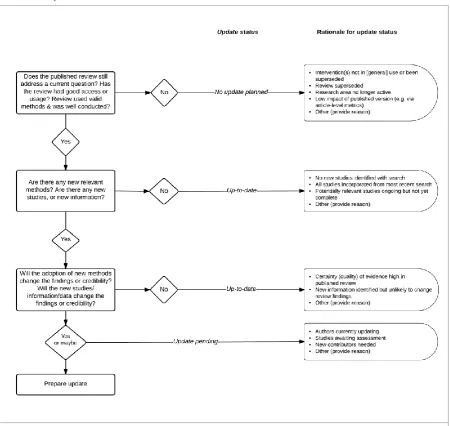
Figure 1. Decision flow chart to assess systematic reviews for updating, with standard
terms to report these decisions
The update status is designed to be attached to systematic reviews after they have been assessed. The rationale explains the reasons for a review being categorized as “up to date”, “update pending”, or “no update planned”.
Step 1. Assess currency
Does the published review still address a current question?
An update is only worthwhile if the question is topical for decision-making for practice, policy, or research priorities (Figure 1). For agencies, people responsible for managing a portfolio of systematic reviews, there is a need to use both formal and informal horizon scanning. This helps identify
questions with currency, and may help identify those reviews that should be updated. The process could include monitoring policy debates around the review, media outlets, scientific (and
8
Has the review had good access or usage?
Metrics for citations, article access and downloads, and sharing via social or traditional media may be used as proxy or indicators for currency and relevance of the review. Reviews that are widely cited and used may be important to update should the need arise. Comparable reviews that are never cited or rarely downloaded, for example, may indicate that they are not addressing a question that is valued, and may not be worth updating.
In most cases, updated reviews are most useful to stakeholders when there is new information or methods that result in a change in findings. However, there are some circumstances in which an up-to-date search for information is important for retaining the credibility of the review, regardless of whether the main findings would change or not. For example, key stakeholders would dismiss a review if a study is carried out in a relevant geographical setting but is not included; if a large, high profile study that may not change the findings is not included; or if an up-to-date search is required for a guideline to achieve credibility. See Box 3 for examples.
If the review does not answer a current question, the intervention has been superseded, then a decision can be made not to update and no further intelligence gathering is required (Figure 1).
Box 3. Currency: examples
The public is interested in vitamin C for preventing the common cold: the Cochrane Review includes over 29 trials with either no effects or small effects, concluding good evidence of no important effects.17 Still a
current question for the public.
Low-osmolarity oral rehydration salt (ORS) solution vs standard solution for acute diarrhoea in children: the 2001 Cochrane Review18 led the World Health Organization to recommend ORS solution formula worldwide
to follow the new ORS solution formula19 and this has now accepted globally. No longer a current question.
Routine prophylactic antibiotics with Caesarean section: the Cochrane Review reports clear evidence of maternal benefit from placebo control trials but no information on the effects on the baby.20 This is a current
question.
A systematic review published in The Lancet examined the effects of artemisinin-based combination treatments compared with monotherapy for treating malaria and showed clear benefit.21 This established
the treatment globally and is no longer a current question and no updated is required.
A Cochrane Review of amalgam restorations for dental caries22 is unlikely to be updated because the use of
dental amalgam is declining, and the question is not seen as being important by many dental specialists. No
longer a current question.
Did the review use valid methods and was it well conducted?
9
Step 2. Identify relevant new methods, studies, and other information
Are there any new relevant methods?
If the question is current, but the review was done some years ago, it may be that the quality of the review does not meet current day standards. Methods have advanced quickly, and data extraction and understanding of the review process has become more sophisticated. For example:
Methods for assessing risk of bias of randomised trials,23 diagnostic test accuracy (QUADAS-2),24 and observational studies (ACROBAT-NRSI).25
Application of summary of findings, evidence profiles and related GRADE methods has meant the characteristics of the intervention, of the participants, and the risk of bias is more thoroughly and systematically documented.26 27
Integration of other study designs containing evidence, such economic evaluation and qualitative research.28
There are other incremental improvements in a wide range of statistical and methodological areas, for example, in describing and taking into account cluster randomised trials.29
AMSTAR can provide an assessment of the overall quality of a systematic review30; and the ROBIS tool can be used to provide a more detailed assessment of the potential for bias.31
Are there any new studies, or other information?
If an authoring or commissioning team wants to ensure a particular review is up to date, there is a need for routine surveillance for new studies by searching and trial register inspection that are potentially relevant to the review at regular intervals. There are several approaches for doing this, including: formal surveillance searching;32 updating the full search strategies in the original review and running the searches; tracking studies in clinical trial and other registers; using literature appraisal services;33 using a defined abbreviated search strategy for the update;34 and checking studies included in related systematic reviews.35
How often this is done, and which approaches to use, are contingent on circumstances and the topic. Some topics move very quickly, and the definition of “regular intervals” will vary according to the field, and the state of evidence in the field; for example, early in the life of a new intervention, there may be a plethora of studies, and surveillance would be needed more frequently.
Step 3. Assess impact of updating the review
Will the adoption of new methods change the findings or credibility?
Editors, referees, or experts in the topic area or methodologists can provide an informed view of whether a review may be substantially improved by application of current methodological
expectations and new methods (Figure 1). Box 4 gives an example of changes in review findings by adopting new methods.
Box 4. Example of adoption of new methods improving review findings
A Cochrane Review of iron supplementation in malaria concluded there was “no significant difference between iron and placebo detected”.36 An update of the review included GRADE assessment of the certainty
10
Will the new studies/information/data change the findings or credibility?
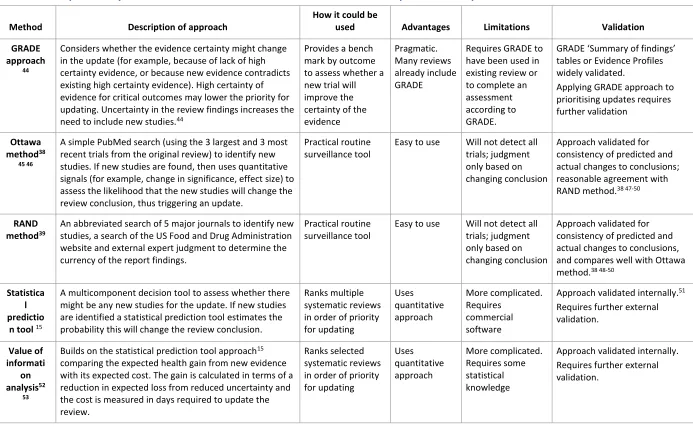
Assessing new data contained in new studies and how they may change the review is often used to determine whether an update should go ahead, and the speed with which the update should be conducted. The appraisal of this new data can be carried out in different ways. Initially methods focused on statistical approaches to predict an overturning of the current review findings in terms of the primary or desired outcome (Table 1). While this is an important aspect, additional studies can add important information to a review, which is more than just changing the primary outcome to a more accurate, reliable estimate. See examples in Box 5.
Reviews with a high level of certainty in the results (that is the GRADE assessment for the body of evidence is high) are less likely to change even with the addition of new studies, information, or data, by definition. GRADE can help guide priorities in whether to update, but it is still important to assess new studies that may meet the inclusion criteria. New studies can show unexpected effects (for example, attenuation of efficacy) or provide new information about the effects seen in different circumstances (groups of patients or locations, for example).
Other tools are specifically designed to help decision-making in updating, for example, the Ottawa38 and RAND39 methods focus on identification of new evidence, the Statistical Predication tool15 calculates the probability of new evidence changing the review conclusion, and the Value of Information analysis approach)40 calculates the expected health gain (Table 1). As yet, there has been limited external validation of these tools to determine which approach would be most effective and when.
If potentially relevant studies are identified which have not previously been assessed for inclusion, authors or those managing the updating process need to assess whether including them may affect the conclusions of the review. They need to examine the weight and certainty of the new evidence to help determine if an update is needed and how urgent that update is. The updating team can assess this informally by using judgement as to whether ‘new’ studies or data are likely to impact substantively on the review, for example, by altering the certainty in an existing comparison, or by generating new comparisons and analyses in the existing review.
Box 5. Examples of new information other than new trials being important
The iconic Cochrane Review of steroids in preterm labour was thought to provide evidence of benefit in the infant and this question no longer required new trials. However, a new large trial published in The Lancet in 2015 showed in low and middle income countries strategies to promote the uptake of neonatal steroids increased neonatal mortality and suspected maternal infection.41 This information needs to somehow be
incorporated into the review to maintain its credibility.
A Cochrane Review of community deworming in developing countries indicates that in recent studies there is little or no effect.42 The inclusion of a large trial of two million children confirmed that there was no effect
on mortality. While the incorporation of the trial in the review did not change the reviews conclusions, the absence of the trial in the review would impact on the credibility of the review, so it was therefore updated. A new paper reporting long-term follow up data on anthracycline chemotherapy as part of cancer treatment was published. While the effects from the outcomes remained essentially unchanged, apart from this longer follow-up, the paper also included additional information about the performance bias in the original trial, shifting the risk of bias for several outcomes from “unknown” to “high” in the Cochrane Review.43
12
Table 1. Could potentially relevant ‘new’ studies affect review conclusions? Examples of formal prediction tools
Method Description of approach
How it could be
used Advantages Limitations Validation
GRADE approach
44
Considers whether the evidence certainty might change in the update (for example, because of lack of high certainty evidence, or because new evidence contradicts existing high certainty evidence). High certainty of evidence for critical outcomes may lower the priority for updating. Uncertainty in the review findings increases the need to include new studies.44
Provides a bench mark by outcome to assess whether a new trial will improve the certainty of the evidence
Pragmatic. Many reviews already include GRADE
Requires GRADE to have been used in existing review or to complete an assessment according to GRADE.
GRADE ‘Summary of findings’ tables or Evidence Profiles widely validated.
Applying GRADE approach to prioritising updates requires further validation
Ottawa method38
45 46
A simple PubMed search (using the 3 largest and 3 most recent trials from the original review) to identify new studies. If new studies are found, then uses quantitative signals (for example, change in significance, effect size) to assess the likelihood that the new studies will change the review conclusion, thus triggering an update.
Practical routine surveillance tool
Easy to use Will not detect all trials; judgment only based on changing conclusion
Approach validated for consistency of predicted and actual changes to conclusions; reasonable agreement with RAND method.38 47-50
RAND method39
An abbreviated search of 5 major journals to identify new studies, a search of the US Food and Drug Administration website and external expert judgment to determine the currency of the report findings.
Practical routine surveillance tool
Easy to use Will not detect all trials; judgment only based on changing conclusion
Approach validated for consistency of predicted and actual changes to conclusions, and compares well with Ottawa method.38 48-50
Statistica l predictio
n tool 15
A multicomponent decision tool to assess whether there might be any new studies for the update. If new studies are identified a statistical prediction tool estimates the probability this will change the review conclusion.
Ranks multiple systematic reviews in order of priority for updating Uses quantitative approach More complicated. Requires commercial software
Approach validated internally.51
Requires further external validation. Value of informati on analysis52 53
Builds on the statistical prediction tool approach15
comparing the expected health gain from new evidence with its expected cost. The gain is calculated in terms of a reduction in expected loss from reduced uncertainty and the cost is measured in days required to update the review.
Ranks selected systematic reviews in order of priority for updating Uses quantitative approach More complicated. Requires some statistical knowledge
13
PREPARING FOR AN UPDATE
Refresh background, objectives, inclusion criteria and methods
Before including new studies in the review, the authors need to revisit the background, objectives, inclusion criteria and methods of the current review. In Cochrane, this is referred to as the protocol, and in this organization editors are part of this process. The update could range from simply
endorsing the current question and inclusion criteria, through to full rewriting of the question, inclusion criteria and methods, and republishing the protocol. As a field progresses with larger better quality trials rigorously testing the questions posed, it may be appropriate to exclude weaker study designs (such as quasi-randomised comparisons or very small trials) from the update, for example (Table 2).
The Panel recommended that a protocol refresh will require the authors to use the latest accepted methods of synthesis, even if this means repeating data extraction for all studies.
14
Protocol section Appraisal points
Background and research question
Review and update background section including supporting references to take account of any changes that may have occurred. This should include updating any new information and current policy debates on the topic.
Assess whether the current review question remains relevant to patients and practice.
Inclusion criteria Consider whether the existing PICO(s) remains current in the light of new knowledge.
Identify any new understanding of definition of patient populations.
Identify new interventions, or those that have been withdrawn, are no longer in use. Identify any changes in usual care standards.
Check for standardized core outcomes sets such as those developed in collaboration with the Core Outcome Measures in Effectiveness Trials (COMET) Initiative
(http://www.comet-initiative.org) or by guideline groups since the original review. Check whether there are any relevant patient-reported outcomes to include subsequent to the original review.
Consider whether there have been new studies with less risk of bias that may warrant a stricter study design inclusion criteria (where the older version, when there was a dearth of evidence, included observational or quasi randomized comparisons).
Methods Appraise and update the methods pending relevant methodological advancements or
developments. For example:
If there are new tools for assessing the risk of bias of individual studies or appraising the quality of a body of evidence (e.g. GRADE).
If new and efficient search approaches are feasible such as a targeted approach to searching, taking into account the quality of the original search and ensuring that the search for the update is of high quality.
15
New authors and authorship
Updated systematic reviews are new publications with new citations. An authorship team publishing an update in a scientific or medical journal is likely to manage the new edition of a review in the same as with any other publication, and follow the ICMJE authorship criteria57. If the previous author or author team steps down, then they should be acknowledged in the new version. However, some may perceive their efforts in the first version warrant continued authorship, and this may be valid. The management of authorship between versions can sometimes be complicated. At worst it delays new authors completing an update and leads to long authorship lists of people from previous versions who probably do not meet ICMJE authorship criteria. One approach with updates including new authors is to have an “opt-in” policy for the existing authors: they can opt in to the new edition, provided they make clear their contribution, and this is then agreed with the entire author team. Updates, although new publications, will generally include content from the published version. Changing licensing rights around systematic reviews to allow new authors of future updates to remix, tweak, or build upon the contributions of the original authors of the published version (similar to the rights available via a Creative Commons licence; http://creativecommons.org) could be more
sustainable and simpler approach. This would allow systematic reviews to continue to evolve and build on the work of a range of authors over time, and for contributors to be given credit for contributions to this previous work.
Efficient searching
In performing an update, a search based on the search conducted for the original review is required. The updated search strategy will need to take into account changes in the review question or inclusion criteria, for example, and may be further adjusted based on knowledge of running the original search strategy. The search strategy for an update need not replicate the original search strategy, but could be refined, for example, based on an analysis of the yield of the original search. These new search approaches are currently undergoing formal empirical evaluation but and they may well provide much more efficient search strategies in the future. Some examples of these possible new methods for review updates are described in Appendix 2.
In reporting the search process for the update, investigators must ensure transparency for any previous versions and the current update, and use an adapted PRISMA flow diagram.58 The search processes and strategies for the update must be adequately reported such that they could be replicated.
Peer review
16
Reporting changes
Authors should provide a clear description of the changes in approach or methods between different editions of a review. Also, authors need to report the differences in findings between the original and updated edition to assist users decide how to use the new edition. The approach or format used to present the differences in findings may vary with the target user group.59 Publishers need to ensure all previous versions of the review remain publically accessible.
“Updates” can range from small adjustments to reviews being completely rewritten, and the Panel spent some time debating whether “new edition” would be a better description than “update”. However, the word “update” is now in common parlance and changing the term, the panel judged, may cause confusion. However, the debate does illustrate that an update may represent a review that asks a similar question but has been completely revised.
TECHNOLOGY AND INNOVATION
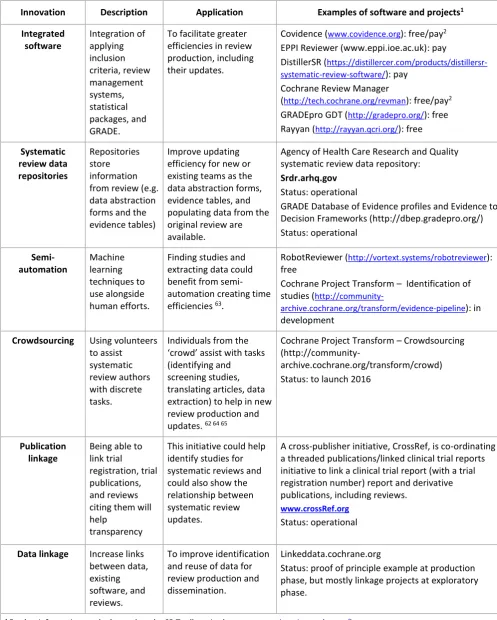
Updating of systematic review is generally done manually and is time-consuming. There are opportunities to make better use of technology to streamline the updating process and to improve efficiency (Table 3). Some of these tools already exist and are in development or in early use. Some are commercially available and some are freely available. The Agency for Healthcare Research and Quality (AHRQ)’s Evidence-Based Practice Center team has recently published tools for searching and screening, and will provide an assessment of the utility, reliability, and availability of these tools.60 Other developments, such as targeted updates that are performed rapidly and focus on updating only key components of a review, may provide different approaches to updating in the future and are being piloted and evaluated.61 With implementation of these various innovations the longer-term goal is for “living” systematic reviews, which identify and incorporate information rapidly as it
17
Table 3. Technological innovations to improve the efficiency of updating systematic
reviews
Innovation Description Application Examples of software and projects1
Integrated software Integration of applying inclusion criteria, review management systems, statistical packages, and GRADE.
To facilitate greater efficiencies in review production, including their updates.
Covidence (www.covidence.org): free/pay2
EPPI Reviewer (www.eppi.ioe.ac.uk): pay
DistillerSR ( https://distillercer.com/products/distillersr-systematic-review-software/): pay
Cochrane Review Manager
(http://tech.cochrane.org/revman): free/pay2
GRADEpro GDT (http://gradepro.org/): free Rayyan (http://rayyan.qcri.org/): free
Systematic review data repositories Repositories store information from review (e.g. data abstraction forms and the evidence tables)
Improve updating efficiency for new or existing teams as the data abstraction forms, evidence tables, and populating data from the original review are available.
Agency of Health Care Research and Quality systematic review data repository:
Srdr.arhq.gov
Status: operational
GRADE Database of Evidence profiles and Evidence to Decision Frameworks (http://dbep.gradepro.org/) Status: operational Semi-automation Machine learning techniques to use alongside human efforts.
Finding studies and extracting data could benefit from semi-automation creating time efficiencies 63.
RobotReviewer (http://vortext.systems/robotreviewer): free
Cochrane Project Transform – Identification of studies (
http://community-archive.cochrane.org/transform/evidence-pipeline): in development
Crowdsourcing Using volunteers to assist
systematic review authors with discrete tasks.
Individuals from the ‘crowd’ assist with tasks (identifying and
screening studies, translating articles, data extraction) to help in new review production and updates. 62 64 65
Cochrane Project Transform – Crowdsourcing
(http://community-archive.cochrane.org/transform/crowd) Status: to launch 2016
Publication linkage
Being able to link trial
registration, trial publications, and reviews citing them will help
transparency
This initiative could help identify studies for systematic reviews and could also show the relationship between systematic review updates.
A cross-publisher initiative, CrossRef, is co-ordinating a threaded publications/linked clinical trial reports initiative to link a clinical trial report (with a trial registration number) report and derivative publications, including reviews.
www.crossRef.org Status: operational
Data linkage Increase links between data, existing software, and reviews.
To improve identification and reuse of data for review production and dissemination.
Linkeddata.cochrane.org
Status: proof of principle example at production phase, but mostly linkage projects at exploratory phase.
1 Further information can be located on the SR Toolbox site (www.systematicreviewtools.com/)
18
CONCLUDING REMARKS
Updating systematic reviews, rather than addressing the same question with a fresh protocol, is generally more efficient and allows incremental improvement over time. Mechanical rules appear unworkable, but there is no clear unified approach on when to update, and how implement this. This Panel of authors, editors, statisticians, information specialists, other methodologists, and guideline developers brought together current thinking and experience in this area to provide guidance. Decisions about whether and when to update a systematic review are judgements made at a point in time. They depend on the currency of the question asked, the need for updating to maintain
credibility, the availability of new evidence, and whether new research or new methods will impact on the findings.
Whether the review uses current methodological standards is important in deciding whether the update will influence the review findings, quality, reliability or credibility sufficiently to justify the effort in updating it. Those updating systematic reviews to author clinical practice guidelines may consider the influence of new study results in potentially overturning the conclusions of an existing review. Yet, even in cases where new study findings do not change the primary outcome measure, new studies can carry important information about subgroup effects, duration of treatment effects, and other relevant clinical information, enhancing the currency and breadth of review results. An update requires appraisal and revision of the background, question, inclusion criteria, and
methods of the existing review and the existing certainty in the evidence. In particular, methods may need to be updated, and search strategies re-considered. Authors of updates need to consider inputs to the current edition, and must follow ICMJE criteria regarding authorship.57
The Panel proposed a standard decision framework, with terms and categories for reporting the decisions made for updating procedures for adoption by Cochrane and other stakeholders. This includes journals publishing systematic review updates and independent authors considering updates of existing published reviews. The Panel developed a checklist to help judgements about when and how to update.
The current emphasis of authors, guideline developers, Cochrane and consequently this guidance has been on effects reviews. The checklists and guidance here is still applicable to other sorts of
systematic reviews, such as diagnostic test accuracy reviews, they will need adaption. Accumulative experience and methods development in reviews other than those of effects are likely to help refine guidance in the future.
This guidance could help groups identify and prioritize reviews for updating and hence use their finite resources to greatest effect. Software innovation and new management systems are being
19
Contributorship statement
HS initiated the workshop. JC, SH, PG, HM and HS organized the materials and the agenda. SH wrote up the proceedings. PG wrote the paper from the proceedings and coordinated the development of the final guidance; JC, SH, HM and HS were active in the finalising of the guidance. All PUGs authors contributed to three rounds of manuscript revision.
Competing interests
All participants have a direct or indirect interest in systematic reviews and updating as part of their job or academic career. Most participants contribute to Cochrane, whose mission includes a
commitment to the updating of its systematic review portfolio. Jackie Chandler, Harriet MacLehose, Rachel Marshall, Chris Mavergames, Karla Soares-Weiser and Marialena Trivella are, or were at that time, employed by the Cochrane Central Executive.
Funding
Attendance at this meeting, for those attendees not directly employed by Cochrane, was not funded by Cochrane beyond the reimbursement of ‘out-of-pocket’ expenses for those attendees for whom this was appropriate. Expenses were not reimbursed for US federal government attendees, in line with US government policy.
Disclaimer
20
APPENDIX 1. LIST OF WORKSHOP PARTICIPANTS
Name Affiliation
Elie A. Akl Director of Clinical Epidemiology Unit, Department of Internal Medicine, American University of Beirut, Beirut (Lebanon); Cochrane GRADEing Methods Group (Canada) Joseph Beyene Associate Professor, Department of Mathematics and Statistics, McMaster University
(Canada)
Jackie Chandler* Methods Co-ordinator, Cochrane Editorial Unit, Cochrane Central Executive (UK)
Stephanie Chang Director, Evidence-based Practice Center Program, Agency for Healthcare and Research Quality (USA)
Rachel Churchill Professor, Centre for Reviews and Dissemination, University of York (UK); Cochrane Common Mental Disorders Group, York (UK)
Karin Dearness McMaster University (Canada); Managing Editor, Cochrane Upper Gastrointestinal and Pancreatic Diseases Group (Canada)
Paul Garner Co-ordinator, Evidence Synthesis for Global Health, Department of Clinical Sciences, Liverpool School of Tropical Medicine, Liverpool (UK); Co-ordinating Editor Cochrane Infectious Diseases Group (UK)
Gordon Guyatt Professor, Department of Clinical Epidemiology & Biostatistics, McMaster University (Canada)
Sally Hopewell* Senior Research Fellow, Centre for Statistics in Medicine, University of Oxford (UK); Cochrane Methodology Review Group (UK)
Carol Lefebvre Independent Information Consultant, Lefebvre Associates Ltd, Oxford (UK); Co-Convenor, Cochrane Information Retrieval Methods Group (UK)
Beth Liles Internal Medicine, Kaiser Permanente Medical Group (USA)
Harriet MacLehose* Senior Editor, Cochrane Editorial Unit, Cochrane Central Executive (UK)
Rachel Marshall Editor, Cochrane Editorial Unit, Cochrane Central Executive (UK)
Laura Martínez García Researcher, Iboamerican Cochrane Centre (Spain)
Chris Mavergames Head of Cochrane Informatics and Knowledge Management, Cochrane Central Executive (Germany)
David Moher Senior Scientist, Clinical Epidemiology, Ottawa Hospital Research Institute (Canada); Associate Professor, Department of Epidemiology and Community Medicine, Faculty of Medicine, University of Ottawa. (Canada)
Mona Nasser Clinical Lecturer in Evidence Based Dentistry in Plymouth University Peninsula School of Denistry (UK); Co-Convenor, Cochrane Priority Setting Methods Group (UK)
21 Margaret Sampson Manager, Library Services, Children’s Hospital of Eastern Ontario (Canada); Member,
Cochrane Information Retrieval Methods Group (Canada)
Holger J.
Schünemann* Professor and Chair, Department of Clinical Epidemiology and Biostatistics, and Department of Medicine, McMaster University (Canada); Cochrane GRADEing Methods Group (Canada)
Karla Soares-Weiser Deputy Editor in Chief, Cochrane Editorial Unit, Cochrane Central Executive (Israel)
Yemisi Takwoingi Research Fellow in Medical Statistics, Institute of Applied Health Research, University of Birmingham (UK); Co-Convenor, Cochrane Screening and Diagnostic Tests Methods Group (UK)
Lehana Thabane Director, Biostatistics Unit, Centre for Evaluation, McMaster University (Canada); Professor, Department of Clinical Epidemiology & Biostatistics, McMaster University (Canada)
Marialena Trivella Centre for Statistics in Medicine, University of Oxford (UK); Statistician and Editor, Cochrane Anaesthesia, Critical and Emergency Care Group (UK)
Peter Tugwell Professor of Medicine, and Epidemiology and Community Medicine, University of Ottawa (Canada); Co-ordinating Editor, Cochrane Musculoskeletal Group (Canada)
Emma Welsh Managing Editor, Cochrane Airways Group, Population Health Research Institute, St George’s, University of London (UK)
Ed C. Wilson Co-Convenor, Cochrane Priority Setting Methods and Campbell & Cochrane Economic Methods Groups; Senior Research Associate in Health Economics, Cambridge Centre for Health Services Research, University of Cambridge (UK)
22
APPENDIX 2. SEARCH STRATEGIES FOR A SYSTEMATIC REVIEW
UPDATE
Newly emerging research is helping refine searching for studies for systematic review updates. This is based on an analysis of original searches and the yield in relation to databases searched, terms, and languages to improve the specificity of searches and reduce the burden of author screening. Further research will help clarify the effectiveness and efficiency of these innovations.
Refining the original searches
Database selection and search strategy optimization
Database selection: While the original search may include multiple databases of many journals, it may be possible to limit the number of databases to the minimum set that would have identified all the original included studies. In some reviews, MEDLINE alone will suffice.
Strategies: Search strategies from the original review can be optimized. Investigators should confirm that the search strategies for the retained database would find the included studies from the original review and adjust the search strategies, if necessary, to improve recall. Examples of adjustments would be adding a key subject heading that was omitted from the original search or adding a newly introduced subject heading.66 After maximizing recall, the searcher should endeavour to optimize precision, removing terms with a low yield of relevant records. Analytic tools such as GoPubMed and PubMed PubReMiner can provide useful analytics for optimizing both recall and precision.67 68
Language: Whilst the original search may include multiple databases of many journals in languages other than English, again examination of the yield of additional studies from other languages can be examined in the original review. In a number of topic areas trials are published only in English language journals, so that a process of searching for non-English language trials may not increase sensitivity of the search. However, this is not currently Cochrane searching policy.
Text word terms: If text word terms are included in the search in the interests of identifying solely not-yet-indexed material, restrict those terms to un-indexed records only, for example, in PubMed the string (pubstatusaheadofprint or publisher[sb] or pubmednotmedline[sb]) can be used.69 70 Using a PubMed-only bespoke search strategy for an update
If the original included studies are all indexed in MEDLINE and the original search process was robust (for example, involved two or more databases and at least one non-database method for identifying relevant studies) a PubMed-only update can be considered. This would consist of two PubMed searches. The first would be a narrow Boolean search of the main MeSH for the population combined with the main MeSH for the intervention. The second would be a search using the Related Articles feature with the PubMed IDs (PMIDs) of the three newest and three largest included studies as the seed articles.32 71
Can searches for updates be limited update by date?
Where the date of the original searches is known, and the original searches were well-designed and well-conducted, the update search should probably be limited to material added to the relevant databases since the original searches were conducted.72. At a meeting with US National Library of Medicine (NLM) staff to discuss updating searches using PubMed, they advocated use of the Create Date [CRDT] field, i.e. the date the citation record was first created (McGhee M and Zipser J, oral communication, 20th June 2014).
23 Expanding searches to identify retracted studies or errata/corrections
In all cases, the bibliographic record for included studies from the review being updated should be checked to identify retraction and errata.73
Additional update searches for trial registers and grey literature
24
APPENDIX 3. PUGS Checklist for updating a systematic review:
deciding when and how
This is PUGS-1, the first version of the checklist. We will modify this checklist in the light of experiences by a variety of users. Any feedback please contact the corresponding author.
Criteria Question Yes or no Comment
Whe th e r t o u p d ate
Step 1. Assess the currency
1. Is it as relevant question? Yes-go to 2 No-no update
Medical progress means some questions become irrelevant
2. Intervention still in use? Yes-go to 3 No-no update
Some interventions may not be in use in one country, but widely used in another (including the private sector) so consider this.
3. Research area active with debates in the literature and possibly new evidence emerging?
Yes-go to 5 No-go to 4
Areas with equipoise and new trials are a priority to update.
4. Has the review been used? Yes-go to 5 No-probably not worth updating
If access is considerable, make update a priority. If not well accessed, used, or cited, compared to those in a similar topic, then it may be that this is not an area of equipoise or debate.
5. Does the review use valid methods and is well conducted?
Yes-go to 6 No-start with a new protocol
Assessment of the methods should take into account methods available when the review was conducted
Step 2. Identify new methods, new studies and other information
6. Are there new studies published or completed?
Yes-go to 9 No-go to 7
It helps the reader to know that there are no new studies meeting the inclusion criteria.
7. Has new information or data from existing included studies come to light that is useful?
Yes-UPDATE & go to 11 No-go to 8
More information on methods, risk of bias or results may improve the review.
Step 3. Assess impact of updating the review
8. Will application of new synthesis methods substantially improve the quality and clarity of the review?
Yes-UPDATE & go to 11 No-no update
GRADE has substantive effects on improving review quality
9. Will the data in the new studies change the findings of the review, or substantially inform the review?
Yes-UPDATE & go to 11 No-go to 10
Use “eyeball” appraisal or formal methods. New studies inform the main desired outcome, but could also inform by being in a different setting, age group, or include new adverse effects
10. Will the absence of the new studies and the older search date lead to questions about the credibility of the review?
Yes-UPDATE and go to 11 No-no update
A large new study may not alter a review’s bottom line but damage its credibility if not included; whereas a large review and with a few small recent studies may not.
Pr e p ar in g t o u p d ate
Refresh protocol 11. Given advances in the field, do the existing objectives, review PICO and methods need modifying?
Yes-adjust & go to 12
No-go to 12
Sometimes new interventions may need to be included. Note any broadening of inclusion criteria will need a new search strategy
Appraise author team
12. Are we/the author team willing, capable and has the time to complete the update?
Yes-go to 13 No-find new team & go to 13
Who makes this judgment varies with commissioning agency; new authors or a new team may be required.
Competing interests 13. Are there any competing interests, such as review authors also investigators of included trials?
Yes-deal with, then go to 14 No- go to 14
Competing interests, including academic, can substantially influence reviews and should be managed carefully. For current and new authors, take into account developments in managing competing interests
Refine search 14. Does the search need to be altered in the light of change in PICO, or can be improved using the yield from the search of the current published version?
Yes-modify & to go to 15 No-go to 15
—
26
References
1. Shekelle PG, Ortiz E, Rhodes S, et al. Validity of the Agency for Healthcare Research and Quality clinical practice guidelines: how quickly do guidelines become outdated? JAMA
2001;286(12):1461-7.
2. Claxton K, Cohen JT, Neumann PJ. When is evidence sufficient? Health Aff (Millwood) 2005;24(1):93-101.
3. Fenwick E, Claxton K, Sculpher M, et al. Improving the efficiency and relevance of health
technology assessment: the role of decision analytic modelling. Paper 179. York: Centre for Health Economics, University of York, 2000.
4. Sculpher M, Claxton K. Establishing the cost-effectiveness of new pharmaceuticals under
conditions of uncertainty--when is there sufficient evidence? Value Health 2005;8(4):433-46. 5. Sculpher M, Drummond M, Buxton M. The iterative use of economic evaluation as part of the
process of health technology assessment. J Health Serv Res Policy 1997;2(1):26-30. 6. Wilson E, Abrams K. From Evidence Based Economics to Economics Based Evidence: Using
Systematic Review to inform the design of future research. In: Shemilt I, Mugford M, Vale L, et al., eds. Evidence Based Economics. London: Blackwell Publishing, 2010.
7. Chalmers I, Enkin M, Keirse MJ. Preparing and updating systematic reviews of randomized controlled trials of health care. Milbank Q 1993;71(3):411-37.
8. Higgins J, Green S, Scholten R. Chapter 3: Maintaining reviews: updates, amendments and
feedback: Version 5.1.0 (updated March 2011), The Cochrane Collaboration; 2011. Available from http://www.cochrane-handbook.org [
9. Cochrane. http://community-archive.cochrane.org/editorial-and-publishing-policy-resource/cochrane-review-updates 2016 (pending) [
10. Moher D, Tsertsvadze A. Systematic reviews: when is an update an update? Lancet 2006;367(9514):881-3.
11. Prasad K, Singh MB, Ryan H. Corticosteroids for managing tuberculous meningitis. Cochrane Database Syst Rev 2016;4:CD002244.
12. Zani B, Gathu M, Donegan S, et al. Dihydroartemisinin-piperaquine for treating uncomplicated Plasmodium falciparum malaria. Cochrane Database Syst Rev 2014;1:CD010927.
13. Adams SP, Tsang M, Wright JM. Lipid lowering efficacy of atorvastatin. Cochrane Database Syst Rev 2012;12:CD008226.
14. Higgins J. Convincing evidence from controlled and uncontrolled studies on the lipid-lowering effect of a statin. Cochrane Database Syst Rev 2012;12:ED000049.
15. Takwoingi Y, Hopewell S, Tovey D, et al. A multicomponent decision tool for prioritising the updating of systematic reviews. BMJ 2013;347:f7191.
16. MacLehose H, Hilton J, Tovey D, et al. The Cochrane Library: revolution or evolution? Shaping the future of Cochrane content. Background paper for The Cochrane Collaboration’s Strategic Session Paris, France, 18 April 2012.
17. Hemila H, Chalker E. Vitamin C for preventing and treating the common cold. Cochrane Database Syst Rev 2013(1):CD000980.
27 19. World Health Organization (WHO). Reduced osmolarity oral rehydration salts (ORS) formulation.
A report from a meeting of Experts jointly organized by UNICEF and WHO. New York: Child and Adolescent Health and Development; 18 July 2001 [Available from:
http://apps.who.int/iris/bitstream/10665/67322/1/WHO_FCH_CAH_01.22.pdf.
20. Smaill FM, Grivell RM. Antibiotic prophylaxis versus no prophylaxis for preventing infection after cesarean section. Cochrane Database Syst Rev 2014(10):CD007482.
21. Adjuik M, Babiker A, Garner P, et al. Artesunate combinations for treatment of malaria: meta-analysis. Lancet 2004;363(9402):9-17.
22. Agnihotry A, Fedorowicz Z, Nasser M. Adhesively bonded versus non-bonded amalgam restorations for dental caries. Cochrane Database Syst Rev 2016(3):CD007517.
23. Higgins JP, Altman DG, Gotzsche PC, et al. The Cochrane Collaboration's tool for assessing risk of bias in randomised trials. BMJ 2011;343:d5928.
24. Whiting PF, Rutjes AW, Westwood ME, et al. QUADAS-2: a revised tool for the quality assessment of diagnostic accuracy studies. Ann Intern Med 2011;155(8):529-36.
25. Sterne JAH, J.P.T.; Reeves, B.C. on behalf of the development group for ACROBAT- NRSI. A Cochrane Risk Of Bias Assessment Tool: for Non-Randomized Studies of Interventions (ACROBAT- NRSI), Version 1.0.0, 24 September 2014 [Available from:
http://www.riskofbias.info.
26. Guyatt GH, Oxman AD, Vist GE, et al. GRADE: an emerging consensus on rating quality of evidence and strength of recommendations. BMJ 2008;336(7650):924-6.
27. Schunemann HJ. Interpreting GRADE's levels of certainty or quality of the evidence: GRADE for statisticians, considering review information size or less emphasis on imprecision? J Clin Epidemiol 2016.
28. Gough D. Qualitative and mixed methods in systematic reviews. Syst Rev 2015;4:181.
29. Richardson M, Garner P, Donegan S. Cluster Randomised Trials in Cochrane Reviews: Evaluation of Methodological and Reporting Practice. PLoS One 2016;11(3):e0151818.
30. Shea B, Grimshaw J, Wells G, et al. Development of AMSTAR: a measurement tool to assess the methodological quality of systematic reviews. BMC Medical Research Methodology
2007;7:10.
31. Whiting P, Savovic J, Higgins JP, et al. ROBIS: A new tool to assess risk of bias in systematic reviews was developed. J Clin Epidemiol 2016;69:225-34.
32. Sampson M, Shojania KG, McGowan J, et al. Surveillance search techniques identified the need to update systematic reviews. J Clin Epidemiol 2008;61(8):755-62.
33. Hemens BJ, Haynes RB. McMaster Premium LiteratUre Service (PLUS) performed well for
identifying new studies for updated Cochrane reviews. J Clin Epidemiol 2012;65(1):62-72 e1. 34. Sagliocca L, De Masi S, Ferrigno L, et al. A pragmatic strategy for the review of clinical evidence. J
Eval Clin Pract 2013;19(4):689-96.
35. Rada G, Peña J, Capurro D, et al. How to create a matrix of evidence in Epistemonikos. Abstracts of the 22nd Cochrane Colloquium; Evidence-informed public health: Opportunities and challenges; Hyderabad, India. Cochrane Database Syst Rev 2014(Suppl 1):132.
28 37. Neuberger A, Okebe J, Yahav D, et al. Oral iron supplements for children in malaria-endemic
areas. Cochrane Database Syst Rev 2016(2):CD006589.
38. Chung M, Newberry SJ, Ansari MT, et al. Two methods provide similar signals for the need to update systematic reviews. J Clin Epidemiol 2012;65(6):660-8.
39. Shekelle P, Newberry S, Maglione M, et al. Assessment of the Need to Update Comparative Effectiveness Reviews: Report of an Initial Rapid Program Assessment (2005-2009): Agency for Healthcare Research and Quality, 2009.
40. Wilson E, on behalf of the Cochrane Priority Setting and Campbell & Cochrane Economics
Methods Groups. Which study when? Proof of concept of a proposed automated tool to help decision which reviews to update first”. Cochrane Database of Systematic Reviews
2014:Suppl 2:29-31.
41. Althabe F, Belizan JM, McClure EM, et al. A population-based, multifaceted strategy to implement antenatal corticosteroid treatment versus standard care for the reduction of neonatal
mortality due to preterm birth in low-income and middle-income countries: the ACT cluster-randomised trial. Lancet 2015;385(9968):629-39.
42. Taylor-Robinson D, Maayan N, Soares-Weiser K, et al. Deworming drugs for soil-transmitted intestinal worms in children: effects on nutritional indicators, haemoglobin and school performance. Cochrane Database Syst Rev 2012(11):CD000371.
43. van Dalen E, van der Pal J, Kremer L. Different dosage schedules for reducing cardiotoxicity in people with cancer receiving anthracycline chemotherapy. Cochrane Database Syst Rev 2016(3):CD005008.
44. Balshem H, Helfand M, Schunemann HJ, et al. GRADE guidelines: 3. Rating the quality of evidence. J Clin Epidemiol 2011;64(4):401-6.
45. Shojania KG, Sampson M, Ansari MT, et al. How quickly do systematic reviews go out of date? A survival analysis. Ann Intern Med 2007;147(4):224-33.
46. Shojania K, Sampson M, Ansari M, et al. Updating Systematic Reviews; AHRQ Technical Reviews; Report No.: 07-0087. Rockville (MD): Agency for Healthcare Research and Quality (US), 2007.
47. Pattanittum P, Laopaiboon M, Moher D, et al. A comparison of statistical methods for identifying out-of-date systematic reviews. PLoS One 2012;7(11):e48894.
48. Shekelle PG, Motala A, Johnsen B. Assessment of a Method to Detect Signals for Updating Systematic Reviews. Rockville (MD), 2014.
49. Shekelle PG, Motala A, Johnsen B, et al. Assessment of a method to detect signals for updating systematic reviews. Syst Rev 2014;3:13.
50. Shekelle PG, Newberry SJ, Wu H, et al. Identifying Signals for Updating Systematic Reviews: A Comparison of Two Methods; Report No.: 11-EHC042-EF. Rockville (MD): Agency for Healthcare Research and Quality (US), 2011.
51. Tovey D, Marshall R, Bazian Ltd, et al. Fit for purpose: centralised updating support for high-priority Cochrane Reviews; National Institute for Health Research Cochrane-National Health Service Engagement Award Scheme July 2011 [Available from:
http://editorial-unit.cochrane.org/sites/editorial-unit.cochrane.org/files/uploads/10_4000_01 Fit for purpose - centralised updating support for high priority Cochrane Reviews FINAL REPORT.pdf.
29 53. Wilson EC. A practical guide to value of information analysis. Pharmacoeconomics
2015;33(2):105-21.
54. Rosenbaum SE, Glenton C, Nylund HK, et al. User testing and stakeholder feedback contributed to the development of understandable and useful Summary of Findings tables for Cochrane reviews. J Clin Epidemiol 2010;63(6):607-19.
55. Rosenbaum SE, Glenton C, Oxman AD. Summary-of-findings tables in Cochrane reviews improved understanding and rapid retrieval of key information. J Clin Epidemiol 2010;63(6):620-6. 56. Vandvik P, Santesso N, Akl E, et al. Formatting modifications in GRADE evidence profiles improved
guideline panelists comprehension and accessibility to information. A randomized trial. Journal of Clinical Epidemiology 2012;65(7):748-55.
57. International Committee of Medical Journal Editors (ICMJE). Defining the role of authors and contributors Accessed 2 November 2015 [Available from:
http://www.icmje.org/recommendations/browse/roles-and-responsibilities/defining-the-role-of-authors-and-contributors.html.
58. Stovold E, Beecher D, Foxlee R, et al. Study flow diagrams in Cochrane systematic review updates: an adapted PRISMA flow diagram. Syst Rev 2014;3:54.
59. Newberry SJ, Shekelle PG, Vaiana M, et al. Reporting the findings of updated systematic reviews of comparative effectiveness: how do users want to view new information? Report No.: 13-EHC093-EF. Rockville (MD): Agency for Healthcare Research and Quality (US), 2013.
60. Paynter R, Bañez L, Berlinerm E, et al. EPC Methods: An Exploration of the Use of Text-Mining Software in Systematic Reviews. Research White Paper. AHRQ Publication 16-EHC023-EF. Rockville, MD: Agency for Healthcare Research and Quality (US); April 2016 [Available from:
https://www.effectivehealthcare.ahrq.gov/search-for-guides-reviews-and-reports/?pageaction=displayproduct&productID=2214.
61. Soares-Weiser K, Marshall R, Bergman H, et al. Updating Cochrane Reviews: results of the first pilot of a focused update. Cochrane Database of Systematic Reviews 2014(Suppl 1):31-3. 62. Elliott J, Turner T, Clavisi O, et al. Living systematic reviews: an emerging opportunity to narrow
the evidence-practice gap. PLoS Med 2014;11(2):e1001603.
63. Marshall IK, J; Wallace, BC. Automating Risk of Bias Assessment for Clinical Trials BCB’14. Proceedings of the 5th ACM conference on Bioinformatics, Computational biology, and Health Informatics. New York, USA: ACM, 2014:88-95.
64. Elliott J, Sim I, Thomas J, et al. #CochraneTech: technology and the future of systematic reviews. Cochrane Database Syst Rev 2014(9):ED000091.
65. Cochrane. Project Transform: The Cochrane Collaboration; Accessed 10 August 2015 [Available from: http://community.cochrane.org/transform.
66. Sampson M, McGowan J. Inquisitio validus Index Medicus: A simple method of validating MEDLINE systematic review searches. Res Synth Methods 2011;2(2):103-9.
67. GoPubMed [Internet]: Transinsight GmbH; 2010 [Available from: http://www.gopubmed.org/. 68. Lefebvre C, Glanville J, Wieland LS, et al. Methodological developments in searching for studies
for systematic reviews: past, present and future? Syst Rev 2013;2:78.
30 70. Thompson JC, Quigley JM, Halfpenny NJ, et al. Importance and methods of searching for
E-publications ahead of print in systematic reviews. Evid Based Med 2016;21(2):55-9. 71. Sampson M, de Bruijn B, Urquhart C, et al. Complementary approaches to searching MEDLINE
may be sufficient for updating existing systematic reviews. J Clin Epidemiol 2016.
72. Bergerhoff KE, S; Paletta, G. Do we need to consider “in process citations” for search strategies? . 12th Cochrane Colloquium. Ottawa, Canada, 2004:129.