Volume 2006, Article ID 24012, Pages1–10 DOI 10.1155/ASP/2006/24012
Analysis of Iterative Waterfilling Algorithm for Multiuser
Power Control in Digital Subscriber Lines
Zhi-Quan Luo1and Jong-Shi Pang2
1Department of Electrical and Computer Engineering, University of Minnesota, 200 Union Street SE,
Minneapolis, MN 55455, USA
2Department of Mathematical Sciences and Department of Decision Sciences and Engineering Systems,
Rensselaer Polytechnic Institute, Troy, NY 12180-3590, USA
Received 3 December 2004; Revised 19 July 2005; Accepted 22 July 2005
We present an equivalent linear complementarity problem (LCP) formulation of the noncooperative Nash game resulting from the DSL power control problem. Based on this LCP reformulation, we establish the linear convergence of the popular distributed iterative waterfilling algorithm (IWFA) for arbitrary symmetric interference environment and for certain asymmetric channel con-ditions with any number of users. In the case of symmetric interference crosstalk coefficients, we show that the users of IWFA in fact, unknowingly but willingly, cooperate to minimize a common quadratic cost function whose gradient measures the received signal power from all users. This is surprising since the DSL users in the IWFA have no intention to cooperate as each maximizes its own rate to reach a Nash equilibrium. In the case of asymmetric coefficients, the convergence of the IWFA is due to a con-traction property of the iterates. In addition, the LCP reformulation enables us to solve the DSL power control problem under no restrictions on the interference coefficients using existing LCP algorithms, for example, Lemke’s method. Indeed, we use the latter method to benchmark the empirical performance of IWFA in the presence of strong crosstalk interference.
Copyright © 2006 Hindawi Publishing Corporation. All rights reserved.
1. INTRODUCTION
In modern DSL systems, all users share the same frequency band and crosstalk is known to be the dominant source of interference. Since the conventional interference cancellation schemes require access to all users’ signals from different vendors in a bundled cable, they are difficult to implement in an unbundled service environment. An alternative strat-egy for reducing crosstalk interference and increasing system throughput is power control whereby interference is con-trolled (rather than cancelled) through the judicious choice of power allocations across frequency. This strategy does not require vendor collaboration and can be easily implemented to mitigate the effect of crosstalk interference and maximize total throughput.
A typical measure of system throughput is the sum of all users’ rates. Unfortunately the problem of maximizing the sum rate subject to individual power constraints turns out to be nonconvex with many local maxima [1]. To obtain a global optimal power allocation solution, a simulated an-nealing method was proposed in [2]; however, this method suffers from slow convergence and lacks a rigorous analysis. More recently, a dual decomposition approach [3] was de-veloped to solve the nonconvex rate maximization problem,
whose complexity was claimed by the authors to be linear in terms of the number of frequency tones but exponential in the number of users. Notice that all of these approaches require a centralized implementation whereby a spectrum management center collects all the channel and noise infor-mation, and calculates rate-maximizing power spectra vec-tors and send them to individual users for implementation. In a departure from this centralized framework, Yu et al. [4] proposed a distributed game-theoretic approach for the power control problem. The key observation is that each DSL user’s data rate is a concave function of its own power spec-tra vector when the interfering users’ power vectors are fixed. Letting each user locally measure the interference plus noise levels and greedily allocate its power to maximize its own rate gives rise to a noncooperative Nash game (called DSL game hereafter) [4,5]. The resulting distributed power con-trol scheme is known as the iterative waterfilling algorithm
(IWFA) and has become a popular candidate for the dynamic spectrum management standard for future DSL systems.
convergence analysis of IWFA in more realistic channel set-tings and for arbitrary number of users. Our approach is based on a key new result that establishes a simple reformu-lation of the noncooperative Nash game (resulting from the distributed power control problem) as a linear complemen-tarity problem (LCP) of the “copositive-plus” type [7]. Based on this equivalent LCP reformulation, we establish the lin-ear convergence of IWFA for arbitrary symmetric interfer-ence environment as well as for diagonally dominant asym-metric channel conditions with any number of users. More-over, in the case of symmetric interference crosstalk coeffi -cients, we show a surprising result that the users of IWFA in fact, unknowingly but willingly, cooperate to minimize a common quadratic cost function whose gradient measures the total received signal power from all users, subject to the constraints that each user must allocate all of its budgeted power across the frequency tones. This “virtual collaborating behavior” is unexpected since the DSL users in IWFA never have any intention nor incentives to cooperate as each simply maximizes its own rate to reach a Nash equilibrium. Another major advantage of this LCP reformulation is that it opens up the possibility to solve the DSL power control problem using the existing well-developed algorithms for LCP, for example, Lemke’s method [7,8]. The latter method requires no restric-tion on the interference coefficients and therefore can be used to benchmark the performance of IWFA, especially in the presence of strong crosstalk interference which leads to mul-tiple Nash equilibrium solutions. In contrast, there has been no theoretical proof of convergence (to an equilibrium solu-tion) for the IWFA under general interference conditions.
Our current work was partly inspired by the recent work of [9] which presented a nonlinear complementarity prob-lem (NCP) formulation of the DSL game using the Karush-Kuhn-Tucker (KKT) optimality condition for each user’s own rate maximization problem. Such an NCP approach can be implemented in a distributed manner despite the need for some small amount of coordination among the DSL users through a spectrum management center. It was shown [9] that the resulting NCP belongs to theP0class under certain
conditions on the crosstalk interference coefficients among the users relative to the various frequency tones. It was fur-ther shown that, under the same conditions, the solution to the NCP is “B-regular” [10]; as a consequence, the NCP can be solved in this case by a host of Newton-type methods as described in the Chapter 9 of the latter monograph. In con-trast to [9], our present work shows that the DSL game is basically a linear problem. This simple result has important consequences as we will see.
The rest of this paper is organized as follows. InSection 2, we present the Nash game formulation of the DSL power control problem and develop an equivalent mixed LCP for-mulation, based on which we obtain a new uniqueness result of the Nash equilibrium solution to the game. InSection 3, we convert the mixed LCP formulation of the DSL game into a standard LCP and show that the well-known Lemke method will successfully compute a Nash equilibrium of the DSL game, under essentially no conditions on the inter-ference and noise coefficients. Section 4 is devoted to the
convergence analysis of the IWFA where we apply an exist-ing convergence theory for a symmetric LCP and the con-traction principle in the asymmetric case to show the lin-ear convergence of IWFA under two sets of channel condi-tions. These convergence results significantly enhance those of [4,6] by allowing arbitrary number of users and more re-alistic channel conditions. Section 5reports simulation re-sults of Lemke’s algorithm and IWFA. It is observed that the IWFA delivers robust convergent behavior under all simu-lated channel conditions and achieves superior sum rate per-formance.Section 6gives some concluding remarks and sug-gestions for future work. A brief summary of the LCP and its extension to an affine variational inequality (AVI) is pre-sented in an Appendix.
2. LCP FORMULATION
Let there be mDSL users who wish to communicate with a central office in an uplink multiaccess channel. Letn de-note the total number of frequency tones available to the DSL users. Each userihas its own power budget described by the feasible set
Pi=
pi∈Rn|0≤pi
k≤CAPik
∀k=1,. . .,n, n
k=1
pi k≤Pimax
(1)
for some positive constants CAPik and Pmaxi , where pi =
(pi1,p2i,. . .,pni) denotes the power spectra vector of useri with pik signifying the power allocated to frequency tonek. In this model, we allow CAPik ≤ ∞. To avoid triviality, we assume throughout the paper that
Pmaxi <
n
k=1
CAPik, (2)
which ensures that the budget constraintnk=1pik ≤Pmaxi is
not redundant.
Taking pkj for j = ias fixed, IWFA lets userisolve the following concave maximization problem in the variablespki fork=1,. . .,n:
maximize fip1,. . .,pm≡ n
k=1
log
1 + p
i k σi
k+
j=iα i j kp
j k subject topi∈Pi,
(3)
whereσki are positive scalars andα i j
k are nonnegative scalars for alli= jand allkrepresenting noise power spectra and channel crosstalk coefficients, respectively. A Nash equilib-rium of the DSL game is a tuple of strategies p∗ ≡(p∗,i)m
i=1
such that, for everyi=1,. . .,m,p∗,i∈Piand fip∗,1,. . .,p∗,i−1,p∗,i,p∗,i+1,. . .,p∗,m
≥ fip∗,1,. . .,p∗,i−1,pi,p∗,i+1,. . .,p∗,m
The existence of such an equilibrium power vectorp∗is well known. Subsequently, we will give some new sufficient con-ditions forp∗to be unique; seeProposition 2. Our main goal in the paper pertains the computation ofp∗. Throughout the paper, we letαii
k=1 for alliandk.
Lettinguibe the multiplier of the inequalitynk=1pik ≤ Pi
max, andγki be the multiplier of the upper bound constraint pik≤CAPik, we can write down the KKT conditions for user i’s problem (3) as follows (wherea ⊥bmeans that the two scalars (or vectors)aandbare orthogonal):
0≤pi k⊥ −
1 σi
k+
m
j=1α
i j kp
j k
+ui+γi
k≥0 ∀k=1,. . .,n,
0≤ui⊥Pimax−
n
k=1
pik≥0,
0≤γi
k⊥CAPik−pik≥0 ∀k=1,. . .,n.
(5)
Although the above KKT system is nonlinear,Proposition 1
shows that, under the assumption (2), the system is equiva-lent to a mixedlinearcomplementarity system (see the Ap-pendix for a discussion on the LCP).
Proposition 1. Suppose that (2) holds. The system (5) is equivalent to
0≤pik⊥σki+ m
j=1
αi jkp j
k+vi+ϕik≥0 ∀k=1,. . .,n,
vifree, Pi
max−
n
k=1
pi k=0, 0≤ϕik⊥CAPik−pik≥0 ∀k=1,. . .,n.
(6)
Proof. Let (pi
k,ui,γik) satisfy (5). We must have
σi k+
m
j=1
αi jkpkj>0 ∀k=1,. . .,n. (7)
We claim thatui>0. Indeed, ifui=0, then
γki ≥
1 σki+
m
j=1α
i j kp
j k
>0 ∀k=1,. . .,n, (8)
which impliespi
k=CAPikfor allk=1,. . .,n. Thus
Pi
max≥
n
k=1
pi k=
n
k=1
CAPik, (9)
which contradicts (2). Hence to get a solution to (6), it suf-fices to define
vi≡ −1
ui, ϕ i k≡
γik
σki+
m
j=1α
i j kp
j k
ui . (10)
Conversely, suppose that (pik,vi,ϕik) satisfies (6). We must havevi < 0; otherwise, complementarity yields pki = 0 for
all k = 1,. . .,n, which contradicts the equality constraint. Consequently, letting
ui≡ −1
vi, γ i k≡ −
ϕik
vi
σi k+
m
j=1α
i j kp
j k
, (11)
we easily see that (5) holds.
In turn, the mixed LCP (6) is the KKT condition of the AVI defined by the affine mapping p ≡ (pi)m
i=1 ∈ Rmn →
σ+M p∈Rmnand the polyhedronX≡m
i=1Pi, whereσ≡
(σi)m
i=1withσibeing then-dimensional noise power vector
(σki)nk=1for useri,Mis the block partitioned matrix (Mi j)mi,j=1
with eachMi j≡Diag(αi j
k)nk=1being then×ndiagonal matrix
of power interferences (note:Miiis an identity matrix), and
Pi≡
pi∈Rn|0≤pi
k≤CAPik
∀k=1,. . .,n, n
k=1
pik=Pmaxi
.
(12)
(See the Appendix for a discussion on the AVI.) Conse-quently, the tuplepis a Nash equilibrium to the DSL game if and only ifp∈Xand
(p−p)T(σ+M p)≥0 ∀p∈X. (13)
We denote this AVI by the triple (X,σ,M). Among its con-sequences, the above AVI reformulation of the DSL game enables us to obtain some new sufficient conditions for the uniqueness of a Nash equilibrium solution. To present these conditions, we define them×mmatrixB=[bi j] by
bi j≡max
1≤k≤nα i j
k ∀i,j=1,. . .,m. (14) Note that bii = 1. In what follows, we review some back-ground results in matrix theory, which can be found in [7].
LetBdia, Blow, and Bupp be the diagonal, strictly lower,
and strictly upper triangular parts ofB, respectively. Since αi jk are all nonnegative, B is a nonnegative matrix. Hence Bdia−Blow is a “Z-matrix”; that is, all its off-diagonal
en-tries are nonpositive. Since all principal minors ofBdia−Blow
are equal to one, Bdia−Blow is a “P-matrix,” and thus a
“Minkowski matrix” (also known as an “M-matrix”). It fol-lows that (Bdia−Blow)−1exists and is a nonnegative matrix.
Therefore, so is the matrixΥ≡(Bdia−Blow)−1Bupp. Letρ(Υ)
denote the spectral radius ofΥ, which is equal to its largest eigenvalue, by the well-known Perron-Frobenius theorm for nonnegative matrices. The matrix
¯
B≡Bdia−Blow−Bupp (15)
For eachk=1,. . .,n, we call them×mmatrixMk, where
Mki j≡α i j
k ∀i,j=1,. . .,m, (16) atone matrix. Notice that the matrixMin the AVI (X,σ,M) is a principal rearrangement of the block diagonal matrix withMk as its diagonal blocks fork = 1,. . .,n. This rear-rangement simply amounts to the alternative grouping of the tuplepby tones, instead of users as done above.
Proposition 2. Suppose that
max
1≤i≤m n
k=1
m
j=1
αi jkpkip j
k>0 ∀p≡
pimi=1=0. (17)
There exists a unique Nash equilibrium to the DSL game. In particular, this holds if either one of the following two condi-tions is satisfied:
(a)for everyk=1,. . .,n, the tone matrixMkis positive definite;
(b)ρ(Υ)<1.
Proof. AsXis the Cartesian product of the setsPi, it follows that the AVI (X,σ,M) has a unique solution if M has the “uniformP property” relative to the Cartesian structure of X; see [10]. This property says that for any nonzero tuple p≡(pi)m
i=1,
max
1≤i≤m
piT m
j=1
Mi jpj>0. (18)
Since Mi j = Diag(αi j
k)nk=1, the above condition is precisely
(17). Under condition (a), the matrixM is positive definite because it is a principal rearrangement of Diag(Mk)n
k=1. It is
easy to verify that
pTM p= m
i=1
n
k=1
m
j=1
αi jkpi kp
j
k. (19)
Hence condition (a) implies (17). To show that condition (b) also implies (17), write
m
j=1
n
k=1
αi jkpikp j k
=
n
k=1
pi
k 2
+ j=i
n
k=1
αi jkpi kp j k ≥ n
k=1
pik
2
−
j=i n
k=1
αi jkpkip j k
≥
n
k=1
pi
k 2
−
j=i
n
k=1
pi
k 2
1/2
×
n
k=1
αi jkpkj2
1/2
≥
n
k=1
pik
2
−
j=i max
1≤k≤nα i j k
n
k=1
pik
2 1/2
×
n
k=1
pkj
2 1/2
=
n
k=1
pi
k 2
1/2m
j=1
¯ bi j
n
k=1
pkj2
1/2
,
(20)
where the first and third inequality are obvious and the sec-ond is due to the Cauchy-Schwarz inequality. Hence letting
qi≡
n
k=1
pi
k 2
1/2
, (21)
we have m
j=1
n
k=1
αi jkpi kp
j k≥qi
m
j=1
¯ bi jqj=qi
¯
Bqi ∀i=1,. . .,m.
(22)
By what has been mentioned above, condition (b) implies
max
1≤i≤mqi ¯
Bqi>0, (23)
becauseqis obviously a nonzero vector; thus (17) holds.
Proposition 2significantly extends the current existence and uniqueness result of [4–6] which required 0≤αi jk ≤1/n for all i = j and allk. Under the latter condition, it can be shown that the symmetric part of each tone matrixMk, (1/2)(Mk+MkT), is strictly diagonally dominant; hence each Mkis positive definite. The conditionρ(Υ)<1 is quite broad; for instance, it includes the case where each matrix Mk is “strictly quasi-diagonally dominant,” that is, where for each k, there exist positive scalarsdkjsuch that
di k>
m
j=1
αi jkd j
k ∀i=1,. . .,m. (24)
InSection 4, we will see that the conditionρ(Υ) < 1 is re-sponsible for the convergence of the IWFA with asymmetric interference coefficients.
As another application of the AVI formulation of the DSL game, we show that if each tone matrixMkis positive semidefinite (but not definite), it is still possible to say some-thing about the uniqueness of certain quantities.
Proposition 3. Suppose that the tone matricesMk, for k =
1,. . .,n, are all positive semidefinite. Then the set of DSL Nash equilibria is a convex polyhedron; moreover, the quantities
m
j=1
αi jk +α
ji k
pkj, ∀i=1,. . .,m;k=1,. . .,n, (25)
Proof. Under the given assumption, the matrixMis positive semidefinite. As such, the polyhedrality of the set of Nash equilibria follows from the well-known monotone AVI the-ory [10]. Furthermore, in this case, the vector (M+MT)pis a constant among all such equilibria p. By unwrapping the structure of the matrixM, the desired constancy of the dis-played quantities follows readily.
We can interpret (αi jk +α ji
k)/2 as the “average interfer-ence coefficient” between useriand userjat frequencyk. In this way, the invariant quantity (1/2)mj=1(α
i j k +α
ji k)p
j k rep-resents the average of signal and interference power received and caused by useriacross all frequency tones.
3. SOLUTION BY LEMKE’S METHOD
We next discuss the solution of the mixed LCP (6) by the well-known Lemke method [7]. Since this method has a ro-bust theory of convergence, its solution can be used as a benchmark to evaluate the empirical performance of IWFA; seeSection 5. For convenience, let us first convert the prob-lem (6) into a standard LCP. Let
wik≡σki+ m
j=1
αi jkp j
k+vi+ϕik ∀k=1,. . .,n, (26)
from which we obtain, consideringk = 1 and substituting p1j=P
j
max−
n k=2p
j
kfor allj=1,. . .,m,
vi= −σ1i+w1i−
m
j=1
αi j1p
j
1−ϕi1
= −σi
1+w1i−
m
j=1
αi j1
Pmaxj −
n
k=2
pkj +ϕi1
= −σ1i−
m
j=1
αi j1P
j
max+wi1+
m
j=1
n
k=2
αi j1p
j k−ϕi1.
(27)
Substituting this into the expression ofwikfork≥2, we de-duce
wik≡σki−σ1i−
m
j=1
αi j1P
j
max+wi1+
m
j=1
αi jkp j k
+ m
j=1
n
=2
αi j1p
j
+ϕik−ϕi1
=σii+wi1+
m
j=1
n
=2
αi j1 +α
i j δk
pj+ϕik−ϕi1,
(28)
whereδkis Kronecker delta, that is,
δk≡
⎧ ⎨ ⎩
1 ifk=, 0 otherwise,
σki ≡σki−σ1i−
m
j=1
αi j1P
j
max ∀k=2,. . .,n.
(29)
Consequently, the concatenation of the system (6) for alli=
1,. . .,mis equivalent to the following: for alli=1,. . .,mand allk=2,. . .,n,
0≤pi
k⊥wik=σki+ m
j=1
n
=2
αi j1 +α
i j δk
×pj+wi1+ϕik−ϕi1≥0,
0≤wi
1⊥pi1=Pmaxi −
n
k=2
pi k≥0, 0≤ϕik⊥CAPik−pik≥0,
0≤ϕi
1⊥CAPi1−Pmaxi +
n
k=2
pi k≥0.
(30)
The above is an LCP of the standard type
0≤z⊥q+Mz≥0, (31) where the constant vectorqis given by
q≡ ⎛ ⎜ ⎜ ⎜ ⎜ ⎜ ⎝
σki :i=1,. . .,m;k=2,. . .,n Pi
max:i=1,. . .,m
CAPik:i=1,. . .,m; k=2,. . .,n CAPi1−Pi
max:i=1,. . .,m
⎞ ⎟ ⎟ ⎟ ⎟ ⎟
⎠, (32)
zis the vector of variables:
z≡ ⎛ ⎜ ⎜ ⎜ ⎜ ⎜ ⎝ pi
k:i=1,. . .,m;k=2,. . .,n w1i :i=1,. . .,m
ϕik:i=1,. . .,m;k=2,. . .,n ϕi
1:i=1,. . .,m
⎞ ⎟ ⎟ ⎟ ⎟ ⎟
⎠, (33)
and the matrixM, partitioned in accordance with the vectors qandz, is of the form
M≡ ⎡ ⎢ ⎢ ⎢ ⎣
M N I −N
−NT 0 0 0
−I 0 0 0
NT 0 0 0 ⎤ ⎥ ⎥ ⎥
⎦, (34)
where the leading principal submatrix Mis a nonnegative (albeit asymmetric) matrix with positive diagonals andNis a special nonnegative matrix. (The details of the matricesM andNare not important except for the distinctive features mentioned here.) Based on (34), it follows that the matrixM is copositive-plus (i.e.,zTMz ≥0 for allz ≥0, and [z ≥0, zTMz=0] implies (M+MT)z=0). Consequently, Lemke’s algorithm can successfully compute a solution to the LCP (31) provided that this LCP is feasible; see [7]. But the lat-ter feasibility condition trivially holds by the nonemptiness of the setsPifori=1,. . .,m, which is a blanket assumption that we have made. Summarizing this discussion, we obtain the following result.
Theorem 1. Suppose that(2)holds and thatPi = ∅for all i=1,. . .,m. For all nonnegative coefficientsαi jk,i= j, and all positiveσki, there exists a Nash equilibrium solution which can
This existence result extends that of [4] which required the condition that maxk{α21
k α12k} < 1 and was only for the two user case.
4. CONVERGENCE ANALYSIS OF THE IWFA
The LCP formulation (31) of the DSL game, where each user’s variables associated with tone 1 are eliminated, facil-itates the computation of a Nash equilibrium by Lemke’s method (seeSection 5for numerical results). Nevertheless, for the convergence analysis of the IWFA, it would be con-venient to return to the AVI (X,q,M), where all variables are left in the formulation. It is well known [10] that the latter AVI is equivalent to the fixed-point equations: for all i=1,. . .,m,
pi= !
pi−σi− m
j=1
Mi jpj "
Pi
=
!
−σi− j=i
Mi jpj "
Pi ,
(35) where [·]Pidenotes the Euclidean projection operator onto
Pi, that is,
[x]Pi =argminpi∈Pi##x−pi##. (36)
As briefly described in Section 2, the IWFA [4–6] is a distributed algorithm for solving the DSL game; it has the attractive feature of not requiring the coordination of the DSL users. In fact, each DSL user i simply maximizes its rate fi(p1,. . .,pm) on the feasible setPiby adjusting its own power vectorpiwhile assuming other users’ powers are fixed but unknown. In so doing, useri measures the aggregated interference powers,
j=i
Mi jpi k=
j=i αi jkp
j
k ∀k, (37)
locally without the specific knowledge of other users’ power allocationspjor crosstalk coefficientsαi j
k,j=i. Such aggre-gated interference powers are sufficient for userito carry out its own rate maximization (3).
Specifically, the iterative waterfilling method can be de-scribed as follows: at each iteration, userimeasures the ag-gregated interferences and updates the new iterate by
pinew
=
⎡ ⎢ ⎢ ⎢ ⎢ ⎢ ⎢ ⎣
−σi−
⎛ ⎜ ⎜ ⎜ ⎜ ⎜ ⎜ ⎝
i−1
j=1
Mi jpjnew+ m
j=i+1
Mi jpjold
$ %& '
aggregated interferences
⎞ ⎟ ⎟ ⎟ ⎟ ⎟ ⎟ ⎠ ⎤ ⎥ ⎥ ⎥ ⎥ ⎥ ⎥ ⎦ Pi .
(38) In other words, userisimply projects the negative of the ag-gregated interferences plus the noise power vector onto the polyhedral setPi. This simple geometric interpretation of the IWFA is key to its convergence analysis, which we sepa-rate into two cases: symmetric and nonsymmetric interfer-ences.
Symmetric interferences
When the DSL users are symmetrically located, the corre-sponding interference coefficients are symmetric:αi jk = α
ji k for alli, j,k. In this case, it follows thatMi j = Mji for all i, j. Hence the matrixM is symmetric. Consequently, the mixed LCP (6) is precisely the KKT condition for the follow-ing quadratic program (QP):
minimizeg(p)≡1
2p TM p+
m
i=1
σiTpi
subject top=pimi=1∈
m (
i=1
Pi.
(39)
Notice that the gradient ofg(p) measures precisely the total received signal power by every user at each frequency. More-over, the set of Nash equilibrium points for the noncoopera-tive rate maximization game (3) correspond exactly to the set of stationary points of the quadratic minimization problem (39), which is not necessarily convex because the matrixM is not positive semidefinite in general. More importantly, the IWFA (38) can be viewed as a block Gauss-Seidel coordinate descent iteration to solve the QP (39). As such, its conver-gence behavior can be established by appealing to the follow-ing general convergence result for the Gauss-Seidel algorithm [11, Proposition 3.4].
Proposition 4. Consider the following quadratic minimiza-tion problem:
minimizeθ(x1,x2,. . .,xn)
subject toxi∈Xi ∀i=1, 2,. . .,n, (40)
with eachXibeing a given polyhedral set. Suppose thatX =
X1×X2× · · · ×Xnis nonempty and thatθis strongly convex
in each variablexi. LetX¯ denote the set of stationary points of
(40)and letx0,x1,x2,. . .be a sequence of iterates generated by
the following fixed-point iteration:
xri+1= )
xri+1− ∇xiθ
x1r+1,x2r+1,. . .,xir+1,xir+1,. . .,xnr *
Xi.
(41)
Then{xr}converges linearly to an element ofX¯ and{θ(xr)}
converges linearly and monotonically.
Under the following identifications:
xi≡pi, Xi≡Pi, θ(x)≡g(p), (42) iteration (38) is precisely (41). SinceMiiis the identity ma-trix for each i, it follows that the quadratic function g(p) is strongly convex in each variable pi. Thus, we can invoke
Proposition 4to conclude the following.
Corollary 1. If the interference coefficients are symmetric, that is,αi jk =αkjifor alli,j,k, then the iterates{pν≡(pν,i)m
i=1}
Notice that in the original IWFA, each user acts greed-ily to maximize its own rate without coordination. What is surprising is that this seemingly totally distributed algorithm can in fact be viewed equivalently as a coordinate descent al-gorithm for the minimization of a single quadratic function. In other words, the users actually collaborate, implicitly and willingly, to minimize a common quadratic objective func-tiong(p) whose gradient corresponds to precisely the total received signal power by every user at each frequency. This important insight is the key to the convergence of the IWFA in the symmetric case.
If signal attenuation increases deterministically with the propagation distance, then the symmetric interference as-sumption used in the above analysis translates directly to the situation that the DSL users are symmetrically located: they are of the same distance to the central office (base station). Such an assumption is obviously idealistic from a practical standpoint. Nonetheless, our analysis of IWFA for this ideal-ized situation may still shed some light on the general behav-ior of IWFA under arbitrary interferences.
Asymmetric interferences
In general, the DSL users may not be symmetrically located. In this case, the interference matrixMis not symmetric and the aggregated interference power vectors cannot be viewed as the gradient of a scalar function. Thus, Proposition 4is no longer applicable. More importantly, there is now a lack of an obvious objective function which serves as a monitor for the progress of the IWFA, making the convergence anal-ysis of this algorithm less straightforward. Nevertheless, it is still possible to establish the convergence of the IWFA by im-posing the spectral radius conditionρ(Υ)<1 introduced in
Proposition 2.
Theorem 2. Suppose thatρ(Υ)<1. Then the iterates{pν ≡
(pν,i)m
i=1} generated by the IWFA converge linearly to the
unique Nash equilibrium of the DSL game.
Proof. Our proof is by a vector contraction argument; see [7]. Letp∗ ≡(p∗,i)m
i=1be the unique Nash equilibrium solution,
which satisfies
p∗,i= !
p∗,i−σi− m
j=1
Mi jp∗,j "
Pi
=
!
−σi− j=i
Mi jp∗,j "
Pi
∀i=1,. . .,m.
(43)
For eachν, we have
pν+1,i= !
−σi− i−1
j=1
Mi jpν+1,j+ m
j=i+1
Mi jpν,j "
Pi
∀i=1,. . .,m. (44)
Let · denote the Euclidean norm inRm. By the nonex-pansiveness property of projection operator (i.e.,[x]Pi − [y]Pi ≤ x−yfor allx,y), we have, for alli=1,. . .,m,
##pν+1,i−p∗,i##
=#####
!
−σi− i−1
j=1
Mi jpν+1,j+ m
j=i+1
Mi jpν,j "
Pi
−
!
−σi− i−1
j=1
Mi jp∗,j+ m
j=i+1
Mi jp∗,j "
Pi
## ## #
≤#####
i−1
j=1
Mi jpν+1,j−p∗,j+ m
j=i+1
Mi jpν,j−p∗,j#### #
≤
i−1
j=1
##Mi jpν+1,j−p∗,j##+ m
j=i+1
##Mi jpν,j−p∗,j##
≤
i−1
j=1
bi j##pν+1,j−p∗,j##+ m
j=i+1
bi j##pν,j−p∗,j##.
(45)
Hence, i
j=1
¯
bi j##pν+1,j−p∗,j##≤ m
j=i+1
bi j##pν,j−p∗,j##, (46)
where ¯B=[¯bi j] is defined by (15). Lettingeν≡(eνi)mi=1with
eνi ≡ pν,j−p∗,jand concatenating the above inequalities for alli=1,. . .,m, we deduce
Bdia−Blow
eν+1≤Buppeν, (47)
which implies
0≤eν+1≤B
dia−Blow
−1
Buppeν=Υeν ∀ν, (48)
where we have used the fact that (Bdia−Blow)−1is nonnegative
entry-wise; see the discussion precedingProposition 2. Since ρ(Υ)<1, the above inequality implies that the sequence of error vectors{eν}contract according to a certain norm. Con-sequently, the sequence converges to zero, implying that the sequence of waterfilling iterates{pν}converges linearly to the unique solutionp∗of the DSL game.
Theorem 2strengthens the existing convergence results [4,6]. Specifically, the condition required for convergence is weaker. In particular, it can be seen that the strong diagonal dominance condition (αi jk ≤1/(m−1)) required in [6] and the respective condition for two user case [4] both imply the conditionρ(Υ)<1. Thus,Theorem 2covers the convergence for a broader class of DSL problems.
5. NUMERICAL SIMULATIONS
Table1: Average sum rate: two user case.
n α12k,α21k ∈(0, 1) α12k ,α21k ∈(0, 1.5)
Lemke IWFA Lemke IWFA 256 704 698 829.73 826.5787 512 1.402×10³ 1.398×10³ 1.6555×10³ 1.6333×10³ 1024 2.786×10³ 2.811×10³ 3.3028×10³ 3.2968×10³
interval (0, 0.1/(m−1)) with the uniform distribution, and the total power budgetsPi
maxare chosen uniformly from the
interval (n/2,n). All sum rates are averaged over 100 in-dependent runs. The IWFA and Lemke’s method are both implemented on a Pentium 4 (1.6 GHz) PC using Matlab 6.5 running under Windows XP. For IWFA, we set a max-imum of 400 iteration cycles (among all users), while the maximum pivoting steps for Lemke’s method is set to be min(1000, 25 mn).
Table 1reports the achieved sum rates (averaged over 100 independent runs) of Lemke’s method and IWFA for 2 users and various numbersnof frequency tones. In this case we have chosen crosstalk coefficients{αi jk} from the intervals (0, 1) and (0, 1.5), respectively, for allk, and alli,j. This rep-resents strong crosstalk interference scenarios. According to the table, the average rates achieved by both algorithms are comparable (within 2%), suggesting that the IWFA is capa-ble of computing approximate Nash solutions with high sum rates. Moreover, the results show that stronger interference actually lead to Nash solutions with higher overall sum rates. This seems to indicate that the well-known Braess paradox [12] exist in DSL games. (In fact, using the QP characteriza-tion of Nash game (cf.Section 4), it is possible to construct simple examples whereby more transmission power for in-dividual users do not necessarily lead to Nash solutions with higher sum rate.)
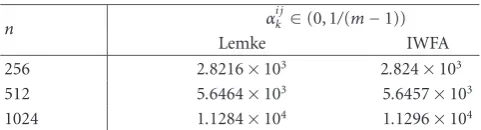
For the case with more (m =10) users, the situation is similar, as shown inTable 2. Indeed, whenαi jk ∈(0, 1/(m− 1)), the condition for the uniqueness of Nash solution is sat-isfied and the two methods have identical performance. The results in both tables show that IWFA solutions are compa-rable in quality to the respective solutions generated by the Lemke method. The difference in the solution qualities are due to the finite termination criteria we have used in both al-gorithms which can cause either algorithm to stop before an equilibrium solution is found.
6. CONCLUSIONS
In this paper we reformulate the DSL Nash game (resulting from the distributed implementation of IWFA) as an equiv-alent LCP, and apply the rich theory for LCP to analyze the convergence behavior of IWFA. Our analysis not only signif-icantly strengthens the existing convergence results, but also yields surprising insight on IWFA. In particular, in the case of symmetric interference, the users of IWFA in fact collab-orate unknowingly to minimize a common quadratic cost, even though their original intention is to maximize their in-dividual rates. Moreover, the LCP reformulation makes it possible to solve the DSL game with existing LCP solvers,
Table2: Average sum rate:m=10 user case.
n α
i j
k ∈(0, 1/(m−1))
Lemke IWFA
256 2.8216×10³ 2.824×10³ 512 5.6464×10³ 5.6457×10³ 1024 1.1284×10⁴ 1.1296×10⁴
such as Lemke’s method. With the latter as a benchmark, we show via computer simulations that IWFA tends to converge to good Nash solutions with high sum rates. Our theoret-ical and simulation work affirms the potential of IWFA as a promising candidate for the dynamic power spectra manage-ment in DSL environmanage-ment.
Several extensions of current work are possible. For ex-ample, under either the diagonal dominance condition of ρ(Υ)< 1 or the symmetric interference condition, one can establish the linear convergence of a distributed (partially) asynchronous implementation of IWFA. In particular, for the diagonal dominance case, one can use a contraction ar-gument similar to that in [13, page 493], while for the sym-metric interference case, use an error bound technique [14] to bound the distance from the iterates to the solution set of the quadratic QP (39). Asynchronous implementation is in-teresting from a practical standpoint since it does not require the DSL users to coordinate the timing of their power spectra updates.
As a future work, we are interested in further analyzing the behavior of IWFA under no assumptions on the crosstalk coefficients. Perhaps the compactness of the feasible set and the nonnegativity of the crosstalk coefficients already ensure the convergence of IWFA, or at least eliminate the possibility of finite limit cycles. These issues and the design of an effi -cient optimal power allocation algorithm for the nonconvex sum rate maximization problem are interesting topics for fu-ture research.
APPENDIX
BACKGROUND ON LCPs AND AVIs
In this appendix, we briefly summarize some technical back-ground related to the linear complementarity problems and affine variational inequalities. For a comprehensive treat-ment of these problems, the readers are referred to the two monographs [7,10].
Unifying linear and quadratic programs and many re-lated problems, the LCP is an inequality system with no ob-jective function to be optimized. Specifically, letMbe a given square matrix of ordern×nandqa column vector inRn. The LCP associated with (q,M) (denoted as LCP(q,M)) is to find x∈Rnsuch that
ismonotone; in this case, the solution set Sol(q,M) is convex (and polyhedral). IfMis symmetric, it can be easily seen that LCP(q,M) corresponds exactly to the KKT conditions for the following QP:
minimize f(x)≡1
2x
TMx+qTx subject tox≥0.
(A.2)
Therefore, the stationary points of above QP are precisely the solutions of the LCP(q,M). Moreover, the gradient vector
∇f(x) can be shown to be constant on each of the polyhedral piece of Sol(q,M). (IfMis in addition positive semidefinite, then Sol(q,M) consists of one polyhedral piece, so∇f(x) is constant over Sol(q,M).) WhenMis not symmetric, the above QP equivalence no longer holds. Instead, we can asso-ciate with the LCP(q,M) the following alternate QP:
minimizexT(q+Mx)
subject toq+Mx≥0, x≥0. (A.3)
In this case, a vectorxis a global minimizer of (A.3) with a zero objective value if and only ifx ∈Sol(q,M). Unlike the symmetric case, the KKT points of (A.3) are not necessarily the solutions of LCP(q,M).
The LCP can also be used to model a linear program (LP) via duality. Indeed, the following LP:
minimizecTx
subject toAx≥b, x≥0 (A.4)
is equivalent to the LCP(q,M) with
q≡
c
−b , M≡
! 0 −AT
A 0
"
, (A.5)
where the matrix M is skew-symmetric, thus positive semidefinite.
There are many algorithms developed for solving an LCP. Among them, Lemke’s method is perhaps the most versatile due to its weak requirements for convergence. Algorithmi-cally, Lemke’s method is a pivoting algorithm, much like the celebrated simplex method for an LP. As such, it is a finite method but suffers from exponential worst case complexity. Nonetheless, its simplicity and superior average performance have made it a popular choice in practice.
For monotone LCPs, we can also use interior point algo-rithms which offer polynomial complexity [15]. These algo-rithms exploit the positive semidefiniteness ofM and typi-cally require only a small number of iterations, albeit every iteration requires the solution of a system of linear equations of sizen×n. In the absence of monotonicity, interior point algorithms are not guaranteed to converge.
Another popular class of iterative algorithms for solving LCPs consists of thematrix splitting algorithms, which are based on the observation that a vectorx ∈Sol(q,M) if and only ifxsatisfies the following fixed point equation:
x=)x−α(Mx+q)*+, (A.6)
where [·]+ denotes projection toRn+ andα > 0 is any
con-stant. This suggests the following simple iterative scheme to compute a solution of LCP(q,M): for a givenstepsizeα >0 and an initial iteratex0≥0,
xr+1=)xr−αMxr+q*+, r=1, 2,. . . . (A.7)
This iterative scheme is called the gradient projection algo-rithm. If {xr}converges, then the limit must be a solution of LCP(q,M). More generally, we can split the matrixM as M = B+C for some matricesBandC and generate a se-quence according to
xr+1=)xr+1−αBxr+1+Cxr+q*
+, r=1, 2,. . . . (A.8)
Again, if the sequence{xr}converges, then its limit must be an element of Sol(q,M). The aforementioned gradient pro-jection is a special matrix splitting algorithm withB ≡ I/α andC≡M−I/α. IfBis taken to be the lower triangular part (including the diagonal) ofMwhileCis taken to be the strict upper triangular part ofM, then the resulting matrix split-ting algorithm simply corresponds to the well-known Gauss-Seidel method for LCP. In general, to ensure convergence, the matrix splittingM =B+Cmust satisfy certain conditions. For example, ifMis symmetric,BandB−Care both posi-tive definite, then the iterates generated by the resulting ma-trix splitting algorithm converges linearly to an element of Sol(q,M).
Much of the theory and algorithms for the LCP can be extended to the AVI of the following form: given the polyhe-dron,
P ≡+x∈Rn:Ax≥b,, (A.9)
findx∗∈Psuch that
(x−x∗)T(q+Mx∗)≥0 ∀x∈P. (A.10)
Within this framework, LCP(q,M) simply corresponds to the case whereA= I andb = 0. The solution set of an AVI is also the union of a finite number of polyhedral sets, which becomes a single (convex) polyhedron when M is positive semidefinite (themonotonecase). In general, a vectorxsolves the above AVI if and only if x satisfies the following fixed point equation:
x=)x−α(Mx+q)*P, (A.11)
where [·]Pdenotes the orthogonal projection operator onto P. Similar to the case of LCP, we can devise matrix splitting algorithms for solving the above AVI:
xr+1=)xr+1−αBxr+1+Cxr+q*P, r=1, 2,. . ., (A.12)
ACKNOWLEDGMENTS
We wish to thank Nobuo Yamashita for making his IWFA code available and Michael Ferris for helping with the Lemke code in the simulation work reported in this paper. The re-search of the first author is supported in part by the Natural Sciences and Engineering Research Council of Canada, Grant no. OPG0090391, by the Canada Research Chair Program, and by the National Science Foundation under Grant DMS-0312416. The research of the second author is supported in part by the National Science Foundation under Grants CCR-0098013 and CCR-0353073.
REFERENCES
[1] K. B. Song, S. T. Chung, G. Ginis, and J. M. Cioffi, “Dy-namic spectrum management for next-generation DSL sys-tems,”IEEE Communications Magazine, vol. 40, no. 10, pp. 101–109, 2002.
[2] G. Cherubini, E. Eleftheriou, and S. Olcer, “On the optimal-ity of power back-offmethods,”American National Standards Institute, ANSI-T1E1.4/235, August 2000.
[3] R. Cendrillon, M. Moonen, J. Verliden, T. Bostoen, and W. Yu, “Optimal multiuser spectrum management for digital sub-scriber lines,” inProceedings of IEEE International Conference on Communications (ICC ’04), vol. 1, pp. 1–5, Paris, France, June 2004.
[4] W. Yu, G. Ginis, and J. M. Cioffi, “Distributed multiuser power control for digital subscriber lines,”IEEE Journal on Selected Areas in Communications, vol. 20, no. 5, pp. 1105–1115, 2002. [5] S. T. Chung, S. J. Kim, J. Lee, and J. M. Cioffi, “A game-theoretic approach to power allocation in frequency-selective Gaussian interference channels,” inProceedings of IEEE In-ternational Symposium on Information Theory (ISIT ’03), pp. 316–316, Pacifico Yokohama, Kanagawa, Japan, June–July 2003.
[6] S. T. Chung, “Transmission schemes for frequency selective Gaussian interference channels,” Doctral disseration, Depart-ment of Electrical Engineering, Stanford University, Stanford, Calif, USA, 2003.
[7] R. W. Cottle, J.-S. Pang, and R. E. Stone,The Linear Comple-mentarity Problem, Academic Press, Boston, Mass, USA, 1992. [8] C. E. Lemke, “Bimatrix equilibrium points and mathematical programming,”Management Science, vol. 11, no. 7, pp. 681– 689, 1965.
[9] N. Yamashita and Z.-Q. Luo, “A nonlinear complementarity approach to multiuser power control for digital subscriber lines,”Optimization Methods and Software, vol. 19, no. 5, pp. 633–652, 2004.
[10] F. Facchinei and J.-S. Pang,Finite-Dimensional Variational In-equalities and Complementarity Problems, Springer, New York, NY, USA, 2003.
[11] Z.-Q. Luo and P. Tseng, “Error bounds and convergence anal-ysis of feasible descent methods: A general approach,”Annals of Operations Research, vol. 46, pp. 157–178, 1993.
[12] D. Braess, “ ¨Uber ein Paradoxon aus der Verkehrsplanung,”
Unternehmensforschung, vol. 12, pp. 258–268, 1968.
[13] D. P. Bertsekas and J. N. Tsitsiklis, Parallel and Distributed Computation: Numerical Methods, Prentice-Hall, Englewood Cliffs, NJ, USA, 1989.
[14] Z.-Q. Luo and P. Tseng, “On the rate of convergence of a dis-tributed asynchronous routing algorithm,”IEEE Transactions on Automatic Control, vol. 39, no. 5, pp. 1123–1129, 1994.
[15] M. Kojima, N. Megiddo, T. Noma, and A. Yoshise,A Unified Approach to Interior Point Algorithms for Linear Complemen-tarity Problems, vol. 538 ofLecture Notes in Computer Science, Springer, Berlin, Germany, 1991.
Zhi-Quan Luo received the B.S. degree in mathematics from Peking University, China, in 1984. During the academic year of 1984 to 1985, he was with Nankai Institute of Mathematics, Tianjin, China. From 1985 to 1989, he studied at the Department of Electrical Engineering and Computer Sci-ence, Massachusetts Institute of Technol-ogy, where he received the Ph.D. degree in operations research. In 1989, he joined the
Department of Electrical and Computer Engineering, McMaster University, Hamilton, Canada, where he became a Professor in 1998 and held the Canada Research Chair in information processing since 2001. Starting April 2003, he has been a Professor with the Department of Electrical and Computer Engineering and holds an endowed ADC Research Chair in wireless telecommunications with the Digital Technology Center at the University of Minnesota. His research interests lie in the union of large-scale optimization, infor-mation theory and coding, data communications, and signal pro-cessing. Professor Luo is a Member of SIAM and MPS. He is a recip-ient of the 2004 IEEE Signal Processing Society’s Best Paper Award, and has held editorial positions for several international journals including SIAM Journal on Optimization, Mathematics of Com-putation, Mathematics of Operations Research, and IEEE Transac-tions on Signal Processing.
Jong-Shi Pangwith a Ph.D. degree in oper-ations research from Stanford University, he is presently the Margaret A. Darrin Distin-guished Professor in applied mathematics at Rensselaer Polytechnic Institute in Troy, New York. Prior to this position, he has taught at The John Hopkins University, The University of Texas at Dallas, and Carnegie-Mellon University. He has received sev-eral awards and honors, most notably the