LEXICAL PHONOLOGY AND SPEECH STYLE: U S I N G A
MODEL TO TEST A THEORY
Sheila M. Williams
Department o f Computer Science, University o f Sheffield Regent Court, 211 Portobello Street
Sheffield, UK S I 4DP email: s.williams@ dcs.shef.ac.uk
ABSTRACT
This paper presents LexPhon, a c o m p u t a t i o n a l f r a m e w o r k for m o d e l l i n g s e g m e n t a l a s p e c t s o f L e x i c a l P h o n o l o g y (LP). After describing the LexPhon system and i n d i c a t i n g h o w it may be set to r e p r e s e n t a l t e r n a t i v e l a n g u a g e descriptions within LP, its potential application in the characterisation of s p e e c h s t y l e c o n t r a s t s is demonstrated through a s m a l l - s c a l e study.
1. INTRODUCTION
The theory of lexical phonology (LP) seeks to explain the inter-relationships between morphology and phonology by allocating some of the phonological processes to the dictionary or lexicon in which the morphemes reside. The functions of brackets and boundary symbols found in other phonological representations are subsumed into the framework of the system. The domains of both morphological and phonological rules within the lexicon are subdivided into strata which define both the type of morphological process applicable and the mode of operation (i.e. whether cyclic or non.cyclic) of the associated phonological rules. Processes applied on early strata are invisible to those of later strata through the application of the "Bracket Erasure Convention".
A computational system, LexPhon, has been devised to demonstrate the principles of LP. LexPhon comprises a level-ordered phonological interpreter and a set of linguistic tools for reformulating the stratum control, developing phonological rule sets and for devising phoneme inventories, including natural class categorisation tools for making explicit the conjunctive relationships between the elements of the inventories derived.
Aspects of LP incorporated into LcxPhon are the Strict Cyclicity Condition, Bracket Erasure and both cyclic and noncyclic control mechanisms. Syllabification is based on the Maximal Onset Principle and fully-specified underlying representations are assumed. The number of strata and attribution of each stratum to either cyclic or noncyclic control is variable by the user. Ordered sets of phonological rules are allocated to strata.
LexPhon is used for comparison of potential structures for the level-ordered frameworks within which the phonological rules operate and for alternative formulations and assignments of the rules themselves. Conclusions can be drawn about the effectiveness of each from the broad phonemic transcriptions resulting from applying any given setting of the system to large quantities of data and from the processing traces also provided.
An example is given of the application of LexPhon to the study of speech style, using data from reported studies of English and Mexico City Spanish and its ability to model the alternative surface forms evidenced by the data, through the re-allocation of the same set of phonological rules to different strata, is evaluated.
2. LEXlCAL PHONOLOGY ( L P )
Lexical phonology (Kiparsky, 1982; 1982b; Halle and Mohanan, 1985, Booij and Rubach, 1987; and many others) is a recent
approach to g e n e r a t i v e p h o n o l o g y
(Chomsky and Halle, 1968) in which the application of the phonological rules, which map from the abstract, underlying form of a word to its surface, phonetic realisation, is tied to the morphological word formation ~ processes taking place.
is stratum-depndant. Thus, LP ties the application of phonological rules to morphological structure in a particularly close way. It provides a highly structured framework in which to develop and evaluate
the rules and r e p r e s e n t a t i o n s for
phonological transformations. However, while there is considerable support for the theory of stratification of morphological rules and the cyclic nature of the application of some phonological rules, opinion is divided as to the number of strata required and the level(s) to which each of t h e identified phonological rules is assigned in any given language and further, as to whether such higher level control structures are universal (Booij and Rubach, 1987) or language specific (Kiparsky, 1982, Halle and Mohanan, 1985).
In addition to linear representations, LP accounts of linguistic phenomena are frequently formulated within the formats provided by autosegmental and metrical, or nonlinear phonology (for examples see Tranel, 1987; van der Hulst and Smith, 1982; Halle and Vernaud, 1982; Leben, 1982; etc.). LP descriptions usually adopt the two principle tiers from autosegmental phonology, the melody and the skeleton, to represent the data. Further layers and/or the hierarchical representations of metrical p h o n o l o g y may be introduced when
required.
The melody corresponds roughly to the linear representation of segments whereas the skeleton carries the positional or timing
i n f o r m a t i o n in x-slots. The x-slots,
sometimes further distinguished as C and V slots, generally correspond one-to-one with the segments and are anchored to elements of the melody tier. However, in the case of long vowels, for instance, two skeletal slots may be attached to the same vowel. Empty slots and floating segments are a l s o permitted by this theory.
Both morphological and phonological higher level structures may be attached to the skeleton tier allowing other levels of organisation, such as onset and rime within syllables, to be represented, if required.
Nonlinearity of both morphology and phonology is incorporated into LP through the structuring of the lexicon and the independence of syllabification from the word-formation process. For LexPhon, the concept of timing slots has influenced the choice of multiple segment descriptions for long vowels and diphthongs.
44
Syllabification, where needed, is derived from the current segmental representation which thus reflects both the melody and skeleton tiers.
However, by permitting features and their domains to be independent of the segment, autosegmental phonology also allows for the description of feature and tonal units smaller than a single segment. This aspect has not been utilised in the current system.
3. THE LEXPHON SYSTEM
LexPhon is implemented in Prolog, using LPA MacPROLOG and is based on principles of lexical phonology.
LexPhon is a collection of interactive linguistic tools comprising a phonological processor, or interpreter, sets of processes for creating and updating ph o n e m e inventories, phonological rule-sets and LP control structures and investigative tools for exploring relationships within the phoneme inventory.
The phonological processor takes as input the underlying forms of the m o r p h e m e s believed to contribute to a particular word and produces, as output, a broad phonemic transcription of the resulting word. To do this, the processor applies sets o f phonological rules to the developing word
string, at each level, or stratum, of
morphological development, in order to demonstrate the transformations required to produce the attested surface representations of the utterance.
LexPhon allows the user to experiment with underlying forms, the structure of the rules to be applied, the ordering of the rules, their application within cyclic or noncyclic stratum control and the definitions of the
segments to be manipulated. The
investigative tools allow the segment definitions of the phoneme inventory to be interrogated to find groups of segments answering particular feature descriptions and to find alternative descriptions of specified groups of segments.
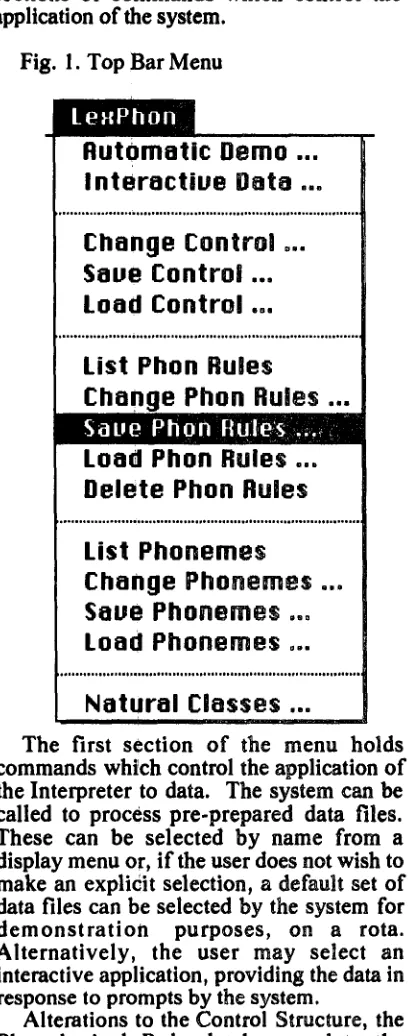
intermediate levels being present to select the appropriate action to be taken. The top level of the hierarchy is accessible to the user via a pull-down top-bar menu containing five sections o f commands which control the application of the system.
Fig. 1. Top Bar Menu
A u t o m a t i c D a r e d ... I n t e r a c t i v e D a t a ...
. . . . , . , , , , , . . . . . . . . . . , . . . . . . o . . .
C h a n g e C o n t r o l o..
S a v e C o n t r o l ... L o a d C o n t r o l .°.
L i s t P h o n R u l e s
C h a n g e P h o n R u l e s ...
L o a d P h o n R u l e s ... D e l e t e P h o n R u l e s
. . . . . . . . . ° ° . , . . , . ° . , , . . , . , . . . . . , . . . , . , . , . . .
L i s t P h o n e m e s
C h a n g e P h o n e m e s ... S a v e P h o n e m e s ..° L o a d P h o n e m e s o..
. . , . . , ° , , . . , . . , . o ~ , . , . . . , . ° . , , ° . , , . , ° o . . , . , , , , , . . , . , . , , . . , . , . , , ° , . , , . , , , . . , , . ,
N a t u r a l C l a s s e s ...
The first section o f the menu holds commands which control the application o f the Interpreter to data. The system can be called to process pre-prepared data files. These can be selected by name from a display menu or, if the user does not wish to make an explicit selection, a default set of data files can be selected by the system for
d e m o n s t r a t i o n purposes, on a rota.
Alternatively, the user may select an interactive application, providing the data in response to prompts by the system.
Alterations to the Control Structure, the Phonological Rule database and to the Phoneme Inventory may be made through the commands provided in the second, third and fourth sections o f the control menu, respectively. Commands are provided to allow the user to list the phoneme and rule descriptions represented by the appropriate sections o f the database and to alter or
replace them as necessary. The Interpreter
c o m m a n d s m a y then be called to
demonstrate the effects o f the changes. The c o m m a n d s provided in the last section o f the menu allow the user to investigate relationships b e t w e e n the members of the current Phoneme Inventory. The user can choose to analyse this database by entering a list of segments by name and receiving one or more categofisations by common feature values or by entering a list o f features with associated values and receiving a list of all segments in the current inventory which satisfy those values.
3.1 Representations
There are basically four different types o f data upon which the processor must operate.
The first and most obvious one is the
word
string,
the representation of the word itself at each of its levels during the word formationprocess. Associated with this is the
phoneme
representation, as each o f the fundamental segments, or phonemes, which make up the word string has a complex structure which serves to establish its relationship to all the other phonemes used by the language under study.W i t h i n the t h e o r y o f LP both
phonological
rules
andstrata
h a v e paramount significance because it is through their interaction that the surface alternations between morphologically related words o f the language are explained.Although the representation o f the affixation process is itself inherent in this interaction process, an affix m o r p h e m e representation has also been devised for LexPhon, to enable the user to dictate the
levels at w h i c h a f f i x a t i o n data is
incorporated into the word string when the full underlying form is presented to the system by means of a data file.
3.1.1 Phonemes
Phonemes are represented by simple predicates o f two arguments, the name, which is a phonetic character, and the feature specification. The phoneme inventory is
fully-specified
for all the features used by Halle and M o h a n a n ( ! 9 8 5 ) in theirdescription o f LP for English. The
[image:3.596.66.270.138.656.2]that 2-valued logic ~s c ~ , p l o y ~ ~ queW t~e database.
T w o separate lists o f feature ~ r a e s are available so that vowels can be specified for tenseness whereas consonants are specgfied for stridency. This is a co:~p:o:~:~s~ ~zkzt~9~ to balance the objectives c~ ~ct ~r.ovi,$~ng values for irreleve.nt fea~,~':~s, wkE~ a:Y=e~::~:~ as closely as possible tc X~e ~ba~u~e ~e~ e m p l o y e d b y Halle arid ~¢~har,~an, and ~i~.e computational efficiency oblained by having both the minimal n u m b e r o f features and feature matrices o f the same dimensior~s for all s e g m e n t s and r~.ay ke~vc ~r~gu~'.~t~c implications (Wi~ia~z, ~.~>~. ...
Example o f vowel:
a n t e r i o r , - h i g h , + t o w , - b u c k ,
- r o u n d , - n a s a l , + c o n t ~ n u a n t , + v o i c e d , - t e n s e .
Example o f consonant:
- s y l l a b i c , "~- c ~.~ ~ ~ ~~ ~ ~ ~
a n t e r i o r , + h i g h , - l o w , - b a c k ,
- r o u n d , - n a s a l , - c a n ' ~ n u a n t , - v o i c e d , + s t r i d e n t
V o w e l s do n o t have ~ fee.Sure specification for length as a~ ~he v~wc~s ~n the i n v e n t o r y are ' s h o r t ' a n d ' p u r e '. Diphthongs and long vowels are represented as two consecutive segments.
I f the application o f a phono[eg~cal ruse, whose conditions are o f i ~ e ~ . ~ ~a~!sfied, would result in the fcr~a~c~, c~' r.. seg~c~* with a feature description which does hoe currently appear in the p h o n e m e ~avemory then the segment is created and added to the inventory. The name for the new ~%~nent ~ g e n e r a t e d by concatena1~,g ~7~?: ~f ~ e s e g m e n t to w h i c h ~ r a n s f o ~ . ~ [ e n a were applied in order to construct i~, wit~ a un~3~e number. This enables the user ~ be abte to trace the p r o c e s s e s whack ~ed to its formation.
3.1.2 Word Strings
W o r d S t r i n g s are o r d e r e d lists o f elements which represent the current state o f the word form, or working string, at any stage o f the derivational process.
e . g .
4 6
:: ( i : ~ , ~ ~:~ ~ , ~ ~ ~ b a u nd a r y ]
~ c ~ : o n to segment names for each p~::.~:~c.~ !'cT7.:e.e~t*d, t~.e word string may
c ... , ~&.,.~, .. . . c~o,~ary m a r k e r s and :.:..~.:~.~:~ ... ~f~::.xat~on w h i c h has ,~.~ ... ~ ... ":~ .... ~"~ ~u~ent stratum. Each s~:.':: =:. ~:=:~ ~.c~::, ~:.~ application predicate
wi~:L:::. ~ ~ : ~ : u m ~akes an input string and ins~nt~,atcs a variable to the string which is the ~:c~ul~ o f its a p p l i c a t i o n . T h e p b . o ~ . ~ , ~ t ~ ¢ , 'p~Ie', predicates operate
. . . ~'~<"~ o f :k~ current word string EFt, ~', .: ...
w~,f.c~,7. ~5~:.~ " : ~ : . ~ . ~ context required by :~...~, ..~.:~r~. ~ e result o f their
t ~ c ~ : . : . : . ~ . ~ f . ~ z . ~ ~ ~ e c : a c e m c n t word stnng
~,=~'i~ ~ f ~ r ~ ~ f f i x a t i o n a t
~ ~ : 2 = [ w o r d b o u n d a r y ,
~ t, ~, ~, ~, ~ o r d b o u n d a r y ]
~; ... ~ . . . . ~ " ~ ' ~ ' ~ * " ~ ~'~|~ " £ - ) I =
... ~ ~:-,,o ::.~ :% n, n, n, p, p,
~" ~!, ~ i'. (;~ ~ = [ I , I , n ,
T~is vowel-shift rules applies w h e n its co~en~ ma~chc~ ~ two instances o f the same
V@V.~3~ ~ 5 c ... ~ ~ each other. ~ ~ ~ " In this
c.~: ... .~ ... , %.:~ ~.p~es to vowels which
7 ~ , , , , ~ ~ ~
~:~ ,,_~.~, 0:.~o~ c : ~ , ~ = ~ ~e~¢ value o f the feature I d A . T ~ C 1~, c : m . r . h i g h becomes + h i g h or +,~iJ~ ~-~.~.~,,~ . . . ~ i ~ h . The r e p l a c e m e n t seg~.¢~:~ ~ c r e ~ e d b y a p p l y i n g a ' . . . ~ ... ' ~ # ~ " ~ which takes the value ... ~.,,::,, .... ~ a t c h e s the context ~::.~ ~. ~.~.~ c . c:~..~z~ges, in this case £ , [high, p~. ,.,.~,~ ~ , ~ f ~ is ' p ' , for positive, ... ~'~ ° f~= h i g h in E is ' n ' (for The ° r ~ c c n s ~ c ~ ' predicate reports the l ~ 9 f both ~n~ source p h o n e m e ( £ in this e x ~ p ~ e ) and the resulting p h o n e which it haa created (x in this example) and lists the full set o f feature values for the new phone. I f the phone matches a description in the
name of that phoneme. Thus, in the output of both the rule (shown as the partial string beginning with the start of the context) and the stratum, two instances of the phoneme x replace the two instances of the phoneme E found in the input string.
In the case of data provided from data files, the word string may also contain atomic elements representing word and compound boundaries and affixes to be
applied at particular strata. The actual
w o r k i n g string(s) consists of any consecutive sequence, within the word string, o f segment names and ' n e w ' boundary markers (i.e. the boundary markers which denote junctures within the current stratum).
e.g.
l w o r d b o u n d a r y ,
c o m p b o u n d a r y ,
g, r, c, c, n,
c o m p b o u n d a r y ,
h, ~, ~,
s,c o m p b o u n d a r y ,
los2, nE:s2,
w o r d b o u n d a r y ]
The level of affixation of an atomic m o r p h e m e is denoted by a number concatenated to the end of the string of segments which represents its underlying form. This is matched to a list of potential affixation types which forms one of the parameters to each stratum definition predicate. Markers denoting compound boundaries must be inserted before, between and after, the lists of elements defining the components to be attached by compounding, to ensure that associated affixes are conjoined in the correct order. In this case more than one current working string may be being processed at any one time within the word string.
As with the interactive word string representation, an atomic structure called 'new' is included in each affix segment list when the affixation process takes place and the morpheme is expanded into its component segment names, to provide an explicit juncture which may be required for the context of some of the phonological transformation rules.
e.g.
[ w o r d b o o n d a r y , g, r, ee, x, n,
Dew, h, a, o, s, n e w , 1, c, s,
new, n, E, s, w o r d b o u n d a r y ]
These extra items are deleted at the end of the stratum in which they are introduced to
ensure that the junctures from that stratum arc not visible to later strata.
3.2 Phonological Rules
Phonological Transformation Rules may involve replacement, transposition, deletion or insertion of segments.
Each rule is represented in the data-base by a Prolog predicate with six arguments.
e.g.
prule(3, [I, s, xl Rest], [x, z, xl
Rest], 's -> z
/ z ... x .
',
scc,
nsyll):-!.
The first parameter is the rule number " which is used in rule ordering and in allocation of rules to strata. The second and third parameters represent the string to be replaced by the rule and the substitution string respectively. Each consist of a list of one or more phoneme names (and possibly new morpheme boundary and/or syllable boundary atoms) or variables, designating the segments undergoing transformation and their contexts, and a list variable to be instantiated to the remainder of the working string. The list variable ensures that the remaining part of the word list, which has not taken part in the transformation, is maintained in its current form as part of the word list.
Where a segment is represented by a variable or a feature bundle, the predicate will normally have one or more clauses to be invoked to satisfy the conditions on that segment. Thus, in the general case, the head of the prule predicate will be followed by a list of clauses representing the conditions to be satisfied in order for the rule application to succeed and the operations to b e performed to instantiate all the relevant information for its consequences to be implemented.
e.g. the diphthongization rule
prule(46,[Phon,Phon l Rest],
[ P h o n , N e w p h o n i R e s t ] ,
'V
->
[ + h i g h , - l o w , i x r o u n d ]
/
[V,
+vowel, txback,-high]
. . . .
',
scc, nsyll) :-
f e a t u r e ( P h o n , c o n s o n a n t al,n),
a l p h a ( b a c k , V a l , P h o n ) ,
Features,[high,p,low,n,round,
• V a l ] ) .
Each rule also has a parameter which is the atomic form of the linguistic description
of the rule. This is used for display
purposes in listing the rule and, in the case o f a rule w h i c h has b e e n g e n e r a t e d interactively, will be the actual string from which the rule has been generated by the system.
The last two parameters which must be specified for each rule denote whether it obeys the Strict Cyclicity Condition and whether it requires that the string to which it is to be applied has been syllabified prior to application. The SCC marker must be set explicitly by the user when generating the rule but the syllabification marker will be set a u t o m a t i c a l l y d u r i n g interactive rule generation if the context for the rule contains a syllable boundary marker.
The rules in phonological rule database are explicitly ordered by means o f their identifying numbers. Phonological rules can be represented disjunctively in the database, if necessary, by asserting a series of rules in the Prolog code, all allocated to the same rule number.
Explicit variables can be attached to segments to indicate that two or m o r e segments must be identical in a particular context.
An interactive rule interpreter is provided which accepts a wide range of input formats including segment labels, feature bundle descriptions, or-notation and s e g m e n t variable labels and translates the linguistic formulation o f a phonological rule into Prolog predicates which implement it.
3.3 The Control System
After a c c e p t i n g the root form, the interactive control system calls the stratum control mechanism to act upon the working string by recursing over the current stratum definitions until all the processes associated with each o f the strata defined have been
applied. A s i m i l a r m e c h a n i s m is
implemented to operate upon data predicates read from data files. These mechanisms are implemented by means o f tail recursion. Failure of the main predicate which defines the control mechanism allows a second predicate to be invoked. This will always succeed, returning the current value of the
working string as the value o f the result variable.
Each call to the s t r a t u m c o n t r o l mechanism is invoked with the stratum number variable already instantiated. Thus, the top-level call passes 1 as the stratum number for the first level o f processing.
eg. the control predicate which governs processing for data input interactively has the following definitions:
d o _ a l l _ s t r a t ( N u m b e r ,
I n p u t ,
Output):-
stratum(Number, First, Last,
_ , C y c l e ) ,d o - s t r a t ( N u m b e r ,
I n p u t ,
Nextstring, First, Last, _ ,
C y c l e ) ,I
Nextnum is Number +
1,do_all_strat(Nextnum,
Nextstring, Output).
do_all_strat(_, String, String).
4 8
and is initially called with
Number
instantiated to I and
Input
instantiated to thewordlist consisting o f the segments o f the
root
morpheme.Assuming that a stratum I exists in the current control structure (ie. that there is at least one stratum in the currently modelled system), this stratum definition is matched by the first clause which thereby instantiates all the variables necessary to implement the
processing
o f the first stratum. Thesevariables are then passed to another predicate 'do_strat' which carries out the processing, returning the final state o f the working string at the end of the stratum, instantiated to the
variable
Nextstring.
The number o f the nextstratum is then calculated and this is then used, together with the value o f the current working string, to call the next stratum by
re-applying the same predicate. This
continues until the 'stratum' predicate fails to match, indicating that no further strata have been defined for this model o f lexical phonology.
The first predicate o f 'do all strat' then fails also and the second predicate is then invoked, always succeeding, associating the
value of the current working string
(Input)
tothe
Output
variable of this last stratum call.This is instantiated to the
Output
variable inthe call w h i c h generated it and thus
instantiated to the
Output
variables in allvalue of the final variable in each call. Thus
the value o f
Output
returned from the firstcall to the 'do all strat' predicate is the same
as that o f the working string
(Nextstring)
atthe end o f the last call which found a new stratum to apply.
As each call to the stratum control mechanism is invoked with only the stratum number instantiated, it must first attempt to unify the remaining control variables in the call with the associated values in a predicate of the stratum definition database which defines the stratum identified by that number, if such a stratum exists. I f no matching predicate is found for this level then the call s u c c e e d s without further recursion by means o f the second control predicate.
Further processing is then carried out to convert the working string from the list form, in w h i c h the segments may be individually manipulated, to a character string. At this stage all the segments in the
list should be s y m b o l s r e p r e s e n t i n g
p h o n e m e names. The resulting string
represents the broad phonemic transcription which is the product o f the Processor.
e.g.
Phonemic
Transcription:
sizzInlrJ
In the case o f data supplied from file, it may happen that, if affixation processes which can only be resolved at later strata separate affix atoms for earlier strata from the root form, then these earlier affixes will never be resolved. Also, if the application o f a p h o n o l o g i c a l r u l e i n v o l v e s a transformation upon a segment which results in the creation of a new segment not listed in the current p h o n e m e inventory, segment descriptors may remain in the working string at the end o f processing. In either of these cases, an appropriate message will b e generated a n d the working string will be displayed in its list form in place o f the phonemic transcription which results from a completely successful application o f the system.
e.g.
Unresolved atoms in t h e
final working string
[wordboundary,compbounda
ry,s,p,o,o,n,s,compboundary,
f,u,l,compboundary,wordbou
ndary]
The phonological rules are applied, in numerical order, in blocks defined by the stratum definition predicates. These blocks must each contain a contiguous set o f rules from the current data-base, the o n l y restriction being that the last rule number specified must be the same as or higher than the first rule number. Thus, blocks m a y overlap and the rules attached t o a later stratum need not be defined later than those attached to earlier strata. Although rules are applied ordinaily within each stratum, there is no requirement that a rule must be defined for every number within the range o f that stratum.
3.3.1 Control Mechanisms
Cyclic and noncyclic Stratum Control Mechanisms are defined and govern the ordering o f morphological affixation and phonological transformation phases for each stratum.
For cyclic application, the relevant rules for the stratum are applied to any appropriate contexts in the current w o r k i n g string, subject to the SCC condition which prevents application o f any rule w h i c h has been marked for SCC, on this cycle, and then the appropriate morphological affixation process is invoked. For interactive use, an interface is provided to elicit and validate the data in the correct format. Data supplied from a datafile is validated and checked against the stratum information to ensure that the current stratum is an appropriate level at which to incorporate it into the w o r d s t r i n g . Following every subsequent affixation at the same stratum, the p h o n o l o g i c a l rules assigned to that stratum are reapplied.
In non-cyclic strata, all affixation takes place before the associated block o f phonological rules is applied, once only, to the outcome of the affixation process.
the Halle and Mohanan model, the only possible morphological process at stratum 3 is compounding.
However, in order to make the system as flexible as possible, the 'hmspecial' predicate set, which controls the order of application of morphological a n d phonological processes, has been extended to include all types of affixation normally possible, in parallel with the normal cyclic control mechanism. Only compounding causes the loopback mechanism to be invoked even if other classes of affixation have been authorised at stratum 3. The loopback mechanism returns the current working string unchanged if no affix is found but invokes the phonological rule predicate followed by the normal 'cyclerule' predicate if affixation has been successful. This enables further affixation to take place, if necessary, cycling through stratum 2 for each affixation process.
As this is an extension to the stratum 3 affixation process, no bracket erasure takes place between the two strata during the looping process. A single application of the bracket erasure predicate is invoked only on final completion of stratum 3, i.e. when there is no further compounding and no further stratum 2 affixation to be processed. This means that all the 'new' conjunction atoms introduced at both stratum 2 and stratum 3 are available throughout this operation.
This mechanism raises many theoretical problems. However, the objective of its implementation in LexPhon was to ascertain the closest possible correspondence to the descriptions provided by Halle and Mohanan (1985) in order to explore its consequences, so it is sufficient to note here that practical demonstrations (Williams, 1993) indicate
that the loopback m e c h a n i s m is
unnecessarily cumbersome and does not achieve the consequences predicted for it.
The Halle and Mohanan description was chosen as the default model as it is both the most complex and the most completely specified model of LP available. Other descriptions of LP were taken into account in trying to make LexPhon sufficiently flexible to be utilised in contrasting a wide variety of approaches to LP.
In addition to being a tool for developing linguistic descriptions, it is intended that the processor should itself be a model of the control structures of LP.
Although the system has not yet been applied extensively to languages other than English, one of the fundamental tenets common to the various approaches to LP is that the mechanisms which apply the rules are language independent but that the phoneme inventory, the morphological and phonological rules and the number and cyclicity of the strata are language dependent (Kiparsky, 1982; Halle and Mohanan, 1985; but see also Booij and Rubach, 1987, for universal model of stratification). The system has been developed to reflect this view with the modules which represent the phoneme inventory, the rulebase and the stratum definitions being independent and
interactively changeable. This also
facilitates comparisons between alternative models of the same language.
3.4 Summary o f the LexPhon default model.
The default phonological interpreter is based on Halle and Mohanan's (1985) detailed description of LP which provides for a framework of five strata, four of which operate within the lexicon. The postlexical and second lexicai strata are noncyclic, all other strata being cyclic in application. Although fundamentally cyclic, stratum 3, the level at which compounding takes place, has a much more complex structure allowing for backtracking to stratum 2 under specific
circumstances. LexPhon can b e
reconfigured by the user to provide for potentially any number of strata, each of which must be designated as cyclic or noncyclic.
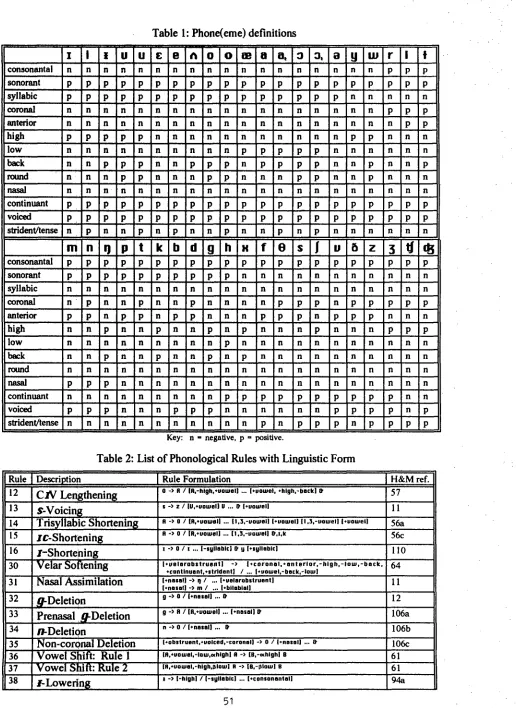
The default databases of the LexPhon system comprise the phoneme inventory containing the 42 phonemes listed above, 24 of the rules suggested by Halle and Mohanan (1985) and the five stratum model also proposed by Halle and Mohanan. Descriptions of the current state of each database can be invoked from the LexPhon system menus. The default definitions are summarised in the tables below.
The segment label / y / a p p e a r s in the defailt phoneme inventory so that the Halle and Mohanan rule specifications could be matched as closely as possible for the default rule set. It is exactly equivalent to the IPA symbol / j / m o r e commonly used for the same feature specification.
coronal anterior l high
Table 1: P h o n e ( e m e ) definitions
I x I '
l, lulul,lol l
o o = ,
a, o 3, o y w r , l t= o n s o w t a l l n l n l n l n l n l n l n l n l n n . n n n n n n n p p p
s o . o = t
Ipilp [P IP IP IP
IP IP IP
P P P P P P P P P P P Psyllabic
[P JP i p[P [P iP IP IP IP
i P P p p p p p n n n n nI n I n l n l . l n l n l n l n l n n n n n n n n n n p p p I n I . I n l n l n l n l n l n l n n n n n n n n n n n p p I p [ p [ p [p [p [n i n [n [n i n n n n n n n p p n n n low I n I n I n I n I n I n I n I n I n n p p p p p n n n n n n
back [n [ n i p l p i p [ n i n l p l p p n p p p p n n p n n p
~ou~d I n I . [ n [ p [ p In I n In [p p n n n p p n n p n n n i n I n l n l n l n l n l n l n l n n n n n n n n n n n n n continuant I P l I P [P I p I p IP IP [P IP P P P P P P P P P P P P voiced I P l l p [ p [ p Ip I p [ p [p I p p p p p p p p p p p p p strident/tenseln IP In I n IP In IP In In p n n p n p n n n n n n consonantal ]
s o n o r n l l t
m
syllabic
i
eomnsJ anterior
high
low back round
continuant voiced strident/tense
HCH[igDl[llmDmn l
I I . , . . , . . , = = . , . . , - . , . . , - . , - . , . n D
l = , l = , l m . ~ i ~ n . ~ = , l e . ~ i . ~ i z , l e . l l [ ~ l - , l I ~,!111 I~,!1 . , l I~,ll I:,ll I I - , l - , l ~ !
3 " - " = " - " = " - " = " = " - " = " = I I
I i , l . , - . , - - . , - . , - - = , - . , - . , - - = , - . , - l l ~ l l
i - , - - , - . , - . , - - , - . , - = , - . , - - , - l l l l
I, ~ i m i ~ l i ~ l i ~ l i . ~ l l ~ i n ~ i i . ~ l , ~ - , l [ ]
l l l l l l l l b l / l ~ l ~ l / l l ~ l l l [ ]
K e y : n = n e g a t i v e , p = p o s i t i v e .
Table 2: List o f Phonological Rules with Linguistic F o r m Rule ] Descriptio n
12 C i V L e n g t h e n i n g 13 s - V o i c i n g
14 Trisyllabic S h o r t e n i n g 15 / c - S h o r t e n i n g
16 / - S h o r t e n i n g 3o Velar S o f t e n i n g 31 Nasal Assimilation 32 g - D e l e t i o n
33 P r e n a s a l ~ D e l e t i o n
34 n-Deleti0n
35 N o n - c o r o n a l Deletion 36 V o w e l Shift: Rule 1
37 V o w e l Shift: R u l e 2 3S Z . L o w e r i n 8
Rule Formulation H&M ref.
0 -> A / lA,-hlgh,+vowel] ... [+vowel, +hlgh,-ba¢k] & 57
s -> z / [U,+uowell U ... & l+uowell ] ]
A -> 0 / [A,tvowel] ... l l , 3 , - v o w e l l [ * v o w e l l I t , 3 , - v o w e l ] l * v o w e l ] 5 6 a
R -> 0 / [R,+vowal] ... [ l , 3 , - v v w e l ] &,l,k 56C
! -> 0 / t ... ]-syllabic] & y l+syllobic] ] l O
i * v o l a r o b s t r u a n t ] -> i * c o r o n a l , + a n t e r i o r , - h l g h , - l o w , - b a c k , 6 4 +contlnuant,*strldont] / ... ]+uowel,-bock,-Iow]
[+nasal] -> q / . . [+uelarobstruent] ] ]
[*nasal[ -> m / ... [*bilabial]
g -> 0 I i+nasal] ... & | 2
g -> A I [A,+vowell ... [+nasal] & ] 0 6 a
n -> o I [+nasal] ... & ]06h
[*obstruent,+volced,-coronal] -> 0 I i*nasal] ... & ] 0 6 C
[A,+vowel,-low,ochlghl R -> [B,-o~hlgh] e 6 ]
[R,+vowel,-hlgh,51ow] R -> [e,-plowl 8 6 ]
[image:9.596.57.574.65.773.2]39 40
41 42 44 45 46 90 96
98
/-Lengthening Spirantization
y-Insertion Palatalization ~Deletion
0 -> O / [-sylleblc] [U,*vowei,*hlgh, +back.-roundl ... [-syllabic]
[+obstruent,+coronal] -> [+conUnuant, .strident] / [*sonorant] ... y
[.obstruent,.coronal[ -> [*contlnuant, .strident] / [-conUnuant] ...
0 -> y / [.consonantall ,.. [*vowel, .hlgh,*back,-round]
[.obstruent,+coronal] -> [-anterlor,+hlgh, - l o w ] / ...
y -> 0 1 [*coronal,-anterlor] ...
95 85
93 80 81
Vowel Reduction u -, o / [u,-vowe,] ... r
Dipthongization u -> [+hlgh,-Iow,~roundl / [U,*uowel, ~back,-nlghl ... 62
/-Rounding [÷uowel,+hlgn,.bock] -> [*roundl 9 4 b
0 -> v / I V , + m l d , + r o u n d l ... I [ - s y n n b l c l 144
A - , 0 / ... In,-uowell 1 2 4
o-Lengthening Degemination
Table 3: Allocation of phonological rules and control mechanisms to strata
Word-derivation [ Associated Halle &
Level [ Phon. Rules Mohanan model +-derivation and 10-19 1. cyclic inflection
#-derivation 30-59 compounding 60-69
post lexical
#-inflection 70-79 90-99
2. noncyclic
3. cyclic with
loop-back to 2
4. cyclic
5. noncyclic
Each of these databases can been updated
using the d i a l o g u e - b a s e d database
d e v e l o p m e n t tools incorporated in the LexPhon system.
Thus, LexPhon can be applied to the comparative study of alternative control frameworks, varying in number and/or cyclicity of strata, for any particular language description; to the development of phonological rule-sets and comparisons of allocations of rules to strata and to the investigation of particular phonological phenomena.
An example of the last case, involving the characterisation of regular variation between speaking styles is presented to illustrate how the LexPhon system can be applied to such a study.
4 . S P E E C H S T Y L E S T U D Y
The term "speech style" usually refers to intra-speaker variation although there is not as yet any consensus as to its scope
(Llisterri, 1992). Definitions and
categorisations may relate to the context in which the speech occurred (formal/ informal); to the task involved in producing the speech (read/descriptive/conversational); to the speed at which the speech is produced (rapid/slow); or to the amount of attention
52
believed to be directed to the speaking process (casual/careful). Stylistic variations may be restricted to prosodic, phonetic and phonemic contrasts or extend to syntax, choice of lexical items or even choice between different languages (Milroy, 1987). Thus, speech style may be seen as a single continuum along which each of the contributory factors may be ranged (Labov,
1981)
or as a set of distinct categories within which there can be intra-style variation (Milroy, 1987). Further, different factors can result in the same phonemic or phonetic contrasts (Kreidler, 1989).Harris (1969) presented a study o f Hispanic phonology in which he contrasted the regular variations in pronunciations which occurred, relative to the speed at which each utterance was produced. He identified four different speeds which could be characterised for the Mexico City dialect of Spanish under study. These comprised:
Largo, slow and also d e s c r i b e d as
overprecise; Andante, not quite so slow and considered typical of natural careful speech; Allegretto, somewhat faster and typical of natural casual speech; and Presto, extremely fast and unconstrained.
The styles are distinguished b y differences in nasal and sibilant assimilations as well as by other variants. The assimilation phenomena seem to be at least partially dependent on differences in the level of boundaries which must be specified in the phonological rules. This suggests that the level ordering of LP might enable a simpler characterisation of speech style contrast be formulated.
are hypothesised to decrease with increases in the rate at which the utterances are produced. Hence, this comparison explores variations in the pronunciation of the same utterances under varying conditions of speech speed and/or carefulness. It is contrasted with a similar study of reported casual versus more careful and/or formal forms in British English.
4.1. The Hispaoic Study
The nasal-assimilation and s-voicing rules suggested by Harris (1969) are applied to underlying forms in the context of a level- ordered LP of Spanish, together with the vowel-glide transformation rule which feeds the nasal and sibilant assimilation rules in certain contexts. Thus, certain adjustments to the Phoneme Inventory were required. In addition to language-specific differences in the phoneme inventory, Harfis's treatment of the Mexico City data explicitly rescinds the distinction between phonemic and phonetic levels. The voiced velar fricative is needed and Harris posits several additional nasal symbols to support his account. In total, he suggests three underlying nasal
segments and an additional four n a s a l
variants which appear in surface forms of the Mexico City data.
4. I. I The Hispanic Phoneme Inventory
In principle, there is no limit to the size of the phone/phoneme inventory in LexPhon. However, in the current system the feature set from which the phonemic segments are created is fixed and some processes can only
operate upon Single character labels. In
addition to 'coronal', 'anterior' and 'back', Harris employs the feature 'distributed' to distinguish between the Hispanic nasals. This is not currently available in LexPhon. Thus, the full set of nasal segments available for the Spanish speech study, and the features over which they vary, were as follows:
Table 4: The Hispanic nasals
rn n fi q fi
c o r o n a l ÷ ÷
a n t e r i o r + +
b a c k - +
[ h i g h ! +
where / m / , / n / and / f i / are the
underlying nasals a n d / q / a n d / f i / are respectively the velar nasal and the additional '+coronal', '-anterior' nasal, hypothesised by Harris, to be present and distinct although acoustically indistinguishable from the a l v e o l a r / n / . Each of these has been allocated a single character label whose appearance in the LexPhon display font is the corresponding IPA character.
The phoneme inventory was updated first to ensure that any segments which might be required for rule definitions would b e available. This is important as the rule interpreter has data validation mechanisms
so that, at the time of input, all segment
labels must refer to segments within the current phoneme inventory.
4.1.2 The Hispanic Rules
Since rules in cyclic strata must relate to derived forms, whereas rules in non-cyclic strata are not permitted to refer to embedded boundaries, two forms of the s-voicing and nasal-assimilation rules were derived.
The vowel-glide transformation rule must be formulated with respect to new derivation at the start of its context, so only one formis required as it is neither cross-boundary nor word-formation independent in its action and can therefore apply at any stratum. It must precede both nasal-assimilation and s- voicing, as it feeds both rules.
I I = [ - c o n s o n a n t a l , +high, - t e n s e ] -> [ - s y l l a b i c ] / & _ [ + s y l l a b i c ] .
Harris provides a series of possible definitions for the nasal assimilation rule. The rule context includes various alternative boundaries or optional boundaries at different speech speeds. Additionally, for fast speech (e.g. Allegretto), Harris requires extra constraints on the nasals to ensure that / m / is unaffected before / n / , and to account for nasal assimilation to word-onset glides.
14 = [ n a s a l ] -> [ i x c o r o n a l , 13anterior, 1~back, 6 h i g h ] / _ & [ - s o n o r a n t , i x c o r o n a l , ~ a n t e r i o r , ~ b a c k , fihigh].
22 = n -> [ t x c o r o n a l , 5 h i g h , -
s y l l a b i c , o < c o r o n a l , 13high,
• 3 b a c k ] .
F o r s - v o i c i n g , Harris provides only one form which varies with speech speed, only in w h e t h e r b o u n d a r i e s or o p t i o n a l boundaries need to be defined.
1 6 = s -> [ v o i c e d ] / _ & [ -
s y l l a b i c , v o i c e d ] .
2 4 = s -> [ v o i c e d ] / _ [ -
s y l l a b i c , v o i c e d ] .
The Hispanic Rule database was formed by first selecting the "Delete Phon Rules" option from the top-level menu, to clear the database and then adding each o f the above rule formulae interactively via the "Add a Rule" dialogue selected from the " C h a n g e Phon Rules" menu.
4.1.3 The Hispanic Data
As Harris had identified a style-dependent variation between article-noun boundaries and the boundaries between less primitive constituents, it was necessary to represent this in the data and adapt LexPhon to cope with utterance construction beyond word level. In this case, as the lowest level word boundaries involved only m o n o m o r p h e m i c definite and indefinite articles, it was derided to treat these as an additional word-internal level and reserve the word boundary symbol to designate phrase boundaries and higher level constituent boundaries.
As the plural m o r p h e m e c o n s i s t e n t l y occurs after other possible suffixes, I have assumed at least two word-internal levels. Thus, most w o r d internal affixes were designated type 1, inflectional affixes were designated type 2, definite and indefinite articles were designated type 3 and phrase b o u n d a r i e s were identified by the word boundary symbol.
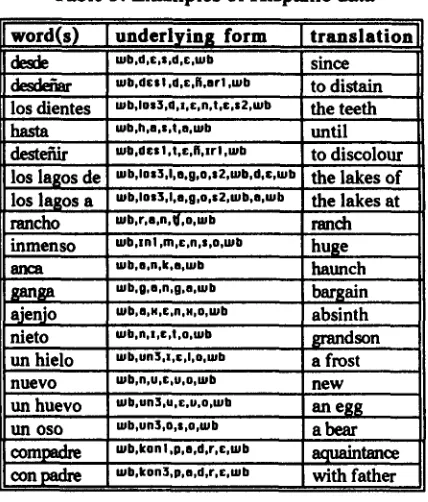
Three sets o f data were selected to include as many cases as possible o f nasal and As/ segments in contexts selected to contrast the s a m e u n d e r l y i n g p h o n e m e string w i t h different boundaries for as many different p h o n e m e sequences as possible.
A total o f 76 words or short phrases were included • in the databases tested on all five settings o f the system. They were selected Io provide as many contrastive contexts as p o s s i b l c with examples for each level o f boundary wherever possible. A selection o f these are shown below.
[image:12.596.311.525.98.349.2]54
Table 5: Examples o f Hispanic data
[ w o r d ( s ) [ u n d e r l y i n g f o r m
I
translationwb,d,t,s,d,c,Wb since
desdefiar wb.d¢,1.a.t.n.orl.wb to distain los dientes wb,los$,q,x,c,n,t,c,s2,wb t h e teeth
hasta wb,h,a,|,t,a.wb d e s t ~ r wb,dts I .t,lc,§,lr I ,wb
wb,los3.l,a.g,o,s2,wb,d,¢,wb
loslagos de
los lagos a
rancho
wb,los3,I,a,g,o,s2,wb,a,wb wb,r,o,n,~,o,wb
inmenso wb,lnl,m,c,n,s,o,wb wb,a,n,k,a,wb wb.o,a,n,g,a,wb
ganga
ajenjo nieto
WbpilpN,t,fl,N~O,Wb wb,n,ldC,t,o,wb
un hielo wb,un3,x,c,i,o,wb
n u e v o wb,n,u,c,v,o,wb
un huevo wb,un3,u,c.v.o,wb
UI'I OSO wb,un3,o,s,o,wb wb,kon l,p,a,d,r,c,wb
mr, e
con padre wb,kon3,p,a,d,r,c,wb
until to discolour the lakes of the lakes at ranch huge haunch bargain absinth grandson a frost n e w an e~8 abear aquaintanee with father 4.1.4 The Control Structure
Optional boundaries are dealt with within the theory o f LP by a s s u m i n g that no boundary is specified in the rule and the rule is either attached to several strata (Halle and Mohanan, 1985) or to the first s t r a t u m following the resolution o f all boundaries across w h i c h it m a y a p p l y (Booij a n d R u b a c h , 1987). F o l l o w i n g Booij and Rubach, I assumed that normal derivation up to word level would take place within a three s t r a t u m m o d e l c o n s i s t i n g o f c y c l i c , p o s t c y c l i c and post lexical strata a n d therefore selected a five stratum m o d e l to begin the investigation (one for each level o f affixation, plus one to ensure that rules could be applied after all w o r d - f o r m a t i o n processes were complete, including bracket erasure). The w o r d formation p r o c e s s e s were assigned in order with type 1 processes at stratum 1, type 2 at stratum 2, type 3 at stratum 3 and word boundaries at stratum 4.
Five contrastive settings o f the model, which varied only in the a s s i g n m e n t o f phonological rules to strata, were prepared:
Table 6: The Hispanic Control settings
Stratum C1 C2 c3 c4 c5
1 10-16 10-16 10-16 10-16 10-16
2 25-49 20-49 II-ll I1-11 I I - I I
3 50-59 50-59 20-59 11-11 I1-11
4 60-69 60-69 60-69 20-69 I1-11
Rule-sets allocated to strata may include "empty sets" if no rules have been allocated to any of the rule numbers assigned
4.1.5 The Results
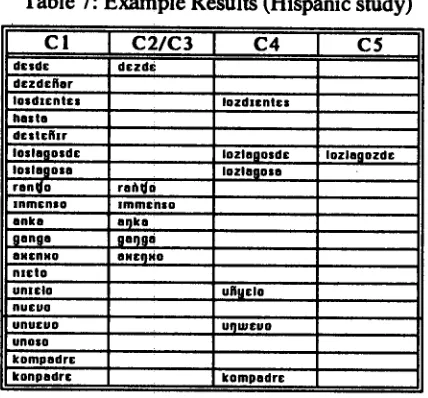
Results are shown examples in Table 5.
[image:13.596.57.271.188.387.2]for each of the
Table 7: Example Results (Hispanic study)
r
Cl C2/C3
dcsdE dczd~
dzzdzfior
C4
Iosdzcntcs Iozdxznl¢s
hasto dcstcflir Ioslagosdc Ioslagosa rondo
x n m c n s o imm~nso
a n k 8
genoa ON~OHO
nx~lo Unlt|O
D U E U O
aQka
gaQQe
aacQXo
unuzvo
Inzlagosd¢ Iozla~ose
Uf~W£VO
C5
Iozlagozdz
unogo kompadr¢
konpadrc kompadr¢
The broad phonemic transcriptions resulting from the three data sets indicate a correspondence from the slow to fast speech with the re-assignment of the phonological rules from low to high strata. However, within this progression, the detailed analysis of the data presented by Harris demonstrates some anomalies. It is not possible to assign the settings CI-C5 to the speech styles Largo, Andante, Allegretto and Presto on a one-to-one (or even many-to-one) basis. At each level there may be forms which Harris assigns to contrasting styles. This may be partially due to the imperfect assignment of structure to the data items examined.
For the Mexico City dialect, Largo speech roughly corresponds to settings C1-C2 of the LP control system proposed here for Spanish, Andante to C2-C3, Allegretto to C4-C5 and Presto may correspond to C5. Thus, the LP model, implemented in LexPhon, appears to give a reasonably good approximation to the data available.
4.2. The English Study
A more modest study of English style contrast data is included to examine whether similar stratum assignment of phonological rules can account for the casual/careful style contrasts found in standard British English.
Again the Booij and Rubach model (1987) has been extended to investigate furlher aspects of the data through the inclusion of an additional stratum and the re-allocation of rules to strata.
Descriptions of English style contrasts tend to be less well structured than the Harris (1969) study of the Mexico City dialect. The most common contrasts applied to spontaneous utterances are b e t w e e n careful and casual speech or between formal and informal speech. These two styles are sometimes, but not always, assumed to correspond. In either case, study is not limited to a comparison o f binary alternations but usually relates to a series of utterance forms varying from one extreme of the style to the other. Laver (1991), for example, cites seven possible utterance forms for the single word 'actually' varying from most formal to most informal style in educated Southem British English.
Kreidler (1989) lists vowel reduction, vowel loss, consonant loss and assimilation among the processes of reduction which contrast formal with informal or rapid English speech. Stress assignment is an important factor in identifying the contexts to which these apply and less formal speech may exhibit some or all of these processes. However, Kreidler suggests that apart from phonemic context, the familiarity of a particular word or phrase may also affect the amount of reduction which it may undergo. Although listing contrastive most careful and most casual forms, Kreidler too states that there may be one or more intermediate pronunciations.
The Phonological Rules and Phoneme Inventory used here are the default databases provided for LexPhon, mainly derived from Halle and Mohanan's (1985) description of LP. Four strata were derived by adding an additional noncyclic stratum to the Booij and Rubach (1987) model and again 5 contrastive settings were used in which blocks of the 24 ordered rules a r e progressively allocated to later strata to reflect more casual speech. The original rule-ordering is maintained throughout.
Table 8: Control Settings for English Style
S t r a t u m C ! C 2 C 3 C 4 C 5
1 1 0 - 1 9 1 0 - 1 9 1 0 - 1 9 1 0 - 1 9 1 0 - 1 9
2 3 0 - 7 9 3 0 - 4 0 2 0 - 2 0 2 0 - 2 0 2 0 - 2 0
3 9 0 - 9 9 4 1 - 9 9 3 0 - 7 9 3 0 - 4 0 2 0 - 2 0
Table 9: The English Data
w o r d ( s ) u n d e r l y i n 8 f o r m actually
is it usual is she
was she wb,w,o,z,wb,l,c,c,wb
horse shoe wb,h,o,r,s ,wb, J,o,o,wb
~naer ~hin wb.s.p.m.m.s.wb.J.l.p.wb
space ship as yet this year not yet next year both you a n d
m e
with you and
u.gb,w,k,t,c,h ~11 ,lI I ,wb wb,l,z.wb,i,t,lUb,n,h,$,¢lnml I ,wb Wb,I,z,wb,LcOc,wb
wb.m.z.wb.y.c.l.wb wb.6.1.s.wb.y.C.m.wb wb.n0o.t.wb.y.¢.t.wb wb.n.c.k.s.t.wb.y.c.m.tub
wb.b.o.o.O.wb.y.o.o.wb.m.n.d.wb.m.c.t.wb
W b , w , l , b , w b , y , o , o , w b , ~ , n , d , w b , m , l : , c , w b
m e
n r o h a h l v w b , p , r , o , b , m b c l I j I ,wb
probably supposed to don't know
Wb.S.C.p.3.3.Z.d4.wb.t.o.O.Wb wb,d,o,o,wb,n,o,t,wb,n,o,u,wb
I have to wb.l.l.wb.h.ee.v.wb.t.O.opwb
she has to wb.J.c.c.wb.h.m.z.wb.t.o.o.wb Wb.w.l.l.wb.n.o0t .wb.y.o.o.wb
w o n ' t y o u
did you wb.dJ.d.wb.y.o.o.wb
u n l e s s yOU wb.n.n.l.£.s.wb.y.o.o.IUb as you wb.ce.z.wb.y.o.o.wb
w h a t do y O U wb.w.m.t.wb.d.o.o.wb.y.o.o.wb.n.c.¢.d.wb
need
what does i t wb.w.m.t.wb.d.o.o.s4.wb.t.t.wb.m.lo.t.c.wb
matter
what did John wb.w.m.t.wb.d.Ld.wb.~.o.n.wb.s.m.m.wb say
Table 10: The English Results
C 1 / C 2 / C 3 C 4 C 5
~ekl~ouaelz
IZltuu3uu~l IZI~UU3UU~BI WOZJII
harsJuu
spc,slzP
mzyct m3cl
6xlcm 615~E~
notyct nckstQcm bouOyuumndmlI wz6~uumndmzz probeebclx scpouzdtuu duunotnou mlh~utuu Jzzhmztuu wzlnot~luu dzdyuu ¢~nles~uu aezyuu waetdUU~lUUnZzd wmtduusztmmtE wmtdxd~onscz
nolJct ncks~cm bouJuuaondml! wz~uumndmH
wxlnol~uu
dxCzuu nnlcluu ~3uu
noltt
wxlnoJuu dx3uu
The first setting is the default setting for LexPhon and no distinction was found between this and the results of next two settings in which some or all of the noncyclic rules from stratum 2 were shifted
56
to stratum 3. Word-internal assimilations involving y-insertion and palatalization have taken place. At the fourth setting, in which many of the noncyclic rules are attached to the final stratum and are applied after all word-formation is complete, a number of assimilations involving palatalization and y- insertion take place across word boundaries as well as word-internally.
Further variations are demonstrated between the fourth and fifth settings. At the fifth setting all post-cyclic rules operate within the final, post-word-level, stratum causing spimntization to apply to contexts spanning word-boundaries.
The variations resulting from the first three settings generally reflect a relatively formal, carefully pronounced speech style, although certain reductions characteristic of spoken rather than written English have not taken place (e.g. 'will not' rather than 'won't'). Some reductions found at the fourth setting in such partial clauses as 'unless you' and 'did you' are attested by Kreidler (1989) as casual speech forms. However, I have found no evidence in the literature for other reductions found at the fourth setting, nor for the further fricative reductions found at the fifth setting. These latter appear to be more typical of "slurred" speech than casual speech.
Much of the style-related variation reported by Laver and Kreidler does not occur as a result of the LexPhon settings tested above. However, the variations which they reported are characterised by phonological rules such as fricative assimilation (Kreidler, p257) and cluster reductions, not required (or not yet implemented in LexPhon) for the derivation of the standard forms of the utterances. Thus, the model provides a partial but inadequate description of careful/casual contrasts found in British English.
5 . S U M M A R Y A N D C O N C L U S I O N S
LexPhon, a computational framework for models of lexical phonology, has been described and an example application of one potential use of such a system has been presented.
A hypothesis was tested that intm-speaker style variation might be the result o f applying the same rules to the same underlying forms but at different stages o f the utterance formation process. In the case o f the Spanish data for the Mexico City dialect, allocation o f rules to strata appears to account for a substantial proportion o f the attested variation between the speech speed styles. For the contrastive study o f English careful versus ~tsual style data, re-allocation o f rules to strata appears to account for a smaller proportion o f the variation attested, in spite o f the use o f a m u c h more comprehensive rule set.
Although the studies presented here are not conclusivei they provide evidence which gives support to the theory that aspects of style variation may be attributable to the level o f word-formation at which phonological rules are applied, rather than necessarily to differences in the formulation of the rules
t h e m s e l v e s . This supports the LP
hypothesis that complex surface phonology o f l a n g u a g e s m a y be the result o f interactions b e t w e e n relatively s i m p l e morphological and phonological processes taking place within a simple framework.
Further, the application o f LexPhon to a problem requiring alternative p h o n e m e inventory, phonological rulebase and L P control f r a m e w o r k d e m o n s t r a t e s t h e flexibility which the system can offer to comparative studies in lexical phonology.
REFERENCES
Booij, G,; Rubach, J. i 987 Postcyclic v. Postlexical
Rules in Lexical Phonology, Linguistic Inquiry
18(1).
Chomsky, N.; Halle, M, 1968 Sound Pattern of
English. Harper & Row.
Halle, M.; Moltanan, K. P. 1985 Segmental
Phonology of Modem English. Linguistic Inquiry
16(1), 57-116.
Halle, M.; Vernaud, J.-R. 1982 On the Framework
of Autosegmental Phonology. The Structure of
Phonological Representations (Part 1). eds. van der Hulst, H,, Smith, N., Foris.
Harris, J. W. 1969 Spanish Phonology. Cambridge
Massachusetts: MIT Press.
van der Hulst, H,; Smith N. 1982 An Overview of
Autosegmentai and Metrical Phonology. The
Structure of Phonological Representations (Part I).
eds. van der Hulst, H,, Smith, N., Foris.
Kiparsky, P, 1982 From Cyclic Phonology to
Lexicai Phonology, 772e Structure of Phonological
Representations (Part I). eds. van der Hulst, H., Smith, N,, Foals.
K~parsky, P. 1982b Lexical Morphology and
Phonology. Linguistics in the Morning Calm:
Selected Papers from SICOL-1981. edited by the iLinguistic Society of Korea, Hanshin Publishing !Company: Seoul, Korea.
eidler, C. W. 1989 of English.
K~ford: The Pronunciation
Blackwell.
Labov, W. 1981 Field methods used by the project
[on linguistic change and variation. Sociolinguistic
iworking paper 81, Austin Texas: South Western ~Education Development Laboratory.
I.~ver, J. 1991 The Gitt of Speech. Edinburgh
University Press.
Leben, W. 1982 Metrical or Autosegmental. The
[Structure of Phonological Representations (Part I).
eds. van der Hulst, H., Smith, N., Foils.
L[isterri, J. 1992 Speaking styles in speech research.
Proc. ELSNET/ESCA/SALT Workshop on llntegrating Speech and Natural Language, Dublin, ilreland.
Mllroy, L. 1987 Observing and Analysing Natural
:Language. Oxford: Basil Blackwell.
T~anel, B. 1987 French schwa and nonlinear
hOnology. Linguistics 25(1 ), 845-866.
liams, S. M. 1993 LexPhon: A computational
plementation of lexical phonology. PhD