Pairwise Relation Classification with Mirror Instances
and a Combined Convolutional Neural Network
Jianfei Yu
School of Information Systems Singapore Management University [email protected]
Jing Jiang
School of Information Systems Singapore Management University
Abstract
Relation classification is the task of classifying the semantic relations between entity pairs in text. Observing that existing work has not fully explored using different representations for relation instances, especially in order to better handle the asymmetry of relation types, in this paper, we propose a neural network based method for relation classification that combines the raw sequence and the shortest dependency path representations of relation instances and uses mirror instances to perform pairwise relation classification. We evaluate our proposed models on two widely used datasets: SemEval-2010 Task 8 and ACE-2005. The empirical results show that our combined model together with mirror instances achieves the state-of-the-art results on both datasets.
1 Introduction
Relation classification is a very important task for many Natural Language Processing (NLP) applica-tions including question answering (Yao and Van Durme, 2014), knowledge base population (Socher et al., 2013) and opinion mining (Kobayashi et al., 2007). The goal of relation classification is to auto-matically identify the semantic relation between a pair of entities in free text. For example, a relation classification system should be able to capture the Cause-Effectrelation between the entities pressure andburstin the sentence “Thebursthas been caused by water hammerpressure.”
Like any classification task, a key research question of relation classification is the identification of a good feature representation for each relation instance. Traditional approaches focus on either com-bining many manually designed features (Zhou et al., 2005; Jiang and Zhai, 2007; Li and Ji, 2014) or leveraging various kernels to implicitly explore a large feature space (Bunescu and Mooney, 2005; Zhang et al., 2006; Qian et al., 2008; Nguyen et al., 2009), but both approaches suffer from their poor generalization ability on unseen words, and fail to achieve very satisfactory performance (Nguyen et al., 2015). Recently, with the advances of deep learning in NLP, neural networks (NNs) have exhib-ited their advantages in dealing with unseen words through pre-trained word embeddings and capturing meaningful hidden representations. Different NN architectures, including Convolutional Neural Net-work (CNN) (Zeng et al., 2014), Recursive Neural NetNet-work (ReNN) (Socher et al., 2012) and Recurrent Neural Network (RNN) (Xu et al., 2015b), have been applied to relation classification.
captured by the shortest dependency path between the two entities and thus are good at capturing long-distance relations, they lose some supplementary information in the original instance (Liu et al., 2015). Observing that the raw sequence and the dependency path representations highly complement each other, we expect a combination of the two structures to be more effective in capturing long-distance relations without losing any information.
Moreover, another important issue with the feature representation of relation instances is regarding the asymmetry of relation types. Most relation types are asymmetric. Take theCause-Effect relation in the SemEval dataset as an example. Cause-Effect(e1, e2)indicates thate1 is the cause ande2 is the
effect. If their roles are reversed, we need to represent the relation as either Cause-Effect(e2, e1) or
Effect-Cause(e1, e2). Suppose we haveK different asymmetric relation types. The current common
practice to handle the relation directions is to transform theK+1 class labels (where the +1 is for the Otherrelation, which is symmetric) into 2K+1 class labels, where each of theK asymmetric relations is expanded into two labels to capture the two directions. For example, fromCause-Effect, another label Effect-Causeis created. Given any sentence containing two entities, we can always treat the first entity ase1 and the second entity ase2. We can then classify their relation into one of the 2K+1 labels.
Although this approach has been shown to be effective, it neglects the fact that the two class labels corresponding to the same original asymmetric relation are correlated. Take the above-mentioned burst-pressure sentence as an example. Most previous methods will treat it as a positive instance for the Effect-Cause relation only (because the first entity burst in the sentence is the effect). They will not relate the sentence to theCause-Effectrelation, although if we treat the second entitypressurease1, its
relation to the first entityburstisCause-Effect. We believe that if we represent each relation instance in two ways by swapping the order of the two entities, we can not only implicitly link the pair of relation labels from the same relation but also make a better prediction on a relation instance based on its two representations.
Based on the two observations above regarding the complementary nature of the raw sequence and dependency path representations and the asymmetry of relation types, in this paper, we propose a mirror instance based pairwise relation classification (MI) method using a convolutional neural network that combines raw sequence and dependency path representations. Our MI method creates mirror instances from the original relation instances by swapping the order of the two entities and using the reversed relation label. The method also learns appropriate weights to combine the predictions made on the original instance and the mirror instance for the final prediction.
Evaluation on SemEval-2010 Task 8 and ACE-2005 shows that both mirror instances and combining raw sequence and dependency path representations help improve the performance of relation classifica-tion. Our results also show that: (1) by using only half of the negative training instances to generate mirror instances, we can push the F1 score to 85.0 on SemEval-2010 Task 8 without using any
ad-ditional manually-crafted, linguistic-driven features; (2) and with only one adad-ditional linguistic-driven feature (entity type), we can obtain results competitive with the state-of-the-art results on ACE-2005.
2 Our Proposed Model
In this section, we first formally formulate the task and introduce our notation. We then present our proposed mirror instance method, including the mirror instance generation strategy and our pairwise relation classification framework. Finally, we present our proposed combined CNN models.
2.1 Problem Formulation
A relation instance consists of a sentence with two entities inside tagged ase1 ande2. Heree1 always
precedese2 in the sentence. LetRbe a set of pre-defined asymmetric relation types, andS be a set of
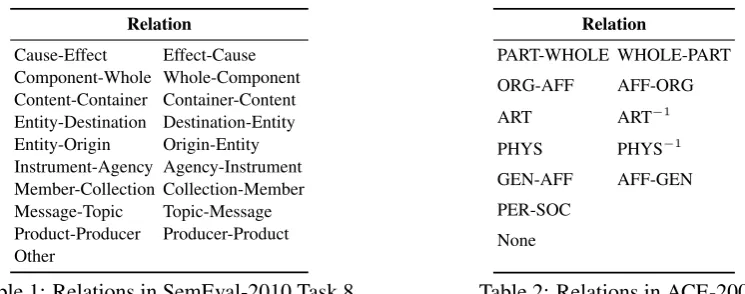
Relation
[image:3.595.101.474.74.221.2]Cause-Effect Effect-Cause Component-Whole Whole-Component Content-Container Container-Content Entity-Destination Destination-Entity Entity-Origin Origin-Entity Instrument-Agency Agency-Instrument Member-Collection Collection-Member Message-Topic Topic-Message Product-Producer Producer-Product Other
Table 1: Relations in SemEval-2010 Task 8.
Relation
PART-WHOLE WHOLE-PART ORG-AFF AFF-ORG
ART ART−1
PHYS PHYS−1
GEN-AFF AFF-GEN PER-SOC
[image:3.595.106.253.78.209.2]None
Table 2: Relations in ACE-2005.
make our explanations simpler, we assume that we are always predicting the relation frome1toe2, and
therefore for eachr∈ R, we introduce a reversed relation label rev(r)to capture the cases when relation ris frome2toe1. For example, ifrisCause-Effect, then rev(r)isEffect-Cause. In total, we have 2K+L
class labels, whereK =|R|andL=|S|. For the SemEval-2010 Task 8 data, we list all the2×9 + 1 class labels in Table 1, where the+1is for the case when there is no relation, denoted byOther. For the ACE-2005 data, all the2×5 + 2class labels are listed in Table 2, where+2indicates the symmetric person-social relation and no relation, denoted byPER-SOCandNone.
We further assume that each relation instance has two kinds of word representations. The first is the raw sequence (RSeq) representation, which consists of the sequence of words in the original sentence. The second is the shorted dependency path (SDP) representation, which is the shortest path frome1 to
e2in the dependency parse tree of the original sentence.
Let us useV to denote the vocabulary that contains all unique words in our dataset andE the set of directed dependency relation labels such as−−→pobj . The RSeq representation of a relation instance contains a sequence of words(w1, w2, . . .)wherewi ∈ V. In addition, inspired by the work by Zeng et al. (2014),
to tag the positions ofe1ande2, we assume that each wordwi in the sequence is associated with two
position indicespiandqi, which indicate the relative distances ofwifrome1ande2, respectively. Take
the token “caused” in the previousburst-pressuresentence as an example. Since its relative distance to the two entities “burst” and “pressure” are 3 and−4 respectively, its two position indices are 3 and−4. We useP to denote the set of all possible position indices in our dataset.
The SDP representation can also be regarded as a sequence of tokens(t1, t2, . . .), where each token is
either a word or a directed dependency relation, that is,tj ∈ V ∪ E. Similar to the RSeq representation,
we also use the relative distances oftjtoe1ande2to indicate the positions ofe1ande2, namelycjand
dj. The left side of the bottom layer of Figure 2 shows the RSeq and the SDP representations of the
relation instance “The[burst]e1 has been caused by water hammer[pressure]e2.”
Formally, we assume that we are given a set of labeled relation instances {(x(n), y(n))}N
n=1, where
y(n)is a relation label andx(n)has two kinds of word representations: RSeq(x(n))and SDP(x(n)).
2.2 Mirror Instance Method
Our first proposal is a new framework to model each relation instance by a pair of representations. The key idea is to first generate amirrorinstance from each original relation instance, and then perform joint training and testing by making use of both the original and the mirror instances.
Our method is motivated by the observation that each relation instance can provide us with a pair of examples with opposite directions. For example, “The[burst]e1 has been caused by water hammer
[pressure]e2.” is an original relation instance and is labeled asEffect-Cause. If we swap the order ofe1
ande2, then the resulting mirror instance “The[burst]e2has been caused by water hammer[pressure]e1.”
31
-1 0 1 2 3 4 5 6 7
Raw Sequence (RSeq) -8 -7 -6 -5 -4 -3 -2 -1 0
Shortest Dependency Path (SDP) Label Effect-Cause e1 e2 The burst has been caused by water hammer pressure -1 0 1 2 3 4 5 6 7
The burste has been caused by water hammer pressure 2 e1 Cause-Effect -8 -7 -6 -5 -4 -3 -2 -1 0
burstensubjpasscausedprep bypobj pressure 1 e2 0 1 2 3 4 5 6
-6 -5 -4 -3 -2 -1 0
-6 -5 -4 -3 -2 -1 0
0 1 2 3 4 5 6
burstensubjpasscausedprep by pobj pressure
[image:4.595.87.506.76.156.2]2 e1
Figure 1: An example of the representations of a mirror instance (in the bottom row) by our method. related, and should not be independent of each other. By generating a mirror instance from each original instance, we can not only double the number of training data but also implicitly link the two labelsrand rev(r). More importantly, for each testing instance, we can better identify its relation label based on its two representations.
For a relation instancex, let us usex¯to denote its mirror instance that we generate, and for a relation labely, let us userev(y)to denote itsmirror label, which is the reverse ofy. Note that ifycorresponds to a symmetric relation label, thenrev(y)also corresponds to the same relation label.
Our mirror instance generation idea is inspired by the negative sampling method by Xu et al. (2015a) but our practice is fairly different. In their method, they only create a negative instance for each posi-tive instance by reversing the original SDP, which will cause the expanded training set more biased to negative instances and thus largely reduce the recall of positive instances, whereas in our method, our generated mirror instances are not simply labeled asOther(orNone) but labeled as a reversed relation from the original relation label. As a result, the class distribution of our generatedmirrortraining set is almost the same as that of the original training set because of themirrorrelationship between the origi-nal andmirrorinstances. More importantly, they simply expand the original training set with additional negative samples and their training process is the same as that in standard practice, while we propose a different pairwise relation classification framework in which the original and the mirror representations are jointly used for each relation instance.
Mirror Instance Generation
The next question is how we should construct RSeq(¯x)and SDP(¯x), the word representations of the mirror instance, such that we can use the same CNN architecture to learn the hidden sentence represen-tations of these mirror instances.
For both SDP(¯x)and RSeq(¯x), although we could simply reverse the original representation as was done by Xu et al. (2015a), we feel that this would result in a completely reversed sentence or shortest dependency path that is unnatural. So we adopt the following way of constructing RSeq(¯x)and SDP(¯x). We leave the sequence of words untouched. For the position indices, since they are used to indicate the positions of the two entities, we simply swap the two position indices for each word such that the original e1 now becomese2 and the originale2 now becomese1. The bottom row of Figure 1 shows RSeq(¯x)
and SDP(¯x)for the mirror instance “The[burst]e2 has been caused by water hammer[pressure]e1.”
Pairwise Relation Classification
Training: Once it is clear how the RSeq and the SDP representations of a mirror instance are con-structed, the next challenge is how to train with these pairs of original and mirror instances such that we can make a final prediction for each relation instance.
Essentially, in addition to the original training data{(x(n), y(n))}N
n=1, we now have additionalN
train-ing instances{(¯x(n),rev(y(n))}N
n=1, wherex¯(n) is the mirror instance ofx(n) andrev(·)is as defined
previously. Moreover, these pairs of original and mirror instances have a one-to-one correspondence relationship, and therefore there should not be any disagreement between their labels.
maximize the log-likelihood of both the original and the mirror instances as follows:
Jc = − N X
n=1
logp(y(n)|x(n);Θ) + logp(rev(y(n))|x¯(n);Θ0), (1)
whereΘandΘ0are two sets of parameters respectively in the CNN model of the original instances and
the mirror instances, which will be detailed in Section 2.3.
However, the Eqn. (1) above still treats each label separately and cannot link y(n) andrev(y(n))to
capture the relations betweenx(n)andx¯(n). Consequently, we further construct a one-to-one
correspon-dence relationship between(x(n), y(n))and(¯x(n),rev(y(n))). Intuitively, for(x(n),x¯(n)), the probability
of the final label beingy(n)should be a weighted combination of the probability ofx(n)beingy(n)and
the probability ofx¯(n) being rev(y(n)). We therefore introduce another parameter ω ∈ R2K+L as a
weight vector to combine the likelihood of the original and the mirror instances. The loss function is given as follows:
Jf = − N X
n=1
logσ(ωy(n))p(y(n)|x(n);Θ) + (1−σ(ωy(n)))p(rev(y(n))|x¯(n);Θ0)
,
where σ(ωy(n)) = 1
1+e−ωy(n) is a tradeoff weight between the probability ofx
(n) being y(n) and the
probability ofx¯(n)beingrev(y(n)).
Finally, we minimizeJc+Jf as our overall objective function. Since the overall objective function
consists of two components and each component is related to the other, we propose to jointly optimize them via stochastic gradient descent with shuffled mini-batches, based on the practice by Kim (2014). In our implementation, the learning rate of each parameter is scheduled by Adadelta (Zeiler, 2012) (= 10−1,ρ= 0.95 forω, and=10−6,ρ= 0.95 forΘandΘ0).
Testing: After training with pairs of original and mirror instances, during the testing stage, how to predict the label of a relation instance becomes straightforward. For a test instancext, we should again
generate its mirror instancex¯t. Thereafter, we can obtain two class distributions by using the trained
model, one fromxt and the other fromx¯t. Let us usec(xt)to denote the former andc(¯xt)the latter.
Finally, we can obtain the final class distributionc(xt,x¯t)based onc(xt)andc(¯xt):
ck(xt,x¯t) = σ(ωk)ck(xt) + (1−σ(ωk))crev(k)(¯xt), 1≤k≤2K+L,
where ck(xt) and crev(k)(¯xt) represent the probability of xt having the relation k and x¯t having the
relationrev(k)respectively, andck(xt,x¯t)denotes the probability of the pair of relation instances having
the relationk. The final predicted label is the relation with the highest probability amongc(xt,x¯t). 2.3 Our Combined CNN Model
Under the mirror instance based pairwise relation classification (MI) framework, we further target at learning better representations for both the original and the mirror instances. Motivated by the observa-tion that the raw sequence and the dependency path representaobserva-tions highly complement each other, we propose to combine the RSeq and the SDP representations of each relation instance (either the original or the mirror instance) together based on the multi-channel CNN architecture by Kim (2014).
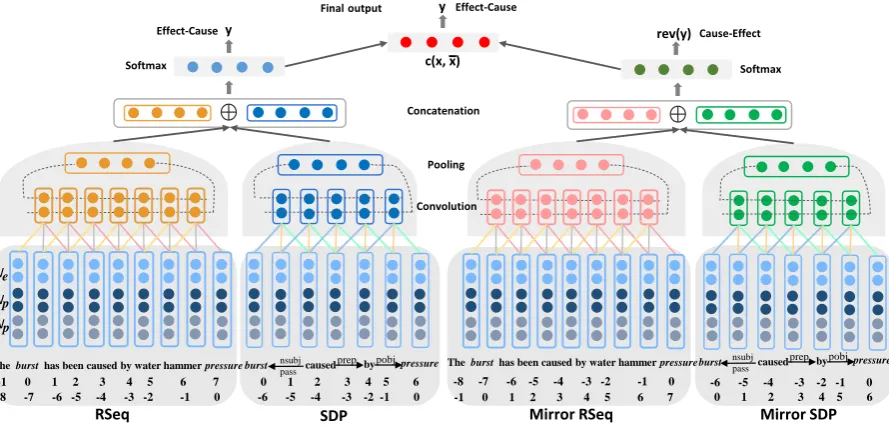
Figure 2 illustrates the whole architecture of the MI framework, which contains two proposed com-bined CNN models. Each model obtains hidden representations of both the raw sequence and the shortest dependency path of a relation instance and then concatenates them for relation classification. It consists of a lookup layer, a convolution-pooling layer and an MLP layer.
Lookup: The lookup layer maps the input sequences to real-valued embedding vectors. Let
Softmax
31
The bursthas been caused by water hammer pressure burst nsubjcaused by pressure pass
prep pobj
-1 0 1 2 3 4 5 6 7 -8 -7 -6 -5 -4 -3 -2 -1 0
Effect-Cause
RSeq SDP
0 1 2 3 4 5 6 -6 -5 -4 -3 -2 -1 0
y rev(y)
c(x, x) y
Final output
Cause-Effect Effect-Cause
The bursthas been caused by water hammer pressure burst nsubjcaused by pressure pass
prep pobj
-1 0 1 2 3 4 5 6 7 -8 -7 -6 -5 -4 -3 -2 -1 0
Mirror RSeq Mirror SDP
0 1 2 3 4 5 6 -6 -5 -4 -3 -2 -1 0
Softmax
We
Wp Wp
[image:6.595.76.521.78.291.2]Convolution Pooling Concatenation
Figure 2: The architecture of the mirror instance based pairwise relation classification (MI) framework. The left and right components correspond to two combined CNN models (Comb) respectively for original instances and mirror instances. column is ad1-dimensional embedding vector for either a word inVor a dependency relation inE. Let Wp ∈Rd2×|P|denote another lookup table for position indices, where each column is ad2-dimensional
embedding vector for a position index. Note that this position embedding idea is borrowed from the work by Zeng et al. (2014), and thus word representations of the raw sequence in our combined model is the same as theirs. After applying the lookup layer, both the RSeq and the SDP representations are transformed into a sequence of(d1+ 2d2)-dimensional vectors.
Convolution-Pooling:Two separate CNNs are used to process the RSeq representation and the SDP representation, and their mechanisms are the same. For each CNN, at positioniof the original sequence, the embedding vectors inside a window of sizencentered atiare concatenated into a new vector, which we refer to aszi ∈Rd. A convolution operation is then performed by applying a filterF∈Rh×donzi
to produce a hidden vectorhi =g(Fzi +b), whereb ∈ Rh is a bias vector andg is a element-wise
non-linear transformation function. Note that we pad the original sequence in front and at the back to ensure that at each positioniwe havenvectors to be combined intohi. After the convolution operation
is applied to the whole sequence, we obtainH = [h1,h2, . . .], and we apply a max-over-time pooling
operator to take the maximum value of each row of H to obtain an overall hidden vectorh∗, which
encodes the information from the entire sequence. Leth∗
r denote this hidden vector derived from RSeq
andh∗
sthe hidden vector derived from SDP.
MLP:The top layer of our model is a multilayer perceptron (MLP) with a softmax layer at the end to predict a(2K +L)-class distribution. This means the objective function for training our model is J(Θ) =−PNn=1logp(y(n)|x(n);Θ), whereΘis the set of all model parameters includingW
e,Wp, F,band the weights in the multilayer perceptron,y(n)is the true relation label for relation instancex(n),
andp(y(n)|x(n);Θ)is the probability of assigningy(n)tox(n)based on the softmax layer. As discussed
in Section 2.2, in our implementation, the gradients are computed via back propagation.
3 Experiments
3.1 Dataset and Evaluation Metric
To evaluate our proposed method, we conduct our experiments on the SemEval-2010 Task 8 dataset and the English portion of the ACE-2005 dataset.
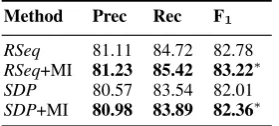
Method Prec Rec F1 RSeq 81.11 84.72 82.78 RSeq+MI 81.23 85.42 83.22∗ SDP 80.57 83.54 82.01 SDP+MI 80.98 83.89 82.36∗ Table 3:Evaluation of our mirror instance method. ∗indicates that our method
signif-icantly improves the corresponding baseline withp <0.05based on McNemar’s test.
[image:7.595.79.219.78.141.2]Method Prec Rec F1 RSeq 81.11 84.72 82.78 SDP 80.57 83.54 82.01 Comb 81.27 85.33 83.20∗ Table 4: Comparison of our com-bined model with two baseline mod-els using eitherRSeqor SDP repre-sentation.
Method Prec Rec F1 Comb 81.27 85.33 83.20 Comb+MI 82.07 86.63 84.23∗ Comb+RMI 82.34 87.76 84.96∗ Table 5: Evaluation of our com-bined CNN model together with the mirror instance method. RMI stands for reduced mirror instances.
instances as the development set. Following all previous work, we use the macro-averagedF1 score to
evaluate our model based on the SemEval-2010 Task 8 official scorer.
ACE-2005: This dataset consists of 6 domains: broadcast news (bn), newswire (nw), broadcast con-versation (bc), telephone concon-versation (cts), weblogs (wl) and usenet (un). Following some previous work (Plank and Moschitti, 2013; Nguyen et al., 2015; Gormley et al., 2015), we consider a domain adaptation setting for coarse-grained relation extraction. Specifically, we take the union ofbnandnwas the training set, half ofbcas the development set, and the remainder (i.e.,ctsandwlas well as the other half ofbc) as the test set. Following Plank and Moschitti (2013), we use the micro-averagedF1score to
evaluate our model.
3.2 Experiment Settings
We use the pre-trained word embeddings fromword2vec1 to initialize the lookup table W
e, and set
the dimensiond1 to 300. For unknown words and directed dependency labels, we randomly initialize
their 300-dimensional embedding vectors. We also randomly initialized the other lookup table of the position embeddings Wp, and set the dimensiond2 to 50. Note that in our preliminary experiments
for ACE-2005, we found that the performance without considering the entity types of the two entity mention heads is very limited. Hence, for ACE-2005, we also randomly initialize another lookup table of the entity type embeddings, whose dimension is set to 50, and represent each token by concatenating its word embedding, position embedding and entity embedding.
We want to compare our combined CNN model with models that use either RSeq or SDP alone, so we consider three experiment settings: SDPrefers to a CNN model that uses only SDP representation of a relation instance,RSeqrefers to a CNN model that uses only the RSeq, andCombrefers to our combined model. For each setting, we use the development set to tune the window sizenand the dimension of the hidden statesh. In a previous study by Nguyen and Grishman (2015), it was found that using multiple window sizes in CNN can bring significant improvements for the RSeq representation. We therefore also experiment with combining multiple window sizes forRSeqandSDP. In the end, we find that for RSeq, the optimal setting is to use a combination of windows with sizes 2, 3, 4 and 5 and to sethto 150. ForSDP, the optimal setting is to use a single window of size 5 and to sethto 400. ForComb, we use the same window sizes and hidden sizeshasRSeqandSDP.
For the other parameters inΘandΘ0, we adopt the settings reported by Nguyen and Grishman (2015).
That is, the non-linear transformation functiongistanh, the mini-batch size is50, the dropout rateα equals0.5, and the hyperparameter for thel2norms is set to be3.
3.3 Evaluation of our Proposed Approach
In this section, we evaluate the different components of our method.
Effect of the Mirror Instance Method
To evaluate the effect of the mirror instances, first, we apply the mirror instance method on top of the two baseline methodsRSeqandSDP, and show the results on SemEval-2010 in Table 3 and the results
Method dev set bc cts wl avg Prec Rec F1 Prec Rec F1 Prec Rec F1 Prec Rec F1 F1 RSeq 73.5 52.7 61.4 70.3 52.4 60.1 65.8 45.9 54.1 57.7 44.1 50.0 54.7 RSeq+MI 69.1 59.1 63.7∗ 65.7 59.2 62.3∗ 67.7 44.9 54.0 59.5 46.9 52.4∗ 56.2 SDP 67.6 49.3 57.0 59.4 45.3 51.4 55.4 37.7 44.9 48.8 36.6 41.8 46.0 SDP+MI 66.5 51.7 58.2∗ 57.6 48.6 52.7∗ 53.3 39.3 45.3 45.8 37.4 41.2 46.4
Table 6: Evaluation of our mirror instance method on ACE-2005.
Method dev set bc cts wl avg
Prec Rec F1 Prec Rec F1 Prec Rec F1 Prec Rec F1 F1 RSeq 73.5 52.7 61.4 70.3 52.4 60.1 65.8 45.9 54.1 57.7 44.1 50.0 54.7 SDP 67.6 49.3 57.0 59.4 45.3 51.4 55.4 37.7 44.9 48.8 36.6 41.8 46.0 Comb 72.4 57.8 64.3∗ 70.6 57.5 63.4∗ 62.5 49.7 55.4∗ 60.4 49.5 54.4∗ 57.7
Table 7: Evaluation of our combined CNN model on ACE-2005.
on ACE-2005 in Table 6. We can see that with the help of the mirror instances, both RSeqandSDP can improve their performance in most cases, and the improvements are statistically significant. This indicates the usefulness of the mirror instances generated by our method.
The Combined CNN Model
To check the effect of combining RSeq and SDP representations, in Table 4 and Table 7, we compare CombwithSDP andRSeqon SemEval-2010 and ACE-2005 respectively. We can observe thatComb outperforms bothSDPandRSeqon two datasets and the improvements are statistically significant. We can also see that the precision ofComband that of the other two models are relatively close, especially on SemEval-2010, and the advantage ofCombis mainly from its recall. It suggests that the RSeq and the SDP representations complement each other and therefore can work better when combined.
The Combined CNN Model together with the Mirror Instance Method
We then apply our mirror instance method on top ofComb. In Table 5 and the top two rows of Table 9, we can observe that our mirror instance method (Comb+MI) can significantly improve the F1 score
ofComb, especially making high improvements in recall, which further verifies the usefulness of our mirror instance method.
Since the goal of our relation classification task is to improve theF1 score for the positive relation
types excluding the label Other, we further investigate the impact of reducing the number of mirror instances generated from theOtherrelation instances, i.e., the negative relation instances on SemEval-2010. By tuning the percentage of negative mirror instances to reduce, we achieve the best performance when reducing 50% of the negative mirror instances. We refer to this method asComb+RMI and show its performance in Table 5 in the last row. We can see that it achieves aF1score of 84.96.
3.4 Comparison with the State of the Art
In this section, we compare our proposed method with all recently published results for SemEval-2010 Task 8 and ACE-2005.
SemEval-2010 Task 8:Since most existing studies have used additional hand-crafted linguistic features (AF) to help the classification task, we show two differentF1 scores, one with AF and one without in
Table 8. It is easy to observe that without AF, Vu et al. (2016) obtained the bestF1 score of 84.9 by
Method Additional Features (AF) F1
with AF without AF SVM (Rink and Harabagiu, 2010) POS, prefixes, morphological, WordNet, 82.2
-Levin classed, ProBank, FrameNet, NomLex-Plus, Google n-gram, paraphrases, TextRunner
CNN (Zeng et al., 2014) words around entities, WordNet 82.7 78.9
DepNN (Liu et al., 2015) NER 83.6 82.8
Hybrid(FCM+Feat) (Gormley et al., 2015) NER 83.7
-SDP-LSTM (Xu et al., 2015b) POS,Wordnet 83.7 82.4
DepLNN+NS (Xu et al., 2015a) Samples from NYT, WordNet 85.6 84.0
CR-CNN (dos Santos et al., 2015) - - 84.1+
ER-CNN + RNN (Vu et al., 2016) - - 84.9+
SpTree (Miwa and Bansal, 2016) Wordnet 85.5 84.5
[image:9.595.72.531.321.433.2]Comb+RMI Wordnet, NER 85.7 85.0
Table 8: Comparisons with state-of-the-arts results on SemEval-2010. + indicates using a special
ranking-based objective function.
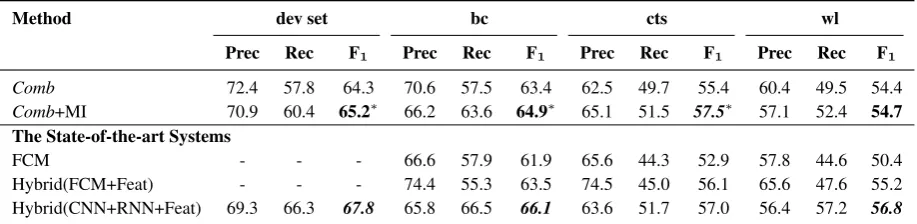
Method dev set bc cts wl
Prec Rec F1 Prec Rec F1 Prec Rec F1 Prec Rec F1
Comb 72.4 57.8 64.3 70.6 57.5 63.4 62.5 49.7 55.4 60.4 49.5 54.4
Comb+MI 70.9 60.4 65.2∗ 66.2 63.6 64.9∗ 65.1 51.5 57.5∗ 57.1 52.4 54.7 The State-of-the-art Systems
FCM - - - 66.6 57.9 61.9 65.6 44.3 52.9 57.8 44.6 50.4
Hybrid(FCM+Feat) - - - 74.4 55.3 63.5 74.5 45.0 56.1 65.6 47.6 55.2
Hybrid(CNN+RNN+Feat) 69.3 66.3 67.8 65.8 66.5 66.1 63.6 51.7 57.0 56.4 57.2 56.8
Table 9: Evaluation of our combined CNN model together with the mirror instance method on ACE-2005. The results of the state-of-the-art systems are taken from Nguyen and Grishman (2016).
We can also see that without utilizing any AF, our Comb+RMI method can push the F1 score to
the state-of-the-art, 85.0. Furthermore, we also consider adding two kinds of lexical features to our model, namely, Named Entity type (NER) and WordNet hypernyms. We first obtain the NER features of all words and Wordnet hypernyms of the two entities using the tool developed by Ciaramita and Altun (2006). Then, we represent each token by concatenating its word embedding, position embedding and entity embedding. Finally, following the practice by Zeng et al. (2014), we also concatenate the Wordnet hypernyms of the two entities with the combined hidden vector. As we can see from the last line of Table 8, our method can achieve the state-of-the-artF1score, 85.7.
ACE-2005:In Table 9, it is easy for us to observe that on all three test domains, our proposedComb+MI method can outperform the state-of-the-art single system FCM with a large margin, which combines traditional linguistic features with learned word embeddings by a log-bilinear model. In addition, we can also find that even in comparison with a competitive hybrid model, which integrates FCM and a traditional feature-based method,Comb+MI can still achieve slightly better performance on thebcand ctsdomains, and similar performance on thewldomain.
4 Related Work
Traditional work on relation classification can be categorized into feature-based methods and kernel-based methods. The former relies on a large number of human-designed features (Zhou et al., 2005; Jiang and Zhai, 2007; Li and Ji, 2014) while the latter leverages various kernels to implicitly explore a much larger feature space (Bunescu and Mooney, 2005; Nguyen et al., 2009). However, both meth-ods suffer from error propagation problems and poor generalization abilities on unseen words. The most popular method to solve the two limitations is based on neural networks (NNs), which have been shown successful in extracting meaningful features and generalizing on unseen words for many NLP tasks (Kim, 2014). For relation classification, Socher et al. (2012) proposed a recursive matrix-vector model based on constituency parse trees. Zeng et al. (2014) and dos Santos et al. (2015) respectively proposed a standard and a ranking-based CNN model based on the raw word sequences. More recently, Xu et al. (2015b) and Miwa and Bansal (2016) respectively proposed a multi-channel sequential LSTM model and a bidirectional tree-LSTM model on the shortest dependency path for relation classification.
Although all these models have been shown to be effective, all of them only focus on learning a single representation for each relation instance. Different from all previous methods, we first design a strategy to generate a mirror instance from each original relation instance and then propose a pairwise relation classification framework to learn a pair of representations for each relation instance.
On the other hand, most existing NN-based approaches for relation classification are either based on the shortest dependency path or the raw sequence, although these two representations may comple-ment each other. In this work, we propose to combine them together based on the multi-channel CNN architecture (Kim, 2014), aiming to capture long-distance relations without losing any information.
5 Conclusions
In this paper, we first proposed a mirror instance method to learn a pair of representations for each instance, which basically includes a mirror instance generation strategy and a pairwise relation clas-sification framework. Based on this, we further proposed a combined CNN model based on both the RSeq and the SDP representations of relation instances. Our experimental results demonstrate that our mirror instance method can improve the baseline models and our combined model without mirror in-stances, and our combined CNN model is more effective than models only using the RSeq or the SDP representation of relation instances. Finally, with the help of some lexical features, our combined CNN model together with the mirror instance method achieves the state-of-the-art result on SemEval-2010 and highly competitive results on ACE-2005.
Acknowledgment
We would like to thank the reviewers for their valuable comments. This research is supported by the Singapore National Research Foundation under its International Research Centre@Singapore Funding Initiative and administered by the IDM Programme Office, Media Development Authority (MDA).
References
Razvan Bunescu and Raymond Mooney. 2005. A shortest path dependency kernel for relation extraction. In
Proceedings of Human Language Technology Conference and Conference on Empirical Methods in Natural
Language Processing, pages 724–731. Association for Computational Linguistics, October.
Massimiliano Ciaramita and Yasemin Altun. 2006. Broad-coverage sense disambiguation and information ex-traction with a supersense sequence tagger. InProceedings of the 2006 Conference on Empirical Methods in
Natural Language Processing, pages 594–602. Association for Computational Linguistics.
and the 7th International Joint Conference on Natural Language Processing (Volume 1: Long Papers), pages 626–634. Association for Computational Linguistics, July.
Javid Ebrahimi and Dejing Dou. 2015. Chain based rnn for relation classification. InProceedings of the 2015 Conference of the North American Chapter of the Association for Computational Linguistics: Human Language
Technologies, pages 1244–1249. Association for Computational Linguistics, May–June.
Matthew R. Gormley, Mo Yu, and Mark Dredze. 2015. Improved relation extraction with feature-rich composi-tional embedding models. InProceedings of the 2015 Conference on Empirical Methods in Natural Language
Processing, pages 1774–1784. Association for Computational Linguistics, September.
Kazuma Hashimoto, Makoto Miwa, Yoshimasa Tsuruoka, and Takashi Chikayama. 2013. Simple customization of recursive neural networks for semantic relation classification. In Proceedings of the 2013 Conference on
Empirical Methods in Natural Language Processing, pages 1372–1376. Association for Computational
Lin-guistics, October.
Jing Jiang and ChengXiang Zhai. 2007. A systematic exploration of the feature space for relation extraction. In
Human Language Technologies 2007: The Conference of the North American Chapter of the Association for
Computational Linguistics; Proceedings of the Main Conference, pages 113–120. Association for
Computa-tional Linguistics, April.
Yoon Kim. 2014. Convolutional neural networks for sentence classification. InProceedings of the 2014
Con-ference on Empirical Methods in Natural Language Processing (EMNLP), pages 1746–1751. Association for
Computational Linguistics, October.
Nozomi Kobayashi, Kentaro Inui, and Yuji Matsumoto. 2007. Extracting aspect-evaluation and aspect-of relations in opinion mining. InEMNLP-CoNLL, volume 7, pages 1065–1074. Citeseer.
Qi Li and Heng Ji. 2014. Incremental joint extraction of entity mentions and relations. InProceedings of the 52nd
Annual Meeting of the Association for Computational Linguistics (Volume 1: Long Papers), pages 402–412,
Baltimore, Maryland, June. Association for Computational Linguistics.
Yang Liu, Furu Wei, Sujian Li, Heng Ji, Ming Zhou, and Houfeng WANG. 2015. A dependency-based neural network for relation classification. InProceedings of the 53rd Annual Meeting of the Association for Compu-tational Linguistics and the 7th International Joint Conference on Natural Language Processing (Volume 2: Short Papers), pages 285–290. Association for Computational Linguistics, July.
Makoto Miwa and Mohit Bansal. 2016. End-to-end relation extraction using lstms on sequences and tree struc-tures. InProceedings of the 54th Annual Meeting of the Association for Computational Linguistics (Volume 1:
Long Papers), pages 1105–1116.
Thien Huu Nguyen and Ralph Grishman. 2015. Relation extraction: Perspective from convolutional neural networks. In Proceedings of the 1st Workshop on Vector Space Modeling for Natural Language Processing, pages 39–48. Association for Computational Linguistics, June.
Thien Huu Nguyen and Ralph Grishman. 2016. Combining neural networks and log-linear models to improve relation extraction.Proceedings of IJCAI Workshop on Deep Learning for Artificial Intelligence.
Truc-Vien T. Nguyen, Alessandro Moschitti, and Giuseppe Riccardi. 2009. Convolution kernels on constituent, dependency and sequential structures for relation extraction. InProceedings of the 2009 Conference on
Empir-ical Methods in Natural Language Processing, pages 1378–1387. Association for Computational Linguistics,
August.
Thien Huu Nguyen, Barbara Plank, and Ralph Grishman. 2015. Semantic representations for domain adapta-tion: A case study on the tree kernel-based method for relation extraction. InProceedings of the 53rd Annual Meeting of the Association for Computational Linguistics and the 7th International Joint Conference on
Nat-ural Language Processing (Volume 1: Long Papers), pages 635–644, Beijing, China, July. Association for
Computational Linguistics.
Longhua Qian, Guodong Zhou, Fang Kong, Qiaoming Zhu, and Peide Qian. 2008. Exploiting constituent depen-dencies for tree kernel-based semantic relation extraction. InProceedings of the 22nd International Conference
on Computational Linguistics-Volume 1, pages 697–704. Association for Computational Linguistics.
Bryan Rink and Sanda Harabagiu. 2010. Utd: Classifying semantic relations by combining lexical and semantic resources. InProceedings of the 5th International Workshop on Semantic Evaluation, pages 256–259. Associ-ation for ComputAssoci-ational Linguistics, July.
Richard Socher, Brody Huval, Christopher D. Manning, and Andrew Y. Ng. 2012. Semantic compositionality through recursive matrix-vector spaces. InProceedings of the 2012 Joint Conference on Empirical Methods in
Natural Language Processing and Computational Natural Language Learning, pages 1201–1211. Association
for Computational Linguistics, July.
Richard Socher, Danqi Chen, Christopher D. Manning, and Andrew Y. Ng. 2013. Reasoning With Neural Tensor Networks For Knowledge Base Completion. InAdvances in Neural Information Processing Systems.
Ngoc Thang Vu, Heike Adel, Pankaj Gupta, and Hinrich Sch¨utze. 2016. Combining recurrent and convolutional neural networks for relation classification. In Proceedings of the 2016 Conference of the North American
Chapter of the Association for Computational Linguistics: Human Language Technologies, pages 534–539,
San Diego, California, June. Association for Computational Linguistics.
Kun Xu, Yansong Feng, Songfang Huang, and Dongyan Zhao. 2015a. Semantic relation classification via convo-lutional neural networks with simple negative sampling. InProceedings of the 2015 Conference on Empirical
Methods in Natural Language Processing, pages 536–540. Association for Computational Linguistics,
Septem-ber.
Yan Xu, Lili Mou, Ge Li, Yunchuan Chen, Hao Peng, and Zhi Jin. 2015b. Classifying relations via long short term memory networks along shortest dependency paths. InProceedings of the 2015 Conference on
Empiri-cal Methods in Natural Language Processing, pages 1785–1794. Association for Computational Linguistics,
September.
Xuchen Yao and Benjamin Van Durme. 2014. Information extraction over structured data: Question answering with freebase. InProceedings of the 52nd Annual Meeting of the Association for Computational Linguistics
(Volume 1: Long Papers), pages 956–966, Baltimore, Maryland, June. Association for Computational
Linguis-tics.
Matthew D Zeiler. 2012. Adadelta: An adaptive learning rate method.arXiv preprint arXiv:1212.5701.
Daojian Zeng, Kang Liu, Siwei Lai, Guangyou Zhou, and Jun Zhao. 2014. Relation classification via convolu-tional deep neural network. InProceedings of COLING 2014, the 25th International Conference on
Computa-tional Linguistics: Technical Papers, pages 2335–2344. Dublin City University and Association for
Computa-tional Linguistics, August.
Min Zhang, Jie Zhang, Jian Su, and GuoDong Zhou. 2006. A composite kernel to extract relations between entities with both flat and structured features. InProceedings of the 21st International Conference on Compu-tational Linguistics and 44th Annual Meeting of the Association for CompuCompu-tational Linguistics, pages 825–832. Association for Computational Linguistics, July.
GuoDong Zhou, Jian Su, Jie Zhang, and Min Zhang. 2005. Exploring various knowledge in relation extraction.
InProceedings of the 43rd Annual Meeting of the Association for Computational Linguistics (ACL’05), pages