Exploring Differential Topic Models for Comparative Summarization
of Scientific Papers
Lei He
*#, Wei Li
*, Hai Zhuge
*# #System Analytics Research Institute, Aston University,
Birmingham, UK
*
Key Lab of Intelligent Information Processing, ICT, CAS
,
University of Chinese Academy of Sciences, Beijing, China
[email protected],[email protected],[email protected]
Abstract
This paper investigates differential topic models (dTM) for summarizing the differences among docu-ment groups. Starting from a simple probabilistic generative model, we propose dTM-SAGE that explic-itly models the deviations on group-specific word distributions to indicate how words are used differen-tially across different document groups from a background word distribution. It is more effective to cap-ture unique characteristics for comparing document groups. To generate dTM-based comparative sum-maries, we propose two sentence scoring methods for measuring the sentence discriminative capacity. Experimental results on scientific papers dataset show that our dTM-based comparative summarization methods significantly outperform the generic baselines and the state-of-the-art comparative summariza-tion methods under ROUGE metrics.
1
Introduction
Today, the interconnected nature of real-world applications brings more cross-field research problems leading to a much closer relationship between research areas. Real-world challenges require research-ers to quickly get acquainted with knowledge in other areas. For example, imagine a researcher who is familiar with topic models wants to extend her research to opinion summarization. She would be more interested in finding out the current development of sentiment analysis and how topic models can be used in sentiment analysis, rather than the common background knowledge such as topic models and basic NLP technologies. Such a real-world demand encourages the study of multi-document compara-tive summarization for scientific papers in multiple subject areas. This paper presents the initial study on this problem.
Comparative summarization aims at summarizing the differences among document groups (Wang et al., 2012). The core is to compare different topics and find unique characteristics for each document
group. The main motivation of this paper is to apply dTM to comparative summarization and to model
the group-specific topics to capture the unique word usage for characterising documents in the same group. To our best knowledge, there is no previous study providing in-depth model analysis and
de-tailed experimental results on dTM applied for comparative summarization.
We first propose a probabilistic generative model dTM-Dirichlet to model the group-specific word
distributions to capture the unique word usage for each document group. However, dTM-Dirichlet is
not a truly differential topic model and it suffers from the problems of high inference cost,
over-parameterization and lack of sparsity. Evolving from the idea of SAGE (Eisenstein et al., 2011), we
develop dTM-SAGE to make the word probability distributions for each document group to share a
common background word distribution and explicitly models how words are used differently in each group from the background word distribution.
Our main contributions include the following two points: (1) we propose dTM to capture unique
characteristics of each document group in the application background of comparative summarization for cross-area scientific papers; and (2) we propose two sentence scoring methods to measure the
sen-This work is licenced under a Creative Commons Attribution 4.0 International License. License details: http://
crea-tivecommons.org/licenses/by/4.0/
tence discriminative capacity and a greedy sentence selection method to automatically generate
sum-mary for dTM-based comparative summarization.
2
Related Work
Multi-document Summarization. Existing multi-document summarization can be either extractive or abstractive (Sekine and Nobata, 2003). Our work focuses on the extractive techniques which involve in assigning saliency scores to sentences and extracting high-scored sentences in a greedy manner to construct a summary (Wan et al., 2007; Cai et al., 2010; Gupta and Lehal, 2010; Celikyilmaz and Hakkani-Tur, 2011). Graph-based ranking techniques such as TextRank (Mihalcea and Tarau, 2004) and LexPageRank (ErKan and Radev, 2004) have been widely used in extractive summarization. A bigram based supervised method was proposed for extractive summarization in ILP framework (Li et al., 2013; Li, 2015). Jha et al. (2015) proposed an extractive algorithm that combines a content model with a discourse model to generate coherent summaries for scientific articles. A multi-dimensional summarization methodology was proposed to transform the paradigm of traditional summarization research through multi-disciplinary fundamental exploration on semantics, dimension, knowledge, computing and cyber-physical society (Zhuge, 2016).
Comparative Summarization. Unlike the generic summarization that summarizes the common in-formation in document collection, the comparative summarization aims to summarize the differences among document groups. Wang et al. (2012) proposed a discriminative sentence selection method to generate summary by selecting sentences in a greedy manner to minimize the generalized variance of a covariance matrix using a multivariate normal model. Shen and Li (2010) proposed a method by building the sentence graph for each document group and extracting a complementary minimum dom-inating set on each graph to form a discriminative summary.
Update Summarization. The most similar task to comparative summarization is update summari-zation, which aims to detect and summarize novel information in a document set B under the assump-tion that users have already learnt the documents in set A, where documents in A chronologically pre-cede the documents in B. The update summarization has been well studied. Most existing methods solve it as a redundancy removal problem by adding functionality to remove redundant sentences us-ing filterus-ing rules (Fisher and Roark, 2008), Maximal Marginal Relevance (Boudin et al., 2008), or graph-based algorithms (Shen and Li, 2010; Li et al., 2008).
More related to this paper is the work of a topic-model based update summarization approach
Du-alSum (Delort and Alfonseca, 2012), which learns a general background distribution across the corpus and a document-specific distribution for each document, but also learns two collection-specific distri-butions for each pair of update collection and base collection: the joint topic distribution and the
up-date topic distribution. This paper revises DualSum as a baseline for evaluation in Section 5.2.
Topic Models for Documents Comparison. The other type of related work is the comparison of documents. Most existing studies for this goal focus on topic models to discover common and specific themes among document collections, referred to as cross-collection topic models (Paul, 2009). This
idea was first explored with an initial topic model PLSI (Zhai et al., 2004), and later improved with
LDA topic model (Blei, 2012; Pual, 2009) which inspires our dTM-Dirichlet. There are a number of
real-world applications extending cross-collection topic models in different scenarios (Ahmed and
Xing, 2010; Li et al., 2011). For example, Paul and Girju (2009) employed cross-collection LDA (
cc-LDA) for cross-cultural analysis of blogs and forums and later they proposed a two-dimensional
topic-aspect model (TAM) to jointly discover topics and aspects in scientific literature (Paul and Girju, 2010).
The common idea behind these cross-collection topic models is that using latent topics capture the common and unique word usage among document collections. Cross-collection topic models neglect the correlations between each collection-specific topic and the common background topic, thus make it insufficient to capture differential word usage. More importantly, the correlations are the essence of the differential topic models.
3
Differential Topic Models
In this section, the differential topic models are explored for comparative summarization. We first
de-velop a simple probabilistic generative model, dTM-Dirichlet. Evolved from dTM-Dirichlet,
devi-ations and a background word distribution, which enables to capture more salient group-specific words and bypass the problems of high inference cost, over-parameterization and lack of sparsity.
To illustrate dTM, we first define some notations to express a document corpus C. Let G be the
number of groups in the corpus, 𝑀𝑔 be the number of papers in group g and 𝑁𝑔,𝑚 be the number of
words in paper m. A word wg,m,n representing the 𝑛𝑡ℎ word in paper m of group g is a discrete
ob-served variable, defined to be an item in the vocabulary list of the whole corpus.
3.1 dTM-Dirichlet Model
dTM-Dirichlet model is a simplified version of cross-collection LDA (ccLDA) (Paul and Girju, 2009)
for comparing multiple text collections. dTM-Dirichlet builds two types of word model. One is for
each document group g, in which there is a group-specific content word model𝜗𝑔 that emits
discrimi-native words for the group. The other type is a superset of group-independent word models 𝜑𝑘 that
generates either background words shared by all document groups or salient words occurring in sever-al documents of different groups. Reconsidering the example in section 1, the group-independent word model represents two classes of words, i.e. the background words like topic model that are shared by almost all papers; and the salient words like NP chunk and dependency parsing that only occur in sev-eral papers of different groups.
We focus on the group-specific word model for comparative summarization. Since background
words and salient words provide no group-specific knowledge, they are not distinguished in
dTM-Dirichlet. Following probabilistic topic models, we assume that word models 𝜑𝑘 and 𝜗𝑔 are
multino-mial distributions over words, drawn from uniform Dirichlet distribution (Dir) with priors𝛼𝜑 and 𝛼𝜗.
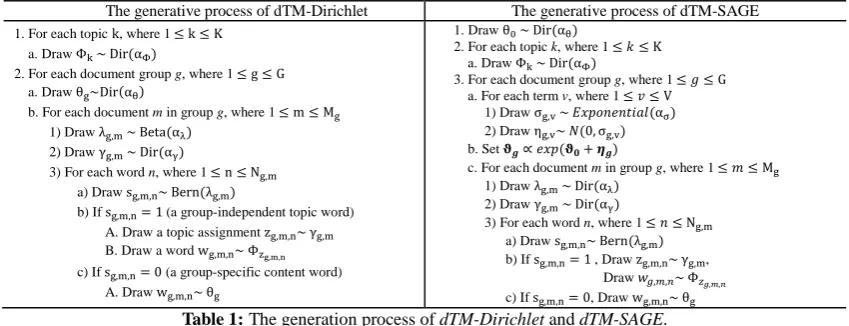
As shown in Fig. 1, dTM-Dirichlet associates each document a topic distribution 𝛾 ~ 𝐷𝑖𝑟 (𝛼𝛾), and
the topic assignment variable 𝑧 for each word in the document thus can be multinomially sampled
from𝛾. Besides a topic variable z, each word is also assigned with a binary variable 𝑠 that indicates
whether the word is a group-independent topic word (s=1) or a group-specific content word (s=0).
Each document has a group-specific word controller 𝜆 ~𝐵𝑒𝑡𝑎(𝛼𝜆), which reflects the proportion of
group-specific content in a document. 𝑠 is sampled from a Bernoulli test with the probability of 𝜆.
Formally, the generative process of dTM-Dirichlet model for a corpus C divided into G document
groups is shown in Table 1. When 𝑠𝑔,𝑚,𝑛= 1, the sample of the group-independent topic word is
iden-tical to LDA. When 𝑠𝑔,𝑚,𝑛= 0, the sample of the word 𝑤𝑔,𝑚,𝑛 is independent from the document’s
top-ic distribution 𝛾𝑔,𝑚 and directly drawn from the group-specific content word distribution 𝜃𝑔.
dTM-Dirichlet models group-specific word distributions to capture the differential lexicon usage of
document groups. However, dTM-Dirichlet is not a truly differential topic model, which requires the
development of dTM-SAGE for comparative summarization.
3.2 dTM-SAGE Model
When generating topics for multiple document collections, LDA-style generative models associate a
multinomial distribution with each document group, which is the same as how we model the
group-specific content words in dTM-Dirichlet model.
In contrast, SAGE (Sparse Additive Generative model) (Eisenstein et al., 2011) provides an
alterna-tive way to LDA by endowing each document group with a model of the deviation in log-frequency
from a constant background distribution, which brings three advantages: First, a sparsity-inducing pri-or can be applied to limit the number of terms whose probability diverges from the background term frequencies. Second, multi-facets latent variables can be easily combined by adding each facet com-ponent together to reduce the inference cost. Third, it is redundant to learn unique probabilities for high-frequency background words of each group. Modelling the deviation of each group-specific word distribution cancels the relearn process for the background words.
We propose dTM-SAGE which explicitly models the deviation in log-frequency of each
group-specific word distribution from a background lexical distribution. dTM-SAGE also builds word models
for group-independent topic words and group-specific content words. The group-independent topic words consist of background topic words and salient topic words.
dTM-SAGE models two types of group-independent words separately: as shown in Fig. 2, the
sali-ent topic words captured by 𝜑𝑘 and the background topic words captured by ϑ0. The word models 𝜑𝑘
and 𝜗0 are multinomial distributions drawn from uniform Dirichlet prior with parameter 𝛼𝜑 and 𝛼𝜗.
To enable ϑ0 to capture real background topic words shared by all document groups, we replace the
constant background distribution in SAGE with a latent distribution learnt by MAP estimation using a
Newton optimization.
The major difference between dTM-SAGE and dTM-Dirichlet is how the group-specific topics are
generated. In Fig.2, each document group g has a group component vector 𝜂𝑔 representing the
devia-tions in log-frequencies from the background distribution ϑ0. The group-specific topic is represented
by log frequency deviations rather than word probabilities. Given the background distribution ϑ0and
the group component vector 𝜂𝑔, the group-specific topic distribution ϑ𝑔 for each word in a document
in the group g, denoted by 𝛝𝒈∝ 𝑒𝑥𝑝(𝛝𝟎+𝜼𝒈), is computed by Equation (1):
0 0, ,
( | , g) / exp( v, g v) v
p w θ η
∑
θ η (1)In Equation (1), g indexes the group component vector and v indexes the term in the corpus
vocabu-lary. Following SAGE, we ignore covariance between terms. For each term v, 𝜂𝑔,𝑣 is drawn from a
zero-mean Gaussian distribution𝑁(0,𝜎𝑔,𝑣), where the variance 𝜎𝑔,𝑣 is drawn from the Exponential
distribution parameterized by 𝛼𝜎. The compound model ∫ 𝑁(η; 0,𝜎)𝐸𝑥𝑝𝑜𝑛𝑒𝑛𝑡𝑖𝑎𝑙(𝜎;𝛼𝜎)𝑑𝜎 is
equiv-alent to a zero-mean Laplace prior on 𝜂 inducing sparsity and meanwhile permitting large degrees of
deviations. In dTM-SAGE, we treat the variance𝜎 as a latent variable and develop variational
infer-ence on it, which is the same as SAGE. The remaining part of dTM-SAGE is the same as
dTM-Dirichlet model. Formally, the generative process of dTM-SAGE is shown in Table 1. See Appendix A for inference details of 𝛝𝟎and𝜼𝒈.
4
Comparative Summary Generation
To summarize differences among document groups, we rely on group-specific topicsϑg to select most
discriminative sentences for summary generation. This section introduces the sentence scoring and the
sentence selection techniques developed for dTM-based comparative summarization.
The generative process of dTM-Dirichlet The generative process of dTM-SAGE
4.1 Sentence Scoring
Both dTM-Dirichlet and dTM-SAGE model the group-specific word distributions 𝜗𝑔 to capture the
unique content in each document group. For dTM-SAGE, we can also get a corpus background topic
distribution𝜗0 that reflects the common themes shared by all groups. To measure the sentence
dis-criminative capacity, we develop two sentence scoring methods: one is based on the word discrimina-tive scores and the other is measured by the difference of the probabilities that a sentence is generated from a group-specific topic distribution and the background topic distribution.
First, given a set of group-specific word distributions 𝜗𝑔 (1≤ 𝑔 ≤G), we define the word d
iscrimi-native score 𝐷𝑆𝑊(𝑣,𝑔) of a term v to a group g as 𝐷𝑆𝑊(𝑣,𝑔) =∑𝑔′≠𝑔( 𝜗𝑔,𝑣− 𝜗𝑔′,𝑣)⁄�∑ 𝜗𝑔 𝑔2,𝑣+𝜖, where 𝜖 is a small number (set to 0.05) to avoid the error of division by zero. Larger value of the word discrimina-tive score indicates more discriminadiscrimina-tive ability the word has. The intuition is that a word more likely to occur in a particular group and less likely to occur in other groups tends to be more discriminative.
The discriminative capacity of a sentence s to a group g 𝐷𝐶𝑆_𝑑𝑠𝑤(𝑠,𝑔) is the average over the word
discriminative scores:
_ ( , ) ( , ) / ( )
w s
DCS
dsw s g
=∑
∈DSW w g
len s
(2) The other method to measure the discriminative capacity of a sentence relies on the likelihood that the sentence is generated from a group-specific distribution and the background topic distribution. Its design is motivated by the idea that a word is more discriminative if it occurs more often in agroup-specific topic and occurs rarely in the shared background topic. Given a topic-word distribution 𝜗, the
probability of a sentence s generated from 𝜗:
log ( | )
P s
θ
=∑
w s∈ logθ
w (3)Given a set of group-specific word distributions 𝜗𝑔 (1≤ 𝑔 ≤G) and the background topic
distribu-tion𝜗0, the discriminative capacity of a sentence s to a group g is defined as the difference of sentence
generative probabilities𝐷𝐶𝑆_𝑑𝑔𝑝(𝑠,𝑔):
0
_ ( , ) log ( | g) (1 )log ( | )
DCS
dgp s g
=u
P s
θ
− −u
P s
θ
(4)where u is a balance factor trading off between group-specific words and background words.
4.2 Sentence Selection
To select discriminative sentences to form group summary, we use different sentence selection meth-ods according to sentence scoring techniques.
For the sentence scoring based on the word discriminative scores, we first rank the sentences
ac-cording to the sentence discriminative capacity score𝐷𝐶𝑆_𝑑𝑠𝑤. Then we select a sentence with the
highest score if it satisfies the redundancy constraint that indicated by a cosine similarity threshold (empirically set to 0.8).
For the scoring based on difference sentences generative probabilities, suppose we have a set of
candidate sentences S to form a summary for group g and we want to select k sentences denoted as 𝑆𝑘.
A greedy sentence selection schema is proposed to build 𝑆𝑘 by iteratively choosing a jth sentence that
currently has the maximum sentence discriminative capacity score 𝐷𝐶𝑆_𝑑𝑔𝑝:
1 *
\
arg max _ ( , )
j j
j
s S S
s
DCS
dgp s g
−
∈
= (5)
In order to discourage redundancy, after select one sentence, we update the group-specific topic dis-tribution𝜗𝑔 by setting ϑg,w∝ ϑ2g,w for each word w in the selected sentence sj∗. Sentences are selected in this manner until reaching the summary limit.
5
Experiments and Results
5.1 Data Collection and Annotation
Comparative summarization is not a new task. However, to our best knowledge there is no public benchmark data set available. For collecting experiment data, we choose three tasks in NLP:
summari-zation (SUMMA), sentiment analysis (SA) and geographical NLP tasks (GEO) to form three document
topic models. We collect 129 papers in total for the three groups from ACL Anthology Searchbench providing full-text search for 28,000 papers in the ACL Anthology. For each group, we search with two types of keyword filters: plain text filter and title filter. Table 2 shows the general information of each document group, including the keywords, the number of documents |D| and the number of sen-tences |S|. To pre-process the dataset, we exclude all tables, figures and formulas, remove stop words, perform stemming with Porter Stemmer, and prune words less than 5 times across the corpus. There are 3720 tokens after pre-processing.
We hire three PhD students in Aston University to annotate the dataset. After reading papers in each group, each annotator is asked to first pick out all discriminative sentences in each paper and then write reference summaries delivering the major differences for each group. Additional instructions are given to annotators: Each reference summary should be no more than 300 words; and the discrimina-tive sentences should enable the judgment of which group the paper belongs to. Equipped with the annotated dataset, two parts of evaluations are performed: evaluation of differential topic models and evaluation of the summarization methods.
5.2 Evaluations on dTM
In this section, we compare dTM-Dirichlet and dTM-SAGE with other three topic models in terms of
model perplexity and topic coherences: (1) the standard LDA topic model, which we run across the
corpus and perform Newton optimization to update hyper-parameters; (2) SAGE, which a sparse
addi-tive generaaddi-tive model proposed in (Eisenstein et al., 2011), and the non-parametric Jeffrey’s prior
make it parameter-free; (3) the variant of DualSum, which is proposed for update summarization
(De-lort and Alfonseca, 2012) and revised to perform comparative summarization by replacing pairs of
collection-specific distributions with group-specific distributions. We implement the variant of
Du-alSum, dTM-Dirichlet and dTM-SAGE models. Experimental settings are detailed below.
Settings for the variant of DualSum. The dirichlet priors for word distributions are empirically set
to 0.1 and 𝛼𝜆 = (2.0,2.0,1.0) to encourage more words generated from the group-specific distributions
and document-specific distributions.
Settings for dTM-Dirichlet. The dirichlet priors for word distributions αΦ and αθ are set to 0.1. For
other papramenters, we set the number of group-independent topics K = 20, the prior for the topic
distribution αγ= 50/𝐾, and the prior for the group-specificword controller αλ= 2.0. Beta(2.0, 2.0)
yields equal probabilities that words sampling from the specific distribution and the group-independent distributions.
Settings for dTM-SAGE. Parameters are set the same as those in dTM-Dirichlet: αΦ=αθ=
0.1, K = 20,αγ= 50/𝐾 andαλ= 2.0. The variational distribution of the variance 𝛔 is Gamma(𝛼�,𝑏�)
which is initialized as 𝛼�= 10.0 and 𝑏�= 5.0. The initialization for 𝛝𝟎 and𝛈are from the Uniform
distribution 𝑈(0, 1) and the Normal distribution 𝑁(0, 0.5) respectively.
First, we investigate the model perplexity. Perplexity is a general measure for evaluating the gen-erative ability of a probabilistic topic model. We compute the perplexity on a held-out test set, 20% of
the original dataset. Note that we calculate the perplexity for all models except the variant of DualSum,
since it models the document-specific distribution for each document and thus there is no natural way
to assign probability to new document. For the variant of DualSum, we train the model on the whole
dataset and report the results on the test set, though it by no means can reflect the generalization ca-pacity of the model.
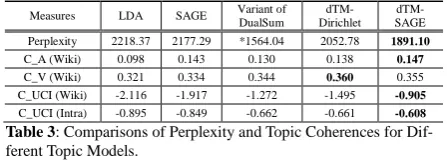
Perplexity results are shown in the first row in Table 3, from which we can see that the perplexity
scores decrease by 7% and 13% respectively between dTM-Dirichlet and standard LDA and between
dTM-SAGE and standard SAGE. The better results of differential topic models over the standard ones
are due to the discrimination between group-specific topics and group-independent topics. Both SAGE
methods outperform their counterparts of the Dirichlet-multinomial, because the sparsity-inducing
pri-or enables SAGE to control sparsity adaptively without over-fitting (Eisenstein et al., 2011).
Group Keywords |D| |S| Title Plain Text
SUMMA summarization topic model 35 6636 SA Sentiment topic model 45 10239
GEO N/A topic model,
geographical 49 8249
Table 2: General Information of the Dataset
Measures LDA SAGE Variant of Perplexity 2218.37 2177.29 *1564.04 2052.78 1891.10 C_A (Wiki) 0.098 0.143 0.130 0.138 0.147 C_V (Wiki) 0.321 0.334 0.344 0.360 0.355 C_UCI (Wiki) -2.116 -1.917 -1.272 -1.495 -0.905 C_UCI (Intra) -0.895 -0.849 -0.662 -0.661 -0.608
To check the quality of the generated group-specific topics, we investigate various topic coherence measures. The intuition behind the topic coherence measures is that words clustering into a single top-ic tend to co-occur in the same document. It has been previously verified that toptop-ic coherence score is highly correlated with human-judged topic coherence in many works. We rely on Palmetto library (Röder et al., 2015), an online open source implementation, which offers a framework to calculate many coherence measures within a reference corpus of the English Wikipedia.
In our experiment, we compare three widely-used coherence scores over the five topic models: (1)
C_A, which is the pairwise comparison of the top words based on a context window of size 5, and
proposed in (Aletras and Stevenson, 2013); (2) C_V, which is a one-set segmentation of the top words
based on a sliding window of size 110, and proposed in (Röder et al., 2015); (3) C_UCI, which is the
pointwise mutual information (PMI) of all word pairs of the top words based on a sliding window of size 10, and proposed in (Newman et al., 2010).
We focus on the group-specific topics. For each group-specific topic-word distribution we get a word list containing the top-20 words and calculate the coherence scores for each word list. The topic coherence results shown in Table 3 are the average coherence scores of the three group word lists. The
coherence scores are calculated within two reference corpus: the English Wikipedia (Wiki) and the
original dataset (Intra). Table 4 shows the top 10 words selected by SAGE, dTM-SAGE and
dTM-Dirichlet for the group SUMMA. Main observations found in Table 3 include:
(1) The three differential topic models generally perform much better than the standard LDA and
SAGE models on all coherence measures, which shows the superiority of our dTM models by
distin-guishing group-specific words and group-independent words;
(2) dTM-SAGE consistently performs the best among all the five models in terms of C_A and
C_UCI with the significant increase at least by 6.5% over dTM-Dirichlet and 8.2% over the variant of
DualSum, which shows the advantage of dTM-SAGE in accurately ranking the group-specific words due to the essence of the differential word model;
(3) dTM-Dirichlet outperforms the variant of DualSum with C_A and C_V, however, it performs
nearly the same or even worse when measured with C_UCI.
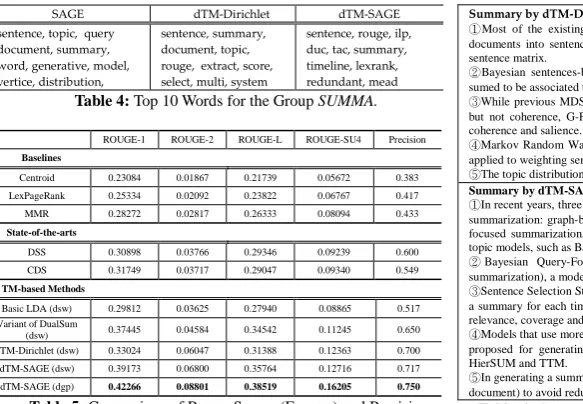
As shown in Table 4, words selected by dTM-SAGE (like rouge, lexrank, redundant) are more
in-formative and discriminative than words selected by SAGE and dTM-Dirichlet.
5.3 Evaluations on Summarization
To evaluate the quality of the generated summaries, we compare our dTM-based comparative
summa-rization methods with five other typical methods under ROUGE metrics (Lin and Hovy, 2003). Fur-ther, to check the discriminative ability of the comparative summaries, following the evaluation meth-od of (Wang et al., 2012), we investigate the precision of the discriminative sentence selection.
In our experiment, we implement three types of summarization methods: (1) Generic baseline methods, including the centroid-based method (Radev et al. 2004), the graph-based method
LexPag-SAGE dTM-Dirichlet dTM-SAGE
①Most of the existing multi-document summarization methods decompose the documents into sentences and work directly in the sentence space using a term-sentence matrix.
②Bayesian sentences-based topic model, every sentences in a document is as-sumed to be associated to a unique latent topic.
③While previous MDS systems have focused primarily on salience and coverage but not coherence, G-Flow generates an ordered summary by jointly optimizing coherence and salience.
④Markov Random Walk Model (MRW) Graphs methods have been successfully applied to weighting sentences for generic and query-focused summarization.
⑤The topic distributions are used to get the sentence scores and rank sentences. Summary by dTM-SAGE.
①In recent years, three major techniques have emerged to perform multi-document summarization: graph-based methds such as LexRank, Biased-LexRank for query-focused summarization, language models such as KLSum and variants based on topic models, such as BayeSum and TopicSum.
②Bayesian Query-Focused Summarization, we present BayeSum (Bayesian summarization), a model for sentence extraction in query-focused summarization.
③Sentence Selection Strategy, The task of timeline summarization aims to produce a summary for each time and the generated summary should meet criteria such as relevance, coverage and coherence.
④Models that use more structure in the representation of documents have also been proposed for generating more coherent and less redundant summaries, such as HierSUM and TTM.
⑤In generating a summary, we use MMR (Maximal Marginal Relevance for multi-document) to avoid redundancy in a summary.
Table 6: Comparison of 5-Sentence Summary Generated by
dTM-Dirichlet and dTM-SAGE.
ROUGE-1 ROUGE-2 ROUGE-L ROUGE-SU4 Precision Baselines
eRank (Radev et al., 2004) and the MMR-based method (Carbonell and Goldstein, 1998); (2)
State-of-the-art comparative summarization methods, including the discriminative sentence selection (DSS)
method (Wang et al., 2012) and the complementary dominating set (CDS) method (Shen and Li, 2010);
(3) TM-based comparative summarization methods, which combine four different TMs with two
sen-tence scoring strategies 𝐷𝐶𝑆_𝑑𝑠𝑤 and 𝐷𝐶𝑆_𝑑𝑔𝑝 defined in section 4.1, including the
basic 𝐿𝐷𝐴 (𝑑𝑠𝑤), the variant of 𝐷𝑢𝑎𝑙𝑆𝑢𝑚 (𝑑𝑠𝑤), dTM-Dirichlet (𝑑𝑠𝑤), dTM-SAGE (𝑑𝑠𝑤) and
dTM-SAGE(𝑑𝑔𝑝). For each group, we select 20 sentences to form the final summary.
First, we examine the precision of the discriminative sentence selection. For each group we have 20 sentences in a summary and count how many sentences belong to the annotated discriminative sen-tence set. Comparisons of the precision results of discriminative sensen-tence selection by different
meth-ods are shown at the last column in Table 5. From the precision results, we find that (1) our dTM
-based comparative summarization methods can select over 70% discriminative sentences, which sig-nificantly outperform the state-of-the-art methods with a nearly 20% increase on the precision score; (2) All generic summarization methods perform rather worse due to different concerns on summariza-tion resulting in the lack of discriminative ability of summaries.
We use ROUGE-1.5.5 toolkit to evaluate the quality of generated summaries by comparing them with human-written reference summaries. In our experiment, we limit the length of all summaries to 250 words and report the average ROUGE scores (F-Scores) on various summarization methods in
Table 5. According to the results, we observe that: (1) our dTM-based comparative summarization
methods perform much better (paired t-test with p<0.05) than all the baselines, which demonstrates that targeting at a different goal for summarizing the general information among document groups, generic summarization methods are less applicable for comparative summarization, though by remov-ing redundancy, MMR performs better than the other two baselines but still lags behind other
summa-rization methods specifically proposed for comparative summasumma-rization; (2) our dTM-based
compara-tive summarization methods significantly outperform (paired t-test with p<0.05) the other two state-of-the-art comparative summarization methods, which shows that summarizing differences by extracting
group-specific topics is more effective than directly summarizing at the sentence level; (3) Both
dTM-SAGE methods achieve better ROUGE scores than dTM-Dirichlet, which is ascribe to the advantage
of a differential word model contributing to more informative and discriminative group-specific topics
(discussed in section 5.2); and, (4) For dTM-SAGE, the greedy sentence selection schema based on
𝐷𝐶𝑆_𝑑𝑔𝑝 is more effective than simply ranking sentence with 𝐷𝐶𝑆_𝑑𝑠𝑤.
5.4 Summary Example
We show an example of the summary generated for the group SUMMA by our dTM-SAGE and
dTM-Dirichlet in Table 6. Looking into the summaries, we find that all sentences in both summaries are related to summarization but different in the degree of their discriminative ability. Apparently, the
summary generated by dTM-SAGE is more specific and unique to summarization, while the summary
generated by dTM-Dirichlet still contains some general information about topic models in sentence ②
and ⑤. Another observation is that the summary of dTM-SAGE tends to contain more salient
group-specific terms that may not occur in most of group documents but still possess high discrimination,
like ‘query-focused’, ‘MMR’ and ‘HierSUM’. In contrast, the summary by dTM-Dirichlet covers more
background group-specific words, like ‘summarization’ and ‘MDS’. Although these background
group-specific terms are discriminative for the group, they are relatively less informative than the sali-ent terms for the purpose of summarization.
6
Conclusions
This paper studies the differential topic models for comparative summarization on cross-area scientific
papers. A differential topic model dTM-SAGE is proposed to capture the unique characteristics of each
document group and generate coherent group-specific topics. A greedy sentence selection method with two sentence discriminative capacity scoring schemas is designed to automatically generate summary
for dTM-based comparative summarization methods, which achieve significant improvements with
Acknowledgements
Research was partially supported by National Science Foundation of China and National Science Foundation of Jiangsu (No. BK20140895).
Reference
Ahmed, A., and Xing, E. P. 2010. Staying informed: supervised and semi-supervised multi-view
topi-cal analysis of ideologitopi-cal perspective. In Proceedings of EMNLP, 1140-1150.
Aletras, N., and Stevenson, M. 2013. Evaluating topic coherence using distributional semantics. In Proceedings of the 10th International Conference on Computational Semantics, 13-22.
Boudin, F., and El-Bèze, M. 2008. A scalable MMR approach to sentence scoring for multi-document
update summarization. In Proceedings of COLING, 23-26.
Blei, D. M. 2012. Probabilistic topic models. Communications of the ACM, 55(4), 77-84.
Cai, X., Li, W., Ouyang, Y., and Yan, H. 2010. Simultaneous ranking and clustering of sentences: a
reinforcement approach to multi-document summarization. In Proceedings of COLING, 134-142.
Celikyilmaz, A., and Hakkani-Tur, D. 2010. A hybrid hierarchical model for multi-document
summa-rization. In Proceedings of ACL, 815-824.
Celikyilmaz, A., and Hakkani-Tür, D. 2011. Discovery of topically coherent sentences for extractive
summarization. In Proceedings of ACL, 491-499.
Delort, J. Y., and Alfonseca, E. 2012. DualSum: a topic-model based approach for update
summariza-tion. In Proceedings of the European Chapter of ACL, 214-223.
Erkan, G., and Radev, D. R. 2004. LexPageRank: Prestige in Multi-Document Text Summarization. In Proceedings of EMNLP, Vol. 4, 365-371.
Eisenstein, J., Ahmed, A., and Xing, E. P. 2011. Sparse additive generative models of text. In
Pro-ceedings of ICML, 1041-1048.
Fisher, S., and Roark, B. 2008. Query-focused supervised sentence ranking for update summaries. In Proceedings of the TAC.
Gupta, V., and Lehal, G. S. 2010. A survey of text summarization extractive techniques. Journal of
Emerging Technologies in Web Intelligence, 2(3), 258-268.
Jha, R., Coke, R. and Radev, D. 2015. Surveyor: A system for generating coherent survey articles for
scientific topics. In Proceedings ofAAAI, 2167-2173.
Lin, C. Y., and Hovy, E. 2003. Automatic evaluation of summaries using n-gram co-occurrence
statis-tics. In HLT-NAACL, 71-78.
Li, W., Wei, F., Lu, Q., and PNR, Y. H. 2008. Ranking sentences with positive and negative
rein-forcement for query-oriented update summarization. In Proceedings of COLING, 489-496.
Li, P., Wang, Y., Gao, W., and Jiang, J. 2011. Generating aspect-oriented multi-document
summariza-tion with event-aspect model. In Proceedings of EMNLP, 1137-1146.
Li, C., Qian, X., and Liu, Y. 2013. Using Supervised Bigram-based ILP for Extractive Summarization. In Proceedings of ACL, 1004-1013.
Li, W. 2015. Abstractive Multi-document Summarization with Semantic Information Extraction. In
Proceedings of EMNLP,1908-1913.
Mihalcea, R., and Tarau, P. 2004. TextRank: Bringing order into texts. In Proceedings of EMNLP,
404-411.
Paul, M. 2009. Cross-collection topic models: Automatically comparing and contrasting text. Master’s thesis, University of Illinois Urbana Champaign, IL, USA.
Paul, M., and Girju, R. 2009. Cross-cultural analysis of blogs and forums with mixed-collection topic
models. In Proceedings of EMNLP, 1408-1417.
Paul, M., and Girju, R. 2010. A two-dimensional topic-aspect model for discovering multi-faceted
top-ics. In Proceedings ofAAAI, 545-550.
Radev, D. R., Jing, H., and Budzikowska, M. 2000. Centroid-based summarization of multiple
docu-ments: sentence extraction, utility-based evaluation, and user studies. In Proceedings of the
NAACL-ANLP, 21-30.
Radev, D. R., Jing, H., Styś, M., and Tam, D. 2004. Centroid-based summarization of multiple
docu-ments. Information Processing & Management, 40(6), 919-938.
Röder, M., Both, A., and Hinneburg, A. 2015. Exploring the space of topic coherence measures. In Proceedings of the 8th ACM international conference on Web search and data mining, 399-408. ACM.
Sekine, S., and Nobata, C. 2003. A survey for multi-document summarization. In Proceedings of the
HLT-NAACL, Vol.5, 65-72.
Shen, C., and Li, T. 2010. Multi-document summarization via the minimum dominating set. In Proceedings of COLING, 984-992.
Wan, X., Yang, J., and Xiao, J. 2007. Towards an iterative reinforcement approach for simultaneous
document summarization and keyword extraction. In Proceedings of ACL, Vol.7, 552-559.
Wang, D., Zhu, S., Li, T., and Gong, Y. 2012. Comparative document summarization via
discrimina-tive sentence selection. ACM Transactions on Knowledge Discovery from Data (TKDD), 6(3), 12.
Zhai, C., Velivelli, A., and Yu, B. 2004. A cross-collection mixture model for comparative text mining. In Proceedings of ACM SIGKDD, 743-748. ACM.
Zhuge, H. 2016. Multi-Dimensional Summarization in Cyber-Physical Society, Morgan Kaufmann.
Appendix A. Variational Inference of
𝛝
𝟎and
𝜼
𝒈Generally, we take MAP (maximum a posterior) estimation for the background word distribution ϑ0
and the group component vectors η and develop variational inference techniques for all other variables.
In dTM-SAGE, the lower bound L with regarding to ϑ0,η and 𝜎 is: