Probabilistic Refinement Algorithms
for the Generation of Referring Expressions
Romina Al tamirano
1Carlos Areces
1,2Luciana Benot ti
1(1) FaMAF, Universidad Nacional de Córdoba, Argentina (2) Consejo Nacional de Investigaciones Científicas y Técnicas, Argentina
{ialtamir,areces,benotti}@famaf.unc.edu.ar
A
BSTRACTWe propose an algorithm for the generation of referring expressions (REs) that adapts the approach of Areces et al. (2008, 2011) to include overspecification and probabilities learned from corpora. After introducing the algorithm, we discuss how probabilities required as input can be computed for any given domain for which a suitable corpus of REs is available, and how the probabilities can be adjusted for new scenes in the domain using a machine learning approach. We exemplify how to compute probabilities over the GRE3D7 corpus of Viethen (2011). The resulting algorithm is able to generate different referring expressions for the same target with a frequency similar to that observed in corpora. We empirically evaluate the new algorithm over the GRE3D7 corpus, and show that the probability distribution of the generated referring expressions matches the one found in the corpus with high accuracy.
1 Generation of referring expressions
In linguistics, areferring expression(RE) is an expression that unequivocally identifies the intended target to the interlocutor, from a set of possible distractors. The generation of referring expressions (GRE) is a key task of most natural language generation (NLG) systems (Reiter and Dale, 2000, Section 5.4). Depending on the information available to the NLG system, certain objects might not be associated with an identifier which can be easily recognized by the user. In those cases, the system will have to generate a, possibly complex, description that contains enough information so that the interlocutor will be able to identify the intended referent. The generation of referring expressions is a well developed field in automated natural language generation. Building upon GRE foundational work (Winograd, 1972; Dale, 1989; Dale and Reiter, 1995), various proposals have investigated the generation of different kinds of referring expressions such as relational expressions (“the blue ball next to the cube” (Dale and Haddock, 1991)), reference to sets (“the two small cubes” (Stone, 2000)), or more expressive logical connectives (“the blue ball not on top of the cube” (van Deemter, 2002)). REs involving relations, in particular, have received increasing attention recently. However, the classical algorithm by Dale and Haddock (1991) was shown to be unable to generate satisfying REs in practice (see the analysis over thecabinet corpusin (Viethen and Dale, 2006)). Furthermore, the Dale and Haddock algorithm and many of its successors (such as (Kelleher and Kruijff, 2006)) are vulnerable to the problem ofinfinite regress, where the algorithm enters an infinite loop, jumping back and forth between descriptions for two related individuals, as in “the book on the table which supports a book on the table . . . ”
Areces et al. (2008, 2011) have proposed low complexity algorithms for the generation of relational REs that eliminate the risk of infinite regression. These algorithms are based on variations of the partition refinement algorithms of Paige and Tarjan (1987). The information provided by a given scene is interpreted as a relational model whose objects are classified into sets that fit the same description. This classification is successivelyrefinedtill the target is the only element fitting the description of its class. The existence of an RE depends on the information available in the input scene, and on the expressive power of the formal language used to describe elements of the different classes in the refinement. Refinement algorithms effectively compute REs for all individuals in the domain, at the same time. The algorithms always terminate returning a formula of the formal language chosen that uniquely describes the target (if the formal language is expressive enough to identify the target in the input model). Refinement algorithms require an ordered list of properties that can be used to described the objects in the scene, and the naturalness of the generated REs strongly depends on this ordering. The goal of this paper is twofold. First we show how we can add non-determinism and overspecification to the refinement algorithms, by replacing the fixed ordering over properties of the input scene by aprobability of usefor each property, and modifying the algorithm accordingly. In this way, each call to the algorithm can produce different REs for the same input scene and target. We will then show that given suitable corpora of REs (like the GRE3D7 corpora discussed in (Viethen, 2011)) we can estimate these probabilities of use so that REs are generated with a probability distribution that matches the one found in corpora.
2 Adding non-determinism and overspecification
class is refined. The procedure always stops when the set of classes stabilizes, i.e., no further refinement is possible with the information available in the scene1. If the target element is in a singleton class, then the formal description of that class is a referring expression; otherwise the target cannot be unequivocally described (inL).
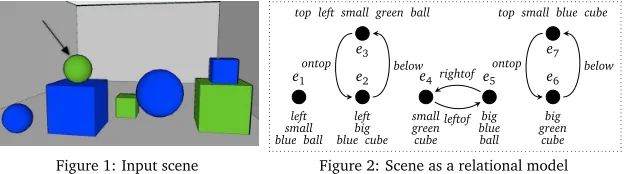
[image:3.420.63.376.200.287.2]We present a modification of the algorithm in (Areces et al., 2008) where the fixed order of properties in the input scene is replaced by a finite probability distribution. The resulting algorithm (see Figure 3) is now non-deterministic: two runs of the algorithm with the same input might result in different REs for objects in the scene. The input to the algorithm will be a relational modelM=〈∆,|| · ||〉, where∆is the non-empty domain of objects in the scene, and ||·||is an interpretation function that assigns to all properties in the scene its intended extension. For example, the scene shown in Figure 1 could be represented by the modelM=〈∆,|| · ||〉 shown in Figure 2; where∆ ={e1, . . . ,e7}, and||green||, for example, is{e3,e4,e6}.
Figure 1: Input scene
e1 left small blue ball e2 left big blue cube e3 top left small green ball
e4 small green cube e5 big blue ball e6 big green cube e7 top small blue cube
below ontop
leftof
rightof ontop below
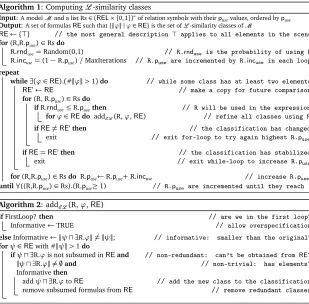
Figure 2: Scene as a relational model On termination, the algorithm computes what are called theL-similarity classes of the input modelM. Intuitively, if two elements in the model belong to the sameL-similarity class, then Lis not expressive enough to tell them appart (i.e, no formula inLcan distinguish them). The algorithm we discuss uses formulas of theELdescription logic language (Baader et al., 2003) to describe refinement classes2. The interpretation of theELformulaψu∃R.ϕis the set of all elements that satisfyψand that are related by relation R to some element that satisfyϕ. Algorithm 1 takes as input a model and a list Rs of pairs (R,R.puse) that links each relation R∈REL, the set of all relation symbols in the model, to some probability of use R.puse. The setREwill contain the formal description of the refinement classes and it is initialized by the most general description>. For each R, we first compute R.rnduse, a random number in [0,1]. If R.rnduse≤R.pusethen we will use R to refine the set of classes. The value of R.puse
will be incremented by R.incusein each main loop, to ensure that all relations are, at some point, considered by the algorithm. This ensures that a referring expression will be found if it exists; but gives higher probability to expressions using relations with a high R.puse. WhileRE
contains descriptions that can be refined (i.e., classes with at least two elements) we will call the refinement function addL(R,ϕ,RE) successively with each relation in Rs. A change in one of the classes, can trigger changes in others. For that reason, ifREchanges, we exit theforloop to
start again with the relations of higher R.puse. If after trying to refine the set with all relations in Rs, the setREhas not changed, then we have reached a stable state (i.e., the classes described inREcannot be further refined with the current R.pusevalues). We will then increment all 1Of course, if we are only interested in a referring expression for a given target we can stop the procedure as soon
as the target is the only element of some of the classes.
2Notice, though, that the particular formal language used is independent of the main algorithm, and different
Algorithm 1: ComputingL-similarity classes
Input:A modelMand a list Rs∈(REL×[0, 1])∗of relation symbols with theirpusevalues, ordered bypuse Output:A set of formulasREsuch that{||ϕ|| |ϕ∈RE}is the set ofL-similarity classes ofM
RE← {>} // the most general description> applies to all elements in the scene for(R,R.puse)∈Rsdo
R.rnduse=Random(0,1) // R.rnduse is the probability of using R R.incuse=(1−R.puse)/MaxIterations // R.puse are incremented by R.incuse in each loop
repeat
while∃(ϕ∈RE).(#||ϕ||>1)do // while some class has at least two elements RE’←RE // make a copy for future comparison for(R, R.puse)∈Rsdo
ifR.rnduse≤R.pusethen // R will be used in the expression forϕ∈REdo addEL(R,ϕ,RE) // refine all classes using R ifRE6=RE’then // the classification has changed exit // exit for-loop to try again highest R.puse
ifRE=RE’then // the classification has stabilized exit // exit while-loop to increase R.puse
for(R,R.puse)∈Rsdo R.puse←R.puse+R.incuse // increase R.puse
until∀((R,R.puse)∈Rs).(R.puse≥1) // R.puse are incremented until they reach 1
Algorithm 2: addEL(R,ϕ,RE)
ifFirstLoop?then // are we in the first loop? Informative←TRUE // allow overspecification elseInformative← ||ψu ∃R.ϕ|| 6=||ψ||; // informative: smaller than the original? forψ∈REwith #||ψ||>1do
ifψu ∃R.ϕis not subsumed inREand // non-redundant: can’t be obtained from RE?
||ψu ∃R.ϕ|| 6=;and // non-trivial: has elements? Informativethen
[image:4.420.48.357.72.376.2]addψu ∃R.ϕtoRE // add the new class to the classification remove subsumed formulas fromRE // remove redundant classes
Figure 3: Refinement algorithm with probabilities and overspecification for theEL-language
the R.pusevalues and start the procedure again. Algorithm 2 almost coincides with the one in (Areces et al., 2008). Theforloop will refine each descriptions inREusing the relation R and the other descriptions already inRE, under certain conditions. The new description
should benon-redundant(it cannot be obtained from classes already inRE),non-trivial(it is not empty), andinformative(it does not coincide with the original class). If these conditions are met, the new description is added toRE, and redundant descriptions created by the new description are eliminated. Theifstatement at the beginning of Algorithm 2 disregards the informativity test during the first loop of the algorithm allowing overspecification.
3 Learning to describe new objects from corpora
The REs in the corpus were produced by 294 participants, each producing 16 referring ex-pressions for 16 scenes. In this way, 140 descriptions for 32 different scenes were obtained, resulting in a corpus of 4480 REs describing a target in a 3D scene containing seven objects. Each description was elicited in the absence of a preceding discourse. A sample scene is shown in Figure 1 (the target is marked with an arrow). For more details on the corpus see (Viethen, 2011, Chapter 5). Importantly for our purposes, the corpus not only contains propositional REs (as other benchmark corpora in the area, e.g., (Gatt et al., 2008)) but also relational REs naturally produced by people. For example, the RE “small ball on top of cube” is used to describe the target in Figure 1. As our algorithm is one of the few that can generate relational REs in an efficient and reliable way, a corpus of relational REs is needed to test its full potential. It is worth mentioning that, although people only used 16 propositional properties and 4 relational properties in their REs, and converged to between 10 and 30 different descriptions of the same target, the possible different correctrelational REsfor a generation algorithm are in the order of several hundred. Hence, reproducing the corpus distribution is a complex task.
We calculate R.pusevalues for each training scene in the corpus in the following way. First, we use the REs in the corpusCto define the relational modelMused by the algorithm. Then we calculate the value ofpusefor each relation R in the model as the percentage of REs in which the relation appears. I.e., R.puse=(# of REs inCin which R appears)/(# of REs inC). The values R.puseobtained in this way should be interpreted as the probability of using R to describe the target in modelM, and we could argue that they are correlated to thesaliencyof R in the scene. For that reason, for example, in the scene in Figure 1 the value ofball.puseis 1, while the value ofcube.puseis 0.178. These probabilities will not be useful to describe different targets in different scenes. We will now see how we can use them to obtain values for new targets and scenes using a machine learning approach.
We selected eight different scenes for testing from the GRE3D7 corpus, and for each, we used the rest of the corpus for training. We used linear regression (Hall et al., 2009) to learn a function estimating the value ofpusefor each relation in the domain. We used simple, domain independent features that can be extracted automatically from the relational model:
target-has(R) :=true if the target is in R
#relations :=number of relations the target is in #bin-relations :=number of the binary relations the target is in
landmark-has(R) :=true if a landmark (i.e., an object directly related to the target) is in R discrimination(R) :=1 divided the number of objects in the model that are in R
Despite its simplicity, the functions obtained by linear regression are able to learn interesting characteristics of the domain. E.g., they correctly model that the saliency of a color depends strongly on whether the target object is of that color, and it does not depend on its discrimination power in the model. They also correctly predict that theontoprelation is used more frequently than the horizontal relations (leftofandrightof), as reported in (Viethen, 2011). Interestingly, they also indicate a characteristic of the GRE3D7 corpus not mentioned in previous work: size is more frequently used for overspecification when the target and landmark have the same size (it is used in overspecified REs in 49% of the descriptions for scenes where target and landmark have the same size, and only 25% of the time when target and landmark have different size).
4 Evaluation
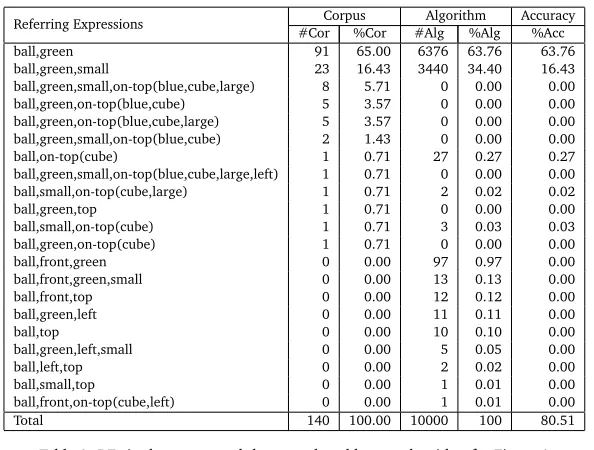
Referring Expressions #CorCorpus%Cor #AlgAlgorithm%Alg Accuracy%Acc
ball,green 91 65.00 6376 63.76 63.76
ball,green,small 23 16.43 3440 34.40 16.43 ball,green,small,on-top(blue,cube,large) 8 5.71 0 0.00 0.00 ball,green,on-top(blue,cube) 5 3.57 0 0.00 0.00 ball,green,on-top(blue,cube,large) 5 3.57 0 0.00 0.00 ball,green,small,on-top(blue,cube) 2 1.43 0 0.00 0.00
ball,on-top(cube) 1 0.71 27 0.27 0.27
ball,green,small,on-top(blue,cube,large,left) 1 0.71 0 0.00 0.00 ball,small,on-top(cube,large) 1 0.71 2 0.02 0.02
ball,green,top 1 0.71 0 0.00 0.00
ball,small,on-top(cube) 1 0.71 3 0.03 0.03 ball,green,on-top(cube) 1 0.71 0 0.00 0.00
ball,front,green 0 0.00 97 0.97 0.00
ball,front,green,small 0 0.00 13 0.13 0.00
ball,front,top 0 0.00 12 0.12 0.00
ball,green,left 0 0.00 11 0.11 0.00
ball,top 0 0.00 10 0.10 0.00
ball,green,left,small 0 0.00 5 0.05 0.00
ball,left,top 0 0.00 2 0.02 0.00
ball,small,top 0 0.00 1 0.01 0.00
ball,front,on-top(cube,left) 0 0.00 1 0.01 0.00
[image:6.420.56.353.68.293.2]Total 140 100.00 10000 100 80.51
Table 1: REs in the corpus and those produced by our algorithm for Figure 1
scene shown in Figure 1 (Scene 3 in the GRE3D7 corpus), then summarize the results for the other seven scenes we used for testing.
Usingpuselearned as described in Section 3 and running our algorithm 10000 times, we obtain 14 different referring expressions for Figure 1. It is already interesting to see that with the
Scenepuse Learnedpuse Randompuse Uniformpuse
[image:7.420.109.327.70.161.2]Scene 1 85.75% 84.49% 17.95% 5.37% Scene 3 82.81% 80.51% 9.89% 4.40% Scene 6 90.11% 83.30% 4.13% 4.16% Scene 8 86.52% 64.06% 16.32% 9.75% Scene 10 89.49% 75.80% 7.56% 3.70% Scene 12 80.21% 81.29% 57.09% 6.68% Scene 13 89.98% 50.79% 9.30% 3.59% Scene 21 92.13% 80.01% 8.45% 6.77% Average 87.13% 75.03% 16.34% 5.55%
Table 2: Accuracy between the REs in the corpus and those generated usingpusevalues computed from the scene, machine learned, random and uniform.
from corpora as explained in Section 3. In most cases the accuracy is rather high and the average accuracy is still high. The relatively low accuracy obtained in Scene 13 is explained mostly by the poor estimation of thepusevalue for thelargerelation. In the corpus, relationssmalland
largeare used much more when the target cannot be uniquely identified using taxonomical (ballandcube) and absolute (greenandblue) properties, but the features we used for machine learning do not capture such dependencies. In spite of this limitation, the average of the second column is 75%, indicating thatpusevalues learned from the corpus are good enough to be used to generate REs for new scenes from the domain. The last two columns can be considered as baselines. In the first one we generate random values forpuse. The accuracy obtained is in most cases poor, but with a noticeable variation due to chance. In addition to poor accuracy, when randompusevalues were used many of the generated REs where unnaturally sounding like “small on the top of a blue cube that is below of something that is small.” In the last column we present the accuracy for an artificial run, where all the REs generated in any of the previous columns were assigned the same probability.
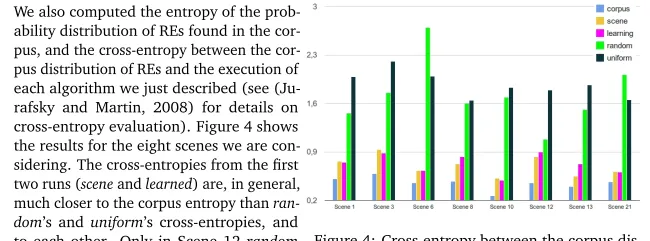
Figure 4: Cross-entropy between the corpus dis-tribution and different runs of the algorithm We also computed the entropy of the
prob-ability distribution of REs found in the pus, and the cross-entropy between the cor-pus distribution of REs and the execution of each algorithm we just described (see (Ju-rafsky and Martin, 2008) for details on cross-entropy evaluation). Figure 4 shows the results for the eight scenes we are con-sidering. The cross-entropies from the first two runs (sceneandlearned) are, in general, much closer to the corpus entropy than ran-dom’s anduniform’s cross-entropies, and to each other. Only in Scene 12random
approaches, by chance, the other two.
5 Discussion and Conclusions
[image:7.420.54.379.342.463.2]humans frequently overspecify their REs (Engelhardt et al., 2006; Arts et al., 2011; Viethen, 2011). We tested the proposed algorithm on the GRE3D7 corpus and found that it is able to generate a large proportion of the overspecified REs found in the corpus without generating trivially redundant referring expressions. Viethen (2011) trains decision trees that achieve 65% average accuracy on the GRE3D7 corpus. This approach is able to generate overspecified relational descriptions, but they might fail to be referring expressions. Indeed, because the method does not verify the extension of the generated expression over a model of the scene, the generated descriptions might not uniquely identify the target. As we have already discussed, our algorithm ensures termination and it always finds a referring expression if one exists. Moreover, it achieves an average of 75% of accuracy over the 8 scenes used in our tests.
Different algorithms for the generation of overspecified referring expressions have been recently proposed (de Lucena and Paraboni, 2008; Ruud et al., 2012). To our knowledge, they have not been evaluated on the GRE3D7 corpus and, hence, comparison is difficult. de Lucena and Paraboni (2008) and Ruud et al. (2012) algorithms have been evaluated on the TUNA-AR corpus (Gatt et al., 2008) where they have achieved a 33% and 40% accuracy respectively. As the TUNA-AR corpus includes only propositional REs, it would be interesting future work to evaluate how these algorithms perform in corpora with relational REs such as GRE3D7.
The way we introduce overspecification is inspired by the work of Keysar et al. (1998) on egocentrism and natural language production. Keysar et al. argue that when producing language, considering hearers point of view is not done from the outset but it is rather an afterthought; adult speakers produce REs egocentrically, just like children do, but then adjust REs so that the addressee is able to identify the target unequivocally. The first, egocentric, step is a heuristic process based in a model of saliency of the scene that contains the target. Our definition of
puseis intended to capture the saliences of the properties for different scenes and targets. The
puseof a relation changes according to the scene. This is in contrast with previous work where the saliency of a property is constant in a domain. Keysar et al. argue that the reason for this generate-and-adjust procedure may have to do with information processing limitations of the mind: if the heuristic that guides the egocentric phase is well tunned, it succeeds with a suitable RE in most cases and seldom requires adjustments. Interestingly, we observe a similar behavior with our algorithm: whenpusevalues learned from the domain are used, the algorithm is not only more accurate but also much faster than when using randompusevalues.
Besides testing our algorithm over the rest of the scenes in the GRE3D7 corpus, as future work we plan to evaluate our algorithm on more complex domains like those provided by Open Domain Folksonomies (Pacheco et al., 2012). We will also explore corpora obtained through interaction such as the GIVE Corpus (Gargett et al., 2010) where it is common to observe multi shot REs. Under time pressure, subjects will first produce an underspecified expression that includes salient properties of the target (e.g., “the red button”). And then, in a following utterance, they add additional properties (e.g., “to the left of the lamp”) to make the expression a proper RE identifying the target uniquely. The source code and the documentation for the algorithm are distributed under the GNU Lesser GPL and can be obtained athttp://code.google.com/p/bisimulation-gre.
References
Areces, C., Figueira, S., and Gorín, D. (2011). Using logic in the generation of referring expressions. In Pogodalla, S. and Prost, J., editors,Proceedings of the 6th International Conference on Logical Aspects of Computational Linguistics (LACL 2011), volume 6736 ofLecture Notes in Computer Science, pages 17–32, Montpelier. Springer.
Areces, C., Koller, A., and Striegnitz, K. (2008). Referring expressions as formulas of description logic. InProceedings of the 5th International Natural Language Generation Conference (INLG’08), pages 42–49, Morristown, NJ, USA. Association for Computational Linguistics.
Arts, A., Maes, A., Noordman, L., and Jansen, C. (2011). Overspecification facilitates object identification.Journal of Pragmatics, 43(1):361–374.
Baader, F., McGuiness, D., Nardi, D., and Patel-Schneider, P., editors (2003).The Description Logic Handbook: Theory, implementation and applications. Cambridge University Press.
Dale, R. (1989). Cooking up referring expressions. InProceedings of the 27th annual meeting on Association for Computational Linguistics, pages 68–75.
Dale, R. and Haddock, N. (1991). Generating referring expressions involving relations. In
Proceedings of the 5th conference of the European chapter of the Association for Computational Linguistics (EACL’91), pages 161–166.
Dale, R. and Reiter, E. (1995). Computational interpretations of the Gricean maxims in the generation of referring expressions.Cognitive Science, 19(2):233–263.
de Lucena, D. J. and Paraboni, I. (2008). USP-EACH frequency-based greedy attribute selection for referring expressions generation. InProceedings of the 5th International Conference on Natural Language Generation (INLG 2008), pages 219–220. Association for Computational Linguistics.
Engelhardt, P., Bailey, K., and Ferreira, F. (2006). Do speakers and listeners observe the gricean maxim of quantity?Journal of Memory and Language, 54(4):554–573.
Gargett, A., Garoufi, K., Koller, A., and Striegnitz, K. (2010). The give-2 corpus of giving instructions in virtual environments. InProceedings of the 7th International Conference on Language Resources and Evaluation (LREC), Malta.
Gatt, A., Belz, A., and Kow, E. (2008). The tuna challenge 2008: Overview and evaluation results. InProceedings of the 5th International Conference on Natural Language Generation (INLG 2008), pages 198–206. Association for Computational Linguistics.
Hall, M., Frank, E., Holmes, G., Pfahringer, B., Reutemann, P., and Witten, I. H. (2009). The WEKA data mining software: an update.ACM SIGKDD Explorations Newsletter, 11(1):10–18.
Jurafsky, D. and Martin, J. (2008).Speech and Language Processing. Pearson Prentice Hall, second edition.
Keysar, B., Barr, D. J., and Horton, W. S. (1998). The Egocentric Basis of Language Use.Current Directions in Psychological Science, 7(2):46–49.
Pacheco, F., Duboue, P., and Domínguez, M. (2012). On the feasibility of open domain referring expression generation using large scale folksonomies. InProceedings of the 2012 Conference of the North American Chapter of the Association for Computational Linguistics: Human Language Technologies, pages 641–645, Montréal, Canada. Association for Computational Linguistics.
Paige, R. and Tarjan, R. (1987). Three partition refinement algorithms. SIAM Journal on Computing, 16(6):973–989.
Reiter, E. and Dale, R. (2000). Building Natural Language Generation Systems. Cambridge University Press, Cambridge.
Ruud, K., Emiel, K., and Mariët, T. (2012). Learning preferences for referring expression generation: Effects of domain, language and algorithm. InINLG 2012 Proceedings of the Seventh International Natural Language Generation Conference, pages 3–11, Utica, IL. Association for Computational Linguistics.
Stone, M. (2000). On identifying sets. InProceedings of the 1st International Natural Language Generation Conference (INLG’00), pages 116–123.
van Deemter, K. (2002). Generating referring expressions: Boolean extensions of the incre-mental algorithm.Computational Linguistics, 28(1):37–52.
van der Sluis, I., Gatt, A., and van Deemter., K. (2007). Evaluating algorithms for the generation of referring expressions: Going beyond toy domains. InProceedings of Recent Advances in Natural Language Processing.
Viethen, H. A. E. (2011).The Generation of Natural Descriptions: Corpus-Based Investigations of Referring Expressions in Visual Domains. PhD thesis, Macquarie University, Sydney, Australia.
Viethen, J. and Dale, R. (2006). Algorithms for generating referring expressions: Do they do what people do? InProceedings of the 4th International Natural Language Generation Conference (INLG’06), pages 63–70.