Structure-Driven Lexicalist Generation
Shashi Narayan
1Claire Gardent
2(1) Université de Lorraine/LORIA, Nancy, France (2) CNRS/LORIA, Nancy, France
[email protected], [email protected]
Abstract
We present a novel algorithm for surface realisation with lexicalist grammars. In this algorithm, the structure of the input is used both top-down to constrain the selection of applicable rules and bottom-up to filter the initial search space associated with local input trees. In addition, parallelism is used to recursively pursue the realisation of each daughter node in the input tree. We evaluate the algorithm on the input data provided by the Generation Challenge Surface Realisation Task and show that it drastically reduce processing time when compared with a simpler, top-down driven, lexicalist approach.
Title and Abstract in Hindi
s\rcnA
-
pr
Ert шNd
-
sE>jt u(pAdn
hm шNd-sE>jt &yAкrZ кF mdd s vAkyo\ к sth s\pAdn к Ely eк nyF
tкnFк pr-tt кr rh h{\। is tкnFк m\ aAgt s\rcnA кA upyog dono\ “Upr s nFc”
upykt Enymo\ к cyn m tTA “nFc s Upr” aAgt s\rcnA m\ mOjd -TAnFy v"o\ s
jw prA\rEBк prF"Z "/ кo EPSVr кrn m\ EкyA gyA h{। isк sAT, smA\trvAd кA
upyog aAgt v"o\ к шAхo\ кF sth s\pAdn ht кшl trFк s EкyA gyA h{। hm apn
tкnFк кA mSyA\кn “u(pAdn prEtyoEgtA: sth s\pAdn” к aA\кwo\ pr кrt h{\ tTA hm
yh EdхAt\ h{\ Eк pr-tt trFкA dsr sADArZ “Upr s nFc” prErt шNd-sE>jt trFкo\
к mкAbl u(pAdn smy кo a(yEDк GVA dtA h{।
Keywords:
Generation, Tree Adjoining Grammar, Surface Realization.1
Introduction
Depending on the type of semantic representation encoded by the grammar, two main types of al-gorithms have been proposed for generating sentences with bi-directional, unification-based gram-mars such as CCG (Combinatory Categorial Grammar, (Espinosa et al., 2010)), HPSG (Head-Driven Phrase Structure Grammar, (Carroll et al., 1999)) and TAG (Tree Adjoining Grammar, (Gardent and Kow, 2005)).
For recursive semantic representations such as first-order logic formulae, head-driven algorithms (Shieber et al., 1990) have been argued to be best because they restrict the combinatorics inherent to bottom-up search; they avoid non termination by using lexical items to guide the search ; and they allow for semantically nonmonotonic grammars (i.e., grammars where the semantics of a rule at the left hand side need not be subsumed by the semantics of the rule at the right hand side). One main issue with this approach however is the so-called logical form equivalence problem (Shieber, 1993). A logic formula may have several logically equivalent but syntactically distinct formulae. For instancep∧qis logically equivalent toq∧p. In general though, a grammar will associate with natural language expressions only one of these logically equivalent formula. Hence a generator will
be able to produce the natural language expressionEonly when given the formulaφassociated
by the grammar withE. For all other formulae logically equivalent toφ, it will fail. Since, the problem of computing logical equivalence for first order logic is undecidable, the problem is quite deep.
For flat semantic representations such as MRSs (Minimal Recursion Semantics, (Copestake et al., 2001)) on the other hand, lexicalist approaches (Espinosa et al., 2010; Carroll and Oepen, 2005; Gardent and Kow, 2005) have extensively been used because (i) they impose few constraints on the grammar thereby making it easier to maintain bi-directional grammars that can be used both for parsing and for generation; and (ii) the approach eschews the logical form equivalence problem – Since the semantic representations are unstructured, there is no requirement on the generator to mirror a semantic structure. One known drawback of lexicalist approaches however is that they generally lack efficiency. Indeed, previous work has shown that the high combinatorics of lexicalist approaches stem from (i) strong lexical ambiguity (each input element is usually associated with a large number of grammatical structures thereby inducing a very large initial search space); (ii) the lack of order information in the input (as opposed to parsing where the order of words in the input string restricts the number of combinations to be explored); and (iii) intersective modifiers (given
nmodifiers applying to the same constituent, there aren!ways to combine these together).
In this paper, we present an algorithm for surface realisation that combines techniques and ideas from the head-driven and the lexicalist approach. On the one hand, rule selection is guided, as in the lexicalist approach, by the elementary units present in the input rather than by its structure – In this way, the logical form equivalence issue is avoided. On the other hand, the structure of the input is used to provide top-down guidance for the search and thereby restrict the combinatorics.
To further improve efficiency, the algorithm integrates three additional optimisation techniques. From the lexicalist approach, it adapts two techniques designed to prune the search space, namely a so-called polarity filter on local input trees (Bonfante et al., 2004); and the use of a language model to prune competing intermediate substructures. In addition, the algorithm is parallelised to explore the possible completions of the top-down predictions simultaneously rather than sequentially.
down. The results show that the algorithm we propose drastically improves on the baseline, reduc-ing generation time for sentences longer than 6 words w.r.t. this baseline.
This paper is structured as follows. Section 2 situates our approach with respect to related work. Section 3 introduces the input data provided by the Generation Challenge Surface Realisation task and used for the evaluation. Section 4 introduces the tree adjoining grammar used by the algo-rithm. Section 5 presents the surface realisation algorithm we developed. Section 6 describes the evaluation setup and the results obtained. Section 7 concludes with pointers for further research.
2
Related Work
Most of the recent proposals on optimising surface realisation with unification grammars focuses on lexicalist approaches, they place minimal requirements on the grammar and eschew the logical form equivalence problem. We now review the optimisation techniques used in these approaches. We also briefly review recent work on statistical approaches to surface realisation.
For HPSG, (Carroll and Oepen, 2005) present a bottom-up, lexicalist, surface realiser which uses a chart based strategy, subsumption-based local ambiguity factoring and a procedure to selectively unpack the generation forest according to a probability distribution given by a conditional, discrim-inative model. The algorithm is evaluated on the hike treebank, a collection of 330 sentences of instructional text taken from Norwegian tourism brochures with an average length of 12.8 words. Practical generation times average below or around one second for outputs of 15 words.
For TAG, (Gardent and Kow, 2007) propose a three step surface realisation algorithm for FB-LTAG (Feature-Based Lexicalised Tree-Adjoining Grammar) where first, a so-called polarity filter is used to prune the initial search space second, substitution is applied to combine trees together and third, adjunction is applied.
In essence, polarity filtering filters out combinations of FB-LTAG elementary trees which cover the input semantics but cannot yield a valid parse tree either because a syntactic requirement cannot be satisfied or because a syntactic resource cannot be used. In this way, the exponential impact of lexical ambiguity can be reduced. Furthermore applying substitution before adjunction means that first a skeleton sentence is built before modifiers are adjoined. This permits reducing the combinatorics introduced by intersective modifiers as the multiple intermediate structures they may license do not propagate to the rest of the sentence tree. In practice however, evaluation is restricted to short input and the algorithm fails to scale up (Gardent and Perez-Beltrachini, 2010).
(Koller and Striegnitz, 2002) present a surface realisation algorithm where (i) the XTAG FB-LTAG grammar (The XTAG Research Group, 2001) is converted to a dependency grammar capturing the derivation trees of XTAG and (ii) a constraint-based dependency parser is used to construct deriva-tion trees from semantic representaderiva-tions. The parser used was specifically developed for the ef-ficient parsing of free word order languages and is shown to efef-ficiently handle both the lexical ambiguity and the lack of order information in the input that are characteristic of surface realisa-tion from a flat semantics. The evaluarealisa-tion however is restricted to a few hand constructed example inputs; and the grammar conversion ignores feature structure information.
mechanisms employed in the initial FB-LTAG. An Earley, bottom-up algorithm is developed and the approach is tested on a large benchmark of artificially constructed examples illustrating dif-ferent levels of linguistic complexity (difdif-ferent input lengths, difdif-ferent numbers of clauses and of modifiers). The approach is shown to outperform the algorithm presented in (Gardent and Kow, 2007) in terms of space. Speed is not evaluated however and the algorithm is not evaluated on the real life data.
Probabilistic techniques have also been proposed to improve e.g., lexical selection, the handling of intersective modifiers and the selection of the best output. For instance, (Bangalore and Rambow, 2000) uses a tree model to produce a single most probable lexical selection while in CCG based White’s system (White, 2004), the best paraphrase is determined on the basis of n-gram scores. To address the fact that there aren!ways to combine anynmodifiers with a single constituent, (White, 2004) proposes to use a language model to prune the chart of identical edges repre-senting different modifier permutations, e.g., to choose betweenfierce black catandblack fierce cat. Similarly, (Bangalore and Rambow, 2000) assumes a single derivation tree that encodes a word lattice (a {fierce black, black fierce} cat), and uses statistical knowledge to select the best linearisa-tion. Recently, (Espinosa et al., 2008) adapted the supertagging techniques first proposed for pars-ing (Bangalore and Joshi, 1999) to surface realisation. Given a treebank in the appropriate format, this technique permits filtering the initial search space by using a model trained on that treebank. Supertagging was shown to improve the performance of symbolic parsers and generators signif-icantly. However, it requires the existence of a treebank in a format appropriate to generate the supertagging model.
In sum, various symbolic and statistical techniques have been developed to improve the effi-ciency of grammar-based surface realisation. However, statistical systems using supertagging require the existence of a treebank in an appropriate format while the purely symbolic sys-tems described in (Carroll and Oepen, 2005; Gardent and Kow, 2005; Koller and Striegnitz, 2002; Gardent and Perez-Beltrachini, 2010) have not been evaluated on large corpora of arbitrarily long sentences such as provided by the surface realisation (SR) task (Belz et al., 2011).
Recently, (Guo et al., 2011; Bohnet et al., 2011; Stent, 2011) have developed statistical dependency realisers that do not make use of an explicit grammar but use cascaded classifiers and n-gram models to map in SR input data to sentences. They obtain the best results in the SR task partly because, for grammar based systems, converting the provided input into the format expected by the grammar proved to be extremely difficult.
The algorithm we propose departs from these approaches in that it is a grammar-based approach; it is optimised by combining parallel processing, top-down prediction and local bottom-up polar-ity filtering; and it was evaluated on a large scale using the input data provided by Generation Challenge SR Task.
3
Input Representations
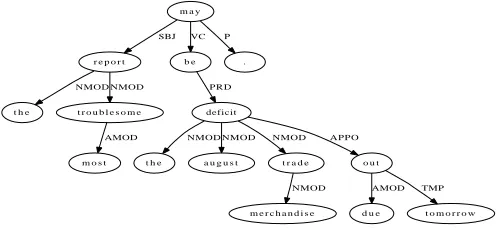
for the SR task is given in Figure 1.
Figure 1: Input shallow dependency tree from the Generation Challenge Surface Realisation Task for the sentence “The most troublesome report may be the August merchandise trade deficit due out tomorrow .”
Note that contrary to the flat semantic representations often used by surface realisers, the SR data has a clear tree structure. Thus the combinatorics induced by the lack of order in flat semantic representations is less in this task. Indeed, the algorithm we present exploits this structure to minimize the combinatorics. Similarly, (White, 2006) applies chunking constraints to the graph structure of flat semantic representation to constrain the generation of coordinate structures and address the issue of semantically incomplete phrases.
4
Grammar
Following (Gardent and Perez-Beltrachini, 2010), we perform surface realisation using a Feature-Based Regular Tree Grammar (FB-RTG) describing the derivation trees of a Feature-Feature-Based Lexi-calised Tree Adjoining Grammar (FB-LTAG, (Joshi and Schabes, 1996)) rather than the FB-LTAG itself. In what follows, we briefly introduce FB-LTAG and the derived FB-RTG used for generation.
4.1
FB-LTAG
The grammar underlying the surface realisation algorithm presented in the next section is an FB-LTAG for English consisting of roughly 1000 trees and whose coverage is similar to XTAG (The XTAG Research Group, 2001).
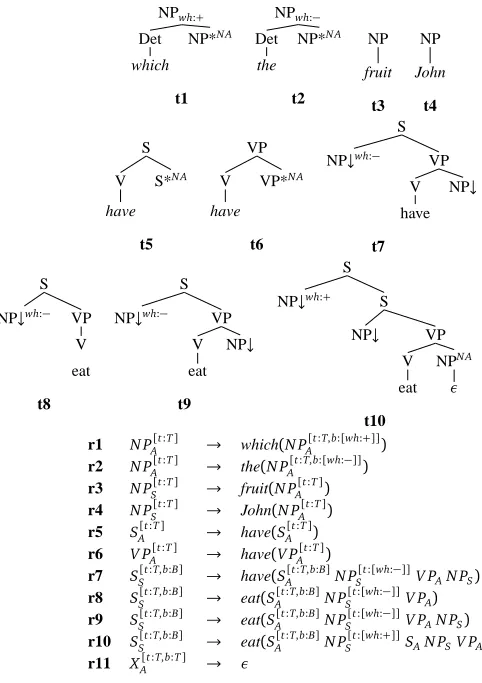
Figure 2 shows an example FB-LTAG. Briefly, an FB-LTAG consists of a set of elementary trees which can be either initial or auxiliary. Initial trees are trees whose leaves are labeled with substi-tution nodes (marked with a down-arrow) or terminal categories. Auxiliary trees are distinguished by a foot node (marked with a star) whose category must be the same as that of the root node. In addition, in an FB-LTAG, each elementary tree is anchored by a lexical item (lexicalisation) and the nodes in the elementary trees are decorated with two feature structures called top and bottom which are unified during derivation. Two tree-composition operations are used to combine trees: substitution and adjunction. Substitution inserts a tree onto a substitution node of some other tree while adjunction inserts an auxiliary tree into a tree. Derivation in an FB-LTAG yields two trees: a
derived tree which is, like for context free grammars, the tree produced by combining the grammar
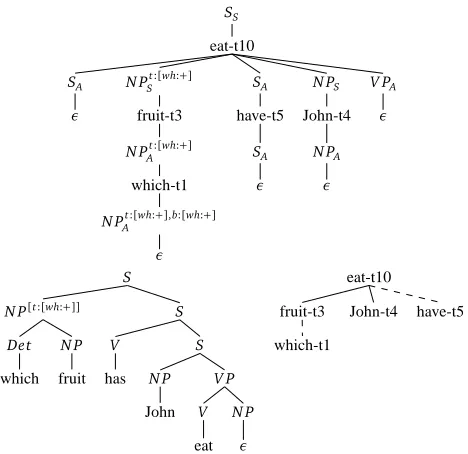
the derived tree was built i.e., which elementary trees were used and how they were combined. Fig-ure 3 show the derived and derivation trees associated by the grammar shown in FigFig-ure 2 with the sentence “Which fruit has John eaten?”. For a detailed presentation of the FB-LTAG formalism, the reader is referred to (Vijay-Shanker and Joshi, 1988).
4.2
FB-RTG
As shown in (Koller and Striegnitz, 2002; Gardent and Perez-Beltrachini, 2010), processing the derivation trees of a given FB-LTAG rather than its derived trees is more efficient. Following (Gardent and Perez-Beltrachini, 2010), we therefore use not the initial FB-LTAG described in the previous section, but the FB-RTG grammar of derivation trees that can be derived from it. That is, the surface realisation algorithm first builds a derivation tree. The generated sentence is then extracted from the derived tree1which can be reconstructed from this derivation tree using the
original FB-LTAG.
Figure 2 shows an example LTAG and the corresponding RTG. The conversion from FB-LTAG to FB-RTG is described in detail in (Schmitz and Roux, 2008). Intuitively, the FB-RTG representation of an FB-LTAG elementary treet, is a rule whose left hand side (LHS) describes the syntactic requirement satisfied byt(e.g.,SSfor an initial tree rooted inSandV PAfor an auxiliary
tree rooted inV P) and whose right hand side (RHS) describes its requirements. Adjunction is
handled as an optional requirement which can be satisfied by the adjunction of an empty string and subscripts indicates the nature of the requirement (Sfor a substitution andAfor adjunction). For instance, the rule r8 in Figure 2 repeated below for convenience, describes the contribution of the elementary tree t8 lexicalised with the lemma eat to a derivation tree as follows: t8 can satisfy a requirement for a substitution on a node labelled with the S category (LHS with the categorySS)
and requires one substitution on a node labelled with the NP category (N PSon the RHS) and two
optional adjunctions of category S and VP respectively (SA,V PAon the RHS).
SS[t:T,b:B]→eat(S[t:T,b:B]A N P[t:[wh:−]]
S V PA)
The derivation process in FB-RTG produces trees that are almost identical to the FB-LTAG deriva-tion trees. Figure 3 shows the FB-LTAG derived, FB-LTAG derivaderiva-tion and FB-RTG derived tree for the sentence “Which fruit has John eaten?”. When abstracting away from the categorial nodes, the FB-RTG derivation tree mirrors the derivation tree of the original FB-LTAG. TheAandS sub-scripts indicate which operation was used for combining; and the nodes at which each FB-LTAG elementary tree adjoins or substitutes is encoded by features in these trees: for instance, the sub-ject node of t9 will have the feature subsub-ject while its obsub-ject node will have the feature obsub-ject. By comparing the dependency relations present in the input tree with the feature values given by the grammar, it is thus possible to determine on which nodes of the mother tree in the derivation tree, its daughter trees should combine.
Note that the FB-RTG tree is unordered. During generation, the appropriate linearisation of the lexical items is obtained by constructing the FB-LTAG derived tree from the FB-RTG derivation tree. Morphological realisation is carried out in a post-processing step from the list of lemmas and feature structures decorating the yield of the FB-LTAG derived tree.
NPwh:+
SS
eat-t10
SA N PSt:[wh:+] SA N PS V PA
ε fruit-t3 have-t5 John-t4 ε
N Pt:[wh:+]
A SA N PA
which-t1 ε ε
N PAt:[wh:+],b:[wh:+] ε
S eat-t10
N P[t:[wh:+]] S fruit-t3 John-t4 have-t5
Det N P V S which-t1
which fruit has N P V P
John V N P
eat ε
5
The Surface Realisation Algorithm
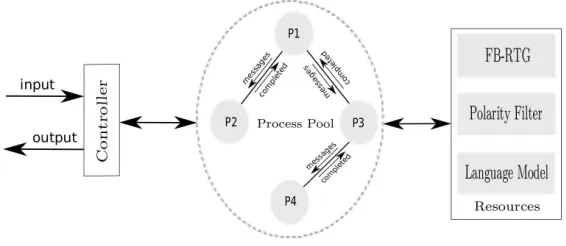
Surface realisation starts from the root node of the input tree and processes all children nodes in parallel by spreading the lexical selection constraints top-down and completing the FB-RTG rules bottom-up. Figure 4 shows the architecture of the surface realiser. The controller provides the interface to our surface realization system. It takes a shallow dependency tree as input and produces a ranked list of sentences as output. More specifically, the controller defines a process pool such that each process present in this pool represents a node (a lemma) in the input dependency tree and the communication scheme among processes reflects the dependency relations among nodes in the input dependency tree. In this way, generation is guided by the structure of the input dependency tree.
Cont
r
ol
ler
Figure 4: A Parallel Architecture for Surface Realisation
The algorithm proceeds in five major steps as follows.
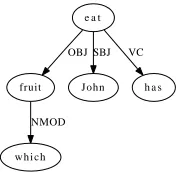
Top-Down Rule selection and Filtering. Starting from the root node, the input dependency tree is traversed top-down to associate each node in the input tree with a set of grammar rules (from the FB-RTG). This step corresponds to the lexical lookup phase of lexicalist approaches whereby each literal in the input selects the grammar rules whose semantics subsumes this literal. Our approach differs from existing lexicalist approaches however in that it uses the top-down information given by the structure of the input to filter out some possibilities that cannot possibly lead to a valid output. More precisely, for each input nodenwith lemmaw, only those rules are selected which are associated withwin the lexicon. In addition, the left-hand side (LHS) category of each selected rule must occur at least once in the right-hand side (RHS) of the rules selected by the parent node.
For instance, given the input dependency tree shown in Figure 5 for the sentence “Which fruit has
John eaten?”, and the grammar given in Figure 2, all rules r8, r9 and r10 associated with the
lemma ‘eat’ will be selected because all of them corresponds to theS2rooted initial trees3.
2The controller triggers the root process “eat” with the initial lexical selection constraint (SS,Srooted initial trees) to
generate complete sentences.
3
e a t
fruit OBJ
John SBJ
h a s VC
w h i c h NMOD
Figure 5: Dependency Tree for “Which fruit has John eaten” p
r8 SS[t:T,b:B] → eat(S[t:T,b:B]A N PS[t:[wh:−]]V PA) p
r9 SS[t:T,b:B] → eat(S[t:T,b:B]A N P[t:[wh:−]]
S V PAN PS) p r10 S[t:T,b:B]
S → eat(S[t:T,b:B]A N PS[t:[wh:+]]SAN PSV PA)
The parent process creates a new lexical selection constraint message consisting of its RHS re-quirements in selected RTG rules and passes it to its children processes. In Figure 5, the process associated with the node ‘eat’ will send a message consisting ofSA,N PSandV PA(RHS require-ments of rules r8, r9 and r10) to its children processes associated with ‘fruit’, ‘John’ and ‘have’.
Starting from the trigger initiated by the controller, the process of message spreading happens in recursive and parallel manner throughout the process pool reflecting the input dependency tree in a top-down fashion. It eliminates all RTG rules which cannot possibly lead to a valid output well before carrying out any substitution and adjoining operation on the RTG rules.
For instance, the rule r7 for ‘have’ will not be selected because its left-hand side isSSwhich does not satisfy the lexical selection constraints (SA,N PSandV PA) sent by its parent ‘eat’.
p
r5 S[t:T]A → have(S[t:T]A ) p r6 V P[t:T]
A → have(V PA[t:T])
× r7 S[t:T,b:B]S → have(S[t:T,b:B]A N PS[t:[wh:−]]V PAN PS)
Leaf closure. When reaching the leaf nodes of the input tree, the top and bottom feature structures of the rules selected by these leaf nodes are unified. The completed rules of a leaf node are sent back to its parent.
Local Polarity filtering. As mentioned in Section 2, polarity filtering (Gardent and Kow, 2005) eliminates from the search space those sets of rules which cover the input but cannot possibly lead to a valid derivation either because a substitution node cannot be filled or because a root node fails to have a matching substitution site4While (Gardent and Kow, 2005) applies polarity filtering to the
initial search space (the set of rules selected by all literals in the input), we apply polarity filtering to each local tree while going up the input tree. Thus, this filtering will weed out all combinations
4Since it only eliminates combinations that cannot possibly lead to a valid parse, polarity filtering does not affect
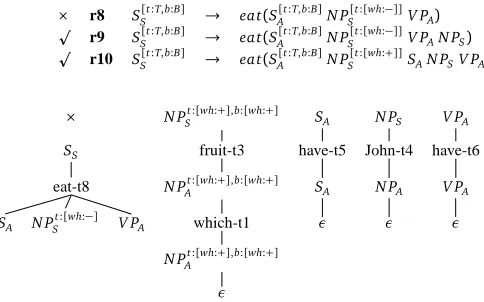
of mother rules and completed immediate daughter rules which cannot possibly yield a complete tree either because some daughter rule cannot be used or because some requirement of the mother rule cannot be satisfied. For instance, after processing the daughters of the ‘eat’ node in the input dependency tree shown in Figure 5, all combinations of r8 (intransitive ‘eat’) with the daughter trees will be excluded. This is because at this stage of processing, the trees built bottom up for ‘which fruit’, ’John’ and ’have’ includes two NPs with LHS categoryN PS(Figure 6) while the r8 rule only requires one such NP. That is, for this rule, the completed daughter rule for which fruit will show up as a superfluous syntactic resource.
× r8 SS[t:T,b:B] → eat(SA[t:T,b:B]N PS[t:[wh:−]]V PA) p r9 S[t:T,b:B]
S → eat(SA[t:T,b:B]N PS[t:[wh:−]]V PAN PS) p
r10 SS[t:T,b:B] → eat(SA[t:T,b:B]N PS[t:[wh:+]]SAN PSV PA)
× N PSt:[wh:+],b:[wh:+] SA N PS V PA
SS fruit-t3 have-t5 John-t4 have-t6
eat-t8 N PAt:[wh:+],b:[wh:+] SA N PA V PA
SA N PSt:[wh:−] V PA which-t1 ε ε ε
N Pt:[wh:+],b:[wh:+] A
ε
Figure 6: Polarity Filtering will filter out the r8 rule for ‘eat’ since one of trees ‘which fruit’ or ‘John’ would then appear as a superfluous syntactic resource as illustrated by the above derivation.
By restricting polarity filtering to local input trees, we avoid the computation of the very large automaton required when filtering the global initial search space as done in (Gardent and Kow, 2005).
As noted by one of our reviewers, supertagging models can probably approximate local polarity filtering. For instance, a supertagger model might learn that an intransitive category is very unlikely whenever the input dependency tree contains one or more core arguments.
The combined effect of top-down filtering and local polarity filtering avoids considering most of RTG rules which can never lead to valid output well before carrying out any substitution and adjoining operation on the RTG rules to try to complete them. The Earley, bottom-up al-gorithm (Gardent and Perez-Beltrachini, 2010) also achieves some amount of top-down filtering during its prediction stage but the lexical selection constraint is limited to the top of the RHS re-quirements of the RTG rule being processed, hence it may try completing the RTG rules which cannot possibly lead to a valid output whereas in our proposed approach all RHS requirements of the selected RTG rules are available as the lexical selection constraint information during both top-down filtering and local polarity filtering steps.
initialized RTG rule using substitution and adjoining operations. The local initialized RTG rule fails to complete if any feature conflicts are found.
Note that for each rule set let through by polarity filtering, the category and the number of daughter trees exactly match the requirement of the associated mother rule. For instance, as explained above, the rule r8 representing an intransitive use of the verb ‘eat’ is ruled out by polarity filtering since it does not permit “consuming” theN PSresource provided by one of NPs ‘which fruit’ or ‘John’.
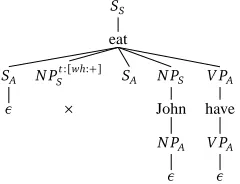
Conversely, given an input tree of the formeat(john, has), the rules r9 and r10 representing a transitive use of the verb ‘eat’ would be filtered out by polarity filtering. As a result, the interme-diate structure shown below will not be computed. That is, while the global polarity filtering used in (Gardent and Kow, 2005) permits weeding out global combination of trees that are invalid, local polarity filtering additionally permits reducing the number of intermediate structures built first, be-cause there is no need for prediction i.e., for active chart items and second, bebe-cause intermediate structures that cannot possibly lead to a valid derivation are not built.
SS
eat
SA N PSt:[wh:+] SA N PS V PA ε × John have
N PA V PA ε ε
Figure 7: Given the input treeeat(john, has), local polarity filtering filters out this intermediate structure because it cannot be completed given the input
N-gram filtering using a Language Model. To further prune the search space and to appropri-ately handle word order, the SR algorithm also integrates a language model and can be parametrized for the number of best scoring n-grams let through after each bottom-up generation step. In this way, not all possible orderings of intersective modifiers are produced, only those that are most probable according to the language model.
6
Empirical Evaluation
We now report on the results obtained when running the algorithm and the grammar described above on the shallow input data provided by the Generation Challenge Surface Realisation Task. Because we are presenting an algorithm for surface realisation rather than a surface realiser, the main focus of the evaluation is on speed (not coverage or accuracy). Nevertheless, we also re-port coverage and BLEU score as an indication of the capabilities of the surface realiser i.e., the algorithm combined with the grammar and the lexicon.
6.1
Runtimes
We use as a baseline the FB-RTG based lexicalist approach (BASELINE) described in (Narayan, 2011). In this approach, FB-RTG rules are selected top-down following the structure of the input dependency tree and all FB-RTG rules selected for a given local input tree are tried out for combi-nation using a chart-based approach. This baseline thus permits observing the impact of the various optimisations described below. In future work, it would be interesting to obtain time information from the systems participating in the SR challenge and to compare them with those of our system.
TDBU-PAR (top-down, bottom-up and parallelised) is the algorithm presented here running on a 4 core system. To evaluate the impact of parallelism on runtimes, we also computed runtimes for a sequential version of the same algorithm (TDBU-SEQ). In TDBU-SEQ, daughter subtrees (processes) of the input dependency tree are processed sequentially.
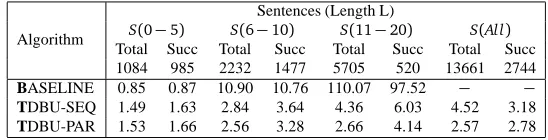
Table 1 shows the runtimes for the three surface realisation algorithms BASELINE, TDBU-SEQ and TDBU-PAR with varying sizes of sentences. For the TDBU algorithms, the n-gram filtering is set to 10 that is, for each local input tree, the 10 best n-grams are passed on. We split the data into 4 sets according to the input length where the input length is the number of nodes (or words) in the input dependency tree. The average number of words in a sentence in the first setS(0−5)is4, in the second setS(6−10),7, in the third setS(11−20),15, and in the final setS(All)(all lengths),
17. The maximum length of a sentence in the final setS(All)is74. To make comparisons between BASELINE, TDBU-SEQ and TDBU-PAR possible, the maximum arity of words present in the input dependency trees is set to 3 (because BASELINE mostly fails on input containing nodes with higher arity).
Algorithm
Sentences (Length L)
S(0−5) S(6−10) S(11−20) S(All)
Total Succ Total Succ Total Succ Total Succ
1084 985 2232 1477 5705 520 13661 2744
BASELINE 0.85 0.87 10.90 10.76 110.07 97.52 − − TDBU-SEQ 1.49 1.63 2.84 3.64 4.36 6.03 4.52 3.18 TDBU-PAR 1.53 1.66 2.56 3.28 2.66 4.14 2.57 2.78
Table 1: Comparison between generation times (seconds)
BASELINE turns out to be faster than TDBU-PAR and TDBU-SEQ for sentences of smaller length (≤5). It can be explained because of the parallelism and the multiprocessing overhead. But TDBU-PAR and TDBU-SEQ leaves behind BASELINE for longer sentences. For input longer than 10, the
simple BASELINE algorithm times out whereas TDBU-PAR remains stable. ForS(All),
TDBU-PAR achieves a reasonable average of 2.57 seconds for all sentences (Total) and 2.78 seconds for successful sentences (Succ).
Table 1 does not show a big difference in performance between TDBU-PAR and TDBU-SEQ because the maximum arity of the input dependency trees is kept low (maximum 3). In Table 2, we split the data by arity whereby the datasetS(i)consists of input dependency trees with maximum arityi. As can be seen, the difference between the two algorithms steadily increases with the arity of the input thereby demonstrating the impact of parallelism.
6.2
Coverage and Accuracy
Algorithm
Sentences (Arity)
S(1) S(2) S(3) S(4) S(5) S(6)
Total Succ Total Succ Total Succ Total Succ Total Succ Total Succ
190 178 1218 964 3619 1039 5320 605 2910 137 1093 18
TDBU-SEQ 0.89 0.94 2.52 2.63 3.65 3.39 5.07 4.54 5.24 4.62 8.20 7.29 TDBU-PAR 0.97 1.03 2.35 2.50 2.63 3.10 2.91 3.77 2.86 3.88 3.09 4.76
Table 2: Comparison between generation times (seconds) with varying arities.
accuracy (on the covered sentences) results obtained for sentences of size 6 (S-6), 8 (S-8) and all (S-All). The dataset S-All differs from the datasetS(All)discussed in previous section. S-All considers all sentences without any restriction over the maximum arity in the input dependency trees. S-All consists of26725sentences with the average length of22and the maximum length of
134. The maximum arity in these sentences varies from1to18with an average of4.
Data Type Total Coverage (#) Coverage (%) BLEU Score
Covered Uncovered
S-6 3877 3506 371 90.43 0.835
S-8 3583 3038 545 84.79 0.800
S-All 26725 10351 16374 38.73 0.675
Table 3: Coverage and Bleu Scores for covered sentences.
As can be seen coverage markedly decreases for longer sentences. Error mining on this data indi-cates that failure to generate is due mostly to complex sentence coordinations (e.g., verb coordi-nation, gapping phenomenon) (Sarkar and Joshi, 1996) which could be very common in sentences of average length22in S-All. Other failure causes are inadequate treatments of multiword expres-sions and foreign words.
7
Conclusion
We presented a novel algorithm for surface realisation with lexicalised grammar which takes ad-vantage of the input structure (a tree) to filter the initial search space both top-down and bottom up; and to parallelise processes. We evaluated this algorithm on large scale data and showed that it drastically reduces runtimes on this data when compared to a simple lexicalist approach which explores the whole search space.
As mentioned in section 3, the input data provided by the SR task differs from the flat semantic representations assumed by most existing surface realisers in that it displays a clear tree structure. The algorithm presented here makes use of that structure to optimize performance. In future work, we plan to investigate whether the hybrid top-down, bottom-up approach we developed to guide the SR search can be generalised to the graph structure of semantic representations.
References
Bangalore, S. and Joshi, A. K. (1999). Supertagging: An approach to almost parsing.
Computa-tional Linguistics, 25(2):237–265.
Bangalore, S. and Rambow, O. (2000). Using TAGs, a tree model and a language model for generation. In Proceedings of the 5th International Workshop on Tree Adjoining Grammars and
Related Formalisms (TAG+5), Paris, France.
Belz, A., White, M., Espinosa, D., Kow, E., Hogan, D., and Stent, A. (2011). The first surface realisation shared task: Overview and evaluation results. In Proceedings of the 13th European
Workshop on Natural Language Generation (ENLG), Nancy, France.
Bohnet, B., Mille, S., Favre, B., and Wanner, L. (2011). <stumaba >: From deep representation to surface. In Proceedings of the Generation Challenges Session at the 13th European Workshop
on Natural Language Generation, pages 232–235, Nancy, France. Association for Computational
Linguistics.
Bonfante, G., Guillaume, B., and Perrier, G. (2004). Polarization and abstraction of grammati-cal formalisms as methods for lexigrammati-cal disambiguation. In Proceedings of the 20th International
Conference on Computational Linguistics (COLING), Geneva, Switzerland.
Carroll, J., Copestake, A., Flickinger, D., and Pazna´nski, V. (1999). An efficient chart gener-ator for (semi-)lexicalist grammars. In Proceedings of the 7th European Workshop on Natural
Language Generation, pages 86–95, Toulouse, France.
Carroll, J. and Oepen, S. (2005). High efficiency realization for a wide-coverage unification gram-mar. In Proceedings of the 2nd International Joint Conference on Natural Language Processing
(IJCNLP), Jeju Island, Korea.
Copestake, A., Lascarides, A., and Flickinger, D. (2001). An algebra for semantic construction in constraint-based grammars. In Proceedings of the 39th Annual Meeting of the Association for
Computational Linguistics, Toulouse, France.
Espinosa, D., Rajkumar, R., White, M., and Berleant, S. (2010). Further meta-evaluation of broad-coverage surface realization. In Proceedings of the 2010 Conference on Empirical Methods
in Natural Language Processing (EMNLP), pages 564–574, Cambridge, MA. Association for
Computational Linguistics.
Espinosa, D., White, M., and Mehay, D. (2008). Hypertagging: Supertagging for surface realiza-tion with CCG. In Proceedings of the 40th Annual Meeting of the Associarealiza-tion of Computarealiza-tional
Linguistics (ACL): Human Language Technologies (HLT), pages 183–191, Columbus, Ohio.
As-sociation for Computational Linguistics.
Gardent, C. and Kow, E. (2005). Generating and selecting grammatical paraphrases. In
Pro-ceedings of the 10th European Workshop on Natural Language Generation (ENLG), Aberdeen,
Scotland.
Gardent, C. and Kow, E. (2007). A symbolic approach to near-deterministic surface realisation using tree adjoining grammar. In Proceedings of the 45th Annual Meeting of the Association of
Computational Linguistics, pages 328–335, Prague, Czech Republic. Association for
Gardent, C. and Perez-Beltrachini, L. (2010). RTG based surface realisation for TAG. In
Pro-ceedings of the 23rd International Conference on Computational Linguistics (COLING), pages
367–375, Beijing, China.
Guo, Y., Hogan, D., and van Genabith, J. (2011). Dcu at generation challenges 2011 surface reali-sation track. In Proceedings of the Generation Challenges Session at the 13th European Workshop
on Natural Language Generation, pages 227–229, Nancy, France. Association for Computational
Linguistics.
Joshi, A. K. and Schabes, Y. (1996). Tree-adjoining grammars. Handbook of Formal Languages
and Automata.
Koller, A. and Striegnitz, K. (2002). Generation as dependency parsing. In Proceedings of the
40th Annual Meeting of the Association of Computational Linguistics (ACL), Philadelphia.
Narayan, S. (2011). RTG based surface realisation from dependency representations. Master’s thesis, University of Nancy 2 and University of Malta. Erasmus Mundus Master "Language and Communication Technology".
Sarkar, A. and Joshi, A. K. (1996). Coordination in tree adjoining grammars: Formalization and implementation. In Proceedings of the 16th International Conference on Computational
Linguistics (COLING), pages 610–615.
Schmitz, S. and Roux, J. L. (2008). Feature unification in TAG derivation trees. In Proceedings of
the 9th International Workshop on Tree Adjoining Grammars and Related Formalisms, Tubingen,
Germany.
Shieber, S. (1993). The problem of logical form equivalence. Computational Linguistics,
19(1):179–190.
Shieber, S. M., Noord, G. V., Pereira, F. C. N., and Moore, R. C. (1990). Semantic-head-driven generation. Computational Linguistics, 16.
Stent, A. (2011). Att-0: Submission to generation challenges 2011 surface realization shared task. In Proceedings of the Generation Challenges Session at the 13th European Workshop on
Natural Language Generation, pages 230–231, Nancy, France. Association for Computational
Linguistics.
The XTAG Research Group (2001). A lexicalised tree adjoining grammar for english. Technical report, Institute for Research in Cognitive Science, University of Pennsylvannia.
Vijay-Shanker, K. and Joshi, A. (1988). Feature structures based tree adjoining grammars. In
Pro-ceedings of the 12th International Conference on Computational Linguistics, Budapest, Hungary.
White, M. (2004). Reining in CCG chart realization. In Proceedings of the third International
Conference on Natural Language Generation (INLG), pages 182–191, Brighton, UK.