Open Entity Extraction from Web Search Query Logs
Alpa Jain
Yahoo! Labs
Marco Pennacchiotti
Yahoo! Labs
Abstract
In this paper we propose a completely un-supervised method for opdomain en-tity extraction and clustering over query logs. The underlying hypothesis is that classes defined by mining search user activ-ity may significantly differ from those typ-ically considered over web documents, in that they better model the user space, i.e. users’ perception and interests. We show that our method outperforms state of the art (semi-)supervised systems based either on web documents or on query logs (16% gain on the clustering task). We also report evi-dence that our method successfully supports a real world application, namely keyword generation for sponsored search.
1 Introduction
Search engines are increasingly moving beyond the traditional keyword-in document-out paradigm, and are improving user experience by focusing on user-oriented tasks such as query suggestions and search personalization. A fundamental building block of these applications is recognizing structured infor-mation, such as, entities(e.g., mentions of people, organizations, or locations) or relations among en-tities (Cao et al., 2008; Hu et al., 2009). For this, search engines typically rely on large collections of entities and relations built using information extrac-tion (IE) techniques (Chaudhuri et al., 2009).
Commonly used IE techniques follow two main assumptions: (1) IE focuses on extracting infor-mation from syntactically and semantically “well-formed” pieces of texts, such as, news corpora and web documents (Pennacchiotti and Pantel, 2009); (2) extraction processes are bootstrapped with some pre-existing knowledge of the target domain (e.g entities are typically extracted for pre-defined cat-egories, such as Actors, Manufacturers, Persons,
Locations (Grishman and Sundheim, 1996)). Prior work (Banko et al., 2007), has looked into relax-ing the second assumption and proposed open in-formation extraction (OIE), a domain-independent and scalable extraction paradigm, which however focuses mostly on web corpora.
In this paper, we argue that for user-oriented ap-plications discussed earlier, IE techniques should go beyond the traditional approach of using “well-formed” text documents. With this in mind, we ex-plore the utility of search query logs, a rich source of user behaviors and perception, and build tech-niques for open entity extraction and clustering over query logs. We hypothesize that web docu-ments and query logs model two different spaces: web documents model theweb space, i.e. general knowledge about entities and concepts in an objec-tive and generic way; search query logs model the
user space, i.e. the users’ view and perception of the world in a more specific fashion, where avail-able information directly expresses users’ needs and intents. For example, in a web space, ‘brit-ney spears’ will tend to be similar and be clus-tered with other singers, such as ‘celine dion’ and ‘bruce springsteen’. On the contrary, in the users’ space, she is highly similar and clustered with other gossiped celebrities like ‘paris hilton’ and ‘serena williams’: the users’ space better models the users’ perception of that person; such a space is then highly valuable for all those applications where users’ perceptions matters.
contribu-tions are: (1) We propose and instantiate a novel model for open information extraction over web search query logs; and we apply it to the task of entity extraction and clustering. (2) We show how we characterize each extracted entity to capture the ‘user space’, and induce classes over the entities. (3) We present an extensive evaluation over real-life datasets showing that query logs is a rich source for domain-independent user-oriented extraction tasks (Section 3). We also show the practicality of our approach by incorporating it into a real-world appli-cation, namely keyword suggestions for sponsored search (Section 4).
2 Open Entity Extraction on Query Log In this section, we present our method for open entity extraction from query logs. We first de-scribe our heuristic method for extracting entities (Section 2.1), and then three different feature ‘user spaces’ to cluster the entities (Section 2.2).
2.1 Entity Extraction
In our setting, entities correspond to Named Enti-ties. i.e. they are defined using the standard named entity types described in (Sekine et al., 2002)1. In
this paper, we use a set of entities extracted from query log, obtained by applying a simple algorithm (any other query log entity extraction method would apply here, e.g. (Pasca, 2007b)). The algorithm is based on the observation that oftentimes users con-struct their search query by copy-pasting phrases from existing texts. Due to this phenomenon, user queries often carry over surface-level properties such as capitalization and tokenization information. Our approach realizes this observation by iden-tifying contiguous capitalized words from a user query. (In our experiments, we observed that 42% of the queries had at least one upper-case character.) Specifically, given a query Q = q1 q2 q3· · · qn,
we define a candidate entityE =e1 e2 · · · em as
the maximal sequence of words (i.e., alpha-numeric characters) in the query such that each word ei in
the entity begins with an uppercase character. The set of candidate entities is then cleaned by apply-ing a set of heuristics, thus producapply-ing the final set of entities. In particular, for each extracted entity,
1We exclude ‘Time’ and ‘Numerical Expressions’, which
are out of the scope of our study.
we assign two confidence scores: a Web-based rep-resentation scoreand a query-log-basedstandalone score. The representation score checks if the case-sensitive representation observed forE inQ, is the
most likely representation for E, as observed on
a Web corpus (e.g., ’DOor HANGing TIps’ is as-signed a low representation score). The standalone score is based on the observation that a candidate
E should often occur in a standalone form among the search query logs, in order to get the status of a proper named entity as defined in (Sekine et al., 2002; Grishman and Sundheim, 1996). In practice, among the query logs we must find queries of the form Q == E, capturing the fact that users are
looking to learn more about the given entity2.
2.2 Entity Clustering
The clustering phase takes as input any of the fea-ture spaces presented in the rest of this section, and groups the entities according to the similarity of their vectors in the space. The desiderata for a clus-tering algorithm for the task of open-domain infor-mation extraction are the following: (1) The algo-rithm must be highly scalable, efficient, and able to handle high dimensionality, since the number of queries and the size of the feature vectors can be large; (2) We do not know in advance the number of clusters; therefore, the algorithm needs not to re-quire a pre-defined number of clusters.
Any clustering algorithm fulfilling the above re-quirements would fit here. In our experiments, we adopt a highly scalable Map-Reduce implementa-tion of the hard-clustering version of Clustering by Committee (CBC), a state-of-the-art clustering al-gorithm presented in (Pantel and Lin, 2002). Context Feature Space. The basic hypothesis for thecontext feature space, is that an entity can be ef-fectively represented by the set of contexts in which it appears in queries. This allows to capture the users’ view of the entity, i.e. what people query, and want to know about the entity. This is similar to that proposed by Pasca (2007b; 2007a), i.e. that queries provide good semantics cues for modeling named entities.
Our query log feature space may significantly differ from a classical contextual feature space
com-2We refer the readers to (Jain and Pennacchiotti, 2010) for
puted over a Web corpus, since the same entity can be differently perceived and described in the two corpora (query log and Web). Consider for exam-ple the entity ‘galapagos islands’. Typical contexts on the Web and query log for this entity are:
web: endemic birds web: big turtles
web: charles darwin foundation web: sensitive water
qlog: trip to qlog: diving qlog: where are the qlog: travel package
The difference between the two representations implies that entities that are similar on the Web, are not necessarily similar on query logs. For exam-ple, on the Web ‘galapagos islands’ is very simi-lar to other countries such as ‘tasmania’, ‘guinea’ and ‘luxemburg’; while on query log is similar to other sea-side travel destination and related con-cepts, such as ‘greek isle’, ‘kauai snorkeling’ and ‘south america cruise’. Our new similarity com-puted over query log, is potentially useful for those applications in which is more important to represent users’ intents, than an objective description of enti-ties (e.g. in query suggestion and intent modeling). To obtain our contextual representation we pro-ceed as follows. For each entity e, we identify
all queries in the query log, in which e appears.
Then, we collect the set of all suffixes and postfixes of the entity in those queries. For example, given the entity ‘galapagos islands’ and the query ‘sum-mer 2008 galapagos islands tour’, the contexts are: ‘summer 2008’ and ‘tour’.
Once the set of all contexts of all entities has been collected, we discard contexts appearing less than
τ-times in the query log, so to avoid statistical
bi-ases due to data sparseness (in the reported experi-ments we setτ = 200). We then compute the cor-rected pointwise mutual information (cpmi)
(Pan-tel and Ravichandran, 2004) between each instance and each contextcas:
cpmi(e, c) =log2
f(e, c)·f(∗,∗)
f(e)·f(c) ·M (1) where f(e, c) is the number of times e and c
occur in the same query; f(e) and f(c) is the count of the entity and the context in the query log; f(∗,∗)the overall count of all co-occurrences
between contexts and entities; andM is the
correc-tion factor presented in (Pantel and Ravichandran, 2004), that eases the pmi’s bias towards infrequent entities/features. Each instance is then represented in the feature space of all contexts, by the computed
pmivalues. Note that our method does not use any NLP parsing, since queries rarely present syntactic structure. This guarantees the method to be com-putationally inexpensive and easily adaptable to languages other than English.
Clickthrough Feature Space. During a search session, users issue a search query for which the search engine presents a list of result urls. Of the search results, users choose those urls that are rep-resentative of their intent. This interaction is cap-tured by means of a click, which is logged by most search engines asclick-through data. For instance, a search log may contain the following clicked urls for a query ‘flv converter’, for different users:
user1: www.flv-converter.com
user2: www.videoconverterdownload.com/flv/
user3: www.ripzor.com/flv.html
Our main motivation behind clustering entities based on past user click behavior is that non-identical queries that generate clicks on the same urls capture similar user intent. Thus, grouping en-tities that were issued as a query and generated user clicks on the same url may be considered similar. For instance, the query ‘convert flv’ may also gen-erate clicks on one of the above urls, thus hinting that the two entities are similar. We observed that websites tend to dedicate a url per entity. There-fore, grouping by click urls can lead to clusters with synonyms (i.e., different ways of representing the same entity) or variants (e.g., spelling errors). To get more relevant clusters, instead of grouping en-tities by the click urls, we use the base urls. For instance, the urlwww.ripzor.com/flv.html
is generalized towww.ripzor.com.
With the advent of encyclopedic web-sites such as, www.wikipedia.org and
stop-list by eliminating top-5 urls based on their inverse document frequency, where an entity is intended as the ‘document’.
In practice, each extracted entityeis represented
by a feature vector of size equal to the number of distinct base urls in the click-through data, across all users. Each dimension in the vector represents a url in the click-through information. The valuef of
an entityefor the dimension associated with url j
is computed as:
f(e, j) =
w(e,j)
qP|U|
i w(e,i)2
if urljclicked for querye;
0 otherwise.
where U is the set of base urls found in click-through data when entity ewas issued as a query;
andw(e, i)is the number of time the base urliwas
clicked whenewas a query.
Hybrid Feature Space. We also experiment a hy-brid feature space, which is composed by the nor-malized union of the two feature spaces above (i.e. context and clickthrough). Though more complex hybrid models could be applied, such as one based on ensemble clustering, we here opt for a simple solution which allows to better read and compare to other methods.
3 Experimental Evaluation
In this section, we report experiments on our clus-tering method. The goal of the experiment is two-fold: (1) evaluate the intrinsic quality of the cluster-ing methods, i.e. if two entities in the same cluster are similar or related from a web user’s perspec-tive; (2) verify if our initial hypothesis holds, i.e. if query log based features spaces capture different properties than Web based feature spaces (i.e. the ‘user space’). In Section 3.1 we describe our ex-perimental setup; and, in 3.2 we provide the results. We couple this intrinsic evaluation with an extrinsic application-driven one in Section 4.
3.1 Experimental Settings
In the experiments we use the following datasets: Query log: A random sample of 100 million, fully anonymized queries collected by the Yahoo! search engine in the first 3 months of 2009, along with their frequency. This dataset is used to generate both the
context and the clickthrough feature spaces for the clustering step.
Web documents: A collection of 500 million web pages crawled by a Yahoo! search engine crawl. This data set is used to implement a web-based fea-ture space that we will compare to in Section 3.2. Entity set: A collection of 2,067,385 entities, ex-tracted with the method described in 2.1, which shows a precision of 0.705 ±0.044. Details on the evaluation of such method are available in (Jain and Pennacchiotti, 2010), where a full comparison with state-of-the-art systems such as (Pasca, 2007b) and (Banko et al., 2007) are also reported.
Evaluation methodology: Many clustering evalu-ation metrics have been proposed, ranging from Pu-rity to Rand-statistics and F-Measure. We first se-lect from the original 2M entity set, a random set of
nentities biased by their frequency in query logs,
so to keep the experiment more realistic (more fre-quent entities have more chances to be picked in the sample). For each entity e in the sample set,
we derived a random list ofkentities that are
clus-tered withe. In our experiments, we setn = 10 andk= 20. We then present to a pool of paid edi-tors, each entityealong with the list of co-clustered
entities. Editors are requested to classify each co-clustered entityeiascorrectorincorrect. An entity
eiis deemed as correct, if it is similar or related toe
from a web user’s perspective: to capture this intu-ition, the editor is asked the question: ‘If you were interested ine, would you be also interested in ei
in any intent?’.3 Annotators’ agreement over a
ran-dom set of 30 entities iskappa = 0.64 (Marques De S´a, 2003), corresponding to substantial agree-ment. Additionally, we ask editors to indicate the
relation typebetweeneandei(synonyms, siblings,
parent-child, topically related). Compared methods:
CL-CTX: A CBC run, based on the query log con-text feature space (Section 2.2).
CL-CLK: A CBC run, based on the clickthrough feature space (Section 2.2).
3For example, if someone is interested in ‘hasbro’, he could
method # cluster avg cluster size
CL-Web 1,601 240
CL-CTX 875 1,182
CL-CLK 4,385 173
[image:5.595.303.528.52.354.2]CL-HYB 1,580 478
Table 1: Statistics on the clustering results.
CL-HYB: A CBC run, based on the hybrid space that combinesCL-CTXandCL-CLK(Section 2.2).
CL-Web: A state-of-the-art open domain method based on features extracted from the Web docu-ments data set (Pantel et al., 2009). This method runs CBC over a space where features are the con-texts in which an entity appears (noun chunks pre-ceding and following the target entity); and feature value is thepmibetween the entity and the chunks. Evaluation metrics: We evaluate each method us-ingaccuracy, intended as the percentage of correct judgments.
[image:5.595.304.527.55.356.2]3.2 Experimental Results
Table 3 reports accuracy results. CL-HYB is the best performing method, achieving 0.85 accuracy, respectively +4% and +11% above CL-CLK and
CL-Web. CL-CTXshows the lowest performance. Our results suggest that query log spaces are more suitable to model the ‘user space’ wrt web features. Specifically, clickthrough information are most use-ful confirming our hypothesis that queries that gen-erate clicks on the same urls capture similar user intents.
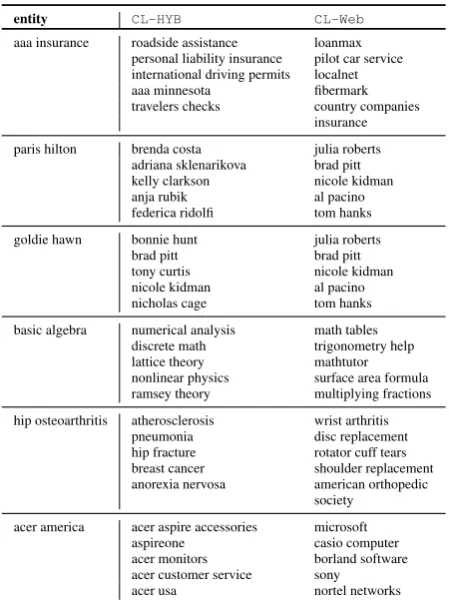
To have an anecdotal and practical intuition on the results, in Table 2 we report some entities and examples of other entities from the same clusters, as obtained from theCL-HYBandCL-Webmethods. The examples show that CL-HYB builds clusters according to a variety of relations, whileCL-Web
mostly capture sibling-like relations.
One relevant of such relations is topicality. For example, for ‘aaa insurance’ the CL-HYB cluster mostly contains entities that are topically related to the American Automobile Association, while the
CL-Web cluster contains generic business compa-nies. In this case, the CL-HYB approach sim-ply chose to group together entities having clicks to ‘aaa.com’ and appearing in contexts as ‘auto club’. On the contrary, CL-Web grouped accord-ing to contexts such as ‘sellaccord-ing’ and ‘company’. The entity ‘hip osteoarthritis’ shows a similar
be-entity CL-HYB CL-Web
aaa insurance roadside assistance loanmax personal liability insurance pilot car service international driving permits localnet aaa minnesota fibermark travelers checks country companies
insurance paris hilton brenda costa julia roberts
adriana sklenarikova brad pitt kelly clarkson nicole kidman anja rubik al pacino federica ridolfi tom hanks goldie hawn bonnie hunt julia roberts
brad pitt brad pitt tony curtis nicole kidman nicole kidman al pacino nicholas cage tom hanks basic algebra numerical analysis math tables
discrete math trigonometry help lattice theory mathtutor nonlinear physics surface area formula ramsey theory multiplying fractions hip osteoarthritis atherosclerosis wrist arthritis
pneumonia disc replacement hip fracture rotator cuff tears breast cancer shoulder replacement anorexia nervosa american orthopedic
society acer america acer aspire accessories microsoft
[image:5.595.112.243.72.123.2]aspireone casio computer acer monitors borland software acer customer service sony acer usa nortel networks
Table 2: Sample of the generated entity clusters.
havior: CL-HYB groups entities topically related to orthopedic issues, since most of the entities are sharing contexts such as ‘treatment’ and ‘recovery’ and, at the same time, clicks to urls such as ‘or-thoinfo.aaos.org’ and ‘arthirtis.about.com’.
Another interesting observation regards entities referring to people. The ‘paris hilton’ and ‘goldie hawn’ examples show that the CL-Web approach groups famous people according to their category – i.e. profession in most cases. On the contrary, query log approaches tend to group people accord-ing to their social attitude, when this prevails over the profession. In the example, CL-HYB clusters the actress ‘goldie hawn’ with other actors, while ‘paris hilton’ is grouped with an heterogeneous set of celebrities that web users tend to query and click in a same manner: In this case, the social per-sona of ‘paris hilton’ prevails over its profession (actress/singer). This aspect is important in many applications, e.g. in query suggestion, where one wants to propose to the user entities that have been similarly queried and clicked.
method Precision
CL-Web 0.735 CL-CTX 0.460 CL-CLK 0.815†
[image:6.595.319.508.71.138.2]CL-HYB 0.850†
Table 3: Precision of various clustering methods († indicates statistical-significant better than the
CL-Webmethod, using t-test).
that query log based methods are more varied in the type of clusters they build. Table 5 shows the dif-ference between the clustering obtained using the different methods and the overlap between the pro-duced clusters. For example, 40% of the relations for theCL-HYBsystem are topical, while 32% are sibiling ones. On the contrary, theCL-Webmethod is highly biased towards sibling relations.
As regard a more attentive analysis of the dif-ferent query log based methods, CL-CTX has the lowest performance. This is mainly due to the fact that contextual data are sometimes too sparse and generic. For example ‘mozilla firefox’ is clustered with ‘movie program’ and ‘astro reading’ because they share only some very generic contexts such as ‘free downloads’. In order to get more data, one op-tion is to relax theτ threshold (see Section 2) so to
include more contexts in the semantic space. Unfor-tunately, this would have a strong drawback, in that low-frequency context tend to be idiosyncratic and spurious. A typical case regards recurring queries submitted by robots for research purposes, such as ‘who is X’, ‘biography of X’, or ‘how to X’. These queries tend to build too generic clusters containing people or objects. Another relevant problem of the
CL-CTX method is that even when using a highτ
cut, clusters still tend to be too big and generic, as statistics in Table 4 shows.
CL-CTX, despite the low performance, is very useful when combined with CL-CLK. Indeed the
CL-HYB system improves +4% over theCL-CLK
system alone. This is because theCL-HYBmethod is able to recover some misleading or incomplete evidence coming from theCL-CLK using features provided byCL-CLK. For example, editors judged as incorrect 11 out of 20 entities co-clustered with the entity ‘goldie hawn’ byCL-CLK. Most of these errors are movies (e.g. ‘beverly hills cops’) soap operas (e.g. ‘sortilegio’) and directors, because all have clicks to ‘imdb.com’ and ‘movies.yahoo.com’.
class method
CL-Web CL-CTX CL-CLK CL-HYB
topic 0.27 0.46 0.46 0.40
sibling 0.72 0.43 0.29 0.32
parent - 0.09 0.13 0.09
child 0.01 - 0.01 0.02
synonym 0.01 0.03 0.12 0.16
Table 4: Fraction of entities that have been classi-fied by editors in the different relation types.
method labelled clusters
CL-CTX CL-CLK CL-HYB CL-Web
CL-CTX - 0.2 0.53 0.29
CL-CLK 0.21 - 0.54 0.34
CL-HYB 0.53 0.51 - 0.31
CL-Web 0.33 0.35 0.41
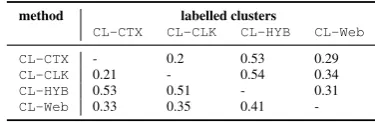
-Table 5: Purity of clusters for each method using clusters from other methods as “labelled” data.
CL-HYBrecovers these errors by including features coming fromCL-CTX such as ‘actress’.
In summary, query log spaces group together en-tities that are similar by web users (this being topi-cal similarity or social attitude), thus constituting a practical model of the ‘user space’ to be leveraged by web applications.
4 Keywords for Sponsored Search
[image:6.595.140.214.72.129.2] [image:6.595.319.507.180.241.2]they produce only suggestions that contain the ini-tial seed (e.g. ‘belkin mp3 player’ for the seed ‘mp3 player’), while nonobvious (and potentially less ex-pensive) suggestions not containing the seed are ne-glected (e.g. ‘ipod nano’ for ‘mp3 player’). For example for ‘galapagos islands’, a typical produc-tion system suggests ‘galapagos islands tour’ which cost almost 5$ per click; while the less obvious ‘isla santa cruz’ would cost only 0.35$. Below we show our method to discover such nonobvious sugges-tions, by retrieving entities in the same cluster of a given seed.
4.1 Experimental Setting
We evaluate the quality of the suggestions proposed by different methods for a set of seed bidterms., adopting the evaluation schema in (Joshi and Mot-wani, 2006)
Dataset Creation. To create the set of seeds, we use Google skTool4. The tool provides a list of
popular bid terms, organized in a taxonomy of ad-vertisement topics. We select 3 common topics: tourism, vehicles and consumer-electronics. For each topic, we randomly pick 5 seeds among the 800 most popular bid terms, which also appear in our entity set described in Section 3.1.5. We
evalu-ate a system by collecting all its suggestions for the 15 seeds, and then extracting a random sample of 20 suggestions per seed.
Evaluation and Metrics. We use precision and Nonobviousness. Precision is computed by ask-ing two experienced human experts to classify each suggestion of a given seed, asrelevantorirrelevant. A suggestion is deemed as relevant if any advertiser would likely choose to bid for the suggestion, hav-ing as intent the seed. Annotator agreement, evalu-ated on a subset of 120 suggestions iskappa= 0.72 (substantial agreement). Precision is computed as the percentage of suggestions judged as relevant. Nonobviousness is a metric introduced in (Joshi and Motwani, 2006), capturing how nonobvious the suggestions are. It simply counts how many
sug-4http://www.google.com/sktool
5The final set of 15 bid terms is: tourism:galapagos
islands,holiday insurance,hotel booking,obertauern,wagrain; vehicles:audi q7,bmw z4,bmw dealers,suzuki grand vi-tara,yamaha banshee; consumer electr:canon rebel xti,divx converter,gtalk,pdf reader,flv converter.
gestions for a given seed do not contain the seed it-self (or any of its variants): this metric is computed automatically using string matching and a simple stemmer.
Comparisons. We compare the suggestions pro-posed byCL-CTX,CL-CLK, andCL-HYB, against
Web and two reference state-of-the-art produc-tion systems: Google AdWords (GOO) and Yahoo Search Marketing Tool (YAH). As concerns our methods, we extract as suggestions the entities that occur in the same cluster of a given seed. For the production systems, we rely on the suggestions pro-posed on the website of the tools.
4.2 Experimental Results
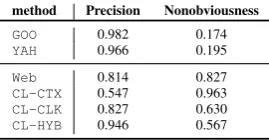
Precision resultsare reported in the second column of Table 6. Both CL-CLK and CL-HYB outper-formWebin precision,CL-HYBbeing close to the upper-bound of the two production systems. As ex-pected, production systems show a very high pre-cision but their suggestions are very obvious. Our results are fairly in line with those obtained on a similar dataset, by Joshi and Motwani (2006).
A closer look at the results shows that most of the errors forCL-CTXare caused by the same problem outlined in Section 3.2: Some entities are wrongly assigned to a cluster, because they have some high
cpmicontext feature which is shared with the
clus-ter centroid, but which is not very characclus-teristic for the entity itself. This is particularly evident for some of the low frequency entities, wherecpmi
val-ues could not reflect the actual semantics of the en-tity. For example the entity ‘nickelodeon’ (a kids tv channel in UK) is assigned to the cluster of ‘galapa-gos islands’, because of the feature ‘cruise’: indeed, some people query about ‘nickelodeon cruise’ be-cause the tv channel organizes some kids cruises. Other mistakes are due to feature ambiguity. For example, the entity ’centurion boats’ is assigned to the cluster of ‘obertauern’ (a ski resort in Aus-tria), because they share the ambiguous feature ‘ski’ (meaning either winter-ski or water-ski). As for the
preci-method Precision Nonobviousness
GOO 0.982 0.174 YAH 0.966 0.195 Web 0.814 0.827
CL-CTX 0.547 0.963
CL-CLK 0.827 0.630
[image:8.595.109.244.59.129.2]CL-HYB 0.946 0.567
Table 6: Results for keyword generation. sion wrtCL-CTXandCL-CLK: the combination of the two spaces decreases the impact of misleading features –e.g. for ‘yamaha bunshee’, allCL-HYB’s suggestions are correct, while almost allCL-CLK’s suggestions are incorrect: the hybrid system recov-ered the negative effect of the misleading feature
ebay.com, by backing up on features from the contextual subspace (e.g. ‘custom’, ‘specs’, ‘used parts’).
Nonobviousness results are reported in column three of Table 6. All our systems return a high num-ber of nonobvious suggestions (all above 50%).6
On the contrary, GOO and YAH show low perfor-mance, as both systems are heavily based on the substring matching technique. This strongly moti-vates the use of semantic approaches as those we propose, that guarantee at the same time both a higher linguistic variety and an equally high preci-sion wrt the production systems. For example, for the seeds ‘galapagos islands’, GOO returns simple suggestions such as ‘galapagos islands vacations’ and ‘galapagos islands map’; while CL-HYB re-turns ‘caribbean mexico’ and ‘pacific dawn’, two terms that are semantically related but dissimilar from the seed. Remember that these letter terms are related to the seed because they are similar in the user space, i.e. users looking at ‘galapagos islands’ tend to similarly look for ‘caribbean mexico’ and ‘pacific dawn’. These suggestions would then be very valuable for tourism advertisers willing to im-prove their visibility through a non-trivial and pos-sibly less expensive set of bid terms.
5 Related Work
While literature abounds with works on entity ex-traction from web documents (e.g. (Banko et al., 2007; Chaudhuri et al., 2009; Pennacchiotti and Pantel, 2009)), the extraction of classes of entities
6Note that very high values forCL-CTXmay be
mislead-ing, as many of the suggestions proposed by this system are incorrect (see precision results) and hence non-obvious (e.g., ‘derek lewis’ for ‘galapagos islands’).
over query logs is a pretty new task, recently intro-duced in (Pasca, 2007b). Pasca’s system extracts entities of pre-defined classes in a semi-supervised fashion, starting with an input class represented by a set of seeds, which are used to induce typical query-contexts for the class. Contexts are then used to extract and select new candidate instances for the class. A similar approach is also adopted in (Sekine and Suzuki, 2007). Pasca shows an improvement of about 20% accuracy, compared to existing Web-based systems. Our extraction algorithm differs from Pasca’s work in that it is completely unsuper-vised. Also, Pasca’s cannot be applied to OIE, i.e. it only works for pre-defined classes. Our cluster-ing approach is related to Lin and Wu’s work (Lin and Wu, 2009). Authors propose a semi-supervised algorithm for query classification. First, they ex-tract a large set of 20M phrases from a query log, as those unique queries appearing more than 100 times in a Web corpus. Then, they cluster the phrases using the K-means algorithm, where features are the phrases’ bag-of-words contexts computed over a web corpus. Finally, they classify queries using a logistic regression algorithm. Our work differs from Lin and Wu, as we focus on entities instead of phrases. Also, the features we use for clustering are from query logs and click data, not web contexts.
6 Conclusions
References
adWords. 2009. Google adwords.
ad-words.google.com/select/keywordtoolexternal.
Banko, Michele, Michael Cafarella, Stephen Soderland, Matthew Broadhead, and Oren Etzioni. 2007. Open
information extraction from the web. InProceedings
of IJCAI.
Cao, Huanhuan, Daxin Jiang, Jian Pei, Qi He, Zhen Liao, Enhong Chen, and Hang Li. 2008. Context-aware query suggestion by mining click-through and
session data. InProceedings of KDD-08.
Chaudhuri, Surajit, Venkatesh Ganti, and Dong Xin. 2009. Exploiting web search to generate synonyms for entities. InProceedings of WWW-09.
Grishman, R. and B. Sundheim. 1996. Message under-standing conference- 6: A brief history. In Proceed-ings of COLING.
Hu, Jian, Gang Wang, Fred Lochovsky, Jian tao Sun, and Zheng Chen. 2009. Understanding user’s query
intent with Wikipedia. InProceedings of WWW-09.
Jain, Alpa and Marco Pennacchiotti. 2010. Open In-formation Extraction from Web Search Query Logs. Technical Report YL-2010-003, Yahoo! Labs.
Joshi, Amruta and Rajeev Motwani. 2006. Keyword generation for search engine advertising. In Proceed-ings of Sixth IEEE-ICDM.
Lin, Dekang and Xiaoyun Wu. 2009. Phrase clustering
for discriminative learning. InProceedings of
ACL-IJCNLP-2009.
Marques De S´a, Joaquim P. 2003. Applied Statistics.
Springer Verlag.
Pantel, Patrick and Dekang Lin. 2002. Discovering
word senses from text. InProceedings KDD-02.
Pantel, Patrick and Deepak Ravichandran. 2004. Auto-matically labeling semantic classes. InProceeding of HLT-NAACL-2004.
Pantel, Patrick, Eric Crestan, Arkady Borkovsky, Ana-Maria Popescu, and Vishnu Vyas. 2009. Web-scale distributional similarity and entity set expansion. In Proceedings of EMNLP-09.
Pasca, Marius. 2007a. Organizing and searching the world wide web of facts - step two: Harnessing the
wisdom of the crowds. InProceedings of the
WWW-2007.
Pasca, Marius. 2007b. Weakly-supervised discovery of named entities using web search queries. In Proceed-ings of CIKM-2007.
Pennacchiotti, Marco and Patrick Pantel. 2009. Entity extraction via ensemble semantics. InProceedings of EMNLP-2009.
Sekine, Satoshi and Hisami Suzuki. 2007. Acquiring
ontological knowledge from query logs. In
Proceed-ings of WWW-07.
Sekine, Satoshi, Kiyoshi Sudo, and Chikashi Nobata.
2002. Extended named entity hierarchy. In
Proceed-ings of LREC-2002.
wordTracker. 2009. Word tracker.
www.wordtracker.com.