How Does the Granularity of an Annotation Scheme
Influence Dependency Parsing Performance?
Simon M ille
1Alicia Bur ga
1Gabriela Fer raro
1Leo Wanner
1,21Universitat Pompeu Fabra Barcelona;2ICREA
❢✐rst♥❛♠❡✳❧❛st♥❛♠❡❅✉♣❢✳❡❞✉
A
BSTRACTThe common use of a singlede factostandard annotation scheme for dependency treebank creation leaves the question open to what extent the performance of an application trained on a treebank depends on this annotation scheme and whether a linguistically richer scheme would imply a decrease of the performance of the application. We investigate the effect of the variation of the number of grammatical relations in a tagset on the performance of dependency parsers. In order to obtain several levels of granularity of the annotation, we design a hierarchical annotation scheme exclusively based on syntactic criteria. The richest annotation contains 60 relations. The more coarse-grained annotations are derived from the richest. As a result, all annotations and thus also the performance of a parser trained on different annotations remain comparable. We carried out experiments with four state-of-the-art dependency parsers. The results support the claim that annotating with more fine-grained syntactic relations does not necessarily imply a significant loss of accuracy. We also show the limits of this approach by giving details on the fine-grained relations that do have a negative impact on the performance of the parsers.
T
ITLE AND ABSTRACT INS
PANISH¿Cómo influye la granularidad de un esquema de anotación
en el rendimiento de parsers de dependencia?
El uso frecuente de un único esquema de anotación estándar para crear corpus de análisis sintáctico de dependencias genera las preguntas de hasta qué punto el rendimiento de una aplicación entrenada con dichos corpus depende del esquema de anotación, y si un esquema lingüísticamente más rico implica que la calidad de la aplicación disminuya. Investigamos aquí el efecto de la granularidad de la anotación sobre el rendimiento de parsers de dependencia. Para obtener distintos niveles de granularidad, diseñamos un esquema de anotación jerárquico basado exclusivamente en criterios sintácticos. La anotación más detallada incluye 60 relaciones, y de ésta derivamos los conjuntos menos detallados. Así, las anotaciones—y el rendimiento de parsers entrenados con ellas—se mantienen comparables. Los experimentos utilizan cuatro parsers del estado del arte. Los resultados apoyan la hipótesis de que una anotación más detallada no implica una pérdida de precisión del parser. Presentamos también las limitaciones de este enfoque, ofreciendo detalles acerca de aquellas relaciones que sí tienen un impacto negativo en la calidad de los parsers.
K
EYWORDS:
dependencies, syntax, annotation, tagset granularity, parsing.SYNOPSIS IN SPANISH
Para medir la precisión de los parsers en función del detalle de los tagsets, se diseñó un esquema jerárquico de anotación de relaciones de dependencia que permite expandir o contraer el número de relaciones a utilizar. La idea general tras este esquema es la aplicación de criterios sólo sintácticos (más que semánticos), más o menos finos, que permiten identificar cada etiqueta gramatical a ser introducida en la anotación, así como agrupar relaciones en una etiqueta más amplia. Así, por ejemplo, para dependientes verbales, necesitamos capturar si éstos pueden pronominalizar, si su movimiento es limitado, etc. En la Tabla 1 se muestra qué relaciones del tagset más detallado son agrupadas bajo la misma etiqueta en el siguiente, y menos detallado, conjunto. Estas agrupaciones se basan en propiedades sintácticas compartidas por un grupo de relaciones.
60 Rels 44 Rels 31 Rels 15 Rels
abs pred abs pred abs pred
compl adnom compl adnom compl adnom
appos appos
analyt fut analyt fut analyt fut AUX analyt pass analyt pass analyt pass analyt perf analyt perf analyt perf analyt prog analyt prog analyt prog
modal modal modal
dobj clitic dobj clitic dobj clitic DOBJ
dobj dobj dobj
copul copul copul COPUL
copul clitic copul clitic copul clitic
iobj1
60 Rels 44 Rels 31 Rels 15 Rels
obl obj1
quasi subj quasi subj quasi subj QSUBJ compar conj bin junct bin junct bin junct aux phras aux phras aux phras NAME aux refl lex
Table 1: Tag groupings for a hierarchy of syntactic tags/Jerarquía de agrupación de etiquetas
sintácticas (Left=top, right=bottom of table)
Los resultados para el Labelled Attachment Score (LAS)—es decir, la proporción de asignación de relaciones con la adecuada etiqueta y el gobernador y el dependiente correctos—se muestran en la Tabla 2. Observamos que los cuatro parsers se comportan de modo similar: su precisión
tags#> 60 44 31 15
Bohnet 81.95 84.11 84.28 84.69 Che 75.14 84.24 84.67 85.11
Malt 79.7 81.9 82.1 82.2
Merlo 82.32 84.53 84.05 84.52
Table 2: LAS (%) of the parsers depending on tag granularity; right: graphical illustration/LAS de los parsers en función de la granularidad del tagset; derecha: ilustración
es constante de 15 a 44 relaciones, pero disminuye con 60 relaciones. Asimismo, notamos una diferencia entre las curvas de Bohnet, Merlo y Malt (prácticamente paralelas) y la de Che, que cae significativamente con 60 relaciones. Todos los parsers logran el mejor rendimiento con el tagset más pequeño y menos detallado. Sin embargo, sorprendentemente, el LAS disminuye muy poco cuando el número de relaciones se duplica, y menos aun entre 31 y 44 relaciones. Con 60 relaciones, no obstante, el LAS cae significativamente alrededor de al menos 2 puntos. También calculamos el UnLabelled Attachment Score (ULA)(ver Tabla 3). Para Bohnet, el ULA aumenta leve pero constantemente de 15 relaciones (90.27%) a 60 relaciones (90.49%). Che, en cambio, presenta la tendencia contraria, y sus resultados decrecen de 15 a 60 relaciones (habiendo una caída mayor con 60). Malt es tan estable como Bohnet, pero no presenta una clara mejora al trabajar con un número mayor de etiquetas. Asimismo, para evaluar si con 15 relaciones la calidad mejora si el parser es entrenado con un tagset más detallado, todos los outputs fueron transformados a 15 relaciones. Como vemos en la Tabla 4, en términos generales, la tendencia es la misma que para el ULA, de modo que podemos concluir que la anotación con más relaciones no parece mejorar la calidad del parser al trabajar con 15 relaciones. Observamos que aquellas relaciones que se diferencian gracias a rasgos sintácticos muy finos (como los diferentes tipos de objetos oblicuos, completivos, o auxiliares reflexivos) son las que más influyen en la disminución de la calidad del parser. Consecuentemente, no separar estas relaciones en relaciones más finas puede ser beneficioso para el parser. Al contrario, observamos que las dependencias que implican diferentes tipos de coordinaciones entre grupos o frases se parsean mejor si no se juntan.
tags#> 60 44 31 15
Bohnet 90.49 90.39 90.31 90.27 Che 86.28 90.37 90.57 90.6
Malt 87.91 88 87.83 87.75
Merlo 90.11 90.67 90.39
-Table 3: ULA of the parsers depending on tag granularity/ULA de los parsers en función de la granularidad del tagset (%)
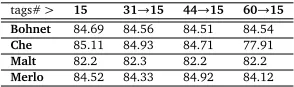
tags#> 15 31→15 44→15 60→15 Bohnet 84.69 84.56 84.51 84.54
Che 85.11 84.93 84.71 77.91
Malt 82.2 82.3 82.2 82.2
Merlo 84.52 84.33 84.92 84.12
1 Introduction
As already pointed out by some researchers (see, e.g., Kübler (2005), Rehbein and van Genabith (2007), Bosco et al. (2010), Bosco and Lavelli (2010)), the use of a single annotation scheme for treebank creation leaves the question open to what extent the performance of an application trained on a treebank depends on the annotation scheme in question. Or, in other words, whether the annotation scheme in use is the best for a given application. To answer this question, Kübler (2005) and Rehbein and van Genabith (2007) compared the performance of a PCFG parser trained on two comparable corpora of German, annotated following different annotation schemes, while Bosco et al. (2010) trained three dependency parsers on two different Italian corpora. In contrast, we are interested in a comparison of the change of the performance of a dependency parser when trained on the same corpus, but annotated with gradually more fine-grained annotation schemes, that is, with gradually more arc labels in the tagset. Our approach differs from (Bosco and Lavelli, 2010) in that we only retain functional syntax for the design of our tagsets. The background of our research is that standard annotation schemes such as the scheme underlying the dependency conversion from the Penn Treebank.1 tend to be minimal in order to facilitate the process of annotation and to improve the readability of the resulting annotation.2 This tendency is reinforced by the general assumption that the less fine-grained the annotation, the better the parser performance. However, this has a major drawback, namely that the parsed structure is often too poor to serve well, e.g., semantic role labeling, deep summarization, content extraction, word sense disambiguation, etc.
To the best of our knowledge, no study actually compares the performance of a dependency parser trained on annotations of varying syntactic granularity, so there are no figures that would demonstrate that it is worth to sacrifice grammatical accuracy and detail for the sake of an acceptable parser accuracy. We carried out such a study on Spanish material. We developed a hierarchical syntactic dependency annotation scheme that allows us to expand and contract syntactic relation branches into larger, more fine-grained, or smaller, more coarse-grained, annotation schemes. The results of parsing experiments demonstrate that it is possible to reach a good balance between the accuracy of a parser and the richness of the linguistic annotation. They also show that the principles that we applied when designing the hierarchical annotation schema are valid and may be used for the design of other annotation schemes in the future.
2 Hierarchical syntactic annotation scheme
The hierarchical annotation scheme in Table 1 has been developed for Spanish on a small corpus of 3513 sentences (100892 words, see (Mille et al., 2009); corpus available at UPF–TALN webpage), which constitutes a section of the Spanish corpus AnCora (Taulé et al., 2008). The general idea underlying this scheme is to apply only syntactic (rather than also semantic) criteria in order to identify each grammatical tag that is to be introduced into the scheme. Using more or less fine-grained criteria allows us to control the level of granularity of the tagset. We do not orientate our scheme towards any particular linguistic theory; the selected criteria are dictated by syntactic behaviour observed in the language in question (in our case, Spanish). For instance, for dependents of verbs, we need to capture whether they can be cliticized, promoted
1The dependency annotation scheme of the Penn Treebank has served as blueprint for annotation schemes of a series
of treebanks in different languages and is thus ade factostandard. See (Marcus et al., 1993) for the original consituency annotation, and (Johansson and Nugues, 2007) for the conversion to one-word-per-line dependency representations.
2“Minimal” refers here not only to the number of tags, but also to the level of precision of the syntactic tags. Indeed,
or demoted, etc. For any kind of dependent, we need to capture the canonical order with respect to its governor, the part-of-speech of the governor, the part-of-speech of the prototypical element that appears in that paradigm, the existence or absence of some agreement between the prototypical dependent and another element of the sentence, the presence/absence and type
of required features of the dependent (e.g., governed preposition, imposed finiteness or case, etc.), the possibility to remove a dependent or not without hampering sentence grammaticality, etc.; see (Burga et al., 2011) for examples and details.
The leftmost column in Table 1 represents the most detailed (and thus linguistically richest) tagset of 60 syntactic relations (henceforthSyntRels) we defined for Spanish: the distinction between one relation and another is, in general, very fine-grained. For instance, there are three types of oblique objects (obl-obj1/2/3), differentiated only by their default order of appearance in a neutral sentence;noun-complis reserved for constructions in which the object cannot move to the left of its governor. The tags in this detailed tagset can be summarized under more generic tags, which would lead to a more coarse-grained, smaller tagset. The obtained more coarse-grained tagset can again be contracted, and so on. In Table 1, we illustrate this procedure for four tagsets in total. The brackets indicate which relations at one level were grouped together under the same label at the following level. Thus, in the second column (44 SyntRels), we group under the labelobl-objany non-agentive prepositional object which cannot be pronominalized, bringing togetherobl-obj1/2/3andnoun-compl. In the third column (31 SyntRels),obl-objandagentare fused into one relationobl-obj, defined as “prepositional object which cannot be pronominalized”. Finally, in the last column (15 SyntRels), one tagOOBJ
gathers any object which cannot be pronominalized, as opposed toIOBJandDOBJ, which can be replaced by a dative and an accusative pronoun, respectively.
3 Experiments
3.1 Background
A number of experiments on different granularities of annotation and their impact on the performance of probabilistic parsers are known from the literature; see in particular Klein and Manning (2003) and Petrov et al. (2006), who show the benefits of splitting generic part-of-speech tags (e.g., NP, VP, etc.) into more precise subcategories for the derivation of accurate probabilistic context-free grammars (PCFG). Our proposal differs from these works in that they focus on constituency parsing and part-of-speech tags, whereas we tackle dependency parsing and edge labels.3 But more importantly, the goals are different. Thus, they target the improvement of parsing accuracy, and for that they infer, with simple rules, from the training data (categorial) information which is more specific than what is directly available. Closer to our work, Bosco and Lavelli (2010) use an Italian corpus in which the dependency relations encode information on morphology, functional syntax and semantics. They discuss the influence of the annotation policies on the evaluation of the parsers and show that the precision and recall of hard-to-parse relations can be quite different, depending on the tag granularity in the annotation, that is, if the annotation contains or not morphological and/or semantic information. In contrast, our goal is to provide evidence that the creation of annotations that capture significant fine-grained distinctive features of the grammar (and only the grammar) of a language does not need to harm significantly the performance of the parsers. Consider as two
3Some other works present a hierarchical organization of grammatical relations (in particular (Bosco et al., 2000),
such fine-grained distinctive features the relationsmodalanddirect-objectin the following two sentences. As indicated, only the direct object can be pronominalized by a clitic pronoun and moved before the governing verb, without that a pro-verb is needed:Juan puede-modal→venir mañana, lit. ‘John might come tomorrow’ (Juan lo puede *(hacer)), andJuan puede-dobj→venir mañana, lit. ‘John is able to come tomorrow’ (Juan lo puede (hacer)). If the annotation of the relations does not encode these phenomena, they are, in fact, lost.4Since this information is of primary relevance to applications related to natural language understanding, it would be an advantage to include it in the syntactic annotation. In the next sections, we show that its inclusion does not harm a parser’s accuracy.
3.2 Setup of the experiments
In our experiments, we used the four tagsets introduced in Section 2. The annotation of the corpus with the most detailed tagset of 60 SyntRels has been obtained from the original annotation in AnCora (Taulé et al., 2008), which has been adapted, revised and enriched manually. Starting from the most fine-grained annotation, we derived automatically the other three, ending up with four different treebanks for the same corpus. Four reference parsers have been used. Three of them are the top three parsers for Spanish in the CoNLL Shared Task 2009 (Hajiˇc et al., 2009): Che’s (Che et al., 2009), henceforthChe, Merlo’s (Gesmundo et al., 2009), henceforthMerlo, and Bohnet’s (Bohnet, 2009), henceforthBohnet. The fourth, the Malt Parser (Nivre et al., 2007), henceforthMalt, has been chosen because it is a very broadly used syntactic dependency parser. Malt and Merlo are transition based, while Bohnet and Che are graph based. In our experiments, all of them processed non-projective dependency trees. Each parser contains its own configuration options, which depend on the parsing approach, the learning techniques, etc. Therefore, it was not possible to apply the same setup to all parsers. Instead, we used for each parser its own default configuration, which does not guarantee an optimal performance. However, as the goal of this paper is not to compare the results of the parsers, but rather the performance of the same parser with different tagsets, optimized configurations are not needed for our purpose.
To train the parsers, the corpus has been divided randomly into a training set (3200 sentences) and a test set (313 sentences).5Each parser has been trained on each of the four annotations of the training set. The obtained sixteen parsing models were applied to the corresponding test sets. Also, in order to see whether or not the performance improved with respect to the smallest tagset when training with more fine-grained tagsets, we mapped the output of each parser onto the smallest tagset. The training and the test sets were the same as in the first experiment.
3.3 Results
For Malt, the assessment of theLabelled Attachment Score(LAS) (that is, the proportion of edges with correct governor and dependent and the right label on the edge) was carried out using the evaluation toolkit provided with the parser. For the other parsers, we used the official CoNLL’06 evaluation toolkit. The LAS figures for each parser and for each version of the annotation are
4One can always imagine some statistical “disambiguation” based on the context in which the construction is used,
but the amount of data needed could be prohibitive—at least for Spanish—and eventually, the only way would probably be to imply human experts for the revision of the annotation.
5Bohnet’s parser uses CoNLL’09 14-column format, while the other three need to be trained on the CoNLL’06
shown in Table 2. The graphic on the right of Table 2 shows how each parser reacts to and how its performance varies with the increasing number of relations in the tagset. We can observe that all four parsers behave similarly: their accuracy is very constant from 15 to 44 SyntRels, and decreases with 60 SyntRels. We also notice that there is a significant difference between Bohnet, Merlo and Malt’s LAS progressions (which are rather parallel) and the progression of Che, which drops when trained with 60 relations (see Section 4). As expected, all parsers reach the highest accuracy with the smallest tagset (15 SyntRels). But surprisingly, the LAS decreases only little with twice as many SyntRels in the tagset (namely 31 SyntRels): 0.1 for Malt, 0.41 for Bohnet, 0.44 for Che, and 0.47 for Merlo. Even more surprisingly, the drop is also rather small between 31 and 44 SyntRels (0.2 for Malt, 0.17 for Bohnet, 0.43 for Che). Merlo even gets better with 44 SyntRels, obtaining a LAS of 84.53%, comparable to that with 15 SyntRels and higher than that with 31 SyntRels. As a result, the decrease of performance from 15 to 44 tags in the tagset is surprisingly small for Malt, Bohnet and Che: 0.3 points for Malt, 0.6 points for Bohnet, 0.9 points for Che, and no decrease at all for Merlo. However, Bohnet, Malt and Merlo see their LAS drop significantly by around 2 points when trained with 60 SyntRels. Che drops by even more than 2 points. The in depth analysis of the behaviour of the parsers with respect to the groups of relations is presented in Section 4.
We also calculated the UnLabelled Attachment(ULA) score for all four parsers (see Ta-ble 3). For a reason beyond our control, we could not get the ULA for Merlo with 15 relations (however, even if incomplete, the ULA figures for Merlo are useful from the perspective of one of our experiments described below). For Bohnet, we observe that the ULA scores slightly but steadily increase in the range from 15 SyntRels (90.27%) to 60 SyntRels (90.49%). Opposite to this tendency, the scores for Che slightly decrease in the range from 15 SyntRels (90.6%) to 44 SyntRels (90.37%), and drop then with 60 SyntRels (86.28%). Malt is as stable as Bohnet, but does not show a regular improvement when dealing with higher numbers of tags. Note that the observed slight variation of the performance numbers of the different parsers across tagsets of varying sizes (always lower than 0.25 points, except Che with 60 relations) could be due to the small size of our training and test sets. In other words, it is possible that with more data, the parsers would give quite stable unlabeled attachment scores across tagsets of varying sizes.
4 Evaluation of selected parsers with respect to specific SyntRels
In the previous section, we saw that the figures of all four parsers drop when trained on the most fine-grained tagset. In this section, we try to identify which relations particularly affect the performance of the parsers and thus obtain information on how the composition of the tagset has an impact on the figures of the evaluation.64.1 Impact of distinctive properties of SyntRels
Due to the relatively small amount of data we have at hand7, there are only 8025 relation instances in the test set8. Some relations do not appear in it at all:prolep,adv-mod,copul-clitic,
num-junctandaux-refl-indir. On the other side, it is not possible to generalize along the lines that the less a relation appears in the training set, the worse the performance of the parser on this relation is. Some relations (compl-adnom,analyt-fut,analyt-progr,analyt-perf,compar,
compar-conj, andcompl1) are scarce in the training set (<200 instances) and in the test set (<20 instances) and, in spite of this, they are parsed with a high accuracy (78%–100%) at least by one of the parsers.
Interestingly, as opposed to the example about objects and modals in Section 3, either the governor or the dependent (or both) of these relations have very distinctive features:
• compl-adnomimplies a determiner followed by a preposition; cf.la-compl-adnom→del sombrero azul, lit. ‘the of-the hat blue’, ‘that one with the blue hat’;
• analyt-fut,analyt-prograndanalyt-perfalways presuppose the same auxiliary as governor and a governed preposition or a non-finite verb as dependent; cf. voy-analyt-fut→a cocinar, lit. ‘I-will[to]cook’;estoy-analyt-progr→cocinando, lit. ‘I-am cooking’;fue -analyt-pass→cocinado, lit. ‘I-was cooked’;
• comparandcompar-conjrequire a comparative adjective governing a fixed conjunction, it-self governing another element (compar-conj); cf.mejor-compar→que-compar-conj→Juan, lit. ‘better than John’;
• compl1requires an adjective on the right of a non-copular verb which undergoes agree-ment with the subject; cf.la frase resulta-compl1→buena, lit. ‘the sentenceF EM.SGends up
correctF EM.SG.
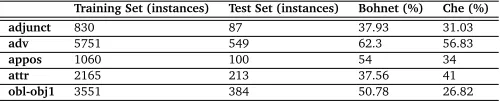
There are also some relations that are not parsed well by either of the parsers, even if the number of their instances in the training and test sets is significant (see Table 5). There are two main explanations of the poor figures for the SyntRels in Table 5. First, the morpho-syntactic features of such relations (e.g., PoS of the head, PoS of the dependent) can vary a lot throughout the corpus: an adverbial or an adjunctive can be an adverb, a common noun, a non-finite verb, a prepositional group, etc. An appositive is usually a common or a proper noun, sometimes introduced by a preposition; an attributive can be a prepositional group or a gerund. Second, these relations also tend to share their basic syntactic configuration with other SyntRels; consider, e.g.,casa-attr→de Barcelona, lit. ‘house from Barcelona’ vs.hermano-obl-obj1→de 6The problematic SyntRels were the same for all four parsers. Due to space restrictions, we chose to focus on the
two graph-based parsers, since the graph-based approach becomes increasingly popular in parsing research.
7Still, we believe that our results are already quite reliable since the average accuracies (without tuning the
parsers) get close to the accuracies obtained by the same parsers at the Shared Task 2009 with much larger data sets (http://ufal.mff.cuni.cz/conll2009-st/results/results.php).
8The dependencies to punctuation signs were not considered in the figures of the evaluation because they are parsed
Training Set (instances) Test Set (instances) Bohnet (%) Che (%)
adjunct 830 87 37.93 31.03
adv 5751 549 62.3 56.83
appos 1060 100 54 34
attr 2165 213 37.56 41
obl-obj1 3551 384 50.78 26.82
Table 5: Poorly parsed frequent SyntRels
Juan‘John’s brother’. Thus, even if the two syntactic constructions seem to be the same (the governor is a noun, the dependent is a preposition, and the dependent of it is a proper noun), only the attributive dependent can be replaced by an adverb, and only the oblique objective is introduced by a preposition which cannot be changed (i.e., a governed preposition; in this case,de‘of’). As far as the SyntRels in Table 5 are concerned, an appositive (and even an adverbial in some cases) can also be confused with them:nebulosa-appos→de Orion, lit. ‘nebula of Orion’. The other SyntRels that share the same N-Prep-N configuration are:abs-pred,obl-obj2,
obl-obj3, andnoun-compl; all of these SyntRels obtain poor scores in the evaluation of both parsers. Similarly, the only difference between adverbials and adjunctives is that adjunctives operate at a sentential level while the scope of adverbials is restricted to their governor:[por ejemplo]←adjunct-,-funciona-,-adv→con una silla, lit. ‘for instance, it-works, with a chair’. The two dependents of the verb are prepositional groups that could be found in any position of the sentence; in other words, there is no superficial clue that would differentiate one from the other.
This general absence of clear distinctive features for each particular SyntRel makes it hard for the parsers to find patterns in their learning phases. Grouping the SyntRels with similar configurations is the main factor that makes the parsers improve. In the next subsection, we give more details about the groupings made in the 60 label tagset.
4.2 Detailed analysis of the evaluations results
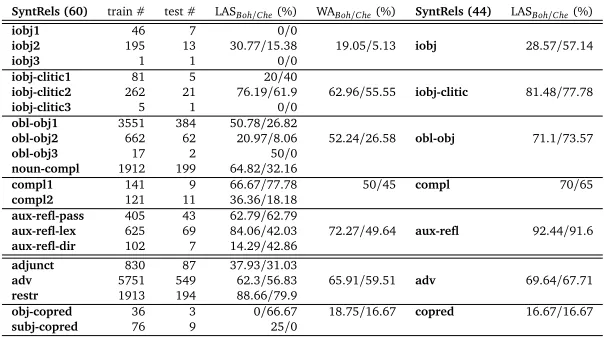
SyntRels (60) train # test # LASBoh/Che(%) WABoh/Che(%) SyntRels (44) LASBoh/Che(%)
iobj1 46 7 0/0
iobj2 195 13 30.77/15.38 19.05/5.13 iobj 28.57/57.14
iobj3 1 1 0/0
iobj-clitic1 81 5 20/40
iobj-clitic2 262 21 76.19/61.9 62.96/55.55 iobj-clitic 81.48/77.78
iobj-clitic3 5 1 0/0
obl-obj1 3551 384 50.78/26.82
obl-obj2 662 62 20.97/8.06 52.24/26.58 obl-obj 71.1/73.57
obl-obj3 17 2 50/0
noun-compl 1912 199 64.82/32.16
compl1 141 9 66.67/77.78 50/45 compl 70/65
compl2 121 11 36.36/18.18
aux-refl-pass 405 43 62.79/62.79
aux-refl-lex 625 69 84.06/42.03 72.27/49.64 aux-refl 92.44/91.6 aux-refl-dir 102 7 14.29/42.86
adjunct 830 87 37.93/31.03
adv 5751 549 62.3/56.83 65.91/59.51 adv 69.64/67.71
restr 1913 194 88.66/79.9
obj-copred 36 3 0/66.67 18.75/16.67 copred 16.67/16.67
subj-copred 76 9 25/0
Table 6: Comparison between 60 and 44 SyntRels for Bohnet’s and Che’s parser
• iobj1,iobj2, andiobj3give an average weighted LAS of 19.05% and 5.13% for the two parsers, whereas when they are grouped under one single labeliobj, the LAS reaches 28.57% and 57.14%; in other words, the LAS drops 9.52 and 52.01 points respectively when training with the most fine-grained relations relations.
• The weighted average ofiobj-clitic1,iobj-clitic2, andiobj-clitic3is 18.52/22.23 points lower than when those labels are grouped under the generic labeliobj-clitic.
• The weighted average ofobl-obj1,obl-obj2,obl-obj3andnoun-complis 18.86/46.99 points lower than when they are grouped under the labelobl-obj. There are 647 instances of this relation in our test set, which means more than 8% of the total number of edges. This subset of SyntRels is largely responsible for the bigger drop of Che when trained with 60 relations.
• Forcompl1andcompl2, the drop is also important compared to when they are grouped undercompl: exactly 20 points for both parsers;
• The different types of reflexive auxiliaries that appear in the test set (passive, lexical, and direct) also work much better as one single labelaux-refl: when they are separated, the LAS drops 20.17 and 41.96 points.
• Finally, for the other very important group by the number of instances in the test set (more than 10% of the edges), the comparison is similar, even if the amplitude is more reduced:adjunct,advandrestrsee their LAS 3.73 and 8.2 points inferior to the LAS of the generic labeladv, which includes them all in the 44 label tagset. Here too the drop is more important for Che than for Bohnet and largely accounts for the global LAS as seen in Table 2.
semantic realities. In fact, the number appended to the oblique object relation label not only stands for the order by default in a neutral sentence (with all the objects being present), but it also directly correlates with the slot in the valency pattern of the governor occupied by the corresponding dependent.9Although there is a relation between the default order of the objects and their (semantic) numbering, when several oblique objects of the same verb are used at the same time, there usually are information structure features that constrain their order. As a result, the objects are never instantiated in the same order, and the parser has almost no clue for guessing to which slot to assign an object.
From the bird’s eye view of the composition of SyntRel-tagsets, it seems that grouping together SyntRels based on their syntactic properties helps the parsers. But not all relation groupings turn out to be beneficiary for the performance of the parsers. Consider the relations that connect two parallel clauses related by a coordination conjunction:juxtapos,quasi-coordandcoord. In the 60 and 44 label tagsets, those three SyntRels are kept separated, and the average weighted LAS is 71.5% and 72.58% for Bohnet, and 61.85% and 68.63% for Che respectively. When
juxtaposandquasi-coordare grouped in the 31 label tagset, Bohnet drops by more than 2 points to 70.31%, while Che slightly rises to 69.33%. However, whencoordis also grouped with the other two under the labelCOORD, both parsers have more difficulties: Bohnet drops by one point and Che by more than six points. We believe that with these three SyntRels, the syntactic constructions at stake are too different for the parsers to be able to find strong common features: a juxtaposition involves a punctuation sign (colon or semi-colon), while a coordination involves a conjunction or a comma, and a quasi-coordination nothing but the two coordinated elements (e.g.¡Estoy aquí-,-quasi-coord→en mi cuarto!, lit. ‘I’m here, in my room!’). Therefore, we believe that even if it is tempting to annotate with a same label any coordinate structure, it is better to keep the different types annotated with different labels.
5 Conclusions
The evaluation of the performance of four state-of-the-art parsers trained on a corpus that was annotated following schemes of different granularity revealed that the loss of accuracy as a consequence of the increase of the size of the tagset, in particular, from 15 to 44 tags, is surprisingly small. This outcome supports the claim that an annotation with more fine-grained syntactic relations does not necessarily imply a significant loss in accuracy. It also supports the argumentation that it is useful to compile a detailed annotation scheme, which then allows for the derivation of a variety of more or less detailed annotations. Our study also suggests that there seems to be a limit with respect to the degree of detail of the tagset beyond which a parser’s accuracy suffers significantly, and that there are some tags which provoke a drop of the LAS more than others. These are, in particular, the very fine-grained divisions which directly reflect semantic valency information. Another conclusion that can be drawn is that training a parser on a fine-grained annotation does not lead to a better performance of this parser when parsing with a coarse-grained tagset. However, it still remains unclear whether the unlabeled attachment score can improve when training on a fine-grained annotation. Experiments with more data would be necessary in order to draw more solid conclusions.
Acknowledgments
We would like to thank B. Bohnet and the anonymous reviewers for their very helpful comments.
9This goes along the lines of Bosco et al. (2010), who mention that semantic distinctions are problematic in their
References
Bohnet, B. (2009). Efficient Parsing of Syntactic and Semantic Dependency Structures. In
Proceedings of CoNLL ’09, pages 67–72, Boulder, Colorado, USA.
Bosco, C. and Lavelli, A. (2010). Annotation Schema Oriented Evaluation for Parsing Validation. InProceedings of TLT-9, pages 19–30, Tartu, Estonia.
Bosco, C., Lombardo, V., Vassallo, D., and Lesmo, L. (2000). Building a Treebank for Italian: a Data-Driven Annotation Schema. InProceedings of LREC ’00, pages 99–105, Athens, Greece.
Bosco, C., Montemagni, S., Mazzei, A., Lombardo, V., Dell’Orletta, F., Lenci, A., Lesmo, L., Attardi, G., Simi, M., Lavelli, A., Hall, J., Nilsson, J., and Nivre, J. (2010). Comparing the Influence of Different Treebank Annotations on Dependency Parsing. InProceedings of LREC ’10, pages 1794–1801, Valletta, Malta.
Briscoe, T., Carroll, J., Graham, J., and Copestake, A. (2002). Relational Evaluation Schemes. InProceedings of the Workshop at LREC ’02 on Beyond PARSEVAL: Towards Improved Evaluation Measures for Parsing Systems, pages 4–6, Gran Canaria, Spain.
Buchholz, S. and Marsi, E. (2006). CoNLL-X Shared Task on Multilingual Dependency Parsing. InProceedings of CoNLL ’06, pages 149–164, New York City, USA.
Burga, A., Mille, S., and Wanner, L. (2011). Looking Behind the Scenes of Syntactic Dependency Corpus Annotation: Towards a Motivated Annotation Schema of Surface-Syntax in Spanish. InProceedings of DepLing ’11, pages 104–114, Barcelona, Spain.
Che, W., Li, Z., Li, Y., Guo, Y., Qin, B., and Liu, T. (2009). Multilingual Dependency-based Syntactic and Semantic Parsing. InProceedings of CoNLL ’09: Shared Task, pages 49–54, Boulder, Colorado, USA.
Gesmundo, A., Henderson, J., Merlo, P., and Titov, I. (2009). A Latent Variable Model of Synchronous Syntactic-Semantic Parsing for Multiple Languages. InProceedings of CoNLL ’09: Shared Task, pages 37–42, Boulder, Colorado, USA.
Hajiˇc, J., Ciaramita, M., Johansson, R., Kawahara, D., Martí, M. A., Màrquez, L., Meyers, A., Nivre, J., Padó, S., Štˇepánek, J., Straˇnák, P., Surdeanu, M., Xue, N., and Zhang, Y. (2009). The CoNLL-2009 Shared Task: Syntactic and Semantic Dependencies in Multiple Languages. In
Proceedings of CoNLL ’09: Shared Task, pages 1–18, Boulder, Colorado, USA.
Johansson, R. and Nugues, P. (2007). Extended Constituent-to-dependency Conversion for English. InProceedings of NODALIDA ’07, pages 105–112, Tartu, Estonia.
Klein, D. and Manning, C. D. (2003). Accurate Unlexicalized Parsing. InProceedings of ACL ’03, volume 1, pages 423–430, Sapporo, Japan.
Kübler, S. (2005). How Do Treebank Annotation Schemes Influence Parsing Results? Or How Not to Compare Apples And Oranges. InProceedings of RANLP ’05, pages 293–300, Borovets, Bulgaria.
Marneffe, M.-C. D., MacCartney, B., and Manning, C. D. (2006). Generating Typed Dependency Parses from Phrase Structure Parses. InProceedings of LREC ’06, pages 449–454, Genoa, Italy. Mille, S., Burga, A., Vidal, V., and Wanner, L. (2009). Towards a Rich Dependency Annotation of Spanish Corpora. InProceedings of SEPLN ’09, pages 325–333, San Sebastian, Spain.
Nivre, J., Hall, J., Nilsson, J., Chanev, A., Eryi˘git, G., Kübler, S., Marinov, S., and Marsi, E. (2007). MaltParser: A Language-Independent System for Data-Driven Dependency Parsing.
Natural Language Engineering Journal, 13(2):99–135.
Petrov, S., Barrett, L., Thibaux, R., and Klein, D. (2006). Learning Accurate, Compact, and Interpretable Tree Annotation. InProceedings of COLING/ACL ’06, pages 433–440, Sydney, Australia.
Rehbein, I. and van Genabith, J. (2007). Treebank Annotation Schemes and Parser Evaluation for German. InProceedings of EMNLP-CoNLL ’07, pages 630–639, Prague, Czeck Republic.