140
Comparative Performance Analysis And
Implementation Of Improved Leach Protocol For
Wireless Sensor Network
G.R. AnnushaKumar1 and V. Padmathilagam2
1 Assistant professor, Deaprtment of ECE, Annamalai University,Chidambaram
2
Assistant professor, Deaprtment of EEE, Annamalai University,Chidambaram
Abstract: In a widespread application wireless sensor network plays an important role in the network protocols like 4G, 5G etc. In this paper, the implementation of energy saving based hierarchical protocol Low Energy Adaptive Clustering Hierarchy (LEACH) and its improved variants is proposed. LEACH plays an essential role in the backbone of any wireless sensor network (WSN) implementation. .A modified hybrid fusion routing algorithm of Quadrature- LEACH (Q- LEACH), Enhanced-LEACH (E- LEACH) and centralized- LEACH (C- LEACH) has been proposed in terms of stability, network lifetime, comparative curve based analysis, false alarm rate and throughput. The comparative performance analysis of the proposed three algorithms has been carriedout.
Keywords: Wireless Sensor Networks (WSN), Low Energy Adaptive Clustering Hierarchy (LEACH), Quadrature- LEACH (Q- LEACH), Enhanced-LEACH (E- LEACH), centralized- LEACH (C- LEACH).
1.INTRODUCTION
In recent years, Wireless sensor network has an increased usage over a wide range of applications ranging from a simple and effective home monitoring system from a remote location, hospital management, military applications, monitoring of remote locations for possible disaster prediction and management. The WSN is comprised of a number of nodes deployed in the field under study and information from these sensors being sensed and transmitted in the form of packets of information continuously to the source through a gateway through the wireless transfer protocol. The information from these nodes could also be transmitted to cloud to enable the users to access required information as and when required from any point of the globe. A wireless sensor network has a sensor mode, sink node and a management node [1]. A large number of self-organizing sensor nodes are established by monitoring the constituting area on the network. The data monitored by sensor nodes are transmitted one by one, along the nodes by a multi-hop routing that will reach the sink node after through the management node either by the wired or wireless Internet. Routing forms the backbone behind any WSN implementation as the efficiency of any WSN network is determined by how effectively the information from the sensor nodes is being transmitted from source to destination [2]. It is further defined by several attributes such as packet loss which defines the number of packets that have been effectively transferred to destination to the total
141
nodes and the cluster head. The key function of the cluster head is rotated at predefined interval to assure even distribution of energy among the sensor nodes. The routing is based on the flawless hauling range data transmission between base station and cluster heads using multi-hop. Its performance is figured out by comparing with LEACH routing protocol using MATLAB. The advantage of LEACH is that each node has the same probability to be a cluster head, which makes the energy dissipation of each node, be relatively balanced [7].
Cluster based routing is an effective research area in WSN. Clustering in WSN is the process of dividing the nodes of WSN into groups, where each group agrees on a central node, called the Cluster Head (CH), which is responsible for storing the sensory data of all group members, and sending to the Base Station (BS). The good clustering algorithm cannot only reduce the energy consumption of the sensor nodes can also reduce communication interference; improve the efficiency of the routing protocols. Therefore a rational algorithm is needed for a highly efficient and stable network. To solve the problem, In this paper, considering the residual energy for each node, a more efficient, more reasonably low overhead adaptive layered algorithms such as E-LEACH, C-LEACH and Q-LEACH have been proposed. The designs of the E-LEACH algorithm, which increase the network lifetime, improve node energy utilization [8]. The C-LEACH is a cluster algorithm in which cluster heads are randomly selected by simulated algorithm from the nodes with energy above the average, for finding the best position of CHs to reduce the energy loss. Q-LEACH for homogeneous networks, which establish stability period, network lifetime and throughput quiet significantly [9]. In this paper a brief review of these techniques has been presented and the comparative measure has been carried out.
2.LEACHPROTOCOL
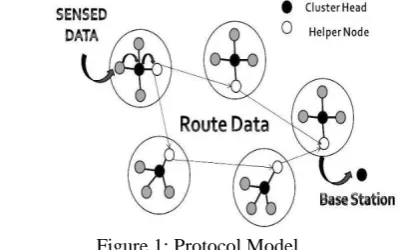
The working method of LEACH starts with the formation of clusters based totally on the received signal strength. The aim of LEACH is to reduce the energy consumption required to the sensor node and also to maintain the clusters sensors network life time in wireless sensor network. A simple model of the protocol is depicted in figure 1.
[image:2.595.315.517.118.243.2].
Figure 1: Protocol Model
It is hierarchical routing based protocol in that a single node which collect data among all the near nodes, is said to be to cluster heads. The cluster heads have a role to gather information from the node to communicate it to the base station (sink). By using a stochastic algorithm at each round to find the energy level of each node it will become a cluster head in this round. LEACH protocol, assuming the node having a full energy to send the data directly to the base station or if the base station more away than to the nearest cluster head, due this the energy of the each sponsor node is totally wasted if it transmit all the time. The cluster head at that time aggregate as well as transfer the sensor data to the BS, during that time to reduce the amount of energy the information that should be compressed to transmit to the BS. But the cluster head is draining out its energy compared to its all the nodes in the cluster. The protocols at random selects a small number of sensor nodes as cluster-heads moreover rotate this role toward consistently distribute the power load amongst the sensors into the network. To reduce inter-cluster and intra cluster collisions LEACH use a TDMA/code-division multiple access (CDMA) technique. Cluster-head randomly rotates over a specified period to identical power dissipation within the sensor network be obtained. Cluster Head is selected as a parameter of “p” probability with the member nodes of a cluster. By using of a dynamic clustering the lifetime of the sensor node network is increasing in LEACH. Implementation of LEACH algorithm has been following two phases [10] [11].
2.1. Setup Phase
In the setup phase an each node has its own random number between 0 and 1, depending upon the random value of the node among the sensors nodes calculate it’s Cluster Head by using a Threshold equation:
142
Here p is the desired percentage of cluster heads and r is the current round, G is the group of nodes which has not been selected as CHs in the previous probabilities selection. The sensor node that is selected as a CH in the previous round is not selected in the next rounds until all other nodes in the network become cluster heads.
2.2. Steady Phase
In the steady phase, nodes transmit their data into a cluster head using TDMA schedule. TDMA schedule allots time slots to everyone. After collecting all the data from the nodes the CH compressed the data and sends it to the base station (BS). In the Fig 1, sensor nodes are grouped to form clusters and each cluster is having a Cluster Head. The nodes in the cluster do not directly communicate with the base station.
3. PROPOSED LEACH ALGORITHMS
3.1 C-LEACH (Centralized- LEACH)
C-LEACH operation similar to the original LEACH Protocol only changes its cluster head selection. C-LEACH perform centralized cluster algorithm for selection of cluster heads (CHs). Setup phase as like that LEACH process, but differences in steady state phase. As per the LEACH the base station has the global information about the sensor nodes and its energy level in the network. From the information base station calculates its average node energy by use of its average energy its to elected the cluster heads among the network and also have a tracking methods by GPS. The Base station sends its decision back to nodes that which nodes are elected as cluster heads [12]. Base station broadcasts CHs ID (identifier) to nodes in the network and nodes have the same ID as elected CHs ID are nominated as CH and collect data from its cluster members using TDMA schedule. Centralized-LEACH uses a deterministic threshold algorithm in which amount of energy in the node and/or whether or not the node was a cluster head in recent time. The CH nodes in the number of nodes cannot placement as assured. The central control algorithm is used in Centralized-LEACH to form the clusters which produce improved clusters by distributing the cluster head nodes through the network [13].
3.2 E-LEACH (Enhanced-LEACH)
Enhanced-LEACH is mainly contributed the overload power consumption problem. E-LEACH involves cluster head selection algorithms which have global information about the other sensor nodes [14] [15]. In the hierarchical clustering routing protocol the main drawback is the total number of cluster head. In order to reduce the less number of cluster heads, then its trouble that cluster members (CMs) which are at a far distance from their CHs consume more energy each clustering network because of the large coverage area. The residual energy of sensor nodes considered as the most important factor, it makes a decision that sensor node turn into the cluster head or not in the next round. Communication between CHs and base station needs more energy than communication between CHs and cluster members. E-LEACH chooses that CH among the nodes from that large residual energy has obtained.
3.3. Q-LEACH (Quadrature- LEACH)
In Q-LEACH, network is making a sector into sectors that is the total area sector into sub-sector from that each sub-sub-sector clusters is formed and is more deterministic in nature. Therefore, nodes in the distributed area within a cluster share within the sub-sector so energy efficient is increasing. Figure 2 shows the general Q-Leach working principle. In that CHs get the information about the nodes after the decision of clusters in their association. With reference to the information gathered from attaching nodes in the association, a guaranteed time slot using Time Division Multiple Access (TDMA) is allocated to each node. Once again the same information sent to the sensor nodes Base Station (BS) in the cluster.
143
Figure 2: Working Principle of Q-LEACH
[image:4.595.143.454.330.587.2]4. RESULTS AND DISCUSSION
Figure 3: False Alarm Probabilities
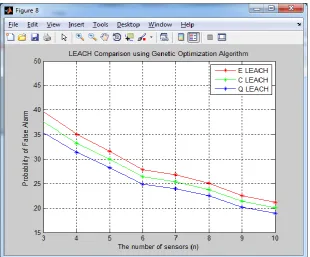
Figure 3 shows that the LEACH protocol comparison of different types of LEACH using genetic optimization rules. In this comparison, Q, C and E - LEACH types are compared to each other. Out of all proposed LEACH protocols, the Q leach have low probability of false alarm with respect to the number of sensor nodes as shown in figure. Efficient use of energy in the network has been the main issue in WSNs for prolonging the lifetime of the network. Q LEACH has found one of the most energy efficient protocols used in WSN. In this
144
Figure 4: Comparative Curve Based Analysis
Figure 4 shows that the LEACH comparison between its types using curve based deployment. Line based deployment is suboptimal when ll C ll < ll EF ll. This means that the existing line based deployment will find a line segment with larger length than what we get in the curve based deployment. In that curve 1 is a deployment a optimal curve based approach and its length is 295.78, and the shortest length of the line segments for different line is 305.78 (denoted by deployment line 1), 315.and 325.78 deployment line 3), respectively. We show the values of the susceptibility of curve 1 under the Algorithm 1 and deployment lines 1-3 by line-based approach is shown in Fig. 4. Algorithm 1 has better performance of barrier coverage than those by line based approach. The larger ll EF ll -- ll C ll the better performance curve based approach would obtain.
[image:5.595.145.454.496.731.2]145
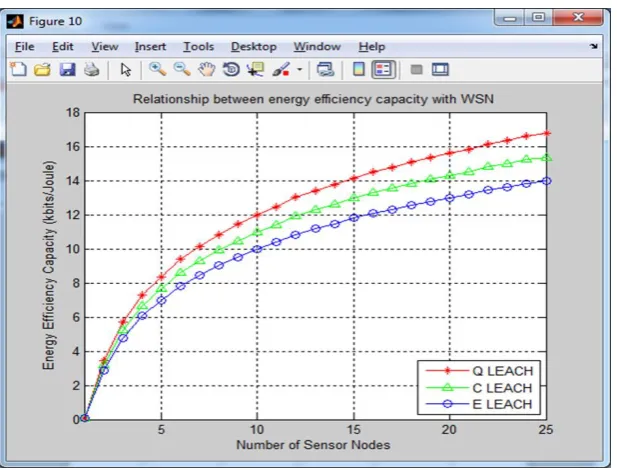
Figure 5 shows that the relationship between energy efficiency capacities (Kbits/joule) in WSN with Improved- LEACH protocols. In that if the sensors node increases the energy consume for the bits transmits is increasing because of that the transmitting loss is reduced within its quadrant. The E-Leach and C-Leach takes less energy compare to the Q-Leach, so the transmitting its data is not
[image:6.595.127.469.220.523.2]possible for all nodes send it to the base station sensor node within the time slot. The time slot increases the total energy consume by the node is increased and the time taken to reach the base station also increases. From the energy efficient capacity Q-LEACH has been achieved higher efficiency compare than C-LEACH and E-LEACH algorithms.
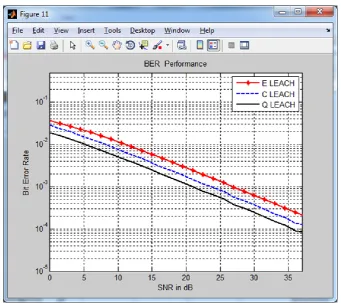
Figure 6: Bit error rate (BER) performance
The figure 6 shows that the bit error rate performance of data transmission in the WSN network of different LEACH protocols for improving the signal to noise ratio for the proposed systems. In the BER the percentages of bits with errors divided by the total transmitted data bits are less in Q-Leach when the SNR is at 0dB comparative with the other Improved leach menthods E-Leach and C-leach. Therefore, the quality of the transmission between
146
Figure 7:Throughput analysis
Figure 7 shows that the effective throughput of all underground sensors for diverse schemes at the same maximum power factor. The throughput and effective throughput of all sensors are overlapped completely for LEACH which means that the LEACH fully meets QoS requirements. All the three improved Leach are very good in the throughput .At
the same time, it is also observed that the effective throughput of Q-LEACH is far greater than that of all sensors, even though the throughput is less for sensors with good channel conditions due to the fact that the QoS awareness leads to throughput degradation for those sensors.
[image:7.595.135.464.479.722.2]147
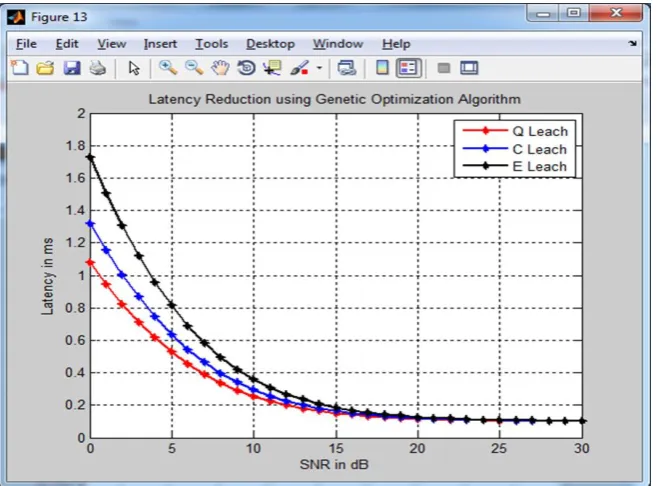
Figure 8 shows that the latency minimization for LEACH protocol. Assume that the node sensing the incoming event is placed at the origin. This node starts sending an alarm message at time 0. All the active nodes, within the transmission radius 2r or less, receive the message and they also begin to broadcast over their own transmission areas. Assuming no propagation delays, at t = 0 the message has spread to the cluster containing the origin. A sleeping node in the set that was already covered by the broadcast message and that changes its state is called a bridge. After the bridge has started its broadcast, all the new active nodes who receive the message, either directly from the bridge or via a multi-hop path, are added to the original cluster
5. CONCLUSION
In this proposed work, a comparative assessment of different LEACH algorithms has been implemented. These comparative assessments have been executed by various components such as False alarm probabilities, Curve Based Analysis, Energy efficiency capacity for the proposed different improved LEACHs. Among these analysis Q- LEACH shows the explicit and achieved the more robust and optimized performance other than the C-LEACH and E-C-LEACH algorithms. Hence Q-LEACH in the network parameters improve the lifetime of the sensor node and having taken energy management. It seems to be an attractive choice for WSNs by extending and enhancing overall network quality parameters.
REFERENCES
[1] Heinzelman WB, Chandrakasan AP, Balakrishnan H, “An application-specific protocol architecture for wireless microsensor networks”, Wireless Communications,01(4), 660–70, 2002;
[2] Ameer Ahmed Abbasi and Mohamed Younis, “A survey on clustering algorithms for wireless sensor networks”, Computer Communications, 30(14), 2826–2841, 2007. [3] Jennifer Yick, Biswanath Mukherjee and
DipakGhosal, “Wireless sensor network survey”, Computer Networks, 52(12), 2292–2330, 2008.
[4] Chen G, Li C, Ye M, Wu J. “An unequal cluster-based routing protocol in wireless sensor networks”, Wireless Networks, 15(2),193–207, 2009
[5] Ezzatiabdellah and Saidbenalla, ”Advanced Low Energy Adaptive Clustering Hierarchy”
International Journal on Computer Science and Engineering,02.(07), 2491-2497, 2010. [6] Suraj Sharma, Sanjay Kumar Jena , “A survey
on secure hierarchical routing protocols in wireless sensor networks”, Proceeding of the International Conference on Communication, Computing & Security (ICCCS '11), 146- 151, 2011.
[7] Santosh IrappaShirol, Ashok Kumar. N and Kalmesh M. Waderhatti, “Advanced-LEACH Protocol of Wireless Sensor Network”, International Journal of Engineering Trends and Technology (IJETT), 4(6), 2261-2264, 2013.
[8] Ravneet Kaur and Deepika
Sharma,“Comparative Analysis Of Leach and Its Descendant Protocols In Wireless Sensor Network” International Journal of P2P Network Trends and Technology,03(01): 561-569,2013.
[9] Poornima, A.S, Amberker, B.B, “Key establishment protocols for secure communication in clustered sensor networks”, International Journal of Communication Networks and Distributed Systems, 11(02), 120-138,2013.
[10] Kaur M, Singh K, “Optimization of Stability Period in WSN using GA based Stable Election Protocol”, International Journal of Computer Applications,91(8), 471-479,2014. [11] Amandeep Kaur and Amit Grover,“LEACH
and Extended LEACH Protocols in Wireless Sensor Network-A Survey” International Journal of Computer Applications, 116(10), 0975 – 8887, 2015.
[12] P. Sasikumar and . K. S. Preetha, “Performance Analysis of Secure LEACH Based Clustering Protocol in Wireless Sensor Networks” International Journal of Applied Engineering Research,10(14), 34035-34041, 2015.
[13] Rajendra Prasad and Rakesh Kumar,“Descendant of LEACH Based Routing Protocols in Wireless Sensor Networks” Elsvier-Proceedia Computer Science, 57(03), 1005-1014,2015.
[14] P. Marappan, P. Rodrigues, "An energy efficient routing protocol for correlated data using C-LEACH in WSN", Wireless Network, 22(04),1415-1423, 2016.
[15] V. K. Arora, V. Sharma, M. Sachdeva, "A survey on LEACH and otherŠs routing protocols in wireless sensor network",