GRAMMAR INDUCTION BY MDL-BASED DISTRIBUTIONAL
CLASSIFICATION
Yikun Guo
Fuliang Weng
Lide Wu
Dept. Of Computer Science Research & Tech Center Dept. Of Computer Science
Fudan University Robert Bosch Corp Fudan University
Shanghai, 200433, China Palo Alto, CA94304, USA Shanghai, 200433, China
[email protected] [email protected] [email protected]
Abstract
In this paper, we introduce a novel MDL-based grammar learning algorithms, which can automatically
induce a good amount of high quality parsing-oriented grammar rules from a tagged corpus with a minimal
annotation. Comparing between the basic best-first MDL induction algorithm and a pseudo-grammar
induction process, we identify problems associated with the current MDL-based grammar induction
approaches. Based on this, we present a novel two-stage grammar induction algorithm to overcome a
local-minimal problem by clustering the left hand sides of the induced grammar rules with a classifier trained
through a seed grammar. Preliminary experimental results show that the resulting induction curve is very
close to its upper bound and outperforms the traditional MDL-based grammar induction.
1. Introduction
With the increasing demand for natural language processing in the various Internet applications, such as
automatic speech recognition and dialog systems, the acquisition of large amount of high quality grammar
rules become more important. The availability of hand-annotated corpora, such as Penn Treebank Project,
offers the possibilities for overcoming this knowledge-engineering bottleneck. However, the parsers based on
such grammar rules have the risk of becoming too tailored to these labeled training data so as not be able to
reliably process sentences from other domains. To parse sentences from a new domain, one would then try to
obtain a new set of grammar rules from that domain, which often would require hand-parsed sentences for
the new domain. Because to (semi-)manually parse a large corpus is both a labor-intensive and a
time-consuming task, it would be beneficial to automatically derive grammar rules from raw text data from that
domain with minimal annotations.
In this paper, we report our ongoing research work in automatic grammar acquisition within the minimal
description length (MDL) [ Ris78, Ris89] paradigm, together with contextual distribution classification to
infer the LHS of those induced rules. Particularly, we want to address three MDL-related grammar induction
issues: 1) What problems do current MDL-based grammar induction approaches have? 2) What MDL values
may we obtain using the basic MDL induction approach when both the grammar rules and their application
order is known? This way, we can have a good idea about the upper bound for the basic MDL-based
grammar induction. 3) Are there any new approaches that can lead to a performance close to that upper
bound?
To answer these questions, we conducted a set of experiments that compare the induction curves under
The results show that the MDL principle alone induces reasonable phrase grammar rules at the beginning,
but quickly leads to a local-minimal and most of induced rules then are not adequate. However, applying the
rules from Treebank by MDL principle in bottom-up order shows monotonous and sharp decrease of MDL
values, compared with the results from the basic MDL principle. We speculate that it may be due to the
vagueness of the LHS symbols from the MDL principle alone, and therefore, we improve our algorithm to
determine LHS using distributional classification. The experimental results show that the new approach is
very close to the hand-annotated rule induction approach in term of MDL values.
The rest of paper is organized as follows: section 2 presents the MDL principle, with an emphasis on
description length gain (DLG), described in [Kit98] following classic information theory [Shannon49,
Cover&Thomas91]. The next section presents two grammar induction strategies, i.e. the basic induction
algorithm, which aims to find optimal grammar rules from the scratch with the guide of MDL principle
alone, and a two-stage improved induction algorithm that first explores the context distribution of five
syntactic categories from some “seed grammar”. During the next induction stage, those induced grammar
rules are dynamically classified as one of the five categories to avoid the deficiency of MDL-based search
strategy. Section 4 reports experimental settings, results and algorithm evaluation. Section 5 reviews previous
MDL-based research on grammar learning and gives our conclusions.
2. Grammar induction by MDL Principle
Grammar induction can be viewed as a process that searches for the best grammar in a predefined
grammar (or hypothesis) space. If a set of permissible rules or rule formats, e.g., context-free grammar
(CFG) rules, are given, it is widely adopted to use the Baum-Welch (or forward-backward) algorithm and its
extension, the inside-outside algorithm [Baker79, Lari&Young90], to estimate the probabilistic parameters
for these grammars. Essentially, there are two sub-tasks in obtaining a CFG rule. One is to decide what the
right-hand terminals or non-terminals should be, and the other is to decide the left-hand symbol (LHS).
2.1. MDL Principle
Researchers have proposed various techniques and criteria to constrain the grammar space and to guide the
search process. For example, [Hol75] used genetic algorithm and [KVG83] applied stimulated annealing
algorithm to facilitate the search process. However, at the core of the search process, the goodness criterion
for search is a critical issue, this is because it tells which grammar rule is better. Among those approaches,
the minimal description length (MDL) principle, which is based on the classic and algorithmic information
theory [Shannon49, Solo64, and Kol65], has received a wide attention.
For any given set of data, i.e. legal sentences, there are usually multiple theories (i.e. a set of grammar
rules) that can account for the data, and we need to decide which one to select. An often used principle is the
Occam’s razor principle, which states that given a choice of the theories, the simplest is best. There are two
aspects associated with the simplicity. One is that how simple is the theory describes the data, and the other
is that how simple is the description of the theory itself. There is clearly a tradeoff between these two aspects.
[Ris78] formalized this as follows: given some data D, we should pick that theory T which minimizes. That
is:
L(T) +L(D|T) (1)
where L(T) is the number of bits needed to minimally encode the theory T, and L(D|T) is the number of
From Shannon’s information theory [Shannon49], we know that if we have a discrete set X of items with a
probability distribution P(x), then to send a message identifying x
∈
X, we need approximately L(x) =-log2(P(x)) bits. In other words
P(x) = 2 –L(x) (2)
This enables us to interpret the MDL principle in Bayesian framework. From the equation it can easily be
seen that minimizing L(T) + L(D|T) corresponds to maximizing P(T)*P(D|T) and hence P(T|D). This shows,
theoretically, searching for the most likely theory for a given data in a Bayesian modeling framework is
equivalent to searching for a model with the minimal description length.
It should be noted that the MDL principle enables us to assign prior probabilities to items in a meaningful
way, even if we do not really have enough prior knowledge. We can do this through minimal length encoding
for the items.
2.2. Description Length Gain
The application of MDL is independent of encoding scheme [Ris89]. To calculate the description length
L(T) +L(D|T), what we need is an ideal encoding scheme, instead of a real compression program. This can be
formulated in terms of token counts in the corpus as below for empirical calculation [Kit 98], following
classic information theory [Shannon49, Cover&Thomas91]:
∑
∑
∈ ∧ ∈ ∧ ∧−
=
−
=
=
V x V xX
x
c
x
c
x
p
x
p
n
X
H
n
X
DL
|
|
)
(
log
)
(
)
(
log
)
(
)
(
)
(
(3)where V is the set of distinct tokens (i.e. the vocabulary) in corpus X and c(x) is the count of x in X.
Accordingly, the description length gain of selecting the substring xixi+1…xj (denoted as xi…j, i < j) as
possible RHS candidate of a grammar in a given corpus is defined as
)
]
[
(
)
(
)
(
... ......
x
x
x
i jX
DL
X
DL
X
r
x j i jDLG
∈
=
−
→
⊗
(4)where
X
[
r
→
x
x...j]
represents a resultant corpus from the operation of replacing all instances of xi…jwith r throughout X, and
⊗
denotes a string concatenation operation with a delimiter inserted between itstwo operands, the current corpus and newly learned phrase xi…j.
It is worth to note that we can choose the substring with maximum DLG value at each iteration without
carrying out the real string substitution throughout the original corpus. The calculation is based on the token
count change involved in the substitution to derive the new corpus. After finding the substring with
maximum DLG, we replace the substring with a new string r in the original corpus.
Another problem is that we need to derive the count of x, for all possible sub-strings x in the corpus X,
because during the induction process, it is necessary to consider all segments (i.e. all n-gram) in the corpus in
order to select a set of good candidates. For one thing, MDL principle itself prefers short grammar rules over
long grammar rules and long rules normally occur less frequent than short rules and hence less possible to
become good grammar rules in the induction. In addition, it is too computationally expensive to consider
each possible of these n-grams at every point in the search. Therefore, we use only bi-gram and tri-gram in
the induction process. However, we will consider two cases: using bi-gram and tri-gram RHS with automatic
MDL principle alone, and using the same number of RHS hand-annotated rules.
3. Learning Strategies
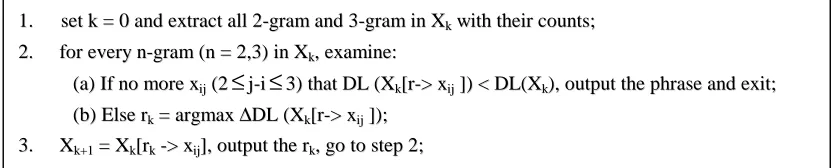
Accordingly, the best first learning algorithm using the goodness criterion is illustrated in figure 1. Given
an utterance U = t0t1…tn as input string of some linguistic token, e.g. part-of-speech tags, the unsupervised
grammar induction looks for the substring with maximum description length decrease, i.e. maximum DLG, at
each iteration and then replaces the n-gram (bi-gram or the tri-gram in our work) with a random symbol in
the whole corpus, at the same time, output the learned rules in this iteration. It loops until description length
[image:4.595.92.508.194.278.2]value does not decrease, or DLG have a zero or negative value.
Figure 1 Basic MDL Induction Algorithm
3.2. Pseudo-Grammar Learning by MDL Principle
One may see that the learning algorithm may not reach the real shortest description length, since it is a
best first strategy that stops at local minima. To evaluate if the MDL principle is applicable for those
hand-annotated rules in Treebank corpus, we implement a pseudo-grammar induction algorithm to gain insights.
Figure 2 outlines this pseudo-grammar induction algorithm.
Figure 2 pseudo-grammar induction algorithm
In the algorithm, by simple extracting all hand-annotated rules from the corpus, the rule form (RHS and
LHS) and the rule application order are predetermined based on the parse trees. We only use MDL principle
to pick a rule in the current step so to get maximum description length gain. When all the child rules are
selected and applied, their parent rule will be considered subsequently. Thus, we apply these hand-annotated
rules roughly in the bottom-up parsing order, guided by the MDL criterion. From this experiment, we want to
figure out how the basic induction algorithm differs from the pseudo-induction, where the rule and the order
of the application are already known, under the same criterion. In addition, through this experiment, we try to
find an upper bound for MDL-based grammar induction.
1
1.. EExxttrraaccttaallllhhaanndd--aannnnoottaatteeddggrraammmmaarrrruulleessffrroommTTrreeeebbaannkkccoorrppuuss,,ssoorrtttthhoosseerruulleessaaccccoorrddiinnggttoo
b
boottttoomm--uuppppaarrssiinnggoorrddeerr,,mmaarrkkggrraammmmaarrrruulleessaass““hhiiddddeenn””,,eexxcceeppttffoorrlleeaaffggrraammmmaarrssiinntthheeeevveerryy
s
seenntteenncceettrreeeeaannddaaddddtthheemmttootthheerruulleeppooooll;;
2
2.. FFoorraallllrruulleessiinntthheerruulleeppooooll,,aappppllyysstteepp22aanndd33ooffbbaassiicciinndduuccttiioonnaallggoorriitthhmmiinnffiigguurree11iinn
e
eaacchhrruunnttoocchhoooosseetthheerruulleewwiitthhmmaaxxiimmuummDDLLGG;;
3
3.. OOuuttppuutttthheelleeaarrnneeddggrraammmmaarraannddaappppllyyiittiinnoorrddeerrttooiinnvvoollvveemmoorreehhiigghheerrlleevveellggrraammmmaarrss,,tthhaatt
i
iss,,iiffaalllltthheecchhiillddrreennooffoonneeggrraammmmaarraarreeaapppplliiccaabbllee,,tthheeggrraammmmaarrccaannbbeemmaarrkkeeddaass““vviissiibbllee””
a
annddhheenncceeaaddddttootthheerruulleeppooooll;;
4
4.. GGoottoosstteepp22iifftthheerreeaarreerruulleessiinntthheerruulleeppoooorr.. 1
1.. sseettkk==00aannddeexxttrraaccttaallll22--ggrraammaanndd33--ggrraammiinnXXkkwwiitthhtthheeiirrccoouunnttss;;
2
2.. ffoorreevveerryynn--ggrraamm((nn==22,,33))iinnXXkk,,eexxaammiinnee::
(
(aa))IIffnnoommoorreexxiijj((22
≤
jj--ii≤
33))tthhaattDDLL((XXkk[[rr-->>xxiijj]]))<<DDLL((XXkk)),,oouuttppuutttthheepphhrraasseeaannddeexxiitt;;(
(bb))EEllsseerrkk==aarrggmmaaxx∆∆DDLL((XXkk[[rr-->>xxiijj]]));;
3
3.3. MDL Induction by Dynamic Distributional Classification
Comparing the results of the two experiments, we discover that the basic MDL induction algorithm alone
does infer reasonable phrasal grammar rules at the beginning, but after getting about a hundred of rules, it
quickly reaches a local-minimum and most of the induced rules are not adequate.
We suspect that it may be due to the random labeling of LHS for those induced rules, because if all the
LHS symbols of the induced rules are different, the repetition of certain patterns becomes less and therefore
its MDL value decreases less dramatically.
Based on this observation, we come up with a new algorithm. We decide to integrate some linguistic
information into the search strategy, which tries to classify the LHS symbols of the induced rules, using
distributional analysis, and to help the search process to infer more syntactic plausible rules.
The algorithm is divided into two stages, one is the context vector training stage and the other is an
improved MDL induction process.
The context vector training algorithm is based on the assumption that similar grammar rules tend to occur
in similar contexts. The contexts of the rules from “VP” category, for instance, differ greatly from those of
the “NP” rules. If the context is restricted to a fixed sliding window (e.g., three part-of-speech tags in our
work, on either side of rules), then we can define the context distribution over all rules in that syntactic
category. The context distribution of one category can be estimated from the observed contexts of sample
sentences in category.
In the next MDL induction stage, we measure the similarity of each MDL induced rule to the center of
context vectors of each syntactic category using Kullback-Leibler (KL) divergence as the distance function
and assign to the LHS of the rule the category with the shortest distance. At each iteration, we also
dynamically update the contexts and their centers of the induced rules for every syntactic category.
For simplicity, the syntactic categories are limited to five non-terminals, i.e., “NP”, “VP”, “S”, “ADJP”,
and “PP”, which are main syntactic components in the syntactic parsing. We take, as “a seed grammar”, a
set of most frequently used grammar rules for each of 5 syntactic categories and analyze the contexts (3 left
and 3 right part-of-speech tags) for each of those rules in the sample corpus. The thirty seed rules we used in
the algorithm are illustrated in Table 1. Note that we not only use the base grammar rules, i.e. the rules at the
leaves of the parsing tree, but also the ones at the upper levels, since exploiting the context of these rules on
the fly will make the search process more robust. Another critical issue concerning the selection of the seed
grammar rules is to decide the number of rules for each category. The ratio we choose is roughly the same
ratio for these five categories in the training corpus. In addition, we discover that “NP” rules alone account
for two thirds of all rules in the hand-annotated Treebank corpus and they dominate other kind of rules
especially in the bottom level of parsing trees. Therefore, we choose many “NP” rules as seed grammar
rules. N
NPP-->>DDTTJJJJNNNN NNPP-->>DDTTJJJJNNNNSS NNPP-->>DDTTNNNN NNPP-->>DDTTNNNNSS NNPP-->>PPRRPP NNPP-->>JJJJNNNNSS N
NPP-->>JJJJNNNN NNPP-->>NNNNPPPPOOSS NNPP-->>DDTTNNNNPPOOSS NNPP-->>JJJJJJJJNNNN NNPP-->>JJJJJJJJNNNNSS NNPP-->>DDTTNNNNNNNN N
NPP-->>DDTTCCDDNNNNSS NNPP-->>NNPPNNPP NNPP-->>NNPPCCCCNNPP AADDJJPP-->>RRBBJJJJ AADDJJPP-->>RRBBJJJJRR AADDJJPP-->>RRBBJJJJSS
A
ADDJJPP-->>RRBBSSJJJJ AADDJJPP-->>RRBBRRJJJJ PPPP-->>IINNNNPP PPPP-->>TTOONNPP PPPP-->>IINNSS VVPP-->>VVBBNNPP V
[image:5.595.96.511.98.156.2]VPP-->>TTOOVVPP VVPP-->>MMDDVVPP VVPP-->>VVBBDDNNPP VVPP-->>VVBBZZNNPP SS-->>NNPPVVPP SS-->>PPPPNNPPVVPP
4. Experiments and Results
A number of preliminary experiments on unsupervised phrase and lexical learning have been conducted on
parts of Treebank corpus. These experiments show promising results by DLG measure [Kit 98]. It shows
certain ability to capture the regularities in the data. Since it takes a learning-via-compression approach, i.e.
MDL principle approach, the result is a set of deterministic CFG rules.
We perform four experiments and all of them use 2,500 sentences extracted from Treebank corpus with
hand-annotated part-of-speech tag for each word as input. Backing off to POS tags is necessary because it
alleviates the sparse data problem.
4.1.
Experiment 1: Basic MDL Grammar Induction
The first experiment is the basic MDL principle induction. The testing corpus contains 2,500 short
sentences and the vocabulary set is made up of 32 POS tags, a subset of 47 tags used in Treebank corpus. We
apply MDL principle on the grammar space, where the RHS of a CFG is bi-gram or tri-gram. The first thirty
of induced rules are given in appendix A.
From the appendix, we can see that most learned grammar rules are reasonable, such as [NNP NNP], [TO
VB] and [MD VB]. However, some other rules seem to be quite “flat”, i.e. lack of internal structures of the
rule. The rule [PRP RB VBD], for instance, should be broken down into [PRP [RB VBD]]. In addition, we
plot MDL value curve to show the MDL decrease trend along the search procedure. The curve is given in
figure 3.
It is clear that having induced about a hundred rules, the basic MDL induction algorithm reaches the local
minimal quickly. For comparison and verification of whether the MDL principle is useful for real world data,
we perform another experiment using the pseudo-induction algorithm in subsection 3.2.
4.2.
Experiment 2: Learning by Pseudo-Grammar Induction
3VHXGR*U DPPDU , QGXFW L RQ
%DVL F 0'/ , QGXFW L RQ
In this experiment, we use the same search strategy but to the manually annotated rules found in Treebank
corpus. The search process only chooses the rule with the maximum description length decrease, while the
rule forms are all predetermined in advance. The MDL curve is illustrated in the figure 3. The detail of the
algorithm is described in section 3.2.
From the figure, we observe that although the two curves are very closely to each other in the beginning,
they differ greatly in the whole process in that: firstly, no local minimal is found in this case, while the basic
induction process quickly becomes flat and has to be terminated because it is too computational expensive to
infer new rules – large amount of randomly selected LHS of the induced rules lead to a very sparse
distribution. Secondly, for the pseudo-grammar induction case, the curve decreases irregularly, that is, a few
“critical” rules make the description length drop dramatically than the rest of them. We still work on
understanding the effects.
To verify if it is just a special case for pseudo-grammar induction, we perform similar experiment on
different sentence sets, illustrated in figure 4. The three curves are obtained by applying pseudo-grammar
induction algorithm on different number of sentences extracted from Treebank corpus, namely 2,500, 5,000
and 10,000 sentences respectively. The chart shows the consistency among varied numbers of sentences.
Figure 4 Different Data Set used in Pseudo-Grammar Induction Experiment
4.3. Experiment 3: MDL Induction by Dynamic Distributional Classification
In this section, we give experiment results of the two-stage induction algorithm described in section 3.3.The goal of the experiment is to incorporate some linguistic knowledge into the search process to get more
syntactic plausible grammar and overcome the local-minimal problem.
After training the classifier on 1,000 POS tagged sentences using the seed grammar rules, we obtain the
context vector centers for all the 5 syntactic categories. Then, we construct the induction sets using a
different set of 2,500 sentences (which is the same as the previous experiements).
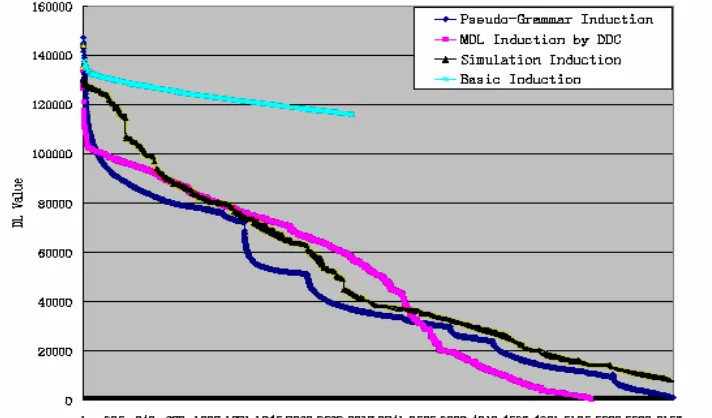
The curve labeled with “MDL Induction by DDC” in Figure 5 summarizes the outcome of the experiment.
From the chart, we see that it decreases monotonically, however, with no local minimal found at this time in
the curve; the search process repeats until no rules can be induced by MDL framework. In addition, the curve
is very close to the pseudo-grammar induction case, i.e. the upper bound of the algorithm.
This algorithm learns not only the right-hand sequences of terminals/non-terminals, but also their LHS
We also conduct another experiment to see the effect when both the classification of syntactic category
and the MDL induction are accurate, that is, assume the syntactic category of every induced rule is correctly
identifiable using extra knowledge, and also assume all induced rules are subset of the grammar rules found
in the hand-annotated Treebank corpus.
We vary the experiment settings in this algorithm to explore the upper bound for experiment 3. Because
many induced grammar rules, which reduce the description length dramatically, are not syntactic plausible
rules and are not found in manual rule set, however, the algorithm assigns a syntactic category for them and
updates the center of the context vector for that category in the search process. This, in turn, impacts on the
classification in the later part of the process. Although we try to use several high-level grammar rules as seed
grammar and explore their context in the induction process to compensate this effect, how to improve the
robustness needs further investigation.
Another major factor to certain poor performance is the limited number of syntactic category, (five in our
work, but more than fifteen in the Treebank), and the restricted number of n-gram (many ‘flat’ grammar rules
are found in Treebank [Gai95]) that we applied in the experiment all impact the induction procedure. To
investigate their impact, we loose the restriction on the limited number of LHS categories. In the each
induction process, as described in section 2.3, we sort the candidate rules by their DLGs in a descending
order, choose only the first rule found in hand-annotated Treebank grammar and apply it by replacing its
RHS sequence with the correct LHS.
In such procedure, no classification is performed, therefore the classifier is always assumed to be accurate,
which removes the effect that grammar rules induced early influence the rules induced later. On the other
hand, all rules learned are syntactic plausible ones, since they are subset of the manual-annotated grammar
rules. The only difference between them is the number of the right-hand symbol and the syntactic category of
the left-hand symbol.
The experiment result is illustrated in the figure 5 with the label, “Simulated induction”. From the figure,
[image:8.595.119.475.324.533.2]we find that the different number of n-grams and the syntactic categories does affect the results, especially in
the later search process, when compared with the “Pseudo-Grammar Induction” curve. On the other hand,
compared with “Grammar Induction by DDC” curve, the classifier is really distracted by the previously
induced “bad” grammar rules. This is the place where future research work can be directed.
In addition, we also calculate the precision and recall for those induced rules, in contrast with the
hand-annotated grammar rules extracted from the same set of 2,500 sentences. The result is illustrated in table2.
Rules after 100 200 500 1000
Precision 0.92 0.89 0.82 0.74
Recall 0.13 0.16 0.18 0.22
Table2the precision and recall for induced rules
5. Related Work and Conclusions
The difficulty of grammar induction depends greatly on the amount of supervision provided.
[Charniak96], for example, has shown that a grammar rule can be easily constructed when the examples are
fully labeled parse tree. However, if the examples consist of only raw sentences with no extra structural
information, grammar induction is very difficult, even theoretically impossible [Gold67]. Part of our work
explores the in-between case, where the category of learned rules could be decided by the result of a
supervised learning algorithm.
Second, the search criterion also impacts the induction process. Besides the MDL principle, there are other
search criteria, similar to us, to guide the “guessing game”. Cook et al. [Cra76] explores a hill-climbing
search for a grammar of a smaller weighted sum of grammar complexity and the discrepancy between the
grammar and corpus; Brill et al. [BMMS90] derive phrase structures from a bracket corpus by generalized
mutual information approach; and Brill and Marcus [BM92] attempt to induce binary branching phrases with
distribution analysis using the information-theoretical measure divergence, derived from relative entropy. de
Marcken gives an in-depth discussion on the kind of issues involved in the pure distribution analysis and on
the disadvantages of the inside-outside algorithm for grammar induction in his PhD thesis [deMa95].
Recently, following Cook’s work, Stolcke [Sto94] worked under the Bayesian modeling framework, whereas
Chen [Chen95, Chen 96] uses the universal prior probability p(G) = 2–l(G) for grammar induction. Their learning strategy reports to work well on small to medium size artificial corpora, using measures such as
entropy, perplexity or likelihood. But, to our knowledge, no one has tried to induce all levels of syntactic
grammar rules on large scale real corpora before.
In the paper, we have shown two MDL-based grammar induction algorithms. Both of them try to infer
syntactic plausible grammar rules for parsing with one focusing on a best-first search strategy with minimal
supervision and the other focusing on integration of language constrains into the learning model. Comparing
these two approaches through experiments, we show that MDL principle alone could induce phrase-level
grammar well, but fails to learn high-level grammar rules. In addition, with integrated language constraints,
the MDL principle could infer not only the grammar rules, but also the categories of the LHS of the learned
rules. The experiments show that the result of the second algorithm is very close to that of the
pseudo-grammar induction algorithm.
To further improve the grammar learning algorithms for high performance parsing, we still need to
investigate the failed instances and come up with more sophisticated learning algorithms. Evaluating learned
Reference
[Baker79] Baker, James K. "Trainable grammars for speech recognition". In Speech Communication
Papers for the 97th Meeting of the Acoustical Society of America, edited by Jared J. Wolf and Dennis H.
Klatt, 547--550, MIT, Cambridge, Mass, 1979
[BM92] Brill, E. and Marcus, M. Automatically Acquiring Phrase Structure Using Distributional
Analysis, In proceedings of 1992 DARPA Speech and Language Workshop, Harriman, N.Y., 1992
[BMMS90] E. Brill, D. Magerman, M. Marcus, and B. Santorini. Deducing Linguistic Structure from the
Statistics of Large Corpora. In Proceedings of DARPA Speech and Natural Language Workshop, Hidden
Valley, Pennsylvania, June 1990
[Charniak96] Charniak, E. Tree-bank grammars. In Proceedings of the National Conference on Artificial
Intelligence (AAAI), 1996
[Chen95] S.F. Chen. Bayesian grammar induction for language modeling. Technical Report TR-01-95,
Harvard University, Center for Research in Computing Technology, January 1995.
[Chen96] S. F. Chen. Building probabilistic models for Natural Language. PhD thesis, Harvard
University, Cambridge, Massachusetts, Cambridge, Mass., 1996
[Cover&Thomas91] Cover, T. and Thomas, J. Elements of Information Theory. John Wiley & Sons, New
York, NY, 1991
[Cra76] Craig M. Cook, Azriel Rosenfeld, and Alan R. Aronson. Grammatical inference by hill climbing.
Information Sciences, 10:59—80, 1976
[deMa95] C. de Marken. The Unsupervised Acquisition of a Lexicon from Continuous Speech. Technical
Report A.I. Memo No. 1558, AI Lab., MIT, Cambridge, MA, November, 1995
[Gai95] Robert Gaizauskas. Investigations into the grammar underlying the Penn Treebank II. Research
Memorandum CS-95-25, University of Sheffield, 1995
[Gold67] E. M. Gold. Language identification in the limit. Information and Control, 10:447--474, 1967
[Hol75] J. Holland. Adaptation in Natural and Artificial Systems. MIT Press, 1975
[KVG83] Kirkpatrick, S., Gelatt, C. and Vecchi, M., "Optimisation by Simulated Annealing," Science, No.
220, pp.671-680, 1983
[Kit98] Kit, C. A goodness measure for phrase learning via compression with the MDL principle. In The
ESSLLI-98 Student Session, Chapter 13, pp.175-187. Aug. 17-28, Saarbruken, 1998
[Kol65] Kolmogorov, A. N. Three approaches to the definition of the concept "quantity of information."
Problemy Peredachi Informatsii 1, 3—11, 1965
[Lari&Young90] K. Lari and S. J. Young. The Estimation of Stochastic Context-Free Grammars Using
the Inside-Outside Algorithm. Computer Speech and Language, 4:35--56, 1990
[Ris78] Rissanen, J. Modeling by shortest data description. Automatica, 14:465--471, 1978.
[Ris89] J. Rissanen. Stochastic Complexity in Statistical Inquiry. World Scientific Publishing Company,
1989.
[Shannon49] C. Shannon and W. Weaver. The mathematical theory of communication. University of
Illinois Press, 1949.
[Solo64] R. J. Solomonoff, "A formal theory of inductive inference," Inform. and Control, vol. 7, pp.
1--22, March 1964; pp. 224--254, June 1964.
[Sto94] A. Stolcke. Bayesian Learning of Probabilistic Language Models. Dissertation, U. California,
Appendix A
The first 30 grammar rules learned by basic MDL grammar induction algorithm from 2,500 sentences in
the Treebank corpus are given below. The rules are marked as true (t), false (f) and unsure (u) respectively
according to human evaluators. There are four columns in the table, namely, rule number, the current
description length with model and data combined when the grammar rule is acquired, the rule and the
evaluation flag. The POS tags in these rules are listed below.
1 146186 NNP NNP t 16 136398 NNP NNPS t
2 144823 TO VB t 17 136274 TO CD CD t
3 142641 MD VB t 18 136128 NNP POS t
4 141748 MD RB VB t 19 135916 EX VBZ u
5 141411 DT JJ NN t 20 135839 WDT [MD VB] t
6 140245 IN DT NN t 21 135762 WDT VBD t
7 138981 PRP VBP u 22 135666 PRP RB VBD u
8 138625 PRP VBD u 23 135569 PRP [MD RB VB] t
9 138119 PRP VBZ u 24 135508 EX VBZ u
10 137703 PRP [MD VB] t 25 135456 WP VBZ t
11 137471 NNS VBP t 26 135369 JJR IN CD f
12 136989 NNS WDT VBP f 27 135271 TO DT NN t
13 136834 WDT VBZ t 28 135082 PRP RB VBP u
14 136681 NNS WP VBP f 29 135023 NNS RB VBP f
15 136567 RB VB t 30 134936 [NNP NNP] POS t
CD: Cardinal number PRP: Personal pronoun
DT: Determiner MD: Modal
JJ: Adjective RB: Adverb
JJS: Adjective, superlative To: ‘to’
IN: Preposition or subordinating conjunction VBD: Verb, past tense
POS: Possessive ending VBN: Verb, past participle
VB: Verb, base form VBZ: Verb, 3rd person singular present