Application of House Holder and Inverse Power
Methods of Numerical Methods in MAGDM
Problems
John Robinson P
1, Susai Alexander P
2 Assistant Professor1,2Department of Mathematics, Bishop Heber College, Tiruchirappalli, India.
Department of Mathematics, Loyola College, Vettavalam, India. [email protected]1, [email protected]2
Abstract- The aim of this paper is to investigate the Multiple Attribute Group Decision Making (MAGDM) problems with intuitionistic fuzzy sets. Some numerical methods like House-Holder and Inverse power methods are coupled with linear programming methods for determining the unknown decision maker weights and it is applied in decision making problem. Feasibility and effectiveness of the proposed methods are illustrated using numerical examples.
Key words: Intuitionistic Fuzzy Set, IFWA and IFHA operator, House Holder and Inverse Power method, Linear Programming Method.
1. INTRODUCTION
Multi Attribute Group Decision Making (MAGDM) problems are wide spread in real life situations. It is obvious that much knowledge in the real world is fuzzy rather than precise.Intuitionistic fuzzy set (IFS) Atanassov, (1999) characterized by a membership function and a non-membership function, is an extension of Zadeh’s fuzzy set Zadeh, (1965; 1978; 1983) whose basic components is only a membership function. An IF has been proven to be highly useful to deal with uncertainty and vagueness. Xu, (2007) defined some new intuitionistic preference relations, such as the consistent intuitionistic preference relation, incomplete intuitionistic preference relation and acceptable intuitionistic preference relation, and studied their properties. Gerstenkorn, &Manko, (1991), Robinson &Amirtharaj, (2014; 2015) propose correlation coefficients for different higher order intuitionistic fuzzy sets and utilized them in ranking the alternatives in MAGDM problems. Yager, (2004), Wei et al., (2011) contributed novel approaches to the field of fuzzy decision making. Jain et al. (2006) discussed several numerical methods for scientific and engineering computation. Here, Householder’s and Power method are used to obtain the solution of linear algebraic equation, which are further utilized to derive the decision maker weights in intuitionistic fuzzy decision making problems. The feasibility and effectiveness of
the proposed method are illustrated using numerical examples.
2. PRELIMINARIES
In this section, some basic definitions and intuitionistic fuzzy weighted averaging operator are presented.
Definition 1:Intuitionistic Fuzzy Set
An IFS A in X is given by
,
A( ),
A( )
,
A
x
x
x
x
X
where
:
0,1
A
X
,
A:
X
0,1
, with the condition0
A( )
x
A( ) 1,
x
x
X
.The numbers
A
x
and
A
x
represent, the membership degree and non-membership degree of the element x to the set A, respectively.Definition 2:For each IFS A in X, if
1
,
,
A
x
Ax
Ax
x
X
then
Ax
is called the degree of indeterminacy of x to A, where 0 ≤
A
x
1
, for all xX.Definition 3: Let
a
j
j,
j
,
for all j = 1, 2, …,n be a collection of intuitionistic fuzzy values. The Intuitionistic Fuzzy Weighted Averaging (IFWA) operator,:
n
1 2
1
1 1
,
,...,
1
(1
) ,
j jn
n j j
j
n n
j j
j j
IFWA
a a
a
a
Where
1,
2,...,
n
T be the weight vector ofa
j,
for all j = 1, 2, …,nsuch that0
j
and1
1.
nj j
Definition 4: Let
a
j
j,
j
,
for all j = 1, 2, …,n be a collection of intuitionistic fuzzy values. The Intuitionistic Fuzzy Ordered Weighted Averaging (IFOWA) operator:
nIFOWA Q
Q
is defined as:
1 2
1
1 1
, ,...,
1
1
j,
j.
n
w n j j
j
n w n
w
j j
j j
IFOWA a a
a
w a
Where
w
w w
1,
2,...,
w
n
T is the associated weighting vector such thatw
j
0
and1
1
n
j j
w
. Furthermore,
1 ,
2 ,...,
n
is a permutation of (1, 2, …,n), such thata
j1
a
j for all j = 2, …, n.3. AN APPROACH TO GROUP
DECISION MAKING WITH
INTUITIONISTIC FUZZY
INFORMATION
Step: 1Utilize the decision information given in the intuitionistic fuzzy decision matrix
R
k andthe IFWAA operator,
1 2
,
,
,...,
,
1
.
, 2,...
1, 2, ..
;
n
k k k
i i i
k k k
i i i
k
t
r
u
v
IFWAA
r
r
r
i
m
To derive the individual overall preference intuitionistic fuzzy values
r
i kof the alternative Ai.Step: 2Utilize the IFHA operator,
1 ,2
,
,
,...,
,
1, 2,...
i i i v w
t
i i i
r
IFHA
r
r
r
i
m
To derive the collective overall preference intuitionistic fuzzy values
r
i
i
1, 2,
..
m
of the alternative Aiwherev
v v
1,
2
v
n
bethe weighting vector of decision makers, with:
1
1 2
0,1 ,
1;
,
t
k n
k
k
w
w w
w
V
V
is the associated weighting vector of the IFHA operator with
1
0,1 ,
1
n
j j
j
w
w
Step: 3Calculate the correlation coefficient between the collective overall preference values
i
r
and the positive ideal valuer
i, where(0,1)
i
r
.The correlation of
A B
,
IFSs x
( )
is given by a formula
1
1
,
[
( )
( )
]
n
ZL A i B i A i B i
i
A i B i
C
A B
x
x
x
x
n
x
x
Step: 4Calculate the correlation coefficient between the collective overall preference values
i
r
and the positive ideal valuer
i, where(0,1)
i
r
.The correlation coefficient of the IFSs,
,
( )
A B
IFSs x
is given by the formula:
,
,
.
( , )
( , )
ZL ZL
ZL ZL
C
A B
A B
C
A A C
B B
Step: 5Rank all the alternatives
1, 2,
,
i
A i
m
and select the best one in accordance with the correlation coefficient obtained in step 4.4. HOUSEHOLDER’S METHOD FOR SYMMETRIC MATRICES
reflections. The orthogonal transformations are of the from
P
I
2
ww
T(1)Where w is a column vector,
w
R
n, such that2 2 2
1 2
...
1
T
n
w w
x
x
x
(2)
It can be easily shown that P is symmetric and orthogonal.
P
T
(
I
2
ww
T T)
2
TI
ww
TP
P
Also
1
(
2
)(
2
)
T T T
T T
P P
I
ww
I
ww
P P
I
P
P
The vectors
w
are constructed with the first(
r
1)
components as zeros, that is1,
(0, 0,..., 0,
,
....,
T
r r r n
w
x x
x
) (3)Since
w w
rT r
1
wehave
x
r2
x
2r1
...
x
n2
1
. With this choice ofw
r, from the matrices2
Tr r
P
I
ww
The similarity transformation is given by
1 T
r r r r r r
P AP
P AP
P AP
(4)
Since
P
r is symmetric and orthogonal. We put1
A
A
and from successivelyA
r
P A P
r r1 r,2,3,...,
1
r
n
. (5)The tridiagonalization is completed with exactly n-2 Householder transformations.
Let us illustrate this procedure using a 4×4 matrix
11 12 13 14
21 22 23 24
31 32 33 34
41 42 43 44
a
a
a
a
a
a
a
a
A
a
a
a
a
a
a
a
a
(6)Since the transformations being used are orthogonal, the sum of the squares of the elements in any row is invariant.
Choose
2
0
2 3 4T
w
x
x
x
x
22
x
32x
42
1
(7) NowP
2
I
2
w w
2 2TTo find
22 2 3 2 42
2 2 2 3 4 2 2 3 3 3 4 3
2 2 4 3 4 4 4
0 0 0 0
0
0 0
0
0
T x x x x x x
w w x x x
x x x x x
x
x x x x x
x
2
2 2 3 2 4
2 2 2
2 3 3 3 4 2 2 4 3 4 4
0
0
0
0
0
2
2
2
2
0
2
2
2
0
2
2
2
T
x
x x
x x
w w
x x
x
x x
x x
x x
x
2
2 2 3 2 4
2 2
2 3 3 3 4
2
2 4 3 4 4
1
0
0
0
0 1 2
2
2
0
2
1 2
2
0
2
2
1 2
x
x x
x x
P
x x
x
x x
x x
x x
x
(8)Where
1 12 2 13 3 14 4
2 22 2 23 3 24 4
3 32 2 33 3 34 4
;
;
;
p
a x
a x
a x
p
a x
a x
a x
p
a x
a x
a x
4 42 2 43 3 44 4
.
p
a x
a x
a x
Example: 1Using the householder’s
transformation reduce the matrix
2
1
1
1
1
0
1
0
1
A
into a tridiagonal matrix. By
using householder’s method we obtain:
2
2
0
2
1
0
0
0
1
B
Example: 2Use the householder’s method to
reduce the given matrix A into the tridiagonal from
4
1
2
2
1
4
1
2
2
1
4
1
2
2
1
4
A
By using the
householder’s procedure then we obtain
3
4
3
0
0
3
16 3
5 3 5
0
0
5 3 5
16 3
9 5
0
0
9 5
12 5
A
The sequence
and the diagonal elements converge to the eigen values of A.
5. POWER METHOD
Power method is normally used to determine the largest eigenvalues and the corresponding eigenvector of the system
Ax
x
.
(9)Let
1,
2,...,
nbe the distinct eigen valuessuch that
1 2
...
n
(10)
And
v v
1, ,....,
2v
nbe the corresponding eigenvectors. The procedure is applicable if a complete system of n independent eigenvectors exists, even through some of theeigenvalues
2,...,
n may not be distinct. Then, any eigenvector v in the space of eigenvectorsv v
1, ,....,
2v
n can be written as1 1 2 2
....
n nv
c v
c v
c v
Premultiplying by A and substituting
1 1 1
,
2 2 2.,
Av
v Av
v etc
we obtain1 1 1 2 2 2 2 1 1 1 2 2
1 1
....
....
n n n n n n
Av c v c v c v
c v c v c v
(11) Pre multiplying by A again and simplifying we get
2 2
2 2 2
1 1 1 2 2
1 1
....
nn n
A v
c v
c
v
c
v
2
1 1 1 2 2
1 1
....
k k
k k n
n n
A v c v c v c v
(12)
1 1
1 1 2
1 1 1 2 2
1 1
....
k k
k k n
n n
A v c v c v c v
(13)
As
k
, the right hand sides of (12) and (13) tend to
kc v
1 1and
k1c v
1 1. Since1 1
1,
i
2, 3,... .
n
the vector1 1 2
(
2 1)
2...
(
)
k k
n n n
c v
c
v
c
v
tends to
c v
1 1 which is the eigenvector corresponding to
1. Eigenvalue
1is obtained as the ratio of the corresponding components of1
&
.
k k
A v
A v
Example:3
Find the largest eigenvalue in modulus and the corresponding eigenvector of the matrix
15
4
3
10
12
6
20
4
2
A
Using the power
method.
Solution:We start the iteration using the unit vector as the initial vector
v
0
1 1 1 .
T By using Power method then we obtain9
0.9999
0.4975
1
v
At this step, the approximation to the largest eigenvalue in modulus are
1
(
)
lim
( )
k r
k
k r
y
v
19.9801
20.0804
19.9826
If we round-off to 3 digits, we have
20
.The approximate largest eigenvalue is 20.0804.The approximate eigenvector is
1
0.4951 0.9999 .
T The exacteigenvalue is -20 and its eigenvector is
1
0.5
1
T.6. INVERSE POWER METHOD
Choose any nonzero eigenvector
y
0
R
nand express it as a linear combination of1
,
2,...,
nv v
v
. Applying the power method on1
A
We have
z
k1
A y
1 k(14)1 1 1
k k k
y
z
m
(15) We write equation (14) asA z
k1
y
k(16) We find
z
k1 by solving the linear sytstem of algebraic equation.Example:4Find the eigenvalue nearest to 3 for
the matrix
2
1
0
1
2
1
0
1
2
A
using the
By using power method then we obtain:
2.400
2.43 2.400
T
Therefore
2.4
and3 (1
)
3 0.42
0.58
1
0
2.58
1
0.58
1
0.9649
0
0
1
0.58
A
I
Since
2.58
does not satisfy2.58
0
A
I
, the correct eigenvalue nearest to 3 is 3.42 and the corresponding eigenvector is
0.7143
1 0.7143
T.The exacteigenvalue of A are
2
2
3.42
, 2 and2
2
0.59
.7. NORMALIZATION OF SOLUTIONS FROM HOUSE HOLDER’S METHOD
Formulation of the decision problem by first Decision Maker (DM):
D.M (1):
Max z
2
w
1
1
w
2
1
w
3Subject to constrains,
1 2
0.6;
1 30.8;
2 30.7; , ,
1 2 30.
w w
w w
w w
w w w
Solution:
1 2 3 1 2 3
2
1
1
0
0
0
Max z
w
w
w
s
s
s
Subject to constrains,
1 2 1 2 3 1 3 1 2 3
2 3 1 2 3 1 2 3 1 2 3
0
0
0.6;
0
0
0.8
0
0
0.7;
,
,
, , ,
0
w
w
s
s
s
w
w
s
s
s
w
w
s
s
s
w w w s s s
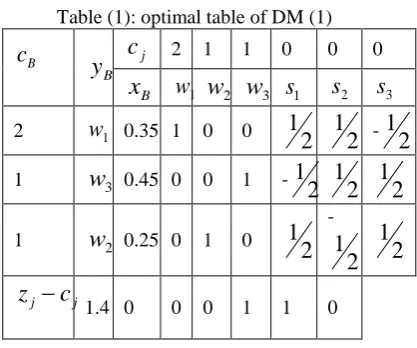
Table (1): optimal table of DM (1)
B
c
B
y
c
j 2 1 1 0 0 0 Bx
w
1w
2w
3s
1s
2s
32
w
1 0.35 1 0 01
2
1
2
-1
2
1
w
3 0.45 0 0 1 -1
2
1
2
1
2
1
w
2 0.25 0 1 01
2
-1
2
1
2
j j
z
c
1.4 0 0 0 1 1 0
Hence the weight vector from DM(1) is
1
0.35,
20.45,
30.25
w
w
w
D.M (2):
Max z
2
w
1
1
w
2
1
w
3Subject to constrains,
1 2
0.5;
1 30.7;
2 30.6;
1,
2,
30.
w
w
w
w
w
w
w w w
Solution:
1 2 3 1 2 3
2
1
1
0
0
0
Max z
w
w
w
s
s
s
Subject to constrains,
1 2 1 2 3 1 3 1 2 3 2 3 1 2 3 1 2 3 1 2 3
0 0 0.5; 0 0 0.7
0 0 0.6; , , , , , 0
w w s s s w w s s s
w w s s s w w w s s s
Table (2): optimal table of DM (2)
Hence the weight vector from DM (2) is
1
0.3;
20.2;
30.4.
w
w
w
D.M (3):
Max z
2
w
1
1
w
2
1
w
3Subject to constrains,
1 2
1 3
2 3 1 2 3
0.6;
0.9;
0.5;
,
,
0
w
w
w
w
w
w
w w w
Solution:
1 2 3 1 2 3
2
1
1
0
0
0
Max z
w
w
w
s
s
s
Subject to constrains,
1 2 1 2 3 1 3 1 2 3
2 3 1 2 3 1 2 3 1 2 3
0
0
0.6;
0
0
0.9;
0
0
0.5; , , , , ,
0
w w s
s
s
w w
s s
s
w w
s
s
s
w w w s s s
Table (3): optimal table of DM (3)
Hence the weight vector from DM (3) is
1
0.5;
20.1;
30.4.
w
w
w
Construct a matrix with the vector obtained from the three decision makers as follows:
B
c
B
y
jc
2 1 1 0 0 0B
x
w
1w
2w
3s
1s
2s
32
w
1 0.3 1 0 01
2
1
2
-1
2
1
w
3 0.4 0 0 1 -1
2
1
2
1
2
1
w
2 0.2 0 1 01
2
-1
2
1
2
j j
[image:5.595.81.480.97.757.2] [image:5.595.65.274.550.724.2]0.35 0.25 0.45
0.3
0.2
0.4
0.5
0.1
0.4
w
0.35
0.3
0.5
0.25 0.2
0.1
0.45 0.4
0.4
T
w
0.3594
0.2717
0.3686
V
Normalization of Solutions from Inverse Power Method
X
w
X
X
2.4 0.331950 2.4
3 0.336099 2.4 0.331950
8. NUMERICAL ILLUSTRATION
Let us suppose there is a risk investment company, which wants to invest a sum of money in the best option. There is a panel with five possible alternatives to invest the money. The risk investment company must take a decision according to the following four attributes: G1 is the risk analysis; G2 is the growth analysis; G3 is the social-political impact analysis; G4 is the environmental impact analysis.
The five possible alternatives
1, 2, 3, 4, 5
i
A i
are to be evaluated using intuitionistic fuzzy numbers by the three decision makers whose weighting vectorisobtainedby normalizing the solution of House Holder’s and inverse power methods are
0.36, 0.27, 0.37
T
0.33, 0.34, 0.33
Tw
under theabove four attributes whose weighting vector
0.2 0.1 0 ,
,
,
.3 0.4
T
and construct,respectively, the decision matrices as listed in
the following matrices
25* 4
1, 2, 3
k ij
R
r
k
as follows:
1
0.3, 0.6
0.2, 0.7
0.7, 0.2
0.4, 0.5
0.5, 0.3
0.2, 0.3
0.3, 0.4
0.2, 0.6
0.7, 0.1
0.1, 0.3
0.5, 0.4 0.6, 0.3
0.7, 0.3 0.7, 0.2
0.6, 0.4 0.5, 0.4
0.8, 0.1 0.6, 0.3
0.6, 0.2 0.4, 0.3
R
2
0.4, 0.3
0.5, 0.2
0.2, 0.5
0.1, 0.6
0.6, 0.2
0.6, 0.1
0.6, 0.1
0.3, 0.4
0.5, 0.3
0.4, 0.3
0.4, 0.2
0.5, 0.2
0.7, 0.1
0.5, 0.2
0.2, 0.3
0.1, 0.5
0.5, 0.1
0.3, 0.
2
0.6, 0.2
0.4, 0.2
R
3
0.4, 0.5
0.5, 0.4
0.2, 0.7
0.1, 0.8
0.6, 0.4
0.6, 0.3
0.6, 0.3
0.3, 0.6
0.5, 0.5
0.4, 0.5
0.4, 0.4
0.5, 0.4
0.7, 0.2
0.5, 0.4
0.2, 0.5
0.1, 0.7
0.5, 0.3
0.3, 0.4
0.6, 0.2
0.4, 0.4
R
Step-1:Utilize the IFWAA operator to derive the individual overall preference intuitionistic fuzzy values
r k
i
of the alternativeA
i is given by: 1
1
(0.347222154, 0.549045978)
r
(1)
2
(0.604147627, 0.312913464)
r
(1)
3
(0.422920038, 0.327041507)
r
(1)
4
(0.456527711, 0.346410162)
r
(1)
5
(0.471481123, 0.198960391)
r
(2)
1
(0.244644753, 0.443076536)
r
B
c
B
y
c
j 2 1 1 0 0 0 Bx
w
1w
2w
3s
1s
2s
32
w
1 0.5 1 0 01
2
1
2
-1
2
1
w
3 0.4 0 0 1 -1
2
1
2
1
2
1
w
2 0.2 0 1 01
2
-1
2
1
2
j j
(2)
2
(0.499648495, 0.2)
r
(2)
3
(0.462173122, 0.225869387)
r
(2)
4
(0.342425064, 0.283679124)
r
(2)
5
(0.479785681, 0.174110113)
r
(3)
1
(0.244644753, 0.652777846)
r
(3)
2
(0.499648495, 0.419296271)
r
(3)
3
(0.462173122, 0.427693840)
r
(3)
4
(0.342425064, 0.465738581)
r
(3)
5
(0.479785681, 0.306734937)
r
Step 2. Utilize the IFHA operator to derive the collective overall preference intuitionistic fuzzy values
r
1of the alternativeA
iThen we have, 1 1
(2) 1
(0.347222154, 0.549045978);
(0.244644753, 0.443076536)
r
r
(3)
1
(0.244644753, 0.652777846)
r
where
0.36, 0.27, 0.37
T
0.33, 0.34, 0.33
Tw
1
2
3
1
2
3
0.319047996;
0.319678982;
0.209543819
n
n n
b
b
b
1
2
3
1
2
3
0.523332094;
0.517187225;
0.622858796
n
n n
b
b
b
Utilizing IFHA operator we get,
,w 1
,
2,
,
nITFHA
a a
a
1 1
1
(1
)
j,
(
)
jj j
n n
w w
a a
j j
Similarly we obtain:
1
(0.284926240, 0.552058815);
r
2
(0.540963409, 0.308604537);
r
3
(0.455857728, 0.326543318);
r
4
(0.387135173, 0.366150179);
r
5
(0.482762757, 0.225426377).
r
Step 3. Calculate the correlation coefficient between the collective overall preference values
i
r
and the positive ideal valuer
i, given as below:
1 1
2 2
3 3
4 4
5 5
,
0.552058815;
,
0.308604537;
,
0.326543318;
,
0.366150179;
,
0.225426377.
ZL ZL ZL ZL ZL
C
r r
C
r r
C
r r
C
r r
C
r r
Step 4. The correlation coefficient of the IFSs, A and B is given by:
1 1
2 2
3 3
4 4
5 5
0.859527561;
0.481661028;
0.542897490
0.624207596;
.
,
,
,
,
0.3710851 4
,
7
ZL ZL ZL ZL
ZL
r r
r r
r r
r r
r r
Step 5. Rank all the alternatives
1, 2, 3, 4, 5
iA i
from the highest closeness (correlation coefficient) obtained from step 4, the result is as follows:1 4 3 2 5
A
A
A
A
A
Hence, the best alternative isA
1.9. CONCLUSION
In this work, we have discussed about the weight determining methods together with weighted averaging operator and the ordered weighted averaging operator. House-Holder and Inverse power methods were coupled with linear programming methods for determining the unknown decision maker weights. The proposed approach in this work not only can comfort the influence of unjust arguments on the decision results, but also avoid losing or distorting the original decision information in the process of aggregation.
REFERENCES
[1] Atanassov, K., (1999): Intuitionistic Fuzzy Sets. Theory and Applications, Physica-Verlag, Heidelberg, New York.
[3] Jain, M.K., Iyengar, S.R.K., & Jain, R.K., (2006): Numerical Methods for Scientific and Engineering Computation. Sixth Edition, New Age Publications.
[4] Robinson, J.P., & Amirtharaj, E.C.H., (2014): Efficient Multiple Attribute Group Decision Making Models with Correlation Coefficient of Vague sets. International Journal of Operations Research and Information Systems, 5 (3), pp. 27-51.
[5] Robinson, J.P., & Amirtharaj, E.C.H., (2015): MAGDM Problems with Correlation coefficient of Triangular Fuzzy IFS. International Journal of Fuzzy System Applications, 4 (1), pp. 1-32. [6] Wei, G., Wang H.J., & Lin,R. (2011):
Application of correlation coefficient to interval-valued intuitionistic fuzzy multiple attribute decision-making with incomplete weight information. Knowledge and Information Systems.26, pp. 337-349.
[7] Xu Z.S., (2007): Intuitionistic fuzzy aggregation operators. IEEE Transactions on Fuzzy Systems, 15 (6), pp. 1179–1187.
[8] Yager, R.R., (2004): Generalized OWA aggregation operators. Fuzzy Optimization and Decision Making, 3: pp. 93-107.
[9] Zadeh, L. A., (1965): Fuzzy sets. Information Control, 8, pp. 338-353.
[10]Zadeh, L.A., (1978): Fuzzy sets as a basis for a theory of possibility. Fuzzy Sets and Systems, 1, pp. 3-28.