A Large Parallel Corpus of Full-Text Scientific Articles
Felipe Soares, Viviane Pereira Moreira, Karin Becker
Institute of Informatics, Universidade Federal do Rio Grande do SulPorto Alegre - RS, Brazil
{felipe.soares, viviane, karin.becker}@inf.ufrgs.br
Abstract
The Scielo database is an important source of scientific information in Latin America, containing articles from several research domains. A striking characteristic of Scielo is that many of its full-text contents are presented in more than one language, thus being a potential source of parallel corpora. In this article, we present the development of a parallel corpus from Scielo in three languages: English, Portuguese, and Spanish. Sentences were automatically aligned using the Hunalign algorithm for all language pairs, and for a subset of trilingual articles also. We demonstrate the capabilities of our corpus by training a Statistical Machine Translation system (Moses) for each language pair, which outperformed related works on scientific articles. Sentence alignment was also manually evaluated, presenting an average of 98.8% correctly aligned sentences across all languages. Our parallel corpus is freely available in the TMX format, with complementary information regarding article metadata.
Keywords:parallel corpus, scientific articles, Scielo
1.
Introduction
Cross-language corpora is one of the basis of Statistical Machine Translation (SMT) systems. The acquisition of quality corpora is not a trivial task, as it may demand con-siderable use of expert human curating, especially for paral-lel corpora. In that sense, the automated building of paralparal-lel corpora from open resources is of great interest in Natu-ral Language Processing (NLP). Europarl (Koehn, 2005), is one of the largest parallel corpora availabe, including up to 21 European languages. Similarly, the United Na-tions (UN) parallel corpus (Ziemski et al., 2016) makes use of UN’s official documents and records, providing aligned sentenced in six languages. Other parallel corpora initia-tives have been reported in distinct domains, such as patents (Utiyama and Isahara, 2007), movie subtitles (Zhang et al., 2014), and books (Skadins et al., 2014).
Parallel corpora based on scientific articles can be a valu-able language resource. Several text mining tasks may ben-efit from the availability of parallel corpora of scientific ar-ticles. The most straightforward example is cross language plagiarism detection, when an original text is translated in another language and presented as novel. Other possible applications are related to article indexing or classification, as well as the development and extension of Named Entity Recognition (NER) tools for multiple languages. The latter is of particular interest to the increasingly active biomedical sciences field, which has already standardized vocabularies and ontologies, thus favoring NER initiatives.
The construction of parallel corpora of scientific texts has been addressed by different authors. Wu et al. (2011) con-structed a parallel corpus of biomedical article titles from PUBMED in six languages. Based on this corpus, the au-thors built SMT systems and achieved higher BLEU scores than Google Translator. With a different intent, Kors et al. (2015) produced a gold-standard annotated parallel corpus for biomedical concept recognition in five languages. They used Medline abstracts, drug labels, and patent claims as sources. Recently, Neves et al. (2016) used the Scielo sci-entific database to produce a parallel corpus of
biomedi-cal abstracts in three language pairs: Portuguese-English, Spanish-English, and French-English.
The Scielo database is a Latin American and Caribbean ini-tiative developed to meet the needs of developing countries regarding scientific communications, increasing the visibil-ity and access to scientific literature (Packer, 2000). An-other interesting aspect of Scielo is that several journals publish full-text of scientific articles in more than one lan-guage, a feature commonly limited to the abstracts. There-fore, the Scielo database can be a valuable source for paral-lel corpora for various scientific domains.
In this work, we developed a parallel corpus of full-text scientific articles collected from the Scielo database in En-glish (EN), Portuguese (PT) and, Spanish (ES). The corpus is sentence aligned for all language pairs. We also made available trilingual alignments for a subset of sentences. The main differences with regard to a previous initiative of Neves et al. (2016) are: (i) our corpus contains full-text articles, providing a larger resource; (ii) we collected data from various domains, not just biomedical; (iii) whenever possible, we presented the articles in a structured way us-ing sections and paragraphs, favorus-ing other NLP tasks such as summarization; and (iv) we included metadata, such as journal name and subject category, which can be used for text classification.
2.
License and Availability
3.
Material and Methods
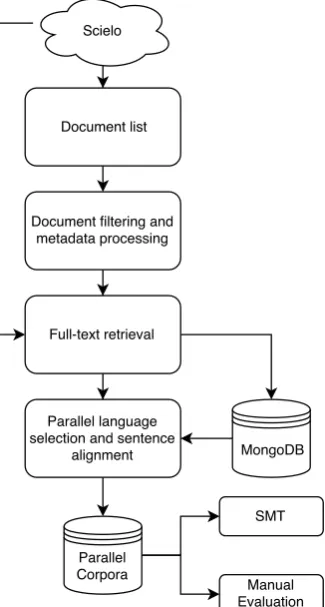
In this section, we detail the information gathered from Sci-elo, the filtering process, as well as our method for article parsing and alignment. An overview of the workflow em-ployed in this article is shown in Figure 1
Figure 1: Steps employed in the development of the parallel corpora.
3.1.
Document retrieval
Scielo’s website1provides unified access to a series of
re-gional databases (such as from Argentina, Brazil, South Africa), offering simple and advanced search capabilities. We iteratively queried the database to retrieve all lists of results, which were then parsed and all relevant contents stored, such as URLs for all available languages of each ar-ticle, authorship, licensing, title, and abstract. We adopted the MongoDB database system, as it is document-oriented, and allows for the easy querying and storage of this type of data.
We queried the results in MongoDB to filter only the ar-ticles meeting the following constraints: a) arar-ticles with full-text available in at least two of three languages of in-terest (i.e. English, Portuguese, and Spanish); and b) type of licensing is non ND terms. The full-text of all articles meeting these two criteria were downloaded from the Sci-elo database in HTML format.
1http://www.scielo.org
3.2.
Document parsing
The HTML contents of all articles were parsed using an in-house Python script tailored to the Scielo format. First, all non-textual elements, such as images, tables, references, citations, and footnotes were removed. Our algorithm was designed to preserve the hierarchical and paragraph struc-ture of the article across the different languages in order to produce results aligned at paragraph and section levels. This could help achieving good sentence level alignment. The main challenges in parsing Scielo HTML contents are heterogeneity issues concerning HTML structure and for-matting over different years. More recent articles are well-formated and contain specific tags for paragraphs, sections, subsections, and titles. We concentrated efforts in develop-ing rules to tackle all ill-formated HTML issues identified, so as to cover as much content as possible, but to reduce the risk of misalignment, we discarded all documents that presented very different structures across the languages. Each parsed full-text translation was stored in MongoDB aiming at preserving the structure of the articles. When our parsing algorithm failed at identifying the document struc-ture, its content was stored as a unstructured list of para-graphs, as we assume that if two translations of the same article present the same number of parsed paragraphs, it is likely they can be simply aligned according to their order.
3.3.
Sentence alignment
Once all articles were parsed, we employed a pre-processing step to ensure a better alignment. We deleted all parentheses from the texts (mainly used for citations), as well as newline/carriage return characters (i.e\nand\r), as they would interfere with the sentence alignment tool. For sentence alignment, we used the LF aligner tool2,
a wrapper around the Hunalign algorithm (Varga et al., 2007), which provides an easy to use and complete solution for sentence alignment, including pre-loaded dictionaries for several languages.
Hunalign uses Gale-Church sentence-length information to first automatically build a dictionary based on this align-ment. Once the dictionary is built, the algorithm realigns the input text in a second iteration, this time combining sentence-length information with the dictionary. When a dictionary is supplied to the algorithm, the first step is skipped. A drawback of Hunalign is that it is not de-signed to handle large corpora (above 10 thousand sen-tences), causing large memory consumption. In these cases, the algorithm cuts the large corpus in smaller manageable chunks, which may affect dictionary building.
For articles with the same structure across the languages, pairs of parallel paragraphs were input to the sentence aligner at a time, aiming at reducing the risk of misalign-ment. For the other cases, all paragraphs were passed to the aligner together. Aligned sentences were stored as text files for post-processing.
After sentence alignment, the following post-processing steps were performed: (i) removal of all non-aligned sen-tences; (ii) removal of all sentences with fewer than three
2https://sourceforge.net/projects/
characters, since they are likely to be noise from ill-formatted HTML; (iii) removal of all sentences written in the same language using a language detector3. This last
step was performed since abstracts in different languages could be present in a full-text HTML, which could produce same-language alignments.
3.4.
Machine translation evaluation
To evaluate the usefulness of our corpus for SMT purposes, we used it to train an automatic translator with Moses (Koehn et al., 2007). The produced translations were eval-uated according to the BLEU score(Papineni et al., 2002), using the evaluation toolmulti-bleuin Moses.
3.5.
Manual evaluation
Although the Hunalign algorithm usually presents a good alignment between sentences, we also conducted a manual validation to evaluate the quality of the aligned sentences. We randomly selected 300 pairs of sentences, 100 for each language pair, and 100 trilingual sentences. If the pair was correctly aligned, we marked it as ”correct”, otherwise, as ”no alignment”.
4.
Results and Discussion
In this section, we present statistics about the corpus and a quality evaluation in terms of SMT and sentence alignment.
4.1.
Corpus statistics
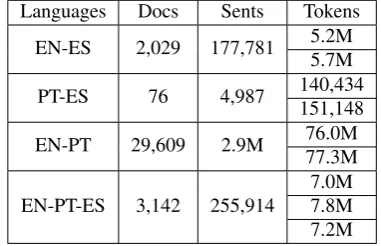
Table 1 shows the overall corpus statistics for all language pairs and for the set of trilingual aligned documents. One may notice that EN-PT documents are predominant over other language pairs. This may be explained by the fact that almost all Brazilian journals are published through Scielo, thus favoring Portuguese-English translations.
The datasets are available4in the TMX format (Rawat et al., 2016), since it is the standard format for translation mem-ories. Besides the aligned sentences, we included the fol-lowing metadata for each document: aligned title, authors, copyright license, DOI (if available), journal name, Scielo’s unique identifier, and subject area. This information was in-cluded either to fully comply with Creative Commons req-uisites, or to provide additional information for other pos-sible applications, such as text classification or clustering. An example of trilingual sentence is shown below:
English: Among its objectives, it aims to defend the interests of society and Nursing in the context of Public Policies and the Unified Health System with emphasis on Mental Health.
Spanish:Entre sus objetivos est´a defender los in-tereses de la sociedad y de la Enfermer´ıa en el contexto de las Pol´ıticas P´ublicas y del Sistema
´
Unico de Salud con ´enfasis en el ´area de la Salud Mental.
3https://github.com/Mimino666/langdetect 4https://figshare.com/s/
091fcaf8ad66a3304e90
Table 1: Corpus statistics for all language pairs and the trilingual set. ”Docs” refers to the number of documents, ”Sents” to the number of aligned sentences, and ”Tokens” is the number of tokens in each language.
Languages Docs Sents Tokens
EN-ES 2,029 177,781 5.2M
5.7M
PT-ES 76 4,987 140,434
151,148
EN-PT 29,609 2.9M 76.0M
77.3M
EN-PT-ES 3,142 255,914
7.0M 7.8M 7.2M
Table 2: BLEU scores for translation using Moses. Previ-ous related work by Neves et al.(2016) is also presented for comparison in the right-hand column.
Language Pairs BLEU
Portuguse:Entre seus objetivos, visa defender os interesses da sociedade e da Enfermagem no con-texto das Pol´ıticas P´ublicas e do Sistema ´Unico de Sa´ude com ˆenfase na ´area de Sa´ude Mental.
4.2.
SMT experiments
Prior to the SMT experiments, all sentences were randomly split in three disjoint datasets for each language pair: train-ing, tuning and test. Approximately 85% of the aligned sen-tences were kept for training, 5% for tuning and 10% for test. The translation models were built following Moses’ baseline system steps5.
Table 2 presents the BLEU scores for each language pair for the test set. We included the best results from related work by Neves et al. (2016) for the sake of comparison. We highlight that their study was focused on titles and abstracts from biomedical articles, while our corpus is focused on full-text content of scientific articles in general.
Our EN-ES models presented considerably higher BLEU scores, despite dealing with several domains. Regarding EN→ES translation, our results are approximately 4.13 percentage points (pp) higher, while about 7.4 pp better for ES→EN. Considering EN-PT, our results are more ex-pressive. BLEU score for EN→PT is 15.48 pp higher, and 17.46 pp for PT→EN.
Another source of comparison is the EuroMatrix project6, which is an European funded initiative to promote
ma-5http://www.statmt.org/moses/?n=moses.
baseline
chine translation research for all pairs of the European Union (EU) languages. When comparing our results to the reported benchmarking BLEU scores available on the project’s website, our results are similar to the reported BLEU scores for the Europarl corpus (scores between 29.4 and 39.4) and overall lower than the ones for the JRC-Acquis corpus (between 55.1 and 60.7). The main differ-ences among these three corpora are domain related, since JRC-Acquis is comprised of EU laws applicable in its state members, Europarl is derived from the EU Parliament pro-ceedings, and our corpus is from scientific articles. Thus, a variation in achieved BLEU scores is expected. As stated by Koehn et al. (2009), JRC-Acquis corpus is of consider-able size within its very specific and well-defined domain of legal text, therefore presenting good translation perfor-mance. On the other hand, Europarl corpus is a transcrip-tion of speeches, thus inducing a greater linguistic variabil-ity.
4.3.
Sentence alignment quality
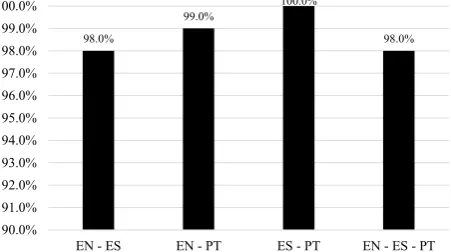
We manually validated the alignment quality for 400 sen-tences randomly sampled from the parsed corpus. Figure 2 depicts the rate of correct alignments for each subset of par-allel languages. All language combinations presented at least 98% of correct alignments, with the language pair ES -PT achieving 100%. Different factors may have contributed to this high alignment quality. The use of Hunalign (Varga et al., 2007) with a dictionary is perhaps the most probable reason, as it combines a dictionary with sentence-length in-formation to boost alignments. The input of articles seg-mented by parallel paragraphs also contributed to quality enhancement, since this can reduce the probability of mis-alignment.
Figure 2: Alignment accuracy for the four language sub-sets.
During alignment validation, some translation incoherences were identified, specially regarding nomenclatures, which may have affected the SMT performance. An example of incorrect scientific nomenclature translation is:
Portuguese:[...]movimentos coreoatetosicos nos membros ipsilaterais ao lado comprometido
which was translated to:
English:[...] and ipsilateral coreoatetosis
while the correct translation would be using ”choreoatheto-sis”:
English:[...] and ipsilateral choreoathetosis.
Another nomenclature translation problem, but related to context, is:
Spanish:[...]estudiantes en el internado de la Es-cuela Superior de Medicina
which was translated to:
English: [...]boarding school students at the School of Medicine
while a better translation would be:
English: [...]medical intern students at the School of Medicine
since boarding schools are mainly associated to primary and secondary education.
5.
Conclusion and Future Work
We developed a parallel corpus of scientific articles in three languages: English, Portuguese and Spanish. Additionally to the language pairs, we provided a subset of trilingual aligned sentences. Our corpus is based on full-text contents from the Scielo database, which is available under open-access licenses, thus favoring distribution.We evaluated our corpus using an SMT experiment with Moses and by manual evaluation of sentence alignment. Our translation experiment presented superior performance regarding BLEU score than a previous related work on Scielo database. We highlight the high translation scores achieved for PT-EN language pairs, boosted by the large number of sentences (almost 3M). Hunalign also presented remarkable alignment quality, with over 98% sentences correctly aligned. Other important features of our corpus are the availability of trilingual sentences, and the addi-tional subset of articles aligned according their hierarchical structures, which can be useful for automatic building of structured abstracts.
Regarding future work, we foresee the use of this corpus in text mining applications, such as classification and cluster-ing. In addition, the corpus could be used in cross-language plagiarism detection, as we provide at least two versions of the same article in multiple languages. New Neural Machine Translation (NMT) systems could be trained to provide a comparison against the tested SMT system. An interesting approach would be use an approach similar to Google’s multilingual NMT (Johnson et al., 2017) to per-form zero-shot translation based on an additional parallel corpus.
6.
Bibliographical References
Johnson, M., Schuster, M., Le, Q. V., Krikun, M., Wu, Y., Chen, Z., Thorat, N., Vi´egas, F., Wattenberg, M., Cor-rado, G., et al. (2017). Google’s multilingual neural ma-chine translation system: Enabling zero-shot translation. Transactions of the Association for Computational Lin-guistics, 5:339–351.
Association for Machine Translation in the Americas, AMTA.
Koehn, P. (2005). Europarl: A parallel corpus for statisti-cal machine translation. InMT summit, volume 5, pages 79–86.
Kors, J. A., Clematide, S., Akhondi, S. A., Van Mulligen, E. M., and Rebholz-Schuhmann, D. (2015). A multilin-gual gold-standard corpus for biomedical concept recog-nition: the mantra gsc. Journal of the American Medical Informatics Association, 22(5):948–956.
Neves, M., Yepes, A. J., and N´ev´eol, A. (2016). The scielo corpus: a parallel corpus of scientific publica-tions for biomedicine. In Nicoletta Calzolari (Confer-ence Chair), et al., editors, Proceedings of the Tenth International Conference on Language Resources and Evaluation (LREC 2016), Paris, France, may. European Language Resources Association (ELRA).
Packer, A. L. (2000). Scielo-a model for cooperative elec-tronic publishing in developing countries. D-Lib Maga-zine, 6(10).
Papineni, K., Roukos, S., Ward, T., and Zhu, W.-J. (2002). Bleu: a method for automatic evaluation of machine translation. InProceedings of the 40th annual meeting on association for computational linguistics, pages 311– 318. Association for Computational Linguistics. Rawat, S., Chandak, M. B., and Chauhan, N., (2016).
An Approach for Efficient Machine Translation Using Translation Memory, pages 285–291. Springer Singa-pore, Singapore.
Skadins, R., Tiedemann, J., Rozis, R., and Deksne, D. (2014). Billions of parallel words for free: Building and
using the eu bookshop corpus. In Proceedings of the Ninth International Conference on Language Resources and Evaluation (LREC 2014), pages 1850–1855. Utiyama, M. and Isahara, H. (2007). A japanese-english
patent parallel corpus. MT summit XI, pages 475–482. Varga, D., Hal´acsy, P., Kornai, A., Nagy, V., N´emeth, L.,
and Tr´on, V. (2007). Parallel corpora for medium den-sity languages.Amsterdam studies in the theory and his-tory of Linguistic Science series 4, 292:247.
Wu, C., Xia, F., Deleger, L., and Solti, I. (2011). Statisti-cal machine translation for biomediStatisti-cal text: are we there yet? InAMIA Annual Symposium Proceedings, volume 2011, page 1290. American Medical Informatics Associ-ation.
Zhang, S., Ling, W., and Dyer, C. (2014). Dual subtitles as parallel corpora.
Ziemski, M., Junczys-Dowmunt, M., and Pouliquen, B. (2016). The united nations parallel corpus v1.0. In Nico-letta Calzolari (Conference Chair), et al., editors, Pro-ceedings of the Tenth International Conference on Lan-guage Resources and Evaluation (LREC 2016), Paris, France, may. European Language Resources Association (ELRA).