M O D E L I N G D I A L O G U E B Y F U N C T I O N A L S U B C A T E G O R I Z A T I O N
J. R. Z u b i z a r r e t a A i z p u r u F a c u l t a d de Inform~itica U . P . V - E . H . U . S a n S e b a s t i a n , S p a i n
E - m a i l : j i p z u a i j @ s i . e h u . e s
Abstract
In this paper we present a dialogue model which has as its main goat to place in context the utterance generated by the speaker. The dialogue model considers that an intervention generates one or more ilocutive acts which are handled as flmctions. These functions subcategorize to or are subcategorized by other functions in the dialogue.
The model uses an exchange schema with the purpose of expressing the different ftmctional subcategorizations. These schemas have properties close to the semantic forms of the verbs in a lexical- functional context.
1 I N T R O D U C T I O N
In task-orientetl dialogues two speakers work in cooperation with the purpose of carrying out a plan. This type of interaction has a start and a development structured by the restrictions of space, thne, transaction object and role of the partieipanls.
A number of researchers [Grosz and Sidner, 86; Litman and Allen, 87; Ramshaw, 91; I.ambert and Carberry, 9211 have suggested that a coherent discourse consists of segments that are related to one another through some type of structuring relation. Our dialogue model tries to capture the goal-oriented nature of discourse, ideutifing the discourse structure by providing the details of a computational mechanism for recognizing the structural relationships.
The model enables the incremental recognition of communicative goals using rewriting rules and functional equations. The grammar constructs the structural tree captnring the dialogical functions of the discourse using functional snbcategorization. The subcategorization process improves on previous approaches [Ferrary et al., 88; Bilage, 91; JOnsson, 911, increasing the expresive power of the traditional dialogue models by modeling the relationships among the communicative actions enabling the task of connecting discottr~.
The different parts of the system have been implemented using a blackboard architecture. The process starts obUfining the f-slructure associated to the intervention making use of a lexical-functional grammar [Abaitua ct al., 9111. In a second phase the f-structure is refined providing the correct explanation, essentially it solves the verbal interpretation and obtains referential
C r a i g J o n e s
D e p a r t m e n t o f C o m p u t e r S c i e n c e U n i v e r s i t y o f A b e r d e e n , S c o t l a n d - U . K ,
information. Then, the planner and/or the dialogue module suu't to work.
In the remainder of this paper, we will present our dialogue model in a top-down manner. Firstly, we show the exchange structure attoptexl and the subcategorization process using two samples. Then, we explain the retroactive and proactive nature of the interaction and we conclude by presenting two kinds of special interventions, the complex ~lll(l compound interventions.
2 E X C I I A N G E S T R U C T U R E
We assign to the constituents of the exchange level initiative and reactive ilocutive functions. These functions qualify ctmstituents which are in the same level of structuration. The initiative functions are assigned to the directriee interventions of the exchange. The reactive functions constitute the generic class of the answers and they try to satisfy the obligations assumed for the interpretation of the initiative functions.
Analyzing the corpus that we dispose we have detected the following initiative functions : Fre q, Fre q- prel l , Freq_aux, Freq_fic, Fqinlbr m, Fqref and Fqi f. Fre q is a function associated with a petition of achievement a physical action. Fqinlbr m inquires inlonnation about the plan in progress. Fqref and Fqi f demand referential and polar information.
The above initiative functions are completed with the lollowing reactive functions : Finformre q, Finform, Fiafref and Finfif.
We assign to the initiative functions, with directrice characteristics, one exchange schema with similar performance to the semantic forms of the verbs in a lexical-functienal context. This exchange schema will tx~ identified from now with the word SCItEMA. An schema specification will exhibit the subcategorizations detected inside an exchange. Therefore, an exchange with au initiative function of type Fqinfor m, inside which a nested exchange has been produced, will have the following schematic representation :
SCHEMA = "Fqinform# < ( 1" Ecomp ) ( T Finform)>"
SCHEMA = "<( [Sugcategorized_by] ) > # F x # <( [Sugcategorizeto] )>"
Just like in a lexical-functional grammar, the initiative function Fqinfor m subcategorizes to the reactive function Finform and to a subexchange identified by Ecomp. This subexchange has, at the same time, a specific initiative function which subeategorizes to the appropriate reactive function and which is subeategorized by the Fqinfor m function. One example of dialogue sequence where this schema could be applied is the following :
$1.- How does it modify the camera's diafragm ? ( F q i n f o r m )
$2.- Do you know where is the key for modifying it ? (Fqif)
$1.- Yes, in the left part of the camera ( F i n f i f +
Finfref)
$2.- Ok, then press the F3 buttom and move the key towards the left (Finform)
In the model which we are going to present both the exchange structure and the intervention structure are going to be definied using rewriting rules. The tree nodes will be enrichied with functional stmcifications just like a lexical- functional grammar. These functional specifications will reference to the initiative and reactive fimctions which are going to appear in the conversation.
The grammar initialy will have the following rules : (1) D --> E 1 ... E i ... E n
(1" EF1)---J, (T E F i ) = ~ (T E F n ) = $ D represents a dialogue, E i the exchange i and EF i the functional specification of the exchange i.
(2) E i -> I l 12 (I 3) (T F x ) = $ (T F y ) = $ Ij represents the intervention j of exchange E i.
Both F x and Fy represent speech acts of the form F(p). That is to say, every node I i will not reflect only the referential and predicative aspect of the interation but also will express the ilocutive force associated to every speech act. A single exchange will be constituted for an initiative intervention and we could suggest nuclear to the exchange, an initiative-reactive intervention and optionaly for a closure reactive intervention of the exchange.
The functions F x and Fy associated with every constituent will be instantiated for some of the initiative and reactive fimctions introduced before.
The rule (2) formulated above handles balancod conversational sequences, that is to my, sequences of the following form :
$1(11).- Please, change the exposure mode.
$2(12).- I changed it already and 1 have left it in PROGRAM.
$1(13_1).- Ok, let us continue, how can 1 change the speed ?
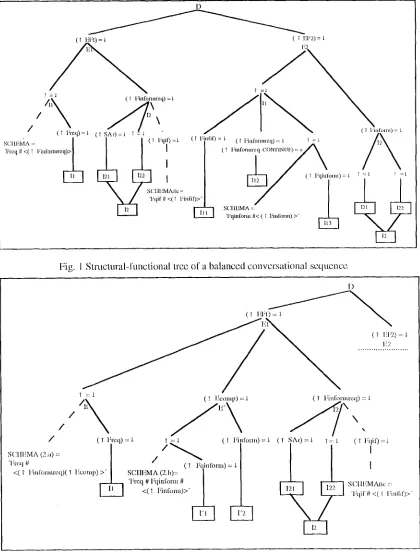
$2(I2).- Press the key XY23 and move the lever. The structural-functional tree which would correspond to this dialogue piece would be the one showed in Fig. 1. Structuraly the dialogue fragment would be constituted by two exchanges which inform about the physical actions performed by the speaker and which are connected with a high level task.
Let us imagine that instead of the previous dialogue piece we produce another one modified a little :
$1(11).- Please, change the exposure mode.
$2(1"1).- Sorry, how do I change it ?
S1(I'2).- Yes, press the buttom MODE and move the lever on the right side.
$2(12).- I changed it already and i have left it in PR 0 GRAM.
$1(13).- Ok, let us continue ...
This second dialogue illustrates a very common phenomena, the speaker departs, momentarily, from the main direction of the conversation, in order to start a secondary exchange which, in most cases, will have a subgoal to be achieved, and then returns to the main axis of the convermtion.
In order to manager these cases we propose a rule like this :
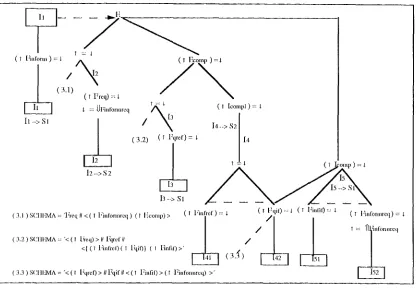
(3) E i --> I 1 E" i 12 t = ~, ( T Ecomp) = .L ( ]" Fy) = .~ Fig. 2 shows the dialogue structure obtained by means of the aplication of the above rule. We associate the schema 2.a to an exchange which has, like initiative intervention, a request function of achievement physical actions. At the .same time, this function subeategorizes to an subordinate exchange - E c o m p - and a reactive intervention.
We emphasize that the subordinate exchange Ecomp has a retroactive nature so that it would not appear at the moment of the initial formulation of the schema.
The schema 2.b is a bit different from the standard notation of a lexical-functional grammar, it specifies an element in the left hand side of the nuclear function. This element will be at the same time the nuclear function of another exchange and reflects the subeategorization that exists between this element and the nuclear constituent of the subordinate exchange.
7"=1
/ " / l ~
Finfo~,req)ir,~~
(ttl"! \ =t
/ ( 1' Freq) = ~ (t
SA)=t
= . . ,~q:req 11 <( T Fiuformre
/
SCIIEMAtic
=
q:qif tf <(TFinfil)>
E
( I EF2)= .[
j l > , . \
( 1" |qtlfoltn) = 1 ( t Finformrcq C J O N ' I ' I N: . , . =
"Fqinform J/< ( I l~inlbnn) >~
Fig. l Structural-functional tree of a balanced conversational sequence
I)
1=,1,
/ ( I Freq) = it,
S C I I F M A (2.;0 =
"Frcq # / ( 1 Fqinform) =
<( T Finlbrmrcq)( 1 Econq)) S C I l E M A (2.13)= [ "l;req # F q i n t \ m n # I
<(I"
Finform)>" ~
[
(I ~
= Il
i
F
l
)
(~ E c o m p ) = l
J . \
1 = 1 ( I F i l l b r m ) = l . ( I
0
( 1 l:inftmnrcq) = l-
Ar)
= 1. I = I
(1 liF2) = 1
1!2
( T Fqif) =~
I
SCI IEIvlAlic
=
q k l i f # < ( I l:infif)>" [image:3.612.91.508.78.342.2] [image:3.612.92.512.82.633.2]3 P R O A C T I V E A N D R E A C T I V E F E A T U R E S I N T H E I N T E R V E N T I O N
An intervention will be composed by a main act that we will designate director act, preceded and/or followed by option,'d subordinate acts. The director act is the speech act that provides the general sense of the intervention, that is to say, its ilocutive force.
In all intervention the interactive functions will be expressed using the proactive or retroactive features that we will associate to the intervention.
The following rules define the structure of an inlervcntiou:
I i --> (X*) I D (X*)
(1" S A ) c = + t = $ (1` SA)c = + X - - > { Ipi , Iri }
(1" S A p ) = $ (T S A r ) = $
The first rule defines file hierarchical relation that exists between the director act (I B) and its subordinate acts coustraiuted by functional equations. The second rule identifies the subordinate act like proactive or retroactive.
3 , 1 C o m p l e x i n t e r v e n t i o n s a n d c o m p o u n d i n t e r v e n t i o n s
In most cases, the reactive and proactive features of the subordinate acts are not related to the director act of the intervention where they appear. In these cases the subordinate act must find ils director act in the dialogue sequeuce, basiealy belore, but sometimes it must wait for the next interventions for its subcategorization.
The presence of this phenomena creates the necessity to extend the original model with the inclusiou of mechanisms which enable to deal with another two new types of interventions: the complex interveutions and the compound interventions.
The complex interventious are constituted of two or more subintcrvcntions with a relation of local domain, that is to say, the subinterventions make reference to the initialive fuuction of the exchange more immediate.
These interventions will have the following formulatiou in the model
E --> I l
(1"
F ~ ) = $ Ix --> Ix 1( 1" l,'xl ) = $
1 X
( 1" lcomp 1) = Ix2 $ Fx2) = $
The schema assigned to the exchange inside of which it is the complex intervention will be the following :
SCIIEMA = "F l # < {( 1" Fxl ) ( q" Fx2) } ( T Freac ) >" F l subcategorizes to 1,'reac using the initiative function (Fx2) of the complex intervention.
The compound interventions are constituted of two or more subinterventions too, between them there is a relation of non local domain. In the cases of ploaclive movement the domain nature will remain defined a posteriori.
The compouml interventions will have the following
folTnulation :
E --> I l Iy
(1' F I ) = $ (i" Icomp ) = $ ly --> Iy l Iy 2
(1" Fy 1 ) = $ ($ F y 2 ) = $
{ ( ~ = g),(1` = ~ ) }
The schema assigned It this exchange will be the following :
SCIIEMA = T l # < ( $ F y t ) > ( 1" 1,'y2)" The function l:y 2 is subcategorizcd by the function 1" l but does not support thematic relations wilh it. These functions will be rcactives and will have non local domain or proactives which produce a thematic rupture with the initiative function F 1.
We illustrate all this with the lollowing dialogue fragment :
S 1.- Now I do not see anything S 2.- Please, press the shooter half way. S 1.- Where is it ?
$2.- Close to the screen, a red buttom do you
see ?
$ 1 . - Yes, yes s y m b o l s a p p e a r but 1 do not understand them.
Ilow we can set in Fig. 3 the stthordinate exchange Ecomp geuerates a complex intervention like a reaction to the nuclear initiative function of the exchange. This complex intervention is composed of two subintervcntions of reactive and initiative nalare . This hlct makes them both appear between curly-braces pointing out that we are treating the same intervention. The presence of the initiative fimction Fqi f generates the schema 3.3 where the initiative function is subcategorizcd by the former initiative lunction (l:qrcf) and subcategorizcs, at the s~une time, to the reactive function (Fiufif) that appear subcategorized in tile former schema. This function represents an expectation generated fl)r Fqi f in 3.2 and an achievement iu 3.3.
( I [:inform ) = 1
~ ( 3 . 1 )
II --> S l
I = 1
( t I:rec0 = t = ~I:infonnreq
£
I2-->$2
T = ~ ( l Icompl)= 1
/ ~
I4--> $2 I
(3.2) ( T Fqref) = t 1,1
(3.1) S('IlI,;MA = "lheq# <( I 1;in[bnnreq) (r licomp) > ( ! l:in ( 3.2 ) SC'III,;MA = "< ( ! li'eq) > tf l~qref #
<l(r Finfrel)( I lqi0} ( I l{nfi0>"
( 3,3 ) S('I1EMA = "< ( t l:qreO > # Fqif g < ( T 17infil) > ( t Finlbnurc~
( I l:qi0 = ,t ( 1" l:infit) = ,t ~: I "* ~ "iJl:hlr~rmre-~ [0f
)
F i g . 3 C o m p l e x a n d c o m p o u n d i n t e r v e n t i o n s
[B ilange, 91 ] Bilange, 1 ~.( 1991). "A Iask independent oral
4 CONCLUSIONS
W e h a v e p r e s e n t e d a d i a l o g u e m o d e l that uses functional subcalcgorizatiou for recognizing Ihc structural r e l a l i o n s h i p s o f the discourse. T h e s u b c a t e g o r i z a t i o n process applies a slruetural s c h e m a to every e x c h a n g e producing a functional definition with properlies close to the semantic forms of tile verbs in a lexical-funetknlal grammar.
The model enables us to handle subordinate exchangcs capluring tile dependencies Ihat exist among the ilocutive f/mctiotls relating tile m a i n function of the exchange to tile initiative function of tile subordinate exchange. Tim complex and c o m p o u n d i n t e r v e n t i o n s m a k e use of tim same m e c h a n i s m of subcalegorizatiou using Ihe proactive and relroaclive features of Ihe interventious.
The parser has b e e n written ill P m l o g with a bottom- up slrategie. The interface between tile blacklx/ard and the differeul K n o w l e d g e BasKs has been i m p l e m e n t e d in C o m m o n l.isp. T h e c o n t r o l m e c h a n i s m uses the scheduling package of Knowledge Craft.
REFERENCES
[Abailua et al., 91] Abaitua, J., Ruiz Anton, J.('.. and Zubizarreta, J.R.(1991). "Un compilador tie l J : ( l y su aplicaci6n al euskara".
Procesamiento del Lenguaje
Natural,
9, p. 177-191.dildogue model".
Proceedings of the Conference of the
European Chapter of the
ACT,, p. 83-88.[Grosz and Sidner, 86] Grosz, B. and Sidner, C.(1986). "Attention, intention and tile structure of discourse".
Computational Linguistics, 12(3),
p. 175-204. [J6nsson, 911 JOnsson, A. ( 1 9 9 1 ) . " A dialogue m a n a g e rusing initiative-response units and distributed control".
Proceedings of the Conference of the European Chapter
of the ACE,
p. 233-238.ll,ambert atld (2arberry, 92l l,mnbert, L. arid Carberry, S.(1992). " M o d e l i n g n e g o l i a t i o n s u b d i a l o g u e s " .
Proceedings of the 30tit Annual Meeting qf the ACL,
p. 193-200.
[I,ilm~m and Allen, 871 l,ilman, I). and Allen, J.(1987). " A plan r e c o g n i t i o n m o d e l fur s u b d i a l o g u e s in conversation".
Cognitive Science, I 1,
p. 163-200. [Manaris and I)ominick, 931 Manaris, B. and l)ominick,W.(1993). "NAL1GI); : a user interface m a n a g e m e n t s y s t e m for the d e v e l o p m e n t of llatural latlguage interi;aces".