An Algorithm for Open Text Semantic Parsing
Lei Shi and Rada Mihalcea
Department of Computer Science University of North Texas [email protected], [email protected]
Abstract
This paper describes an algorithm for open text shal-low semantic parsing. The algorithm relies on a frame dataset (FrameNet) and a semantic network (WordNet), to identify semantic relations between words in open text, as well as shallow semantic fea-tures associated with concepts in the text. Parsing semantic structures allows semantic units and con-stituents to be accessed and processed in a more meaningful way than syntactic parsing, moving the automation of understanding natural language text to a higher level.
1 Introduction
The goal of the semantic parser is to analyze the semantic structure of a natural language sentence. Similar in spirit with the syntactic parser – whose goal is to parse a valid natural language sentence into a parse tree indicating how the sentence can be syntactically decomposed into smaller syntactic constituents – the purpose of the semantic parser is to analyze the structure of sentence meaning. Sen-tence meaning is composed byentitiesand interac-tions between entities, where entities are assigned semanticroles, and can be further modified by other modifiers. The meaning of a sentence is decom-posed into smaller semantic units connected by var-ious semantic relations by the principle of compo-sitionality, and the parser represents the semantic structure – including semantic units as well as se-mantic relations, connecting them into a formal for-mat.
In this paper, we describe the main components of the semantic parser, and illustrate the basic pro-cedures involved in parsing semantically open text. We believe that such structures, reflecting various levels of semantic interpretation of the text, can be used to improve the quality of text processing appli-cations, by taking into account the meaning of text.
The paper is organized as follows. Wefirst de-scribe the semantic structure of English sentences, as the basis for semantic parsing. We then
intro-duce the knowledge bases utilized by the parser, and show how we use this knowledge in the process of semantic parsing. Next, we describe the parsing algorithm and elaborate on each of the three main steps involved in the process of semantic parsing: (1) syntactic and shallow semantic analysis, (2) se-mantic role assignment, and (3) application of de-fault rules. Finally, we illustrate the parsing process with several examples, and show how the semantic parsing algorithm can be integrated into other lan-guage processing systems.
2 Semantic Structure
Semantics is the denotation of a string of symbols, either a sentence or a word. Similar to a syn-tactic parser, which shows how a larger string is formed by smaller strings from a formal point of view, the semantic parser shows how the denotation of a larger string – sentence, is formed by deno-tations of smaller strings – words. Syntactic rela-tions can be described using a set of rules about how a sentence string is formally generated using word strings. Instead, semantic relations between seman-tic constituents depend on our understanding of the world, which is across languages and syntax.
We can model the sentence semantics as describ-ing entities and interactions between entities. Enti-ties can represent physical objects, as well as time, places, or ideas, and are usually formally realized as nouns or noun phrases. Interactions, usually real-ized as verbs, describe relationships or interactions between participating entities. Note that a partic-ipant can also be an interaction, which can be re-garded as an entity nominalized from an interaction. We assign semantic roles to participants, and their semantic relations are identified by the case frame introduced by their interaction. In a sentence, par-ticipants and interactions can be further modified by various modifiers, including descriptive
partic-ular instances such as the pizza I ordered. Other semantic relations can also be identified, such as coreference, complement, and others. Based on the principle of compositionality, the sentence semantic structure is recursive, similar to a tree.
The semantic parser analyzes shallow-level se-mantics, which is derived directly from linguis-tic knowledge, such as rules about semanlinguis-tic role assignment, lexical semantic knowledge, and syntactic-semantic mappings, without taking into account any context or common sense knowledge. The parser can be used as an intermediate semantic processing tool before higher levels of text under-standing.
3 Knowledge Bases for Semantic Parsing One major problem faced by many natural language understanding applications that rely on syntactic analysis of text, is the fact that similar syntactic pat-terns may introduce different semantic interpreta-tions. Likewise, similar meanings can be syntac-tically realized in many different ways. The seman-tic parser attempts to solve this problem, and pro-duces a syntax-independent representation of sen-tence meaning, so that semantic constituents can be accessed and processed in a more meaningful and
flexible way, avoiding the sometimes rigid interpre-tations produced by a syntactic analyzer. For in-stance, the sentences I boil water and water boils contain a similar relation between water and boil, even though they have different syntactic structures. To deal with the large number of cases where the same syntactic relation introduces different seman-tic relations, we need knowledge about how to map syntax to semantics. To this end, we use two main types of knowledge – about words, and about rela-tions between words. The first type of knowledge is drawn from WordNet – a large lexical database with rich information about words and concepts. We refer to this asword-level knowledge. The lat-ter is derived from FrameNet – a resource that con-tains information about different situations, called frames, in which semantic relations are syntacti-cally realized in natural language sentences. We call this sentence-level knowledge. In addition to these two lexical knowledge bases, the parser also utilizes a set of manually defined rules, which en-code mappings from syntactic structures to seman-tic relations, and which are also used to handle those structures not explicitly addressed by FrameNet or WordNet.
In this section, we describe the type of infor-mation extracted from these knowledge bases, and show how this information is encoded in a format
accessible to the semantic parser.
3.1 Frame Identification and Semantic Role
Assignment
FrameNet (Johnson et al., 2002) provides the knowledge needed to identify case frames and se-mantic roles. FrameNet is based on the theory of frame semantics, and defines a sentence level on-tology. In frame semantics, aframecorresponds to an interaction and its participants, both of which denote a scenario, in which participants play some kind of roles. A frame has a name, and we use this name to identify the semantic relation that groups together the semantic roles. In FrameNet, nouns, verbs and adjectives can be used to identify frames. Each annotated sentence in FrameNet
exempli-fies a possible syntactic realization for the seman-tic roles associated with a frame for a given target word. By extracting the syntactic features and cor-responding semantic roles from all annotated sen-tences in the FrameNet corpus, we are able to auto-matically build a large set of rules that encode the possible syntactic realizations of semantic frames.
In our implementation, we use only verbs as target words for frame identification. Currently, FrameNet defines about 1700 verbs attached to 230 different frames. To extend the parser coverage to a larger subset of English verbs, we are using Verb-Net (Kipper et al., 2000), which allows us to handle a significantly larger set of English verbs.
VerbNet is a verb lexicon compatible with Word-Net, but with explicitly stated syntactic and se-mantic information using Levin’s verb classification (Levin, 1993). The fundamental assumption is that the syntactic frames of a verb as an argument-taking element are a direct reflection of the underlying se-mantics. Therefore verbs in the same VerbNet class usually share common FrameNet frames, and have the same syntactic behavior. Hence, rules extracted from FrameNet for a given verb can be easily ex-tended to verbs in the same VerbNet class. To en-sure a correct outcome, we have manually validated the FrameNet-VerbNet mapping, and corrected the few discrepancies that were observed between Verb-Net classes and FrameVerb-Net frames.
3.1.1 Rules Learned from FrameNet
FrameNet data “is meant to be lexicographically rel-evant, not statistically representative” (Johnson et al., 2002), and therefore we are using FrameNet as a starting point to derive rules for a rule-based se-mantic parser.
andphrase type(PT) features.
In addition, other syntactic features are extracted from the sentence context. One such feature is the relative position(RP) to the target word. Sometimes the same syntactic constituent may play different se-mantic roles according to its position with respect to the target word. For instance the sentences: I pay you. andYou pay me. have different roles assigned to the same lexical unit you based on the relative position with respect to the target wordpay.
Another feature is thevoiceof the sentence. Con-sider these examples: I paid Mary 500 dollars. and I was paid by Mary 500 dollars. In these two sen-tences,Ihas the same values for the features GF, PT and RP, but it plays completely different roles in the same frame because of the difference of voice.
If the phrase type is prepositional phrase (PP), we also record the actual preposition that precedes the phrase. Consider these examples:I was paid for my work. and I was paid by Mary. The prepositional phrases in these examples have the same values for the features GF, PT, and RP, but different preposi-tions differentiate the roles they should play.
After we extract all these syntactic features, the semantic role is appended to the rule, which creates a mapping from syntactic features to semantic roles. Feature sets are arranged in a list, the order of which is identical to that in the sentence. The or-der of sets within the list is important, as illustrated by the following example: “I give the boy a ball.” Here, the boy and a ball have the same features as described above, but since the boy occurs be-fore a ball, then the boy plays the role of recipi-ent. Altogether, the rule for a possible realization of a frame exemplified by a tagged sentence is an ordered sequence of syntactic features with their se-mantic roles.
For instance, Table 1 lists the syntactic and se-mantic features extracted from FrameNet for the sentenceI had chased Selden over the moor.
I had chased Selden over the moor
GF Ext obj comp
PT NP Target NP PP
Position before after after Voice active
PP over
Role Theme Goal Path
Table 1: Example sentence with syntactic and se-mantic features
The corresponding formalized rule for this sen-tence is:
[active, [ext,np,before,theme], [obj,np, after,goal], [comp,pp,after,over,path]]
In FrameNet, there are multiple annotated sen-tences for each frame to demonstrate multiple pos-sible syntactic realizations. All pospos-sible realizations of a frame are collected and stored in a list for that frame, which also includes the target word, its syn-tactic category, and the name of the frame. All the frames defined in FrameNet are transformed into this format, so that they can be easily handled by the rule-based semantic parser.
3.2 Word Level Knowledge
WordNet (Miller, 1995) is the resource used to iden-tify shallow semantic features that can be attached to lexical units. For instance, attribute relations, adjective/adverb classifications, and others, are se-mantic features extracted from WordNet and stored together with the words, so that they can be directly used in the parsing process.
All words are uniformly defined, regardless of their class. Features are assigned to each word, cluding syntactic and shallow semantic features, in-dicating the functions played by the word. Syntactic features are used by the feature-augmented syntac-tic analyzer to identify grammasyntac-tical errors and pro-duce syntactic information for semantic role assign-ment. Semantic features encode lexical semantic in-formation extracted from WordNet that is used to determine semantic relations between words in var-ious situations.
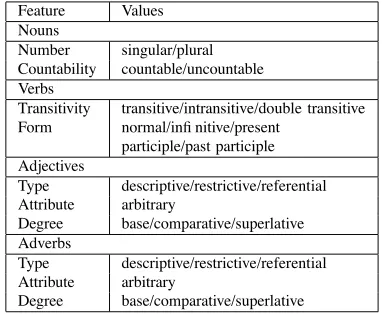
Features can be arbitrarily defined, as long as there are rules to handle them. The features we define encode information about the syntactic category of a word, number and countability for nouns, transitivity and form for verbs, type, degree, and attribute for adjectives and adverbs, and others. Table 2 lists the main features used for content words.
Feature Values Nouns
Number singular/plural Countability countable/uncountable Verbs
Transitivity transitive/intransitive/double transitive Form normal/infinitive/present
participle/past participle Adjectives
Type descriptive/restrictive/referential Attribute arbitrary
Degree base/comparative/superlative Adverbs
Type descriptive/restrictive/referential Attribute arbitrary
Degree base/comparative/superlative
Table 2: Features for content words
lexicon is defined as:
lex(dog,W):- W= [parse:dog, cat:noun, num:singular, count:countable].
Here, the category (cat) is defined as noun, the number (num) is singular, and we also record the countability (count)1.
For adjectives, the value of theattribute feature is also stored, which is provided by theattribute re-lation in WordNet. This rere-lation links a descriptive adjective to the attribute (noun) it modifies, such as slow→speed. For example, for the adjectiveslow, the entry in the lexicon is defined as:
lex(slow,W):- W= [parse:slow, cat:adj,
attr:speed, degree:base, type:descriptive].
Here, the category (cat) is defined as adjective, thetypeis descriptive,degreeis base form. We also record theattrfeature, which is derived from the at-tributerelation in WordNet, and links a descriptive adjective to the attribute (noun) it modifies, such as slow→speed.
We are also exploiting the transitional relations from adverbs to adjectives and to nouns. We noticed that some descriptive adverbs have correspondence to descriptive adjectives, which in turn are linked to nouns by the attribute relation. Using these transi-tional links, we derive relations like:slowly→slow
→speed. A typical descriptive adverb is defined as follows:
lex(slowly,W):- W= [parse:slowly, cat:adv, attr:speed, degree:base, type:descriptive].
In addition to incorporating semantic information from WordNet into the lexicon, this word level on-tology is also used to derive default rules, as dis-cussed later.
3.3 Hand-coded Knowledge
The FrameNet database encodes various syntac-tic realizations only for semansyntac-tic roles within a frame. Syntax-semantics mappings other than se-mantic roles are manually encoded as rules inte-grated in the syntactic-semantic analyzer. The an-alyzer determines the syntactic structure of the sen-tence, and once a particular syntactic constituent is identified, its corresponding mapping rules are immediately applied. The syntactic constituent is
1The value for the feature (countability) is obtained
from word properties stored in the Link parser dictionaries (http://www.link.cs.cmu.edu/link/). The Link dictionaries are also used to derive the lists of words to be stored in the lexi-con. Note however that the Link parser itself is not used in the parsing process.
then translated into its corresponding semantic con-stituent, together with the relevant semantic infor-mation.
Some semantic relations can be directly derived from syntactic patterns. For example, a restrictive relative clause such as “the manthat you see” serves as a referential modifier. An adverbial clause be-ginning with “because” is a modifier describing the “reason” of the interaction. The inflection from “apple” to “apples” adds an attributive modifier of quantityto the entity “apple”.
However, syntactic relations may often introduce semantic ambiguity, with multiple possible interpre-tations. To handle these cases, we encode rules that describe all possible interpretations of any given structure, and then use lexical semantic informa-tion as selecinforma-tional restricinforma-tions for ambiguity reso-lution. For instance, in “a book on Chinese his-tory”,on Chinese history describes the topic of the book and this interpretation can be uniquely deter-mined by noting thathistoryis not a physical object, and thus the interpretation ofon Chinese historyas describing location is semantically anomalous. In-stead, in “a book on the computer”,on the computer may describe a location, but it could also describe the book topic, and hence the correct interpretation of this sentence cannot be determined without ad-ditional context. In such cases, the semantic parser produces all possible interpretations, allowing sys-tems that use the semantic parser’s output to deter-mine the right interpretation that bestfits the appli-cation at hand.
Selectional restrictions – as part of the hand-coded knowledge – are used for both semantic role identification and syntax-semantics translation. These additional rules are needed to supplement the information encoded in FrameNet, since FrameNet only annotates syntactic features, which often times do not provide enough information for identifying correct semantic roles.
Consider for example “I break the window” vs. ”The hammer breaks the window”. According to our semantic parser, the participants in the interac-tion “break” have exactly the same syntactic fea-tures in both sentences, but they play different se-mantic roles (“I” plays theagent role while “ham-mer” plays theinstrument role), since they belong to different ontological categories: “I” refers to a person and “hammer” refers to a tool. This interpre-tation is not possible using only FrameNet informa-tion, and thus wefill the gap by attaching selectional restrictions to the rules extracted from FrameNet.
en-tityE belongs to the ontological category C if the nounEis a child node ofCin the WordNet seman-tic hierarchy of nouns. For example, if we define the ontological category for the role “instrument” as instrumentality, then all hyponyms of instrumental-itycan play this role, while other nouns like “boy”, which are not part of the instrumentality category will be rejected. Selectional restrictions are defined using a Disjunctive Normal Form (DNF) in the fol-lowing format:
[Onto(ID,P),Onto(ID,P),...],[Onto(ID,P),...],...
Here, “Onto” is a noun and ID is its Word-Net sense, which uniquely identifies Onto as a node in the semantic network. “P” can be set to p (positive) or n (negative), denoting if a noun should belong to the given category or not. For example, [person(1,n),object(1,p)],[substance(1,p)] means that the noun should belong to object(sense #1) but not person(sense #1)2, or it should belong
to substance(sense #1). This information is added to the rules derived from FrameNet, and therefore after this step, a complete FrameNet rule entry is:
[Voice,[GF,PT,SelectionalRestriction,Role],...].
4 Semantic Parsing
The general procedure of semantic parsing consists of three main steps3: (1) The syntactic-semantic analyzer analyzes the syntactic structure, and uses hand-coded rules as well as lexical semantic knowl-edge to identify some semantic relations between constituents. It also prepares syntactic features for semantic role assignment in the next step. (2) The role assigner uses rules extracted from FrameNet, and assigns semantic roles for identified partici-pants, based on their syntactic features as produced in thefirst step. (3) For those constituents not exem-plified in FrameNet, we apply default rules to decide their default meaning.
4.1 Feature Augmented Syntactic-Semantic
Analyzer
The analyzer is implemented as a bottom-up chart parsing algorithm based on features. We include rules of syntax-semantics mappings in the unifi ca-tion based formalism. The parser analyzes syntac-tic relations and immediately applies corresponding mapping rules to obtain semantic relations when a
2person(sense #1) is a child node ofobject(sense #1) in WordNet
3The parsing algorithm is implemented as a rule-based
sys-tem using a declarative programming language Prolog.
syntactic relation is identified. Most semantic rela-tions (e.g. various modifiers) are identified in this step, except semantic role annotation and applica-tion of default rules, which are postponed for a later stage. The analyzer generates an intermediate for-mat, where target words and arguments are explic-itly tagged with their syntactic and semantic fea-tures, so that they can be matched against the rules derived from FrameNet. We are using a feature-based analyzer that accomplishes three main tasks:
4.1.1 Check if the sentence is grammatically
correct
The syntactic analyzer is based on a feature aug-mented grammar, and therefore has the capability of detecting if a sentence is grammatically correct (un-like statistical parsers, which attempt to parse any sentence, regardless of their well-formness). The grammar consists of a set of rules defining how con-stituents with different syntactic or semantic fea-tures can unify with each other.
By defining a grammar in this way, using fea-tures, once the right features are selected, the an-alyzer can reject some grammatically incorrect sen-tences such as: I have much apples., You has my car., and some semantically anomalous sentences: The technology is very military.4.
4.1.2 Provide features for semantic role
assignment
Through syntactic-semantic analysis in the first step, sentences are transformed into a format in which target words and syntactic constituents are explicitly tagged with their features. Unlike FrameNet – which may also assign roles to adverbs, we only use the subject, object(s) and prepositional phrases as potential participants in the interaction for semantic role labeling5. The analyzer marks verbs astargetwords for frame identification, iden-tifies constituents for semantic role assignment, and produces features such as GF, PT, Voice, Preposi-tion, as well as ontological categories for each con-stituent, in a format identical to the rules extracted from FrameNet, so that they can be matched with the frame definitions.
The ontological categories of constituents are used to match selectional restrictions, and are au-tomatically derived from the head word of the noun phrase, or the head word of the noun phrase of the prepositional phrase. For other constituents that act like nouns, such as pronouns, infinitive forms, gerunds, or noun clauses, we have manually defined
4Sincemilitaryis not a descriptive adjective, it cannot be modified byveryand predicative use is forbidden.
ontological categories. For example, “book” is the ontological category of the phrase “the interesting book” and “on the book”. “person” is the ontolog-ical category we manually define for the pronoun “he”. We have also defined several special onto-logical categories that are not in WordNet such as any, which can be matched to any selectional re-striction, nonperson, which means everything ex-cept person, and others. Note that this matching procedure also plays the role of a word sense dis-ambiguation tool, by selecting only those categories that match the current frame constituents. After this step, target words and syntactic constituents can be assigned with the corresponding case frame and semantic roles during the second step of semantic parsing.
4.1.3 Identify some semantic relations
Some semantic relations can be identified in this phase. These semantic relations include word level semantic relations, and some semantic relations that have direct syntactic correspondence by using syntax-semantics mapping rules. This phase can also identify the function of the sentence such as assertion,query,yn-query,command etc, based on syntactic patterns of the sentence.
The output of the analyzer is an intermediate for-mat suitable for the semantic parser, which contains syntactic features and identified semantic relations. For example, the output for the sentence“He kicked the old dog.”is:
[assertion,
[[tag, ext, np, person,
[[entity, [he], reference(third)],
[modification(attribute), quantity(single)], [modification(attribute), gender (male)]]], [target, v, kick, active, [kick]],
[modification(attribute), time (past)], [tag, obj, np, dog,
[[modification(reference), reference(the)], [modification(attribute), age(old)], [target, n, dog, [dog]]]]]
]
4.2 Semantic Role Assignment
In the process of semantic role assignment, wefirst start by identifying all possible frames, according to the target word. Next, a matching algorithm is used tofind the most likely match among all rules of these frames, to identify the correct frame (or frames if several are possible), and assign semantic roles.
In a sentence describing an interaction, we select the verb as thetargetword, which triggers the sen-tence level frame and uses the FrameNet rules of that target word for matching. If the verb is not
defined in FrameNet and VerbNet, we use Word-Net synonymy relation to check if any of its syn-onyms is defined in FrameNet or VerbNet. If such synonyms exist, their rules are applied to the tar-get word. This approach is based on the idea in-troduced by Levin that “what enables a speaker to determine the behavior of a verb is its meaning” (Levin, 1993). Synonymous verbs always intro-duce the same semantic frame and usually have the same syntactic behavior. To minimize information in the verb lexicon, non-frequently used verbs usu-ally inherit a subset of the syntactic behavior of their frequently used synonyms. Since VerbNet has defined a framework of syntactic-semantic behav-ior for these frequently used verbs, the behavbehav-ior of other related verbs can be quite accurately predicted by using WordNet synonymy relations. Using this approach, we achieve a coverage of more than 3000 verbal lexical units.
The matching algorithm relies on a scoring scheme to evaluate the similarity between two se-quences of features. The matching starts from the
first constituent of the sentence. It looks through the list of entries in the rule and when a match is found, it moves to the next constituent looking for a new match. A match involves match of syntactic features, as well as match of selectional restrictions. An exact match means that both syntactic features and selectional restrictions are matched, which in-crements the score of matching by 3. We apply selectional restriction by looking up the WordNet noun hierarchies. If the node of the ontological cat-egory is within the areas that the selectional restric-tion describes, this is regarded as a match. When applying selectional restrictions, due to polysemy of the ontological entries, we try all possible senses, starting from the most frequently used sense accord-ing to WordNet, until one sense meets the selec-tional restriction. If the syntactic features match ex-actly, but none of the possible word senses meet the selectional restrictions, this is regarded as a partial match, which increments the score by 2.
identi-fier. Finally, after all constituents have found their match, if there are still remaining entries in the rule, the total score is decreased by 1. This is a penalty paid by partial matches, since additional constituents may indicate different semantic role la-beling, which may change the interpretation of the entire sentence.
A polysemous verb may belong to multiple frames, and a frame pertaining to a given target word may have multiple possible syntactic realiza-tions, exemplified by different sentences in the cor-pus. We try to match the syntactic features in the in-termediate format with all the rules of all the frames available for the target word, and compare their matching scores. The rule with the highest score is selected, and used for semantic role assignment. Through this scoring scheme, the matching algo-rithm tries to maximize the utilization of syntactic and semantic information available in the sentence, to correctly identify case frames and semantic roles.
4.2.1 Walk-Through Example
Assume the following two rules, triggered for the target wordbreak:
1: [active,[ext,np,[[person(1,p)]],agent], [obj,np,[[object(1,p)]],theme],
[comp,pp,with,[[instrumentality(3,p)]], instrument]]
2: [[ext,np,[[instrumentality(3,p)]],instrument], [obj,np,[[person(1,n),object(1,p)]],theme]]
3: [[ext,np,[[person(1,n),object(1,p)]],theme]]
And the sentences:
A:I break the window with a hammer B:The hammer breaks the window C:The window breaks on the wall
The features identified by the analyzer are:
A’:[[ext,np,active,person], [obj,np,active,window], [comp,pp,active,with,hammer]]
B’:[[ext,np,active,hammer], [obj,np,active,window]]
C’:[[ext,np,active,window], [comp,pp,on,wall]]
Using the matching/scoring algorithm, the score for matching A’ to rule 1 is determined as 9 since there are 3 exact matches, and to rule 2 as 5 since there is an exact match for “the window” but a par-tial match for “I”. Hence, the matching algorithm selects rule 1, and the semantic role for “I” isagent. Similarly, when we match B’ to rule 1, we obtain a score of 4, since there is an exact match for “the window”, a partial match for “the hammer”, and
rule 1 has an additional entry for a prepositional phrase, which decrements the score by 1. It makes a larger score of 6 for matching with rule 2. There-fore, for the second case, the role assigned to “the hammer” isinstrument. Rule 3 is not applied to the
first two sentences since they have additional ob-jects; similarly, rule 1 and 2 cannot be applied to sentence C for the same reason. Thefirst constituent in Cfinds an exact match in rule 3 with a total score of 3, and hence “the window” is assigned the correct roletheme. The prepositional phrase “on the wall”, for which no entry for labeling a role is found in rule 3, will be handled by default rules (see Section 4.3). Based on the principle of compositionality, mod-ifiers and constituents assigned semantic roles can describe interactions, so the semantic role assign-ment is performed recursively, until all roles within frames triggered by all target words are assigned.
4.3 Applying Default Rules
We always assign semantic roles to subjects and ob-jects6, but only some prepositional phrases can
in-troduce semantic roles, as defined in the FrameNet case frames. Other prepositional phrases function as modifiers; in order to handle these constituents, and allow for a complete semantic interpretation of the sentence, we have defined a set of default rules that are applied as the last step of the semantic pars-ing process. For example, FrameNet defines a role for the prepositional phrase on him in “I depend on him” but not for on the streetin “I walk on the street”, because it does not play a role, but it is a modifier describing a location. Since the role for the prepositional phrase beginning withonis not
de-fined for the target wordwalkin FrameNet, we ap-ply the default rule that “on something” modifies the locationattribute of the interactionwalk. Note that we include selectional restriction in the default rule since constituents with the same syntactic features such as “on Tuesday” and “on the table” may have obviously different semantic interpretations. An ex-ample of a default rule is shown below, indicating that the interpretation of a prepositional phrase fol-lowed by a time period (where time period is an ontological category from WordNet) is that of time modifier:
DefaultRule([_,pp,_,on,Onto,_],time):-SelectionalRestriction
(Onto,1,
[[time_period(1,p)]])
We have defined around 100 such default rules, which are applied during the last step of the
seman-6Where a subject and object are usually realized by noun
tic parsing process.
5 Parser Output and Evaluation
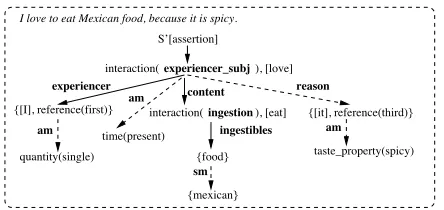
We illustrate here the output of the semantic parser on a natural language sentence, and show the corresponding semantic structure and tree7. For example, for the sentenceI like to eat Mexican food because it is spicy, the semantic parser produces the following encoding of sentence type, frames, se-mantic constituents and roles, and various attributes and modifiers:
T = assertion P =
[[experiencer, [[entity, [i], reference(first)], [modification(attribute), quantity(single)]]], [interaction(experiencer_subj),[love]],
[modification(attribute), time(present)], [content, [
[interaction(ingestion), [eat]], [ingestibles, [entity, [food]]
[[modification(restriction), [mexican]], ]]]],
[reason, [[agent, [[entity, [it], reference(third)],
[modification(attribute), quantity(single)]]], [description,
[modification(attribute), time(present)]], [modification(attribute),
taste_property(spicy)]]] ]
The corresponding parse tree is shown in Figure 1.
ingestion), [eat] interaction(
I love to eat Mexican food, because it is spicy.
{[I], reference(first)}
S’[assertion]
interaction(experiencer_subj), [love]
{[it], reference(third)}
time(present) quantity(single) {food}
{mexican}
taste_property(spicy) ingestibles
experiencer content reason
am am
sm am
Figure 1: Semantic parse tree(am= attributive modifier,
rm= referential modifier,sm= restrictive modifier)
We have conducted evaluations of the semantic role assignment algorithm on 350 sentences ran-domly selected from FrameNet. The test sentences were removed from the FrameNet corpus, and the rules-extraction procedure described earlier in the paper was invoked on this reduced corpus. All test sentences were then semantically parsed, and full semantic annotations were produced for each sen-tence. Notice that the evaluation is conducted only
7The semantic parser was demonstrated in a major Natural
Language Processing conference, and can be also demonstrated during the workshop.
for semantic role assignment – since this is the only information available in FrameNet. The other se-mantic annotations produced by the parser (e.g. at-tribute, gender, countability) are not evaluated at this point, since there are no hand-validated anno-tations of this kind available in current resources.
Both frames and frame elements are automati-cally identified by the parser. Out of all the elements correctly identified, we found that 74.5% were as-signed with the correct role (this is therefore the accuracy of role assignment), which compares fa-vorably with previous results reported in the liter-ature for this task. Notice also that since this is a rule-based approach, the parser does not need large amounts of annotated data, and it works well the same for words for which only one or two sentences are annotated.
6 Interface and Integration to Other Systems
The semantic algorithm uses linguistic knowledge, such as syntactic realization of semantic roles in a case frame, syntax-semantics mappings, and lexical semantic knowledge, to parse the semantic structure of open text. It can be regarded as a shallow se-mantic analyzer, which provides partial results for higher level understanding systems that can effec-tively utilize context, commonsense, and other types of knowledge, to achievefinal accurate meaning in-terpretations, or use custom defined rules for high level processing in particular domains.
rank all of them by their scores as the likelihood of being the correct interpretation. Other systems can use high level knowledge such as common sense, context or user defined rules to choose the right in-terpretation.
As an integral part of the parsing system, we pro-vide several interfaces that allow other systems or additional modules to change the behavior of the parser based on their rules and knowledge. One such interface is the ontochg predicate, which is called whenever the ontological category is
identi-fied for a constituent during the syntactic-semantic analysis. By default, it outputs the same ontolog-ical category as identified by the parser, but other systems can change the content of this predicate to replace the ontological category identified by the parser with other categories, according to their rules and knowledge. This is particularly useful for inte-grating add-ons capable of anaphora and metaphor resolution. Theadjattpredicate is another interface for add-ons that can resolve polysemy of descriptive adjectives and adverbs. Due to polysemy, some de-scriptive adjectives and adverbs may modify differ-ent attributes in differdiffer-ent situations and sometimes the resolution requires high level understanding us-ing commonsense knowledge and context. These interfaces make the semantic parser more flexible, robust, and easier to integrate into other systems that achieve high level meaning processing and under-standing.
7 Related Work
There are several statistical approaches for auto-matic semantic role labeling based on PropBank and FrameNet. (Gildea and Jurafsky, 2000) pro-posed a statistical approach based on FrameNet I data for annotation of semantic roles. Fleischman (Fleischman et al., 2003) used FrameNet annota-tions in a maximum entropy framework. A more
flexible generative model is proposed in (Thomp-son et al., 2003), where null-instantiated roles can be also identified, and frames are not assumed to be known a-priori. These approaches exclusively focus on semantic roles labeling based on statistical meth-ods, rather than analysis of the full structure of sen-tence semantics. However, a rule-based approach is closer to the way humans interpret the semantic structure of a sentence. Moreover, as mentioned earlier, the FrameNet data is not meant to be “sta-tistically representative” (Johnson et al., 2002), but rather illustrative for various language constructs, and therefore a rule-based approach is more suitable for this lexical resource.
8 Conclusions
In this paper, we proposed an algorithm for open text shallow semantic parsing. The algorithm has the capability to analyze the semantic structure of a sentence, and show how the meaning of the en-tire sentence is composed of smaller semantic units, linked by various semantic relations. The parsing process utilizes linguistic knowledge, consisting of rules derived from a frame dataset (FrameNet), a se-mantic network (WordNet), as well as hand-coded rules of syntax-semantics mappings, which encode natural selectional restrictions. Parsing semantic structures allows semantic units and constituents to be accessed and processed in a more meaningful way than syntactic parsing, and enables higher-level text understanding applications. We believe that the semantic parser will prove useful for a range of lan-guage processing applications that require knowl-edge of text meaning, including word sense disam-biguation, information retrieval, question answer-ing, machine translation, and others.
References
M. Fleischman, N. Kwon, and E. Hovy. 2003. Maximum entropy models for FrameNet
classi-fication. In Proceedings of 2003 Conference on Empirical Methods in Natural Language Pro-cessing EMNLP-2003, Sapporo, Japan.
D. Gildea and D. Jurafsky. 2000. Automatic label-ing of semantic roles. InProceedings of the 38th Annual Conference of the Association for Com-putational Linguistics (ACL 2000), pages 512– 520, Hong Kong, October.
C. Johnson, C. Fillmore, M. Petruck, C. Baker, M. Ellsworth, J. Ruppenhofer, and E. Wood.
2002. FrameNet: Theory and Practice.
http://www.icsi.berkeley.edu/ framenet.
K. Kipper, H.T.Dang, and M. Palmer. 2000. Class-based construction of a verb lexicon. In Proceed-ings of Seventeenth National Conference on
Arti-ficial Intelligence AAAI 2000, Austin,TX, July. B. Levin. 1993. English Verb Classes and
Alterna-tion: A Preliminary Investigation. The Univer-sity of Chicago Press.
G. Miller. 1995. Wordnet: A lexical database. Communication of the ACM, 38(11):39–41. C. Thompson, R. Levy, and C. Manning. 2003. A