From a Surface Analysis to a Dependency Structure
Lu´ısa Coheur
L2
F INESC-ID / GRIL Lisboa, Portugal [email protected]
Nuno Mamede
L2
F INESC-ID / IST Lisboa, Portugal [email protected]
Gabriel G. B`es
GRIL / Univ. Blaise-Pascal Clermont-Ferrand, France
Abstract
This paper describes how we use the arrows properties from the 5P Paradigm to generate a dependency structure from a surface analy-sis. Besides the arrows properties, two mod-ules, Algas and Ogre, are presented. Moreover, we show how we express linguistic descriptions away from parsing decisions.
1 Introduction
Following the 5P Paradigm (B`es, 1999; Hag`ege, 2000; B`es and Hag`ege, 2001) we build a syntactic-semantic interface which obtains a graph from the analysis of input text. The graph express a dependency structure, which is the domain of a function that will obtain as out-put a logic semantic interpretation.
The whole syntactic-semantic interface is in-tegrated by four modules: Susana in charge of surface analysis, Algas and Ogre, defining the graph, and ASdeCopas, that obtains the logic semantic representation. In this paper we present the first three modules, focussing mainly on Algas and Ogre.
5P argues for a carefully separation between linguistic descriptions and algorithms. The first ones are expressed by Properties and the last ones by Processes. Futhermore, linguistic mod-elised and formalised descriptions (i.e. Prop-erties, P2 of 5P) are not designed to be the declarative source of algorithms, but rather as a repository of information (Hag`ege and B`es, 2002) that one should be able to re-use (to-tally or partially) in each task. Following and completing this, we assume that the parsing is-sue can be viewed from at least three different points of view: (i) modelised and formalised linguistic observation; (ii) computational effec-tive procedures; (iii) useful computational con-straints. These three aspects of the same issue are distinctly tackled in the proposed syntactic-semantic interface, but they converge in the ob-tention of results.
There are three different kinds of Properties (P2) in 5P: existence, linearity and arrow prop-erties. The first two underly the Susana module (3.1). They express which are the possible mor-phological categories of some expression and the possible order between them. The third ones arrow properties specify arrow pairs, which for-mally are directed arcs of a graph. Arrow prop-erties underly the Algas (3.2) and Ogre (3.3) modules. At the level of Projections (i.e. P3 of 5P) the balanced parentheses structure un-derlying sentences is exploited (2). Computa-tional useful constraints improve Algas perfor-mance (5).
2 Arrow properties
The motivation behind an arrow property is to connect two elements, because the established relation is needed to reach the desired semantic representation (B`es, 1999). Notice that this for-malism can be applied to establish dependencies either between words, chunks or phrases. Nev-ertheless, arrows can be seen as dependencies but, contrary to the main dependency theories, an arrow is not labeled and go from dependents to the head (Hag`ege, 2000).
Let C be the set of category labels available, M the set of chunk labels, P a set of phrase labels and I a set of indexes.
Arrow Property: An arrow property is a tuple (X, n, Z, Y, m, R+, R−) noted by:
Xn →Z Ym, +R+
-R−
where:
• X, Y ∈ M ∪ C (X is said to be the source and Y the target of the arrow);
• Z∈M∪P(the segment labeledZcontains X andY);
• R+, R− are sets of constraints over the
that Z must verify, either positive ones (R+) on symbols which must be attested or negative ones (R−) on symbols which must
not occur);
• n, m∈I.
Both R+, R− impose simple constraints over
the arrows, such as symbols that should or should not occur within Z or linear order re-lations that should be satisfied between its con-stituents. As an example, the following ar-row property says that within an interroga-tive phrase (Pint), an interrogative chunk (IntC) with an interrogative pronoun inside (pint) ar-rows a nominal chunk (NC) on its right (i ≺
k), as long as there is no other nominal chunk between them (i≺j ≺ k).
IntCi({pint}/) →P int NCk -{NCj}
A more complex type of constraint is the “stack” constraint (Coheur, 2004). This con-straint is based on the linguistically motivated work over balanced parentheses of (B`es and Dahl, 2003; B`es et al., 2003). Briefly, the idea behind that work is the following: given a sentence, if we introduce a left parentheses everytime we find a word such as que(that),
se(if), ...) – the introducers – and a right parentheses everytime we find an inflected verbal form1
, at the end of the sentence, the number of left parentheses is equal to the number of right ones, and at any point of it, the number of left ones is equal or greater that the number of right ones (B`es and Dahl, 2003). In (B`es and Dahl, 2003), they use this natural language evidence in order to identify the main phrase, relatives, coordinations, etc. Within our work, we use it to precise arrowing relations. For example, consider the sentence
Quais os hot´eis que tˆem piscina?(Which are the hotels that have a swimming pool?). The surface analysis of this statement results in the following (where VCstands for verbal chunk):
(Quais)IntC (os hot´eis)N C (que)RelC (tˆem)V C (piscina)N C
Typically the NC os hot´eis arrows the main VC, but in this situation, as there is no mainVC we want it to arrow itself. Nevertheless, there is an arrow property saying that anNCcan arrow aVC, which applied to this particular situation
1
See (B`es and Dahl, 2003) for details about how to deal with coordination.
would establish a wrong dependency (Figure 1).
Figure 1: Wrong dependency
Roughly, we use the stack constraint that says that anNCarrows aVCif the stack of introduc-ers and flexioned verbs is empty between them2
: NCi →S VCk
+{stackj = [ ]}
As a result, if we consider again the example
Quais os hot´eis que tˆem piscina, the NC hot´eis
will not arrow the VC tˆem, because the stack constraint is not verified between them (there is only the introducer que).
3 Reaching the dependency structure
3.1 Surface analysis
From existence and linearity properties (P2 of 5P) specifiyng chunks, it can be deduced what categories can or must start a chunk, and which ones can or must be the last one. Drawing on this linguistic information, chunks are detected in a surface analysis made by Susana (Batista and Mamede, 2002). As an example, consider the question Qual a maior praia do Algarve?(Which is the biggest beach in Algarve?). Susana outputs the following surface analysis (where PC stands for preposi-tional chunk):
(Qual)IntC (a maior praia)N C (do
Al-garve)P C (?)P onct
3.2 Algas
Algas is the C++ program responsible for con-necting chunks and the elements inside them, taking as input a structure that contains infor-mation from arrow properties and also informa-tion that can limit the search space (see secinforma-tion 4 from details about this). Additionally, as in-side the majority of the chunks all the elements arrow the last element (the head), the user can declare which are the chunks that verify this property. As a result, no calculus need to be made in order to compute dependencies inside these chunks: all its elements arrow the last one. This possibility is computational very usefull.
2
Continuing with our example, after Algas ex-ecution, we have the output from Figure 2. Both the IntC and the PC chunks arrow the NCand inside them, all the elements arrow the head.
Figure 2: Algas’s output.
Algas is able to skip unalyzable parts of a sentence, but (for the moment) some constraints are made to its output:
(1) There is at most an element arrowing itself, inside each chunk;
(2) Cycles are not allowed;
(3) Arrow crossing is not allowed (projectiv-ity);
(4) An element cannot be the target of an ar-row if it is not the source of any arar-row.
Notice that these constraints are made inside the program. Notice that, in particular the pro-jectivity requirement is not imposed by 5P. We impose it, due to the fact that – for the moment – we are only dealing with written Portuguese, that typically respects this property.
3.3 Ogre
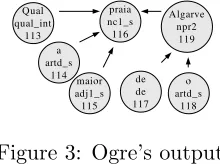
After Algas, the text is processed by Ogre, a pipeline of Perl and XSLT scripts, that gener-ates a graph from the arrowed structures pro-duced by Algas3. This process is based on the following: if a chunk arrows another chunk, the head of the first chunk will arrow the head of the second chunk, and the chunk label can be omitted.
[image:3.595.128.238.647.731.2]Continuing with our example, after Ogre we have the graph of Figure 3 (a dependency struc-ture). Basically, IntC and PC head – respec-tively qual and Algarve – arrow now the NC head.
Figure 3: Ogre’s output.
3
Arrowed structures produced by Algas can also be seen as a graph, having nodes containing graphs.
It might seem that we are keeping away infor-mation in this step, but the new arrowing rela-tion between chunk heads keeps the lost struc-tures. Beside, as information about the direc-tion of the arrows is kept, and the posidirec-tion of each word is also kept in the graph, we are still able to distinguish behaviours dependent on word order for the following semantic task. That is, both semantic relations and word order are kept within our graph.
Ogre’s motivation is to converge different structures into the same graph. For example, after Ogre’s execution O Ritz ´e onde?, E onde´ o Ritz? andOnde ´e o Ritz?, they all share the same graph (appart from positions).
4 From descriptions to the algorithm input structures
In order to keep descriptions apart from pro-cessing, arrow properties and Algas input struc-tures are developed in parallel. Then, arrow properties are formally mapped into Algas in-put structures (see (Coheur, 2004) for details). This decision allowed us to add computational constraints to Algas input structures, leaving descriptions untouchable.
In fact, in order to reduce the search space, Algas has the option of letting the user control the distance between the source and the target of an arrow. This is particularly very usefull to control PP attachments (in this case PC attachments). Thus, if we want a PC to arrow an NC that is at most n positions away, we simply say:
PC→S NC [{NC <n PC}/]
Notice that we could make an extension over the arrow properties formalism in order to al-low this kind of information. Nevertheless, it is well know that in natural language there is no fix distance between two elements. Adding a distance constraint over arrow properties would add procedural information to a repository re-sulting from natural language observations.
5 Applications
Notice that, although arrows are not labeled, the fact that we know its source, target and direction, give us enough information to find (or at least guess) a label for it. In fact, we could add a label to the majority of the ar-rows. For example, using the link-types from the Link Grammar (Sleator and Temperley, 1993; Sleator, 1998), if an adverb connects an adjective, this connection would be labeledEA, if an adverb connects another adverb, the la-bel would be EE. AsdeCopas can be used to add this information to the graph. Neverthe-less, the fact that we are using an unlabelled connection serves languages as Portuguese par-ticularly well. In Portuguese, it is not 100% sure that we are able to identify the subject. For example, we can say “O Tom´as come a sopa.”, “Come a sopa o Tom´as.”, or even “A sopa come o Tom´as.” having all the same (most probable) interpretation: Thomas eats the soup. That is, there is no misleading interpretation due to our knowledge of the world: a man can eat a soup, but a soup cannot eat a man. As so, arrow prop-erties simply establish relations, and we leave to semantic analysis the task of deciding what is the nature of these relations.
6 Conclusions
We presented two modules – Algas and Ogre – that build a dependency graph from a sur-face analysis. Algas uses information from a formalism called arrows properties. Neverthe-less this formalism is independent from Algas input structures, that can be enriched with in-formation that limits the relations to establish. In the future we want the user to be able to control the constraints over Algas output. That is, the user will have the option to chose if out-put may contain arrows crossing or not.
For the moment the Susana-Algas-Ogre mod-ules of the syntactic-semantic interface behave without problems in the domain of question interpretation. They apply successfully to an elicited corpus of questions produced by N por-tuguese speakers which were asked to produce them simulating effective and natural questions. Our next step is to try to use them incremen-tally (A¨ıt-Mokhtar et al., 2002).
Also, another improvement will be over arrow properties, as we want to organise them in a hierarchy.
7 Acknowledgements
This paper was supported by FCT (Funda¸c˜ao para a Ciˆencia e Tecnologia) and by Project POSI/PLP/41319/2001 (FEDER).
References
Salah A¨ıt-Mokhtar, Jean-Pierre Chanod, and Claude Roux. 2002. Robustness beyound shallowness: incremental deep parsing. Nat-ural Language Engineering, pages 121–144. Fernando Batista and Nuno Mamede. 2002.
SuSAna: M´odulo multifuncional da an´alise sint´actica de superf´ıcie. In Julio Gonzalo, Anselmo Pe˜nas, and Antonio Ferr´andez, ed-itors, Proc. Multilingual Information Access and Natural Language Processing Workshop (IBERAMIA 2002), pages 29–37, Sevilla, Spain, November.
Gabriel G. B`es and Veronica Dahl. 2003. Bal-anced parentheses in nl texts: a useful cue in the syntax/semantics interface. In Nacy Workshop on Prospects and Advances in the Syntax/Semantics Interface.
Gabriel G. B`es and Caroline Hag`ege. 2001. Properties in 5P. Technical report, GRIL, Universit´e Blaise-Pascal, Clermont-Ferrand, France, November.
Gabriel G. B`es, Veronica Dahl, Daniel Guil-lot, Lionel Lamadon, Ioana Milutinovici, and Joana Paulo. 2003. A parsing system for bal-anced parentheses in nl texts. InCLIN’2003. Gabriel G. B`es. 1999. La phrase verbal noyau en fran¸cais. In in Recherches sur le fran¸cais parl´e, volume 15, pages 273–358. Universit´e de Provence, France.
Lu´ısa Coheur, Nuno Mamede, and Gabriel G. B´es. 2003. ASdeCopas: a syntactic-semantic interface. InEpia, Beja, Portugal, Dezembro. Springer-Verlag.
Lu´ısa Coheur. 2004. A interface entre a sin-taxe e a semˆantica no quadro das l´ınguas naturais. Ph.D. thesis, Instituto Superior T´ecnico, Universidade T´ecnica de Lisboa, Portugal, Universit´e Blaise-Pascal, France. work in progress.
Caroline Hag`ege and Gabriel G. B`es. 2002. En-coding and reusing linguistic information ex-pressed by linguistic properties. In Proceed-ings of COLING’2002, Taipei.
Daniel Sleator and Davy Temperley. 1993. Parsing english with a link grammar. In Pro-ceedings of the Third International Workshop on Parsing Technologies.